This paper addresses a missing element in Wu et al.’s (2015) ninefold policy capacity framework: the ‘capacity for what’ question. Specifically, it explores the objectives toward which policy capacities are directed, focusing on how government capabilities and competencies can be utilized to either create or destroy public value.
Through a literature review, the paper establishes the connections between public value and policy capacity. An illustrative case of value destruction, specifically, the US Department of Government Efficiency (DOGE) experience during the early second term of the Trump administration, is used to demonstrate how policy capacity can be deployed to dismantle as well as create public value.
The paper finds that outcome achievement, trust, service delivery quality, and efficiency were all negatively impacted by DOGE’s four key activities: de-regulation, workforce reduction, program cuts, and cutting advisory committees. These activities required policy capacities to exist and be deployed in the same way as is done with public value creation.
Public value creation — integrating substantive value, legitimacy, and operational feasibility — provides a valuable framework for reshaping policies, but it can also lead to value destruction. This perspective prompts a critical examination of the objectives behind administrative actions and encourages analysts and commentators to avoid assuming that high government capacity is always advantageous.
Introduction
The question of whether governments have the fundamental capability or ‘capacity’ to design and implement their plans and ambitions has a long history of study in the policy sciences (Honadle, 1981), with lower levels of capacity invariably invoked as a barrier to effective policy-making. This has been a concern since the subject began to receive serious treatment in the classical era of public policy studies in the 1960s and 1970s (Vickers, 1965). Concerns about ‘capacity gaps’, for example, have been a subject of continual interest among both practitioners and scholars of policy topics from healthcare to crisis management (Fukuyama, 2013; Savoia and Sen, 2015).
In some respects, this research agenda has made progress in recent years reconciling and integrating the various aspects of policy capacity uncovered in an earlier era of studies. It has, for example, generated a better understanding of the different kinds of competences and capabilities governments and other organizations enjoy and their impact on facilitating or impeding actual and potential government abilities (Gleeson et al., 2011; Wu et al., 2015).
The most well-cited and comprehensive effort at synthesizing these studies, the framework and taxonomy proposed by Wu, Howlett, and Ramesh in 2015, now serves as the main entry point to this discussion. This framework begins from the premise that ‘capacity’ is a general term that combines both competencies and capabilities, or the various skills and resources governments can theoretically mobilize in any given circumstance.
This article, however, addresses a different, further and often overlooked question in most existing studies: that of the purpose of capacity. In general, the accepted thinking in many fields is that higher levels of capacity are always superior to lower levels, as they better help governments achieve their objectives. But this fails to take into account whether or not the goals towards which capacity is dedicated are laudable, such as delivering effective public health services, or lamentable, such as building cost-effective camps in which to imprison political opponents. That is, some objectives are less worthy than others and having a high capacity to implement or achieve them is not always desirable.
In what follows, an effort is made to deal with this issue by conceptually re-examining capacity thinking and frameworks from the perspective of the creation and destruction of private and public value. Following the lead of Moore’s (1995), we argue that any policy capacity framework, such as the Wu et al. framework, needs to address a range of normative concerns, something towards which the public value scholarship excels.
Continuing to neglect policy capacity’s normative underbelly means future scholarship will continue to be relegated to descriptive exercises and exist in the realm of, at best, a form of technocratic administrative discourse artificially divorced from normative concerns.
Background: the bright-side presuppositions of policy capacity analyses
Almost all policy scholars have defined policy capacity in a positive sense; as a phenomenon positively affecting “the ability of governments to make intelligent choices” (Painter and Pierre, 2005) through its ability to scan the environment and set strategic directions; to weigh and assess the implications of policy alternatives; or more generally, just to “make appropriate use of knowledge in policy-making” (Parsons, 2004).
For example, Painter and Pierre (2005) define policy capacity as: “… the ability to marshal the necessary resources to make intelligent collective choices, in particular to set strategic directions, for the allocation of scarce resources to public ends.” Others retained this relatively narrow focus but added additional skills and resources to this definition, such as those involved in the acquisition and utilization of policy-relevant knowledge, the ability to frame options, the application of both qualitative and quantitative research methods to policy problems, and the effective use of communications, and stakeholder management strategies.
Other scholars, such as Bridgman and Davis (2000), were even more generous, arguing that policy capacity should also include the ability of governments to efficiently implement preferred choices of action as well as to formulate or decide upon them. Holmberg and Rothstein (2012) and Rotberg (2014), for example, also went well beyond policy formulation in emphasizing the systemic and structural preconditions of good governance, such as honesty, rule of law, merit appointments, social trust, and legitimacy, as key components of policy capacity. Still others focused their attention on more meta-levels of governance. Hence Parsons (2004) defined policy capacity as the ‘weaving’ function of modern governments — the ability to join the multiplicity of organizations and interests to form a coherent policy fabric.
These views have had an impact on practice. In a major report which influenced subsequent Canadian federal government organizational reforms, for example, Fellegi (1996) framed high levels of capacity as beneficial and argued that policy capacity should include the nature and quality of the resources available to review, formulate and implement policies, and the practices and procedures by which these resources are mobilized and used.
The Wu et al. (2015) policy capacity framework (Table 1) is a conceptual clarification and synthesis of this literature whereby capacity is seen as a function of three competencies (analytical, managerial, and political) affecting the ability of governments in their relationships with other governance actors, which intersect at three levels of capabilities or resources: the individual, organizational, and systemic. Analytical competencies allow policy alternatives to be effectively generated and investigated; managerial competencies focus on how state resources are effectively brought to bear on policy issues; and political competencies give policy-makers and managers the room to maneuverer and the support required to develop and implement their ideas, programs, and plans (Gleeson et al., 2011; Fukuyama, 2013; Rotberg, 2014).
These competencies exist at three levels. At the individual level, individual policy workers (Wellstead and Stedman, 2010; Colebatch et al., 2011) and managers (Howlett and Walker, 2012) must be able to participate in and contribute to designing, deploying, and evaluating policies. Resources must also be available at the level of the organization, and aspects of the structure and make-up of policy-relevant organizations affect their members’ ability to perform policy functions. Organizational features that unduly circumscribe individual decision capabilities or morale among policy workers, for example, can undermine an agency’s ability to acquire and perform its functions. The organizational conditions most relevant to policy capacity include those related to information, management, and political support (Gleeson et al., 2011). Finally, system level capabilities include the level of support and trust a public agency enjoys from its political masters and from society at large (Woo et al., 2015). Political support from both above and below is vital because agencies and managers must be considered legitimate in order to access resources from their authorizing institutions and constituencies on a continuing basis (Painter and Pierre, 2005).
Capacity for what? Limitations of existing capacity theory
This is a useful framework. However, it says nothing about the validity or desirability of the purposes towards which capacities may be deployed.
More capacity is assumed to improve governments’ ability to make ‘intelligent choices’, scan environments, weigh options, and use knowledge effectively in policy-making. From early work on capacity gaps through to the Wu et al. framework, higher analytical, managerial, and political competencies at individual, organizational, and system levels are almost always normatively coded as desirable.
That is, this orientation obscures the simple but critical question: capacity in aid of what objectives? The same skills and resources that enable high-quality health or education systems can also underpin sophisticated surveillance, repression, or the efficient operation of detention camps. This is the ‘darkside’ of public policy, which refers to the ‘dark’ or less than public interested motives of some of those involved in both policy-making and ‘policy taking’ (Howlett, 2022; Howlett and Leong, 2022). Capacity studies have generally ignored it in favor of analyses which infer good intentions to both policy-makers and governments as a whole (Legrand et al., 2025).
In practice, goals and capacities are tightly coupled; yet mainstream capacity studies bracket off the purposes to which capacities are put, relegating normative concerns to the background and reinforcing a technocratic, ostensibly value-neutral discourse. Addressing the ‘capacity for what?’ question therefore requires reconnecting capacity analysis with the creation and destruction of both private and public value, and engaging more directly with the ‘darkside’ of policy-making where malign intent, manipulation, and anti-public-interest behaviour are central.
Integrating policy capacity and public value management
Public value scholarship provides a ready-made normative lens for answering the ‘capacity for what?’ question. This literature conceptualizes public value as the outcomes citizens desire from government, produced in ways consistent with democratic norms, rights, and expectations, and distinguishes between different types of value (social, environmental, political) as well as between instrumental and prime values. Subsequent syntheses have emphasized outcome achievement, trust and legitimacy, service quality, efficiency, and meaningful stakeholder participation as core dimensions of public value.
This idea of public value as a public administration concept was first introduced in 1995 by Mark Moore in order to better conceptualize how public managers realize collective aspirations when working with various actors to develop public policies and programs (Barzelay, 2019). The concept of ‘public value’ in the sense that it is used here refers to the ‘public value management’ analysis developed by Moore in the effort to improve user value in government activities (Moore, 1995). Subsequent studies examined the concept in the context of multi-actor level and organizational perspectives on public value creation (Bryson et al., 2014; Jørgensen and Bozeman, 2007) as did a broader ‘public values’ scholarship by other authors (Jørgensen and Bozeman, 2007) with its origins in political science. This literature focuses on how public value is defined and how it can be enhanced for broader groups while distinguishing between different value types such as social value, environmental value, or political value (Bovaird and Loeffler, 2012). It provides “a normative consensus about the rights, benefits, and prerogatives to which citizens should (and should not) be entitled; the obligations of citizens to society, the state, and one another; and the principles upon which governments and policies must be based” (Bozeman, 2007, p. 13).
While there are several definitions of public value (Mussari and Ruggiero, 2010), Moore’s original definition, namely, “the outcomes that citizens want from government, achieved in a way that is consistent with their values and expectations”, is still widely used. Underlying these conceptions of public value are deontological ethics, the moral theory inspired by the 18th-century philosopher Immanuel Kant, that focuses on the inherent rightness or wrongness of actions rather than on their consequences. Public managers are expected to be guided by a sense of duty to serve the public interest ‘appropriately’, regardless of consequences, and focus on creating benefits for society and a respect for democratic processes rather than, for example, calculations of risk and returns (Moore, 2014).
Integrating the Wu et al. 3×3 capacity framework with the public value one allows us to recast each cell of the Wu et al. matrix as a potential site of both value creation and value destruction: the same analytical, managerial, and political capacities that can support beneficial outcomes can also be mobilized to erode trust, reduce equity, lower service quality, and undermine democratic accountability. This integrated perspective moves capacity analysis beyond descriptive catalogues of skills and resources and towards a more explicitly normative assessment of how capacity is deployed, and with what implications for public value.
Dealing with the darkside of policy capacity conceptually: the public value framework
The thrust of existing capacity research remains firmly oriented in thinking about policy modeling and analysis as a dispassionate, scientific engagement with policy-making, a process that is assumed, if done right, to deliver on beneficial government goals, and to do so in an efficient way (Durnova and Weible, 2020). Problems with policy designs caused by the ‘darkside’ of policy-making — the uncertainty inherent to real-world political settings, malign intent as well as the endemic recalcitrance of many policy-makers and policy-takers to comply with or promote the public interest and public value in their activities — remain very much unexamined in the literature (LeGrand et al., 2025; Colebatch et al., 2011). One way these subjects can be broached in the capacity literature, however, is by distinguishing carefully between the kinds of value-added activities towards which governing capacities can be devoted. These can both be beneficial – ‘value creation’ – or malign – ‘value destruction’ (Bozeman, 2007) and governments’ competences and capabilities can be oriented toward either, or both.
Following Talbot’s (2011) conceptual review of the public value field, Faulkner and Kaufman (2018) systematic study found that research in the field was focused on concerns about trust and legitimacy, outcome achievement, service delivery quality, and efficiency. Thabit et al. (2024) analyzed 59 peer-reviewed studies to combine Moore’s action-based approach with Bozeman’s more expansive notion of public values. They identify two broad categories of public values: instrumental and prime. The former values are concerned with procedural legitimacy, democratic accountability, and equity and reciprocity, whereas the latter are focused on performance value and problem-solving. They also found that engagement, dialogue, and meaningful stakeholder participation were critical. Table 1 summarizes the state of the public value literature found in these articles.
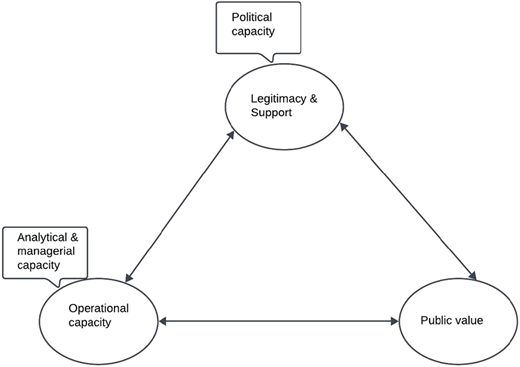
As Table 1 shows, the central to the concept of enhancing public value is the idea that public managers need to meet three tests or specific conditions in an administrative strategy if they are to create public value. They include an output that is “substantively valuable”, “legitimate and politically sustainable”, and “operationally and administratively feasible” (Moore, 1995). The success of a strategy is contingent upon satisfying all three aspects of this well-known public value “strategic triangle” before committing to a determined strategy (Moore, 1995; Moore and Khagram, 2004).
This is quite different from orthodox capacity studies which focus almost entirely on the latter two dimensions (Figure 1). Feasibility has always been central in capacity studies while legitimacy and support have also been recognized as important for ensuring that the strategy or initiative has the backing of key stakeholders, including citizens, political leaders, and other influential groups (Woo et al., 2015).
Thus, there is some overlap with Wu et al.’s more extensive policy capacity framework, but it only describes one leg of the public value stool in detail while touching on a second. It suggests that what is needed is an approach to public value that combines both technical and normative considerations if the question of ‘capacity for what’ is to be successfully addressed.
Integrating policy capacity and public value management: value-creation and value-destruction
The balancing act of each point in the triad is quite complex in real-life management scenarios, as Moore has acknowledged and others have since debated (Moore, 1995). In such an approach, the central public value or value component which answers the question ‘capacity for what?’ is ‘what kind of public value will be created?’. But, more importantly, it is also a question of whether value in these realms is created through the deployment of government resources and skills, or destroyed. That is, capacity can be deployed in many different areas and ways, as Wu et al. (2015) argued, but this can also be done for either benign (‘value creation’) purposes or malign (‘value destruction’) ones. While most work focuses on the former, it is our argument that the latter also deserves attention.
Focusing on value creation and value destruction in the analysis of policy capacity and the purposes towards which it is put, it is argued below, encourages managers and scholars alike to better define the mission, outcomes, or services that ought to benefit the public and helps inform their thinking about what kinds of capacities are needed and appropriate in any given context.
For example, attention has been focused recently on three often neglected aspects of policy-making risk: uncertainties around policy problems, malicious decision-making and the effects of poor public compliance with government intentions (LeGrand et al., 2025). False, biased, incorrect or misleading information can enter into political discussions over time and affect policy deliberations in undesirable ways. And the non-public interested behavior of policy makers can lead them to place private gain or state gains ahead of the public good, again interfering with effective policy-making and often destroying public value in the process.
It is only fairly recently that the literature on policy design has recognized the importance of identifying and accounting for these kinds of darker policy ‘risks’ that jeopardize beneficial value-creating outcomes (Howlett and Legrand, 2022), but this analysis has not been applied to questions around capacity.
This is somewhat surprising since other policy-related literatures, especially those that fall under or overlap with it, such as political science, law, and public administration, have long accepted that the ideal of good government is continually besieged by a range of pathologies and manipulative practices (Goodin, 1980). These works variously include explanations of how badly-construed information can skew government policy, especially where state and governance knowledge bases and capacities are limited; how decision-maker are often motivated by interests other than the creation of public value; and how policy targets — those whose behaviours government attempts to manage — often embark on forms of lawful and unlawful ‘misconduct’, such as fraud, gamesmanship, evasion, deliberate non-compliance, and others, to undermine government intentions (Saward, 1992).
Evidence of such malicious and malign policy behaviour is, for example, embodied in the many forms of corruption, collusion, and clientelism that can affect policy-making. But there has been little investigation of these forms of public value destruction and their capacity requisites (Bozeman, 2007; Esposito and Ricci, 2015; Cui and Osborne, 2023).
The darkside of policy capacity: the Trump administration and DOGE
How the public value framework can help to contextualize the policy environment and the impact of capacity upon it (and vice versa) can be illustrated through an examination of the recent activities of the controversial Department of Government Efficiency (DOGE) created in USA following the re-election of Donald Trump in 2024.
DOGE, a federal initiative, was created via Executive Order 14158 in January 2025 to ‘cut waste and fraud’ in the federal civil service. Initially led by billionaire business executive Elon Musk, this unit within the Executive Office of the President rapidly established itself during the first three months of 2025 undertaking sweeping cuts to federal government agencies and programs. It used individuals with high levels of analytical skills, organizational resources (private and public databases) and political resources (presidential approval and sanction) to dramatically impact the federal civil service.
Specifically, DOGE focused on the following four core activities, all of which involve value destruction. First, it promoted aggressive deregulation often not demanded by regulated groups and companies, specifically mandating that ten existing regulations must be eliminated for every new federal regulation. Although the stated goal of reducing the overall regulatory burden on businesses and individuals was often cited, the chainsaw approach to slashing regulation raised many questions about negative impacts on worker safety and consumer health, among others while the merits and savings produced by de-regulation often proved illusory (Davenport, 2025).
Second, DOGE also set in motion as well-publicized set of federal workforce cuts, including hiring freezes and a “1-for-4 attrition plan” leading to the elimination of 275,240 positions, many of whom were qualified professionals (Challenger, Gray & Christmas, 2025; White House, 2025a). In conjunction, ‘Schedule F’ was reinstated and expanded, reclassifying approximately 50,000 federal employees in policy-related positions as at-will appointees with minimal civil service protections, stripping them of job security and allowing them to be fired at the discretion of agency heads (White House, 2025b). This often resulted in critical personnel being let go, such as those responsible for the safety and storage of nuclear weapons, while estimates of cost savings again proved illusory as many personnel were ultimately hired back either by court order or by the government agencies themselves.
A third significant action by DOGE eliminated of agencies, programs, and facilities, which Musk called a “deep state purge” (Caputo, 2025). Three most notable agencies and programs were targeted for elimination: the Consumer Financial Protection Bureau (CFPB), Department of Education, and USAID, the federal organization responsible for foreign aid (Gangitano, 2025). Across all agencies, field offices were closed and building leases were not renewed (Fahrenthold et al., 2025). In many cases, however, these activities were picked up by other units after some delay and disruption again leading to much value destruction.
Finally, DOGE also began organizing the elimination of advisory committees that provide expert advice and stakeholder input to agencies. This was based on the claim that they were superfluous or biased, and that reducing their number would streamline decision-making (Department of Homeland Security, 2025). However, these cuts eliminated many sources of expertise and advice the federal government had relied upon in research and evaluation such as the National Science Foundation (NSF) advisory committees, NASA Science Advisory Boards, the GSA AI Government Efficiency Committee, and dismissing all 400 experts working on the Sixth National Climate Assessment (Volcovici, 2025). These reductions only allowed for the possibility that streamlined policy processes would be less well-informed and error-prone than in the past.
These activities of DOG are highlighted in Table 3 in the context of value destruction.
As Table 4 shows, DOGE enjoyed high capacity but exercised it for public value destruction rather than its creation, highlighting both the need to be careful to distinguish between the purposes to which capacity can be deployed and the utility of using a public value lens or framework to help assess those purposes.
A strong policy capacity-public value destruction lens approach of this kind can readily be applied to many other current cases including the 2013-2019 childcare benefits (Toeslagenaffaire) scandal in the Netherlands, the 2016-2020 Robodebt scandal in Australia, and the environmental policy and regulation rollbacks under Bolsonaro in Brazil (2019-2022).
Conclusion: re-visiting policy capacity through a public value lens
The policy capacity literature generally fails to consider normative considerations, whereas the more normative public value approach, in particular Moore’s notion of ‘operational capacity’, somewhat under-theorizes the importance of capacity but exhibits strengths in the normative dimension. Integrating the two can help both by distinguishing between capacity types and their usefulness for public value creation/destruction.
Importantly for policy capacity, viewed in this light a public value management perspective on government capabilities and competences “does not seek to confine” values from politics but, with a focus on democratic governance, transparency, and accountability, rather “sees it as central to the management challenge” (Stoker, 2006, p. 47).
This analysis highlights that the original Wu et al. 3x3 policy capacity matrix requires amendment. That is, each cell in the matrix can be seen to have two possible dimensions, not one: possibilities of use for both value creation and destruction. By synthesizing the policy capacity framework with public value management, we propose a more nuanced approach that goes beyond mere technical efficiency. The integrated framework (Table 5) recognizes that governmental capabilities must be evaluated not just by their technical sophistication, but by their alignment with democratic values, public accountability, and genuine service to citizens' needs.
This integration of the public value perspective with policy capacity has several important implications for policy-making and governance. First, it suggests that future capacity-building initiatives need to incorporate explicit ethical considerations. This means not only developing technical skills and resources but also ensuring that these capabilities are directed towards genuinely improving public welfare. It also suggests that policymakers and scholars need to move beyond a purely instrumental view of governmental capabilities. The focus should shift to creating a more holistic framework that balances concerns for effectiveness with deeper questions about the desirability and moral implications of governmental actions. The current approach, which implicitly assumes that higher capacity is always better, should be replaced with a more nuanced understanding that considers the normative direction of governmental capabilities. And it highlights how Moore’s strategic triangle — combining substantive value, legitimacy, and operational feasibility — offers a promising template for reorienting studies of policy capacity towards more meaningful public outcomes.
Fundamentally, the article highlights that policy capacity is not a neutral technical construct but a deeply political and ethical endeavor and should be treated as such. High-capacity states can either serve or undermine public interests, depending on the beliefs, values, and intentions of those wielding administrative power.
The integration of policy capacity and public value management in this way is not merely a theoretical exercise, but represents a crucial step towards more ethical, responsive, and accountable governance. Recognizing the potential for both constructive and destructive uses of state capacity is needed if administrative systems that genuinely serve the public good are to be created and maintained. The DOGE case vividly demonstrates how seemingly neutral bureaucratic processes can be strategically designed to create systemic barriers which perpetuate and otherwise fail to create if not diminish public value.
This paper forms part of Special Section on “Policy Capacity Framework in Implementation Analysis Across Different Contexts in the World”, guest edited by Dr Fabiana C. Saddi, Dr Stephen Peckham and Dr Nagina Khan.