


Although corporate restructuring has the potential to provide performance benefits to firms, it can also bring upheaval and challenges to the restructuring firms’ employees. Further, the frequency of corporate restructuring across the business landscape shows no signs of abating. The purpose of this review paper is to identify and synthesize what is known about the selection, implementation and outcomes of the human resource management (HRM) practices that firms deploy in the context of corporate restructuring, with the additional aim of distilling fertile research areas for scholars and best-practice guidance for practitioners.
This paper is based upon a systematic review of 110 articles published in highly-ranked, peer-reviewed journals from 2003 to 2023.
This review surfaces the predominant ability-, motivation- and opportunity-enhancing HRM practices employed by restructuring firms. It further elucidates the major themes and challenges associated with the use and outcomes of these practices across firms and restructuring settings. The analysis illuminates gaps and opportunities in the literature to suggest future directions for the study of HRM practices and corporate restructuring.
This paper identifies, categorizes and integrates the extant literature on HRM practices and outcomes in corporate restructuring, which is a topic that is salient to both researchers and managers. Papers are classified using the Ability, Motivation and Opportunity framework. An inclusive definition of corporate restructuring, which includes organizational, portfolio, governance and financial restructuring, is applied across two decades of research to provide a comprehensive and holistic assessment.
Introduction
Corporate restructuring is a double-edged sword. Engaging in restructuring can catalyze attractive positive payoffs for firms (Bowman et al., 1999; Kaplan and Stromberg, 2009), yet the substantive organizational changes its implementation requires can be challenging for the employees and managers within them (Cascio and Wynn, 2004; Dlouhy and Casper, 2021; Turnley and Feldman, 1998). Mitigating corporate restructuring’s potentially adverse effects on workers holds undeniable appeal for firms, as employee retention, productivity and commitment are crucial ingredients in restructuring success (Harney et al., 2018). Further, given that the frequency and heft of corporate restructuring are increasing (Financial Times, 2024), taking stock of what is known about the types of human resource management (HRM) practices that are leveraged during restructuring – and whether they work to alleviate the consequent challenges faced by employees – is both timely and valuable.
This review paper aims to respond to this need. As such, this paper investigates what has been – and identifies what needs to be – learned about the HRM tools, policies and processes that firms deploy in conjunction with corporate restructuring. In so doing, this paper aims to (1) distill trends and changes in how HRM practices have been implemented in restructuring over the past two decades, (2) categorize these practices through thematic analysis, (3) synthesize what is known about their use and efficacy, and (4) share informed recommendations for future research directions. It is intended that this review and its findings may serve as a resource for not only scholars but also practitioners, as successfully managing human resource issues in times of corporate restructuring continues to pose vexing challenges for firms.
Given the preponderance of corporate restructuring on firms’ strategic agendas and the centrality of HRM practices to firms’ operations, it is not surprising that these topics have each themselves garnered extensive research attention. Recent review papers on HRM practices have, for example, focused on specific practices (e.g. work-life programs, Akter et al., 2022), the use of HRM practices in particular types of organizations (e.g. professional service firms, Sokolov and Zavyalova, 2022), and the relationship between HRM practices and outcomes (Chadwick and Flinchbaugh, 2021). As for corporate restructuring, current reviews have addressed the drivers of restructuring events (e.g. divestiture, Kolev, 2016) and probed deeply into complex restructuring phenomena (e.g. organizational turnarounds and private equity (PE), McGrath and Nerkar, 2023). Further, extant reviews have addressed the combination of HR issues and corporate strategy implementation, such as cultural integration in acquisitions (Lakshman, 2011) or human integration during the post-acquisition integration process (Dao and Bauer, 2021). This review article aims to complement these works by applying a focused lens on firms’ use of HRM practices across the full spectrum of corporate restructuring actions.
The paper has a four-part design. The first lays the paper’s foundation, addressing corporate restructuring, HRM practices and the salience of their combination. The second focuses on methodology, describing the systematic review process that was used to build the paper’s sample and the Ability, Motivation and Opportunity (AMO) framework (Appelbaum et al., 2000) that was applied in its analysis. The third presents and discusses the paper’s results. This section shares an overview of the state of the literature, followed by an examination and synthesis of the HRM practices studied and the outcomes they influence. The fourth leverages the themes, findings and gaps discerned from the review to suggest future directions for the study of HRM practices and corporate restructuring, as well as managerial implications.
Setting the stage: HRM practices, corporate restructuring and their interplay
HRM practices: HRM practices are the tools, structures, policies and procedures that firms deploy to help manage employee behaviors and outcomes, which, in turn, have ramifications for firm performance (Edgar and Geare, 2005). These practices are frequently associated with employee recruitment, compensation and performance management, training, employee engagement and employment security (Huselid, 1995; Pfeffer, 1998).
A major advancement in the study of HRM practices shifted the conversation from the perspective of individual practices to one of reinforcing, coherent “bundles” of practices (MacDuffie, 1995; Guest, 2002). Since these bundles can have powerful and transformative effects on an organization, this interconnected, system-oriented view also evokes the importance of alignment between the management practices in play and the strategic objectives of the firm. In this regard, HRM practices are not only “HR tools” but also “strategy tools” that impact the execution and realization of the firm’s strategy and performance goals (Huselid, 1995).
A valuable stream of work has investigated how HRM practices (and their bundles) may influence individual-, team- and firm-based outcomes (Combs et al., 2006; Jiang et al., 2012). A takeaway from these works is that a direct relationship between HRM practices and firm performance can be difficult to discern (Wright et al., 2005). Accordingly, this literature has also devoted extensive effort toward identifying the myriad intermediary outcomes – from employee attitudes (Edgar and Geare, 2005) to innovation (Laursen and Foss, 2003) to knowledge transfer (Minbaeva, 2005) – that HRM practices can impact more directly and distilling how those mediators may in turn influence firm outcomes.
Corporate restructuring: While corporate restructuring takes many forms, it always has two core characteristics. First, the changes that corporate restructuring imposes upon the organization are far-reaching and momentous. Second, firms undertake restructuring with the objective of improving their performance.
Corporate restructuring activities are commonly classified into four categories (Bowman et al., 1999; Kaplan and Stromberg, 2009). Portfolio restructuring involves changing the boundaries of the firm and thus the businesses, markets and geographies in which it operates, through such means as acquisitions, divestitures and closures (e.g. Edwards and Edwards, 2015). Organizational restructuring pertains to major internal changes, such as reorganization, via the likes of downsizing, delayering and redesign (e.g. Dlouhy and Casper, 2021). Financial restructuring relates to major changes in the firm’s capital structure, such as when the firm takes on heavy debt in leveraged buyouts (e.g. Lin, 2016). Governance restructuring most directly refers to changes in board control and its practices, but it encompasses the consequent active involvement of the investor-owners in setting firm strategy, instituting organizational structures and processes (such as compensation and incentive plans), and making managerial employment decisions (e.g. Boselie and Koene, 2010).
In practice, firms’ engagement with restructuring often involves multiple activities within a single category – such as divesting to finance an acquisition – and from across the categories, such as a post-acquisition organizational structure redesign (Kolev, 2016; Moschieri, 2011). This connectivity amongst restructuring types makes understanding each even more salient – and answering this need is accordingly reflected in this review’s multi-type examination of corporate restructuring.
The interplay between HRM practices and corporate restructuring: The substantiveness of corporate restructuring translates to similarly significant impacts on employees – and this leads directly to the importance of restructuring’s interplay with HRM practices. To realize corporate restructuring’s hoped-for performance improvements, firms need employees to perform well. However, irrespective of its type, restructuring brings consequences to employees. While the specifics of the sources may differ – be it the taxing demands of working under the severe cost reductions and short-term time horizons of financial restructuring (Clark, 2009), the fear of “being next” amid increased job responsibilities after downsizing (Cascio and Wynn, 2004; McCann et al., 2008), or the difficulties of executing post-acquisition integration amid festering “us versus them” tensions (King et al., 2020) – the negative ramifications of restructuring for employees are material. Yet, in the throes of these challenged circumstances, strong employee performance is essential. HRM practices are vital tools that firms can wield to address this dissonance.
Methodology
This research used a systematic literature review process that was comprehensive and replicable (Tranfield et al., 2003). It began with identifying paper candidates for inclusion in the sample, which was followed by screening and evaluation to develop the final sample. These resultant papers were coded and analyzed. Figure 1 provides an overview of the process. Comprehensive details about this procedure are in Appendix 1 in the online supplement.
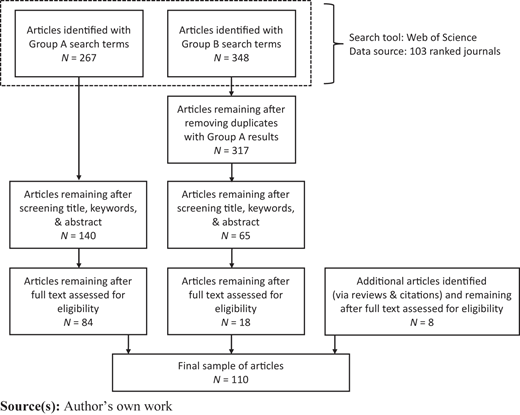
Given that a primary objective of this review is to provide research recommendations for scholars and managerial implications for practitioners, it was critical that the articles studied be high-quality, peer-reviewed works. Thus, by design, this criterion excludes the “grey literature,” which refers to materials that do not undergo the conventional academic peer-review process, such as consulting firm white papers, company publications, news articles and blog posts (Adams et al., 2017). Moreover, since the combined topics of HRM practices and corporate restructuring cross disciplinary boundaries, including a diversity of academic perspectives in the search was necessary. Accordingly, three sources were used to identify appropriate journals: the Financial Times “top 50” journal list, the Australian Business Deans Council journal list, and the Academic Journal Guide from the Chartered Association of Business Schools. Overall, 103 journals were identified.
These journals were searched using Web of Science and its “topic search” capability, which checks article titles, keywords and abstracts. Papers published from 2003 to 2023 were included, in keeping with this review’s aim to examine trends and findings that have emerged over the past two decades. The search terms used in the queries are provided in Table S1, Appendix 1. One set of search terms pertains to corporate restructuring, another captures high-level HRM practices, and the third includes terms that characterize specific HRM practices. Applying these search terms identified 584 papers for initial screening (Figure 1).
To pass the screening process, each article had to address corporate restructuring and HRM practices. Papers focused on early-stage private capital and entrepreneurial spinouts were excluded. 205 papers remained after this screening.
In the second evaluation round, the full text of each article was manually assessed for eligibility. The same inclusion criteria were applied but with additional stringency. Here, papers were further required to either (1) address at least one specific HRM practice or (2) examine the relationship between an aggregated “HRM practices” variable and its outcome in the restructuring context. As a last step, additional paper candidates identified through citations and readings of the review papers were assessed using the stringent inclusion criteria, revealing another 8 eligible papers. In all, there are 110 papers in the final sample representing 32 journals. Articles in the final sample are listed in Appendix 2.
The articles in the final sample were next examined for evidence pertaining to HRM practices and their outcomes in the restructuring context. The AMO model was used to help structure the coding and categorization process for the HRM practices data. This framework enjoys wide application – indeed, it is one of the “dominant” theories in HRM research (Boselie et al., 2005) and the “most well-accepted framework for understanding HRM practices” (Paauwe et al., 2013, p. 5). Its prominence in the HRM literature is due to its flexibility (suitable across different industry, cultural and strategic contexts), comprehensiveness (together, the ability-, motivation- and opportunity-enhancing practice dimensions reflect key performance drivers), clarity (encouraging its use by scholars and practitioners) and empirical support for its validity and efficacy (Bos-Nehles et al., 2023).
The heart of AMO theory lies in the concept that certain HRM practices can foster and advance employees’ abilities, motivations, and opportunities to participate (Appelbaum et al., 2000). This can catalyze employees’ positive discretionary effort – or, stated more colloquially, their willingness to “go the extra mile” – which, in turn, can improve employee and firm performance (Jiang et al., 2012). The AMO model is particularly well-suited to evaluate HRM practices used in the context of corporate restructuring, since times of restructuring are often characterized by resource constraints in the face of multiplying employee demands (Brueller et al., 2018). Firms may well depend upon their employees’ positive discretionary effort to successfully navigate the restructuring situation and its aftermath.
This is not to say that other frameworks could not serve as useful alternatives. For example, articles could be coded according to a universalist “best practice” model, such as Pfeffer’s (1998) seven practices approach, which is anchored in the idea that implementation of certain HRM practices will consistently lead to performance improvements (Kaufman and Miller, 2011). As another example, frameworks grounded in the stakeholder view (Freeman, 1984), such as the balanced scorecard (Kaplan and Norton, 1996), could be used to categorize the data and structure the analysis using the perspectives of primary stakeholders (e.g. employees, customers and investors) as the organizing dimensions (Boselie et al., 2005). However, the tight fit between the objectives of this review and the features of the AMO model, along with the positive consensus around its application in the HRM literature, serves to make the AMO framework the strongest candidate for use in this article.
The HRM practices addressed in each paper were coded and categorized according to the AMO model. Results from the coding and analysis are presented next.
Results and discussion
State of the literature
This section provides sample characteristics and initial insights into firms’ use of HRM practices in corporate restructuring. Figure 2 graphs the number of articles (110 overall) by year and restructuring type. In terms of temporal trends, there is a peak in 2012 (10 papers) followed by a cluster of high-level years until 2016. This peak may reflect researcher attention to the rise of restructuring that occurred following the 2008 global financial crisis. Regarding the corporate restructuring types, organizational is the most frequent (53% of the total), followed by portfolio (29%), and “financial and governance” (18%). The strong prevalence of each type reinforces the importance of taking an expansive view of corporate restructuring when studying HRM practices. Moreover, since portfolio and “financial and governance” restructuring may be of particular salience to finance and strategy scholars, this underscores the validity of engaging in a multidisciplinary journal search when identifying candidates for the sample.
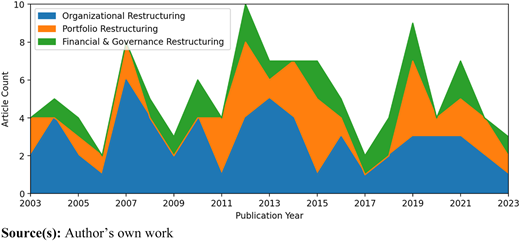
Number of articles published by year and classified by corporate restructuring type
Number of articles published by year and classified by corporate restructuring type
The articles reflect a diversity of geographic settings (Figure 3). This is relevant to the study of HRM practices, as firms’ abilities to deploy certain practices may be facilitated or constrained by different institutional and cultural contexts (Edwards and Edwards, 2015; Genin et al., 2021). The consistency of portfolio restructuring across locations illustrates the global nature of this phenomenon. The strong showing of the financial and governance restructuring category in the UK and US is driven by PE, whereas it reflects privatizations in China (Xing and Liu, 2016). Several articles that represented more than one geographic context examined the transferability of HRM practices from the headquarters or acquiring country to the target or subsidiary (Geary and Hunek, 2019).
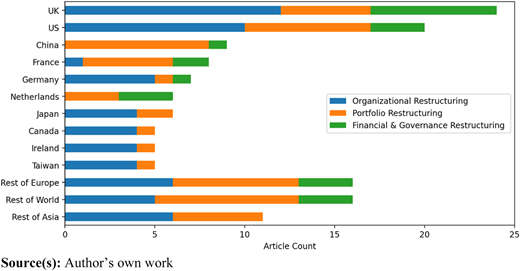
Number of articles by research sample geographic location and classified by corporate restructuring type
Number of articles by research sample geographic location and classified by corporate restructuring type
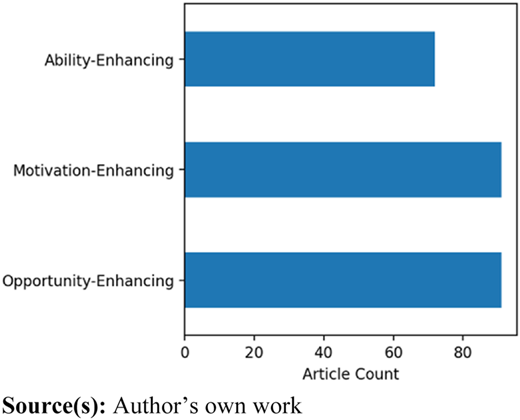
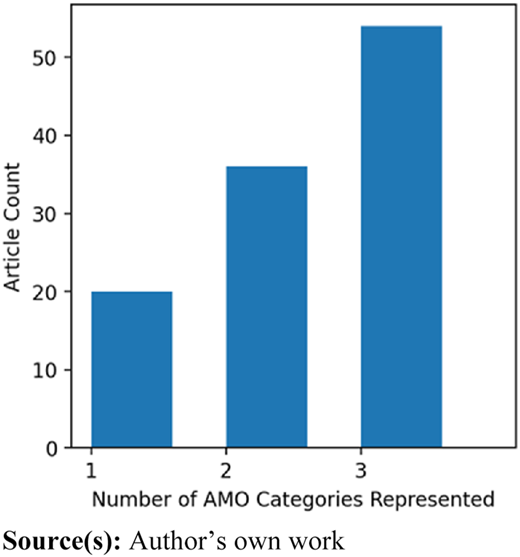
Turning to the HRM practices themselves, Figure 4 illustrates that all three AMO categories are well-represented across the studies, with the motivation- and opportunity-enhancing practices categories equally represented (91 papers each) and the ability-enhancing practices category close behind (72 papers). To be clear, these data represent any time at least one practice was coded in a paper for the particular category. Complementing this view, Figure 5 shows how frequently one, two or all three AMO categories were studied within a single paper. Only one AMO category was addressed in 20 papers, two of the three AMO categories were represented in 38 papers, and all three categories were represented in 52 papers. The high extent to which papers address more than one AMO category may be an indicator of firms’ leveraging HRM practice bundles during their restructuring efforts (MacDuffie, 1995; Jiang et al., 2012).
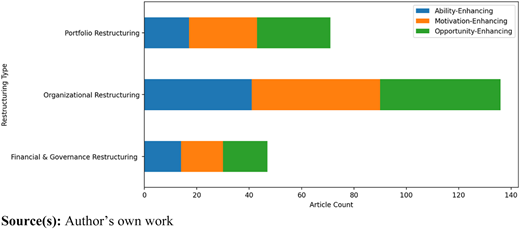
The interplay between the types of HRM practices employed and the restructuring context is illustrated in Figure 6. A key insight is that all three AMO HRM practice types are represented across the restructuring categories, approximately one-third each, on a within-restructuring category basis. This shared pattern suggests that the restructuring types have strong commonalities when it comes to the variety of practices that firms use during their execution. Indeed, while the specifics of the restructuring contexts may be different, the needs and objectives pertaining to the employees during restructuring appear to have some degree of similarity – irrespective of whether it is portfolio, organizational or financial restructuring. This also implies that each AMO type has some level of effect (or, at least, firms’ belief of an effect) in each restructuring context, since none of the restructuring settings over- or under-emphasize a particular AMO dimension.
Next, findings corresponding to the HRM practices deployed in the restructuring setting are shared according to each category within the AMO model. Specific ability-, motivation- and opportunity-enhancing practices identified in the review are provided in Tables S2, S3 and S4 of Appendix 3, respectively.
Ability-enhancing HRM practices in corporate restructuring: insights and trends
Practices in this category pertain to employees’ knowledge, skills and capabilities (Jiang et al., 2012). Accordingly, ability-enhancing processes and tools can shape the profile of employees entering (or leaving) the organization (such as those affiliated with recruitment and selection), affect the type, level, and extent of employees’ skillsets and capabilities (as with training and development), and help identify employees’ strengths and weaknesses (such as with performance evaluations) (Bos-Nehles et al., 2017; Brueller et al., 2018). (See Table S2).
HRM practices addressing employee recruitment and selection that were identified in the literature often pertained to managing the complexities of firms entering a new country – especially an emerging market – in the restructuring process. As such, practices included emphasizing international expertise and shared language skills in employees (Cooke et al., 2015; Reiche et al., 2015) to facilitate rapid performance gains in the new business unit. Other practices used to help expedite this process included staffing the new organization with expats (Reiche et al., 2015) and hiring employees from related fields (Srinivasan and Chandwani, 2014). Staffing procedures also reflected the cost-cutting objectives of restructuring actions, such as in the use of fixed-term and temporary workers (Stevenot et al., 2018), although increases in contract staff were not uniformly the case (Bacon et al., 2019; Johnstone, 2023).
Practices relating to training and development strongly tracked to the restructuring context. In the aftermath of merger and acquisition (M&A) restructuring activities, for example, firms provide the newly acquired employees with company- and culture-oriented training to expedite alignment with the new values, approaches and expectations of the acquirer (Xing and Liu, 2016). Such “indoctrination” or “alignment” training is also leveraged by firms that are shifting the company’s strategy, irrespective of restructuring type (Vakola et al., 2007). Similarly, there were several examples of firms providing “employability training,” retraining, and developmental resources to assist workers impacted by restructuring actions like layoffs and plant closures (Alewell and Hauff, 2013; Wigblad et al., 2012; Chadwick et al., 2004).
Performance evaluation-related practices included the institution of clear operations-oriented targets (such as “stretch” production targets, Boselie and Koene, 2010) as well as the introduction of competency- and behavior-based goals (Cooke and Huang, 2011). For the latter, Martin and Gollan’s (2012) study of a European bank’s restructuring illustrated how behavior-based goals were implemented to ensure that performance was “not just about what you’ve delivered but how you’ve delivered it” (p. 3310). The inclusion of more recent innovative appraisal procedures, such as self- and 360-evaluations, was received with discomfort and trepidation by some employees (Geary and Hunek, 2019).
Motivation-enhancing HRM practices in corporate restructuring: insights and trends
Motivation-enhancing practices focus on fostering employees’ initiative, effort and drive to perform (Jiang et al., 2012). These practices can encompass such issues as promotion and recognition, compensation and rewards, employee wellness and care, and workplace climate and inclusivity (Chang et al., 2012; Brueller et al., 2018). (See Table S3).
In the HRM practice areas of compensation and promotion, a shared theme that emerged concerned employees’ struggles to accept new approaches in compensation structures and promotion procedures that were being instituted as part of restructuring efforts. There were striking examples of restructuring firms in Japan (and Asia more broadly) that were encouraging a move from tenure-based compensation schemes to performance-based compensation schemes (Gill, 2012). This mirrored the shift from the old style managerial-driven perspective to a shareholder-driven view that was diffusing throughout a “modernizing” Japan (Hassard et al., 2012). Likewise, promotion criteria were transitioning from seniority-based to merit-based (and, furthermore, the institutionalized “job-for-life” was under threat) in restructuring firms (Gill, 2012; Morris et al., 2021). Interestingly, even with these burgeoning changes, Olcott and Oliver (2014) showed that it was ownership change (to foreign firms) through M&A restructuring that was the necessary catalyst to open promotion paths to women, whose career progression had heretofore been stymied by social norms and firm-imposed constraints.
Practices pertaining to pay, benefits, leave and working hours clearly reflected the cost-cutting objectives that are commonly found across restructuring types. HRM practices such as pay freezes, mandatory leave, early retirement, cuts in fringe benefits and loss of social events were identified as being part of the cost-reduction formula (Lai et al., 2016; Boselie and Koene, 2010). Some papers surfaced a pattern of firms (not the majority) taking advantage of the restructuring action to significantly alter their employment systems to their employees’ detriment (Roche and Teague, 2014). Cook et al. (2016) evidence how a British retailer exploited the recessionary environment to institute hardline HRM practices (onerous shift schedules, job enlargement amid staff reductions and marked increases in productivity targets) that would not have been otherwise tolerated had the employees not been constrained from changing employers in the loose labor market.
On the flip side, several motivation-enhancing practices reflected sensitivity to employee well-being during the restructuring. Improvements in working conditions (Cohn et al., 2021; Cooke et al., 2015), social support from supervisors (Som, 2003; Dlouhy and Casper, 2021) and efforts to preserve employee dignity during job loss (Chadwick et al., 2004; Iverson and Zatzick, 2011) were identified in the literature.
Opportunity-enhancing HRM practices in corporate restructuring: insights and trends
Opportunity-enhancing HRM practices provide employees with opportunities to participate in creating work environments that enable and enrich their work and performance (Jiang et al., 2012). As such, HRM practices in this AMO dimension address such participative-enabling issues as job design, employee involvement, communication and knowledge sharing, and union relations (Chang et al., 2012; Sokolov and Zavyalova, 2022). (See Table S4).
HRM practices associated with job design and the firm’s approach to work emphasized flexibility and agility, which are crucial for firms that are navigating restructuring. These included flexible job descriptions and designs (Zatzick and Iverson, 2006; Bacon et al., 2012), as well as an increase in cross-functional teams and team working (Garaudel et al., 2008; Gill, 2012; Bruining et al., 2005).
Studies that examined opportunity-enhancing practices for employee involvement considered the extent to which employees were involved in decision-making processes on issues that would affect them, including those that addressed how they work, at what level should performance targets be set, and occupational health and safety (Hoque et al., 2023; Iverson and Zatzick, 2011; Minbaeva and Muratbekova-Touron, 2011). Union-related practices were also used to help ensure that employees’ views were heard and included in key decisions with management, such as through employee involvement in joint labor-management committees (Johnson and Watt, 2022).
This attention to employee engagement and consultation was also reflected in HRM practices pertaining to communication and knowledge-sharing. Here, there was an emphasis on the degree to which employees were informed or consulted about the restructuring and its execution. This included whether employees were given advance notice about the restructuring action (Wigblad et al., 2012), whether they were provided with information about the strategy and rationale for the restructuring (Tanure and Gonzalez-Duarte, 2007; Gomes et al., 2012), and whether employees were given tactical logistics information about its implementation (Clibborn, 2019). Moreover, a stream of work in the knowledge-sharing area examined the transfer and adaptation of HRM practices. This has heightened relevance in the restructuring setting, since knowledge and capability transference between corporate and its subsidiaries, between the acquirer and the target, or between the PE firm and its portfolio companies are often necessary ingredients in realizing restructuring’s potential value (Srinivasan and Chandwani, 2014; Geary and Hunek, 2019).
Outcomes of HRM practices in corporate restructuring
Four categories of outcomes pertaining to HRM practices in corporate restructuring were discerned from the literature: financial, operational, restructuring-oriented and HR-oriented. Table S5 ( Appendix 3) lists these outcomes. Financial outcomes capture the firm’s financial performance and include profitability (Bloom et al., 2012; Kim and Ployhart, 2014; Chew and Sharma, 2005), firm growth (Poon and Waring, 2010), accounting-based measures (e.g. cash flow, Clark, 2009) and market-based measures (e.g. Tobin’s q, Bloom et al., 2012). Operational outcomes track the functioning of the businesses and the effectiveness of their management. These include productivity (e.g. total factor productivity and sales per employee, Bai et al., 2022; Iverson and Zatzick, 2011), product quality (Thibodeau et al., 2007), technological innovation (Genin et al., 2021) and workplace safety (Cohn et al., 2021). Corporate restructuring-oriented measures are geared to outcomes associated with the restructuring action, such as integration speed (Cooke and Huang, 2011) and deal value creation (Babenko et al., 2021). HR-oriented outcomes pertain to human resources and employees, including the extent of HRM practice adoption (Bacon et al., 2012), absenteeism (Wood et al., 2020), employee commitment (Marques et al., 2014) and turnover intention (Lee et al., 2013). Notably, numerous outcomes, particularly in the HR-oriented dimension, are measured at the employee level, which thereby helps to fill a gap that has been identified in the HRM literature (Guest, 2002).
As expected from previous work, discerning clear-cut relationships between individual HRM practices examined in the sample and firm performance is difficult (Wright et al., 2005). Facilitated by meta-analyses in the broader (non-restructuring-focused) HRM literature, progress has been made in deciphering how HRM practices affect intermediary organizational outcomes (Jiang et al., 2012) and how HRM practice bundles impact performance (Combs et al., 2006). However, assessing HRM practices’ efficacy across papers in the restructuring context poses specific challenges. Notably, interpretation of what constitutes “good” or “bad” outcomes remains in the eye of the beholder. Several articles evidenced that firms intentionally make tradeoffs between HR-related outcomes and financial outcomes. To wit, Babenko et al. (2021) evidenced that the costs of adversely modifying employee compensation plan structure (e.g. canceling employee options in an M&A event) were superseded by the firm’s financial gains associated with that employee-harming practice. Likewise, Poon and Waring (2010), in their study of the restructuring and turnaround of AirAsia, illustrate how the firm, in keeping with its strategy of extreme cost-minimization that propelled the airline to financial success, routinely used employee-impairing HRM practices (e.g. not informing employees of their rights, illegal overtime requirements and absence of a formalized conflict resolution policy). While AirAsia might have touted these as “best practices,” its employees undoubtedly would have considered them to be “worst practices.” This echoes the controversy associated with PE. While some research documents neutral or even improved use of employee-friendly practices in leveraged buyouts (Bacon et al., 2019; Bruining et al., 2005), other research finds the opposite (Clark, 2009; Stevenot et al., 2018).
Another theme that emerged was the importance of differentiating between employee groups when examining the impact of HRM practices in restructuring. For example, Antoni et al. (2019) evidence that older workers experience notably worse employment and earnings results than the average worker after PE buyout (which represents a collective bundle of HRM practices). In another illustration, Morris et al. (2021), differentiating amongst senior, middle and junior managers, find significant differences between their experiences. Further, Agrawal and Tambe (2016) differentiated by employees’ skills and find workers with IT capabilities experienced more positive employment and wage outcomes in PE-driven restructuring than others.
Future research directions
Four areas for future research on HRM practices in corporate restructuring, derived from the review, are recommended below.
Responsible restructuring: While the review revealed that there has been consistent, keen attention to the HRM practice of downsizing over the past twenty years, it also surfaced a recent stream of work that examines the complementary practice of “compassionate” or “responsible” downsizing and the HRM practices it employs (Johnson and Watt, 2022; Tsai and Shih, 2013). Drawing upon ideas and theories that were born out of an earlier era of extensive restructuring (Cascio, 2005), these studies evidence that some firms adopt an employee-sensitive approach to downsizing implementation, which can involve such practices as reskilling, funding educational opportunities, severance, and open communication about the layoff and its timing (Johnson and Watt, 2022; Teague and Roche, 2014). Responsible restructuring can also include practices of management-employee engagement and consultation to brainstorm options to soften (or even avoid) the layoff (Cascio and Wynn, 2004; Johnstone and Wilkinson, 2018). Further, the review showed that this compassionate approach has expanded to encompass “responsible restructuring” more broadly, beyond the initial emphasis on downsizing (Cascio, 2005).
This is a promising trajectory for future research. One avenue of potential study concerns responsible restructuring’s “ripple effects.” The employee-sensitive HRM practices that are deployed with responsible restructuring have impacts that reverberate well beyond the redundant employees. Internal stakeholders include the “surviving” employees; external stakeholders include firms that hire displaced workers and public service organizations that help with reskilling and social support. This research area encourages taking a wide view of the stakeholders impacted, directly and indirectly, by restructuring HRM practices. Such investigations could offer tangible insights toward resolving the ongoing tensions between HRM requirements under a shareholder-driven capitalist perspective versus a managerial-driven (or stakeholder-driven) perspective (Morris et al., 2008; Cook et al., 2016).
“Practicing” for restructuring readiness: This review is anchored in examining the use of HRM practices in corporate restructuring. Yet, a persistent theme throughout this literature directs study not to the during-restructuring period but, instead, to the pre-restructuring period (Colman and Rouzies, 2019; Kim and Ployhart, 2014). These works propose that the firm’s engagement in HRM practices ahead of the restructuring is what can ultimately determine firm success when the need to restructure arises (Kaufman, 2013). This speaks to resource- and capability-building, and, further, the development of competitive advantage (Barney, 1991).
For example, Kim and Ployhart (2014) highlight the importance of the early use of ability-enhancing HRM practices like training and staffing to develop a workforce that possesses the flexibility and adaptability needed to successfully maneuver restructuring’s challenges. Kaufman (2013) evidences that pre-building opportunity-enhancing practices for employee involvement and voice will inculcate the employee loyalty and trust required for successful restructuring, as well as provide the means for idea sharing in collaborative efforts to identify options for the restructuring’s implementation. Colman and Rouzies (2019) emphasize pre-building a productive relationship between unions and management (a vehicle for employee representation and inclusion) to weather the restructuring. Cascio and Wynn (2004) suggest that waiting until the restructuring event to initiate employee participation-based HRM practices is far too late, since employees will dismiss these efforts if the firm has been operating autocratically without employee input.
Given this collective evidence, the concept of “restructuring readiness” through pre-investment in HRM practices deserves future study. Issues to explore include how to discern which practices are the highest priority for pre-building and how much to invest in them. To this end, understanding whether there is a component of the AMO practice categories that is most important to nurture and pre-build would be valuable. Another key question concerns whether the benefits of investing to ensure that HRM practices are “restructuring ready” can be quantified. This has not only research significance but also practical implications (as every firm faces limits on HRM investment). Finally, researchers need to reconcile these findings, which showcase the benefits of pre-investment in HRM practices, with the results of the PE approach. In the PE case of “finance and governance” restructuring, the organization’s existing practices and systems are commonly replaced with the PE firms’ own approaches (Kaplan and Stromberg, 2009). This raises the issue of whether investing in “restructuring readiness” is more applicable to some types of restructuring settings than others.
Employee communication and engagement in restructuring: The pivotal role that communication plays in securing employee engagement during restructuring surfaced as a dominant theme. The review revealed three areas of innovative HRM communication-facilitating practices that are exciting future research areas.
In the first, the literature suggests that HRM practices may be designed to play two roles – their expected “frontstage” role and their communication “backstage” role. For example, in Kaufman’s (2013) study, Delta Airlines needed to use the practices of salary reductions and layoffs in its restructuring efforts. However, by publicly announcing it was tying the size of the wage cuts and the magnitude of the layoffs to the price of oil, Delta was also designing these practices to serve dual purposes as communication tools. In so doing, Delta leveraged the communication backstage role of these practices to help explain and validate the “why” that made the cuts necessary. While this does not make the cuts any easier to bear, it does engender employee engagement and understanding of the motivation behind them. More research into identifying other types of dual “communicative practices” that are in use (or could be used) would have immediate practical applications.
The second stream focuses on the practice of using “boundary spanners” to help facilitate communication between employees and management in restructuring – and thus foster employee engagement (Colman and Rouzies, 2019; Moschieri, 2011). This practice was evidenced to be especially useful during post-acquisition integration in cross-border M&A, which requires bridging not only company-level but also country-level culture (Khan et al., 2019; Al-Husan et al., 2014). In these cases, individuals who were formally designated to act as boundary spanners helped to align the organizations by disseminating information (to both sides) about the combined firm’s intended strategy, the ongoing plans for the integration and new organizational structure, and key operational logistics. Importantly, the boundary spanners (who all had experience in both national corporate cultures) helped the acquirer to identify whether and how HRM practices should be changed in the acquired businesses (Khan et al., 2019). In some cases, neutral outsiders were hired to fill the boundary-spanner role, whereas, in others, internal expats from the acquirer were used (Al-Husan et al., 2014). In US-based acquisitions, Colman and Rouzies (2019) found that union representatives could be effective boundary spanners in the post-acquisition integration process. Along with sharing information, these boundary spanners crucially helped to “sell” the acquisition amongst the target employees and thus minimize acquirer-target conflict.
Given the promising evidence of boundary spanner use during restructuring, further research into how the practice is best designed and deployed is merited. Issues include: what key characteristics and skills do boundary spanners need for success, from where and how should boundary spanners be selected, to whom should they report, and on what metrics should they be held accountable. Further, questions of whether and how boundary spanners’ roles change in restructuring scenarios that reflect growth (acquisition) versus contraction (divestiture) deserve investigation. Insights into these issues can help formalize the boundary-spanner HRM practice and promote its use.
The third stream focuses on innovations in communication-facilitating practices. This review revealed that firms have deployed myriad technologies and tools to share knowledge and foster employee engagement during restructuring. These ranged from large formal meetings to daily management “walk arounds” (Zhang et al., 2015; Bruining et al., 2005). Social media, company intranet and email updates (Bellido de Luna, 2022; Gomes et al., 2012) were also included in the technology-based options. These tools varied in effectiveness; the need for two-way communication and language barriers (e.g. in multinational corporations) posed hurdles. The lack of a shared language can be vexing in restructurings that involve cross-border acquisitions, as possessing a shared language can be a defining determinant in social identification (Reiche et al., 2015). Having a common social identity in turn impacts the degree and ease to which the acquired organization will align with its new parent.
This encourages a new research trajectory that examines how advanced communication tools, especially those that remove language barriers, have been used in corporate restructuring and to what effect on employee engagement. For example, Slack and WhatsApp can be deployed with third-party applications to enable (relatively) immediate translation. Implementing communication tools like these, which can help restructuring firms facilitate two-way communication in a shared language amongst its employees and with its management, could mark a consequential advancement in firms’ communication-facilitating practices and employee engagement.
Widen the scope of theoretical considerations: Any theoretical lens or framework that researchers bring to bear will shape their analyses and findings (Boselie et al., 2005). By anchoring this review in the AMO perspective, two of its related theories naturally inform the research: the resource-based view (RBV) of the firm (Barney, 1991) and stakeholder theory (Freeman, 1984). RBV, with its attention to the role that valuable, rare, inimitable and non-substitutable (VRIN) resources play in fostering the firm’s competitive advantage, is widely applied in HRM (Boselie et al., 2005). HRM practices can be VRIN resources, as can employees and their knowledge, skills, commitment and relationships (each of which may stem from HRM practices) (Barney and Wright, 1998). Likewise, stakeholder theory, which is rooted in firms’ consideration of participants beyond shareholders – from employees to customers to unions – when formulating strategy and assessing performance, is also an underpinning theoretical lens. Not only do HRM practices influence employees, but by extension, the stakeholders with whom employees engage and impact.
Yet, applying different theoretical perspectives could surface additional insights – and these reflect fertile research opportunities. For example, the AMO lens encourages a contingency theory perspective, as AMO thinking does not prescribe a universal set of best practices (Delery and Doty, 1996). Contingency theory suggests that a particular firm’s optimal HRM practices are conditional upon contextual factors, such as its workforce characteristics, business strategy, culture and institutional environment (Kaufman and Miller, 2011). The diversity of potential contingency factors represented in this paper, including geographies, industries and even restructuring types, beckons further and deeper application of the contingency view in future research on HRM practices in restructuring.
Agency theory (Jensen and Meckling, 1976) is another strong candidate. This view, which centers on resolving conflicts of interest and promoting goal alignment between principals (e.g. owners) and their agents (e.g. managers) to advance firm performance, is frequently utilized in the corporate restructuring literature (Kaplan and Stromberg, 2009). In this paper’s context, agency theory could offer insights into how principals (employers) design and deploy HRM practices to help ensure their agents (employees) act in support of and in accordance with the restructuring’s objectives. This lens could additionally serve to elucidate the bureaucratic and organizational costs that are associated with developing, integrating, and enforcing these HRM practices, along with monitoring their effectiveness (Wright and McMahan, 1992).
Managerial implications
This review surfaces four key implications for practitioners.
- (1)
Build an HRM practice toolkit for corporate restructuring. Many of the same practices were shown to have been readily deployed across different restructuring contexts. Practices such as skill-building through job rotation, performance-based pay and providing advance warning about changes to employees were applied across the restructuring spectrum, suggesting that the employee-related challenges that these practices can help address are a common denominator amongst restructuring types. For managers, this represents an opportunity for capability-building. Lessons learned about which practices were (un)successful in one restructuring situation should be codified and applied in the next.
- (2)
Communicate before, during and after the restructuring with employees. This HRM practice can be one of the easiest (and cheapest) to implement, yet it promises outsized returns in employee engagement and participation. Indeed, it is difficult for employees to accept restructuring when it is unclear why it is necessary, what it means for them, and how their efforts can contribute to its success (Gill, 2012; Boselie and Koene, 2010; Iverson and Zatzick, 2011).
- (3)
Invest in HRM practices well before the restructuring event. The review revealed that firms with well-established practices of knowledge-sharing, employee well-being and skill development could count on employees to be partners in restructuring, rather than adversaries (Kaufman, 2013; Kim and Ployhart, 2014).
- (4)
HRM practice implementation matters. Not only the “what” but the “how” and “when” count too. The review surfaced that the “standard” bundle of PE management practices, for example, can have oppositional effects in different deployments and variance in outcomes amongst different employee groups in the same firm (Antoni et al., 2019). Successful HRM in restructuring rests not just in choosing the appropriate HRM practices, but in implementing them with clear intention and sensitivities to the specifics of the setting.
Limitations
The recommendations and implications offered above need to be viewed against the backdrop of the limitations of this research. First, this review examined articles from scholarly journals that were identified as highly-ranked based upon three prominent ranking systems. However, any process that attempts to rank journals will invariably have shortcomings. Further, there are numerous types of sources, beyond peer-reviewed journal articles, in the grey literature (Adams et al., 2017). While these sources are not subject to the same assessment process as academic articles and typically do not offer the theoretical grounding and depth of critical analysis that were necessary for this review, they can provide more contemporary insights than scholarly works (as they are unrestricted by the time lags imposed by the academic publication process) and can more easily do so on developing or timely issues. Second, although the search terms used were designed to be comprehensive and representative of the literature, they are, by definition, selective. Third, the AMO framework was used to structure the analysis. While this is a well-established model that is germane to this paper’s focus, it is only one of several options. Fourth, coding the HRM practices data required interpretation at times, due to researchers’ varying styles and objectives.
Conclusion
Over the past twenty years, scholars have made significant progress in advancing understanding of the selection, implementation, and outcomes of HRM practices in corporate restructuring. Through a systematic, multidisciplinary review with the AMO model as a guide, this paper has identified and synthesized these findings. The review revealed the substantiveness of the state of the literature, which showcases the diversity and extent of the AMO-enhancing HRM practices that have been deployed across the corporate restructuring alternatives. Using the themes and insights that were distilled from this integration as a springboard, promising areas for future work and practical implications for managers were identified. Especially since neither restructuring nor the onslaught of challenges it poses to employees give any indication of easing, it is hoped that this review can serve as a resource to assist scholars and managers in their aims to help firms navigate corporate restructuring successfully.
References
Supplementary material
The supplementary material for this article can be found online.

