Sustainable management of construction and demolition (C&D) waste is a growing environmental priority, particularly in rapidly developing countries such as Saudi Arabia. Among the key strategies for sustainable C&D waste management is source segregation; however, its implementation remains inconsistent and insufficiently understood. This study aims to explore the current practices, challenges, and opportunities associated with source segregation in Saudi Arabia's C&D waste sector.
A qualitative research design was adopted, involving in-depth semi-structured interviews with 19 stakeholders representing government agencies, private waste companies, recycling facilities, and academic institutions. The data were analysed using thematic analysis.
Thematic analysis revealed five major themes: current practices and benefits, barriers and enablers, policies and regulations, stakeholder roles and collaboration and circular economy (CE) integration and future opportunities. Although participants expressed strong support for source segregation, findings indicate that systemic barriers, such as limited awareness, institutional fragmentation and high operational costs, continue to impede progress. Conversely, enabling conditions, including government support, technological innovation and academic-industry collaboration, were identified as key drivers for improvement.
This study provides a contextualised and stakeholder-centred understanding of source segregation within the Saudi construction industry. It offers practical insights for policymakers and practitioners seeking to advance sustainable waste management and accelerate the integration of CE principles.
1. Introduction
The building and construction sector is among the most resource-intensive industries worldwide, generating extensive environmental, economic, and social impacts. Globally, construction and demolition (C&D) waste accounts for around 30% of total solid waste, reaching 700 to 800 million tonnes annually within the European Union (Haas et al., 2020; Iacoboaea et al., 2019; Soto-Paz et al., 2023). Roughly 35% of this waste is still sent to landfills without treatment or recycling, posing ongoing environmental and resource-management challenges (Menegaki and Damigos, 2018; Purchase et al., 2022). As a cross-cutting industry, construction underpins nearly all other economic sectors by providing the physical infrastructure and assets essential to national development (Hassan et al., 2022; Townsend and Anshassi, 2023). C&D waste is composed of high-volume materials (e.g., concrete, wood, metals, bricks, asphalt, and glass), many of which possess substantial potential for reuse and recycling (Ulubeyli et al., 2017; Shooshtarian et al., 2020; Purchase et al., 2022). However, ineffective waste-management practices, particularly indiscriminate dumping and mixing of materials, continue to cause environmental degradation, resource loss, and public-health risks (Alsheyab, 2022; Atta and Bakhoum, 2024; Lee et al., 2024). In response, international policy and academic discourse increasingly advocate the adoption of circular economy (CE) principles as a sustainable alternative to the traditional linear “take–make–dispose” model.
CE promotes resource efficiency, waste minimisation, and the reintegration of materials into production cycles. In the construction sector, transitioning to a circular model requires systemic change across the entire project lifecycle, from material selection and building design to waste handling and end-of-life recovery (Hasibuan et al., 2025; Purchase et al., 2022; Swarnakar and Khalfan, 2024). Core strategies include using recycled aggregates, adopting modular construction systems, implementing material passports, and developing closed-loop supply chains. The European Commission estimates that the building and construction sector accounts for approximately 37% of global greenhouse gas emissions. Embracing CE principles offers a pathway to reducing this footprint, achieving net-zero targets and accelerating progress toward the Sustainable Development Goals (SDGs) in the face of the global climate crisis (Finamore and Oltean-Dumbrava, 2024). Moreover, applying circular principles within the C&D waste sector can unlock economic value, create green employment opportunities, and enhance material security, particularly in countries heavily dependent on imported raw materials (Mandpe et al., 2023; Mayanti and Helo, 2024).
In addition to the CE perspective, Institutional Theory offers a complementary lens for analysing the governance dimension of the C&D waste sector. Institutional Theory posits that organisational behaviour is shaped by regulative, normative, and cultural-cognitive forces that influence structures and actions (Scott, 2013). Within the context, overlapping mandates, weak accountability, and conflicting institutional logics often lead to fragmented policy implementation (Dahlmans et al., 2024). For example, recent research has shown that fragmentation among ministries and regulatory agencies can delay the execution of CE and waste management policies in developing countries (Noufal et al., 2020; Serge Kubanza and Simatele, 2020). Similarly, studies in the Gulf region reveal that ambiguous role delineation between municipalities and environmental authorities creates inefficiencies in enforcing waste segregation standards (Hemidat et al., 2022; Nie et al., 2024).
Within this framework, source segregation, the on-site separation of C&D waste materials at the point of generation, plays a foundational role by enabling high-quality material recovery and reducing contamination that compromises recycling efficiency (Poon et al., 2001). Unlike mixed-waste collection, which often results in contamination and loss of recyclability, source segregation improves material purity, enhances recycling efficiency, and reduces the cost and complexity of downstream treatment. While many studies highlight segregation's technical benefits, particularly in improving recycling rates (Poon et al., 2001; Talla and McIlwaine, 2024; Wang et al., 2010), others argue that socio-institutional barriers often outweigh these operational benefits in practice (Li et al., 2011; Rangga et al., 2023; Shooshtarian et al., 2020). Without effective segregation at the source, CE strategies risk being undermined by inefficiencies, higher costs, and declining material quality. Thus, source segregation is not only as a technical action, but as a strategic intervention that underpins the success of circular construction, particularly in rapidly developing contexts such as Saudi Arabia, where large-scale urban and infrastructure projects form the cornerstone of Vision (2030).
Beyond its technical and economic merits, source segregation has broader implications for policy compliance, public awareness, and industry behaviour. Countries such as Spain, France, Austria, and Germany have integrated mandatory segregation policies into their national waste strategies, supported by robust infrastructure, regulatory enforcement, and public-private collaboration (Colmenero Fonseca et al., 2023). Conversely, many countries in the Middle East and North Africa (MENA) region, including Saudi Arabia, remain at an early stage of developing such practices.
Over the past 2 decades, the rapid expansion of the construction sector in Saudi Arabia has become one of the largest generators of C&D waste in the region. In this context, source segregation is no longer an aspirational goal but a critical operational requirement for achieving sustainable C&D waste management. According to recent studies, approximately 50% of Saudi Arabia's total solid waste originates from C&D activities, exceeding 120 million tonnes annually (Alazmi et al., 2025). Moreover, the volume of waste generated is growing in tandem with the pace of development. It is estimated that 50–60 tonnes of C&D waste are produced per 1,000 m2 of new construction and 600–700 tonnes per 1,000 m2 for the demolition of older buildings (Ouda et al., 2018). In response to this challenge, Saudi Vision 2030 identifies C&D waste as a strategic priority, aiming to reduce the proportion sent to landfills by 60% through an integrated strategy comprising 12% recycling, 35% reuse, and 13% treatment (Haider et al., 2022). Additionally, Vision 2030 aspires to recycle up to 90% of total waste, contributing an estimated SAR 120 billion to the national economy and creating nearly 100,000 new jobs (Alazmi et al., 2025).
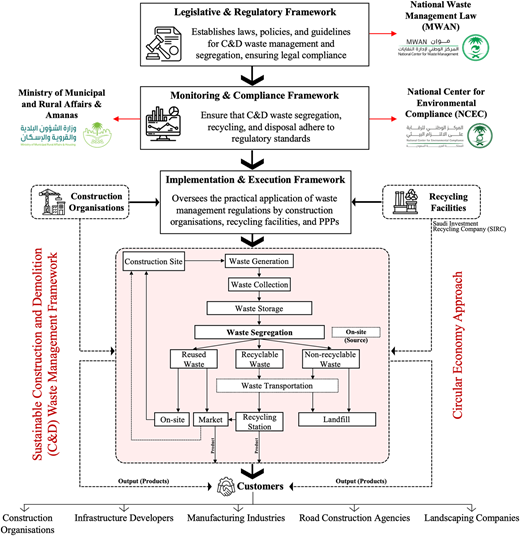
To achieve these ambitious goals, Saudi Arabia has recently introduced a regulatory and policy framework that, while still in its early stages, reflects a strong national commitment to sustainable waste management. As illustrated in Figure 1, this framework is anchored by the National Waste Management Law (MWAN), which is responsible for overseeing and regulating waste management practices across the Kingdom (MWAN, 2019). Complementing the MWAN, the National Centre for Environmental Compliance (NCEC) plays a critical role in monitoring, enforcing, and ensuring compliance with environmental regulations, including those governing C&D waste segregation (NCEC, 2019). The Ministry of Municipal and Rural Affairs and Housing (MOMRAH) also contributes by establishing and implementing environmental standards for C&D waste management, pollution control, and sustainability within the construction sector.
Although Saudi Arabia has outlined ambitious targets and developed a regulatory framework for sustainable waste management, a significant gap remains between policy aspirations and on-ground practice, particularly in the area of source segregation. Despite its centrality to effective C&D waste management, source segregation remains underrepresented as a distinct component within current national strategies and targets. This raises critical questions regarding the institutional, operational, and behavioural dynamics shaping C&D waste practices in the Kingdom. What roles do different stakeholders play in promoting or resisting source segregation? What are the perceived barriers, enablers, and incentives influencing its adoption? And how does source segregation align with broader sustainability goals, such as the transition to a CE or the reduction of carbon emissions?
1.1 Research gap, scope and objectives
From a literature perspective, while the importance of C&D waste management is widely acknowledged, especially given its projected growth in the coming years, the majority of studies addressing sustainable strategies (including source segregation) have been conducted in developed countries, with limited attention to emerging economies, such as Saudi Arabia (Soto-Paz et al., 2023). Moreover, although research on C&D waste management in Saudi Arabia has increased, studies focussing specifically on source segregation remain scarce. In most cases, segregation is mentioned as part of broader investigations into recycling practices or waste reduction strategies (Alazmi et al., 2025; Blaisi, 2019; Haider et al., 2022; Ouda et al., 2018; Sarhan et al., 2017). These studies tend to adopt quantitative or policy-review perspectives that describe overall waste volumes, recycling rates, or regulatory targets without exploring how segregation practices actually occur on construction sites, how actors interpret related policies, or why institutional misalignment persists. Consequently, positioning source segregation as a standalone research focus is both timely and necessary, offering valuable insights that could support the successful implementation of Saudi Arabia's sustainable waste management initiatives. In other words, this research moves beyond descriptive assessment by employing an in-depth qualitative approach that captures stakeholder experiences regarding on-site segregation behaviour.
Accordingly, this study seeks to fill this knowledge gap by conducting a thematic analysis of in-depth interviews with key stakeholders in Saudi Arabia's C&D waste. Through this approach, the study aims to.
Investigate the current practices of source segregation in Saudi Arabia's C&D waste sector.
Identify and analyse the main barriers and enabling factors (e.g., technical, institutional, economic, and cultural) that influence the successful adoption of source segregation practices in the Saudi building and construction sector.
Evaluate the role of national policies, regulations, and institutional frameworks in shaping source segregation efforts and promoting CE outcomes in the construction industry.
2. Research methodology
This study adopted a qualitative research approach, utilising thematic analysis, to investigate the source segregation process of C&D waste in Saudi Arabia. Many considerations drove this choice. First, source segregation of C&D waste in Saudi Arabia is an underexplored and context-specific practice. Quantitative data are scarce, making qualitative inquiry ideal for generating foundational understanding (Creswell and Creswell, 2014; Gummesson, 2006). Second, the issue involves multiple stakeholders (e.g., government authorities, contractors, recycling companies, and academics) whose experiences, perceptions, and interactions cannot be captured through numerical data alone. A qualitative approach allows for a deeper understanding of how institutional, behavioural, and operational factors influence segregation practices. Third, waste governance in Saudi Arabia is shaped by complex socio-institutional arrangements and regulatory overlaps, making qualitative methods suitable for exploring these dynamics and revealing how fragmentation or coordination among institutions can affect implementation. Fourth, qualitative research provides the flexibility needed to investigate an evolving policy environment such as Vision 2030, where attitudes, awareness, and institutional capacities are rapidly changing. Finally, qualitative inquiry enables us to develop contextualised, policy-relevant insights that can guide decision-makers toward designing more effective segregation systems tailored to the Saudi situation.
2.1 Data collection and processing
The primary source of data for this study was the perspectives of selected participants, including experts and stakeholders directly involved in the building and construction sector. The initial sample consisted of 34 potential participants who were identified through professional networks, governmental directories, and industry associations related to C&D waste management in Saudi Arabia. From this pool, 19 participants were ultimately selected based on three key criteria: (1) direct professional involvement in C&D waste generation, management, or regulation; (2) a minimum of three years of experience in the construction, recycling, or environmental policy sector; and (3) demonstrated knowledge or decision-making capacity related to waste segregation practices. Thematic saturation was reached by the 19th interview, at which point no new codes or themes were identified.
A purposeful sampling strategy was employed to ensure that participants were well-suited to the research objectives and could provide relevant and meaningful insights (Herchline, 2024; Palinkas et al., 2015). The participants were categorised into four main stakeholder groups: academics (2), Construction contractors and C&D waste services providers (7), government organisation representatives (4), and recycling facility representatives (6). Their professional experience ranged from 3 to 15 years, offering a diverse and informed range of viewpoints. It is worth mentioning that although the sample was not evenly distributed across stakeholder groups, with only two academics included, this was intentional and aligned with the study's focus on practical implementation rather than theoretical perspectives. Greater representation was given to practitioners, regulators, and recycling facility managers directly involved in daily C&D waste management operations. Academics were included to provide complementary analytical viewpoints. This purposeful imbalance ensured that the data reflected real-world practices, institutional dynamics, and policy challenges most relevant to the research aims. The interviews were conducted between February and March 2025, with 12 interviews conducted online and the remaining 7 conducted face-to-face. Each participant responded to a set of 15 open-ended questions, with interview durations ranging from 40 to 90 min. Ethical approval for this study was granted by the RMIT University DSC, the College Human Ethics Advisory Network CHEAN (No: 2024–27526-25483). Table 1 provides a detailed overview of the participant profiles.
2.2 Data analysis
The study followed the six-phase thematic analysis framework proposed by Braun and Clarke (2006), which includes: (1) familiarisation, (2) generating initial codes, (3) developing interpretive codes, (4) reconstructing themes, (5) reviewing and refining themes, and (6) defining and naming themes (Braun and Clarke, 2006). All interviews were conducted in Arabic and then translated and transcribed into English for analysis. The transcripts were coded manually using an iterative process that combined both descriptive and interpretive coding. Initial codes were derived directly from participants' responses and were then organised into broader themes that captured recurring patterns and underlying meanings. The coding process was carried out systematically to ensure internal consistency and achieve thematic saturation. ATLAS.ti software (ATLAS.ti, 2025) was used to support the coding process and get the final set of themes. Comprehensive details of the thematic analysis procedure are provided in the supplementary document attached to this manuscript.
3. Results
The thematic analysis resulted in five main themes that collectively illustrate the landscape of source segregation of C&D waste in Saudi Arabia: (1) current practices and benefits, (2) barriers and enablers, (3) policies and regulations, (4) stakeholder roles and collaboration, and (5) circular economy integration and future opportunities.
3.1 Source segregation: current practices and benefits
Participants consistently reported a significant lack of source segregation of C&D waste across most projects in various cities throughout Saudi Arabia. As one interviewee noted, “ …. . Source separation has not yet been fully adopted” [RF_01]. Even in cases where source segregation was attempted, it was typically conducted in an entirely manual and rudimentary way: “Upon arrival, workers manually segregate the materials, separating plastic from iron and other recyclable materials.” [RF_01]. Moreover, some participants went further, confirming the complete absence of source segregation practices in Saudi Arabia:
“[There is still no actual waste segregation at the source in Saudi Arabia] — that's correct.” [WC_06].
Participants attributed this to many underlying reasons. One interviewee pointed to a flawed understanding of the importance of source segregation: “There's also a perception that even if they separate waste on-site, it might end up mixed again during transportation or disposal.” [GO_01]. Others cited systemic issues, such as the lack of a structured segregation framework and standardised practices: “Unfortunately, there is no structured source segregation system in place for C&D waste ….” [GO_03].
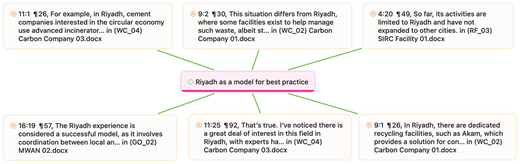
Despite this widespread view that source segregation is either at a very early stage or entirely absent in many Saudi construction projects, many participants highlighted active recycling efforts of C&D waste, particularly in cities such as Riyadh. This difference in participant perspectives reflects both a geographical divide (Riyadh versus other regions, as the capital with more advanced institutional and recycling infrastructure) and a project-scale divide (mega-projects versus standard construction projects). Nine quotes from seven participants (e.g., RF_01, RF_03, WC_02, GO_02) recognised Riyadh as a model for best practices, especially due to the availability of recycling facilities like Akam. Figure 2 presents selected participant quotes highlighting Riyadh's recycling initiatives.
In addition, some participants documented recent successful efforts in C&D waste management, although these initiatives do not include on-site segregation:
“We've only been in the market for 8 to 10 months. However, we've managed to recycle around 700,000 tonnes, all of which have been directed to the landfills.” [WC_04].
“One of our recent initiatives is ‘Madinati’, a digital platform designed to track and manage all types of waste, including C&D waste.” [GO_03].
Moreover, participants expressed two distinct motivations for supporting source segregation of C&D waste: while some emphasised its economic benefits, others were more driven by its environmental value. Economically, participants mentioned reduced disposal costs, decreased consumption of raw materials, and job creation. As one participant explained, “Source segregation contributes economically by reducing disposal costs, generating revenue, creating job opportunities, and enhancing the circular economy.” [WC_05]. Another participant added, “… … The primary goal of recycling is not just waste disposal but also reducing the consumption of raw materials.” [WC_03]. On the environmental side, many participants highlighted benefits such as lowering carbon emissions and reducing pressure on landfills. “[Source segregation] reduces the consumption of natural resources. Extracting raw materials consumes energy and leads to significant carbon emissions,” noted one interviewee [RF_04].
3.2 Barriers and enablers
Participants identified a wide range of factors that either hinder or facilitate the implementation of source segregation for C&D waste in Saudi Arabia. These insights reveal a complex interplay between institutional, operational, and perceptual dimensions. Table 2 presents a summary of the key barriers and enablers influencing the implementation of source segregation for C&D waste in Saudi Arabia.
One of the most frequently mentioned barriers was the lack of awareness. Participants explained that many stakeholders, including contractors and site workers, either misunderstood the purpose of segregation or doubted its benefits. As one recycling facility representative explained, “The biggest challenge was the lack of public awareness regarding recycling. There was a common belief that recycled materials were of no value, which led to an accumulation of waste on our end.” [RF_01]. Another critical obstacle was the high operational cost of segregation. Participants identified a range of cost factors, including the expenses associated with sorting equipment, landfill fees, infrastructure development, facility maintenance, and transportation logistics. “In reality, several steps in the recycling process make it costly and complex, and this represents one of the main challenges and barriers we face.” a waste company representative [WC_04].
Another frequently mentioned challenge was institutional fragmentation and overlapping responsibilities. Ten participants emphasised that unclear roles across government entities led to inconsistent practices and a lack of accountability. “But the problem lies in enforcing these laws, as the responsibilities of several executive bodies, such as municipalities and local councils, overlap without a single entity overseeing the entire process.” [RF_04]. Additional barriers included public scepticism toward recycled product quality, price mismatch between recycled and raw materials, lack of transparency in segregation practices, insufficient recycling infrastructure, variability in materials, logistical constraints, and social resistance to recycled materials. These were captured in several remarks:
“Moreover, many sectors struggle with a lack of transparency in waste processing.” [AC_01].
“At times, the cost of recycling is higher than traditional disposal, making contractors less motivated to choose sustainable solutions.” [WC_07].
Despite these challenges, participants also pointed to some key enablers that could facilitate the broader adoption of source segregation for C&D waste in Saudi Arabia. The most frequently cited enabler was the use of technology. Respondents emphasised that emerging technologies (e.g., automated sorting systems, smart bins, big data analysis, sensors, AI-based solutions, IoT technologies, and digital tracking platforms) can significantly enhance the source segregation processes. One participant noted that “Technology can help a lot, like waste tracking systems to trace origins and movement, and smart sorting equipment to distinguish recyclable from non-recyclable materials.“[GO_04]. Another participant highlighted how automation reduces dependency on labour and minimises error: “Automation is also a key tool in reducing the workload for workers in recycling centres, as robots can sort large volumes of waste in a shorter time” [RF_06]. Participants also referred to the role of digital systems in improving traceability and accountability in the segregation process. “Our organisation is improving reporting and tracking processes by using advanced technology to monitor the amount of waste segregated and recycled.” [WC_07].
The second most reported enabler was governmental support. This included the establishment of clear regulatory frameworks and the implementation of incentive structures. Participants emphasised that without strong governmental leadership and policy alignment, efforts to implement segregation systems often remain fragmented or voluntary. As one participant noted, “The government should support recycling by offering incentives such as compensating for price differences, increasing the cost of raw materials, or mandating a certain percentage of recycled materials in projects.” [WC_06]. Another participant focused specifically on the importance of financial incentives, stating, “Governments can play a key role in supporting the recycling sector by offering financial incentives and tax exemptions for companies that invest in recycling technologies.” [GO_02].
Lastly, academic research and innovation were recognised by several participants as an emerging enabler. Universities and research institutions were seen as key partners in developing context-specific technologies, conducting pilot projects, and generating evidence-based practices that can support implementation. Participants emphasised that investment in scientific inquiry and knowledge-sharing is essential to drive progress in this field. As one waste company representative noted, “Encouraging research and development in this sector is key to identifying the best methods for achieving environmental and economic goals.” [WC_07]. Another participant stressed the importance of continuous innovation, stating, “I would like to emphasise the importance of investing in scientific research and development to improve current practices.” [AC_01].
3.3 Policies and regulations
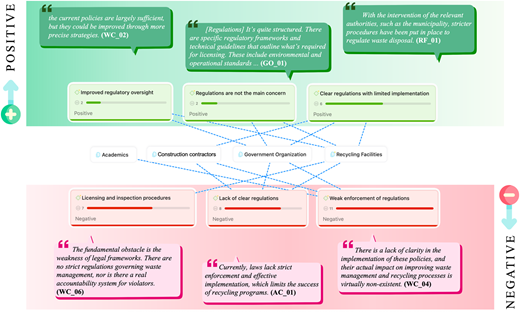
Participants offered varied and sometimes conflicting perspectives regarding the regulatory environment surrounding source segregation of C&D waste in Saudi Arabia. These contrasting views reflect the broader complexity of implementing regulatory frameworks in a sector that involves multiple stakeholders, diverse project scales, and evolving environmental and economic goals. Figure 3 presents a visual summary of these contrasting views regarding the regulatory framework for C&D waste source segregation in Saudi Arabia.
On one side, several participants voiced frustration with the lack of a clear and enforceable regulatory structure, describing the current system as fragmented, inconsistently applied, or poorly implemented. “The absence of a clear regulatory structure leads to disorganised waste management and non-compliance with recycling requirements by some entities.“, noted a government official [GO_02]. Another participant from a recycling facility highlighted the same issue in relation to downstream processing, stating, “Additionally, there are no clear laws mandating the transport of waste to licensed processing sites.” [RF_04].
On the other hand, some participants acknowledged recent regulatory advancements and viewed the evolving legal environment as a positive step toward formalising segregation practices. For example, a government participant remarked, “There are laws in place that require contractors to work with licensed waste hauliers and ensure proper disposal.” [GO_03]. Another participant highlighted the guidance offered by national regulatory bodies, noting, “For contractors, the National Centre for Waste Management 'Mawan's regulations provide a clear answer. The laws clearly state the need to utilise C&D waste.” [RF_04]. These views reflect growing awareness of national initiatives that aim to standardise recycling and disposal practices across the construction industry. Interestingly, not all participants viewed regulation as the primary driver of change. Some expressed scepticism toward policy reliance, arguing that regulation alone may not ensure compliance or foster innovation. “I don't believe regulations and policies are always the solutions.“, commented a recycling facility representative [RF_05], suggesting that complementary approaches (e.g. education, incentives, and industry-led practices) may be equally important in encouraging effective segregation behaviour.
Also, it is worth mentioning that many participants proposed specific policy recommendations that, in their opinion, could significantly accelerate the implementation of source segregation for C&D waste in Saudi Arabia. A recurring suggestion was the introduction of financial instruments and regulatory incentives to shift behaviours and promote compliance. One waste company representative emphasised the importance of financial mechanisms, stating, “Taxation, money, and money make everything work. I know it's often difficult, and it's unpopular. But unfortunately, you know, while waste management is a free-to-use service, change won't happen.” [WC_01]. Another participant proposed a graduated requirement system for the use of recycled materials in public projects, outlining, “Government projects should require 35% recycled material to stimulate demand and sector growth. All road, paving, and concrete barrier projects should use 100% recycled materials. Projects valued at less than SAR 50 million should use at least 10% recycled materials. Projects valued between SAR 50–100 million should use 20% recycled materials. Projects over SAR 100 million should use 30% recycled materials.” [GO_04].
3.4 Stakeholder roles and collaboration
The thematic analysis revealed a strong consensus among participants regarding the critical role of cross-sector collaboration in enhancing the source segregation of C&D waste in Saudi Arabia. Participants consistently emphasised that effective and sustainable waste management cannot be achieved in isolation. Instead, it requires coordinated action among a broad spectrum of stakeholders (e.g. government agencies, private sector actors, civil society, and educational institutions).
As one academic participant stated, “Sustainable solutions require collaboration among different stakeholders, including the government, companies, educational institutions, and civil society.” [AC_01]. Another participant elaborated on the practical outcomes of such cooperation, noting, “By fostering collaboration between companies, regulatory bodies, and the community, we can achieve a real shift towards more efficient and sustainable waste management, benefiting the environment and the economy” [WC_07]. A particularly notable sub-theme emerging from the interviews was the call for stronger collaboration between educational institutions/universities and the C&D waste management industry. Participants viewed education not only as a channel for raising public awareness but also as a strategic partner in shaping the future workforce and embedding sustainable practices. “Establishing partnerships with higher education institutions could be beneficial in developing specialised educational programmes focused on recycling and waste management.” explained one academic participant [AC_01]. Others described ongoing efforts: “We are involved in various educational initiatives to raise awareness about the importance of recycling. For example, we organise workshops in schools and universities to teach students how they can contribute to recycling efforts.” [RF_06].
In addition to the education sector, participants also highlighted the essential role of local communities in supporting source segregation initiatives. There was a clear belief that public engagement, awareness-building, and behavioural change at the community level were necessary for long-term success. As one participant explained, “The community plays a crucial role in supporting these efforts. Strengthening communication between individuals and society about the importance of waste sorting and how each person can contribute is vital …..” [AC_01]. Finally, the National Centre for Waste Management (NCWM) was repeatedly identified as a key institutional stakeholder with a central regulatory and facilitative role in the development of source segregation systems. Participants acknowledged the authority of the NCWM in licencing and oversight, as well as its responsiveness in resolving implementation challenges.
3.5 Circular economy integration and future opportunities
Participants widely recognised the critical role of source segregation in enabling the CE, particularly within the C&D waste sector. Many emphasised that segregation is not just a technical step in waste management but the very foundation upon which circular practices are built. Efficient sorting at the source was described as a prerequisite for the feasibility of downstream recycling, reuse, and material recovery:
“Why is waste segregation at the source considered the backbone of the circular economy? The reason is that this process determines whether recycling will be feasible later or not.” [WC_03].
“Waste sorting is the foundation of the circular economy—rather than discarding everything, we reuse it, reducing pressure on natural resources.” [GO_04].
However, some participants emphasised that the CE should not be approached as an isolated concept, but rather as part of a broader economic and institutional framework. One participant argued for a transitional phase that first establishes a functioning “waste economy” to pave the way for circularity: “Now, until you end up having a kind of an economy, a waste economy, I mean obviously we want to move towards a circular economy, but certainly the first stage would be a waste economy where there's money flowing around and people come because it's privatised, it's not a public, it's a privatised industry.” [WC_01].
4. Discussion
4.1 Interpretative overview of thematic insights
The five themes derived from the thematic analysis collectively reveal how source segregation of C&D waste in Saudi Arabia is shaped by institutional, behavioural, and governance dynamics that extend far beyond technical considerations. The first theme reveals a clear paradox between recognition and enactment: while participants widely acknowledge the economic and environmental benefits of source segregation, actual on-site implementation remains rare. This intention–action gap reflects institutional inertia driven by weak incentives, limited enforcement, and entrenched operational norms. Unlike previous studies in other regions (e.g. China and India) that attribute low segregation rates to logistical or financial constraints (Huang et al., 2018; Shooshtarian et al., 2020), a closer reading of participants' responses in this study points to a distinct contextual factor, which is institutional mistrust. Participants expressed doubts about whether segregated materials would remain separated after collection and revealing a systemic credibility deficit that undermines behavioural commitment. These findings therefore extend the CE debate by reframing segregation not only as a technical or behavioural challenge, but also as a trust-dependent institutional process in which consistent enforcement, transparent monitoring, and credible supply-chain governance are important requirements for sustained adoption.
Building on this, the second theme examines the barriers to source segregation (e.g. limited awareness, high costs, and institutional fragmentation) as an interlocking system of constraints rather than isolated ones. This systemic interplay mirrors findings in other governance contexts where regulatory ambiguity and overlapping mandates weaken implementation coherence (Figueiredo et al., 2024; Oluleye et al., 2022; Walters et al., 2024). In Saudi Arabia, poor inter-agency coordination and top-down control increase uncertainty and reduce private-sector commitment, confirming the institutional theory's claims that unclear authority encourages compliance minimalism. Divergent perceptions of regulation further reveal power asymmetries: while government bodies view regulation as progress, firms interpret it as a cost burden (Andersson and Buser, 2022; Figueiredo et al., 2024). Moreover, the overreliance on digitalisation as a solution reflects a bias that overlooks governance and trust deficits. Thus, this study advances previous research by showing that Saudi Arabia's challenge is not only technological but also institutional maturity, where effective segregation depends on coordinated authority, legitimacy, and participatory governance rather than automation alone.
This pattern of institutional fragmentation becomes more explicit in the third theme, which exposes a regulatory paradox in Saudi Arabia's waste governance. Participants' mixed views on regulation reflect overlapping mandates, inconsistent enforcement, and weak coordination, aligning with global concerns over policy incoherence in fragmented environmental systems (Leonardo et al., 2025; Maria et al., 2020). While similar structural misalignments have hindered CE transitions in Europe (Kirchherr et al., 2017), the Saudi case is distinguished by its top-down regulatory culture, which limits regional consistency and stakeholder engagement. Participants' recognition that “regulation alone cannot drive change” signals a shift toward hybrid governance, where legal frameworks must be complemented by incentives and collaborative mechanisms (Leonardo et al., 2025). Consequently, this research reframes Saudi waste policy as a coordination challenge, arguing that effective CE transitions require integrated and trust-based governance rather than fragmented or purely regulatory reform.
From regulation, the discussion moves toward stakeholder collaboration, which is the focus of the fourth theme. Here, source segregation is revealed to be relational, rather than procedural, relying on the strength of collaboration across academia, government, industry, and communities. Participants highlighted that sustainable waste management cannot be achieved through regulation alone but through multi-actor partnerships that combine knowledge, resources, and local engagement, consistent with collaborative governance theory (Valentina et al., 2025; Vasconcelos et al., 2022). However, in Saudi Arabia, such collaboration remains fragmented and state-dependent, with universities, private firms, and regulators engaging in short-term or top-down initiatives rather than sustained co-production. While previous studies emphasise universities' role as boundary organisations and knowledge brokers (Olayiwola et al., 2023), this study shows how power asymmetries and institutional dependency constrain that role. The paradox of state-led collaboration, where the government functions as both enabler and barrier, limits innovation and shared ownership. Here, this research advances existing literature by framing collaboration not as a normative goal but as a structural necessity, where horizontal trust-building and intermediary institutions are essential for advancing CE transitions in centralised governance systems.
Finally, the fifth theme situates segregation within the broader vision of the CE, presenting it as the sector's structural foundation. However, this research adds contextual depth by revealing a locally grounded understanding of circularity as a phased transition rather than an immediate systemic shift. Participants' idea of a “waste economy” as a transitional phase reflects a pragmatic adaptation to Saudi Arabia's limited regulatory maturity and infrastructural capacity. While the emphasis on digitalisation as a driver of circular progress aligns with global smart-city trends, this research emphasises that the efficacy of technology depends on equitable access and effective governance.
4.2 Stakeholder perspectives and the interrelationship between themes and participant groups
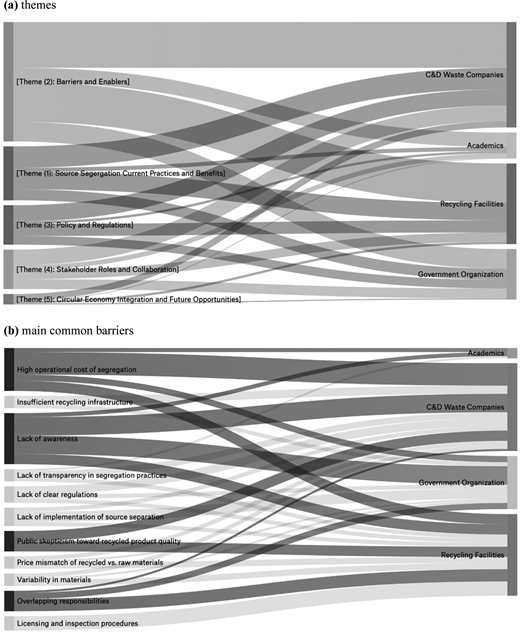
A closer reading of the interview data reveals deeper relationships and systemic dynamics shaping the current situation in Saudi Arabia. For example, Figure 4 reveals critical insights into how different stakeholder groups engage with the issue of source segregation in the C&D waste sector. As illustrated in Panel (a), construction contractors and C&D waste services providers and recycling facilities were the most vocal contributors to themes related to barriers and enablers, reflecting their operational involvement and first-hand exposure to daily challenges. In contrast, while other themes (e.g. policies and regulations, stakeholder roles and collaboration, and CE integration) were acknowledged, they received relatively less emphasis from most participant groups. This suggests that discussions around source segregation in Saudi Arabia are still predominantly shaped by immediate practical challenges and perceived opportunities, rather than by broader systemic or strategic considerations. Furthermore, Panel (b) highlights the nuanced understanding of barriers across stakeholder groups. While academics, construction contractors and C&D waste services providers, and government organisations commonly emphasised tangible obstacles such as high operational costs and lack of awareness, representatives from recycling facilities echoed these concerns but placed additional emphasis on the issue of overlapping institutional responsibilities, reflecting their challenges in navigating regulatory fragmentation.
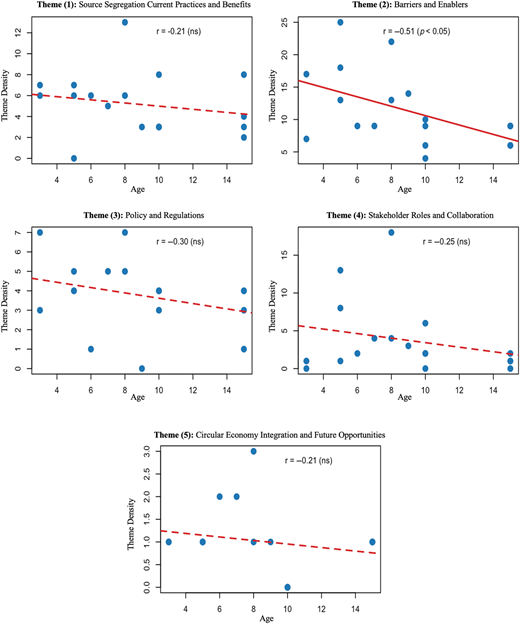
Moreover, although the correlation analysis (Figure 5) revealed mostly weak or non-significant relationships between participants' years of experience and their emphasis on key themes, this pattern is itself revealing. The absence of strong correlations suggests that perceptions of barriers, regulatory gaps, and collaboration challenges are systemic rather than experiential, cutting across professional seniority. In other words, institutional conditions, not individual experience, shape how actors interpret the feasibility of source segregation. The only significant trend, a moderate negative correlation for barriers and enablers (r = −0.51, p < 0.05), indicates that less experienced participants perceived structural obstacles more sharply, likely due to their direct engagement with on-site operations.
5. Conclusion
This study explored the multifaceted landscape of source segregation in the C&D waste sector in Saudi Arabia. The findings reveal that while stakeholders strongly support the principles of source segregation, its implementation across Saudi Arabia remains inconsistent, underregulated, and underutilised. Systemic barriers such as lack of awareness, high operational costs, overlapping responsibilities, and infrastructure limitations continue to hinder progress. The study also highlights strong enabling conditions: the promise of technology, emerging regulatory frameworks, academic-industry partnerships, and the growing engagement of the NCWM. Importantly, the analysis showed that less experienced participants placed greater emphasis on barriers and enabling factors, suggesting a generational lens through which the urgency of reform is perceived. Also, findings demonstrate that the challenge of advancing source segregation in Saudi Arabia lies in other factors, such as socio-institutional configuration. The results show how weak coordination, fragmented mandates, and limited institutional trust constrain the translation of policy ambition into on-site practice.
Additionally, this study makes valuable contributions across theoretical, practical, and policy dimensions. Theoretically, it contributes to understanding the socio-institutional complexity of circular transitions by showing how behavioural intentions, regulatory structures, and trust dynamics interact to shape implementation outcomes in emerging economies. In terms of industry practice, this study identifies the real-world barriers and enablers from the participants' point of view, offering actionable insights for improving source segregation processes, increasing the end-users of products with recycled content (PwRC), and enhancing cross-sector collaboration. From a policy dimension, the findings of this study inform the development of clearer regulatory frameworks, targeted incentives, and public-private coordination mechanisms.
While this study offers valuable insights into the implementation of source segregation in the C&D waste sector in Saudi Arabia, some limitations should be acknowledged. First, the research is based on a qualitative thematic analysis of interviews with a relatively small and targeted group of stakeholders. Although these participants were diverse and represented key sectors (e.g. government, private companies, academia, and recycling facilities), the findings may not fully capture the perspectives of all actors involved in this space, such as informal workers, local contractors, or PwRC. Moreover, the use of purposeful sampling, while appropriate for identifying information-rich cases, may limit the generalisability of the findings, as participants were selected based on expertise and relevance rather than random representation.
Building on the findings of this study, future research should aim to broaden both the methodological scope and participant base. Quantitative studies using surveys or statistical modelling (e.g. structural equation modelling (SEM) or agent-based simulations) could complement qualitative insights and enable generalisability across larger populations. Comparative analyses between cities or regions within Saudi Arabia, or even across different countries, including those in the MENA region, would also be valuable in identifying context-specific challenges and best practices in source segregation. From a policy perspective, future work could explore how segregation performance indicators might be integrated into Saudi Arabia's Vision 2030 sustainability frameworks, particularly through the NCWM and municipal regulations. For industry stakeholders, further research should investigate the economic viability and environmental impacts of different segregation models to inform more data-driven policy and decisions.
Ethics approval
Ethical approval granted by XX University (No. 2024–27526-25483).
The authors thank all participants
The supplementary material for this article can be found online.