Skip to article sections
Purpose

Cement manufacturing is a vital yet emission-intensive industry that faces challenges in certifying sustainable production practices, driven by the need for transparency, accountability and regulatory compliance. This paper provides a blockchain-based certification framework to enhance traceability and sustainability in cement production.

Design/methodology/approach

Leveraging Ethereum smart contracts (SCs) and blockchain technology, our solution ensures decentralized, immutable tracking of emissions data, production processes and compliance through secure interactions among regulators, manufacturers and auditors. The framework facilitates deployment, registration, reporting, auditing and certification. Detailed insights into system architecture, algorithms, SC implementation and validation are provided. Security analysis evaluates access controls, data privacy and vulnerability mitigation, while cost analysis highlights the framework's economic feasibility by examining gas costs for key functions.

Findings

The blockchain-based framework successfully produced a scalable solution with a modular design to allow for flexible deployment by different regulatory bodies. Transparency was achieved through blockchain events announcement, and accuracy was ensured through periodic auditing rounds. Security analysis results show no serious vulnerabilities. The developed framework proves a cost-effective solution for certifying sustainable production practices in the cement industry, with potential applications across other heavy manufacturing sectors.

Research limitations/implications

Cement manufacturing is a vital yet emission-intensive industry that faces significant challenges in certifying sustainable production practices, driven by the need for transparency, accountability and regulatory compliance.

Practical implications

We believe that this paper provides the following practical implications: Innovative Framework: A blockchain-based certification system promoting adherence to sustainable processes in cement manufacturing. SC Implementation: Detailed insights into the system architecture, implementation and validation of algorithms and SCs. Comprehensive Analysis: A thorough security analysis of SC coding and a cost analysis highlighting the economic feasibility of our proposed framework.

Social implications

The proposed methodology will help all stakeholder involved in the cement production and supply chain have a better understanding and a robust tool to observe and learn about operations, tasks and other activities made through sustainable cement production

Originality/value

The study contributes a novel blockchain-based method to certify sustainable production in energy-intensive industries, especially cement, offering a valuable tool that ensures transparency and immutability.

Acronym

Meaning

BC

Blockchain

CEMS

Continuous Emissions Monitoring Systems

CCUS

Carbon Capture, Utilization and Storage

DApp

Decentralized Application

EA

Ethereum Address

ETH

Ether (cryptocurrency)

GCCA

Global Cement and Concrete Association

GGBS

Ground Granulated Blast Furnace Slag

IPFS

Inter-Planetary File System

IoT

Internet of Things

SC

Smart Contract

SM

Smart Meters

The persistent increase in global population calls for the development of essential infrastructure, including housing, transportation, industrial, commercial and other urban construction projects (Chatham House, 2018; Wong et al., 2022). As a result, it is no surprise that concrete is the most widely used manufactured material on the planet, second only to water in global consumption (Gagg, 2014; Rubenstein, 2012). Cement, the primary component of concrete, is responsible for about 8% of global emissions (Chandler, 2019). If it were a country, this industry's emissions would make it the third-largest emitting country in the world (Mittleman, 2018). Most of the CO2 emissions related to cement production are attributable to the calcination process – about 50% – and the combustion of fuel, traditionally fossil-based, to satisfy the energy needs of the kilns – about 40%. The remaining 10% is associated with electricity, transportation and machinery needs across different stages of the cement production process (IEA, 2018a).

Sustainable transition is inherently tricky in competitive heavy industries, especially when the product is as capital-intensive (Schorcht et al., 2013) and critical to infrastructure development as cement. Cost considerations are bound to be increasingly crucial as competing firms try to differentiate their products, making expensive sustainability concerns and solutions harder to implement. For example, the United States Geological Survey (USGS) counts over 20 cement operations in the UAE alone as of 2019, the latest reported year (Szczesniak, 2023). This, in an already highly emitting industry, means that it is imperative to not only impose but also subsequently certify sustainable policies and practices in this industry.

The escalating global concern over climate change and its adverse effects has necessitated the exploration of innovative solutions to mitigate industrial emissions. Despite many international initiatives (see Climate Action, n.d.; United Nations, 2015) and at the urging of scientists, experts and youth movements, we approach the 2030 deadlines we set for ourselves in the 2015 Paris Agreement with many nations and industries failing to meet their fair share of emissions reductions (UN Climate Change, 2022, 2023a, b). It is, therefore, urgently necessary to transition towards more sustainable production methods to curb industrial emissions in general and cement production in particular. It is also worth noting that despite major challenges (Singh & Kumar, 2024), targeting these emissions directly tackles 3 of the 17 Sustainable Development Goals (SDGs), namely: SDG 9: Build resilient infrastructure, promote inclusive and sustainable industrialization and foster innovation, SDG 11: Make cities and human settlements inclusive, safe, resilient and sustainable and SDG 13: Take urgent action to combat climate change and its impacts.

Based on our thorough literature exploration, the main research questions this paper aims to address are:

  1. How can a blockchain-based certification framework be designed and applied to benefit from blockchain technology's decentralized, secure and transparent nature, while promoting adherence to sustainable processes and enabling product certification in the cement-making industry?

  2. How can smart contracts (SCs) be developed, tested and validated to automate and support the governance and application of a blockchain-based certification framework for sustainable cement production?

  3. What are the implications and challenges of applying the proposed solution, and how can we advance blockchain applications in industrial emissions mitigation?

Reductions in emissions need not come with technological setbacks. The digitization of manufacturing sectors has brought about a fourth industrial revolution with potential solutions that leverage this digital transformation and can help bring down emissions and increase the efficiency of current processes (AlKhader et al., 2023; Alsadi et al., 2024). Blockchain is among the digital technologies widely adopted across various applications (Rodrigo et al., 2024; Wong et al., 2022). Famously recognized as the technology behind cryptocurrencies such as Bitcoin, blockchain has found many uses outside digital finance, thanks to its many valuable characteristics. A decentralized, transparent, immutable, traceable ledger system, blockchain technology has the potential to solve many of the issues associated with industrial emissions mitigation by establishing accountability, monitoring, certifying and incentivizing industrial emission reductions, particularly in cement manufacturing. In this work, we propose a blockchain-based approach that utilizes the defining characteristics of the technology to monitor and certify sustainable cement manufacturing.

The contributions of this work can be summarized as follows:

  1. We identify best practices in monitoring and certifying the sustainability of the cement production process.

  2. We design and apply a blockchain-based certification framework that benefits from BC technology's decentralized, secure, transparent nature, promotes adherence to sustainable processes and allows for product certification in the cement-making industry.

  3. We develop, test and validate SCs to automate and support the governance and application of the designed framework.

  4. We present our solution with multiple key illustrations, such as system architecture, sequence diagrams and algorithms.

  5. We analyse the security and cost of our solution, open research challenges, contributions and implications of the developed solution to advance research in blockchain applications in industrial emissions mitigation.

The rest of the paper is structured as follows: Section 2 provides background on the cement-making process, low-carbon cement production, current monitoring frameworks and blockchain technology's applications. Section 3 explains the methodology. Section 4 outlines the proposed framework's architecture and sequence diagrams. Also, Section 4.3 details the Solidity code algorithms and testing/validation procedures. Section 5 covers security, cost considerations and future research directions. Lastly, Section 6 summarizes our contribution to certifying sustainable production practices in the cement industry using blockchain technology.

This section provides essential background information, structured as follows: First, we explain the cement production process and highlight the stages at which emissions are produced. We then discuss the literature on low-carbon cement and existing frameworks to monitor and certify sustainable cement production. Finally, we examine the application of blockchain technology in manufacturing, the construction industry and cement production in particular. A summary of the literature review is provided towards the end.

Modern cement production, as shown in Figure 1, is a three-stage process (IEA, 2018a): Raw materials sourcing and preparation, in which naturally occurring deposits of calcium carbonate (limestone, chalk, etc.) – a crucial component for cement – are extracted from quarries near cement plants (IEA, 2018a). Small amounts of other materials – such as iron ore, bauxite, shale, clay or sand – are excavated to provide iron oxide, alumina and silica for the cement mix based on final product requirements. The quarried raw materials are then crushed to less than 10 centimetres and transported to the cement plant, where they are mixed (pre-homogenization) and milled into a fine powder (raw meal). This raw meal is then heated using exhaust kiln gases moving in the opposite direction in a pre-heater, where thermal energy is recovered, and the temperature of the raw meal is raised to above 900 degrees Celsius (IEA, 2018a). Finally, just before entering the kiln to produce the clinker (the main ingredient in cement making), the now heated raw meal is pre-calcined in a chamber, usually at the bottom of the pre-heater and above – partly within – the kiln.

The clinker production stage occurs in the rotary kiln, where temperatures reach up to 1,450 degrees Celsius. Fuel is fired directly into the kiln, and as it rotates, the pre-calcined meal falls progressively into hotter zones towards the flame. Chemical and physical reactions – such as completing the calcination process started in the previous stage – partially melt the meal and convert it into clinker. Electric blowers rapidly cool the clinker from around 1,000 to around 100 degrees Celsius. The clinker is stored and can either be sold as is or processed into cement by moving on to the next stage.

During the final stage of clinker grinding and storage, the clinker is mixed with other minerals to make cement. If clinker substitutes are used in this stage, we can produce blended cement, which can have a lower environmental impact depending on the substitute percentage. This cooled mixture is finely ground into a grey powder – Portland/Blended cement. The final product is stored in silos for later use, packaged or loaded in bulk and transported to customers.

In addition to the massive amounts of heat required to reach the necessary temperatures to produce cement, the endothermic calcination process mentioned above produces direct CO2 emissions. It is a crucial thermal treatment process in cement production. Limestone (calcium carbonate, CaCO3) is heated to very high temperatures – around 900°C (1,652°F) – and undergoes chemical decomposition into lime (calcium oxide, CaO) and CO2 gas.

This reaction alone is responsible for most direct process-related CO2 emissions – around 55% of total CO2 emissions in cement production and 4% of total global emissions (Zero Carbon Australia, 2017). Noting here that most of the required energy in this industry is still derived from the burning of fossil fuels, 32% of cement-making emissions are direct and attributable to generating the required heat, and the remaining 13% are attributable to the electricity used to grind and transport the material across the process (indirect emissions) (Zero Carbon Australia, 2017). Despite the cement industry's massive carbon footprint, it can be mitigated by applying various policies and strategies to reduce the emission factor, with the most radical implementations of existing policy frameworks theoretically reaching net zero (Hummieda et al., 2023).

In the introduction, we demonstrated the importance of making the cement industry more sustainable. This can be done by targeting the most harmful effects of the process and reducing both the direct emissions released, in addition to promoting sustainable practices in terms of indirect emissions, such as sustainable transportation, storage and power production. There are several methods by which energy-intensive cement production emissions can be reduced, and Hummieda et al. (2023) comprehensively accounts for the most effective options. Since calcination is the most energy-intensive and emissions-emitting step, utilizing solar calcination is a promising sustainable alternative to traditional fossil-powered kiln methods (Moumin et al., 2020). The study hypothesized that if half of the production adopts solar calcination with controlled CO2 sequestration (a significant adoption rate without strict policy enforcement), emissions could be reduced by 8–28% across the process.

Further reductions can be achieved by simply using – and therefore producing – less clinker in cement blends. To mitigate the emission intensity of the clinker-making process, the current 90% lime-based clinker can be replaced with alternative materials such as limestone, coal fly ash, ground granulated blast furnace slag (GGBS) and metakaolin (a type of calcined clay) (Zero Carbon Australia, 2017). By substituting clinker, Portland cement can achieve a 6% reduction in emissions for every 10% clinker replacement (Zero Carbon Australia, 2017). Carbon Capture, Utilization and Storage (CCUS) can also be effectively applied in cement production through mineral carbonation. In this emerging technology, a pure carbon dioxide stream reacts with calcium or magnesium, forming a carbonate mineral. This mineral permanently locks CO2 in a stable solid state. While the separation process to obtain pure CO2 has an associated energy cost, the subsequent carbonation reaction can offset approximately half of this energy. According to the report “Rethinking Cement,” mineral carbonation has the potential to prevent 95% of cement kiln emissions from being released into the atmosphere (Zero Carbon Australia, 2017).

More emissions reductions and sustainable practices can be applied across the process, such as improving energy efficiency, switching to alternative fuels and decarbonizing power production and transportation within the process (IEA, 2018b). Expanding into social and financial sustainability provides even more ways by which producers can be incentivized to deliver the best, most competitive product on all fronts. Blockchain technology can then lend itself to certifying the application of these practices to participating products.

No currently implemented robust framework for the certification of the cement production process has been found in the literature. There is, however, an effort to encourage monitoring and ensure sustainable practices in this industry under the Global Cement and Concrete Association (GCCA) (“Global Cement and Concrete Association (GCCA)”, 2024). General best practices across the concrete and cement industry are outlined, and the GCCA defines a net-zero road map, but the organization cannot enforce its application. The GCCA does not itself monitor or certify anything. Still, it does publish guidelines under its sustainability charter (Global Cement and Concrete Association, 2019) that may be followed by those manufacturers that wish to produce their products sustainably:

  1. Full Members are required to commit to the Sustainability Charter by achieving either Compliance (self-reporting, unpublished data) or Extended Compliance (third-party audit, published data). This is done by adhering to the published guidelines and submitting sustainability targets and performance data.

  2. Members who do not adhere to these guidelines or publish their compliance data are demoted to Associate Members, who need not sign the charter.

The GCCA audits compliant members every 4 years and requires extended compliant members to perform their own audits. Associate members are not audited. The GCCA also provides two monitoring and reporting guidelines when it comes to emissions – one focusing on CO2, and one for other types of emissions such as hydrocarbons and volatile organic compounds, heavy metals and their compounds, polychlorinated dibenzodioxins and dibenzofurans. Mass balance methodology (details in ISO 14001), continuous emissions monitoring systems (CEMS) and periodic monitoring are recommended depending on the type of emissions (Global Cement and Concrete Association, 2019). No penalties are outlined in the charter for manufacturers in breach of the sustainability charter or massive emitters with no measures to abate. Reporting is not mandatory or necessarily public – limiting accountability – and the GCCA sets no targets or benchmarks for emission levels. Instead, manufacturers are encouraged to set their own. It is worth noting that the GCCA's efforts include a value chain of cement and concrete and do not focus on the cement manufacturing process alone. Their “Five pillars of sustainability” are health and safety, climate change and energy, social responsibility, environment and nature and circular economy.

Blockchain technology has already proven itself to be a revolutionary innovation that has the potential to transform various sectors. In this section, we will explore some relevant applications of blockchain technology in the literature, beginning with its implementation in the manufacturing industry. We will then narrow down to the construction industry and examine if blockchain technology has been utilized in the cement manufacturing process thus far.

2.4.1 Manufacturing industries

Blockchain technology has found wide application in manufacturing industries due to its unique and valuable properties as an alternative to traditional data storage methods. The applications of blockchain in sustainable manufacturing, in particular, were studied by Khanfar et al. (2021), where – through a systematic review – the contributions of the technology to economic, environmental and social performance were assessed. Specific to our purpose, the contributions to the environmental performance of manufacturers can be made in environmental management, the use of resources, pollution, dangerousness and the natural environment. The authors specifically note aspects of environmental certification and compliance, where blockchain can contribute to transparency in measuring, tracking and tracing raw material sources and usage, carbon emissions, emissions reductions, renewable energy use, reduced fossil fuel usage, recycling, dangerous outputs and manufacturing impacts on the natural environment. Another paper investigated the impact of blockchain technology on developing smart and sustainable manufacturing facilities (Alazab and Alhyari, 2024). The authors found that blockchains play an important role in enhancing resource efficiency, optimizing production processes and enabling real-time data analysis for informed decisions, driving intelligent and smart operations. In other industries, it can be used to trace materials in and out of the manufacturing phase to ensure the overall sustainability and authenticity of the product (Moawad et al., 2025a, b). Blockchain can be used to help manufacturers improve their sustainability performance by utilizing blockchain features and characteristics such as SCs, peer-to-peer networks, traceability, transparency, security and distributed and synchronized data sharing.

2.4.2 Construction industry

A gap analysis research in industry 4.0 applications in construction by Elghaish et al. (2022) found that blockchain, when combined with the Internet of Things (IoT), offers a secure and interconnected platform for monitoring the supply chain of elements throughout a project's and asset's life cycle. Existing research primarily focuses on conceptual solutions and digital ecosystems. Consequently, there is a demand for practical solutions that can be verified through real-world case studies. Another analysis identifies six areas of potential blockchain integration in construction, all from a project management point of view (Kiu et al., 2022). Even so, the authors note that most papers they have come across are mainly conceptual, not offering many actionable solutions. They, therefore, recommend that future research direction move towards developing simulation models, conducting real-life case studies on blockchain applications in construction projects and analysing blockchain's capability with current systems in use. These recommendations are echoed once more by Elghaish et al. (2021), finding that conceptual frameworks and review papers dominate the research space and calling for researchers to validate the proposed themes and frameworks and provide real applications.

Some technical solutions do exist. A blockchain-based framework was indeed developed to solve issues in precast construction (Wang et al., 2020a). The framework and its development processes are presented in detail, and algorithms for SCs are developed for the model's implementation, extending the use of blockchain into the domain of construction logistics. Another paper developed a digital twin and blockchain framework for traceable data communication in construction projects (Lee et al., 2021). The work shows how such a framework can help to secure traceable and immutable data communication among project participants. Another work presents a blockchain-based decentralized system for managing construction materials and inventory, aiming to enhance transparency and traceability in the construction supply chain (Basheer et al., 2024). The authors integrate the Economic Order Quantity approach within blockchain SCs to streamline procurement and reduce costs.

Some related studies have also considered the application of blockchains in payment transactions (Das et al., 2020), information sharing and Business Information Management (Tao et al., 2022, 2023) and governmental supervision over construction work (Lu et al., 2021b). Supply chain management is among the most popular blockchain applications in the literature, with a few papers investigating and proposing solutions from data tracking, information sharing, visibility and IoT integrations (Hamledari and Fischer, 2021; Li et al., 2022; Lu et al., 2021a; Qian and Papadonikolaki, 2021; Wang et al., 2020b).

Carbon management applications of blockchain technology in construction have been studied for trading systems (Li et al., 2021), climate finance (Schulz and Feist, 2021), GHG emissions monitoring and green supply chain frameworks (Diniz et al., 2021). Rodrigo et al. examined the potential for embodied carbon estimation in construction supply chains (Rodrigo et al., 2020, 2022), while others studied the potential for carbon certification in buildings, ultimately leading to participation in carbon credit markets (Woo et al., 2021). We find in (Mubarik et al., 2021; Pan et al., 2019) investigations on the impacts of applying blockchain to green supply chain practices and its benefits on enhancing positive environmental behaviours, information sharing and carbon transactions tracking.

We have seen two recent applications of blockchain in the construction industry that provide the technical frameworks, SCs and testing processes necessary for practical application and evaluation. Wang et al. (2020b) focus on the precast construction supply chain and do not consider the carbon management aspect. Meanwhile, Xu et al. (2024) focus on carbon management, but of construction materials and products as a whole and with a supply chain perspective (as opposed to the product-specific approach). Carbon monitoring is not integrated into the blockchain solution (actors share their data), but they do focus on the encryption levels and technical computer science behind the solution. These works also demonstrate the framework used in developing blockchain solutions, SCs and testing and validation scenarios, which our work uses as well.

These findings clearly show that there is a further need in the general context of the construction industry (and specifically, in the cement manufacturing process) for actionable solutions to the problems faced, such as trust and transparency issues identified in (Kiu et al., 2022). While there are various applications and scenarios in the literature, there is still a lack of emissions management and tracking applications with higher decentralisation levels. We venture to fill this gap by precisely applying blockchain technology in the sustainable certification of cement production, which is indeed an aspect of the general construction industry.

2.4.3 Cement production process

There is a lack of papers that technically examine the use of blockchain technology specifically in the cement manufacturing process. We have come across one paper in our literature review (Umran et al., 2021), which presents the use of a private blockchain with Proof of Authorization as its consensus mechanism and integration of IoT devices in the industrial environment of a cement factory. The focus is on the efficient and secure operation of the factory itself, and the authors achieve successful integration results, but there is no product certification or sustainable production standards in the scope of the work.

While the potential areas of integration and the benefits of blockchain technology have been extensively researched in the manufacturing and construction industries, the existing body of literature remains mainly conceptual, and there is a lack of work on technical solutions that employ the various aspects of blockchain technology – such as SCs – in a real-world application. This gap is somewhat mitigated in construction industries in general but remains largely unexplored in the cement manufacturing process, which is energy and emissions-intensive. Therefore, our proposed solution to certify the sustainable production of cement neatly fills the gap in required research work in this area. To the best of the author's knowledge, this paper is the first work to utilize a blockchain-based approach to certify sustainable production practices and safe emissions levels in the cement industry.

To the author's best knowledge, the only existing comprehensive framework designed specifically for sustainable cement certification is the GCCA framework described above in Section 2: Background, under Monitoring and certifying cement production. No solutions that use blockchain in particular were found in the relevant literature. Therefore, our solution benefits from being the first work in this area to propose a blockchain-based approach. Still, several benefits make our work stand out:

The centralized nature of other possible solutions means that the central entity that manages, records, audits and issues certification is in full control of all aspects of the framework. It may not follow its stated functions equally for all manufacturers by manipulating or tampering with the data or certifications. In our proposed solution, the use of Ethereum SCs and decentralized storage ensures that all registration, reporting and auditing upon which certification is based are transparent and visible to everyone in the Ethereum network. This means that data integrity and security are achieved due to the immutability of the blockchain. Additionally, all registered entities in the framework are subject to the same rules, SCs and certification requirements. There is no full and partial membership or extended and regular compliance. All certificates can be traced and tracked, and algorithms to calculate them are visible to everyone, from regulators to end users of cement. Auditing requirements and results are openly published and decentralized to prevent any tampering with the data. Finally, by focusing on the cement manufacturing process, our framework holds manufacturers accountable for their direct and indirect emissions without allowing them to escape accountability to the end users and regulators by greenwashing other aspects of the value chain of cement and concrete.

This section outlines the systematic approach – as seen in Figure 2, used to develop the blockchain-based framework for certifying sustainable cement production. We hypothesize that the aforementioned framework will enhance compliance and environmental sustainability in one of the most carbon-emitting sectors in an already emissions-intensive industry. The methodology was designed to ensure the framework's effectiveness, scalability, relevance to the cement industry and generalizability. A combination of literature review, industry practices and technical feasibility studies guided each step.

The first step involved identifying the problem, contextualising the target industry for the case study and reviewing existing solutions. A comprehensive review of existing literature and frameworks was conducted to understand the gaps and opportunities. We found that:

  1. There is a lack of robust, transparent, traceable systems to monitor and certify emissions and sustainability practices in cement production.

  2. We found limited use (and therefore potential) of blockchain technology to address issues of transparency, data integrity and traceability in this regard.

  3. Existing industry guidelines, such as the GCCA framework, rely heavily on self-reporting and lack enforcement mechanisms, which is understandable for an international organisation.

This review informed the decision to develop a blockchain-based solution, leveraging Ethereum's SC capabilities to automate processes and ensure transparency.

The framework was designed in a modular manner, incorporating existing sustainability and blockchain frameworks. Key components included:

  1. Stakeholder Roles and Responsibilities: The primary stakeholders – regulatory authorities, cement manufacturers and independent auditors – were defined based on their roles in monitoring, reporting, auditing and certifying emissions.

  2. System Architecture: The high-level architecture of the framework was conceptualized to include SCs, CEMS, decentralized storage (IPFS) and interaction sequences among stakeholders. The architecture was designed to ensure scalability, security and compliance with industry practices.

  3. Technology Selection: The Ethereum blockchain was chosen due to its flexibility, decentralized nature and robust support for SC development. The transition to Proof-of-Stake (PoS) consensus further aligned Ethereum with environmental goals.

SCs were developed using the Solidity programming language on Remix IDE to automate the framework's core functions. The design process included:

  1. Defining Functional Requirements: Each contract was designed to handle specific tasks, such as registration, emissions reporting, auditing and certification issuance.

  2. Algorithm Development: Algorithms for calculating emissions factors, certifying sustainability scores and verifying compliance were developed to ensure accuracy and fairness.

  3. Security Measures: Security features such as access control, immutability and event-driven notifications were integrated to protect data integrity and prevent unauthorized access.

The developed SCs were tested extensively in a simulated environment using the Remix Ethereum IDE. Testing scenarios were designed to validate the following:

  1. Functionality: Ensuring that all functions – such as registration, reporting and certification – performed as expected.

  2. Security: Verifying that unauthorized transactions were blocked and access controls functioned correctly.

The economic feasibility of the framework was evaluated by analysing the gas costs associated with deploying and executing the SCs. This step involved:

  1. Estimating gas costs under various network conditions and optimizing the SC code to minimize expenses.

  2. Exploring layer-two solutions, such as ZkSync, to further reduce costs while maintaining functionality.

Specific justifications guided each decision in the framework's development. For example, the use of Ethereum was based on its established ecosystem and support for SC-based applications, while Continuous Emission Monitoring Systems (CEMS) were selected to ensure real-time, accurate data collection. IPFS was integrated to store large datasets off-chain, reducing on-chain storage costs while maintaining accessibility and traceability.

Following this methodology, the framework was designed to be robust, scalable and adaptable to the unique challenges of sustainable cement production while also being easy to generalise to other industries with minor modifications. This systematic framework has been applied in various applications of blockchain technology and has successfully leveraged its benefits to solve problems in multiple fields, including maintenance, rare material handling, supply chain and sustainability (Alqaryuti et al., 2025; Chadly et al., 2023; Hasan et al., 2020; Moawad et al., 2025a, b; Patro et al., 2022; Salah et al., 2019). The subsequent sections detail the technical implementation and features of the proposed blockchain-based solution.

This section briefly explains blockchain technology in general and the utility of the Ethereum blockchain in particular for our solution. The proposed blockchain-based approach to certifying cement production is detailed in terms of the stakeholders, SCs, the system architecture and the sequence of interactions.

At its core, blockchain is a way of storing information in a decentralized database – a ledger – accessible by all participants, immutable and appended only with their collective agreement (consensus). Information is stored in blocks, linked to each other by unique hashes. Any changes in the contents of the block result in a change in the hash, giving rise to a highly secure and tamper-proof technology. A blockchain network is owned and controlled by no one and yet shared and monitored by everyone (Swan, 2015). This gives rise to certain properties:

Decentralization: The information stored on a blockchain is not controlled by any single entity. That means there are fewer weak points, and there is no need to trust a central entity or even other participants with the stored data.

Immutability: Once data are stored on the blockchain, it cannot be removed or tampered with. There is always a permanent record of all transactions.

Transparency: The ledger is visible to all participants, who can access, view, verify and trace transactions. This facilitates trust.

Security and Privacy: Blockchains are based on cryptography and hashing and can be appended through consensus only in a structure of sequential blocks. This makes the information very secure. Additionally, participants in a blockchain are hard to identify due to the use of public key infrastructure, enhancing privacy.

This has obvious implementation benefits for cryptocurrencies, but the information stored on the decentralized ledger does not necessarily need to be used in financial transactions. As a general-purpose database technology, blockchain can – in theory – be applied to any data-related context (Nguyen et al., 2019). To assess the utility of blockchain for any given application, we must examine whether the characteristics we have mentioned are useful for our application.

The underlying blockchain upon which the proposed solution is built is the Ethereum blockchain. Beyond just being a cryptocurrency (Ether, listed as ETH), Ethereum introduced SCs – programmable, self-executing agreements with predefined rules that automate and streamline processes. Ethereum's decentralized nature ensures that no one can fully control the network. It eliminates the need for trusted intermediaries – inheriting all the beneficial characteristics of blockchain technology. Ethereum further improves this by introducing the Solidity and decentralized Applications (DApp) ecosystem through which SCs are deployed and executed (Ethereum, 2023). In the context of certifying the sustainability of cement manufacturing, the characteristics of the Ethereum blockchain lend themselves to the certification of sustainable practices in industrial processes. Transparency and immutability ensure the tracing of industrial emissions at their sources, foster sustainable practices to reduce them and promote supplier accountability. Decentralization means that no single entity controls emissions and compliance data, which would reduce the risk of data manipulation and increase trust. The security and privacy of blockchains can ensure compliance without compromising sensitive business information. SCs can automate compliance alerts and incentivize sustainable practices by punishing or rewarding producers for their adherence (or lack thereof) to sustainability targets.

Several blockchain platforms, including Hyperledger Fabric, Corda, Stellar and Rootstock (RSK), offer SC capabilities; however, Ethereum emerges as the most suitable platform for our framework due to its unique combination of flexibility, decentralization and robust ecosystem support. Ethereum's Turing-complete SCs allow for the automation of complex and evolving processes, such as emission reporting, auditing and certification. Solutions such as Hyperledger Fabric may be more suitable in an internal monitoring solution, but since our focus is on transparency, Ethereum's permissionless and decentralized nature enhances transparency and accountability, ensuring that data remains accessible and trustworthy for all stakeholders. Additionally, Ethereum benefits from an extensive developer community, mature tooling and compatibility with decentralized applications (DApps), which streamline implementation and adoption. The planned transition from Proof of Work (PoW) to the more sustainable Proof of Stake (PoS) consensus mechanism further aligns Ethereum with the environmental goals of our framework, making it an ideal choice for scalable and sustainable industrial solutions (Staff, 2023).

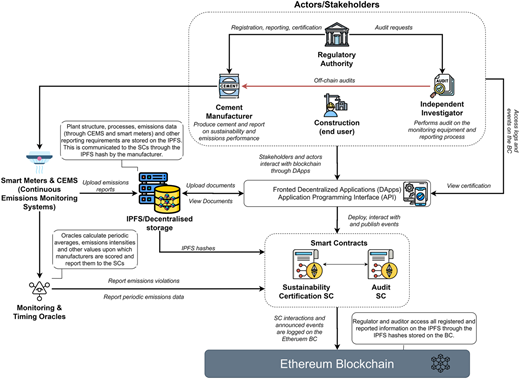
Our proposed solution employs SCs representing the primary requirements and stages of obtaining sustainability certification. These SCs are accessible through decentralized applications (DApps) that the stakeholders use to interact with the SCs. The regulatory authority deploys the SCs and approves transactions, while cement manufacturers register, participate in the system by reporting the required information and receive certification. Independent investigators accept audit requests, access manufacturer reports and information and submit audit results.

The framework is supported by CEMS (CEMS) and smart meters (SMs) – connected to oracles – that monitor and record periodic emissions data supplied to the reporting SCs. Additionally, stakeholders interact with decentralized storage systems such as the Inter-Planetary File System (IPFS) through IPFS hashes to manage large data sets required for reporting and certification. All registration information, reports, transactions and results are recorded on the Ethereum blockchain through the SCs and traceable through each actor's Ethereum address (EA), benefiting from the data security characteristics of the technology and accessible to end users, such as regulating authorities or property developers and project managers that purchase the produced cement for construction. Figure 3 shows the architecture of the proposed blockchain-based cement certification system. More details on the main actors and system components are presented below.

4.2.1 Stakeholders

There are three main stakeholders in our framework who interact with each other using Ethereum SCs.

Regulatory authority: The regulator in our framework is responsible for deploying SCs and holding manufacturers accountable – usually a governmental body tasked with ensuring compliance, sustainable production and emissions mitigation. They also participate in the SCs, approving and sending requests, setting emissions standards and limits and accessing all information stored on and off-chain. The regulator, after announcing the framework and deploying the Sustainability Certification SC, approves applications from cement manufacturers, rejects or revokes registration for non-compliant members and legally backs the certificates issued for compliant members.

Cement manufacturers: Manufacturers are the focus of the framework, as it is their production processes and emissions that are monitored, reported, audited and certified. After successfully registering for the system, manufacturers must install and maintain CEMS and SMs at the most emitting stages of the cement manufacturing process, such as at the kiln stack, pre-heater and pre-calciner, depending on the specific process of each manufacturer (defined during the registration phase). These systems communicate with SCs using oracles, and their information is consolidated into emissions intensities and periodic performance numbers. Manufacturers must also update their information (any process changes, improvements, etc.) and submit their reports at periodic intervals (every quarter/year) to ensure that their scores and certificates reflect their efforts.

Independent investigators: At least once every certification cycle (a certification cycle is defined by the completion of the entire proposed framework once), the regulator will commission an independent investigation/audit to ensure that the manufacturer's self-reporting, CEMS, SMs and registered information are accurate. The independent investigator does not directly interact with the regulator and only interacts with the manufacturer during site visits and equipment checks. All other interaction is done through the auditing SC, ensuring efficiency and reducing any chances for undue influence or malpractice.

4.2.2 Ethereum SCs and sequence of operations

We introduce below the proposed SCs in our framework and outline the order in which our framework will operate, as outlined in the sequence diagrams (Figures 4–6). Our framework includes two SCs:

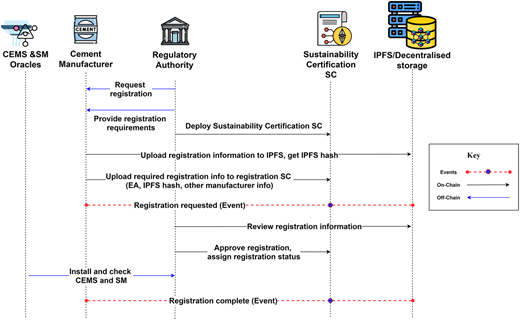
Sustainability Certification SC: This is the main framework SC and contains the bulk of the required interactions, mainly involving the regulator and the cement manufacturers. This SC is responsible for the three main functions of registration, reporting and certification. Once the regulator deploys this SC, the manufacturer is required to interact and register their information through it. Current production process stages, energy requirements, raw material input, produced output, waste material, direct emissions at required process stages, terms and conditions of participating in the framework, other legal documents and large historical data sets about the manufacturing process (specifics on machines deployed and process requirements). Required information can be registered on the SC by uploading it to the decentralized storage system to reduce storage costs. The respective IPFS hash is provided in the SC. Once a manufacturer successfully registers, the SC announces this as an event to everyone on the blockchain. Figure 4 shows the sequence diagram for this stage of the proposed solution.

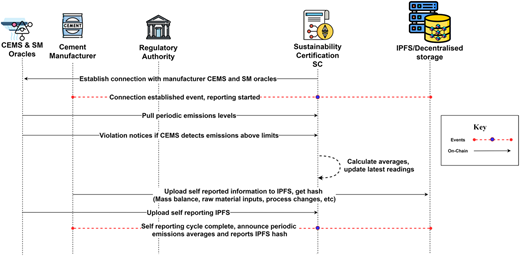
After the regulator approves the registration and the requisite CEMS and SMs are installed, the SC is connected with the reporting oracles, which – the manufacturer ensures – periodically report emissions data. The SC calculates and reports averages, emissions intensities/factors and other performance-related metrics every quarter or year. Manufacturers upload their self-reporting to the IPFS system and provide the hash to the reporting SC. When a reporting cycle is complete, the SC announces the results to everyone on the blockchain. Figure 5 shows the sequence diagram for this stage of the proposed solution.

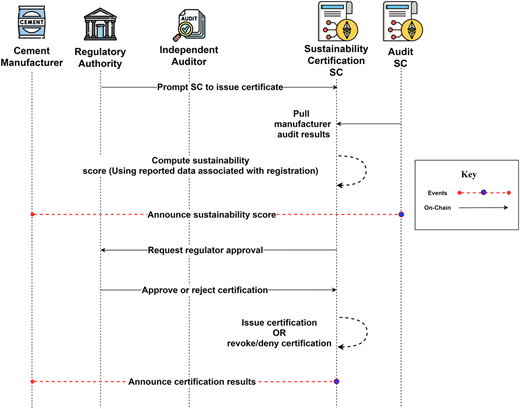
After auditing is approved, the manufacturer prompts the SC to compute the sustainability score – the algorithm for which can be set by the regulator – and issue the certification based on registered process information, reported data and auditing results. This is then announced on the blockchain, and if the score is above the certification threshold, a certificate is issued for the manufacturer's EA with the regulator's approval. Figure 6 shows the sequence diagram for this stage of the proposed solution.

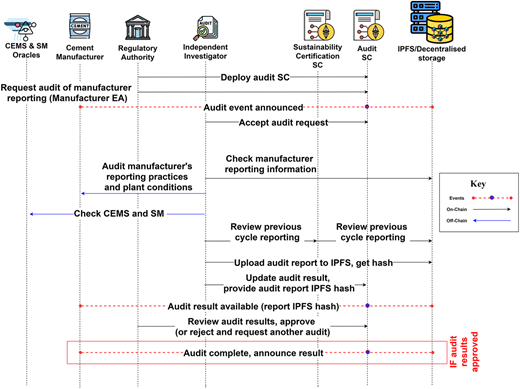
Auditing SC: The second SC required for our framework includes the interactions for the auditing stage of the process. To ensure that the manufacturer's reports are accurate and that the CEMS have not malfunctioned or been tampered with, the regulator deploys the auditing SC and announces an audit request. Independent investigators accept the audit request and obtain the respective manufacturer's information (EA), reporting information and registration IPFS hashes. After reviewing the previous cycles' reporting, performing on-site visits, and checking on the CEMS and SMs, the independent investigator prepares and submits a report – with the highlights directly on the SC and the full report through an IPFS hash. The SC then announces the result of the report, and the regulator must review and either accept or reject the request. The registration status of the manufacturer is then updated on the registration SC. Figure 7 shows the sequence diagram for this stage of the proposed solution.

4.2.3 Decentralized storage system

Decentralized storage (Such as IPFS protocol-based solutions) is a cost-efficient way to publish and store information in a decentralized manner. Once data are uploaded, a unique hash is generated and stored on the blockchain through the associated SCs and is accessible by other SCs and participants in the network. Any changes to the files are reflected in their hashes, making any tampering with the data easily traceable.

After recognizing the need for sustainable certification of production processes in the cement industry, the utility of applying a blockchain-based approach, identifying the stakeholders and laying out the system's architecture (Figure 3), we write the SCs at the centre of the solution.

The logic behind the code is explained in detail in the following section to allow the easy reproduction and generalization of our work. The SCs are developed using Solidity in the Remix Ethereum IDE. The documentation for the Solidity language is provided at (soliditylang.org, 2024), while the documentation for the Remix IDE is found at (Remix Team, n.d.).

The solidity code uses structures to hold manufacturer, reporting, certification and audit information, in addition to defining multiple events to announce important information to the network and modifiers to ensure the proper levels of access are granted to each stakeholder–function combination. Our framework can be thought of as having four main functions: Deployment and Registration, Reporting, Auditing and Certification.

4.3.1 Deployment and Registration

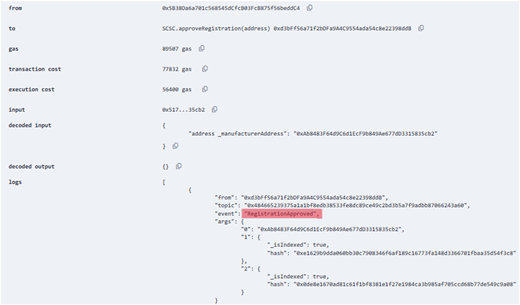
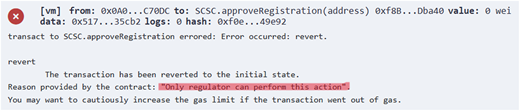
In the first stage of the proposed framework, captured in Algorithm 1, the SC must be deployed by the regulator, which the constructor then sets for all subsequent SC interactions using their unique EA. The manufacturer then transacts the register function, providing their official name, geographical address and the IPFS hash of their comprehensive registration details document. An event about the manufacturer's intent to register, their EA, registered name and location is announced. Upon listening to this event, the regulator reviews the registration information on the IPFS and approves the manufacturer's registration to the framework by transacting the approveRegistration function using the manufacturer's EA. Only the regulator can complete this step, ensured by the onlyRegulator modifier. The approval is announced in an event that also emits the manufacturer's name, EA and location.

Algorithm 1.

Registering Cement Manufacturers

-Manufacturer Registration

Input: Name, Location, Registration Info IPFS Hash

Output: Manufacturer registered (but not approved yet)

if caller is already registered then

 Reject the transaction with the message “Manufacturer is already registered”;

else

 Create a new manufacturer with the provided details and set the registration status to false;

 Emit the “RegistrationRequested” event with the manufacturer's address (EA), name, and

 location;

- Approve Manufacturer Registration

Input: Manufacturer Address

Output: Manufacturer registration approved

if caller is not the regulator then

 Reject the transaction with the message “Only the regulator can approve registration.”;

else

 Approve manufacturer registration by setting registration status to true;

 Set emission threshold for the manufacturer;

 Emit the “RegistrationApproved” event with the manufacturer's address, name and location;

4.3.2 Reporting

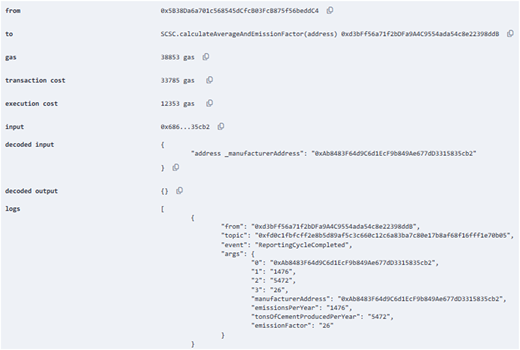
In the reporting stage of the framework, seen in Algorithm 2, Manufacturers initiate the reporting process by connecting their sensors to the SC. This action is facilitated by the connectSensors function, accessible only to registered manufacturers. Upon invocation, the manufacturer's status of sensor connectivity is updated, triggering an event and signalling a successful connection. Following sensor connectivity, manufacturers report their emissions data to the SC. Utilizing the reportEmissions function, registered manufacturers submit their emissions information, including the amount of emissions, tons of cement produced and an IPFS hash referencing the comprehensive emissions report. Each submission generates a new emissions report stored alongside previous submissions. The manufacturer's cumulative emissions, production statistics and reporting frequency are also updated. In cases where reported emissions exceed the predefined threshold, a violation event is emitted, notifying the regulator. Periodically, the regulator calculates each manufacturer's average emissions and emission factor. By invoking the calculateAverageAndEmissionFactor function, accessible exclusively to the regulator, historical emissions data is analysed to derive annual emissions, production rates and ultimately, the emission factor (emissions per ton of cement produced). This calculation considers the time elapsed since the last report and ensures non-zero division for accurate results. An event is emitted upon completion, providing insights into the manufacturer's environmental performance.

Algorithm 2.

Reporting Manufacturer Emissions

- Connect Sensors

Input: Manufacturer Prompts connection

Output: Manufacturer connected to sensors

if caller is not a registered manufacturer then

 Reject the transaction with the message “Only registered manufacturers can connect sensors.”;

else

 Connect manufacturer to sensors by setting connection status to true;

 Emit “SensorConnected” event with manufacturer's address;

- Report Emissions

Input: Emissions, Tons of Cement Produced, Report IPFS Hash

Output: Emissions reported

if caller is not a registered manufacturer then

 Reject the transaction with the message “Only registered manufacturers can report emissions.”;

else if manufacturer is not connected to sensors then

 Reject the transaction with the message “Manufacturer must be connected to sensors to report

 emissions.”;

else

 Record emissions report with provided details;

 Update manufacturer's emissions data;

 Check for emissions violation and emit event if threshold exceeded;

- Calculate Average Emissions and Emission Factor

Input: Manufacturer Address

Output: Average emissions, Tons of cement produced per year, Emission factor

if caller is not the regulator then

 Reject the transaction with the message “Only the regulator can calculate emissions data.”;

else

 Calculate emissions data based on manufacturer's reports;

 Emit the “ReportingCycleCompleted” event with emissions data;

4.3.3 Auditing

To ensure compliance and maintain accountability within the cement manufacturing ecosystem, the regulatory authority initiates audits by requesting manufacturers to undergo evaluation. This process, illustrated by Algorithms 34, begins with the regulator invoking the requestAudit function, generating a unique request ID for tracking purposes. Each audit request is associated with a specific manufacturer and marked “open” for auditor applications. Upon request initiation, an event is emitted, signalling the opening of the audit request. Auditors interested in conducting audits apply through the applyForAudit function, accessible exclusively to auditors and restricted from manufacturers. Applicants submit their candidacy for a specific audit request, expressing their willingness to participate. The applied auditors' Ethereum addresses are appended to the respective request, facilitating regulator selection. An event is emitted to notify the stakeholders of the auditor's application.

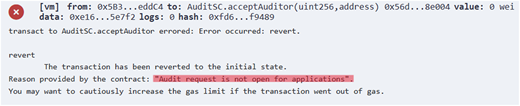
Regulators review auditor applications and accept suitable candidates by invoking the acceptAuditor function. From the pool of applicants, regulators select auditors for a particular audit request, adding them to the list of accepted auditors. Accepted auditors are removed from the list of applied auditors, and the request for further applications is closed. This action ensures that auditors are designated for specific audit tasks, enhancing efficiency and accountability. Following regulator acceptance, auditors conduct audits and submit reports using the submitAuditReport function. Only accepted auditors associated with a specific audit request can submit audit reports. Upon submission, auditors provide an IPFS hash referencing the comprehensive audit report and indicate whether the manufacturer passed the audit. Subsequently, the audit request is marked as completed, and the audit result, along with the report's availability, is emitted through blockchain events. Regulators finalize the audit process by approving or rejecting audit results using the approveAuditResult function. Upon reviewing the submitted audit report, regulators approve the satisfactory results or reject them if deemed inadequate. Approval signifies compliance with regulatory standards, while rejection may trigger additional actions, such as reopening the audit request for further evaluation. Relevant events are emitted to inform stakeholders of the audit outcome and any subsequent actions taken.

Algorithm 3.

Commissioning audits

- Request Audit

Input: Manufacturer Address

Output: Audit request initiated

if caller is not the regulator then

 Reject the transaction with the message “Only the regulator can request an audit.”;

else

 Create a new audit request with the provided manufacturer address;

 Emit the “AuditRequestOpened” event with regulator, manufacturer and request ID;

- Apply for Audit

Input: Request ID

Output: Auditor applied

if caller is the regulator or manufacturer then

 Reject the transaction with the message “Only auditors can apply for audits.”;

else

 Add auditor to the list of applied auditors for the given request ID;

 Emit “AuditorApplied” event with auditor's address and request ID;

- Accept Auditor

Input: Request ID, Auditor Address

Output: Auditor accepted

if caller is not the regulator then

 Reject the transaction with the message “Only the regulator can accept auditors.”’

else

 Add auditor to the list of accepted auditors and remove from applied auditors;

 Close the audit request for further applications;

Algorithm 4.

Submitting and Approving Audits

- Submit Audit Report

Input: Request ID, Report IPFS Hash, Pass/Fail Status

Output: Audit report submitted

if caller is not accepted auditor then

 Reject the transaction with the message “Only accepted auditors can submit audit reports.”;

else

 Record audit report with provided details and set request status to completed;

 Emit the “AuditReportSubmitted” event with request ID and report IPFS hash;

 Emit “AuditResultAvailable” event with pass/fail status;

- Approve Audit Result

Input: Request ID, Approval Status

Output: Audit result approved

if caller is not the regulator then

 Reject the transaction with the message “Only the regulator can approve audit results.”;

else

 Approve audit result by setting approval status to true;

 Emit the “AuditResultAvailable” event with approval status;

 If approved, emit the “AuditCompleted” event;

4.3.4 Certification

After the auditing phase, regulators may issue certificates to compliant manufacturers. The issueCertificate function facilitates this process by generating a sustainability score based on the emission factor. A new certification is created, capturing relevant manufacturer details and environmental metrics. An event announcing the issuance and certification index is emitted, facilitating subsequent approval procedures. Finally, regulators review and approve certificates using the approveCertificate function. By providing the index of the certificate to be approved, regulators mark the certification as regulator-approved, signalling compliance with environmental standards. This action triggers an event confirming the approval. This final stage of our framework can be seen in the logic of Algorithm 5.

Throughout these interactions, the SCs maintain strict access controls, ensuring that only registered manufacturers, authorized auditors and the regulator who deploys the SCs can engage in relevant functions. This design fosters transparency, accountability and adherence to environmental regulations within the cement manufacturing ecosystem without compromising sensitive information while maintaining appropriate data access.

Algorithm 5.

Issuing certification

- Issue Certificate

Input: Manufacturer Address

Output: Certificate issued

if caller is not the regulator then

 Reject the transaction with the message “Only the regulator can issue certificates.”;

else

 Calculate sustainability score and create a new certification;

 Add certification to the array and emit event;

 Reset manufacturer's emissions data for the next cycle;

- Approve Certificate

Input: Certificate Index

Output: Certificate approved

if caller is not the regulator then

 Reject the transaction with the message “Only the regulator can approve certificates.”;

else

 Approve certificate by setting approval status to true;

 Emit “CertificateApproved” event with certificate index;

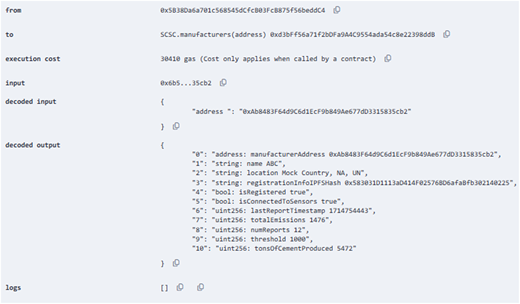
In this section, we compile, test and validate our SCs in the Remix IDE to ensure the correct framework implementation is achieved. The code compiles without any errors, and the functions transact successfully with the proper access privileges. They display the appropriate error messages when these privileges are not met. The framework and developed SCs are tested and validated in many scenarios and configurations. A scenario was designed to simulate interactions among a regulator, a manufacturer, an auditor and multiple unauthorized entities, focusing on potential breaches or improper actions. Table 1 shows the EAs of the stakeholders/actors used in the testing and validation stage. Figures 8–14 show the successful interactions with the SCs, rejected unauthorized interactions and the structures containing manufacturer and audit information. The sequence begins with the regulator deploying the SC, followed by the manufacturer submitting an application to register within the system. Approval of the application is restricted to the regulator; any attempts by unauthorized entities to approve the action trigger an error, as illustrated in Figure 11. Once registered, the manufacturer connects sensors for continuous emission monitoring. Unregistered manufacturers are unable to connect sensors to the blockchain, as demonstrated in Figure 13. The sensors function as oracles, transmitting emission data to the SC. The regulator retrieves this data to calculate averages. Unauthorized attempts to access or manipulate this data also result in an error. Subsequently, the audit process is initiated when the manufacturer requests an audit. Only registered auditors are eligible to apply and the regulator selects an auditor from the pool of applicants. The chosen auditor conducts the audit off-chain to verify compliance with regulations and then submits a report. This submission is restricted to registered auditors, preventing forgery attempts, as shown in Figure 12. Finally, the regulator issues a certificate if the manufacturer meets all standards. The solidity code, screenshots of the implementation, and all information required to independently recreate and test the framework are available on GitHub (https://github.com/AmmarHummieda/CSF---Cement-Sustainability-Framework) and in the supplementary documents of this paper.

In this section, we discuss scalability concerns, security and cost considerations associated with our proposed solution to ensure the framework's efficiency, integrity and value.

One of the key challenges in blockchain technology is scalability. Since every node in the network must process and store each transaction, this inherently reduces potential scalability, throughput and computing speed. However, this trade-off enhances security and verifiability. Compared to traditional networks, which can handle up to 4,000 transactions per second, Ethereum is significantly slower, managing only about 20 transactions per second, making it less scalable. To address these limitations, ongoing research is investigating solutions such as sharding and rollups. These approaches aim to improve scalability by reducing the requirement for every node to process all transactions and store all data on the blockchain, thereby achieving greater efficiency without compromising security (Team, 2024).

In the context of our work for the cement industry – and indeed the potential for applications in similar energy-intensive industries, scalability challenges are not anticipated. Manufacturers are certified annually, audits occur infrequently and the system involves limited actions performed at low frequencies. For CEMS and SM, data for extended periods would typically be uploaded periodically in a single batch, while large data with high resolutions are stored on decentralised storage solutions. Any errors can be addressed as they arise, further minimizing the computational load on the blockchain. Our framework, along with the modular nature of SCs in Solidity, enables adjustments to the frequency of certifications, audits and reporting. This flexibility allows regulators who adopt it to have complete control over the cost and scalability of the framework, tailored to their specific requirements and capabilities.

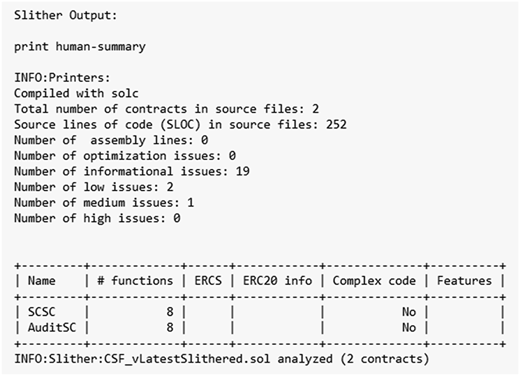
To ensure the integrity and security of the SCs we developed, we ran a security analysis using the popular solidity static analysis framework Slither (Feist et al., 2023). Figure 15 shows the output detailing the issues identified by Slither in our SCs.

Two low-severity issues were identified, and further inspection revealed that they relate to the use of timestamps within SCs, which can be risky due to miner manipulation. While miners cannot directly set timestamps, they can slightly manipulate them within a small range to bypass deadlines or expiry conditions. In the specific context of our implementation, the timestamps are used in the registration and the emissions reporting functions for record keeping and have no access control utilisation. There are no serious security concerns stemming from this use, specifically within the context of our implementation (therefore the low severity).

A single medium-severity issue was also identified. Upon inspection, this issue relates to the declaration of an uninitialized local variable within the requestAudit function. This is considered an issue because uninitialized variables may lead to code errors, undefined behaviours and security risks, particularly if the variable in question is used for access control. However, our use of the variable was for storage – using an empty array to store the addresses of applying auditors for the regulator to later choose from. This section of the code was tested, and no errors or undefined behaviour were observed. Since no access control relates to this array, we conclude that the risk of security breaches is non-existent.

Finally, informational issues are not assigned a severity level and pertain to the use of mixedCase convention in naming variables and functions. Slither automatically picked up variables named with single words (such as register, emissions, manufacturer and so on) as non-conforming to the mixedCase convention, despite the convention applying to variable names that contain more than one word (such as approveRegistration, reportEmissions, requestAudit and so on). The convention was duly applied wherever names contained more than a single word. This does not constitute a security threat or vulnerability.

The issues identified during this security analysis are all mitigable. When it comes to the low-severity issues with timestamps, these can be mitigated upon deployment in a real-world scenario by using region-based trusted external oracles for time-related functions in the SCs. External data, ie, off-chain information, must be evaluated in terms of consistency, reliability and performance. This means that the chosen oracle source must be able to reliably produce accurate time information and deliver it on-chain through a consistent data feed. For increased security, regulators utilising our solution have the option of setting up their own off-chain service or – provided they are connected – use a government-issued time reporting service.

The medium severity issue can be fixed easily by initialising the storage array with a set size instead of leaving it dynamic. This set size will depend on the information the deploying regulator will request from the auditor. As such, while we can easily fix this in our code by setting a size and properly initialising the array with slots for the information to be collected, we have decided to leave it as it is (dynamic array) to emphasize the generalizability of our solution. We reiterate that this causes no issues in the code functionality and does not produce a security threat based on our testing.

Transactions done on the Ethereum blockchain cost gas – a representation of the computational effort required to execute operations or SCs on the network. Gas is priced in ether, the native cryptocurrency of the Ethereum platform. The cost of gas is measured in “Gwei,” a fraction of ether, with 1 Gwei equalling 0.000000001 ether. Transactions require gas because they need to be processed by miners, who secure the network by validating and adding transactions to the blockchain. The more complex or resource-intensive a transaction is, the more gas it will require. Gas prices can fluctuate based on network demand and congestion. SCs define the amount of gas needed for their execution, ensuring that users pay a fair and predictable fee for the computational resources they consume. Since all transactions (and, by extension, SCs) require gas, it is essential to study the cost of our SCs and the proposed framework. Tables 2 and 3 detail the cost of each function in both of our SCs in sequential order of operations.

To calculate the cost of our solution in US Dollars (USD), we have used conversion rates from gas to Gwei (mentioned above), from Gwei to ETH (Ether) and from ETH to USD. For the 25th of May 2024, the dynamic rates (Gwei/gas and $/ETH) were 6 and 3,753 Gwei per gas unit and dollars per ETH, respectively. Note that the significant costs lie mainly in deploying the SCs, which are only done once. Additionally, note that repetitive functions such as checking the structures and reporting emissions are comparatively cheaper. The frequency of these functions is entirely under the regulator's control, and one may decide to require reports once every week, month, quarter or year, depending on their budgets or reporting requirements. The gas costs are based on the business of the network and the current prices of ether on the market, making them very volatile. In our analysis, we saw a 70% reduction in price due to that volatility. High costs are generally due to the rising cost of Ether, which can be mitigated by deploying the SCs using a layer two solution, such as ZkSync (cost shown in Tables 2 and 3).

While our solution is not a process improvement that would directly decrease emissions, nor a policy that could be enforced to reduce emissions, it is a tool that ensures cement producers abide by existing policies and helps identify the most sustainable cement company, so a physical and direct benefit is difficult to quantify. That being said, if we check Tables 2 and 3, the annual cost of applying the solution on Ethereum is around 2,277 USD per company, assuming the certificate is issued yearly, the audit is conducted quarterly, and emissions are reported daily. However, transitioning to ZKsync would reduce this cost to 10.5 USD. This is an extreme minimal expense for a major industry like cement.

Given that the social cost of carbon ranges between 50 and 120 USD/tCO2 (EPA, 2024), if the model is responsible for a minimum reduction of 19–46 tCO2 per year, which is a very achievable goal and below the required value to get back on track, it would be considered feasible based on the benefit-cost ratio.

Current projections indicate that the industry is not on track to meet 2030 or 2050 climate targets (IEA, 2023), highlighting the need for enhanced monitoring and accountability measures. By leveraging blockchain-based certification, companies could enhance compliance with sustainability regulations and expedite their transition to cleaner cement production.

While the proposed framework is tailored specifically for the cement manufacturing industry, the underlying principles and blockchain-based approach can be generalized and adapted to other industrial sectors facing similar sustainability and emissions challenges – such as steel and aluminium production, agriculture, paper and rubber, among others. These industries share similar challenges regarding environmental impact, regulatory compliance and the need for transparent and verifiable reporting mechanisms.

Some critical aspects in our framework enable straightforward generalization with some modifications. The modular design of the core functionalities of the framework – in that they are separated into different SCs or segments within the same SC – allows for the seamless transformation from applying it in cement production to other target heavy industries. The roles of stakeholders, producers and auditors are easily configurable and specific data types and regulatory requirements can be modified in simple lines of our Solidity SC code. The integration of CEMS can be adapted to interface with industry-specific monitoring systems, enabling data collection and reporting from various sources.

For an ideal generalization process, we recommend conducting a thorough requirements analysis for the target application to understand the industry's sustainability challenges, regulatory landscape and reporting requirements to identify the correct adaptation. Following this, the existing data models in the SCs must be extended to incorporate industry-specific data points, such as raw materials, production processes and emission sources. This customization ensures that the tracked and managed data is relevant and comprehensive. Additionally, the framework's parameters, such as emission thresholds, reporting frequencies and certification criteria, must be configured to align with the industry's regulations and best practices, ensuring compliance and effectiveness. The SCs need to be modified or extended to incorporate industry-specific logic, calculations and rules for certification and compliance. This step is crucial for maintaining the integrity and functionality of the framework within the context of the target industry. Integration with the industry's existing monitoring systems or the development of custom monitoring solutions, is also necessary to ensure that data is accurately and efficiently fed into the SCs through oracles. Our CEMS implementation is a generally good solution for most uses, but utilizing existing solutions may bring down the cost of implementation. This brings us neatly to cost considerations, which can be positively affected by adding or removing functions that are not required or reducing the frequency of specific function calls to bring down the gas costs of our implementation. Finally, choosing which blockchain to deploy the framework to significantly affects cost. In industries where blockchain solutions are already implemented (such as Hyperledger Fabric), modifying the framework to work within those blockchains may be worth considering.

Our proposed blockchain-based framework offers significant advancements in certifying sustainable production practices in the cement industry. However, there are certain limitations and areas for future exploration:

Scalability: The current implementation focuses on a single regulator overseeing multiple manufacturers. Future work could explore scalability issues when multiple regulators or a larger number of manufacturers are involved.

Privacy concerns: The transparency of blockchain technology may raise privacy concerns, especially regarding sensitive data such as emissions reports. While our implementation limits the amount of publicly announced information to our conception of essential data, future research could investigate methods for more objectively ensuring privacy while maintaining transparency and audibility.

Interoperability: As the framework matures, interoperability with existing systems and standards in the cement industry becomes crucial. Future work could focus on developing standards for data exchange and interoperability between different blockchain networks.

Regulatory compliance: Our regulatory framework prioritizes compliance, but it needs to be updated as environmental regulations change. To address this, dynamic frameworks can be explored in future research.

User experience: Improving the user experience for stakeholders interacting with the blockchain-based framework is essential for widespread adoption. Future work could focus on designing intuitive user interfaces and streamlining user interactions.

Cost optimization: Our cost analysis provides insights into gas costs associated with SC functions. However, further optimization strategies could minimize transaction costs and improve cost-effectiveness.

Pilot study: Our framework, despite our thorough testing, validation and analysis, remains unexamined in a real-life scenario. The adoption of this framework by a governing body would provide valuable insight and may expose it to challenges that will certainly improve its function and efficiency.

Extension to other industries: While our framework is tailored to the cement industry, similar blockchain-based approaches could be applied to other energy-intensive industries facing sustainability challenges. Future research could explore the applicability and adaptation of our framework to industries such as aluminium, steel, chemicals and mining.

Addressing these limitations and exploring these avenues for future work would enhance the effectiveness, scalability and applicability of blockchain-based solutions for certifying sustainable production practices not only in the cement industry but also across other heavy manufacturing sectors.

The implications of this study extend far beyond the technical implementation of a blockchain-based certification system for sustainable cement production. This research has the potential to significantly reshape how sustainability is approached, verified and incentivized across heavy industries. For regulatory bodies, it offers a powerful tool to streamline compliance monitoring and enforcement while providing cement manufacturers with a credible means to demonstrate their commitment to sustainable practices. This transparency could enhance investor and consumer confidence, potentially driving market preferences towards more sustainable products and substantially contributing to reducing greenhouse gas emissions from the cement industry – a crucial step in global climate change mitigation efforts.

The successful implementation of this system could also hasten the adoption of similar technologies in other emissions-intensive sectors, as discussed in the generalization section, potentially spurring a broader shift towards transparent, verifiable sustainability practices across heavy industries. For policymakers, this framework could serve as a model for developing more effective regulations and incentives for sustainable industrial practices. In the research community, it opens up new avenues for developing similar frameworks and then studying the long-term impacts of blockchain-based systems on industry behaviour and environmental outcomes.

By verifying and incentivising sustainable practices in a major emissions-producing industry, this framework could significantly contribute to global efforts to achieve sustainability goals, such as those outlined in the Paris Agreement and the UN Sustainable Development Goals. Therefore, this study presents a technical solution and has the potential to drive meaningful changes in industrial sustainability practices, representing an essential step towards more transparent, accountable and environmentally responsible industrial operations.

Cement manufacturing, as the most widely used manufactured material, is a critical but significant source of emissions, demanding innovative solutions to balance its indispensability with environmental sustainability. This paper introduces a novel blockchain-based framework designed to certify sustainable production practices in the cement industry. By leveraging the transparency, immutability and decentralization of blockchain technology, this framework enhances accountability, regulatory compliance and transparency in monitoring and certifying emission reduction efforts. The system employs Ethereum SCs to enable seamless interactions among regulators, manufacturers and auditors, facilitating key processes such as deployment, registration, reporting, auditing and certification.

The detailed implementation of the framework – covering system architecture, logical algorithms, sequence diagrams and Solidity code – demonstrates its robustness, security and practical applicability. Security analysis further validates its effectiveness, emphasizing access control mechanisms, event-driven architecture and modifiers to ensure data integrity and prevent unauthorized access. Additionally, the framework is modular, allowing regulators to tailor the frequency of reporting transactions to balance cost and oversight needs, thereby mitigating concerns over the high deployment costs typically associated with blockchain technology.

Despite its merits, the study acknowledges certain limitations such as the challenges associated with scaling the framework for live Ethereum network operations, ensuring regulatory compliance, balancing privacy concerns with the inherent transparency of blockchain technology, interoperability with existing systems, cost optimization and the lack of real-world empirical trials on live industrial data or large-scale field testing. Addressing these challenges – while briefly discussed – remains an active area for future research. Further work could focus on deploying and testing the framework in plants and on the live Ethereum network, creating a user-friendly decentralized application and generalizing the solution for various industries.

Our framework was designed to be modular and flexible, giving the regulator full control over all important parameters of the certification process. This means that the implementation process – given the adoption of our framework by interested regulators – would require editing the code to fit the required jurisdiction and deploying the framework on the Ethereum network. If a more private solution is preferred, the SC code can be modified to be deployed on other blockchain solutions with different security and transparency parameters – such as Hyperledger Fabric.

This research fills a critical gap in the existing literature by providing a scalable, transparent and cost-effective model for certifying sustainable practices in the cement industry. Its applicability extends beyond cement to other heavy manufacturing sectors, such as steel and aluminium production, offering a promising pathway for global environmental stewardship and regulatory compliance in energy-intensive industries. The potential extends to tackling 3 of the United Nations Sustainable Development Goals (SDGs 9, 11 and 13), laying the foundation for transformative applications of blockchain in fostering sustainable industrial practices and encouraging a paradigm shift towards more accountable and eco-friendly manufacturing processes worldwide.

The authors would like to state that this study did not involve human participants or animals. Therefore, ethical approval was not required.
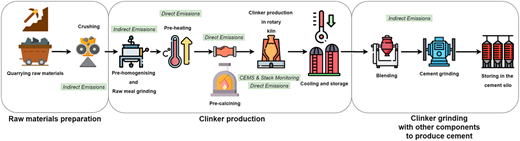
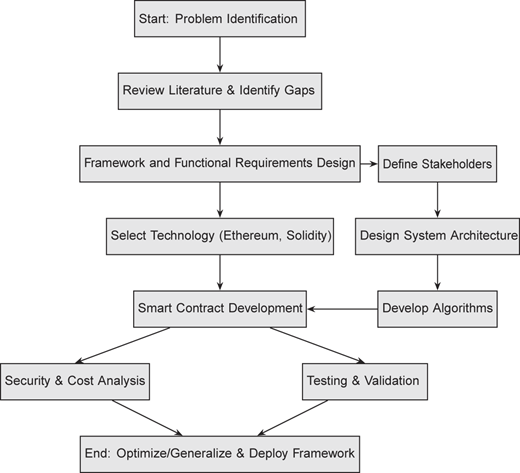
Alazab
,
M.
and
Alhyari
,
S.
(
2024
), “
Industry 4.0 innovation: a systematic literature review on the role of blockchain technology in creating smart and sustainable manufacturing facilities
”,
Information
, Vol. 
15
No. 
78
, p.
78
, doi: .
AlKhader
,
W.
,
Jayaraman
,
R.
,
Salah
,
K.
,
Sleptchenko
,
A.
,
Antony
,
J.
and
Omar
,
M.
(
2023
), “
Leveraging blockchain and nfts for quality 4.0 implementation in digital manufacturing
”,
Journal of Manufacturing Technology Management
, Vol. 
34
No. 
7
, pp. 
1208
-
1234
, doi: .
Alqaryuti
,
A.
,
Moawad
,
K.
,
Salah
,
K.
,
Mayyas
,
A.
and
Jayaraman
,
R.
(
2025
), “
Blockchain-driven framework for preventive maintenance management of aircraft hydraulic systems
”,
Discov Internet Things
, Vol. 
5
No. 
50
, 50, doi: .
Alsadi
,
J.
,
Alkhatib
,
F.
,
Antony
,
J.
,
Garza-Reyes
,
J.A.
,
Tortorella
,
G.
and
Cudney
,
E.A.
(
2024
), “
A systematic literature review with bibliometric analysis of quality 4.0
”,
The TQM Journal
, Vol. 
37
No. 
5
, pp. 
1446
-
1470
, doi: .
Basheer
,
M.
,
Elghaish
,
F.
,
Brooks
,
T.
,
Pour Rahimian
,
F.
and
Park
,
C.
(
2024
), “
Blockchain-based decentralized material management system for construction projects
”,
Journal of Building Engineering
, Vol. 
82
, 108263,
available at:
 https://doi.org/10.1016/j.jobe.2023.108263 (
accessed
 28 Februray 2024).
Chadly
,
A.
,
Hasan
,
H.R.
,
Moawad
,
K.
,
Salah
,
K.
,
Omar
,
M.
and
Mayyas
,
A.
(
2023
), “
A blockchain-based solution for the traceability of rare earth metals used in thin-film photovoltaics
”,
Journal of Cleaner Production
, Vol. 
428
, 139399, doi: .
Chandler
,
D.L.
(
2019
), “
Researchers have created emissions-free cement
”,
available at:
 https://www.weforum.org/agenda/2019/09/cement-production-country-world-third-largest-emitter (
accessed
 27 Februray 2024).
Chatham House
(
2018
), “
Making concrete change: innovation in low-carbon cement and concrete
”,
available at:
 https://www.chathamhouse.org/2018/06/making-concrete-change-innovation-low-carbon-cement-and-concrete (
accessed
 27 Februray 2024).
Climate Action
(
n.d.
), “
Intiatives for action
”,
available at:
 https://www.un.org/en/climatechange/climate-action-coalitions (
accessed
 28 February 2024).
Das
,
M.
,
Luo
,
H.
and
Cheng
,
J.C.
(
2020
), “
Securing interim payments in construction projects through a blockchain-based framework
”,
Automation in Construction
, Vol. 
118
, 103284, doi: .
Diniz
,
E.H.
,
Yamaguchi
,
J.A.
,
Rachael dos Santos
,
T.
,
Pereira de Carvalho
,
A.
,
Alégo
,
A.S.
and
Carvalho
,
M.
(
2021
), “
Greening inventories: blockchain to improve the ghg protocol program in scope 2
”,
Journal of Cleaner Production
, Vol. 
291
, 125900, doi: .
Elghaish
,
F.
,
Hosseini
,
M.R.
,
Matarneh
,
S.
,
Talebi
,
S.
,
Wu
,
S.
,
Martek
,
I.
,
Poshdar
,
M.
and
Ghodrati
,
N.
(
2021
), “
Blockchain and the ‘internet of things’ for the construction industry: research trends and opportunities
”,
Automation in Construction
, Vol. 
132
, 103942, doi: .
Elghaish
,
F.
,
Matarneh
,
S.
,
Edwards
,
D.
,
Pour Rahimian
,
F.
,
El-Gohary
,
H.
and
Ejohwomu
,
O.
(
2022
), “
Applications of industry 4.0 digital technologies towards a construction circular economy: gap analysis and conceptual framework
”,
Construction Innovation
, Vol. 
22
No. 
3
, pp. 
647
-
670
, doi: .
EPA
(
2024
), “
EPA's ‘report on the social cost of greenhouse gases: estimates incorporating recent scientific advances’ — US EPA
”,
available at:
 https://www.epa.gov/environmental-economics/scghg (
accessed
 31 January 2024).
Ethereum
(
2023
), “
What is ethereum?
”,
available at:
 https://ethereum.org/en/what-is-ethereum/(
accessed
 2 May 2024).
Feist
,
J.
,
Grieco
,
G.
and
Groce
,
A.
(
2023
), “
Slither analyzer (Version 0.9.5)
”,
available at:
 https://github.com/crytic/slither
Gagg
,
C.R.
(
2014
), “
Cement and concrete as an engineering material: an historic appraisal and case study analysis
”,
Engineering Failure Analysis
, Vol. 
40
, pp. 
114
-
140
,
available at:
 https://doi.org/10.1016/j.engfailanal.2014.02.004 (
accessed
 27 February 2024).
Global Cement and Concrete Association
(
2019
),
Gcca Sustainability Charter (Tech. rep.)
,
Global Cement and Concrete Association
,
London
,
available at:
 https://gccassociation.org/sustainability-innovation/sustainability-charter-and-guidelines/
Global cement and concrete association (gcca)
(
2024
),
available at:
 https://gccassociation.org/ (
accessed
 23 March 2024).
Hamledari
,
H.
and
Fischer
,
M.
(
2021
), “
Measuring the impact of blockchain and smart contracts on construction supply chain visibility
”,
Advanced Engineering Informatics
, Vol. 
50
, 101444, doi: .
Hasan
,
H.R.
,
Salah
,
K.
,
Jayaraman
,
R.
,
Ahmad
,
R.W.
,
Yaqoob
,
I.
and
Omar
,
M.
(
2020
), “
Blockchain-based solution for the traceability of spare parts in manufacturing
”,
IEEE Access
, Vol. 
8
, pp. 
100308
-
100322
, doi: .
Hummieda
,
A.
,
Bouabid
,
A.
,
Moawad
,
K.
and
Mayyas
,
A.
(
2023
), “
The uae's energy system and ghg emissions: pathways to achieving national goals by 2050
”,
Clean Energy
, Vol. 
7
No. 
5
, pp. 
962
-
980
, doi: .
IEA
(
2018a
),
Technology Roadmap - Low-Carbon Transition in the Cement Industry (Tech. rep.)
,
IEA
,
Paris
,
available at:
 https://www.iea.org/reports/technology-roadmap-low-carbon-transition-in-the-cement-industry (
accessed
 28 February 2024).
IEA
(
2018b
),
Technology roadmap - Low-Carbon Transition in the Cement Industry (Tech. rep.)
,
IEA
,
available at:
 https://www.iea.org/reports/technology-roadmap-low-carbon-transition-in-the-cement-industry (
accessed
 7 March 2024).
IEA
(
2023
), “
Cement - iea
”,
available at:
 https://www.iea.org/energy-system/industry/cement#tracking (
accessed
 31 January 2024).
Khanfar
,
A.A.A.
,
Iranmanesh
,
M.
,
Ghobakhloo
,
M.
,
Senali
,
M.G.
and
Fathi
,
M.
(
2021
), “
Applications of blockchain technology in sustainable manufacturing and supply chain management: a systematic review
”,
Sustainability
, Vol. 
13
No. 
7870
, p.
7870
, doi: .
Kiu
,
M.S.
,
Chia
,
F.C.
and
Wong
,
P.F.
(
2022
), “
Exploring the potentials of blockchain application in construction industry: a systematic review
”,
International Journal of Construction Management
, Vol. 
22
No. 
15
, pp. 
2931
-
2940
, doi: .
Lee
,
D.
,
Lee
,
S.H.
,
Masoud
,
N.
,
Krishnan
,
M.S.
and
Li
,
V.C.
(
2021
), “
Integrated digital twin and blockchain framework to support accountable information sharing in construction projects
”,
Automation in Construction
, Vol. 
127
, 103688,
available at:
 https://doi.org/10.1016/j.autcon.2021.103688 (
accessed
 28 February 2024).
Li
,
W.
,
Wang
,
L.
,
Li
,
Y.
and
Liu
,
B.
(
2021
), “
A blockchain-based emissions trading system for the road transport sector: policy design and evaluation
”,
Climate Policy
, Vol. 
21
No. 
3
, pp. 
337
-
352
, doi: .
Li
,
X.
,
Lu
,
W.
,
Xue
,
F.
,
Wu
,
L.
,
Zhao
,
R.
,
Lou
,
J.
and
Xu
,
J.
(
2022
), “
Blockchain-enabled IoT-BIM platform for supply chain management in modular construction
”,
Journal of Construction Engineering and Management
, Vol. 
148
No. 
2
, 04021195, doi: .
Lu
,
W.
,
Li
,
X.
,
Xue
,
F.
,
Zhao
,
R.
,
Wu
,
L.
and
Yeh
,
A.G.
(
2021a
), “
Exploring smart construction objects as blockchain oracles in construction supply chain management
”,
Automation in Construction
, Vol. 
129
, 103816, doi: .
Lu
,
W.
,
Wu
,
L.
,
Zhao
,
R.
,
Li
,
X.
and
Xue
,
F.
(
2021b
), “
Blockchain technology for governmental supervision of construction work: learning from digital currency electronic payment systems
”,
Journal of Construction Engineering and Management
, Vol. 
147
No. 
10
, 04021122, doi: .
Mittleman
,
E.
(
2018
),
The Cement Industry, One of the World's Largest Co2 Emitters, Pledges to Cut Greenhouse Gases
,
Yale
 
E360, available at:
 https://e360.yale.edu/digest/the-cement-industry-one-of-the-worlds-largest-$CO_2$-emitters-pledges-to-cut-greenhouse-gases (
accessed
 27 February 2024)
Moawad
,
K.
,
Hummieda
,
A.
,
Musamih
,
A.
,
Salah
,
K.
and
Mayyas
,
A.
(
2025a
), “
Blockchain and nfts: revolutionizing critical material recycling from end-of-life lithium-ion batteries
”,
Resources, Conservation & Recycling Advances
, Vol. 
27
, 200258, doi: .
Moawad
,
K.
,
Musamih
,
A.
,
Chadly
,
A.
,
Mayyas
,
A.
,
Salah
,
K.
,
Jayaraman
,
R.
,
Omar
,
M.
and
Yaqoob
,
I.
(
2025b
), “
Blockchain-enabled sustainability of li-ion batteries supply chain: tracking and sourcing eco-friendly materials
”,
International Journal of Production Research
, pp. 
1
-
42
, doi: .
Moumin
,
G.
,
Ryssel
,
M.
,
Zhao
,
L.
,
Markewitz
,
P.
,
Sattler
,
C.
,
Robinius
,
M.
and
Stolten
,
D.
(
2020
), “
CO2 emission reduction in the cement industry by using a solar calciner
”,
Renewable Energy
, Vol. 
145
, pp. 
1578
-
1596
, doi: .
Mubarik
,
M.
,
Rasi
,
R.Z.R.M.
,
Mubarak
,
M.F.
and
Ashraf
,
R.
(
2021
), “
Impact of blockchain technology on green supply chain practices: evidence from emerging economy
”,
Management of Environmental Quality
, Vol. 
32
No. 
5
, pp. 
1023
-
1039
, doi: .
Nguyen
,
D.C.
,
Pathirana
,
P.N.
,
Ding
,
M.
and
Seneviratne
,
A.
(
2019
), “
Blockchain for 5g and beyond networks: a state of the art survey
”,
ArXiv, abs/1912.05062
,
available at:
 https://api.semanticscholar.org/CorpusID:209202834
Pan
,
Y.
,
Zhang
,
X.
,
Wang
,
Y.
,
Yan
,
J.
,
Zhou
,
S.
,
Li
,
G.
and
Bao
,
J.
(
2019
), “
Application of blockchain in carbon trading [innovative solutions for energy transitions]
”,
Energy Procedia
, Vol. 
158
, pp. 
4286
-
4291
, doi: .
Patro
,
P.K.
,
Jayaraman
,
R.
,
Salah
,
K.
and
Yaqoob
,
I.
(
2022
), “
Blockchain-based traceability for the fishery supply chain
”,
IEEE Access
, Vol. 
10
, pp. 
81134
-
81154
, doi: .
Qian
,
X.
and
Papadonikolaki
,
E.
(
2021
), “
Shifting trust in construction supply chains through blockchain technology
”,
Engineering, Construction and Architectural Management
, Vol. 
28
No. 
2
, pp. 
584
-
602
, doi: .
Remix Team
(
n.d.
), “
Remix documentation
”,
available at:
 https://remix.ethereum.org (
accessed
 14 July 2024).
Rodrigo
,
M.N.N.
,
Perera
,
S.
,
Senaratne
,
S.
and
Jin
,
X.
(
2020
), “
Potential application of blockchain technology for embodied carbon estimating in construction supply chains
”,
Buildings
, Vol. 
10
No. 
8
, p.
140
, doi: .
Rodrigo
,
M.N.N.
,
Perera
,
S.
,
Senaratne
,
S.
and
Jin
,
X.
(
2022
), “
Systematic development of a data model for the blockchain-based embodied carbon (bec) estimator for construction
”,
Engineering, Construction and Architectural Management
, Vol. 
29
No. 
9
, pp. 
3311
-
3330
, doi: .
Rodrigo
,
N.
,
Omrany
,
H.
,
Chang
,
R.
and
Zuo
,
J.
(
2024
), “
Leveraging digital technologies for circular economy in construction industry: a way forward
”,
Smart and Sustainable Built Environment
, Vol. 
13
No. 
1
, pp. 
85
-
116
, doi: .
Rubenstein
,
M.
(
2012
), “
Emissions from the cement industry
”,
State of the Planet
,
available at:
 https://news.climate.columbia.edu/2012/05/09/emissions-from-the-cement-industry (
accessed
 27 February 2024).
Salah
,
K.
,
Nizamuddin
,
N.
,
Jayaraman
,
R.
and
Omar
,
M.
(
2019
), “
Blockchain-based soybean traceability in agricultural supply chain
”,
IEEE Access
, Vol. 
7
, pp. 
73295
-
73305
, doi: .
Schorcht
,
F.
,
Kourti
,
I.
,
Scalet
,
B.M.
,
Roudier
,
S.
and
Delgado Sancho
,
L.
(
2013
),
Best Available Techniques (Bat) Reference Document for the Production of Cement, Lime and Magnesium Oxide (Tech. rep.)
,
European Commission, Joint Research Centre, Institute for Prospective Technological Studies
,
Seville
,
available at:
 https://eippcb.jrc.ec.europa.eu/sites/default/files/2019-11/CLM%5C_Published%5C_def%5C_0.pdf (
accessed
 28 February 2024).
Schulz
,
K.
and
Feist
,
M.
(
2021
), “
Leveraging blockchain technology for innovative climate finance under the green climate fund
”,
Earth System Governance
, Vol. 
7
, 100084, doi: .
Singh
,
A.K.
and
Kumar
,
V.P.
(
2024
), “
Establishing the relationship between the strategic factors influencing blockchain technology deployment for achieving sdg and esg objectives during infrastructure development: an ism-micmac approach
”,
Smart and Sustainable Built Environment
, Vol. 
13
No. 
3
, pp. 
711
-
736
, doi: .
soliditylang.org
(
2024
), “
Solidity documentation
”,
available at:
 https://docs.soliditylang.org/en/develop/ (
accessed
 14 July 2024).
Staff
,
C.E.
(
2023
), “
A deep dive into the 5 popular smart contract development platforms and their comparison
”,
available at:
 https://cointelegraph.com/learn/articles/smart-contract-development-platforms (
Updated
 22 April 2024).
Swan
,
M.
(
2015
),
Blockchain: Blueprint for a New Economy
,
O’Reilly Media
,
Sebastopol
.
Szczesniak
,
P.A.
(
2023
),
The Mineral Industry of the united arab emirates (Tech. rep.)
,
U.S. Geological Survey
,
available at:
 https://www.usgs.gov/centers/nmic/minerals-yearbook-volume-iii-area-reports-international-africa-and-middle-east (
accessed
 28 February 2024).
Tao
,
X.
,
Liu
,
Y.
,
Wong
,
P. K.-Y.
,
Chen
,
K.
,
Das
,
M.
and
Cheng
,
J.C.
(
2022
), “
Confidentiality-minded framework for blockchain-based bim design collaboration
”,
Automation in Construction
, Vol. 
136
, 104172, doi: .
Tao
,
X.
,
Das
,
M.
,
Zheng
,
C.
,
Liu
,
Y.
,
Wong
,
P. K.-Y.
,
Xu
,
Y.
,
Liu
,
H.
,
Gong
,
X.
and
Cheng
,
J.C.
(
2023
), “
Enhancing bim security in emergency construction projects using lightweight blockchain-as-a-service
”,
Automation in Construction
, Vol. 
150
, 104846, doi: .
Team
,
S.C.
(
2024
), “
Transactions per second (tps) in blockchain explained
”,
available at:
 https://shardeum.org/blog/blockchain-basics/transactions-per-second-tps-in-blockchain-explained/(
accessed
 27 November 2024).
Umran
,
S.M.
,
Lu
,
S.
,
Abduljabbar
,
Z.A.
,
Zhu
,
J.
and
Wu
,
J.
(
2021
), “
Secure data of industrial internet of things in a cement factory based on a blockchain technology
”,
Applied Sciences
, Vol. 
11
No. 
6376
, p.
6376
, doi: .
UN Climate Change
(
2022
), “
Climate plans remain insufficient: more ambitious action needed now
”,
available at:
 https://unfccc.int/news/climate-plans-remain-insufficient-more-ambitious-action-needed-now (
accessed
 28 February 2024).
UN Climate Change
(
2023a
), “
Ndc synthesis report
”,
available at:
 https://unfccc.int/ndc-synthesis-report-2023 (
accessed
 28 February 2024).
UN Climate Change
(
2023b
), “
New analysis of national climate plans: insufficient progress made, cop28 must set stage for immediate action
”,
available at:
 https://unfccc.int/news/new-analysis-of-national-climate-plans-insufficient-progress-made-cop28-must-set-stage-for-immediate (
accessed
 28 February 2024).
United Nations
(
2015
), “
Goal 13: Take urgent action to combat climate change and its impacts
”,
available at:
 https://www.un.org/sustainabledevelopment/climate-change/ (
accessed
 28 February 2024).
Wang
,
Z.
,
Wang
,
T.
,
Hu
,
H.
,
Gong
,
J.
,
Ren
,
X.
and
Xiao
,
Q.
(
2020a
), “
Blockchain-based framework for improving supply chain traceability and information sharing in precast construction
”,
Automation in Construction
, Vol. 
111
, 103063, doi: .
Wang
,
Z.
,
Wang
,
T.
,
Hu
,
H.
,
Gong
,
J.
,
Ren
,
X.
and
Xiao
,
Q.
(
2020b
), “
Blockchain-based framework for improving supply chain traceability and information sharing in precast construction
”,
Automation in Construction
, Vol. 
111
, 103063, doi: .
Wong
,
P.F.
,
Chia
,
F.C.
,
Kiu
,
M.S.
and
Lou
,
E.C.
(
2022
), “
Potential integration of blockchain technology into smart sustainable city (ssc) developments: a systematic review
”,
Smart and Sustainable Built Environment
, Vol. 
11
No. 
3
, pp. 
559
-
574
, doi: .
Woo
,
J.
,
Fatima
,
R.
,
Kibert
,
C.J.
,
Newman
,
R.E.
,
Tian
,
Y.
and
Srinivasan
,
R.S.
(
2021
), “
Applying blockchain technology for building energy performance measurement, reporting, and verification (mrv) and the carbon credit market: a review of the literature
”,
Building and Environment
, Vol. 
205
, 108199, doi: .
Xu
,
Y.
,
Tao
,
X.
,
Das
,
M.
,
Kwok
,
H.H.
,
Liu
,
H.
,
Kuan
,
K.K.
,
Lau
,
A.K.
and
Cheng
,
J.C.
(
2024
), “
A blockchain-based framework for carbon management towards construction material and product certification
”,
Advanced Engineering Informatics
, Vol. 
61
, 102242, doi: .
Zero Carbon Australia
(
2017
),
Zero Carbon Industry Plan: Rethinking Cement (Tech. rep.)
,
Beyond Zero Emissions
,
Australia
,
available at:
 https://apo.org.au/sites/default/files/resource-files/2017-08/apo-nid103031.pdf (
accessed
 7 March 2024).
Published by Emerald Publishing Limited. This article is published under the Creative Commons Attribution (CC BY 4.0) licence. Anyone may reproduce, distribute, translate and create derivative works of this article (for both commercial and non-commercial purposes), subject to full attribution to the original publication and authors. The full terms of this licence may be seen at http://creativecommons.org/licences/by/4.0/legalcode

Data & Figures

Figure 1
A three-stage process flowchart shows cement production from quarrying to storage icons at each stage.The manufacturing process diagram shows three large, horizontally arranged labeled boxes. From left to right, the first box, “Raw materials preparation,” illustrates quarrying raw materials with a pickaxe and cart icon labeled “Indirect Emissions,” leading by a right-pointing arrow to “crushing” indicated by a crusher icon. This leads to the second box, “Clinker production.” A right-pointing arrow from crushing connects to “Pre-homogenising and Raw meal grinding” with a grinding mill icon labeled above with “Indirect Emissions.” A right-pointing arrow leads to “Pre-heating” with a thermometer icon labeled above with “Direct Emissions,” then a right-pointing arrow to “Pre-calcining” with a heating pipe icon labeled above with “Direct Emissions.” A right-pointing arrow connects to “Clinker production in rotary kiln” with a rotary kiln icon labeled below with “C E M S and Stack Monitoring” and “Direct Emissions.” A rightward arrow leads to “Cooling and storage” with two tall cylindrical silo icons. Cooling and storage lead to the third box, “Clinker grinding with other components to produce cement.” A right-pointing arrow leads to “Blending,” then another right-pointing arrow to “Cement grinding,” and finally a right-pointing arrow to “Storing in the cement silo.” Above blending and cement grinding, “Indirect Emissions” is labeled.

Cement manufacturing process, divided into its three main stages and noting the major emitting steps. Source: Authors' own creation/work

Figure 1
A three-stage process flowchart shows cement production from quarrying to storage icons at each stage.The manufacturing process diagram shows three large, horizontally arranged labeled boxes. From left to right, the first box, “Raw materials preparation,” illustrates quarrying raw materials with a pickaxe and cart icon labeled “Indirect Emissions,” leading by a right-pointing arrow to “crushing” indicated by a crusher icon. This leads to the second box, “Clinker production.” A right-pointing arrow from crushing connects to “Pre-homogenising and Raw meal grinding” with a grinding mill icon labeled above with “Indirect Emissions.” A right-pointing arrow leads to “Pre-heating” with a thermometer icon labeled above with “Direct Emissions,” then a right-pointing arrow to “Pre-calcining” with a heating pipe icon labeled above with “Direct Emissions.” A right-pointing arrow connects to “Clinker production in rotary kiln” with a rotary kiln icon labeled below with “C E M S and Stack Monitoring” and “Direct Emissions.” A rightward arrow leads to “Cooling and storage” with two tall cylindrical silo icons. Cooling and storage lead to the third box, “Clinker grinding with other components to produce cement.” A right-pointing arrow leads to “Blending,” then another right-pointing arrow to “Cement grinding,” and finally a right-pointing arrow to “Storing in the cement silo.” Above blending and cement grinding, “Indirect Emissions” is labeled.

Cement manufacturing process, divided into its three main stages and noting the major emitting steps. Source: Authors' own creation/work

Close modal
Figure 2
A flowchart outlining steps from problem identification to requirements, smart contracts, testing, and deployment.At the top, rectangular text box 1 is labeled “Start: Problem Identification.” A downward arrow leads to a rectangular text box 2 labeled “Review Literature and Identify Gaps.” A downward arrow from rectangular text box 2 leads to rectangular text box 3 labeled “Framework and Functional Requirements Design.” A right-pointing arrow leads to a rectangular text box 4 labeled “Define Stakeholders.” The right-pointing downward arrow leads to a rectangular text box 5 labeled “Design System Architecture.” A downward arrow from rectangular text box 3 leads to rectangular text box 6 labeled “Select Technology (Ethereum, Solidity).” A downward arrow from this rectangular text box 6 leads to a rectangular text box 7 labeled “Smart Contract Development.” A downward arrow from rectangular text box 5 leads to rectangular text box 8 labeled “Develop Algorithms.” A left-pointing arrow from this rectangular text box 8 leads to rectangular text box 7. From these two downward-slanting arrows emerge from the bottom of rectangular text box 7. On the left, the downward-slanting arrow leads to rectangular text box 9 labeled “Security and Cost Analysis,” and the right downward-slanting arrow leads to rectangular text box 10 labeled “Testing and Validation.” A downward arrow from rectangular text box 9 and rectangular text box 10 leads to rectangular text box 11 labeled “End: Optimize slash Generalize slash Deploy Framework.”

Methodology flowchart diagram. Source: Authors' own creation/work

Figure 2
A flowchart outlining steps from problem identification to requirements, smart contracts, testing, and deployment.At the top, rectangular text box 1 is labeled “Start: Problem Identification.” A downward arrow leads to a rectangular text box 2 labeled “Review Literature and Identify Gaps.” A downward arrow from rectangular text box 2 leads to rectangular text box 3 labeled “Framework and Functional Requirements Design.” A right-pointing arrow leads to a rectangular text box 4 labeled “Define Stakeholders.” The right-pointing downward arrow leads to a rectangular text box 5 labeled “Design System Architecture.” A downward arrow from rectangular text box 3 leads to rectangular text box 6 labeled “Select Technology (Ethereum, Solidity).” A downward arrow from this rectangular text box 6 leads to a rectangular text box 7 labeled “Smart Contract Development.” A downward arrow from rectangular text box 5 leads to rectangular text box 8 labeled “Develop Algorithms.” A left-pointing arrow from this rectangular text box 8 leads to rectangular text box 7. From these two downward-slanting arrows emerge from the bottom of rectangular text box 7. On the left, the downward-slanting arrow leads to rectangular text box 9 labeled “Security and Cost Analysis,” and the right downward-slanting arrow leads to rectangular text box 10 labeled “Testing and Validation.” A downward arrow from rectangular text box 9 and rectangular text box 10 leads to rectangular text box 11 labeled “End: Optimize slash Generalize slash Deploy Framework.”

Methodology flowchart diagram. Source: Authors' own creation/work

Close modal
Figure 3
An architecture diagram displaying smart meters, I P F S storage, smart contracts, and the Ethereum blockchain.The architecture diagram titled “Actors slash Stakeholders” shows a blockchain-based cement emission monitoring process. At the top center, a dotted, rounded rectangle includes four stakeholders: “Regulatory Authority” with the government building logo, “Cement Manufacturer” with the cement bag logo, “Construction (end user)” with the construction icon, and “Independent Investigator” with the clipboard logo. A downward-left arrow labeled “Registration, reporting, certification” connects the Regulatory Authority to the Cement Manufacturer, while a downward-right arrow labeled “Audit requests” connects to the Independent Investigator. A horizontal left-pointing arrow labeled “Off-chain audits” links the Independent Investigator to the Cement Manufacturer. A downward arrow from a dotted, rounded rectangle box labeled “Stakeholders and actors interact with blockchain through D Apps” points to the “Fronted Decentralized Applications (D Apps) Application Programming Interface (A P I)” box with a monitor and mobile logo. From the D Apps slash A P I box, a rightward arrow labeled “View certification” connects to a vertical side connector labeled “Access logs and events on the B C,” which extends upward to the top dotted rounded rectangle box. A downward arrow labeled “Deploy, interact with, and publish events” leads from D Apps slash A P I points into a dashed, rounded rectangle labeled “Smart Contracts,” containing “Sustainability Certification S C” on the left and “Audit S C” on the right with document and Ethereum logos connected by a double-headed arrow. Below this section, a downwards arrow labeled “S C interactions and announced events are logged on the Ethereum B C.” A downward arrow connects “Smart Contracts” to the “Ethereum Blockchain” with the Ethereum logo, a rectangular box above the “Ethereum Blockchain” that reads “Regulators and auditors access information on I P F S through the I P F S hashes stored on the B C.” On the left, below “Cement Manufacturer,” a long leftward arrow points to “Smart Meters and C E M S (Continuous Emissions Monitoring Systems)” with a sensor logo, and a rightward arrow labeled “Upload emissions reports” connects it to “I P F S Slash Decentralised storage” with a server and cylinder logo. A note above explains that “plant structure, processes, and emissions data (through C E M S and smart meters), and other reporting requirements are stored on I P F S. This is communicated to S C s through the I P F S hash by the manufacturer.” From the I P F S storage, a downward arrow labeled “I P F S hashes” connects to Smart Contracts. Between I P F S and D apps Slash A P I, Bidirectional arrows labeled “Upload documents” above and “View documents” below. Below the smart meters, a downward arrow points to “Monitoring and Timing Oracles” with a triangle icon. A note above explains that “Oracles calculate periodic averages, emissions intensities, and other values upon which manufacturers are scored and report them to the S Cs.” A rightward arrow from Oracle, labeled “Report emissions violations” above and “Report periodic emissions data” below, leads to Smart Contracts.

High-level system architecture of the proposed blockchain-based certification solution. Source: Authors' own creation/work

Figure 3
An architecture diagram displaying smart meters, I P F S storage, smart contracts, and the Ethereum blockchain.The architecture diagram titled “Actors slash Stakeholders” shows a blockchain-based cement emission monitoring process. At the top center, a dotted, rounded rectangle includes four stakeholders: “Regulatory Authority” with the government building logo, “Cement Manufacturer” with the cement bag logo, “Construction (end user)” with the construction icon, and “Independent Investigator” with the clipboard logo. A downward-left arrow labeled “Registration, reporting, certification” connects the Regulatory Authority to the Cement Manufacturer, while a downward-right arrow labeled “Audit requests” connects to the Independent Investigator. A horizontal left-pointing arrow labeled “Off-chain audits” links the Independent Investigator to the Cement Manufacturer. A downward arrow from a dotted, rounded rectangle box labeled “Stakeholders and actors interact with blockchain through D Apps” points to the “Fronted Decentralized Applications (D Apps) Application Programming Interface (A P I)” box with a monitor and mobile logo. From the D Apps slash A P I box, a rightward arrow labeled “View certification” connects to a vertical side connector labeled “Access logs and events on the B C,” which extends upward to the top dotted rounded rectangle box. A downward arrow labeled “Deploy, interact with, and publish events” leads from D Apps slash A P I points into a dashed, rounded rectangle labeled “Smart Contracts,” containing “Sustainability Certification S C” on the left and “Audit S C” on the right with document and Ethereum logos connected by a double-headed arrow. Below this section, a downwards arrow labeled “S C interactions and announced events are logged on the Ethereum B C.” A downward arrow connects “Smart Contracts” to the “Ethereum Blockchain” with the Ethereum logo, a rectangular box above the “Ethereum Blockchain” that reads “Regulators and auditors access information on I P F S through the I P F S hashes stored on the B C.” On the left, below “Cement Manufacturer,” a long leftward arrow points to “Smart Meters and C E M S (Continuous Emissions Monitoring Systems)” with a sensor logo, and a rightward arrow labeled “Upload emissions reports” connects it to “I P F S Slash Decentralised storage” with a server and cylinder logo. A note above explains that “plant structure, processes, and emissions data (through C E M S and smart meters), and other reporting requirements are stored on I P F S. This is communicated to S C s through the I P F S hash by the manufacturer.” From the I P F S storage, a downward arrow labeled “I P F S hashes” connects to Smart Contracts. Between I P F S and D apps Slash A P I, Bidirectional arrows labeled “Upload documents” above and “View documents” below. Below the smart meters, a downward arrow points to “Monitoring and Timing Oracles” with a triangle icon. A note above explains that “Oracles calculate periodic averages, emissions intensities, and other values upon which manufacturers are scored and report them to the S Cs.” A rightward arrow from Oracle, labeled “Report emissions violations” above and “Report periodic emissions data” below, leads to Smart Contracts.

High-level system architecture of the proposed blockchain-based certification solution. Source: Authors' own creation/work

Close modal
Figure 4
A sequence diagram shows five actors with three legends.The sequence diagram displays five actors at the top from left to right: “C E M S and S M Oracles” with a thermometer and scale icon, “Cement Manufacturer” with a cement bag icon, “Regulatory Authority” with a classical building icon, “Sustainability Certification S C” with a document and gear icon, and “I P F S Slash Decentralised storage” with a server and data icon. Vertical dashed lines descend from each actor. A legend box positioned on the right displays “Legend,” with “Events” indicated by a red dashed line segment with red and blue dots, “On-Chain” indicated by a black solid horizontal arrow, and “Off-Chain” indicated by a blue solid horizontal arrow. From top to bottom, the interactions proceed as follows: An “Off-Chain” arrow points leftward from “Regulatory Authority” to “Cement Manufacturer” labeled “Request registration.” An “Off-Chain” arrow points left from “Regulatory Authority” to “Cement Manufacturer,” labeled “Provide registration requirements.” An “On-Chain” arrow points right from “Regulatory Authority” to “Sustainability Certification S C,” labeled “Deploy Sustainability Certification S C.” An “On-Chain” arrow points right from “Cement Manufacturer” to “I P F S Slash Decentralised storage” and is labeled “Upload registration information to I P F S, get I P F S hash.” An “On-Chain” arrow points right from “Cement Manufacturer” to “Sustainability Certification S C,” labeled “Upload required registration info to registration S C (E A, I P F S hash, other manufacturer info).” An “Events” arrow extends rightward from “Cement Manufacturer” to “I P F S Slash Decentralised storage.” A blue dot is placed on “Sustainability Certification S C,” labeled “Registration requested (Event).” An “On-Chain” arrow points right from “Regulatory Authority” to “I P F S Slash Decentralised storage” and is labeled “Review registration information.” An “On-Chain” arrow points right from “Regulatory Authority” to “Sustainability Certification S C,” labeled “Approve registration, assign registration status.” An “Off-Chain” arrow points right from “C E M S and S M Oracles” to “Regulatory Authority,” labeled “Install and check C E M S and S M.” An “Events” arrow extends rightward from “Cement Manufacturer” to “I P F S Slash Decentralised storage.” A blue dot is placed on “Sustainability Certification S C,” labeled “Registration complete (Event).”

Sequence diagram illustrating the interactions of stakeholders with the SCs in the registration phase of the proposed framework. Source: Authors' own creation/work

Figure 4
A sequence diagram shows five actors with three legends.The sequence diagram displays five actors at the top from left to right: “C E M S and S M Oracles” with a thermometer and scale icon, “Cement Manufacturer” with a cement bag icon, “Regulatory Authority” with a classical building icon, “Sustainability Certification S C” with a document and gear icon, and “I P F S Slash Decentralised storage” with a server and data icon. Vertical dashed lines descend from each actor. A legend box positioned on the right displays “Legend,” with “Events” indicated by a red dashed line segment with red and blue dots, “On-Chain” indicated by a black solid horizontal arrow, and “Off-Chain” indicated by a blue solid horizontal arrow. From top to bottom, the interactions proceed as follows: An “Off-Chain” arrow points leftward from “Regulatory Authority” to “Cement Manufacturer” labeled “Request registration.” An “Off-Chain” arrow points left from “Regulatory Authority” to “Cement Manufacturer,” labeled “Provide registration requirements.” An “On-Chain” arrow points right from “Regulatory Authority” to “Sustainability Certification S C,” labeled “Deploy Sustainability Certification S C.” An “On-Chain” arrow points right from “Cement Manufacturer” to “I P F S Slash Decentralised storage” and is labeled “Upload registration information to I P F S, get I P F S hash.” An “On-Chain” arrow points right from “Cement Manufacturer” to “Sustainability Certification S C,” labeled “Upload required registration info to registration S C (E A, I P F S hash, other manufacturer info).” An “Events” arrow extends rightward from “Cement Manufacturer” to “I P F S Slash Decentralised storage.” A blue dot is placed on “Sustainability Certification S C,” labeled “Registration requested (Event).” An “On-Chain” arrow points right from “Regulatory Authority” to “I P F S Slash Decentralised storage” and is labeled “Review registration information.” An “On-Chain” arrow points right from “Regulatory Authority” to “Sustainability Certification S C,” labeled “Approve registration, assign registration status.” An “Off-Chain” arrow points right from “C E M S and S M Oracles” to “Regulatory Authority,” labeled “Install and check C E M S and S M.” An “Events” arrow extends rightward from “Cement Manufacturer” to “I P F S Slash Decentralised storage.” A blue dot is placed on “Sustainability Certification S C,” labeled “Registration complete (Event).”

Sequence diagram illustrating the interactions of stakeholders with the SCs in the registration phase of the proposed framework. Source: Authors' own creation/work

Close modal
Figure 5
A flowchart showing emissions reporting steps between oracles, manufacturers, regulators, certification, and I P F S.The sequence diagram illustrates the data flow and interactions between five vertical entities: “C E M S and S M Oracles,” “Cement Manufacturer,” “Regulatory Authority,” “Sustainability Certification S C,” and “I P F S slash Decentralised storage.” Horizontal dashed lines represent the sequence of events over time, and a vertical line is present under each entity. A legend on the right indicates that “Events” are represented by a dashed red line with solid blue and red circular markers, and “on-chain” is represented by a black arrow. The sequence begins with a dashed red line with solid blue and red circular markers from “Cement Manufacturer” to “I P F S slash Decentralised storage” labeled “Connection established, reporting started.” Above this, an arrow labeled “Establish connection with manufacturer C E M S and S M oracles” extends leftward from “Sustainability Certification S C” back to “C E M S and S M Oracles.” Next, a black right-pointing arrow, representing a process, goes from “C E M S and S M Oracles” to “Sustainability Certification S C” labeled “Pull periodic emissions levels.” Following this, a black rightward arrow goes from “C E M S and S M Oracles” to “Sustainability Certification S C,” labeled “Violation notices if C E M S detects emissions above limits.” A dashed arrow from “Sustainability Certification S C” to itself is labeled “Calculate averages, update latest readings.” Next, a rightward black arrow goes from “Cement Manufacturer” to “I P F S slash Decentralised storage” labeled “Upload self-reported information to I P F S, get hash (Mass balance, raw material inputs, process changes, etcetera).” This is followed by a solid rightward black arrow from “C E M S and S M Oracles” to “Sustainability Certification S C” labeled “Upload self-reporting I P F S.” The sequence concludes with a dashed red line with solid blue and red circular markers from “Cement Manufacturer” to “Sustainability Certification S C” labeled “Self-reporting cycle complete, announce periodic emissions averages and reports I P F S hash.”

Sequence diagram illustrating the interactions of stakeholders with the SCs in the reporting phase of the proposed framework. Source: Authors' own creation/work

Figure 5
A flowchart showing emissions reporting steps between oracles, manufacturers, regulators, certification, and I P F S.The sequence diagram illustrates the data flow and interactions between five vertical entities: “C E M S and S M Oracles,” “Cement Manufacturer,” “Regulatory Authority,” “Sustainability Certification S C,” and “I P F S slash Decentralised storage.” Horizontal dashed lines represent the sequence of events over time, and a vertical line is present under each entity. A legend on the right indicates that “Events” are represented by a dashed red line with solid blue and red circular markers, and “on-chain” is represented by a black arrow. The sequence begins with a dashed red line with solid blue and red circular markers from “Cement Manufacturer” to “I P F S slash Decentralised storage” labeled “Connection established, reporting started.” Above this, an arrow labeled “Establish connection with manufacturer C E M S and S M oracles” extends leftward from “Sustainability Certification S C” back to “C E M S and S M Oracles.” Next, a black right-pointing arrow, representing a process, goes from “C E M S and S M Oracles” to “Sustainability Certification S C” labeled “Pull periodic emissions levels.” Following this, a black rightward arrow goes from “C E M S and S M Oracles” to “Sustainability Certification S C,” labeled “Violation notices if C E M S detects emissions above limits.” A dashed arrow from “Sustainability Certification S C” to itself is labeled “Calculate averages, update latest readings.” Next, a rightward black arrow goes from “Cement Manufacturer” to “I P F S slash Decentralised storage” labeled “Upload self-reported information to I P F S, get hash (Mass balance, raw material inputs, process changes, etcetera).” This is followed by a solid rightward black arrow from “C E M S and S M Oracles” to “Sustainability Certification S C” labeled “Upload self-reporting I P F S.” The sequence concludes with a dashed red line with solid blue and red circular markers from “Cement Manufacturer” to “Sustainability Certification S C” labeled “Self-reporting cycle complete, announce periodic emissions averages and reports I P F S hash.”

Sequence diagram illustrating the interactions of stakeholders with the SCs in the reporting phase of the proposed framework. Source: Authors' own creation/work

Close modal
Figure 6
A sequence diagram shows five actors with interactions labeled On-Chain and Events, with a legend on the right.The sequence diagram displays five actors at the top from left to right. The “Cement Manufacturer,” with a cement bag icon; “Regulatory Authority,” with a classical building icon; “Independent Auditor,” with a document and checkmark icon; “Sustainability Certification S C,” with a document and gear icon; and “Audit S C,” with a document and gear icon. Vertical dashed lines descend from each actor. A legend box positioned on the right displays “Events,” indicated by a red dashed line segment with red and blue dots, and “On-Chain,” indicated by a solid horizontal arrow. From top to bottom, the interactions proceed as follows: An “On-Chain” arrow pointing right from “Regulatory Authority” to “Sustainability Certification S C,” labeled “Prompt S C to issue certificate.” An “On-Chain” arrow pointing left from “Audit S C” to “Sustainability Certification S C,” labeled “Pull manufacturer audit results.” A dashed arrow pointing to itself “Sustainability Certification S C,” labeled “Compute sustainability score (Using reported data associated with registration).” An “Events” arrow from “Cement Manufacturer” extending rightward to “Audit S C,” labeled “Announce sustainability score.” An “On-Chain” arrow pointing left from “Sustainability Certification S C” to “Regulatory Authority,” labeled “Request regulator approval.” An “On-Chain” arrow pointing right from “Regulatory Authority” to “Sustainability Certification S C,” labeled “Approve or reject certification.” A dashed arrow pointing to itself “Sustainability Certification S C,” labeled “Issue certification OR revoke slash deny certification.” An “Events” arrow from “Cement Manufacturer” extending rightward to “Sustainability Certification S C,” labeled “Announce certification results.

Sequence diagram illustrating the interactions of stakeholders with the SCs in the certification phase of the proposed framework. Source: Authors' own creation/work

Figure 6
A sequence diagram shows five actors with interactions labeled On-Chain and Events, with a legend on the right.The sequence diagram displays five actors at the top from left to right. The “Cement Manufacturer,” with a cement bag icon; “Regulatory Authority,” with a classical building icon; “Independent Auditor,” with a document and checkmark icon; “Sustainability Certification S C,” with a document and gear icon; and “Audit S C,” with a document and gear icon. Vertical dashed lines descend from each actor. A legend box positioned on the right displays “Events,” indicated by a red dashed line segment with red and blue dots, and “On-Chain,” indicated by a solid horizontal arrow. From top to bottom, the interactions proceed as follows: An “On-Chain” arrow pointing right from “Regulatory Authority” to “Sustainability Certification S C,” labeled “Prompt S C to issue certificate.” An “On-Chain” arrow pointing left from “Audit S C” to “Sustainability Certification S C,” labeled “Pull manufacturer audit results.” A dashed arrow pointing to itself “Sustainability Certification S C,” labeled “Compute sustainability score (Using reported data associated with registration).” An “Events” arrow from “Cement Manufacturer” extending rightward to “Audit S C,” labeled “Announce sustainability score.” An “On-Chain” arrow pointing left from “Sustainability Certification S C” to “Regulatory Authority,” labeled “Request regulator approval.” An “On-Chain” arrow pointing right from “Regulatory Authority” to “Sustainability Certification S C,” labeled “Approve or reject certification.” A dashed arrow pointing to itself “Sustainability Certification S C,” labeled “Issue certification OR revoke slash deny certification.” An “Events” arrow from “Cement Manufacturer” extending rightward to “Sustainability Certification S C,” labeled “Announce certification results.

Sequence diagram illustrating the interactions of stakeholders with the SCs in the certification phase of the proposed framework. Source: Authors' own creation/work

Close modal
Figure 7
A sequence diagram displays seven actors with vertical dashed lines and interactions with arrows labeled by legend types.The sequence diagram displays seven actors at the top from left to right: “C E M S and S M Oracles,” with a thermometer and scale icon; “Cement Manufacturer,” with a cement bag icon; “Regulatory Authority,” with a classical building icon; “Independent Investigator,” with a clipboard and checkmark icon; “Sustainability Certification S C,” with a document and gear icon; “Audit S C,” with a document and gear icon; and “I P F S slash Decentralised storage,” with a server and data icon. Vertical dashed lines descend from each actor. A legend box positioned on the right displays “Legend,” with “Events” indicated by a red dashed line segment with red and blue dots, “On-Chain” indicated by a black solid horizontal arrow, and “Off-Chain” indicated by a blue solid horizontal arrow. From top to bottom, the interactions proceed as follows: An “On-Chain” arrow pointing right from “Regulatory Authority” to “Audit S C,” labeled “Deploy audit S C.” An “On-Chain” arrow pointing right from “Regulatory Authority” to “Audit S C,” labeled “Request audit of manufacturer reporting (Manufacturer E A).” An “Events” arrow from “Cement Manufacturer” extending rightward to “I P F S Slash Decentralised storage,” with a red dot on “Cement Manufacturer,” a blue dot on “Audit S C,” and a red dot on “I P F S Slash Decentralised storage,” labeled “Audit event announced.” An “On-Chain” arrow pointing right from “Independent Investigator” to “Audit S C,” labeled “Accept audit request.” An “On-Chain” arrow pointing right from “Independent Investigator” to “I P F S Slash Decentralised storage,” labeled “Check manufacturer reporting information.” An “Off-Chain” arrow pointing left from “Independent Investigator” to “Cement Manufacturer,” labeled “Audit manufacturer’s reporting practices and plant conditions.” An “Off-Chain” arrow pointing left from “Independent Investigator” to “C E M S and S M Oracles,” labeled “Check C E M S and S M.” An “On-Chain” arrow pointing right from “Independent Investigator” to “Sustainability Certification S C,” labeled “Review previous cycle reporting,” and from “Independent Investigator” to “I P F S Slash Decentralised storage,” labeled “Review previous cycle reporting.” An “On-Chain” arrow pointing right from “Independent Investigator” to “I P F S Slash Decentralised storage,” labeled “Upload audit report to I P F S, get hash.” An “On-Chain” arrow pointing right from “Independent Investigator” to “Audit S C,” labeled “Update audit result, provide audit report I P F S hash.” An “Events” arrow from “Cement Manufacturer” extending rightward to “I P F S Slash Decentralised storage,” with a red dot on “Cement Manufacturer,” a blue dot on “Audit S C,” and a red dot on “I P F S Slash Decentralised storage,” labeled “Audit result available (report I P F S hash).” An “On-Chain” arrow pointing right from “Regulatory Authority” to “Audit S C,” labeled “Review audit results, approve (or reject and request another audit).” An “Events” arrow from “Cement Manufacturer” extending rightward to “I P F S slash Decentralised storage,” with a red dot on “Cement Manufacturer,” a blue dot on “Audit S C,” and a red dot on “I P F S slash Decentralised storage,” with a red box surrounding the label “Audit complete, announce result” and vertical text on the right reading “IF audit results approved.”

Sequence diagram illustrating the interactions of stakeholders with the SCs in the Auditing phase of the proposed framework. Source: Authors' own creation/work

Figure 7
A sequence diagram displays seven actors with vertical dashed lines and interactions with arrows labeled by legend types.The sequence diagram displays seven actors at the top from left to right: “C E M S and S M Oracles,” with a thermometer and scale icon; “Cement Manufacturer,” with a cement bag icon; “Regulatory Authority,” with a classical building icon; “Independent Investigator,” with a clipboard and checkmark icon; “Sustainability Certification S C,” with a document and gear icon; “Audit S C,” with a document and gear icon; and “I P F S slash Decentralised storage,” with a server and data icon. Vertical dashed lines descend from each actor. A legend box positioned on the right displays “Legend,” with “Events” indicated by a red dashed line segment with red and blue dots, “On-Chain” indicated by a black solid horizontal arrow, and “Off-Chain” indicated by a blue solid horizontal arrow. From top to bottom, the interactions proceed as follows: An “On-Chain” arrow pointing right from “Regulatory Authority” to “Audit S C,” labeled “Deploy audit S C.” An “On-Chain” arrow pointing right from “Regulatory Authority” to “Audit S C,” labeled “Request audit of manufacturer reporting (Manufacturer E A).” An “Events” arrow from “Cement Manufacturer” extending rightward to “I P F S Slash Decentralised storage,” with a red dot on “Cement Manufacturer,” a blue dot on “Audit S C,” and a red dot on “I P F S Slash Decentralised storage,” labeled “Audit event announced.” An “On-Chain” arrow pointing right from “Independent Investigator” to “Audit S C,” labeled “Accept audit request.” An “On-Chain” arrow pointing right from “Independent Investigator” to “I P F S Slash Decentralised storage,” labeled “Check manufacturer reporting information.” An “Off-Chain” arrow pointing left from “Independent Investigator” to “Cement Manufacturer,” labeled “Audit manufacturer’s reporting practices and plant conditions.” An “Off-Chain” arrow pointing left from “Independent Investigator” to “C E M S and S M Oracles,” labeled “Check C E M S and S M.” An “On-Chain” arrow pointing right from “Independent Investigator” to “Sustainability Certification S C,” labeled “Review previous cycle reporting,” and from “Independent Investigator” to “I P F S Slash Decentralised storage,” labeled “Review previous cycle reporting.” An “On-Chain” arrow pointing right from “Independent Investigator” to “I P F S Slash Decentralised storage,” labeled “Upload audit report to I P F S, get hash.” An “On-Chain” arrow pointing right from “Independent Investigator” to “Audit S C,” labeled “Update audit result, provide audit report I P F S hash.” An “Events” arrow from “Cement Manufacturer” extending rightward to “I P F S Slash Decentralised storage,” with a red dot on “Cement Manufacturer,” a blue dot on “Audit S C,” and a red dot on “I P F S Slash Decentralised storage,” labeled “Audit result available (report I P F S hash).” An “On-Chain” arrow pointing right from “Regulatory Authority” to “Audit S C,” labeled “Review audit results, approve (or reject and request another audit).” An “Events” arrow from “Cement Manufacturer” extending rightward to “I P F S slash Decentralised storage,” with a red dot on “Cement Manufacturer,” a blue dot on “Audit S C,” and a red dot on “I P F S slash Decentralised storage,” with a red box surrounding the label “Audit complete, announce result” and vertical text on the right reading “IF audit results approved.”

Sequence diagram illustrating the interactions of stakeholders with the SCs in the Auditing phase of the proposed framework. Source: Authors' own creation/work

Close modal
Figure 8
A successful smart contract transaction showing the “Registration Approved” event for a manufacturer.The screenshot shows “Ethereum smart contract interaction” text as follows: Line 1. from: 0 x 5 B 3 8 D a 6 a 7 0 1 c 5 6 8 5 4 5 d C f c B 0 3 F c B 8 7 5 f 5 6 b e d d C 4 copy icon. Line 2. to: S C S C dot approve Registration open parenthesis address close parenthesis 0 x d 3 b F f 5 6 a 7 1 f 2 b D F a 9 A 4 C 9 5 5 4 a d a 5 4 c 8 e 2 2 3 9 8 d d B copy icon. Line 3. gas: 8 9 5 0 7 gas copy icon. Line 4. transaction cost: 7 7 8 3 2 gas copy icon. Line 5. execution cost: 5 6 4 0 0 gas copy icon. Line 6. input: 0 x 5 1 7 horizontal ellipsis 3 5 c b 2 copy icon. Line 7. decoded input: open curly bracket. Subline 1. “address underscore manufacture Address” colon “0 x A b 8 4 8 3 F 6 4 d 9 c 6 d 1 E c F 9 b 8 4 9 A e 6 7 7 d D 3 3 1 5 8 3 5 c b 2” Subline 2. close curly bracket copy icon. Line 8. decoded output: open curly bracket close curly bracket copy icon. Line 9. logs: open square bracket. Subline 1. Open curly bracket. Subline 2. from colon “0 x d 3 b F f 5 6 a 7 1 f 2 b D f a 9 A 4 C 9 5 5 4 a d a 5 4 c 8 e 2 2 3 9 8 d d B,” subline 3. “topic” colon “0 x 4 8 4 6 6 5 2 3 9 3 7 5 a 1 a 1 b f 8 e d b 3 8 5 3 3 f e 8 d c e 4 9 c 2 b d 3 b 5 a 7 f 9 a d b b 8 7 0 6 6 2 4 3 a 6 0,” Subline 4. “event” colon “Registration Approved,” Highlighted in red, Subline 5. “args” colon open curly bracket Subline 6. “0” colon “0 x A b 8 4 8 3 F 6 4 d 9 C 6 d 1 E c F 9 b 4 9 A e 6 7 7 d D 3 3 1 5 8 3 5 c b 2,” Subline 7. “1” colon open curly bracket, Subline 8. “underscore is Indexed” colon true, Subline 9. “hash” colon “0 x e 1 6 2 9 b 9 d d a 0 6 0 b b 3 0 c 7 9 0 8 3 4 6 f 6 a f 1 8 9 c 1 6 7 7 3 f a 1 4 8 d 3 3 6 6 7 0 1 f b a a 3 5 d 5 4 f 3 c 8” Subline 10. Close curly bracket, Subline 11. “2” colon open curly bracket “underscore is Indexed” colon true, Subline 12. “hash” colon 0 x 0 d e 8 e 1 6 7 0 a d 8 1 c 6 1 f 1 b f 8 3 8 1 e 1 f 2 7 e 1 9 8 4 c a 3 b 9 8 5 a f 7 0 5 c c d 6 8 b 7 7 d e 5 4 9 c 9 a 0 8” Subline 13. Close curly bracket. Subline 14. Close curly bracket.

Transaction logs displaying the approve registration function – approving manufacturer registration. Source: Authors' own creation/work

Figure 8
A successful smart contract transaction showing the “Registration Approved” event for a manufacturer.The screenshot shows “Ethereum smart contract interaction” text as follows: Line 1. from: 0 x 5 B 3 8 D a 6 a 7 0 1 c 5 6 8 5 4 5 d C f c B 0 3 F c B 8 7 5 f 5 6 b e d d C 4 copy icon. Line 2. to: S C S C dot approve Registration open parenthesis address close parenthesis 0 x d 3 b F f 5 6 a 7 1 f 2 b D F a 9 A 4 C 9 5 5 4 a d a 5 4 c 8 e 2 2 3 9 8 d d B copy icon. Line 3. gas: 8 9 5 0 7 gas copy icon. Line 4. transaction cost: 7 7 8 3 2 gas copy icon. Line 5. execution cost: 5 6 4 0 0 gas copy icon. Line 6. input: 0 x 5 1 7 horizontal ellipsis 3 5 c b 2 copy icon. Line 7. decoded input: open curly bracket. Subline 1. “address underscore manufacture Address” colon “0 x A b 8 4 8 3 F 6 4 d 9 c 6 d 1 E c F 9 b 8 4 9 A e 6 7 7 d D 3 3 1 5 8 3 5 c b 2” Subline 2. close curly bracket copy icon. Line 8. decoded output: open curly bracket close curly bracket copy icon. Line 9. logs: open square bracket. Subline 1. Open curly bracket. Subline 2. from colon “0 x d 3 b F f 5 6 a 7 1 f 2 b D f a 9 A 4 C 9 5 5 4 a d a 5 4 c 8 e 2 2 3 9 8 d d B,” subline 3. “topic” colon “0 x 4 8 4 6 6 5 2 3 9 3 7 5 a 1 a 1 b f 8 e d b 3 8 5 3 3 f e 8 d c e 4 9 c 2 b d 3 b 5 a 7 f 9 a d b b 8 7 0 6 6 2 4 3 a 6 0,” Subline 4. “event” colon “Registration Approved,” Highlighted in red, Subline 5. “args” colon open curly bracket Subline 6. “0” colon “0 x A b 8 4 8 3 F 6 4 d 9 C 6 d 1 E c F 9 b 4 9 A e 6 7 7 d D 3 3 1 5 8 3 5 c b 2,” Subline 7. “1” colon open curly bracket, Subline 8. “underscore is Indexed” colon true, Subline 9. “hash” colon “0 x e 1 6 2 9 b 9 d d a 0 6 0 b b 3 0 c 7 9 0 8 3 4 6 f 6 a f 1 8 9 c 1 6 7 7 3 f a 1 4 8 d 3 3 6 6 7 0 1 f b a a 3 5 d 5 4 f 3 c 8” Subline 10. Close curly bracket, Subline 11. “2” colon open curly bracket “underscore is Indexed” colon true, Subline 12. “hash” colon 0 x 0 d e 8 e 1 6 7 0 a d 8 1 c 6 1 f 1 b f 8 3 8 1 e 1 f 2 7 e 1 9 8 4 c a 3 b 9 8 5 a f 7 0 5 c c d 6 8 b 7 7 d e 5 4 9 c 9 a 0 8” Subline 13. Close curly bracket. Subline 14. Close curly bracket.

Transaction logs displaying the approve registration function – approving manufacturer registration. Source: Authors' own creation/work

Close modal
Figure 9
An Ethereum transaction log showing gas usage, input address, and a log event with emissions-related values.The screenshot shows the “Ethereum transaction log” text included. Line 1. from: 0 x 5 B 3 8 D a 6 a 7 0 1 c 5 6 8 5 4 5 d C f c B 0 3 F c B 8 7 5 f 5 6 b e d d C 4 copy icon. Line 2. to: S C S C dot calculate Average And Emission Factor open parenthesis address close parenthesis 0 x d 3 b F f 5 6 a 7 1 f 2 b D F a 9 A 4 C 9 5 5 4 a d a 5 4 c 8 e 2 2 3 9 8 d d B copy icon. Line 3. gas: 3 8 8 5 3 gas copy icon. Line 4. transaction cost: 3 3 7 8 5 gas copy icon. Line 5. execution cost: 1 2 3 5 3 gas copy icon. Line 6. input: 0 x 6 8 6 horizontal ellipsis 3 5 c b 2 copy icon. Line 7. decoded input: open curly bracket Subline 1. “address underscore manufacturer Address” colon “0 x A b 8 4 8 3 F 6 4 d 9 C 6 d 1 E c F 9 b 8 4 9 A e 6 7 7 d D 3 3 1 5 8 3 5 c b 2” Subline 2. Close curly bracket copy icon. Line 8. decoded output: open curly bracket close curly bracket copy icon. Line 9. Logs: open square bracket Subline 1. open curly bracket Subline 2. “from” colon “0 x d 3 b F f 5 6 a 7 1 f 2 b D F a 9 A 4 C 9 5 5 4 a d a 5 4 c 8 e 2 2 3 9 8 8 d d B,” subline 3. “topic” colon “0 x f d 0 c 1 f 6 f c f f 2 e 8 b 5 d 8 9 a f 5 c 3 c 6 6 0 c 1 2 c 6 a 8 3 b a 7 c 8 0 e 1 7 b 8 a f 6 8 f 1 6 f f f 1e 7 0 b 0 5,” Subline 4.“event” colon “ReportingKeyCompleted,” Subline 5.“args” colon open curly bracket Subline 6. “0” colon “0 x A b 8 4 8 3 F 6 4 d 9 c 6 d 1 E c F 9 b 8 4 9 A e 6 7 7 d D 3 3 1 5 8 3 5 c b 2,” Subline 7. “1” colon “1 4 7 6,” Subline 8. “2” colon “5 4 7 2,” Subline 9. “3” colon “2 6,” Subline 10. “manufacturer Address” colon “0 x A b 8 4 8 3 F 6 4 d 9 C 6 d 1 E c F 9 b 8 4 9 a e 6 7 7 d D 3 3 1 5 8 3 5 c b 2,” Subline 11. “emissions Per Year” colon “1476,” Subline 12. “tons Of Cement Produced Per Year” colon “5472,” Subline 13. “emission Factor” colon “26” Subline 14. close curly bracket Subline 15. close curly bracket

Transaction logs displaying the results of the emissions calculation function. Source: Authors' own creation/work

Figure 9
An Ethereum transaction log showing gas usage, input address, and a log event with emissions-related values.The screenshot shows the “Ethereum transaction log” text included. Line 1. from: 0 x 5 B 3 8 D a 6 a 7 0 1 c 5 6 8 5 4 5 d C f c B 0 3 F c B 8 7 5 f 5 6 b e d d C 4 copy icon. Line 2. to: S C S C dot calculate Average And Emission Factor open parenthesis address close parenthesis 0 x d 3 b F f 5 6 a 7 1 f 2 b D F a 9 A 4 C 9 5 5 4 a d a 5 4 c 8 e 2 2 3 9 8 d d B copy icon. Line 3. gas: 3 8 8 5 3 gas copy icon. Line 4. transaction cost: 3 3 7 8 5 gas copy icon. Line 5. execution cost: 1 2 3 5 3 gas copy icon. Line 6. input: 0 x 6 8 6 horizontal ellipsis 3 5 c b 2 copy icon. Line 7. decoded input: open curly bracket Subline 1. “address underscore manufacturer Address” colon “0 x A b 8 4 8 3 F 6 4 d 9 C 6 d 1 E c F 9 b 8 4 9 A e 6 7 7 d D 3 3 1 5 8 3 5 c b 2” Subline 2. Close curly bracket copy icon. Line 8. decoded output: open curly bracket close curly bracket copy icon. Line 9. Logs: open square bracket Subline 1. open curly bracket Subline 2. “from” colon “0 x d 3 b F f 5 6 a 7 1 f 2 b D F a 9 A 4 C 9 5 5 4 a d a 5 4 c 8 e 2 2 3 9 8 8 d d B,” subline 3. “topic” colon “0 x f d 0 c 1 f 6 f c f f 2 e 8 b 5 d 8 9 a f 5 c 3 c 6 6 0 c 1 2 c 6 a 8 3 b a 7 c 8 0 e 1 7 b 8 a f 6 8 f 1 6 f f f 1e 7 0 b 0 5,” Subline 4.“event” colon “ReportingKeyCompleted,” Subline 5.“args” colon open curly bracket Subline 6. “0” colon “0 x A b 8 4 8 3 F 6 4 d 9 c 6 d 1 E c F 9 b 8 4 9 A e 6 7 7 d D 3 3 1 5 8 3 5 c b 2,” Subline 7. “1” colon “1 4 7 6,” Subline 8. “2” colon “5 4 7 2,” Subline 9. “3” colon “2 6,” Subline 10. “manufacturer Address” colon “0 x A b 8 4 8 3 F 6 4 d 9 C 6 d 1 E c F 9 b 8 4 9 a e 6 7 7 d D 3 3 1 5 8 3 5 c b 2,” Subline 11. “emissions Per Year” colon “1476,” Subline 12. “tons Of Cement Produced Per Year” colon “5472,” Subline 13. “emission Factor” colon “26” Subline 14. close curly bracket Subline 15. close curly bracket

Transaction logs displaying the results of the emissions calculation function. Source: Authors' own creation/work

Close modal
Figure 10
A decoded Ethereum smart contract transaction showing manufacturer details and execution metadata.The screenshot shows the “Ethereum smart contract interaction” text as follows. Line 1. from: 0 x 5 B 3 8 D a 6 a 7 0 1 1 c 5 6 8 5 4 8 d C f c B 0 3 F c B 8 7 5 f 5 6 b e d d C 4 copy icon. Line 2. to: S C S C dot manufacturers open parenthesis address close parenthesis 0 x d 3 b F f 5 6 a 7 1 f 2 b D F a 9 A 4 C 9 5 5 4 a d a 5 4 c 8 e 2 2 3 9 8 d d B copy icon. Line 3. execution cost: 3 0 4 1 0 gas open parenthesis Cost only applies when called by a contract close parenthesis copy icon. Line 4. input: 0 x 6 b 5 horizontal ellipsis 3 5 c b 2 copy icon. Line 5. decoded input: open curly bracket. Subline 1. “address” colon “0 x A b 8 4 8 3 f 6 4 d 9 c 6 d 1 E c F 9 b 4 9 A e 6 7 7 d D 3 3 1 5 8 3 5 c b 2.” Line 6. close curly bracket copy icon. Line 7. decoded output: open curly bracket. Subline 1. “0” colon “address colon manufacturer Address 0 x A b 8 4 8 3 F 6 4 d 9 c 6 d 1 E c F 9 b 8 4 9 A e 6 7 7 d D 3 3 1 5 8 3 5 c b 2,” Subline 2. “1” colon “string colon name A B C,” Subline 3. “2” colon “string colon location Mock Country, N A, U N,” Subline 4. “3” colon “string colon registration Info I P F S Hash 0 x 5 8 3 0 3 1 D 1 1 1 3 a D 4 1 4 F 0 2 5 7 6 B D 6 a f a B f b 3 0 2 1 4 0 2 2 5,” Subline 5. “4” colon “bool colon is c Registered true,” Subline 6. “5” colon “bool colon is Connected To Sensors true,” Subline 7. “6” colon “uint 256 colon last Report Time stamp 1 7 1 4 7 5 4 4 4 3,” Subline 8. “7” colon “unit 256 colon total Emissions 1 4 7 6,” Subline 9. “8” colon “unit 256 colon num Reports 12,” Subline 10. “9” colon “unit 256 colon threshold 1000,” Subline 11. “10” colon “unit 256 colon tons Of Cement Produced 5 4 7 2” Line 8. close curly bracket copy icon, Line 9. logs: open square bracket close square bracket double copy icon.

Transaction logs displaying the manufacturer information structure. Source: Authors' own creation/work

Figure 10
A decoded Ethereum smart contract transaction showing manufacturer details and execution metadata.The screenshot shows the “Ethereum smart contract interaction” text as follows. Line 1. from: 0 x 5 B 3 8 D a 6 a 7 0 1 1 c 5 6 8 5 4 8 d C f c B 0 3 F c B 8 7 5 f 5 6 b e d d C 4 copy icon. Line 2. to: S C S C dot manufacturers open parenthesis address close parenthesis 0 x d 3 b F f 5 6 a 7 1 f 2 b D F a 9 A 4 C 9 5 5 4 a d a 5 4 c 8 e 2 2 3 9 8 d d B copy icon. Line 3. execution cost: 3 0 4 1 0 gas open parenthesis Cost only applies when called by a contract close parenthesis copy icon. Line 4. input: 0 x 6 b 5 horizontal ellipsis 3 5 c b 2 copy icon. Line 5. decoded input: open curly bracket. Subline 1. “address” colon “0 x A b 8 4 8 3 f 6 4 d 9 c 6 d 1 E c F 9 b 4 9 A e 6 7 7 d D 3 3 1 5 8 3 5 c b 2.” Line 6. close curly bracket copy icon. Line 7. decoded output: open curly bracket. Subline 1. “0” colon “address colon manufacturer Address 0 x A b 8 4 8 3 F 6 4 d 9 c 6 d 1 E c F 9 b 8 4 9 A e 6 7 7 d D 3 3 1 5 8 3 5 c b 2,” Subline 2. “1” colon “string colon name A B C,” Subline 3. “2” colon “string colon location Mock Country, N A, U N,” Subline 4. “3” colon “string colon registration Info I P F S Hash 0 x 5 8 3 0 3 1 D 1 1 1 3 a D 4 1 4 F 0 2 5 7 6 B D 6 a f a B f b 3 0 2 1 4 0 2 2 5,” Subline 5. “4” colon “bool colon is c Registered true,” Subline 6. “5” colon “bool colon is Connected To Sensors true,” Subline 7. “6” colon “uint 256 colon last Report Time stamp 1 7 1 4 7 5 4 4 4 3,” Subline 8. “7” colon “unit 256 colon total Emissions 1 4 7 6,” Subline 9. “8” colon “unit 256 colon num Reports 12,” Subline 10. “9” colon “unit 256 colon threshold 1000,” Subline 11. “10” colon “unit 256 colon tons Of Cement Produced 5 4 7 2” Line 8. close curly bracket copy icon, Line 9. logs: open square bracket close square bracket double copy icon.

Transaction logs displaying the manufacturer information structure. Source: Authors' own creation/work

Close modal
Figure 11
A blockchain transaction error message showing revert due to unauthorized access to “approve Registration”.The screenshot shows transaction logs; the texts in the following are: Line 1. cross icon in red solid circle, open square bracket v m close square bracket from colon 0 x 0 A 0 a horizontal ellipsis C 7 0 D c, to colon S S C C dot approve Registration open parenthesis address close parenthesis 0 x f 8 B horizontal ellipsis D b a 4 0, value colon 0 wei. Line 2. data colon 0 x 5 1 7 horizontal ellipsis 3 5 c b 2, logs colon 0, hash colon 0 x f 0 e horizontal ellipsis 4 9 e 9 2. Line 3. transact to S S C C dot approve Registration errored colon Error occurred colon revert. Line 4. revert Line 5. The transaction has been reverted to the initial state. Line 6. Reason provided by the contract colon “Only regulator can perform this action,” highlighted in red. Line 7. You may want to cautiously increase the gas limit if the transaction went out of gas.

Transaction logs displaying a rejected unauthorized transaction by a non-regulator EA. Source: Authors' own creation/work

Figure 11
A blockchain transaction error message showing revert due to unauthorized access to “approve Registration”.The screenshot shows transaction logs; the texts in the following are: Line 1. cross icon in red solid circle, open square bracket v m close square bracket from colon 0 x 0 A 0 a horizontal ellipsis C 7 0 D c, to colon S S C C dot approve Registration open parenthesis address close parenthesis 0 x f 8 B horizontal ellipsis D b a 4 0, value colon 0 wei. Line 2. data colon 0 x 5 1 7 horizontal ellipsis 3 5 c b 2, logs colon 0, hash colon 0 x f 0 e horizontal ellipsis 4 9 e 9 2. Line 3. transact to S S C C dot approve Registration errored colon Error occurred colon revert. Line 4. revert Line 5. The transaction has been reverted to the initial state. Line 6. Reason provided by the contract colon “Only regulator can perform this action,” highlighted in red. Line 7. You may want to cautiously increase the gas limit if the transaction went out of gas.

Transaction logs displaying a rejected unauthorized transaction by a non-regulator EA. Source: Authors' own creation/work

Close modal
Figure 12
An only accepted auditor can submit a report error message from a smart contract transaction.The screenshot shows transaction logs; the texts in the following are: Line 1. cross icon in red solid circle, open square bracket v m close square bracket from colon 0 x 0 4 B 2 a horizontal ellipsis C 0 2 d b, to colon Audit S C dot submit Audit Report open parenthesis unit 2 5 6, string, bool close parenthesis 0 x B a b horizontal ellipsis a a 6 3 0, value colon 0 wei. Line 2. data colon 0 x b 3 9 horizontal ellipsis 0 0 0 0 0, logs colon 0, hash colon 0 x 2 6 2 horizontal ellipsis b 6 2 4 d Line 3. transact to, Audit S C dot submit Audit Report errored colon Error, occurred colon revert, Line 4. revert Line 5. The transaction has been reverted to the initial state. Line 6. Reason provided by the contract colon “Only accepted auditor can submit report,” highlighted in red. Line 7. You may want to cautiously increase the gas limit if the transaction went out of gas.

Transaction logs displaying a rejected unauthorized submit audit report transaction by a non-auditor EA. Source: Authors' own creation/work

Figure 12
An only accepted auditor can submit a report error message from a smart contract transaction.The screenshot shows transaction logs; the texts in the following are: Line 1. cross icon in red solid circle, open square bracket v m close square bracket from colon 0 x 0 4 B 2 a horizontal ellipsis C 0 2 d b, to colon Audit S C dot submit Audit Report open parenthesis unit 2 5 6, string, bool close parenthesis 0 x B a b horizontal ellipsis a a 6 3 0, value colon 0 wei. Line 2. data colon 0 x b 3 9 horizontal ellipsis 0 0 0 0 0, logs colon 0, hash colon 0 x 2 6 2 horizontal ellipsis b 6 2 4 d Line 3. transact to, Audit S C dot submit Audit Report errored colon Error, occurred colon revert, Line 4. revert Line 5. The transaction has been reverted to the initial state. Line 6. Reason provided by the contract colon “Only accepted auditor can submit report,” highlighted in red. Line 7. You may want to cautiously increase the gas limit if the transaction went out of gas.

Transaction logs displaying a rejected unauthorized submit audit report transaction by a non-auditor EA. Source: Authors' own creation/work

Close modal
Figure 13
A manufacturer is not registered—error and message from a smart contract transaction.The screenshot shows transaction logs; the texts in the following are: Line 1. cross icon in red solid circle, open square bracket v m close square bracket from colon 0 x 0 A 0 a horizontal ellipsis C 7 0 D C, to colon S C S C.connect Sensors open parenthesis close parenthesis 0 x f 8 B horizontal ellipsis D b a 4 0, value colon 0 wei. data colon 0 x e 9 0 horizontal ellipsis 4 f e a 3, logs colon 0. Line 2. hash colon 0 x d 2 c horizontal ellipsis a c c 8 7. Line 3. transact to, S C S C dot connect Sensors errored colon Error, occurred colon. Line 4. revert. Line 5. The transaction has been reverted to the initial state. Line 6. Reason provided by the contract colon “Manufacturer is not registered,” highlighted in red. Line 7. You may want to cautiously increase the gas limit if the transaction went out of gas.

Transaction logs displaying a rejected unauthorized connectSensors transaction by an unregistered EA. Source: Authors' own creation/work

Figure 13
A manufacturer is not registered—error and message from a smart contract transaction.The screenshot shows transaction logs; the texts in the following are: Line 1. cross icon in red solid circle, open square bracket v m close square bracket from colon 0 x 0 A 0 a horizontal ellipsis C 7 0 D C, to colon S C S C.connect Sensors open parenthesis close parenthesis 0 x f 8 B horizontal ellipsis D b a 4 0, value colon 0 wei. data colon 0 x e 9 0 horizontal ellipsis 4 f e a 3, logs colon 0. Line 2. hash colon 0 x d 2 c horizontal ellipsis a c c 8 7. Line 3. transact to, S C S C dot connect Sensors errored colon Error, occurred colon. Line 4. revert. Line 5. The transaction has been reverted to the initial state. Line 6. Reason provided by the contract colon “Manufacturer is not registered,” highlighted in red. Line 7. You may want to cautiously increase the gas limit if the transaction went out of gas.

Transaction logs displaying a rejected unauthorized connectSensors transaction by an unregistered EA. Source: Authors' own creation/work

Close modal
Figure 14
An audit request is not open for applications; error message from a smart contract transaction.The screenshot shows transaction logs; the texts in the following are: Line 1. cross icon in red solid circle, open square bracket v m close square bracket from colon 0 x 5 B 3 a horizontal ellipsis e d d C 4, to colon Audit S C dot accept Auditor open parenthesis unit 2 5 6, address close parenthesis 0 x 5 6 d horizontal ellipsis 8 e 0 0 4, value colon 0 wei. Line 2. data colon 0 x e 1 6 horizontal ellipsis 5 e 7 f 2, logs colon 0, hash colon 0 x f d 6 horizontal ellipsis a f 9 4 8 9. Line 3. transact to, Audit S C dot accept Auditor errored colon Error occurred colon revert. Line 4. revert. Line 5. The transaction has been reverted to the initial state. Line 6. Reason provided by the contract colon “Audit request is not open for applications,” highlighted in red. Line 7. You may want to cautiously increase the gas limit if the transaction went out of gas.

Transaction logs displaying a rejected application to perform an audit after an EA was already approved to conduct it. Source: Authors' own creation/work

Figure 14
An audit request is not open for applications; error message from a smart contract transaction.The screenshot shows transaction logs; the texts in the following are: Line 1. cross icon in red solid circle, open square bracket v m close square bracket from colon 0 x 5 B 3 a horizontal ellipsis e d d C 4, to colon Audit S C dot accept Auditor open parenthesis unit 2 5 6, address close parenthesis 0 x 5 6 d horizontal ellipsis 8 e 0 0 4, value colon 0 wei. Line 2. data colon 0 x e 1 6 horizontal ellipsis 5 e 7 f 2, logs colon 0, hash colon 0 x f d 6 horizontal ellipsis a f 9 4 8 9. Line 3. transact to, Audit S C dot accept Auditor errored colon Error occurred colon revert. Line 4. revert. Line 5. The transaction has been reverted to the initial state. Line 6. Reason provided by the contract colon “Audit request is not open for applications,” highlighted in red. Line 7. You may want to cautiously increase the gas limit if the transaction went out of gas.

Transaction logs displaying a rejected application to perform an audit after an EA was already approved to conduct it. Source: Authors' own creation/work

Close modal
Figure 15
A Slither analysis summary showing contract structure, detected issues, and feature overview for Solidity code.The screenshot shows “Slither static analysis tool” output, as follows: Line 1. Slither Output colon. Line 2. print human-summary. Line 3. INFORMATION colon Printers colon. Line 4. Compiled with solc. Line 5. Total number of contracts in source files colon 2. Line 6. Source lines of code open parenthesis S L O C close parenthesis in source files colon 252. Line 7. Number of assembly lines colon 0. Line 8. Number of optimization issues colon 0. Line 9. Number of informational issues colon 19. Line 10. Number of low issues colon 2. Line 11. Number of medium issues colon 1. Line 12. Number of high issues colon 0. Below, the table shows a dashed line bordered with six column headers: Column 1, Name. Column 2, Hash functions. Column 3, E R C S. Column 4, E R C 20 info. Column 5, Complex code. Column 6, Features. Row 1. Column 1 spans into 2 sub rows: Subro 1, S C S C, Subrow 2, Audit S C. Column 2, Subrow 1, 8. Subrow 2, 8. Column 3, Subrow 1, blank. Subrow 2, blank. Column 4, Subrow 1, blank. Subrow 2, blank. Column 5, Subrow 1, No. Subrow 2, No. Column 6, Subrow 1, blank. Subrow 2, blank. The table footer text reads, “INFO colon Slither colon C S F underscore v Latest Slithered dot sol analyzed (2 contracts).”

Slither security analysis of the developed SCs. Source: Authors' own creation/work

Figure 15
A Slither analysis summary showing contract structure, detected issues, and feature overview for Solidity code.The screenshot shows “Slither static analysis tool” output, as follows: Line 1. Slither Output colon. Line 2. print human-summary. Line 3. INFORMATION colon Printers colon. Line 4. Compiled with solc. Line 5. Total number of contracts in source files colon 2. Line 6. Source lines of code open parenthesis S L O C close parenthesis in source files colon 252. Line 7. Number of assembly lines colon 0. Line 8. Number of optimization issues colon 0. Line 9. Number of informational issues colon 19. Line 10. Number of low issues colon 2. Line 11. Number of medium issues colon 1. Line 12. Number of high issues colon 0. Below, the table shows a dashed line bordered with six column headers: Column 1, Name. Column 2, Hash functions. Column 3, E R C S. Column 4, E R C 20 info. Column 5, Complex code. Column 6, Features. Row 1. Column 1 spans into 2 sub rows: Subro 1, S C S C, Subrow 2, Audit S C. Column 2, Subrow 1, 8. Subrow 2, 8. Column 3, Subrow 1, blank. Subrow 2, blank. Column 4, Subrow 1, blank. Subrow 2, blank. Column 5, Subrow 1, No. Subrow 2, No. Column 6, Subrow 1, blank. Subrow 2, blank. The table footer text reads, “INFO colon Slither colon C S F underscore v Latest Slithered dot sol analyzed (2 contracts).”

Slither security analysis of the developed SCs. Source: Authors' own creation/work

Close modal
Table 1

EAs of the stakeholders/actors in our framework used in the testing and validation of the SCs

StakeholderEthereum address
Regulator0 × 5B38Da6a701c568545dCfcB03FcB875f56beddC4
Manufacturer0 × Ab8483F64d9C6d1EcF9b849Ae677dD3315835cb2
Auditor0 × 617F2E2fD72FD9D5503197092aC168c91465E7f2
Table 2

Gas cost in USD of the SCSC SC's functions

FunctionTransaction (gas)Execution (gas)Total (ETH)Ethereum cost ($)ZkSync cost ($)
Deploy SC 1 (SCSC)2,226,1302,020,2760.0254784495.620.3984
Register178,115154,4270.001995257.490.0312
approveRegistration77,83256,4000.000805393.020.0126
connectSensors28,1127,0480.000210960.790.0033
reportEmissions120,90598,9250.001318984.950.0206
Calculation33,78512,3530.000276831.040.0043
Manufacturer struct030,4100.000182460.680.0029
issueCertificate180,754173,7220.002126867.980.0333
approveCertificate49,49428,3020.000466781.750.0073
Source(s): Authors' own creation/work
Table 3

Gas cost in USD of the Audit SC's functions

FunctionTransaction (gas)Execution (gas)Total (ETH)Ethereum cost ($)ZkSync cost ($)
Deploy SC 2 (AuditSC)1,909,3311,727,9550.0218237281.910.3413
requestAudit126,672105,2400.001391475.220.0218
applyForAudit77,41756,2250.000801853.010.0125
acceptAuditor75,69463,7340.000836573.140.0131
submitAuditReport106,65784,7010.001148154.310.0180
approveAuditResult35,69514,3630.000300351.130.0047
auditRequests struct015,9250.000095550.360.0015
Source(s): Authors' own creation/work

Supplements

References

Alazab
,
M.
and
Alhyari
,
S.
(
2024
), “
Industry 4.0 innovation: a systematic literature review on the role of blockchain technology in creating smart and sustainable manufacturing facilities
”,
Information
, Vol. 
15
No. 
78
, p.
78
, doi: .
AlKhader
,
W.
,
Jayaraman
,
R.
,
Salah
,
K.
,
Sleptchenko
,
A.
,
Antony
,
J.
and
Omar
,
M.
(
2023
), “
Leveraging blockchain and nfts for quality 4.0 implementation in digital manufacturing
”,
Journal of Manufacturing Technology Management
, Vol. 
34
No. 
7
, pp. 
1208
-
1234
, doi: .
Alqaryuti
,
A.
,
Moawad
,
K.
,
Salah
,
K.
,
Mayyas
,
A.
and
Jayaraman
,
R.
(
2025
), “
Blockchain-driven framework for preventive maintenance management of aircraft hydraulic systems
”,
Discov Internet Things
, Vol. 
5
No. 
50
, 50, doi: .
Alsadi
,
J.
,
Alkhatib
,
F.
,
Antony
,
J.
,
Garza-Reyes
,
J.A.
,
Tortorella
,
G.
and
Cudney
,
E.A.
(
2024
), “
A systematic literature review with bibliometric analysis of quality 4.0
”,
The TQM Journal
, Vol. 
37
No. 
5
, pp. 
1446
-
1470
, doi: .
Basheer
,
M.
,
Elghaish
,
F.
,
Brooks
,
T.
,
Pour Rahimian
,
F.
and
Park
,
C.
(
2024
), “
Blockchain-based decentralized material management system for construction projects
”,
Journal of Building Engineering
, Vol. 
82
, 108263,
available at:
 https://doi.org/10.1016/j.jobe.2023.108263 (
accessed
 28 Februray 2024).
Chadly
,
A.
,
Hasan
,
H.R.
,
Moawad
,
K.
,
Salah
,
K.
,
Omar
,
M.
and
Mayyas
,
A.
(
2023
), “
A blockchain-based solution for the traceability of rare earth metals used in thin-film photovoltaics
”,
Journal of Cleaner Production
, Vol. 
428
, 139399, doi: .
Chandler
,
D.L.
(
2019
), “
Researchers have created emissions-free cement
”,
available at:
 https://www.weforum.org/agenda/2019/09/cement-production-country-world-third-largest-emitter (
accessed
 27 Februray 2024).
Chatham House
(
2018
), “
Making concrete change: innovation in low-carbon cement and concrete
”,
available at:
 https://www.chathamhouse.org/2018/06/making-concrete-change-innovation-low-carbon-cement-and-concrete (
accessed
 27 Februray 2024).
Climate Action
(
n.d.
), “
Intiatives for action
”,
available at:
 https://www.un.org/en/climatechange/climate-action-coalitions (
accessed
 28 February 2024).
Das
,
M.
,
Luo
,
H.
and
Cheng
,
J.C.
(
2020
), “
Securing interim payments in construction projects through a blockchain-based framework
”,
Automation in Construction
, Vol. 
118
, 103284, doi: .
Diniz
,
E.H.
,
Yamaguchi
,
J.A.
,
Rachael dos Santos
,
T.
,
Pereira de Carvalho
,
A.
,
Alégo
,
A.S.
and
Carvalho
,
M.
(
2021
), “
Greening inventories: blockchain to improve the ghg protocol program in scope 2
”,
Journal of Cleaner Production
, Vol. 
291
, 125900, doi: .
Elghaish
,
F.
,
Hosseini
,
M.R.
,
Matarneh
,
S.
,
Talebi
,
S.
,
Wu
,
S.
,
Martek
,
I.
,
Poshdar
,
M.
and
Ghodrati
,
N.
(
2021
), “
Blockchain and the ‘internet of things’ for the construction industry: research trends and opportunities
”,
Automation in Construction
, Vol. 
132
, 103942, doi: .
Elghaish
,
F.
,
Matarneh
,
S.
,
Edwards
,
D.
,
Pour Rahimian
,
F.
,
El-Gohary
,
H.
and
Ejohwomu
,
O.
(
2022
), “
Applications of industry 4.0 digital technologies towards a construction circular economy: gap analysis and conceptual framework
”,
Construction Innovation
, Vol. 
22
No. 
3
, pp. 
647
-
670
, doi: .
EPA
(
2024
), “
EPA's ‘report on the social cost of greenhouse gases: estimates incorporating recent scientific advances’ — US EPA
”,
available at:
 https://www.epa.gov/environmental-economics/scghg (
accessed
 31 January 2024).
Ethereum
(
2023
), “
What is ethereum?
”,
available at:
 https://ethereum.org/en/what-is-ethereum/(
accessed
 2 May 2024).
Feist
,
J.
,
Grieco
,
G.
and
Groce
,
A.
(
2023
), “
Slither analyzer (Version 0.9.5)
”,
available at:
 https://github.com/crytic/slither
Gagg
,
C.R.
(
2014
), “
Cement and concrete as an engineering material: an historic appraisal and case study analysis
”,
Engineering Failure Analysis
, Vol. 
40
, pp. 
114
-
140
,
available at:
 https://doi.org/10.1016/j.engfailanal.2014.02.004 (
accessed
 27 February 2024).
Global Cement and Concrete Association
(
2019
),
Gcca Sustainability Charter (Tech. rep.)
,
Global Cement and Concrete Association
,
London
,
available at:
 https://gccassociation.org/sustainability-innovation/sustainability-charter-and-guidelines/
Global cement and concrete association (gcca)
(
2024
),
available at:
 https://gccassociation.org/ (
accessed
 23 March 2024).
Hamledari
,
H.
and
Fischer
,
M.
(
2021
), “
Measuring the impact of blockchain and smart contracts on construction supply chain visibility
”,
Advanced Engineering Informatics
, Vol. 
50
, 101444, doi: .
Hasan
,
H.R.
,
Salah
,
K.
,
Jayaraman
,
R.
,
Ahmad
,
R.W.
,
Yaqoob
,
I.
and
Omar
,
M.
(
2020
), “
Blockchain-based solution for the traceability of spare parts in manufacturing
”,
IEEE Access
, Vol. 
8
, pp. 
100308
-
100322
, doi: .
Hummieda
,
A.
,
Bouabid
,
A.
,
Moawad
,
K.
and
Mayyas
,
A.
(
2023
), “
The uae's energy system and ghg emissions: pathways to achieving national goals by 2050
”,
Clean Energy
, Vol. 
7
No. 
5
, pp. 
962
-
980
, doi: .
IEA
(
2018a
),
Technology Roadmap - Low-Carbon Transition in the Cement Industry (Tech. rep.)
,
IEA
,
Paris
,
available at:
 https://www.iea.org/reports/technology-roadmap-low-carbon-transition-in-the-cement-industry (
accessed
 28 February 2024).
IEA
(
2018b
),
Technology roadmap - Low-Carbon Transition in the Cement Industry (Tech. rep.)
,
IEA
,
available at:
 https://www.iea.org/reports/technology-roadmap-low-carbon-transition-in-the-cement-industry (
accessed
 7 March 2024).
IEA
(
2023
), “
Cement - iea
”,
available at:
 https://www.iea.org/energy-system/industry/cement#tracking (
accessed
 31 January 2024).
Khanfar
,
A.A.A.
,
Iranmanesh
,
M.
,
Ghobakhloo
,
M.
,
Senali
,
M.G.
and
Fathi
,
M.
(
2021
), “
Applications of blockchain technology in sustainable manufacturing and supply chain management: a systematic review
”,
Sustainability
, Vol. 
13
No. 
7870
, p.
7870
, doi: .
Kiu
,
M.S.
,
Chia
,
F.C.
and
Wong
,
P.F.
(
2022
), “
Exploring the potentials of blockchain application in construction industry: a systematic review
”,
International Journal of Construction Management
, Vol. 
22
No. 
15
, pp. 
2931
-
2940
, doi: .
Lee
,
D.
,
Lee
,
S.H.
,
Masoud
,
N.
,
Krishnan
,
M.S.
and
Li
,
V.C.
(
2021
), “
Integrated digital twin and blockchain framework to support accountable information sharing in construction projects
”,
Automation in Construction
, Vol. 
127
, 103688,
available at:
 https://doi.org/10.1016/j.autcon.2021.103688 (
accessed
 28 February 2024).
Li
,
W.
,
Wang
,
L.
,
Li
,
Y.
and
Liu
,
B.
(
2021
), “
A blockchain-based emissions trading system for the road transport sector: policy design and evaluation
”,
Climate Policy
, Vol. 
21
No. 
3
, pp. 
337
-
352
, doi: .
Li
,
X.
,
Lu
,
W.
,
Xue
,
F.
,
Wu
,
L.
,
Zhao
,
R.
,
Lou
,
J.
and
Xu
,
J.
(
2022
), “
Blockchain-enabled IoT-BIM platform for supply chain management in modular construction
”,
Journal of Construction Engineering and Management
, Vol. 
148
No. 
2
, 04021195, doi: .
Lu
,
W.
,
Li
,
X.
,
Xue
,
F.
,
Zhao
,
R.
,
Wu
,
L.
and
Yeh
,
A.G.
(
2021a
), “
Exploring smart construction objects as blockchain oracles in construction supply chain management
”,
Automation in Construction
, Vol. 
129
, 103816, doi: .
Lu
,
W.
,
Wu
,
L.
,
Zhao
,
R.
,
Li
,
X.
and
Xue
,
F.
(
2021b
), “
Blockchain technology for governmental supervision of construction work: learning from digital currency electronic payment systems
”,
Journal of Construction Engineering and Management
, Vol. 
147
No. 
10
, 04021122, doi: .
Mittleman
,
E.
(
2018
),
The Cement Industry, One of the World's Largest Co2 Emitters, Pledges to Cut Greenhouse Gases
,
Yale
 
E360, available at:
 https://e360.yale.edu/digest/the-cement-industry-one-of-the-worlds-largest-$CO_2$-emitters-pledges-to-cut-greenhouse-gases (
accessed
 27 February 2024)
Moawad
,
K.
,
Hummieda
,
A.
,
Musamih
,
A.
,
Salah
,
K.
and
Mayyas
,
A.
(
2025a
), “
Blockchain and nfts: revolutionizing critical material recycling from end-of-life lithium-ion batteries
”,
Resources, Conservation & Recycling Advances
, Vol. 
27
, 200258, doi: .
Moawad
,
K.
,
Musamih
,
A.
,
Chadly
,
A.
,
Mayyas
,
A.
,
Salah
,
K.
,
Jayaraman
,
R.
,
Omar
,
M.
and
Yaqoob
,
I.
(
2025b
), “
Blockchain-enabled sustainability of li-ion batteries supply chain: tracking and sourcing eco-friendly materials
”,
International Journal of Production Research
, pp. 
1
-
42
, doi: .
Moumin
,
G.
,
Ryssel
,
M.
,
Zhao
,
L.
,
Markewitz
,
P.
,
Sattler
,
C.
,
Robinius
,
M.
and
Stolten
,
D.
(
2020
), “
CO2 emission reduction in the cement industry by using a solar calciner
”,
Renewable Energy
, Vol. 
145
, pp. 
1578
-
1596
, doi: .
Mubarik
,
M.
,
Rasi
,
R.Z.R.M.
,
Mubarak
,
M.F.
and
Ashraf
,
R.
(
2021
), “
Impact of blockchain technology on green supply chain practices: evidence from emerging economy
”,
Management of Environmental Quality
, Vol. 
32
No. 
5
, pp. 
1023
-
1039
, doi: .
Nguyen
,
D.C.
,
Pathirana
,
P.N.
,
Ding
,
M.
and
Seneviratne
,
A.
(
2019
), “
Blockchain for 5g and beyond networks: a state of the art survey
”,
ArXiv, abs/1912.05062
,
available at:
 https://api.semanticscholar.org/CorpusID:209202834
Pan
,
Y.
,
Zhang
,
X.
,
Wang
,
Y.
,
Yan
,
J.
,
Zhou
,
S.
,
Li
,
G.
and
Bao
,
J.
(
2019
), “
Application of blockchain in carbon trading [innovative solutions for energy transitions]
”,
Energy Procedia
, Vol. 
158
, pp. 
4286
-
4291
, doi: .
Patro
,
P.K.
,
Jayaraman
,
R.
,
Salah
,
K.
and
Yaqoob
,
I.
(
2022
), “
Blockchain-based traceability for the fishery supply chain
”,
IEEE Access
, Vol. 
10
, pp. 
81134
-
81154
, doi: .
Qian
,
X.
and
Papadonikolaki
,
E.
(
2021
), “
Shifting trust in construction supply chains through blockchain technology
”,
Engineering, Construction and Architectural Management
, Vol. 
28
No. 
2
, pp. 
584
-
602
, doi: .
Remix Team
(
n.d.
), “
Remix documentation
”,
available at:
 https://remix.ethereum.org (
accessed
 14 July 2024).
Rodrigo
,
M.N.N.
,
Perera
,
S.
,
Senaratne
,
S.
and
Jin
,
X.
(
2020
), “
Potential application of blockchain technology for embodied carbon estimating in construction supply chains
”,
Buildings
, Vol. 
10
No. 
8
, p.
140
, doi: .
Rodrigo
,
M.N.N.
,
Perera
,
S.
,
Senaratne
,
S.
and
Jin
,
X.
(
2022
), “
Systematic development of a data model for the blockchain-based embodied carbon (bec) estimator for construction
”,
Engineering, Construction and Architectural Management
, Vol. 
29
No. 
9
, pp. 
3311
-
3330
, doi: .
Rodrigo
,
N.
,
Omrany
,
H.
,
Chang
,
R.
and
Zuo
,
J.
(
2024
), “
Leveraging digital technologies for circular economy in construction industry: a way forward
”,
Smart and Sustainable Built Environment
, Vol. 
13
No. 
1
, pp. 
85
-
116
, doi: .
Rubenstein
,
M.
(
2012
), “
Emissions from the cement industry
”,
State of the Planet
,
available at:
 https://news.climate.columbia.edu/2012/05/09/emissions-from-the-cement-industry (
accessed
 27 February 2024).
Salah
,
K.
,
Nizamuddin
,
N.
,
Jayaraman
,
R.
and
Omar
,
M.
(
2019
), “
Blockchain-based soybean traceability in agricultural supply chain
”,
IEEE Access
, Vol. 
7
, pp. 
73295
-
73305
, doi: .
Schorcht
,
F.
,
Kourti
,
I.
,
Scalet
,
B.M.
,
Roudier
,
S.
and
Delgado Sancho
,
L.
(
2013
),
Best Available Techniques (Bat) Reference Document for the Production of Cement, Lime and Magnesium Oxide (Tech. rep.)
,
European Commission, Joint Research Centre, Institute for Prospective Technological Studies
,
Seville
,
available at:
 https://eippcb.jrc.ec.europa.eu/sites/default/files/2019-11/CLM%5C_Published%5C_def%5C_0.pdf (
accessed
 28 February 2024).
Schulz
,
K.
and
Feist
,
M.
(
2021
), “
Leveraging blockchain technology for innovative climate finance under the green climate fund
”,
Earth System Governance
, Vol. 
7
, 100084, doi: .
Singh
,
A.K.
and
Kumar
,
V.P.
(
2024
), “
Establishing the relationship between the strategic factors influencing blockchain technology deployment for achieving sdg and esg objectives during infrastructure development: an ism-micmac approach
”,
Smart and Sustainable Built Environment
, Vol. 
13
No. 
3
, pp. 
711
-
736
, doi: .
soliditylang.org
(
2024
), “
Solidity documentation
”,
available at:
 https://docs.soliditylang.org/en/develop/ (
accessed
 14 July 2024).
Staff
,
C.E.
(
2023
), “
A deep dive into the 5 popular smart contract development platforms and their comparison
”,
available at:
 https://cointelegraph.com/learn/articles/smart-contract-development-platforms (
Updated
 22 April 2024).
Swan
,
M.
(
2015
),
Blockchain: Blueprint for a New Economy
,
O’Reilly Media
,
Sebastopol
.
Szczesniak
,
P.A.
(
2023
),
The Mineral Industry of the united arab emirates (Tech. rep.)
,
U.S. Geological Survey
,
available at:
 https://www.usgs.gov/centers/nmic/minerals-yearbook-volume-iii-area-reports-international-africa-and-middle-east (
accessed
 28 February 2024).
Tao
,
X.
,
Liu
,
Y.
,
Wong
,
P. K.-Y.
,
Chen
,
K.
,
Das
,
M.
and
Cheng
,
J.C.
(
2022
), “
Confidentiality-minded framework for blockchain-based bim design collaboration
”,
Automation in Construction
, Vol. 
136
, 104172, doi: .
Tao
,
X.
,
Das
,
M.
,
Zheng
,
C.
,
Liu
,
Y.
,
Wong
,
P. K.-Y.
,
Xu
,
Y.
,
Liu
,
H.
,
Gong
,
X.
and
Cheng
,
J.C.
(
2023
), “
Enhancing bim security in emergency construction projects using lightweight blockchain-as-a-service
”,
Automation in Construction
, Vol. 
150
, 104846, doi: .
Team
,
S.C.
(
2024
), “
Transactions per second (tps) in blockchain explained
”,
available at:
 https://shardeum.org/blog/blockchain-basics/transactions-per-second-tps-in-blockchain-explained/(
accessed
 27 November 2024).
Umran
,
S.M.
,
Lu
,
S.
,
Abduljabbar
,
Z.A.
,
Zhu
,
J.
and
Wu
,
J.
(
2021
), “
Secure data of industrial internet of things in a cement factory based on a blockchain technology
”,
Applied Sciences
, Vol. 
11
No. 
6376
, p.
6376
, doi: .
UN Climate Change
(
2022
), “
Climate plans remain insufficient: more ambitious action needed now
”,
available at:
 https://unfccc.int/news/climate-plans-remain-insufficient-more-ambitious-action-needed-now (
accessed
 28 February 2024).
UN Climate Change
(
2023a
), “
Ndc synthesis report
”,
available at:
 https://unfccc.int/ndc-synthesis-report-2023 (
accessed
 28 February 2024).
UN Climate Change
(
2023b
), “
New analysis of national climate plans: insufficient progress made, cop28 must set stage for immediate action
”,
available at:
 https://unfccc.int/news/new-analysis-of-national-climate-plans-insufficient-progress-made-cop28-must-set-stage-for-immediate (
accessed
 28 February 2024).
United Nations
(
2015
), “
Goal 13: Take urgent action to combat climate change and its impacts
”,
available at:
 https://www.un.org/sustainabledevelopment/climate-change/ (
accessed
 28 February 2024).
Wang
,
Z.
,
Wang
,
T.
,
Hu
,
H.
,
Gong
,
J.
,
Ren
,
X.
and
Xiao
,
Q.
(
2020a
), “
Blockchain-based framework for improving supply chain traceability and information sharing in precast construction
”,
Automation in Construction
, Vol. 
111
, 103063, doi: .
Wang
,
Z.
,
Wang
,
T.
,
Hu
,
H.
,
Gong
,
J.
,
Ren
,
X.
and
Xiao
,
Q.
(
2020b
), “
Blockchain-based framework for improving supply chain traceability and information sharing in precast construction
”,
Automation in Construction
, Vol. 
111
, 103063, doi: .
Wong
,
P.F.
,
Chia
,
F.C.
,
Kiu
,
M.S.
and
Lou
,
E.C.
(
2022
), “
Potential integration of blockchain technology into smart sustainable city (ssc) developments: a systematic review
”,
Smart and Sustainable Built Environment
, Vol. 
11
No. 
3
, pp. 
559
-
574
, doi: .
Woo
,
J.
,
Fatima
,
R.
,
Kibert
,
C.J.
,
Newman
,
R.E.
,
Tian
,
Y.
and
Srinivasan
,
R.S.
(
2021
), “
Applying blockchain technology for building energy performance measurement, reporting, and verification (mrv) and the carbon credit market: a review of the literature
”,
Building and Environment
, Vol. 
205
, 108199, doi: .
Xu
,
Y.
,
Tao
,
X.
,
Das
,
M.
,
Kwok
,
H.H.
,
Liu
,
H.
,
Kuan
,
K.K.
,
Lau
,
A.K.
and
Cheng
,
J.C.
(
2024
), “
A blockchain-based framework for carbon management towards construction material and product certification
”,
Advanced Engineering Informatics
, Vol. 
61
, 102242, doi: .
Zero Carbon Australia
(
2017
),
Zero Carbon Industry Plan: Rethinking Cement (Tech. rep.)
,
Beyond Zero Emissions
,
Australia
,
available at:
 https://apo.org.au/sites/default/files/resource-files/2017-08/apo-nid103031.pdf (
accessed
 7 March 2024).

Languages

or Create an Account

Close Modal
Close Modal