Professionally integrated doctorates such as “industrial PhDs” (IndPhD) are considered a way of promoting societally relevant and applicable knowledge production in the academy. IndPhDs place the student in a brokering role between industry and academia – theorised as two different discourse communities (DCs) in this study – which entails new and challenging practices when communicating their research. Whereas previous research has painted the communication realities of IndPhDs with broad brush strokes, this study aims to highlight the variety of their experiences and challenges, along with the support needed.
This study designed and used a survey distributed to IndPhD students affiliated with major Swedish technological universities.
Participants communicated in a variety of genres in academia and industry, but many found the adaptation across audiences challenging. They overall lacked support in developing the skills needed to adapt their communication across the two DCs as well as developing their knowledge-brokering identity.
Previous research has lacked detail in describing the communication realities and challenges of IndPhD students, providing an insufficient base for designing training and support. Drawing on DCs and knowledge brokering, a set of concepts not previously used together to theorise IndPhDs, this study adds a more fine-grained picture – identifying and detailing areas where support is needed as well as providing advice for practice.
Introduction
Interest in doctorates involving both academia and industry is increasing, providing potential benefits to academia, industry and students (Compagnucci and Spigarelli, 2024; Grimm, 2018). In theory, these doctorates provide a boundary spanning function and foster collaboration despite differences between the contexts in terms of goals, timeframes, organisation and communication (Malfroy, 2011). For example, academia has a long-term focus on knowledge production while industry’s focus is short-term product development. For universities specifically, these doctorates address the societal push for more collaboration (Pertuz et al., 2021) and applicable research (Tomlinson, 2018), the need for a boundary spanning function and the need to prepare researchers to work in industry (Thune, 2009). For industry, it is an opportunity to engage with the latest research, find solutions and drive innovation (Grimm, 2018; Gustavsson et al., 2016). In professional and industrial doctorates (IndPhDs), students are assumed to have the key function of knowledge brokers (cf Wenger, 1998), belonging to both contexts and communicating in and across both of them (Wallgren and Dahlgren, 2007). They optimally develop skills required for academia (e.g. doing research and communicating it to academic audiences), industry and brokering (Ashonibare, 2023; Granata and Dochy, 2016; Jones, 2018; Mitic and Okahana, 2021). The skills needed in industry and brokering include for instance networking, communicating in non-academic contexts, developing new industrial solutions and “bridging the gap between research and its application” (Compagnucci and Spigarelli, 2024, p. 2). Such skills are crucial also given that most PhD graduates today end up working in industry (Borrell-Damian et al., 2010; Compagnucci and Spigarelli, 2024).
However, collaborative doctoral students have “a markedly different researcher training experience” than traditional [1] PhDs (Thune, 2009, p. 645). There are different versions of collaborative doctorates across the globe. For example, we find professional doctorates (among others the Doctor of Education, EdD; and the Doctor of Engineering, EngD) in the UK, the USA, Australia and China (Jones, 2018; McGloin and Wynne, 2022), and IndPhDs in continental Europe and the UK (e.g. Grimm, 2018; Roolaht, 2015). Professional doctorates have requirements that differ from PhDs, often with a shorter thesis and more focus on the connection to a practice (e.g. education for the EdD; Jones, 2018). IndPhD students, who are in focus in this study, are typically employed by a company/organisation outside of academia (hereafter referred to as “industry”) funding their PhD, though the details may vary across countries and institutions (e.g. in Norway, IndPhDs are partially funded by industry and partly by government). Importantly, in IndPhDs the skills related to industry and brokering mentioned above are added to the same formal academic requirements that traditional PhDs have (Grimm, 2018). Moreover, as brokers they must negotiate between their stakeholders to ensure their project meets all stakeholders’ demands, expectations and needs (Compagnucci and Spigarelli, 2024; Wenger, 1998). Thus, it is crucial for IndPhDs to learn to speak and write both “academia and practitionese” (Kihlander et al., 2011) and it should be a priority for universities and industry involved in IndPhD programs to support students in developing communication skills that span both their contexts. Our study explores the communication, challenges and brokering of IndPhD students. These PhD students are of particular interest given that they exist in many countries (Negretti et al., 2025) and disciplines, and are particularly strongly established in science, technology, engineering and mathematics (STEM) and in Sweden, where this study was conducted (Wallgren, 2007).
Research into IndPhD students’ communication practices and the challenges they face remains limited. Previous studies emphasise that the success of IndPhDs overall depends largely on support of both communities, in terms of organisation (Assbring and Nuur, 2017), and the quantity and quality of training and supervision (Compagnucci and Spigarelli, 2024; Wallgren, 2007). Unfortunately, lacking training and support is common, often resulting in sub-optimal learning experiences (Bernhard and Olsson, 2023; Compagnucci and Spigarelli, 2024). Specifically, while communication skills are crucial both during and after the IndPhD, there is little research into how students develop and apply these skills across contexts and what support they may need (Borrell-Damian et al., 2010; Muurlink et al., 2024; Wallgren and Dahlgren, 2007). Research broadly highlights differences in genres used to communicate research (Kihlander et al., 2011; Santos et al., 2021) – papers in academia and presentations in industry – but lacks a more fine-grained picture, for example, regarding what other genres are used. Both scientific papers and presentations (Kihlander et al., 2011) as well as diverging modes of communication and language (Santos et al., 2021) pose challenges in IndPhDs. For example, academic writing is often challenging for students in traditional PhD programmes (Sala-Bubaré et al., 2018), and even more so for students returning to academia after years in industry (Peters et al., 2017), a common IndPhD profile. Specifically, academic writing often poses obstacles for any PhD student in terms of difficulties in structuring and self-regulating the writing process, difficulties in transferring knowledge into writing, negative self-perception and feelings associated with academic writing, lacking advice and feedback from supervisors, and overall feelings of being unprepared for doctoral writing (Calle-Arango and Ávila Reyes, 2022). Moreover, IndPhDs must not only learn to communicate in each of their contexts (e.g. Granata and Dochy, 2016; Santos and Patrício, 2020), but also to “translate” knowledge, goals and expectations between the two (Kihlander et al., 2011). While there is some research on training for these types of doctoral students, it mainly focuses on other skills or industry-relevant skills overall rather than communication, and either courses or supervision rather than investigating any support students might get and how they perceive that support (Compagnucci and Spigarelli, 2024). In summary, communication is essential in IndPhDs, providing the foundation for a successful collaboration (Kihlander et al., 2011). However, previous research has only painted IndPhDs communication realities in broad brush strokes, providing an insufficient base for designing training and support and little concrete advice for practice (Negretti et al., 2025).
We argue that IndPhDs as knowledge brokers are the nexus of the collaboration between two contexts that constitute two different discourse communities (DCs; see Swales, 2016). It is thus important to further explore and systematically describe their experiences and understand their presumably multifaced challenges. Such understanding is crucial for providing effective support and training and improving the quality of the collaboration between the stakeholders. Based on these assumptions, we focus on experiences of communicating research in various forms and for various audiences. Our study adds much needed details, for example, regarding how students communicate their knowledge to different audiences, in what form (genres), how they learn these communicative skills and the support and training they receive or might need. We also identify the challenges students experience in brokering between industry and academia and key areas for training. Finally, and perhaps most importantly, we place significant emphasis on the usefulness of our theoretical perspective in implications for practice. Our research questions are:
What are IndPhD students’ experiences of communication within and across DCs?
What are IndPhD students’ training and support needs regarding communication?
Data were collected through a survey distributed to IndPhDs at the five major technological universities in Sweden. The rationale for focusing on STEM is that IndPhDs are particularly common and pushed for in STEM, in Sweden and globally (Compagnucci and Spigarelli, 2024; SCB, 2024).
Theoretical framework
We analyse our data through a discourse community (DC) lens. DC refers to a group of people – such as a specific company, a university department or association based on a shared interest – that share a set of discourses (Swales, 2016). Broadly, focus is on “texts and language, the genres and lexis that enable members […] to maintain their goals, regulate their membership, and communicate efficiently with one another” (Johns, 1997, p. 51-52). Specifically, each DC has its own (Swales, 2016):
set of goals;
internal communication;
participatory mechanisms;
genres;
terminology;
hierarchies;
silential relations; and
expectations.
Rightfully, the concept has received critique for being too structuralist to adequately describe complex realities, including defining what constitutes a DC (Bazerman and Prior, 2005). However, we argue that it provides a useful lens to examine socialisation into different contexts and characterise communication practices (c.f. Duff, 2010). In academia, DCs have been a useful concept to differentiate publication patterns and practices (e.g. Kamler, 2008, focusing on traditional PhDs and their experiences), and how various educational practices socialise students into academic DCs (e.g. peer and supervisor feedback, Zhang et al., 2018; Basturkmen et al., 2014). In industry, DCs have been used to analyse communication in single companies (e.g., the writing practices of a group of engineers in a specific project, Pogner, 2003) and across companies (e.g., engineers writing practices for a certain topic and genre across several companies, Singh et al., 2019). To our knowledge, DCs have not yet been applied to illuminate IndPhD students’ realities in and between academia and industry.
In our study, we assume that the IndPhD student’s two contexts, academia and industry, are different DCs. These DCs differ not only in goals, timeframes and organisational structures (Malfroy, 2011), but also broadly in genres, terminology and expectations on PhD projects (Compagnucci and Spigarelli, 2024; Kihlander et al., 2011). While these factors cover several criteria of DCs, we will return to the assumption of the contexts being different DCs in the discussion and map our results onto the criteria. Note that DC is a centrifugal concept that focuses on differences between DCs and similarities within single DCs, rather than similarities across DCs. However, we acknowledge that there are likely similarities across IndPhD students’ DCs, which we will return to in the discussion. Importantly, theorising industry and academia as different DCs helps illuminate differences between the contexts and what that means for IndPhD students’ realities – in terms of their communication, learning to communicate and overall PhD experiences. We argue that such analysis is crucial for designing evidence-based training that addresses the actual needs of IndPhD students.
In addition to DCs, we borrow the concept knowledge broker from Communities of Practice (Wenger, 1998) to theorise our study. Knowledge brokering refers to “the different ways in which knowledge production and use can be linked” (Turnhout et al., 2013, p. 356), for example, research and policy or industrial applications (Meyer and Brun, 2023). Knowledge brokers are “experts who inter-act, communicate, facilitate learning, share and create knowledge across sectors” (Garcia-Morante et al., 2024, p. 2). Specifically, PhD students or graduates may act as knowledge brokers between their two DCs. After graduation, those pursuing non-academic careers may take on a variety of brokering roles, contributing to bridge building, the co-creation of knowledge and promoting networks (Garcia-Morante et al., 2024). Brokering may also happen during traditional PhDs, driven by students’ own interests (Mars and Moravec, 2022). Importantly, Wallgren and Dahlgren (2007) highlighted the brokering role of IndPhDs in their study, who in theory had a unique position to act as brokers but in practice faced barriers – similar to the PhD holders in Garcia-Morante et al.’s study – both in their doctoral studies overall and specifically in their communication (see also McAlpine and Inouye, 2022). Our study explores what exactly these communication challenges consist of and how they might be overcome.
Method
Questionnaires were distributed to IndPhDs at five Swedish STEM universities. The study obtained informed consent and follows the Swedish Research Council’s (2024) ethical requirements and guidelines for good research practice.
Settings, participants
Participants were IndPhDs at least one year into their doctorate. Students from five Swedish universities well renowned in STEM, geographically spread across the country and of varying size, were included. Participation was anonymous and voluntary. No compensation was offered to participants. In total, 152 IndPhDs from diverse STEM disciplines participated, corresponding to a response rate of 28.4%. Table 1 provides information about the participants.
Data collection
An English/Swedish questionnaire was distributed (see Supplementary material A, which is available online). It contained the following areas, topics and types of questions:
Background: Age, PhD studies (e.g., start year, university and employing organisation), and previous education and occupation.
Type of questions: Short free text and multiple choice questions.
Communication practices: Audience and their level of knowledge, genres and language usage (current and previous experience).
Type of questions: Mainly multiple choice questions and opportunities to comment on those.
Learning to communicate research: Challenges, strategies to deal with challenges, courses, other support and support wanted.
Type of questions: A few multiple choice questions followed by several free text questions, which comprise the main part of this section.
Final questions and comments: Possibility to comment on communication practices and other aspects of doing an IndPhD as well as volunteer for the next phase of the project.
Type of questions: Free text questions.
The design was based on our research questions as well as questionnaires used in previous studies on researchers’ communication practices (see Bohlin and Bergman, 2019; Emerson, 2017; Entradas et al., 2020; Pérez-Llantada, 2021). It was piloted with five PhD students with a similar background to the target group.
Data analysis
To systematically describe the meaning of the qualitative data across participants, we used qualitative content analysis (Cho and Lee, 2014; Schreier, 2012). As is common in qualitative content analysis (Kuckartz and Rädiker, 2023), many of the survey questions were designed to enable this analysis: type of organisation, reported challenges, how participants dealt with challenges, learning from courses, additional support received and what communication support participants wanted. Each of these open-ended questions targeted one aspect of IndPhD students’ communication realities which we identified as pertinent based on previous research and our research questions, and comprised a main category in the analysis. Within each main category, the data was coded into sub-categories that were derived inductively from the data. An inductive approach was chosen in this step to maintain the exploratory nature of the study within the main categories (c.f. Kuckartz and Rädiker, 2023). As is common in inductive coding in qualitative content analysis, our minds were “not entirely blank at the beginning of the study” (Armat et al., 2018, p. 219) but shaped by factors such as our research questions, previous research and assumptions. Furthermore, coding into inductively derived categories inevitably contains some degree of deduction, as discussed by Armat et al. (2018), but is still considered as inductive based on how the sub-categories are generated. Examples of coding for reported challenges are shown in Table 2. Note that these categories are thematic (Kuckartz and Rädiker, 2023), mainly describing manifest meaning of participants’ answers to the questions (Graneheim et al., 2017).
In the first phase of the data analysis process (reading and exploring the data), we discovered that participants across the data set referred to opportunities and challenges that were not covered by the specific survey questions. We therefore added this inductively as a main category, and coded it inductively across the data set into sub-categories. We later named it “opportunities and challenges of dual discourse community membership” and analysed the findings using DCs as a theoretical lens. This category is analytical rather than thematic (Kuckartz and Rädiker, 2023), with broader and more analytical sub-categories than the other main categories. The coding into sub-categories was based on both latent and manifest meaning, somewhat similar to what would be described as themes in thematic analysis (Braun and Clarke, 2006, 2022).
Note that for all data analysis, each free text answer could be analysed into one or several sub-categories (see Table 2). Further examples of coding are available online in Supplementary material B. To maintain anonymity, the employing organisation was not included. Our relatively large sample enabled us to explore the prevalence of the different sub-categories in some of the main categories, although we emphasise that prevalence does not automatically equate with which sub-categories we consider most important in relation to our research questions. To reveal this prevalence, we used the coding to generate descriptive counts. For example, the counts (presented in percentages) for challenges indicated how prominent different challenges were in the data. This in turn enables us to shed light on whether a specific challenge may need to be addressed on a systemic level rather than university, company, project or individual level. Descriptive statistics were used to present the quantitative data regarding, for example, reported genres, if participants experienced challenges or not, and courses participants had taken (see the questionnaire in Supplementary material A, which is available online, for the full set of quantitative questions).
Results
The questionnaire targeted four areas:
communication practices;
challenges in communication;
learning to communicate research; and
opportunities and challenges of dual discourse community membership.
The results are presented in this order.
Communication practices
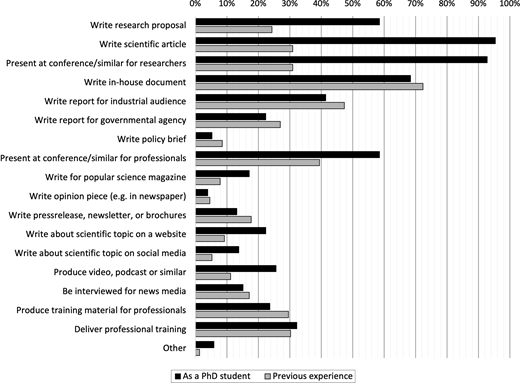
Most communicated their research to both researchers in their own field (93%) and industrial audiences (87%). In addition, some reported communicating to specific professions affected by their research (29%), civil servants (22%), politicians (7%), the public (17%) or non-profit organisations (8%). Overall, participants had more previous experience communicating within industry (76%) than with researchers in their field (41%). Figure 1 displays the genres used. There was a larger difference between current practice and previous experience for scientific papers (second set of bars) than writing in-house documents or reports for industry (fourth and fifth set of bars). In STEM in Sweden, compilation theses – consisting of several published papers – are standard, explaining the high percentage for scientific papers. These findings about previous experiences and practices suggest that many participants might need support with research communication in academia, like all PhD students, but perhaps less support for communication in industry.
Unsurprisingly, researchers were perceived as more knowledgeable about the participants’ field of research (58% rated them as moderately or very knowledgeable; only 3.9% rated them as not very knowledgeable) compared to other audiences (29% and 32%, respectively). However, 38% reported variation within each audience, which may further complicate participants’ adaptation of communication across their DCs.
Regarding language, 50% had previous experience of using both Swedish and English in a professional setting, 11% only Swedish, 25% only English and the remainder English and at least one other language. Both Swedish and English were commonly used with both researchers (51%) and other audiences (42%). Using only English was also common (43% and 34% with researchers and other audiences, respectively), but only Swedish was uncommon in industry (18%) and absent in academia. This suggests that adequate skills in both languages – particularly English – are important for IndPhDs.
Challenges in communication
More than half of the students (53%) experienced challenges in communicating their research, while 36% did not; the rest were unsure. The sub-category adapt to audiences (22%) was more commonly reported than academic writing (8.6%), possibly due to more support for academic writing (see next section, Learning to Communicate Research). Adapt to audience included and overlapped with the second to fourth most commonly reported sub-categories for challenges: identifying and adapting to the audience’s level of knowledge (19%), level of language and language usage (14%) and level of detail (9.2%). Overall, these findings suggest a gap in IndPhD education regarding research communication training – which currently does not fully address students’ needs.
Participants dealt with challenges with diverse strategies. The most common sub-categories were learning by doing (20% of those who experienced challenges), taking courses (16%), analysing the target audience (11%), supervisor support (10%), preparing presentations properly (7.5%), including extra material to enable adaptation on the spot (6.3%) and reading examples (6.3%). Notably, full answers revealed that external support, such as courses and supervisory support, mainly focused on academic writing.
Learning to communicate research
Two thirds of the IndPhD students (66%) had taken a communication course, most often in academic writing (57%). Of those, 76% found it beneficial, mainly for academic writing (24%) and sometimes for presentation skills (11%). Only 26% had taken a course in communicating research to people other than scientists. Almost none had taken a course or learned something useful pertaining to communication in industry, including presentations in industry, as exemplified by one participant:
I learnt a lot of things that were useful, but nothing that targeted contact with the industry.
Instead, courses without an academic focus seemed to focus on communication with the general public (5.3% found their courses useful for this purpose). Participants wished for additional support tailored to IndPhDs – focusing on communication to industry and similar non-academic audiences, and translating and bridging between industry and academia (see quotes 2–4). Note that while many had industry experience, they presumably did not have experience of being PhD students in industry, meaning they were in a sense new at the job and could be assumed to need support like any new employee. Few requested more academic writing support (quote 5):
Communicating with industry/regulatory bodies
Writing (not purely academic) reports
I think we need comprehensive courses in bridging between research and practice and how to communicate our research out of our own […] academic bubble.
Writing retreat, academic writing, write applications
These findings strengthen the assumption that students receive more support for academic writing than for adapting communication to other audiences.
In addition to courses, 39% reported support from supervisors and some from other PhD students (8.6%). Thirteen percent reported receiving support in industry, but this was a diverse sub-category in which the kind and extent of support and from whom varied greatly. However, 16% reported little to no support except for courses or felt alone in facing their challenges. In summary, the support reported in addition to courses varied greatly, especially in industry.
Opportunities and challenges of dual discourse community membership
Finally, participants were asked to comment on their overall experiences as IndPhDs. Together with the rest of the survey, their comments generated four sub-categories in which dual DC membership poses additional challenges and/or opportunities for IndPhDs compared to traditional PhDs: communication, knowledge brokering and negotiation, lacking support and identities and belonging.
Firstly, regarding communication, students wrote that learning to communicate to several audiences requires more work, but also provides training in prioritising and viewing one’s research from another perspective:
Communicating as an industrial PhD required more work than a normal PhD, but I think it puts a different perspective on the research that you are doing. This is more challenging, but you constantly have to make sure that you are focusing on useful things. This is a strength in my opinion.
To be an industrial PhD student gives great training in communicating your research to different audiences and adapt to the audience.
It also provided outreach opportunities, which was appreciated:
I think it’s positive that I’ve had better opportunities to reach out with my research […] I think this will be useful when I’m done with my PhD.
Secondly, knowledge brokering was highlighted as a unique aspect of being an IndPhD, including a possibility to bridge the gap between industry and academia:
It takes research closer to industry and makes faster application of research results possible.
However, bridging the gap involved negotiating between stakeholders in terms of interests and demands:
It can be challenging to have two different stakeholders as a PhD student, in particular to deal with the different demands from industry and academia.
There are many aspects that need to be balanced between industry and academia, and lots of alignment is necessary and the need to find common ground and avoid competing interests. The work as an industrial PhD involves both clarifying research interest to the company as well as clarifying business interests to academia.
Participants brought up the need to ensure shared objectives and mutual understanding as challenging, and tied this both to differences in both epistemology and communication:
Industry leaders lack insight into what to expect of […] the research in itself. Research is to a large extent “know-why”, but companies are often interested in “know-how”.
The two stakeholders (industry/academia) sometimes speak completely different languages, but my experience is that industry often understands academia better than academia understands industry.
As exemplified above, some participants described that both industry and academia need to better understand each other. In practice, dual stakeholders may also lead to difficulties in prioritising and time management:
Difficult with time when one has to it divide between two different tasks, no one can serve two lords.
Lacking support in terms of training and procedures was mentioned in relation to communication, as described earlier, but also to training in general and the IndPhD overall:
Especially in industry, the audience can be very challenging to convince how seemingly theoretical work can be relevant for every development issue. This is something that we need to train a lot better, that means not only speaking and arguing, but presenting, visualising, taking the most relevant information and giving it to the audience in a digestible way, so they see the usefulness in it.
[Detailed description of not being included in the research environment in academia] My experience is that there is a lack of routines for how to deal with and include industrial PhD students.
Finally, as suggested in quote 16 above, Identity and belonging were described as issues in connection to lacking support, inclusion and belonging:
Very little of the information, courses and training available have this type of PhD student as a target audience. Challenges, needs and opportunities – in communication and otherwise – are quite different when you have “two jobs” and in a way two different professional identities.
I am part of industry and university, but it can feel quite alone, because I’m not fully belonging to any group.
Discussion
Our findings provide a more nuanced picture of IndPhD students communication practices than previous research. We show that multiple genres are common in both industry and academia. Genres include presenting at conferences to scientists or professionals; writing reports for industry; writing research proposals; and delivering professional training. Our study specifies what it means in practice that IndPhDs need to speak both “academia and practitionese”, translate between the two (Kihlander et al., 2011) and develop the skills required to adapt to diverse audiences and genres (Granata and Dochy, 2016; Santos and Patrício, 2020; Wallgren and Dahlgren, 2007). While our findings on previous experience suggest many students may be proficient in “practitionese”, the findings on challenges contradict this suggestion (elaborated below). Possibly, their role within the industrial DC evolved after becoming IndPhD students, changing what, to whom and how they communicate.
In addition, our findings underscore and concretise how industry and academia are different DCs, and how IndPhD students adapt across DCs. Adaptation includes accounting for differences in many of the defining features of DCs (cf. Swales, 2016): goals and expectations (i.e. criterion 1, goals, and 8, expectations; see also Grimm, 2018); how research knowledge is shared within the communities (i.e. criteria 2, internal communication, and 3, participatory mechanisms); which genres are used (criterion 4, genres); and language choices – including English versus the national language and appropriate words and expressions for each communities (criterion 5, terminology), which some participants referred to as the level of the language. Note that arguing that industry and academia are different DCs does not entail ignoring similarities across the contexts. For example, terminology was reported to differ across the DCs, but participants still communicate about the same subject in both DCs. This suggests that some overlap can be assumed. However, we argue that the centrifugal aspect of DCs as a theoretical concept is useful to foreground what support may be needed in IndPhDs as a result of the connection to two DCs.
Overall, the findings regarding challenges and training reveal differences between the two DCs in terms of feedback, support and development (criteria 3, participatory mechanisms, Swales, 2016). For example, our findings indicate that participants found it more challenging to navigate their industrial DC than their academic one, with challenges pertaining to the audience’s level of knowledge, language and level of detail needed. IndPhD students seemed to receive sufficient support for academic communication – through supervision and courses – in comparison to the lack of support for brokering and communication in industry. This contrasts with previous research on challenges of academic writing for traditional PhD students (e.g. Sala-Bubaré et al., 2018), possibly due to even bigger challenges in industrial communication for our participants.
We generated four sub-categories that were related to the added challenges and opportunities of being a member of both DCs. Communication and knowledge brokering seemed to offer both, while lacking support and identities and belonging were reported as challenges. These findings concur with previous research on other industry-academia collaborations, emphasising the importance of support and structure, shared objectives and mutual understanding and effective communication (Borrell-Damian et al., 2010; Pertuz et al., 2021; Sjöö and Hellström, 2019; Starbuck, 2001; Thune, 2011). In other words, a boundary spanning function in the form of an IndPhD student is beneficial, but insufficient without other factors and proper support for the student. Furthermore, our findings suggest that IndPhD students’ membership in their two DCs may vary; as brokers, they may remain peripheral in both contexts (see Wenger, 1998, on brokering in the peripheries), posing issues with dual identities and lack of belonging (cf Meyer and Brun, 2023 on brokering in general, not specifically in IndPhDs).
Our study has limitations in drawing conclusions on organisation, i.e. how to best organise IndPhDs, support around IndPhD projects in the respective contexts. Nonetheless, we do underscore the need for more support in learning to communicate research in and across DCs and in knowledge brokering, identity and sense of belonging (cf Bernhard and Olsson, 2023; Wallgren, 2007). These findings echo previous research on knowledge brokers in other contexts, concluding that knowledge brokers often lack support, training and recognition for their brokering (Meyer and Brun, 2023). Our study adds specificity to the understanding of these challenges in the IndPhD context from a student perspective. In addition to challenges in research communication across the two DCs, our findings suggest that communication around practical matters often needs improvement. Furthermore, the misalignments between what support students wanted and what they received underscores the need for better dialogue among stakeholders. Enhancing structure, support and communication is crucial to ensure the quality of IndPhD students’ experiences and the overall success of projects.
Implications for practice
Our findings, align with previous research (e.g. Compagnucci and Spigarelli, 2024), highlight the potential of the IndPhD as a boundary spanning function between industry and academia. IndPhDs provide opportunities for students to develop communication skills needed in both contexts, and act as knowledge brokers between the two DCs both during and after their PhD The implications we propose are relevant for universities and doctoral programmes, supervisors in both contexts, the employers in industry and to some extent additional funders. To address challenges and further enhance the benefits of IndPhDs, we suggest the following:
Industry communication training: Provide targeted, deliberate and evidence-based training (cf Donaghue and Adams, 2025). For universities and doctoral programmes, this means designing training focused on specific communication practices (or genres) and genre awareness – defined as “rhetorical flexibility necessary for adapting their socio-cognitive genre knowledge to ever-evolving contexts” (Johns, 2008, p. 238). This is crucial for adapting communication across contexts, audiences and DCs. Use Swales’ (2016) criteria for DCs to illuminate characteristics, differences and similarities across the contexts, and what that might mean for IndPhDs communication. Training could also provide opportunities for peer interaction and community-building among IndPhD students, potentially helping them deal with dual roles and professional identities. Note that while training often falls to the university, employers in industry may also contribute. Collaboration is key in ensuring relevance also in industry and across the two contexts.
Structured planning phase: Formalise the planning phase of the IndPhD to ensure motives for involvement, structure, inclusion and responsibilities are clear and agreed upon before starting the project and at the very beginning of the IndPhD. This should be addressed in policies at both national and institutional level to ensure sufficient structure in all IndPhD projects. At a project level, use the criteria for DCs to identify and address differences between the DCs to prevent issues and bring specific attention to IndPhD students’ roles and needs as knowledge brokers. In the planning phase, we underscore the importance of active involvement of all stakeholders for the project, including the industrial partner (e.g. the manager and industrial supervisor), academia (e.g. academic supervisor and representatives from the doctoral programme) and the IndPhD student. If additional funders have expectations related to the project, these should also be involved.
Continuous follow-up: Monitor both the academic and industrial context to ensure adequate support and training and challenges are dealt with. Use DCs as a framework to identify challenges, especially relating to communication. Specific attention should be paid to the students’ role as knowledge brokers and potentially peripheral participation in both industry and academia. Continuous follow-up concerns the same actors involved in the planning phase for the specific project, but requirements for such follow-up should also be included in policies at national and institutional level.
Supervisor and manager training: Educate supervisors and managers on challenges and support needed in an IndPhD, including the knowledge brokering role. Universities and doctoral programmes are central in designing and conducting such training, but should collaborate with industry to ensure perspectives and needs of industry are included.
Conclusion
Whereas previous research has painted the communication realities of IndPhDs with broad brush strokes – for example, only pointing to broad genres and investigating some aspects of support – this study highlights the variety of their experiences and specific challenges, along with the support needed. Our participants communicated their research to industry and academia through a variety of genres, but lacked support in developing their knowledge-brokering identity and the skills to adapt their communication across the different DCs. Theorising industry and academia as different DCs is a key contribution of our study because it illuminates important differences between the contexts across the DC criteria, and their impact on IndPhD students’ realities – in terms of communication, learning and overall PhD experiences. Our study adds to the limited research on IndPhDs assessing “whether they offer an effective response, or an optimal approach, to meeting the demands of both the knowledge society and doctoral candidates” (Compagnucci and Spigarelli, 2024, p. 21), by identifying and detailing areas where support is needed, and providing actionable implications for practice.
We recognise that there are limitations of our study. While including IndPhDs from a diversity of STEM disciplines, our study focused on top STEM universities in Sweden, limiting generalisability to smaller universities and other national contexts, given that policies and details of the set up vary across countries. However, our findings concur with previous research that has accounted for the variation in structure and support within countries (Compagnucci and Spigarelli, 2024). This suggests that the local organisation, people involved and how the collaboration, communication and support work in the specific context may be more important than national differences in ensuring that IndPhDs and similar doctorates provide a fruitful and positive experience for those involved.
Further research could expand our study to other countries, disciplines and university types and possibly do so on an even larger scale, combining qualitative and quantitative measures to provide additional granularity. Further factors to explore include language use, motives for involvement, structures, inclusion and previous knowledge and experience of supervisors. Genre is another aspect to investigate closer in future research, for example, detailing what defines the different genres and how they may overlap across genres and DCs. It is also essential to explore whether the IndPhD student is the only boundary spanning function and complement with the perspectives of academia and industry (e.g. supervisors and managers). To complement our detailed and systematic description of IndPhD students communication practices and experiences of being in different DCs, we also see a need for further studies with a broader focus on brokering and communities, such as communities of practice (cf Wenger, 1998), clarifying how different actors in the project are connected, what roles they play and where/who provides support.
Thank you to our participants who kindly gave us their time.
Supplementary material
The supplementary material for this article can be found online.
Note
We acknowledge that traditional PhD is an imperfect term. However, it, to a greater extent than other options avoids a deficit discourse, where either IndPhDs or what we here refer to as traditional PhDs are characterised as lacking. Traditional PhD is also a commonly used term in the literature on professional doctorates and IndPhDs that we refer to in this study and therefore the usage here provides some consistency.