For HR leaders managing global operations, transferring HR practices from headquarters to subsidiaries is rarely straightforward. This study aims to explore how subsidiaries adapt headquarters-designed practices to fit local contexts, revealing three distinct patterns that can help practitioners navigate the standardisation-localisation dilemma.
Drawing on interviews with HR managers and frontline leaders across ten multinational subsidiaries, this study examines real-world experiences of practice adaptation across different industries and organisational cultures.
Three adaptation patterns emerge: complete replication of headquarters practices, selective implementation of specific elements, and integrated approaches blending global and local practices. Each pattern serves different strategic purposes and organisational contexts.
HR practitioners can use these patterns as a diagnostic framework to determine when to standardise, when to adapt and how to balance global consistency with local effectiveness. The findings provide actionable guidance for improving practice acceptance and organisational performance.
This article translates academic research into practical guidance, helping HR leaders make informed decisions about the appropriate level of adaptation for different HR practices while maintaining strategic alignment across their global operations.
Introduction
The transfer of human resource management practices from headquarters to subsidiaries remains one of the most persistent challenges facing multinational enterprises (MNEs). While the theoretical promise of standardised global HR practices includes enhanced efficiency, improved data comparability and strategic alignment across organisational boundaries (Farndale et al., 2010), the empirical reality is far more complex. Research consistently demonstrates that practices designed at headquarters rarely transfer to subsidiaries without adaptation, modification, or even rejection (Ansari et al., 2010). This gap between standardisation aspirations and localisation realities creates the “global integration–local responsiveness” dilemma – a tension that continues to challenge HR leaders in multinational organisations.
While scholars have documented that practices vary as they diffuse (Ansari et al., 2010) and examined why such variation occurs (Ansari et al., 2014), less attention has been devoted to providing actionable frameworks that help HR leaders determine when and how to adapt transferred practices. This gap is particularly acute for practitioners operating in emerging markets and developing economies, where contextual differences from headquarters locations are often most pronounced. However, local HR capabilities may still be developing (Tenakwah et al., 2023). The challenge intensifies as organisations navigate multiple competing pressures: regulatory compliance that demands standardisation, cultural differences that require localisation, economic constraints that necessitate efficiency and employee expectations that vary dramatically across geographies (Tenakwah, 2021).
Recent shifts in the global work environment have further complicated the practice transfer landscape. The rise of distributed and hybrid work models has created new questions about which practices can and should be standardised across physical and virtual boundaries (Tenakwah and Watson, 2024). The rapid adoption of artificial intelligence and automation in HR functions introduces both opportunities to enhance global consistency through technology and new risks related to cultural appropriateness and privacy across diverse legal contexts (Tenakwah and Watson, 2025). Meanwhile, the intensifying competition for talent has raised the stakes for the effective implementation of HR practices, as organisations recognise that poorly adapted practices can undermine employee engagement and fuel unwanted turnover (Tenakwah, 2024). Against this backdrop, this paper addresses a fundamental question:
How do subsidiaries actually adapt headquarters-designed HR practices, and what patterns of adaptation can guide practitioners in making more informed decisions about practice transfer?
The challenge: one size rarely fits all
As global head of HR for your multinational organisation, you have invested significant resources in developing best-practice HR systems at headquarters. Your performance management framework is data-driven and sophisticated. Your talent development programs have won industry awards. Your employee engagement initiatives deliver measurable results.
However, when these practices roll out to subsidiaries across different countries and cultures, the results are inconsistent. Some locations embrace them enthusiastically. Others implement them half-heartedly. A few quietly develop their own approaches, creating pockets of non-compliance that worry both you and your executive team.
This dilemma-balancing global consistency with local relevance-is one of the most persistent challenges in international HR management. Push too hard for standardisation, and you risk practices that do not fit local legal requirements, cultural norms or business realities. Allow too much local variation, and you lose the economies of scale, data comparability and strategic alignment that motivated centralisation in the first place.
The reality is that HR practices rarely transfer without some degree of adaptation. Understanding how and why subsidiaries adapt practices and when adaptation helps versus hinders, is essential for global HR effectiveness.
Three patterns of practice adaptation
Our research across ten multinational subsidiaries reveals three distinct approaches to adapting headquarters-designed HR practices. Each serves different purposes and reflects different organisational dynamics.
Pattern 1: full replication – “we implement it as is"
Some subsidiaries implement headquarters practices without modification, treating them as non-negotiable standards. As one HR manager explained: Largely, HR practices transferred are implemented unaltered, so it is a replication of what is done at headquarters except in cases where there are legal or regulatory infractions.
This approach typically applies to practices where:
Headquarters requires strict standardisation for strategic or compliance reasons.
The organisation has strong cultural values around global consistency.
Subsidiaries have limited decision-making authority.
There is strong trust in the headquarters’ expertise.
Common practices following this pattern include performance management systems, recruitment and selection frameworks and training and development programs. The emphasis is on maintaining “one company, one approach” to ensure comparability, fairness and efficiency across the global network.
Pattern 2: selective adoption –“we pick what works”"
Other subsidiaries take a more selective approach, implementing specific elements of headquarters practices while discarding or modifying others. One manager described it this way: Usually, there are aspects of the practices that could help the business, so we pick those rather than adopt the whole package, which could create problems for us.
This pattern emerges when:
Certain practice elements conflict with local culture or expectations.
Headquarters provides frameworks rather than rigid prescriptions.
Subsidiaries have moderate autonomy to customise.
Local business conditions require flexibility.
Compensation and employee relations practices frequently follow this pattern. Subsidiaries might adopt the overall philosophy and key components while adjusting specific elements, such as reward structures or communication approaches, to align with local preferences and reduce employee resistance.
Pattern 3: integration – “a blend of global and local”"
The third pattern involves creating hybrid practices that integrate headquarters frameworks with locally developed elements. As one HR leader noted, most of the practices used in this subsidiary are a mix of locally developed and transferred practices. Sometimes the practices may not be context-friendly, so we advise on how to improve acceptance.
Integration works best when:
Headquarters actively encourages innovation and local input.
There is collaborative dialogue between headquarters and subsidiaries.
Subsidiaries have strong HR capability and credibility.
The practice area has high local sensitivity (culture, engagement, wellbeing).
This approach treats practice transfer as a two-way street. Headquarters provides strategic direction and best practices, while subsidiaries contribute local market knowledge and implementation expertise. The result is practices that maintain global alignment while achieving genuine local fit.
Measuring success: defining outcomes for each pattern
Understanding which adaptation pattern to employ is only half the challenge – knowing how to measure whether it is working is equally critical. Each pattern requires different success indicators because each serves different strategic purposes. Table 1 outlines the primary success metrics, how to measure and the red flags for each adaptation approach.
The primary indicators represent the core metrics that directly reflect whether the pattern is achieving its intended purpose. For full replication, the emphasis is on fidelity to the headquarters design and operational efficiency. Selective adoption focuses on local effectiveness and stakeholder acceptance. Integration prioritises bidirectional value creation and organisational learning.
It is important to note that these metrics are not mutually exclusive. A successfully replicated practice should still achieve local relevance, and an integrated approach must maintain strategic alignment. However, the relative weight given to each metric should reflect the chosen adaptation pattern.
What this means for your organisation
These three patterns are not mutually exclusive-most global organisations use different approaches for different practices. The key is to be intentional about which pattern you use in each practice area, rather than defaulting to a one-size-fits-all approach:
1. Match the adaptation pattern to strategic purpose.
Not all HR practices require the same level of global consistency. Consider using:
Full replication for practices where standardisation is strategically critical, compliance frameworks, core talent processes for high-potential employees, and leadership competencies aligned to corporate values.
Selective adoption for practices where the underlying principles matter more than specific implementation-compensation philosophy, employee relations approaches, and learning and development frameworks.
Integration for practices where local context is paramount-employee engagement initiatives, wellbeing programs, diversity and inclusion strategies, communication approaches
2. Build subsidiary hr capability as a strategic asset.
Subsidiaries that successfully adapt practices are not just modifying what headquarters sends them-they are contributing valuable insights back to the organisation. Several managers described how adaptation improved not only local acceptance but also the practices themselves.
Rather than viewing adaptation as deviation or non-compliance, consider it a source of innovation. Create mechanisms for subsidiaries to share successful adaptations that might benefit other locations or inform future headquarters practice design. This transforms your subsidiary HR teams from passive implementers into active contributors to global HR excellence.
3. Establish clear decision rights.
Ambiguity about who decides what creates frustration and inconsistency. For each HR practice area, clearly define:
Which elements are non-negotiable (must implement as specified).
Which elements have flexibility (can adapt within parameters).
Which elements are entirely local decisions (subsidiary discretion).
One manager captured this well: Headquarters understands that not everything will work here because we are different. So, usually they give us a guideline rather than a full practice. This clarity enables subsidiaries to adapt appropriately while maintaining essential standardisation.
4. Monitor both implementation and impact.
Traditional compliance monitoring asks, “Did they implement it?” However, for adapted practices, you also need to ask, “Did it achieve the intended outcome?” Track both process compliance and results metrics to understand whether adaptation is helping or hindering strategic objectives.
If a subsidiary achieves strong results through an adapted approach, that is valuable data. If full replication produces poor results in specific contexts, that is valuable data too. Use both to improve your global HR practices continuously.
Making it work: a decision framework
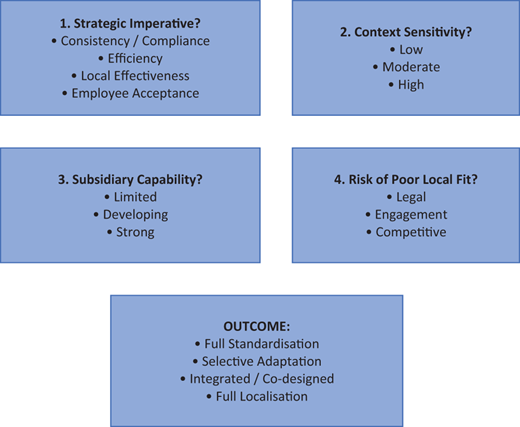
When designing or transferring an HR practice, ask:
What is the strategic imperative? (Consistency, efficiency, compliance vs local effectiveness, cultural fit, employee acceptance).
How context-sensitive is this practice? (Low sensitivity = standardise; high sensitivity = allow adaptation).
What capability exists in subsidiaries? (Strong capability = enable integration; developing capability = selective adoption; limited capability = full replication).
What are the risks of poor local fit? (Legal exposure, employee disengagement, competitive disadvantage vs. operational inefficiency, data inconsistency).
Your answers will guide you towards the most appropriate adaptation pattern for each practice. Figure 1
Looking forward
The old debate about standardisation versus localisation presents a false choice. The reality is more nuanced: different practices require different approaches, and the “right” level of adaptation depends on multiple factors, including strategic importance, local context, subsidiary capability and the specific nature of the practice itself.
The most effective global HR organisations do not rigidly enforce standardisation or passively accept unlimited variation. Instead, they thoughtfully determine which practices must be standardised, which can be selectively adapted and which should integrate global and local elements. They build subsidiary HR capability, establish clear decision rights and monitor both implementation and outcomes.
Most importantly, they view practice adaptation not as a threat to consistency but as an opportunity for continuous improvement. When subsidiaries successfully adapt practices to achieve better local results, that knowledge benefits the entire organisation. When headquarters practices prove robust across diverse contexts, that validates their strategic value.
The goal is not perfect standardisation or complete localisation-it’s strategic alignment with appropriate flexibility. These three patterns provide a roadmap for achieving that balance.