

Total reward is a capital idea
Article Type: Rewards From: Strategic HR Review, Volume 9, Issue 1
Short case studies and research papers that demonstrate best practice in rewards
The ideas behind total reward go back to at least the eighteenth century. In 1776 the great Scottish economist Adam Smith wrote that employees should maximize their “total net advantage” of work, thinking not just in terms of wages but also of such factors as its “agreeableness,” job security and the possibility of success or failure. More modern writers, such as the UK’s Michael Armstrong, have also emphasized that total reward comprises both the extrinsic (e.g. pay) and intrinsic (e.g. job satisfaction)elements in reward. US consultants Schuster and Zingheim have gone further in talking about total reward as a “philosophy, a set of principles, a mindset” rather than a set of particular reward practices. Nonetheless, the core point should be that total reward encompasses the psychological contract between the employer and employee. It should recognize the mutuality of offer,acceptance and performance of that contract, going beyond the formal terms to the unspoken assumptions of what both parties expect from the deal.
However, total reward in more recent times has been taken over as an employer-driven, one-sided rather than mutual concept. There is an understanding by organizations that there is a breadth of reasons why employees join and why they stay, and what motivates them while they are at work varies. But employers have focused their efforts on branding – how can we package our offer to attract the recruits we want; on communication – how can we get employees to realize the full value of their reward package; and on segmentation –how can we tailor rewards to fit different constituencies? Thus we have seen as outputs of this effort recruitment literature, total reward statements and flexible benefits offerings. Too often, though, these initiatives have been driven by employer perceptions of what turns employees on, without seeking employee input. And this has happened in the context of tight labour markets where attraction and retention have been seen to be vital in the “war for talent.”
Listening to employees
To redress the balance, Capital Ambition (the UK local government’s Regional Improvement and Efficiency Partnership for London) invited the Institute for Employee Studies to develop a methodology to help individual boroughs create an appropriate total reward strategy to meet their differing needs. The focus of the project would be on the employee perspective. So questions posed were based on:
Why people join the organization, why they come to work and why they stay.
What people value in reward, work and the physical environment.
Whether the same deal applies to everybody or whether different groups (by age, gender, seniority, etc.) might value different aspects of the total reward proposition.
The approach taken was to work with a pilot London borough to explore these issues. IES ran eight discussion groups with employees, structured to reflect grade, service, directorate and gender, and also conducted an employee survey. The results were then plotted onto Schuster and Zingheim’s four quadrant total reward model as shown in Figure 1, though we altered some of the titles in a way that resonated better with the borough’s HR team.
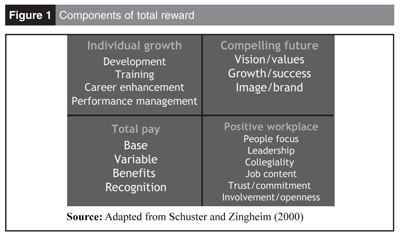
So what did the results tell us about the attitudes of employees in local government in this part of London? Here is a flavour of the responses.
Total pay
Pay was important to people according to the survey; from the focus groups its salience was more in terms of a “hygiene factor” (a la Hertzberg). Staff understood that their remuneration was behind the private sector, but they did not expect to compete with that constituency. Relative to other local government employers, their position was felt not to be too bad.
On performance related pay (PRP), all staff reported uneven performance levels among colleagues. Some favored PRP as an incentive, while others doubted its practical fairness (e.g. fears on managerial inconsistency) or pointed to risks of a negative impact on the culture of collaboration.
There was mixed awareness of what benefits were available. The sector’s pension was deemed to be the most important benefit, but was not well understood and younger people doubt the longevity of having such a good defined benefit scheme. There was some interest in benefit choice, especially for younger professional staff, but on a limited scale, with particular interest in a holiday buy out option.
Lower graded staff benefited from positive client recognition, rather than manager acknowledgement. Administrative staff felt their efforts were taken for granted. Professional staff were more positive about the recognition of their work.
Positive workplace (effective organization)
Communication – most formal messages seemed to pass female manual staff by, compared with their male counterparts, and they felt insufficiently listened to (as did administrative staff). Poor communications switched people off the most from performing well, the survey told us.
Professionals complained of very slow decision making without sufficient consultation and many in the survey put bureaucratic processes as the greatest inhibition to motivation.
Doing stimulating work was the second most important work feature in the employee survey and the opportunity for a better and more challenging job was a key feature in why staff joined the organization.
Individual growth (development)
Careers – female manual staff did not show as much interest in career development as their male equivalents. Administrative staff felt quite frustrated at the perceived lack of encouragement for their development. Mid level professionals were quite transactional; they wanted development to suit their needs to progress and if it was not forthcoming would move on to another organization.
Skills development was fourth in the list of important work features according to the employee survey. A lack of opportunities would also cause(especially senior) staff to leave.
Compelling future (attractive organization)
Male manual staff were much clearer on the organizational purpose than female manual staff. And, not surprisingly, the most senior mangers were most committed to organizational goals. Interestingly, corporate professionals were not so engaged with the brand. However, providing a good service, “making a difference” and doing good for the community all featured as important in the survey.
What does one do with these results?
For the organization that took part in the pilot it has provided a sense check of how employees feel about key aspects of work and the value proposition offered to them. In the detail of the results not fully presented here, the organization can identify differences in what attracts people, what keeps them and what motivates and de-motivates. Thus, there are some practical improvements that can be made to internal systems and decision processes that would release the contribution of some staff. How change is handled impacts on both the employee perception of their employer and their propensity to leave. Emphasizing that the borough’s purpose is to serve the community is a rallying call for many in the organization and leadership efforts could be directed in this way.
The data on reward is more complex than this short report can give. People may not join local government for money, but yet they do expect fair pay in relation to realistic competitors. Yet there seems some ignorance on what is on offer, which does suggest that giving attention to communication is vital. The results on PRP suggest a proceed-with-caution approach. Again, getting the processes right is critical against a background of some support but also some scepticism.
The detailed analysis by employee group reveals really marked patterns of relationship to the organization. Over simplifying for brevity – female manual staff have a transactional deal that revolves around satisfying their work and domestic agenda together. Younger professionals are also transactional with developing their skills the core component of the deal. Senior staff have a more relational psychological contract and are highly engaged with the organization, yet there is also a strong personal element to their commitment.
A multi-perspective approach
Understanding these different perspectives should help the borough’s management both adjust the offering and target communications. This sort of segmentation goes beyond the usual flexible benefits or job families approaches into other aspects of people and organizational management. The way forward is holistic and integrative but cognizant of difference.
What the organization finally has to do is see how these employee views of the world fit with the management perspective. At a time when budgets are under severe pressures, reconciling, say, employee hopes of job security with workforce cuts, will be particularly challenging. The advantage of this sort of total reward project is that at least the organization knows what is important to people when it makes its inevitable changes.
Peter ReillyDirector of HR research and consultancy at the Institute for Employment Studies.
About the author
Peter Reilly is Director of HR research and consultancy at the Institute for Employment Studies (IES). He joined IES in 1995. He leads the work on reward and on the HR function, but contributes significantly to HR planning and labour market projects. He has published IES reports on reward, human resource planning, HR shared services and outsourcing. He has written numerous articles and books on both reward and the HR function. Reilly gives consultancy support to organizations on issues concerning HR strategy, planning and resourcing,retention, HR organization, trends in personnel management, performance management and reward. Peter Reilly can be contacted at: peter.reilly@employment-studies.co.uk

