
Skip to article sections
Purpose

The purpose of this paper is to develop an integrated view of consumers’ perspectives on remanufactured products. Building on the relevant literature, it presents a framework for exploring consumer responses toward remanufactured products. It highlights the existing challenges for firms in succeeding with remanufactured products in the business-to-customer (B2C) markets.

Design/methodology/approach

This research introduces an integrative framework for studying consumer responses toward remanufactured products. It uses a systematic search method and a cross-disciplinary approach. Academic articles from peer-reviewed journals support the development of the framework.

Findings

Based on the literature review, this study identifies four themes that influence consumer responses, intentions and actions toward remanufactured products: the product itself, consumer characteristics, brand and external context. This study demonstrates that consumer responses consist of two components, affective and cognitive, that can be triggered by one or several identified factors. This study highlights and develops a research agenda to address the current literature’s terminological, theoretical, methodological and behavioral challenges.

Research limitations/implications

There are three main directions for further research pathways: terminological unification, theoretical development and methodological advancements.

Practical implications

Applying the presented framework can help practitioners better understand how to enhance consumer engagement and experience with remanufactured products.

Originality/value

This paper improves the limited understanding of consumers’ perspectives on remanufactured products, systematizes existing knowledge and presents an integrated framework for consumer responses toward remanufactured products for the B2C market.

The growing relevance of sustainable consumer products has attracted academic interest across multiple disciplines, ranging from marketing (Farzin et al., 2023; Onel, 2024) and environmental research (Abbasi et al., 2022; Bigliardi et al., 2022; Boyer et al., 2021) to operations management (Abbey et al., 2019; Abdulla et al., 2023). While recycling has traditionally been promoted as a sustainable solution, it typically involves breaking down products into raw materials – resulting in a loss of the original product’s functional and economic value (Nasr and Thurston, 2006). In contrast, value-retention processes (VRPs) aim to preserve as much of the product’s integrity and performance as possible. Firms are increasingly investing in VRPs such as direct reuse, product repair (Munten and Vanhamme, 2023), product refurbishment (Nasiri and Shokouhyar, 2021) and product remanufacturing (Kurilova-Palisaitiene et al., 2023; Russell and Nasr, 2023), to meet increasing consumer demands for sustainable products and proactively adapt to rapidly changing legislation.

Among these VRPs, remanufacturing is considered the golden standard and can be described as an industrial process that restores used products to a like-new or better condition (Lund, 1984). Its ability to retain both the physical structure and functional performance of products distinguishes it as a critical enabler of sustainable consumption and circular economy transitions. In line with the United Nations Sustainable Development Goals (SDGs), remanufacturing offers substantial environmental and socio-economic benefits, including reduced CO2 emissions, resource conservation and job creation (Ijomah et al., 1999; Sundin and Lee, 2012). These benefits have led to growing adoption in sectors such as aerospace, automotive and medical equipment (Dils, 2021; Russell and Nasr, 2023).

However, despite its strategic potential, adoption of remanufacturing in the business-to-customer (B2C) markets remains limited. While it has been studied and implemented in business-to-business (B2B) contexts, remanufactured consumer products face skepticism related to perceived quality, hygiene and perceived value. Recent works explore how factors such as physical exposure (Abdulla et al., 2023), price incentives (Chun et al., 2022; Kerber et al., 2021), consumer education (Abdulla et al., 2023) and consumers’ knowledge about remanufactured products (Kerber et al., 2021) can counteract this skepticism. Yet the findings remain mixed and sometimes contradictory, particularly regarding the role of knowledge in shaping consumer intentions and behavior.

In addition to this conceptual uncertainty, researchers continue to face empirical challenges in clearly identifying and categorizing value-retained products, as definitions of remanufacturing are not consistently applied across studies (Russell and Nasr, 2023). This ambiguity complicates both consumer understanding and research efforts, limiting theoretical and practical progress in the field. Addressing these gaps is crucial for unlocking remanufacturing’s potential in consumer markets and advancing responsible consumption.

To support research efforts, the present research aims to develop an integrated view of consumer perspectives on remanufactured products by assessing and synthesizing existing literature on consumers’ intentions and behaviors. Based on a literature review with a systematic approach, we introduce an integrative framework and formulate a research agenda to address the existing knowledge gap. We thoroughly examine the use of terminology and analyze methodological approaches in the existing literature on remanufactured products.

This review explores consumer-related research on remanufactured products across sectors such as electronics, automotive parts and household appliances. By doing so, we aim to enable a more comprehensive synthesis of theoretical applications and consumer behavior constructs in the remanufacturing literature.

In this paper, we make three key contributions. First, we conduct a descriptive analysis of the literature, examining the theoretical foundations, methodological approaches and focal products studied, as well as how remanufactured products are defined and operationalized in the consumer context. Second, we identify and synthesize key themes emerging from the literature and propose an integrative framework that delineates consumer responses – both cognitive and affective – toward remanufactured products. Third, we highlight key gaps in existing research and propose a forward-looking research agenda to deepen understanding of consumer behavior in the context of remanufactured products.

Sustainable products are broadly understood as offerings that have less negative environmental and social impacts in comparison with traditional offerings throughout their life cycle while maintaining functional and customer value (Belz and Peattie, 2012; Peattie, 1995). From a circular economy perspective, such products are associated with longevity, reparability, reusability and resource efficiency (Stahel, 2016). They align with the principles of regenerating natural ecosystems, continuously using products and materials and eliminating waste and pollution through design (Geissdoerfer et al., 2017).

Product life extension strategies such as reuse, refurbishment and remanufacturing play a central role in sustainable product systems. Among these, remanufacturing is characterized by comprehensive value retention processes that restore products to a like-new condition, often including quality assurance, functional testing and warranties (Ijomah et al., 1999; Lund, 1984). Refurbishment, while similar in intent, generally involves less intensive interventions such as minor repairs or aesthetic improvements, resulting in a lower degree of processing (Ijomah and Danis, 2012). Nevertheless, both refurbishment and remanufacturing align with sustainability goals by enabling circular material flows and reducing the demand for new product manufacturing.

While used products – without any additional processing – offer the highest potential environmental benefits due to the absence of additional resource inputs, they often suffer from low perceived value and quality concerns among consumers. In this regard, remanufactured and refurbished products provide a valuable trade-off. Although they require additional processing, which may marginally reduce their sustainability advantage compared to direct reuse, they enhance product functionality and reliability. Although it is well established that remanufactured and refurbished products make sustainable choices more accessible – by offering options that balance environmental benefits with consumer expectations – anecdotal evidence suggests these initiatives often fail to meet consumer needs and expectations. For example, Electrolux’s remanufacturing leasing agreement for home appliances faced challenges (Electrolux Professional Group, 2024). This indicates that we still have limited knowledge about consumer responses to such offerings, which makes marketing them in the market difficult.

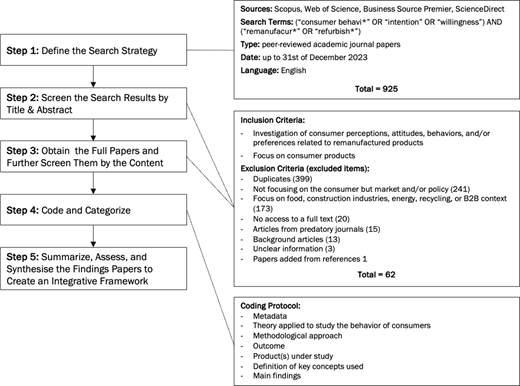
The increased interest from firms in reaching consumers in a B2C context through remanufacturing has initiated us to perform an integrative literature review, assessing and synthesizing existing knowledge (Snyder, 2019; Torraco, 2005). To achieve the aim of this paper, we combined a systematic search method with a cross-disciplinary approach to explore remanufacturing and closely related concepts (see Figure 1). We selected databases where research on remanufacturing in a B2C context can potentially be indexed (Scopus, Web of Science, Business Source Premier, including ScienceDirect). Due to the interdisciplinary and evolving nature of the core concept and the inconsistency in using the term remanufacturing, it encouraged a broad search across the title, keywords, and abstract in all academic fields. In addition to remanufacturing, variations of the resembling term refurbishment were also covered to grasp a broader scope of processes with higher levels of product interventions. Although refurbishment generally involves fewer interventions than remanufacturing, many refurbished products undergo similar restorative steps (Ijomah and Danis, 2012; Kurilova-Palisaitiene et al., 2023), resulting in products that may appear and function similarly to remanufactured ones. Moreover, the boundaries between these terms remain fluid in practice and in academic literature.

In our search, we consider the terms intention and willingness alongside consumer behavior. To secure the inclusion of all relevant literature, we limited our search to English-language research articles published in peer-reviewed journals until the end of December 2023.

Our initial database searches yielded 379 articles from Scopus, 346 from Web of Science, 171 from Business Source Premier, and 29 from ScienceDirect. After removing duplicates (n = 399), two researchers independently screened the remaining articles based on predefined inclusion and exclusion criteria. Inclusion criteria focused on studies investigating consumer perceptions, attitudes, behaviors, or preferences related to remanufactured products, specifically within consumer product contexts. Articles were excluded if they focused on market-level or policy issues (n = 241), food, construction, energy, recycling or B2B contexts (n = 173), lacked access to full text (n = 20), originated from predatory journals (n = 15), were background articles (n = 13), or contained unclear information (n = 3). One additional article was identified through reference screening.

The final sample for performing the current integrative literature review included 62 research articles. The papers most frequently appeared in Journal of Cleaner Production (15), International Journal of Production Economics (4), Journal of Operations Management (3), Journal of Retailing and Consumer Services (3), Resources, Conservation and Recycling (3), Business Strategy and the Environment (3), International Journal of Production Research (3) and Sustainable Production and Consumption (3).

We conducted two steps of coding to structure this review. To ensure reliability in the coding process, two researchers independently coded a subset of the studies and compared the results. Discrepancies were discussed and resolved through consensus, and the coding guide was refined accordingly. This process was repeated until coding consistency was achieved, after which the remaining articles were coded.

First, guided by the theory–context–characteristics–methodology (TCCM) framework (Branca et al., 2024), we applied descriptive coding to capture theoretical frameworks, methodological approaches, products under study, definitions of key concepts, main findings and outcomes from research papers as it could offer us a comprehensive overview of a study’s scope, design and contributions. Moreover, we gathered relevant metadata, which included authorship, publication year and journal. These components allowed us to critically assess the research and compare the results, facilitating knowledge synthesis and identifying gaps. This layer enabled us to map broader trends and contextualize the thematic synthesis.

Second, we needed to explore and detail the linkages related to a focal construct, disclosing antecedents and outcomes (Jaakkola, 2020; MacInnis, 2011) to fulfill the aim of the paper in developing an integrated view of consumer responses toward remanufactured products. Therefore, we performed inductive construct-level coding by extracting the key findings, models and constructs tested in each study. These constructs were then grouped into seven overarching themes – remanufactured product, consumer characteristics, brand, external context, consumer responses, intentions and actions – which formed the foundation for our integrative framework. This thematic synthesis builds on descriptive mapping to show how the topic has been studied and to develop an integrated framework based on key constructs and patterns.

We identified 62 research articles that were included in this review. Of these articles, two were literature review papers. The first study (Singhal et al., 2019a, 2019b) used meta-analysis (n = 10) to conduct a literature review. The authors discuss the constructs such as purchase intention, attitude, subjective norm and perceived risk, underlining that subjective norm is the most important factor influencing consumer purchase intention toward remanufactured consumer products. The most recent systematic review (Belbağ and Belbağ, 2023) considered 53 articles on consumer purchase behavior of remanufactured products. The authors highlight the existing interest in the area and specify several directions for future research on remanufactured products from the consumer perspective. The review was purely descriptive without integrating existing knowledge and further conceptualization. We argue that there is a need to synthesize existing knowledge in this area to be able to move the research forward.

Table 1 presents a summary of theory, context, characteristics and methodology following the TCCM framework. The following subsections detail patterns and gaps in each dimension, including definition and operationalization of the term remanufacturing in the studies.

Research on consumer responses toward remanufactured products has largely been conducted by scholars in operations and engineering, which has shaped the theoretical approaches used to explore consumer behavior in this area. The theory of planned behavior (TPB) (Kerber et al., 2021; Khor and Hazen, 2017; Pisitsankkhakarn and Vassanadumrongdee, 2020) and concepts of risk and quality perceptions (Abbey et al., 2019; Confente et al., 2021; Hamzaoui-Essoussi and Linton, 2014) are the most common theories applied within the existing research on the topic of consumer responses toward remanufactured products.

While many studies have applied the TPB and explored various boundary conditions, they often remain at a general level, lacking the needed details to capture the complexity of consumer behavior. In addition, most existing literature focuses on the product characteristics, such as quality, price, and performance. While these factors are important, insufficient much attention is given to studying customers’ spontaneous cognitive, affective, physical, sensorial and social responses to remanufactured products (Becker and Jaakkola, 2020; Lemon and Verhoef, 2016), which would help to explain why the responses are formed in a certain way, thus putting the customer’s experience as a way better to understand the purchase and use of remanufactured products. This gap underscores the need for new theoretical approaches.

Although the TPB deals with intention, it does not account for the intention-action gap: the phenomenon of positive intentions toward remanufactured products does not always translate into actual actions (Abbey et al., 2017; Khor and Hazen, 2017). One of the ways to address this gap is to study spontaneous responses captured right after interactions with these products (Becker and Jaakkola, 2020). Including these perspectives currently missing in research is crucial to developing a more comprehensive understanding of how consumers buy and use remanufactured products.

Guided by the purpose of exploring consumer responses toward remanufactured products, the research articles included in the review examine various products such as automotive parts (Chinen et al., 2022; Matsumoto et al., 2017, 2018; Wang et al., 2013), personal electronics (Hazen et al., 2012; Mugge et al., 2017a, 2017b; Singhal et al., 2019b) and home appliances (Koide et al., 2023; Atlason et al., 2017; Guide and Li, 2010). Some papers in the review include several product categories and a broad spectrum of individual products within one study, such as electronics (e.g. laptops, tablets, smartphones), automotive parts, cameras and home appliances. The benefits of such studies are understanding consumer interest and acceptance of different remanufactured products. For instance, by conducting a qualitative study, Mugge et al. (2017a, 2017b) created a rank of products of high likelihood that customers would purchase if they were refurbished by providing different reasons according to the insights gained through the in-depth interviews.

Furthermore, among the articles incorporated into the review, more than 20% of the studies focus on cell phones, with some specifying the models and brands (Abbey et al., 2019, 2017; Van Weelden et al., 2016). On the other hand, some of the included articles do not specifically discuss which products they consider when conducting the research (Alyahya et al., 2023; Gaur et al., 2022; Zhang and Luo, 2021; Liao et al., 2015), which leads to conceptual confusion concerning the managerial relevance of the results and compromises the relevance of findings. To advance the field, future studies should clearly define product categories by specifying product condition, processing type (e.g. remanufacturing, refurbishing, reuse) and changes in perceived value to support practical application by remanufacturers. This level of detail helps clarify how the product qualifies after a value-retention process.

Across the reviewed literature, purchase intention emerged as the most frequently studied consumer response. This construct often serves as a foundational indicator of consumer acceptance and is typically examined in relation to variables such as perceived quality, price sensitivity, environmental concern or brand trust. The second most common response is willingness to pay (WTP), addressed in seven studies, which often explore consumers’ price thresholds or premium acceptance for remanufactured and refurbished products (Guide and Li, 2010; Michaud and Llerena, 2010).

Other responses include switching intention, which captures consumers’ likelihood of transitioning from new to remanufactured alternatives (Hazen et al., 2017a, 2017b), and purchase behavior, which measures actual or self-reported behavior rather than stated intention (Gaur et al., 2015). Acceptance is also examined in studies, typically as a broader attitudinal construct indicating openness to product offerings (Van Weelden et al., 2016).

This breakdown highlights a strong focus on intentional and attitudinal outcomes, while behavioral and emotional responses remain relatively underexplored. This points to future opportunities for more diverse research designs in this area.

The most frequently used research method for studying remanufactured products is a quantitative study design (around 90%). Among these papers, 39 articles were based on a survey. In eight articles, experiments were conducted where researchers typically use bid auctions (Guide and Li, 2010; Michaud and Llerena, 2010), vignette-based field experiments (Bittar, 2018) and panel data (Duan and Aloysius, 2019; Frota Neto et al., 2016; Xu et al., 2017). Most survey-based studies focused on one particular country or region, such as The Netherlands (Van Weelden et al., 2016), Spain (Jimenez-Parra et al., 2014), China (Zhang and Luo, 2021) and Malaysia (De Guimarães et al., 2023). Few studies compared different markets (Chinen et al., 2022; Chun et al., 2022; De Silva et al., 2021; Matsumoto et al., 2017).

Existing qualitative studies on the topic employed different methodological approaches such as focus groups (Gaur et al., 2022), in-depth interviews (Gaur et al., 2022; Van Weelden et al., 2016), observation (Nasiri and Shokouhyar, 2021) and post hoc interviews in combination with a survey (Mugge et al., 2018). In these research articles, the authors studied consumers’ perceptions and reasons for choosing different types of remanufactured consumer products.

One notable shortcoming in the literature is the scarce use of experimental designs that involve direct interaction with remanufactured products. Research suggests that allowing consumers to physically engage with these products can lead to more positive attitudes (Abdulla et al., 2023), implying that showing the product is more effective than simply describing it.

Another concern is the frequent reliance on student samples. While some argue that students represent future consumers with strong sustainability values (Gaur et al., 2022), others caution that they are not representative of the broader population (Lynch, 1999; Perez-Castillo and Vera-Martinez, 2020). Student samples tend to be homogenous in terms of age and background, which limits the ability to generalize findings to diverse consumer segments.

The precise definition of core concepts is crucial for the research. It forms the foundation for a shared understanding, ensuring consistency and rigor in scholarly discourse, data collection, analysis and reliable conclusions. After reviewing commonly used definitions in the B2C context for remanufacturing, one can find that there is a congruence and a set of core principles in most interpretations of remanufacturing, which is conceptualized as the restoration of used products to a like-new condition, ensuring they have performance characteristics and durability at least as good as those of the original product (Ijomah et al., 1999; Lund, 1984). Core elements across definitions include the use of previously owned products, disassembly and inspection, and a restoration process that results in performance equivalence to new.

However, while the processes of remanufacturing and refurbishment are often clearly defined in theory, a persistent challenge lies in categorizing the products subjected to these value-retention interventions. The issue is not necessarily the lack of conceptual clarity around the processes themselves but rather the absence of detail regarding the actual interventions performed on the products within empirical studies. Even papers that adopt commonly agreed definitions frequently fail to specify how the product was treated, making it difficult to determine whether it was remanufactured, refurbished or repaired. This ambiguity limits comparability across studies and weakens the explanatory power of consumer-focused research.

Based on the inductive coding of the constructs studied in the reviewed articles, we identified a set of recurring themes that characterize how consumer responses toward remanufactured products have been conceptualized. These themes provide insight into what has been emphasized in prior research and what areas remain underexplored.

The themes presented in Table 2 reflect the key categories of constructs identified across the literature on remanufactured products in B2C contexts. These include product-related attributes (e.g. price, quality, warranty, information), brand-related aspects (e.g. brand equity, reputation), consumer characteristics (e.g. environmental concern, sustainability attitudes) and external contextual influences (e.g. social norms, product certification, policy incentives). In addition, studies examined a range of consumer responses, from cognitive evaluations to intentions and behaviors, such as WTP or purchase actions. These thematic categories serve as the basis for the integrative framework developed further.

5.1.1 Remanufactured product.

The first theme focuses on the remanufactured product, which we conceptualize as a combination of core attributes and associated services. Reviewed studies frequently examine product-related factors such as price (Chun et al., 2023; Gan and Chen, 2020) and quality (Abbey et al., 2017; Abdulla et al., 2023; Duan and Aloysius, 2019), with findings consistently indicating that perceived lower quality can negatively influence consumer evaluations. In addition, alternative selling formats – such as opaque selling, where product details are withheld until after purchase (Anderson and Celik, 2020) – have been shown to affect consumer intentions (Esmaeilian et al., 2021). Other relevant factors include ease of access, return policies, and distribution channels, all of which can enhance consumer trust and intention (Agostini et al., 2021; Confente et al., 2021; Kerber et al., 2021). Moreover, elements such as warranty (Gan and Chen, 2020) and product information transparency (Chun et al., 2023; Mugge et al., 2018) are identified as important drivers of purchase intention.

5.1.2 Brand.

The next theme is brand. This theme consists of interrelated factors such as brand equity (Bittar, 2018), brand reputation (Gan and Chen, 2020) and brand image (Gaur et al., 2022), which positively impact consumers’ intentions toward remanufactured products. However, brand reputation is not necessarily considered a primary reason for choosing a particular product (Gan and Chen, 2020). However, other contradictory evidence shows that a product’s brand can have little or even damaging effects on consumers’ intentions toward remanufactured products (Abbey et al., 2015).

5.1.3 Consumer characteristics.

Characteristics of consumers were found to be one of the dominant themes as well. For instance, a sustainable attitude, which refers to consumers’ green behavior, was found to substantially define consumer choices of remanufactured products (Abbasi et al., 2022; Bigliardi et al., 2022; Chinen et al., 2022; Chun et al., 2022; Gaur et al., 2015; Hamzaoui-Essoussi and Linton, 2014). Further, consumers’ status consciousness significantly influences their product choices (De Silva et al., 2021; Wang and Kuah, 2018). The positive influence can be explained by the growing social prestige of being environmentally friendly. The negative perception of remanufactured products as inferior mainly explains the negative influence (Wang and Kuah, 2018).

5.1.4 External context.

The reviewed literature recognizes the importance of external context, which can impact consumer responses toward remanufactured products. Product certification is shown to be an essential indicator of remanufactured product quality and sustainability for the consumer, increasing their willingness to use such products (Chun et al., 2023; Harms and Linton, 2016; Matsumoto et al., 2018). Governmental incentives, such as tax reductions, were also considered to influence consumers’ willingness to opt for sustainable product choices (Abbasi et al., 2022; Hazen et al., 2017a, 2017b). In addition, in many research articles, social norms (Bigliardi et al., 2022), such as societal concerns regarding the environment (Abbasi et al., 2022; Chun et al., 2023) and social desirability (Duan and Aloysius, 2019), were examined as key motivation factors to align consumer choices with responsible consumption patterns.

5.1.5 Consumer responses.

The next theme we identified is consumer responses. According to the literature, such factors as quality assurance (Abbey et al., 2017; Abdulla et al., 2023), risk aversion (Abbasi et al., 2022; Abbey et al., 2017; Agostini et al., 2021; Chun et al., 2022; Confente et al., 2021) and risk perception were found to impact consumer intention negatively (Abbasi et al., 2022; Abbey et al., 2017; Agostini et al., 2021; Chun et al., 2022; Confente et al., 2021). This negative impact could be explained by a willingness to avoid product malfunctioning and the inconvenience or costs associated with product failures.

5.1.6 Intentions and actions.

The outcomes of most of the research articles in the review were discussed through behavioral response constructs such as purchase intention (Abbasi et al., 2022; Agostini et al., 2021; Bigliardi et al., 2022; Bittar, 2018; Chun et al., 2023; Confente et al., 2021; Gaur et al., 2015), WTP (Abbey et al., 2017, 2019; Abdulla et al., 2023) or WTP premium (Duan and Aloysius, 2019). We explain that these constructs are most commonly used to measure consumer intentions to perform a behavior and are often considered a proxy for that behavior (Ajzen, 1985).

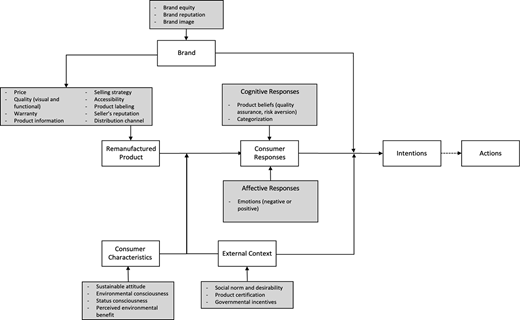
A thematic analysis of the reviewed literature allowed us to identify and organize key constructs into an integrative framework (Figure 2) that captures consumer responses toward remanufactured products. The framework builds upon Bloch’s (1995) model of consumer responses to product form, previously applied to remanufacturing in design research (Mugge et al., 2018). We extend this model to offer a consolidated view of psychological and behavioral processes in the context of remanufactured products.

The framework was developed to synthesize existing knowledge, provide an integrated understanding of consumer responses, and support future research into how consumers transition from avoiding to adopting remanufactured products. Related constructs were grouped into higher-order factors, depicted in white boxes, while specific variables derived from the literature are shown in grey boxes. Arrows indicate the hypothesized relationships between these factors, including mediating and moderating effects. The dashed line from intention to action reflects the complexity and nonlinearity of this transition.

A key feature of this framework is the role of the remanufactured product itself. Product-specific attributes – such as quality cues, perceived contamination, performance expectations and warranty – are frequently studied and shape both cognitive and affective consumer responses. These evaluations inform beliefs about product reliability and influence downstream outcomes such as purchase intention and WTP. Consumer characteristics – such as environmental concerns, values and past experiences – influence consumer interaction with remanufactured products. These antecedents shape subsequent psychological responses. The external context includes both social influences (e.g. peers, family) and institutional signals (e.g. government policies, NGO campaigns), which can shape consumer attitudes and norms.

The brand plays a distinct and twofold role in the remanufacturing context. On the one hand, it may refer to the original brand of the product (e.g. a well-known electronics brand), which influences consumer trust through brand equity and familiarity. On the other hand, it may represent the brand of the remanufacturer or third party that refurbishes and markets the product. These brands can have differing reputational signals and credibility. Because of this duality, the brand is represented separately from the product itself in the framework. Brand-related constructs – such as brand equity, trust and credibility – moderate or mediate how consumers evaluate remanufactured products and form behavioral intentions (Duan and Aloysius, 2019; Wang et al., 2023).

Upon interaction with a product, consumers have psychological responses that are cognitive or affective in nature (Bloch, 1995; Ostrom, 1969). Cognitive responses include beliefs about product reliability and categorization processes. The concept involves consumers’ ability to classify remanufactured products based on perceived similarity to known categories – a concept underexplored in the literature but illustrated by Moosmayer et al. (2020) in the context of products after value-retention processes. Affective responses reflect emotional reactions, such as disgust (Abdulla et al., 2023), negatively affecting consumer evaluations of the products. Although most studies do not explicitly distinguish between cognitive and affective reactions, both are evident and play critical roles in shaping consumer intentions.

We acknowledge that other types of spontaneous responses can arise after interacting with the product, apart from cognitive and affective, such as physical, sensorial and social (Becker and Jaakkola, 2020; Lemon and Verhoef, 2016). However, these responses were not studied in the literature on the B2C context in remanufacturing and, therefore, were not included in the framework.

Prior studies predominantly address consumer acceptance (Esmaeilian et al., 2021; Van Weelden et al., 2016), purchase intention (Bigliardi et al., 2022; Chun et al., 2022; Zheng et al., 2024) and WTP (Abdulla et al., 2023; Boyer et al., 2021; Duan and Aloysius, 2019), which together account for over 80% of the reviewed research. These constructs emphasize the centrality of intention in consumer decision-making, though evidence suggests a gap between intention and actual behavior. Actual behaviors remain underexamined, and several studies note the intention–behavior gap (Abbey et al., 2017; Khor and Hazen, 2017). This highlights the need for further empirical work focusing on behavioral outcomes beyond intention.

Our analysis suggests that the B2C remanufacturing literature faces several challenges. First, in the descriptive analysis of the studies included in the review, we observe a terminological challenge. Despite consensus on remanufacturing as an industrial process (Ijomah et al., 1999; Lund, 1984), distinguishing remanufactured products from other value-retained products in the B2C context remains challenging, with few researchers addressing this issue (Frota Neto et al., 2016). None of the studies specify product interventions. This ambiguity creates consumer confusion and insecurity, as expectations may not align with product performance, reinforcing negative perceptions. A shared understanding of remanufactured products and studies informing consumers of the scope and process of remanufacturing are essential.

Second, another finding of our descriptive analysis of the literature is a theoretical challenge. The literature relies on a narrow set of theories: (a) TPB and (b) risk and quality perception. These theories are limited, addressing primarily functionality risk, while overlooking other risk dimensions, such as social, physical and psychological (Baker et al., 2016; Stone and Grønhaug, 1993). Expanding theoretical approaches could provide richer insights into consumer responses.

Third, through the descriptive analysis, we recognize a methodological challenge. The literature remains dominated by cross-sectional surveys with limited ecological validity. Few studies employ experimental designs or real-world exposure to remanufactured products, which is essential for understanding how consumers perceive, evaluate and act on product-related cues in practice. Researchers should specify the products studied to improve generalizability, replication, validation and comparison of results. More longitudinal and experiential studies involving real consumers are necessary to capture actual behavior patterns and improve external validity.

Fourth, through the thematic analysis of the studies, we emphasize a behavioral challenge in how consumer responses are conceptualized. Therefore, understanding consumers’ associations with and reactions to remanufactured products in exposure contexts remains underexplored. The proposed framework integrates consumer responses through cognitive and affective components (Bloch, 1995); however, associations as part of the cognitive component are largely overlooked. In addition, examining responses like physical, sensory and social reactions (Becker and Jaakkola, 2020; Lemon and Verhoef, 2016) can yield further insights into consumer perspectives.

Building on the analyses, framework and identified challenges, we provide general guidelines and research questions to advance knowledge in the B2C context of remanufacturing. Given the multidisciplinary nature of this area and intending to help organize future research (Van Riel and Snyder, 2024), our research agenda covers two main focuses: (a) customer and (b) product and operations. Table 3 summarizes these challenges and suggests research questions for further contributions to the field.

To address the terminological challenge, establishing a shared understanding of remanufactured products is crucial. In the customer engagement and experience focus, researchers could investigate how consumers co-create value with remanufacturers, exploring how different value-retention strategies impact this process and shape consumer expectations (Arsenovic et al., 2019). In the product and operational focus, research can differentiate remanufactured products from other value-retention processes, such as direct reuse and refurbishing, and assess regulatory compliance and sustainability practices to inform effective communication strategies.

Further exploration of consumer perspectives on remanufactured products is needed to address the theoretical challenge. In the customer engagement and experience focus, researchers could expand on risk theories to study social and psychological risks’ impact on purchasing decisions and examine branding influences – manufacturer, remanufacturer and distributor – certification and warranty. In terms of product and operational focus, research can investigate integrating consumer feedback into product development to improve quality and performance and examine supply chain transparency to build consumer trust in authenticity and sustainability.

To tackle the methodological challenge, researchers should specify product types more precisely, moving beyond broad categories like “electronics” to consumer-centered categories, such as “around us,” “on us” or “in us,” which reflect the product’s proximity to the body and ownership modes (Abbey et al., 2015). Using these categories helps capture consumer relationships with products, improving generalizability. Including real consumers from the target audience in future studies will also increase external validity, enabling findings to be applied effectively in shaping consumer behavior.

For the behavioral challenge, research focusing on customer engagement and experience research could examine how consumer associations with quality and reliability shape cognitive and affective responses to remanufactured products, impacting value co-creation and engagement. Studies could also explore how direct consumer interactions and spontaneous responses, such as physical, sensorial and social (Becker and Jaakkola, 2020; Lemon and Verhoef, 2016), influence overall perceptions. Researchers with product and operational focus could investigate securing supplies of used products suitable for remanufacturing.

This research makes the first step in developing an integrated view of consumer perspectives on remanufactured products. To extend previous research, our study consolidates the existing knowledge about the topic and combines the main findings from previous research. Unlike previous literature reviews on the topic (Belbağ and Belbağ, 2023; Singhal et al., 2019a, 2019b), this review challenges some approaches in existing research by examining the operationalization of core concepts, theories used to study consumer behavior toward remanufactured products, and methodological approaches. We underscore three main theoretical contributions.

First, we address a foundational gap by examining how remanufactured products are defined and presented in existing research. While many studies refer to products as remanufactured, none clearly specify the underlying interventions or processes that justify this classification. This lack of detail creates significant terminological ambiguity, limiting both the theoretical precision of the construct and its practical relevance. It undermines comparability across studies and contributes to consumer confusion, as the perceived value and legitimacy of remanufactured products often depend on an understanding of what has been done to the product. By highlighting this inconsistency, our analysis lays the groundwork for more rigorous conceptualization in future research and clearer communication with consumers.

Second, we synthesized the key themes emerging from the literature and organized them into an integrative framework, building on Bloch’s (1995) model of consumer response to product form. The framework consists of five higher-order categories – remanufactured product, brand, consumer characteristics, external context and consumer responses – that consolidate previously fragmented constructs in the literature. We advance the conceptualization of consumer responses by distinguishing between their cognitive and affective dimensions. This dual perspective enables a more comprehensive understanding of consumer perspectives on remanufactured products and helps reconcile inconsistencies across existing studies. By moving beyond a product-centric view, the framework highlights the broader individual and contextual drivers of consumer response and provides a structured foundation for future research.

Third, we highlight several open challenges in the existing literature and formulate a research agenda to address them. These challenges include terminological, theoretical, behavioral and methodological aspects. The terminological challenge emphasizes establishing a shared understanding of remanufactured consumer products. The theoretical challenge points to the limited scope of theories that study the phenomenon. The methodological challenge highlights the impact of poor research design on the implementation of research findings. Finally, the behavioral challenge underscores the lack of focus on studying consumers’ actual behavior.

From a practical perspective, by integrating existing findings in the literature, we show that consumer perspectives on remanufactured products are complex phenomena beyond understanding consumer responses to new or used products but combining these understandings to some extent. Therefore, remanufacturers must consider several different aspects when reaching potential consumers. According to the papers in this review, price and quality are key influences on purchase intent, which are typical for any product. Despite undergoing physical interventions to retain product value, remanufactured products often resemble used products, posing marketing challenges. To address these challenges, practitioners must emphasize the differences between remanufactured and directly reused products, which can be done by exposing consumers to these products. Furthermore, rapidly changing legislation requires more and more companies to adjust their production processes and develop more sustainable alternatives to their products. Consequently, exploring how to market alternative products is inevitable and should be considered by practitioners.

Applying the integrative framework can facilitate practitioners’ comprehension of the underlying mechanisms that can enhance consumer engagement and experience with remanufactured products. By considering each element within the framework, practitioners can gain insightful perspectives to devise more effective marketing strategies for these products. As a result, the framework can serve as a learning tool and a strategic asset in designing and refining marketing strategies to effectively communicate remanufactured products and bring benefits for consumers, sustainable development, and business.

The results of the study must be understood in light of certain limitations. The literature review did not include books and conference papers. It was also limited to papers published in English. A further limitation was the search strings used to identify the sample of papers for our research. Since most research on remanufactured products focuses on the B2B market, we wanted to capture all published papers addressing remanufacturing in B2C markets. We captured more papers than any existing literature review had done, but there is always a risk that single manuscripts have been missed. Using backtracking of references, we are certain that no key papers have been overlooked.
Abbasi
,
G.A.
,
Chee Keong
,
K.Q.
,
Kumar
,
K.M.
and
Iranmanesh
,
M.
(
2022
), “
Asymmetrical modelling to understand purchase intention towards remanufactured products in the circular economy and a closed-loop supply chain: an empirical study in Malaysia
”,
Journal of Cleaner Production
, Vol.
359
, p.
132137
, doi: .
Abbey
,
J.D.
,
Meloy
,
M.G.
,
Blackburn
,
J.
and
Guide
,
V.D.R.
(
2015
), “
Consumer markets for remanufactured and refurbished products
”,
California Management Review
, Vol.
57
No.
4
, pp.
26
-
42
.
Abbey
,
J.D.
,
Kleber
,
R.
,
Souza
,
G.C.
and
Voigt
,
G.
(
2017
), “
The role of perceived quality risk in pricing remanufactured products
”,
Production and Operations Management
, Vol.
26
No.
1
, pp.
100
-
115
.
Abbey
,
J.D.
,
Kleber
,
R.
,
Souza
,
G.C.
and
Voigt
,
G.
(
2019
), “
Remanufacturing and consumers’ risky choices: behavioral modeling and the role of ambiguity aversion
”,
Journal of Operations Management
, Vol.
65
No.
1
, pp.
4
-
21
.
Abdulla
,
H.
,
Abbey
,
J.D.
,
Atalay
,
A.S.
and
Meloy
,
M.G.
(
2023
), “
Show, don’t tell: education and physical exposure effects in remanufactured product markets
”,
Journal of Operations Management
, Vol.
70
No.
2
, pp.
243
-
256
.
Agostini
,
L.
,
Bigliardi
,
B.
,
Filippelli
,
S.
and
Galati
,
F.
(
2021
), “
Seller reputation, distribution and intention to purchase refurbished products
”,
Journal of Cleaner Production
, Vol.
316
, p.
128296
, doi: .
Ajzen
,
I.
(
1985
), “From intentions to actions: a theory of planned behavior”, in
Kuhl
,
J.
and
Beckmann
,
J.
(Eds),
Action Control
,
Springer
,
Berlin; Heidelberg
, pp.
11
-
39
, doi: .
Alyahya
,
M.
,
Agag
,
G.
,
Aliedan
,
M.
and
Abdelmoety
,
Z.H.
(
2023
), “
Understanding the factors affecting consumers’ behaviour when purchasing refurbished products: a chaordic perspective
”,
Journal of Retailing and Consumer Services
, Vol.
75
, p.
103492
, doi: .
Anderson
,
S.P.
and
Celik
,
L.
(
2020
), “
Opaque selling
”,
Information Economics and Policy
, Vol.
52
, p.
100869
, doi: .
Arsenovic
,
J.
,
Edvardsson
,
B.
and
Tronvoll
,
B.
(
2019
), “
Moving toward collaborative service recovery: a multiactor orientation
”,
Service Science
, Vol.
11
No.
3
, pp.
201
-
212
.
Atlason
,
R.S.
,
Giacalone
,
D.
and
Parajuly
,
K.
(
2017
), “
Product design in the circular economy: users’ perception of end-of-life scenarios for electrical and electronic appliances
”,
Journal of Cleaner Production
, Vol.
168
, pp.
1059
-
1069
, doi: .
Baker
,
M.A.
,
Shin
,
J.T.
and
Kim
,
Y.W.
(
2016
), “
An exploration and investigation of edible insect consumption: the impacts of image and description on risk perceptions and purchase intent
”,
Psychology and Marketing
, Vol.
33
No.
2
, pp.
94
-
112
.
Becker
,
L.
and
Jaakkola
,
E.
(
2020
), “
Customer experience: fundamental premises and implications for research
”,
Journal of the Academy of Marketing Science
, Vol.
48
No.
4
, pp.
630
-
648
.
Belbağ
,
A.G.
and
Belbağ
,
S.
(
2023
), “
Remanufactured products: a systematic review from the consumer perspective
”,
Journal of Remanufacturing
, Vol.
13
No.
2
, pp.
207
-
241
.
Belz
,
F.M.
and
Peattie
,
K.
(
2012
),
Sustainability Marketing: A Global Perspective
, (2nd ed.) ,
Wiley
,
Hoboken, N.J
.
Bigliardi
,
B.
,
Filippelli
,
S.
and
Quinto
,
I.
(
2022
), “
Environmentally-conscious behaviours in the circular economy. An analysis of consumers’ green purchase intentions for refurbished smartphones
”,
Journal of Cleaner Production
, Vol.
378
, p.
134379
, doi: .
Bittar
,
A.D.V.
(
2018
), “
Selling remanufactured products: does consumer environmental consciousness matter?
”,
Journal of Cleaner Production
, Vol.
181
, pp.
527
-
536
, doi: .
Bloch
,
P.H.
(
1995
), “
Seeking the ideal form: product design and consumer response
”,
Journal of Marketing
, Vol.
59
No.
3
, pp.
16
-
29
.
Borin
,
N.
,
Lindsey-Mullikin
,
J.
and
Krishnan
,
R.
(
2013
), “
An analysis of consumer reactions to green strategies
”,
Journal of Product and Brand Management
, Vol.
22
No.
2
, pp.
118
-
128
.
Boyer
,
R.H.W.
,
Hunka
,
A.D.
,
Linder
,
M.
,
Whalen
,
K.A.
and
Habibi
,
S.
(
2021
), “
Product labels for the circular economy: are customers willing to pay for circular?
”,
Sustainable Production and Consumption
, Vol.
27
, pp.
61
-
71
, doi: .
Branca
,
G.
,
Marino
,
V.
and
Resciniti
,
R.
(
2024
), “
How do consumers evaluate products in virtual reality? A literature review for a research agenda
”,
Spanish Journal of Marketing - ESIC
, Vol.
28
No.
3
, pp.
356
-
380
.
Cao
,
J.
,
Chen
,
X.
,
Zhang
,
X.
,
Gao
,
Y.
,
Zhang
,
X.
and
Kumar
,
S.
(
2020
), “
Overview of remanufacturing industry in China: government policies, enterprise, and public awareness
”,
Journal of Cleaner Production
, Vol.
242
, p.
118450
, doi: .
Chinen
,
K.
,
Matsumoto
,
M.
,
McQuitty
,
S.
and
Kojima
,
M.
(
2022
), “
The mediating role of functionality orientation for purchasing remanufactured products: cases in China, Indonesia, and Thailand
”,
Journal of Industrial Ecology
, Vol.
26
No.
2
, pp.
536
-
547
.
Chun
,
Y.Y.
,
Chinen
,
K.
and
Matsumoto
,
M.
(
2023
), “
How to attract newness-conscious consumers to a circular electric vehicle economy
”,
Sustainable Production and Consumption
, Vol.
40
, pp.
147
-
158
, doi: .
Chun
,
Y.Y.
,
Matsumoto
,
M.
,
Chinen
,
K.
,
Endo
,
H.
,
Gan
,
S.S.
and
Tahara
,
K.
(
2022
), “
What will lead Asian consumers into circular consumption? An empirical study of purchasing refurbished smartphones in Japan and Indonesia
”,
Sustainable Production and Consumption
, Vol.
33
, pp.
158
-
167
, doi: .
Confente
,
I.
,
Russo
,
I.
,
Peinkofer
,
S.
and
Frankel
,
R.
(
2021
), “
The challenge of remanufactured products: the role of returns policy and channel structure to reduce consumers’ perceived risk
”,
International Journal of Physical Distribution and Logistics Management
, Vol.
51
No.
4
, pp.
350
-
380
.
De Guimarães
,
J.C.F.
,
Severo
,
E.A.
,
Klein
,
L.L.
,
Dorion
,
E.C.H.
and
Lazzari
,
F.
(
2023
), “
Antecedents of sustainable consumption of remanufactured products: a circular economy experiment in the Brazilian context
”,
Journal of Cleaner Production
, Vol.
385
, p.
135571
, doi: .
De Silva
,
M.
,
Wang
,
P.
and
Kuah
,
A.T.H.
(
2021
), “
Why wouldn’t green appeal drive purchase intention? Moderation effects of consumption values in the UK and China
”,
Journal of Business Research
, Vol.
122
, pp.
713
-
724
, doi: .
Dils
,
E.
(
2021
),
ETC/WMGE Report 10/2021: Contribution of Remanufacturing to Circular Economy
.
Duan
,
Y.
and
Aloysius
,
J.A.
(
2019
), “
Supply chain transparency and willingness-to-pay for refurbished products
”,
The International Journal of Logistics Management
, Vol.
30
, pp.
797
-
820
, doi: .
Electrolux Professional Group
(
2024
), “
Annual and sustainability report 2023
”,
Electrolux Professional Group
,
Stockholm
,
available at:
Annual and sustainability report 2023Link to a PDF of the cited article. (
accessed
8 March 2025).
Esmaeilian
,
B.
,
Onnipalayam Saminathan
,
P.
,
Cade
,
W.
and
Behdad
,
S.
(
2021
), “
Marketing strategies for refurbished products: survey-based insights for probabilistic selling and technology level
”,
Resources, Conservation and Recycling
, Vol.
167
, p.
105401
, doi: .
Farzin
,
M.
,
Shababi
,
H.
,
Shirchi Sasi
,
G.
,
Sadeghi
,
M.
and
Makvandi
,
R.
(
2023
), “
The determinants of eco-fashion purchase intention and willingness to pay
”,
Spanish Journal of Marketing - ESIC
, Vol.
27
No.
3
, pp.
348
-
366
.
Frota Neto
,
J.Q.
,
Bloemhof
,
J.
and
Corbett
,
C.
(
2016
), “
Market prices of remanufactured, used and new items: evidence from eBay
”,
International Journal of Production Economics
, Vol.
171
, pp.
371
-
380
, doi: .
Gan
,
Q.
and
Chen
,
S.
(
2020
), “
Assessing consumers’ motivations for purchasing remanufactured products: using single valued neutrosophic sets and prospect theory
”,
Kybernetes
, Vol.
49
No.
9
, pp.
2221
-
2240
.
Gaur
,
J.
,
Srivastava
,
A.
and
Gupta
,
R.
(
2022
), “
Willingness to purchase refurbished products sold online: a qualitative inquiry of young consumers from an emerging market
”,
Young Consumers
, Vol.
23
No.
4
, pp.
627
-
650
.
Gaur
,
J.
,
Amini
,
M.
,
Banerjee
,
P.
and
Gupta
,
R.
(
2015
), “
Drivers of consumer purchase intentions for remanufactured products: a study of Indian consumers relocated to the USA
”,
Qualitative Market Research: An International Journal
, Vol.
18
No.
1
, pp.
30
-
47
.
Geissdoerfer
,
M.
,
Savaget
,
P.
,
Bocken
,
N.M.P.
and
Hultink
,
E.J.
(
2017
), “
The circular economy – a new sustainability paradigm?
”,
Journal of Cleaner Production
, Vol.
143
, pp.
757
-
768
, doi: .
Guide
,
V.D.R.
Jr.
and
Li
,
J.
(
2010
), “
The potential for cannibalization of new products sales by remanufactured products*: the potential for cannibalization of new products sales by remanufactured products
”,
Decision Sciences
, Vol.
41
No.
3
, pp.
547
-
572
.
Hamzaoui-Essoussi
,
L.
and
Linton
,
J.D.
(
2014
), “
Offering branded remanufactured/recycled products: at what price?
”,
Journal of Remanufacturing
, Vol.
4
No.
1
, p.
9
.
Harms
,
R.
and
Linton
,
J.D.
(
2016
), “
Willingness to pay for eco-certified refurbished products: the effects of environmental attitudes and knowledge: WTP for eco-certified refurbished products
”,
Journal of Industrial Ecology
, Vol.
20
No.
4
, pp.
893
-
904
.
Hazen
,
B.T.
,
Mollenkopf
,
D.A.
and
Wang
,
Y.
(
2017
a), “
Remanufacturing for the circular economy: an examination of consumer switching behavior
”,
Business Strategy and the Environment
, Vol.
26
No.
4
, pp.
451
-
464
.
Hazen
,
B.T.
,
Boone
,
C.A.
,
Wang
,
Y.
and
Khor
,
K.S.
(
2017
b), “
Perceived quality of remanufactured products: construct and measure development
”,
Journal of Cleaner Production
, Vol.
142
, pp.
716
-
726
, doi: .
Hazen
,
B.T.
,
Overstreet
,
R.E.
,
Jones-Farmer
,
L.A.
and
Field
,
H.S.
(
2012
), “
The role of ambiguity tolerance in consumer perception of remanufactured products
”,
International Journal of Production Economics
, Vol.
135
No.
2
, pp.
781
-
790
.
Ijomah
,
W.L.
and
Danis
,
M.
(
2012
), “Refurbishment and reuse of WEEE”, In
Goodship
,
V.
,
Stevels
,
A.
and
Huisman
,
J.
(Eds),
Waste Electrical and Electronic Equipment (WEEE) Handbook
,
Woodhead Publishing
, pp.
145
-
162
.
Ijomah
,
W.L.
,
Bennett
,
J.P.
and
Pearce
,
J.
(
1999
), “
Remanufacturing: evidence of environmentally conscious business practice in the UK
”,
Proceedings First International Symposium on Environmentally Conscious Design and Inverse Manufacturing, presented at the Proceedings First International Symposium on Environmentally Conscious Design and Inverse Manufacturing
,
IEEE
,
Tokyo, Japan
, pp.
192
-
196
, doi: .
Jaakkola
,
E.
(
2020
), “
Designing conceptual articles: four approaches
”,
AMS Review
, Vol.
10
Nos
1-2
, pp.
18
-
26
.
Jimenez-Parra
,
B.
,
Rubio
,
S.
and
Vicente-Molina
,
M.
(
2014
), “
Key drivers in the behavior of potential consumers of remanufactured products: a study on laptops in Spain
”,
Journal of Cleaner Production
, Vol.
85
, pp.
488
-
496
, doi: .
Kerber
,
J.C.
,
de Souza
,
E.D.
,
Bouzon
,
M.
,
Cruz
,
R.M.
and
Govindan
,
K.
(
2021
), “
Consumer behaviour aspects towards remanufactured electronic products in an emerging economy: effects on demand and related risks
”,
Resources, Conservation and Recycling
, Vol.
170
, p.
105572
, doi: .
Khor
,
K.S.
and
Hazen
,
B.T.
(
2017
), “
Remanufactured products purchase intentions and behaviour: evidence from Malaysia
”,
International Journal of Production Research
, Vol.
55
No.
8
, pp.
2149
-
2162
.
Koide
,
R.
,
Yamamoto
,
H.
,
Kimita
,
K.
,
Nishino
,
N.
and
Murakami
,
S.
(
2023
), “
Circular business cannibalization: a hierarchical Bayes conjoint analysis on reuse, refurbishment, and subscription of home appliances
”,
Journal of Cleaner Production
, Vol.
422
, p.
138580
, doi: .
Kurilova-Palisaitiene
,
J.
,
Sundin
,
E.
and
Sakao
,
T.
(
2023
), “
Orienting around circular strategies (Rs): how to reach the longest and highest ride on the retained value hill?
”,
Journal of Cleaner Production
, Vol.
424
, p.
138724
, doi: .
Kwarteng
,
M.A.
,
Pilík
,
M.
and
Juřičková
,
E.
(
2018
), “
Beyond cost saving: other factor consideration in online purchases of used electronic goods: a conjoint analysis approach
”,
Management and Marketing
, Vol.
13
No.
3
, pp.
1051
-
1063
.
Lemon
,
K.N.
and
Verhoef
,
P.C.
(
2016
), “
Understanding customer experience throughout the customer journey
”,
Journal of Marketing
, Vol.
80
No.
6
, pp.
69
-
96
.
Liao
,
B.
,
Li
,
B.
and
Cheng
,
J.
(
2015
), “
A warranty model for remanufactured products
”,
Journal of Industrial and Production Engineering
, Vol.
32
No.
8
, pp.
551
-
558
.
Lund
,
R.T.
(
1984
),
Remanufacturing: The Experience of the United States and Implications for Developing Countries
,
1. print.
,
The World Bank
,
Washington, DC
.
Lynch
,
J.G.
(
1999
), “
Theory and external validity
”,
Journal of the Academy of Marketing Science
, Vol.
27
No.
3
, pp.
367
-
376
.
McKie
,
E.C.
,
Ferguson
,
M.E.
,
Galbreth
,
M.R.
and
Venkataraman
,
S.
(
2018
), “
How do consumers choose between multiple product generations and conditions? An empirical study of iPad sales on eBay
”,
Production and Operations Management
, Vol.
27
No.
8
, pp.
1574
-
1594
.
MacInnis
,
D.J.
(
2011
), “
A framework for conceptual contributions in marketing
”,
Journal of Marketing
, Vol.
75
No.
4
, pp.
136
-
154
.
Matsumoto
,
M.
,
Chinen
,
K.
and
Endo
,
H.
(
2017
), “
Comparison of U.S. and Japanese consumers’ perceptions of remanufactured auto parts: consumer perceptions of remanufactured auto parts
”,
Journal of Industrial Ecology
, Vol.
21
No.
4
, pp.
966
-
979
.
Matsumoto
,
M.
,
Chinen
,
K.
and
Endo
,
H.
(
2018
), “
Paving the way for sustainable remanufacturing in southeast Asia: an analysis of auto parts markets
”,
Journal of Cleaner Production
, Vol.
205
, pp.
1029
-
1041
, doi: .
Michaud
,
C.
and
Llerena
,
D.
(
2010
), “
Green consumer behaviour: an experimental analysis of willingness to pay for remanufactured products
”,
Business Strategy and the Environment
, Vol.
20
No.
6
, pp.
408
-
420
.
Moosmayer
,
D.C.
,
Abdulrahman
,
M.D.-A.
,
Subramanian
,
N.
and
Bergkvist
,
L.
(
2020
), “
Strategic and operational remanufacturing mental models: a study on Chinese automotive consumers buying choice
”,
International Journal of Operations and Production Management
, Vol.
40
No.
2
, pp.
173
-
195
.
Mugge
,
R.
,
Jockin
,
B.
and
Bocken
,
N.
(
2017
a), “
How to sell refurbished smartphones? An investigation of different customer groups and appropriate incentives
”,
Journal of Cleaner Production
, Vol.
147
, pp.
284
-
296
, doi: .
Mugge
,
R.
,
Safari
,
I.
and
Balkenende
,
R.
(
2017
b), “
Is there a market for refurbished toothbrushes? An exploratory study on consumers’ acceptance of refurbishment for different product categories
”, in
Bakker
,
C.
and
Mugge
,
R.
(Eds),
presented at the PRODUCT LIFETIMES AND THE ENVIRONMENT (PLATE)
, pp.
293
-
297
, doi: .
Mugge
,
R.
,
De Jong
,
W.
,
Person
,
O.
and
Hultink
,
E.J.
(
2018
), “
If it ain’t broke, don’t explain it’: the influence of visual and verbal information about prior use on consumers’ evaluations of refurbished electronics
”,
The Design Journal
, Vol.
21
No.
4
, pp.
499
-
520
.
Munten
,
P.
and
Vanhamme
,
J.
(
2023
), “
To reduce waste, have it repaired! The quality signaling effect of product repairability
”,
Journal of Business Research
, Vol.
156
, p.
113457
, doi: .
Nasiri
,
M.S.
and
Shokouhyar
,
S.
(
2021
), “
Actual consumers’ response to purchase refurbished smartphones: exploring perceived value from product reviews in online retailing
”,
Journal of Retailing and Consumer Services
, Vol.
62
, p.
102652
, doi: .
Nasr
,
N.
and
Thurston
,
M.
(
2006
), “
Remanufacturing: a key enabler to sustainable product systems
”,
Proceedings of CIRP International Conference on Lifecycle Engineering.
Onel
,
N.
(
2024
), “
Transforming consumption: the role of values, beliefs, and norms in promoting four types of sustainable behavior
”,
Journal of Consumer Behaviour
, Vol.
23
No.
2
, pp.
491
-
513
.
Ostrom
,
T.M.
(
1969
), “
The relationship between the affective, behavioral, and cognitive components of attitude
”,
Journal of Experimental Social Psychology
, Vol.
5
No.
1
, pp.
12
-
30
.
Peattie
,
K.
(
1995
),
Environmental Marketing Management: Meeting the Green Challenge
,
Pitman
,
London
.
Perez-Castillo
,
D.
and
Vera-Martinez
,
J.
(
2020
), “
Green behaviour and switching intention towards remanufactured products in sustainable consumers as potential earlier adopters
”,
Asia Pacific Journal of Marketing and Logistics
, Vol.
33
No.
8
, pp.
1776
-
1797
.
Pisitsankkhakarn
,
R.
and
Vassanadumrongdee
,
S.
(
2020
), “
Enhancing purchase intention in circular economy: an empirical evidence of remanufactured automotive product in Thailand
”,
Resources, Conservation and Recycling
, Vol.
156
, p.
104702
, doi: .
Russell
,
J.D.
and
Nasr
,
N.Z.
(
2023
), “
Value-retained vs. impacts avoided: the differentiated contributions of remanufacturing, refurbishment, repair, and reuse within a circular economy
”,
Journal of Remanufacturing
, Vol.
13
No.
1
, pp.
25
-
51
.
Singhal
,
D.
,
Jena
,
S.K.
and
Tripathy
,
S.
(
2019
a), “
Factors influencing the purchase intention of consumers towards remanufactured products: a systematic review and meta-analysis
”,
International Journal of Production Research
, Vol.
57
No.
23
, pp.
7289
-
7299
.
Singhal
,
D.
,
Tripathy
,
S.
and
Jena
,
S.K.
(
2019
b), “
Acceptance of remanufactured products in the circular economy: an empirical study in India
”,
Management Decision
, Vol.
57
No.
4
, pp.
953
-
970
.
Snyder
,
H.
(
2019
), “
Literature review as a research methodology: an overview and guidelines
”,
Journal of Business Research
, Vol.
104
, pp.
333
-
339
, doi: .
Stahel
,
W.R.
(
2016
), “
The circular economy
”,
Nature
, Vol.
531
No.
7595
, pp.
435
-
438
.
Stone
,
R.N.
and
Grønhaug
,
K.
(
1993
), “
Perceived risk: further considerations for the MarketingDiscipline
”,
European Journal of Marketing
, Vol.
27
No.
3
, pp.
39
-
50
.
Sundin
,
E.
and
Lee
,
H.M.
(
2012
), “In what way is remanufacturing good for the environment?”, in
Matsumoto
,
M.
,
Umeda
,
Y.
,
Masui
,
K.
and
Fukushige
,
S.
(Eds),
Design for Innovative Value Towards a Sustainable Society
,
Springer Netherlands
,
Dordrecht
, pp.
552
-
557
, doi: .
Torraco
,
R.J.
(
2005
), “
Writing integrative literature reviews: guidelines and examples
”,
Human Resource Development Review
, Vol.
4
No.
3
, pp.
356
-
367
.
Vafadarnikjoo
,
A.
,
Mishra
,
N.
,
Govindan
,
K.
and
Chalvatzis
,
K.
(
2018
), “
Assessment of consumers’ motivations to purchase a remanufactured product by applying fuzzy Delphi method and single valued neutrosophic sets
”,
Journal of Cleaner Production
, Vol.
196
, pp.
230
-
244
, doi: .
Van Riel
,
A.
and
Snyder
,
H.
(
2024
), “
Enhancing the impact of literature reviews: guidelines for making meaningful contributions
”,
Spanish Journal of Marketing - ESIC
, Vol.
28
No.
3
, pp.
250
-
265
.
Van Weelden
,
E.
,
Mugge
,
R.
and
Bakker
,
C.
(
2016
), “
Paving the way towards circular consumption: exploring consumer acceptance of refurbished mobile phones in the Dutch market
”,
Journal of Cleaner Production
, Vol.
113
, pp.
743
-
754
, doi: .
Wang
,
Y.
and
Hazen
,
B.T.
(
2016
), “
Consumer product knowledge and intention to purchase remanufactured products
”,
International Journal of Production Economics
, Vol.
181
, pp.
460
-
469
, doi: .
Wang
,
P.
and
Kuah
,
A.T.H.
(
2018
), “
Green marketing cradle-to-cradle: remanufactured products in Asian markets
”,
Thunderbird International Business Review
, Vol.
60
No.
5
, pp.
783
-
795
.
Wang
,
Z.
,
Huo
,
J.
and
Duan
,
Y.
(
2023
), “
Manufacturers’ strategy for introducing remanufactured products under a government subsidy: introduce or not?
”,
Journal of Management Science and Engineering
, Vol.
8
No.
1
, pp.
128
-
148
.
Wang
,
Y.
,
Wiegerinck
,
V.
,
Krikke
,
H.
and
Zhang
,
H.
(
2013
), “
Understanding the purchase intention towards remanufactured product in closed-loop supply chains: an empirical study in China
”,
International Journal of Physical Distribution and Logistics Management
, Vol.
43
No.
10
, pp.
866
-
888
.
Wang
,
Y.
,
Zhu
,
Q.
,
Krikke
,
H.
and
Hazen
,
B.
(
2020
a), “
How product and process knowledge enable consumer switching to remanufactured laptop computers in circular economy
”,
Technological Forecasting and Social Change
, Vol.
161
, p.
120275
, doi: .
Wang
,
S.
,
Wang
,
J.
,
Yang
,
F.
,
Wang
,
Y.
and
Li
,
J.
(
2018
), “
Consumer familiarity, ambiguity tolerance, and purchase behavior toward remanufactured products: the implications for remanufacturers
”,
Business Strategy and the Environment
, Vol.
27
No.
8
, pp.
1741
-
1750
.
Wang
,
S.
,
Wang
,
J.
,
Yang
,
F.
,
Li
,
J.
and
Song
,
J.
(
2020
b), “
Determinants of consumers’ remanufactured products purchase intentions: evidence from China
”,
International Journal of Production Research
, Vol.
58
No.
8
, pp.
2368
-
2383
.
Xu
,
X.
,
Zeng
,
S.
and
He
,
Y.
(
2017
), “
The influence of e-services on customer online purchasing behavior toward remanufactured products
”,
International Journal of Production Economics
, Vol.
187
, pp.
113
-
125
, doi: .
Zhang
,
W.
and
Luo
,
B.
(
2021
), “
Do environmental concern and perceived risk contribute to consumers’ intention toward buying remanufactured products? An empirical study from China
”,
Clean Technologies and Environmental Policy
, Vol.
23
No.
2
, pp.
463
-
474
.
Zheng
,
Y.E.
,
Wang
,
Q.
and
Park
,
C.H.
(
2024
), “
Friend or foe? The impact of refurbished products in markets with network effects and standards competition
”,
Journal of Operations Management
, Vol.
70
No.
2
, pp.
224
-
242
.
Published by Emerald Publishing Limited. This article is published under the Creative Commons Attribution (CC BY 4.0) licence. Anyone may reproduce, distribute, translate and create derivative works of this article (for both commercial and non-commercial purposes), subject to full attribution to the original publication and authors. The full terms of this licence maybe seen at Link to the terms of the CC BY 4.0 licenceLink to the terms of the CC BY 4.0 licence.

Data & Figures

Figure 1.
A five-step literature review process is shown, beginning with defining the strategy and ending with synthesis, accompanied by inclusion, exclusion, and coding criteria for screening 925 sources.The process visual outlines a systematic five-step methodology for reviewing literature on consumer behaviour regarding remanufactured products. Step 1 defines the search strategy using terms like consumer behaviour and remanufacture, applied to sources including Scopus and ScienceDirect. Step 2 screens 925 results by title and abstract, then Step 3 narrows them further by reviewing full texts. Step 4 involves coding and categorising, and Step 5 synthesises the findings into a framework. Criteria exclude duplicates, non-consumer-focused works, inaccessible texts, and others, reducing the total to 62 papers. Coding includes metadata, theory, methodology, outcome, and key findings.

An overview of the key steps in the integrative literature review process

Figure 1.
A five-step literature review process is shown, beginning with defining the strategy and ending with synthesis, accompanied by inclusion, exclusion, and coding criteria for screening 925 sources.The process visual outlines a systematic five-step methodology for reviewing literature on consumer behaviour regarding remanufactured products. Step 1 defines the search strategy using terms like consumer behaviour and remanufacture, applied to sources including Scopus and ScienceDirect. Step 2 screens 925 results by title and abstract, then Step 3 narrows them further by reviewing full texts. Step 4 involves coding and categorising, and Step 5 synthesises the findings into a framework. Criteria exclude duplicates, non-consumer-focused works, inaccessible texts, and others, reducing the total to 62 papers. Coding includes metadata, theory, methodology, outcome, and key findings.

An overview of the key steps in the integrative literature review process

Close Figure 1.
Figure 2.
A flowchart illustrates the relationship between brand elements, consumer responses, intentions, and actions related to remanufactured products.The image is a flowchart that depicts the relationships between various components related to brands and consumer behavior regarding remanufactured products. At the top, the brand is associated with aspects such as brand equity, reputation, and image, which flow into sections detailing pricing, quality, warranty, and product information. The chart branches into two main components: cognitive and affective responses, further influencing consumer intentions and subsequent actions. Below, consumer characteristics like sustainable attitudes and environmental consciousness interlink with external context factors such as social norms and product certification. The overall structure allows for a comprehensive understanding of the interactions among these factors. Boxes are shaded to differentiate between sections, and arrows indicate the flow of information.

Integrative framework of consumer responses toward remanufactured products

Figure 2.
A flowchart illustrates the relationship between brand elements, consumer responses, intentions, and actions related to remanufactured products.The image is a flowchart that depicts the relationships between various components related to brands and consumer behavior regarding remanufactured products. At the top, the brand is associated with aspects such as brand equity, reputation, and image, which flow into sections detailing pricing, quality, warranty, and product information. The chart branches into two main components: cognitive and affective responses, further influencing consumer intentions and subsequent actions. Below, consumer characteristics like sustainable attitudes and environmental consciousness interlink with external context factors such as social norms and product certification. The overall structure allows for a comprehensive understanding of the interactions among these factors. Boxes are shaded to differentiate between sections, and arrows indicate the flow of information.

Integrative framework of consumer responses toward remanufactured products

Close Figure 2.
Table 1.

Summary of selected studies

TheoryContextCharacteristicsMethodology
Theory appliedAuthor(s) and yearProduct(s) under studyResponse under study
Closed-loop supply chain, cannibalization modelingGuide and Li (2010) Bosch power tools (Jigsaw), Cisco network security deviceWillingness to payExperimental (eBay data, 73, auctions)
Green consumer behavior theoryMichaud and Llerena (2010) CameraWillingness to payExperimental (a series of third-price sealed bid auctions)
Ambiguity toleranceHazen et al. (2012) (1) Personal electronics (2) Home or business electronics (3) Industrial items (4) Vehicle partsWillingness to paySurvey, students, 340
No specific named theory, but grounded in environmental attitude and price sensitivity researchBorin et al. (2013) PrinterPerceived quality, purchase intention, and environmental attitudesExperimental, scenario-based, students, 416
Theory of planned behavior, theory of perceived riskWang et al. (2013) Remanufactured automotive productsPurchase intentionSurvey; 288 participants
Perceived quality, perceived risk, and willingness to payHamzaoui-Essoussi and Linton (2014) Domtar - paper, LG - cell phones, NEC - printers, Konica - single-use cameras, and Epson - toner cartridgesWillingness to paySurvey, student sample, 322
Theory of planned behaviorJimenez-Parra et al. (2014) LaptopsPurchase intentionSurvey, students, 1529
Grounded theoryGaur et al. (2015) Not specified (general remanufactured products)Purchase behaviorQualitative (interviews, Indian born consumers residing in USA, 45
Insurance theoryLiao et al. (2015) Not specifiedPriceMathematical modelling
No specific named theoryHarms and Linton (2016) Single-use camera, cell phone, printer, toner cartridge, car tire (everything branded)Willingness to paySurvey, students, 231
Information asymmetry theoryFrota Neto et al. (2016) iPodsWillingness to payeBay data, 1716
EKB modelVan Weelden et al. (2016) Cell phones (Apple)AcceptanceQualitative (in-depth interviews, consumers, 20)
Prospect theoryWang and Hazen (2016) EnginePurchase intentionSurvey, students, 264
Behavioral operations, risky choice theoryAbbey et al. (2017) Remanufactured Apple electronics (smartphones)Willingness to pay (WTP), perceived quality, perceived riskStudy 1: Survey, Mturk (consumers), 82 Study 2: Survey, Mturk (consumers), 130 Study 3: Experimental, recruited students, 56
Kano modelAtlason et al. (2017) Refrigerator, microwave, vacuum cleaner, electric coffee machine, laptop, smartphone, digital camera, televisionCustomer satisfaction, willingness to paySurvey, consumers, 146
Perceived quality (multidimensional aspect)Hazen et al. (2017b)Automotive parts, consumer electronicsSwitching intentionMeasurement and scale development
Push-Pull-Mooring theory of migrationHazen et al. (2017a)LaptopsSwitching intentionSurvey, students and MTurk, 445, 475
Theory of planned behaviorKhor and Hazen (2017) (1) large household equipment, (2) small household equipment, (3) information technology and telecommunication equipment, (4) consumer equipment, (5) electrical and electronic tools and (6) toys, leisure and sports equipmentPurchase intentionSurvey, consumers, 165
No specific named theoryMugge et al. (2017b)Electric toothbrush, kettle, computer mouse, sunglasses, hanger, headphones, umbrella, vase, camera, cooking pot, wallet, iron, microwave, stereo, wrist watch, armchair, clock, laptop, smartphone, standing light, trashbin, washing machine, backpack, coffee maker, desk lamp, drill, office chair, suitcase, table, wardrobe (mentioned with potential to accept)Consumer acceptance by product typeQualitative (in-depth interviews, consumers, 18)
EKB modelMugge et al. (2017a)SmartphonesPurchase intentionSurvey, consumers, 250
Utility theory, transaction cost theory, and market signal theoryXu et al. (2017) Tablets (Apple iPad 2)Willingness to payeBay data, 3002 auctions, 1657 fixed price transactions
Signaling theoryBittar (2018) LaptopPurchase behaviorExperimental (vignette-based field experiment)
Trade-off theoryKwarteng et al. (2018) Electronic products (not specified)Consumer preferences in online purchases of used electronicsSurvey, students, 429
No specific named theoryMatsumoto et al. (2018) Automotive partsKnowledge, perceived benefits/risks, and purchase intentionSurvey, consumers, 973
Green consumer behavior frameworkMatsumoto et al. (2018) Automotive parts (alternator and/or starter)Green purchasing behavior, stakeholder influenceSurvey, consumers, 1500
Choice modelingMcKie et al. (2018) McKie et al. (2018) Tablets (Apple iPad)Product evaluationeBay data, 7700
No specific named theoryMugge et al. (2018) Smartphones (Apple)Purchase motivation and response to incentivesExperimental, 110; Post-hoc interviews (12)
Neutrosophic logicVafadarnikjoo et al. (2018) BikeMotivational factors (quality, warranty, price, etc.)Survey, students, 104
No specific named theory; he study draws on status consumption, value consciousness, and green marketing frameworks within the circular economy contextWang and Kuah (2018) Electronic products (tablets, laptops, smartphones)Purchase intentionSurvey, consumers, 1168
Theory of planned behaviorWang et al. (2018) Remanufactured cellular phonesPurchase intentionSurvey; 493 usable responses
Behavioral decision theory, risky-choice frameworkAbbey et al. (2019) Remanufactured smartphones (iPhone, Huawei)Willingness to pay, perceived risk, ambiguity aversionBehavioral modeling and incentivized experiments; 96 participants
No specific named theoryDuan and Aloysius (2019) LaptopsWillingness to pay premium, perceived qualityExperimental (2 studies, 2x2, Mturk, 348)
NASinghal et al. (2019a)Not specifiedPurchase intentionLiterature review (meta-analysis), 10
Theory of planned behaviorSinghal et al. (2019b)Electronic products (smartphones, laptops)Purchase intentionSurvey, students, 1534
No specific named theoryCao et al. (2020) Not specified (general remanufactured products)Public awareness and policy effectivenessSurvey, 572
Prospect theoryGan and Chen (2020) Not specifiedPurchase motivationSurvey, students, 107
Mental model theoryMoosmayer et al. (2020) Volkswagen Golf 1.4T (130 HP), engine type (new/remanufactured)Consumer preferences and utility for remanufactured engines (vs. new).Choice-based conjoint analysis; 199 participants
Stimulus–response model, theory of planned behaviorPisitsankkhakarn and Vassanadumrongdee (2020) Engine alternatorPurchase intentionSurvey, consumers, 200
Theory of planned behaviorWang et al. (2020b)Remanufactured cellular phonesPurchase intentionSurvey, students, 497
Signaling theoryWang et al. (2020a)LaptopsSwitching intentionSurvey, consumers, 906
Stimulus response model, prospect theoryAgostini et al. (2021) SmartphonesPurchase intentionSurvey, students, 444
No specific named theoryBoyer et al. (2021) Smartphones, robot vacuum cleanersWillingness to pay for different levels of circularitySurvey, consumers, 800
Perceived risk theoryConfente et al. (2021) Tablets (fictional brand)Perceived risk, purchase intentionSurvey experiment; 302 participants (UK)
Value–attitude–behavior (VAB) frameworkDe Silva et al. (2021) Not specified (general remanufactured products)Purchase intentionSurvey, consumers, 956
Combination of theory of planned behavior, economic theories and bounded rationality theoriesEsmaeilian et al. (2021) Cell phonesAcceptanceSurvey, students, 227
Theory of planned behaviorKerber et al. (2021) Electronic products (not specified)Demand risk, priceSurvey, random, 256
Customer satisfactionNasiri and Shokouhyar (2021) SmartphonesCustomer satisfaction (focus on dimensions of CS and post-purchase behavior)Observational (analysis of product reviews in online retailing)
Push-Pull-Mooring theory of migrationPerez-Castillo and Vera-Martinez (2020) SmartphonesSwitching intentionSurvey, consumers, 248; in-depth interviews, 13
Theory of planned behaviorZhang and Luo (2021) Not specifiedPurchase intentionSurvey, consumers, 676
Stimulus-organism-response (S-O-R), complexity theoryAbbasi et al. (2022) Remanufactured consumer electronicsIntention to purchase remanufactured productsSurvey; 253 participants (Malaysia)
Theory of planned behavior and attitude-behavior-context theoryBigliardi et al. (2022) SmartphonesPurchase intentionSurvey (Delphi technique), experts, 20
Regulatory focus theory, theory of planned behaviorChinen et al. (2022) Automotive partsWillingness to purchaseSurvey; 1440 participants
Combination of theory of planned behavior and economic theories which focuses on price and socioeconomic characteristicsChun et al. (2022) SmartphonesPurchase intentionSurvey, consumers, 1200
Socio-technical systems (STS) theoryGaur et al. (2022) Not specifiedWillingness to purchaseFocus group discussion (20), Depth interviews (17), consumers aware of refurbished products
Disgust theory, mere exposure effect, familiarity–liking hypothesisAbdulla et al. (2023) Study 1: not specified Study 2: Philips Sonicare Electric Toothbrush and a Samsung Bluetooth Headset Study 3: electric toothbrushAppeal and willingness to pay (WTP) for remanufactured productsStudy 1: Survey, Mturk (consumers), 196 Study 2: Survey, students, 223 Study 3: Experimental, recruited participants, 389 (physical exposure through virtual simulation)
Complexity theory, protection motivation theoryAlyahya et al. (2023) Refurbished products (unspecified category)Intention to purchase refurbished productsExploratory, Fuzzyset qualitative comparative analysis (FsQCA) (online survey, consumers, 472)
Complexity theoryAlyahya et al. (2023)Not specifiedPurchase behaviorExploratory, Fuzzyset qualitative comparative analysis (FsQCA) (online survey, consumers, 420)
Theory, context, characteristics and methodology (TCCM) frameworkBelbağ and Belbağ (2023) The articles covered are mostly studied electronic remanufactured productsNot applicableSystematic review of the literature
No specific named theoryChun et al. (2023) EV partsPurchase intentionSurvey, consumers, 600
Utilitarian and hedonic dimensionsDe Guimarães et al. (2023) SmartphonesPurchase intentionSurvey, random, 2543
Consumer preference theoryKoide et al. (2023) RefrigeratorPreferences for circular business models, market cannibalization, consumer segmentsSurvey with conjoint, 1194 consumers; then simulation
Network effects, signaling theoryZheng et al. (2024) Tablet, smartwatchesPurchase intentionPricing regression model (Amazon data), Experiment: (1) 361, mTurk, (2) 277, mTurk
Table 2.

Description of the identified themes

FactorDescriptionKey variablesFrequencyKey references
Remanufactured productUsed products that have been returned to the responsible party and restored to a like-new or better conditionPrice, quality (visual and functional), warranty, product information, selling strategy, accessibility, labeling, seller’s reputation, distribution channel34Agostini et al. (2021), Boyer et al. (2021), Gan and Chen (2020), Gaur et al. (2022), Hazen et al. (2017b, 2017a), Kerber et al. (2021) 
Consumer characteristicsIndividual characteristics consumer possesses before interaction with a productSustainable attitude, environmental consciousness, status consciousness, perceived environmental benefit11Abbasi et al. (2022), Abbey et al. (2015, 2019), Abdulla et al. (2023), Bigliardi et al. (2022), Chinen et al. (2022), Chun et al. (2022), Wang et al. (2018) 
BrandBrand of original equipment manufacturerBrand equity, brand reputation, brand image6Bittar (2018), Borin et al. (2013), Gan and Chen (2020), Gaur et al. (2022) 
Consumer responsesConsumer reactions toward a productCognitive responses: Beliefs (quality assurance, risk aversion), categorization Affective responses: Emotions (negative or positive)21Abdulla et al. (2023), Agostini et al. (2021), Chun et al. (2023), Confente et al. (2021), De Silva et al. (2021), Moosmayer et al. (2020) 
External contextSocial settings and surroundingsSocial norm and desirability, certification, governmental incentives14Abbasi et al. (2022), Bigliardi et al. (2022), Chun et al. (2023), Duan and Aloysius (2019), Hazen et al. (2017a)
IntentionsMotivational factors that influence behaviorPurchase intention, willingness to purchase, use intention, willingness to use28Abbasi et al. (2022), Agostini et al. (2021), Bigliardi et al. (2022), Bittar (2018), Chinen et al. (2022), Chun et al. (2023), Confente et al. (2021) 
ActionsBehavioral outcomes for the consumer of using a remanufactured productBuying behavior, use behavior4Abdulla et al. (2023), Khor and Hazen (2017) 
Table 3.

A research agenda and suggested research on consumer perspective on remanufactured products

ChallengeResearch questions
Customer focusProduct and operational focus
TerminologicalHow do consumers co-create value with remanufacturers by engaging in circular solutions? How do differences in value-retention strategies affect value co-creation between consumers and remanufacturers? How do differing value propositions of value-retention processes affect consumer expectations and experience?What are a remanufactured product’s defining features and functionalities, and how do they differ from other products after value retention? What are consumers’ needs and preferences that a remanufactured product aims to fulfill? How are regulatory compliance and sustainability goals achieved and documented when consumer products are being remanufactured?
TheoreticalWhat is the role of social and psychological risks on consumer purchase decisions and the use of remanufactured products? What is the influence of manufacturer brand, remanufacturer brand, and distributor brand on consumer purchase decisions and the use of remanufactured products? What roles do certification and warranty have in consumer purchase decisions and the use of remanufactured products?How is consumer feedback integrated into the remanufactured product development and improvement process? How do operational practices related to environmental sustainability influence consumer perceptions of remanufactured products? What role do supply chain transparency and traceability play in shaping consumer trust and perceptions of a remanufactured product’s authenticity and sustainability?
MethodologicalApplication of exploratory methods. Use field-based experiments to observe consumer behavior and responses toward the offerings in real contexts
Specification of the target audience. Studies should include real consumers who reflect the audience of interest to ensure that findings are generalizable to a broader consumer base
Specification of the object under study. Specify products to avoid broad generalizations and facilitate study replication and result validation
BehavioralHow do consumer associations with low vs. high quality and reliability influence their cognitive and affective responses to remanufactured products? How do cognitive and affective responses impact the value co-creation process regarding remanufactured products? How do consumer experiences and interactions with a remanufactured product impact their perception and satisfaction?How can remanufacturers secure a stable supply of used products that can be remanufactured? What processes are needed to decide upon what products should be used for scrapped material and what should be remanufactured? How can firms influence consumers to return products to the firm?

Supplements

References

Abbasi
,
G.A.
,
Chee Keong
,
K.Q.
,
Kumar
,
K.M.
and
Iranmanesh
,
M.
(
2022
), “
Asymmetrical modelling to understand purchase intention towards remanufactured products in the circular economy and a closed-loop supply chain: an empirical study in Malaysia
”,
Journal of Cleaner Production
, Vol.
359
, p.
132137
, doi: .
Abbey
,
J.D.
,
Meloy
,
M.G.
,
Blackburn
,
J.
and
Guide
,
V.D.R.
(
2015
), “
Consumer markets for remanufactured and refurbished products
”,
California Management Review
, Vol.
57
No.
4
, pp.
26
-
42
.
Abbey
,
J.D.
,
Kleber
,
R.
,
Souza
,
G.C.
and
Voigt
,
G.
(
2017
), “
The role of perceived quality risk in pricing remanufactured products
”,
Production and Operations Management
, Vol.
26
No.
1
, pp.
100
-
115
.
Abbey
,
J.D.
,
Kleber
,
R.
,
Souza
,
G.C.
and
Voigt
,
G.
(
2019
), “
Remanufacturing and consumers’ risky choices: behavioral modeling and the role of ambiguity aversion
”,
Journal of Operations Management
, Vol.
65
No.
1
, pp.
4
-
21
.
Abdulla
,
H.
,
Abbey
,
J.D.
,
Atalay
,
A.S.
and
Meloy
,
M.G.
(
2023
), “
Show, don’t tell: education and physical exposure effects in remanufactured product markets
”,
Journal of Operations Management
, Vol.
70
No.
2
, pp.
243
-
256
.
Agostini
,
L.
,
Bigliardi
,
B.
,
Filippelli
,
S.
and
Galati
,
F.
(
2021
), “
Seller reputation, distribution and intention to purchase refurbished products
”,
Journal of Cleaner Production
, Vol.
316
, p.
128296
, doi: .
Ajzen
,
I.
(
1985
), “From intentions to actions: a theory of planned behavior”, in
Kuhl
,
J.
and
Beckmann
,
J.
(Eds),
Action Control
,
Springer
,
Berlin; Heidelberg
, pp.
11
-
39
, doi: .
Alyahya
,
M.
,
Agag
,
G.
,
Aliedan
,
M.
and
Abdelmoety
,
Z.H.
(
2023
), “
Understanding the factors affecting consumers’ behaviour when purchasing refurbished products: a chaordic perspective
”,
Journal of Retailing and Consumer Services
, Vol.
75
, p.
103492
, doi: .
Anderson
,
S.P.
and
Celik
,
L.
(
2020
), “
Opaque selling
”,
Information Economics and Policy
, Vol.
52
, p.
100869
, doi: .
Arsenovic
,
J.
,
Edvardsson
,
B.
and
Tronvoll
,
B.
(
2019
), “
Moving toward collaborative service recovery: a multiactor orientation
”,
Service Science
, Vol.
11
No.
3
, pp.
201
-
212
.
Atlason
,
R.S.
,
Giacalone
,
D.
and
Parajuly
,
K.
(
2017
), “
Product design in the circular economy: users’ perception of end-of-life scenarios for electrical and electronic appliances
”,
Journal of Cleaner Production
, Vol.
168
, pp.
1059
-
1069
, doi: .
Baker
,
M.A.
,
Shin
,
J.T.
and
Kim
,
Y.W.
(
2016
), “
An exploration and investigation of edible insect consumption: the impacts of image and description on risk perceptions and purchase intent
”,
Psychology and Marketing
, Vol.
33
No.
2
, pp.
94
-
112
.
Becker
,
L.
and
Jaakkola
,
E.
(
2020
), “
Customer experience: fundamental premises and implications for research
”,
Journal of the Academy of Marketing Science
, Vol.
48
No.
4
, pp.
630
-
648
.
Belbağ
,
A.G.
and
Belbağ
,
S.
(
2023
), “
Remanufactured products: a systematic review from the consumer perspective
”,
Journal of Remanufacturing
, Vol.
13
No.
2
, pp.
207
-
241
.
Belz
,
F.M.
and
Peattie
,
K.
(
2012
),
Sustainability Marketing: A Global Perspective
, (2nd ed.) ,
Wiley
,
Hoboken, N.J
.
Bigliardi
,
B.
,
Filippelli
,
S.
and
Quinto
,
I.
(
2022
), “
Environmentally-conscious behaviours in the circular economy. An analysis of consumers’ green purchase intentions for refurbished smartphones
”,
Journal of Cleaner Production
, Vol.
378
, p.
134379
, doi: .
Bittar
,
A.D.V.
(
2018
), “
Selling remanufactured products: does consumer environmental consciousness matter?
”,
Journal of Cleaner Production
, Vol.
181
, pp.
527
-
536
, doi: .
Bloch
,
P.H.
(
1995
), “
Seeking the ideal form: product design and consumer response
”,
Journal of Marketing
, Vol.
59
No.
3
, pp.
16
-
29
.
Borin
,
N.
,
Lindsey-Mullikin
,
J.
and
Krishnan
,
R.
(
2013
), “
An analysis of consumer reactions to green strategies
”,
Journal of Product and Brand Management
, Vol.
22
No.
2
, pp.
118
-
128
.
Boyer
,
R.H.W.
,
Hunka
,
A.D.
,
Linder
,
M.
,
Whalen
,
K.A.
and
Habibi
,
S.
(
2021
), “
Product labels for the circular economy: are customers willing to pay for circular?
”,
Sustainable Production and Consumption
, Vol.
27
, pp.
61
-
71
, doi: .
Branca
,
G.
,
Marino
,
V.
and
Resciniti
,
R.
(
2024
), “
How do consumers evaluate products in virtual reality? A literature review for a research agenda
”,
Spanish Journal of Marketing - ESIC
, Vol.
28
No.
3
, pp.
356
-
380
.
Cao
,
J.
,
Chen
,
X.
,
Zhang
,
X.
,
Gao
,
Y.
,
Zhang
,
X.
and
Kumar
,
S.
(
2020
), “
Overview of remanufacturing industry in China: government policies, enterprise, and public awareness
”,
Journal of Cleaner Production
, Vol.
242
, p.
118450
, doi: .
Chinen
,
K.
,
Matsumoto
,
M.
,
McQuitty
,
S.
and
Kojima
,
M.
(
2022
), “
The mediating role of functionality orientation for purchasing remanufactured products: cases in China, Indonesia, and Thailand
”,
Journal of Industrial Ecology
, Vol.
26
No.
2
, pp.
536
-
547
.
Chun
,
Y.Y.
,
Chinen
,
K.
and
Matsumoto
,
M.
(
2023
), “
How to attract newness-conscious consumers to a circular electric vehicle economy
”,
Sustainable Production and Consumption
, Vol.
40
, pp.
147
-
158
, doi: .
Chun
,
Y.Y.
,
Matsumoto
,
M.
,
Chinen
,
K.
,
Endo
,
H.
,
Gan
,
S.S.
and
Tahara
,
K.
(
2022
), “
What will lead Asian consumers into circular consumption? An empirical study of purchasing refurbished smartphones in Japan and Indonesia
”,
Sustainable Production and Consumption
, Vol.
33
, pp.
158
-
167
, doi: .
Confente
,
I.
,
Russo
,
I.
,
Peinkofer
,
S.
and
Frankel
,
R.
(
2021
), “
The challenge of remanufactured products: the role of returns policy and channel structure to reduce consumers’ perceived risk
”,
International Journal of Physical Distribution and Logistics Management
, Vol.
51
No.
4
, pp.
350
-
380
.
De Guimarães
,
J.C.F.
,
Severo
,
E.A.
,
Klein
,
L.L.
,
Dorion
,
E.C.H.
and
Lazzari
,
F.
(
2023
), “
Antecedents of sustainable consumption of remanufactured products: a circular economy experiment in the Brazilian context
”,
Journal of Cleaner Production
, Vol.
385
, p.
135571
, doi: .
De Silva
,
M.
,
Wang
,
P.
and
Kuah
,
A.T.H.
(
2021
), “
Why wouldn’t green appeal drive purchase intention? Moderation effects of consumption values in the UK and China
”,
Journal of Business Research
, Vol.
122
, pp.
713
-
724
, doi: .
Dils
,
E.
(
2021
),
ETC/WMGE Report 10/2021: Contribution of Remanufacturing to Circular Economy
.
Duan
,
Y.
and
Aloysius
,
J.A.
(
2019
), “
Supply chain transparency and willingness-to-pay for refurbished products
”,
The International Journal of Logistics Management
, Vol.
30
, pp.
797
-
820
, doi: .
Electrolux Professional Group
(
2024
), “
Annual and sustainability report 2023
”,
Electrolux Professional Group
,
Stockholm
,
available at:
Annual and sustainability report 2023Link to a PDF of the cited article. (
accessed
8 March 2025).
Esmaeilian
,
B.
,
Onnipalayam Saminathan
,
P.
,
Cade
,
W.
and
Behdad
,
S.
(
2021
), “
Marketing strategies for refurbished products: survey-based insights for probabilistic selling and technology level
”,
Resources, Conservation and Recycling
, Vol.
167
, p.
105401
, doi: .
Farzin
,
M.
,
Shababi
,
H.
,
Shirchi Sasi
,
G.
,
Sadeghi
,
M.
and
Makvandi
,
R.
(
2023
), “
The determinants of eco-fashion purchase intention and willingness to pay
”,
Spanish Journal of Marketing - ESIC
, Vol.
27
No.
3
, pp.
348
-
366
.
Frota Neto
,
J.Q.
,
Bloemhof
,
J.
and
Corbett
,
C.
(
2016
), “
Market prices of remanufactured, used and new items: evidence from eBay
”,
International Journal of Production Economics
, Vol.
171
, pp.
371
-
380
, doi: .
Gan
,
Q.
and
Chen
,
S.
(
2020
), “
Assessing consumers’ motivations for purchasing remanufactured products: using single valued neutrosophic sets and prospect theory
”,
Kybernetes
, Vol.
49
No.
9
, pp.
2221
-
2240
.
Gaur
,
J.
,
Srivastava
,
A.
and
Gupta
,
R.
(
2022
), “
Willingness to purchase refurbished products sold online: a qualitative inquiry of young consumers from an emerging market
”,
Young Consumers
, Vol.
23
No.
4
, pp.
627
-
650
.
Gaur
,
J.
,
Amini
,
M.
,
Banerjee
,
P.
and
Gupta
,
R.
(
2015
), “
Drivers of consumer purchase intentions for remanufactured products: a study of Indian consumers relocated to the USA
”,
Qualitative Market Research: An International Journal
, Vol.
18
No.
1
, pp.
30
-
47
.
Geissdoerfer
,
M.
,
Savaget
,
P.
,
Bocken
,
N.M.P.
and
Hultink
,
E.J.
(
2017
), “
The circular economy – a new sustainability paradigm?
”,
Journal of Cleaner Production
, Vol.
143
, pp.
757
-
768
, doi: .
Guide
,
V.D.R.
Jr.
and
Li
,
J.
(
2010
), “
The potential for cannibalization of new products sales by remanufactured products*: the potential for cannibalization of new products sales by remanufactured products
”,
Decision Sciences
, Vol.
41
No.
3
, pp.
547
-
572
.
Hamzaoui-Essoussi
,
L.
and
Linton
,
J.D.
(
2014
), “
Offering branded remanufactured/recycled products: at what price?
”,
Journal of Remanufacturing
, Vol.
4
No.
1
, p.
9
.
Harms
,
R.
and
Linton
,
J.D.
(
2016
), “
Willingness to pay for eco-certified refurbished products: the effects of environmental attitudes and knowledge: WTP for eco-certified refurbished products
”,
Journal of Industrial Ecology
, Vol.
20
No.
4
, pp.
893
-
904
.
Hazen
,
B.T.
,
Mollenkopf
,
D.A.
and
Wang
,
Y.
(
2017
a), “
Remanufacturing for the circular economy: an examination of consumer switching behavior
”,
Business Strategy and the Environment
, Vol.
26
No.
4
, pp.
451
-
464
.
Hazen
,
B.T.
,
Boone
,
C.A.
,
Wang
,
Y.
and
Khor
,
K.S.
(
2017
b), “
Perceived quality of remanufactured products: construct and measure development
”,
Journal of Cleaner Production
, Vol.
142
, pp.
716
-
726
, doi: .
Hazen
,
B.T.
,
Overstreet
,
R.E.
,
Jones-Farmer
,
L.A.
and
Field
,
H.S.
(
2012
), “
The role of ambiguity tolerance in consumer perception of remanufactured products
”,
International Journal of Production Economics
, Vol.
135
No.
2
, pp.
781
-
790
.
Ijomah
,
W.L.
and
Danis
,
M.
(
2012
), “Refurbishment and reuse of WEEE”, In
Goodship
,
V.
,
Stevels
,
A.
and
Huisman
,
J.
(Eds),
Waste Electrical and Electronic Equipment (WEEE) Handbook
,
Woodhead Publishing
, pp.
145
-
162
.
Ijomah
,
W.L.
,
Bennett
,
J.P.
and
Pearce
,
J.
(
1999
), “
Remanufacturing: evidence of environmentally conscious business practice in the UK
”,
Proceedings First International Symposium on Environmentally Conscious Design and Inverse Manufacturing, presented at the Proceedings First International Symposium on Environmentally Conscious Design and Inverse Manufacturing
,
IEEE
,
Tokyo, Japan
, pp.
192
-
196
, doi: .
Jaakkola
,
E.
(
2020
), “
Designing conceptual articles: four approaches
”,
AMS Review
, Vol.
10
Nos
1-2
, pp.
18
-
26
.
Jimenez-Parra
,
B.
,
Rubio
,
S.
and
Vicente-Molina
,
M.
(
2014
), “
Key drivers in the behavior of potential consumers of remanufactured products: a study on laptops in Spain
”,
Journal of Cleaner Production
, Vol.
85
, pp.
488
-
496
, doi: .
Kerber
,
J.C.
,
de Souza
,
E.D.
,
Bouzon
,
M.
,
Cruz
,
R.M.
and
Govindan
,
K.
(
2021
), “
Consumer behaviour aspects towards remanufactured electronic products in an emerging economy: effects on demand and related risks
”,
Resources, Conservation and Recycling
, Vol.
170
, p.
105572
, doi: .
Khor
,
K.S.
and
Hazen
,
B.T.
(
2017
), “
Remanufactured products purchase intentions and behaviour: evidence from Malaysia
”,
International Journal of Production Research
, Vol.
55
No.
8
, pp.
2149
-
2162
.
Koide
,
R.
,
Yamamoto
,
H.
,
Kimita
,
K.
,
Nishino
,
N.
and
Murakami
,
S.
(
2023
), “
Circular business cannibalization: a hierarchical Bayes conjoint analysis on reuse, refurbishment, and subscription of home appliances
”,
Journal of Cleaner Production
, Vol.
422
, p.
138580
, doi: .
Kurilova-Palisaitiene
,
J.
,
Sundin
,
E.
and
Sakao
,
T.
(
2023
), “
Orienting around circular strategies (Rs): how to reach the longest and highest ride on the retained value hill?
”,
Journal of Cleaner Production
, Vol.
424
, p.
138724
, doi: .
Kwarteng
,
M.A.
,
Pilík
,
M.
and
Juřičková
,
E.
(
2018
), “
Beyond cost saving: other factor consideration in online purchases of used electronic goods: a conjoint analysis approach
”,
Management and Marketing
, Vol.
13
No.
3
, pp.
1051
-
1063
.
Lemon
,
K.N.
and
Verhoef
,
P.C.
(
2016
), “
Understanding customer experience throughout the customer journey
”,
Journal of Marketing
, Vol.
80
No.
6
, pp.
69
-
96
.
Liao
,
B.
,
Li
,
B.
and
Cheng
,
J.
(
2015
), “
A warranty model for remanufactured products
”,
Journal of Industrial and Production Engineering
, Vol.
32
No.
8
, pp.
551
-
558
.
Lund
,
R.T.
(
1984
),
Remanufacturing: The Experience of the United States and Implications for Developing Countries
,
1. print.
,
The World Bank
,
Washington, DC
.
Lynch
,
J.G.
(
1999
), “
Theory and external validity
”,
Journal of the Academy of Marketing Science
, Vol.
27
No.
3
, pp.
367
-
376
.
McKie
,
E.C.
,
Ferguson
,
M.E.
,
Galbreth
,
M.R.
and
Venkataraman
,
S.
(
2018
), “
How do consumers choose between multiple product generations and conditions? An empirical study of iPad sales on eBay
”,
Production and Operations Management
, Vol.
27
No.
8
, pp.
1574
-
1594
.
MacInnis
,
D.J.
(
2011
), “
A framework for conceptual contributions in marketing
”,
Journal of Marketing
, Vol.
75
No.
4
, pp.
136
-
154
.
Matsumoto
,
M.
,
Chinen
,
K.
and
Endo
,
H.
(
2017
), “
Comparison of U.S. and Japanese consumers’ perceptions of remanufactured auto parts: consumer perceptions of remanufactured auto parts
”,
Journal of Industrial Ecology
, Vol.
21
No.
4
, pp.
966
-
979
.
Matsumoto
,
M.
,
Chinen
,
K.
and
Endo
,
H.
(
2018
), “
Paving the way for sustainable remanufacturing in southeast Asia: an analysis of auto parts markets
”,
Journal of Cleaner Production
, Vol.
205
, pp.
1029
-
1041
, doi: .
Michaud
,
C.
and
Llerena
,
D.
(
2010
), “
Green consumer behaviour: an experimental analysis of willingness to pay for remanufactured products
”,
Business Strategy and the Environment
, Vol.
20
No.
6
, pp.
408
-
420
.
Moosmayer
,
D.C.
,
Abdulrahman
,
M.D.-A.
,
Subramanian
,
N.
and
Bergkvist
,
L.
(
2020
), “
Strategic and operational remanufacturing mental models: a study on Chinese automotive consumers buying choice
”,
International Journal of Operations and Production Management
, Vol.
40
No.
2
, pp.
173
-
195
.
Mugge
,
R.
,
Jockin
,
B.
and
Bocken
,
N.
(
2017
a), “
How to sell refurbished smartphones? An investigation of different customer groups and appropriate incentives
”,
Journal of Cleaner Production
, Vol.
147
, pp.
284
-
296
, doi: .
Mugge
,
R.
,
Safari
,
I.
and
Balkenende
,
R.
(
2017
b), “
Is there a market for refurbished toothbrushes? An exploratory study on consumers’ acceptance of refurbishment for different product categories
”, in
Bakker
,
C.
and
Mugge
,
R.
(Eds),
presented at the PRODUCT LIFETIMES AND THE ENVIRONMENT (PLATE)
, pp.
293
-
297
, doi: .
Mugge
,
R.
,
De Jong
,
W.
,
Person
,
O.
and
Hultink
,
E.J.
(
2018
), “
If it ain’t broke, don’t explain it’: the influence of visual and verbal information about prior use on consumers’ evaluations of refurbished electronics
”,
The Design Journal
, Vol.
21
No.
4
, pp.
499
-
520
.
Munten
,
P.
and
Vanhamme
,
J.
(
2023
), “
To reduce waste, have it repaired! The quality signaling effect of product repairability
”,
Journal of Business Research
, Vol.
156
, p.
113457
, doi: .
Nasiri
,
M.S.
and
Shokouhyar
,
S.
(
2021
), “
Actual consumers’ response to purchase refurbished smartphones: exploring perceived value from product reviews in online retailing
”,
Journal of Retailing and Consumer Services
, Vol.
62
, p.
102652
, doi: .
Nasr
,
N.
and
Thurston
,
M.
(
2006
), “
Remanufacturing: a key enabler to sustainable product systems
”,
Proceedings of CIRP International Conference on Lifecycle Engineering.
Onel
,
N.
(
2024
), “
Transforming consumption: the role of values, beliefs, and norms in promoting four types of sustainable behavior
”,
Journal of Consumer Behaviour
, Vol.
23
No.
2
, pp.
491
-
513
.
Ostrom
,
T.M.
(
1969
), “
The relationship between the affective, behavioral, and cognitive components of attitude
”,
Journal of Experimental Social Psychology
, Vol.
5
No.
1
, pp.
12
-
30
.
Peattie
,
K.
(
1995
),
Environmental Marketing Management: Meeting the Green Challenge
,
Pitman
,
London
.
Perez-Castillo
,
D.
and
Vera-Martinez
,
J.
(
2020
), “
Green behaviour and switching intention towards remanufactured products in sustainable consumers as potential earlier adopters
”,
Asia Pacific Journal of Marketing and Logistics
, Vol.
33
No.
8
, pp.
1776
-
1797
.
Pisitsankkhakarn
,
R.
and
Vassanadumrongdee
,
S.
(
2020
), “
Enhancing purchase intention in circular economy: an empirical evidence of remanufactured automotive product in Thailand
”,
Resources, Conservation and Recycling
, Vol.
156
, p.
104702
, doi: .
Russell
,
J.D.
and
Nasr
,
N.Z.
(
2023
), “
Value-retained vs. impacts avoided: the differentiated contributions of remanufacturing, refurbishment, repair, and reuse within a circular economy
”,
Journal of Remanufacturing
, Vol.
13
No.
1
, pp.
25
-
51
.
Singhal
,
D.
,
Jena
,
S.K.
and
Tripathy
,
S.
(
2019
a), “
Factors influencing the purchase intention of consumers towards remanufactured products: a systematic review and meta-analysis
”,
International Journal of Production Research
, Vol.
57
No.
23
, pp.
7289
-
7299
.
Singhal
,
D.
,
Tripathy
,
S.
and
Jena
,
S.K.
(
2019
b), “
Acceptance of remanufactured products in the circular economy: an empirical study in India
”,
Management Decision
, Vol.
57
No.
4
, pp.
953
-
970
.
Snyder
,
H.
(
2019
), “
Literature review as a research methodology: an overview and guidelines
”,
Journal of Business Research
, Vol.
104
, pp.
333
-
339
, doi: .
Stahel
,
W.R.
(
2016
), “
The circular economy
”,
Nature
, Vol.
531
No.
7595
, pp.
435
-
438
.
Stone
,
R.N.
and
Grønhaug
,
K.
(
1993
), “
Perceived risk: further considerations for the MarketingDiscipline
”,
European Journal of Marketing
, Vol.
27
No.
3
, pp.
39
-
50
.
Sundin
,
E.
and
Lee
,
H.M.
(
2012
), “In what way is remanufacturing good for the environment?”, in
Matsumoto
,
M.
,
Umeda
,
Y.
,
Masui
,
K.
and
Fukushige
,
S.
(Eds),
Design for Innovative Value Towards a Sustainable Society
,
Springer Netherlands
,
Dordrecht
, pp.
552
-
557
, doi: .
Torraco
,
R.J.
(
2005
), “
Writing integrative literature reviews: guidelines and examples
”,
Human Resource Development Review
, Vol.
4
No.
3
, pp.
356
-
367
.
Vafadarnikjoo
,
A.
,
Mishra
,
N.
,
Govindan
,
K.
and
Chalvatzis
,
K.
(
2018
), “
Assessment of consumers’ motivations to purchase a remanufactured product by applying fuzzy Delphi method and single valued neutrosophic sets
”,
Journal of Cleaner Production
, Vol.
196
, pp.
230
-
244
, doi: .
Van Riel
,
A.
and
Snyder
,
H.
(
2024
), “
Enhancing the impact of literature reviews: guidelines for making meaningful contributions
”,
Spanish Journal of Marketing - ESIC
, Vol.
28
No.
3
, pp.
250
-
265
.
Van Weelden
,
E.
,
Mugge
,
R.
and
Bakker
,
C.
(
2016
), “
Paving the way towards circular consumption: exploring consumer acceptance of refurbished mobile phones in the Dutch market
”,
Journal of Cleaner Production
, Vol.
113
, pp.
743
-
754
, doi: .
Wang
,
Y.
and
Hazen
,
B.T.
(
2016
), “
Consumer product knowledge and intention to purchase remanufactured products
”,
International Journal of Production Economics
, Vol.
181
, pp.
460
-
469
, doi: .
Wang
,
P.
and
Kuah
,
A.T.H.
(
2018
), “
Green marketing cradle-to-cradle: remanufactured products in Asian markets
”,
Thunderbird International Business Review
, Vol.
60
No.
5
, pp.
783
-
795
.
Wang
,
Z.
,
Huo
,
J.
and
Duan
,
Y.
(
2023
), “
Manufacturers’ strategy for introducing remanufactured products under a government subsidy: introduce or not?
”,
Journal of Management Science and Engineering
, Vol.
8
No.
1
, pp.
128
-
148
.
Wang
,
Y.
,
Wiegerinck
,
V.
,
Krikke
,
H.
and
Zhang
,
H.
(
2013
), “
Understanding the purchase intention towards remanufactured product in closed-loop supply chains: an empirical study in China
”,
International Journal of Physical Distribution and Logistics Management
, Vol.
43
No.
10
, pp.
866
-
888
.
Wang
,
Y.
,
Zhu
,
Q.
,
Krikke
,
H.
and
Hazen
,
B.
(
2020
a), “
How product and process knowledge enable consumer switching to remanufactured laptop computers in circular economy
”,
Technological Forecasting and Social Change
, Vol.
161
, p.
120275
, doi: .
Wang
,
S.
,
Wang
,
J.
,
Yang
,
F.
,
Wang
,
Y.
and
Li
,
J.
(
2018
), “
Consumer familiarity, ambiguity tolerance, and purchase behavior toward remanufactured products: the implications for remanufacturers
”,
Business Strategy and the Environment
, Vol.
27
No.
8
, pp.
1741
-
1750
.
Wang
,
S.
,
Wang
,
J.
,
Yang
,
F.
,
Li
,
J.
and
Song
,
J.
(
2020
b), “
Determinants of consumers’ remanufactured products purchase intentions: evidence from China
”,
International Journal of Production Research
, Vol.
58
No.
8
, pp.
2368
-
2383
.
Xu
,
X.
,
Zeng
,
S.
and
He
,
Y.
(
2017
), “
The influence of e-services on customer online purchasing behavior toward remanufactured products
”,
International Journal of Production Economics
, Vol.
187
, pp.
113
-
125
, doi: .
Zhang
,
W.
and
Luo
,
B.
(
2021
), “
Do environmental concern and perceived risk contribute to consumers’ intention toward buying remanufactured products? An empirical study from China
”,
Clean Technologies and Environmental Policy
, Vol.
23
No.
2
, pp.
463
-
474
.
Zheng
,
Y.E.
,
Wang
,
Q.
and
Park
,
C.H.
(
2024
), “
Friend or foe? The impact of refurbished products in markets with network effects and standards competition
”,
Journal of Operations Management
, Vol.
70
No.
2
, pp.
224
-
242
.

Languages

or Create an Account

Close subscription notice
Close access options
