The emergence of s-commerce has increased the significance of enhancing customer engagement (CE) behavior via the company’s pages on social networking sites (SNS). CE motives are categorized into two elements: hedonic and utilitarian. However, the specific factors that determine utilitarian or hedonic motives in the context of s-commerce remain unclear. This study aims to investigate the factors affecting the development of hedonic and utilitarian motives, thereby improving CE in s-commerce, based on the uses and gratification theory (UGT).
To test the proposed model, an online survey was conducted, and data were collected using a convenience sample of 271 Egyptian Facebook users who interact with the company’s Facebook pages. The data were subsequently analyzed using partial least squares structural equation modeling.
The study findings indicated that convenience, selection, information availability and lack of sociality are positively correlated with the utilitarian motive (UM), whereas adventure, gratification and idea shopping are positively associated with the hedonic motive (HM). In addition, the results indicated that both UM and HM contribute to increasing CE on s-commerce pages.
To the best of the authors’ knowledge, this is the first study to investigate the specific variables affecting hedonic and utilitarian motives that enhance CE in the context of social commerce. This enables businesses and practitioners, especially in developing countries, to manage their s-commerce pages more efficiently and effectively, thereby enhancing consumer engagement with their social media platforms.
1. Introduction
In recent years, there has been a significant increase in the frequency and duration of customers’ use of social media platforms, such as Facebook, YouTube, Instagram, TikTok and X/Twitter. This rise has led to increased customer connections and marketing initiatives that use these platforms to interact with customers (Bailey et al., 2021). Firms and retailers are increasingly incorporating social networking services into their marketing strategies and using them for commerce-related activities (Anderson et al., 2014; Pöyry et al., 2013). Consequently, the concept of social commerce has emerged. Social commerce, also known as s-commerce, is described as:
The use of Internet-based media (social networking sites) to enable people to participate in selling, buying, comparing, and sharing of information about products and services in online marketplaces and communities (Zhou et al., 2013, p. 61).
The global value of social commerce sales reached $732bn in 2021 and is projected to reach approximately $2.9bn by 2026 (Statista, 2022). The significant volume of business prompts numerous corporate managers to increase their efforts to convince consumers to engage in social commerce and repurchase (Tuncer, 2021).
Evidence indicates that customer engagement (CE) plays a crucial role in s-commerce success and sustainability (Molinillo et al., 2020), which is recognized as “the level of the customer’s (or potential customer’s) interaction, and connection with the brand or firm’s offerings and activities initiated by the organization or customer” (Wongkitrungrueng and Assarut, 2020, p. 548). Moreover, businesses view it as the primary advantage they expect to gain by engaging with social media platforms (Wongkitrungrueng and Assarut, 2020), considering its significant role in enhancing word-of-mouth communication via social media and influencing repurchase intentions (Busalim et al., 2024).
Despite its significance, limited studies have investigated CE in the context of s-commerce (Busalim et al., 2021). Most empirical research has focused on evaluating the effects of s-commerce on business results, with a significant deficiency of studies investigating consumer behaviors and attitudes toward their engagement with s-commerce (Busalim and Asadi, 2025). Furthermore, few scholars examine the antecedents of CE behavior on s-commerce platforms (Molinillo et al., 2020). CE motives have been categorized into two elements: hedonic and utilitarian. Nevertheless, the precise factors determining utilitarian or hedonic motives and how these factors facilitate the formation of CE remain unclear (Qing and Haiying, 2021). Additional research is necessary to gain a more comprehensive understanding of the specific hedonic and utilitarian drivers of customer activity in commercial social networking sites (SNS) settings (Pöyry et al., 2013). Due to the novelty of s-commerce research, theoretical development in this area is still in its early stages, and there is a dearth of comprehensive frameworks for explaining CE behavior in the context of s-commerce (Busalim et al., 2021). Consequently, it is essential to perform a more comprehensive analysis of the antecedent factors that elucidate CE from the perspective of both hedonic and utilitarian motives in the context of s-commerce.
To address this research gap, the current study aims to fulfill three research objectives. First, it examines the unique factors that contribute to hedonic and utilitarian motives among s-commerce consumers. Second, it aims to determine the relationship between hedonic and utilitarian motives and CE, and which motive significantly influences consumer engagement behavior. Third, it attempts to extend the knowledge of CE-driven factors to a non-Western setting (e.g. Egypt) and shed light on CE behaviors with s-commerce in developing economies. This aspect is necessary since consumers with diverse cultural backgrounds would react differently to the same s-commerce content. The behavior patterns found in one country might not be broadly applicable to other countries (Al-Omoush et al., 2022). When formulating s-commerce strategies or any business strategy, it is essential to account for the varied demands and expectations of customers from different cultural backgrounds. Previous research on social commerce has predominantly focused on Western consumers, leading to a limited understanding of social media user behavior across diverse cultures (Yao et al., 2019). National culture has been shown to affect consumer behavior in the realm of s-commerce. Therefore, enterprises must understand the distinctions between developed and emerging markets to more effectively meet the needs of customers from diverse cultural backgrounds (Nakayama and Wan, 2019). Consumer behavior concerning s-commerce in developing economies remains understudied. Therefore, it is essential to investigate this phenomenon in these markets, enabling companies currently operating or planning to operate in developing countries to enhance their service to customers on social media platforms.
The present study offers multiple contributions. First, this study enhances the existing literature on CE management in s-commerce by proposing and validating a conceptual framework that identifies the antecedent factors influencing CE behavior from both hedonic and utilitarian perspectives, grounded in the Uses and Gratification Theory (UGT). Second, it provides critical insights into consumer engagement behavior in social commerce, enabling businesses and practitioners to manage their social commerce platforms more efficiently and achieve higher levels of consumer interaction on their social media pages. Third, it enhances our understanding of circular economy behavior in emerging markets, particularly in the previously unexplored Egyptian market. Egypt serves as a compelling subject for analysis, classified as an emerging market with substantial social media usage. In the first quarter of 2023, Egypt recorded over 46 million active social media users, representing a significant percentage of its total population of approximately 105 million (Statista, 2024a). On average, each person allocated 2 h and 40 min per day to social networking services (Statista, 2024b). Consequently, the Egyptian market is regarded as one of the most appealing emerging economies for s-commerce.
The remainder of this article is structured as follows: Section 2 presents the literature background. Subsequently, Section 3 presents the proposed model and hypotheses. Section 4 outlines the research methods, followed by the results presented in Section 5. Section 6 presents the conclusions and recommendations.
2. Literature background
2.1 Social commerce
S-commerce is a relatively recent term focusing on conducting e-commerce transactions using SNS (Hewei and Youngsook, 2022). Due to the rapid adoption of smartphones and mobile platforms, many businesses have embraced a range of SNS and unorthodox sales channels to connect and interact with consumers (Hoa and Chung, 2020). Establishing social media pages facilitates the acquisition of numerous followers, the creation of brand-related content, the improvement of company-consumer interactions, the dissemination of company-related messages, and the maintenance of strong client relationships (Nadeem et al., 2021). The strength of SNS derives from the fact that they are designed around their members, rather than the topically designed web in general, allowing firms to leverage the interconnection between users to reach massive audiences at minimal cost (Pöyry et al., 2013).
As social networking platforms have become increasingly accessible, an increasing number of customers rely on them as a primary source of information about companies, products, and services (Zhou et al., 2013). The interactive nature of s-commerce, which includes real-time chat features and communities, enables consumers to share their purchase experiences and post information at any time (Liu et al., 2021). S-commerce also enables customers to use SNS to partake in activities such as buying, vending, marketing, reviewing, assessing and exchanging knowledge in electronic and traditional markets (Al-Omoush et al., 2022). S-commerce facilitates social interactions between consumers and businesses via SNS, transforming conventional e-commerce from a product-focused to a consumer-focused business model (Meilatinova, 2021).
2.2 Customer engagement
CE has gained more significance for increasing business profitability. Increasing numbers of businesses view CE as a strategic necessity that generates a durable competitive advantage (Roy et al., 2018). CE is characterized as “the customer’s behavioral manifestation toward firm or a brand, beyond purchase, resulting from motivational drivers” (Doorn et al., 2010, p. 253). In the virtual environment, CE is described as “an interactive, active participating and content-contributing behavior within the online brand-related community” (Chang and Fan, 2017, p. 255). CE behaviors involve a variety of customers’ behavioral manifestations that have an impact on businesses, such as writing reviews, web postings and blogging, making referrals, assisting others, disseminating word of mouth, recommending a particular company or goods, as well as co-creating value by taking part in the core offering and developing goods and services (Hua et al., 2021; Wei et al., 2013). Engagement is especially pertinent in the case of social networking site communication. As SNSs are relationship-focused and fundamentally interactive. Therefore, CE with s-commerce pages inevitably contributes to the formation of meaningful relationships. For instance, interacting with customers on social media platforms via wall postings allows people to engage with companies by writing comments, indicating their likes or dislikes and sharing the content with their social contacts (Tsai and Men 2013).
Previous research on CE in various fields has revealed several measurement methods. In the context of s-commerce setting, most researchers have measured CE as a unidimensional factor (e.g., Busalim et al., 2021; Chang and Fan, 2017). However, in marketing, CE has also been considered a multidimensional factor that can be either behavioral or psychological (Jaakkola and Alexander 2014). Some scholars viewed CE from the psychological perspective and measured it via three aspects: cognitive, emotional and behavioral (e.g. Brodie et al., 2013; Rather and Hollebeek, 2021) or through the dimensions of vigor, absorption and dedication (e.g. Chu et al., 2019; Molinillo et al., 2020).
In contrast, other researchers assessed CE from a behavioral perspective. For instance, Jaakkola and Alexander (2014) suggested four behaviors of CE, including augmenting, co-developing, influencing, and mobilizing. In the s-commerce domain, following the behavioral perspective, Tsai and Men (2013) have developed and empirically validated a two-dimensional scale for estimating CE with brand pages on SNSs, comprising consumption and contribution, based on the work of Muntinga et al. (2011). Harmeling et al. (2017) illustrated that conceptualization of CE from a behavioral perspective better reflects the intrinsic and extrinsic meaning of CE than the psychological perspective. Therefore, the present study focuses on the behavioral perspective for assessing CE, measuring it as a second-order construct that encompasses two behaviors: consumption and contribution, based on Tsai and Men’s (2013) scale.
2.3 Uses and gratifications theory
The UGT was first introduced by Katz et al. (1973). It was initially used to explain customer motives and the effectiveness of mass-media usage (Aydin, 2019). It aims to identify the cognitive and affective needs that can be fulfilled by using and interacting with particular media channels. Consumers typically choose the media channel and engage with the content that gratifies them best and accomplishes their objectives (Florenthal, 2019). The UGT lacks a fixed array of elements or variables, instead providing a nomological framework for research (Pillai et al., 2025). It offers a significant framework for comprehending consumers’ motivations for specific media platforms (Sowmya et al., 2024). Research has used the UGT across diverse devices (e.g. television, MP3 players and mobile phones) and communication contexts (Cheng et al., 2025), encompassing mobile instant messaging applications (Kaur et al., 2020), social media platforms (Wang et al., 2024) and live streaming (Fu et al., 2024).
This theory serves as a suitable tool for examining matters pertaining to interactive and social media, as it emphasizes the motivations for their adoption. It elucidates consumers’ motivations and requirements, as well as the repercussions, encompassing their internal responses and behaviors (Wang et al., 2024). Consequently, numerous studies used the UGT to identify the determinants influencing SNS (e.g. Busalim et al., 2021; Bailey et al., 2021; Sharma and Crossler, 2014; Verhagen et al., 2015). The utilization of this theory in s-commerce research helps understand the motivating factors that influence consumer engagement in such an environment. It can also provide insights into the reasons and mechanisms behind the continued engagement of social media consumers with s-commerce sites (Busalim et al., 2021). For the aforementioned reasons, this research opted to use the UGT within the s-commerce context.
2.4 Hedonic and utilitarian motives
Building on the perspective of the UGT, several studies in the marketing field categorized the motivational drivers of consumer engagement behavior in online communities’ environment into utilitarian and hedonic motives (e.g. Busalim et al., 2021; Kritzinger and Petzer, 2021; Nikhashemi et al., 2021; Papagiannidis et al., 2017; Qing and Haiying, 2021). UM focuses on the cognitive, functional, task-oriented and non-emotional aspects of the shopping process (Chung, 2015). In contrast, HM focuses on the entertaining, exciting, fun, pleasant and emotional aspects (Babin et al., 1994; Zheng et al., 2019).
UM is linked to achieving a specific objective through the company’s s-commerce pages, such as gathering relevant information about an item of interest and making more effective consumption-related decisions. Conversely, HM is likely linked to seeking an enjoyable means of spending time, having a desire for entertainment and deriving pleasure while browsing the company’s s-commerce pages (Pöyry et al., 2013). UM represents the task-related worth obtained from the shopping activity, whereas HM expresses the worth that existed in the shopping process, distinct from task-driven activities (Babin and Attaway, 2000).
3. Proposed model and hypotheses
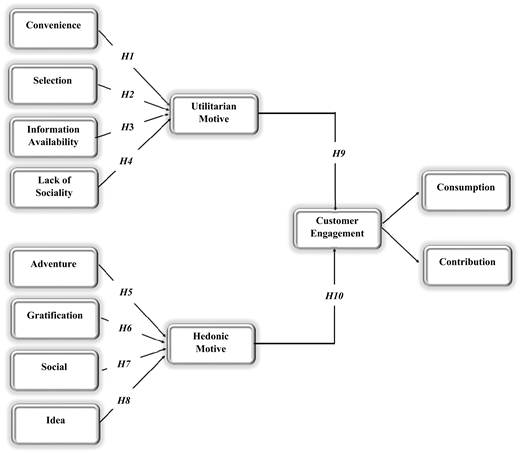
Based on the UGT, this paper tests a theoretical model relating precursors of UM and precursors of HM to consumer engagement with s-commerce (Figure 1). Wolfinbarger and Gilly (2001) categorized the motivational factors that constitute UM in the digital environment into four aspects: convenience, selection, information availability and lack of sociality. Empirical research has validated the role of these factors in explaining UM; for example, Fülöp et al. (2023) and To et al. (2007) asserted the influence of convenience, selection and information availability in shaping UM in online shopping contexts. Akram et al. (2021) also confirmed the significant role of the four factors in predicting UM in the s-commerce domain. This study posits that convenience, selection, information availability and lack of sociality are four antecedents influencing consumers’ UM in the context of s-commerce.
HM, as outlined by Arnold and Reynolds (2003), encompasses six factors influencing shoppers in physical stores: adventure, gratification, role, value, social and idea shopping. In online environments, researchers have investigated the role of these factors in predicting HU. For instance, Fülöp et al. (2023) demonstrated that adventure, gratification, and social shopping significantly predict HM. Conversely, To et al. (2007) determined that adventure is the primary factor influencing HM. In the context of s-commerce, Akram et al. (2021) identified adventure, gratification, social and idea shopping as significant predictors of HM. This study excludes the role factor, as it is encompassed by the convenience attribute of online shopping (To et al., 2007). Online shopping enables customers to fulfill their roles irrespective of location or time constraints (Parsons, 2002). The value factor is often neglected in online shopping, as it indicates customers’ strong emphasis on seeking bargains (Arnold and Reynolds, 2003). Online shopping lacks a negotiation mechanism, resulting in customers being unable to engage in bargaining or experience the satisfaction associated with negotiation (To et al., 2007). Consequently, four aspects were employed as predictors of HM in this study: adventure, gratification, social and idea shopping.
Following Tsai and Men’s (2013) approach, this study measures CE as a multidimensional factor comprising two categories of engagement behaviors: consumption and contribution. The consumption aspect describes customers’ reactive engagement with message consumption. In contrast, the contribution aspect relates to customers’ proactive engagement in two-way interactions and advocacy practices.
3.1 Utilitarian motive precursors
3.1.1 Convenience.
“Convenience in shopping means effortless shopping, amount of time consumed in search of location, store, product and information” (Kesari and Atulkar, 2016, p. 24). In the online setting, customers are motivated by the convenience of making orders at home or at the workplace without time limits (Rohm and Swaminathan, 2004). They can dress more comfortably at home and browse or buy items according to their schedule (To et al., 2007). Convenience was identified as a motivational driver of CE behavior (Roy et al., 2018). It has been identified as a fundamental factor influencing utilitarian motivation in both e-commerce (Fülöp et al., 2023; To et al., 2007) and s-commerce (Akram et al., 2021) settings. To further investigate the effect of convenience on UM in the context of s-commerce, we propose that:
Convenience is positively associated with utilitarian motivation for s-commerce sites.
3.1.2 Selection.
Customers can access a broader selection of product alternatives through online shopping channels compared to conventional stores (Alba et al., 1997). The interactive nature of SNS, as opposed to traditional websites, has inevitably altered how customers interact with brands. SNS users frequently communicate with various brands and goods through reading, viewing, commenting, browsing and sharing (Schivinski et al., 2016). Selection is identified as a predictor of UM in the online commerce (Fülöp et al., 2023; To et al., 2007) and s-commerce (Akram et al., 2021) contexts. To further investigate the influence of selection on UM in the s-commerce setting, we propose that:
Selection is positively associated with utilitarian motivation for s-commerce sites.
3.1.3 Information availability.
Information availability denotes the benefits associated with obtaining useful information that facilitates online shopping (Martínez-López et al., 2014). E-commerce provides an infrastructure that enables customers to search, compare and obtain information more easily and thoroughly than the traditional retail system (Rohm and Swaminathan, 2004). Unique to virtual communities such as social networking platforms is the ability to obtain shared information and gain insight into others’ significant thoughts (Aydin, 2019). SNS has the characteristics of quick dissemination and extensive coverage, enabling the efficient provision of information to consumers (Chen et al., 2021). It was found that providing informative content significantly improved CE in a social media environment (Cvijikj and Michahelles, 2013). Information availability is a determinant of UM (Fülöp et al., 2023; Kumar and Yadav, 2021; To et al., 2007). To examine the correlation between information availability and UM in the context of s-commerce, we hypothesize the following:
Information availability is positively associated with utilitarian motivation for s-commerce sites.
3.1.4 Lack of sociality.
Lack of sociality is related to the advantages of avoiding social interaction with those around us in physical stores (either salespersons or customers) and of shopping online without feeling timid or embarrassed (Martínez-López et al., 2014). Customers who shop online do not have to worry about bargaining with vendors, communicating with annoying fellow clients, or being disturbed by others. The advantages of reduced social interaction may be interpreted as UM for E-commerce shopping (Akram et al., 2021). Lack of sociality can be one of the determinants of UM in s-commerce (Akram et al., 2021). To offer further empirical evidence regarding the influence of lack of sociality on user motivation in the social commerce context, we propose that:
Lack of sociality is positively associated with utilitarian motivation for s-commerce sites.
3.2 Hedonic motive precursors
3.2.1 Adventure shopping.
Adventure shopping is described as “shopping for stimulation, adventure, and the feeling of being in another world” (Arnold and Reynolds, 2003, p. 80). It implies that clients experience something new and exciting and enjoy a sense of discovery while shopping (To et al., 2007). In the online environment, customers feel excited when interacting with businesses’ websites (Kumar and Yadav, 2021). adventurous aspect of shopping can create hedonic worth for consumers (Babin et al., 1994). Therefore, previous research has demonstrated that adventure shopping can explain HM (e.g. Kumar and Yadav, 2021; To et al., 2007). Due to insufficient empirical evidence supporting this association in the s-commerce context, we hypothesized the following:
Adventure shopping is positively associated with hedonic motivation for s-commerce sites.
3.2.2 Gratification shopping.
Gratification is defined as the practice of engaging in shopping activities to reduce stress, enhance mood, and obtain personal satisfaction (Arnold and Reynolds, 2003). Shopping activity can enhance customers’ sentiments and moods through self-gratification (Tauber, 1972). Indeed, shopping has been identified as an emotion-centered coping method for dealing with stressful situations or diverting a person’s attention from a problem (Lee et al., 2001). Gratification shopping can increase consumers’ HM (Akram et al., 2021; Fülöp et al., 2023). To provide further evidence supporting the influence of gratification shopping on UM in the context of s-commerce, we postulate that:
Gratification shopping is positively associated with hedonic motivation for s-commerce sites.
3.2.3 Social shopping.
Social shopping relates to “social interaction, reference group affiliation, and communicating with others having similar interests” (Rohm and Swaminathan, 2004, p. 750). Online shopping outperforms traditional shopping in terms of the capability to rapidly enlarge a consumer’s network of connections and the internet’s capability to go beyond conventional social etiquette. Since consumers are willing to socialize and converse with total strangers in virtual communities and share information and experiences with them, they would not do so in the physical community (Parsons, 2002). Furthermore, SNS create good opportunities for social interaction between consumers through chat, posting, instant messaging and comments (Chen et al., 2021), and allow them to interact with others who share similar interests (Aydin, 2019). Akram et al. (2021) and Fülöp et al. (2023) demonstrated the salience of social shopping as a driver of HM. To provide further evidence on the association between social shopping and HM in the context of s-commerce, we propose the following hypothesis:
Social shopping is positively associated with hedonic motivation for s-commerce sites.
3.2.4 Idea shopping.
Idea shopping describes “shopping to keep up with trends and new fashions, and to see new products and innovations” (Arnold and Reynolds, 2003, p. 80). Several consumers are concerned about staying updated with the recent trends in fashion, styling and innovative goods (Tauber, 1972). Indeed, discovering the latest trends is one of the primary motives for online shopping (Parsons, 2002). In the online context, consumers can obtain, assess and grasp information about various goods, brands and current trends and receive pleasure (To et al., 2007). Furthermore, Akram et al. (2021) illustrated the pivotal role of idea shopping in forming HM with s-commerce sites. To provide further evidence of the impact of idea shopping on UM in the s-commerce context, we propose the following hypothesis:
Idea shopping is positively associated with hedonic motivation for s-commerce sites.
3.3 The relation between hedonic and utilitarian motives and customer engagement
Prior literature has recently identified Hedonic and utilitarian motivations as significant determinants of CE. For example, Itani et al. (2020) unveiled that hedonic and utilitarian values have a significant influence on CE with service firms. According to Qing and Haiying (2021), both HM and UM positively drive consumer–brand engagement with branded apps. Nikhashemi et al. (2021) revealed that utilitarian and hedonic benefits determine CE with shopping augmented reality apps. Kritzinger and Petzer (2021) also demonstrated that HM and UM predict CE toward mobile instant messaging apps. Papagiannidis et al. (2017) pointed out that HM and UM promote CE in the simulated retail environment. In the s-commerce domain, Busalim et al. (2021) reported that HM and UM are among the main predictors of CE. To provide additional evidence on the effects of HM and UM on CE in the context of s-commerce, we hypothesize that:
Utilitarian motivation positively impacts CE with s-commerce.
Hedonic motivation positively impacts CE with s-commerce.
4. Methodology
4.1 Questionnaire design
The latent research constructs were measured using scales adapted from prior studies, with questions modified to suit the context of s-commerce. The convenience and selection items were adapted from Eastlick and Feinberg (1999) and To et al. (2007). Information availability was derived from Korgaonkar and Wolin (1999) and To et al. (2007), and lack of sociality was derived from To et al. (2007). The items of adventure, social and idea shopping were adapted from Arnold and Reynolds (2003) and To et al. (2007), whereas gratification was derived from Arnold and Reynolds (2003) and O’Brien (2010). Both UM and HM items were derived from Voss et al. (2003). Finally, the CE items were adapted from Tsai and Men (2013). The survey items were drafted in English and translated into Arabic using the back-translation method (Mullen, 1995) with the assistance of two linguists. Afterward, a pilot study was conducted involving 20 social media users (8 men and 12 women) who were graduate students in the Business Administration Department at Suez University, Egypt. The participants assessed the comprehensibility and clarity of the questionnaire statements, resulting in pertinent modifications of the survey items based on their feedback. Consequently, the final version of the questionnaire contained three parts: the first part compiled information about participants’ prior experience visiting companies’ Facebook pages. The second part consisted of 44 items, measured using a five-point Likert scale, with 1 indicating complete disagreement and 5 indicating complete agreement. In contrast, the final part collected the participant’s demographic data.
4.2 Sampling and data collection procedure
In the absence of a sampling frame for the target population, a non-probability convenience sampling method was used to gather primary data from respondents. An online survey was conducted from February to June 2022 by distributing the survey link on the Facebook pages of several prominent shopping groups in the Egyptian market, including Sell and Buy Anything and Everything in Egypt, Tales of Shopping and Shopping Zoom. Facebook is predominantly targeted because it is the largest and most used social networking platform for businesses (Chuah et al., 2020). As of January 2024, approximately 81% of internet users in Egypt used the app, establishing it as the most prevalent social networking service in Egypt (Statista, 2024c). Facebook is a social media platform that facilitates communication and networking among users. Participants were instructed to answer two filter questions at the onset of the survey to assess their eligibility for inclusion in the questionnaire. Responses were considered only from individuals who indicated they were followers or visitors of any company’s Facebook pages and were over 18 years of age. The sample comprised Egyptian Facebook users who had previously engaged with corporate accounts on the platform and were at least 18 years of age.
A total of 346 subjects completed the survey. Responses were included only if they confirmed following or visiting the firms’ Facebook pages and if the respondents were > 18 years of age. Consequently, 75 responses were excluded, resulting in a total sample size of 271 subjects. Table 1 summarizes the sample profile according to their demographic attributes and the frequency of visits to such pages. The study subjects consisted of 42.8% males and 57.2% females, indicating no gender bias in the results. The age distribution shows that the vast majority of the sample were in the 18–30 years age category (84.8%), followed by 31–40 years (9.6%), 41–50 years (4.1%) and over 51 years old (1.5%). In terms of educational background, the most significant proportion of the sample held undergraduate degrees (72.3%), followed by (15.9%) high school diploma or an equivalent, (11.1%) graduate degrees and (0.7%) below high school diploma. Regarding the frequency of visiting such pages, 10.3% of subjects visited corporate Facebook pages daily, 18.8% visited weekly, 17.4% visited monthly, 12.9% visited quarterly and 40.6% visited less than once per yearly quarter.
5. Results and analysis
Partial least squares structural equation modeling (PLS-SEM) was used to assess the validity and reliability of the measurement model, as well as to evaluate the hypotheses within the structural model, using SmartPLS version 4 software. The PLS-SEM method is extensively used in the social sciences due to its capacity to estimate complex models involving multiple constructs and structural pathways (Hair et al., 2019). A normality test was conducted using SPSS version 24 prior to assessing the measurement model. All study variables exhibited a normal distribution, with skewness and kurtosis values remaining within the range of +3 and −3.
5.1 Common method bias
Herman’s single-factor test was used to assess common method bias (CMB). The results indicated that CMB was not a concern, as no individual factor explained more than 50% of the model’s variance. The variance inflation factor (VIF) was analyzed, revealing that none of the constructs surpassed the 3.3 threshold proposed by Kock (2015). Consequently, there was no common method bias in this study.
5.2 Measurement model
The validity and reliability of the measurement model were assessed. As depicted in Table 2, the standardized factor loadings for the research items exceeded 0.5. The Cronbach’s alpha (α) scores of each construct showed acceptable levels of reliability, as they surpassed the recommended standard of 0.6 (Bagozzi and Yi, 1988). The composite reliability (CR) values for all variables exceeded the threshold value of 0.7, as suggested by Hair et al. (2017). The average variance extracted (AVE) surpassed the minimum acceptable value of 0.5 for all variables (Hair et al., 2017). Accordingly, the reliability and convergent validity of our framework were achieved. Regarding discriminant validity, the Fornell–Larcker criterion and the Heterotrait–Monotrait Ratio (HTMT) technique were used. Fornell and Larcker’s criterion shows that all square roots of the AVE scores were greater than latent variable correlations (Fornell and Larcker, 1981) (see Table 3). All HTMT ratios were deemed acceptable, with ratios less than 0.85, as suggested by Henseler et al. (2015) (see Table 4). Hence, discriminant validity was achieved.
5.3 Structural model and hypothesis testing
The structural model was evaluated using the bootstrapping approach (subsample size 5,000, bias-corrected confidence intervals 95%) to verify the significance of the relationships between variables in our proposed model. The SRMR value was 0.067, indicating adequate model fit, as it is below the recommended threshold of 0.08 (Henseler et al., 2016). The effect size f2 ranged from having no effect (0.003) to having a medium effect (0.214), demonstrating their varying effects on the endogenous variables. The predictive relevance Q2 for all endogenous constructs was above zero, proving its predictive power (Hair et al., 2019). Table 5 indicates that convenience, selection, information availability and lack of sociality are determinants of UM. The comparison of the independent factors’ effects on UM revealed that information availability exerts a more substantial influence than convenience, selection, and lack of sociality. Consequently, we accepted H1, H2, H3 and H4.
The results demonstrated that adventure, gratification and idea shopping were the precursors of HM. When comparing the relative effects of our independent factors on HM, the results indicated that the influence of adventure is more significant than that of idea shopping and gratification. In contrast, the impact of social shopping was insignificant for HM. Therefore, H5, H6 and H8 were accepted, while H7 was rejected. The results also illustrated that UM and HM are positively associated with CE. Therefore, H9 and H10 were accepted. The results also demonstrated that HM had a more significant impact on CE than UM.
Finally, the bootstrapping approach was used (sample 5,000 bias-corrected confidence intervals 95%) to assess the significance of the indirect effects between variables within our theorized model. As presented in Table 6, convenience, information availability, and lack of sociality significantly impacted CE via UM. Conversely, the indirect effect of selection and CE via UM was insignificant. This finding suggests that UM serves as a partial mediator between the examined variables and CE. The impact of adventure and idea shopping on consumer engagement through hedonic motivation was determined to be significant. No statistically significant indirect effect was observed between social shopping, gratification and CE through hedonic motivation. This finding indicates that HM exerts a partial mediating effect between the examined variables and CE.
6. Discussion
In the era of social media, CE has proven to be crucial for the growth and viability of firms’ pages on SNS as it promotes active community participation (Nadeem et al., 2021). Therefore, it is necessary to comprehend and acknowledge the actual motivations of CE to promote CE behaviors on firms’ s-commerce pages. The absence of comprehensive theoretical frameworks for elucidating CE behavior in the realm of s-commerce has resulted in a scarcity of studies examining the antecedent factors of CE in this environment (Busalim et al., 2021). Depending on the UGT, the current study aimed to address this gap by proposing a conceptual framework that examines the antecedent factors of utilitarian and hedonic motives that explain CE in the s-commerce context. It examines the role of convenience, selection, information availability and lack of sociality as precursors of UM and the role of adventure, gratification, social and idea shopping as precursors of HM in affecting CE. It also enhances our comprehension of CE behavior in emerging economies, whose markets have been inadequately investigated and comprehended, with a particular focus on the Egyptian market. The findings of this research are expected to provide new insights into consumers’ perceptions toward s-commerce in an emerging market setting and assist firms in achieving higher levels of consumer engagement with their social media pages.
The findings indicate that convenience, selection, information availability and lack of sociality are key determinants of UM. This result aligns with the findings of Akram et al. (2021), which indicate that these four factors are crucial for comprehending UM in s-commerce. Additionally, this finding is consistent with the research of Fülöp et al. (2023) and To et al. (2007), who emphasize the significance of convenience, selection and information availability in understanding UM in e-commerce. The results indicated that, among the four constructs elucidating UM, information availability emerged as the most significant factor, followed by convenience, selection and lack of sociality, in that order. This finding suggests that the primary factor influencing UM for social commerce sites is the need for immediate and comprehensive product information. This scenario is relevant to Egyptian consumers, as many physical stores in the Egyptian market do not provide immediate and comprehensive information, a contrast to what is typically available in conventional stores. The interactive nature of s-commerce allows consumers to access information from the recommendations, opinions and comments of others, which is not available in physical stores.
Convenience is identified as the second most significant factor influencing the UM among Egyptian consumers. This finding is attributed to the convenience offered by firms’ social media pages, which enable users to transcend the constraints of time and space. Additionally, due to Egypt’s high population density, many retail establishments experience significant congestion, especially during major events. This circumstance leads Egyptian consumers to prefer shopping through s-commerce platforms to avoid the inconveniences associated with crowds and waiting lines. Therefore, convenience is considered a vital element in the development of utilitarian value.
The factors of selection and lack of sociality seem to elucidate the phenomenon of UM among Egyptian consumers. The findings indicate that most physical stores in the Egyptian market lack a diverse range of product options, primarily due to inventory constraints. Fixed prices are absent, requiring consumers to negotiate with sales personnel to secure a fair price. Egyptian consumers favor s-commerce platforms for several reasons: they provide access to a broader array of options and product selections, minimize interactions with sales personnel during shopping and allow for online browsing or purchasing without the discomfort of in-person engagement.
Adventure, gratification, and idea shopping are identified as the main predictors of HM. These findings are consistent with prior research, including Akram et al. (2021), which illustrates the influence of adventure, gratification and idea shopping on HM, as well as To et al. (2007) and Kumar and Yadav (2021), which substantiate the significance of adventure in elucidating HM. The findings indicated that adventure shopping has a significantly greater influence on HU than idea shopping and gratification, suggesting that the sense of adventure among consumers is the primary factor driving the enhancement of hedonic motives associated with companies’ social media pages. The findings further demonstrate that HM remains unaffected by social shopping, aligning with the conclusions of Kumar and Yadav (2021). This finding suggests that customers do not consider the formation of friendships, sharing experiences, and interactions with like-minded individuals as key drivers of hedonic motives. This finding may stem from social media platforms currently providing such benefits to their users. Consequently, social media users in the Egyptian market do not require engagement with the company’s Facebook pages to benefit from their existing use of social media platforms.
The present study’s findings demonstrate that utilitarian and hedonic motives profoundly impact CE, indicating that greater utilitarian and hedonic values offered to clients on s-commerce sites lead to increased engagement activities with this type of business. These findings are in accordance with former literature, which has clarified that UM and HM are essential for CE prediction (e.g., Itani et al., 2020; Kritzinger and Petzer, 2021; Nikhashemi et al., 2021; Papagiannidis et al., 2017; Qing and Haiying, 2021) and in the s-commerce setting (e.g. Busalim et al., 2021).
Additionally, the findings revealed that HM has a more significant impact on CE than MU, suggesting that engaging customer behavior with s-commerce pages is driven more by HM than by UM. This result is consistent with earlier research, which revealed that hedonic motive has a more substantial influence on CE than UM in s-commerce environment (Busalim et al., 2021), mobile instant messaging applications (Kritzinger and Petzer (2021)) and virtual retail environments (Papagiannidis et al., 2017).
Furthermore, the current study’s findings demonstrated the existence of indirect associations between convenience, information availability and lack of sociality and CE through UM, as well as between adventure and idea shopping and CE through HM. This suggests that UM and HM serve as significant mediators in the proposed model. These findings indicated that consumers would engage more with companies’ pages on social networks if firms provided the antecedents of UM and HM that are imperative to consumers.
In conclusion, our research offers significant insights for businesses planning to incorporate social media into their operations. It provides companies with a more comprehensive understanding of the factors that influence consumer engagement behavior in the emerging social commerce market. Executives and marketers should take these insights into account when creating and managing companies’ social media pages to enhance consumer engagement with their accounts
7. Theoretical and practical implications
This study provides three theoretical insights to the literature on CE management within the context of s-commerce. First, it contributes to current knowledge on s-commerce by offering a comprehensive framework for analyzing CE behavior within social media contexts. It uses UGT to identify antecedent factors that influence both hedonic and utilitarian motives driving CE among s-commerce consumers. This study fills a gap in existing research, which predominantly emphasizes either utilitarian or hedonic motivations in e-commerce (Akram et al., 2021), by identifying the specific components that define UM and HM in s-commerce platforms. The findings indicate that UM is significantly influenced by factors such as convenience, selection, information availability and lack of sociality. In contrast, HM is significantly influenced by adventure, gratification and idea shopping. Second, it provides empirical evidence supporting the relationship between consumer engagement and hedonic and utilitarian motives within the social commerce context. Third, this study broadens the understanding of CE-driven factors in a non-Western context, specifically Egypt, and elucidates CE behaviors in relation to s-commerce within developing economies, which have been underexplored and inadequately comprehended. This contributes to the existing literature on CE within the framework of social commerce in emerging markets.
This study presents several important practical implications. First, our research findings identify factors that explain UM: convenience, selection, information availability and lack of sociality. It is crucial to consider each of these factors when designing s-commerce pages. Executives and practitioners of s-commerce in emerging markets, particularly in Egypt, must provide thorough and precise information about their products, offers and discounts, while also offering clear explanations to enhance consumer comprehension of product features. It is essential to provide diverse options and a broad selection of products and brands on their pages, enabling customers to select the most suitable choice for themselves. Additionally, it is essential to provide consumers with a straightforward and convenient experience when navigating social media pages. Furthermore, they should implement measures that enhance the shopping experience while minimizing disruptions, thereby ensuring consumers enjoy a seamless and comfortable experience on their platforms.
Second, the empirical results indicate that HM is influenced by adventure, gratification and idea shopping. Consequently, managers of s-commerce platforms in the Egyptian market should focus on creating appealing, unique and innovative pages that highlight new products and prevailing market trends. Pages should be designed to evoke excitement, relaxation and enjoyment for consumers. Furthermore, it is essential to keep customers informed about current trends, fashions, styles and innovative products. These actions may improve the hedonic benefits for consumers engaged in s-commerce.
Third, this study illustrates the beneficial impacts of UM and HM on CE, indicating that firms and marketers should prioritize the development of well-structured s-commerce pages that provide both utilitarian and hedonic value to enhance consumer engagement on these platforms. Fourth, as HM has a more significant impact on CE compared to UM, executives and developers of s-commerce pages need to enhance the hedonic value of their platforms. This can be accomplished by integrating enjoyable and stimulating elements and delivering content in an engaging format to enhance customer interactions with their pages. It can also be attained through the use of animated graphics, engaging audio, an appealing layout and other hedonic content (Ashraf et al., 2016). Marketers and managers could also consider launching “member of the week” programs to recognize and reward businesses’ loyal advocates. This form of appreciation enhances consumer satisfaction, potentially leading to increased engagement. Furthermore, executives can exhibit their sense of humor when sharing content. Most consumers appreciate humorous content (Wang et al., 2024). Table 7 presents a summary of the research findings and their implications.
8. Limitations and future research
This study contains some limitations that scholars should address in future studies. First, we used Facebook commerce pages as a case study. Consequently, the results of this study do not apply to all social media applications. Future research should investigate additional social media platforms, such as Twitter and Instagram, to evaluate the model relationships and enhance the applicability of the existing framework across various social media environments. Second, the majority of survey participants were in their twenties. We recommend that researchers include participants from various age groups to achieve results that more accurately reflect consumers’ attitudes. Third, the survey comprised a total of 271 participants. Future research should focus on a larger sample size to enhance the generalizability of the findings. Fourth, this study uses a non-probability convenience sampling method to collect data from respondents, thereby limiting the generalizability of the results. Therefore, future research should employ a probability sampling technique that more accurately represents the entire population to enhance the generalizability of the findings. Fifth, our research framework included the most pertinent factors to utilitarian and hedonic values. However, future studies should incorporate additional variables that contribute to creating utilitarian and hedonic consumer benefits to improve the accuracy and predictability of the proposed model in assessing CE in an s-commerce environment.