


This paper aims to define the concept, composition, connotation, functional technology and development path of autonomous transportation systems (ATS) and provide theoretical basis and support for the construction and development of ATS.
The research analyzes the concept and connotation of ATS, studies the composition and structure of ATS, sorts out pillar function technology system including perception, digitization, interoperability, computing and integration in ATS hierarchically, and looks forward to the future development path of ATS from human participation and systems intelligence.
This paper puts forward the concept, composition, connotation and structure of ATS, proposes the pillar functional technology system of ATS and proposes four development stages of ATS.
The research can provide a theoretical and scientific basis for the high-quality, efficient, orderly construction and development of ATS.
1. Introduction
In the 1980s, to solve the problems of traffic safety, congestion and pollution, developed countries such as the USA, Europe, Japan and South Korea competed to develop intelligent transportation systems (ITS) (Zhao et al., 2014), and the transportation systems are developing under the leading of the ITS in the past two decades. However, the transportation systems are undergoing profound changes currently, the original ITS can no longer meet the development requirements of the future transportation.
In terms of the demands, with the rapid development of traffic and transportation, the number of vehicle registrations in the world reached 1,081 million in 2019, about 3.4 times that of 39 years ago (Davis et al., 2022), approximately 1.3 million people died each year as a result of road traffic crashes (World Health Organization, 2018). The CO2 emission of transport exceeded 8,222 million tons in 2019, accounted for about 24.5% of the global CO2 emission (International Energy Agency, 2022). It can be seen that traffic participants and managers have an increasingly urgent need to further improve the intelligence level of the transportation systems and build a new generation of transportation systems that is safe, convenient, efficient, green and economical.
In terms of the subversive information technologies are developing rapidly, such as artificial intelligence (AI), the Internet of Things, big data, cyber-physical systems (CPS) and cloud/fog/edge computing, the original technical bottlenecks such as holographic perception, real-time interaction and machine decision-making have a new solution. The new generation of information technology and transportation are gradually integrated, giving birth to transportation technologies such as smart cars, autonomous driving and V2X, which also provides opportelementies and technical support for the leap-forward transformation of the transportation systems.
Driven by both demands and technologies, the USA, Europe, China and other countries are vigorously promoting a new generation of ITS that runs autonomously independent of the human operation, which is named as autonomous transportation systems (ATS). Compared with the existing ITS, which aims to improve the intelligence level of the system through advanced enabling technology, it lacks a clear system form orientation. ATS is to sort out its development path and required technical support under the guidance of a clear systems form with few or no human participation in the systems. The systems should further realize autonomous perception and decision-making on the basis of automated execution.
The U.S. Department of Transportation developed Automated Vehicles Comprehensive Plan (U.S. Department of Transportation, 2021) and Architecture Reference for Cooperative and Intelligent Transportation (U.S. Department of Transportation, 2022) to prepare for the future of transportation. Federal Aviation Administration (2020) released NextGen Annual Report to make flying even safer, more efficient and more predictable. The European Rail Research Advisory Council released RAIL 2050 VISION (The European Rail Research Advisory Council, 2017) and Rail 2030 – Research and Innovation Priorities (The European Rail Research Advisory Council, 2019) proposed to build a progressively more automated interconnected railway system. Ministry of Transport and Ministry of Science and Technology of the People’s Republic of China (2021) released Opinions on Accelerating the Construction of a Powerful Transportation Country Driven by Scientific and Technological Innovation and proposed to “strengthen the research and development of complete technologies clusters for ATS.” International Maritime Organization (2019) released Interim Guidelines for MASS (Maritime Autonomous Surface Ships) Trials to study a new generation of autonomous ships.
In the academic research community, many scholars have carried out the conceptual and theoretical research related to the ATS. SAE International (2014) released Taxonomy and Definitions for Terms Related to On-Road Motor Vehicle Automated Driving Systems. Anna et al. (2018) proposed a classification scheme to classify and harmonize the capabilities of a road infrastructure to support and guide automated vehicles. Yan (2020) studied the concept, composition and key technologies of autonomous waterway transportation systems and prospected its future development. Gao et al. (2018) put forward the development trend and suggestion of autonomous automatic operation system in rail transportation systems. However, ATS is still in the early stage of development and lacks sufficient basic theoretical support.
To sum up, as a new generation of the transportation systems, there is no internationally recognized definition, related theoretical and technology system about the ATS. This paper tries to give the concept and connotation of the ATS, and the development path and pillar functional technology system of ATS are proposed accordingly. The technological- and application-oriented innovations led by ATS will further enhance the safety, efficiency and environmental friendliness of transportation systems and promote green and intelligent development of transportation.
The rest of the paper is structured as follows. Section 2 introduces the concept, composition and connotation of ATS. Section 3 designs five pillar functional technologies for ATS. Section 4 develops the development roadmap and evolution paths of ATS. Section 5 provides concluding remarks.
2. ATS concept, composition and connotation
As a new generation of transportation systems, a clear and unambiguous definition is critical foundation for the construction and development of the ATS. Hence, the concept, connotation and composition of the ATS are defined and illustrated in this section.
2.1 The concept of autonomous transportation system
As a new generation of transportation systems, ATS is a typical system of systems (SoS) with complex structure and function, and it is integrated from multiple fields. It is built and developed based on the deep integration of transportation systems with the enabling/energized technologies (intelligent, network, computation, data, material energy, etc.) and the sciences (psychological, cognitive, behavioral, etc.). It can complete the “displacement +” mission with high safety, high efficiency and high quality. The components of ATS have the abilities of self-perception, self-adaptation, self-learning, self-decision, self-reconstitution and harmonious interoperability, and the ATS as a whole has the abilities of highly intelligent, highly adaptable, highly openness and highly resilient.
2.2 The composition of autonomous transportation system
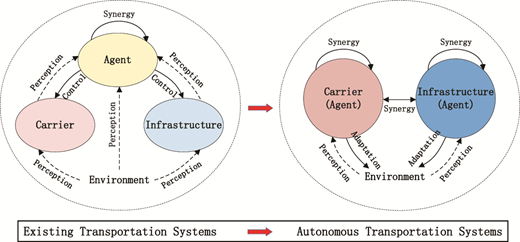
The ATS is composed of four functional subsystems or constituents: agent, carrier, infrastructure and environment. Agent represents the intelligent elements in the transportation system, which is in charge of the information collection, procession, decision-making execution, etc., and it could be the human or machine. Carrier refers to vehicles with the fundamental motor function in the transportation system, which is responsible for the displacement of the cargo or human. Infrastructure is the basic systems and facilities in the transportation system, and their functions are supporting, restraining and indicating the movement of the carrier. Environment indicates the movement conditions of the carrier in the transportation system, including the nature and humanistic environment.
2.3 The connotation of autonomous transportation system
The essential task of the transportation system is to achieve the displacement of the cargo or human between the origin-destination through the movement of the carriers with the constraints and supports of the infrastructure, and the operation of the carriers are all performed under the various command and control schemes. There is no doubt that any decision-making or execution of the carrier is all based on larger number of data collection, information procession and knowledge supporting, and most of the works are performed by the human currently.
As for a transportation system with autonomous operation capability, the operation of the system should be independent of the human. The operation functions of human in the system should be displaced by the nonhuman equipment and facilities, and the human are just the served objects by the transportation system. Hence, the connotations of the ATS can be described as that the operation functions (perception, interoperation, computation, decision-making, execution, etc.) of the agent are all transferred from the human to the carrier, infrastructure or other facilities, and the transportation system can be operated autonomously independent of human.
As shown in Figure 1, in the existing transportation systems, the functions of the agent are performed by the human (drivers, managers) and the direct synergy among carrier and infrastructure is inadequate, and the agent composed of human in charge of the system collaborative operation. In ideal ATS, the functions of the agent are distributed into the carrier and infrastructure and integrated into a whole system through synergy. The carrier and infrastructure can adapt to the transportation environment and operate autonomously by interoperating and synergy among carriers and infrastructures.
3. The pillar functional technologies for autonomous transportation systems
Combining the definition and classification of supporting technologies is very important for the development of the ATS, and the technologies can be classified as the SoS technology, system technology and element technology. The latter two types of technologies are the specific technologies that are always varied and diverse, whereas the SoS technology which remains stable is more important for the ATS, especially at the infancy. Hence, the functional technologies as the typical SoS technology are introduced in this paper, and it is divided into five categories, including technologies for comprehensive sensing and perception and identification, technologies for transportation infrastructure and network digitalization, technologies for interoperability among the system components, technologies for transportation computation and technologies for system integration.
3.1 Technologies for comprehensive sensing, perception and identification
Perception and understanding of the transportation system’s situations and behaviors are the basic of the system operation, and the data or information collection to be indispensable equally. The necessary technologies, subject–object pairs, the content for the ATS comprehensive sensing, perception and identification are listed in Table 1.
Technologies for comprehensive sensing, perception and identification
| Functional technologies | Subject | Perceiving content | Identification and assessment content |
|---|---|---|---|
| Carrier operating state self-perception and situational self-assessment | Carrier | The motion, performance and service states of the carrier | The situation of the carrier |
| Carrier-oriented environment perception and situation assessment | The spatiotemporal state of other carriers and traffic participants; the state of the infrastructure and natural environment | State and availability of the right-of-way | |
| Infrastructure state perception | Infrastructure | The performance and service state of the infrastructure | Infrastructure state and the spatiotemporal availability of the right-of-way |
| Infrastructure-oriented environment perception and situation assessment | The spatiotemporal state of carriers and traffic participants, the state of natural environment and the right-of-way | Spatiotemporal availability of the right-of-way; microscopic state of the traffic flow | |
| Traffic flow and network operation state perception and situation assessment | Traffic management system | The states of the traffic flow, infrastructure, network, right-of-way and natural environment | The situations of the traffic flow; the multigranularity risk of the network; the availability of the network |
| Collaborative perception and perception enhancement | Multiagent collaboration | Collaboration/enhanced perception from the carrier, infrastructure and operation control center | Complement and enhance other perception-based technologies |
3.2 Technologies for transportation infrastructure and network digitalization
Digital transportation components are the developing trend and characters of the ATS. It will provide a convenient high-effective way to reappear high-fidelity transportation situation and behavior in the digital space, and the simulation, evaluation, testing and validation for the lifecycle will promote the overall efficiency of the ATS. The technologies for transportation infrastructure and network digitization are listed in Table 2.
Technologies for transportation infrastructure and network digitalization
| Functional technologies | Modeling/expression objects | Modeling/expressing content | Modeling/expression purpose |
|---|---|---|---|
| Infrastructure digital modeling | The key physical components of infrastructure (facilities of carrying, control, induction, protection, auxiliary) and natural environment | Structured information model and digital expression for the infrastructure and its physical components | Form a strictly mapped and operational digital mirror of the infrastructure and its physical components |
| Infrastructure state expression and enhancement | Structural state, performance state and service state of the infrastructure physical components | The generation, digitization expression and embedding models for the infrastructure state | Form an accessible, understandable and computable digital model of the infrastructure |
| Network digital modeling | Components of the network and the corresponding spatial relationships | Digital model and expression of the network functions, grades, right-of-way and their spatial relationships | Form an accessible, understandable and computable digital model of the network |
| Network state expression and enhancement | Structural state, performance state and service state of the network | The generation, digitization expression and embedding models for the components and network state | Each component of the road network and the road network model accessible, understandable, computable |
| Carrier-road-network-environment symbiosis expression and digital | An integrated model reflecting the spatiotemporal symbiosis relationships among the carrier, flow, infrastructure, network and environment | Integrated model and digital expression of the symbiotic relationship among the carrier, flow, infrastructure, network and environment | Form an integrated expression and operational digital space for the static and dynamic relationship among the components of the ATS |
3.3 Technologies for interoperability among the system constituents
Interoperability is the ability of the ATS components to connect and communicate in a coordinated way, including the horizontal interoperability and vertical interoperability according to the information exchange and mutual recognition. The horizontal interoperability refers to the interoperation among different constituents at the same level, whereas the vertical interoperability means the interoperation among the different level in the same constituent. The interoperability technologies among the agent (A), carrier (C) and infrastructure (I) are listed in Table 3. Among them, in the early stage of the development of ATS, the functions of the agent are performed by the human, including the driver (Ad) and the traffic management and control systems (Am). As the ATS gradually develops and matures, the function of the driver is completed by the carrier, and the function of the traffic management and control systems is completed by the infrastructure.
Technologies for interoperability among the system constituents
| Functional technologies | Interoperability function | Interoperability purpose |
|---|---|---|
| Driver-carrier (Ad-C) interoperability | C-Ad: state expression of the carrier, other states expression required for driving Ad-C: operational behavior | Realize the information sharing and decision making |
| Traffic management systems-driver (Am-Ad) interoperability | Ad-Am: traffic state announcement, traffic guidance and management Am-Ad: interaction between travel request and destination information | Realize the information sharing of traffic state and demands, and support the planning and management of the traffic rights-of-way |
| Traffic management systems-infrastructure (Am-I) interoperability | Am-I: traffic control signals announcement, infrastructure operation state monitoring I-Am: traffic information collection and feedback | Realize traffic signal dispatch control and state feedback |
| Traffic management systems-carrier (Am-C) interoperability | Am-C: traffic control statue announcement, right-of-way assignment permission C-Am: feedback of the operation state, perception state and response state | Realize the traffic information collection and guidance management |
| Carrier-infrastructure (C-I) interoperability | C-I: feedback of the regional traffic running state I-C: expression of the right-of-way state | Synergy of the carriers and infrastructure |
| Agent-carrier-infrastructure (A-C-I) interoperability | A-C: carrier operation control A-I: confirmation and control of key right-of-way | Complement the deficiencies of the ATS |
| Carrier-carrier (C-C) interoperability | C-C: collaborative perception, collaborative decision-making, collaborative control | Information interaction and synergy among carriers |
3.4 Technologies for transportation computation
There are many models used to express the mechanism of the transportation situations and behaviors, and the reliable and effective transportation computation models are the fundamental solution for the transfer from the human intelligence to machine intelligence. The nine categories of ATS computing technologies are listed in Table 4.
Technologies for transportation computation
| Functional technologies | Computing subject | Computing function | Computing purpose |
|---|---|---|---|
| Carrier-oriented state expression and situation modeling evaluation | Carrier | Cognitive model and computer mechanism for the traffic state and situation | Provide decision support for driving |
| Infrastructure-oriented state expression and situation modeling evaluation | Infrastructure | Provide decision support for right-of-way availability | |
| Network-oriented state expression and situation modeling evaluation | Traffic management systems | Provide decision support for right-of-way configuration and traffic flow management | |
| Modeling evaluation and decision-making for carriers in-transit operation behavior | Carriers, infrastructure, traffic management systems | Cognitive model and computer mechanism for the carrier in-transit behavior | Provide decision support for driving and right-of-way selection |
| Self-adaptive mechanism and decision-making for infrastructure | Infrastructure, traffic management systems | Cognitive model and computer mechanism for the infrastructure and regional traffic states | Provide decision support for the dynamic adjustment of the infrastructure functions |
| Network traffic management modeling and decision-making | Traffic management systems | Cognition, prediction, decision-making and control models, and computing mechanisms for network traffic states | Provide decision support for network traffic states assessment and management |
| Traffic flow behavior modeling and analysis | Traffic management systems | Cognition and dynamic models, and computing mechanisms for the self-organized/controlled traffic flow (micro, meso, macro) | Provide decision support for traffic states assessment and management of network and carrier in-transit behavior |
| Information models and data integration architecture for ATS | Carriers, infrastructure, traffic management systems | Information models and data integration architecture for the carrier and infrastructure operation, and traffic management | Form an integrated and interoperable computing platform |
| ATS-oriented other data processing and computing technologies | Carriers, infrastructure, traffic management systems | Traffic-specific computing mechanisms and algorithms for improving computing efficiency and accuracy | Improve the computing efficiency and trustworthiness of ATS |
3.5 Technologies for system integration
The usefulness, usability, suitability and effectiveness are the basic assessment criteria of the ATS. Meanwhile, the ATS is the integrator of multitechnologies, and the performance of the system is determined by the mode and effect of integration. Hence, the system integration technologies based on the establishment or evaluation objects and the establishment/evaluation content and purposes are listed in Table 5.
Technologies for system integration
| Fictional technologies | Objects | Content | Purpose |
|---|---|---|---|
| Hierarchical CPS model construction for ATS | Multigrained architecture of the ATS physical model; the definition and transfer form of the information interaction | The form of hierarchical CPS structure, interoperability among the layers and the digital modeling technologies | Realize the organic, orderly and logical combination of the elements, technologies and system modules, form a reliable, efficient and real-time collaborative ATS that considering the computing, network and physical environment |
| Evolvable architecture for ATS | Architectures, components and interoperability of the ATS in different levels of autonomy | Evolutionary modular construction for ATS at different levels of autonomy; evaluation about the intergenerational characteristics and DoA for ATS | Predict and evaluate the DoA, evolution direction and mode of ATS |
| Evaluation of transportation-related technology | The element, system and SoS technologies of ATS at different levels of autonomy | Indicators system, and evaluation, testing, verification method for maturity of technologies, product, integration, application | Evaluate the practicability of each element technology, system technology and SoS technology |
| Testing and evaluation of enabling/energized technologies | Technologies in other fields that have an enabling/energized functions or effects on ATS | Index system and corresponding testing and evaluation technology for the adaptability, maturity, compatibility, integration and security of enabling/energized technologies. | Oriented by the requirements of ATS, evaluate the function/performance of the enabling/energized technologies |
| Construction and operation of testing and verification environment for ATS | ATS at different levels of autonomy | A platform that can configure and operate the functional modules composed by the elements and interoperability relationships of ATS; offline/real-time/half-physical/physical simulation environment | Realize accurate verification of ATS on functions configurable and modular reconfigurable operating environment |
| Customization and configuration optimization of ATS | Definition and custom of elements and interoperability for ATS, adaptive module matching method of the functions for different ATS scenarios | The matching degree evaluation methods of the modules and interoperability; the adaptive matching and optimization methods aims at the ATS performance achievable | Oriented by the function and performance requirements of the specific ATS scenario, design the components of ATS with the minimum cost |
| ATS-related technical standards | Elements and interoperability relationship of carrier, infrastructure and traffic management system in ATS | Establish technical standards and specifications for different stages of ATS, such as the basic definitions and terms, general specifications, design methods, core technologies, performance, product manufacturing, key equipment, integrated applications and recycling | Build the standards for the entire technical system, the industrial chains and the lifecycle of ATS, lead the research, design, manufacturing, inspection and other related works about the ATS |
4. Development roadmap and evolution paths of autonomous transportation systems
ATS essentially refers to reducing the degree of human participation in the transportation systems by improving the intelligence of the systems. Facing the future ATS, the transportation systems will gradually transfer to less human participation and even no human participation, and the role of human beings in the transportation system will be transformed from drivers and other participants to the carriers and infrastructure. The autonomous perception, decision and execution capabilities of the carriers and infrastructure will be improved gradually, and the autonomous operation abilities of the system are promoted according to the real-time interconnection, interaction and harmonious interoperability among carriers and infrastructure.
As a new generation of transportation systems, ATS lacks relevant theoretical system support. The existing development path and the classification standards like the levels of driving automation of the transportation systems are all oriented to ITS, and are mostly aimed at some components (vehicles or infrastructure) of a single type of transportation (roads, railways, etc.). Therefore, under the guidance of the final form of ATS unmanned, a development path and grading standard suitable for various transportation modes, covering system carriers, infrastructure and other components are proposed, which provides a route design and guidance for the research and development of the ATS. As shown in Figure 2, the degree of autonomy (DoA) according to the criteria of the human participation is divided into four stages and six levels: existing transportation systems (L0–L1), partial autonomy (L2–L3), high autonomy (L4) and full autonomy (L5).
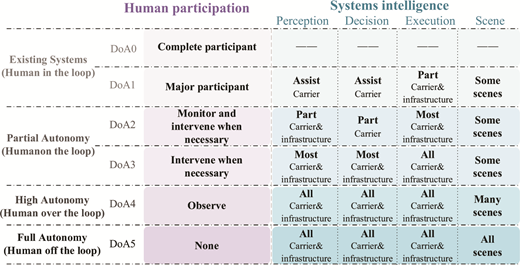
Specifically, at the stage of existing systems (human in the loop), human participate in all the specific links, and the systems intelligence is low. This stage can be subdivided into Level 0 and Level 1. At Level 0, human participate in all perception, decision and execution, and the systems itself has no autonomous capabilities. At Level 1, human are still participants in the systems majorly, but the systems can assist human to complete perception and decision, and autonomous execution achieved partially. Among them, the carrier and infrastructure can complete part of the execution within the corresponding range, while the assist perception and decision are mainly completed by the carrier.
At the stage of partial autonomy (human on the loop), human will get involved when necessary, and the systems operated autonomously to some extent. This stage can be subdivided into Level 2 and Level 3. At Level 2, human no longer execute specific operations, but the systems operation situation still should be monitored and intervened at any time when necessary. Most of the execution within the corresponding range are performed by the carrier and infrastructure. At Level 3, human do not need to monitor systems operation real-time, but should respond and intervene at the emergency moment. Almost all the execution are completed by the carrier and infrastructure, and the dynamic information such as guidance signals and right-of-way status can be perceived by the infrastructure autonomously, and cooperate with the carrier to realize most of the autonomous perception and decision.
At the stage of high autonomy (human over the loop), human no longer participate in specific links except to the overall situation observation, and the systems can achieve autonomous operation completely under specified scenes. As the stage corresponds to the Level 4, the dynamic micro information can be perceived by the infrastructure autonomously, and all of the autonomous perception and decision can be realized to cooperate with the carrier.
In the stage of full autonomy (human off the loop), human functions disappeared during the operation of the transportation systems, the systems can operate completely autonomously in all scenes. As this stage corresponds to Level 5, the group synergy and harmonious interoperability can be achieved between carrier and infrastructure, and all the perception, decision and execution can be completed autonomously.
5. Conclusion
The background and origin of ATS are introduced in this paper, and the corresponding concept, connotation and composition of ATS are defined accordingly. Then, the five kinds of pillar functional technologies for ATS are constructed from the perspective of information perception, system digitalization, interoperability, computing and integration. Furthermore, the development and evolution path of the ATS from the degree of human participation are designed. This paper provides a followable model and route for the development of ATS, and the technological and application innovations led by the ATS architecture will further enhance the safety, efficiency and environmental friendliness of the transportation systems and also promote the green and intelligent development of transportation. Moreover, the development of the ATS will greatly promote the deep integration of transportation-related industries, AI and other enabling technologies.
This project was supported by the National Nature Science Foundation of China (No. 61903023), State Key Laboratory of Rail Traffic Control and Safety (Contract No. RCS2021ZT006) and Beijing Jiaotong University.

