This study aims to uncover the ongoing discourse on generative artificial intelligence (AI), literacy and governance while providing nuanced perspectives on stakeholder involvement and recommendations for the effective regulation and utilization of generative AI technologies.
This study chooses generative AI-related online news coverage on BBC News as the case study. Oriented by a case study methodology, this study conducts a qualitative content analysis on 78 news articles related to generative AI.
By analyzing 78 news articles, generative AI is found to be portrayed in the news in the following ways: Generative AI is primarily used in generating texts, images, audio and videos. Generative AI can have both positive and negative impacts on people’s everyday lives. People’s generative AI literacy includes understanding, using and evaluating generative AI and combating generative AI harms. Various stakeholders, encompassing government authorities, industry, organizations/institutions, academia and affected individuals/users, engage in the practice of AI governance concerning generative AI.
Based on the findings, this study constructs a framework of competencies and considerations constituting generative AI literacy. Furthermore, this study underscores the role played by government authorities as coordinators who conduct co-governance with other stakeholders regarding generative AI literacy and who possess the legislative authority to offer robust legal safeguards to protect against harm.
1. Introduction
In an era where technological advancements are reshaping the boundaries of what is possible, the rise of generative artificial intelligence (AI) has captured the collective imagination. With its ability to produce deepfake videos, AI-generated art, chatbot conversations and even fake images depicting fictional scenarios, generative AI has become an influential force in shaping the way people interact with information. At the same time, fears about unintended consequences, exemplified by deepfake videos and fake news circulating on social media (Westerlund, 2019), have ignited serious conversations about the imperative need for a comprehensive regulatory framework to govern generative AI’s development and utilization (Meskys et al., 2020).
As generative AI becomes an integral part of our daily lives, the interplay between individuals’ experiences with AI and their literacy in comprehending its intricacies becomes important, particularly in the context of evolving skills and capacities. The capability of individuals to navigate this technological landscape is instrumental, and as society grapples with the implications of generative AI, it becomes increasingly evident that public literacy is integral to effective governance. This understanding extends to the roles played by both the general public and government authorities in shaping the regulatory environment for AI technologies.
Navigating the intricate landscape of AI governance requires a nuanced comprehension of how generative AI resonates with the public. This understanding ensures that governance practices are not only effective but also reflective of the diverse needs and expectations of a technologically engaged society. The present paper aims to contribute to this understanding by delving into the public discourse of individuals’ experiences and current practices of AI governance regarding people’s literacy in the realm of generative AI, shedding light on the avenues for enhanced governance of generative AI.
As generative AI continues to push the boundaries of innovation and ethics, public media becomes a central conduit for conveying the nuances, challenges and potential benefits associated with this technology. Hence, the current article endeavors to explore people’s experiences with generative AI by analyzing news articles from public service broadcasting media, specifically BBC News, as a case study. The choice of BBC News adds both validity and limitations (see the methods), allowing for a focused examination of generative AI perceptions in a reputable and widely accessible media outlet.
Through the lens of public media, the present research aims to uncover the ongoing debate on generative AI, literacy and governance while providing nuanced perspectives on stakeholder involvement and recommendations for effective regulation and utilization of generative AI technologies. The research questions are as follows:
What application and impact of generative AI are presented in BBC News articles?
How is people’s literacy on generative AI portrayed in BBC News articles?
What roles do various stakeholders play in the public discourse around generative AI, and in what ways can government authorities contribute to enhancing generative AI literacy?
2. Literature review
2.1 The rise of generative artificial intelligence
The current landscape of AI research has witnessed a profound transformation with the emergence and evolution of generative AI. According to Sætra (2023), generative AI is an umbrella term, describing machine learning solutions trained on massive data sets to create output responding to prompts input by users. From the report published by consultant company McKinsey and Company (2023), generative AI is stated as being a set of algorithms that can be used to produce new content, such as audio, code, images, text, simulations and videos. Scholars such as Bandi et al. (2023) have argued that generative AI is powerful technology for content creation. In Bandi et al. (2023) work, the researchers have summarized various approaches of generative AI systems to produce content, covering text-to-text, text-to-image, text-to-audio/speech, text-to-code, code-to-text and image text.
In the field of this emerging technology, ChatGPT and DALL-E are two representative applications that open many people’s horizons toward the era of generative AI (Hirvonen et al., 2023). Developed by OpenAI company, ChatGPT is a chatbot that can synthesize answers based on trained data to answer any asked question; similarly, DALL-E 2 is an image generator that can create images based on textual input (Brandtzæg et al., 2023; Fui-Hoon Nah et al., 2023; McKinsey and Company, 2023). With advancements in language models, these two applications are undergoing significant evolution. For example, the advanced large multimodal model GPT-4 enables the system to describe trends or generate captions for pictures input by users (Terrasi, 2023); additionally, the latest version of the DALL-E system, known as DALL-E 3, enhances the quality of the images that are output (Metz, 2023).
With the flourishing of signature applications, such as ChatGPT, the generative AI market is predicted to grow into a $1.3tn market by 2032 (Catsaros, 2023). In this context, a large amount of existing research has focused on generative AI used in different areas and the impacts caused by these applications (e.g. Brynjolfsson et al., 2023; Ebert and Louridas, 2023; Michel-Villarreal et al., 2023; Walters and Murcko, 2020). For instance, Brynjolfsson et al. (2023) have conducted research on people’s adoption of generative AI tools to offer conversational assistance to customer support agents and found that these tools can help increase the productivity of agents by 14%. Michel-Villarreal et al. (2023) have used ethnography as the main approach to engage with ChatGPT and identified the opportunities (e.g. 24/7 support and accessibility, personalized learning and tutoring, etc.) and challenges (e.g. lack of awareness and understanding, resource constraints, etc.) brought by generative AI on higher education. Furthermore, numerous studies have delved into the application of generative AI systems in diverse domains, including medicinal chemistry (Walters and Murcko, 2020), the software industry (Ebert and Louridas, 2023) and beyond.
As generative AI becomes more prevalent, concerns regarding its usage have also escalated. Scholars such as Lambert and Stevens (2023) have demonstrated a series of concerns toward ChatGPT in terms of academic integrity, accuracy of information/misinformation, biases, discrimination, stereotypes, misuse/abuse/ethics and privacy/security. Similarly, Fischer (2023) has also used ChatGPT as an example and illustrated ChatGPT’s harmful usage, such as threats to jobs, misinformation and so forth and design, such as human cost, environmental cost and so forth. In addition, Sætra (2023) has discussed the challenges of generative AI at the macro (e.g. environmental costs), meso (e.g. bias and discrimination) and micro (e.g. persuasion and manipulation) levels. Research has shed light on the current issues related to generative AI and sought solutions to tackle these problems.
While confronting these challenges brought about by generative AI, a number of previous studies have focused on the discussion of combating generative AI-related harms. For example, Alasadi and Baiz (2023, pp. 2969–2970) have listed solutions to address generative AI issues, such as developing “cost-effective AI solutions,” establishing “partnerships and collaborations,” encouraging “open-source AI initiatives” and incorporating “AI into educational funding models.” Other works have concentrated on fighting the negative impacts associated with a specific type of generative AI application, such as deepfakes. For instance, from the technical side, Katarya and Lal (2020) have presented three approaches of deepfake detection involving fake image detection, fake video detection and fake audio detection. In addition, scholars from the field of law have explored the capability and limitation of current law to properly deal with problematic deepfake pornography (Gieseke, 2020; Mania, 2024).
Situated in the era of generative AI, the present article examines people’s experiences with generative AI spanning fields rather than centering on a specific model, product or field. By analyzing the real-life examples presented by news articles, the authors aim to comprehend both the benefits and challenges posed by generative AI. Furthermore, the study aims to build connections between these experiences, individuals’ skills and capabilities in the realm of generative AI and the current state of AI governance by governmental bodies.
2.2 Artificial intelligence literacy
With AI dramatically shaping people’s everyday lives, a comprehensive understanding of AI literacy becomes pivotal for individuals navigating the intricate intersections of technology, information and society. Topics related to AI literacy are not only widely discussed in academic circles but are also featured prominently in documents issued by governments or institutions. A large amount of documents are related to the actions that boost people’s information literacy (e.g. National Artificial Intelligence Advisory Committee, 2023). For example, the US National Artificial Intelligence Advisory Committee (2023) has published a file listing the different contexts that require AI literacy, pointing out recommendations for enhancing people’s AI literacy in America. Moreover, UNESCO (2022) has released a report to map out the K-12 (from kindergarten to the 12th grade) AI curricula endorsed by either national or regional governments around the world, showing a comprehensive landscape of AI education for cultivating young people’s AI literacy.
In terms of academic works, many scholars have attempted to conceptualize or build a framework for evaluating AI literacy (e.g. Long and Magerko, 2020; Ng et al., 2021; Perchik et al., 2023; Yi, 2021). In the field of human–computer interaction studies, Long and Magerko have first clarified the definition of AI literacy as “a set of competencies that enables individuals to critically evaluate AI technologies; communicate and collaborate effectively with AI; and use AI as a tool online, at home, and in the workplace” (Long and Magerko, 2020, p. 2). Subsequently, based on an exploratory literature review, Long and Magerko (2020) have further pointed out 17 competencies constituting AI literacy. In line with Long and Magerko’s approach, Ng et al. (2021, p. 4) used the same approach and conceptualized AI literacy that involved four aspects: knowing and understanding AI, using and applying AI, evaluating and creating AI and AI ethics.
Notably, most of the literature addressing AI literacy has focused on young people, including children or students, primarily concentrating on AI education (Casal-Otero et al., 2023; Domínguez Figaredo and Stoyanovich, 2023; Druga et al., 2019; Kong et al., 2023; Lee et al., 2021). For example, Casal-Otero et al.(2023, p. 6) have conducted a systematic literature review regarding AI education in K-12 curriculum and found that current education should integrate AI literacy by acquiring AI knowledge to “recognize artifacts using AI, learning how AI works, learning to live with AI”. By organizing an AI workshop for middle school students, Lee et al. (2021) have observed participants’ participation and engagement with AI-related activities and found that young students had fundamental AI literacy.
Kong et al. (2023) paid attention to university students’ conceptual building of AI. They have designed and tested an AI literacy program based on a conceptual framework to enhance people’s conceptual understanding, literacy, empowerment and ethical awareness. By lowering the barrier to entry for AI literacy, their work has shown the positive effect of such a program, indicating that it can be extended to include more participants such as senior secondary school students and the general public.
Still, only a few studies have focused on enhancing AI literacy across the public or different educational fields and levels. Going beyond K-12 and technical aspects of AI systems, Domínguez Figaredo and Stoyanovich (2023) have argued for a “stakeholder-first” approach to design educational projects by targeting a broader range of audiences from industry experts to laypeople and focusing more on the ethical, legal and social implications of AI.
Ng et al. (2022) have argued for AI literacy for all. They have underlined that AI literacy should be acquired by all learners, even though there are different contents and approaches for different education levels across K-16 (from kindergarten to the 16th grade). They have highlighted that all citizens, from kindergarteners, primary and secondary students to non-computer science university students, should learn AI to facilitate their living, working and learning to contribute to a better society.
In particular, German statistical consultant Schüller (2022) has suggested a framework for data and AI literacy for everyone in a data-driven society. Not only schools, teacher training and higher education, but extracurricular and vocational training are needed to enable people’s capability to gain data-related insights and shape decision-making. The framework aims to facilitate people’s transdisciplinary competence and lifelong learning from three perspectives: the application-oriented perspective, the technical–methodological perspective and the socio-cultural perspective. This requires public statistical institutions to develop and promote training programs, for example, in cooperation with educational actors such as adult education centers or public libraries. She has used the education app “Stadt | Land | Datenfluss” (cofounded by the German Federal Ministry for Economic Affairs and Energy) to enhance Germans’ data literacy to illustrate how the framework benefits adult education.
In addition, although many studies have focused on the topic of AI literacy, few specifically have delved into the nuances of generative AI literacy. Some of the existing studies explored generative AI literacy in the realm of education (e.g. Relmasira et al., 2023; Cao and Dede, 2023). For example, Relmasira et al. (2023) have optimized generative AI education principles by implementing a three-session classroom intervention in an Indonesian school and analyzing students’ reflection papers. Cao and Dede (2023) have made valuable recommendations for educators seeking to enhance students’ understanding of generative AI.
In response to the limited scholarly attention given to generative AI literacy and literacy for the general public, rather than the young and/or students, the current study is designed to bridge this gap. The analysis based on individuals’ experiences with generative AI, as shown in news stories, can lead us to identify some of the key components of generative AI literacy, thus providing insights not just for educators or technologists but also for the government and stakeholders with the power of governance.
2.3 Artificial intelligence governance
With the rapid advancement and increasing application of AI technologies across the private and public sectors, the literature in the field of AI governance is continuously expanding (Lütge et al., 2021). According to Mäntymäki et al., AI governance is defined as follows:
A system of rules, practices, processes, and technological tools that are employed to ensure an organization’s use of AI technologies aligns with the organization’s strategies, objectives, and values; fulfills legal requirements; and meets principles of ethical AI followed by the organization (Mäntymäki et al., 2022, p. 604).
In this sense, AI governance can be performed by not only governments or other institutions in the public sector but also private organizations, which has been indicated by previous research. For instance, the private organization the Data Privacy Group has published strategies for implementing effective AI governance (Borner, 2023). Some governments have also been taking action and have come up with regulations and policies for AI governance, such as the impact assessment of an AI regulation published by the European Commission (2021). In 2023, the European Parliament and Council reached an agreement on the European Union’s Artificial Intelligence Act to protect citizens’ rights (Hainsdorf et al., 2023).
When it comes to academia, the topic of AI governance and regulation has been widely explored. In 2018, Dafoe (2018, p. 49) has published a research agenda on AI governance outlining the principles of AI governance, including solving the problems related to security (AI safety, conditional stabilization) and autonomy (freedom, continuity, sovereignty). In this context, the researcher has argued that governance institutions should be able to guarantee the safety of AI technologies and be resilient to changes and challenges (Dafoe, 2018, pp. 50–51).
Other studies on AI governance have often been seen as an overview of current practices based on a literature review or mapping out AI governance activities (e.g. Birkstedt et al., 2023; Kuziemski and Misuraca, 2020). For example, relying on different examples of AI governance practices in Canada, Poland and Finland, Kuziemski and Misuraca (2020) have pointed out the current practices from the perspectives of drivers, goals, barriers and risks. Birkstedt et al. (2023) have conducted a systematic literature review on the articles related to AI governance and identified AI governance literature from four dimensions: technology, stakeholders, context and regulation and processes.
Remarkably, AI literacy is widely seen as one of the most essential elements of AI governance interventions. As Larsson et al. (2023) have illustrated, in discussions related to AI, advocating for literacy has evolved into a widely accepted normative stance when addressing governance issues. For example, “establishing internal oversight capabilities and literacy” is one of the perspectives in a report of the Government of Canada for ensuring the quality of the system (Kuziemski and Misuraca, 2020, p. 5). Simultaneously, from the literature, the government, here taking a main role of the public sector, is one of the most important stakeholders surrounding AI governance. Furthermore, Al Zadjali (2020) has pointed out that the government should be capable of generating value for all stakeholders through various actions. This research is positioned between AI literacy and governmental AI governance, trying to bring the implications to current governmental policymaking from the perspective of AI literacy, especially generative AI literacy.
Furthermore, in considering AI governance, a large number of scholars have opted to examine the subject through the lens of real-life policies or enactments, with limited research being conducted on its portrayal in the media. Regarding the research of media representation, the literature has leaned more on elaborating the portrayal of AI technology and its artifacts, such as large language models such as ChatGPT or image generators such as DALL-E, rather than delving into discussion of AI governance behind AI issues. For example, Xian et al. (2024) have used global news coverage on generative AI from 2021 to 2023 to explore the distribution of topics and sentiment across time and space; they have identified various key topics from business, corporate technological development, regulation and security and education. The business- and corporate-related articles have shown a more positive sentiment, while those on regulation and security have shown a more reserved, neutral to negative sentiment, reflecting major concerns in different fields. This finding echoes current research on generative AI’s benefits and risks (Bandi et al., 2023).
It is imperative to examine AI governance through the lens of media representation. Given that the media serves as a conduit between the public and various societal actors, it bears the responsibility of disseminating information and heightening awareness of pertinent issues. Hence, to address this gap, the present study will take a close look at AI governance based on an analysis of news articles released by BBC News, which is renowned for its authoritative role in public service broadcasting.
3. Methodology and methods
3.1 Case study
The current research was a qualitative study oriented by a case study. According to Bazeley, “qualitative analysis is fundamentally case-oriented” (2013, p. 5). A case study is a valuable approach for researchers to explore in depth a phenomenon in a process, program, event, activity or other context (Baxter and Jack, 2008; Creswell, 2014). This approach allows researchers to apply any method of data collection (Priya, 2021) and underscores the situated interrelatedness of various characteristics and causes of the particular phenomenon (Bazeley, 2013).
Led by this approach, the present study chose generative AI-related online news coverage on BBC News as a case based on two considerations. First, BBC is one of the most influential public service broadcasters in the world and always embraces the unique value of public service broadcasting (BBC, 2004). The BBC News website remained at the top of visits among 50 influential news media (Majid, 2024), which can be regarded as representative compared with other news media. Second, public service broadcasting is a kind of media aiming to guard citizens’ integrity and interests and, meanwhile, inform, educate and entertain audiences (Banerjee and Seneviratne, 2006, p. 12; Gorham, 1967, p. 221, cited in Grummell, 2009, p. 270). The information published by these media is often perceived as authoritative information and also a good lens through which to observe what is going on in society. Overall, the news coverage published by BBC News is a proper case for analysis.
3.2 Sampling
The present study focused on news articles published by the BBC News website. To identify pertinent articles, a keyword search was executed on the BBC website using the search term “generative AI.” The search was conducted on January 24 and directed to all content published on the BBC News website. The search results showed 290 pieces of news coverage presented in various forms, encompassing radio, video, games, images, programs and news articles. In line with Marshall (1996), the sampling from this coverage was based on specific criteria:
Because we were aiming at analyzing news articles, 139 news pieces in non-article form were excluded from our selection.
The article needed to present content related to generative AI.
This strategy helped us cover as much rich textual material related to generative AI as possible. Led by this strategy, we went through the content of these articles and excluded 71 articles not related to generative AI and two duplicates. Ultimately, 78 news articles (see Appendix) related to generative AI, each marked with a unique ID number, were chosen as the sample.
3.3 Data analysis
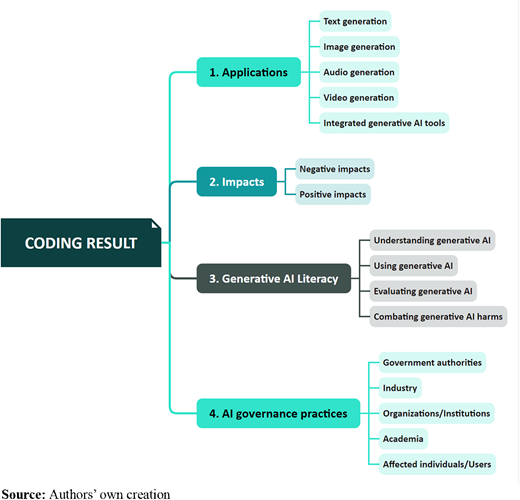
A qualitative content analysis (Schreier, 2012) was conducted based on a sample of news articles. The texts of the news articles were segmented into every sentence as a unit for analysis. The analysis was conducted in an inductive, data-driven way, allowing the categories to emerge from the empirical material (Schreier, 2012, p. 25). By assigning successive parts of the empirical data to categories, we sought to interpret the meaning of this qualitative material in a systematic way (Schreier, 2012, p. 1). Based on the analysis, 16 categories were extracted: text generation, image generation, audio generation, video generation, integrated generative AI tools, negative impacts, positive impacts, understanding generative AI, using generative AI, evaluating generative AI, combating generative AI harms, government authorities, industry, organizations/institutions, academia and affected individuals/users. Furthermore, four themes were identified from these categories: applications, impacts, generative AI literacy and AI governance practices. For example, the code “Meta has announced a series of new chatbots to be used in its Messenger service” (73) was grouped into the category of “text generation,” contributing to forming the theme of “applications”; the code “Faked AI images and videos of politicians are also exacerbating the problem of online misinformation” (70) was directed to the category of “negative impacts,” belonging to the theme of “impacts.” Through this process, a coding result was finalized, as shown in Figure 1.
Given our selection of news articles exclusively from the BBC as the sample, it is vital to acknowledge the potential presence of bias in these samples. Attempting to reduce this limitation and improve the reliability of our analysis, we applied strict strategies to systematically select our samples.
4. Results
4.1 Generative artificial intelligence applications
Table 1 shows the diverse applications of generative AI reported by news stories, shedding light on the public discourse surrounding this emerging technology. Here, generative AI is primarily used in generating texts, images, audio and videos. In addition, as generative AI advances, other applications, such as integrated generative AI tools, have emerged in people’s everyday lives as well.
Notably, regarding text generation and image generation, the examples show two divisions of applications – text/image generator and conversational AI systems, such as ChatGPT (54) and DALL-E (26). For video generation, generative AI is used not only for creating fake videos, such as deepfakes (24), but also for building characters, such as news presenters (8) and a holographic video of Elvis (74) [1]. In addition, there are two types of integrated generative AI tools presented in new stories: AI systems offering a set of services, such as Copilot (19) [2], and AI agent devices, for example, the phone-like device R1 [3] that allows users to circumvent apps (13).
4.2 Impacts of generative artificial intelligence
The impacts of generative AI were mainly portrayed from two perspectives: its risks and benefits. The examples in Table 2 reveal the risks as a negative impact, including misuse and abusive use, mis- and disinformation, copyright infringements, creativity erosion, job displacement, bias, capability obscurity and environmental issues. Remarkably, misuse and abusive use include two branches: the applications maliciously manipulated by specific users, such as generating naked images of children (41), and misuse caused by the system itself, such as chatbot making illegal purchase led by its wrong models (45). Moreover, regarding the risks of mis- and disinformation, generative AI can produce inauthentic information like fake news stories (33) and false information, such as ChatGPT-generated false answers to students’ homework (54).
Table 3 shows the examples of the benefits brought by generative AI. The benefits, or the positive impact of generative AI, consist of innovation fostering, inspiration acquisition, skills/knowledge popularization, cost reduction, productivity boost and customer experience enhancement. A few benefits are directly linked to content creation, knowledge dissemination and cost savings, while the others contribute to improving customers’ and people’s working experiences.
4.3 People’s generative artificial intelligence literacy
Table 4 displays people’s generative AI literacy, as indicated in the news articles, including a set of elements – understanding, using, evaluating generative AI and combating generative AI harms. People primarily show their understanding of generative AI by talking about the technology itself, its applications and its impact. They pay particular attention to the applications, for example, the developers of the application (29) and functionality (30). The impact discussed by people covers both negative and positive impacts, which overlaps with the results of the aforementioned section.
Regarding using generative AI, the article quotes come from different groups – professionals (4), practitioners (7) and students (18) – as developers or customers. Usage among students echoes one of the acknowledged benefits of generative AI – skills/knowledge popularization – as discussed in previous sections.
When considering the literacies of using and evaluating AI, both positive and negative aspects are apparent. The evaluation of generative AI significantly revolves around its future, marked by a spectrum of optimistic and pessimistic tones. For example, some interviewees perceive generative AI as valuable for artistic work (7), while others express concerns about the potentially serious consequences of manipulating generative AI (61).
Moving beyond usage and evaluation, the literacy of combating generative AI harms is unveiled through two perspectives: avoiding potential harm and dealing with harm. Individuals made efforts to discern false information or keep specific regulations in mind (24) to steer clear of being misled (9). Simultaneously, they may take legal actions or stand up (70) to protect their rights when harmed by generative AI applications (32).
4.4 Stakeholders and existing artificial intelligence governance practices regarding generative artificial intelligence literacy
The instances in Table 5 are categorized by different stakeholders, involving government authorities, industry, organizations/institutions, academia and affected individuals/users. Government authorities have played an essential role in the four practices related to generative AI. First, they have tried to comprehend the current status of AI by conducting investigations (21, 37) and collecting opinions from the public (76). Second, government authorities have been dedicated to disseminating knowledge of generative AI through publishing relevant authoritative reports, policies and laws (71) and promoting education programs (46), aiming to draw public attention and facilitate the accessibility of these tools. Third, government authorities have been actively collaborating with other stakeholders related to generative AI. The collaborations span different fields and regions; for example, international representatives from various areas signed the Bletchley Declaration [4] on AI Summit hosted in the UK (50), working together to build a better environment for developing and utilizing generative AI. Finally, the government authorities have strode to make policies and laws to drive the regulations of generative AI (55).
The examples of industry practices expose five perspectives: offering diverse tools, popularizing knowledge, regulating generative AI, understanding the current status and collaborating with other stakeholders. It should be noted that the industry acts as a generative AI service provider that offers massive tools for people (7). Moreover, to regulate generative AI use, tech companies not only internally formulate regulations to standardize developers’ utilization of generative AI (68) but also externally make policies to lead to users’ positive consumption (21).
Additionally, organizations/institutions and academia also contribute to AI governance regarding generative AI literacy in various ways. Organizations/institutions primarily engage in the practices of popularizing knowledge of generative AI, understanding the current status of generative AI, collaborating with other stakeholders and combating generative AI harms. Prominently, some organizations, such as an organization focusing on tackling child sexual abuse (41), help people who are victims of generative AI applications. For academia, they underline the importance of conducting research on generative AI to enhance people’s AI literacy (18) through the practice of understanding the current status and collaborating with other stakeholders.
Finally, the BBC News articles also illustrate how users and affected individuals made their efforts to elevate AI governance regarding AI literacy. For these stakeholders, three approaches, including combating generative AI harms, understanding their current status and collaborating with other stakeholders, form the basis of their practice. Noticeably, people are trying to use their ways of understanding generative AI better, such as young people’s exploration of classmates’ use of ChatGPT (54) and addressing the issues related to AI (41).
5. Discussion
5.1 Four paradoxes of generative artificial intelligence’s impact
We identify four paradoxes regarding the impacts of generative AI from BBC News articles. First, there is a paradox between creativity reduction and improvement, particularly in the field of art. From the news articles, we find that, on the one hand, generative AI is described as being used to spark creators’ inspiration; however, on the other hand, people show their worries about an erosion of creation caused by the overuse of technology.
The second paradox is between beginner-friendly use and misuse and abusive use. Although one of the advantages highlights that generative AI applications reduce the technical barriers to content creation, making them more accessible to users, it also underscores the heightened risks of misuse and abusive utilization of generative AI.
Third, the results have indicated a paradox between job growth and displacement. For instance, a report from Goldman Sachs [5] in 2023 estimates that AI can replace the equivalent of 300 million full-time jobs; it simultaneously argues that there might be new jobs emerging alongside a boom in productivity (12).
The fourth paradox is directed at the tension between energy saving and waste. With productivity improvement and job displacement by machines, generative AI may be helpful in saving more energy. However, one of the negative impacts points out that generative AI applications can use more power than conventional applications (67).
Some of the impacts mentioned above align with the perspectives on the impacts of generative AI outlined by, for example, Bandi et al. (2023), Brynjolfsson et al. (2023), Fischer (2023) and Sætra (2023), particularly regarding aspects such as content creation, productivity enhancement, threats to jobs and environmental costs. Expanding upon the literature, the present study points out paradoxes in terms of the impacts of generative AI as additional nuances, shedding light on the complexity of generative AI use and its consequences.
We posit that these four paradoxes necessitate specific considerations in individuals’ generative AI literacy and AI governance practices. We advocate for all stakeholders to foster an environment conducive to a comprehensive understanding and judicious use of generative AI. Addressing these issues requires the establishment of clearer boundaries differentiating proper use, overuse, misuse and the abusive use of generative AI. This aligns with competencies integral to AI literacy (Long and Magerko, 2020; Ng et al., 2021). In addition, in addressing those concerns related to energy wastage, we recommend that government authorities and industry stakeholders discharge their responsibilities in AI governance, including the formulation of regulations.
5.2 “Combating generative artificial intelligence harms” as a unique element of generative artificial intelligence literacy
With AI literacy being seen as civic competence (Hirvonen et al., 2023), the results of the present study indicate several components of AI literacy pertaining to generative AI. Drawing from the comprehensive model proposed by Long and Magerko (2020), which encompasses 17 competencies and 15 considerations integral to AI literacy, we have constructed a framework of people’s generative AI literacy based on our analysis:
understanding the technology, application and impact of generative AI;
using generative AI properly and ethically;
evaluating the positive and negative sides of generative AI; and
avoiding potential harms and dealing with harms of generative AI.
This proposed framework is structured around four essential elements: understanding, using, evaluating generative AI and combating generative AI harms. Within these elements, we have identified and delineated nine competencies and considerations aimed at fostering a nuanced understanding of and responsible engagement with generative AI technology. Our findings align with previous research by Long and Magerko (2020), who also have pointed out perspectives on understanding, using and evaluating AI technology. Building on this, our study extends the literacy framework by underscoring the new aspect of “combating generative AI harms”. Importantly, the emergence of the category “combating generative AI harms” that signifies a unique dimension within the generative AI framework, one distinct from traditional AI literacy models. This suggests that generative AI, as portrayed in media and public discourse, is often presented with potential challenges that may have adverse effects on individuals’ daily lives. Consequently, individuals have expressed a heightened sense of caution and take proactive measures in response to these perceived issues. Notably, some findings of combating generative AI harms echo previous research by, for instance, Mania (2024), who also has discussed legal protection as a significant way to fight generative AI harms.
The inclusion of “combating generative AI harms” as a distinctive element within the generative AI framework underscores the imperative for individuals to not only understand and use this technology but also to actively address and mitigate potential risks. This novel element also accentuates the need for the implementation of robust AI governance practices to safeguard individuals against the potential negative impacts of generative AI.
Remarkably, our framework for enhancing people’s generative AI literacy holds significant practical value. In terms of education, this framework can be regarded as a basis for developing generative AI curricula in educational institutions, here involving K-12 schools to universities. Additionally, regarding the ethics and policy development of generative AI, this framework can serve as a compass for policymakers and ethicists to establish AI ethic guidelines and regulations.
5.3 The role of government authorities in generative artificial intelligence governance
Informed by the literature of Mäntymäki et al. (2022) and Larsson et al. (2023), we adopt a literacy perspective to examine AI governance, emphasizing the practices of various stakeholders involved in the governance of generative AI. Our analysis has underscored the pivotal role assigned to government authorities in this multifaceted ecosystem. Government authorities have been depicted as key connectors, collaborating with industry, academia and organizations to conduct research, institute regulations and provide legal safeguards for individuals. In light of this, we advocate for government authorities to assume the role of coordinators, leveraging resources and power among diverse stakeholders.
Emphasizing the importance of co-governance, we have highlighted the crucial role of government authorities in facilitating collaboration among stakeholders from different sectors, disciplines and regions. A notable example is the AI Summit at Bletchley Park, UK, where representatives from technology industries, government authorities and academia convened to discuss AI-related issues `(50). This summit led to the signing of the Bletchley Declaration by 28 countries and the EU, underscoring a commitment to ensuring the safe use of AI. The example of co-governance resonates with the argument proposed by Al Zadjali (2020), who similarly has emphasized the government’s role in creating value for all involved stakeholders. As vividly depicted by BBC News and disseminated to broad audiences, these instances may intrigue citizens’ interest in AI literacy, potentially fostering increased civic engagement in co-governance initiatives.
Furthermore, our analysis has indicated the need for intensified regulation of generative AI by government authorities. This reflects the fact that government authorities are taking high responsibility for making regulations and policies in this ecosystem, which is in line with the literature published by the European Commission (2021) and Hainsdorf et al. (2023). As shown by the previous sections illuminating the potential negative impacts on individuals, government authorities possessing legislative authority are uniquely positioned to offer robust legal safeguards to protect against harm.
6. Conclusion
In our qualitative content analysis of 78 BBC News articles on generative AI, we examine its diverse applications and profound impacts on daily life. AI technologies applied in content generation can have both negative and positive impacts on people’s everyday lives, as portrayed in the news articles. Our study also unravels four paradoxes intricately linked to generative AI literacy and governance practices regarding creativity, accessibility, work and environment, providing a nuanced perspective on this evolving technology.
A distinctive facet within the generative AI literacy framework emerged –“combating generative AI harms.” This element, based on traditional AI literacy models, signifies the imperative for individuals not only to understand and use generative AI but also to actively address and mitigate potential risks. This unique dimension underscores the proactive measures individuals take to counteract the potential negative impacts associated with generative AI applications.
Government authorities play a pivotal role as coordinators in the generative AI landscape: They foster collaboration among diverse stakeholders, including industry, academia and organizations, contributing to a cohesive approach to regulating generative AI. As a response to potential harm, we advocate for intensified regulation by government authorities, leveraging their legislative authority to offer robust legal safeguards. Furthermore, we promote increased media responsibility in raising public awareness about generative AI issues and encouraging active civic engagement in AI governance initiatives.
Our findings contribute rich insights into the generative AI research landscape, emphasizing the interconnected nature of literacy and governance through the lens of media discourses. As we conclude, we encourage future research to leverage diverse methodologies, focusing on demographic variations. This will enable a deeper understanding of individuals’ experiences and considerations regarding generative AI literacy and governance, further advancing our comprehension of this transformative technology.
Notes
Elvis Aaron Presley is a famous American singer and actor who has been said to be one of the most influential cultural icons of the twentieth century.
Developed by Microsoft, Copilot is an integrated generative tool that allows users to conduct a group of tasks, such as searching for specific information, generating texts, creating images based on prompts, and so forth.
R1 is a standalone AI device, developed by AI startup Rabbit, that can connects to users’ mobile apps and operates tasks for users.
The Bletchley Declaration, agreed by countries attending the AI Safety Summit 2023 at Bletchley Park, Buckinghamshire, proclaims a new global effort to release vast benefits provided by AI while prioritizing its safety.
The Goldman Sachs Group, Inc. is a leading global investment banking, securities and investment management firm.