The study applied the Unified Theory of Technology Acceptance and Use Theory 2 (UTAUT2) to predict blended learning acceptance by students in universities in Zimbabwe. Blended learning is a heterogeneous mode of teaching and learning that combines face-to-face (F2F) and online modes. Owing to advances in technology, and recently, the advent of pandemics, such as COVID-19, the need for multimodal teaching approaches, such as blended learning, to enhance access to education in universities has become very important.
A quantitative approach that used a structured questionnaire for data collection from a sample of 432 postgraduate students was used. Data validation was done using confirmatory factor analysis (CFA). The structural equation modelling technique was used for data analysis.
Results showed that out of the seven factors of the UTAUT2, the factors such as performance expectancy, effort expectancy, social influences, facilitating conditions and hedonic motivation significantly and positively influenced the behavioural intentions of students in universities to accept blended learning. On the other hand, habit and price value did not significantly influence university students' behavioural intentions to accept the bended learning mode. It was further shown in the study that behavioural intentions significantly influenced the acceptance of blended learning by university students. In light of the above results, it was concluded that the UTAUT2 could be used to predict the acceptance of blended learning by university students.
The main study limitation was that it was only carried out at universities that had information and communication technology (ICT) infrastructure challenges owing to the fact that the economic situation in Zimbabwe is depressed. Limited ICT infrastructure in the universities might have had some impact on the nature of behavioural intentions of students to accept blended learning as a learning mode. Further research could be carried out in countries with better economies that are able to fund ICT infrastructures of their universities and to establish whether the results of the current study could either be confirmed, disconfirmed or enriched.
The paper suggests that universities need to increase investment in ICT infrastructure as well as in capacitating students with the necessary ICT skills for the effective use of institutional ICT when learning using the blended learning mode. Without adequate and appropriate ICT infrastructure as well as necessary ICT skills, students may develop low motivation levels and negative attitudes towards blended learning, which may eventually may affect their acceptance of the learning mode.
There is no known study that has been conducted using the UTAUT2 to establish antecedents of behavioural intentions of students to accept blended learning in the context of Zimbabwean universities. This study therefore opens new ground on factors influencing the acceptance of blended learning in the context of Zimbabwean universities. Also, the results showed that habit and price value do not significantly contribute to the behavioural intentions of university students to accept blended learning, which is not consistent with findings of past studies. This inconsistency opens new opportunities for further studies on the conditions under which these two factors can be used to significantly contribute to the development of behavioural intentions of students to accept blended learning.
1. Introduction
According to Wu et al. (2010, p. 176), “advances in information and communication technology (ICT), also simply called technology, offers a multiplicity of possibilities for communication, interaction and multimedia delivery systems in universities”. The advent of COVID-19 has added another dimension to the acceptance of blended learning as one of the learning modes of choice in universities (UNESCO, 2020). As an alternative to, or perhaps an improvement of purely online teaching and learning, blended learning does not only offer increased access flexibility, eliminate time and geographical barriers and allow for collaborative learning but also provides direct lecturer/student interaction during the physical or classroom-based learning phase (Wu et al., 2010). In Zimbabwe, while blended learning had been offered for the last two decades by the only open university called the Zimbabwe Open University, all 22 universities in Zimbabwe have migrated to blended learning in reaction to the challenges of COVID-19 (Mhlanga, 2021; Mukeredzi, 2021). The different digital tools that are used in universities for the online part of blended learning include cell phones and laptops, Microsoft teams, Zoom, Google docs and many others (Mhlanga, 2021; UNESCO, 2020; Maphosa, 2021). Despite the fact that the migration of all universities in Zimbabwe to blended learning came as a strategic move by universities to ensure student access to education, a number of challenges continue to affect the smooth implementation of the strategy in Zimbabwe. Among the major challenges affecting blended learning in universities in Zimbabwe are “the lack of access to digital technology, poor Internet connectivity, low levels of online teaching skills of lecturers and inadequate Wi-Fi that continue to make teaching and learning difficult” (Mukeredzi, 2021, p. 1). Despite the prevalence of the above challenges, no studies, in the context of Zimbabwe, have been conducted applying the Unified Theory of Technology Acceptance and Use Theory 2 (UTAUT2) to assess factors that influence the acceptance of blended learning by students in universities in Zimbabwe. The current study therefore seeks to bridge the research gap by applying the UTAUT2 to establish factors that influence the acceptance of blended learning by university students. The study is guided by the following objectives:
To establish factors that have a significant influence on the acceptance of blended learning by students in universities.
To establish the blended learning model that is mostly used for teaching in universities.
2. Literature review: conceptual and theoretical frameworks
This section addresses the concept of blended learning and the theoretical framework that informs the study.
2.1 Understanding blended learning
The term blended learning is used in many educational settings, yet there is still ambiguity with regards to what it actually means (Hranstinski, 2019; Wang, 2019). The answer to the questions: what, why and how we blend remain elusive (Cakir and Bichelmeyer, 2016; European Commission, 2020; Hrastinski, 2019). Due to failure by authorities in the field of blended learning to provide clear answers to the above questions, blended learning has inadvertently remained ill-defined, assuming many definitions and meaning different things to different people. While there is still no clear evidence on how much of each modality used in blended learning, between face to face (F2F) and online, is more beneficial during teaching and learning (Zhonggen, 2015), a study by Anthony et al. (2019) opined that effective blended learning consists of 70% online learning and 30% classroom-based learning. A study by Owston et al. (2019) also suggested that effective blended learning consists of 80% online learning and 20% physical learning.
Blended learning is a heterogeneous teaching and learning method that has been defined variously with all definitions converging on the fact that it is a hybrid method (White, 2019). The nature of its hybridness, on a continuum from F2F to online, is still open to debate (White, 2019). This is also why Lawless (2019) argues that it is only circumstances that determine how blended learning is used, and this means, therefore, that coming up with a universally agreed definition thereof becomes even more difficult. Lawless (2019, p. 1) argues that “blended learning is an approach to education that combines online educational materials and opportunities for interaction with traditional place-based teaching methods”. Other definitions view blended learning as mixed methods learning (Prasad, 2015) or a thoughtful integration of F2F and online experiences (Wang, 2019), a combination of any number of technologies to facilitate teaching and learning (Friesen, 2012), a system of learning that enhances old methods of teaching with the use of new technologies (Lynch, 2018), a method of teaching and learning that combines online and traditional classroom methods (Rivera, 2019; Skypnyk et al., 2015) or a dynamic, engaged online learning that is combined with a dynamic offline learning to give students more influence over the time, space, place and path of their learning (Tucker, 2021).
The above definitions therefore imply that blended learning is characterised by the following factors: (1) blended learning is a dynamic, evolving and active process of teaching and learning, (2) part of learning occurs online in which the student has some form of influence over the pace and path of engaging with the content, (3) the other part of learning occurs in the classroom during F2F and (4) the online and F2F components of blended learning complement each other to create an integrated learning process (White, 2019). Overall, what is clear from the views of what blended learning is that it is a combination of all the institution-facilitated teaching and learning that occurs in virtual and physical environments (Akbarov et al., 2018; Alsalhi et al., 2019; Volchenkova, 2016). For this study, blended learning is viewed as a learning mode that is a combination of traditional F2F mode with digital learning mode.
2.2 Models of blended learning
Four major models characterise blended learning (Bowyer, 2017; Christensen Institute, 2021). The four models are the rotation, flex, self-blend and enriched virtual models (Tucker, 2021). The rotation model is when students rotate between working online and other classroom-based modalities while the flex model is when students mostly use the online modality according to individually customised schedules with F2F learning provided by the instructor only as needed (Bryan and Volchenkova, 2018). The self-blend model is one in which students complement traditional learning modalities with off-campus online learning as needed while the enriched virtual model is one in which students learn mostly using the online modality with occasional visits to the campus for the F2F modality (Bryan and Volchenkova, 2018; Hrastinski, 2019; Horn and Heather, 2014).
2.3 Theoretical underpinning informing hypotheses formulation
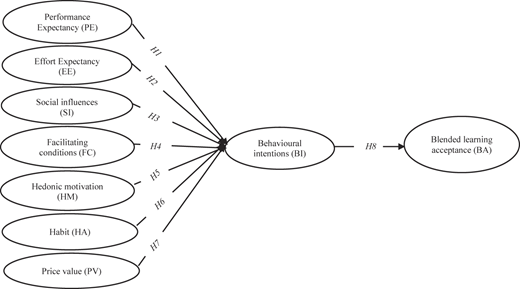
The study is informed by the UTAUT2 model developed by Venkatesh et al. (2012) as a theoretical lens. The UTAUT2 is an extension or improvement of the UTAUT by Venkatesh et al. (2003) meant to assess users' behavioural intentions to accept technology (Morton et al., 2016). The UTAUT is premised on the belief “that an individual's intention to use technology is influenced by the four main constructs, namely, performance expectancy (PE), effort expectancy (EE), social influences (SI) and facilitating conditions (FC)” (Yeou, 2016, p. 302). It is a model that explains 70% of variance in the behavioural intentions of users to accept technology, way ahead of previous technology acceptancy models, which explain between 27 and 40% of the variance (Yeou, 2016; Venkatesh et al., 2003). The main criticism of the UTAUT was that it was too cumbersome and failed to explain technology usage behaviour of users (Casey and Wilson-Evered, 2012) and hence the introduction of the UTAUT2 by Venkatesh et al. (2012) by including three more constructs, namely, hedonic motivation, price value and habit (Abu-Gharaah and Aljaafreh, 2021). Based on the conceptual and theoretical frameworks, a research model (Figure 1) was developed.
2.3.1 Influence of performance expectancy (PE) on blended learning acceptance
PE is the “degree to which an individual believes that using a system will help him or her to attain gains in job performance” (Venkatesh et al., 2003). It is hence the level to which technology is perceived to be useful (Chao, 2019; Huang and Kao, 2015). In this study, PE suggests that university students will accept blended learning if they believe that it will enhance their academic performance. The importance of PE in the behavioural intentions to accept technology by users has been widely researched on. Separate studies by Abu-Gharrah and Aljaafreh (2021), Amparo (2021) and Abbas (2018) found that there was a positive relationship between PE and behavioural intentions of students to accept blended learning. Based on the results of previous research, the first hypothesis of this study is given as follows:
There is a significant and positive relationship between PE and the behavioural intentions of university students to accept blended learning.
2.3.2 Influence of effort expectancy (EE) on blended learning acceptance
EE is the “degree of simplicity and ease of use of a system” (Venkatesh et al., 2003, p. 428). It is hence the extent to which users believe that a system would be effortless to use in the performance of their duties (Huang and Kao, 2015). In this study, EE is taken to mean that university students who believe that using blended learning for learning will be effortless will highly likely develop behavioural intentions to accept it as a learning mode in their studies. The significance of EE on the behavioural intentions of users to accept a learning system is also highlighted in a number of studies. Studies by Abu-Gharrah and Aljaafreh (2021), Azizi et al. (2020), Morton et al. (2016) and Kiviniemi (2014) found that there was a positive relationship between EE and behavioural intentions of technology users to accept blended learning. Based on the results of previous research, the second hypothesis of this study is given as follows:
There is a significant and positive relationship between EE significantly and the behavioural intentions of university students to accept blended learning.
2.3.3 Influence of social influences (SIs) on blended learning acceptance
SIs refer to the “degree to which an individual perceives that referent groups (peers, parents, friends or faculty) believe that it is important for him or her to use a system” (Venkatesh et al., 2003, p. 429). This therefore means that an individual uses a system, such as blended learning, when he/she believes that others in his/her social network feel that it is important that he/she should use the system (Venkatesh et al., 2012). In the current study, students in universities will develop behavioural intentions to use blended learning if they feel that either their friends, lecturers, peers or parents are of the view that they should use it in their studies. Studies by Abu-Gharrah and Aljaafreh (2021), Amparo (2021) and Huang and Kao (2015) found that SIs significantly influence the behavioural intentions of individuals to use blended learning. A study by Wu and Liu (2013) also found a positive relationship between SIs and behavioural intentions of students to accept blended learning. Based on the results of previous research, the third hypothesis of this study is given below:
There is a significant and positive relationship between SIs and the behavioural intentions of university students to accept blended learning.
2.3.4 Influence of facilitating conditions (FCs) on blended learning acceptance
FCs relate to a belief by users of a system that exists in an organisation, technological and organisational infrastructure to adequately support the use of a system, such as blended learning (Moorthy et al., 2019). This implies that if an individual perceives that his/her organisation has adequate resources to be able to use the blended learning mode, he/she will develop behavioural intentions to use blended learning. In this study, students who believe that their institution has adequate and appropriate technological and organisational infrastructure to support their learning using blended learning mode will develop behavioural intentions to use the learning mode in their academic studies. Findings from previous studies highlight the importance of FCs in the development of behavioural intentions of technology users to accept blended learning. Studies by Abu-Gharrah and Aljaafreh (2021), Wu and Liu (2013), Lu et al. (2020) and Sattari et al. (2017) showed a positive relationship between FCs and behavioural intentions of users to accept a learning system, such as blended learning. Separate studies by Abu-Garrah and Aljaafreh (2021) and Hoque and Sorwar (2017), however, found no significant relationship between FCs and behavioural intentions to accept blended learning as a learning system. Based on the results of previous research, the fourth hypothesis of this study is given as follows:
There is a positive and significant relationship between FCs and the behavioural intentions of university students to accept blended learning.
2.3.5 Influence of hedonic motivation (HM) on blended learning acceptance
Defined as “the users' pleasure of using a system” (Chao, 2019, p. 5), HM is one of the critical factors in shaping behavioural intentions of people to perform certain actions. According to Venkatesh et al. (2012) and Amparo (2021), HM relates to a perception that using a particular system is an enjoyable experience. In the present study, students who find joy or pleasure in the use of blended learning as a learning mode will likely develop behavioural intentions to accept the system in their studies. The importance of HM in the development of behavioural intentions of individuals to accept a system, such as blended learning, is widely discussed in previous studies. Findings in studies by Venkatesh et al. (2012), Nikolopoulo et al. (2020), Gharrah et al. (2021), Ho (2014) and Alalwan et al. (2017) showed that HM has a positive and significant relationship with behavioural intentions of individuals to accept a system, such as blended learning. A study by Abu-Garrah and Aljaafreh (2021), however, found no positive and significant relationship between HM and behavioural intentions of users to accept a system such as blended learning. Based on the results of previous research, the fifth hypothesis of this study is given as follows:
There is a significant and positive relationship between HM and the behavioural intentions of university students to accept blended learning.
2.3.6 Influence of habit (HA) on blended learning acceptance
HA is the “degree to which individuals perform behaviours automatically” (Casey and Wilson-Evered, 2012, p. 2035). Moorthy et al. (2019) defines habit as the extent to which an individual uses a system involuntarily. This suggests that habit relates to a behaviour that has become a usual way of doing things or a behaviour that has become almost involuntary. In the current study, if the use of blended learning mode by students becomes an everyday or usual activity, in the end students will develop behavioural intentions to use it in their studies. The importance of habit in the behavioural intentions of individuals to accept a system, such as blended learning, is highlighted in a number of studies. Studies by Huang and Kao (2015), Nguyen et al. (2014) and Abu-Garrah and Aljaafreh (2021) found that HA significantly influences the behavioural intentions of users to accept a system, such as blended learning. Azizi et al. (2020) in his study, however, found no significant relationship between HA and behavioural intentions of individuals to accept a system, such as blended learning. Based on the results of previous research, the sixth hypothesis of this study is given as follows:
There is a significant and positive relationship between HA and the behavioural intentions of university students to accept blended learning.
2.3.7 Influence of price value (PV) on blended learning
Defined as the level of an individual's understanding of the monetary costs and benefits of using a system, PV is one of the factors affecting behavioural intentions of individuals to accept something (Moorthy et al., 2019; Venkatesh et al., 2012). This means that HM is a cognitive trade-off between the perceived benefits and monetary costs of a system or technology (Venkatesh et al., 2012). In the current study, PV suggests that students who believe that the benefits of learning through blended learning outweigh the monetary costs of the system have a high likelihood of developing behavioural intentions of accepting blended learning as a learning mode in their studies. The influence of price value on the behavioural intentions of users to accept a system has also been highlighted in a number of studies. Moorthy et al. (2019), Abu-Gharrah and Aljaafreh (2021) and Alalwan et al. (2017) in their studies found that there was a significant relationship between PV and the behavioural intentions of users to accept a system. Based on the results of previous research, the seventh hypothesis of this study is given as follows:
There is a significant and positive relationship between PV and the behavioural intentions of university students to accept blended learning.
2.3.8 Behavioural intentions (BI) and blended learning acceptance (BA)
Behavioural intentions are the probability that a person will perform a particular activity (Azizi et al., 2020; Brusso, 2015). In the current study, the above definition suggests that students who develop behavioural intentions to accept or use blended learning as a learning mode will most likely accept and use it in their studies. Acceptance of blended leaning is also defined as the use of blended learning (Brusso, 2015). Various studies highlight the significance of behavioural intentions of individuals to accept learning systems, such as blended learning. Studies by Azizi et al. (2020), Abu-Gharrah and Aljaafreh (2021), Huang and Kao (2015) and Jahanbakhsh et al. (2018) found a significant relationship between BI and the acceptance of blended learning. Based on the results of previous research, the eighth hypothesis of this study is given as follows:
There is a significant and positive relationship between BI and the acceptance of blended learning by university students.
3. Research methodology
This section reports on the research design, paradigm, approach, type, methods and instruments used in the study.
3.1 Research design, paradigm, approach, type and sampling
The study assumed a quantitative approach located in the post-positivist paradigm. The study also employed a descriptive research design to collect and analyse data on factors influencing the acceptance of blended learning by students in universities based on the elements of the UTAUT2. The use of blended learning as a learning mode is not a matter of choice in universities in Zimbabwe but a must as part of the new normal. All universities in Zimbabwe use the enriched virtual model of blended learning. Data were collected from a sample of 432 students selected using the stratified random sampling strategy from a population of 600 postgraduate students. The students were selected from four purposively selected universities. The distribution of institutional sample sizes that made up the study sample were as follows: X1 = 113; X2 = 105; X3 = 109 and X4 = 105. As a result, a total of 432 questionnaires were administered through an email survey. As part of the administration, the researchers first obtained permission to carry out the research at the four institutions after which the Deans of Faculties were contacted for the sole purpose of assisting with the email addresses of the randomly selected participants from each faculty of the universities. Using the emails, the researchers administered the questionnaire using the SurveyMonkey. The researchers used the minimum online survey requirement of 12.21 days for the return of completed online questionnaires (Ilieva et al., 2002) as a benchmark and hence allowed two weeks for questionnaires to be completed and returned, with a further one week set aside for following up. After three weeks, 175 completed questionnaires were returned, and this gave a return rate of 40.5%. This return rate was acceptable as it was within the minimum requirement of 33% return rate for online surveys (QuestionPro, 2020; Sinclare et al., 2012).
Demographic profiles of the respondents are shown in Table 1. It can be seen from the results that the universities in Zimbabwe recruit more female students (53%) than male students. Most of the students (79%) are 30 years old, with most of the students (76%), as expected, are in the first and second year of their studies. The faculty of Commerce has the highest student population (29%) while the faculty of Education has the least student population (10%). Faculties of Social Sciences (24%) and Science (23%) have the second and third highest student populations, respectively. Most of the students (58%) are at the bachelor's degree level, as expected, while the least number of students (2%) was pursuing professional qualifications in accounting.
3.2 Instrument development
A structured questionnaire with nine sections that used a five-point Likert scale was developed for collecting data on factors influencing the acceptance of blended learning by students in universities. The nine sections were as follows: performance expectancy (PE) – 4 items, effort expectancy (EE) – 4 items, social influences (SI) – 3 items, facilitating conditions (FC) – 4 items, hedonic motivation (HM) – 3 items, price value (PV) – 3 items, habit (HA) – 4 items, behavioural intention (BI) – 3 items and acceptance of blended learning (AB) – 3 items. Table 2 shows the proof of questionnaire which was used, highlighting the seven constructs, their items, item codes and item sources.
4. Results
This section discusses data validation for the measurement scale as well as how data were analysed. The purpose of data validation was to ensure that issues of validity and reliability were addressed and confirmed in the study.
4.1 Measurement model analysis
Convergent validity, discriminant validity, internal consistency reliability and model fit measurement were used as tools for data validation, as shown in the results in Tables 3 and 4. Measurement model analysis was done to confirm that the collected data met the minimum requirements for data to be confirmed as reliable and valid. The minimum requirements to be satisfied for data to be confirmed as reliable and valid are also highlighted.
The researcher first cleaned the data for outliers before validating the data. Outliers were identified as items that had either λ < 0.6, α < 0.7 or average variance accepted (AVE) < 0.6 (Hair et al., 2017). The following items were found to be outliers: EE4, FC2 and HA1 and were removed from the measurement scale to ensure that all the measurement tools satisfied the minimum requirements, as shown in Table 3. After cleaning the data to remove outliers, the data were then tested for normality before validation. Skewness and kurtosis were used for testing data normality. The results in Table 3 show that the data were normally distributed as for all values, S < |2| (Tabachnick and Fidell, 2019) and for all values, K < |4| (Tabachnick and Fidell, 2019). The researcher then measured internal consistency reliability, convergent validity, content validity, construct validity and discriminant validity in that order to validate the data. To measure internal consistency reliability, Cronbach's alpha (CA) and composite reliability (CR) were used. The researcher observed that all values of CA ranged between 0.749 and 0.920, thus satisfying the minimum requirement of α ≥ 0.7; and all CR values ranged between 0.812 and 0.93,1 thus also satisfying the minimum requirement of CR ≥ 0.6 demonstrating the presence of internal consistency reliability in the data (Kawakami et al., 2020). To measure convergent validity, the researcher used standardised factor loadings, AVE, internal consistency reliability and model fit indices. The results in Table 3 show that all standardised factor loadings satisfied the minimum requirement of λ > 0.6; internal consistency reliability was confirmed by CA ≥ 0.7 (Nunnally, 1978; Segars, 1997) and CR > 0.6 (Fornell and Larcker, 1981). Also, all AVE values satisfied the minimum requirement of AVE > 0.6. Based on the above metrics, convergent validity was therefore confirmed in the study.
Further confirmation of convergent validity was done through the assessment of measurement model fit indices, namely, MIN/degrees of freedom (χ2/df), goodness of fit index (GFI), adjusted goodness of fit index (AGFI), normed fit index (NFI), Tucker–Lewis index (TLI), comparative fit index (CFI) and the root mean square error of approximation (RMSEA) (Kline, 2005; Hooper et al., 2008; Hu and Bentler, 1999) (Table 3). Based on the results in Table 4, the measurement model fit metrics satisfied the minimum requirements for model fit demonstrating overall model fit and confirming convergent validity (Hu and Bentler, 1999; Kline, 2005).
To measure discriminant validity, the researcher used square roots of AVE as well as the maximum shared value (MSV) metric (Table 5).
The square roots of AVE (bold diagonal values) in Table 5 are greater that corresponding inter-construct correlations demonstrating the presence of adequate discriminant validity in the data (Segars, 1997). Also, the values of AVE are also greater than the MSV metrics further demonstrating adequate discriminant validity in the data (Alumran et al., 2014).
The results in Table 6 show that university students believe that blended learning does not perform to expectations with regards to assisting them to learn successfully (M = 2.23; SD = 0.641). The results also show that students are of the view that blended learning is not easy to use (M = 2.77; SD = 0.719) as a learning mode. The results in Table 6 show that university students are easily influenced by those in their social circles (M = 4.05; SD = 0.721) to use blended learning as a learning mode. There is a general belief among students that facilitating conditions at their institutions are not conducive for using blended learning (M = 2.99; SD = 0.749), and hence their belief that blended learning is not able to assist them to learn successfully and that it is not easy to use. Students are not generally motivated (M = 0.203; SD = 0.731) to use blended learning as a learning mode. The results in Table 6 further demonstrate that the issue of costs of the blended learning mode is not an issue of concern to students as long as it enables them to effectively learn (M = 2.74; SD = 0.705). The results also show that habitually using blended learning is not a guarantee that students will be interested in using it for learning (M = 2.15; SD = 0.681). The university students show low levels of behavioural intentions to accept blended learning (M = 2.23; SD = 0.711) and less interest in accepting blended learning as a learning mode (M = 2.60; SD = 0.701)
4.2 Hypothesis testing
Hypotheses were tested using the structural equation modelling approach. First model fit metrics were assessed to establish if they were within acceptable levels for structural modelling to be conducted. The results showed that χ2/df = 1.925; GFI = 0.962; AGFI = 0.931; NFI = 960; TLI = 0.969; CFI = 0.975; RMSEA = 0.046 confirming that all the metrics were within acceptable ranges (Hooper et al., 2008) for structural equation modelling to be used to test hypotheses. Path analysis was then conducted to assess path coefficients.
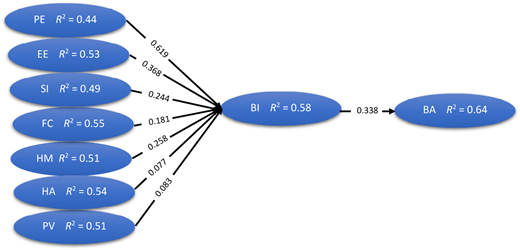
The results of hypothesis testing using structural equation modelling in Table 7 show that performance expectancy (β = 0.619; ρ < 0.05), effort expectancy (β = 0.368; ρ < 0.001), social influences (β = 0.244; ρ < 0.001), facilitating conditions (β = 0.181; ρ < 0.01) and hedonic motivation (β = 0.258; ρ < 0.05) significantly influenced the behavioural intentions of university students to accept blended learning. Thus, H1–H5 were supported. These results show that if students believe that blended learning will help them perform better in their studies and is easy to use, then they will develop behavioural intentions to accept it for learning. These results further show that if students believe that facilitating conditions, such as the presence of adequate and appropriate ICT infrastructure at their institutions, are present and if the use of blended learning is a pleasurable experience then students will develop behavioural intentions to accept blended learning in their studies. Furthermore, the results show that university students are easily influenced by those in their social circles to use blended learning in their studies. On the other hand, if students perceive that conditions for using blended learning as a learning mode are not conducive, then they will not accept blended learning as a learning mode. This is highlighted in the descriptive statistics in Table 6 where results showed that students were generally not satisfied with the facilitating conditions at their institutions, felt demotivated and felt that blended learning was complicated to use making it difficult for them to perform better in their academic studies. From the results in Table 7, performance expectancy has the highest influence followed by effort expectancy while facilitating conditions have the least influence on the behavioural intentions of university students to accept blended learning as a mode for learning. The results also show that habit (β = 0.077; ρ > 0.05) as well as price value (β = 0.083; ρ > 0.05) do not significantly influence the behavioural intentions of students in universities to accept blended learning as a mode of learning. H6 and H7 were thus not supported. The results in Table 7 further show that behavioural intentions of students (β = 0.338; ρ < 0.001) significantly influence the acceptance of blended learning by students in universities. H8 was thus supported.
The results in Figure 2 show the contribution of the latent variables to variations in the behavioural intentions of university students to accept blended learning. It is shown in Figure 2 that performance expectancy contributed 44%, effort expectancy (53%), social influences (49%), facilitating conditions (55%), hedonic motivation (51%), habit (54%) and price value (51%) of the variation to the behavioural intentions to accept blended learning by university students. This shows that facilitating conditions contribute the highest variation to the behavioural intentions of students to accept blended learning while performance expectancy contributes the least. Behavioural intentions also contributed 58% of the variation to the acceptance of blended learning by students in universities. The overall model contributed 64% of the variation to the acceptance of blended learning by students in universities.
5. Discussion
The purpose of the study was to establish factors that influence technology acceptance by students in universities in Zimbabwe through the lens of the UTAUT2. Seven dimensions of the UTAUT2 were used in the study.
The results of the study showed that performance expectancy has a significant influence on the behavioural intentions of students in universities to accept blended learning. This suggests that once students are of the view that blended learning makes their learning productive in terms of them being able to achieve their learning goals, they will accept it. These findings are consistent with results of previous studies which found that once students view blended learning as useful, they will accept it in their academic studies. Abu-Gharrah and Aljaafreh (2021), Azizi et al. (2020), Chung et al. (2020), Amparo (2021) and Abbas (2018) in their studies found that PE significantly influenced the behavioural intentions of students in universities to accept blended learning. Since the main goal of students is to achieve better academic performance, if they perceive that the blended learning mode assists them to achieve better academic performance, they will accept it as a learning mode.
It was established in the study that effort expectancy significantly influenced the behavioural intentions of students in universities to accept blended learning as a learning mode. These results suggest that students who are of the view that blended learning is effortless to use in their studies develop behavioural intentions to accept it in their studies. These findings confirm results of previous studies. It was established in a number of past studies that users who believe that a system, such as blended learning, would be effortless to use in the performance of their tasks will have a high probability of developing behavioural intentions to accept it as a learning mode (Huang and Kao, 2015; Venkatesh et al., 2012). This was also confirmed in a study by Abu-Gharrah and Aljaafreh (2021), which established that effort expectancy significantly influenced the behavioural intentions of users to accept a system such as blended learning in universities.
It was further shown in the study that social influences significantly influenced the behavioural intentions of students in universities to accept blended learning as a learning mode. These results demonstrate the role of social circles as critical in the development of behavioural intentions by university students to accept blended learning as a learning mode. These results also show that the willingness or otherwise of students in universities to use blended learning as a mode for learning can easily be swayed by referent groups with whom they periodically or regularly socialise. This confirms findings of past studies. A study by Venkatesh et al. (2012) found that individuals tend to accept and use a system when they believe that important others in their social network feel that they should use the system. Morton et al. (2016) and Kiviniemi (2014), in their studies, also established that there were significant relationships between social influences and behavioural intentions of users to accept a system such as blended learning.
The results of this study also showed that facilitating conditions had a significant influence on the behavioural intentions of students in universities to accept blended learning as a learning mode. This suggests that an environment that is supportive and has the necessary infrastructure (technological and administrative) is very important in the development of behavioural intentions by students to accept blended learning as a learning mode. If a university environment has adequate and appropriate ICT infrastructure, has a supportive institutional leadership and also has qualified technical support teams to help students engage with their studies effectively using the blended learning mode, it becomes a conducive environment for students to develop behavioural intentions to accept blended learning as a learning mode. Lu, Le and Vu (2020) and Sattari et al. (2017) in their studies established that facilitating conditions promoted a learning environment that enables students to develop behavioural intentions to accept systems, such as blended learning, in their studies.
The study further established that hedonic motivation significantly influenced behavioural intentions of students in universities to accept blended learning as a learning mode. This suggests that when students find the use of blended learning as enjoyable in their studies (Amparo, 2021), they would develop behavioural intentions to accept it as a learning mode. Universities can create an environment where the use of blended learning as a learning mode becomes pleasurable if they provide the required ICT infrastructure as well as well-trained technical teams to support the use of blended learning as a learning mode by students. Venkatesh et al. (2012), Nikolopoulo et al. (2020) and Gharrah et al. (2021), in their studies, established that there were positive and significant relationships between hedonic motivation and the behavioural intentions of students in universities to accept a system, such as blended learning, as a learning tool. These studies allude to the role of motivation and feelings of joy or pleasure that students experience when using blended learning as a learning mode that contributes to the development of behavioural intentions by students in universities to accept blended learning in their studies.
It was further established from the study that behavioural intentions of students positively and significantly influence the acceptance of blended learning as a learning mode by students in universities. These results suggest that there is a high likelihood that students who demonstrate inclination to use blended learning eventually accept blended learning as a learning mode. The above results are in line with findings from previous studies. Separate studies by Abu-Gharrah and Aljaafreh (2021) and Huang and Kao (2015) found significant relationships between the behavioural intentions of students and their eventual acceptance of blended learning as a learning mode. The results of the current study as well as of previous studies therefore demonstrate the importance of behavioural intentions in shaping the final decisions of students in universities to accept blended learning as a learning mode.
It was likewise shown in the study that habit and price value do not have a significant and positive effect on the behavioural intentions of students to accept blended learning as a learning mode. This suggests that the fact that students may have used a system, such as blended learning, over time as well as the cost of the blended learning system do not significantly influence their intentions to either accept or not blended learning as a learning mode. These results support the findings of a study by Azizi et al. (2020), which found that habit and price did not have a significant effect on the behavioural intentions of students in universities to accept a system, such as blended learning, as a learning mode. The findings of this study were however inconsistent with those of Huang and Kao (2015), Nguyen et al. (2014) and Abu-Garrah and Aljaafreh (2021), which found that habit significantly influenced the behavioural intentions of users to accept a system. With regards to price value, the findings of the current study are also inconsistent with studies of Moorthy et al. (2019), Abu-Gharrah and Aljaafreh (2021) and Alalwan et al. (2017), which found that there was a significant relationship between price value and the behavioural intentions of users to accept a system. The results of the current study, therefore and overall, mean that students are mostly interested on whether the blended learning mode is useful to their studies, is effortless and enjoyable to use rather than on the costs or how long they have been using the system for them to come up with a decision to accept it as a learning mode.
6. Conclusions
A number of conclusions were drawn in this study in line with the findings. First, it was concluded that students are mostly motivated to accept blended learning if they believe that the system would help them to be productive and achieve their educational goals of improved academic performance. Second, it was concluded that students accept systems that are easy to use; hence, they will be willing to accept blended learning as a learning mode if they perceived it as effortless to use in their studies. Third, it was concluded that social influence plays a critical role in the development of behavioural intentions of students to accept blended learning as a learning mode. This means the students accept the blended learning mode if they believe that those around them (referent group) believe that it is important for them to do so. Fourth, it was concluded that students accept using blended learning if there exists a supportive learning environment in which students have adequate resources, such as ICT and organisational infrastructure as well as adequately trained technical teams, to support the application of the blended learning mode in universities. Fifth, it was further concluded that students prefer systems that are pleasurable to use and hence will accept blended learning for use in their studies if they enjoy using it. Sixth, it was also concluded that issues of cost and habitual use of blended learning are not important in shaping the behavioural intentions of students to accept the blended learning mode. University students are mostly interested on whether the blended learning system works to help them achieve their learning goals. Finally, it was concluded that students who develop intentions to accept blended learning have a very high likelihood of eventually accepting it in their studies.
6.1 Recommendations
For students to accept blended learning as a learning mode in their studies, universities need to invest more in ICT infrastructure to enable students to have adequate and appropriate ICTs for online instruction to effectively complement traditional F2F instruction in universities. With adequate and appropriate ICT infrastructure for online learning, students may be more motivated to use blended learning and may develop positive attitudes towards it leading to the development of behavioural intentions to accept it. Also, universities need to enhance the ICT skills of both students and their lecturers to ensure that they effectively use the ICT tools for online learning and teaching, respectively. If students particularly find the ICT in the blended learning mode to be difficult to use, they may have challenges with online learning leading to them not accepting the blended learning mode. Since results showed that social influence significantly affect the behavioural intentions of students to accept the blended learning mode, the use of group activities during blended learning is important to ensure that students have opportunities to share knowledge and skills and motivate each other to use blended learning as a learning mode.
6.2 Implications of the study
The advent of disasters, such as COIVD-19, has meant that universities need to come up with more innovative ways of enhancing access to education by students. Blended learning is one such innovative ways of ensuring that students access education. By establishing factors that have an effect on the acceptance of the blended learning mode by students in universities, this study contributes to enhanced student access to education and also assists university authorities in understanding how to deal with issues that may affect the acceptance of the blended learning mode by students in universities. The findings further demonstrated that of the three additional factors of UTAUT to make UTAU2, only hedonic motivation has a significant influence on students' behavioural intentions to accept the blended learning mode while the other two, namely, habit and price value do not. This situation provides an opportunity for further study to establish the conditions under which these two factors may be applied in order to positively and significantly have an influence on the acceptance of the blended learning mode by students in universities.
6.3 Study limitations
The main study limitation was that it was only carried out at universities that had ICT infrastructure challenges owing to the fact that the economic situation in Zimbabwe is depressed. Limited ICT infrastructure in the universities might have had some impact on the nature of behavioural intentions of students to accept blended learning as a learning mode. Further research could be carried out in countries with better economies that are able to fund ICT infrastructures of their universities and to establish whether the results of the current study could either be confirmed, disconfirmed or enriched.
Compliance with ethical standards: This has been done in the paper.
The researcher wishes to thank all those who participated in this study and made it a success.
Funding: There is no funding associated with this paper.
References
Appendix
Appendix contents are available online for this article.