This study investigates the barriers constraining the effective implementation of sustainable procurement practices in state-owned enterprises (SOEs), with specific reference to South Africa.
A concurrent mixed-methods research design was adopted. Data were collected through semi-structured interviews with 51 procurement professionals across 26 Schedule 2 and Schedule 3 SOEs. Quantitative data were analysed using descriptive and inferential statistics to rank procurement barriers, while qualitative data were analysed thematically to provide contextual depth.
The findings reveal that institutional and market-level barriers, particularly the dominance of preferential procurement mandates and the limited availability of green suppliers, are the most significant constraints, outweighing organisational and capability-related barriers. Governance failures, economic cost dominance and weak environmental integration further reinforce persistent implementation gaps. Differences between Schedule 2 and Schedule 3 SOEs indicate that governance structures and financial autonomy moderate the manifestation of these barriers.
The study’s findings should be interpreted in light of several limitations. The empirical focus was restricted to Gauteng Province and to SOEs affiliated with the State-Owned Enterprises Forum (SOEPF). The results may therefore not fully capture the experiences of SOEs in other provinces or those outside the SOEPF. In addition, the purposive sampling approach, while appropriate for targeting knowledgeable respondents, may have excluded alternative perspectives, particularly from smaller or less formalised SOEs. The sample distribution was also uneven, with a higher representation of Schedule 2 entities, which may have influenced the robustness of the comparative analysis. Future research should therefore seek balance and expand the sample to provide a more comprehensive assessment of SP adoption across the different SOEs schedules. Future studies should extend the geographic and sectoral scope of inquiry, employ stratified or weighted sampling to enhance representativeness and conduct cross-national comparisons to better understand contextual influences on SP. Further research should also explore innovative approaches such as circular economy models, green financing and supplier development programmes, which may provide new pathways for overcoming SP barriers in SOEs. Lastly, future studies could use advanced decision-making techniques, such as the best–worst method, to systematically arrange SP barriers according to their relative significance, thereby supporting more targeted and effective policy intervention.
The results suggest that isolated training or procedural reforms are insufficient. Effective sustainable procurement in SOEs requires coordinated institutional reform, strengthened governance and enforcement mechanisms, supplier market development and targeted capability-building initiatives.
The findings highlight the urgent need for a national SP policy framework that integrates social, economic and environmental dimensions. Such a framework should provide clear guidelines for SOEs, ensure alignment with global sustainability standards and promote consistent enforcement. Capacity development programmes are also essential to equip procurement professionals with the knowledge and skills required for green procurement and life-cycle costing. Furthermore, preferential procurement policies should be reformed to more effectively support marginalised groups, including enterprises owned by people with disabilities. Finally, measures to improve transparency, strengthen consequence management and develop markets for green suppliers are critical for embedding sustainability across the procurement system.
This study contributes to the literature by empirically ranking sustainable procurement barriers and developing a multi-level conceptual framework that explains how institutional, governance, market, organisational and capability constraints interact to produce policy–practice decoupling in SOE procurement.
1. Introduction
Sustainable public procurement (SPP) has emerged globally as a strategic policy instrument through which governments leverage purchasing power to advance environmental stewardship, social inclusion and economic resilience (Government of Mauritius, 2011). Public procurement accounts for approximately 15% of GDP in developed economies and up to 25% in developing countries, underscoring its potential role in achieving sustainable development goals (Roos, 2013). In many jurisdictions, particularly within the European Union, sustainability considerations have increasingly been embedded in procurement frameworks, with environmental criteria gaining prominence (Ochieng et al., 2016; Kumar, 2022).
In South Africa, however, sustainable procurement remains weakly institutionalised. Rather than being governed by a comprehensive sustainability-oriented framework, public procurement has historically been positioned as a socio-economic transformation instrument through mechanisms such as the Preferential Procurement Policy Framework Act (PPPFA) and Broad-Based Black Economic Empowerment (B-BBEE). While these instruments have contributed meaningfully to equity and inclusion, they have also created tension between socio-economic compliance and environmental sustainability objectives (Turley and Perera, 2014; Quinot, 2023). The absence of a coherent and enforceable national sustainable procurement framework has limited the integration of environmental criteria, particularly within SOEs, which collectively command procurement budgets exceeding R900 billion (Setino and Ambe, 2016). SOEs occupy a pivotal position in South Africa’s economy and are subject to heightened scrutiny related to governance failures, corruption, fiscal inefficiency and service delivery challenges, alongside growing expectations to contribute to climate change mitigation and sustainable development (Nzimakwe, 2023; PwC, 2022). Despite this strategic importance, existing procurement research in South Africa has largely focused on conventional practices prioritising technical compliance and price efficiency, with limited attention to how institutional mandates, market readiness and governance conditions constrain sustainable procurement implementation in SOEs (Nzimakwe and Biyela, 2021; Ngubane, 2024). As a result, sustainability adoption remains fragmented, uneven and frequently symbolic, characterised by weak environmental integration and persistent policy–practice decoupling (Quinot, 2023; Williams-Elegebe, 2021).
Further complexity arises from the structural heterogeneity of SOEs. Schedule 2 SOEs are commercially oriented and operate with greater financial autonomy, while Schedule 3 SOEs are more heavily state-funded and compliance-driven, often facing tighter fiscal and administrative constraints (Bolton, 2006; Western Cape Government, 2019). Despite these structural differences, there is a notable absence of systematic, comparative research examining which barriers dominate sustainable procurement implementation across SOE categories and how institutional, market, and governance constraints interact to shape outcomes. This gap limits both theoretical understanding and policy design, as the relative importance and configuration of barriers remain poorly understood. Addressing this gap, we conducted a comparative empirical investigation of sustainable procurement barriers in South African SOEs, with a focus on Schedule 2 and Schedule 3 entities in Gauteng Province. In ranking the barriers and developing a multi-level conceptual framework, the study moves beyond descriptive identification to explain why institutional and market constraints dominate and how they interact with governance, organisational routines and capability factors. Specifically, the study seeks to:
Identify and rank the barriers influencing sustainable procurement implementation in Schedule 2 and Schedule 3 SOEs.
Examine how these barriers differ across SOE categories given their distinct governance and financial structures.
This study makes three core contributions to the literature on sustainable procurement in public sector organisations. First, it offers a comparative empirical analysis of sustainable procurement barriers in Schedule 2 and Schedule 3 state-owned enterprises (SOEs) in South Africa, showing how differences in governance and financial autonomy shape sustainability constraints, an area largely overlooked in prior research that treats SOEs as institutionally uniform. Second, the study advances the field by empirically ranking procurement barriers, demonstrating that institutional and market-level constraints, particularly preferential procurement dominance and limited green supplier availability, consistently outweigh organisational and capability barriers. This challenges prevailing assumptions that skills and awareness deficits are the primary obstacles to sustainable procurement. Third, drawing on institutional and stakeholder theory, the study develops a multi-level conceptual framework explaining how institutional mandates, governance failures, supplier-market readiness, organisational routines and capability deficits interact to produce persistent policy–practice decoupling in SOE procurement, thereby shifting the literature from descriptive barrier identification towards explanatory theorisation of barrier dominance and interaction.
2. Literature review
This section reviews the literature on SP practices in SOEs globally, highlights the South African context and identifies the barriers that constrain implementation. It also provides the justification for the present study and outlines its theoretical underpinnings.
2.1 Global perspective on sustainable procurement practices in SOEs
Sustainable procurement is broadly defined as the process by which public institutions acquire goods, services and works in ways that achieve value for money across the entire life cycle, while simultaneously generating social and economic benefits and minimising environmental harm (Kalubanga, 2012). Within SOEs, SP involves embedding principles of economic efficiency, social equity and environmental stewardship into procurement decisions (Brammer and Walker, 2011; Hsueh et al., 2020). Thus, procurement in SOEs is not limited to financial considerations but extends to broader societal objectives, including fair labour, inclusivity and ecological protection (Chelangat et al., 2015).
Global evidence shows that SP practices in SOEs are heterogeneous, reflecting differences in national regulatory frameworks, institutional capacities and development priorities (Islam et al., 2017). In the United States, for example, federal procurement mandates require agencies to prioritise eco-friendly goods and recycled materials while also promoting small- and medium-sized enterprises (SMEs) and local suppliers through instruments such as the Buy America Act (Wang et al., 2018). In Kenya, SOEs in the sugar sector have been found to emphasise social sustainability through fair labour practices, local supplier development and community engagement. However, environmental aspects such as waste reduction, recycling and emissions control remain underdeveloped (Kiserema et al., 2025). In South Africa, procurement has historically been used as a redistributive policy tool to address racial and socio-economic inequalities, thereby prioritising preferential procurement objectives over environmental sustainability (Bolton, 2006). These studies underscore the pivotal role of SOEs in advancing sustainable procurement. However, they also highlight persistent imbalances, particularly the tendency for economic and social objectives to dominate, while environmental sustainability lags behind.
2.2 Sustainable procurement practices in South African SOEs
South African SOEs occupy a critical position in the national economy, accounting for a substantial share of public expenditure and serving as key vehicles for delivering economic and social development (Bolton, 2008). The country has 715 SOEs, classified under the Public Finance Management Act (PFMA) based on their policy mandates, financial independence and operational autonomy. Of these, Schedule 2 SOEs represent major public entities, for example, Transnet, South African Airways, that operate with significant commercial orientation, while Schedule 3 SOEs, such as the South African Revenue Service, Passenger Rail Agency of South Africa, are smaller entities, largely state-funded and more tightly bound to service delivery mandates (Western Cape Government, 2019). These structural differences imply variations in procurement strategies and sustainability orientations. Schedule 2 SOEs, given their commercial imperatives, often prioritise financial viability and operational efficiency, which can come at the expense of long-term environmental goals (Manyathi and Jarbandhan, 2024). By contrast, Schedule 3 SOEs are more compliance-driven, with procurement practices explicitly aligned to socio-economic development objectives, such as empowerment and service delivery. Both categories, however, operate within regulatory frameworks anchored in preferential procurement policies and Black Economic Empowerment (B-BBEE), which reinforce social transformation as the dominant pillar of procurement (Setino and Ambe, 2016).
Despite these frameworks, significant implementation challenges persist. The decentralised procurement model, which grants SOEs discretion in aligning sustainability practices with organisational mandates, has produced mixed outcomes (National Treasury, 2015). While decentralisation creates opportunities for innovation and context-specific sustainability practices, it has also led to fragmentation, weak oversight and uneven capacity. Scholars highlight persistent issues such as corruption, inadequate technical skills and unethical behaviour, which continue to undermine the effective institutionalisation of sustainable procurement (Nzimakwe, 2023).
2.3 Barriers to sustainable procurement in SOEs and justification of the study
Although the literature on SP has expanded substantially over the past decade, important gaps remain in understanding how barriers to SP manifest, interact and persist within SOEs. While SP is widely recognised as a global policy priority, its implementation in SOEs, particularly in developing and transitional economies, remains uneven, contested and frequently symbolic rather than substantive (Shaikh et al., 2024). Empirical evidence from contexts including the United States, Kenya, South Africa, Pakistan, India, Zimbabwe and Ireland indicates that SP adoption is constrained less by normative intent than by entrenched institutional, organisational, market and capability barriers that inhibit operationalisation (Roman, 2017; Jere et al., 2021; Shaikh et al., 2024; Kekana and Ngubane, 2025; Phela et al., 2025). A synthesis of 14 empirical studies published between 2014 and 2025 across nine countries reveals a stable set of barrier domains that repeatedly undermine SP implementation in SOEs (Table 1). These barriers are mutually reinforcing and produce persistent policy–practice decoupling. First, institutional and regulatory constraints include fragmented or weakly enforceable SP policies, limited environmental legislation and mandate misalignment in which compliance and socio-economic objectives crowd out environmental criteria (Chelangat et al., 2015; Gormly, 2014; Mansi, 2015; Saroha et al., 2019; Quinot, 2023; Shaikh et al., 2024; Phela et al., 2025). Second, governance and integrity failures, including corruption, political interference, maladministration and weak accountability, distort procurement processes and erode reform credibility, particularly in African public sector contexts (Myeza et al., 2021; Jere et al., 2021; Nzimakwe, 2023; Phela et al., 2025). Third, supplier-market readiness remains a critical constraint: limited availability of green suppliers, weak capabilities, unclear standards and underdeveloped markets restrict sustainable sourcing even where intent exists (Chelangat et al., 2015; Roman, 2017; Shaikh et al., 2024; Kiserema et al., 2025). Fourth, organisational structures and routines, notably decentralised and siloed procurement, weak leadership and limited coordination, impede consistent implementation (Chelangat et al., 2015; Roman, 2017; Nzimakwe, 2023; Phela et al., 2025). Fifth, financial constraints and cost logics persist in the form of higher upfront costs, inadequate budgets and dominant short-term cost-minimisation logics (Gormly, 2014; Chelangat et al., 2015; Roman, 2017). Finally, technical and human capability constraints include skills gaps, limited awareness of SP, weak access to analytical tools such as life-cycle costing and ESG metrics, and limited supplier knowledge (Gormly, 2014; Nzimakwe, 2023).
Table 1 shows that SP barriers persist across both developed and developing contexts but are particularly pronounced and multidimensional in African SOEs, with South Africa and Kenya appearing most frequently across categories. Studies from Kenya (Chelangat et al., 2015; Kiserema et al., 2025), Botswana (Kuruneri, 2025), Northern Ghana (Abubakari et al., 2025) and Nigeria (Oyebanjo and Tengeh, 2020) further confirm the role of political interference, resource constraints, weak monitoring, limited awareness and absent or weak SP frameworks in constraining adoption.
However, these studies are embedded in institutional and regulatory contexts that differ materially from South Africa’s procurement regime, which is shaped by constitutional procurement principles, preferential procurement mandates (PPPFA) and socio-economic transformation objectives (BBB-EE). Within South Africa, prior research has focused primarily on procurement governance (Kekana and Ngubane, 2025; Manyathi and Jarbandhan, 2024) or on green procurement in the broader public sector (Ngubane, 2024), without systematically examining how economic, social, and environmental objectives are jointly constrained within SOE procurement practice. This study therefore addresses a clear empirical and conceptual gap by providing a systematic, SOE-focused investigation of the barriers that inhibit the integrated adoption of sustainable procurement in South Africa and by analysing how institutional mandates, governance dynamics, market conditions, organisational routines and capability constraints interact to produce persistent implementation failure.
2.4 Theoretical underpinning for identified SP barriers
This study is guided by institutional theory and stakeholder theory, both of which provide useful lenses for analysing the barriers that inhibit sustainable procurement in SOEs. Institutional theory explains how external pressures, such as government policies, regulatory frameworks and industry norms, shape organisational behaviour and legitimacy (Chelangat et al., 2015; Oyebanjo and Tengeh, 2020). In the procurement context, institutional theory highlights how SOEs respond to coercive, normative and mimetic pressures, which may promote conformity to sustainability goals but can also reinforce inefficiencies and path dependency (Kuruneri, 2025; Walker et al., 2012). Stakeholder theory, by contrast, emphasises the role of multiple actors, government, suppliers, customers, communities and civil society, in influencing organisational decision-making and sustainability outcomes (Touboulic and Walker, 2015; Kalubanga, 2012). From this perspective, SP requires balancing the often-competing interests of diverse stakeholders, a challenge that becomes acute in SOEs where political, social and environmental objectives frequently intersect. Together, these theories provide a robust framework for analysing SP barriers. Institutional theory highlights the regulatory and normative constraints that shape procurement practices, while stakeholder theory underscores the need for inclusive engagement with actors whose demands influence procurement priorities. Building on these perspectives, this study addresses the following research questions:
Identify and rank the barriers influencing sustainable procurement implementation in Schedule 2 and Schedule 3 SOEs; and
Examine how these barriers differ across SOE categories given their distinct governance and financial structures.
3. Research methodology
This section outlines the research design, sampling and data collection procedures, the research instrument and measurement, data analysis techniques and the approaches employed to ensure reliability and validity.
3.1 Research design
The study employed a concurrent mixed-methods research design, integrating quantitative and qualitative approaches to generate both breadth and depth in understanding the barriers to SP in SOEs. The quantitative component adopted a descriptive and explanatory orientation, designed to evaluate the statistical prevalence and variation of barriers across SOEs. The qualitative component, in turn, provided contextual depth by exploring the lived experiences and perspectives of procurement professionals. Primary data were collected through a semi-structured questionnaire, which constituted the central instrument of inquiry. This questionnaire was deliberately structured to combine closed-ended items for quantitative measurement with open-ended questions, enabling richer qualitative insights. The mixed-methods approach was considered particularly appropriate given the multifaceted nature of SP barriers, which encompass regulatory, institutional, technical, financial and behavioural dimensions.
3.2 Sampling and data collection
The empirical investigation was conducted among state-owned enterprises located in Gauteng Province, the economic hub of South Africa and the centre of national government procurement activity. Out of a population of 63 SOEs affiliated with the State-Owned Enterprises Forum (SOEPF), a purposive sample of 26 organisations was selected. The sampling strategy was informed by specific inclusion criteria to ensure both relevance and feasibility. Only SOEs classified under Schedule 2 and Schedule 3 of the PFMA were included, as these represent distinct governance arrangements and procurement mandates. In addition, only SOEs with an operational presence in Gauteng were considered, given the logistical advantages and the concentration of national headquarters in the province. The selection also prioritised SOEs operating in strategic sectors such as aviation, electricity and public services, where procurement decisions are closely linked to the country’s developmental objectives. Finally, only organisations that confirmed the participation of at least one procurement professional in a decision-making role were retained. A total of 51 procurement professionals were interviewed across the 26 SOEs. According to Saunders et al. (2019), a minimum sample size of 30 is considered adequate for statistical analysis. This is suggested as a rule of thumb. These respondents included Chief Procurement Officers, procurement managers, supervisors and officers, all of whom were actively engaged in procurement planning, policy development or supplier selection. In most organisations, multiple respondents were interviewed to enhance the validity of findings and capture intra-organisational diversity of perspectives. In one case, however, participation was limited to a single professional due to organisational constraints.
3.3 Research instrument and measurement
The research instrument was developed through a combination of desktop research and fieldwork preparation. A comprehensive review of existing literature on SP barriers, including both international and South African studies, provided the foundation for the design of the questionnaire (United Nations Environment Programme (UNEP), 2021b, Oyebanjo and Tengeh, 2020; Islam et al., 2017; National Treasury, 2015). The questionnaire consisted of two sections. The first comprised closed-ended items designed to quantitatively measure perceptions of barriers to SP. These items were constructed on the basis of recurring themes identified in the literature, such as the dominance of preferential procurement policies, the absence of a comprehensive SP framework, decentralised procurement structures, corruption and inadequate technical expertise. Responses were captured on a 5-point Likert scale, ranging from strongly disagree (1) to strongly agree (5). The second section included open-ended questions that invited participants to elaborate on barriers they experienced in practice. For example, respondents were asked: “If you have any additional comments on barriers influencing SP practices, please elaborate.” This design allowed for the triangulation of quantitative patterns with qualitative narratives, ensuring that statistical results could be interpreted within the contextual realities of SOE procurement. The questionnaire was refined through expert consultation with procurement specialists and pilot-tested with a small group of professionals to ensure clarity and content validity.
3.4 Data analysis
The quantitative data were analysed using SPSS statistical software. Descriptive statistics, including frequencies, percentages, mean scores and standard deviations, were calculated to profile respondents and summarise their perceptions of procurement barriers. Inferential analysis was undertaken using Independent Samples t-tests to compare responses between Schedule 2 and Schedule 3 SOEs. Levene’s test for equality of variances was conducted to determine the appropriate form of the t-test, and statistical significance was established at p ≤ 0.05. Results were reported in terms of mean differences, standard errors and 95% confidence intervals. The qualitative data derived from the open-ended responses were analysed using thematic analysis. Responses were systematically coded and categorised to identify recurring themes and patterns, such as procurement’s emphasis on preferential policies, limited awareness of sustainability, corruption and the lack of green suppliers. This process enabled the identification of nuanced organisational dynamics and practices that could not be captured through structured survey items alone. The combination of statistical and thematic analysis provided a comprehensive account of the barriers to sustainable procurement within SOEs.
3.5 Reliability and validity
Several measures were undertaken to ensure the reliability and validity of the research. The questionnaire was piloted with a subset of procurement professionals, and their feedback was incorporated to refine the wording, structure and relevance of questions. Internal consistency of the scale was tested using Cronbach’s alpha, which produced a coefficient of 0.750. This value exceeds the widely accepted threshold of 0.70 (Saunders et al., 2019), confirming satisfactory reliability. Content validity was ensured by grounding the questionnaire items in a comprehensive literature review and validating them through expert consultation. Methodological triangulation was also achieved by combining quantitative and qualitative data, which strengthened the validity of the findings by enabling convergence and corroboration across multiple sources of evidence.
3.6 Framework development and derivation logic
The conceptual framework was developed through a structured process of methodological triangulation. First, quantitative analysis was used to rank sustainable procurement barriers based on mean scores, enabling identification of dominant constraints across institutional, governance, market, organisational and capability dimensions. Second, qualitative thematic analysis was employed to examine how these barriers are experienced and enacted in practice, providing insight into their underlying mechanisms and interactions. Third, findings from both strands were integrated and interpreted through the lenses of institutional and stakeholder theory to establish the relative dominance, sequencing and interaction of barriers across levels. This integrative process enabled the abstraction of a multi-level conceptual framework explaining how upstream institutional and governance conditions shape supplier-market readiness, organisational procurement routines and capability formation, resulting in persistent policy–practice decoupling in sustainable procurement implementation.
4. Results and discussion
This section presents the analysis performed on the collected data. This includes demographic profiles and descriptive and inferential analyses of the barriers affecting the effective implementation of SP practices in SOEs. The discussion interprets the results in the context of institutional theory, stakeholder theory and the resource-based view.
5. Results
This section reports the empirical findings from the quantitative and qualitative analyses. It begins with the respondent profile, then presents descriptive statistics and ranked barriers, and concludes with qualitative themes and cross-schedule patterning.
5.1 Demographic profile
Table 2 summarises respondents by SOE schedule, job title and years of procurement experience.
Respondents were predominantly drawn from Schedule 2 entities (86.3%). The sample includes perspectives across operational and strategic procurement roles, and it is experience-rich, with 88.4% reporting more than five years of procurement experience. This respondent profile supports the credibility of reported perceptions about procurement constraints in SOEs (Setino and Ambe, 2016; Saunders et al., 2019).
5.2 Descriptive statistics of perceived barriers
Table 3 reports mean scores and standard deviations for barriers to sustainable procurement.
5.3 Ranked barriers by dominant locus of constraint
To support interpretation and framework development, barriers were also classified by their dominant locus of constraint (institutional, governance, market, organisational, capability). Table 4 presents the ranked barriers with this classification.
5.4 Qualitative findings and cross-schedule patterning
The qualitative analysis identified eight themes describing how barriers are experienced in practice: emphasis on preferential procurement; poor implementation of preferential procurement; limited environmental integration; lack of training; limited awareness; policy–practice gaps; corruption and ethical challenges; and weak focus on green suppliers. These themes provide explanatory detail on how institutional mandates, governance conditions and organisational routines shape sustainability outcomes in procurement. Table 5 summarises the cross-schedule patterning of themes for Schedule 2 and Schedule 3 SOEs.
6. Discussion
This section interprets the findings through institutional and stakeholder theory to explain how interacting barriers produce weak and uneven sustainable procurement implementation in state-owned enterprises (SOEs).
6.1 Dominance and configuration of procurement barriers (RQ1)
The empirical ranking of barriers demonstrates that sustainable procurement failure in South African SOEs is driven primarily by institutional, market and governance-level constraints, rather than by organisational capacity or technical skills alone. Preferential procurement dominance and limited availability of green suppliers emerged as the most salient barriers, followed by economic cost dominance and corruption. This pattern reinforces established evidence that sustainable procurement outcomes are structurally conditioned by regulatory mandates, governance integrity and supplier-market readiness, rather than by internal operational deficiencies (Brammer and Walker, 2011; Roman, 2017; Quinot, 2023). From an institutional theory perspective, the dominance of preferential procurement reflects a coercive compliance logic that defines legitimacy in public procurement. In South Africa, procurement has historically functioned as a socio-economic transformation instrument, unintentionally marginalising environmental sustainability where policy frameworks and enforcement mechanisms do not explicitly integrate environmental objectives (Bolton, 2006; Quinot, 2023; Williams-Elegebe, 2021). The absence of a coherent and enforceable sustainable procurement policy reinforces this mandate misalignment, leaving environmental objectives weakly institutionalised and inconsistently operationalised.
Governance and integrity failures further amplify these constraints. Political interference, fronting and weak consequence management undermine accountability and distort supplier evaluation, reinforcing policy–practice decoupling between sustainability intent and implementation (Myeza et al., 2021; Nzimakwe, 2023). The prominence of insufficient green suppliers is best understood as an outcome of weak institutional demand signals and limited incentives for sustainability capability development within supplier markets. Uncertainty around sustainability standards and limited market depth indicate that supplier readiness is shaped by policy clarity and enforcement rather than supplier willingness alone, consistent with findings from comparable public procurement contexts (Roman, 2017). At the organisational level, economic and price dominance reflect the embedding of cost-compliance logics within procurement routines. Evidence of outdated specifications and limited environmental auditing suggests routine-driven implementation that prioritises price verifiability over environmental performance. Capability constraints, such as awareness and skills gaps, are present but comparatively lower-ranked, indicating that training and tools alone are unlikely to generate change without upstream institutional alignment and governance integrity (Turley and Perera, 2014; UNEP, 2021a).
6.2 Schedule-based differentiation and moderating effects (RQ2)
SOE schedule moderates both the intensity and manifestation of procurement barriers. Schedule 3 SOEs exhibit lower awareness, minimal environmental integration and a stronger compliance-driven orientation, while Schedule 2 entities display partial sustainability integration but remain vulnerable to governance failures and enforcement gaps. These differences reflect structural positioning: Schedule 3 entities typically operate under tighter fiscal control and stronger dependence on state funding, reinforcing cost and compliance priorities (Western Cape Government, 2019). Schedule 2 SOEs, although more commercially oriented, remain exposed to institutional and political dynamics that weaken sustainability integration through decoupling (Manyathi and Jarbandhan, 2024). Institutional theory explains these differences as variation in the intensity of coercive pressures across organisational categories, while stakeholder theory highlights the weak salience of environmental stakeholders in compliance-dominant contexts (Touboulic and Walker, 2015). These dynamics explain the persistence of uneven sustainability adoption despite formal policy commitments.
6.3 A multi-level framework of interacting barriers
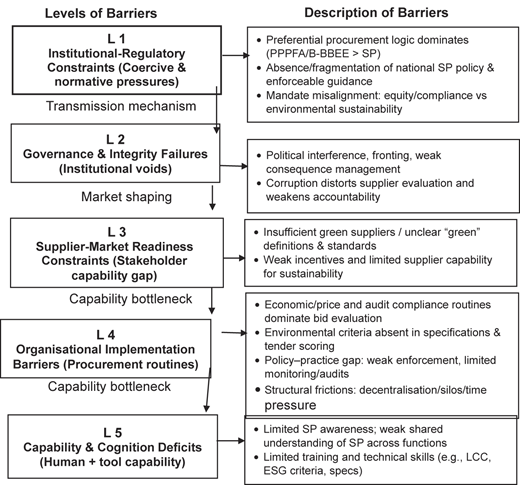
The conceptual framework was derived through triangulation of quantitative barrier rankings and qualitative thematic evidence and explains sustainable procurement failure in SOEs as the outcome of interacting constraints across institutional, governance, market, organisational and capability levels. Guided by institutional and stakeholder theory, the framework conceptualises these constraints as a vertically structured configuration in which upstream conditions shape downstream implementation outcomes. At the institutional and governance levels, preferential procurement mandates, the absence of enforceable sustainable procurement policy and governance failures function as upstream constraints that define legitimacy, incentives and enforcement conditions. Consistent with institutional theory, these coercive pressures shape organisational behaviour and prioritisation, reinforcing compliance-oriented procurement practices (Bolton, 2006; Quinot, 2023). These conditions also shape supplier-market readiness by weakening demand signals for sustainability and limiting incentives for green supplier development, reflecting uneven stakeholder salience within procurement systems (Roman, 2017).
Organisational procurement routines operationalise these pressures through cost-compliance dominance, outdated specifications and limited sustainability monitoring, resulting in persistent policy–practice decoupling, a central mechanism highlighted in institutional theory (Walker et al., 2012). Capability deficits, such as limited awareness, training and analytical tools, act as downstream bottlenecks that constrain implementation even where strategic intent exists, amplifying rather than originating procurement failure (Turley and Perera, 2014; UNEP, 2021a). SOE schedule moderates the strength and manifestation of these dynamics. Schedule 3 entities experience stronger coercive and fiscal pressures and lower sustainability integration, while Schedule 2 entities exhibit partial integration but remain vulnerable to governance and enforcement gaps. This differentiation reflects institutionally structured variation in stakeholder power and legitimacy, consistent with stakeholder theory (Western Cape Government, 2019; Touboulic and Walker, 2015).
Table 6 summarises how quantitative evidence and qualitative themes converge to inform each framework component, while Figure 1 presents the resulting theory-informed, multi-level architecture explaining weak and uneven sustainable procurement implementation in South African SOEs.
The framework illustrates how upstream institutional mandates and governance conditions shape supplier-market readiness, organisational procurement routines and capability formation, producing uneven sustainable procurement outcomes across Schedule 2 and Schedule 3 state-owned enterprises.
6.4 Theoretical implications
This study advances institutional theory by demonstrating how coercive compliance pressures indirectly shape supplier markets and organisational routines, producing persistent decoupling of environmental sustainability in procurement. It also extends stakeholder theory by showing that stakeholder salience is institutionally structured, privileging socio-economic and political stakeholders while marginalising environmental actors and green suppliers (Kalubanga, 2012; Touboulic and Walker, 2015).
6.5 Practical implications
The findings imply that isolated training interventions are unlikely to generate meaningful change unless upstream institutional and governance constraints are addressed. Effective reform requires coordinated action across levels: policy coherence and enforceable SP guidance, strengthened governance and consequence management, supplier market development and definitional clarity for “green” standards, routine-level integration of environmental criteria in specifications and evaluation, and structured capability development (UNEP, 2021a; Turley and Perera, 2014).
7. Conclusion
This study demonstrates that sustainable procurement in South African state-owned enterprises is constrained primarily by institutional mandates, governance failures and supplier-market limitations, rather than by organisational capacity or skills alone. By empirically ranking procurement barriers and integrating quantitative and qualitative evidence, the study shows how preferential procurement dominance and weak green supplier markets systematically outweigh lower-level constraints. Building on institutional and stakeholder theory, the proposed multi-level conceptual framework explains how these barriers interact across institutional, governance, market, organisational and capability levels to produce persistent policy–practice decoupling in SOE procurement. The study advances sustainable procurement scholarship by shifting the focus from descriptive barrier identification to explanatory analysis of barrier dominance and interaction, offering a stronger analytical basis for theory development and targeted policy reform in public sector procurement.
8. Limitations and directions for future research
The study’s findings should be interpreted in light of several limitations. The empirical focus was restricted to Gauteng Province and to SOEs affiliated with the SOEPF. The results may therefore not fully capture the experiences of SOEs in other provinces or those outside the SOEPF. In addition, the purposive sampling approach, while appropriate for targeting knowledgeable respondents, may have excluded alternative perspectives, particularly from smaller or less formalised SOEs. The sample distribution was also uneven, with a higher representation of Schedule 2 entities, which may have influenced the robustness of the comparative analysis. Future research should therefore seek balance and expand the sample to provide a more comprehensive assessment of SP adoption across the different SOEs schedules.
Future studies should extend the geographic and sectoral scope of inquiry, employ stratified or weighted sampling to enhance representativeness and conduct cross-national comparisons to better understand contextual influences on SP. Further research should also explore innovative approaches such as circular economy models, green financing and supplier development programmes, which may provide new pathways for overcoming SP barriers in SOEs. Lastly, future studies could use advanced decision-making techniques, such as the best–worst method, to systematically arrange SP barriers according to their relative significance, thereby supporting more targeted and effective policy intervention.