Responsible leadership (RL) is crucial to a bank’s performance and reputation. One way to accomplish this is to focus on reducing turnover and improving performance. This study investigates the impact of RL on bank performance, reputation and employee turnover intention in Bangladesh. It aims to contribute to the literature by examining the relationship between RL and key organisational outcomes, explicitly focusing on employee turnover intention as a mediating factor.
Applying the social identity theory, this paper develops and examines six hypotheses through structural equation modelling. The time-lagged data collection technique was used to collect responses from 711 full-time bank employees in Bangladesh.
The results reveal that RL positively influences bank performance and reputation while negatively affecting employee turnover intention. Additionally, bank performance significantly enhances reputation and turnover intention negatively impacts performance. Notably, employee turnover intention partially mediates the relationship between RL and bank performance, emphasising the critical role of employee retention in organisational outcomes.
The findings provide actionable insights for policymakers and human resource managers in banks, offering RL as a strategic tool to enhance performance, improve employee retention and foster long-term reputation sustainability while addressing evolving economic challenges.
This study extends social identity theory within the human resource literature by applying RL to the financial sector in a South Asian context, specifically Bangladesh. It provides novel insights into how RL influences financial performance and employee retention, highlighting its critical role in promoting organisational success and sustainability in developing economies.
1. Introduction
Effective human resource management (HRM) practices require leadership approaches that help organisations achieve global sustainability goals and improve performance. Responsible Leadership (RL), characterised by ethical decision-making and a focus on stakeholder well-being, has emerged as a critical factor in achieving these goals, particularly in the banking sector (Javeria et al., 2019; Yasin, 2021). The United Nations Sustainable Development Goals (SDGs), especially SDG 8 (decent work and economic growth) and SDG 10 (reduced inequalities), underscore the importance of RL in fostering sustainable organisational growth (Saks, 2022; Khare et al., 2025). In the banking sector, where employee stability directly influences performance and reputation, RL significantly enhances employee retention and satisfaction, essential for long-term organisational success (Sobhani et al., 2021; Cai et al., 2024).
Despite considerable research on leadership styles and organisational outcomes, the role of RL in non-Western contexts remains underexplored (Haque et al., 2019; Yasin, 2021; Islam et al., 2024). Existing studies have highlighted RL’s importance in reducing turnover and improving performance (Ng and Stanton, 2023; Katfi et al., 2025), these findings predominantly focus on Western settings. This gap is especially evident in emerging markets like Bangladesh, where high turnover rates present significant challenges, particularly regarding bank performance and a sustainable reputation (Sobhani et al., 2021). As a result, this paper explores how RL can influence turnover intentions and bank performance in Bangladesh, offering valuable insight into RL’s role in strengthening organisational performance and reputation in emerging economies.
Moreover, with the ongoing phenomenon of the “Great Resignation” and its impact on HRM practices (Ng and Stanton, 2023), the need for leadership strategies to mitigate turnover is more pressing than ever. Scholars argue that RL reduces turnover intentions by fostering employee engagement and satisfaction (Haque et al., 2019; Yasin, 2021; Alwali, 2023). This study applies the Social Identity Theory (Tajfel, 1974; Tajfel and Turner, 1986) to explore the mediating effect of employee turnover intention between RL and bank performance. By strengthening organisational identity, RL reduces turnover intentions, enhancing performance and reputation. This is particularly important in emerging markets like Bangladesh, where effective HRM practices can mitigate high turnover and improve organisational outcomes (Bamber et al., 2017). Ultimately, RL is a strategic tool to align organisational strategies with global sustainability goals of economic growth and reduced inequalities (Chandel and Arora, 2025). This study highlights RL’s indirect role in improving performance and reputation through its influence on turnover intentions, reinforcing its critical importance in achieving sustainable organisational success in a South Asian context. By focusing on Bangladesh, this paper provides valuable contributions to understanding RL’s role in promoting sustainable organisational success in emerging economies, aligning with broader goals of economic growth and reduced inequalities (Saks, 2022; Khare et al., 2025; Chandel and Arora, 2025).
1.1 Expanding responsible leadership research beyond South Asia
While RL has been widely studied in Western and South Asian contexts, exploring its application in other emerging economies remains necessary. Leadership practices in non-Western settings, particularly in Latin America and Africa, are shaped by unique socio-cultural and institutional factors that may influence RL’s effectiveness. For example, Mangaliso (2001) highlights how Ubuntu leadership in African contexts fosters collective well-being and relational accountability, contrasting with more individualistic leadership models. Similarly, Gomez and Martínez (2017) discusses paternalistic leadership in Latin American organizations, where hierarchical yet family-oriented leadership styles influence employee commitment and ethical decision-making. These culturally embedded leadership models suggest that RL’s impact is not uniform across regions. Furthermore, existing research often relies on structural equation modelling (SEM) approaches (Anderson and Gerbing, 1988), which, while methodologically rigorous, may not fully capture the interplay between leadership styles, institutional constraints, and socio-political realities in these economies. Expanding RL research beyond South Asia and incorporating African and Latin American perspectives—while leveraging diverse methodological approaches—would contribute to a more comprehensive understanding of RL’s global impact.
1.2 Contrasting responsible leadership with transformational and ethical leadership
While value-based leadership styles such as transformational and ethical leadership have been widely acknowledged for their contributions to employee motivation and organisational outcomes, Responsible Leadership (RL) offers a distinct yet complementary approach. Transformational leadership primarily emphasises inspiring and emotionally engaging followers to achieve higher performance by articulating a compelling vision and fostering personal development (Haque, 2021; Alwali, 2024). Ethical leadership, in contrast, centres on normative conduct, focusing on fairness, integrity, and ethical modelling to influence employee behaviour (Zhu et al., 2014).
RL distinguishes itself through its broader stakeholder orientation and explicit alignment with social responsibility and sustainability goals (Pless, 2007; Doh and Quigley, 2014). Unlike transformational leadership, which is often inward-looking and focused on internal follower development, RL explicitly incorporates external stakeholder concerns, including community, environment, and future generations. Furthermore, RL operates through mechanisms grounded in ethical alignment and stakeholder dialogue, extending beyond the emotional engagement typical of transformational leadership (Rehman et al., 2021; Saks, 2022).
Contextually, RL is especially suited to complex, high-stakes environments such as crisis response or sustainability-driven organisational change, where ethical decision-making and stakeholder inclusion are paramount (Varma, 2020; Haque et al., 2025). By comparison, transformational leadership may be more applicable in growth-oriented settings where strategic vision and innovation are the central priorities. This contrast underscores RL’s distinct contribution to navigating ethical dilemmas and advancing the UN Sustainable Development Goals, especially in sectors like banking, where societal trust and responsibility are critical (Khare et al., 2025; Chandel and Arora, 2025).
2. Theoretical background and hypotheses development
2.1 The banking sector of Bangladesh, HRM practices and leadership initiatives
The banking sector in Bangladesh comprises 62 scheduled banks, regulated by Bangladesh Bank under the Bangladesh Bank Order, 1972 and the Bank Company Act, 1991. These include 6 State-Owned Commercial Banks, 3 Specialised Banks, 43 Private Commercial Banks (33 conventional and 10 Islami Shariah-based), one digital commercial bank, and nine foreign commercial banks. Additionally, there are five non-scheduled banks (Bangladesh Bank, n.d.). In this sector, RL has become a key factor in enhancing performance and reputation (Rimi et al., 2017; Sobhani et al., 2021). RL, with its responsible decision-making and focus on stakeholder well-being, plays a critical role in addressing challenges such as employee turnover and organisational sustainability, while contributing to the achievement of the United Nations 2030 SDG goals (Sobhani et al., 2021). Considering the three Ps—people, profit, and planet (as society)—RL has the potential to balance these dimensions, fostering sustainable organisational success (Pless, 2007; Haque et al., 2019). Research indicates that RL fosters ethical behaviour, positively influencing employee retention, satisfaction, and long-term organisational reputation (Haque et al., 2019, 2021; Rehman et al., 2021).
In Bangladesh, where bureaucratic leadership is common (Mohammad et al., 2017; Haque and Jahid, 2021), RL provides a promising alternative to improve performance and reduce turnover (Sobhani et al., 2021). While the global interest in RL is growing, empirical research on its effectiveness in Bangladesh remains limited (Dhar and Chowdhury, 2021; Sobhani et al., 2021; Haque et al., 2025). This study aims to fill this gap by exploring the impact of RL on turnover intention, bank performance, and reputation, providing new insights into leadership practices in the region.
The COVID-19 pandemic has underscored RL’s importance, particularly in navigating financial challenges and addressing social responsibility demands (Rimi et al., 2017; Sobhani et al., 2021). In these turbulent times, the role of executives in fostering ethical behaviour becomes even more critical for reducing turnover and improving employee satisfaction (Brown et al., 2019; Haque et al., 2019). This paper examines RL’s mediating effect on employee turnover intention and its potential to enhance bank performance and reputation. The findings offer valuable insights for policymakers, managers, and banks to improve organisational outcomes and social contributions and align with global sustainability goals, including SDGs 8 and 10 (Cai et al., 2024).
2.2 Responsible leadership and bank performance
RL has been increasingly recognised as a significant driver of organisational performance and employee well-being. Defined by its ethical decision-making, long-term focus on stakeholder interests, and commitment to sustainability, RL plays a crucial role in shaping organisational culture, especially in sectors like banking (Rimi et al., 2017; Haque et al., 2019). RL is rooted in the idea that leaders should act not only for the organisation’s benefit but also for the greater good of society and the well-being of their employees. This leadership style, therefore, prioritises ethical practices, social responsibility, and the engagement of employees, directly influencing organisational outcomes like bank performance and employee turnover intentions.
Bank performance is multi-dimensional, encompassing both financial and non-financial outcomes. Financial performance is often measured by metrics such as return on assets (ROA) and return on investments (ROE) (Dhar and Chowdhury, 2021), while non-financial performance includes customer satisfaction, employee engagement, and environmental responsibility (Rehman et al., 2021; Guo et al., 2024). Researchers have argued that RL’s focus on ethical decision-making and stakeholder engagement contributes significantly to the non-financial aspects of bank performance, including improved customer satisfaction and employee motivation (Haque et al., 2021; Haque, 2021). RL has been linked to enhanced organisational performance by fostering a positive social identity and belongingness among employees.
Drawing from Social Identity Theory (Tajfel, 1974; Tajfel and Turner, 1986), employees who identify with their leaders are more likely to invest effort into the organisation’s success. According to SIT, employees’ self-concept is shaped by their membership in organisational groups, and when leaders embody values that align with these identities, employees feel a stronger connection and commitment to the organisation’s goals. In the context of banks, by reinforcing ethical values and stakeholder responsibility, RL may help employees perceive the organisation as a source of pride, thereby boosting performance (Tajfel and Turner, 1986). Employees who align with these responsible values are more motivated and likely to contribute to improved organisational outcomes, including higher productivity and better financial performance. Considering this reasoning, this paper posits that:
RL will be positively related to bank performance.
2.3 Responsible leadership and employee turnover intention
Employee turnover intention refers to the likelihood of employees contemplating leaving their jobs, often preceding actual turnover (Robbins and Judge, 2007). Turnover intention can significantly impact organisations, contributing to increased recruitment costs, the loss of experienced employees, and a decline in organisational knowledge (Low et al., 2001). RL has been recognised as a key factor in reducing turnover intention by fostering an ethical work environment that prioritises employees’ well-being and needs (Dordunu et al., 2020; Haque, 2021). Leadership styles rooted in fairness, transparency, and ethics create psychological safety and trust within the workplace, reducing employees’ intention to leave their positions (Masta and Riyanto, 2020; Nguyen et al., 2021).
Social Identity Theory (Tajfel, 1974; Tajfel and Turner, 1986) provides a robust framework for understanding the connection between RL and reduced turnover intention. SIT suggests that employees’ self-concept is shaped by their membership in various organisational groups. When leaders demonstrate values that align with these identities, employees develop a sense of connection and belonging. This identification with the organisation, fostered by RL, enhances employees’ commitment, making them less likely to consider leaving. In this context, RL practices, which emphasise responsibility toward internal (employees) and external (stakeholders) groups, can significantly reduce feelings of alienation and dissatisfaction—key drivers of turnover intention. When employees perceive that their values are aligned with the organisation’s mission, they feel more valued, leading to a deeper emotional connection and stronger loyalty to the organisation (Haque et al., 2019). Consequently, employees are more likely to stay, reducing turnover intention and enhancing organisational stability. Accordingly, this paper hypothesises as follows:
RL will be negatively related to employee turnover intention.
2.4 Responsible leadership and bank reputation
Value-based leadership styles like transformational (Men and Stacks, 2013; Alwali, 2024) and ethical leadership (Zhu et al., 2014) are well-established drivers of positive employee performance and organisational reputation (Varma, 2020). These approaches evoke positive emotions in employees and motivate them by offering a compelling vision for the future (Men and Stacks, 2013; Alwali et al., 2022). However, the impact of RL on organisational outcomes, particularly bank reputation, remains underexplored.
Varma (2020) suggests that managing crises responsibly can enhance the organisation’s reputation, as reflected in public perception and financial outcomes. RL fosters this by promoting ethical decision-making, social responsibility, and stakeholder engagement, all contributing to a bank’s reputation. Social Identity Theory (Tajfel, 1974; Tajfel and Turner, 1986) explains that employees who identify with RL may feel a sense of belonging and pride, strengthening their psychological and social ties to the organisation. This heightened commitment encourages employees to represent the organisation positively, boosting its reputation. Hence, employees who feel connected to RL values are more likely to engage with the community and prioritise the bank’s interests. This behaviour improves employee satisfaction and enhances public trust and organisational reputation, key elements for long-term success in the banking sector. Therefore, this paper posits the following hypothesis: Accordingly, this paper justifies the following hypothesis:
RL will be positively related to bank reputation.
2.5 Bank performance and bank reputation
A bank’s financial and social performance significantly influences its reputation. Financial metrics, such as return on investment and customer satisfaction, can elevate a bank’s standing in the industry (Kim et al., 2021). Similarly, social contributions, including CSR initiatives and charitable engagements, shape the bank’s public image (Flammer, 2013). A strong performance record, demonstrated through customer service, product offerings, and profitability, can enhance a bank’s reputation and increase future expectations from stakeholders (Rao, 1994).
RL is central to this dynamic, as leaders who drive ethical decision-making and long-term sustainability influence financial and social performance (Hoffman, 2005; Hofmann et al., 2012). RL fosters organisational practices that align with societal and environmental expectations, resulting in a reputation that reflects the bank’s commitment to stakeholder interests. Moreover, RL’s emphasis on corporate social responsibility helps position the bank as a trustworthy, responsible institution, thus reinforcing its positive reputation. Hence, several studies have demonstrated a positive relationship between business performance and organisational reputation (Aqueveque et al., 2018; Zhou et al., 2021). When banks achieve high performance, their reputation improves, creating a cycle that benefits the institution and its stakeholders. Accordingly, this paper hypothesizes the following:
Bank performance will be positively related to bank reputation.
2.6 Employee turnover intention and bank performance
Employee turnover intention, the likelihood of employees contemplating leaving their organisation, can significantly undermine a bank’s performance. Research has shown that turnover intention often leads to actual turnover, disrupting workflow, increasing recruitment and training costs, and diminishing employee morale, all of which contribute to lower organisational performance (Haque et al., 2019; Dordunu et al., 2020). In Bangladesh’s highly competitive banking sector, where performance is paramount, effectively managing turnover is crucial for sustaining competitiveness and achieving organisational objectives (Dordunu et al., 2020).
Applying Social Identity Theory (Tajfel, 1974; Tajfel and Turner, 1986), it can be argued that employees with higher turnover intentions exhibit lower engagement with their banks, negatively impacting performance. As employees’ sense of belonging and connection to the organisation weakens, their psychological commitment and contribution to the bank’s success decline. In contrast, RL may foster an environment where employees feel valued and aligned with the organisation’s mission. This sense of belonging is strengthened through RL, which may encourage employees to remain committed and reduces their intention to leave, thus enhancing their performance and contributing positively to the bank’s overall success. Therefore, paper predicts a negative relationship between employee turnover intention and bank performance and offer the following hypothesis.
Employee turnover intention will be negatively related to bank performance.
2.7 The mediating role of employee turnover intention
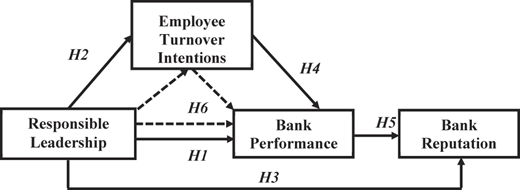
Employee turnover intention is the desire to leave an organization or seek alternative employment (Brown et al., 2019; Haque et al., 2019). It has garnered increasing attention in banking studies as a key determinant of employees’ behavioural outcomes (Haque et al., 2019). Hypotheses H1 and H2 explain that employees who perceive higher levels of RL tend to develop stronger engagement and bonding with senior executives and managers within banks. According to Social Identity Theory (Tajfel, 1974; Tajfel and Turner, 1986), when senior management demonstrates responsible behaviour, employees identify with these leaders and align their actions accordingly. As a result, turnover intention is likely to decrease. Conversely, when employees perceive lower levels of RL, their engagement and motivation may decline, increasing turnover intention.
This raises the question of whether turnover intention mediates the relationship between RL and bank performance. For instance, employees motivated by RL may continue to perform well despite harbouring turnover intentions. However, if turnover intention becomes too pronounced, it could independently affect bank performance by causing disruptions, increasing recruitment costs, and diminishing morale. Therefore, this paper hypothesizes that turnover intention mediates the direct relationship between RL and bank performance. Accordingly, this paper offers the following hypothesis:
Employee turnover intention mediates the direct relationship between RL and bank performance.
3. Methods
This study applied a quantitative approach to examine the relationships between RL, bank performance, reputation, and employee turnover intention. A web-based online survey was conducted with employees of Bangladeshi banks, employing explanatory and correlational research methods. The target population consisted of full-time bank employees over 18 years of age who held managerial or supervisory positions in the banking sector of Bangladesh. Before the primary data collection, a pilot test was conducted to identify potential issues with the survey questions. Pilot tests are recommended by Reynolds et al. (1993) to enhance the design of the questionnaire and identify areas for improvement in the online survey.
3.1 Data collection process and sampling
This study gathered data from bank managers and employees of major commercial banks in Bangladesh. Respondents, aged over 18, worked in managerial or employee-level roles across various banking departments, with duties related to customer service and employee supervision, focusing on day-to-day HRM practices. Participants were provided with complete information and the option to withdraw anonymously, making them suitable for measuring the influence of RL on bank performance, reputation, and turnover intention. A multi-source (e.g. employee and manager), multi-option (online, in-person survey and zoom sessions) and time-lagged research design was used to reduce common method bias (Podsakoff et al., 2003). At Time 1, the first survey (via Qualtrix) was distributed to the respondents through online surveys. Three months later, at Time 2, the second survey (in-person with the data collection team) was distributed to employees and managers.
In this study, 300 surveys were collected at Time 1 and 411 at Time 2, with a total of 711 completed surveys. A sample size of 711 was determined to be sufficient. The G*Power analysis (with a medium effect size, f2 = 0.15, α error probability of 0.01, power of 0.95, and 4 predictors) determined a required sample size of 169 (Faul et al., 2009), which is significantly lower than our actual sample size of 711. This confirms that the study has a more than adequate sample size. The demographic information, available in Table 1, highlights the diversity of our sample.
This study collected research data over two stages. First, a pilot test was conducted where a total of 90 responses were collected to scrutinise the collected responses. However, no significant changes were needed except for a few explanatory notes about item wording. For example, “my organisation” was rephrased as “my bank” and “total remuneration” with “total salary and benefits”. The second stage involved the development of a web-based questionnaire distributed via Qualtrix. A total of five thousand five hundred email invitations were made available to full-time employees of different Bangladeshi banks using the nonprobability judgemental sampling method (Burns and Bush, 2006). The data collection response rate for this study was 12.92%. Moreover, no differences between any of the variables indicate that non-response bias was not a problem in this study (Krosnick, 1999). Lastly, the respondents’ responses were anonymous and confidential, and at any time, they had the option to stop participating.
3.1.1 Non-response bias
This study assessed potential non-response bias using the method suggested by Armstrong and Overton (1977), a widely recognised approach in survey-based research (e.g. Porter and Whitcomb, 2005). Early and late responses were compared across the primary constructs of the model—RL, employee turnover intention, bank performance, and bank reputation (see Figure 2). Independent sample t-tests were conducted on the mean scores of early and late respondents (n = 35). The results showed p-values above the 0.05 threshold for all constructs (e.g. 0.071 for RL, 0.333 for employee turnover intention, 0.076 for bank performance, and 0.949 for bank reputation), indicating no significant differences based on response timing. As a result, non-response bias was not a concern in this study.
3.2 Measures
First, the RL was assessed using a scale developed by Doh et al. (2011). It comprises 13 items, and a sample of the survey questions was “my bank takes an active role in its community (e.g. doing good things for the society).” All the responses were collected on a five-point Likert scale (e.g. 1 = strongly disagree to 5 = strongly agree), and the Cronbach’s α of RL was 0.93. Second, the scale for bank performance was adopted from Delaney and Huselid (1996). This scale had five items, and a sample was “the quality of products, services, or programs of my bank, are: (1) much worse to (5) much better” Delaney and Huselid (1996) reported the reliability score (Cronbach’s alpha) of the scale as 0.85 and in this study, the reliability score was 0.89. Third, a four-item scale collected from Kelloway et al. (1999) was used to measure the ETI for Bangladeshi bank employees. An example of a sample item was “I am thinking about leaving this bank”. In this study, the Cronbach’s alpha of the scale was 0.92. Finally, bank reputation was collected from Lin et al. (2012). One of the three items of the applied scale was, “this is a reputable bank to work for”. The Cronbach’s alpha of this scale in this study was 0.83.
3.3 Demographic profile
In the demographic response, survey respondents provided information regarding gender, age, working level in the bank, level of education, duration of service in work and annual income (after-tax). Table 1 presents the summary of the demographic profile of participants (N = 711).
3.4 Data-analysis procedures
Data analysis in this study was conducted in two phases: preliminary analysis and hypothesis testing. In the first phase, descriptive and inferential statistics were used to check for out-of-bounds items, with mean, standard deviation, and correlation matrix analyses, alongside reliability tests for the scales. In the second phase, hypotheses were tested using a two-step structural equation modelling (SEM) technique (Anderson and Gerbing, 1988).
The first step, the measurement model, assessed the appropriateness of the scales by evaluating how well the indicators and errors fit. This included composite reliability and discriminant validity tests. The second step, the structural model, examined the relationships between constructs (e.g. RL, bank performance, employee turnover intention, and bank reputation) using path analysis (Byrne, 2010). SEM, performed with AMOS (IBM SPSS Statistics 29), estimated fit indices (e.g. χ2, RMSEA, NFI). SEM is favoured for path analyses due to its ability to calculate the total effect of explanatory variables on dependent variables (Raykov and Marcoulides, 2006). This study also investigated the mediating effect of employee turnover intention on the RL-bank performance relationship. Two conditions were required to validate this mediation: first, RL must correlate with bank performance and employee turnover intention; second, adding employee turnover intention to the model must alter the initial RL-bank performance relationship.
4. Results and hypothesis testing
4.1 Descriptive statistics and correlation test
Table 2 presents the key statistics, correlation values, and Cronbach’s α for all variables considered in this study. RL was positively correlated with bank performance (r = 0.651, p < 0.01) and negatively correlated with employee turnover intention (r = −0.386, p < 0.01). A significant negative correlation was found between employee turnover intention and bank performance (r = −0.423, p < 0.01). Furthermore, a positive correlation was observed between bank performance and reputation (r = 0.576, p < 0.01). These findings, with their strong and significant correlations, support the hypotheses proposed in this study.
4.2 First step: measurement model
The two-stage modelling technique proposed by Anderson and Gerbing (1988) was utilised in this study for data analysis. RL was measured using 13 items across three components, demonstrating a good fit with the measurement model (χ2 = 207.917, χ2/df = 3.713, p = 0.000, CFI = 0.96, GFI = 0.95, AGFI = 0.93, TLI = 0.97, NFI = 0.96, RMSEA = 0.062, SRMR = 0.0311). The confirmatory factor analysis (CFA) results revealed that all dimensions of RL loaded significantly, ranging from 0.65 to 0.90. Bank performance also showed a good fit (χ2 = 8.079, χ2/df = 2.693, p = 0.000, GFI = 0.98, AGFI = 0.97, CFI = 0.98, TLI = 0.98, NFI = 0.98, RMSEA = 0.049, SRMR = 0.0096). The model for employee turnover intention indicated a reasonable fit (χ2 = 19.271, χ2/df = 9.636, p = 0.000, CFI = 0.98, GFI = 0.97, AGFI = 0.94, TLI = 0.97, NFI = 0.98, RMSEA = 0.110, SRMR = 0.0125). In contrast, the three-item bank reputation scale exhibited an exceptional fit (CFI = 1, GFI = 1, NFI = 1, RMSEA = 0.651, SRMR = 0.000). Additionally, the reliability of the bank reputation scale was assessed using composite reliability (Raykov, 1997), yielding a satisfactory score of 0.84, with item loadings ranging from 0.65 to 0.88.
4.3 Second step: structural model
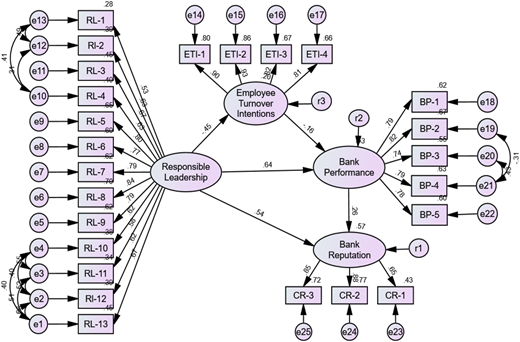
The structural model and regression weights are presented in Figure 2. The confirmatory factor analysis (CFA) results demonstrated that the hypothesised model fit the data well (χ2 = 887.993, χ2/df = 3.429, p = 0.000, GFI = 0.91, AGFI = 0.87, NFI = 0.93, TLI = 0.95, CFI = 0.95, RMSEA = 0.058, SRMR = 0.0450). Consequently, both stages of the structural model were validated, and no additional modifications were necessary.
4.4 Hypotheses testing
This study tested five hypotheses (H1 to H5) using standardised β values from a modified structural model to examine the relationships between RL, bank performance, employee turnover intention, and bank reputation. The analysis ensured the absence of multicollinearity and confirmed normality through tolerance values, variance inflation factors, and skewness values, all falling within acceptable ranges (−2.15 to 0.30).
As shown in Figure 2, the direct influence of RL on bank performance (H1) was significant (β = 0.532; p < 0.001), fully supporting H1. H2, which explored the relationship between RL and employee turnover intention, also showed a significant negative correlation (β = −0.808; p < 0.001), confirming that RL reduces turnover intention. H3, assessing the relationship between RL and bank reputation, was fully supported by a significant positive β-value (β = 0.338; p < 0.001). H4 examined the effect of employee turnover intention on bank performance, revealing a negative relationship (β = −0.073; p < 0.001), albeit weaker than the direct effect of RL.
The mediation analysis in H5, where employee turnover intention was introduced as a mediator, indicated partial mediation. The direct effect of RL on bank performance declined significantly from (β = 0.644; p < 0.001) to (β = 0.071; p < 0.001), providing evidence of partial mediation, as shown in Figure 2. The mediational analysis was further supported by 5,000 bootstrap resamples, with 99% bias-corrected percentile confidence intervals demonstrating the indirect effects of employee turnover intention.
The study also explored the proportion of variance explained by the model. RL explained 64%, 54%, and −45% of the variance in bank performance, bank reputation, and employee turnover intention, respectively. Bank performance explained 26% of the variance in bank reputation. These results are summarised in Tables 3 and 4, which present the SEM estimates for the tested hypotheses.
Tables 3 and 4 summarises the Structural Equation Modelling (SEM) results for all the tested hypotheses. Additionally, the study examined the hypothesised model with three control variables: gender, age, and annual income. Table 5 summarises the results related to these control variables. The analyses revealed that all control variables, except age concerning employee turnover intention, did not significantly influence the relationships specified in the study. Consistent with the findings of Ferres et al. (2002), older employees were found to respond more negatively to a lack of fit between their expectations and new jobs than younger employees, which may explain the observed influence of age on turnover intention.
4.5 Common method biases
This study utilised Harman’s one-factor (or single-factor) method to assess common method bias (CMB), and the total variance of all independent variables was found to be 41.84%, below the 50% threshold. Given that Harman’s test may sometimes fail to detect small biases, Lindell and Whitney (2001) recommended the marker variable technique as an additional check. As shown in Figure 2, the average correlation coefficient between the marker variable and the main variables—RL, bank performance, employee turnover intention, and bank reputation—was 0.28 (p > 0.05), suggesting no significant CMB. Therefore, the results from both approaches indicate that CMB does not impact the model under study.
5. Discussion
The study’s findings, summarised in Table 3, provide valuable insights into the relationships between RL, bank performance, employee turnover intention, and bank reputation. These results support the hypothesis and highlight RL’s crucial role in enhancing organisational outcomes, confirming its importance as a driver for improved bank performance and reputation.
First, the positive relationship between RL and bank performance (H1) demonstrates that RL is a key factor in improving organisational outcomes. This aligns with Rehman et al. (2021), who emphasise that RL boosts employee engagement, enhancing performance. Yasin (2021) also highlights RL’s role in driving performance within the banking sector.
Similarly, the negative relationship between RL and employee turnover intention (H2) suggests that RL fosters stronger employee relationships and engagement, thereby reducing turnover. Doh et al. (2011) argue that RL strengthens emotional ties with employees, increasing retention. This finding mirrors Katfi et al. (2025), who identify engagement and job satisfaction as mediators in reducing turnover.
H3 confirms that RL positively influences bank reputation, reinforcing leadership’s role in improving corporate image. Nguyen et al. (2021) support this view, highlighting that RL enhances stakeholder trust, which is vital in competitive markets. Furthermore, H4 reveals a positive relationship between bank performance and reputation, indicating that performance improvements lead to a higher reputation. This aligns with Aqueveque et al. (2018), Kim et al. (2021), and Zhou et al. (2021), who show that high performance boosts public perception and trust.
Testing H5 shows that employee turnover intention negatively impacts bank performance. This is consistent with Haque et al. (2019) and Dordunu et al. (2020), who suggest that turnover disrupts operations and morale. The study’s findings underline the importance of retaining employees for sustained performance.
Finally, H6 reveals that employee turnover intention mediates the relationship between RL and bank performance. This mediation effect, consistent with Christian and Ellis (2014) and Haque et al. (2019), suggests that RL indirectly enhances performance by reducing turnover. Accordingly, the study highlights RL’s significant impact on performance, turnover, and reputation. These findings align with the works of Khanam and Tarab (2024) and Gazi et al. (2025), who stress RL’s role in shaping organisational outcomes. The mediation effect further emphasises the interconnectedness of leadership, employee engagement, and performance, contributing to the growing literature on leadership in the banking sector and offering practical implications for improving internal operations and reputation.
6. Implications of the study
6.1 Theoretical implications
This paper has several critical theoretical implications. First, this paper extends the Social Identity Theory for leadership in HRM by integrating RL, particularly in Bangladesh’s banking sector. The findings show RL’s impact on bank performance and reputation through its influence on employees’ social identity and turnover intention, supporting Hogg et al. (2012) on the importance of follower identification. Applying Tajfel and Turner’s (1986) Social Identity Theory highlights RL’s role in strengthening group identification, reducing turnover, and enhancing outcomes. This aligns with Hogg’s (2008) call to explore leadership styles that foster group cohesion. By linking RL to practical outcomes, this study broadens the scope of Social Identity Theory, reinforcing Jun et al.’s (2025) insights on leadership’s role in organisational citizenship behaviour, offering new research paths in HRM to extend our understanding of the role of RL in driving bank performance, reducing turnover intention, and enhancing reputation, particularly within the context of developing nations. Prior research underscores the importance of RL in motivating employees and improving organisational outcomes by viewing employees as significant stakeholders (PlessKhanam and Tarab 2024, 2007; Doh and Quigley, 2014; Khanam and Tarab 2024). This study furthers this by investigating the relationship between RL and key organisational outcomes in the banking sector.
Second, this paper demonstrates how RL influences bank performance and reputation by incorporating Social Identity Theory (Tajfel, 1974; Tajfel and Turner, 1986). It reveals how responsible leaders create a sense of belonging and trust among employees, ultimately improving organisational outcomes. Accordingly, it extends the literature of Tajfel and Turner (1986) to clarify their Social Identity Theory by integrating RL into practices for organisational success and reputation. Third, this study highlights the underexplored role of employee turnover intention as a mediating factor between RL and bank performance (Haque et al., 2019), contributing to the RL literature in banking and integrating turnover intention as a mediator offers a deeper understanding of how RL impacts performance beyond direct leadership effects.
Third, to further enrich the theoretical discussion, integrating research on transformational leadership and other value-based leadership styles would provide valuable insights into leadership practices within the banking sector. Transformational leadership, which emphasises inspiring and motivating employees toward higher organisational goals, complements RL by fostering employee engagement, commitment, and alignment with organisational values (Haque, 2021; Doh and Quigley, 2014). Furthermore, studies have shown that value-based leadership styles, such as ethical and authentic leadership, can enhance trust and organisational reputation, key elements of RL (Zhu et al., 2014; Kim et al., 2021). In the context of banking, these leadership styles not only contribute to improved employee performance and retention (Brown et al., 2019) but also support the achievement of socio-economic goals aligned with the UN SDGs, such as financial inclusion and sustainable practices (Chandel and Arora, 2025; Gazi et al., 2025). Integrating these leadership styles with RL offers a comprehensive framework for understanding how leadership can drive organisational success and broader socio-economic outcomes.
Finally, while RL has been extensively examined in Western contexts, there is a noticeable gap in research focused on non-Western environments, particularly in developing countries like Bangladesh (Haque et al., 2019; Rehman et al., 2021; Gazi et al., 2025). This paper addresses this gap by exploring RL in the Asian context, specifically within the banking sector in Bangladesh, making a valuable contribution to non-Western leadership literature.
6.2 Practical implications
The findings of this study suggest that RL plays a critical role in improving bank performance and reputation, making it essential for banks in Bangladesh to invest in developing RL competencies among their leadership teams. Effective RL can foster a motivated and engaged workforce, leading to improved organisational outcomes, such as increased performance and strengthened bank reputation (Doh et al., 2011; Haque et al., 2019). Furthermore, RL has a direct influence on reducing employee turnover intention, thus improving employee retention, a crucial issue for the banking sector in Bangladesh, where high turnover remains a significant challenge (Isa et al., 2025). Integrating RL into HRM practices can help mitigate turnover-related risks and foster a more stable and productive workforce.
Bank policymakers can strategically implement RL to drive organisational success and contribute to broader socio-economic benefits, particularly in alignment with the United Nations’ SDGs. RL enhances employee engagement, retention, and performance, key drivers of organisational success (Alfes et al., 2013; Haque et al., 2019). Additionally, RL practices strengthen corporate reputation and stakeholder trust, improving financial and environmental performance (Reynolds et al., 1993; Zhu et al., 2014). Bank policymakers can integrate RL into HR strategies, focusing on ethical leadership, CSR initiatives, and sustainable business models that contribute directly to SDGs (Saks, 2022; Khare et al., 2025). These practices enhance organisational outcomes and address global challenges like financial inclusion and environmental sustainability, generating long-term socio-economic benefits (Chandel and Arora, 2025).
In addition, RL’s alignment with the United Nations’ SDG 8 and SDG 10 underscores its potential to contribute to broader national economic development. Promoting RL within Bangladesh’s banking sector can help enhance employee retention and overall economic growth and reduce inequalities (The 17 Goals, 2021; Khare et al., 2025). As such, this study presents RL as a strategic tool for fostering sustainable economic growth, positioning Bangladesh’s banking sector for long-term success and stability.
Finally, incorporating improved leadership practices within the banking sector can have significant broader societal impacts. Banks can positively influence public attitudes towards the sector by fostering trust, transparency, and accountability through leadership development (Saks, 2022; Doh and Quigley, 2014). As organizations become more aligned with ethical practices and socio-economic responsibilities, they can enhance their reputations and build stronger relationships with customers and the public. This, in turn, can lead to increased customer loyalty, better financial inclusion, and a more stable financial environment. Ultimately, such practices contribute to national economic development by fostering a culture of responsible banking, which promotes sustainable growth, financial stability, and greater public confidence in the financial system (Aqueveque et al., 2018; Sobhani et al., 2021). Moreover, as banks improve leadership effectiveness, they can contribute to achieving the United Nations’ SDGs (e.g. SDG 8 and SDG 10), particularly in economic growth, employment, and innovation (Chandel and Arora, 2025; Pless, 2007).
6.3 Limitations of the study and future research opportunities
Despite its significant contributions, this study has several limitations that future research could address. First, the study is based on data from Bangladesh, which may limit the generalizability of the findings. However, the specific context of Bangladesh provides valuable insights for other South Asian countries with similar socio-economic characteristics. Future studies could replicate this research in other South Asian nations, broadening the region’s understanding of RL. Comparative studies with Western countries could also offer insights into cross-cultural variations in leadership practices and their impact on organisational outcomes, especially in achieving SDGs within the financial sector (Gazi et al., 2025; Khare et al., 2025).
Second, the study relied on self-reported employee data, introducing CMB risk. Although the study employed techniques like Harman’s one-factor test and the marker variable approach (Lindell and Whitney, 2001) to mitigate CMB, the risk of bias still exists. Future research could benefit from using multi-source data, incorporating managerial or customer perspectives, to enhance the validity and robustness of findings. Moreover, using cross-sectional data limits the ability to make causal inferences, as it only provides a snapshot of relationships at a single point in time. In contrast, a longitudinal study tracks data over extended periods, allowing for a deeper understanding of how RL influences bank performance and reputation over time. By capturing changes at multiple time points, a longitudinal design can establish causal relationships, demonstrating whether RL consistently impacts organizational outcomes or if the effects fluctuate. It also provides insights into the long-term sustainability of RL’s effects, which is critical for understanding its enduring influence on performance, employee retention, and reputation in the banking sector. Thus, a longitudinal study would offer more robust and nuanced findings, addressing the limitations of cross-sectional research.
Third, this study focused on employee turnover intention rather than actual turnover. Although turnover intention is a significant predictor, examining actual turnover may provide more concrete insights into RL’s impact on employee retention and organisational performance. Future studies could explore actual turnover data for a more comprehensive understanding of RL’s influence.
Fourth, judgemental sampling was purposefully chosen to target knowledgeable respondents with relevant managerial or supervisory experience in HRM practices within Bangladeshi banks (Burns and Bush, 2006). However, this non-probability sampling technique carries inherent limitations, such as potential selection bias and reduced generalisability beyond the study population. The study employed a time-lagged, multi-source approach to enhance methodological rigour, confirmed sample adequacy through G*Power analysis (Faul et al., 2009), and implemented tests to address potential non-response bias (Armstrong and Overton, 1977). Despite these measures, alternative sampling strategies—such as stratified random sampling—could provide improved representativeness and external validity in future research. Stratifying respondents by variables such as job level or bank type (e.g. public vs private, Islamic vs conventional) may yield more generalisable insights. Recognising this limitation and outlining methodological improvements aligns with established recommendations for enhancing the robustness of survey-based organisational research (Krosnick, 1999; Podsakoff et al., 2003).
Finally, future research could refine the hypothesised model by considering alternative mediators, such as trust (Kim et al., 2015) or employee citizenship behaviour (Alfes et al., 2013), which could shed more light on how RL impacts organisational outcomes. These directions would deepen our understanding of RL in banking and expand research on how RL can support SDGs in emerging economies (Khanam and Tarab, 2024; Isa et al., 2025).
7. Conclusion
This study explores the effects of RL in the banking sector on employee turnover intention, bank performance, and organizational reputation. The findings reveal that RL significantly enhances employee retention, indirectly improving performance and reputation. By integrating Social Identity Theory, the study offers a novel perspective on organizational success in emerging markets, addressing a critical gap in the literature. It emphasizes fostering employees’ sense of belonging and commitment, which is crucial for sustainable growth. Furthermore, the research highlights RL’s potential to advance SDGs 8 (Decent Work and Economic Growth) and 10 (Reduced Inequalities) within the financial sector by promoting ethical, stakeholder-oriented practices that balance people, profit, and the planet. These insights are particularly relevant for policymakers, HR practitioners, and academics seeking to foster sustainable success in South Asia. While centred on Bangladesh, the findings have broader implications for similar socio-economic contexts, underscoring RL’s universal relevance in driving long-term sustainability in the banking industry.
This study was funded by the Institute for Advanced Research (IAR), United International University (UIU), Bangladesh.