
Skip to article sections
Purpose

Live-streaming e-commerce is characterized by real-time interaction, namely, consumer-streamer interaction (CSI) and consumer-consumer interaction (CCI). Integrating uses and gratifications theory (UGT) and the Elaboration Likelihood Model (ELM), this study proposes a dual-process framework of trust formation: CSI (expertise and responsiveness) cultivates trust through the central route by enabling evaluation of information quality, whereas CCI (personalization and entertainment) cultivates trust through the peripheral route by leveraging social proof and emotional resonance.

Design/methodology/approach

Using survey data from 409 live-streaming shoppers in China and employing partial least squares structural equation modeling (PLS-SEM), this study examines how CSI and CCI shape purchase intention via perceived trust, and how price sensitivity moderates the trust-purchase intention relationship.

Findings

CSI and CCI enhanced purchase intention through perceived trust, with indistinguishable baseline effects. Trust partially mediated these associations, with central and peripheral patterns. Price sensitivity eliminated personalization's direct effect, suggesting comparable effects may conceal mechanistic differences. Furthermore, heightened sensitivity induced systematic processing, reducing reliance on trust and moderating the perceived trust–purchase intention relationship.

Originality/value

This study advances live-streaming research by embedding dual-process theory within real-time interaction dynamics. Contributions include demonstrating equivalent effects can operate through divergent mechanisms, reconceptualizing streamer expertise as a dynamically validated signal, and empirically testing ELM's boundary conditions, showing peripheral-route effectiveness depends on low motivation (proxied by price sensitivity). Findings extend ELM to live-streaming and offer actionable guidance for interaction strategy design.

Live-streaming e-commerce has reshaped how consumers acquire information through real-time interaction, emerging as a key growth engine in digital retail. By 2025, China's live-streaming users had exceeded 833 million, with transaction volumes surpassing RMB 5 trillion, accounting for one-third of total online retail sales (China Internet Network Information Center, 2025; State Administration for Market Regulation, 2026). However, rapid growth has not eased consumers' trust concerns; trust remains a bottleneck constraining further development. Thus, understanding and cultivating consumer trust in the live-streaming context has become a core issue for both academia and industry.

Real-time interaction is the core competitive advantage of live-streaming (Xue et al., 2020) and can be distinguished into two forms: consumer-streamer interaction (CSI) and consumer-consumer interaction (CCI). The former reduces information asymmetry through professional demonstrations and timely responses, enabling consumers to directly assess the streamer's expertise and responsiveness (Joo and Yang, 2023). The latter involves experienced consumers sharing product experiences and recommendations via danmaku thereby reinforcing social bonds and enhancing consumers' perceived personalization and entertainment value (Fan et al., 2024). Together, these two interaction types form the basis for consumer trust in the live-streaming.

Yet, literature leaves three important questions unresolved. First, CSI and CCI have been examined in isolation (Gu et al., 2023), leaving their comparative mechanisms undertheorized. Second, expertise has predominantly been treated as a static characteristic, with limited consideration of how it may function as a dynamic signal that consumers actively assess and validate through real-time interaction (Li et al., 2025). Third, prior research has not examined whether these interaction types foster trust through distinct cognitive routes, a distinction that carries theoretical weight given the Elaboration Likelihood Model's (ELM) prediction that central and peripheral-route trust differ in durability (Petty and Cacioppo, 1986). Accordingly, this study addresses the following research questions:

  • Q1: How do CSI and CCI differentially influence consumer trust in live-streaming e-commerce?

  • Q2: How does perceived trust affect purchase intention, and how does price sensitivity moderate this effect?

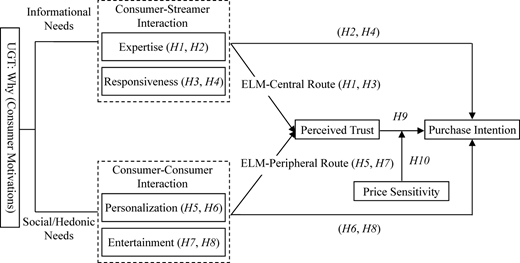
To answer these questions, this study integrates Uses and Gratifications Theory (UGT) with ELM. UGT identifies consumers' core motivations for engaging in live streaming (Fu et al., 2024), whereas ELM explains how the fulfillment of different needs translates into persuasion through its central and peripheral routes (Petty and Cacioppo, 1986). Drawing on this framework, this study proposes that CSI activates the central route, building trust through careful evaluation of information quality. Specifically, expertise is reconceptualized as a dynamically validated signal: credibility is established when knowledge is mobilized in real time and publicly tested, with responsiveness reflecting the streamer's capacity for timely and substantive replies. In contrast, CCI activates the peripheral route, building trust through heuristic cues: personalization (trust in peers transfers to the streamer) and entertainment (positive affect spills over to purchase decisions). This study further tests the boundary conditions of peripheral-route persuasion using price sensitivity as a proxy for processing motivation.

This study makes three contributions. First, it advances understanding of consumer persuasion by demonstrating statistical equivalence does not imply mechanistic equivalence. Although the effects of different interaction types on trust and purchase intention were statistically comparable, price sensitivity as a moderator reveals a mechanistic difference between the peripheral and central routes.

Second, departing from the traditional view of expertise as a static attribute, this study reconceptualizes it as a dynamic signal that must be validated through real-time interaction. Drawing on signaling theory (Spence, 1973), expertise and responsiveness are shown to independently contribute to trust formation.

Third, it extends ELM to live-streaming (Luo et al., 2024a) and supports its core prediction that the peripheral route loses effectiveness when processing motivation is high.

Existing research has examined the antecedents of purchase intention in live-streaming from two perspectives: streamer characteristics and live-streaming content features. Streamer characteristics include streamer-product fit (Park and Lin, 2020), linguistic features and speech acts (Chen et al., 2023), attractiveness and communication styles (Guo et al., 2022), and professional competence (Li et al., 2025). Live-streaming content feature research has focused on how time pressure and immersive experiences drive impulse purchase behavior (Hao and Huang, 2025). However, these two perspectives have largely overlooked live-streaming's defining feature: real-time interaction.

A growing body of research has begun to acknowledge real-time interaction as a distinct construct, differentiating between CSI and CCI. CSI centers on information quality, driving behavior through the satisfaction of cognitive needs, the cultivation of trust, and the formation of parasocial relationships (Gu et al., 2023; Zhang et al., 2022; Ma et al., 2024). By contrast, CCI emphasizes emotional contagion, fostering a sense of community, enhancing social presence, and amplifying herd behavior (He et al., 2026; Chen et al., 2025). Scholars have extended research to explore micro-level phenomena such as danmaku consistency and emotional contagion (Zhang and Ruan, 2024; Kim et al., 2026), corroborating the distinction between informational and emotional communication strategies (Luo et al., 2024b).

Despite these contributions, three substantive gaps remain. First, no study has directly contrasted the mechanisms by which CSI and CCI steer consumer behavior. Second, prior research has largely characterized expertise as a static attribute (Li et al., 2025), with its dynamic and interaction-dependent nature receiving little empirical scrutiny. Third, the boundary conditions governing ELM's peripheral route remain empirically unexplored in live-streaming, leaving a key theoretical prediction unverified.

Thus, this study employs dual-process theory, distinguishing between central and peripheral routes, to juxtapose CSI and CCI pathways, reconceptualizes expertise as a dynamic, interaction-validated signal, and introduces price sensitivity as a moderating variable to probe the boundary conditions of peripheral-route persuasion.

Existing research has approached trust formation from three perspectives: streamer characteristics, encompassing professional competence and attractiveness (Alnoor et al., 2024); interactive process, wherein real-time interaction bolsters social presence (Fu et al., 2024); and social influence, operationalized through peer interactions and social validation (Zhang et al., 2022). Recent studies have further extended this line to trust transfer mechanisms (Li et al., 2025) and their boundary conditions (Li et al., 2024).

However, these studies have not distinguished the pathways through which trust is constructed. According to ELM, trust generated through the central and peripheral routes may structurally diverge in both its cognitive architecture and longevity (Petty and Cacioppo, 1986). Therefore, this study introduces price sensitivity as a moderator to identify when peripheral-route trust formation occurs, providing empirical evidence for the model's boundary conditions.

This study integrates UGT and ELM to distinguish the cognitive routes activated by different interaction types. UGT captures consumers' informational, social, and hedonic motivations for live-streaming shopping, while ELM explains how these gratifications translate into trust via central or peripheral routes (Table 1).

In live-streaming, informational gratification triggers the central route, prompting systematic evaluation of streamer expertise and responsiveness, whereas social and hedonic gratifications activate the peripheral route, relying on heuristic cues such as social proof and affect transfer. Grounded in signaling theory (Spence, 1973), expertise is reconceived as a dynamic signal whose credibility is established and verified through real-time interaction. Both pathways jointly shape consumer trust and purchase intention, with meaningful implications for the persistence of trust formed though distinct cognitive mechanisms.

Figure 1 presents the proposed theoretical model, illustrating how real-time interaction leads to purchase intention through perceived trust and how price sensitivity moderates this process.

Under the UGT-ELM framework, CSI activates the central route by fulfilling informational needs: expertise provides the cognitive basis of the interactive signal, while responsiveness validates it in real time.

3.1.1 The influence of expertise

Expertise refers to a streamer's ability to recommend products based on professional knowledge and experience, a key dimension of interaction quality (Lu et al., 2024). Through the central route, expertise fosters consumer trust via rational evaluation in two ways. First, it reduces information asymmetry by clarifying product attributes, thereby lowering perceived purchase risk (Wongkitrungrueng and Assarut, 2020). Second, systematic demonstration of professional knowledge encourages parasocial trust, increasing consumer confidence in the streamer and their recommendations (Zhang et al., 2023). This trust deepens consumer immersion and engagement, strengthening CSI and reinforcing perceived expertise in a positive feedback loop (Liao et al., 2023). Moreover, consumers are more receptive to recommendations from competent streamers (Cheah et al., 2024). Based on this, we hypothesize:

H1.

Expertise is positively associated with perceived trust.

Additionally, expertise may directly influence purchase intentions by simplifying complex product evaluations and lowering decision-making barriers. Professional demonstrations simplify complex product attributes, enabling more efficient informed decisions, especially for experience and credence goods that are difficult to evaluate prior to purchase (Dang-Van et al., 2023). Thus, we propose:

H2.

Expertise is positively associated with purchase intention.

3.1.2 The influence of responsiveness

The real-time question-and-answer nature of live-streaming gives responsiveness its dynamic character (Zhai and Chen, 2023), with instantaneous feedback conveying product value, fostering immersion, and encouraging participation (Gao et al., 2025).

As the real-time interactive manifestation of underlying expertise, responsiveness directly addresses consumers' informational needs. Timely and substantive responses transform static expertise claims into dynamic signals subject to real-time verification, feeding evaluable information into the central route. The credibility of expertise thus hinges on interactive validation.

Responsiveness may build trust through three interrelated pathways. First, it provides immediate product clarification, enhancing information adequacy and consumer understanding, while signaling empathy and a customer-oriented stance (Zhang et al., 2023). Second, minimizing response latency fosters psychological closeness, reducing perceived social distance between consumers and streamers (He et al., 2022). Third, this closeness strengthens perceptions of authenticity and sincerity, reinforcing relational trust (Zhang et al., 2022). Based on this, we hypothesize:

H3.

Responsiveness is positively associated with perceived trust.

Responsiveness may also directly influence purchase intention. By capturing attention peaks in real-time interaction, it can trigger impulse mechanisms that convert transient interest into purchase behavior (Gu et al., 2023). Streamers' immediate responses may evoke scarcity or fear of missing out, prompting consumers to bypass deliberative processing and accelerate purchase decisions (Sun et al., 2024). Thus, we propose:

H4.

Responsiveness is positively associated with purchase intention.

Under the UGT-ELM framework, CCI activates the peripheral route by fulfilling personalization and entertainment needs, building trust via heuristic cues: social proof and affect transfer.

3.2.1 The influence of personalization

In live-streaming, informed consumers share product-related experiential insights, creating a diversified information flow from which other participants selectively extract content that they perceive as personally relevant (Zhang and Zhang, 2024; Zhang et al., 2024; Zhang and Ruan, 2024).

When consumers observe similar others endorsing a product, they use this social cue to form positive judgment of the product's reliability (Fu et al., 2024). Such a favorable product assessment may then transfer to the streamer, elevating perceptions of the streamer's own trustworthiness (Tripp et al., 2022). Thus, we hypothesize:

H5.

Personalization is positively associated with perceived trust.

Personalization may also directly influence purchase intention by enhancing information efficiency. It enables real-time access to customized information (Zhang et al., 2022), reducing cognitive load and decision barriers, shortening decision time (Lv et al., 2022), and increasing receptivity to recommendations (Wang et al., 2024). Personalized filtering may also help consumers evaluate options more effectively and arrive at more informed purchase decisions (Fu et al., 2024). Thus, we propose:

H6.

Personalization is positively associated with purchase intention.

3.2.2 The influence of entertainment

Entertainment in live-streaming arises from multidirectional consumer interactions, such as danmaku (Gu et al., 2023). These interactions enable consumers to co-construct socioemotional experiences and foster collective emotional resonance (Mo and Yang, 2026).

Shared entertainment experiences may create a sense of parasocial community, fostering emotional connections with the streamer and perceptions of warmth and authenticity, thereby facilitating trust formation (Kim et al., 2026). Positive emotions may also strengthen consumer bonds and indirectly enhance trust (Hsu and Hu, 2024). Thus, we hypothesize:

H7.

Entertainment is positively associated with perceived trust.

Entertainment may also directly influence purchase intention through three pathways. First, via affect transfer, positive emotions generated through interaction may transfer to recommended products, stimulating purchase intention (Yu et al., 2025). Second, via flow experience, interactive entertainment may induce temporal distortion, enhancing purchase intention by deepening information processing and filtering distractions (Wang et al., 2026). Third, via hedonic extension, increased viewing duration and interaction frequency may lead consumers to view products as pleasurable extensions, stimulating desire for possession (Liu et al., 2025). Thus, we propose:

H8.

Entertainment is positively associated with purchase intention.

In live-streaming, trust reduces information asymmetry and facilitates behavioral conversion, serving as a primary driver of purchase intention (Li et al., 2025). This dual functionality operates via two pathways. Cognitively, it may reduce decision uncertainty (Hameed et al., 2025); affectively, it may elicit emotional commitment and psychological security, thereby facilitating purchase decisions (Alnoor et al., 2024). Thus, we propose:

H9.

Perceived trust is positively associated with purchase intention.

In live-streaming, where promotions are frequent, price is a core decision-making incentive (Gu et al., 2024). Price sensitivity, defined as consumers' attention to price changes and the weight assigned to price in decisions (Li et al., 2024), has generated two competing views on its moderating role in the trust–purchase intention relationship.

The trust signal attenuation hypothesis posits that high price sensitivity activates systematic processing, prompting attribute-based comparisons and price calculations, thereby weakening trust's diagnostic value and its positive effect on purchase intention (Pavlou et al., 2007). Conversely, the risk-mitigation hypothesis suggests that highly price-sensitive consumers, concerned about potential losses, may rely more on trust as a risk-mitigating mechanism (Mayer et al., 1995).

Given the abundant real-time information available through live-streaming interaction (Huang et al., 2024), price-sensitive consumers tend to adopt attribute-based evaluation strategies. Accordingly, we support the trust signal attenuation hypothesis and propose:

H10.

Price sensitivity negatively moderates the relationship between perceived trust and purchase intention.

The measurement scales were adapted from validated scales in the literature to suit the live-streaming context. The English items were translated into Chinese using a back-translation procedure. Further, two bilingual researchers verified the translation to ensure item consistency and clarity (Lu et al., 2024).

Specifically, expertise (Li et al., 2025), personalization (Kang et al., 2021), responsiveness (Ma et al., 2024), entertainment (Joo and Yang, 2023), perceived trust (Cheah et al., 2024), price sensitivity (Gu et al., 2024), and purchase intention (Fu et al., 2024) were each measured using a five-point Likert scale (1 = strongly disagree; 5 = strongly agree). Demographic control variables included gender, age, education level, and monthly consumption expenditure (Table 2).

The survey targeted consumers who had watched and purchased through live-streaming. A pilot test with 52 respondents led to the revisions of several measurement items. The main survey was administered via the WJX platform (Link to the website), a national panel of over 2.6 million registered users with demographic quotas. A screening question (“Do you frequently watch live-streaming?”) identified eligible respondents; only those who answered “Yes” proceeded. From March 3 to 31, 2025, 532 responses were collected. After excluding incomplete, straight-lined, and overly fast responses (<90 seconds), 409 valid responses remained (valid response rate = 76.9%). The sample size exceeded the minimum requirement for Partial Least Squares Structural Equation Modeling (PLS-SEM), providing sufficient statistical power (Kock and Hadaya, 2018).

The sample was roughly balanced by gender (50.3% male, 49.7% female). The age distribution was dominated by the 21–30 group (49.3%), with 89.6% of respondents aged 41 or under, closely matching the core post-90s consumer demographic. Bachelor's degree holders comprised 46.4%, and enterprise employees represented the largest occupational group (45.7%), both consistent with the live-streaming shopping user profile. Monthly consumption was most concentrated in the ¥1,001–2,000 range (30.0%), with a sample mean of ¥1,846—approximating the national average of ¥1,720 (iResearch, 2025). Relative to industry benchmarks, the sample shows strong representativeness (Table 3).

To control for CMB, this study incorporated a common method factor into the PLS-SEM model (Podsakoff et al., 2024); results are reported in Table 4. The analysis indicates that method variance accounted for only 0.2% of total variance, yielding a substantive-to-method variance ratio of 341:1. Furthermore, none of the 25 method factor loadings reached statistical significance, suggesting that common method bias does not materially affect the study's findings.

Smart PLS 4 was used for PLS-SEM analysis. Variance inflation factor (VIF) diagnostics (Table 5) shows that all VIF values fell below the threshold of 5 (range: 1.434–2.241), indicating no serious multicollinearity concerns (Liang et al., 2007).

5.1.1 Assessment of scale reliability

Reliability analysis (Table 5) shows that Cronbach's alpha and composite reliability values for all variables exceed 0.700 (Cheung et al., 2023), confirming satisfactory internal consistency reliability.

5.1.2 Assessment of the convergent validity

Convergent validity analysis (Table 5) shows that all indicator loadings exceeded 0.700 and were statistically significant (t > 1.96, p < 0.05) (Cheung et al., 2023), and the average variance extracted (AVE) for each construct exceeded 0.50 (Fu et al., 2024), demonstrating good convergent validity. Content validity was established by consulting experts and practitioners during the scale-development phase.

5.1.3 Assessment of discriminant validity

Discriminant validity analysis (Table 6) shows that the square root of each construct's AVE exceeded its highest correlation with any other construct, thereby demonstrating satisfactory discriminant validity (Fu et al., 2024).

The theoretical framework and hypotheses were assessed using a PLS-SEM model built in Smart PLS 4 (Figure 1). Model fit was acceptable (SRMR = 0.05, below 0.08; Liang et al., 2007).

5.2.1 Direct effects test

The direct effects of the four interaction dimensions on perceived trust and purchase intention (H1-H8) were tested using 5,000 bootstrap resamples (Table 7).

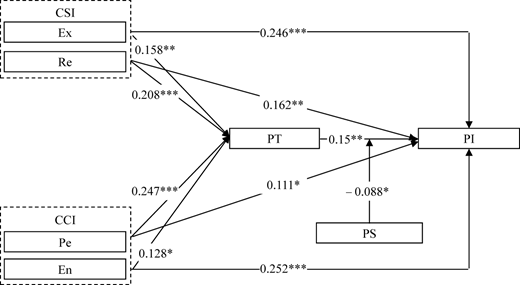
Ex positively affected perceived trust (H1: β = 0.158, p < 0.01) and PI (H2: β = 0.246, p < 0.001). Re positively affected PT (H3: β = 0.208, p < 0.001) and PI (H4: β = 0.162, p < 0.01). Pe positively affected PT (H5: β = 0.247, p < 0.001) and PI (H6: β = 0.111, p < 0.05). En positively affected PT (H7: β = 0.128, p < 0.05) and PI (H8: β = 0.252, p < 0.001). In addition, PT positively affected PI (H9: β = 0.15, p < 0.01). All hypotheses received support.

5.2.2 Moderating effect of price sensitivity

In the base mediation model, Pe had a significant direct effect on PI. After introducing PS and its interaction term with PT, however, the direct effect of Pe became non-significant (β = 0.060, p = 0.268, 95% CI [–0.046, 0.166]), whereas the PT × PS interaction was significant (H10: β = −0.088, p < 0.05, 95% CI [–0.168, −0.008]). This finding supports the trust signal attenuation hypothesis: when price-sensitive consumers have access to abundant real-time information, they tend to adopt attribute-based evaluation rather than rely on trust. The results are illustrated in Figure 2.

5.2.3 Mediating effects test

The mediating role of PT was tested using SPSS PROCESS (Model 4) with 5,000 bootstrap resamples and 95% bias-corrected confidence intervals.

As shown in Table 8, all four dimensions exerted significant partial mediating effects on PI through PT. Partial mediation was confirmed for Ex (indirect effect = 0.091, 95% CI [0.051, 0.138]; direct effect = 0.352, 95% CI [0.281, 0.423]), Pe (indirect effect = 0.111, 95% CI [0.070, 0.160]; direct effect = 0.256, 95% CI [0.180, 0.333]), En (indirect effect = 0.090, 95% CI [0.053, 0.132]; direct effect = 0.370, 95% CI [0.298, 0.441]), and Re (indirect effect = 0.105, 95% CI [0.065, 0.152]; direct effect = 0.236, 95% CI [0.160, 0.312]).

Conditional indirect effect analyses (Table 8) further show that the indirect effects varied across PS levels. At low PS, the conditional indirect effects of Re (0.042, 95% CI [0.008, 0.079]) and Pe (0.050, 95% CI [0.010, 0.093]) were significant. At high PS, neither effect was significant. In contrast, Ex (low PS: 0.032, 95% CI [−0.001, 0.068]; high PS: 0.004, 95% CI [−0.019, 0.028]) and En (low PS: 0.026, 95% CI [−0.006, 0.060]; high PS: 0.003, 95% CI [−0.019, 0.027]) did not exhibit significant conditional indirect effects at either price sensitivity level.

These results indicate that PS moderates the indirect effects of Re and Pe which are significant only for consumers with low PS. By contrast, the indirect effects of Ex and En on purchase intention are independent of PS.

5.2.4 Coefficient comparison tests

Significant differences in the path coefficients of the interaction dimensions were tested using Smart PLS's model constraint function (Sarstedt et al., 2020); results are reported in Table 9. The effects of the dimensions were not statistically distinguishable. As presented in Table 9, none of the twelve pairwise comparisons for the paths to trust and purchase intention reached statistical significance. The 95% confidence intervals for all pairwise differences included zero, indicating that the effects of the four interaction dimensions were not statistically distinguishable.

This study supports a dual-process framework in which real-time interaction influences purchase intention through perceived trust, moderated by price sensitivity (Table 10).

First, this study demonstrates that comparable effect sizes do not inherently imply equivalent mechanisms. All four dimensions were similarly associated with perceived trust and purchase intention. However, under conditions of price sensitivity moderation, only personalization's direct association became non-significant, suggesting that statistically indistinguishable effects may operate through different mechanisms.

Second, perceived trust acts as a partial mediator, exhibiting conditional patterns highly consistent with ELM. Central-route variables differ in trust mediation (responsiveness conditional, expertise stable), whereas peripheral-route variables diverge: personalization operates via trust only under low motivation, while entertainment primarily through direct pathways.

Third, price sensitivity negatively moderates the trust–purchase intention relationship. Heightened price sensitivity appears to trigger more systematic cognitive processing, shifting consumers to favor attribute-based comparisons and reducing their reliance on trust as a peripheral heuristic cue. Consequently, the positive association between trust and purchase intention weakens as price sensitivity rises.

First, this study contributes to marketing theory by challenging the implicit assumption in prior research that similar effect sizes reflect comparable underlying mechanisms (Luo et al., 2024b). While conventional literature treats matching path coefficients as evidence of a uniform persuasion process, the conditional evidence here suggests that statistically indistinguishable effects can operate through entirely different mechanisms. Specifically, surface-level statistical symmetry does not guarantee a shared psychological route to purchase intention when environmental boundaries like price sensitivity are introduced.

Second, extending the static view of streamer expertise (Li et al., 2025) and drawing on signaling theory (Spence, 1973), this study reconceptualizes expertise as a dynamic signal that must be validated through live interaction. In doing so, the findings demonstrate that real-time responsiveness functions as an independent, parallel pillar in trust formation, alongside established expertise.

Third, this study empirically tests the boundary conditions of the peripheral-route persuasion within live-streaming. Personalization's indirect effect via trust is exclusively significant under low-price-sensitivity consumers, and price sensitivity attenuates the direct trust–purchase intention relationship. These findings provide robust empirical backing for ELM's foundational premise that peripheral-route persuasion requires low processing motivation (Petty and Cacioppo, 1986), thereby extending understanding of the peripheral route's boundary conditions in live-streaming.

First, achieving operational success in live-streaming depends on systematic selection of interaction dimensions, which platform managers must tailor to both product classification and strategic goals. Expertise yields are most effective for technically complex products that require cognitive evaluation. Real-time responsiveness functions as a robust driver of consumer trust and purchase intention, meriting priority investment. Entertainment is conversion-focused, with most of its effect bypassing the trust, and is best deployed in mid-to-late live-streaming stages to reduce decision fatigue and encourage impulse purchases.

Second, practitioners should deploy price sensitivity as a basis for customer segmentation. Among high price-sensitive segments, value-oriented signals such as competitive pricing and quality assurance should be prioritized over personalized social proof, since personalization's direct effect on purchase intention diminishes under conditions of heightened price consciousness. In contrast, for low-sensitivity segments, personalization should be harnessed to build trust, danmaku interactions encouraged to foster community, and entertainment value mobilized as a conversion mechanism.

Third, expertise should be validated through dynamic real-time interaction. Platforms should implement streamer training protocols that place particular emphasis on delivering thorough and substantive responses to consumer questions. Encouraging viewers to challenge streamers with rigorous questions allow abstract claims of professional knowledge to be publicly verified, effectively converting them into observable and credible trust signals. Finally, platforms should strengthen responsiveness infrastructure, including adequate peak-hour staffing and resource allocation, so that timely and comprehensive replies can be consistently delivered, treating responsiveness as a trust-building force rather than a secondary complement to expertise.

First, a tension exists between the process-oriented framework and the cross-sectional data. The model posits that different interaction types build trust via distinct pathways, which may yield trust with different durability and resistance to counter-persuasion. However, cross-sectional data cannot capture trust's dynamic evolution or test such pathway differences (He et al., 2026). Future research could address this using longitudinal designs or trust-violation experiments.

Second, concerns about single-source bias and common method variance persist. Despite procedural and statistical controls, shared variance may still influence the results. Additionally, measuring purchase intention rather than actual behavior leaves an intention–behavior gap. Future research could enhance robustness by incorporating platform-generated behavioral data (Mo and Yang, 2026), multiple secondary sources, and multi-method triangulation.

Third, other boundary conditions beyond price sensitivity merit exploration. Streamer type is a promising candidate: influencer streamers likely provide peripheral cues, while expert streamers may elicit central-route processing (Zheng et al., 2026). Future research should test the generalizability of these pathway effects across different streamer types.

The authors are grateful to the editor and anonymous reviewers for their insightful and constructive comments, which have significantly improved the quality of this paper.
Alnoor
,
A.
,
Abbas
,
S.
,
Khaw
,
K.W.
,
Muhsen
,
Y.R.
and
Chew
,
X.
(
2024
), “
Unveiling the optimal configuration of impulsive buying behavior using fuzzy set qualitative comparative analysis and multi-criteria decision approach
”,
Journal of Retailing and Consumer Services
, Vol. 
81
, 104057, doi: .
Cheah
,
C.W.
,
Koay
,
K.Y.
and
Lim
,
W.M.
(
2024
), “
Social media influencer over-endorsement: implications from a moderated-mediation analysis
”,
Journal of Retailing and Consumer Services
, Vol. 
79
, 103831, doi: .
Chen
,
A.
,
Zhang
,
Y.
,
Liu
,
Y.
and
Lu
,
Y.
(
2023
), “
Be a good speaker in livestream shopping: a speech act theory perspective
”,
Electronic Commerce Research and Applications
, Vol. 
61
, 101301, doi: .
Chen
,
X.
,
Wang
,
Y.
,
Wei
,
S.
and
Shen
,
J.
(
2025
), “
The effect of herd behavior on consumer intention in live streaming e-commerce: the moderating role of interaction
”,
International Journal of Human-Computer Interaction
, Vol. 
41
No. 
2
, pp. 
1674
-
1687
, doi: .
Cheung
,
G.W.
,
Cooper-Thomas
,
H.D.
,
Lau
,
R.S.
and
Wang
,
L.C.
(
2023
), “
Reporting reliability, convergent and discriminant validity with structural equation modeling: a review and best-practice recommendations
”,
Asia Pacific Journal of Management
, Vol. 
41
No. 
2
, pp. 
745
-
783
, doi: .
China Internet Network Information Center
(
2025
), “
The 56th statistical report on China’s internet development
”,
available at:
 Link to the website (
accessed
 21 July 2025).
Dang-Van
,
T.
,
Vo-Thanh
,
T.
,
Vu
,
T.T.
,
Wang
,
J.
and
Nguyen
,
N.
(
2023
), “
Do consumers stick with good-looking broadcasters? The mediating and moderating mechanisms of motivation and emotion
”,
Journal of Business Research
, Vol. 
156
, 113483, doi: .
Fan
,
X.
,
Zhang
,
L.
,
Guo
,
X.
and
Zhao
,
W.
(
2024
), “
The impact of live-streaming interactivity on live-streaming sales mode based on game-theoretic analysis
”,
Journal of Retailing and Consumer Services
, Vol. 
81
, 103981, doi: .
Fu
,
S.
,
Zheng
,
X.
,
Hou
,
T.
and
Yang
,
Y.
(
2024
), “
Product purchase or gift-giving? An investigation of different viewer-streamer interaction strategies in tourism live streaming
”,
Tourism Management Perspectives
, Vol. 
51
, 101219, doi: .
Gao
,
J.
,
Zhao
,
X.
,
Zhai
,
M.
,
Zhang
,
D.
and
Li
,
G.
(
2025
), “
AI or human? The effect of streamer types on consumer purchase intention in live streaming
”,
International Journal of Human-Computer Interaction
, Vol. 
41
No. 
1
, pp. 
305
-
317
, doi: .
Gu
,
Y.
,
Cheng
,
X.
and
Shen
,
J.
(
2023
), “
Design shopping as an experience: exploring the effect of the live-streaming shopping characteristics on consumers’ participation intention and memorable experience
”,
Information and Management
, Vol. 
60
No. 
5
, 103810, doi: .
Gu
,
X.
,
Zhang
,
X.
and
Kannan
,
P.K.
(
2024
), “
Influencer mix strategies in livestream commerce: impact on product sales
”,
Journal of Marketing
, Vol. 
88
No. 
4
, pp. 
64
-
83
, doi: .
Guo
,
Y.
,
Zhang
,
K.
and
Wang
,
C.
(
2022
), “
Way to success: understanding top streamer’s popularity and influence from the perspective of source characteristics
”,
Journal of Retailing and Consumer Services
, Vol. 
64
, 102786, doi: .
Hameed
,
I.
,
Zainab
,
B.
,
Akram
,
U.
,
Ying
,
W.J.
,
Xing
,
C.C.
and
Khan
,
K.
(
2025
), “
Decoding willingness to buy in live-streaming retail: the application of stimulus organism response model using PLS-SEM and SEM-ANN
”,
Journal of Retailing and Consumer Services
, Vol. 
84
, 104236, doi: .
Hao
,
S.
and
Huang
,
L.
(
2025
), “
The persuasive effects of scarcity messages on impulsive buying in live-streaming e-commerce: the moderating role of time scarcity
”,
Asia Pacific Journal of Marketing and Logistics
, Vol. 
37
No. 
2
, pp. 
441
-
459
, doi: .
He
,
Y.
,
Li
,
W.
and
Xue
,
J.
(
2022
), “
What and how driving consumer engagement and purchase intention in officer live streaming? A two-factor theory perspective
”,
Electronic Commerce Research and Applications
, Vol. 
56
, 101223, doi: .
He
,
L.
,
Li
,
X.
,
Li
,
Y.
,
Liu
,
Y.
,
Zhang
,
N.
and
Zhou
,
X.
(
2026
), “
Is more always better? The effect of audience size on sales performance in live streaming commerce: a multimethod study
”,
Journal of Retailing and Consumer Services
, Vol. 
89
, 104613, doi: .
Hsu
,
L.C.
and
Hu
,
S.Y.
(
2024
), “
Antecedents and consequences of the trust transfer effect on social commerce: the moderating role of customer engagement
”,
Current Psychology
, Vol. 
43
No. 
5
, pp. 
4040
-
4061
, doi: .
Huang
,
W.
,
Jiang
,
W.
,
Luo
,
X.
,
Mei
,
X.
and
Wei
,
L.
(
2024
), “
It’s showtime: live-streaming e-commerce and optimal promotion insertion policy
”,
Production and Operations Management
, Vol. 
35
No. 
2
, pp. 
434
-
450
, doi: .
iResearch
(
2025
), “
Analysis and trend research report on the operation of China’s live e-commerce industry from 2025-2029
”,
available at:
 Link to the website (
accessed
 2 June 2025).
Joo
,
E.
and
Yang
,
J.
(
2023
), “
How perceived interactivity affects consumers’ shopping intentions in live stream commerce: roles of immersion, user gratification and product involvement
”,
The Journal of Research in Indian Medicine
, Vol. 
17
No. 
5
, pp. 
754
-
772
, doi: .
Kang
,
K.
,
Lu
,
J.
,
Guo
,
L.
and
Li
,
W.
(
2021
), “
The dynamic effect of interactivity on customer engagement behavior through tie strength: evidence from live streaming commerce platforms
”,
International Journal of Information Management
, Vol. 
56
, 102251, doi: .
Kim
,
H.S.
,
Chung
,
M.Y.
and
Kim
,
Y.
(
2026
), “
Exploring the role of user participation in emotional contagion and coping in cancer vlog communities on YouTube
”,
Health Communication
, Vol. 
41
No. 
4
, pp. 
517
-
530
, doi: .
Kock
,
N.
and
Hadaya
,
P.
(
2018
), “
Minimum sample size estimation in PLS-SEM: the inverse square root and gamma-exponential methods
”,
Information Systems Journal
, Vol. 
28
No. 
1
, pp. 
227
-
261
, doi: .
Li
,
Y.
,
Ning
,
Y.
,
Fan
,
W.
,
Kumar
,
A.
and
Ye
,
F.
(
2024
), “
Channel choice in live streaming commerce
”,
Production and Operations Management
, Vol. 
33
No. 
11
, pp. 
2221
-
2240
, doi: .
Li
,
X.
,
Wang
,
Q.
,
Yao
,
X.
,
Yan
,
X.
and
Li
,
R.
(
2025
), “
How do influencers’ impression management tactics affect purchase intention in live commerce?-Trust transfer and gender differences
”,
Information and Management
, Vol. 
62
No. 
2
, 104094, doi: .
Liang
,
H.
,
Saraf
,
N.
,
Hu
,
Q.
and
Xue
,
Y.
(
2007
), “
Assimilation of enterprise systems: the effect of institutional pressures and the mediating role of top management
”,
MIS Quarterly
, Vol. 
31
No. 
1
, pp. 
59
-
87
, doi: .
Liao
,
J.
,
Chen
,
K.
,
Qi
,
J.
,
Li
,
J.
and
Yu
,
I.Y.
(
2023
), “
Creating immersive and parasocial live shopping experience for viewers: the role of streamers’ interactional communication style
”,
The Journal of Research in Indian Medicine
, Vol. 
17
No. 
1
, pp. 
140
-
155
, doi: .
Liu
,
Q.
,
Ma
,
N.
and
Zhang
,
X.
(
2025
), “
Can AI-virtual anchors replace human internet celebrities for live streaming sales of products? An emotion theory perspective
”,
Journal of Retailing and Consumer Services
, Vol. 
82
, 104107, doi: .
Lu
,
H.H.
,
Chen
,
C.F.
and
Tai
,
Y.W.
(
2024
), “
Exploring the roles of vlogger characteristics and video attributes on followers’ value perceptions and behavioral intention
”,
Journal of Retailing and Consumer Services
, Vol. 
77
, 103686, doi: .
Luo
,
X.
,
Cheah
,
J.H.
,
Hollebeek
,
L.D.
and
Lim
,
X.J.
(
2024a
), “
Boosting customers’ impulsive buying tendency in live-streaming commerce: the role of customer engagement and deal proneness
”,
Journal of Retailing and Consumer Services
, Vol. 
77
, 103644, doi: .
Luo
,
L.
,
Xu
,
M.
and
Zheng
,
Y.
(
2024b
), “
Informative or affective? Exploring the effects of streamers’ topic types on user engagement in live streaming commerce
”,
Journal of Retailing and Consumer Services
, Vol. 
79
, 103799, doi: .
Lv
,
X.
,
Zhang
,
R.
,
Su
,
Y.
and
Yang
,
Y.
(
2022
), “
Exploring how live streaming affects immediate buying behavior and continuous watching intention: a multigroup analysis
”,
Journal of Travel and Tourism Marketing
, Vol. 
39
No. 
1
, pp. 
109
-
135
, doi: .
Ma
,
X.
,
Aw
,
E.C.X.
and
Filieri
,
R.
(
2024
), “
From screen to cart: how influencers drive impulsive buying in livestreaming commerce
”,
The Journal of Research in Indian Medicine
, Vol. 
18
No. 
6
, pp. 
1034
-
1058
, doi: .
Mayer
,
R.C.
,
Davis
,
J.H.
and
Schoorman
,
F.D.
(
1995
), “
An integrative model of organizational trust
”,
Academy of Management Review
, Vol. 
20
No. 
3
, pp. 
709
-
734
, doi: .
Mo
,
S.
and
Yang
,
Y.
(
2026
), “
The effect of cross-gender endorsement in live streaming: the moderating role of sexually related products
”,
Journal of Retailing and Consumer Services
, Vol. 
90
, 104676, doi: .
Park
,
H.J.
and
Lin
,
L.M.
(
2020
), “
The effects of match-ups on the consumer attitudes toward internet celebrities and their live streaming contents in the context of product endorsement
”,
Journal of Retailing and Consumer Services
, Vol. 
52
, 101934, doi: .
Pavlou
,
P.A.
,
Liang
,
H.
and
Xue
,
Y.
(
2007
), “
Understanding and mitigating uncertainty in online exchange relationships: a principal-agent perspective
”,
MIS Quarterly
, Vol. 
31
No. 
1
, pp. 
105
-
136
, doi: .
Petty
,
R.
and
Cacioppo
,
J.
(
1986
), “The elaboration likelihood model of persuasion”, in
Petty
,
R.E.
and
Cacioppo
,
J.T.
(Eds),
Communication and Persuasion: Central and Peripheral Routes to Attitude Change
,
Springer
, pp. 
1
-
24
, doi: .
Podsakoff
,
P.M.
,
Podsakoff
,
N.P.
,
Williams
,
L.J.
,
Huang
,
C.
and
Yang
,
J.
(
2024
), “
Common method bias: it’s bad, it’s complex, it’s widespread, and it’s not easy to fix
”,
Annual Review of Organizational Psychology and Organizational Behavior
, Vol. 
11
No. 
1
, pp. 
17
-
61
, doi: .
Sarstedt
,
M.
,
Hair
,
J.F.
,
Nitzl
,
C.
,
Ringle
,
C.M.
and
Howard
,
M.C.
(
2020
), “
Beyond a tandem analysis of SEM and PROCESS: use of PLS-SEM for mediation analyses
”,
International Journal of Market Research
, Vol. 
62
No. 
3
, pp. 
288
-
299
, doi: .
Spence
,
M.
(
1973
), “
Job market signaling
”,
Quarterly Journal of Economics
, Vol. 
87
No. 
3
, pp. 
355
-
374
, doi: .
State Administration for Market Regulation Development Research Center and Chinese Academy of Social Sciences
(
2026
), “
2025 live streaming e-commerce industry development white paper
”,
available at:
 Link to the website (
accessed
 9 February 2026).
Sun
,
J.
,
Sarfraz
,
M.
,
Ivascu
,
L.
,
Han
,
H.
and
Ozturk
,
I.
(
2024
), “
Live streaming and livelihoods: decoding the creator Economy’s influence on consumer attitude and digital behavior
”,
Journal of Retailing and Consumer Services
, Vol. 
78
, 103753, doi: .
Tripp
,
J.
,
McKnight
,
D.H.
and
Lankton
,
N.
(
2022
), “
What most influences consumers’ intention to use? Different motivation and trust stories for Uber, airbnb, and taskrabbit
”,
European Journal of Information Systems
, Vol. 
32
No. 
5
, pp. 
818
-
840
, doi: .
Wang
,
Q.
,
Li
,
X.
and
Yan
,
X.
(
2026
), “
When the mindful ones experience flow: a moderated-mediation model of purchase intention in live commerce
”,
Information Technology and People
, Vol. 
39
No. 
2
, pp.
635
-
667
, doi: .
Wang
,
Y.
,
Zhu
,
J.
,
Liu
,
R.
and
Jiang
,
Y.
(
2024
), “
Enhancing recommendation acceptance: resolving the personalization-privacy paradox in recommender systems: a privacy calculus perspective
”,
International Journal of Information Management
, Vol. 
76
, 102755, doi: .
Wongkitrungrueng
,
A.
and
Assarut
,
N.
(
2020
), “
The role of live streaming in building consumer trust and engagement with social commerce sellers
”,
Journal of Business Research
, Vol. 
117
, pp. 
543
-
556
, doi: .
Xue
,
J.
,
Liang
,
X.
,
Xie
,
T.
and
Wang
,
H.
(
2020
), “
See now, act now: how to interact with customers to enhance social commerce engagement?
”,
Information and Management
, Vol. 
57
No. 
6
, 103324, doi: .
Yu
,
T.
,
Teoh
,
A.P.
,
Bian
,
Q.
,
Liao
,
J.
and
Wang
,
C.
(
2025
), “
Can virtual influencers affect purchase intentions in tourism and hospitality e-commerce live streaming? An empirical study in China
”,
International Journal of Contemporary Hospitality Management
, Vol. 
37
No. 
1
, pp. 
216
-
238
, doi: .
Zhai
,
M.
and
Chen
,
Y.
(
2023
), “
How do relational bonds affect user engagement in e-commerce livestreaming? The mediating role of trust
”,
Journal of Retailing and Consumer Services
, Vol. 
71
, 103239, doi: .
Zhang
,
N.
and
Ruan
,
C.
(
2024
), “
Danmaku consistency reduces consumer purchases during live streaming: a dual-process model
”,
Psychology and Marketing
, Vol. 
41
No. 
11
, pp. 
2591
-
2607
, doi: .
Zhang
,
X.
and
Zhang
,
S.
(
2024
), “
Investigating impulse purchases in live streaming e-commerce: a perspective of match-ups
”,
Technological Forecasting and Social Change
, Vol. 
205
, 123513, doi: .
Zhang
,
M.
,
Liu
,
Y.
,
Wang
,
Y.
and
Zhao
,
L.
(
2022
), “
How to retain customers: understanding the role of trust in live streaming commerce with a socio-technical perspective
”,
Computers in Human Behavior
, Vol. 
127
, 107052, doi: .
Zhang
,
P.
,
Chao
,
C.W.F.
,
Chiong
,
R.
,
Hasan
,
N.
,
Aljaroodi
,
H.M.
and
Tian
,
F.
(
2023
), “
Effects of in-store live stream on consumers’ offline purchase intention
”,
Journal of Retailing and Consumer Services
, Vol. 
72
, 103262, doi: .
Zhang
,
Y.
,
Li
,
K.
,
Qian
,
C.
,
Li
,
X.
and
Yuan
,
Q.
(
2024
), “
How real-time interaction and sentiment influence online sales? Understanding the role of live streaming Danmaku
”,
Journal of Retailing and Consumer Services
, Vol. 
78
, 103793, doi: .
Zheng
,
J.
,
Wang
,
Y.
,
Dou
,
Y.
and
Ling
,
H.
(
2026
), “
The marketing effects of live streaming in online marketplaces
”,
Information and Management
, Vol. 
63
No. 
2
, 104288, doi: .
Published by Emerald Publishing Limited. This article is published under the Creative Commons Attribution (CC BY 4.0) license. Anyone may reproduce, distribute, translate and create derivative works of this article (for both commercial and non-commercial purposes), subject to full attribution to the original publication and authors. The full terms of this licence may be seen at Link to the terms of the CC BY 4.0 licence.

Data & Figures

Figure 1
A diagram illustrating a research framework and hypotheses related to consumer motivations and purchase intentions.A diagram representing a research framework and hypotheses. The diagram is structured around consumer motivations, divided into informational needs and social/hedonic needs. Informational needs are linked to consumer-streamer interaction, which includes expertise and responsiveness. Social/hedonic needs are linked to consumer-consumer interaction, which includes personalization and entertainment. The diagram shows two routes from these interactions to purchase intention: the ELM-Central Route and the ELM-Peripheral Route. Expertise and responsiveness are part of the ELM-Central Route, while personalization and entertainment are part of the ELM-Peripheral Route. Perceived trust is influenced by both routes and affects purchase intention directly. Price sensitivity also directly influences purchase intention. The diagram includes arrows indicating the flow and relationships between these elements.

Research framework and hypotheses. Source: Authors' own work

Figure 1
A diagram illustrating a research framework and hypotheses related to consumer motivations and purchase intentions.A diagram representing a research framework and hypotheses. The diagram is structured around consumer motivations, divided into informational needs and social/hedonic needs. Informational needs are linked to consumer-streamer interaction, which includes expertise and responsiveness. Social/hedonic needs are linked to consumer-consumer interaction, which includes personalization and entertainment. The diagram shows two routes from these interactions to purchase intention: the ELM-Central Route and the ELM-Peripheral Route. Expertise and responsiveness are part of the ELM-Central Route, while personalization and entertainment are part of the ELM-Peripheral Route. Perceived trust is influenced by both routes and affects purchase intention directly. Price sensitivity also directly influences purchase intention. The diagram includes arrows indicating the flow and relationships between these elements.

Research framework and hypotheses. Source: Authors' own work

Close modal
Figure 2
A diagram of path analysis results with labeled components and statistical significance markers.The diagram illustrates the results of a path analysis, featuring labeled components such as CSI, CCI, PT, PI, and PS. Arrows indicate relationships between these components, with numerical values representing the strength of these relationships. Statistical significance is marked with asterisks, where three asterisks denote p < 0.001, two asterisks denote p < 0.01, and one asterisk denotes p < 0.05. The components CSI and CCI are further divided into subcomponents Ex, Re, Pe, and En, which also have arrows pointing to PT and PI, indicating their interconnections and influences.

Results of path analysis. Note: ***p < 0.001, **p < 0.01, *p < 0.05. Source: Authors' own work

Figure 2
A diagram of path analysis results with labeled components and statistical significance markers.The diagram illustrates the results of a path analysis, featuring labeled components such as CSI, CCI, PT, PI, and PS. Arrows indicate relationships between these components, with numerical values representing the strength of these relationships. Statistical significance is marked with asterisks, where three asterisks denote p < 0.001, two asterisks denote p < 0.01, and one asterisk denotes p < 0.05. The components CSI and CCI are further divided into subcomponents Ex, Re, Pe, and En, which also have arrows pointing to PT and PI, indicating their interconnections and influences.

Results of path analysis. Note: ***p < 0.001, **p < 0.01, *p < 0.05. Source: Authors' own work

Close modal
Table 1

Mapping of UGT onto the ELM

Gratification typeDefinitionInteraction dimensionTheoretical link to ELM
InformationalSeeking accurate product information to make well-informed decisionsCSI (expertise and responsiveness)Central route: information quality triggers systematic processing
SocialSeeking identification and reassurance from similar othersCCI (personalization)Peripheral route: social proof
HedonicSeeking pleasure and immersive experiencesCCI (entertainment)Peripheral route: affect transfer
Source(s): Authors' own work
Table 2

Constructs and measurement items

VariablesCodesMeasurement itemReferences
Expertise(Ex)Ex1I think the streamer has rich product expertiseLi et al. (2025) 
Ex2I think the streamer can make good use of this product
Ex3I think the streamer knows a lot about the product
Ex4The streamer shows deep, hands-on expertise with the product
Responsiveness(Re)Re1I think the streamer actively responds to consumer questions or topicsMa et al. (2024) 
Re2The streamer responds to questions thoughtfully, not dismissively
Re3The advice is tailored to the individual
Personalization(Pe)Pe1Sharing the moment with other consumers amplified my interestKang et al. (2021) 
Pe2Shared danmaku perspectives reaffirmed my fit with this stream
Pe3The danmaku took the discussion deeper into key issues than I could by myself
Entertainment(En)En1The real-time connection with other consumers via danmaku was very enjoyableJoo and Yang (2023) 
En2I lost myself in the stream and the chat, completely losing track of time
En3I found livestream consumer interactions intrinsically motivating
Perceived Trust(PT)PT1I believe the streamer is honest with the consumersCheah et al. (2024) 
PT2I trust that the recommendations come from the streamer's genuine experience
PT3I believe that the product information provided by the streamer is truthful
PT4I believe that the seller's conduct will align with the streamer's commitments
Price Sensitivity(PS)PS1I pay more attention to the price of the product when watching the live streamingGu et al. (2024) 
PS2I'd be reluctant to buy a product that requires an extra fee at the streamer's studio
PS3I'd hesitate to buy if I'm paying a premium for the stream experience
Purchase Intention(PI)PI1I plan to keep watching the live streaming and consider buying laterFu et al. (2024) 
PI2I plan to shop regularly at this streamer's studio going forward
PI3I would like to recommend this streamer's studio to others
PI4I follow streamers to better understand products and guide my future purchases
PI5I'll go to this streamer's studio first for similar needs
Source(s): Authors' own work
Table 3

Distribution of sample characteristics

VariablesOptionsFrequencyPercentage (%)
GenderMale20650.30
Female20349.70
Age16–20 years old7618.60
21–30 years old20249.30
31–40 years old8921.70
41–50 years old256.10
Over 51 years old174.10
EducationHigh school and below5312.90
Associate degree11728.60
Bachelor's degree19046.4
Master's degree297.0
PhD204.80
OccupationSchool student8420.50
Government/public institution staff6916.80
Enterprise employee18745.70
Self-employed person4711.40
Others225.30
Monthly consumption (¥)Less than 10008721.20
1001–200012330.0
2001–400011528.10
4001–60004911.90
More than 6001358.50
Source(s): Authors' own work
Table 4

Common method bias analysis

ConstructIndictorSubstantive factor loading (R1)R12Method factor loading (R2)R22
 Ex10.862***0.7430.0040.000016
ExEx20.841***0.707−0.0760.005776
 Ex30.841***0.7070.0630.003969
 Ex40.856***0.7330.0080.000064
 R10.849***0.721−0.0160.000256
ReR20.866***0.7500.0260.000676
 R30.854***0.729−0.010.0001
 Pe10.849***0.721−0.0160.000256
PePe20.853***0.7280.0260.000676
 Pe30.850***0.723−0.0110.000121
 En10.846***0.716−0.0490.002401
EnEn20.859***0.7380.0570.003249
 En30.838***0.702−0.010.0001
 PT10.844***0.7120.070.0049
PTPT20.781***0.610−0.0490.002401
 PT30.821***0.674−0.020.0004
 PT40.820***0.672−0.0070.000049
 PS10.824***0.679−0.0510.002601
PSPS20.833***0.694−0.010.0001
 PS30.794***0.6300.0640.004096
 PI10.785***0.616−0.0220.000484
 PI20.765***0.585−0.0750.005625
PIPI30.803***0.6450.0350.001225
 PI40.788***0.621−0.0430.001849
 PI50.825***0.6810.0960.009216
Average 0.8300.690−0.000640.002024

Note(s): ***p < 0.001, **p < 0.01, *p < 0.05

Source(s): Authors' own work
Table 5

Reliability and validity analysis

ConstructItemsFactor loadingVIFCronbach's αCRAVE
ExEx10.8632.2410.8720.8740.723
Ex20.8332.049
Ex30.8472.026
Ex40.8582.177
ReR10.8471.7770.8180.8210.733
R20.8591.903
R30.8631.796
PePe10.8461.7510.8090.8090.724
Pe20.8531.779
Pe30.8521.756
EnEn10.8351.7430.8040.8070.718
En20.8631.808
En30.8441.669
PTPT10.8551.9730.8340.8420.667
PT20.771.623
PT30.821.820
PT40.821.820
PSPS10.8271.5370.7510.7550.668
PS20.8391.571
PS30.7861.434
PIPI10.7831.7580.8530.8560.630
PI20.7611.675
PI30.8061.873
PI40.7851.769
PI50.8311.994
Source(s): Authors' own work
Table 6

Discrimination validity analysis

Fornell–Larcker criterionEnExPIPSPTPeRe
En0.847      
Ex0.5330.850     
PI0.5500.5330.794    
PS−0.427−0.474−0.5670.817   
PT0.3980.3910.453−0.5000.817  
Pe0.4660.4340.442−0.4610.4300.851 
Re0.3430.2800.401−0.3950.3620.2660.856
Source(s): Authors' own work
Table 7

Results of structural model assessment

Basic mediation modelModerated mediation model
Patht-valuePath coefficient (β)Resultt-valuePath coefficient (β)Result
En → PI3.8030.252***Supported3.4680.222***Supported
En → PT1.9990.128*Supported1.9990.128*Supported
Ex → PI4.0210.246***Supported2.8730.170**Supported
Ex → PT2.640.158**Supported2.640.158**Supported
Pe → PI2.0050.111*Supported1.1070.06nsNot Supported
Pe → PT4.2490.247***Supported4.2490.247***Supported
PT → PI2.6320.150**Supported1.9810.150*Supported
Re → PI2.950.162**Supported2.1050.114*Supported
Re → PT3.890.208***Supported3.8910.208***Supported
PS → PI   5.250.294***Supported
PS × PT → PI  2.1670.088*Supported

Note(s): ***p < 0.001, **p < 0.01, *p < 0.05

Source(s): Authors' own work
Table 8

Mediating effects and conditional indirect effects of interaction dimensions

PathEffect95% CIResultsPS levelEffectSE95% CIResults
Ex → PT → PI0.091[0.051, 0.138]Partial mediatedLow0.0320.018[−0.001, 0.068]Not significant
High0.0040.012[−0.019, 0.028]Not significant
Re → PT → PI0.105[0.065, 0.152]Partial mediatedLow0.0420.018[0.008, 0.079]Significant
High0.0050.013[−0.021, 0.031]Not significant
Pe → PT → PI0.111[0.070, 0.160]Partial mediatedLow0.0500.021[0.010, 0.093]Significant
High0.0060.017[−0.027, 0.041]Not significant
En → PT → PI0.090[0.053, 0.132]Partial mediatedLow0.0260.017[−0.006, 0.060]Not significant
High0.0030.012[−0.019, 0.027]Not significant

Note(s): Conditional indirect effects evaluated at low (−1 SD) and high (+1 SD) levels of price sensitivity

Source(s): Authors' own work
Table 9

Coefficient comparison tests for interaction dimensions

Pairwise comparisonsΔβtp95% CIΔβtp95% CI
Effects on PTEffects on PI
Ex vs. Pe0.0891.0670.286[−0.252, 0.074]0.1101.3750.169[−0.047, 0.267]
Ex vs. En0.0300.3420.732[−0.142, 0.202]0.0520.5960.551[−0.223, 0.119]
Ex vs. Re0.0500.6200.535[−0.208, 0.108]0.0560.7000.484[−0.101, 0.213]
Pe vs. En0.1191.3770.168[−0.050, 0.288]0.1621.9350.053[−0.326, 0.002]
Pe vs. Re0.0390.4920.623[−0.116, 0.194]0.0540.7050.481[−0.204, 0.096]
En vs. Re0.0800.9560.339[−0.244, 0.084]0.1081.2870.197[−0.056, 0.272]
Source(s): Authors' own work
Table 10

Summary of the CSI-CCI dual-process framework

Core insightDescriptionEmpirical evidence
Effect size ≠ mechanismWhile statistically indistinguishable, Pe's direct effect dissipates upon controlling for PS, whereas the other dimensions remain robustPe → PI: 0.111* → 0.060 (n.s.)
Ex → PI: 0.246*** → 0.170**
R → PI: 0.162** → 0.114*
En → PI: 0.252*** → 0.222***
Same trust, different routesCSI builds trust via the central route, while CCI builds trust via the peripheral routeCSI→PT: 0.158** / 0.208***
CCI→ PT: 0.247*** / 0.128*
PS as a boundary conditionPS negatively moderates the PT–PI relationship. High PS triggers systematic processing, thereby reducing reliance on PT as a peripheral heuristicPT× PS → PI: β = −0.088*
Pe indirect effect: 0.050* [0.010, 0.093] (low PS), n.s. (high PS)

Note(s): ***p < 0.001, **p < 0.01, *p < 0.05

Source(s): Authors' own work

Supplements

References

Alnoor
,
A.
,
Abbas
,
S.
,
Khaw
,
K.W.
,
Muhsen
,
Y.R.
and
Chew
,
X.
(
2024
), “
Unveiling the optimal configuration of impulsive buying behavior using fuzzy set qualitative comparative analysis and multi-criteria decision approach
”,
Journal of Retailing and Consumer Services
, Vol. 
81
, 104057, doi: .
Cheah
,
C.W.
,
Koay
,
K.Y.
and
Lim
,
W.M.
(
2024
), “
Social media influencer over-endorsement: implications from a moderated-mediation analysis
”,
Journal of Retailing and Consumer Services
, Vol. 
79
, 103831, doi: .
Chen
,
A.
,
Zhang
,
Y.
,
Liu
,
Y.
and
Lu
,
Y.
(
2023
), “
Be a good speaker in livestream shopping: a speech act theory perspective
”,
Electronic Commerce Research and Applications
, Vol. 
61
, 101301, doi: .
Chen
,
X.
,
Wang
,
Y.
,
Wei
,
S.
and
Shen
,
J.
(
2025
), “
The effect of herd behavior on consumer intention in live streaming e-commerce: the moderating role of interaction
”,
International Journal of Human-Computer Interaction
, Vol. 
41
No. 
2
, pp. 
1674
-
1687
, doi: .
Cheung
,
G.W.
,
Cooper-Thomas
,
H.D.
,
Lau
,
R.S.
and
Wang
,
L.C.
(
2023
), “
Reporting reliability, convergent and discriminant validity with structural equation modeling: a review and best-practice recommendations
”,
Asia Pacific Journal of Management
, Vol. 
41
No. 
2
, pp. 
745
-
783
, doi: .
China Internet Network Information Center
(
2025
), “
The 56th statistical report on China’s internet development
”,
available at:
 Link to the website (
accessed
 21 July 2025).
Dang-Van
,
T.
,
Vo-Thanh
,
T.
,
Vu
,
T.T.
,
Wang
,
J.
and
Nguyen
,
N.
(
2023
), “
Do consumers stick with good-looking broadcasters? The mediating and moderating mechanisms of motivation and emotion
”,
Journal of Business Research
, Vol. 
156
, 113483, doi: .
Fan
,
X.
,
Zhang
,
L.
,
Guo
,
X.
and
Zhao
,
W.
(
2024
), “
The impact of live-streaming interactivity on live-streaming sales mode based on game-theoretic analysis
”,
Journal of Retailing and Consumer Services
, Vol. 
81
, 103981, doi: .
Fu
,
S.
,
Zheng
,
X.
,
Hou
,
T.
and
Yang
,
Y.
(
2024
), “
Product purchase or gift-giving? An investigation of different viewer-streamer interaction strategies in tourism live streaming
”,
Tourism Management Perspectives
, Vol. 
51
, 101219, doi: .
Gao
,
J.
,
Zhao
,
X.
,
Zhai
,
M.
,
Zhang
,
D.
and
Li
,
G.
(
2025
), “
AI or human? The effect of streamer types on consumer purchase intention in live streaming
”,
International Journal of Human-Computer Interaction
, Vol. 
41
No. 
1
, pp. 
305
-
317
, doi: .
Gu
,
Y.
,
Cheng
,
X.
and
Shen
,
J.
(
2023
), “
Design shopping as an experience: exploring the effect of the live-streaming shopping characteristics on consumers’ participation intention and memorable experience
”,
Information and Management
, Vol. 
60
No. 
5
, 103810, doi: .
Gu
,
X.
,
Zhang
,
X.
and
Kannan
,
P.K.
(
2024
), “
Influencer mix strategies in livestream commerce: impact on product sales
”,
Journal of Marketing
, Vol. 
88
No. 
4
, pp. 
64
-
83
, doi: .
Guo
,
Y.
,
Zhang
,
K.
and
Wang
,
C.
(
2022
), “
Way to success: understanding top streamer’s popularity and influence from the perspective of source characteristics
”,
Journal of Retailing and Consumer Services
, Vol. 
64
, 102786, doi: .
Hameed
,
I.
,
Zainab
,
B.
,
Akram
,
U.
,
Ying
,
W.J.
,
Xing
,
C.C.
and
Khan
,
K.
(
2025
), “
Decoding willingness to buy in live-streaming retail: the application of stimulus organism response model using PLS-SEM and SEM-ANN
”,
Journal of Retailing and Consumer Services
, Vol. 
84
, 104236, doi: .
Hao
,
S.
and
Huang
,
L.
(
2025
), “
The persuasive effects of scarcity messages on impulsive buying in live-streaming e-commerce: the moderating role of time scarcity
”,
Asia Pacific Journal of Marketing and Logistics
, Vol. 
37
No. 
2
, pp. 
441
-
459
, doi: .
He
,
Y.
,
Li
,
W.
and
Xue
,
J.
(
2022
), “
What and how driving consumer engagement and purchase intention in officer live streaming? A two-factor theory perspective
”,
Electronic Commerce Research and Applications
, Vol. 
56
, 101223, doi: .
He
,
L.
,
Li
,
X.
,
Li
,
Y.
,
Liu
,
Y.
,
Zhang
,
N.
and
Zhou
,
X.
(
2026
), “
Is more always better? The effect of audience size on sales performance in live streaming commerce: a multimethod study
”,
Journal of Retailing and Consumer Services
, Vol. 
89
, 104613, doi: .
Hsu
,
L.C.
and
Hu
,
S.Y.
(
2024
), “
Antecedents and consequences of the trust transfer effect on social commerce: the moderating role of customer engagement
”,
Current Psychology
, Vol. 
43
No. 
5
, pp. 
4040
-
4061
, doi: .
Huang
,
W.
,
Jiang
,
W.
,
Luo
,
X.
,
Mei
,
X.
and
Wei
,
L.
(
2024
), “
It’s showtime: live-streaming e-commerce and optimal promotion insertion policy
”,
Production and Operations Management
, Vol. 
35
No. 
2
, pp. 
434
-
450
, doi: .
iResearch
(
2025
), “
Analysis and trend research report on the operation of China’s live e-commerce industry from 2025-2029
”,
available at:
 Link to the website (
accessed
 2 June 2025).
Joo
,
E.
and
Yang
,
J.
(
2023
), “
How perceived interactivity affects consumers’ shopping intentions in live stream commerce: roles of immersion, user gratification and product involvement
”,
The Journal of Research in Indian Medicine
, Vol. 
17
No. 
5
, pp. 
754
-
772
, doi: .
Kang
,
K.
,
Lu
,
J.
,
Guo
,
L.
and
Li
,
W.
(
2021
), “
The dynamic effect of interactivity on customer engagement behavior through tie strength: evidence from live streaming commerce platforms
”,
International Journal of Information Management
, Vol. 
56
, 102251, doi: .
Kim
,
H.S.
,
Chung
,
M.Y.
and
Kim
,
Y.
(
2026
), “
Exploring the role of user participation in emotional contagion and coping in cancer vlog communities on YouTube
”,
Health Communication
, Vol. 
41
No. 
4
, pp. 
517
-
530
, doi: .
Kock
,
N.
and
Hadaya
,
P.
(
2018
), “
Minimum sample size estimation in PLS-SEM: the inverse square root and gamma-exponential methods
”,
Information Systems Journal
, Vol. 
28
No. 
1
, pp. 
227
-
261
, doi: .
Li
,
Y.
,
Ning
,
Y.
,
Fan
,
W.
,
Kumar
,
A.
and
Ye
,
F.
(
2024
), “
Channel choice in live streaming commerce
”,
Production and Operations Management
, Vol. 
33
No. 
11
, pp. 
2221
-
2240
, doi: .
Li
,
X.
,
Wang
,
Q.
,
Yao
,
X.
,
Yan
,
X.
and
Li
,
R.
(
2025
), “
How do influencers’ impression management tactics affect purchase intention in live commerce?-Trust transfer and gender differences
”,
Information and Management
, Vol. 
62
No. 
2
, 104094, doi: .
Liang
,
H.
,
Saraf
,
N.
,
Hu
,
Q.
and
Xue
,
Y.
(
2007
), “
Assimilation of enterprise systems: the effect of institutional pressures and the mediating role of top management
”,
MIS Quarterly
, Vol. 
31
No. 
1
, pp. 
59
-
87
, doi: .
Liao
,
J.
,
Chen
,
K.
,
Qi
,
J.
,
Li
,
J.
and
Yu
,
I.Y.
(
2023
), “
Creating immersive and parasocial live shopping experience for viewers: the role of streamers’ interactional communication style
”,
The Journal of Research in Indian Medicine
, Vol. 
17
No. 
1
, pp. 
140
-
155
, doi: .
Liu
,
Q.
,
Ma
,
N.
and
Zhang
,
X.
(
2025
), “
Can AI-virtual anchors replace human internet celebrities for live streaming sales of products? An emotion theory perspective
”,
Journal of Retailing and Consumer Services
, Vol. 
82
, 104107, doi: .
Lu
,
H.H.
,
Chen
,
C.F.
and
Tai
,
Y.W.
(
2024
), “
Exploring the roles of vlogger characteristics and video attributes on followers’ value perceptions and behavioral intention
”,
Journal of Retailing and Consumer Services
, Vol. 
77
, 103686, doi: .
Luo
,
X.
,
Cheah
,
J.H.
,
Hollebeek
,
L.D.
and
Lim
,
X.J.
(
2024a
), “
Boosting customers’ impulsive buying tendency in live-streaming commerce: the role of customer engagement and deal proneness
”,
Journal of Retailing and Consumer Services
, Vol. 
77
, 103644, doi: .
Luo
,
L.
,
Xu
,
M.
and
Zheng
,
Y.
(
2024b
), “
Informative or affective? Exploring the effects of streamers’ topic types on user engagement in live streaming commerce
”,
Journal of Retailing and Consumer Services
, Vol. 
79
, 103799, doi: .
Lv
,
X.
,
Zhang
,
R.
,
Su
,
Y.
and
Yang
,
Y.
(
2022
), “
Exploring how live streaming affects immediate buying behavior and continuous watching intention: a multigroup analysis
”,
Journal of Travel and Tourism Marketing
, Vol. 
39
No. 
1
, pp. 
109
-
135
, doi: .
Ma
,
X.
,
Aw
,
E.C.X.
and
Filieri
,
R.
(
2024
), “
From screen to cart: how influencers drive impulsive buying in livestreaming commerce
”,
The Journal of Research in Indian Medicine
, Vol. 
18
No. 
6
, pp. 
1034
-
1058
, doi: .
Mayer
,
R.C.
,
Davis
,
J.H.
and
Schoorman
,
F.D.
(
1995
), “
An integrative model of organizational trust
”,
Academy of Management Review
, Vol. 
20
No. 
3
, pp. 
709
-
734
, doi: .
Mo
,
S.
and
Yang
,
Y.
(
2026
), “
The effect of cross-gender endorsement in live streaming: the moderating role of sexually related products
”,
Journal of Retailing and Consumer Services
, Vol. 
90
, 104676, doi: .
Park
,
H.J.
and
Lin
,
L.M.
(
2020
), “
The effects of match-ups on the consumer attitudes toward internet celebrities and their live streaming contents in the context of product endorsement
”,
Journal of Retailing and Consumer Services
, Vol. 
52
, 101934, doi: .
Pavlou
,
P.A.
,
Liang
,
H.
and
Xue
,
Y.
(
2007
), “
Understanding and mitigating uncertainty in online exchange relationships: a principal-agent perspective
”,
MIS Quarterly
, Vol. 
31
No. 
1
, pp. 
105
-
136
, doi: .
Petty
,
R.
and
Cacioppo
,
J.
(
1986
), “The elaboration likelihood model of persuasion”, in
Petty
,
R.E.
and
Cacioppo
,
J.T.
(Eds),
Communication and Persuasion: Central and Peripheral Routes to Attitude Change
,
Springer
, pp. 
1
-
24
, doi: .
Podsakoff
,
P.M.
,
Podsakoff
,
N.P.
,
Williams
,
L.J.
,
Huang
,
C.
and
Yang
,
J.
(
2024
), “
Common method bias: it’s bad, it’s complex, it’s widespread, and it’s not easy to fix
”,
Annual Review of Organizational Psychology and Organizational Behavior
, Vol. 
11
No. 
1
, pp. 
17
-
61
, doi: .
Sarstedt
,
M.
,
Hair
,
J.F.
,
Nitzl
,
C.
,
Ringle
,
C.M.
and
Howard
,
M.C.
(
2020
), “
Beyond a tandem analysis of SEM and PROCESS: use of PLS-SEM for mediation analyses
”,
International Journal of Market Research
, Vol. 
62
No. 
3
, pp. 
288
-
299
, doi: .
Spence
,
M.
(
1973
), “
Job market signaling
”,
Quarterly Journal of Economics
, Vol. 
87
No. 
3
, pp. 
355
-
374
, doi: .
State Administration for Market Regulation Development Research Center and Chinese Academy of Social Sciences
(
2026
), “
2025 live streaming e-commerce industry development white paper
”,
available at:
 Link to the website (
accessed
 9 February 2026).
Sun
,
J.
,
Sarfraz
,
M.
,
Ivascu
,
L.
,
Han
,
H.
and
Ozturk
,
I.
(
2024
), “
Live streaming and livelihoods: decoding the creator Economy’s influence on consumer attitude and digital behavior
”,
Journal of Retailing and Consumer Services
, Vol. 
78
, 103753, doi: .
Tripp
,
J.
,
McKnight
,
D.H.
and
Lankton
,
N.
(
2022
), “
What most influences consumers’ intention to use? Different motivation and trust stories for Uber, airbnb, and taskrabbit
”,
European Journal of Information Systems
, Vol. 
32
No. 
5
, pp. 
818
-
840
, doi: .
Wang
,
Q.
,
Li
,
X.
and
Yan
,
X.
(
2026
), “
When the mindful ones experience flow: a moderated-mediation model of purchase intention in live commerce
”,
Information Technology and People
, Vol. 
39
No. 
2
, pp.
635
-
667
, doi: .
Wang
,
Y.
,
Zhu
,
J.
,
Liu
,
R.
and
Jiang
,
Y.
(
2024
), “
Enhancing recommendation acceptance: resolving the personalization-privacy paradox in recommender systems: a privacy calculus perspective
”,
International Journal of Information Management
, Vol. 
76
, 102755, doi: .
Wongkitrungrueng
,
A.
and
Assarut
,
N.
(
2020
), “
The role of live streaming in building consumer trust and engagement with social commerce sellers
”,
Journal of Business Research
, Vol. 
117
, pp. 
543
-
556
, doi: .
Xue
,
J.
,
Liang
,
X.
,
Xie
,
T.
and
Wang
,
H.
(
2020
), “
See now, act now: how to interact with customers to enhance social commerce engagement?
”,
Information and Management
, Vol. 
57
No. 
6
, 103324, doi: .
Yu
,
T.
,
Teoh
,
A.P.
,
Bian
,
Q.
,
Liao
,
J.
and
Wang
,
C.
(
2025
), “
Can virtual influencers affect purchase intentions in tourism and hospitality e-commerce live streaming? An empirical study in China
”,
International Journal of Contemporary Hospitality Management
, Vol. 
37
No. 
1
, pp. 
216
-
238
, doi: .
Zhai
,
M.
and
Chen
,
Y.
(
2023
), “
How do relational bonds affect user engagement in e-commerce livestreaming? The mediating role of trust
”,
Journal of Retailing and Consumer Services
, Vol. 
71
, 103239, doi: .
Zhang
,
N.
and
Ruan
,
C.
(
2024
), “
Danmaku consistency reduces consumer purchases during live streaming: a dual-process model
”,
Psychology and Marketing
, Vol. 
41
No. 
11
, pp. 
2591
-
2607
, doi: .
Zhang
,
X.
and
Zhang
,
S.
(
2024
), “
Investigating impulse purchases in live streaming e-commerce: a perspective of match-ups
”,
Technological Forecasting and Social Change
, Vol. 
205
, 123513, doi: .
Zhang
,
M.
,
Liu
,
Y.
,
Wang
,
Y.
and
Zhao
,
L.
(
2022
), “
How to retain customers: understanding the role of trust in live streaming commerce with a socio-technical perspective
”,
Computers in Human Behavior
, Vol. 
127
, 107052, doi: .
Zhang
,
P.
,
Chao
,
C.W.F.
,
Chiong
,
R.
,
Hasan
,
N.
,
Aljaroodi
,
H.M.
and
Tian
,
F.
(
2023
), “
Effects of in-store live stream on consumers’ offline purchase intention
”,
Journal of Retailing and Consumer Services
, Vol. 
72
, 103262, doi: .
Zhang
,
Y.
,
Li
,
K.
,
Qian
,
C.
,
Li
,
X.
and
Yuan
,
Q.
(
2024
), “
How real-time interaction and sentiment influence online sales? Understanding the role of live streaming Danmaku
”,
Journal of Retailing and Consumer Services
, Vol. 
78
, 103793, doi: .
Zheng
,
J.
,
Wang
,
Y.
,
Dou
,
Y.
and
Ling
,
H.
(
2026
), “
The marketing effects of live streaming in online marketplaces
”,
Information and Management
, Vol. 
63
No. 
2
, 104288, doi: .

Languages

or Create an Account

Close Modal
Close Modal
