


This paper aims to study the service quality of intercity rail transit in the Pearl River Delta, improve passengers’ travel experience and promote the sustainable development of intercity rail transit.
This article uses the AHP-fuzzy comprehensive evaluation method to measure the service quality of intercity rail transit in the Pearl River Delta. Firstly, it uses the AHP method to construct a service quality evaluation system for intercity rail transit in the Pearl River Delta. Secondly, based on the service quality evaluation index system for intercity rail transit in the Pearl River Delta, a survey questionnaire is constructed and the fuzzy comprehensive evaluation method is used to measure the service quality of intercity rail transit in the Pearl River Delta.
The service quality of intercity rail transit in the Pearl River Delta cities is at a level of passenger satisfaction, and the main factors restricting the improvement of the service quality of intercity rail transit in the Pearl River Delta are convenience, economy and service effectiveness.
Because the research object is the service quality of intercity rail transit in the Pearl River Delta, the research results may not be universal. Therefore, researchers are encouraged to propose further tests.
This article further deepens the empirical contribution of service quality research theory and methods by studying the service quality of intercity rail transit in the Pearl River Delta. It constructs a research framework for evaluating the service quality of intercity rail transit. This research framework has certain representativeness and scientificity.
The research on the service quality of intercity rail transit in the Pearl River Delta is of great significance in improving its service quality, enhancing passenger experience, promoting sustainable improvement of intercity rail transit, promoting regional economic development and meeting the needs of urban agglomeration development.
Firstly, this study provides a new perspective on the quality of rail transit services from a quantitative rather than a qualitative perspective. Secondly, this study enriches and broadens the research topics related to rail transit, exploring the service quality of rail transit from an intercity perspective. Thirdly, our research aims to promote original methods and empirical contributions. Specifically, this study expands the relevant theories of service quality and establishes a comprehensive research framework for evaluating the service quality of intercity rail transit.
1. Introduction
The Pearl River Delta is located in the lower reaches of the Pearl River in Guangdong Province, adjacent to Hong Kong and Macao, and across the sea from Southeast Asia, with convenient land and sea transportation. The region covers nine cities: Guangzhou, Shenzhen, Foshan, Dongguan, Zhongshan, Zhuhai, Jiangmen, Zhaoqing, and Huizhou. With the acceleration of urbanization in China, transportation connections between urban agglomerations are becoming increasingly close. As a fast, high-capacity, and eco-friendly mode of transportation, intercity rail transit plays a vital role in optimizing the spatial layout of urban agglomerations and promoting regional economic development. As one of the economically developed regions in China, the development of intercity rail transit in the Pearl River Delta region is of great significance to the development of the Greater Bay Area urban agglomeration.
The income and consumption levels of residents in the Pearl River Delta region are among the highest in Guangdong Province. According to the 2022 Guangdong Statistical Yearbook, the area has a permanent population of 78.2943 million, accounting for 61.86% of the permanent population in Guangdong Province. The Gross Domestic Product (GDP) of Guangdong Province reached 1.0468 trillion yuan, accounting for 81.07% of the province's total GDP. The per capita GDP was 133,437 yuan, residents' per capita income was 62,700 yuan, and their per capita consumption expenditure was 37837.40 yuan. The service quality of intercity rail transit in the Pearl River Delta is closely linked to the transportation accessibility of the region's resident population. Intercity rail transit is the primary mode of intercity transportation in the Pearl River Delta, which is also the most concentrated area of rail transit in Guangdong Province. As of 2022, the region has a railway network spanning 1,343 kilometers, with 8,495 operating vehicles and 41 active lines, transporting 4.18 billion passengers annually. The intercity rail transit network in the Pearl River Delta covers most cities, providing fast and convenient transportation services between cities in the region. With the development of urban agglomerations, the demand for intercity travel among residents is increasing. High-quality intercity rail services can meet daily commuting needs, improve residents' quality of life, and promote balanced development within urban agglomerations. Therefore, this article will quantitatively analyze the current status and existing issues of intercity rail transit service quality in the Pearl River Delta using the Analytic Hierarchy Process and Fuzzy Comprehensive Evaluation method. Relevant improvement measures will be proposed to enhance the service quality of intercity rail transit for residents, which is of great significance for promoting regional economic development, addressing the development needs of urban agglomerations, fostering sustainable transportation improvements, and enhancing passenger experience.
2. Literature review
2.1 Research on service quality in the economic field
In 1972, scholars first proposed the concept of service quality, defining it as a criterion for evaluating whether a service meets psychological expectations (Levitt, 2012). In 1982, Grönroos emphasized the interactive nature of services and used functionality and technical quality as dimensions for assessing service quality, particularly focusing on the impact of environmental facility functionality. Technical quality is based on management's perception, emphasizing service procedures, how services are provided, and what consumers receive (Grönroos, 1982). In Parasuraman et al. (1985) defined service quality as the difference between the expected level of service before it is obtained and the actual perceived level after its provision. In 1998, they developed the SERVQUAL service quality evaluation model, which includes five dimensions: tangible facilities, reliability, responsiveness, security, and emotional investment, to assess service quality (Parasuraman et al., 1985, 1988). The evolution of the definition of service quality reflects the continuous deepening of research on its evaluation system.
In the context of rail transit, service quality refers to the level of service designed to meet passengers' travel needs, facilitate the transfer of passengers between different stations, and compensate for facility and environmental deficiencies through personnel services. Rail transit service quality is characterized by comprehensive object coverage, interactive processes, subjective evaluation, and perceived heterogeneity (Oña et al., 2014).
Research on rail transit service quality focuses on the relationship between consumer satisfaction with transportation services and their intention to reuse them. Studies in this field often present interdisciplinary characteristics, combining theories such as SERVQUAL and customer satisfaction to explore various factors influencing passenger satisfaction, including travel mode (Mashrur and Shakil, 2022), travel distance (Ting et al., 2021), transfer waiting time (Akbari et al., 2024), and other determinants. These studies aim to uncover pathways to enhance the competitiveness of transportation enterprises. Additionally, integrating SERVQUAL with psychological theories—such as the Health Belief Model (Wisutwattanasak et al., 2023), Behavioral Theory (Zhang et al., 2021), and Social Responsibility Theory (Caiyun et al., 2022)—this research investigates how service levels are evaluated and the factors influencing passengers' intentions to reuse rail transit services. For example, Wisutwattanasak et al. (2023) combined SERVQUAL and the Health Belief Model to study how railway service quality impacts passenger willingness to use rail transit in the post-pandemic era, aiming to increase the frequency of rail transit use from a health-conscious perspective (Wisutwattanasak et al., 2023).
2.2 Service quality research in the field of rail transit
Service quality is a key factor influencing citizens' choice to use intercity rail transit, which has also garnered increasing attention in the transportation field. Since rail transit services share many similarities with other service sectors, scholars have extended classic service quality theories to the transportation industry. For example, Xie et al. (2020) analyzed the pricing issues of transportation services in urban rail transit and explored the impact of different fare systems on passenger and freight user satisfaction (Xie et al., 2020). Chen et al. (2020) designed a semantic scale to investigate the perceived quality of passengers in urban rail transit, helping managers understand passengers' perceptions more intuitively (Weiya et al., 2020). Based on a service quality model, they studied urban rail transit service quality, providing both theoretical support and practical guidance for the sustainable development of these services.
To improve the utilization and operational efficiency of intercity rail transit and maximize its appeal, high-quality urban rail operation services and reasonable operating hours must be considered essential prerequisites (Moyano and Dobruszkes, 2017). First, it is important to note that factors influencing service quality differ across industries. In addition to the dimensions mentioned in the SERVQUAL scale, other scholars have identified additional factors that affect rail transit service quality, such as ride comfort, safety, cleanliness, and more. Research has shown that travel accuracy and system safety are the most impactful on service quality (Cavana et al., 2007; Nathanail, 2007; Erkan et al., 2017). Given the characteristics of rail transit services, the time dimension—encompassing passenger waiting time and travel time—plays a critical role in service quality (Machado et al., 2018; Tiglao et al., 2020; Adebola et al., 2021). Rail transit services also exhibit spatial heterogeneity, offering spatial transfer services (Eboli et al., 2018). Consequently, scholars have highlighted the importance of convenience factors, such as the distribution of rail stations, which affect the accessibility of passengers' destinations and the convenience of transfers (Hakimi et al., 2022; Jyoti et al., 2020; Li et al., 2019; Machado et al., 2018; Huang et al., 2017). Additionally, studies have explored the quality of rail transit services from the perspectives of age and gender, finding significant differences among passengers in factors such as signage, comfort, speed, safety, facilities, ticketing services, employee services, and information provision (Hakimi et al., 2021). Mu et al. (2025) quantitatively evaluated the toughness of the Dalian urban rail transit system revealing the impact of the rail transit service system's absorption, buffering, and recovery capabilities in the face of interference on the quality of rail transit service operation (Mu et al., 2025). To sum up, the influencing factors of rail transit service quality are complex and diverse.
Research on rail transit service quality extends to various dimensions, including online public opinion evaluation, public transport accessibility evaluation, and the evaluation of how information sources influence perceptions of service quality. It also explores the effects of rail transit service emergency management capability and rail transit intelligent service capability on traffic service quality. Gong et al. (2024) evaluated online public opinions on urban rail transit services by analyzing social media data (Gong et al., 2024). They constructed domain-specific dictionaries and text classification algorithms to conduct sentiment and semantic timeline analysis, extracting public opinions about urban rail transit services from social media. Shafiq et al. (2024) assessed the accessibility of public transportation services, using cluster analysis to identify underserved areas (Shafiq et al., 2024). Their research focuses on improving service quality in high-demand areas and enhancing accessibility. Xu et al. (2024) evaluated the importance of Beijing urban rail transit network stations in combination with centrality and time reliability indicators improving the service quality of rail transit (Xu et al., 2024). Romero et al. (2023) examined the influence of different information sources on passengers' perception of service quality, finding that both online and traditional information sources affect passengers' views (Romero et al., 2023). Awad et al. (2023) measured the performance of urban rail transit services, emphasizing the interdependence between cost efficiency and service quality (Awad et al., 2023). Taecharungroj (2022) identified the experiential dimensions of urban rail transit travelers by analyzing TripAdvisor reviews and comparing global urban rail transit networks (Taecharungroj, 2022). Merlin et al. (2021) used structural equation modeling to explain the accessibility and passenger volume of public transportation in 50 large urban areas across the United States (Merlin et al., 2021). Dou et al. (2024) from the perspective of passenger perception, using the online review data of Shanghai Metro, analyzed the service quality attribute and its impact on satisfaction through the structural theme model, providing a new perspective for improving service (Dou et al., 2024). Phuoc et al. (2024) based on the paradigm of “service quality satisfaction behavior intention”, analyzed the impact of physical and social environment on urban railway service quality and passenger loyalty, and provided strategies for improving passenger loyalty (Phuoc et al., 2024). Zhuo et al. (2024) proposed passenger route and departure time guidance strategies for the disruption of supersaturated urban rail transit network, which effectively reduced the total travel time of passengers, improved the ability of the system to respond to emergencies, and improved the service quality of rail transit (Zhuo et al., 2024). Scholars have studied the path to improve the service quality of rail transit from the perspective of intelligent service capability of rail transit, Liang et al. (2024) discussed the application of collaborative edge intelligent services enabled by blockchain in urban rail transit, aiming to improve the service efficiency of rail transit (Liang et al., 2024).
The above research shows that the factors affecting the quality of rail transit service include social media public opinion, accessibility, diversity of information sources, the performance of urban rail transit service, emergency management ability, and intelligent service ability. The above research reflects the multi-dimensional characteristics of rail transit service quality and its impact on passenger experience.
2.3 Research methods for service quality in the field of rail transit
Scholars primarily use structural equation modeling (SEM), factor analysis, and multi-attribute group decision-making models to study the factors affecting rail transit service quality (Taecharungroj, 2022; Merlin et al., 2021; Dou et al., 2024). Additionally, methods such as the nondominated sorting genetic algorithm (NSGA-II), intuitionistic fuzzy entropy, intuitionistic fuzzy weighted average (IFWA), artificial neural networks (ANN), and fuzzy TOPSIS have been applied to evaluate the quality level of rail transit services (Phuoc et al., 2024; Zhuo et al., 2024). For example, Yuxuan et al. (2024) employed the MINLP model to consider time-varying passenger flow and vehicle turnover processes, generating high-quality solutions quickly through customized genetic algorithms (Liang et al., 2024). Scholars also use SEM to analyze the relationship between service quality and passenger intentions. Rahman et al. (2023), for instance, used SEM to establish relationships between service quality variables based on user perceptions (Ibrahim et al., 2020). Mandhani et al. (2021) applied Bayesian Networks (BN) and PLS-SEM methods to study the interrelationships between factors affecting subway service quality, exploring the impact of gender differences on service quality perceptions (Wang and Shi, 2020). Chen et al. (2020) developed a semantic scale to investigate passengers' perceived quality of urban rail transit, presenting the service conditions and passenger experiences through specific attributes and their descriptions (Wenxin et al., 2020). They used an interval-valued intuitionistic fuzzy model to measure service quality management for urban rail transit. Wenxin et al. (2020) proposed a multi-objective optimization model that combines schedule optimization to minimize train energy consumption while maximizing service quality (Yuning et al., 2018). Li et al. (2019) applied the fuzzy TOPSIS method to improve the service quality of the Beijing rail transit system (Chang and Jung, 2017). Eboli et al. (2018) introduced a spatial heterogeneity approach to handle the spatial variability of service quality attributes, which is essential for understanding passengers' perceptions of railway services (Yuxuan et al., 2024). Li (2015) utilized the AHP to construct an evaluation system for urban rail transit service quality and calculated the weight of each factor using hierarchical relationships and matrix methods (Rahman et al., 2023). The variety of research methods used highlights the complexity and diversity in evaluating rail transit service quality. Each method has unique advantages and applications, providing scientific approaches to improve rail transit service quality, thereby enhancing passenger satisfaction and operational efficiency.
2.4 Literature review conclusion
Scholars have made substantial progress in exploring the quality of intercity rail transit services and the application of models such as the analytical hierarchy process (AHP). This research has laid a solid theoretical foundation for the present study, although there are some shortcomings. In most evaluations of intercity rail transit service quality, the analysis is focused on a single subway line within a particular city, For example, the quality of rail transit in Beijing, Shanghai, Urumqi, Dalian, Tianjin, Madrid, Dhaka, Porto, Tehran and other cities has been studied, with relatively little research addressing cross-city rail transit service quality.
This gap is especially evident in the Pearl River Delta region, which includes nine cities in the Guangdong-Hong Kong-Macao Greater Bay Area. These cities are economically interconnected, with frequent business and daily travel. However, there is a lack of research on the quality of Intercity rail transit services in this region. Therefore, this study aims to address this gap by focusing on the quality of Intercity rail transit services in the Pearl River Delta. This region is not only one of the most economically prosperous in China but also serves as a model for developing urban agglomerations in China and globally. Analyzing the quality of Intercity rail transit services in the Pearl River Delta urban agglomerations will help readers better understand China’s rail transit service levels and provide valuable reference points for the development of rail transit systems in other urban agglomerations worldwide.
In summary, this paper uses the nine cities in the Pearl River Delta as a case study, comprehensively considering the actual conditions of economic and intercity rail development. It builds a multi-dimensional index system and uses a comprehensive evaluation model combining AHP and fuzzy evaluation to assess and analyze the quality of intercity rail services in these cities. The study aims to provide reasonable and scientifically based countermeasures and suggestions for improving intercity rail services in the Pearl River Delta region.
3. Research methods
This article uses the AHP-fuzzy comprehensive evaluation method to assess the service quality of Intercity rail transit in the Pearl River Delta. First, the quality of intercity rail transit services is a multidimensional concept that involves various aspects such as passenger satisfaction, operational efficiency, safety, and more. Therefore, an evaluation tool that can integrate these factors comprehensively is needed. The AHP method scientifically determines the weights of each evaluation indicator by constructing a hierarchical structure model and judgment matrix, ensuring the objectivity and rationality of the evaluation results. Second, the fuzzy comprehensive evaluation method effectively handles the uncertainty and fuzziness in the evaluation process, particularly in service quality, which is difficult to quantify using precise numerical values. This makes the evaluation results more closely aligned with actual conditions. Third, the AHP-fuzzy comprehensive evaluation method improves efficiency by quickly combining expert experience with data analysis, providing more accurate feedback on service quality. It helps decision-makers formulate more effective service improvement measures and policies. The AHP-fuzzy comprehensive evaluation method is flexible and can be adjusted according to different evaluation objectives and conditions. It has been proven effective in the field of service quality evaluation. Therefore, its application in evaluating intercity rail transit service quality in the Pearl River Delta is scientifically feasible and applicable.
3.1 Determination of weights using analytic hierarchy process (AHP)
The weight of indicators is the key to a fuzzy comprehensive evaluation. Analytic Hierarchy Process (AHP) is an effective method for determining weights and is suitable for solving problems that are difficult to quantify fully. It can model and quantify complex decision-making processes, compare and calculate different indicators, and obtain the weights of different indicators (Akbari et al., 2024).
3.2 Fuzzy comprehensive evaluation method
When conducting a comprehensive evaluation of things, it is necessary to consider the comprehensiveness of indicators, which involve multidimensional influencing factors. However, the multifaceted evaluation factor indicators are not definite but vague concepts. The fuzzy comprehensive evaluation method is a comprehensive evaluation method based on fuzzy mathematics. The concept was proposed by American automatic control expert Chad, who transformed qualitative evaluation into quantitative evaluation based on the membership theory of fuzzy mathematics and made an overall evaluation of things or objects constrained by multiple factors through fuzzy mathematics. It has the characteristics of precise results and strong systematicity, which can effectively solve fuzzy and difficult-to-quantify problems and is suitable for solving various nondeterministic problems.
4. Evaluation index system and data sources for intercity rail transit service quality
4.1 Construction principles of evaluation index system for intercity rail transit service quality
Generally speaking, constructing a comprehensive evaluation index system should follow basic principles such as comprehensiveness, hierarchy, scientificity, comparability, purposefulness, operability, ease of quantification, and consistency with evaluation methods. In addition, as rail transit service products involve passenger displacement, to construct a comprehensive evaluation system for Intercity rail transit service quality from the perspectives of regulatory authorities, operational departments, social third parties, and passengers, it is also necessary to consider the independence and uniqueness of the industry.
Tailored to local conditions: Due to the different development stages and service demands of Intercity rail transit systems in each region, the requirements for rail transit services may also vary.
Guiding principle: The evaluation aims to improve further and promote the healthy and sustainable development of Intercity rail transit services. Therefore, selecting indicators should guide the healthy and rational development of the Intercity rail transit system.
Intercity rail transit services' fundamental purpose is to meet passengers' travel needs. Therefore, the evaluation system should be based on objective rationality, and a passenger survey feedback mechanism should be established to reflect passenger opinions fully.
4.2 Construction principles and ideas for the evaluation index system of intercity rail transit service quality
The selection of Intercity rail transit service quality evaluation indicators must determine evaluation objectives, dimensions, and levels. According to the evaluation concept model mentioned earlier, consulting multiple experts and passengers' opinions and reviewing relevant literature, the factors that affect passengers' most intuitive feelings mainly include the facilities, service management, efficiency level, comfort level, convenience level, and economy of rail transit.
Whether the service facilities of rail transit are complete refers to whether they can provide passengers with basic hardware facilities, including their completeness and humanized settings. This article selects eight sub-factor evaluation indicators, including safety protection and rescue facilities and equipment, ticketing and ticketing systems, station ventilation systems, information systems, station broadcasting systems, the safety of platform screen doors, and clarity of station guide signs. Comfort includes whether the car insurance is comfortable and does not feel crowded and whether the cabin is clean and tidy. With the acceleration of people's pace of life, efficiency has gradually become an essential factor affecting passenger travel. This article selects the convenience of travel and transferring lines as sub-facto efficiency indicators. The punctuality of trains and reasonable charges also affect passengers' service quality evaluation.
4.3 Evaluation index system for intercity rail transit service quality
Based on the above theories, construction principles, and ideas, combined with passengers' requirements for safety, reliability, comfort, convenience, efficiency, and completeness of passenger services, consulting with passengers and industry managers and operators of the Pearl River Delta intercity rail transit, the evaluation indicators for Intercity rail transit service quality were obtained, as shown in Table 1.
Evaluation index system for intercity rail transit service quality
| Target layer | First level indicator | Second level indicators | Code |
|---|---|---|---|
| Evaluation of service quality of intercity rail transit in the pearl river delta A1 | Facility B1 | The safety protection and rescue facilities and equipment are reliable C1 | X11 |
| The ticketing system is comprehensive C2 | X12 | ||
| The station ventilation system is reliable C3 | X13 | ||
| The station escalator is safe C4 | X14 | ||
| The waiting information system is reliable C5 | X15 | ||
| The station broadcasting system is complete C6 | X16 | ||
| Platform screen doors are safe C7 | X17 | ||
| The guidance signs inside the station are clear and distinct C8 | X18 | ||
| Service B2 | The service personnel can answer my inquiries in a time C9 | X21 | |
| The station attendant maintains order at the station very well C10 | X22 | ||
| Strict security check C11 | X23 | ||
| Comfort B3 | The carriage is comfortable and not crowded C12 | X31 | |
| The carriage is clean and tidy C13 | X32 | ||
| Convenience B4 | Convenient travel C14 | X41 | |
| Convenient transfer C15 | X42 | ||
| Efficiency B5 | High punctuality rate C16 | X51 | |
| Charge B6 | Reasonable pricing C17 | X61 |
Source(s): Authors’ own work
4.4 Data sources
This study collected data through a questionnaire survey. Ensures that the questionnaire design is comprehensive and targeted to collect information crucial for evaluating service quality. The interviewees are passengers from intercity rail transit in the Pearl River Delta. The questionnaire design covers essential demographic characteristics, including age, gender, occupation, education, and income. This article uses SPSS software to conduct statistical analysis on the collected data, including frequency distribution, mean value, consistency test analysis, etc., to explore the relationship between the demographic characteristics of the respondents and their evaluation of the quality of intercity rail transit services.
In this study, 1,100 questionnaires were distributed, and 963 valid questionnaires were collected, with an effective rate of 87.55%. The age distribution of the respondents is as follows: 49.03% are aged 20–30, 30.15% are aged 31–40, 13.47% are aged 41–50, and 7.35% are aged 51 and above. The gender ratio is 53.2% for males and 46.8% for females. The occupational distribution shows that employees and students in enterprises and institutions account for a relatively large proportion, with 35.6 and 24.2%, respectively. Regarding education level, 67.4% of respondents have a university degree or above, and 32.6% have a high school degree or below. The distribution of income levels shows that 42.5% of respondents have a monthly income of 3,000–6,000 yuan, 35.8% have a monthly income of 6,000–9,000 yuan, and 21.7% have a monthly income of over 9,000 yuan.
5. Research on the service quality of intercity rail transit in the Pearl River Delta based on AHP-fuzzy comprehensive evaluation
The Pearl River Delta Intercity Rail’s construction goal is to control the shortest time required for high-speed trains to reach any surrounding city within one hour, with Guangzhou as the central hub. It connects Guangzhou, Shenzhen, Dongguan, Huizhou, Zhuhai, Zhongshan, Jiangmen, Foshan, and Zhaoqing. It’s a critical project for interconnectivity between Guangdong, Hong Kong, and Macao Greater Bay Area cities. As of January 2024, the Guangzhou Zhuhai Intercity Railway, the Jiangmen Branch of the Guangzhou Zhuhai Intercity Railway, the Guangzhou Foshan Zhaoqing Intercity Railway, the Guanghui Intercity Railway (Dongguan West Station – Xiaojinkou Station), the Guangzhou Shenzhen Intercity Railway (Guangzhou East Station – Xintang South Station – Shenzhen Airport Station), the Zhuhai Jinan Intercity Railway, the Guangqing Intercity Railway, and the Guangzhou East Ring Intercity Railway (Huadu Station – Baiyun Airport North Station) have been opened. The under-construction railways include the Guangzhou Foshan Loop Line (Foshan West Station – Guangzhou South Station – Baiyun Airport North Station), the Guangzhou Shenzhen Intercity Railway (Xintang South Station – Baiyun Airport North Station, Pazhou Station – Machong Station), and the Guanghui Intercity Railway (Guangzhou South Station – Dongguan West Station). This article focuses on researching transportation service quality for the above-mentioned opened Intercity rail transit.
5.1 Passenger profile and travel characteristics of intercity rail transit services in the Pearl River Delta
Passengers in the Pearl River Delta intercity rail transit exhibit different distributions in five aspects: age, occupation, travel route, travel frequency, and travel time.
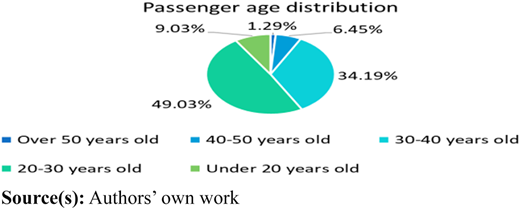
The age distribution of passengers is specifically shown in Figure 1. Passengers taking the Pearl River Delta intercity rail transit are mainly under 40, accounting for 92.25%, the leading passenger group. Among them, passengers aged 20–30 account for as much as 49.03%.
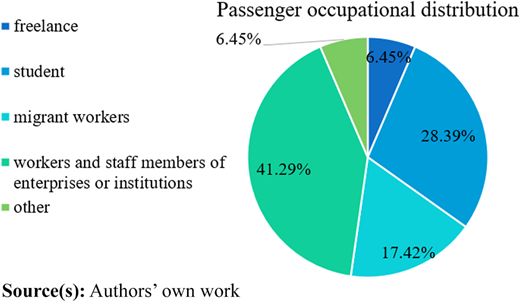
The occupational distribution of passengers on the Pearl River Delta intercity rail transit shown in Figure 2, with employees and students from enterprises and institutions.
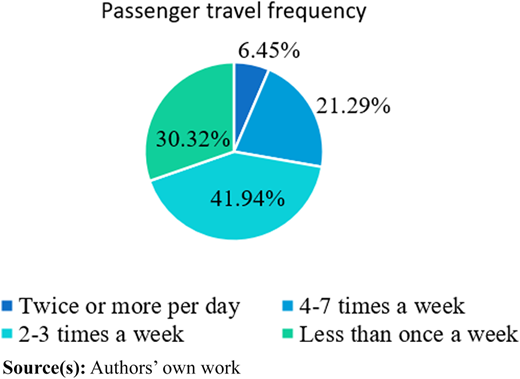
The frequency distribution of passengers travels shown in Figure 3. The proportion of taking intercity rail transit 2–3 times a week is up to 41.94%. The proportion of more than 2 times a day is the lowest, accounting for only 6.45%.
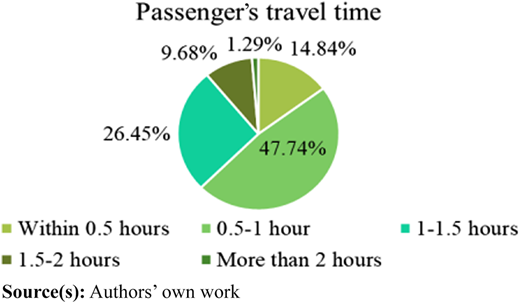
Distribution of travel time for passengers shown in Figure 4. For passengers taking the Pearl River Delta intercity rail transit, nearly half of them travel for half an hour and an hour, while only 1.29% of passengers travel for more than 2 hours.
5.2 Weight of evaluation index system for intercity rail transit services in the Pearl River Delta based on AHP
The intercity rail transit service quality in the Pearl River Delta consists of 6 categories and 17 main influencing factors, which will be evaluated for the AHP-fuzzy comprehensive analysis method. Divide the target indicators into two levels, namely the first level indicator, the evaluation criteria layer B, and the impact factor layer C, to establish a three-level evaluation index system for the service quality of the Pearl River Delta intercity rail transit. Based on this evaluation system, architecture, sociology, and urban planning experts are invited to assign weights and scores to each indicator. The corresponding weight values for each indicator are calculated and shown in Table 2.
Evaluation index system for intercity rail transit services in the Pearl River Delta based on AHP
| Target layer | First level indicator | Weight | Sort | Second level indicators | Weight | Comprehensive weight | Sort |
|---|---|---|---|---|---|---|---|
| A1 | Facility B1 | 0.326 | 1 | The safety protection and rescue facilities and equipment are reliable C1 | 0.231 | 0.075 | 4 |
| The ticketing system is comprehensive C2 | 0.131 | 0.043 | 11 | ||||
| The station ventilation system is reliable C3 | 0.046 | 0.015 | 17 | ||||
| The station escalator is safe C4 | 0.083 | 0.027 | 14 | ||||
| The waiting information system is reliable C5 | 0.15 | 0.049 | 7 | ||||
| The station broadcasting system is complete C6 | 0.15 | 0.049 | 7 | ||||
| Platform screen doors are safe C7 | 0.096 | 0.031 | 13 | ||||
| The guidance signs inside the station are clear and distinct C8 | 0.114 | 0.037 | 12 | ||||
| Service B2 | 0.086 | 6 | The service personnel can answer my inquiries in a time C9 | 0.250 | 0.022 | 15 | |
| The station attendant maintains order at the station very wellC10 | 0.500 | 0.043 | 10 | ||||
| Strict security check C11 | 0.250 | 0.022 | 15 | ||||
| Comfort B3 | 0.133 | 3 | The carriage is comfortable and not crowded C12 | 0.667 | 0.089 | 3 | |
| The carriage is clean and tidy C13 | 0.333 | 0.044 | 9 | ||||
| Convenience B4 | 0.111 | 5 | Convenient travel C14 | 0.5 | 0.056 | 5 | |
| Convenient transfer C15 | 0.5 | 0.056 | 5 | ||||
| Efficiency B5 | 0.118 | 4 | High punctuality rate C16 | 1 | 0.118 | 2 | |
| Charge B6 | 0.226 | 2 | Reasonable pricing C17 | 1 | 0.226 | 1 |
Source(s): Authors’ own work
As shown in Table 2, the weights of evaluation indicators at each criterion level reflect their importance in the service quality evaluation system for intercity rail transit in the Pearl River Delta. According to the ranking in the evaluation criteria layer: facilities > reasonable fees > comfort > efficiency > convenience > service management. The completeness of facilities and equipment and the rationality of charges are important in evaluating service quality for intercity rail transit in the Pearl River Delta.
5.3 Quality of intercity rail transit services in the Pearl River Delta based on AHP-fuzzy comprehensive evaluation
Based on the analysis of the questionnaire survey results, the four valuation of the service quality of intercity rail transit in the Pearl River Delta is divided into four levels, with a comment set of
According to the AHP-fuzzy comprehensive evaluation method, the frequency distribution of each influencing factor is obtained by statistically analyzing the primary data obtained from expert and passenger evaluations as Table 3.
Evaluation intervals for service quality of intercity rail transit in the Pearl River Delta
| Comment category | Score range | Code |
|---|---|---|
| [90,100) | S | |
| [80,90) | Q | |
| [60,80) | G | |
| [40,60) | D | |
| [0,40) | V |
Source(s): Authors’ own work
The frequency distribution of each indicator is calculated based on the results of the questionnaire survey as Table 4.
Evaluation intervals for service quality of intercity rail transit in the Pearl River Delta
| Target layer | Evaluation standard B | Influencing factors C | S | Q | G | D | V |
|---|---|---|---|---|---|---|---|
| A1 | Facility B1 | The safety protection and rescue facilities and equipment are reliable C1 | 0.272 | 0.426 | 0.252 | 0.045 | 0.000 |
| The ticketing system is comprehensive C2 | 0.329 | 0.432 | 0.194 | 0.045 | 0.000 | ||
| The station ventilation system is reliable C3 | 0.258 | 0.471 | 0.226 | 0.045 | 0.000 | ||
| The station escalator is safe C4 | 0.277 | 0.503 | 0.168 | 0.052 | 0.000 | ||
| The waiting information system is reliable C5 | 0.252 | 0.503 | 0.219 | 0.026 | 0.000 | ||
| The station broadcasting system is complete C6 | 0.219 | 0.497 | 0.232 | 0.052 | 0.000 | ||
| Platform screen doors are safe C7 | 0.258 | 0.471 | 0.219 | 0.052 | 0.000 | ||
| The guidance signs inside the station are clear and distinct C8 | 0.252 | 0.484 | 0.194 | 0.065 | 0.007 | ||
| Service B2 | The service personnel can answer my inquiries in a time C9 | 0.226 | 0.490 | 0.226 | 0.058 | 0.000 | |
| The station attendant maintains order at the station very wellC10 | 0.316 | 0.490 | 0.168 | 0.026 | 0.000 | ||
| Strict security check C11 | 0.271 | 0.490 | 0.174 | 0.065 | 0.000 | ||
| Comfort B3 | The carriage is comfortable and not crowded C12 | 0.207 | 0.387 | 0.368 | 0.039 | 0.000 | |
| The carriage is clean and tidy C13 | 0.271 | 0.471 | 0.219 | 0.039 | 0.000 | ||
| Convenience B4 | Convenient travel C14 | 0.297 | 0.432 | 0.194 | 0.077 | 0.000 | |
| Convenient transfer C15 | 0.265 | 0.458 | 0.226 | 0.052 | 0.000 | ||
| Efficiency B5 | High punctuality rate C16 | 0.323 | 0.465 | 0.187 | 0.026 | 0.000 | |
| Charge B6 | Reasonable pricing C17 | 0.207 | 0.536 | 0.200 | 0.058 | 0.000 |
Source(s): Authors’ own work
According to the evaluation model mentioned earlier, the weight set of sub-factor evaluation indicators is obtained as follows.
The evaluation vector of the main factors can be obtained,
The evaluation vector is obtained as = , Therefore, the satisfaction distribution of intercity rail facilities in the Pearl River Delta can be obtained, with a very satisfied proportion of 26.5%, a satisfied proportion of 46.9%, a relatively satisfied proportion of 21.9%, a relatively dissatisfied proportion of 4.7%, and a very dissatisfied proportion of 0.1%.
Similarly, the evaluation vector of is =
The evaluation vector of is =
The evaluation vector of is =
The evaluation vector of is =
The evaluation vector of is =
The evaluation set of primary indicators can be obtained, as shown in Table 5.
First level indicator weights and evaluation sets of the Pearl River Delta urban rail service quality evaluation index system
| Target layer A | Evaluation standard B | Weight | S | Q | G | D | V |
|---|---|---|---|---|---|---|---|
| Evaluation and analysis of service quality of intercity rail transit in the pearl river delta | Facility B1 | 0.326 | 0.265 | 0.469 | 0.219 | 0.047 | 0.001 |
| Service B2 | 0.086 | 0.282 | 0.490 | 0.184 | 0.044 | 0.000 | |
| Comfort B3 | 0.133 | 0.228 | 0.415 | 0.318 | 0.039 | 0.000 | |
| Convenience B4 | 0.111 | 0.281 | 0.445 | 0.210 | 0.065 | 0.000 | |
| Efficiency B5 | 0.118 | 0.323 | 0.465 | 0.187 | 0.026 | 0.000 | |
| Charge B6 | 0.226 | 0.207 | 0.536 | 0.200 | 0.058 | 0.000 |
Source(s): Authors’ own work
Weight set of evaluation indicators for the main factor layer as A,
The evaluation vector of ,
By summing up the values of the columns, the evaluation level of service quality for intercity rail transit in the Pearl River Delta can be calculated as follows,
The calculation results show that the quality level of intercity rail transit services in the Pearl River Delta is satisfied, , generally satisfied, dissatisfied, and very dissatisfied are 25.69, 47.54, 22.00, 4.74, and 0.02%.
The satisfaction rate of intercity rail transit service quality in the Pearl River Delta is 73.23%, while the general dissatisfaction rate is 22%, with a specific rate of 4.76%. Based on the passenger evaluation of six quality indicators—facility B1, service management B2, comfort B3, convenience B4, efficiency B5, and reasonable charge B6—the dissatisfaction rates are 4.8, 4.4, 3.9, 6.5, 2.6, and 5.8%, respectively, averaging at 4.67%. The indicators with dissatisfaction rates exceeding the average are facilities, reasonable charges, and convenience. Conversely, the satisfaction rates for these indicators are 73.4, 77.2, 64.3, 72.6, 78.8, and 74.3%, respectively, with an average satisfaction rate of 73.4%. Facilities, comfort, and convenience fall below this average satisfaction rate, indicating that both facilities and convenience significantly impact overall satisfaction, with both satisfaction rates lower than average and dissatisfaction rates higher than average. Therefore, improving the Pearl River Delta's intercity rail services should focus primarily on enhancing the comprehensiveness of facilities and travel convenience. Additionally, efforts should be made to improve service efficiency, reduce fare levels, and lower passenger dissatisfaction rates. Finally, to meet the rising quality expectations of passengers, it is essential to enhance the comfort of intercity rail services in the Pearl River Delta and elevate passenger satisfaction levels.
6. Conclusion and suggestions
6.1 Research conclusion
The service quality of Intercity rail transit refers to the degree to which the inherent service capability and level of Intercity rail transit enterprises meet the requirements formed by the interaction and contact process between passengers and facilities, equipment, environment, and personnel, and the overall perception feedback of passengers towards this process; it is the combination of service process quality and service result quality. Based on the connotation and characteristics of service quality, the process of passengers traveling by rail transit, and their basic requirements for rail transit passenger services, combined with the attributes of intercity rail transit in the Pearl River Delta and relevant service specification requirements, a service quality evaluation index system has been established. Adopting the AHP-fuzzy comprehensive analysis method, the two analysis methods complement each other to ensure that the evaluation results are as accurate, objective, and scientific as possible. The overall service quality of the intercity rail transit in the Pearl River Delta is at a “satisfactory” level, and the areas that need to be prioritized for improvement include charging issues and overcrowding in train carriages.
6.2 Suggestions
The service quality of Intercity rail transit staff directly affects passengers' impression and choice of Intercity rail transit services. Therefore, it is necessary to strengthen software construction, improve the quality of Intercity rail transit services, enhance the service level of staff, provide regular training for station staff, continuously enhance their professional abilities, and improve service quality. Relevant departments should regularly conduct investigations and analyses on service quality, continuously improve their services, enhance work efficiency, and promote high-quality work.
The completeness of Intercity rail transit facilities and equipment is an essential factor affecting service quality evaluation. Therefore, in the development process of Intercity rail transit, it is necessary to pay attention to facility and equipment issues fully, ensure the completeness and safety of facilities and equipment, attach importance to safety issues, and regularly inspect and repair relevant facilities.
Many external factors influence the quality of Intercity rail transit, so it is necessary to strengthen external cooperation, enhance publicity efforts, encourage passengers to ride in a civilized manner, continuously strengthen communication with government departments around the station, and improve passengers' awareness of safe and civilized riding.
6.3 Practical and theoretical contributions
This paper studies the service quality of intercity rail transit in the Pearl River Delta Based on the AHP-fuzzy comprehensive evaluation method and provides scientific evaluation and improvement suggestions for improving the service quality of rail transit in this region. At the practical level, the research results of this paper will help the rail transit operation departments in the Pearl River Delta region to clarify the current situation of service quality and the main problems, such as convenience, economy and comfort, and the improvement of facilities, to take targeted measures to improve, improve the travel experience of passengers, and promote the sustainable development of intercity rail transit. In addition, the research methods and conclusions of this paper can also provide a reference for the evaluation of Intercity rail transit service quality in other regions, and promote the overall development of the rail transit industry.
At the theoretical level, this paper constructs a multi-dimensional intercity rail transit service quality evaluation index system and uses the AHP-fuzzy comprehensive evaluation method to quantitatively evaluate the service quality. The application of this research method enriches the theory and method system of rail transit service quality evaluation and provides a reference example for subsequent related research. At the same time, the research of this paper also expands the application of service quality theory in the field of transportation, especially in the specific scenario of intercity rail transit, which helps to deeply understand the multi-dimensional characteristics of service quality and the influencing factors of passenger experience, and provides theoretical support for the improvement of rail transit service quality.
Funding: This research was funded by Guangzhou Huashang College (Nos. 910108005, HS2024SFZY10 and HS2024ZLGC16); Guangdong Philosophy and Social Sciences Planning Project (No. GD24XGL030) and Guangzhou Philosophy and Social Sciences Development “14th Five Year Plan” 2024 Regular Project (No. 2024GZGJ211).
Data availability: The data to support the finding of the Research on the Service Quality of Intercity rail transit in the Pearl River Delta Based on AHP Fuzzy Comprehensive Evaluation are available from all the authors upon request.
Conflicts of interest: The authors declare there are no conflicts of interest regarding the publication of this paper.

