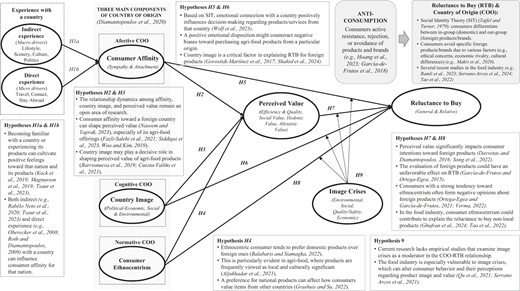
Globalization has increased the importance of understanding consumer behavior, including anti-consumption tendencies, toward agri-food products, particularly in contexts where a sector or country faces an image crisis. This study aims to identify the key factors influencing consumer reluctance to buy (RTB) foreign agri-food products – a form of anti-consumption – with a specific focus on the role of country of origin in decision-making. By analyzing these variables, the research seeks to provide insights that can help businesses and policymakers develop more effective strategies to address consumer concerns and improve market positioning.
A conceptual model is proposed suggesting that RTB foreign agri-food products can be mitigated by consumer affinity toward a foreign country and other key variables such as country image and perceived value, counteracting consumer ethnocentrism, notably when image crises affect a country-product. The empirical study focuses on the Spanish agri-food sector, using data from 335 German consumers. Partial least squares structural equation modeling (PLS-SEM) was employed to analyze the relationships within the model.
Results indicate that affinity toward a foreign country and perceived value significantly reduce RTB of foreign agri-food products, whereas consumer ethnocentrism increases RTB. Moreover, the study reveals that image crises moderate these relationships.
This study provides original insights by investigating the agri-food sector and the nuanced impact of country image and consumer affinity in mitigating RTB, a manifestation of potential anti-consumption, within this context. Notably, it offers novel empirical evidence on how image crises concerning a country-product dynamically moderate the influence of these key variables.
1. Introduction
Organizations are increasingly exposed to criticism, negative campaigns, and crises that can significantly harm their reputation, brand, and relationships with stakeholders (Dönmez and Blanco-González, 2025). Protecting an organization’s image and repairing reputational damage are essential goals, making effective communication strategies and consumer forgiveness critical (Feng et al., 2022). This is especially relevant in the agri-food sector, where image crises can spread rapidly through both mass media channels and social media platforms, leading to widespread reputational damage (Sonntag et al., 2021).
In recent years, anti-consumption has emerged as a significant research area, particularly in the context of image crises (Hoang et al., 2023). Anti-consumption is not merely the opposite of consumption but involves active resistance, rejection, or avoidance of certain products or brands (Zavestoski, 2002). One form of anti-consumption is the reluctance to buy (RTB), where consumers passively avoid specific products or categories due to various factors, including ethical concerns, economic rivalry, and cultural differences (Makri et al., 2020). RTB can manifest in boycotts (Arslan et al., 2018) or in the avoidance of foreign products, such as Chinese apparel or Spanish agri-food products, due to negative perceptions or even image crises (Pérez-Mesa et al., 2019). Identifying the drivers of RTB is crucial for businesses and policymakers, as early intervention can prevent escalations into full-blown crises (Pecot et al., 2021).
Research on RTB related to foreign products has primarily examined the impact of COO-related mechanisms on consumer decisions, including country image (Ortega-Egea and García-de-Frutos, 2021), country animosity (Antonetti et al., 2019), and consumer ethnocentrism (Verma, 2022). While previous studies have explored negative affective mechanisms that increase RTB, such as animosity and anticipated regret (Khan et al., 2019), a notable gap exists in the literature regarding the role of positive emotional drivers in mitigating RTB. Specifically, little attention has been given to how positive emotions—like consumer affinity—could potentially counteract RTB and improve perceptions of foreign products. A promising factor is consumer affinity, defined as a consumer’s positive emotional connection to a foreign country (Oberecker and Diamantopoulos, 2011). This emotional connection could lead to favorable perceptions of a country and its products (Kock et al., 2019). Prior studies suggest that affinity, characterized by feelings of sympathy, attachment, or admiration, fosters positive evaluations of a country and its goods (Fazli-Salehi et al., 2021). However, limited research has examined the role of affinity in RTB, and no prior studies have specifically analyzed its potential to mitigate the rejection of foreign products. Therefore, this study aims to fill this gap by investigating how consumer affinity, understood as a positive emotional bond with a foreign country, can mitigate RTB agri-food products from this country, offering novel insights into the emotional dynamics influencing consumer RTB products. Understanding this relationship will provide valuable insights for international marketing strategies and crisis management in the agricultural sector, offering a more nuanced perspective on consumer behavior in the face of negative country-of-origin effects.
Several arguments support our proposal. RTB is not necessarily permanent; Souiden et al. (2018) argue that it can be temporary and reversible. This suggests that fostering affinity for foreign countries could help international organizations mitigate RTB through emotional marketing and branding strategies (Avraham, 2021). Such efforts can enhance perceived product value and counteract negative feelings toward a country (Papadopoulos et al., 2017). Additionally, managing consumer affinity may help overcome ethnocentric biases, which are among the primary barriers to purchasing foreign products (Gineikiene et al., 2017). Thus, addressing consumer affinity not only helps mitigate RTB but also offers a potential strategy for overcoming ethnocentrism, a central challenge in the acceptance of foreign products (Balabanis and Siamagka, 2022). This is particularly important in the agri-food sector, where reputation and consumer trust are crucial for market success (Apostolopoulos et al., 2024).
Given this context, the present study investigates the key variables influencing RTB toward foreign agri-food products, emphasizing the role of consumer affinity as a mitigating factor of this phenomenon. This research proposes that RTB can be reduced by fostering affinity toward a country, improving country image, and enhancing perceived value, thereby counteracting the influence of ethnocentrism in the potential consumers (Kock et al., 2019; Zeithaml et al., 2020). Furthermore, the study examines direct and indirect experiences with foreign countries as potential drivers of affinity, an area that remains underexplored in the literature (Asseraf and Shoham, 2017; Oberecker et al., 2008). The research model also considers the moderating effect of image crises on the relationship between consumer affinity, country image, ethnocentrism, and RTB. To address the gaps identified in the literature and to further investigate the role of consumer affinity in reducing RTB foreign agri-food products in a context of image crises, this study focuses on the following research questions (RQ):
How does consumer affinity toward a foreign country influence reluctance to buy (RTB) agri-food products from that country in an image crisis context?
What roles do consumer affinity, country image and perceived value play in mitigating RTB of foreign agri-food products?
How do direct and indirect experiences with foreign countries influence consumer affinity toward foreign agri-food products?
To what extent do image crises moderate the relationship between consumer affinity, country image, ethnocentrism and RTB of foreign agri-food products?
To address these research gaps, this study focuses on the Spanish agri-food sector, a major European supplier of fruits and vegetables (ICEX, 2024). In 2024, Spain exported €9.19 billion worth of vegetables to the European Union (ICEX, 2024), with 40% of Europeans consuming Spanish produce (Andalusian Ministry of Agriculture, 2024). Despite this market presence, Spanish agri-food products have been subject to criticism and controversies in key markets like Germany, France, and the United Kingdom due to concerns over food safety, environmental sustainability, and labor practices. These issues have triggered various image crises and negatively impacted exports (Pérez-Mesa et al., 2019, 2023). This study examines the German market, Spain’s largest agri-food export destination, analyzing how German consumers’ affinity toward Spain, along with country image, perceived value, and ethnocentrism, influence RTB toward Spanish agri-food products.
The paper is structured as follows: First, it introduces the conceptual framework and literature review. Second, it outlines the research hypotheses and model. Third, it details data collection methods and research context. Next, it presents the model’s operationalization and analysis. Finally, it discusses findings, theoretical and managerial implications, limitations, and future research directions.
2. Theoretical background and literature review
Research on anti-consumption explores why consumers actively avoid certain products or brands, emphasizing that consumption and anti-consumption are not opposites (García-de-Frutos et al., 2018). One key focus in anti-consumption studies is the “COO effect,” which describes how country-of-origin (COO) influences consumer attitudes and evaluations of products. This effect includes cognitive (beliefs about a country), affective (emotional associations like affinity or animosity), and normative (social norms like ethnocentrism) components (Diamantopoulos et al., 2020). These mechanisms help explain consumer behavior like RTB, where consumers reject foreign products due to these influences (Makri et al., 2020).
The study applies Social Identity Theory (SIT) (Tajfel and Turner, 1979) to explain how consumers differentiate between in-group (domestic) and out-group (foreign) products, and how emotional attachment or affinity toward a foreign country can impact RTB (Verma, 2022). The research model proposed here examines three key antecedents of RTB: cognitive (country image), affective (consumer affinity), and normative (consumer ethnocentrism) mechanisms. The study extends the COO literature by focusing on consumer affinity (see Figure 1), which represents a positive emotional connection to a foreign country and its products, contrasting with ethnocentrism, which favors domestic goods. The model also looks at how these factors, moderated by image crises (e.g. social, environmental, food safety, and economic crises), influence consumer RTB decisions.
2.1 Potential sources of affinity
Familiarity with a country or experience with its products can foster positive feelings toward that nation and associate it with a specific product category (Magnusson et al., 2019; Tsaur et al., 2023). These positive feelings have been examined through the concept of consumer affinity (Kock et al., 2019), which can be analyzed on two levels: macro and micro. The macro level encompasses indirect experience with a foreign country, influenced by various factors such as lifestyle and the mentality of its citizens (Qing et al., 2012; Tsaur et al., 2023); landscape, climate, and environment (Asseraf and Shoham, 2017; Tsaur et al., 2023); traditions, history, and associated values (Bernard and Zarrouki-Karoui, 2014); cultural similarities, shared values, and religion (Rabêlo Neto et al., 2020); as well as the country’s economic and political situation. Conversely, the micro level involves direct experience with the country, derived from personal interactions with its citizens, institutions, and customs (Roth and Diamantopoulos, 2009), as well as experiences gained through living abroad or traveling (Oberecker et al., 2008). In this regard, direct contact with individuals from a foreign country tends to foster more favorable perceptions. Although significant insights have emerged in the study of direct and indirect experiences with foreign countries, most research has been theoretical (e.g. Papadopoulos et al., 2017), lacking empirical validation of the key factors driving consumer affinity. Thus, this study proposes a specific set of macro (indirect) and micro (direct) drivers that influence consumers’ emotional attachment to a foreign country. Based on this framework, we posit the following hypothesis:
(a) Indirect and (b) direct experience with a specific foreign country positively affects consumer affinity toward that country.
2.2 COO mechanisms that affect perceived value
Perceived value is a key variable in consumer behavior research (Blut et al., 2023; Zeithaml et al., 2020). From a consumption experience perspective (Holbrook and Hirschman, 1982), value extends beyond a mere cost-benefit trade-off (Zeithaml, 1988), incorporating emotional and experiential dimensions. Holbrook (1999) defines value as an “interactive relativistic preference experience” (p. 5), which influences satisfaction, repurchase intentions, and word-of-mouth (Gallarza et al., 2021). Despite its significance, the link between affinity and perceived value remains underexplored. Naseem and Yaprak (2023) suggest that consumer affinity can shape perceived value, even though affinity products. Studies indicate that strong affinity reduces risk perception (Halim and Zulkarnain, 2017) and enhances brand and company value, facilitating foreign market entry (Oberecker et al., 2008). Cakici and Shukla (2017) stress the need to integrate perceived value into COO research.
This relationship becomes particularly relevant in the context of agri-food products, which often carry symbolic, cultural, and emotional meanings for consumers, beyond their functional utility (e.g. Siddiqui et al., 2023). Food is not only consumed but also experienced, shared, and valued for its origin, tradition, and authenticity (Woo and Kim, 2019). These attributes are especially salient in cross-border consumption, where perceived value may depend not only on price and quality, but also on the consumer’s affinity toward the product’s country of origin (Fazli-Salehi et al., 2021). Addressing this gap, this study examines how consumer affinity influences perceived value in an international context. We propose:
Consumer affinity is positively related to the perceived value of agri-food products from a specific foreign country.
In the context of international consumption, perceived value is influenced by variables such as perceived image and ethnocentrism. However, the distinction between image and value has often been blurred, particularly in the international domain. Traditional value components like quality, price, and value-for-money (Zeithaml, 1988) have sometimes been classified as dimensions of country image (Diamantopoulos et al., 2011). Similarly, the concept of “country brand equity” has been used to describe the perceived value of products from a given country (Zeugner-Roth et al., 2008), while “country equity” has been defined as the value a country bestows on its products (Pappu and Quester, 2010). Despite this conceptual overlap, some studies have empirically differentiated the two constructs and examined their relationship (e.g. Graciola et al., 2020). However, research explicitly linking country image to perceived value remains limited (Vijaranakorn and Shannon, 2017). In the case of agri-food products, where origin is not only a signal of quality but also evokes emotional and symbolic associations for consumers, country image may play a decisive role in shaping perceived value (Barrionuevo et al., 2019). Cuesta-Valiño et al. (2021) demonstrated the relevance of brand image as a key antecedent of brand value in the agri-food sector. Given that country image shapes consumer judgments and behaviors (Zhang et al., 2018), we propose the following hypothesis:
Country image positively affects the perceived value of agri-food products from a specific foreign country.
Finally, one of the crucial variables that has arisen in the international marketing literature is the concept of ethnocentrism (Mishra et al., 2023). Consumer ethnocentrism significantly influences consumers’ perceived value and willingness to buy (Chaturvedi et al., 2024; Pestar Bizjak et al., 2018). This type of ethnocentric consumer tends to prefer domestic products over foreign ones (Balabaris and Siamagka, 2022), showing prejudice against certain foreign countries and underestimating their products and services (Wang et al., 2013). Kaynak and Kara (2002) demonstrated that ethnocentrism influences perceptions of foreign products, while Le et al. (2013) found that ethnocentrism affects perceived value, favoring local consumer preferences. Laksamana (2016) proposed a negative link between ethnocentrism and perceived value, though no empirical support was found for this relationship. Recently, Lee (2024) discovered that ethnocentrism uses brand names as reliable signals of perceived value. In the agri-food sector, these dynamics may be particularly salient, as such products are often perceived as inherently local and deeply connected to cultural identity (Aljukhadar et al., 2021). Purchasing agri-food products can thus satisfy ethnocentric motivations, fostering greater trust in local sellers—and in some cases, even in foreign producers when they are perceived as culturally proximate (Grashuis and Su, 2022). Based on this, consumer ethnocentrism may influence the perceived value of foreign products. Thus, we propose:
Consumer ethnocentrism negatively affects the perceived value of agri-food products from a specific foreign country.
2.3 Variables that affect reluctance to buy
First, the potential mitigating effect of affinity toward a foreign country on RTB products from that country remains underexplored in scientific literature. According to Oberecker et al. (2008), based on SIT, consumer affinity is linked to emotional feelings of sympathy and attachment toward an outgroup, i.e. a foreign country that becomes an in-group due to direct personal experience or normative exposure. This affinity positively influences decision-making regarding products and services from that country. More recently, Wolf et al. (2023) defined affinity as a positive emotional state that becomes part of an individual’s identity, thus influencing consumer intentions to consume products from that country. Affinity also results in lower perceived risk and greater trust in products from the affinity country (Papadopoulos et al., 2017). In particular, emotions, identity, and perceived quality are deeply linked to the origin in the case of agri-food products. Consumers often associate locally grown food with superior quality and better taste, which in turn strengthens their connection to local food networks and influences their purchasing intentions (Lykins et al., 2025). Consumer affinity toward a specific foreign country can produce analogous effects. This emotional connection can positively shape consumer behavior, increasing their willingness to purchase agri-food products from a particular country. Despite the well-established divergence in the behavioral patterns of purchase intention and RTB (e.g. García-de-Frutos et al., 2018), it is plausible that a positive emotional disposition may potentially counteract negative biases toward purchasing agri-food products from a particular origin.
Therefore, it can be hypothesized that consumer affinity reduces RTB toward products from a specific foreign country:
Consumer affinity negatively affects reluctance to buy agri-food products from a specific foreign country.
Second, the role of country image in mitigating RTB requires deeper examination. Gorostidi-Martínez et al. (2017) argued that perceived country image is a critical factor in explaining RTB for foreign products. Country image can have a direct and negative impact on RTB, as García-de-Frutos and Ortega-Egea (2015) showed through their analysis of political-economic, social, and environmental country-image factors. These factors influence RTB indirectly, and the authors emphasized their importance in studies focused on country-based anti-consumption. Recently, Shahid et al. (2024) argued that a strong corporate image reduces informational uncertainties and customer reluctance to purchase. Hence, focusing on the agri-food sector, the following hypothesis is proposed:
Country image negatively affects reluctance to buy agri-food products from a specific foreign country.
Third, international marketing research and studies on Country-of-Origin (COO) have established that perceived value significantly impacts consumer intentions toward foreign products (Davvetas and Diamantopoulos, 2016; Song et al., 2022). However, no definitive relationship between perceived value and RTB has been explored in the existing literature. Nijssen and Douglas (2004) noted that the evaluation of foreign products has an unfavorable effect on RTB, while Rose et al. (2009) partially supported the link between positive product judgments and a decreased unwillingness to buy foreign products. García-de-Frutos and Ortega-Egea (2015) demonstrated that judgments of foreign products negatively affect RTB. Given the established influence of perceived value on general intentions toward foreign products, and the indications of its potential link to reluctance to buy, it is reasonable to expect that this potential mitigating effect of perceived value on RTB would be evident in the context of agri-food products, where quality and origin are frequently key considerations. Consequently, the following hypothesis is proposed:
Perceived value negatively affects reluctance to buy agri-food products from a specific foreign country.
Finally, prior research has highlighted that consumers with a strong tendency toward ethnocentrism often form negative opinions about foreign products (Ortega-Egea and García-de-Frutos, 2021; Verma, 2022). Such consumers prefer domestic goods, overestimating their attributes (Wang and Chen, 2004). Ethnocentric consumers tend to express RTB toward foreign products (García-de-Frutos and Ortega-Egea, 2015). Nijssen and Douglas (2004) found empirical evidence supporting the positive association between ethnocentrism and RTB. In the food domain, ethnocentric attitudes have been shown to correlate positively with the consumption of traditional local products, particularly domestically produced ready-to-eat items (Ghufran et al., 2022), suggesting a broader preference for culturally familiar goods while avoiding imports to assist the local farmers and the economy (Ramli et al., 2023). Moreover, recent studies have shown that consumer ethnocentrism contributes to explain the reluctance to buy food products from a particular origin (Tao et al., 2022). Based on this reasoning, we hypothesize:
Consumer ethnocentrism positively affects reluctance to buy agri-food products from a specific foreign country.
2.4 Image crises as a moderator
This study examines the role of image crises as a moderator in the relationship between COO mechanisms (normative, cognitive, and affective) and the RTB foreign products. While previous research has explored negative events affecting brand image (e.g. Armstrong Soule and Sekhon, 2022), there are no empirical studies addressing image crises as a moderator in the COO-RTB relationship. An image crisis is defined as a sudden and impactful event that affects a country’s reputation (Tworzydło and Gawroński, 2022). These crises, particularly in the food industry, can influence consumer behavior and perceptions of product quality or value (Qu et al., 2021). For example, crises related to food safety, environmental concerns, or economic problems can negatively impact consumers’ trust in products from a country (Serrano-Arcos et al., 2021; Matthews et al., 2021). This study focuses on how image crises may moderate the relationship between consumer affinity, country image, perceived value, and RTB foreign products. It also explores how ethnocentrism may influence consumer behavior in these situations, as image crises could enhance local preferences.
Image crises moderate the relationship between consumer affinity and reluctance to buy.
Image crises moderate the relationship between country image and reluctance to buy.
Image crises moderate the relationship between perceived value and reluctance to buy.
Image crises moderate the relationship between ethnocentrism and reluctance to buy.
3. Methods
3.1 Constructs measurement
The questionnaire was developed based on a review of relevant literature and included six measures: experience with a country, consumer affinity, consumer ethnocentrism, country image, perceived value, and RTB. Experience with a country was assessed through both macro (culture, scenery, politics/economics, and lifestyle) and micro (contact, living abroad, and travel) drivers, using scales adapted from Bernard and Zarrouk-Karoui (2014) and Oberecker et al. (2008). Consumer affinity was measured with two dimensions (sympathy and attachment) using a scale from Oberecker and Diamantopoulos (2011). Ethnocentrism was evaluated using an abbreviated CETSCALE (Shimp and Sharma, 1987). Country image was assessed through political-economic, social, and environmental dimensions with fifteen items adapted from previous studies (García-de-Frutos and Ortega-Egea, 2015; Heslop et al., 2010; Pappu et al., 2007). Perceived value was measured with twenty-one items based on Holbrook (1999) and Sánchez-Fernández et al. (2009). Consumer RTB was evaluated using six items, divided into general and relative components, based on scales by Darling and Wood (1990) and Klein et al. (1998). Answers were rated on a seven-point Likert scale, from (1) “strongly disagree” to (7) “strongly agree”. The content was translated into German utilizing the back-translation method to ensure cross-language equivalence between English and German. The multi-item scales involved in the study are shown in Table 2. The questionnaire included respondents’ demographic information, such as gender, age and region.
3.2 Research context and data collection
This study focuses on the Spanish agri-food sector, the leading European exporter of fruits and vegetables (ICEX, 2024). This sector has faced repeated image crises in key markets such as Germany, France, and the United Kingdom (Pérez-Mesa et al., 2019, 2023), linked to social issues (immigrant workers), environmental concerns (unsustainable horticultural practices), and food safety risks (use of unauthorized pesticides). These crises have affected its perceived value and exports, making it a clear example of RTB in foreign markets. Additionally, Spain is considered an affinity country for agri-food products (Oberecker et al., 2008). Germany was chosen as the study’s target market as it is the main destination for Spanish agri-food exports, accounting for 40% of total exports in 2023 (Andalusian Ministry of Agriculture, 2024).
A causal research design was employed. Data were collected through an online survey conducted by a market research firm in January–February 2020. The early 2020 data collection strategically captured the impact of significant 2017–2019 media-driven image crises concerning Spanish greenhouse practices, crucial for analyzing RTB. This specific timeframe provides a valuable baseline to understand how these crises, and subsequent efforts to address them, influenced consumer behavior and the key role of consumer affinity. Pretests were conducted with students (7) and consumers (50) to refine measurement items. A stratified random sampling method was applied to ensure geographic representativeness. Then, we selected individuals who consume fruits and vegetables from Spain to guarantee the “relevance and representativeness of measurement items” (Netemeyer et al., 2003, p. 75). The sample was selected in terms of geographic and demographic representativeness of the German territory following the German Federal Statistical Office (see Table 1). Thus, the sample procedure was stratified random sampling. Participants obtained points in a loyalty program for taking the survey, which is a common survey resource (Oberecker and Diamantopoulos, 2011). Of the original 450 consumers invited, 335 answered the questionnaire during a three-week survey period, which was considered an adequate sample size yielding a highly satisfactory response rate of 74.4% (e.g. Memon et al., 2020).
3.3 Data analysis
First, common method bias was scrutinized employing Harman’s one-factor test (Hair et al., 2019; Sarstedt et al., 2021). Results demonstrated that the common factor explains less than 50% of the exploratory factor analysis. These findings suggest that the study is not affected by common method bias (χ2 = 1026.811; df = 62; p = 0.000; CFI = 0.96; RMSEA = 0.148; SRMR = 0.151). Second, data analysis was analyzed by Partial Least Squares Structural Equation Modeling (PLS-SEM) with SmartPLS 3.0 (Shmueli et al., 2019). The reliability and validity of the measurement model was measured. Next, the structural model was analyzed to assess the hypothesized relationships in the conceptual model. To evaluate the model, we employed a two-stage approach to PLS-SEM, combining the repeated indicator method and latent variable scores (Ping, 2004).
4. Results
4.1 Measurement model assessment
The measurement model was evaluated using confirmatory factor analysis (CFA) following guidelines by Hair et al. (2019) and Sarstedt et al. (2021). CFA was used to analyze psychometric properties and purify the scales, removing items with insufficient loadings. Specifically, a subcategory of macro drivers (political and economic situation), an ethnocentrism indicator, and an item from the efficiency and quality value dimension were dropped due to low loadings.
CFA supported the multi-dimensional (second-order) structure of five variables in the research model: experience with a country, consumer affinity, country image, perceived value, and RTB. Experience with a country was split into two subscales: indirect experience (macro drivers) and direct experience (micro drivers), with macro drivers showing the strongest effect (βs > 0.70; ps < 0.01). Consumer affinity consisted of two subscales: soft emotions (sympathy) and strong emotions (attachment), with attachment being more representative (βs > 0.70; ps < 0.01), as suggested by Oberecker and Diamantopoulos (2011). Country image included three dimensions: political-economic, social, and environmental, with environmental image having the strongest influence (βs > 0.70; ps < 0.01), following García-de-Frutos and Ortega-Egea (2015). Perceived value had four components: efficiency and quality, social, hedonic, and altruistic value, with hedonic value being the most representative (βs > 0.70; ps < 0.01), in line with Holbrook’s (1999) original proposal. RTB for foreign products was also multidimensional, with general and relative RTB showing similar effect sizes (βs > 0.70; ps < 0.01). Once CFA had been carried out, all factor loadings were significant (p < 0.01), for first and second-order constructs and standardized loadings presented indicators loading higher than 0.70 (see Tables 2 and 3, respectively). The internal consistency reliability, convergent validity, and discriminant validity of the constructs were assessed according to Hair et al. (2019) and Fornell and Larcker (1981). Internal consistency was measured using Rayko’s rho and Cronbach’s alpha, with satisfactory results (0.74–0.97). Additionally, average variance extracted (AVE) and composite reliability (CR) were calculated, with CR values exceeding the 0.70 threshold. All AVE values were above 0.50, confirming discriminant validity. The results from the statistical tables support the validity and reliability of the constructs.
Discriminant validity was further assessed by ensuring that the AVE of each latent variable exceeded its shared variance with other constructs, as per Fornell and Larcker (1981), and this criterion was met for all first- and second-order variables. Additionally, the Heterotrait-Monotrait Ratio (HTMT) of correlations was used to evaluate discriminant validity, with a threshold of 0.90. None of the HTMT values exceeded this threshold, and the confidence intervals did not include 1, confirming discriminant validity for the proposed model constructs (see Tables 4 and 5).
4.2 Structural model assessment
An assessment of multicollinearity in the structural model was performed using the variance inflation factor (VIF), with all values below the recommended threshold (3.3), indicating no significant collinearity or common method bias. The structural model explained 67.5, 50.4, and 34.6% of the variance in consumer affinity, perceived value, and RTB, respectively, with all R-squared values being significant and above 0.10. The path coefficients were statistically significant and supported the proposed model, confirming its validity.
Our results show that experience with a country positively affects consumer affinity (γ = 0.83, ρ < 0.01). The disaggregation of experience into macro (lifestyle, scenery, culture) and micro drivers (travel, living abroad, contact) did not alter the relationships. Both macro drivers (γ = 0.62, ρ < 0.01) and micro drivers (γ = 0.30, ρ < 0.01) positively influence affinity, with macro drivers having a stronger effect. Consumer affinity also positively affects perceived value (γ = 0.56, ρ < 0.01), supporting Hypothesis H2. Country image also positively affects perceived value (γ = 0.31, ρ < 0.01), confirming H3. In contrast, ethnocentrism had no significant effect on perceived value (γ = −0.02, n.s.), failing to support H4. These findings suggest affinity is a stronger driver of perceived value than ethnocentrism.
Regarding RTB, consumer affinity significantly reduces RTB for foreign products (γ = −0.48, ρ < 0.01), supporting H5. Country image also negatively affects RTB (γ = −0.31, ρ < 0.01), supporting H6, and positive perceived value reduces RTB (γ = −0.42, ρ < 0.01), confirming H7. Ethnocentrism, on the other hand, positively affects RTB (γ = 0.20, ρ < 0.05), supporting H8. These results highlight the differential effects of affective (affinity) and normative (ethnocentrism) COO mechanisms on consumer RTB.
4.3 Moderating effect of image crises
To examine the moderating impact of consumer affinity within the research model, the methodology employed utilized the product indicator approach. This involved the multiplication of the predictor and moderator to generate interaction constructs (Ramayah et al., 2018). Accordingly, four interaction constructs (consumer affinity x Image crises, consumer ethnocentrism x Image crises, consumer ethnocentrism x image crises and perceived value x image crises) were employed to analyze the effects of consumer affinity, country image, consumer ethnocentrism and RTB. The estimated path coefficient for the moderating effect of image crises was found on the relationship between consumer affinity and RTB (β = −0.131, t = 2.40, p < 0.05), country image and RTB (β = −0.181, t = 3.75, p < 0.01); and consumer ethnocentrism and RTB (β = −0.103, t = 5.96, p < 0.01) therefore H9a, H9b and H9d were supported (Table 6).
5. Discussion and implications
This study examines the influence of country image, consumer affinity, and consumer ethnocentrism on RTB behavior, considering cognitive, affective, and normative mechanisms. It expands the existing literature by exploring consumer affinity as an affective mechanism in the context of the COO effect, traditionally attributed to country image. The research also looks at consumer ethnocentrism, representing a “pro-ingroup” mentality, to understand home country bias. Using SIT, the study proposes that consumer affinity can positively influence value perceptions and reduce rejection of foreign products. Additionally, it evaluates how product-country-related factors and crises (social, environmental, food safety, economic) affect RTB behavior.
5.1 Theoretical implications
This study examines various mechanisms of the COO effect, with a focus on previously unexplored affective aspects, aiming to analyze how to mitigate RTB foreign products, particularly during an image crisis. In fact, our research goes beyond merely mitigating RTB, proactively seeking to prevent it through the development of consumer affinity toward a foreign country, thereby benefiting consumption of products from that origin. Following Social Identity Theory (SIT), this research shows that people who feel an affinity for a foreign country may consider it part of their “in-group” (i.e. a group they identify with), reducing RTB products from that country. To the best of our knowledge, this is the first study to empirically demonstrate the importance of affinity in decreasing consumer RTB for non-local products. Results show that consumer affinity (an affective COO mechanism) is a key factor in explaining perceived value and RTB, with a stronger influence than country image or ethnocentrism (cognitive and normative COO mechanisms). In other words, consumers with strong positive emotions, such as sympathy and attachment to a foreign country (i.e. the two components of consumer affinity as an affective COO mechanism), reduce RTB for products from that country, counteracting the negative effect of considering local products superior.
Based on our current understanding, this research demonstrates that affinity is significant in forming perceived value. Therefore, our results confirm previous theoretical proposals (e.g. Naseem and Yaprak, 2023) that assert that strong feelings of affinity increase perceived value of foreign products. Moreover, this study reveals that the influence of consumer affinity is even greater than that exerted by country image in the formation of the perceived value of foreign products, which underscores the importance of affinity in the context of international product consumption (Fazli-Salehi et al., 2021; Terasaki et al., 2022) and, specifically, in the food industry (Dang and Doan, 2024). Consistent with Nijssen and Douglas (2004), García-de-Frutos and Ortega-Egea (2015) and, more recently, Nguyen and Van Nguyen (2022) and Serrano-Arcos et al. (2024), this research also confirms that higher perceived value of foreign products negatively impacts RTB those products, reversing anti-consumption tendencies. Furthermore, in line with previous research (e.g. Güngördü Belbağ, 2023; Fazli-Salehi et al., 2021; Nguyen and Van Nguyen, 2022), our study reveals that high ethnocentric tendencies positively influence RTB for foreign products. Nevertheless, our findings respond to recent studies that suggest the need to highlight the role of country affinity in shaping consumer ethnocentrism (Kinawy, 2025), empirically demonstrating that consumer affinity exerts a stronger effect on RTB (Moraes and Strehlau, 2020). This finding is consistent with Oberecker and Diamantopoulos (2011), who suggest that ethnocentric tendencies do not play a major role in consumers’ perceptions when they have affinity for a country and its products.
Another contribution of this research is that affective COO mechanisms (affinity) and cognitive COO mechanisms (country image) complement each other in shaping consumer perception and RTB behavior. Recent studies (e.g. Samiee et al., 2024) mainly focused on cognitive COO evaluation as a predictor of behavioral outcomes, but it is important to incorporate both affective and cognitive mechanisms due to the relevance of affective influences (Moraes and Strehlau, 2020). Aligned with Oberecker and Diamantopoulos (2011), our research shows that the affective COO mechanism (affinity) is more influential than cognitive assessment in consumer perception (perceived value) and anti-consumption behavior (RTB).
This study also explores the antecedents of affinity through consumers’ direct and indirect experiences with a country, empirically demonstrating the drivers proposed by Oberecker et al. (2008). Macro drivers, related to lifestyle, culture, and politics, are more significant than micro drivers like personal contact or living abroad. In contrast to other studies (e.g. Tsaur et al., 2023), macro drivers like political and economic situations were found to be less relevant. In light of recent geopolitical instability (e.g. the Ukrainian–Russian conflict), the impact on sectors such as tourism highlights the importance of understanding the emotional motivations behind travel decisions. In line with recent research, such as the studies by Farmaki et al. (2024) and Josiassen et al. (2023), it is emphasized that factors like animosity and affinity play a crucial role in consumer decisions, suggesting the need for more complex approaches that go beyond traditional linear analyses. This perspective is especially relevant when considering agri-food products, where perceptions of affinity and cultural identity can reduce reluctance toward foreign products during times of crisis. Moreover, affinity can enhance the positive experiences associated with actively participating in the creation of products. The experience of prosumption —i.e. a phenomenon in which consumers not only consume products or services but also actively participate in their creation or production— has also been shown to be a driving factor of affinity (Wolf et al., 2023). Therefore, affinity can enhance the positive experiences associated with actively participating in the creation of products.
5.2 Practical implications
Given that image crisis can have a severe impact on the demand and perception of a sector associated with a country’s product, organizations and institutions must take into account mechanisms that accentuate RTB and those that can serve as allies in mitigating it within this context (Pascual-Fraile et al., 2024; Zhao et al., 2024), as highlighted in recent contributions that emphasize the role of national image and sector-specific challenges in consumer perception.
This paper demonstrated the mitigating power that consumer affinity has on consumer RTB products from foreign countries. Accordingly, institutions and organizations should design and implement marketing strategies that generate and/or enhance feelings of affinity for the COO of their products to improve country image and consumer value perception. These emotional bonds toward the COO will ultimately reduce consumer RTB products of specific foreign origins. Moreover, this knowledge could help institutions and companies to successfully support their products, brands, and/or services, since the findings show that they should concentrate on promoting consumer affinity to improve both country image and perceived value while reducing the effect that ethnocentrism seems to have on RTB. In this sense, organizations should get involved, together with institutions, in communication campaigns that emphasize positive aspects of the COO related, for example, to lifestyle, scenery, culture, politics and economics dimensions that have recently been identified as key drivers of consumer affinity (i.e. macro drivers of affinity; e.g. Tsaur et al., 2023). Therefore, generating consumer affinity to the COO of their products, will mitigate image crises and, consequently, RTB products from that origin.
Regarding the specific sector of fruits and vegetables, this research can help professionals in this field to understand the emotions, attitudes, and behaviors of consumers toward a specific product category. We demonstrated that the Spanish agri-food sector might benefit from inducing positive feelings of affinity toward Spain through emotion-based advertisements (due to the positive link between affinity and willingness to buy products from a specific country; e.g. Terasaki et al., 2022; or brands; e.g. Shi et al., 2021). Such efforts might include attracting foreign people and generating an emotional feeling about a specific country (induced by personal experience) and attracting people to visit that country and consume their products/services/brands.
In addition, consumer ethnocentrism has constantly been found to be a barrier to foreign organizations in terms of offering their products in the global marketplace (e.g. Chaturvedi et al., 2024; Miguel et al., 2022). Therefore, affinity toward a particular country and its products/services (in this case, Spain) may show promise in countering ethnocentric barriers, which remain a major obstacle to purchasing non-local products (Kinawy, 2025; Shin et al., 2025). The companies in this sector could benefit from strategies that promote a positive image of Spain and affinity toward a country, without going into emphasizing the qualities of their fruits and vegetables or other types of products (or do it in parallel). This strategy could help to consider the Spanish product as “local” in the sense of a greater feeling of “emotional closeness” (not “physical closeness”) and, therefore, it would help the sector to integrate into the new trends that promote the consumption of proximity.
6. Limitations and future research
This study has several limitations, highlighting the need for further research. Firstly, it focused on German consumers, the primary destination market for Spanish agri-food products and a significant source of negative and fake news and, therefore, image crises. To improve the generalizability of the findings, replication in other destination markets, such as the United Kingdom and France, is recommended. While this context is relevant due to the specific challenges faced by Spanish agri-food products within the European market, future research should broaden the geographical scope to improve the generalizability of the findings. Replication in diverse destination markets, not only within Europe (such as the United Kingdom and France), but also in regions like Asia, Africa, and South America, is strongly recommended. Investigating different markets with varying cultural and economic landscapes will provide a more comprehensive understanding of the factors influencing reluctance to buy foreign agri-food products. This aligns with prior research emphasizing cross-country comparisons (e.g. Cakici and Shukla, 2017; Zhao et al., 2024). Additionally, future studies should explore variations in general product-country affinity across different product categories (e.g. Kock et al., 2019).
Secondly, this study focused on a single product category—Spanish fruits and vegetables—providing only a partial view. Broader research should include a range of categories (e.g. natural-based, hedonic, utilitarian products) for a more comprehensive understanding. Furthermore, future research should assess the impact of various media platforms (e.g. social media, mass media, radio) on fostering affinity, as this would provide valuable insights for organizations (Godey et al., 2016). Additionally, consumer affinity and its antecedents remain underexplored (e.g. Wolf et al., 2023). Future studies should investigate how affinity is formed and its effects on consumer purchase decisions, exploring its perceptual and behavioral consequences.
While this study considered variables like affinity, perceived value, and ethnocentrism concerning RTB, further analysis of the anti-consumption phenomenon is needed. Research should explore how variables such as competence, warmth (Kervyn et al., 2022), and place attachment—commonly studied in the context of tourism—affect anti-consumption behaviors, such as boycotting (Lasarov et al., 2023). Moreover, future research should not only explore these dynamics in the context of image crises, which was a key driver for this study, but also in situations where the exporting country already enjoys a positive image in the importing market (e.g. Australian food in parts of Asia or Italian products in the US or Canada). Comparing these different scenarios could reveal nuanced insights into the factors influencing consumer RTB and, broadly, anti-consumption.