Organizations rely on their business processes to achieve their business objectives and ensure compliance with relevant laws and regulations. Hence, conformance to process specifications is essential to remain compliant. Various factors influence an organization’s ability to operate in conformance to its process specifications. This study investigates the influence of business process management (BPM)-supportive culture and individual process orientation on process conformance.
A construct was created for perceived process conformance and two constructs were selected from literature to represent BPM-supportive culture and individual process orientation. A survey was conducted with 178 employees of a global enterprise, hypotheses were formulated, and a statistical model was constructed and validated.
Results pinpoint the key role of the BPM-supportive culture in influencing both individual process orientation and conformance. Individual process orientation is also found to have a significant influence on process conformance. The findings provide additional evidence for the significance of human-related aspects of BPM in achieving BPM success.
The contributions of this paper help better understand how soft factors of BPM contribute to employees’ process conformance drawing on and relating concepts of BPM and organizational routines.
1. Introduction
Organizations establish processes to ensure that their business objectives can be met while operating in compliance with relevant laws and regulations (Dumas et al., 2018; Turetken et al., 2011). In highly regulated environments, process specifications serve as an important management control tool, and conformance to the specifications is a necessity to ensure compliance with relevant laws and regulations (Gong and Janssen, 2012). Consequently, process conformance has received significant attention in the research and practice (van der Aalst and Dustdar, 2012; Elgammal et al., 2016). Process conformance – the extent of the discrepancies between the performance of a process and its specifications – involves multiple dimensions, including control flow as well as the rules, dependencies and constraints that apply to the process (van der Aalst and De Medeiros, 2005; Mannhardt et al., 2016). Using diverse techniques, organizations perform (internal) audits to control the adherence of their process enactments to process specifications, standard procedures, regulations or other relevant directives (Lenz and Hahn, 2015; Turetken et al., 2019).
Several factors influence an organization’s ability to execute its processes in conformance with its process specifications (Gong and Janssen, 2012). Organizational process orientation represents a number of such potential factors. Process-oriented organizations outperform competitors in terms of financial and non-financial performance (Kohlbacher, 2010; Skrinjar et al., 2008; Tarhan et al., 2015). This competitive advantage leads to an increase in motivation in becoming process-oriented (Kohlbacher, 2010). To increase their level of process orientation, many organizations have started business process management (BPM) initiatives and emphasized a change in the organizational and information technology (IT) structure (vom Brocke and Mendling, 2018; Dumas et al., 2018). However, research toward BPM success factors observes a need for a more holistic framework, including soft factors, such as culture and people (Rosemann and vom Brocke, 2014; Trkman, 2010).
Organizational culture, referring to the shared basic assumptions, values or beliefs (Schein, 2004), is often considered as one of the strong determinants of the BPM success (de Bruin, 2009) and process performance (Schmiedel et al., 2020). In particular, the organizational values of customer orientation, excellence, responsibility and teamwork have been related to the success of a BPM initiative. They are collectively referred to as BPM-supportive culture (Schmiedel et al., 2013). From a holistic BPM capability perspective, the construction of a BPM-supportive culture in an organization is considered a key capability that guides the attitude and behavior of individuals that constitute the organization (de Bruin, 2009). Hence, individuals’ attitude and beliefs toward business processes is another factor for BPM success (vom Brocke et al., 2021; Rosemann and vom Brocke, 2014), which is reflected as the individual process orientation (Leyer et al., 2015).
Existing BPM research has acknowledged the relationships between the soft factors of BPM and process conformance (vom Brocke and Sinnl, 2011; Schmiedel et al., 2015) and empirically investigated its influence on several aspects, such as process performance (Schmiedel et al., 2020). Literature has also investigated the direct and indirect influence of employee training (Krebs, 2002; Leyer et al., 2015), process automation (Kettenbohrer et al., 2016) and process model representation (Dikici et al., 2017) on the employees’ level of process conformance. However, the influence of the BPM soft factors on the process conformance that organizations achieve has not been theoretically modeled and empirically investigated in the academic literature.
Therefore, our research objective in this study is to investigate the influence of BPM-supportive culture and individual process orientation on process conformance as perceived by the individuals, i.e. the employees of organizations who participate in the execution of organizational processes. To this end, first, drawing on the literature on BPM and organization routines and we have developed our research model which involves three constructs: BPM-supportive culture, individual process orientation and perceived process conformance. Second, we have developed a multi-item scale to measure perceived process conformance. Finally, we have tested the model empirically with data from a survey performed with a sample of 178 employees of a global enterprise located in several countries and operating in the domain of healthcare systems and technologies.
The remainder of the paper is organized as follows. Section 2 discusses the theoretical background of the key concepts of BPM culture, individual process orientation and process conformance. Sections 3 and 4 outline our research design, followed by our research model. In Section 5, we present the questionnaire that we developed as well as those that we adopted from existing research. Section 6 presents the results of our statistical analyses based on the data gathered through the survey. Finally, in Section 7, we conclude with discussions on the results, limitations and outlook for future research.
2. Theoretical background
2.1 Culture and organizational routines
In our investigation of the relationship between BPM-supportive culture and process conformance in the BPM context, we draw on the framework of organizational routines as generative systems (Feldman and Pentland, 2003; Pentland and Feldman, 2005; Rerup and Feldman, 2011). Organizational routines are “repetitive, recognizable patterns of interdependent actions, carried out by multiple actors” that consist of abstract regularities and expectations that enable participants to guide, account for, and refer to specific performances of a routine (Feldman and Pentland, 2003; Pentland and Feldman, 2005). Hence, business processes are viewed as specializations of organizational routines (Becker, 2004; Beverungen, 2014).
Organizational routines can be conceptualized into two constitutive and related aspects. The ostensive aspect relates to “the ideal or schematic form of the routines”. It is the abstract, generalized idea of the routine or the routine in principle. The performative aspect of the routine relates to “the specific actions, by specific people, in specific places and times; it is the routine in practice” (Feldman and Pentland, 2003). The ostensive aspect constraints or enables the performative aspect through guiding the behaviors of participants and accounting for and referring to the activities they perform. The performative aspect (i.e. routine performances) serves as a primary source of creation, modification and maintenance of the ostensive aspect (Feldman and Pentland, 2003). The interaction between the ostensive and performative aspects of routines informs the understanding of change and collective outcomes (Feldman and Pentland, 2003). As such, ostensive aspects of routines provide managers with opportunities to interfere in this interaction and shape those understandings through interferences. These interferences enable routine participants to reflect on their actions and decide how to alter the performative aspects (Feldman and Pentland, 2003; Pentland and Feldman, 2005). Typical interferences are through the use of BPM artifacts, such as prescriptive process models, operating procedures, templates or IT systems, which codify the ostensive aspect (Beverungen, 2014; Pentland and Feldman, 2005, 2008). In this context, the discrepancies between ostensive and performative aspects such as contradictions and inconsistencies can be considered as process conformance issues. In BPM, process mining techniques can be used for conformance checking and discovering such conformance issues (Beverungen, 2014; Breuker and Matzner, 2014).
While ostensive patterns constitute the abstract and reference understandings, they are constructed for a specific routine at the routine level. An organizational level concept that is similar and related to the ostensive aspect of routines is the organizational interpretive schemas, which can be defined as a set of shared assumptions, values and frames of reference that give meaning to everyday activities and guide how organization members think and act (Balogun and Johnson, 2004; Rerup and Feldman, 2011). While enacted schemes are constituted for observable actions that relate to all organizational routines, managers can enable a change of observable behavior by espousing new or different organizational interpretive schemes (Rerup and Feldman, 2011). As such, organizational level BPM values, which are also deemed as cultural values, such as customer orientation or continuous improvement, can be related to these schemata as their parts.
2.2 BPM-supportive culture and individual process orientation
Rosemann and vom Brocke (2014) identify people and culture as two of the six core elements that shape the holistic discipline of BPM. These core elements represent a critical success factor for BPM, which sooner or later, need to be considered by organizations striving for success with BPM.
Culture manifests itself on an invisible layer in the form of values and beliefs, which is a determinant of the visible behavior (Schein, 2004). Aspects of culture can hinder or support BPM initiatives and are recognized as a key driver in BPM (vom Brocke et al., 2016; vom Brocke and Sinnl, 2011; de Bruin, 2009). Early work observes facets as readiness to change, formalism in processes, abandoning authorities, teamwork and commitment as positively influencing BPM adoption (Hribar and Mendling, 2014). Subsequent work conceptualizes the notion of BPM culture and its corresponding values. BPM-supportive culture is defined as an organizational culture that supports BPM objectives and is shaped by the following four cultural values: customer orientation, excellence, responsibility and teamwork (abbreviated as CERT) (vom Brocke and Schmiedel, 2011; Schmiedel et al., 2013). Table 1 (left) provides definitions for these values.
In order to adopt a process-oriented culture company-wide, employees have to adopt its shared values and express them in their daily work activities (Chen et al., 2009). People core element of BPM relates to the BPM capabilities that are acquired by an organization’s human capital. Leyer et al. (2015) conceptualize the application of process skills and knowledge in the daily work routine through the construct of individual process orientation (IPO). IPO describes the attitude and behavior of employees toward working in a process-oriented way. This is a critical success factor for organizations to achieve a company-wide process orientation as it leads to an increase in productivity, flexibility and transparency. The aspects defining the IPO are depicted in Table 1 (right).
Business processes are established to reflect an organization’s strategy in achieving its business objectives, operating in accordance with the policies and rules and in compliance with laws, regulations and relevant standards (Elgammal et al., 2016). Therefore, conforming to the specified processes in execution is of utmost importance, particularly in highly regulated business environments, such as aerospace, banking, insurance, pharmaceuticals and healthcare. In such environments, conflicts between ostensive and performative aspects may have significant legal consequences. Hence, organizations strive to align them to ensure process conformance. Actual process conformance is influenced by diverse organizational and process technology-related factors, such as employee training and process automation, or those that relate to the approaches used to represent predefined process models (Dikici et al., 2017; Krebs, 2002; Turetken et al., 2020; Zazworka et al., 2010).
3. Research design
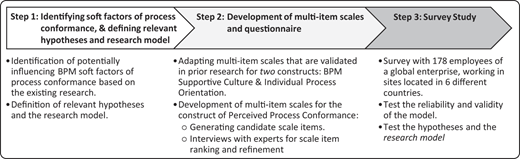
In this study, we investigate how the level of process conformance is influenced by the BPM-supportive culture and the level of IPO. Figure 1 summarizes the research steps that we followed to address this research objective. As a first step, based on the relevant theoretical background in the BPM and relevant fields, we identified two BPM soft factors that potentially influence process conformance. Next, we have proposed a model that hypothesizes these two factors as important antecedents of process conformance.
For the assessment of the proposed model, we have used the survey as our primary research method and developed a questionnaire (step 2 in Figure 1). For two constructs of the model (namely, BPM-supportive culture and IPO), the questionnaire items that are validated in prior research have been adopted. We have operationalized the process conformance construct as perceived process conformance (PPC) and developed new questionnaire items (i.e. multi-item scales) following the step-by-step process proposed by Stratman and Roth (2002).
Finally, to evaluate the proposed model using the finalized questionnaire items, we have conducted a survey with the participation of 178 employees of a global enterprise (step 3 in Figure 1). Employees were from six different sites that were located in different countries and continents. In the following sections, we elaborate on the steps that we followed in developing and validating our measurement instrument, and in testing its underlying theoretical model.
4. Hypotheses and research model
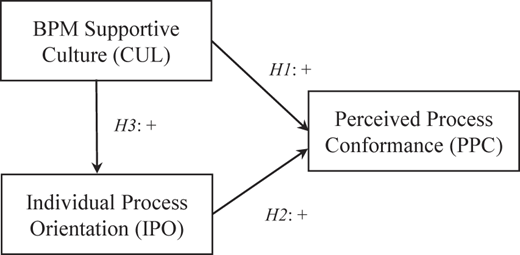
Aligned with our research objective, we propose the research model depicted in Figure 2. The model proposes that the process conformance as perceived by the individuals (PPC) is positively influenced by the BPM supportive culture (CUL) of an organization (H1) and the process orientation of individuals (H2). The model also suggests that the BPM supportive culture positively influences IPO (H3). In the paragraphs below, we discuss – based on the proposed research model – how we draw our hypotheses regarding the relationships between these constructs.
In Section 2, we introduce the organizational values that comprise a BPM-supportive culture: customer orientation, excellence, responsibility, and teamwork. From a cognitive perspective, these values are parts of the organizational interpretive schemata, which give meaning to everyday activities and provide organization members with a common base of thinking and action (Balogun and Johnson, 2004; Rerup and Feldman, 2011) and a shared understanding through the process of establishing processes and connections between the processes (Feldman and Rafaeli, 2002). Customer orientation involves sharing of customer requirements (Tumbas and Schmiedel, 2013), providing employees with an understanding of how their work affects the customer. Through excellence, an environment is created in which improvement of processes is encouraged and facilitated, which is considered to result in a tendency to act in conformance with the processes (Schmiedel et al., 2013). Part of the responsibility is commitment (Schmiedel et al., 2014). A committed employee can identify and align him/herself with the organizational goals, showing a willingness to conform to processes (Kettenbohrer, 2016). Facilitation of teamwork, for example, through fostering open communication, enables the employee to work cross-functionally (Tumbas and Schmiedel, 2013). This provides them with the ability to execute processes more effectively, as the processes typically require cross-functional coordination. Accordingly, we pose the following hypothesis:
BPM-supportive culture positively influences perceived process conformance.
Individuals’ level of understanding of the abstract, generalized idea of the routine (i.e. the ostensive aspect) can guide, account for and refer to the specific performances of a routine (i.e. the performative aspect) (Pentland and Feldman, 2005). The study by Krebs (2002) measures the process conformance subjectively and observes an increase in the level after employees undergo training and awareness creation sessions about processes. This provides evidence that obtaining process knowledge and understanding of process goals are indicators of the process orientation (Kohlbacher and Gruenwald, 2011; Leyer et al., 2015; Turetken and Demirors, 2008). Employees need explicit and tacit knowledge about the specific processes that they participate in to have the ability to contribute to the success of a BPM initiative (de Bruin and Rosemann, 2007). One of the foundations of process orientation is adding value to the customers, and process-oriented employees are aware of this reason and how this contributes to customers’ experiences (Willaert et al., 2007). Customer stories can stimulate employees’ motivation (Grant and Berry, 2011), influencing the commitment to the process (Kettenbohrer, 2016). Altogether, this indicates that the level of IPO has a positive influence on the attitude of employees toward processes, increasing PPC and leading to the following hypothesis:
Individual process orientation positively influences perceived process conformance.
An organization with a BPM-supportive culture creates an environment that complements the BPM initiatives (Schmiedel et al., 2013). Among the practices that stimulate such an environment are the motivation through good examples, monitoring process performance and having simple procedures for process innovation proposals (Tumbas and Schmiedel, 2013). Such activities enhance a cultural change, which can alter an individual’s attitude and behavior (de Bruin, 2009). Hence, the IPO depends on BPM-supportive culture. There is less incentive and more resistance for an employee to develop upon his level of process orientation if the organization does not emphasize its importance or even pose a cultural misfit with respect to BPM. For example, without process performance metrics, it can be difficult to spot areas of process improvement. A BPM-supportive culture should provide this complementing environment, where leaders emphasize investing in process-related training (de Bruin, 2009). The less tangible aspect of culture, reflecting values and beliefs, enables the growth of the more tangible aspect of IPO, reflecting individual attitude and behavior. Therefore, we pose the following hypothesis:
BPM supportive culture positively influences individual process orientation
In the next section, we present the design of the questionnaire and the measurement models for corresponding constructs of our research model.
5. Questionnaire and multi-item scales
We developed a questionnaire for assessing our research model depicted in Figure 2. Below, we present the questionnaire items that we have adopted from existing research. This is followed by the description of how we have developed new scales for the construct of “perceived process conformance” that lacked validated items in the existing literature.
5.1 Adopted scale items for CUL and IPO
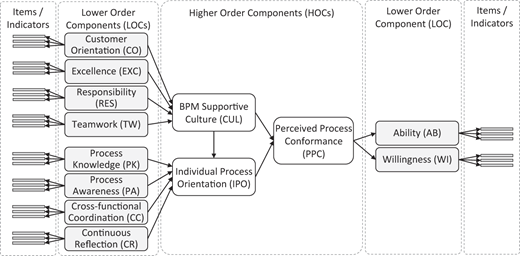
For the constructs of BPM-supportive culture and IPO, validated measurement models are available in the literature. To measure CUL, the scale developed by Schmiedel et al. (2013, 2014) was adopted. The IPO was measured using the construct proposed by Leyer et al. (2015). Both IPO and CUL are hierarchical constructs that have a formative-reflective type (Ringle et al., 2012). Accordingly, CUL and IPO are second-order formative latent variables, each consisting of four first-order variables measured reflectively (Table 1). The items that were used in the questionnaire for CUL and IPO are presented in Appendix 1 and 2, respectively.
5.2 Development of a multi-item scale for PPC
Unlike CUL and IPO, there is no validated scale or items in the existing research for PPC construct. Hence, we have developed and validated the questionnaire items for this construct following the process applied in (Churchill, 1979). The item pool was generated and refined based on the literature and expert views. The latter ensures the content validity of the measurement model.
Based on the existing literature (Bandura, 1993; Bowen, 1986; Hammer, 2007; McCormack and Johnson, 2001; Rosemann and vom Brocke, 2014; Young, 1984), we defined PCC as a higher-order construct (reflective-reflective) which is manifested by two lower-order constructs: Willingness to comply and Ability to comply.
Willingness: Rosemann and vom Brocke (2014) find process attitudes and behavior as one of the capability areas of the people factor of BPM. It captures process-related behavior, such as the willingness to comply with the process design. Willingness is key to the successful adaptation of systems in the area of information technology (Bowen, 1986; Young, 1984). It plays a key role also in other process maturity frameworks and is reflected as a behavioral attribute of the process performer pronounced as “trying for” or “striving for” consistent process execution (and even “proposing” relevant improvements) (Hammer, 2007). In the BPM Capability Framework (Rosemann and vom Brocke, 2014), willingness to conform to specified processes is partly reflected by the willingness to take accountability for business processes and relevant outcomes. Similarly, in the Process and Enterprise Maturity Model (Hammer, 2007), willingness is echoed by the process performer’s enthusiasm to follow the process.
Ability relates to the perceived self-efficacy, which refers to the level of one’s belief in his/her ability to complete tasks (Bandura, 1977). It is influenced by perceived controllability. This facet represents the constraints and opportunities in the environment (Bandura, 1993). Thus, a user needs sufficient skills, expertise, knowledge, resources and training to perceive an ability to execute the task correctly (Hammer, 2007; McCormack, 2001; Rosemann and vom Brocke, 2014). Availability of resources, such as skills, knowledge and training, determines the ability of an employee to execute processes correctly.
Both ability and willingness were modeled as reflective latent constructs following the reflective measurement theory (Jarvis et al., 2003). Accordingly, the reflective indicators for each construct can be seen as interchangeable items that simultaneously change when the evaluation of the latent construct changes. Thus, the reflective indicators of the construct can be understood as a function of the latent variable. Any single item can generally be left out without violating the meaning of the construct. Moreover, the reflective indicators are seen as a representative sample of all the possible items that stem from the conceptual domain of the construct, as we discuss above.
The next step in the multi-item scale development involved the definition of initial scale-items for the willingness and ability components. We defined 11 items (7 for willingness and 4 for ability). Table 2 presents these items. Next, we asked two experts in the BPM field (one academician and one practitioner), each with over 15 years of experience in the field to review these items for their appropriateness and level of representativeness with respect to the components they belong to. Considering these two properties, the experts separately ranked each item. Three items with the lowest scores were removed from the list, resulting in 8 items (4 for ability and 4 for willingness) as depicted in Table 2. As suggested in the literature, four-item scales for each lower-order component are considered sufficient and reliable (Yong and Pearce, 2013).
5.3 Questionnaire design and survey execution
Final instruments for the survey included 17 items for CUL, and 20 items for IPO that were adopted from literature, and 8 items for PPC that we have developed. Additional demographic questions regarding age, gender, level of education, site, work experience in current position, work experience in the current area of expertise and experience within the organization were also included in the questionnaire.
The survey was distributed to the employees of a global enterprise, which is headquartered in Europe. The company is operating in the healthcare systems and technologies industry, developing and producing medical systems. Employees from six different locations worldwide (in Europe, Asia and North America), to which we refer to as sites, participated in the survey. The invitations to the survey were sent by the directors of the quality department of these sites. For maintaining a level of consistency among survey participants, 357 employees who had participated in the execution of a particular set of processes were invited. Out of this number, 178 participated, which led to an overall response rate of 50%. The responses were kept anonymous.
6. Results
To estimate our research model, we performed a partial least square structural equation modeling (PLS-SEM) using SmartPLS (version 3.2.6) (Ringle et al., 2015). For the estimation of the second-order constructs, we used the two-stage approach, in which a new model was derived from the latent variable scores from a first-order model (Becker et al., 2012). Accordingly, Mode-B was set as the mode of measurement for the second-order reflective-formative constructs CUL and IPO. For the second-order construct PPC, Mode A was selected, which generally suits reflective–reflective type models best (Becker et al., 2012). The model was estimated by applying a path weighting scheme with 300 interactions. A bootstrap analysis with 5000 subsamples was carried out for testing the significance of the PLS-SEM results.
6.1 Measurement model
PLS-SEM sets requirements for the sample size and collinearity of variables (Hair et al., 2017). The G*Power tool suggests a sample size of 160 for medium effect size (0.15), an alpha probability of 0.05, a power of 0.95 and 8 predictor variables (Cohen, 1992). This condition is satisfied with the obtained sample size of 178.
Table 3 presents the breakdown of the means of the constructs. Means were calculated as composite scores, based on the list of items given in Section 5.
The respondents varied in educational levels. The majority had master’s (40%) or bachelor’s (40%) degrees. Half of the remaining respondents (10%) had a high-school degree, whereas others had a PhD degree. They were employed at different organizational units in the sites: about 42% were working in the R&D units, 31% in the quality assurance, 8% in the customer service, and the remaining in operations, marketing and supply chain management units.
Since all the data were collected through a single method, i.e., survey, common method bias (CMB) must be checked. To test for CMB, Harman’s single factor test and the full collinearity test were conducted. For Harman’s single-factor test, exploratory factor analysis (EFA) without rotation revealed 13 distinct factors with eigenvalues above 1, cumulatively explaining 59% of the variance. The results showed that no single component explained much of the overall variance (the largest component explained only up to 27.8%). To reconfirm the results, we employed the more conservative full collinearity approach for CMB assessment (Kock, 2015), which relies on model-wide collinearity assessment. WarpPLS software package (version 7.0) (Kock, 2020) was used to conduct the full collinearity analysis.
As recommended, the full variance inflation factors (VIFs) (Table 4) were lower than the acceptable threshold of 5 (Hair et al., 2017). Thus, CMB is unlikely to be a serious validity concern.
6.2 Measurement model assessment
The construct reliability and validity of the measurement model were assessed through internal consistency, discriminant validity and convergent validity (Tables 4-6). The convergent validity was assessed based on indicator reliability and average variance extracted (AVE). The indicator reliability analysis was performed by applying the outer loading relevance testing (Hair et al., 2017). As such, the indicators with loadings below 0.4 were removed, and the remaining indicators were deleted iteratively when their removal led to a significant increase in AVE. Additional indicators were removed during the discriminant validity assessment in accordance with guidelines by Henseler et al. (2015). However, the removal of these items had other implications. The relationships between LOCs and HOCs can be biased if the number of indicators is not similar across all LOCs (Becker et al., 2012). Therefore, several indicators had to be removed to have an equal number of indicators for each LOC per higher-order component. As such, the item refinement resulted in three indicators per LOC for PPC, IPO and CUL. Figure 3 depicts the resulting higher-order structural equation model and the number of indicators for LOCs after refinement.
The final set of all indicators for CUL, IPO and PPC, including their factor loadings before and after refinement, are given in Appendixes 1, 2 and 3, respectively. Accordingly, the outer loadings of the indicators were within the range of 0.681–0.913, which is acceptable (Hair et al., 2017). All outer loadings were significant (p < 0.001). Using the commonly applied minimum threshold of 0.5 (Fornell and Larcker, 1981), all AVE values being above 0.5 demonstrate that convergent validity was established for all constructs.
The internal consistency was assessed through Cronbach’s alpha and composite reliability (Table 4). The composite reliability scores of all constructs were within the range of satisfactory reliability (0.7) (Hair et al., 2019). The Cronbach’s alphas of the constructs were within an acceptable reliability range (Nunally and Bernstein, 1994). Discriminant validity was assessed using the Fornell–Larcker criterion (1981) and the heterotrait–monotrait (HTMT) ratio of correlations using the latest guidelines (Henseler et al., 2015). Fornell–Larcker criterion was met as the square roots of AVE values for the constructs are higher than the correlations between constructs (Table 4). Similarly, all HTMT correlations were below 0.9, supporting that discriminant validity was established (Henseler et al., 2015).
To create the second-order measurement model, the corresponding latent variable scores from the first-order model were added as indicators for the second-order constructs. Next, the formative CUL and IPO measurement models were assessed, which required the analysis of outer weights and the collinearity between indicators using and VIF (Table 7). The significance and relevance of the formative items were assessed according to their outer weights such that items were retained if their weights were significant; otherwise, their outer loadings were greater than 0.5 (Hair et al., 2017). As such, all the formative indicators of the second-order measurement model were retained as either their weights were significant or their loading was above 0.5. VIF values suggested no multicollinearity issues, as they were smaller than 5.0 (Hair et al., 2017).
The reflective measurement model of the second-order construct PCC was assessed through indicator reliability (loadings >0.7), composite reliability (>0.7) and average variance extracted (AVE > 0.5). Accordingly, the loadings for the indicators of PCC were above 0.7 and significant, the composite reliability (0.884) and the Cronbach’s alpha (0.736) were above 0.7, and the AVE (0.791) was above 0.5, which support that the measurement model of PPC is valid and reliable. Overall, our assessment of the measurement model showed no significant reason to consider the collected data as invalid, unreliable or unusable in terms of validity, reliability or multicollinearity.
6.3 Differences in sites
Although the survey was conducted in a single enterprise, we expected differences in sites, particularly with respect to the level of BPM-supportive culture. This was mainly due to the differences in countries and geographical locations where sites were located. Apart from different sample sizes, the variances in the responses for BPM-supportive culture differ (according to the Levene’s test [p < 0.05]). In such cases, using non-parametric tests is appropriate. We used the non-parametric Kruskal–Wallis test for multiple comparisons of the differences in values from different sites. The test shows a significant difference in BPM-supportive culture among sites [X2(5) = 19.457, p = 0.002]. A post-hoc pairwise analysis revealed that site A and C differ significantly from B (p = 0.033 and p = 0.002, respectively). This partially supports the assumption that although the sites stem from the same enterprise, some sites differ significantly in their organizational culture concerning the support for BPM.
6.4 Structural model
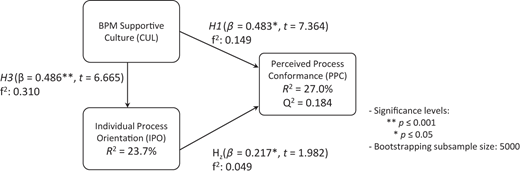
The assessment of the structural model was performed by using the coefficient of determination (R-square), the blindfolding-based predictive relevance measure (Q-square), and the statistical significance and relevance of the path coefficients (beta estimates, t-values, p-values and the effect size f-square) (Figure 4).
Accordingly, the BPM supportive culture was shown to have a positive significant influence on PPC (β = 0.483; p < 0.05; f2: 0.149) and IPO (β = 0.486; p < 0.001; f2: 0.310), thereby supporting H1 and H3. Moreover, IPO was seen to yield a significant positive influence on PPC (β = 0.217; p < 0.05; f2: 0.049) in support of H2. The f-squares indicate a moderate effect of CUL on IPO and small effects of IPO and CUL on PPC (Hair et al., 2017).
The R-squares indicate that the explained variances in IPO and PPC by the model were rather weak (Hair et al., 2017). Q-square was calculated (blindfolding omission distance = 7) only for PPC as it is suitable for a reflectively measured endogenous variable. The Q-square of PPC with a value greater than zero indicates that the model has predictive relevance (i.e. out-of-sample predictive power) for PPC.
In addition, the mediating effect of IPO in the relationship between CUL and PPC was assessed by finding the indirect effect. Accordingly, the indirect effect (β = 0.106; p = 0.17) was found to be insignificant, not supporting a mediation effect of IPO.
7. Discussion and conclusions
Table 8 summarizes our hypotheses and findings. The results of our analyses show that the relationship between CUL and PPC and between CUL and IPO are significantly positive, supporting our first and third hypotheses (H1 and H3). This aligns with the arguments that culture has a strong impact on shaping the attitude and behavior of individuals (de Bruin, 2009). Accordingly, establishing BPM-supportive culture influences individuals’ attitudes and behaviors leading to an increase in IPO. It also positively influences individuals’ standpoint in conforming to the specified process. Business practitioners should allude to culture as a key driver and primary concern for the successful implementation of BPM (de Bruin, 2009; Savvas, 2005). Institutionalization of BPM in an organization requires following a holistic approach and considering BPM-supportive culture, which can act as a management method for achieving company goals (Giacosa et al., 2018).
The nearly strong influence of CUL on IPO (f2: 0.310) illustrates the level of impact that culture can have on shaping individuals’ attitudes in terms of the level of process orientation. We can infer, for instance, that the support for teamwork as a cultural dimension increases employees’ likelihood to demonstrate high levels of cross-functional coordination. Yet, BPM-supportive culture only explains about 24% of the variance in the level of IPO. The stimulation of changes in these two aspects, CUL and IPO, does not happen in isolation or by accident. The organizational changes result from a strategic orientation, typically ignited through BP-orientation initiatives at the strategy level (McCormack, 2001). Such initiatives can lead to changes in the nature and goals of employees’ jobs, which, in turn, influence their attitudes toward processes (Tang et al., 2013). Similarly, additional constructs, such as process training, BPM system use and job construal, can be considered to contribute to the equation. Training is often observed to be effective for stimulating IPO, since it helps employees both in achieving a new way of thinking and acquiring the set of skills (Leyer et al., 2015; Tumbas and Schmiedel, 2013; Wollersheim et al., 2016). Using a BPM system is considered an effective way of “learning by doing”, which can influence IPO directly and indirectly through increased job construal (Kettenbohrer et al., 2016). Job construal refers to the perceived embeddedness of the task performed by the employee (Kettenbohrer et al., 2016).
Our analysis of the survey data shows a significant positive relationship between IPO and PPC, which supports the arguments that led to the formulation of our second hypothesis (H2). In brief, this aligns with the view that increasing people’s process orientation can significantly impact their intentions and attitude in following the process specifications. The results confirm that the increased process orientation is a factor that leads to specific attitudes and behaviors among process participants (Ahmad and Looy, 2019). This can also have important implications for the process standardization efforts, thereby on the overall process and product quality.
Our model results in an R2 value of 27% for the PPC, which indicates that, although IPO and CUL have strong influences, the PPC is influenced largely also by other substantial factors. Literature suggests strategic orientation, organizational structures and conditions, and general management and leadership styles have a significant influence on perceived process quality (Grau and Moormann, 2014; McCormack, 2001). In addition, other core BPM values, such as governance structures that relate to specification of decision-making and process-related roles, can also potentially play a key role (Rosemann and vom Brocke, 2014). Without such structures, employees can find it hard to recognize their part in the process and live up to the expectations. In short, the BPM soft factors of CUL and IPP play an important role in individuals’ attitudes in following standard processes. Still, organizations require a broader perspective to understand and establish process conformance.
7.1 Limitations, future work and implications
Our work suffers from a number of limitations, which can be addressed in future research. The survey data that we used in our research originates from a single enterprise. Although the sites are located in different countries and continents, and there exist statistically significant differences in the BPM-supportive culture in some sites, the fact that the participants work in a single global organization and sites operate in the same industry domain poses risks to the external validity of our findings. One can argue about enterprise-wide or national cultural elements that motivate the BPM-supportive culture at different sites and at different levels. The business domain of medical device production is a highly regulated one, which could influence the extent to which employees incorporate process definitions into their daily work practices. In other business domains, where process compliance is of less importance, the results may potentially differ. Therefore, future research can include surveys conducted in multiple organizations of different sizes and operating in different business domains to validate the results achieved in this study.
There are also other variables that we did not consider in our survey but can play a role in the interplay between the three core concepts that we investigated in this study. The size of the organization (large enterprise versus SME) and the organizational role of the individual employee (top or middle management versus operational staff members) are a few that could influence these relationships (Van Looy and Van den Bergh, 2018). Future research can also incorporate such variables to provide additional insight into the results of this research.
Another limitation relates to the method we used in measuring process conformance. We considered this construct as a latent variable in our research model and captured the PPC as a proxy for actual process conformance. Research shows that perceived and actual process conformance can differ in some circumstances (Zazworka et al., 2010). Therefore, further research is necessary to determine the actual conformance (e.g. by using process mining or other process conformance checking techniques (vom Brocke et al., 2021; Graafmans et al., 2021)) to discover the relation between PPC and incorporate it into the research model if necessary.
The relatively low R2 values signal the existence of other key factors that potentially influence IPO and PPC. We discussed a selection of such potential factors and the control variables in the above section. Future research should consider extending the research model with additional factors to better understand the key constructs under consideration.
Our work makes two main contributions to the research. The research model proposes BPM-supportive culture as a strong determinant of the level of conformance to standard processes. Although limited, it provides a statistically significant explanation of the variance for PPC. Accordingly, BPM-supportive culture has a positive influence not only on process performance (Schmiedel et al., 2020) but also on process conformance. Our research provides empirical evidence on the potential of BPM-supportive culture on changing observable behavior of individuals (process participants) as a type of organizational interpretive scheme (Rerup and Feldman, 2011). Second, our study contributes to the BPM literature with a set of validated scale items for PPC. Future studies in this research field can incorporate these items in their models.
Findings in this research lead to implications also for practice. The practitioners should recognize organizational culture as an important driver of BPM success. This study confirms this argument, with a specific focus on process conformance as a success indicator. Organizations should continually focus on actively managing a BPM culture, for example, by assessing their BPM-supportive culture (Kregel et al., 2021) and on developing weak areas (Tumbas and Schmiedel, 2013). A stronger organization-wide BPM-supportive culture allows for a better process performance in the end (Hammer, 2007; Schmiedel et al., 2020). This study provides significant evidence that such efforts contribute to an increase in individuals’ level of process orientation, and their willingness and ability to conform to standard processes.
References
Appendix 1 Items for BPM-Supportive Culture (CUL)
We have not changed the scale used in the original source and adopted the 1–7 Likert scale, from “strongly disagree” to “strongly agree”.
Appendix 2 Items for Individual Process Orientation (IPO)
We have not changed the scale used in the original source and adopted the 1–5 Likert scale, from “strongly disagree” to “strongly agree”.
Appendix 3 Items for Perceived Process Conformance (PPC)
Each statement is evaluated on a 1–5 Likert scale, from “strongly disagree” to “strongly agree”.