


The purpose of this paper is to investigate the role of an agentic disposition (proactive personality) and an agentic career orientation (protean career orientation) on the agentic career competencies of graduating students in four culturally diverse countries.
We surveyed 662 graduating business students from Belgium, India, Ireland and the USA using a cross-sectional, cross-cultural research design. Responses were analysed using structural equation modelling.
The results confirmed that country context matters when considering individuals’ career competencies and the antecedents explaining them. While proactive personality was associated with the development of career competencies in all countries, the mediating role of protean career orientation was more important in the non-Anglo countries of Belgium and India.
This study demonstrates the importance of incorporating country context when studying agentic career concepts.
Introduction
Career advisors in Western countries have long encouraged individuals to be active sculptors of their careers (Bell and Staw, 1989; Wang and Wanberg, 2017). The economic downturn in the late 1980s, with the resulting decrease in job security and upward mobility, led agency to take centre stage in the career literature. Career scholars advise and even expect individuals to use their agency to achieve career success, such as by being proactive (e.g., De Vos et al., 2009; Smale et al., 2019), harnessing a self-directed, protean career orientation (Hall et al., 2018) and developing important career competencies (Talluri et al., 2024). Given the current context of precarious, flexible and global careers, it is not surprising that scholarly focus on career agency has only intensified over time.
Career agency has been defined as a “person’s sense of mastery or control over the career” (Hall et al., 2018, p. 138) and has been conceptualised through a wide number of theoretical approaches representing almost one-third of all theories of career success since the year 2000 (Spurk et al., 2019). This study focuses on three agentic constructs in relation to graduating students who are transitioning to the labour market. Specifically, we investigate the role of an agentic disposition (proactive personality) and an agentic career orientation (protean career orientation) on the agentic career competencies relevant to graduating students. Agency is particularly important at the beginning of careers since a smooth education-to-work transition is crucial for subsequent career success (Lo Presti et al., 2022).
Although it is well-recognised that careers are influenced by the cultures in which they are embedded, research exploring similarities and differences in careers across national borders is still in its infancy (Mayrhofer et al., 2020). A central goal of comparative career research is to identify the extent to which various career constructs are “context-invariant and context-sensitive” (Lazarova et al., 2018, p. 260). This is particularly important in the area of career agency since the “agency agenda” was developed in the USA and most research has been conducted in single countries in the West (Smale et al., 2019). To the best of our knowledge, no empirical research on agentic career competencies and their antecedents has been conducted cross-culturally. We therefore study our model relationships in four culturally diverse countries – Belgium, India, Ireland and the USA – to better understand the universality of these agentic concepts and relationships.
Career competencies
Career competencies (CC) have played a prominent role in career research for the past three decades (Talluri et al., 2024). CCs are defined as “knowledge, skills, and abilities central to career development, which can be influenced and developed by the individual” (Akkermans et al., 2013, p. 246). They are distinct from personality traits in the sense that they can be learned and developed (Akkermans et al., 2013; Francis-Smythe et al., 2013), and are “described in behavioral terms, disregarding the underlying characteristics and predispositions of a person” (Francis-Smythe et al., 2013, p. 3). Graduating students with higher levels of CC have more success finding employment and gaining employment that fits their education level and subject area (Grosemans and De Cuyper, 2021). Graduates’ competencies in career planning and networking at the time of graduation, have been shown to affect both objective and subjective early career success (De Vos et al., 2009).
Researchers have identified several CCs thought to be necessary for effective career management (see Talluri et al., 2024, for a review of the various frameworks and measures). Francis-Smythe et al. (2013) identified seven CCs (goal setting and career planning, self-knowledge, job performance, career-related skills, knowledge of (office) politics, career guidance and networking, and feedback seeking and self-presentation) which predict both objective and subjective career success. Given that our focus is on students, three of the Francis-Smythe et al. (2013) CCs are most relevant: (1) self-knowledge which is an awareness of one’s personality, interests, and abilities and how they fit with career choices; (2) career guidance and networking which are proactive behaviours linked to building and utilising networks to seek career-related help and advice; and (3) goal setting and career planning which is the clarity one has about career goals and how to achieve them. These are very similar to the reflective, communicative and behavioural CCs identified by Akkermans et al. (2013) and have been applied to graduates transitioning to the labour market (Lo Presti et al., 2022).
Talluri et al. (2024) recently developed a nomological network of CCs and included proactive personality and protean career orientation as two key antecedents. Specifically, they identified proactive personality as a stable personal characteristic and protean career orientation as a motivational antecedent.
Proactive personality as a predictor of career competencies
Proactive personality (PP) is “the relatively stable tendency to effect environmental change” (Bateman and Crant, 1993, p. 103). Individuals with a strong PP are likely to actively seek future opportunities and take action to develop key resources – like CCs – that help future career development (Talluri et al., 2024). In their theoretical model of CCs, Talluri et al. (2024) identified PP as a key, stable personal characteristic predicting CCs. This is further supported by Social Cognitive Theory (Bandura, 1997), which has been influential in the scholarly work on career choice (e.g., Lent and Brown, 2019) and career success (e.g., Schoenfeld et al., 2017), and suggests that there are “… individual differences in perceived agency and capability to act in a purposeful and motivated manner” (Wang and Wanberg, 2017, p. 549).
In relation to our three CCs, there is empirical evidence to suggest that PP will influence each of them. Li et al. (2020) found that PP is positively associated with feedback-seeking, reflective learning from job experiences and self-assurance, all suggesting increased self-knowledge. Valls et al. (2020) found a significant positive relationship between PP and career planning among graduating students. Bendella and Wolff (2020) found that PP was the strongest predictor of networking in their meta-analysis.
PP might be particularly relevant to explain how graduates approach the process of transitioning to the labour market, given the strong emphasis on agency in today’s world of work (Valls et al., 2020). For graduating students, this includes envisioning their professional futures, thereby considering their strengths, interests and qualifications (self-knowledge), making plans to find a job that matches these (planning) and approaching relevant others who can support or help them in finding a job (networking). We therefore expect:
PP will be positively related to the CCs of self-knowledge, networking and planning.
Mediating role of protean career orientation
The Talluri et al. (2024) model treats both PP and protean career orientation (PCO) as independent antecedents of CCs. We, however, propose a more nuanced relationship. Specifically, we propose PCO as a key mediator in the relationship between PP and CCs. Protean career theory conceives agency as a central mechanism towards individuals developing their own definition of career success and taking action to achieve it (Hall et al., 2018).
Building on Social Cognitive Theory (Bandura, 1997), we suggest that PCO can be seen as a resource through which a PP is translated into career outcomes (Hirschi et al., 2013). A proactive disposition does not automatically lead to the manifestation of proactive behaviour (Valls et al., 2020), however, those with highly proactive personalities are more likely to develop an agentic orientation to their careers (Briscoe et al., 2006). In turn, having a PCO, whereby someone sees themselves as the primary driver of their career, will increase the likelihood that they will develop important CCs (Ayoobzadeh, 2022). This is supported by research evidence in relation to our specific CCs. In their multi-wave study, Hirschi et al. (2017) found that PCO influenced the extent to which university students are self-aware. Bazine et al. (2024) found that PCO influenced the career planning and networking behaviour of graduating university students.
This all suggests that graduating students with highly proactive personalities are more likely to develop agentic CCs because they are more likely to develop an agentic orientation to their careers. Specifically, they will be more knowledgeable about themselves and their career, and more engaged in both networking behaviours and career planning. We propose that:
PCO will mediate the positive association between PP and the CCs of self-knowledge, networking and planning.
A cross-cultural perspective
In their nomological model of CCs, Talluri et al. (2024) propose national culture as a key contextual moderator that influences the conditions under which CCs develop. Although they argue that “being able to reflect on one’s strengths or to build a professional network should be relevant for people’s career development regardless of … country” (p. 12), they stress the paucity of cross-cultural research on CCs and call for research from diverse geographies and cultures to investigate their influence.
National culture is “the collective programming of the mind that distinguishes the members of one human group from another” (Hofstede, 2001, p. 9). Cognitive theorists argue that culture forms a significant part of the beliefs, knowledge and values that are retained in the long-term memory of individuals within a cultural group (Peterson and Wood, 2008). This provides culturally shared ways of perceiving and understanding the world which results in individuals conforming to the norms and values of their national culture while being unaware of why they are doing so.
To understand the differences between countries, scholars have classified culture by dimensions (e.g., Hofstede, 2001; House et al., 2004; Schwartz, 2006) and used similarities between countries on these dimensions to create distinct world cultural clusters. Hofstede’s classification scheme is arguably the most recognised (Yao, 2014) and despite some criticism, is widely utilised for cross-cultural investigations because of its clarity and parsimony, and because subsequent classification schemes largely built upon rather than contradicted Hofstede’s conclusions (Kirkman et al., 2006).
Hofstede’s original work (1980) on country culture identified four key cultural values’ dimensions (individualism/collectivism, uncertainty avoidance, power distance and masculinity/femininity) that are potentially relevant to one’s orientation to careers and may influence various aspects of career agency. Career agency concepts were developed in the USA which has high individualism, low uncertainty avoidance, low power distance and moderately high masculinity (Hofstede, 2001). In collectivist countries, where people are loyal to their extended families and societal-level groups, individuals may have less career agency because career decisions are influenced by family and societal expectations (Akosah-Twumasi et al., 2018) and there is an assumption that organisations will take care of them and their careers (Ramamoorthy et al., 2007). In high uncertainty avoidance countries, where people feel threatened by ambiguity and prefer to be told what to do (Chang and Lu, 2007), career agency may be inhibited (Claes et al., 2005). People from high power distance countries accept that power is distributed unequally across society (Hofstede, 2001) and are more likely to accept career guidance from superiors whom they assume will know what is best for them (Khapova et al., 2012). Finally, in low masculinity countries, people are more focused on relationships rather than on using agency to compete and achieve material success (Khapova et al., 2012).
While there are no cross-cultural studies on the relationships in our CC model, of which we are aware, there is related empirical evidence that suggests that national culture may influence them. For instance, Claes et al. (2005) found that levels of PP differed across Belgian, Finnish and Spanish samples. Segers et al. (2008) found that individualism and power distance were both negatively related to PCO across nine European countries. Claes and Ruiz-Quintanilla (1998) found that career planning was greater in individualistic countries and in countries with low uncertainty avoidance. They also found that networking was stronger in countries with a low power distance and those with low uncertainty avoidance.
Based on this theoretical reasoning and empirical evidence, we contend that intercultural differences have implications for the relationships proposed in our research model. Graduating students, even those with a strong PP, may not be motivated to develop CCs in countries that do not encourage career agency. If taking initiative in the shaping of one’s career is not supported by one’s country values, students with a strong PP will not be more likely to develop a PCO. Furthermore, even if someone does develop a strong PCO in such a culture, it may not be associated with a higher amount of CCs if those competencies are not perceived as helpful for getting a good job offer.
The limited cross-culture research on career agency makes it difficult to make specific directional predictions about how the relationships in the model will differ by country. We therefore suggest the following hypothesis:
The relationships amongst the variables in the CCs model will differ in the four countries studied.
Method
Participants and procedure
The countries included in this study – Belgium, India, Ireland and the USA – provide a heterogeneous set of cultures. These four countries represent three distinct world clusters in leading models of cultural similarities and differences (Hofstede, 2001; House et al., 2004; Schwartz, 2006). Furthermore, while the USA and Ireland are both part of the Anglo (Hofstede, 1980; House et al., 2004) or English-speaking (Schwartz, 2006) cluster, Schwartz describes the USA as being “assertive, pragmatic, entrepreneurial, and even exploitative” (2006, p. 158) and argues that it differs from other English-speaking countries which are otherwise homogeneous. Hofstede’s country-level scores vary widely among the four countries studied. The USA has the highest individualism score (91) followed by Belgium (75) then Ireland (70); India falls on the collectivist side (48). Belgium has the highest score on uncertainty avoidance (94) while the other three countries score low [USA (46), India (40), Ireland (35)]. India and Belgium have high scores on power distance (77, 65 respectively) while the USA and Ireland score low (40, 28 respectively). Masculinity does not differ substantially across the countries; they are all slightly higher than the global average.
The Belgian, Indian and Irish samples were drawn from a wide range of Master’s degree programmes including Finance, Human Resource Management, Entrepreneurship and Business Administration. The USA sample was drawn from final-year undergraduate students in similar areas of specialisation. Students were sent an email with a link to the online Qualtrics survey. As all respondents were studying in English, the surveys were also in English. Research ethics approval was granted. The total number of respondents was 1,110, with a response rate of 43.5%. To maintain cultural homogeneity within each country sample, the analyses were conducted on the subset of respondents who were born in the same country in which they were studying. Given our focus on education-to-work transition, only full-time students were included. The final sample was 662 (Belgium 184, India 240, Ireland 126 and US 112). Our sample reflected the gender and age of the student populations in each of the four universities. The average age of the total sample was 25.2 years (SD = 4.2). The average age of the four country samples (Belgium 24.2, SD = 1.3; India 25.1; SD = 1.8; Ireland 28.8; SD = 7.8 and USA 22.8, SD = 2.6) indicates that the respondents from Ireland were slightly older. There was a good representation of both men and women in the respondents (46% female). Slightly more than half of the respondents were female in Belgium (58%) and the USA (56%), while about half were female in Ireland (48%), and about a third in India (31%).
Measures
CC was measured using three subscales from the Career Competencies Indicator (Francis-Smythe et al., 2013). Self-knowledge, networking and planning were measured with four items each, using a Likert-scale format (1 = strongly disagree, 5 = strongly agree). Self-knowledge assessed how much the person was cognisant of their own capabilities and interests (“I know my strengths and weaknesses”) (α = 0.78). Networking assessed the degree to which the person seeks out contacts to help with their career self-management (“I seek career guidance from people with experience that is relevant to my career”) (α = 0.85). Planning assessed whether the respondent had plans in place for their career (“I have a clear idea of what my career goals are”) (α = 0.88).
PP was operationalised using the shortened, 10-item version (Seibert et al., 1999) of the Bateman and Crant (1993) scale. Respondents indicated the extent to which they agreed that statements were accurate descriptions of themselves, using the same 5-point response scale as above. A sample item is: “If I see something I don’t like, I fix it” (α = 0.88).
PCO was measured using an adapted version of the Briscoe et al. (2006) Self-Directed Career Management Subscale. The initial conceptualisation of PCO has two dimensions, i.e., values-driven and self-directed. As there is evidence suggesting that the values-driven subscale is problematic in non-USA samples (e.g., Chan et al., 2015), we utilised only the self-directed subscale. Respondents indicated the extent to which the statements were true for them on a 5-point response scale (1 = to little or no extent, 5 = to a great extent). A sample item is: “I am responsible for my success or failure in my career”. We removed one item (“I will rely more on myself than others to find a new job when necessary”) from the measure as it did not load on the relevant principal component. We also changed the wording of two statements from past tense to future as we were surveying graduating students rather than workers (α = 0.84).
Statistical analyses
To test H1 and H2, we used Confirmatory Factor Analysis (CFA) and Structural Equation Modelling (SEM) to evaluate the fit of the measurement model and the structural model, respectively. In order to test the fit between the model and the data, the Comparative Fit Index (CFI), Root Mean Square Error of Approximation (RMSEA) and Standardised Root Mean Square Residual (SRMR) were calculated using the lavaan package in R. In order to show adequate fit, a model needed to show a CFI greater than 0.90, an RMSEA less than 0.08 and a SRMR less than 0.05. We used Full Information Maximum Likelihood imputation of missing observations in these analyses, as recommended by Collins et al. (2001). To address H3, we performed a multi-group SEM analysis to determine whether the CCs Model differed for the four countries.
Results
Descriptive statistics
Means and standard deviations for the observed variables are shown in Table 1 along with the inter-correlations for the whole sample. The correlations are consistent with the model’s predictions. (For correlation matrices for each country separately, see Supplementary File 1). We also compared the means of the study variables by country using ANOVA (See Supplementary File 2). The US students scored significantly higher than those from the other countries on networking, planning and PP. For self-knowledge, US students scored significantly higher than Belgian and Irish students, but not Indian students. For PCO, while the US students had the second highest score, it was not significantly higher than the other countries.
Means, standard deviations and observed correlations
| Variable | Mean | SD | 1 | 2 | 3 | 4 | 5 | 6 |
|---|---|---|---|---|---|---|---|---|
| 1 Self-Knowledge | 4.04 | 0.54 | ||||||
| 2 Networking | 3.52 | 0.83 | 0.35*** | |||||
| 3 Planning | 3.44 | 0.85 | 0.55*** | 0.54*** | ||||
| 4 PP | 3.71 | 0.57 | 0.48*** | 0.50*** | 0.51*** | |||
| 5 PCO | 3.99 | 0.56 | 0.38*** | 0.30** | 0.39*** | 0.52*** | ||
| 6 Gendera | 0.46 | 0.50 | 0.03 | −0.03 | −0.06 | −0.10* | −0.03 | |
| 7 Age | 25.20 | 4.24 | 0.05 | −0.07† | 0.00 | −0.01 | 0.01 | −0.13** |
Note(s): a 0 = Male, 1 = Female. N = 662. †p < 0.10, *p < 0.05, **p < 0.01, ***p < 0.001
Source(s): Authors’ work
Fit of the measurement model
The CFA showed that the measurement model provides a good fit with our data (CFI = 0.912, RMSEA = 0.056, SRMR = 0.044) and can be used to describe the underlying structure of the included variables. (See Supplementary File 3 for the factor loadings from the CFA noting that the proposed factor structure loadings were all statistically different from zero (p < 0.001). The correlations among the latent variables are in Supplementary File 4). We used multi-group CFA to test for measurement equivalence. The assumption that the same measurement model would fit for all four countries received fairly good support (configural invariance model CFI = 0.874, RMSEA = 0.068; invariance in configuration and loadings model CFI = 0.862, RMSEA = 0.069), but the lower fit indices suggest that there may be some differences across countries in how the included measures behave.
Fit of the structural model
The results of the SEM analyses indicated that the indirect effects model (pure mediation) did not adequately fit the data (CFI = 0.892, RMSEA = 0.061, SRMR = 0.084). However, the model that includes both direct and indirect effects (partial mediation) did provide an adequate fit (CFI = 0.912, RMSEA = 0.056, SRMR = 0.044). Furthermore, a comparison of the two models indicated that the partially mediated model provided a significantly better fit (c2 = 170.69, df = 3, p < 0.001). The standardised path coefficients for this model can be seen in Figure 1. All coefficients were significant, except for the path between PCO and networking therefore H1 is supported, and H2 is partially supported.
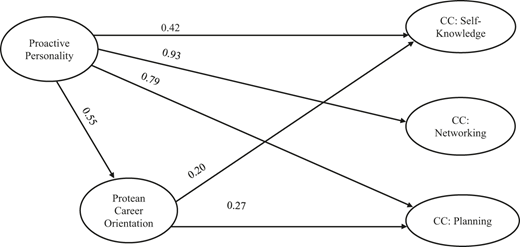
Career Competencies results model. Note: Numbers are regression coefficients from SEM significant at p < 0.01 Source: Authors’ work
Career Competencies results model. Note: Numbers are regression coefficients from SEM significant at p < 0.01 Source: Authors’ work
Cross-cultural effects
To address H3, as to whether the relationships amongst the model variables differ across the four countries, we fitted a multi-group structural equation model, with each country representing a different group in the analysis. We found that there was a meaningful degradation in fit (CFI = 0.874, RMSEA = 0.068, SRMR = 0.066) as compared to the universal model. The decrease in model fit when the model was tested in multiple countries suggests that the same general structure does not adequately fit in all four countries. This outcome implies that there are potentially meaningful differences in the structure of the model across countries.
Structural coefficients for each country are shown in Figure 2. For the Indian, Irish and USA samples, the direct paths from PP to all 3 CCs were significant. For the Belgian sample, however, PP does not appear relevant to self-knowledge. There was also a significant association between PP and PCO for all four countries.
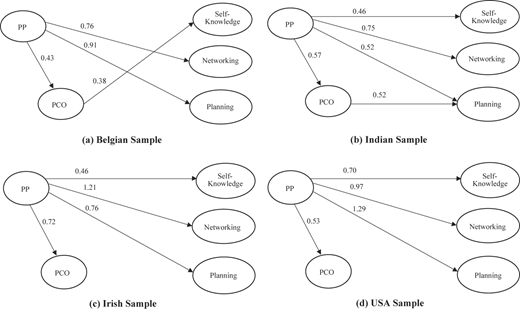
CC model for Belgium, India, Ireland and the USA. Note: Numbers are regression coefficients from SEM significant at p < 0.01. Source: Authors’ work
CC model for Belgium, India, Ireland and the USA. Note: Numbers are regression coefficients from SEM significant at p < 0.01. Source: Authors’ work
Regarding the mediating role of PCO, we can see that the models for the Irish and USA samples are most similar to each other. Neither country showed significant relationships between the expected mediator, PCO and any of the CCs. In the Belgian sample, PCO mediated the relationship between PP and self-knowledge, while in the Indian sample, PCO partially mediated PP and planning.
Overall, in relation to H3, this evidence suggests that there are aspects of the model that are largely universal (e.g., direct effects of PP on most CCs) and aspects that differ across countries (e.g., the mediating role of PCO in the model). An examination of the latent variable correlations across models also highlights specific country differences. The latent variable correlation between PP and self-knowledge for the USA is higher than the other countries (0.70 for the USA, 0.46 for India and Ireland and non-significant for Belgium). Similarly, the USA has the largest latent variable correlation between PP and planning (1.29 for the USA, 0.91 for Belgium, 0.76 for Ireland and 0.52 for India). The Irish sample has the largest latent variable correlation between PP and networking (1.21 for Ireland, 0.97 for the USA,0.76 for Belgium, 0.75 for India).
Discussion
In this study, we examined whether graduating students’ CCs were explained by PP directly and indirectly through PCO. We also asked if these hypothesised relationships held in the diverse countries of Belgium, India, Ireland and the USA, to determine if the relationship amongst these agentic constructs – that were initially proposed in the USA – are “context-invariant” and/or “context-sensitive” (Lazarova et al., 2018, p. 260). Our hypotheses were largely supported: We found that PP was positively associated with the 3 CCs (H1). For two of the CCs (self-knowledge and planning, but not networking), this relationship was partially mediated by PCO (H2). When examining these relationships in different countries (H3), we found that aspects of the model were consistent across countries (e.g., direct effects of PP on networking and planning) while others were “context-sensitive” (e.g., mediating role of PCO).
Theoretical implications
Our study makes three important theoretical contributions to the career agency and comparative career literatures.
First, we advance the literature on the antecedents of agentic CCs by examining the indirect effects of an agentic disposition (PP) through an agentic orientation (PCO). While Talluri et al. (2024) incorporate these two important antecedents in their recently developed CC model – referring to PP as a personal characteristic and PCO as a motivational personal factor – they treat them as independent predictors. Our findings show that the relationship is more complex. Those who are not naturally proactive are less likely to acquire a protean orientation that is so important for the development of CCs to facilitate career success. Our findings are in line with theorising on protean careers and they help to further our understanding of how PP may affect career outcomes through what Hall et al. (2018) call protean career mechanisms, with PCO serving as a personal resource through which PP is translated into career outcomes (Hirschi et al., 2013). Our findings are also consistent with Social Cognitive Theory (Bandura, 1997), which posits that individual differences in perceived agency and capability to act in a purposeful and motivated manner may affect one’s tendency to actively manage one’s career (Seibert et al., 1999; Wang and Wanberg, 2017).
Second, by including self-knowledge, networking and planning as separate CCs in our theoretical model, we contribute to the literature on CCs by showing that our antecedents affect the development of these competencies differently. As suggested by Ayoobzadeh (2022), CCs are not a global construct and therefore it should not be surprising that different antecedents are associated with different CCs. Although there was a positive association between PP and all 3 CCs, contrary to our expectations, PCO did not mediate the relationship between PP and networking – as it did for self-knowledge and planning – in the overall sample. A possible explanation for our findings is that people with a high PCO might see networking as the opposite of being self-sufficient and managing one’s own career. If students feel they should be getting a job on their own merits (what they know) and not through their connections (who they know), this may serve as a barrier to networking. The lack of significant findings related to networking is consistent with some prior research. Colakoglu (2011) found that career boundarylessness was related to self-knowledge and transferable CCs, but not networking CC. Furthermore, Lo Presti et al. (2023) expected but did not find that PCO was associated with social networks.
Third, and arguably most importantly, we add to the scholarly knowledge on comparative careers by examining agentic constructs of graduating students in culturally diverse countries. Our study addresses recent calls to use a cultural lens to understand agentic career concepts and their interrelationships (Mayrhofer et al., 2020) and related calls to understand the role of national culture in the development of CCs (Talluri et al., 2024). We found general “context-invariant” aspects to the model in terms of the direct effects of PP on the CCs. There were significant direct effects in all four countries, and in all but one country – Belgium – the direct effects were significant for all 3 CCs. We also found aspects of the model that are more “context-sensitive”, specifically the mediating role of PCO. The USA and Irish models differed from both the Belgian model and the Indian model. It is somewhat surprising that PCO did not mediate the relationship between PP and CCs in the USA and Ireland. Perhaps having a natural predisposition to being proactive is so strongly related to the development of CCs in these countries that one’s orientation to one’s career (PCO) does not add any additional explanatory power.
Further, in the multi-group SEM for Belgium, only the indirect path between PP and self-knowledge through PCO was significant. Lazarova et al. (2018), in their detailed analysis of the 5C studies, reported that Belgian employers have a higher use of career management human resource practices for employees in comparison to other countries. High uncertainty avoidance in Belgium, along with a sense of moral obligation to treat everyone well (Schwartz, 2006), may explain why proactive graduating students do not need to be particularly self-aware if they are going into organisations that will take an active role in managing their careers. In the multi-group SEM for India, PP was directly and indirectly related to career planning through PCO. The significant indirect path suggests that, in this country context, having a PCO may increase the likelihood of someone actively setting goals and planning their career, beyond what having a PP may do for the development of that competency.
Overall, these findings show that national cultural matters when considering individuals’ CCs and the antecedents explaining them. PCO mediated the relationship between PP and CCs in only two of the four countries, and for a different competency in the two countries, suggesting that country differences exist. While the country models did differ, PP was an important predictor of CCs for all four countries, even for those from countries with low individualism or high uncertainty avoidance. This supports the robustness of individual dispositions in explaining how graduating students enact their careers across cultural contexts.
Practical implications
Our findings are relevant for graduating students as well as the educational institutions that prepare them for the labour market and employers that hire them. As the CCs of self-knowledge, networking and planning are important factors for career success, it is important for students to develop these competencies prior to entering the labour market. Educational institutions have a role in ensuring this happens. Our research shows that this is especially important for those with low PP who may be left behind by their more proactive counterparts. Interventions may be warranted to help these students develop a protean, self-directed orientation towards their career.
Moreover, given the current global scene for education, student populations may be mixed in terms of their country of origin and the country where they are studying. Including career development programmes and building cultural awareness into them, will be important to make sure that what is considered “natural” in one culture is not assumed to hold for students coming from other cultures. Similarly, our findings in relation to PP indicate that employers need to continue playing a role in their employees’ career management. This is especially true for graduating students transitioning to the workplace, who are often unclear about how to manage their careers and who may anticipate that employers will provide career direction and support.
Finally, the current study suggests the importance of taking different approaches to helping new graduates across cultures. For instance, helping students to develop a PCO in Belgium and in India may increase the chances that they will develop a fuller spectrum of CCs. Furthermore, the level of PP and CCs that are appropriate in one culture may not be appropriate in another cultural context. For instance, students in the USA may develop networking competencies that are not appropriate in, or useful for, getting ahead in another country. Our findings suggest that employers and job applicants may benefit from a sound awareness of cultural differences when navigating international careers.
Limitations and suggestions for future research
While this study is one of the first to examine these career issues among graduating business students in multiple national contexts, it is not without its limitations. Although our samples are representative of the student populations from which they were drawn, having only one university from each country means that it was not possible to control for potential institutional factors that may have had an influence on the study variables and relationships. There were also differences in the samples in terms of level (bachelor's versus master's), with some age differences as well, which could make drawing conclusions across the samples more challenging. Clearly using much larger samples within individual countries and from a wider range of countries would allow for more advanced methods of analysis and more robust conclusions.
Our model was tested using single-source measures which may have inflated the relationships among the study variables. We used a cross-sectional design, which does not allow a direct assessment of the temporal nature of the transition that respondents were going through when they left university to start their work careers. This also limits conclusions about causality. Longitudinal, repeated measures’ designs will be important to further address how PP, as a stable disposition and PCO, as a motivational factor, might be related over time and influence CCs. Such designs might also help to rule out possible common-method bias. A longitudinal design would also allow for the examination of the effects of these variables on career success once the graduates are in the workforce.
Funding: This study was carried out as part of the ICAR network (International Career Research Network), initiated and partly funded by Neoma Business School, France.
References
The supplementary material for this article can be found online.

