This study investigates the role of transformational and shared leadership in relation to employee performance and intention to leave. Moreover, the indirect effects of communication quality and organizational commitment on these relationships were examined.
This cross-sectional study adopted a quantitative approach. Information technology knowledge workers (n = 291) employed in high-tech companies based in Poland completed an online questionnaire comprising items pertaining to six established constructs. After establishing the factor structure and convergent/discriminant validity of the measures, the responses were subjected to mediation analysis in AMOS to investigate direct and indirect effects.
Transformational leadership produced a direct negative effect on the intention to leave, while shared leadership produced a direct positive effect on employee performance. Mediators boosted relationships, especially in the case of shared leadership.
This study highlights the need to explore multiple leadership styles simultaneously and supports the principles underlying adaptive leadership theory. It also promotes the need to explore the influence of mediators to better understand the effects of leadership on followers.
Introduction
In this empirical study, we investigated the role of leadership amongst IT knowledge workers. As the world of work environments is evolving, more organizations are beginning to understand the criticality of digital technologies for enhanced success (Martinez-Caro, Cegarra-Navarro, & Alfonso-Ruiz, 2020). Its importance stems from the fact that countries and organizations alike are actively pursuing the need to invest more heavily in technology and automated processes. According to McKinsey’s analysis (Manyika et al., 2017), the world of work will experience immense shifts in the topography of job skills by 2030 as organizations invest more aggressively in the need to “technologize.” The Future of Jobs Report by the World Economic Forum (2023) posits that technology adoption will remain a key driver of business transformation in the next five years. In fact, more than four-fifths of the organizations surveyed identify the adoption of new and disruptive technologies as a means to broaden their digital access. These advancements not only drive organizational transformation but also heighten the demand for IT experts – a significant challenge for many businesses. This challenge is further amplified by the rapid growth of artificial intelligence which is reshaping business demands. High-tech companies, in particular, struggle to retain their knowledge workers, as a large proportion of them leave their jobs because another employer provides better pay or working conditions. Contemporary IT professionals represent a category of new-world-of-work employees and are generally more likely to move from one organization to the next (Joseph, Koh, & Ang, 2007). The need to exercise good leadership given these challenges among IT knowledge workers is warranted. Their knowledge and skills develop dynamically, constituting the main factor in building competitive advantage and so the contribution by and retention of, knowledge workers becomes critical (Lee-Kelley, Blackman, & Hurst, 2007). Our study is embedded in this business and economic context.
The literature has identified leadership as a critical phenomenon within the field of management, as leadership has implications for individual and organizational outcomes (Fischer, Dietz, & Antonakis, 2017, Hughes, Lee, Tian, Newman, & Legood, 2018). Given that leadership is inherently a multifaceted phenomenon, researchers recognize that there is no one “best” style of leadership but rather a number of styles depending on context, situations, tasks and personalities (e.g. Antonakis, Avolio, & Sivasubramaniam, 2003; Serban & Roberts, 2016). In this study, we relied on adaptive leadership theory (DeRue, 2011) in recognition of the significance of different leadership styles (Hoch, Bommer, Dulebohn, & Wu, 2018) and rather than examine “styles” in separate studies, we tested this proposition by considering both styles simultaneously in the same theoretically driven model. In line with calls from other scholars (e.g. Empson, Langley, & Sergi, 2023; Pearce, Knippenberg, & Ginkel, 2023), we explored how leadership influence can take shape both as a means to enhance collaboration (shared leadership, hereinafter SL) and to inspire others to reinforce positive behaviors and minimize less desirable ones (transformational leadership, hereinafter TL).
Leadership is both a social and goal-oriented influence process where leadership variables affect outcomes related to follower behaviors (Antonakis, Day, & Schyns, 2012; Fischer et al., 2017). In this study, we focus on employee performance as a positive organizational outcome (Avolio & Bass, 2004) and intention to leave as a negative organizational outcome (Mansour & Tremblay, 2018). In line with studies that promote the need to explore the explanatory power of mediators in understanding the effects of leadership on followers (Cassar, Bezzina, & Buttigieg, 2017), we examined the role of communication quality (Valls, González-Romá, & Tomás, 2016) and organizational commitment (Jyoti & Bhau, 2016) as potential mediators in these leadership-outcome pathways. While other mediators could have been equally plausible, we chose communication quality and organizational commitment due to the practical and theoretical considerations. Communication constitutes an important resource for passing and sharing information while also creating opportunities for learning. In contrast, improper communication lines lead to possible errors and instances of incorrect project completion dates. As IT-related work has become more likely to be performed at a distance and at irregular hours rather than confined to a specific office space or time, the state of communication is critical and may well be an enabler as well as a potential risk. Therefore, we deemed the perceived state of communication quality to explain salient relations between perceived leadership and specific outcomes (e.g. Neufeld, Wan, & Fang, 2010). On the other hand, commitment (namely affective commitment) has a long history of being conceptually recognized as gelling antecedents and outcomes. In one influential paper on commitment, Mercurio (2015) calls out for a more integrative conceptualization and notes how historically and theoretically, scholars depicted commitment as projecting an emotional cathartic effect that is primarily triggered by individual perceptions of actions and practices (e.g. leadership) and their subsequent effect on outcomes.
Such investigations in transition economies like Poland are warranted because of their increasing endeavors in identifying worker dynamics in view of industry innovation (Gajdzik & Wolniak, 2022). Moreover, studies like ours build on previous studies that have looked separately at the role of leadership and the process of knowledge sharing in the realm of innovativeness and intellectual capital development among knowledge workers (Kmieciak, 2021; Kucharska, 2021) and compare them under the wider umbrella of adaptive leadership. Poland has been adopting human resources (HR) practices comparable to Western-based teachings in a bid to render organizations more competitive and more strategic (Purgał-Popiela, Pauli, & Pocztowski, 2023; Stor, 2023). In fact, Poland is one of the fastest-growing labor markets in the IT field in the EU, with a workforce of 694,000 ICT specialists (Eurostat, 2024). Thus, global companies are attracted to Poland because of the availability of highly skilled and affordable tech talent.
The rest of this article will present the rationale underlying the research objectives of this study, followed by the method adopted to collect and analyze the data and the results. Finally, we will discuss the findings in light of the multifaceted realities of leadership.
Literature review
Transformational leadership and shared leadership
Most leadership studies have presented leaders as “visionaries” for their followers (Tourish, 2013), suggesting that leadership influence generally takes a top-down approach. Transformational leadership (TL) refers to “the leader moving the follower beyond immediate self-interests through idealized influence (charisma), inspiration, intellectual stimulation, or individualized consideration” (Bass, 1999, p. 11). It is one of the most often considered leadership styles and undeniably has played a crucial role in leadership research (Knippenberg & Sitkin, 2013). Moreover, research has implied connections between leaders and followers that impact outcomes at the individual and organizational levels (e.g. Wang, Courtright, & Colbert, 2011; Avolio & Yammarino, 2013).
However, some researchers (e.g. D’Innocenzo, Mathieu, & Kukenberger, 2016; Empson et al., 2023) have suggested that top-down vertical exchanges should be limited to create the space for sharing leadership among co-workers. In recent years, scholars have emphasized that leadership also requires collective participation (e.g. Empson et al., 2023; Mehraein, Visintin, & Pittino, 2023) and this is coherent with the SL concept. By definition, scholars describe shared leadership (SL) as “a dynamic, interactive influence process among individuals in groups for which the objective is to lead one another to the achievement of group or organizational goals or both” (Pearce & Conger, 2003, p. 1). Scholars have also defined this leadership style as the collective influence of co-workers on each other (Sivasubramaniam, Murry, Avolio, & Jung, 2002) or team processes where it is rather the whole team that conducts leadership processes rather than a single designated individual (Ensley, Hmieleski, & Pearce, 2006). This implies a serial emergence of temporary leaders depending on the tasks, knowledge, skills and abilities (Erkutlu, 2012). Moreover, scholars identify SL as relevant in an era of digital technologies and collaboration platforms when considering the complexity and distributive nature of organizational settings (Castellano, Chandavimol, Khelladi, & Orhan, 2021; Lungeanu, DeChurch, & Contractor, 2022).
An adaptive view on leadership
Adaptive theory underlines the dynamic character of leadership as a complex adaptive process of leading and following (DeRue, 2011). It emphasizes that leadership is an interactive and contextually embedded process of leading and following in groups and allows for different leadership styles to emerge depending on a variety of contingent factors (DeRue, 2011). Consequently, adaptation to the circumstances and the ability to use the strengths of the most appropriate leadership style can benefit organizations (Yukl, 2013) and maximize leadership efficiency in the face of changes (Yergler, 2011). Researchers also recommend considering leadership as both a collective and a plural phenomenon (Denis, Langley, & Sergi, 2012). Therefore, instead of analyzing leadership styles as competing, we can examine TL and SL in organizational settings as coexisting leadership styles that affect social and performance outcomes (Oc, 2018; Pearce et al., 2023). However, despite the fact that these styles can influence outcomes, only a few studies examined these styles simultaneously (e.g. Thylefors & Persson, 2014; Choi, Kim, & Kang, 2017; Tran & Vu, 2021). Studies (e.g. DeRue, 2011) suggest that TL and SL are not competitive but rather complementary forms of leadership.
Transformational leadership and shared leadership as antecedents of employee performance and intention to leave
Both TL and SL are likely to predict employee performance and intention to leave (Ensley et al., 2006; Buil, Martinez, & Matute, 2019; Shatila, Agyei, & Aloulou, 2024; Tran & Vu, 2021). However, given their distinct nature, they may affect different aspects of employee behavior (Pearce et al., 2023). “Employee performance” is one of the most desirable and essential employee behaviors and an important component of employee effectiveness (Avolio & Bass, 2004). We based our conceptualization of employee performance for this study on the employee’s perception that their contribution (1) is valued by internal and/or external customers, (2) is ahead of target delivery dates and (3) yields high-quality products (Maynard, Mathieu, Gilson, Sanchez, & Dean, 2019). Researchers generally consider both TL and SL to influence employee performance (Tran & Vu, 2021), albeit in different ways. For example, studies by Choi et al. (2017) provide evidence that SL improved processes such as organizing and planning effectiveness, whereas TL contributed to outputs. Similarly, previous studies have demonstrated that TL influences mainly behavioral states such as performance (Dvir, Eden, Avolio, & Shamir, 2002), while SL influences processes such as learning (Shoukat, Elgammal, Shah, & Shaukat, 2022) and creativity (Serban & Roberts, 2016). As these recent studies may suggest, these leadership styles can influence employee performance differently. Given that our conceptualization of employee performance centers around quality and timely delivery and relates more to the process of attaining one’s goal at work, we hypothesized:
SL has a stronger positive direct effect on employee performance than TL.
Leaders are expected to elicit employee attitudes that influence intention to leave (Enwereuzor & Ugwu, 2021). Retaining employees is especially crucial because the foundation for competitive advantage is the knowledge, competencies and talents of team members (Kossyva, Theriou, Aggelidis, & Sarigiannidis, 2023). Moreover, the results of studies conducted by Tao et al. (2017) reveal that the leadership style matters for the intention to leave. Intention to leave constitutes a subset of withdrawal behaviors defined as any purposeful and intended behavior by which an employee attempts to actively avoid work or reduces one’s interest in the work or the organization (Bluedorn, 1982). Intention to leave is one of the most unproductive behaviors in an organization, as it impacts cost and also the organization’s reputation. Therefore, it represents a definite output arising from influences such as leadership (Sliter, Sliter, & Jex, 2012). Walumbwa and Lawler (2003) suggest that TL may be predictive of intention to leave because transformational leaders seek to provide adequate needs to followers, which enables them to connect to their organization and team. Failing to satisfy these may increase one’s propensity to exit. On the other hand, the association between SL and intention to leave is slightly more complex. Studies among teachers suggest that a lack of sharedness as emphasized in instructional leadership is likely to elicit a reduction in shared values and self-efficacy possibly, leading to the intention to leave (Qadach, Schechter, & Da’as, 2020). Consequently, we hypothesized:
TL has a stronger negative direct effect on the intention to leave than SL.
The role of mediators: communication quality and organizational commitment
Leadership is a complex phenomenon that is likely to influence specific outcome behaviors through a variety of mechanisms, including mediators. Hayes (2018) has highlighted the theoretical role of the mediator as a variable that processes the association between two variables. In this study, we explore communication quality as a potential mediator. Communication quality is measured by frequency, content and quality (Marlow, Lacerenza, & Salas, 2017). Communication is critical for conveying information, providing direction and ensuring clarity; failing to do so may result in undesired consequences such as delays, waste and failure to achieve objectives. The quality of communication between leaders and followers is critical because it enables understanding, allows vision sharing and aligns efforts to goals (Jacobsen & Salomonsen, 2021). Thus, assessing a leader’s communication effectiveness provides valuable insight into perceptions of their leadership, which may, in turn, influence potential outcomes. Similarly, the second potential mediator that we explored in this study, i.e. organizational commitment, is often portrayed as one’s emotional attachment to the organization, which binds the individual to the place of work, which translates into feelings of loyalty and belongingness (Mercurio, 2015). As mentioned, the literature has largely depicted commitment from an emotional stance that elicits a degree of identification with the organization. Leaders who are perceived to elicit such emotional attachment by employees are likely to project that back on their general work behaviors. Hence, commitment is likely to be a strong mediator in this sense. Moreover, both communication quality and organizational commitment are highly associated with TL (e.g. Yue, Men, & Ferguson, 2019) and SL (e.g. Drescher & Garbers, 2016; Thien & Adams, 2021), and both are considered very strong determinants of intention to leave (e.g. Meyer & Allen, 1991; Aladwan, Bhanugopan, & Fish, 2013; Haque, Fernando, & Caputi, 2019). This implies that communication quality is likely to reflect improved processes that enhance dynamics between leaders and followers that may explain better and improved desirable behaviors and reduce negative behaviors such as intention to leave. Hence, we hypothesized:
Communication quality mediates the relationships between (1) TL and employee performance (H2a), (2) SL and employee performance (H2b); (3) TL and intention to leave (H2c) and (4) SL and intention to leave (H2d).
Furthermore, a degree of attachment to the organization triggered by followers’ perception of the leader’s goodwill may increase desirable behaviors and reduce unwanted ones. Hence, we hypothesized:
Organizational commitment mediates the relationships between (1) TL and employee performance (H3a), (2) SL and employee performance (H3b); (3) TL and intention to leave (H3c) and (4) SL and intention to leave (H3d).
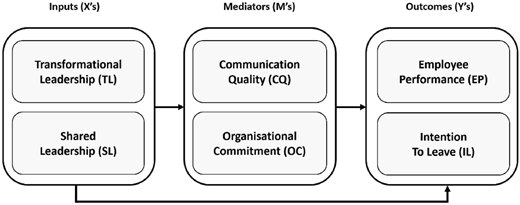
Based on the above, we adopted the research framework presented in Figure 1.
Method
Participants
This cross-sectional study targeted IT knowledge workers employed in high-tech companies based in Poland. Using the official company register of Poland (“Krajowy Rejestr Sądowy”) available on the Polish Government portal Biznes.gov.pl, we specified IT (“informatyczne”) as a search criterion, and this generated 181 IT companies. After contacting these companies, 62 agreed to support our research, which constituted a response rate of 34.3%. The HR departments of these high-tech companies shared an email containing a weblink to an online questionnaire inviting IT knowledge workers to participate in our study. Participation was voluntary. We specified that the participants had to (1) be fluent in English, (2) report to a direct supervisor to avoid having supervisors rating themselves in the TL statements and (3) occupy a job position that required advanced professional knowledge, education and/or experience in the IT domain. Hence, census intentions transitioned into purposive sampling based on defined criteria. Prior to data collection from human subjects, we obtained ethical clearance from the Research Ethics Commission of the University of Bielsko-Biala. We also computed the a priori minimum sample size using the inverse square method (Kock & Hadaya, 2018). After specifying a significance level of 5%, a power level of 80% and a minimum path coefficient of 0.20, as recommended by Hair, Black, Babin, and Anderson (2010), the recommended minimum sample size was 155. In July 2023, 291 relevant participants provided complete responses to our questionnaire. This exceeded the a-priori minimum sample size established for this study.
The majority of the respondents were male (82.5%), and their mean age was 38.0 years (SD = 9.1), with ages ranging from 19 to 65 years. The participants possessed academic qualifications (89%) or professional qualifications in the IT domain (11%), such as the Certified Ethical Hacker, Diploma in VMware vSphere and ISTQB Certification. Moreover, more than 70% of the respondents graduated from IT studies as engineers or Master of Science engineers. The participants occupied multiple roles, which included IT developer/programmer (47.6%), IT consultant (22.6%), IT tester (21.43%), project manager (15.2%), IT analyst (14.6%) and IT architect (12.2%).
Measures
We took the 29 Likert-type statements utilized in the questionnaire from the following six established constructs.
The TL scale consists of seven items taken from the study by Carless, Wearing, and Mann (2000). An example item is “My leader fosters trust, involvement, and cooperation among team members.” Cronbach’s alpha was 0.95.
For SL and in line with other researchers (e.g. Avolio, Sivasubramaniam, Murry, Jung, & Garger, 2003), we used the referent-shift approach by taking the TL scale (Carless et al., 2000) and shifting the source of leadership from the formal leader to the collective. An example item is “My work colleagues foster collective trust, involvement, and co-operation.” Cronbach’s alpha was 0.91.
Communication quality (Valls et al., 2016) consisted of five items. We made slight adaptations such that we replaced the questions with statements and the term “team” with “core work colleagues.” An example item is “Communication among core work colleagues is effective.” Cronbach alpha’s was 0.94.
Organizational commitment comprised four items (see Marsden, Kalleberg, & Cook, 1993, p. 376, items 3–6). An example item is “I would turn down another job for more pay to stay with this organization.” Cronbach’s alpha was 0.80.
Employee performance comprised three items adapted from Maynard et al. (2019) so that the items focus on the individual rather than on the team. An example item is “I deliver my products on, or ahead of, my target delivery date.” Cronbach’s alpha was 0.77.
Finally, intention to leave consisted of three items (Mansour & Tremblay, 2018). An example item is “I think a lot about leaving this organization.” Cronbach’s alpha was 0.90.
We requested respondents to rate their level of agreement on a scale ranging from 1 = strongly disagree to 7 = strongly agree. Higher scores reflected higher levels of the construct.
Finally, we asked the respondents to provide demographic information regarding their gender, age, highest level of education, work status (part-time/full-time) and their occupational role in the organization. We guaranteed anonymity and confidentiality.
Procedures and analysis
In the preliminary analysis, we started by generating a six-factor first-order confirmatory factor analysis (CFA) in AMOS (Version 29) to examine the factor structure. To determine goodness-of-fit, we used the guidelines by Hu and Bentler (1999). More specifically, apart from presenting the Chi-square (χ2) test and its p-value (preferably p > 0.05, but this is highly affected by multivariate normality and sample size), we obtained the confirmatory fit index (CFI, ≥0.90 acceptable, ≥0.95 good), the root-mean-square error of approximation (RMSEA, ≤0.08 acceptable, ≤0.06 good) and the standardized root-mean-square residual (SRMR, ≤0.10 acceptable, ≤0.08 good). Where necessary, we examined modification indices and correlated some error terms to improve model fit. Second, we proceeded to establish the measures’ reliability and convergent/discriminant validity. To this end, scholars recommend the following measures and thresholds (Hair et al., 2010): composite reliability (CR, ≥0.70) for internal consistency reliability; average variance explained (AVE, ≥0.05) for convergent validity; maximum shared variance (MSV) smaller than the AVE, and the square root of the AVE greater than the average inter-construct correlations for discriminant validity. Third, we included a common latent variable, linked it to all the indicator variables in CFA, and used the χ2 difference test to determine if common method bias (CMB) was present. In the presence of CMB, we imputed bias-corrected composite variables.
In the main analysis, we started by obtaining descriptive statistics of composite variables and then checked whether any of the demographic variables were linked to X and Y (Elwert, 2013). If so, these demographic variables became potential control variables in structural equation modeling (SEM), which is suitable for examining direct and indirect relationships within the same theoretically driven model and providing goodness-of-fit assessments. Furthermore, we used covariance-based SEM (CB-SEM) rather than variance-based SEM (PLS-SEM) since we were more interested in hypothesis testing and confirmatory analysis rather than exploring a complex or formative model (Hair, Ringle, & Sarstedt, 2011). To examine the study’s hypotheses, we used mediation analysis in AMOS (Version 29), a primary tool for CB-SEM. Since the absence of temporal data limits causal inference, our cross-sectional study focused on establishing theoretical direction rather than temporal ordering (Kline, 2015; Hayes, 2018). The independent variables were TL (X1) and SL (X2), the mediators were communication quality (M1) and organizational commitment (M2), while the outcomes were employee performance (Y1) and intention to leave (Y2). We started by assessing the goodness-of-fit of the structural model by using the guidelines and thresholds by Hu and Bentler (1999) highlighted above. To test for direct effects, we assessed the statistical significance of the regression coefficients, while for testing indirect effects, we used the bias-corrected percentile method with 5,000 bootstrap samples and 95% confidence intervals (CIs). An indirect effect is significant when the 95% CI does not include zero. In interpreting the indirect effects (full vs partial), we used guidelines by Zhao, Lynch, and Chen (2010).
Results
Factor structure and construct validity
The initial six-factor first-order CFA produced an acceptable fit to the data (χ2 = 710.52, df = 362, p < 0.01; χ2/df = 1.96, CFI = 0.94, RMSEA = 0.06 and SRMR = 0.05). Following an inspection of modification indices, there was an incremental improvement in model fit when the error terms of TL2 and TL3 (Δχ2 = 21.72, df = 1, p < 0.01), SL5 and SL7 (Δχ2 = 16.42, df = 1, p < 0.01) and TL3 and TL4 (Δχ2 = 17.97, df = 1, p < 0.01) were covaried. The resulting model produced a good fit (χ2 = 654.41, df = 359, p < 0.01; χ2/df = 1.82, CFI = 0.95, RMSEA = 0.05 and SRMR = 0.04).
We proceeded by adding a common latent factor to the CFA model (χ2 = 651.35, df = 338, p < 0.01; χ2/df = 1.82, CFI = 0.94, RMSEA = 0.05 and SRMR = 0.04) to assess the effect of CMB. The Chi-squared difference test (Δχ2 = 17.97, df = 1, p < 0.01) revealed that our model did not have any significant CMB issues. Thus, we proceeded to establish reliability and convergent/discriminant validity of the construct measures (see Table 1) without the need to impute bias-corrected composite variables.
Table 1 summarizes descriptive statistics of the main study variables and the correlations between these six main study variables.
Table 1 shows that all CRs and AVEs exceeded 0.70 and 0.50, respectively, all MSVs were smaller than the corresponding AVEs, and the square roots of the AVEs were larger than the inter-construct correlations. Hence, there were no reliability and convergent/discriminant validity issues (Hair et al., 2010). Furthermore, all correlations were in the correct theoretical direction. Before proceeding to the SEM analysis, we examined whether four specific demographic variables were significantly correlated to the independent and dependent variables (see Table 2).
Table 2 shows that none of the four demographic variables was linked to both Xi and Yi. Hence, the mediation analysis did not include any control variables (Elwert, 2013).
Testing for direct and indirect effects
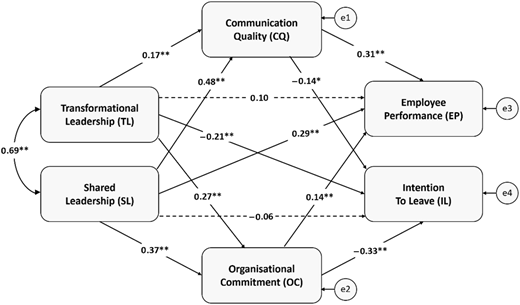
The mediation model provided an excellent fit to the data (χ2 = 0.20, df = 2, p = 0.91; χ2/df = 0.10, CFA = 1.00, RMSEA = 0.00 and SRMR = 0.01). Table 3 summarizes regression weights and their significance for the direct paths.
Table 3 shows that the direct paths from SL to employee performance and TL to intention to leave were significant. However, the direct paths from TL to employee performance and SL to intention to leave were not significant. Therefore, H1a and H1b were upheld. Figure 2 illustrates the path diagram with standardized regression weights for the direct effects.
Testing for indirect effects
Table 4 provides statistical output from the indirect relationships.
Table 4 shows that all eight indirect effects tested via user-defined estimands were statistically significant. More specifically:
Communication quality fully mediated the pathways between TL and employee performance and SL and intention to leave, thereby supporting H2a and H2d.
Communication quality partially mediated the pathways between SL and employee performance and TL and intention to leave, thereby supporting H2b and H2c.
Organizational commitment fully mediated the pathways between TL and employee performance and SL and intention to leave, thereby supporting H3a and H3d.
Organizational commitment partially mediated the pathways from SL to employee performance and TL and intention to leave, thereby supporting H3b and H3c.
Discussion
We examined the relative importance of different perceived leadership styles by analyzing their direct effects on specific outcomes and assessing the role of specific mediators in explaining potential indirect effects. Our results support the theoretical principles of adaptive leadership theory (DeRue, 2011), supporting the claims by other researchers (e.g. Oc, 2018; Pearce et al., 2023). While correlations between the study variables were in the correct theoretical direction, when considering the simultaneous influence of both TL and SL in an SEM (competing) model, SL had a positive direct effect on employee performance, while TL had a negative direct effect on intention to leave. This aligns with the literature, as TL appeals to the need for inspiration and care from a leader who supports goal achievement at work. Since transformational leadership tends to reduce intention to leave (Tao et al., 2017), this effect was expected in the findings. On the other hand, SL resonated more via communication quality and organizational commitment, giving employees the understanding that they can share and exchange ideas and beliefs about their work, which is likely to increase the sense of achievement in terms of employee performance. In addition, this pattern of findings is also corroborated by the fact that TL showed no significant direct effect on team effectiveness relative to SL, while SL failed to show any significant direct effects on intention to leave in relation to TL. This is in line with the notion that different leadership styles have distinct effects on different salient outcomes and supports the need to vary the leadership purpose (Pearce et al., 2023).
Furthermore, our study showed that mediators are also likely to strengthen specific relationships between leadership styles and outcomes in indirect ways. Results revealed that communication quality is more likely to mediate the influence of SL on outcomes, in particular employee performance, while organizational commitment is more likely to mediate the influence of TL on outcomes, in particular intention to leave. We may explain it by the fact that communication quality is an attribute that employees are likely to appraise as facilitating the extent and speed by which they share, exchange and transfer ideas and hence impacts SL on employee performance. On the other hand, organizational commitment is an attitude that signifies the extent a person feels attached to one’s organization as a function of the affective attention the leader gives followers, who are subsequently less likely to leave (Haque et al., 2019). Furthermore, communication quality and organizational commitment accentuated the pathways between SL and outcomes (Drescher & Garbers, 2016; Thien & Adams, 2021). More specifically, communication quality mediated the relationship between SL and employee performance much more stronger than in the case of TL as a standardized indirect effect (0.15 vs 0.05). This was also the case with the intention to leave (−0.07 vs −0.02), suggesting that communication quality has a stronger effect on withdrawal behaviors when people feel they co-belong and have discretion to share views safely over and above that of valuing a sense of motivation from a higher-ranking person serving as leader of the team. In the case of organizational commitment, SL, compared to TL, was also better predictive of intention to leave (−0.12 vs −0.09) and employee performance (0.05 vs 0.04), albeit to a lesser extent. Hence, the bigger influential aspect of SL was consistent throughout, but without discrediting the influence of TL too. Indeed, while these results are interesting findings in themselves, one does well to highlight a potential specificity of this study. The participants in this investigation were IT knowledge workers. Generally, IT professionals are more likely to operate in a less hierarchical format, more remote and more likely to employ technology for collaborative processes (Han & Hazard, 2022). Furthermore, typical of knowledge workers, IT employees are more likely to rely on their competence and sense of being self-goal-driven rather than solely feeling the need for inspirational direction. While this may explain why SL was more emphatic in these associations, the simultaneous influence of TL may add better to this explanation as it provides a sense of direction and hence coordination among IT knowledge workers (Nordbäck & Espinosa, 2019).
Theoretical and practical implications
The basis for our study centered around the notion of adaptive leadership theory, which suggests that many leadership styles coexist in any ecosystem, with certain styles exerting more influence over others on specific outcomes. From a theoretical standpoint, this study provides support for propagating adaptive leadership in that rather than competing leadership styles, one should consider more seriously how these coexist and hence be part of a larger integrated framework, which is best explored both with its internal tensions that can be simultaneously paradoxical and complementary (Pearce et al., 2023). Moreover, explanatory frameworks of leadership should incorporate alternative mechanisms in the form of mediators. Our results suggest that mediators can alter or shift the importance of specific styles on selected outcomes.
From a practical perspective, let us underline that leadership is a multifaceted phenomenon. Rather than learning about different styles, practitioners should know when to execute specific behaviors, as these are consequently appraised by followers in adjusting specific behavioral outcomes (Cassar et al., 2017).
Limitations and further research suggestions
This study is not without its limitations. First, it examined the relationships of two leadership styles (TL and SL) with employee outcomes. We investigated those leadership styles based on the recent recommendations about leadership (Pearce et al., 2023). However, perhaps an extended study including other leadership styles could provide a more holistic understanding. Second, we conducted the study among IT knowledge workers. Therefore, it has limited generalizability. Whether these studies extend to other knowledge workers warrants investigation. Third, we adopted a cross-sectional design, and hence adopting a longitudinal study could provide insights into cause-and-effect relationships. Longitudinal designs will elicit better conclusions about how outcomes may fluctuate as a function of differing leadership styles and whether intermittent (mediator) variables will be significantly responsible for such changes over time. Because IT work is fluid and not constrained by fixed parameters such as physical space, it is important to understand how these types of workers relate to their perceived leadership as conditions change. Moreover, it will be relevant to examine how collective teams share perceptions about outcomes, and hence future research should also examine multi-level variations over time. Furthermore, when studying shared leadership, rather than using the referent-shift measures, such studies could use social network approaches. Social network approaches do not assume convergence of attitudes and offer a theoretical framework for analyzing the relational influence structure within teams (Carson, Tesluk, & Marrone, 2007).
In conclusion, SL and TL exert a complementary and competing relationship with outcomes. Leadership is inherently complex, and no single style can be ever considered universally superior to another. Considering the complexity of the leadership phenomenon, we hope that future studies will evaluate multiple leadership styles and explore potential paradoxical tensions that exist in various styles, preferably over time.