To identify and characterize policies for managing overdue receivables among Polish enterprises.
The survey using the computer-assisted web interviewing method was applied. Based on the 754 responses to the designed survey questionnaire, a clustering method was conducted to analyze three proposed policies for managing overdue receivables. Logit models were then applied to determine the factors affecting the implementation of these policies.
Based on the literature review and the experience of the paper's authors, three types of overdue receivables management policies were proposed, namely confrontational, prudential and relations-based, and then the factors affecting the choice of each policy were identified along with their strength.
The research concerns only the Polish market, although the proposed solutions can also be applied in other countries with a similar business environment.
Enterprises may have different policies for managing overdue receivables depending on their attitude to risk and their relationship with the environment. A relations-based policy is recommended for temporary payment problems with counterparties, as it supports maintaining long-term business relationships with various stakeholders.
The paper identifies new directions for research on overdue receivables management policies among Polish enterprises. The applicability of the study lies in the company's ability to determine what kind of policy it wants to pursue and its consequences.
Introduction
The management of accounts receivable is one of the key elements in the formation of working capital and is also a fundamental area of interest in corporate finance. While this issue has received a lot of attention in the literature, the concept of managing overdue receivables is poorly recognized and represents a research gap. The failure to pay for goods or services on time is one of the most serious challenges facing businesses and may lead to payment gridlock and ultimately to bankruptcy.
We may see the importance of this problem by analyzing the data contained, for example, in the European Payment Report. On average, European entrepreneurs spend 74 days a year chasing overdue payments. Late payments affect 79% of businesses. Overdue payments have the greatest negative impact on business operations. Studies show that up to 43% of companies need state-of-the-art technology platforms to manage their overdue receivables more effectively (European payment report, 2016, 2023). In the case of Polish entrepreneurs, in Q1 2023, 71.2% of them declared that they had overdue trade receivables (Szybki Monitoring NBP, 2024). Meanwhile, the results of the research presented in the EU Payment Observatory Annual Report (2024)show that in 2023, late payment problems were present in most EU countries. Unfortunately, Poland (68%) was one of the three countries indicating the highest percentage of businesses affected by late payments, closely behind Malta (76%) and Luxembourg (70%), in comparison with an EU average of 47% (EU Payment Observatory Annual Report, 2024, pp. 13–14). Approximately 40% of SME entities in Q1 2024 indicated that they had receivables overdue by more than 60 days (BIG Info Monitor, 2024).
In terms of dealing with overdue receivables across Europe, there is a tendency to recover debts without going beyond the same organizational unit. The European average is 62%, but Northern European entrepreneurs recover their debts primarily in this way (69% of respondents). As a second resort, entrepreneurs turn to law firms (36%), especially in Eastern Europe (48%). On average, 23% of businesses in Europe will pass on their overdue accounts receivable to debt collection agencies, with Northern Europeans most likely to do so (29%) and Eastern Europeans least likely (17%). In contrast to other countries, businesses from the UK, Germany, the Netherlands and Poland show a strong interest in working with debt collection companies to recover their debts. Conversely, businesses in Ireland, Denmark, Greece and Switzerland are most interested in recovering debts themselves. The selling of debts is the least common form of debt recovery, chosen by 7% of enterprises in Southern Europe (lowest interest) and 21% in Western Europe (highest interest). In Greece, no company showed an interest in selling debts (Global Collections Review, 2015, Global Collections Review Europe, 2017).
Considering the relevance of the problem and the lack of extensive research on overdue receivables in Poland, we set the following research objective: To identify and characterize policies for managing overdue receivables among Polish enterprises.
Moreover, we also sought answers to the following research questions:
What are the common and differentiating variables in terms of the management policies implemented regarding overdue receivables?
How strong is the impact of these variables on the policies implemented for the management of overdue receivables?
In the following sections, the article includes a literature review, a description of the data and methodology of the study, the results of the research and the conclusions.
Literature review
The management of overdue receivables is a key element of accounts receivable management. It is the application of various measures by a creditor regarding prevention, monitoring and collection, aiming to achieve the goal of ensuring (consciously creating) conditions for the safe execution of a contract concluded between the given parties.
Noteworthy, in the literature, scholars analyze the management of trade accounts receivable, being an autonomous and material asset of a company, together with working capital. An example of an integrated approach is the research of Bougheas, Mateut, and Mizen (2009), who examined the response of accounts receivable to changes in inventory cost, business profitability, business risk and liquidity. Kadochnikova, Semenikhina, and Garifullina (2019) explored the relationship between accounts receivable and sales revenue, accounts payable and cash. A classic strand of research in this area has been to identify the role of accounts receivable in maximizing enterprise value. Kim-Atkins’ (1978) fundamental proof of the positive impact of accounts receivable on enterprise value has been empirically tested by numerous researchers. For example, Sharma and Kumar (2011) found a positive correlation between ROA and accounts receivable. However, many studies show a negative correlation between the value of accounts receivable and business profitability, i.e. a credit policy that includes a minimum value of accounts receivable promotes profitability maximization (Deloof, 2003; Lazaridis & Tryfonidis, 2006; García-Teruel & Martínez-Solano, 2007; Samiloglu & Demirgunes, 2008; Johnson & Gill, 2010; Mathuva, 2010). These studies covered Belgium, Greece, the USA, Spain and Kenya. On the other hand, Denčić-Mihajlov, Ljubenović, and Malinić (2013) formulated an optimal model of accounts receivable management that promotes the maximization of enterprise value.
The impact of accounts receivable on enterprise value must be considered as a decision-maker's classic dilemma between maximizing this value and easing financial liquidity. It is a trade-off between profitability and liquidity (Kim, Mauer, & Sherman, 1998; Deloof, 2003). An enterprise optimizes its accounts receivable decisions so as to concentrate either on maximizing enterprise value by decreasing financial liquidity risk or on financial liquidity at the expense of lower enterprise value. The same is true for the management of overdue accounts receivable. Accordingly, the main purpose of accounts receivable management must be to achieve financial benefits or protect financial liquidity (Ross, Westerfield, & Jordan, 1995, p. 683; Kreczmańska-Gigol, 2015, p. 192). The firm's maximization of profits, cash flow or asset accretion manifest financial benefits. A means of achieving this objective is to stimulate sales through an increase in accounts receivable. Safeguarding financial liquidity for accounts receivable may involve ensuring the security of contract fulfillment, whereby accounts receivable will be paid on time and in full (Morawska, 2013, p. 154).
Recently, the concept of the socially responsible economy has gained increasing importance. It distinguishes between the objectives of enterprise management, i.e. the maximizing of shareholder value versus stakeholder value (Bek-Gaik & Rymkiewicz, 2018; Wang, Chen, Xue, & Liang, 2022). According to some scholars, in the long term, the realization of value growth for shareholders coincides with the goal of value growth from a stakeholder perspective (Jensen, 2002; Freeman, Wicks, & Parmar, 2004; Keay, 2007). It also affects accounts receivable, as it pinpoints the importance of business accountability to all its stakeholders, such as the staff and suppliers. Singh, Singh, and Mishra (2021) emphasize that accounts receivable management should proceed in a way that does not negatively impact customer relationships (Dobroszek, Mourao, & Urbaniak, 2023). The key to successful debt collection is to recover the debt and maintain a good business relationship with the customer so that further cooperation is possible. A tool suitable to support the debt collection process is the concept of Customer relationship management – CRM (Geib, Kolbe, & Brenner, 2006). The effect of implementing this business model is to create long-term relationships by building loyalty among the company's customers (Wejer-Kudełko & Kudełko, 2017). This approach can lead to increased business value for shareholders and stakeholders over the long term.
One of the key elements of accounts receivable is overdue accounts receivable, i.e. those that the counterparties (debtors) have failed to pay the company (creditor) on time. Such accounts receivable and their management are not a prevalent topic in the literature. Based on the few available studies in other countries, late payments and irrecoverable receivables negatively impact firms' profitability (Paul, Devi, & Teh, 2012) and may lead to insolvency (Remeikiene, Gaspareniene, & Grigaliune, 2016; Korol & Prusak, 2022).
The literature review shows that research into the management of overdue accounts receivable focuses on collection, and primarily on how organizations handle this process.
Companies can manage debt collection, i.e. the recovery of accounts receivable after the due date, on their own or outsource it. Businesses should develop their debt collection model to suit the firm's organizational structure, the size of operations and the industry routine, to make debt recovery as effective as possible (Liao, Du, Yang, & Huang, 2021; Kobsch, Conrad, Goetze, & Stricker, 2023). Scholars have also noted that the adoption of generative AI and machine learning techniques may serve as a new context and as tools for management concepts (Korzynski et al., 2023; Jankowski & Paliński, 2024). The models employed internal, external (Altınok et al., 2022) and mixed debt collection (Mroczkowski, 2004; Sanchez, Maldonado, & Vairetti, 2022). It is argued in the literature that debt collection should proceed to perpetuate the company's good reputation and its market position, following applicable good debt collection practices (Stănescu, 2021, 2022), and seek to develop a model of cooperation with customers based on commercial reliability (Mroczkowski, 2004; Wodyńska, 2007). This is because overly severe treatment of debtors may discourage the company's potential customers.
From the perspective of overdue accounts receivable, it is worth mentioning that accounts receivable are managed within the credit process. This includes (Mian & Smith, 1992; Wędzki, 2018, p. 83) setting out rules and procedures for the management of accounts receivable (credit policy), assessing the credit risk of counterparties as company debtors, defining legal and economic payment terms for the counterparty (payment security), deciding whether to grant or refuse trade credit, financing accounts receivable, monitoring the collection of accounts receivable, collecting overdue and bad debts, and restructuring bad debts. If the given types of credit policy vary, this should be manifested at least at one stage of the credit process, meaning that a model criterion for differentiating between credit policy types can be formulated (Wędzki, 2018, p. 341). If the credit process stages vary for particular types of credit policy, one may assume that they will also vary for particular overdue accounts receivable management policies.
Therefore, based on the literature review and taking into account experience, we propose three policies for the management of overdue receivables, which can exhibit both similar and differentiating features at particular stages of the credit process. These are: (1) Maximizing the financial benefit, which can be called a confrontational policy, as achieving this objective requires the most effective credit policy instruments at the expense of debtors. On the one hand, profit maximization involves unlimited trade credit. On the other hand, when there is an insufficiency in the timely payment of receivables, the company is not willing to negotiate, such as extending payment terms, reducing debts, etc. and by any means will seek to recover debts as soon as possible; (2) Minimizing credit risk by, for example, carefully assessing the risk of the counterparty, and entering into contracts to hedge against any risk of its insolvency (prudential policy); (3) Optimizing stakeholder relations, which we may call a relations-based policy, as maintaining long-term good relationships within the credit process is of paramount importance. This policy stems from the company's conciliatory management in the spirit of the aforementioned corporate social responsibility (CSR) and customer relationship management. The company intends to ensure the best possible relationship with its stakeholders, primarily employees and contractors and receivables are part of optimizing this relationship (Wejer-Kudełko, 2016; Coelho, Jayantilal, & Ferreira, 2023). In this model, an enterprise may make a settlement with a counterparty, such as extending payment terms or making partial write-offs, with a view to improving the financial condition of such a counterparty and maintaining cooperation with it in the long term, which in turn will benefit it financially. The advantages of this policy become particularly evident when a counterparty is experiencing temporary financial difficulties. Refusing to cooperate, such as by declining to negotiate the proposed credit terms, may push the counterparty to the brink of insolvency. The consequences of such a situation can directly impact business partners. The creditor may be unable to recover their receivables and may lose a customer. Indirect consequences may also arise, affecting other stakeholders, such as the bankrupt entity's employees, the local region in which it operates or the municipality's revenue. When implementing this policy, it is essential to assess the financial condition of the counterparty to determine whether the difficulties are temporary or permanent. Such a policy is only justifiable in the case of temporary financial difficulties.
The application of the above principles among Polish entrepreneurs was the subject of a study, which we will present later in the article.
From the point of view of the proposed policies, it is necessary to identify the extent to which the policies differ in the credit process. In the sequence of measures within the credit process (Mian & Smith, 1992; Wędzki, 2018, p. 83), the following stages appear to be particularly useful: (1) the credit policy defining stage, including positioning the credit policy within the corporate organizational structure, (2) the credit risk assessment stage, i.e. the risk of insolvency of a counterparty who is granted trade credit, (3) the stage for defining credit terms for the counterparty, establishing credit terms, credit limits, collaterals, etc. (4) the credit decision stage, applying the criteria for granting or refusing trade credit and (5) the overdue accounts receivable recovery stage, which involves the collection of accounts receivable not paid by the due date.
For the above stages, how organizations manage overdue accounts receivable may vary. We present the features of each stage below. We further researched these features among Polish enterprises in the context of the mentioned policies.
The form of the credit process (Salek, 2005, p. 59, p. 149; Huls, 2012; Jankowski, 2006; Kreczmańska-Gigol, 2018): (1) may involve the creditor in the handling of contracts and accounts receivable or this may be an element of other duties, e.g. accounting or sales, (2) may be imposed by the counterparty, in which case the firm agrees to the contract and relationship model imposed by the counterparty, (3) may represent a separate organizational unit (a single function, e.g. credit controller; a separate department, e.g. legal) or (4) may involve the additional handling of certain stages by an external law firm.
At the counterparty credit risk examination stage, a firm may (Nastarowicz, 2012; Drozd & Serrano-Padial, 2017; Fedaseyeu & Hunt, 2018; Kroeber & Yam, 2020): (1) not investigate credit risk, (2) examine credit risk by assessing the counterparty's financial standing based on financial statements available at the National Court Register, (3) examine credit risk by verifying the status of the counterparty's overdue trade debt with a mercantile agency, (4) examine credit risk by verifying the counterparty's bank debt with a credit bureau or (5) take other action, such as obtaining information from chambers of commerce, debt collection agencies or media reports.
If the firm has its legal department or outsources to a law firm, it may legally structure a contract to secure the creditor's claims (the firm) against the debtor (the counterparty) when determining the payment terms for the counterparty. This includes establishing quasi-security (e.g. blank promissory note, civil law surety, bank guarantee, accession to debt, irrevocable power of attorney, set-off clause) or in rem security (e.g. pledge on movables, transfer of ownership as security, sale subject to right of repurchase, assignment of accounts receivable as security, blocking of funds in bank accounts, security deposit, mortgage). The company may also not agree to the terms of the contract from the legal side, relying instead on standard contracts available in legal guides or on the internet.
At the credit decision stage, profit maximization involves unlimited trade credit, i.e. any counterparty is granted credit upon request and the minimization of credit risk is manifested in prudent trade credit.
When collecting overdue accounts receivable, the company may opt for (Wodyńska, 2007; Kreczmańska-Gigol, 2011; Banasik, Kędzierski, Morawska, Panfil, & Sławicki, 2021): amicable debt collection (involving payment requests, for example, in the form of emails, text messages, inspections by mobile debt collectors at the debtor's location), alternative dispute resolution in the form of: settlement negotiations (such as telephone negotiations, negotiation of repayment terms, out-of-court settlement) or pre-court (contractual) mediation, arbitration court procedure or court proceedings including: expedited proceedings (order for payment and writ of payment), litigation (including court mediation), enforcement (enforcement order, bankruptcy or restructuring) or post-enforcement collection initiated following unsuccessful enforcement by an enforcement officer. This includes the sale of the debt (e.g. to a debt collection office or on an electronic debt exchange).
Noteworthy, in addition to the typical financial and economic factors, behavioral characteristics play an important role in credit management (In Kulawczuk & Poszewicki, 2010; Wrońska-Bukalska & Wilkowska, 2017; Goel & Rastogi, 2023). This is particularly evident in the case of small and medium-sized enterprises. Therefore, the choice and creation of a receivables management policy, including overdue receivables, can depend on many variables, including non-financial ones, e.g. the enterprise profile, and the sociodemographic and psychological factors of the entrepreneur. This is indicated by individual studies that have analyzed such factors as, for example, the industry and size of the enterprise, as well as the gender, age, mentality and education level of the entrepreneur (Ključnikov, Kozubíková, & Sopková, 2017; Hoque, 2017; Dankiewicz, 2018; Taseva, 2019; Matejun, 2021; Goetze, Herdt, Conrad, & Stricker, 2023). Hence, the authors posed two research questions in the introduction to the article regarding the differentiating factors and an assessment of their strength of influence on the policies implemented for the management of overdue receivables. In our study, we evaluated the impact of the proposed variables. The following sections present the results thereof.
Data and methodology
Between July and November 2022, we analyzed 754 Polish companies that posted positive revenue for the previous accounting year, focusing especially on the management of their overdue receivables, using an online survey on webankieta.pl. The survey included factors that could potentially impact a firm's choice of a specific accounts receivable management policy (Table 1).
The study used data from Statistics Poland to estimate the number of active enterprises (2.15 million; GUS, 2020), allowing an acceptable error of up to 5% with a significance level of α = 0.01. Based on the PARP report (2021), we confirmed the representativeness of the research sample for all Polish enterprises using a 5% significance level fractional test for enterprise size, turnover, number of employees, industry, and voivodeship. We confirmed the sample's randomness at a 7% confidence level.
We divided the companies into the above-proposed three mutually exclusive types of credit management policy: confrontational, prudential and relations-based. We verified the three proposed policies (RQ1) based on the companies' declarations in response to the survey questions regarding the purpose of their accounts receivable management. We defined this purpose as: the maximization of benefits, the minimization of trade credit risk, or the optimization of solvency for the aforementioned policies (respectively, confrontational, prudential and relations-based). Then we examined the similarities and differences between these policies in terms of the credit process and sociodemographic factors using fractional tests.
We asked each group the same set of 22 closed-ended questions (Table 3) to determine how they implement a particular stage (Table 2) of the credit process.
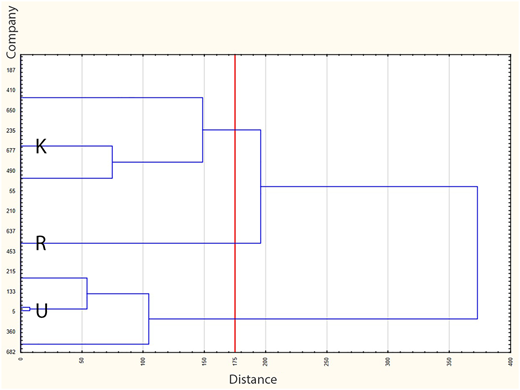
We used a clustering method to create a dendrogram for Euclidean distance using two variables, i.e. the achievement of a certain type of benefit from the management of overdue receivables, and the way in which this benefit is achieved at different stages of the credit process, listed in Table 2. We standardized the data used in the cluster by the maximum value, which does not affect the distribution of objects or the effectiveness of the analysis (Deptuła, 2018). Scholars commonly use this approach in business analysis (Tarka, 2009; Dzuba & Krylov, 2021). The rationale for the utilization of thresholds in the clustering process is rooted in the objective of identifying economically interpretable clusters in terms of the company characteristics that are of interest in the study.
For RQ2, we estimated logit models for each policy separately with the policy type as a dependent variable (binary variable) and the six stages of the credit policy as independent variables (Table 2). Scholars have widely used logistic regression to solve similar problems in debt management (Mian & Smith, 1992; Kapadia et al., 2022) and financial distress forecasting (Waszkowski, 2013).
Findings
The clustering method results (Figure 1) show that the firms fell into three main clusters (policies). The majority of businesses declared that they focused on maximizing the benefits of having accounts receivable (confrontational policy) (41.3%), followed by risk minimization (36.5%), and solvency optimization (22.1%) by taking care of employees and suppliers (Table 3).
We found that over 40% of respondents had occasionally overdue receivables, 34% had persistently overdue receivables and 26% had no overdue receivables. The majority (58%) were in the services sector, followed by distribution (27%), manufacturing (22%) and construction (9%). Most of them (67.57%) were small enterprises, with 52.7% employing up to 9 personnel, 29.19% up to 49 employees, and 18.10% more than 50.
Considering RQ1, we examined the differences among the various policies. According to Table 4, groups representing three policies are mostly mutually exclusive, which primarily relates to the organizational stage of accounts receivable management, the examination of trade credit risk, and the determination of payment terms. For confrontational and prudential policies, differences also occur at the credit decision stage.
The study revealed similarities between confrontational and relations-based policies in credit decision-making, while prudential and relations-based policies showed similarities in the collection of overdue debts. These differences are surprising because they show that the credit decision-making process is irrelevant for policy types that are as different as confrontational and relations-based policies. However, prudential and relations-based policies similarly treat overdue debts, either by referring the case to court or by settling the case.
The findings of fractional tests (Table 4) lead to the conclusion that the groups differed significantly at each stage of the credit process (55 out of 60 cases), meaning that the confrontational, prudential, and relations-based policies are significantly different. Furthermore, based on the fractional tests, those three groups are additionally representative of businesses operating in Poland.
The results presented in Tables 5 and 7 are logit model estimates referring to RQ2. It is evident from the p-value of the F statistic, as indicated in the relevant tables, that all models under consideration were statistically significant.
Table 5 reveals that the significant stages of a confrontational policy are the organization of accounts receivable management, counterparty credit risk assessment and the collection of overdue accounts receivable. The determination of payment terms for the counterparty (collaterals) and credit decision-making are not significant, and the determination of payment terms for the counterparty (lawyer consultation) is of little significance.
In contrast, for a prudential policy (Table 6), the only significant stage in the credit process is the determination of payment terms for the counterparty (collaterals). Conditionally, we may also consider the stage of collecting overdue accounts significant.
In terms of a relations-based policy (Table 7), only the organization of accounts receivable management is of negligible importance.
As some steps of the credit process are not statistically significant, they will not affect the choice of each policy. Furthermore, for the statistically significant stages, only the organization of accounts receivable management was of major significance for a confrontational policy, and of lesser importance for a relations-based policy.
For a relations-based policy, virtually no stage of the policy is significant to achieve the policy objective of good relations with suppliers and employees. However, the mathematical sign for this variable for relations-based entrepreneurs is the opposite of that of confrontational entrepreneurs, which results in the increased probability of identifying the entrepreneur's policy as relations-based with a lower value of the independent variable in Table 7. Since the mathematical sign of the variable for the organization of accounts receivable management is the opposite for relations-based and confrontational entrepreneurs, a preference for solutions with a lower value of this variable in Table 7 will increase the likelihood of an entrepreneur's policy being identified as relations-based. Concerning this policy, the statistically non-significant variables identify the main point of interest for entrepreneurs in a relations-based policy: namely, long-term relationships with suppliers and employees rather than short-term financial benefits.
Expectedly, for prudential policies, securing debt is important, as the high value of the coefficient (Table 6) suggests. Higher values of this independent variable increase the likelihood that the policy will be identified as prudential.
For a confrontational policy, the decisive stages of the process, i.e. the organization of accounts receivable management, the examination of counterparty credit risk, and the collection of overdue accounts receivable, showed positive coefficient values. Therefore, the higher the values of the independent variables, the higher the likelihood that the policy pursued will be identified as confrontational.
The estimated models also confirmed that the statistically significant stages of the credit process were different for each policy, which proves that confrontational, prudential and relations-based policies are mutually exclusive.
Tables 8 and 9 present the results of the logit model estimates separately for each policy.
For a confrontational policy, the only factors significantly influencing the policy are the incidence of overdue accounts receivable and the business size by turnover (Table 8).
For a prudential policy (Table 9), the incidence of overdue accounts receivable and the business size by turnover are also important factors.
A high and positive value of the coefficient for the incidence of overdue accounts receivable concerning a confrontational policy suggests that problems with accounts receivable encourage businesses to choose this policy (if they are large companies). In contrast, a high and negative value of the coefficient for a prudential policy and a negative value of the coefficient for business size imply that smaller companies choose a prudential policy in cases of overdue accounts receivable problems.
A high and positive value of the coefficient for business size by turnover concerning a confrontational policy and a lower and negative value for a prudential policy imply that large companies are generally more likely to pursue a confrontational policy than smaller firms. Thus, the smaller the firm, the more prudential its policy.
For a relations-based policy, none of the pertinent factors was significant.
Conclusions
This study extends the knowledge on the management of overdue receivables, as the literature review shows that, thus far, the focus has been on the collection stage. Research has focused, among other things, on identifying factors that increase the effectiveness of debt collection. The study findings show that the following stages are important for a confrontational policy: the organization of receivables management, the examination of counterparty credit risk, and the collection of overdue receivables. The determination of the counterparty's payment terms, i.e. the securing of receivables and the credit decision, is irrelevant for this policy, same as the determination of the counterparty's payment terms, i.e. the legal service. In the case of a prudential policy, the only relevant step in the credit process is determining the counterparty's payment terms – securing the receivables. Conditionally, we may consider the stage of the collection of overdue receivables also important. As far as a relations-based policy is concerned, only the organization of receivables management is of minor importance. The results indicate that only certain stages of the credit process influence the choice of overdue receivables management policy. In addition, the study identifies factors that potentially influence a firm's choice of a particular overdue receivables management policy. For a prudential policy, such factors are the existence of a problem with overdue receivables and the size of the company, both of which are also important factors for a confrontational policy. For a relations-based policy, none of the identified factors is relevant.
We make three important contributions to the literature. First, we identified three strategies for managing delinquent receivables: confrontational, prudential, and relations-based. Second, we identified the stages of the credit process that are relevant to each of these overdue receivables management strategies. Third, we extended the knowledge of factors impacting the management of overdue receivables.
The applicability of our study shows in the fact that a firm is able to determine the type of policy it wants to pursue. To determine this, Tables 10 and 11 present the results of the estimation of logit models for certain statistically significant policy tools.
To pursue a confrontational credit policy, a firm should (as per Table 11): consult an external law firm, rather than refrain from examining the financial standing based on financial statements, verify the counterparty using mercantile agency data and, to a greater extent, credit bureau information, and pursue claims in court.
Only collateral is relevant in the credit process for a prudential policy (Table 11).
For a relations-based policy, none of the policy tools was statistically significant, which means that to implement this policy, the identified tools may not be used or they may be structured somewhat arbitrarily, as their effectiveness in optimizing relationships with employees and suppliers is of little significance.
We identified a distinction between confrontational, prudential and relations-based policies. However, Wald's diagram suggests that there may be more than three strategies, which may prove a better distinction between policies at different stages of the credit process. This indicates a need for more in-depth research in the area of overdue receivables management, particularly through the use of alternative research methods such as qualitative approaches, including interviews or case studies. Moreover, it would be beneficial to incorporate this topic more extensively into the curricula of finance-related courses.
Furthermore, the criteria for differentiating among the three policy types were based on the benefits identified in the study. These and other policy approaches can serve to assess the financial effectiveness of a company's strategic decisions. For confrontational and prudential policies, specific financial efficiency criteria can be established. Conversely, in the case of relations-based policies, the lack of immediate financial results may challenge the value-maximization paradigm. Nonetheless, such policies can prove advantageous over the long term, particularly when supporting entrepreneurs facing temporary financial hardship. Enabling these entities to continue operations and improve their financial stability may generate substantial economic and social benefits. This type of information is especially valuable when making decisions regarding the restructuring of strategic enterprises within specific regions.