The purpose of this study was to identify the role of product category in consumers' price fairness perception of cross-channel price differentiation strategies in multichannel retail.
Experimental method based on a scenario approach was used, employing the between-subjects research design. 898 respondents assessed their perception of price fairness, measured on a three-item scale (acceptable, justifiable, reasonable). Three product categories of different purchase frequency (toys, cosmetics, food & beverages) were tested in scenarios where cross-channel discount and purchase urgency were manipulated. Nonparametric independent samples tests, regression SPSS PROCESS macro (Hayes, 2012), and artificial neural networks (Multilayer Perceptron) were used to analyse the data.
First, the low cross-channel price discount (−10%) should not impact the customer fairness perception in comparison to the price parity scenario, in a situation where online order delivery costs are assumed. Second, the price discount online is perceived as less fair in more frequent-purchase product categories, such as cosmetics or food & beverages. Third, age relates to a more favourable assessment of price differentiation strategies: the 55+ respondents assess it the most fair, while 18–24-year-old respondents assess it the least fair.
This study, to our knowledge, is the first to analyse frequently purchased products in the context of price fairness of cross-channel price difference strategies implementation in multichannel retail. It extends the scope of product categories, and depth of discount, and includes purchase urgency, and the channel/delivery scheme choice.
1. Introduction
The e-commerce market in Europe has lately experienced exceptional growth, with the revenues increase expected at 31% between 2023 and 2027 (ECDB, 2024). Such a growth could be the result of several factors, including the broad adoption of smartphones and other mobile devices, which made the shopping online more convenient (ReportLinker, 2024), and significantly increased the price transparency.
Multichannel retailers are squeezed between low prices from online pure-players (operating online only), and higher operating costs of bricks-and-mortar stores. With the high price transparency in the online channel, multichannel retailers have to keep prices low to successfully compete against online pure-players. At the same time, in the offline channel, where the price research is more difficult and time consuming, the strategy to differentiate prices and recover higher costs of operations, is justified (Ratchford, Soysal, Zentner, & Gauri, 2022).
Considering the fast-growing European e-commerce market, and the multichannel retail operating costs implications, the temptation to differentiate the prices between channels remains strong. As such, it is advisable to investigate circumstances in which such a strategy would be tolerated by the customers, of which product category and purchase frequency is gaining importance with growing grocery online shopping.
Therefore, the key research question of this study would be:
Does the product category and its purchase frequency impact the consumers' perceived price fairness of cross-channel price differentiation strategies?
Our study contributes to the discriminatory pricing and price fairness research streams as follows. First, following the framework for multi- and omni-channel customer management (Neslin et al., 2006; Neslin, 2022), we aim to develop the knowledge in the area of coordinating channel strategies, coordinating price across channels, in particular. Second, we contribute to the price fairness theory (Xia, Monroe, & Cox, 2004) by expanding the list of price fairness determinants with product category, with regards to its purchase frequency.
2. Literature review
2.1 Multichannel price differentiation
The existing research on the online and offline channels' interplay in a multichannel retailer has mainly covered the effects of extending the operations with an additional channel added on top of an existing channel. The leading findings would be that adding the online channel does not significantly jeopardize the offline channel (Ratchford et al., 2022). Cross-channel price differentiation has been mainly studied from three perspectives: theoretical research aiming at the definition of an optimal retailer behaviour, observational research studying retailers' practices, and empirical research investigating customer behaviour in reaction to cross-channel price differentiation (Fassnacht & Unterhuber, 2015). The literature on pricing strategies in a multichannel environment covers the effects of price promotions on cross-channel purchase decisions at multichannel grocery retailers (Breugelmans & Campo, 2016); the role of competitive benchmarking in geographic pricing decisions (Li, Gordon, & Netzer, 2018); price differentiation associated with online shipping options (from stock delivery or drop-shipping) (Hammami, Asgari, Frein, & Nouira, 2022); or retailers' application (or not) of self-matching in a variety of competitive scenarios (Kireyev, Kumar, & Ofek, 2017).
Customers' perception of fairness when faced with the cross-channel price differentiation strategies remains a key research focus. Research covered price (un)fairness perceptions of personalized pricing (Hufnagel, Schwaiger, & Weritz, 2022); or perceptions of pay-what-you-want price differentiation mechanisms across channels (Narwal & Nayak, 2020). Part of the research proves that price differentiation might not necessarily be badly perceived by the customers, there may be circumstances, in which the perception of this strategy would not significantly differ from a price parity scenario. Fassnacht and Unterhuber (2016) concluded that price differentiation when the prices were lower online was well received by customers. Further, they indicated better acceptance of price differentiation for look-and-feel products (T-Shirt), where the offline channel offers advantage (possibility to try on) than for quasi-commodity products (mp-3 player). Homburg, Lauer, and Vomberg (2019) found that higher offline prices are also feasible for high-priced products (TV, printer) and low-priced take-away products (DVD movie). Up to our knowledge, no research has been carried out on the grocery products, although they have been recommended for future investigation (Homburg et al., 2019). In summary, the question to apply price differentiation strategy or not, remains pending for retailers offering multichannel experience (Kannan & Li, 2017), and calls for research to investigate the consumer perceptions in different conditions and product categories.
2.2 Perceived price fairness
According to the equity theory, exchange relationships are considered as fair if the perceived input-outcome ratios are not significantly different from each other (Xia et al., 2004). Therefore, in case of the multi-channel retail environment, a higher price (outcome) in one channel needs to be reflected by a higher input for the retailer in this channel for consumers to consider the price difference as fair. Stemming from this, the price fairness theory serves as the theoretical foundation of our study because researchers expect that “deviation from uniform prices (…) is likely to cause fairness problems” (Li et al., 2018). Price fairness theory brings forward that the perception of whether a price is fair or unfair is a result of customers' assessment of the price being reasonable, acceptable, or justifiable (Bolton, Warlop, & Alba, 2003; Xia et al., 2004).
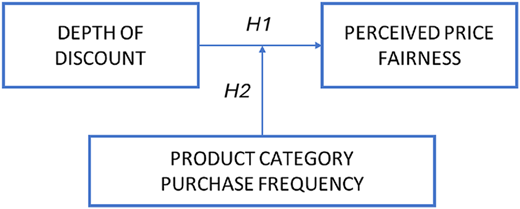
In the situation of price differentiation between online and offline channels, apart from the depth of discount between the channels, there are factors that could affect the consumer perceived price fairness. First, the product category being purchased could evoke different levels of price fairness perception. Second, the purchase frequency could be a differentiating factor, as the customers, while accepting the price difference in the case of seldom purchased products, they might be more upset, if the situation concerned frequently purchase products. Therefore, the hypotheses set for this research were defined as follows (see also the Research model at Figure 1):
The depth of discount online vs offline impacts the perceived price fairness.
In a situation of price discount online vs offline, the relation between price discount and perceived price fairness is moderated by (H2a) product category, and (H2b) purchase frequency.
3. Data and methods
3.1 Method
The between-subjects research design employing scenario approach was used in this study. Only respondents who purchased a given product category at least once in the last 12 months were invited to the survey. Within the three product categories (toys, cosmetics, food & beverages), the respondents were asked to imagine that they were about to purchase a product at a price of approximately 16.50 EUR. They were supposed to imagine they needed the product either for tonight (urgent purchase) or in 1–2 weeks (non-urgent purchase). The price scheme assumed prices lower online, with the delivery time and costs set at 48-h delivery and 2.6 EUR. After being exposed to a given scenario, the respondents were asked to assess the fairness of the pricing scheme.
Within each of the three product categories, the level of online discount, and the purchase urgency were manipulated. Additionally, 3 reference cells were included (0% discount; 3 product categories; non-urgent), getting us to the final number of 15 cells.
The latest European e-commerce report by ECDB (2024) claims Fashion, Electronics, and Hobby & Leisure to be the primary revenue e-commerce product categories. Of the three biggest e-commerce categories, Fashion and Electronics have been extensively researched, while Hobby & Leisure was not, that is why it was chosen for this research. Also, majority of the existing research studied low-level discounts (−5%, −10%, −15%), while according to the latest observational research of retailers' behaviour, the online discounts in the Hobby & Leisure category reached higher levels (Kiczmachowska, de Pourbaix, & Jemielniak, 2023). Therefore, in this research, we covered −10% and −40% online discounts.
The data were collected with the CAWI method. The analysis employed descriptive statistics, correlation analysis, independent sample tests (Mann Whitney U-Test, Kruskall-Wallis Test), while moderation analysis was made using SPSS PROCESS macro (Hayes, 2012). Non-linear relationships were tested with artificial neural networks (Multilayer Perceptron).
3.2 Variables
Perceived price fairness was assessed using 3-item scale of the price being reasonable, acceptable, or justifiable (Bolton et al., 2003). Other variables included age, gender, urban/rural inhabitancy, purchase frequency, Internet usage intensity, discount online vs offline, product, and purchase urgency (Table 1).
3.3 Sample
A total sample of 1,065 respondents were interviewed, of which 898 stated the correct price difference (or parity) in the scenario. The sample was collected in Poland, the TOP-6 fastest growing e-commerce markets in Europe (ECDB, 2024), using Online Panel (Ariadna, 2024), which is the method that have recently gained popularity in management research, and its use in experimental studies is prevalent (Porter, Outlaw, Gale, & Cho, 2019). The scenario groups did not exhibit statistically significant differences in terms of gender, age, urban inhabitancy, or Internet usage.
4. Results
4.1 Sample and product category validation
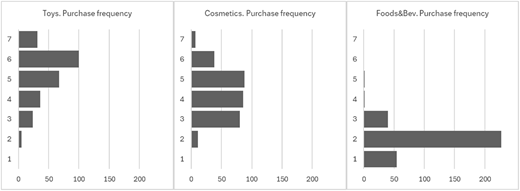
Three product categories were tested, characterised by different purchase frequency: non-frequent (Toys), frequent (Cosmetics), very frequent (Food & Beverages) (Figure 2).
The product groups turned out to significantly differ from each other in terms of purchase frequency. Pairwise comparisons showed significant different distribution for all the pairs of product categories (Table 2).
The respondents' groups assigned to the scenarios were similar in terms of their gender, age, and urban inhabitancy (Table 3): Kruskal-Wallis Test of the variables did not perform any significant difference in the variables distribution across scenarios.
4.2 Scale and scenarios validation
The perceived price fairness scale consisted of 3 statements of the price being acceptable, justifiable and reasonable (Bolton et al., 2003), and tested excellent on reliability (Cronbach's Alpha = 0.943), and validity (Table 4).
Scenarios were assessed as easy-to-understand (M = 6.34; SD = 1.2), and realistic (M = 6.11; SD = 1.2). Additionally, the assessment was consistent across the scenarios: the Kruskal-Wallis Tests for easy-to-understand and realistic variables did not show any significant differences in their distribution across the scenarios (Table 5).
4.3 Group comparisons
Total sample correlations analysis returned statistically significant correlations of fairness to age (0.093, p < 0.01), Internet usage (0.118; p < 0.01), discount (−0.182; p < 0.01), and product category (−0.069; p < 0.05). It did not show statistically significant correlation to gender, urban inhabitancy, purchase frequency, or purchase urgency (Table 6). The interpretation would be that the youngest respondents perceived price differentiation as significantly less fair vs older respondents. Also, the higher was the discount, the lower turned out to be the perceived price fairness. However, the respondents assessed price fairness lower for cosmetics and food & beverages categories, in comparison to toys, which were purchased the least often.
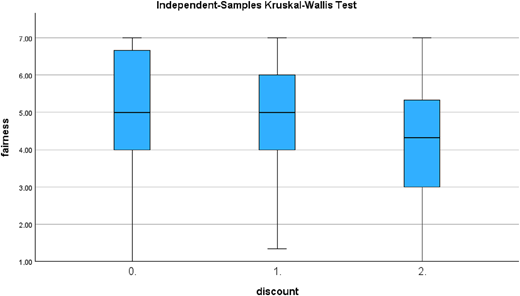
The independent samples Kruskal-Wallis test carried for discount in relation to perceived price fairness proved that there were statistically significant differences in distribution of the perceived price fairness across discount levels (Table 7).
4.4 Moderating effects of product and purchase frequency
Regression analysis with SPSS PROCESS macro by Hayes (Model 2; Hayes, 2012) revealed statistically significant moderating role of product category in cross-channel price discount relation to perceived price fairness (p < 0.05), while the moderating role of purchase frequency was not statistically significant. Age and Internet usage turned out to be statistically significant covariates, while gender, urban inhabitancy, and purchase urgency did not. The model turned out to be statistically significant (p < 0.001), with R-sq = 0.0749, meaning that it explained 7.49% of perceived price fairness variability (Table 9).
The slopes for discount, product, age, purchase frequency, and Internet usage were statistically significant, negative for discount, product, and purchase frequency (discount: b = −0.4355; se = 0.0805; p < 0.01; product: b = −0.3477; se = 0.1079; p < 0.01; purchase frequency: b = −0.1293; se = 0.0517; p < 0.05), and positive for age (b = 0.1656; se = 0.0413; p < 0.01) and Internet usage (b = 0.1516; se = 0.0426; p < 0.01). Significant and negative slope for discount confirmed H1.
The interaction term for product was statistically significant (b = 0.3161, se = 0.1434, p < 0.05), indicating that the relationship between discount level and perceived price fairness was conditional on the level of product category, therefore H2a was confirmed. The interaction term for purchase frequency was not statistically significant (b = 0.0772, se = 0.0700, p = 0.2704), indicating that the relationship between discount level and perceived price fairness was not conditional on the level of purchase frequency, so H2b was rejected. The R-sq improvement of product moderating role was calculated at R-sq-chng = 0.0044, and for purchase frequency at R-sq-chng = 0.0012.
4.5 Multilayer perceptron (MLP)
Artificial neural networks are very popular for modelling non-linear problems and for the prediction of the output values for given input parameters from their training values. Multilayer perceptron (MLP) is one of the most commonly used types of artificial neural networks; it utilizes a supervised learning technique (backpropagation for training) (Gorjani et al., 2021). MLP is composed of multiple layers, including an input layer, hidden layers, and an output layer, where each layer contains a set of perception elements known as neurons. The multilayer perceptron algorithm can be used to build a prediction system or forecasting model (Chan et al., 2023), and many researchers claim the superiority of neural network over statistical models in prediction tasks (Ismail, Awang, Rahman, & Makhtar, 2015; Pirmohammadi & Mast, 2020).
The variable used for assigning respondents to two groups (Median Perceived price fairness) was created by using the Median, and the cases were split using visual binning function in SPSS. Rerunning MLPs returns different results, as each time the assignment of the items to training and testing groups is random, therefore it is advisable to run the MLP several times to check the stability of the model. MLPs run for low/high (Median split) perceived price fairness solution, returned models with percent incorrect prediction levels within 36% to 41.3%, the best performing models summaries are shown in Table 10. The Training Models returned Percent Incorrect predictions of 39% for Model 1and Model 2, while Testing Models returned Percent Incorrect Predictions of, respectively, 36.5% and 41.3%.
The Classification Table (Table 11) indicated that Overall Percent Predicted Correct was similar across Training and Testing environments, 61.0% and 63.5% for Model 1, and 61.0% and 58.7% for Model 2. In MLPs, the Area Under the ROC Curve indicates how optimal the model is. In this study, we adopted the following criteria to interpret the area under the ROC curve: (A) 0.90–1 = excellent; (B) 0.80–0.90 = good; (C) 0.70–0.80 = fair; (D) 0.60–0.70 = poor; (E) 0.50–0.60 = fail (Aryadoust & Goh, 2014). In our case, for Median solution, both models indicated acceptable levels (Table 12) getting 0.659 for Mode l 1, and 0.667 for Model 2.
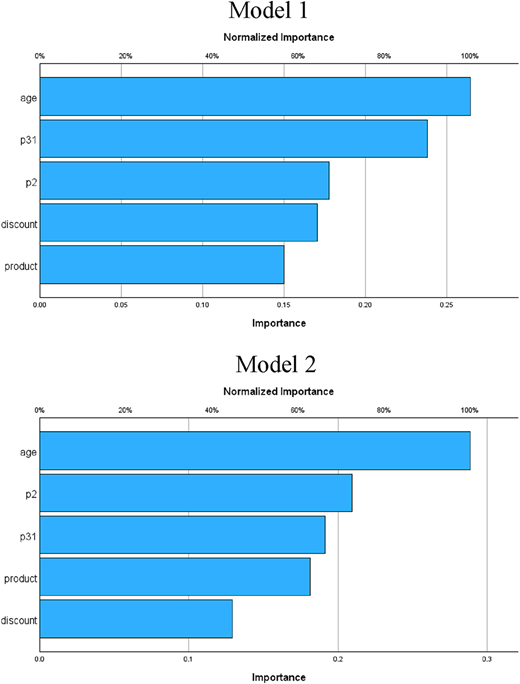
Finally, a normalized Importance Index for each independent variable was calculated, which indicates the weight of each independent variable in predicting the dependent variable, and ranges from 0% to 100%. Higher indices indicate the higher contribution of the variable to predicting or classifying the dependent variable (Aryadoust & Goh, 2014). In our case, the importance of the independent variables differed moderately across the two models (Table 13), which was further depicted in Figure 4.
In both models, the age scored the highest (100%), followed by Internet usage (90%; 66.3%) and purchase frequency (67.1%; 72.6%), with product (56.7%; 62.8%), and discount (64.4%; 44.7%) closing the list.
In summary, the MLP models delivered satisfactory results in predicting the perceived price fairness. Further attempts to run the MLP models for Tertile or Quartile splits of cases according to their perceived price fairness assessment, failed to perform on medium ranges (2nd tertile, or 2nd and 3rd quartiles), as well as on total model performance, therefore their detailed descriptions will not be displayed here.
5. Discussion
As assumed, and in line with previous research (Fassnacht & Unterhuber, 2016; Homburg et al., 2019; Narwal & Nayak, 2020; Hufnagel et al., 2022), the depth of discount had statistically significant impact on perceived price fairness in price differentiation strategy: the higher the discount, the more unfair this strategy was perceived by the customers. However, −10% discount did not reveal statistically significant differences vs parity scenario, leading to the conclusion that low level online discount is assessed approximately equally fair vs parity scenario, provided the delivery costs were incorporated in the equation.
Further, previous research suggested that the product category influenced consumers' acceptance of cross-channel price differentiation, provided the prices were lower online. Homburg et al. (2019) reported that impulse purchases turned out to be more feasible for offline premiums when compared to planned purchases. Fassnacht and Unterhuber (2016) suggested greater acceptance of price differentiation for look-and-feel product categories than for quasi commodity products. Our study extends these findings with frequent purchase product categories. According to our analysis, the price discount online was perceived as less fair in more frequent and repeated purchase product categories, such as cosmetics or food & beverages, when compared to non-frequent product categories (toys). This could suggest that the consumers' acceptance of price differentiation strategy was higher for products that were more a once-off purchase, but the respondents were rightly more reluctant to accept it, if the product was supposed to be purchased frequently and repeatedly.
The interesting finding about age was that the oldest (55+) and the youngest (18–24) age groups significantly differed in their perception of price differentiation strategies, while the perception of all the remaining age groups was largely the same (between the assessments of old and young respondents). So the relationship between the age and perceived price fairness was not that it was improving gradually with age, but it was falling approximately into frames of generations Z, Y, and X, which could constitute an interesting future research path.
Finally, we did not confirm purchase urgency as a variable significantly impacting the perceived price fairness of cross-channel price differentiation, suggesting that time pressure of the purchase did not significantly affect the perceived price fairness. Our initial assumption was that the consumers faced with the online price discount would be more upset if they would be forced to pay premium offline because of time pressure. However, it seems that respondents assessed the fairness of the equation detached from the purchase urgency. Possibly, they were blaming themselves for the urgency of the situation, as they could have planned the purchase in advance.
6. Conclusions, limitations, and future research recommendations
This study is up to our knowledge the first to analyse frequently purchased products in the context of cross-channel price difference strategies implementation in multichannel retail. Following the framework for multichannel customer management in the area of coordinating the prices across channels (Neslin et al., 2006), and building on price fairness theory (Xia et al., 2004), we extended the scope of product categories, depth of discount, and added the dimensions of purchase urgency, and the channel/delivery scheme choice. We also shed light on the role of consumers' demographic and behavioural features in the price fairness perception.
This research added to the existing multichannel retail management framework and price fairness theory in several ways. First, it confirmed the level of discount as a variable negatively impacting the perceived price fairness. However, low-level online price discount (−10%) did not receive statistically different assessment vs price-parity scenario in a situation when additional costs of online purchase delivery were incurred. Second, it enriched the existing model with the purchase frequency variable, suggesting that the product categories that are frequently and repeatedly purchased receive lower perceived price fairness of the price differentiation strategy. Third, this paper indicated that age related to more favourable assessment of price differentiation strategies: the 55+ respondents assessed it as the most fair, while 18–24 years old respondents assessed it as the least fair.
The limitation of this research is that it tackled two levels of online discount, as a reference to the price-parity scenario, while additional research of medium online discount would constitute an important future research path. Another limitation is that it considered medium price level, which could limit the range of products in scope. However, as the purpose of this study was to investigate the role of product category, such a limitation to one common price level had to be made. Nevertheless, further research comparing lower (and more adequate to frequent purchase products) price levels, would be an advisable future research direction. Although the research sample was panel-based, which carries certain limitations to the generalisability of the findings, its size (898 respondents) and demographic structure in line with the Polish population, should be able to reduce those concerns.
Ethical statement
This study was conducted in accordance with the ethical standards of the Kozminski University Warsaw and was reviewed and approved by the Research Ethics Committee of the Kozminski University (Date of Approval: 20/02/2024).
All participants provided informed consent prior to their participation in the study. Participation was voluntary, and respondents were informed of their right to withdraw at any time without consequences. All data were collected and stored confidentially and used solely for research purposes.
This research is a part of the Project Consumer price sensitivity under conditions of technological change in trade that was financed by the Polish National Science Center – Opus 23: Grant no 2023/49/B/HS4/02536. The Authors would like to thank the Polish National Science Center for their contribution.