A positive online learning community fosters active social interaction and deep social connectedness among learners. Social presence in asynchronous online discussions (AODs) is critical to forming an active learning community. Observation techniques, content analysis using the community of inquiry framework, and social network analysis were employed in this longitudinal study exploring patterns of social presence behaviors in AODs across two online courses over two semesters for a single cohort of graduate students. Findings suggested that varied instructional stages and instructor involvement were crucial factors in learners achieving higher social presence in AODs. Learner interaction frequency and several postings did not adequately represent levels of social presence. Techniques are recommended to prompt learner engagement in AODs to scaffold meaningful online learning experiences.
Introduction
Without a supportive online environment, engaging learners in deep-level online learning is challenging (Ding, 2019). Social learning strategies have prompted learner engagement in online courses to build a more supportive and effective learning community (Liu et al., 2007, Phirangee, 2016). Asynchronous online discussions (AODs) have evolved as a widely used instructional technique to prompt social interactions and information exchanges during online learning (Gao et al., 2013; Koszalka et al., 2021). Participating in AODs allows learners ample opportunities to interact and communicate by sharing their thoughts, asking questions, and giving feedback (Yang et al., 2010). Social presence (SP), a sense of belonging among participants in a community of inquiry, indicates effective learning in online contexts (Garrison & Akyol, 2013). The belonging suggests a willingness to participate, comfort in participating, and the ability to learn more efficiently with others. Studies have suggested that, in online environments, a higher perception of SP usually indicates a better ability to achieve the desired collaborative learning-related outcomes (Reio & Crim, 2013). Learners perceive socially absent online environments as impersonal, where they are often less ready to share knowledge. Thus, a lack of SP and connection may frustrate learners, make them unsatisfied with a course, and be less engaged in deeplevel learning (Reio & Crim, 2013). To prompt perceptions of a fulfilling social learning environment that will result in a positive online learning experience, it is critical to foster a strong sense of SP among learners in online courses.
Though considerable efforts have been devoted to studying the importance of establishing a SP in online learning, few studies have more fully explored the nature and development of SP in the online learning environment (Lowenthal & Dunlap, 2018, 2020; Picciano, 2002; Rourke & Kanuka, 2009; Swan & Shih, 2005). Most research on SP evaluated and measured learner perceptions of SP by employing self-report surveys and postlearning experience interviews. These techniques neglected to measure the presence and magnitude of actual SP behaviors. Empirical evidence suggests there is not always consistency between learner self-reports and their actual behavioral interaction (Picciano, 2002). Thus, studies using only perception self-reports may have inflated findings.
Social presence in the online learning environment should be viewed more scrupulously, using, for example, observational techniques and social network analysis to map patterns and characterize the attributes of online interaction. Also, given that most SP studies were short-term periods within the same context (or course) with different participants, additionally investigating that explores the nature and development of SP over time and across different contexts may be helpful to unpacking this complex environment. By conducting a longitudinal study beyond the self-reporting strategy, we intended to explore the patterns and levels of SP among the same cohort of graduate students in several AOD sessions across two online courses over two semesters. Observation techniques, document analysis, and social network mapping were employed to distinguish the behavioral interaction characteristics and development of social interactions and SP in the online environment.
Literature Review
Social Interaction in Asynchronous Online Discussions
Social interactions can be recognized as how learners and instructors exchange knowledge and thoughts. An online learning community where learners can learn with each other’s thoughts and perspectives through social interactions is beneficial to their learning experiences (Dabbagh, 2005). Since the success of online courses is often directly related to the quantity and quality of interactions (Picciano, 2002), the instruction on social interaction scaffolding and opportunities should be deliberately designed to foster interaction in specific ways through timely and focused postings and responses in AODs (Bernard et al., 2009).
The community of inquiry framework (CoI) provides measures for researchers to investigate interactions in online learning environments and choose possible strategies to increase learning experiences and outcomes (Arbaugh et al., 2008; Garrison et al., 2000). The CoI survey was employed in the study by Cho and Tobias (2016), where learner interactions in different online discussion conditions were investigated. The results suggested that interaction with the instructor was the most important factor explaining SP. Huang et al. (2017) used the CoI SP subscale to examine learner interactions and SP in different learning stages, confirming the crucial role of interaction in forming a learner’s SP in online learning. Though these studies suggested that the CoI survey was a valid, reliable, and efficient measure of social interaction and its association with a SP, it is worth mentioning that self-reporting is not always accurate. Thus, it is advantageous also to employ other methods to confirm, validate, and provide more sophisticated ways to examine and analyze learner interaction in online courses (Picciano, 2002).
Social interaction and presence are closely related concepts, and the latter has often been used synonymously. However, a recent, more precise definition clarifies the difference in the connotation of social interaction to a perception of connectedness (Huang et al., 2017). The interaction may demonstrate presence. Nevertheless, in posting and interacting in an online environment, learners may not necessarily feel a presence or belonging to a group (Picciano, 2002). Presence is a complex variable warranting further explorations using different research approaches beyond selfreporting.
Social Presence in Asynchronous Online Discussions
Social presence is “the ability of participants to identify with the group or course of study, communicate purposefully in a trusting environment, and develop personal affective relationships progressively by way of projecting their individual personalities” (Garrison, 2009, p. 32). According to the CoI framework, the process of creating an online learning environment that promotes higher order thinking and deep levels of learning consists of the development and interactions among three interrelated presences: SP, cognitive presence, and teaching presence (Garrison & Arbaugh, 2007; Garrison et al., 2000). Cognitive presence refers to the inquiry process that fosters deeper thinking about content, leading the learner to construct meaningful learning (Garrison et al., 2000). Teaching presence consists of faculty-directed instruction for effective learning, pedagogical methods, and course design (Swan et al., 2008). Social presence has been used to understand learners’ interactive behaviors in online environments (Saadatmand et al., 2017). It is conceptualized as a combination of affective responses (AR), interactive responses (IR), and cohesive responses (CR; Rourke et al., 1999). In addition, specific indicators were developed for SP categories to help researchers identify observable SP instances and to analyze the AOD transcripts (Rourke et al., 2001).
Studies have focused on techniques to help establish and enhance SP in AODs to gain more meaningful online learning experiences. Empirical evidence from Chen and Liu’s (2020) study suggested that assigning different sizes of online discussion groups and specific discussion requirements generated different SP frequencies. Similar results also showed in Akcaoglu and Lee’s (2016) study that small and permanent discussion groups augment learners’ perception of SP in AODs. Lee and Huang’s (2018) study comparing a regular 16-week semester online with an intensive 5-week online course also found that providing more interaction opportunities (longer time) helped learners to develop a higher SP.
Beyond these studies, instructor involvement was a critical aspect that influenced how learners interacted and perceived SP in AODs. While Costley (2015) found that increasing the amount of instructor control over the AODs decreased the amount of SP within the learners’ posts, Lowenthal and Dunlap’s (2018) study demonstrated that learners were more interested in connecting with their instructors than their peers. These contradictory findings suggested that SP is more complicated than expected. Moreover, Lowenthal and Dunlap’s (2020) study identified instructional tasks and previous relationships as other situational variables that influenced SP in AODs. Thus, essential design factors, including group size, amount of interaction time allocated, instructor role, instructions that guide discussions, instructional tasks, and peer relationships may affect the establishment and maintenance of SP within AODs.
Social presence within online environments significantly influences learners’ learning experiences. However, how educators should facilitate and examine the establishment and the extent of SP to help learners better achieve a meaningful online learning experience is less certain. Critical research is still needed to understand the nature and development of SP in online courses.
The Current Study
This study uses longitudinal field observations that followed the same cohort of graduate students who participated in the same two online graduate-level courses’ AODs, over two semesters. A multiple instrumental case study design was used, and “multiple cases were described and compared to provide insight” (Creswell, 2002, p. 465). The fall semester course focused on learning outcomes associated with introductory instruction on educational technologies used in instructional settings. In contrast, the spring semester course focused on the fundamentals of educational project management, supporting learners in developing competencies to manage educational projects.
The AODs, as the major activities in both courses, engage learners in idea exchange and demonstrate evidence of learning course content. Both courses’ AODs began in the second week with an introduction to the course objectives, content structure, assignments, and learners’ responsibilities. Prerequisite readings and prework were shared in the course management system to prepare learners for content-related discussions. Each AOD opened for 1 to 2 weeks and required learners to post at least one initial response to a moderator question and two content-substantial responses to peers. In both courses, AODs were self-monitored with limited instructor involvement, and learners were graded based on participation level and content focus. Although each of the AODs covered different content topics, all AOD threads were prompted with surface and deep-level content questions. Learners were required to demonstrate their learning outcomes from prework and think reflectively when articulating their ideas and interpretations. Table 1 presents the summaries of the two courses and their AOD designs.
Research Questions
The specific research questions included:
What were the patterns of SP identified within a single cohort of students in AODs across two online courses over two semesters?
What were the levels of SP noted within a single cohort of students in AODs across two online courses over two semesters?
How did social interaction and SP emerge in AODs across two online courses over two semesters? Did they remain consistent or appear different?
Methodology, Data Collection, and Analysis
The first case consisted of 5 AOD introductory educational technology topics, while the second included 5 AOD introductory project management topics. An IRB-exempt status was also given to this study. The AOD scripts were downloaded and used as the primary analysis data.
Transcript analysis of learners’ AOD postings was applied using the categories and indicators defined in the CoI framework. SP was analyzed by coding for affective, interactive, and cohesive responses (Swan, 2003; Hughes et al., 2007). See the appendix. MAXQDA software was used to code and analyze the data. The analysis unit combining the thematic unit’s flexibility with the syntactical unit’s reliability is the most appropriate (Rourke et al., 1999). A more accurate frequency of SP behaviors can be captured using a smaller unit of analysis, which can also show the logic of indicators and preserve identification consistency. Thus, this study coded SP behaviors at the sentence level, whereby a single sentence could include multiple SP behaviors. Through an iterative coding practice process, two coders finalized the coding scheme with an interrater agreement of 0.75. The descriptive analysis presented the total number of postings, sentences, and instances of SP at both category and indicator levels in response to the question about patterns of SP behaviors. Social presence levels (average SP per sentence) were calculated and compared across two courses by individual AOD and learner, respectively. Social network mapping analysis was conducted through the Gephi program to investigate and visualize the interaction patterns and relationships among the same cohort of students across two courses. All figures are included at the end of the paper.
Results
Participants
The participants, the same single intact cohort of graduate students (N = 12), completed introductory educational technology survey-type course in the fall of 2020 and an introduction to educational project management course in the spring of 2021 for a master of science instructional design program at a private northeastern university in the United States. The average age of the participants was 44 years old, and most were male (80%). Most participants were on active-duty military (80%), while the others were veterans (20%). Participants had taken an average of four or more previous online courses. In addition, half of the participants had some experience using educational technologies (50%), followed by participants who had sufficient experience with educational technologies (25%) and those who had little to no experience with educational technologies (25%). All participants completed consent forms permitting us to launch content analysis on their online discussion postings from both courses.
Learner Participation
Five AOD cases from each of the two online courses were analyzed in chronological order. Learner participation in both courses was regularly recorded in Table 2. Compared to the fall semester, learners posted more frequently (Npostings = 289) but wrote fewer sentences (Nsentences = 1,698) in the spring semester. The number of learner postings among five AOD cases ranged from 46 to 71 in the fall course and from 52 to 67 in the spring course. Learners engaged and wrote the most for AOD Case 5 in the fall course, whereas they posted the most for Case 3 and wrote the most for Case 5 in the spring course. Learner engaged the least for AOD Case 2 in both courses.
Descriptive statistics are reported in Table 3 at the SP category and indicator level to address the first research question.
Social Presence Category Pattern
Both courses revealed that CR presented the most and had the highest overall mean scores (Mfall = 98.6, Mspring = 101.2), followed by IR (Mfall = 90.2, Mspring = 76.0), and AR (Mfall = 37.6, Mspring = 51.4). A similar SP categorical pattern was also found in Lowenthal et al.’s (2020) study, where affective indicators were used the least (1373 times) within their sample compared to interactive (2581 times) and cohesive indicators (2454 times). Across all the AODs in the fall term, the mean score difference between IR and CR (Minteractive = 90.2, Mcohesive = 98.6) was relatively minor compared with the ones between these two categories and the AR (Maffective = 37.6). Such mean score difference between CR and AR suggested that learners had a stronger ability to identify with the group and share commitment in achieving learning goals, but this does not map their self-projection into and within the learning community (Garrison, 2009; Rourke et al., 1999).
Social Presence Indicator Pattern
Given that very little previous SP research has reported findings at the indicator level (Lowenthal et al., 2020), this study looked more deeply at the occurrence and frequency of individual SP indicators across two courses. According to the comparisons of SP indicators, humor was used least frequently in the affective category—the least used indicator in Lowenthal et al. (2020) study, followed by emotion; complimenting was used the most frequently in the interactive category, followed by acknowledgment. Group reference and vocative—one of the top three indicators in Lowenthal et al.’s (2020) study, were the two SP indicators used the most and almost at the same frequency in the cohesive category. In contrast, greetings and embracing the group were used the least.
Levels of Social Presence Categories
To address the second research question, comparisons between the two courses were launched by calculating the levels of SP categories and indicators. Based on Rourke et al.’s (1999) SP density, we calculated the SP level by averaging the SP instances of each sentence (as opposed to per word in Rourke et al., 1999). Detailed results were presented in Table 4, where we found a higher overall SP level in the spring course (0.673) than in the fall course (0.551). More specifically, all three SP categories in the spring term had higher SP levels than the fall term: affective responses (fall = 0.091; spring = 0.151), interactive responses (fall = 0.220; spring = 0.223), and cohesive responses (fall = 0.240; spring = 0.300). Within the same cohort of students, the same level of substantial increases was found in both affective and cohesive responses from the fall term to the spring term (AR = 0.061; CR = 0.060) compared to the minor increase in interactive responses (IR = 0.003). Over the two semesters, learners strengthened their ability progressively to develop personal affective relationships and reached a shared commitment to achieving learning goals together as a learning community (Garrison, 2016). suggesting that longer interaction time and collaboration experiences might help facilitate learners’ degree of comfort in recognizing each other in an online learning community.
Levels of Social Presence Indicators
Although all three SP categories’ levels had increased within the same cohort of students across two courses, not all SP indicators contributed to the increase within the same category in the spring term. All indicators were increased over time except emotion in AR, agreement/disagreements and invitation were decreased in IR, and greetings and embracing the group in CR were decreased.
It is explicit that the highest reflected indicators of SP level across both courses were vocatives and group references. Nevertheless, the level of self-disclosure was enhanced the most among all indicators, together with the increases of paralanguage and humor within the affective category, suggesting the same cohort of graduates had gradually established a trusting learning community across two semesters, where they felt safe as well as being identified and accepted. Thus, by participating and collaborating in the discussion activities, learners felt more comfortable and brave in sharing personal information and showing vulnerabilities or feelings among each other in the spring course. However, as learners exposed more personal feelings and experiences, they tended to focus less on exchanging knowledge or feedback related to the course content in terms of the decreases in agreements/disagreements and invitations that might contribute to the minor increase in the overall interactive category level.
Levels of Social Presence by Each AOD
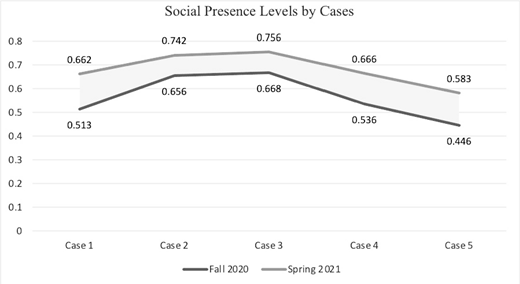
Figure 1 shows how SP level was established and manifested in each AOD across the fall 2020 and spring 2021 courses. Overall, each AOD case in the spring course had a higher level of SP than those in the fall course. Surprisingly, two courses shared the same fluctuations throughout the five AODs, where both courses’ SP levels ranged from the lowest in discussion Case 5 (D5) to the highest level in discussion Case 3 (D3), suggesting different time points throughout the course semester might influence learner’s level of participation and engagement in interacting and using SP behaviors with each other. Therefore, we looked at each SP category level separately in the two courses.
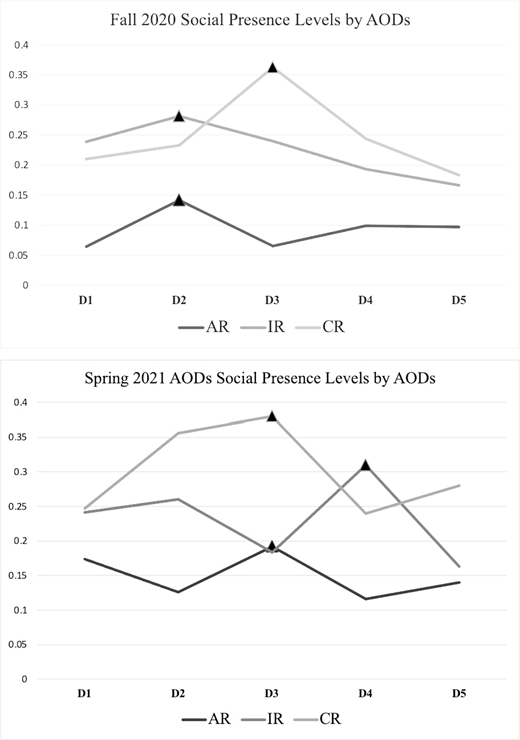
As Figure 2 shows, the highest levels of the affective and interactive category were found in D2, and the highest cohesive category was found in D3 in the fall course. In contrast, the highest levels of affective and cohesive categories were found in D3 in the spring term, whereas D4 had the highest interactive responses level indicating that the discussions in the middle of the course could be the most productive and effective period for learners to establish SP. In both courses, all SP categories dropped nearly the lowest level after reaching the highest SP category level.
Levels of Social Presence by Each Student
As shown by Table 5, we explored the SP level at the individual learner level to see if all learners’ SP levels had increased and if their levels had increased in each category over time. A paired sample t test was also conducted to learn the differences in learners’ SP levels in the two courses. Our result t(11) = 3.93, p < 0.05 indicated that learners’ SP level in the spring term was statistically significantly higher than in the fall term. Cohen’s d was estimated at 1.135, a very strong and large effect based on Cohen’s (1992) guidelines, confirming that more time and more opportunities for collaboration help increase a learner’s SP level.
Nevertheless, a learner’s high overall SP level does not necessarily equate to a high level in each of the three categories. While S4’s affective levels were the highest in both courses, S4’s interactive level in the spring term was the lowest. Similarly, while S9 had the highest interactive level in both courses, S9’s affective level in the fall term was the lowest, suggesting that learners may have varying degrees and different preferences for SP behaviors. (Lowenthal & Dunlap, 2020). They may be better at using specific categories of SP categories than others, as well as having their preference for forms of communication to present various SP behaviors. Moreover, among the three SP categories, there are more learners whose IR level has decreased over time compared to AR and CR (e.g., S2, S3, S4, S5, S9 in grey).
Student Interaction and Relationship Patterns
To understand whether learner social interaction truly matched their SP level, a social network analysis was conducted to map the same cohort of students’ interactive activity patterns and relationships in each course, including posting characteristics such as frequencies and postings’ popularity and interaction group.
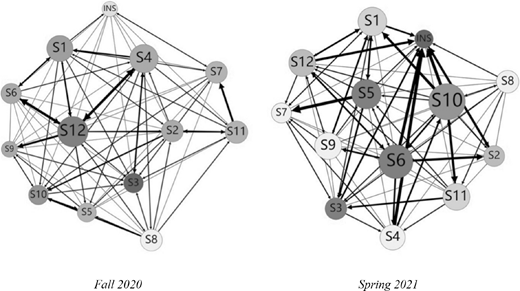
As shown in Figure 3, each map includes 12 nodes representing the learners and one node representing the instructor (labeled INS). The node size indicates each learner’s activity level in responding to others’ posts in AODs, obtained by calculating the total number of responses sent out by a learner divided by the total number of participants. The node color indicates learners’ popularity and centrality within the AODs, obtained by calculating the total number of responses the learner received divided by the total number of participants. The edge and its width connecting the nodes represent the frequencies of learner interactions, and the arrows point out the directions of interactions.
The spring course map revealed relatively more significant nodes suggesting a higher rate of learner interaction in replying to others’ postings and an increase in nodes in darker green, indicating more popular posts that elicited resonance and sympathy among peers. Additionally, the spring course had more thick and evenly distributed edges within the same cohort of learners than the fall course, suggesting learners had created a more social interactive learning community without confining their communications and interactions within a fixed small social circle. Furthermore, while the sizes of both instructors’ nodes were almost identical, the spring course’s instructor had a darker green node color, indicating that the instructor’s postings and comments drew greater attention and prompted more discussions among learners.
Combined with our previous results, we found that learners with more significant nodes and darker node colors were not those with the highest SP level. For instance, in the fall term, while S12 had the most significant node size and darkest node color, indicating a higher frequency of social interaction, S12 had a relatively lower SP level than the top three learners (e.g., S4, S9, S3). Similarly, in the spring term, while S10 and S6 had bigger node sizes and darker node colors, their SP levels were lower than S4, S9, and S3. By performing correlation tests for both courses (r(10) = 0.025, p = 0.938 in the fall course; r(10) = 0.277, p = 0.383 in the spring course), no statistically significant correlation was found between learner’s social interaction frequency and SP level. Higher interaction or posting frequency may not assure a higher SP level without knowing the postings’ quality and content. It is also possible that learners post less frequently, but the content of each posting has more SP behaviors.
Discussion
Instruction Stages
The overall SP levels in the two courses produced very similar fluctuations throughout the five AODs, suggesting different time points throughout a course semester might influence learners’ levels of participation and engagement when interacting with SP behaviors with each other. As seen in Figure 1, both courses’ trajectories indicated a steady increase in SP levels from D1 to D3. Then both fell sharply to the lowest level after reaching the highest level. The same repeating pattern of SP level revealed that the earlier to the middle of the course would be the most productive and efficient time for learners to establish a SP. Hence, instructors should be mindful of earlier instructional stages and plan strategically to set up the AOD environment that will better prepare and scaffold learners for deeper interactions and learning later in the instruction (Garrison & Akyol, 2013; Garrison et al., 2000). It may be more beneficial, efficient, and meaningful to help learners build higher SP and sustain those behaviors at a stable level throughout the course rather than achieving high levels of SP and then reverting to low levels. Thus, online instructional designers and educators should carefully develop and arrange AOD activities based on different stages of instruction. Continuously exploring instructional strategies that can maintain learner SP at higher levels is of great necessity to continuous learning.
Social Interaction and Social Presence
The results of this study support previous research findings that longer interaction time and more opportunities for interaction aid in establishing and developing SP (Figure 3). Through continuously interacting and collaborating, the same cohort of learners built stronger group cohesion and a more trusting learning environment over the two semesters. However, when we compared individual learners’ actual interactions to their SP levels, as shown in the social network maps, we discovered that more social interactions did not always correspond to higher SP levels. Though interaction may demonstrate presence, learners may not sense the presence or belong to a group when posting and communicating online. Thus, further exploration is needed to identify the benchmark and criteria for guaranteeing meaningful learner interactions, which would help facilitate SP in online courses. More research into the relationship between different types of social interactions and SP levels is required to determine which interaction conditions may best support higher SP levels.
Instructor Involvement
In this study, with the limited amount of instructor involvement in both courses, the higher popularity of the instructor postings in the spring term suggested that the quality and content of instructor feedback and comments seem to be more essential and effective in helping learners establish higher levels of SP in AODs. We concur with the results of previous studies that the structure of a discussion, as well as how an instructor posts (e.g., modeling and setting the tone), can influence how learners post (An et al., 2009; Casey & Kroth, 2013; Dennen, 2005; Lowenthal et al., 2020). Online instructors should be attentive to their role as instructors to influence learner SP positively. This attentiveness may include entering and posting messages, prompting quality discussions on course content, providing feedback, and modeling tones and styles of asking prompt questions that might arouse further and deeper discussions.
Although the same cohort of learners related and shared more about personal experiences as they were getting used to interacting and communicating with each other as a group, they appeared to post fewer comments about course content based on the decreased overall usage of interactive communication. This finding implies that a lower number of learning behaviors were observed. Thus, we recommend that instructors monitor and motivate learners to interact in meaningful content-learning exchanges. Research should further examine why learners’ interactive responses may decrease over time and which instructional techniques may effectively facilitate higher and continuous levels of SP in AODs.
Conclusion
This longitudinal study investigated patterns and levels of SP among the same cohort of students in two courses that spanned two different semesters. Learner discussion posts indicated that SP was an essential part of AODs. The results of this study suggest that different time points over a course semester may influence learners’ levels of participation and engagement while interacting with SP behaviors with each other.-Specifically, the middle of the course may be the most productive and effective period for learners to establish SP and deep-level learning. Knowing that maintaining a limited amount of instructor involvement helps build SP, we found that the content and quality of the instructor’s postings also appeared to be crucial and effective in helping learners establish higher SP levels in AODs. Lastly, more frequent interactions and postings on AODs may not guarantee a high level of SP, highlighting the need to examine and understand the quality and content of the postings. The findings of this study help unpack the complexity and establishment of social relationships and provide insights into making AODs more productive in prompting learners to engage with each other and learn course content with each other. Thus, these results inform instructional designers and online educators on possible techniques to enhance and prompt learner participation and engagement in AODs to gain more meaningful online learning experiences. Hence, the analysis of these case studies provided further insights into the growth of knowledge on SP levels in AODs.