The top-down approach of assigning the whole class articles by authors of historically privileged identities, and expecting students to dutifully read and reflect in writing, is an ineffective way to respect, excite, connect with, and challenge students, most especially students of identities historically marginalized in the online academy. In this article, I discuss how student-created texts can be used as an alternative to engage and affirm the humanities of students, the class, and communities beyond the classroom. Drawing upon Freirean (1970) notions of humanizing pedagogy, I explain how developing student-created texts can create space for students to center identity, values, place, and social change in their online class experience. Then, by engaging with texts created by peers, students learn from, with, and about others; therefore, fostering empathy, connection, and critically conscious inspiration among class participants. An illustrative example of student-created texts and accompanying assignments within the online higher education setting is offered. I advance the concept of student-created texts not as a universal method to simply be reproduced. Rather, Freirean humanizing necessitates radically reconstructed approaches enacted by critically conscious educators. Student-created texts may be one piece within a larger system of coursework, that when paired with critical ideology, foci, and dialog between students, professor, and community, can support online classroom communities aspiring to Freire’s ideals.
Why won’t students do the assigned readings? That’s the question on the minds of many online professors today. Assigning the whole class an article by authors of historically privileged identities, and expecting students to dutifully read and then reflect in writing is an ineffective way to respect, excite, connect with, and challenge students, most especially students historically marginalized within the online academy. When students have no choice or human connection to a text, why would they have any motivation to read it? Today’s online university students exist in a world where generative artificial intelligence (AI) can do the reading and write a reflection for them. When an assignment feels robotic, students won’t hesitate to submit a robotic response, if they bother submitting it at all.
Sure, a few eager students will always do the readings to earn their “A,” but who is left behind? It is no secret that dehumanized practices disproportionately exclude or harm university students of identities historically marginalized by society and systems. For example, graduation rates for Asian and White undergraduates are above average, while rates are below average for Hispanic, Pacific Islander, AmericanIndian/Alaska Native, and Black undergraduates (NCES, 2019). Online professors must take heed.
Student-Created Texts as a Humanizing Approach
Course texts can (and should) be reimagined. In what follows, I introduce the concept of student-created texts, or texts written, created, and published by the students within a course, as a way to engage and affirm students’ humanity. With this approach, students learn through text creation and then engage with texts created by their peers. Please note that I understand “texts” to include written and spoken word, visual materials including video or social media content, and collections of materials curated by students.
I come to this work as a professor of education who has taught online for nearly a decade, with a focus on infusing critical, feminist, and culturally sustaining lenses into my courses. For example, see my past work considering how assessments and grading can be critically reimagined to avoid the reproduction of inequity (Shelton et al., 2020). I find that student-created texts are one approach, among many, that professors can use to create space for students to center identity, values, place, social change, and counter-narrative in their online class experience. Engaging with texts created by their peers facilitates learning from and about others, with the potential to foster empathy, connection, and inspiration across class participants.
Freire’s Humanizing Pedagogy
To design online learning with student-created texts, I draw upon notions of a humanizing pedagogy, as initially introduced by Paolo Freire (1970) and then advanced by many scholars, key among them Lilia Bartolomé (1994) and María del Carmen Salazar (2013). Freire’s humanizing pedagogy demands that educators push beyond the manipulation and control of students, to instead foster humanização, or students becoming more fully creative, communicating, socially transforming participants in the world (Freire, 1970). Salazar (2013) explained that humanizing pedagogy must be:
Tied to social change
Rooted in respect, trust, and relations of reciprocity
Locally generated based on student input into the curriculum
Adaptive to the needs of marginalized students
Reflective of the diversity of students’ lives
Appreciative that students are experts of their own background knowledge
As Salazar (2013) emphasized,
Above all, Freire encourages educators to listen to their students and build on their knowledge and experiences in order to engage in contextualized, dynamic, and personalized educational approaches that further the goals of humanization and social transformation (p. 127).
Humanizing pedagogy cannot be reduced to decontextualized and reproducible methods (Bartolomé, 1994). Instead, humanizing pedagogy necessitates radically reconstructed approaches enacted by critically conscious educators who privilege students’ expression of consciousness. I therefore acknowledge that student-created texts must be part of a larger system of coursework, that together when paired with critical ideology, foci, and dialog, may aspire to approach the Freierian ideal of humanizing pedagogy.
Student-Created Texts: An Example from the Field
In what follows, I offer an example of how to engage Freirean humanizing pedagogy within the online classroom, through student-created texts. This example comes from a 7-week masters-level online course that I teach, entitled, Technology in the K–16 Classroom. This course is offered through a public state university, which is a recently minted Hispanic Serving Institution, located close to the Diné, Hopi, Hualapai, Havasupai, Paiute, and Zuni nations with expressed commitments to Indigenous student success and inclusive excellence (Northern Arizona University, 2024). I include these details to foreground the socially just mission of this university, which justifies the Freirean lens as a logical approach to serving the students and the communities in this context.
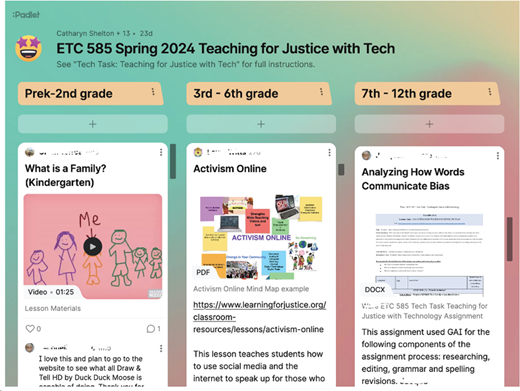
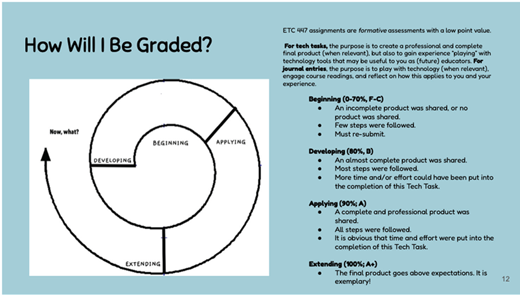
This example learning experience occurs over weeks 4 and 5 of the course. First students spend a week developing a text. Given the course’s focus on technology in the classroom, the text they develop is a technology-infused lesson plan focused on diversity, justice, and/or action and accompanying learning materials. Full details and instructions for this assignment are presented in Table 1. Students share the texts they create to a class Padlet board (https://padlet.com/), which is an online pinboard created by the professor, where students can post content, view content posted by others, and post replies to each other’s posts (see Figure 1). I use a free Padlet account. The next week, students engage with the student-created texts their peers developed, along with a popular press article. They then write a guided reflection connected to these texts (see Table 2). In my 7-week course, students engage a cycle like this developing student-created texts and dialoging around them for three different topics (the topic illustrated in this example, along with two additional topics).
Implementing Student-Created Texts
The example above illustrates how student-created texts can be implemented in a classroom driven by humanizing pedagogy. In what follows, I offer considerations for implementation, with the understanding that student-created texts are not a universal method to be merely reproduced (Bartolomé, 1994). Instead, it is my intent to offer a single example of what one component of an assemblage of radically reconstructed teaching and learning could look like. To engage student-created texts from a lens of Freirean humanizing, educators must bring critical consciousness and a focus on privilege, social concerns, and students of historically marginalized identities. I offer three critical considerations that professors and course designers should consider for such an assignment’s design and implementation:
First, I intentionally layered student-created texts with other texts throughout my course, including scholarly publications, popular press articles, short-form video and podcasts, and professor-created content. For example, in the learning experience I discuss in this article, students engage with student-created texts via Padlet alongside Turner’s (2019) popular press article, “Teaching Kindness Isn’t Enough.” In the week preceding the learning experience, no student-created texts were included at all. Students engaged with a YouTube video, a popular press article, and a scholarly article focused on that week’s topic of digital citizenship. The act of positioning student-created content on equal ground as other more traditional academic texts expresses respect and trust for students’ background and home knowledges.
Second, I wrote the assignment instructions and prompts carefully to align with the tenets of humanizing pedagogy outlined by Salazar (2013). For example, prompts intentionally center student choice to be adaptive to students’ lived experiences, needs, and expertise, particularly students of historically marginalized identities. The assignment’s content focuses on teaching for diversity, justice, and action, which pushes students to grapple with social inequities, power, and privilege.
Third, it was important when designing this teaching/learning, that students do not just write the texts, they also engage with texts created by their peers. This facilitates learning from and about others, fostering students’ (and my own) humanização through empathy, connection, and reciprocity.
Conclusion
We exist in an era of online university learning that prioritizes and prizes mechanistic, automized, surveilled, and rote online learning experiences. Advocates for humanizing approaches to online teaching and learning may tout simple solutions, such as adding instructor videos or infusing student collaboration activities. While sometimes these efforts may offer students some relief, they fail to truly realize Freire’s aspirations for humanizing pedagogy, which is to enable students to become more fully creative, communicating, socially transforming participants in the world. Mehta and Aguilera (2020) point out,
Much of the current rhetoric around humanizing online teaching and learning tends to privilege a more “autonomous” stance, which frames methods and technologies as autonomously able to influence teaching and learning, in contrast to the more “ideological” framing in which Freirean traditions of humanizing pedagogies have been rooted. (p. 112)
To engage Freire’s vision of humanizing pedagogy, professors must center humanização as an aspiration, one that can be fostered by featuring students’ knowledge, engaging issues of power,fostering critical dialog, taking action, and making collective meaning between the classroom and the places we inhabit. Student-created texts may be one way to begin to engage Freirean humanizing in the online university classroom.
About the author