This study examines the relationship between cultural values and digital transformation performance (DTP) in Islamic banking while investigates the moderating role of work engagement.
Using institutional theory and work engagement theory, survey data were collected from 550 employees across five Islamic banks in Kuwait and analyzed using PLS-SEM.
Power distance, uncertainty avoidance, collectivism, and long-term orientation positively influence DTP. Indulgence has a negative effect, while masculinity is insignificant. Work engagement strengthens the effects of uncertainty avoidance and long-term orientation and reduces the negative impact of indulgence, but does not affect power distance, collectivism or masculinity.
Managers should use clear structures, formal procedures, teamwork, and long-term planning to support DT. Strengthening employee engagement through training, communication and participation is critical for improving adaptability and sustaining transformation.
This study advances work engagement theory by showing that engagement plays a conditional role, strengthening adaptive and long-term cultural effects while reducing weaker behavioral discipline. It highlights that institutional alignment alone is insufficient without active employee involvement.
1. Research background
Digital transformation (DT) has become essential in banking due to advances in technologies such as artificial intelligence, blockchain, big data, and the Internet of Things (Munira, 2025). These technologies improve efficiency, service quality, and data-driven decision-making, including fraud detection, and predictive analytics (Pareek and Ghosal, 2024). Collectively, they enhance productivity in the financial sector (Panjwani and Shili, 2020).
DT goes beyond adopting new technologies. It requires changes in organizational structures, processes, and business models (Talafidaryani and Asarian, 2024). Digital transformation performance (DTP) therefore reflects how well digital initiatives improve growth, innovation, and operational efficiency (Shen et al., 2022). Recent studies show that DTP depends not only on technology but also on institutional and socio-cultural factors (Hasan et al., 2025).
Institutional Theory (Meyer and Rowan, 1977) explains that organizations operate within rules, norms, and expectations. Consequently, banks pursue DT not only for efficiency but also to meet regulatory demands and maintain legitimacy (DiMaggio and Powell, 1983; Scott, 2014). In Islamic banking, DT is shaped by conventional regulatory frameworks and Sharia principles, which emphasize ethics, transparency, and risk-sharing (Kalimullina, 2024). This creates a dual institutional environment where digital initiatives must be technologically effective and Sharia-compliant.
In parallel, national culture also influences DT outcomes (Okereke et al., 2025). Hofstede's cultural dimensions (power distance, uncertainty avoidance, collectivism, masculinity, long-term orientation, and indulgence) help explain these effects (Hofstede et al., 2010). However, prior findings remain inconclusive (Arogundade, 2020; Rubino et al., 2020), suggesting that moderating factors may shape these relationships.
In Islamic banking, cultural traits such as hierarchy, collectivism, and uncertainty avoidance present a double-edged sword for DT through coordination and compliance, yet may also engender organizational inertia if leadership fails to navigate them sensitively (Zaman, 2018). Simultaneously, Islamic principles encourage discipline, and long-term orientation, which support sustainable transformation.
Despite the importance of DT, limited studies integrate Institutional Theory, cultural dimensions, and employee-level factors in Islamic banking. Drawing on Work Engagement Theory (Kahn, 1990), employee engagement reflects employees’ physical, cognitive, and emotional involvement in their roles. Engaged employees tend to be more adaptable, innovative, and resilient, rendering them critical contributors to DT success (Huang et al., 2022). To address these gaps, this study examines (1) the relationship between Hofstede’s cultural dimensions and DTP and (2) the moderating role of work engagement in this relationship.
2. Literature review
This section reviews theories and prior studies on cultural dimensions, work engagement, and DTP. It develops hypotheses based on Institutional Theory and related perspectives to explain the expected relationships among these variables.
2.1 Hypotheses development
Power distance (PD) reflects acceptance of hierarchy in organizations (Hofstede et al., 2010). In high-PD settings, centralized decision-making supports fast implementation and compliance with regulatory and Sharia requirements. Empirical studies show that hierarchical structures support ICT adoption and organizational coordination (Bankole and Bankole, 2017; Cao et al., 2025). Institutional Theory suggests that hierarchy strengthens compliance with external expectations, while Organizational Culture Theory (Schein, 2010) highlights the role of authority in shaping employee behavior. Although excessive hierarchy may limit innovation (Dai et al., 2022), its benefits for control and alignment are likely to be more important in Islamic banking. Based on these discussions, the following hypothesis is proposed:
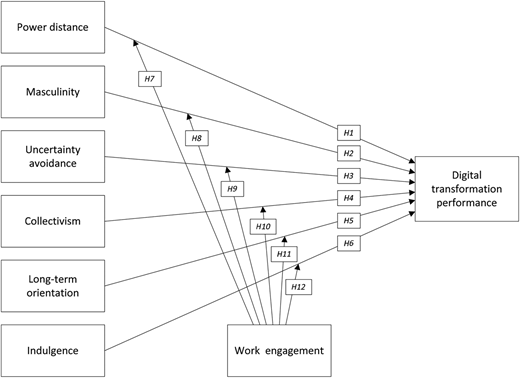
Power distance is related to DTP.
Uncertainty avoidance (UA) reflects a preference for structured processes and risk reduction (Snitker, 2010). While high-UA cultures may resist change, digital systems reduce uncertainty through standardization (Li and Wang, 2024). Innovation Diffusion Theory (Rogers, 2003) suggests that technology adoption increases when perceived risks are reduced. Similarly, the Theory of Constraints (Goldratt, 1984) emphasizes the value of structured processes in improving efficiency. Thus, UA may encourage DT by supporting control, stability, and compliance.
Uncertainty avoidance is related to DTP.
Collectivism emphasizes teamwork, shared goals, and cooperation. These values support collaboration and knowledge sharing, which are essential for DT (Qin et al., 2024). Social Exchange Theory (Blau, 1964) explains that trust and mutual support encourage employees to contribute to organizational goals. Furthermore, Cultural Theory (Douglas, 1982) argues that shared norms promote coordinated action. In Islamic banking, collectivism is reinforced by the concept of ummah (collective welfare), strengthening commitment and coordination. Despite potential delays in decision-making, collectivism strengthens alignment and commitment, thereby positively influencing DTP.
Collectivism is related to DTP.
Masculinity emphasizes competition and achievement. These values can encourage innovation through goal orientation and risk-taking (Rubino et al., 2020). Achievement Motivation Theory (McClelland, 1961) suggests that recognition, advancement, and performance-driven rewards encourage proactive and innovative behavior. However, excessive competition may reduce collaboration and flexibility. Path-Goal Theory (House, 1971) indicates that overly competitive environments can hinder teamwork and organizational effectiveness. In Islamic banking, where cooperation and ethical values are emphasized, the influence of masculinity may be less pronounced (Ayaganova, 2018). Based on these discussions, the following hypothesis is proposed:
Masculinity is related to DTP.
Long-term orientation (LO) emphasizes planning, persistence, and future focus (Hofstede et al., 2010). Organizations with strong LO are more likely to sustain digital strategies and adapt to change (Aksoy, 2024; Picoto and Pinto, 2021). This aligns with Dynamic Capability Theory (Teece et al., 1997), which stresses long-term adaptability to technological change. Additionally, Expectancy Theory (Vroom, 1964) supports the idea that employees invest effort when they perceive long-term rewards, reinforcing sustained digital initiatives. In Islamic banking, LO aligns with principles of accountability and sustainability, supporting continuous and strategic DT, thereby enhancing DTP.
Long-term orientation is related to DTP.
Indulgence represents the degree to which individuals prioritize enjoyment and autonomy (Heydari et al., 2021). While indulgent cultures may encourage creativity and innovation, they can also reduce discipline and organizational focus (Krause et al., 2024). Self-Determination Theory (Deci and Ryan, 1985; Ryan and Deci, 2000) suggests that autonomy enhances intrinsic motivation and innovative behavior (Carter et al., 2024). Therefore, indulgence is associated with DTP:
Indulgence is related to DTP.
Institutional Theory suggests that hierarchy supports coordination and compliance, excessive power distance but may hinder innovation due to reduced employee voice. Work engagement helps overcome these limitations by encouraging employees to contribute beyond formal roles (Kahn, 1990). Engaged employees are more willing to share ideas and support digital initiatives despite hierarchical constraints (Jovanović et al., 2018). Based on these arguments, this study proposes the following hypothesis:
Work engagement moderates the relationship between power distance and DTP.
Uncertainty avoidance (UA) reflects a preference for structured processes and risk minimization (Hofstede, 1980). While UA can create resistance to change, Institutional Theory suggests that structured digital systems reduce uncertainty and make transformation easier. Work engagement strengthens this relationship by enhancing employees’ adaptive capacity. According to Work Engagement Theory, engaged employees are more resilient and willing to invest effort in uncertain situations. Drawing on Social Exchange Theory, engaged employees respond to organizational support by embracing change and engaging in problem-solving behaviors. Empirical evidence indicates that engaged employees are more willing to share ideas and support digital initiatives despite hierarchical constraints (Huang et al., 2022). Therefore, work engagement helps turn uncertainty avoidance into a driver of effective DT.
Work engagement moderates the relationship between uncertainty avoidance and DTP.
Collectivism encourages teamwork and cooperation but may sometimes suppress individual initiative (O’Neill et al., 2016). Work engagement aligns individual motivation with collective objectives, strengthening the positive aspects of collectivism. Based on Social Exchange Theory, engaged employees are more willing to cooperate, share knowledge, and contribute to group success. Empirical studies show that engagement enhances teamwork, communication, and knowledge sharing in collectivist environments (Sun and Bunchapattanasakda, 2019). This suggests that engagement strengthens the positive link between collectivism and performance outcomes.
Work engagement moderates the relationship between collectivism and DTP.
Masculine promotes achievement and performance but can also increase stress and unhealthy competition (Rubino et al., 2020). Drawing on Motivation Theory (Kahn, 1990), engaged employees exhibit dedication and absorption, which convert competitive drives into productive effort. From a self-determination perspective, engagement promotes intrinsic motivation, reducing the negative effects of excessive competition and enhancing collaboration. Engaged employees are more dedicated and better able to channel competitive energy into productive effort, reducing negative effects while enhancing performance (Cole and Packer, 2011). Thus, work engagement is expected to moderate the masculinity–DTP relationship by enhancing its performance benefits while reducing negative stress-related effects.
Work engagement moderates the relationship between masculinity and DTP.
Long-term orientation (LO) emphasizes perseverance, long-term goals, and sustained effort (Hofstede, 1980). While LO supports DT, its effectiveness depends on employees’ willingness to sustain effort over time (Rubino et al., 2020). Work engagement strengthens this relationship by enhancing persistence and commitment. According to Kahn (1990), engaged employees are invested in their roles and willing to exert sustained effort toward long-term goals. In line with Social Exchange Theory, engaged employees reciprocate organizational investment in long-term strategies by aligning their efforts with organizational objectives. Empirical findings show that engagement is linked to persistence, innovation, and long-term performance.
Work engagement moderates the relationship between long-term orientation and DTP.
Indulgence reflects freedom, enjoyment, and autonomy in a culture (Hofstede, 1980). It can promote creativity but may also reduce discipline and focus on long-term goals (Jovanović et al., 2018). Work engagement helps reduce these negative effects by turning autonomy into productive behavior. From Self-Determination Theory (Deci and Ryan, 1985), engaged employees utilize this autonomy as intrinsic motivation, leading to higher performance. They are also better at staying focused and aligned with goals. Empirical studies show that engaged employees can turn positive emotions into innovation and improved outcomes (Fietz et al., 2021). Thus, work engagement is expected to buffer the negative effects of indulgence while enhancing its positive aspects, leading to improve DTP.
Work engagement moderates the relationship between indulgence and DTP.
2.2 Research framework
3. Methodology
This section outlines measurement instruments, sampling design, and data collection procedures used to examine the relationships among cultural dimensions, work engagement, and DTP.
3.1 Measurement
As shown in Table 1, DTP was measured using a scale adapted from Shen et al. (2022), capturing growth, innovation, and intelligent operations. Power distance, uncertainty avoidance, collectivism, and masculinity were measured using scales adapted from Culpepper and Watts (1999). Long-term orientation and indulgence were measured using scales adapted from Cohen (2021) and Beugelsdijk et al. (2015), respectively. Work engagement was measured using the Utrecht Work Engagement Scale (UWES-9) (Schaufeli et al., 2006). All items used a five-point Likert scale (1 = strongly disagree, 5 = strongly agree).
3.2 Sampling and data collection
The study surveyed employees from five Islamic banks in Kuwait. Quota sampling was used to ensure representation based on bank size (Saunders et al., 2019), followed by judgmental sampling to select employees with at least 12 months of DT experience (Sekaran and Bougie, 2019).
The minimum sample size was determined using the ten-times rule (Hair et al., 2021). With six paths (34 measurement items) pointing to the dependent variable (DTP), the required minimum sample size was 340 (34 × 10). To account for non-responses, 606 employees were targeted.
Following ethics approval, bank representatives assisted in distributing online questionnaires. Participants gave consent and were assured of confidentiality. Of 606 surveys distributed, 550 valid responses were collected.
4. Data analysis and results
As the data were collected from a single source using self-reported questionnaires, Harman’s single-factor test was conducted to assess common method variance (CMV). The principal factor explained 22.1% of the total variance, indicating that CMV was not a significant concern (Podsakoff et al., 2003).
4.1 Profile overview
Descriptive statistics were generated using SPSS version 26 (IBM-Corp, 2019). Table 2 summarizes respondent characteristics. Males represented 62.36% of the sample and females 37.64%. The largest age group was 30–39 years (28.91%), followed by 50–59 years (18.55%) and 20–29 years (17.27%). Most respondents held a bachelor’s degree (61.09%), while 14.00% held a master’s degree and 10.91% possessed a doctoral qualification. Kuwaiti nationals comprised 80.00%, with expatriates representing 20.00%.
4.2 Model assessment
The measurement models were evaluated using the PLS algorithm in SmartPLS 4 (Ringle et al., 2015). As reported in Table 3, all Cronbach’s alpha and composite reliability values exceeded 0.70, indicating acceptable reliability (Hair et al., 2017).
Two items (DTP6 and WE7) were removed due to low factor loadings (0.278 and 0.351), below the recommended threshold of 0.708 (Hair et al., 2021). After removal, all remaining items met the threshold. Furthermore, all Average Variance Extracted (AVE) values exceeded 0.50, confirming convergent validity (Hair et al., 2017).
Discriminant validity was assessed using the Heterotrait–Monotrait (HTMT) ratio. As shown in Table 4, all HTMT values were below 0.90, confirming that the variables were distinct from one another (Hair et al., 2017).
The structural model was evaluated using the coefficient of determination (R2). Following Cohen’s (1988), R2 values of 0.26, 0.13, and 0.02 indicate substantial, moderate, and weak explanatory power, respectively. The model produced an R2 value of 0.463 for DTP, indicating that 46.3% of the variance in DTP is explained by the six cultural dimensions. This demonstrates substantial explanatory power.
4.3 Hypotheses testing
This section presents the results of the hypothesis testing, including both the direct effects of cultural dimensions on DTP and the moderating effects of work engagement.
4.3.1 Direct effects
Hypotheses H1–H6 examined the relationships between the six cultural dimensions and DTP. PLS bootstrapping was used to estimate two-tailed t-values at the 5% significance level.
As shown in Table 5, H1 was supported (β = 0.490, t = 11.342), indicating a positive association of power distance and DTP. H2 was supported (β = 0.424, t = 9.506), confirming a positive relationship between uncertainty avoidance and DTP. Similarly, H3 was also supported (β = 0.402, t = 8.950), demonstrating that collectivism positively related to DTP. However, H4 was not supported (β = 0.090, t = 1.018), suggesting no significant association between masculinity and DTP. H5 was supported (β = 0.435, t = 11.584), indicating a positive relationship between long-term orientation and DTP. H6 was also supported (β = −0.137, t = 3.254), revealing a negative association between indulgence and DTP.
Based on the standardized coefficients, power distance was the strongest predictor of DTP, followed by long-term orientation, uncertainty avoidance, and collectivism. Masculinity and indulgence showed weak effects. These results suggest that hierarchy management, long-term planning, and procedural clarity play a greater role in DTP than competitiveness or indulgence.
4.3.2 Moderating effects of work engagement
Tables 6 and 7 depict that work engagement demonstrates a modest moderating role. It significantly strengthens the relationships between uncertainty avoidance and DTP, and between long-term orientation and DTP. It also weakens the negative effect of indulgence on DTP. However, the moderating effects on power distance, collectivism, and masculinity were not supported. Overall, including the interaction terms resulted in a small but meaningful increase in the explained variance of DTP, indicating that work engagement contributes additional explanatory power.
4.3.3 Interpretation of two-way interaction effects
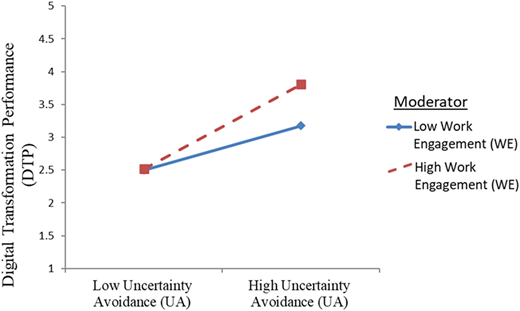
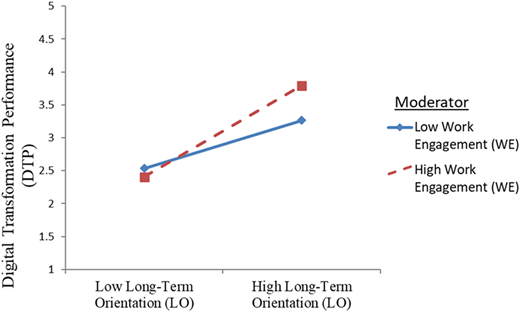
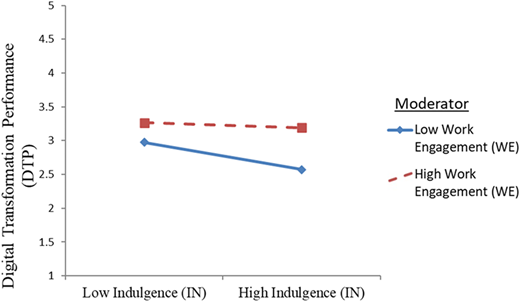
The supported moderating effects (H8, H11, and H12) were further analyzed using an Excel worksheet for two-way interactions (Figures 2–4) from Link to the website, following Cohen’s (1988) guidelines.
Figure 2 shows that uncertainty avoidance positively related to DTP at both low and high levels of work engagement, with a stronger effect under high engagement, as indicated by the steeper slope. This suggests that engaged employees amplify the positive impact of uncertainty avoidance on DTP.
Figure 3 demonstrates that the positive relationship between long-term orientation and DTP is stronger when work engagement is high. This suggests that engaged employees help translate long-term strategic thinking into successful digital transformation outcomes.
Figure 4 shows that indulgence negatively affects DTP regardless of engagement level. However, the negative effect is stronger when engagement is low and weaker when engagement is high, indicating that work engagement mitigates the adverse impact of indulgence.
5. Discussion and implications
This section discusses the main findings, their theoretical and practical implications, and outlines limitations and future research directions.
5.1 Discussion of findings
The findings show that power distance, uncertainty avoidance, collectivism, and long-term orientation are positively associated with DTP, indicating that hierarchy, structured processes, teamwork, and long-term planning support DT. Although prior studies (Dai et al., 2022;Rubino et al., 2020) often suggest these factors hinder innovation, they are beneficial in Islamic banking due to strong regulatory and Sharia requirements (Kalimullina, 2024). Consequently, power distance facilitates decision-making, while uncertainty avoidance reduces ambiguity and improves implementation.
The positive effects of collectivism and long-term orientation align with prior research emphasizing the importance of collaboration, shared responsibility, and strategic persistence in DT (Aksoy, 2024; Picoto and Pinto, 2021; Qin et al., 2024; Sun and Bunchapattanasakda, 2019). Collectivist cultures encourage teamwork and knowledge sharing, whereas long-term orientation encourages sustained investment in digital initiatives. In Islamic banking, these cultural characteristics reflect Islamic principles such as collective welfare (ummah) and sustainability.
In contrast, indulgence is negatively associated with DTP, indicating that excessive focus on personal enjoyment and freedom may weaken discipline and long-term commitment to transformation initiatives (Jovanović et al., 2018; Krause et al., 2024). Masculinity, however, is not significantly related to DTP, indicating that competitive and achievement-oriented values do not necessarily enhance innovation or organizational performance, particularly in environments that emphasize cooperation and ethical values (Ayaganova, 2018; Rubino et al., 2020). Together, these findings highlight that the association of cultural dimensions and DTP is context-dependent.
The moderation analysis reveals that work engagement plays a selective role. It strengthens the relationships between uncertainty avoidance and DTP, and between long-term orientation and DTP, while reducing the negative impact of indulgence. However, it does not significantly moderate relationships involving power distance, collectivism, or masculinity. These findings suggest that engaged employees are particularly important for adaptability and sustained effort, but less influential in shaping deeply embedded cultural structures such as hierarchy and collective norms.
5.2 Theoretical implications
This study contributes to theories by integrating institutional, behavioral, and strategic perspectives to explain DTP in Islamic banking.
First, the findings extend Institutional Theory by demonstrating that DTP is shaped by both regulatory frameworks and Sharia governance mechanisms. The positive relationships of power distance (H1), uncertainty avoidance (H2), collectivism (H3), and long-term orientation (H5) with DTP indicate that these cultural dimensions function as institutional enablers rather than barriers. From an institutional perspective, power distance (H1) and uncertainty avoidance (H2) reinforce coercive and normative pressures, encouraging compliance and structured implementation of digital initiatives. Similarly, collectivism (H3) supports shared norms and social cohesion, while long-term orientation (H5) aligns with sustainability and persistence required for transformation.
Second, the results related to uncertainty avoidance (H2) are further supported by Innovation Diffusion Theory, which suggests that individuals are more likely to adopt innovations when risks are minimized. The positive effect of H2 indicates that structured digital systems reduce uncertainty, making transformation more acceptable. Furthermore, the significant moderating effect of work engagement (H8) further indicates that engaged employees facilitate adaptation to new technologies.
Third, the findings on collectivism (H3) and its interaction with work engagement (H9 – not supported) provide insights through Social Exchange Theory. While collectivism (H3) positively influences DTP through cooperation and shared responsibility, the non-significant moderating effect (H9) suggests that these cooperative norms are already deeply institutionalized, reducing the additional explanatory role of engagement.
Fourth, the strong influence of long-term orientation (H5) aligns with Dynamic Capability Theory, which emphasizes sustained adaptation to change. The significant moderating effect of work engagement (H11) indicates that engaged employees play a critical role in translating long-term strategic orientation into effective DT outcomes.
Fifth, the negative relationship of indulgence (H6) and its moderating effect (H12) can be explained through Self-Determination Theory. While indulgence (H6) may weaken discipline and long-term focus, the significant moderating effect (H12) shows that work engagement buffers this negative impact by channeling autonomy into productive and goal-oriented behavior.
Sixth, the non-significant effect of masculinity (H4) and its non-significant moderation (H10) challenge assumptions derived from Achievement Motivation Theory and Path-Goal Theory. These findings suggest that competitive and performance-oriented values are less relevant in Islamic banking, where ethical values, cooperation, and social responsibility are more dominant drivers of performance.
Finally, the study extends Work Engagement Theory by demonstrating its contingent moderating role across hypotheses. Work engagement strengthens relationships involving uncertainty avoidance (H8) and long-term orientation (H11), and mitigates negative cultural effects such as indulgence (H12). However, its non-significant moderating effects on power distance (H7), collectivism (H9), and masculinity (H10) indicate that engagement does not universally amplify all cultural influences. Instead, its effectiveness depends on whether cultural dimensions require adaptability, motivation, or behavioral transformation beyond institutional structures.
5.3 Practical implications
The findings highlight that successful DT in Islamic banking requires targeted managerial actions.
The positive effect of power distance (H1) suggests that managers should leverage hierarchical structures to support DT. Clear authority lines, centralized decision-making, and alignment with Sharia supervisory boards can accelerate implementation while ensuring compliance with regulatory and Islamic requirements.
The positive influence of uncertainty avoidance (H2) highlights the importance of structured digital strategies. Managers should establish clear policies, guidelines, and training programs to reduce uncertainty when introducing new technologies. This aligns with both coercive institutional pressures and Islamic principles emphasizing clarity and avoidance of uncertainty (gharar).
The role of collectivism (H3) indicates that fostering teamwork, collaboration, and shared responsibility can enhance DT outcomes. Managers should promote group-based incentives and knowledge sharing, consistent with Islamic values of cooperation and mutual benefit.
The significant effect of long-term orientation (H5) suggests that Islamic banks should prioritize sustainable digital investments. Managers should align DT initiatives with long-term strategic goals and Islamic principles of accountability and stewardship.
The non-significant role of masculinity (H4) implies that managers should focus less on competition and more on ethical leadership, collaboration, and inclusive decision-making, which are more aligned with Islamic values.
The negative effect of indulgence (H6) highlights the need for discipline and performance monitoring. Managers should design structured performance systems, clear KPIs, and accountability mechanisms to ensure that digital initiatives remain focused and sustainable.
The non-significant moderating effects (H7, H9, H10) suggest that organizations should not rely solely on engagement to influence outcomes related to hierarchy, collectivism, or competitiveness. Instead, these areas should be managed through strong institutional structures and governance mechanisms.
The significant moderation of uncertainty avoidance (H8) and long-term orientation (H11) indicate that engagement is crucial in environments requiring adaptability and sustained effort. Managers should foster engagement through (1) training and digital skill development, (2) clear communication of DT goals, and (3) employee participation in decision-making. These practices help employees actively support structured and long-term digital initiatives.
The moderating role of indulgence (H12) shows that engagement can reduce the negative effects of weaker discipline. Managers should enhance motivation through recognition, incentives, and meaningful work aligned with Islamic ethical values, encouraging employees to internalize organizational and Sharia expectations.
5.4 Limitations and future research directions
Despite its contributions, this study has several limitations that provide opportunities for future research.
First, the cross-sectional design limits the ability to capture the evolving nature of DTP. Future research should employ longitudinal designs to examine how cultural and institutional factors influence DTP across different stages. Such approaches would allow researchers to better understand causal mechanisms and the stability of relationships across different stages of DT.
Second, the study focuses exclusively on Islamic banks in Kuwait, which may limit the generalizability of the findings. Institutional environments, regulatory frameworks, and interpretations of Sharia principles vary across countries and regions. For example, differences in governance structures, market maturity, and technological readiness may influence how institutional pressures shape DT. Future studies should conduct cross-country comparisons, particularly in other GCC countries and regions.
Third, while the study acknowledges the importance of Sharia principles (e.g. risk-sharing, transparency, ethical conduct), these factors were not explicitly measured. This limits the ability to fully understand how Islamic values influence DT outcomes. Future studies should examine effect of digital technologies on Sharia compliance and transparency. This would strengthen the integration of Islamic finance theory with DT research.
Fourth, this study considers work engagement as the sole moderating variable, which provides only a partial explanation of employee-level influences. However, DT is also influenced by other organizational and leadership factors. Future research should examine other moderators, such as leadership styles. These variables may further explain the mixed results observed in H7–H12 and provide deeper insights into human and organizational drivers of DTP.
5.5 Conclusion
Successful DT in Islamic banking requires aligning culture, institutional pressures, and employee engagement. Banks that integrate structured governance, ethical compliance, and engaged employees are more likely to achieve sustainable DTP.