Despite decades of effort, women remain underrepresented in the construction workforce due to a range of barriers. This study uses the Behaviour Change Wheel (BCW) to systematically devise strategies to overcome these barriers and provide actionable solutions that enhance women’s participation and retention in the construction sector.
The study employs a systematic literature review to identify critical barriers to gender diversity and corresponding strategies for overcoming them. A total of 53 peer-reviewed articles were analysed using the PRISMA method. The challenges presented in the literature were mapped onto the BCW framework and the COM-B model, a psychological model of behaviour, to develop interventions.
The systematic review revealed critical barriers in various themes spanning the education and career pipeline. By applying the BCW, targeted strategies such as early STEM engagement, mentorship, flexible work policies and inclusive recruitment were identified to address behavioural determinants of capability, opportunity and motivation (COM-B). Intervention functions were developed for key stakeholders across education, persuasion, training, enablement and environmental restructuring.
This paper is the first to apply the BCW to develop intervention guidelines to systematically improve gender diversity in construction. The use of a comprehensive behavioural change framework offers a novel approach to developing theory-based, systematic interventions to enhance gender inclusivity. The study provides a roadmap for stakeholders to implement sustainable changes in the construction sector.
1. Introduction
The construction industry is a significant contributor to the world economy. However, the sector has been criticised for more than three decades for its lack of gender diversity (Arriola, 1990, Edirisinghe et al., 2024). In the workforces of developed countries, women are equally represented, with government policy interventions improving gender diversity. However, only between 9 and 14.6% of workers in the construction industry, across all occupation categories, are female (Edirisinghe et al., 2024). Recently, Edirisinghe et al. (2024) conducted an analysis of “leaks in the career pipeline” (Regis et al., 2019; Amir Naser et al., 2023; Edirisinghe et al., 2024; Hickey et al., 2022) internationally over the past 37 years which revealed an alarming declining trend in gender diversity, particularly at the education stage.
The socio-economic benefits of gender diversity, particularly in the construction industry, have been strongly argued for. Bringing more women into construction would mitigate the industry’s skill and labour shortages (Agapiou, 2002; Amaratunga et al., 2006; Hasan and Kamardeen, 2022; King et al., 2019; Moncaster and Dillon, 2018; Oo et al., 2022). Women are often described as an “untapped resource” (Menches and Abraham, 2007), as governments and companies have instead focused on migrant workers to address these shortages (Ackrill et al., 2017; Ness, 2012). Moreover, workgroup and organisational performance has been shown to increase as a result of women contributing diverse perspectives and talents that enhance overall decision making (Ahuja and Kumari, 2012; Baker et al., 2021; Loosemore and Galea, 2008; Hickey and Cui, 2020), leading to better productivity (Amir Naser et al., 2023; Baker et al., 2021; Campbell and Mínguez-vera, 2008; Ksiazek and Nowak, 2017).
Driven by advanced technologies, the construction industry is undergoing a significant transformation with the rise of Industry 4.0 (Forcael et al., 2020; Edirisinghe, 2019) and the anticipated arrival of Industry 5.0. Characterised by digitalisation, automation and less manual work, these transformations will mark a paradigm shift, bringing opportunities for innovative approaches to make this structural change female-friendly (Edirisinghe et al., 2024) to increase women’s participation in the industry (Ghanbaripour et al., 2023). Therefore, proposing strategies to improve gender diversity in the construction industry is timely and essential in this era of technological advancement.
Over the past three decades, substantial research has been conducted to understand the barriers and challenges causing persistent “leaks” in education and career pipelines in construction (Edirisinghe et al., 2024). These are extensively covered in recent reviews (Ghanbaripour et al., 2023; Hasan et al., 2021b; Rotimi et al., 2023; Lekchiri and Kamm, 2020). Possible root causes and challenges are reported in these papers, ranging from a lack of female-friendly uniforms to more significant problems such as sexual assault due to poor industry culture.
In response to persistent gender imbalances in construction, several industry-led and government-supported initiatives have been introduced globally in recent years. These include gender equity certifications, mentoring programs, and awareness campaigns such as those led by the National Association of Women in Construction (NAWIC), which promote visibility and leadership pathways for women in the industry (NAWIC, 2023). The Construction Industry Culture Taskforce (CICT) in Australia has also introduced initiatives like the Culture Standard to improve diversity, equity, well-being, and flexibility in construction workplaces (CICT, 2022). The Australian Constructors Association (ACA) has also launched the Pledge Program, where member organisations commit to implementing workplace flexibility and diversity standards (ACA, 2023). While these initiatives reflect growing awareness and intent, many remain limited by fragmented implementation, symbolic compliance, or the absence of measurable behavioural outcomes (Edirisinghe et al., 2024; Husam et al., 2024; Yan et al., 2024). Furthermore, the broader systemic issues underlying gender inequality have been highlighted in recent literature. For instance, Duckworth et al. (2024) identify the mental health challenges faced by manual and trade workers as intertwined with gendered exclusion and poor job design, while Galea et al. (2018) argue that deeply entrenched gender norms in construction organisations continue to reinforce structural disadvantage. Moreover, most existing efforts are not grounded in a structured theoretical framework for behaviour change (Yan et al., 2024; Husam et al., 2024), which limits their effectiveness and scalability. This underscores the value of adopting a comprehensive, behaviourally informed model, which enables systematic diagnosis of barriers and alignment of interventions with behavioural determinants. Therefore, this paper proposes interventions to overcome the barriers and challenges and enhance women’s participation and retention in the construction industry using the Behaviour Change Wheel (BCW (Michie et al., 2011)), a comprehensive framework for designing behaviour change interventions. The goal is to provide a roadmap for industry stakeholders to implement proactive strategies that will attract more women to the field and create an inclusive environment where they can thrive.
This study contributes original insights by being the first to systematically apply the Behaviour Change Wheel (BCW) and COM-B model to gender diversity challenges in construction. Unlike previous research, which primarily identifies barriers, this study integrates a behavioural science framework to develop targeted, actionable interventions. The systematic literature review consolidates existing findings and maps interventions to the COM-B model, offering a structured and theory-driven approach for practical application. This novel framework ensures that strategies are tailored to specific behavioural determinants, providing a roadmap for industry-wide implementation and policy development. By systematically categorising interventions based on BCW’s intervention functions (education, persuasion, incentivisation, etc.), this research bridges the gap between theoretical understanding and actionable solutions, making it a significant contribution to academia and industry.
The next section sets the background of the research, while Section 3 outlines the methodology employed in the study, detailing the approach used to gather and analyse data and present the findings. The subsequent section presents blended findings and discussion, integrating the results from the systematic literature review with the mapping of interventions using the Behaviour Change Wheel. This approach provides a comprehensive view of the current challenges and potential strategies for improving gender diversity in the construction industry.
2. Background
The process of designing interventions to overcome the barriers to gender diversity in the construction industry would benefit from theories and frameworks from behavioural science. The Behaviour Change Wheel (BCW) (Michie et al., 2011) and COM-B (Capability, Opportunity, Motivation—Behaviour) model are developments in the behaviour change field that provide a systematic theoretical basis for understanding and providing tools to change behaviour based on multiple models of health behaviour (Michie et al., 2011). The BCW enables developers to systematically and transparently identify intervention functions and policy categories for bringing about change (Barker et al., 2016). The process of intervention development using the BCW and COM-B model is outlined in detail in the coming paragraphs. It has been applied in order to apply strategies found in the literature to address gender diversity in construction.
2.1 Theoretical underpinnings of the Behaviour Change Wheel
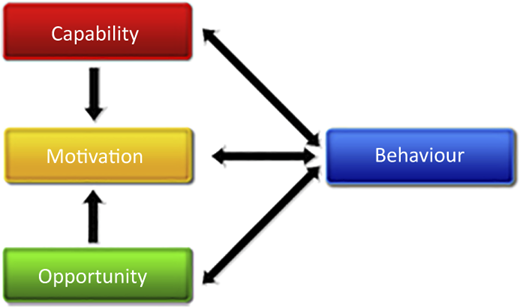
The BCW was developed by Michie et al. (2011) from an extensive review of behavioural science frameworks designed to facilitate the development of behaviour change interventions. The BCW is a synthesis of 19 existing frameworks in the behavioural sciences. At the core of the BCW lies a behaviour change model known as the COM-B, which postulates that behaviour change depends on the interactions between three key determinants: the capability (C), opportunity (O) and motivation (M) to perform a certain behaviour (see Figure 1, below; (Truelove et al., 2020). These domains prompt the consideration of a wide range of influences, including individual, social, and environmental factors.
Capability encompasses the physical and psychological abilities required to engage in the desired behaviour. Physical capability refers to the practical skills or physical capacity to perform a task, while psychological capability involves cognitive functions such as understanding, knowledge, and mental resilience (Michie et al., 2011; Fahim et al., 2020).
Opportunity refers to external factors that facilitate or hinder the behaviour, such as the social and physical environment (Michie et al., 2011).
Motivation includes both reflective and automatic processes that drive behaviour. Reflective motivation refers to conscious decision-making, such as intentions and planning, while automatic motivation describes unconscious processes, such as habits, emotional responses, and impulses (Michie et al., 2011).
These three components interact to generate or inhibit behaviour, and each can be influenced through targeted interventions.
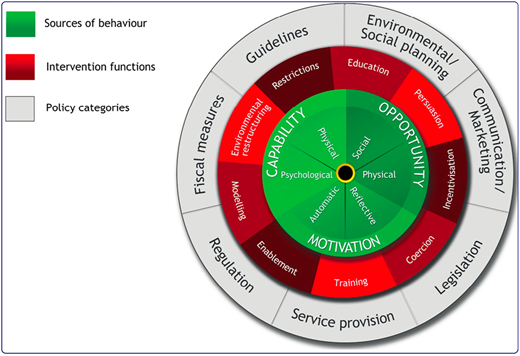
The BCW expands the COM-B core by identifying nine evidence-based “intervention functions”—education, persuasion, incentivisation, coercion, training, restriction, environmental restructuring, modelling, and enablement—which can be used individually or in combination to address specific behavioural drivers (Michie et al., 2011) (see Figure 2). Furthermore, the model links these functions to seven policy categories: guidelines, legislation, regulation, and service provision (Michie et al., 2011), thereby bridging micro-level interventions with macro-level policy levers.
One of the BCW’s major strengths lies in its comprehensive and structured nature—it provides a step-by-step method to identify behavioural barriers, understand their determinants through the COM-B lens, and then map these to the most appropriate intervention functions and delivery mechanisms (Barker et al., 2016). This stands in contrast to many other models, which tend to be either narrowly focused (e.g. only on cognitive elements) or lack clear operational guidance for intervention design (Barker et al., 2016).
The BCW and COM-B model have been widely adopted across multiple fields to design interventions to change behaviour. For example, in healthcare, these models have been used to improve patient adherence to treatments, such as increasing hearing aid usage (Barker et al., 2016) and reducing sitting time in the workplace (Munir et al., 2018). In public health, the BCW has been utilised to design interventions for smoking cessation (Shoesmith et al., 2022), physical activity promotion (Truelove et al., 2020), and dietary changes (Cornish et al., 2019), while in environmental sustainability, it has guided efforts to encourage recycling and reduce energy consumption (Staddon et al., 2016).
While the BCW has been widely applied in health, sustainability, and education, its application to gender diversity in the construction sector remains unexplored. This study represents the first known effort to systematically apply the BCW to this context, offering original insights into how behavioural science can support inclusive workforce transformation. Existing frameworks in construction diversity research tend to be descriptive or sociological, lacking a clear pathway for practical, stakeholder-oriented intervention design. By adopting the BCW and COM-B, this study fills a methodological and theoretical gap, enabling the development of interventions that are not only evidence-based but also tailored to real-world implementation.
The BCW was selected over other models because of its clarity, adaptability, and success in driving systemic change in domains where behaviour is deeply embedded in cultural and institutional practices—precisely the conditions found in the construction industry. Its use in this paper is not only appropriate but essential to bridging the divide between identifying persistent barriers and proposing structured, multi-level solutions.
The following sections outline the study’s methodology, barriers to gender diversity in the construction industry, and apply the BCW to design interventions to overcome a number of those barriers. This process will ensure that women have the capability, opportunity, and motivation to enter, remain in, and progress within the industry. Using the BCW will ensure that these interventions are grounded in a comprehensive understanding of behaviour and tailored to address unique challenges faced by women in this sector.
3. Methodology
This section outlines the methodological framework adopted for this study, which consists of a systematic literature review, data screening and coding processes, and the subsequent application of behavioural theory models. It begins by presenting the research aims and guiding questions, followed by an explanation of the systematic data collection and analysis procedures. The final part describes the integration of the Behaviour Change Wheel (BCW) and COM-B model to map identified barriers and strategies to relevant behavioural determinants and intervention functions.
3.1 Research aims
This paper has two major goals: (1) achieving a systematic understanding of multifaceted challenges to improve gender diversity in construction and (2) developing tailored collaborative, practical strategies and action items for various stakeholders towards a proactive response. This study aims to achieve these goals by moving from a “leaky pipeline” towards a “shared solution space”.
This research aims to develop interventions based on the solid theoretical underpinning of the Behaviour Change Wheel to improve gender diversity in the construction industry. To achieve this, the research is guided by two key questions:
How can the barriers and challenges women face in the construction industry be systematically mapped to develop a cohesive understanding of strategies that can be implemented throughout the education and career pipeline?
How can the BCW framework be used to develop interventions that address the barriers to gender diversity in the construction industry as action items for various stakeholders?
To address the research questions, the study followed a structured three-stage process. First, barriers to gender diversity and proposed strategies were identified through a systematic literature review of peer-reviewed publications. These were thematically coded and analysed to extract recurring behavioural challenges and intervention ideas. In the second stage, the identified barriers were categorised within the COM-B model—Capability, Opportunity, and Motivation—based on their reflected behavioural determinants. In the final stage, the Behaviour Change Wheel (BCW) was used to map each barrier to corresponding intervention functions, ensuring that proposed strategies aligned with behaviourally informed mechanisms such as education, training, environmental restructuring, and enablement. This stepwise process allowed for developing structured, theoretically grounded recommendations tailored to key stakeholder groups across the construction ecosystem.
3.2 Data collection and analysis
To cohesively map barriers and challenges and the strategies to overcome them, a systematic review was conducted using the PRISMA methodology (Moher et al., 2010), which has been widely applied in literature reviews across disciplines. The systematic review focused on retrieving peer-reviewed articles from Science Direct, ISI Web of Science, and Google Scholar, ensuring data integrity and reliability and minimising bias.
A comprehensive search strategy was formulated using the following search terms: “gender diversity”, “women in construction”, “gender inequality”, “gender diversity initiatives”, “gender equality”, “diversity and inclusion in construction”, “interventions”, and “construction industry”. The search terms were combined using Boolean operators to optimise both breadth and relevance. Specifically, we used combinations such as:
(“gender diversity” OR “gender equality” OR “women in construction”) AND (“construction industry”)
(“diversity and inclusion”) AND (“construction”) AND (“interventions” OR “strategies”)
Wildcard searches were applied where relevant (e.g. “intervention” * to capture both “intervention” and “interventions”).
The search was limited to peer-reviewed journal articles, conference papers, and academic reports. Documents were included if they discussed gender diversity in the construction industry context, focusing specifically on barriers, challenges, initiatives, and strategies related to gender diversity. The review was global in scope, considering articles from any geographic region published within the past 30 years (1993–2024), with only studies in English or available in translation included. The initial search yielded approximately 13,500 results from Google Scholar, 260 from ScienceDirect, and 77 from Web of Science, using combinations of Boolean operators and predefined keywords related to gender diversity and the construction industry. The large volume of results from Google Scholar reflects its inclusion of grey literature, non-peer-reviewed sources, and limited filtering options. To maintain consistency and relevance, only the first 200 results from Google Scholar, ranked by relevance, were screened—an approach supported by systematic review guidelines for managing large and unfiltered datasets (Haddaway et al., 2015). All searches were restricted to publications between 1993 and 2024, with Web of Science returning records from 1998–2024 due to its archival structure. 84 Duplicates were removed before screening, and only peer-reviewed journal articles, conference papers, and academic reports written in English or with a full English translation were included for final review. These were screened by title and abstract, after which 76 full-text articles were assessed for eligibility.
Studies were included if they focused directly on gender diversity within the construction sector and presented empirical or conceptual discussions of challenges, strategies, or interventions. Only peer-reviewed journal articles, academic reports, and conference papers were considered, provided they were published in English or had full English translations. The review prioritised sources that offered insight into intervention frameworks, barriers to participation, and initiatives to enhance gender inclusivity in construction.
Studies were excluded if they addressed gender diversity outside the construction sector (e.g. violence against women of colour), focused on diversity traits unrelated to gender or construction (e.g. cultural or ethnic diversity), or examined construction without a specific focus on gender (e.g. occupational health or general workforce issues). Non-peer-reviewed sources, such as grey literature and editorial pieces, were also excluded from the review.
After applying these criteria, 53 articles remained for qualitative analysis. Seven review papers from STEM disciplines were included to provide cross-disciplinary insights. This process followed the PRISMA guidelines to ensure a transparent, rigorous, and reproducible approach to literature selection.
3.2.1 Data analysis
NVivo was used to organise and code textual data, enabling the identification of key themes and patterns related to challenges and strategies for promoting gender diversity within the construction industry. Themes were derived from a thorough literature review and categorised according to the barriers and proposed interventions. To ensure academic rigour and reduce bias, a multiple-researcher approach was employed during coding. This involved collaboration between researchers from diverse disciplines, including gender studies, sociology, and construction management. The integration of both insider (construction-specific) and outsider (cross-disciplinary) perspectives enhanced the depth and reliability of the findings, as per the method outlined by Hayfield and Huxley (2015).
3.3 Application of the BCW and the COM-B model
Following the thematic analysis, a detailed one-to-one mapping was conducted between the barriers and strategies identified in the literature. These pairings were then synthesised and grouped into key themes for further analysis. Each barrier–strategy pair was examined using the COM-B model to determine the underlying behavioural determinants—capability, opportunity, and motivation. The Behaviour Change Wheel (BCW) was subsequently used to align these determinants with relevant intervention functions, such as education, training, environmental restructuring, persuasion, modelling, and enablement. This structured process supported the development of targeted, theory-informed recommendations that directly respond to the most persistent and well-documented challenges in the construction sector. The framework enables a clear behavioural rationale for intervention design, supporting the translation of literature-derived insights into practical, actionable solutions.
4. Findings and discussion
This section provides an in-depth synthesis of the study’s findings, organised around the COM-B model’s three behavioural components: Capability, Motivation, and Opportunity. It begins by identifying the key barriers to gender diversity in the construction industry across the education and career pipeline, highlighting how these challenges contribute to the ongoing “leaky pipeline” effect. Each subsequent subsection explores these barriers in relation to their behavioural determinants and presents corresponding strategies to address them. The discussion integrates empirical insights and theoretical frameworks to demonstrate how specific interventions can drive systemic change. The section also illustrates how each strategy was mapped to relevant intervention functions using the Behaviour Change Wheel (BCW), providing a structured foundation for practical, theory-informed solutions tailored to diverse stakeholder groups.
4.1 Systematic classification of barriers to gender diversity in construction for the COM-B model
Although the primary focus of this paper is on proposing interventions to reduce the barriers women face in the construction industry, understanding these barriers is essential for framing effective solutions. Over the past three decades, a plethora of studies have highlighted the persistent challenges that occur at every stage of a woman’s construction industry career pipeline, ranging from attraction and recruitment to retention and progression (Adogbo et al., 2015; Aulin and Jingmond, 2011; Azhar and Griffin, 2014; Perrenoud et al., 2020; Washington, 2022).
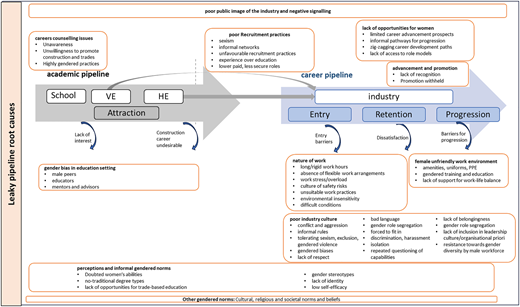
These challenges are resulting in harm to women’s health, mentally (Kamardeen and Sunindijo, 2017; Rotimi et al., 2023; Sang et al., 2007; Sunindijo and Kamardeen, 2017; Hasan and Kamardeen, 2022; Devi and Kiran, 2014) and physically (Hanklang et al., 2014; Mariam et al., 2021; Pamidimukkala and Kermanshachi, 2023; Rotimi et al., 2023; Sang et al., 2007; Sultana et al., 2014; Hasan and Kamardeen, 2022). Together, these barriers and challenges form a “leaky pipeline” (Amir Naser et al., 2023; Regis et al., 2019), with women dropping out of the construction industry at various stages, beginning as early as secondary education and extending throughout their careers. This early disengagement is not only shaped by institutional and societal barriers but is also compounded by declining mental health and motivational strain among young construction workers navigating the education and career pipeline (Tennakoon et al., 2024). Gender-based challenges prevent women from realising their full potential in the industry, leading to higher attrition rates than their male counterparts (Rotimi et al., 2023; Maurer et al., 2021; Sang et al., 2007). Women are more likely to leave their roles, particularly in the private sector, due to the persistent challenges they face, including discrimination, lack of advancement opportunities, and a hostile work environment (Maurer et al., 2021). As a result, women in construction experience higher turnover rates, especially when they are underrepresented in leadership positions (Rotimi et al., 2023). From this review, a classification of causes of the leaky pipeline emerged, starting with the education system (vocational and higher education; VE&HE) and then transitioning into entry, retention and progression in the industry (see Figure 3, below). These “leaks” created by gender diversity problems in construction have been referenced when designing strategies according to the BCW framework.
The construction industry presents numerous barriers to gender diversity, from the initial stages of attracting women to the field to retention and progression. Women face challenges stemming from the industry’s poor public image (Amaratunga et al., 2006; Arditi et al., 2013; Fielden et al., 2000, 2001; Gale, 1990; Greed, 2000; Hasan et al., 2021a), to exclusion from informal networks (Arcand, 2016; Baruah, 2018; Oo et al., 2022) and biased recruitment practices (Ksiazek and Nowak, 2017; Agapiou, 2002; Amaratunga et al., 2006; Clarke et al., 2017; Fielden et al., 2001; Galea, 2017; Baruah, 2018; English and Le Jeune, 2012; Hodzic et al., 2022; Ness, 2012; Olofsdotter and Rasmusson, 2016; Hasan et al., 2021a), which make entering the industry difficult. Once in the workforce, they encounter gender segregation (Wright and Conley, 2020; Norberg and Johansson, 2021; Galea, 2017; Bennett et al., 1999), discrimination (Wright and Conley, 2020; Norberg and Johansson, 2021; Galea, 2017; Bennett et al., 1999), verbal harassment (Arcand, 2016; Sahoo and Lenka, 2016) and sexual harassment (Arcand, 2016; Arriola, 1990; Norberg and Johansson, 2021), and rigid working conditions (Ling et al., 2016; Sewalk and Nietfeld, 2013; Amir Naser et al., 2023; Clarke et al., 2017; Arditi et al., 2013; Devi and Kiran, 2014; Galea, 2017; Oo et al., 2019), all of which contribute to high attrition rates. Limited opportunities for career advancement (Agapiou, 2002; Hatipkarasulu and Roff, 2011; Maurer et al., 2021; Hickey et al., 2022; Ahuja and Kumari, 2012; Sang et al., 2007; Azhar and Griffin, 2014), coupled with a lack of female role models (Adogbo et al., 2015; Ksiazek and Nowak, 2017) and entrenched gender norms further exacerbate the issue (Kakar and Hasan, 2023; Sangweni and Root, 2015; Powell et al., 2010; Adogbo et al., 2015). Cumulatively, these barriers lead to a “leaky pipeline” where women drop out of the industry at different stages of their careers. To achieve gender diversity in construction, it is essential to address these structural and cultural barriers holistically, fostering an inclusive environment where women can thrive at every stage of their careers.
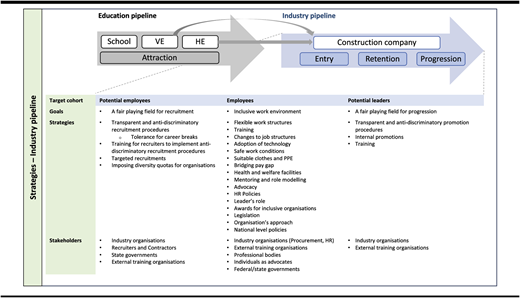
A detailed one-to-one mapping between identified barriers and corresponding strategies was conducted as part of this study to inform the development of a structured behavioural intervention framework. Each strategy was aligned to a specific barrier and then categorised under the relevant COM-B component—capability, opportunity, or motivation—before informing the design of targeted interventions using the Behaviour Change Wheel. A visual summary of these strategies, which are used to overcome the barriers in the industry pipeline, is presented in Figure 4, which illustrates the intervention goals, target groups, and relevant stakeholders across the attraction, entry, retention, and progression stages in construction.
For example, biased or informal recruitment practices remain a persistent barrier to women’s entry into the construction industry. To address this, the literature recommends several interrelated strategies. Transparent and anti-discriminatory recruitment procedures—such as moving away from informal hiring and adopting merit-based selection—are essential to ensuring fairness (Choi et al., 2022; Karakhan et al., 2021; Jones et al., 2017). These approaches are further strengthened by partnering with construction tradeswomen’s networks and accommodating non-linear career paths (Oo et al., 2022; Greed, 2000). Cultural change is also required: recruiters and contractors need training to overcome bias and support anti-discriminatory hiring practices (Regis et al., 2019). Targeted recruitment can be achieved through inclusive job ads, direct university engagement, and deliberate recruitment into leadership roles, which can reinforce broader organisational change (Law, 1989; King et al., 2019; Hickey and Cui, 2020; Baker et al., 2021). Although diversity quotas have been used in some jurisdictions to boost representation, their effectiveness is debated. Research suggests that quotas may risk tokenism or perceived unfairness, and some women express concerns about being seen as beneficiaries of compliance rather than merit (Sangweni and Root, 2015; Arcand, 2016; Baruah, 2018; Won et al., 2021; Preece, 2016; Holdsworth et al., 2020).
Other commonly mapped barriers include poor site conditions, limited access to amenities, and inflexible work environments, which can be addressed through gender-inclusive PPE, improved facilities, and flexible scheduling (Wright, 2016; Heydari Mohammad et al., 2024). Similarly, the underrepresentation of women in leadership positions has led to calls for mentoring schemes, leadership development programs, and structured visibility efforts (Galea et al., 2018). These examples demonstrate the close alignment between identified barriers and evidence-based strategies and form the basis for the COM-B mapping and intervention development presented in the following section.
4.2 Interventions to improve gender diversity in the construction industry under the BCW and the COM-B model
This section maps the strategies identified in the literature using the Behaviour Change Wheel (BCW) and the COM-B model. The COM-B framework classifies behaviour change interventions into three core components: capability, opportunity, and motivation (COM). The mapping process, as shown in Table 1, below, categorises each intervention based on its alignment with the nine intervention functions within the BCW. Building on the foundational understanding of the BCW and the COM-B model, this approach provides a structured pathway to systematically address the barriers women face in the construction sector. By aligning barriers and strategies with intervention functions from the BCW, this framework ensures that the proposed interventions are theoretically grounded and practicable, facilitating sustainable behaviour change to promote gender diversity.
To develop this framework, barriers identified in the literature were first thematically grouped and analysed to determine their underlying behavioural determinants within the COM-B model (capability, opportunity, and motivation). Each barrier was then associated with one or more strategies designed to mitigate it. These strategies were subsequently classified under the BCW’s nine intervention functions to ensure practical relevance and theoretical coherence. This stepwise mapping process, although summarised in Table 1, was based on a detailed synthesis of barrier-strategy-intervention linkages. The full mapping process is presented in Appendices I (Full list of Intervention Strategies and Stakeholders) and II (COM-B Classification of Interventions), which outline how each strategy aligns with its targeted behavioural source and intervention function.
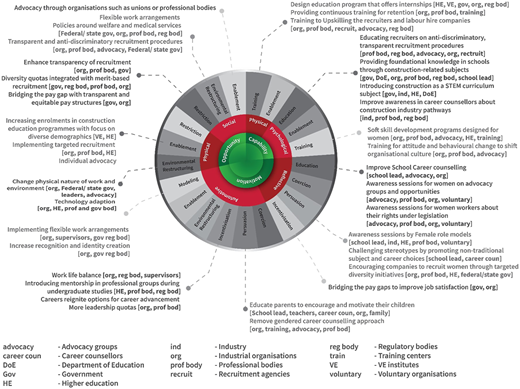
The mapping process identified targeted interventions across all three COM-B components, ranging from enhancing physical and psychological capabilities to increasing social and environmental opportunities and fostering both reflective and automatic motivations. This ensures that the interventions address key behavioural drivers for change at multiple levels.
Figure 5, below, provides a comprehensive visual summary of these strategies, encapsulating the proposed interventions through the lens of the Behaviour Change Wheel. At its core, the COM-B model, located at the wheel’s centre, highlights the three essential components required for behaviour change: capability, opportunity, and motivation. These inner layers represent the foundation of behaviour, with each component playing a critical role in shaping individuals’ ability and willingness to engage in gender diversity initiatives within the construction industry. Capability focuses on both physical and psychological aspects, opportunity includes environmental and social factors, and motivation addresses both reflective (deliberate) and automatic (habitual) influences. These interventions are aimed at various stakeholders, including industry organisations, advocacy groups, career counsellors, government education departments, educational institutions (both higher and vocational), professional bodies, and regulatory agencies; cross-sectorial collaboration is crucial to achieving systemic change (Edirisinghe et al., 2024).
The outer layers of the wheel extend these foundational elements by connecting them to specific intervention functions, such as education, persuasion, training, environmental restructuring, and enablement. These intervention functions act as practical strategies that can be applied to facilitate change in various behavioural components. For example, training can be used to enhance capability, while environmental restructuring can create opportunities for women in construction. This layered structure ensures that interventions are not focused only on individual behaviour but also address systemic and environmental changes, creating a comprehensive and targeted approach for implementing gender diversity initiatives across the construction sector, responding to the recent call for research to move from examining the “leaky pipeline” to a “shared solutions space” with best practice guidelines (Edirisinghe et al., 2024).
4.2.1 Capability
In the context of gender diversity in the construction industry, addressing capability involves equipping women with the necessary skills, knowledge, and confidence to enter and thrive in this traditionally male-dominated field. This section will focus on mapping strategies from the literature that aim to enhance both physical capabilities, such as skills and technical competencies, and psychological capabilities, including cognitive abilities, confidence, and decision-making skills. The strategies aim to remove barriers to women’s full participation in construction by focusing on educational initiatives, targeted training programs, and other interventions designed to build foundational and advanced capabilities.
4.2.1.1 Physical capability
4.2.1.1.1 Education programs and early interventions
Early educational interventions are crucial for developing an interest in construction among young girls (Washington, 2022). Morello et al. (2018) highlight the importance of introducing construction-related subjects early on to develop foundational knowledge and cultivate out-of-the-box thinking. By incorporating construction into the STEM curriculum, students, especially girls, are exposed to non-traditional career paths, challenging stereotypes and broadening their future career choices (Adogbo et al., 2015; Patel and Pitroda, 2016; Aulin and Jingmond, 2011; Vijayaragunathan and Rasanthi, 2019; Ettinger et al., 2019).
Awareness programs targeted at secondary school students also play a key role. Such initiatives focus on informing students about the variety of career paths available in the construction sector beyond fieldwork, thus dismantling the narrow perception of construction as labour-intensive and male-dominated (Powell et al., 2010; Moore and Gloeckner, 2007; Oo et al., 2019, 2020; Baruah, 2018). Industry professionals and female role models can provide valuable insight into construction career pathways, encouraging girls to consider roles they might not have previously thought accessible (Adogbo et al., 2015).
4.2.1.2 Continuous training and skill development
One of the primary barriers to gender diversity in construction is the lack of skill development and ongoing training for women in the workforce. As Moore and Gloeckner (2007) highlighted, education programs offering internships during vocational and higher education (VE/HE) provide women with practical experience and increase their employability in the sector (Moore and Gloeckner, 2007; Powell et al., 2010; Oo et al., 2019, 2020; Baruah, 2018).
Providing continuing professional training (Aulin and Jingmond, 2011), particularly in areas such as safety measures, the proper use of PPE, and workplace hazards, helps ensure retention by empowering women with the necessary technical competencies (Aulin and Jingmond, 2011; Sultana et al., 2014).
4.2.1.3 Psychological capability
4.2.1.3.1 Soft skill development
Psychological capability focuses on building the cognitive and emotional resilience women need to navigate the often challenging social and cultural dynamics of the construction industry. As Gayani Fernando et al. (2014) and Choi et al. (2022) have indicated, soft-skill development programs can help women overcome the psychological barriers posed by a male-dominated environment, allowing them to excel in team-based and leadership roles.
Early interventions also play a role in psychological capability by helping girls develop confidence in their abilities and providing them with the tools to challenge societal norms. Offering workshops that focus on team building, leadership, and effective communication can make a significant difference in encouraging young women to pursue construction as a career (Morello et al., 2018). Integrating these programs into existing educational curricula and workplace training can further enhance their effectiveness, providing women with the psychological tools they need to succeed.
4.2.1.4 Training on anti-discriminatory practices and cultural change
A key strategy in addressing gender diversity is educating recruiters and labour-hire companies on anti-discriminatory and transparent recruitment procedures (Regis et al., 2019). Gender bias in hiring practices is a significant barrier that prevents women from accessing job opportunities on an equal footing with men. Training to change attitudes and behaviours within organisations is essential for creating a more inclusive workplace culture (Patel and Pitroda, 2016; Ahuja and Kumari, 2012; Vijayaragunathan and Rasanthi, 2019). Programs focusing on respectful relationships, diversity, and cultural awareness can facilitate this shift, promoting a more supportive environment for women in construction (Jones et al., 2017; Regis et al., 2019).
Further, training programs encouraging a shift in organisational culture—such as those focusing on respectful relationships and gender equality—can foster long-term change (Jones et al., 2017; Regis et al., 2019). This cultural shift is vital in reducing gender-based discrimination and supporting the retention and advancement of women within the sector.
The strategies outlined in Table 1, above, demonstrate a comprehensive approach to enhancing both the physical and psychological capabilities of women in the construction industry. By targeting educational institutions, industry organisations, and regulatory bodies, these interventions address key barriers at multiple levels.
4.2.2 Motivation
In the construction industry, women’s motivation to enter, remain, and progress is influenced by various internal and external factors, including perceived opportunities, job satisfaction, work–life balance, and societal expectations. Addressing these motivational drivers is crucial to fostering gender diversity in the industry. In the context of the COM-B model, reflective motivation refers to the conscious decision-making processes that shape behaviour (Michie et al., 2011), such as career goals, aspirations, and long-term planning. Strategies that improve reflective motivation can range from increasing awareness about career paths to providing financial incentives that make construction more appealing to women. On the other hand, automatic motivation includes unconscious influences such as social conditioning, habits, and emotional responses (Michie et al., 2011).
The strategies outlined in Figure 4, above, address both reflective motivation (M-Re) and automatic motivation (M-Au), targeting different aspects of women’s decision-making processes and emotional responses to careers in the construction industry. These strategies focus on education, persuasion, incentivisation, coercion, and enablement to drive behaviour change, particularly in overcoming gender-related barriers within the industry.
4.2.2.1 Reflective motivation
Reflective motivation encompasses conscious processes such as setting goals, evaluating career paths, and planning for long-term success. Initiatives such as improved career counselling at the school level are crucial in improving women’s motivation to join and progress in the construction sector (Jones et al., 2017; Regis et al., 2019). Schools and advocacy groups can promote construction as a viable career option, highlighting diverse opportunities and benefits beyond manual on-site work (Washington, 2022; Moore and Gloeckner, 2007).
Importantly, the broader cultural context also plays a key role in shaping women’s reflective motivation. The construction industry’s entrenched masculine norms—often associated with toughness, physical dominance, and emotional suppression—can lead women to feel misaligned with its cultural identity, discouraging them from viewing it as a suitable or rewarding career path (Hanna et al., 2020). These perceptions may not only deter initial entry but also limit women’s long-term engagement and career aspirations within the sector. Therefore, addressing cultural change is critical alongside career guidance efforts.
Further, awareness sessions presented by female role models and professionals sharing personal success stories and promoting gender diversity can inspire women to pursue construction careers (Adogbo et al., 2015). Encouraging schools to challenge traditional gender norms and stereotypes through curriculum changes and career counselling (Aulin and Jingmond, 2011) can have long-term effects on students’ reflective motivation, empowering them to consider non-traditional careers.
Bridging pay gaps is another critical strategy for improving job satisfaction and retention of women in the construction industry (Galea et al., 2018; King et al., 2019). Transparent pay structures and auditing processes can ensure fairness, reducing one of the main disincentives for women to pursue or remain in construction careers.
4.2.2.2 Automatic motivation
Automatic motivation includes unconscious influences like social conditioning, habits, and emotional responses. Social norms and familial expectations can play a significant role in shaping women’s career choices, which can either hinder or facilitate their entry into male-dominated sectors like construction. Programs aimed at educating parents—such as the “Bring Your Child to Work Day” initiative—can foster early interest and help parents encourage their daughters to explore careers in construction (Fielden et al., 2001). Such family-based interventions tap into automatic motivational drivers by altering ingrained societal norms.
Moreover, flexible work arrangements, such as work–life balance initiatives and job-sharing, directly target women’s emotional responses to career progression by addressing common stressors like long working hours and family responsibilities (Devi and Kiran, 2014; Greed, 2000). These policies can mitigate burnout and increase retention, particularly among mid-career women.
Mentorship programs are also crucial in enhancing automatic motivation. By pairing women with experienced professionals who can provide technical guidance and emotional support (Adogbo et al., 2015; Moore and Gloeckner, 2007), these relationships foster a sense of belonging and identity, essential in male-dominated fields (Powell et al., 2010).
4.2.2.3 Additional strategies
Companies implementing targeted recruitment and diversity initiatives is essential to actively attracting more women to the construction industry (Arcand, 2016; Baruah, 2018). These initiatives challenge biases in recruitment processes and can be further supported by establishing diversity quotas (Hickey and Cui, 2020). By promoting the inclusion of women in executive and leadership roles, these strategies aim to create a more equitable industry landscape.
Incentivising professional memberships during undergraduate studies can also enhance women’s identity creation within the sector, helping them believe that the industry is accessible to those willing to work hard, regardless of gender (Moore and Gloeckner, 2007). Additionally, policies aimed at bridging the pay gap and offering incentives to women in executive positions further enhance motivation by aligning pay and rewards with merit (Galea et al., 2018; King et al., 2019).
4.2.3 Opportunity
Enhancing opportunities for women in construction will involve restructuring both the physical work environment and social structures to foster inclusivity. Key areas include improving recruitment practices, creating supportive workplace policies, and addressing cultural and systemic barriers that hinder women’s advancement. Opportunities can be categorised as physical—relating to the tangible elements of the workplace, such as facilities, equipment, and safety measures—and social—involving recruitment practices, workplace culture, and advocacy (Michie et al., 2011).
By increasing these opportunities, organisations can reduce the external barriers that prevent women from entering and thriving in the construction industry. The strategies outlined in Figure 4, above, related to opportunities focus on restructuring the environment through targeted recruitment, flexible work arrangements, transparent pay structures, and improved advocacy.
4.2.3.1 Physical opportunities
Workplace restructuring is critical for creating a safer and more inclusive work environment and thus improving retention. One key strategy is enhancing the physical aspects of the work by improving facilities, such as providing appropriate personal protective equipment (PPE), sanitation, and uniforms tailored to women’s needs. Such changes help reduce physical strain and improve working conditions for women (Hanklang et al., 2014; Patel and Pitroda, 2016). Additionally, ergonomic workstations and adoption of new technologies, such as converting manual jobs into tasks that can be performed remotely, can further reduce workplace hazards and make construction more accessible (Ling et al., 2016; Patel and Pitroda, 2016).
The literature also highlights the importance of bridging the pay gap by introducing transparent pay structures and ensuring equitable remuneration across the industry. This is a crucial factor for attracting and retaining women in the construction workforce (Galea et al., 2018; King et al., 2019). Addressing wage disparities can enhance job satisfaction and incentivise women to pursue long-term careers in construction.
4.2.3.2 Social opportunities
Targeted recruitment strategies are essential to removing gender biases and promoting transparency in hiring processes. These include encouraging women to apply in position advertising and changing recruitment criteria to focus on education and job training over experience. This approach has been shown to reduce barriers to entry for women and open up leadership opportunities (Arcand, 2016; Baruah, 2018; Hickey and Cui, 2020). Additionally, flexible work arrangements—such as parental leave, flexible hours, and support for work–life balance—are vital in retaining women, particularly those who face competing demands between their professional and personal lives (Choi et al., 2022; Greed, 2000).
Finally, advocacy and mentorship play a significant role in creating supportive networks for women. Professional bodies, such as the National Association of Women in Construction (NAWIC), provide mentorship, advocacy, and career development opportunities that empower women to advance in the industry (Jones et al., 2017; Pamidimukkala and Kermanshachi, 2023). Through such organisations, women can access resources, advice, and opportunities that help them navigate gender-based challenges and achieve career growth.
5. Conclusions
This paper addresses calls for practical, collaborative strategies and action items to ensure effective implementation of gender diversity initiatives by utilising the Behaviour Change Wheel (BCW) and the COM-B model to map interventions that address longstanding barriers. The BCW framework presents a novel, evidence-based approach to promoting gender diversity in construction, ensuring that interventions are both practical and sustainable and make a timely contribution to the construction industry’s progression toward the fifth industrial revolution.
The systematic literature review revealed persistent challenges faced by women and other underrepresented groups, including recruitment biases, inadequate working conditions, and limited opportunities for career advancement. Previous studies have emphasised the complexity of these challenges and the importance of context-specific, tailored strategies and the urgent need to move from the “leaky pipeline” to a “shared solutions space”.
The interventions mapped using the BCW framework offer a structured approach to overcoming these barriers by enhancing capability, opportunity, and motivation. By aligning interventions with stakeholder action items, this paper provides a comprehensive roadmap to create a more inclusive and equitable construction sector and for the cross-sectorial collaboration required for such systemic change. Proposed interventions—such as targeted recruitment, continuous training, flexible work arrangements, and transparent pay structures—hold significant potential for increasing women’s participation in the industry.
These findings have important implications for both policy and practice. The study provides industry stakeholders, educators, and policymakers with a practical, evidence-based framework for designing behavioural interventions that are both scalable and adaptable. Furthermore, it supports a systemic approach to cultural transformation in construction and offers a replicable model for other male-dominated industries seeking inclusive growth. By contributing to a more structured understanding of behaviour change, this research supports the long-term goal of an equitable, resilient workforce. However, successful implementation requires a coordinated and collective effort from industry stakeholders, policymakers, and educational institutions and must be supported by policy; these are essential for delivering and supporting behaviour change on a systemic level.
While this study provides a structured, theory-informed foundation for designing gender diversity interventions, it is not without limitations. As a systematic review based on secondary data, the findings are limited by the scope, quality, and generalisability of the included literature. The practical effectiveness of the proposed interventions remains to be tested in real-world settings. Future research will focus on validating these strategies through empirical studies, and stakeholder engagement to assess their impact and adaptability across diverse construction contexts.
Authors would like to acknowledge the funding support from the Career Reignite Program of RMIT University.
References
The supplementary material for this article can be found online.