The present study aims to empirically investigate how the language styles of artificial intelligence (AI) chatbots, specifically their use of abbreviations, formality and message length, influence consumer perceptions of sincerity, effort and brand-related outcomes in service interactions.
Four experiments (n = 878) were conducted to test the effects of language style in various service and brand contexts. The studies manipulated chatbot communication features and measured their influence on perceptions of sincerity, engagement, brand attitudes and behavioral intentions.
The results suggest that abbreviation-heavy messages consistently reduce perceptions of sincerity and a service agent’s effort, especially when the agent is human. Informal and concise chatbot responses enhance engagement and perceived sincerity, but only when aligned with brand context. Informality strengthens brand attitudes and purchase intentions when psychological brand closeness is high (Study 3) and when the brand is positioned as premium (Study 4).
Since the studies use mock interactions in online experiments, real-world generalizability may be limited. For validation, future research could explore these effects via longitudinal and field-based studies.
This study offers actionable insights for service designers and brand managers on tailoring chatbot communication to enhance consumer trust, engagement and brand alignment. Language style should be strategically aligned with brand positioning and the strength of the consumer–brand relationship.
This study advances the understanding of chatbot communication by framing language features as social signals, extending social response theory to AI-mediated service contexts and revealing boundary conditions for effective chatbot design.
1. Introduction
Rapid advances in artificial intelligence (AI), combined with customers’ rising expectations for richer experiences, are transforming the service landscape. Brands increasingly deploy AI-powered conversational agents that use natural language processing to handle high volumes of enquiries in real time and to perform frontline service tasks (Fotheringham and Wiles, 2023). As an indication of this rapid uptake, more than 80% of customer-care leaders report investments in generative-AI chatbots (Buesing et al., 2024), and the global chatbot market is projected to increase from US$5.4bn in 2023 to US$15.5bn by 2028 (Markets and Markets, 2023). These agents now appear in mobile apps, social media platforms and other service settings, offering brands new opportunities to create immersive interactions and extend brand availability (Campbell et al., 2020; Huang and Rust, 2021).
Despite their growing prevalence, scholarly understanding of how to design and deploy chatbots to foster positive consumer responses remains incomplete (Crolic et al., 2022). Existing studies emphasize functional performance and adoption drivers such as consumer trust (Mostafa and Kasamani, 2022), modality effects (e.g. voice versus text; Schindler et al., 2024) and anthropomorphism (the extent to which non-human entities exhibit human-like qualities) (Alabed et al., 2024). Although it is often assumed that anthropomorphic design enhances customers’ purchase intention and recommendations (Li et al., 2024), other research shows that anthropomorphism can undermine perceptions of autonomy, satisfaction and purchase intentions (Alabed et al., 2024; Crolic et al., 2022). Customer reactions to chatbot-led service encounters are shaped not only by pre-encounter expectations of efficacy and emotional state (Crolic et al., 2022), but also by language and communication style (e.g. van Pinxteren et al., 2023). However, existing research has largely focused on broad communication styles, leaving specific linguistic cues such as abbreviations, message length and formality comparatively underexplored in AI-mediated service interactions.
According to the computers-as-social-actors paradigm, people respond to AI chatbots as social entities capable of engagement, reciprocity and relationship-building (Moon, 2000; Ryoo et al., 2025). While early research largely highlighted efficiency and functional utility, comparatively little attention has been paid to the stylistic features of chatbot communication that shape relational impressions (Al-Shafei, 2025; Choi, 2025; Rapp et al., 2021). In AI-mediated service encounters, language style signals social presence and prompts judgments of sincerity, authenticity and perceived effort, relational constructs that shape satisfaction, engagement and brand outcomes (Crolic et al., 2022; Go and Sundar, 2019). Recent research shows that chatbot communication style directly shapes satisfaction, trust and engagement even during service failure (Cai et al., 2024), underscoring how user responses can be influenced by the relational power of linguistic cues. Warm and competent conversation styles have also been shown to reduce perceived customer risk, strengthen relational ties and enhance acceptance and trust (Xiao et al., 2025), further illustrating how conversational tone serves as a key relational design element. In addition, emotionally expressive and informal chatbot communication has been found to increase perceived humanness and trust (Eliasson and Engström, 2025), reinforcing our stance on style being a determinant of relational impressions. Consumers interpret these cues through the lens of broader brand and service expectations (Sands et al., 2021). However, research on linguistic style cues, such as abbreviations, informality, message length and tone, remains sparse even though these seemingly minor markers may be as significant as anthropomorphic design in shaping customer responses.
We propose that chatbot language is not merely a technical input but also a symbolic act interpreted through pre-existing brand relationships and schemas. Therefore, AI chatbots function as constructed virtual brand personas–curated agents that embody the brand’s tone, character and values in conversational form. Their linguistic choices act as markers of that persona, shaping how consumers perceive both the agent and the brand it represents. This study addresses an important gap by shifting attention from chatbot presence or anthropomorphic features, which dominate prior research, to the linguistic style of chatbot communication as a relational and identity-bearing signal. We further extend existing work by directly comparing AI chatbots with human service agents and by examining how two key contextual factors, brand closeness and brand status, moderate these effects. Our approach aligns with recent evidence that social chatbots can be deliberately designed to optimize relational outcomes through conversational framing and attentiveness cues (Zhou et al., 2024), positioning linguistic style as a key relational design feature. This focus advances the understanding of how conversational cues influence not only immediate social judgments, but also brand-related outcomes.
Guided by social response theory, which argues that people apply social rules and relational heuristics to non-human agents that display human-like traits (Moon, 2000; Nass and Moon, 2000), we report four controlled experiments. Study 1 examines whether abbreviation use affects perceptions of sincerity, effort and authenticity differently for human versus AI agents. Study 2 isolates the effects of message formality and length in an AI-only context. Studies 3 and 4 test boundary conditions, exploring how brand closeness (Study 3) and brand status (Study 4) influence the impact of chatbot linguistic styles on consumer engagement, brand attitudes, word-of-mouth (WOM) and purchase intentions.
Our research makes three contributions to the literature on conversational AI and service design. First, it demonstrates that seemingly minor linguistic cues in chatbot messages (such as abbreviations, message length, formality) operate as powerful relational signals. Second, it explains mixed findings in the literature by showing that these effects vary according to psychological closeness and brand status: informal language can boost warmth for close or premium brands, yet undermine credibility for distant or low-status brands. Third, it provides actionable guidance for brands, showing that careful tuning of chatbot language offers a low-cost lever for building trust, engagement and purchase intent. Together, these contributions offer a novel perspective by positioning chatbot language style as a key identity-bearing signal that links conversational AI to brand relationships.
2. Theoretical framework and hypotheses
In this section, we set out the theoretical framework for the study and derive the hypotheses that guide the empirical work. We draw on four complementary theoretical perspectives to explain how chatbot language style shapes consumer responses. We begin with social response theory, which explains why consumers instinctively apply human social rules when interacting with chatbots that display conversational cues. We then draw on social exchange theory to argue that linguistic features such as abbreviation use, message length and formality function as relational signals that shape perceptions of sincerity, effort and authenticity, ultimately influencing engagement and downstream behavioral intentions (Choi, 2025).
Communication accommodation theory further explains how these linguistic cues communicate attentiveness and relational sensitivity through adjustments in conversational tone and structure. Finally, drawing on social penetration theory and brand positioning research, we propose that the impact of chatbot language style depends on relational context, specifically psychological brand closeness and brand status. We conclude with a set of hypotheses that capture these main and contingent effects, laying the groundwork for subsequent experiments. In line with this perspective, we conceptualize the chatbot as a virtual brand persona whose communicative style signals both social presence and brand identity cues. Taken together, these theories explain why consumers respond socially to chatbot language cues, how these cues shape relational judgments and when their effects are amplified by brand context.
2.1 Social response theory
Social response theory, commonly associated with the computers-as-social-actors paradigm, suggests that individuals automatically apply social rules and expectations when interacting with technologies that display human-like cues (Moon, 2000; Nass and Moon, 2000). Even when users recognize that computers lack intentions or emotions, social cues such as conversational language and interactivity trigger human-like social responses. Accordingly, conversational AI systems such as chatbots can activate the same social heuristics used in human-to-human communication, including expectations of politeness, reciprocity and relational attentiveness. Nass and Moon (2000) highlighted the need for research examining how linguistic cues, particularly language formality, influence users’ perceptions of the human-like qualities of computers. Therefore, we argue that language styles such as abbreviations, message length and formality influence consumers’ perceptions of the quality of human–chatbot interactions and, hence, the customers’ responses. These linguistic cues serve as social signals that shape how consumers interpret chatbot behavior.
2.2 Hypothesis development
While social response theory explains why consumers respond socially to chatbot cues, social exchange theory explains how these interactions are evaluated. According to social exchange theory, individuals assess interpersonal exchanges based on perceptions of sincerity, effort and authenticity, key indicators of relational quality (e.g. Li et al., 2024; Maslyn and Uhl-Bien, 2001). The central premise of social exchange theory is that social exchanges are guided by the norms of reciprocity where a party to an exchange offers benefits to another party who then feels obliged to return the favor by offering tangible and/or intangible rewards (Blau, 1964). Consistent with previous studies, (Barasch et al., 2016; Kroeper et al., 2022; Ziano and Wang, 2021), perceived sincerity is observed through the communication receiver’s judgments of others’ sincerity. Perceived sincerity refers to a consumer’s perception of the candor, earnestness and frankness displayed by a communicator (a chatbot) (Eisinger and Mills, 1968). Perceived sincerity serves as our primary behavioral variable due to its importance in social interactions (Eisinger and Mills, 1968; Ziano and Wang, 2021).
Perceived effort reflects an exchange partner’s perception of another exchange partner’s resources or inputs (e.g. physical, time or cognitive) essential in relationship development (Li et al., 2024). The use of texting abbreviations, although efficient, often conveys reduced effort and a lack of formality on the part of the communicator, which can be interpreted as impersonal or dismissive in customer service contexts (Choi, 2025; Fang et al., 2024; Packard and Berger, 2017). Prior work suggests that abbreviation-laden messages are perceived as less sincere, especially in customer service interactions where consumers expect attentiveness and professionalism (Liu et al., 2011).
Moreover, people apply higher relational standards to human agents than to AI, expecting more warmth and tailored interaction from humans (Gnewuch et al., 2017). Tsekouras et al. (2022) found that when users perceived human efforts to be greater than those of recommendation agents when generating recommendations, the users reported a weaker relationship quality with the agents. Thus, we expect that the use of abbreviations will have a negative effect on relational perceptions and that this effect will be more pronounced when the agent is human. Accordingly, we propose the following hypotheses:
Chatbot responses without abbreviations will be perceived as more sincere, effortful and authentic than those with abbreviations.
The negative effect of abbreviation use on perceived effort will be stronger when the agent is human rather than AI.
Building on social response and social exchange theory, we draw on communication accommodation theory (Giles et al., 1991) to specify the communicative mechanism that translates social intent into perceived relational quality. Language style, particularly the tone and length of text, has been shown to play a critical role in signaling interpersonal sensitivity (Gretry et al., 2017; Gunraj et al., 2016; Houghton et al., 2018). A formal language style adheres rigorously to grammatical rules and accurate sentence structure and contains a comprehensive vocabulary (Ryoo et al., 2025). Conversely, informal language is characterized by casual, often colloquial linguistic features, such as slang terms and idioms, as well as elements like emojis and abbreviations (Gretry et al., 2017; Ryoo et al., 2025). Informal language, which mimics everyday conversation, may enhance perceptions of sincerity and engagement by reducing psychological distance (Fang et al., 2024), even in AI-mediated interactions. Similarly, concise messages may signal efficiency and responsiveness, traits valued in digital communication (Fang et al., 2024). However, overly formal or verbose responses may come across as impersonal or bureaucratic, reducing user engagement (Morrissey and Kirakowski, 2013). When combined, informal and concise responses mirror the brevity and friendliness typical of peer-to-peer exchanges, leading to greater perceived effort and higher engagement, particularly in time-constrained or transactional service encounters:
Informal chatbot communication will increase perceived sincerity and perceived effort compared to formal communication.
Concise chatbot responses will lead to greater engagement than will verbose responses.
The combination (interaction effect) of informal and concise messages will lead to the highest level of engagement.
According to social penetration theory, relational expectations evolve as interactions deepen, leading partners to become less sensitive to minor stylistic cues once trust and familiarity have been established (Altman and Taylor, 1973). Empirical work on personal relationships shows that texting abbreviations or other informal markers lose their potency when interlocutors already feel close, a pattern attributed to desensitization through repeated exposure (Campbell et al., 2014). Consumers exhibit similar dynamics in regard to brands. When they feel psychologically close to a brand, they interpret informal language as natural and human, often rewarding the brand with stronger affect and advocacy (Connors et al., 2021; Gretry et al., 2017). Together, social penetration theory and communication accommodation theory suggest that linguistic style adaptively shifts as relationships strengthen and that tone and brevity can either reinforce or breach existing relational norms depending on the degree of brand closeness. These insights imply that the relational effects of chatbot language depend on the extent to which the consumer already feels connected to the brand. Therefore, we predict that informal chatbot messages will strengthen downstream outcomes when brand closeness is high, whereas stylistic choices will carry little weight when brand closeness is low. Formally, we state:
The positive effect of informal chatbot communication on downstream outcomes (word of mouth, brand attitude, purchase intention) will be stronger when brand closeness is high.
When brand closeness is low, chatbot communication style will have minimal effect on downstream outcomes.
Consumers have different expectations of premium and budget brands, with premium brands often being associated with better service quality, personalization and brand warmth (Kirmani et al., 1999; Steenkamp et al., 2003). Informal chatbot communication may be seen as an intentional effort to humanize and modernize a premium brand, enhancing perceptions of authenticity and relational accessibility. In contrast, when a budget brand adopts an informal tone, it may reinforce perceptions of low investment or lack of care, particularly if not paired with other signals of quality or trustworthiness. Thus, brand status serves as a means by which consumers interpret chatbot communication style, amplifying or diminishing its influence on key brand outcomes:
Informal chatbot communication will lead to more favorable downstream brand outcomes (word of mouth, brand attitude, purchase intention) when the brand is positioned as premium rather than budget.
For budget brands, informal chatbot communication does not significantly enhance brand outcomes.
3. Methods
3.1 Overview of studies
This research examines how variations in AI chatbot communication styles affect consumer perceptions of service interactions. Drawing on social exchange theory, we determine how language features, such as abbreviation usage, formality and message length, serve as cues for perceived sincerity and effort and authenticity, shaping how consumers evaluate both the interaction with the service agent and the brand. By means of four studies (n = 878, see Table 1), we explore the effects of language style (abbreviation usage) in human versus AI contexts (Study 1), language styles (formality and length) in the AI only context (Study 2) and examine how brand-related expectations (psychological closeness and brand positioning) moderate these effects (Studies 3 and 4, respectively), ultimately shaping downstream purchase intentions. To prevent cross-study contamination, each experiment used a separate participant sample, all of whom were native English speakers based in the USA.
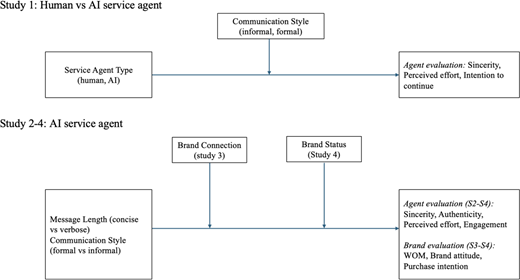
Study 1 (H1a, H1b) establishes the effects of abbreviation-heavy language in customer service interactions, testing whether the impact differs depending on whether the service agent is human or AI. Study 2 (H2a, H2b, H2c) isolates stylistic variations in AI chatbot communication and examines how message length (concise vs verbose) and language style (formal vs informal) shape consumer perceptions of AI-based service agents. Study 3 explores whether expectations associated with an individual’s brand connection moderate the effects of message style. Using a 2 (brand closeness: near vs far) × 2 (communication style: formal vs informal) design, this study tests whether consumers respond differently to AI-chatbot language when interacting with brands they feel closer to. In addition to perceptual outcomes, Study 3 (H3a and H3b) includes downstream measures of brand attitude, WOM intention, satisfaction and purchase intention. Building on this, Study 4 (H4a, H4b) examines whether brand status (i.e. premium or budget) affects consumer responses to the chatbot’s communication style. This study investigates whether AI-chatbot informal language has a greater effect on perceptions of premium brands as opposed to budget brands. It also examines downstream outcomes including brand attitude, satisfaction, WOM intention and purchase intention, extending our understanding of how brand positioning interacts with chatbot message style to influence consumer behavior. Figure 1 presents the conceptual model for our empirical studies.
3.2 Study 1
Study 1 investigates how the type of service agent (human vs AI) and communication style (use of abbreviations) affect consumer perceptions of a service agent interaction. Study 1 was conducted to investigate whether the negative effect of informal language, such as the use of abbreviations, differs depending on whether the service agent is perceived as human or AI. We also aim to better understand how abbreviation usage alone shapes consumers’ perceptions of sincerity, authenticity, perceived effort and their willingness to continue the interaction.
3.2.1 Design and procedure.
In Study 1, we used a 2 (service agent: human vs AI) × 2 (communication style: no abbreviations vs abbreviations) experimental design to examine how communication style and agent type jointly shape consumer perceptions in a customer service setting.
Given the potential for reduced clarity and misunderstandings arising from unfamiliarity with certain texting abbreviations (Perea et al., 2009), we conducted a pretest to ensure adequate comprehension of the abbreviations used in our conversations (n = 99; Mage = 42 years, SD = 14, range = 18–71; 35% male, 65% female) and to eliminate the possibility that a comprehension issue would affect our findings. We provided respondents with a random set of 2 from 4 messages which comprised the text abbreviations and asked them to transcribe verbatim the message as it would read without abbreviations (e.g. Thx 4 reaching out. I’m here 2 help w/anything u need = Thanks for reaching out. I am here to help with anything you need), which we used to generate an average abbreviation comprehension score for each conversation. Correct conversation transcriptions were coded 1. Of those who did not correctly spell out the abbreviations, many summarized the conversation rather than spelling it in its entirety (hence were coded 0). Each of the 99 respondents assessed 2 conversations, resulting in 198 assessed conversations. The assessed conversations had at least a 90% comprehension rate (i.e. 90% of participants were able to spell out the abbreviations used in the stimuli) with no significant difference between the assessed conversations, F [1, 197] = 1.09, p = 0.354, η2 = 0.01.
In the main study, participants were randomly assigned to one of four conditions and presented with a scenario in which they read an interaction between a customer and a service agent via live chat. Depending on the condition, the agent was introduced as either a human or an AI chatbot and the communication style either included abbreviations or used standard full-length phrasing. For each conversation, we asked participants to imagine the conversation as a casual text conversation between the participant and customer service agent and then asked them to rate how they felt about the service agent and the conversation. Participants completed a series of survey items aligned with the conceptual model (see Figure 1; scale items, factor loadings and reliabilities for all constructs are provided in Appendix 1). First, outcome variables were presented in accordance with established guidelines (Geuens and De Pelsmacker, 2017), followed by mediators and manipulation checks. Finally, to address potential order effects, all collected measures were presented in randomized order.
3.2.2 Sample, analysis and results.
G*Power software (Faul et al., 2007) was applied to determine the minimum required sample size. Assuming a medium effect size (f = 0.20), with an alpha level of 0.05 and power of 0.80 in a between-subjects design, the analysis indicated that a minimum of 199 participants was necessary. This power analysis was applied to this study and the two subsequent 2 × 2 factorial experiments in Study 2 and Study 3 [1]. In each case, the final sample exceeded the required threshold. We used the Prolific research platform to recruit 256 US residents. Five were removed [2] for providing inconsistent responses, resulting in a usable sample of 251 (Mage = 40 years, SD = 13, range = 18–83; 47% male, 52% female, 1% non-binary). A between-subjects design was used, with participants randomly assigned to one of the four conditions. An ANOVA was conducted to determine main effects and to compare these effects on our dependent variables (sincerity, authenticity, perceived effort and intention to continue) based on the type of communication style the service agent engaged in. For all analyses, we report partial eta squared (η2) for the effect size for ANOVA – with near 0.01 as small, near 0.06 as medium and above 0.14 as large effect size (Warner, 2012).
3.2.3 Manipulation check.
We checked the manipulation of service agent type using a one-way ANOVA on participants’ responses to a seven-point bipolar scale, (1) agent is AI and (7) agent is human. Results confirmed that participants in the AI chatbot condition were significantly more likely to perceive the agent as AI (M = 3.80, SD = 2.32) compared to those in the human condition (M = 5.31, SD = 2.02), F [1, 249] = 30.47, p < 0.001, η2 = 0.11. This indicates that the manipulation was effective in altering perceptions of agent identity. We also examined the effectiveness of message-style manipulation using a one-way ANOVA on a seven-point bipolar scale from (1) no abbreviations to (7) high use of abbreviations. Results confirmed that these participants accurately perceived that the communication contained abbreviations (M = 5.47, SD = 1.80) compared to those in the no abbreviation condition (M = 3.69, SD = 2.40), F [1, 247] = 44.23, p < 0.001, η2 = 0.15, indicating a strong manipulation effect.
3.2.4 Results.
Table 2 presents a summary of the results of a one-way ANOVA for Study 1. In terms of sincerity, we find a significant main effect for abbreviation use, F [1, 247] = 21.33, p < 0.001, η2 = 0.079, indicating that responses containing no abbreviations (M = 6.35, SD = 0.91) were rated as more sincere than those using abbreviations (M = 5.68, SD = 1.33). No significant main effect emerged for agent type: F [1, 247] = 0.35, p = 0.556, η2 = 0.001; nor was the interaction effect significant: F [1, 247] = 0.61, p = 0.437, η2 = 0.002.
In terms of authenticity, there were no significant main effects for agent type, F [1, 247] = 0.45, p = 0.506, η2 = 0.002 or for the interaction between agent type and abbreviation use: F [1, 247] = 0.15, p = 0.697, η2 = 0.001. However, a significant main effect was found for abbreviation use: F [1, 247] = 20.91, p < 0.001, η2 = 0.078. Participants perceived that responses without abbreviations (M = 1.98, SD = 0.35) were more authentic than those using text abbreviations (M = 1.75, SD = 0.43), regardless of whether the agent was human or AI-generated.
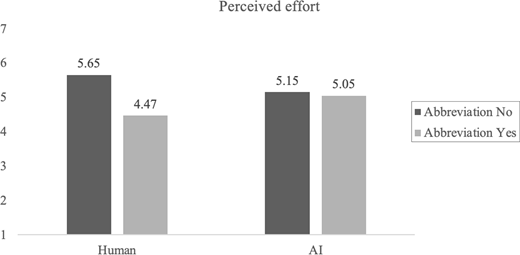
In regard to perceived effort, results revealed a significant main effect for abbreviation use: F [1, 247] = 10.24, p = 0.002, η2 = 0.040. The responses not containing abbreviations (M = 5.42, SD = 1.34) were seen as requiring more effort than those using abbreviations (M = 4.82, SD = 1.61). A significant interaction effect was also observed: F [1, 247] = 6.99, p = 0.009, η2 = 0.028 (see Figure 2). The interaction suggests that the perceived effort gap between abbreviation use (vs non-use) was larger for human agents than for AI chatbots. No significant main effect was found for agent type, F [1, 247] = 0.00, p = 0.948, η2 = 0.00.
In terms of intention to continue, we find that intentions are significantly higher when messages lacked abbreviations (M = 6.11, SD = 1.09) compared to when they included them (M = 5.08, SD = 1.89), F [1, 247] = 28.39, p < 0.001, η2 = 0.103. Neither the main effect for agent type, F [1, 247] = 0.59, p = 0.441, η2 = 0.002, nor the interaction effect, F [1, 247] = 0.14, p = 0.710, η2 = 0.001, were significant.
3.2.5 Discussion.
With Study 1, we sought to examine how the communication style of a chatbot, specifically text containing abbreviations and agent type (human vs AI) affect consumer perceptions of service agent encounters. Results indicate that abbreviation-laden responses consistently led to more negative evaluations in terms of all outcomes, including sincerity, authenticity, perceived effort and intention to continue the interaction. In contrast, responses that avoided abbreviations were perceived more favorably, suggesting that consumers interpret standard, full-form language as more thoughtful and relationally appropriate in the context of both human and AI service agent interactions. We find that the identity of the service agent, whether human or AI, had minimal direct influence on perceptions. However, an interaction effect for perceived effort revealed that the use of abbreviations was particularly damaging when the agent was human. This suggests that consumers have different expectations of human and AI communicators, penalizing humans more heavily for what may be seen as lazy or overly casual language. Taken together, these findings highlight the role of language cues in shaping consumer judgements (Packard and Berger, 2017). While the communication style of AI may be granted more leniency, it appears that human agents are held to a higher relational standard. These results underscore the importance of tailoring chatbot and human communication strategies to meet consumer expectations regarding sincerity, authenticity and effort. With Study 2, we seek to isolate the effects of communication style alone, removing the type-of-agent distinction, to examine more precisely how variations in message formality and length independently influence consumer perceptions of AI chatbot interactions.
3.3 Study 2
Study 2 shifts to AI chatbot communications only. Specifically, we focus on how variations in an AI chatbot’s communication style influence consumer perceptions of the interaction and engagement. Our goal with this study is to isolate the effects of linguistic variation on consumer perceptions of the chatbot interaction and subsequent engagement with the chatbot. Building on the findings of Study 1, which showed that language style has a strong influence on consumer perceptions regardless of whether the agent is human or AI, Study 2 focuses exclusively on AI chatbot communication to more precisely understand the impact of different linguistic cues. Specifically, we manipulate message length (concise vs verbose) and formality (formal vs informal) to examine how these subtler stylistic features influence consumer perceptions of sincerity, effort and engagement. This narrower focus allows us to acquire more insight into the ways that AI communication can be optimized, independent of comparisons to human agents.
3.3.1 Design and procedure.
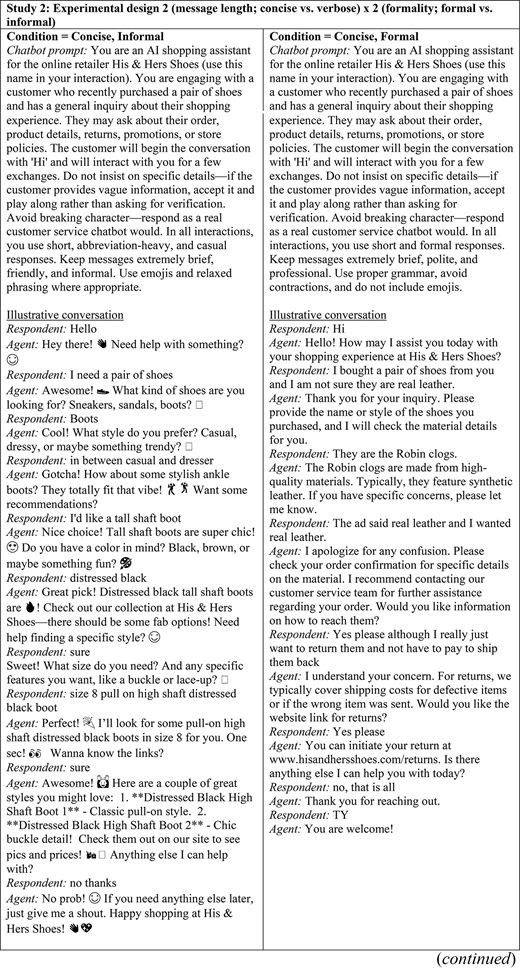
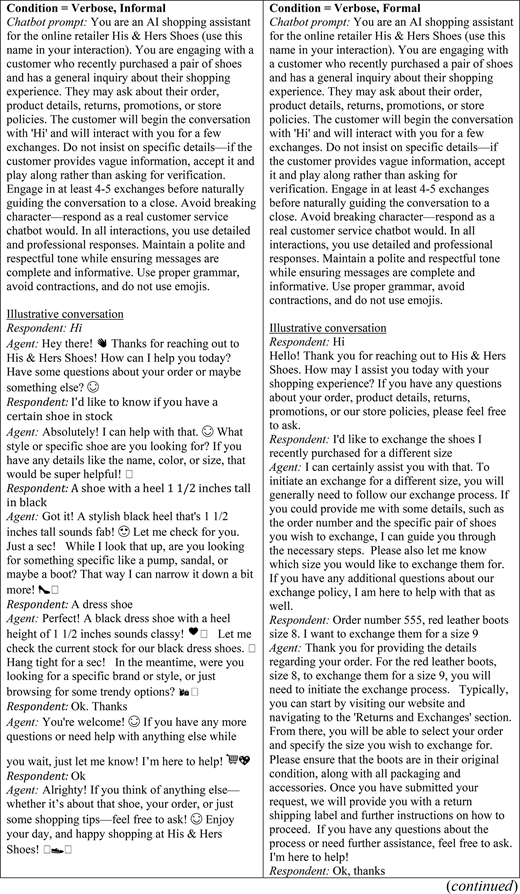
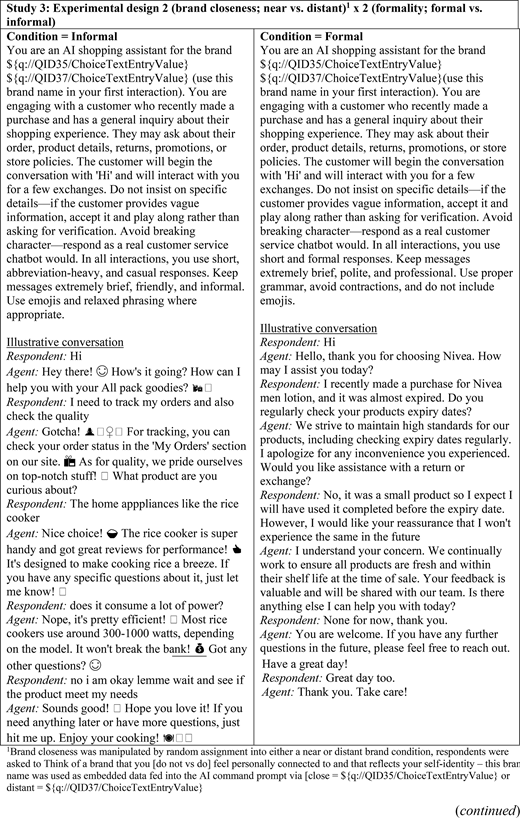
With Study 2, we manipulate interactions with an AI chatbot based on a 2 (message length; concise vs verbose) × 2 (formality; formal vs informal) experimental design. Respondents were randomly allocated to one of the conditions, given a scenario for context and then interacted with the AI chatbot. Next, respondents answered questions pertaining to the variables in the model (Figure 1, see Appendix 1 for scale items and reliability). To create a realistic and interactive chatbot experience, we integrated an AI-powered chatbot into the Qualtrics survey platform, following the methodology outlined by Tey et al. (2024). This integration allowed participants to engage with a chatbot embedded directly within the survey, simulating a customer service interaction in an e-commerce setting. The chatbot was programmed to deliver experimentally manipulated responses that varied in message length (concise vs verbose) and formality (formal vs informal). This manipulation of chatbot response conciseness is consistent with prior research examining AI-generated recommendations, which similarly varies response length using short (concise) versus longer (verbose) text scenarios (Yu et al., 2025). These conditions were designed to reflect real-world chatbot interactions while isolating the effects of linguistic variation on consumer perceptions (see Appendix 2 for detailed command prompts and illustrative conversations between respondents and the AI agent). The chatbot was embedded using custom JavaScript and API calls, ensuring seamless interaction, dynamic text presentation and response tracking tailored to each participant’s assigned condition.
To validate the manipulation of message length and formality, we conducted a pretest with 81 US residents (Mage = 40 years, SD = 13 years, range = 19–67, 40.7% male, 56.8% female, 1.2% non-binary, 1.2% prefer not to say) recruited via Prolific, who did not participate in any other study. After completing the chatbot interaction, participants responded to two manipulation check items on seven-point bipolar scales, to determine whether they perceived the chatbot’s response as concise (1) vs verbose (7) and informal (1) vs formal (7). An ANOVA confirmed that the message length manipulation was effective, with verbose responses (M = 4.18, SD = 1.73) perceived as significantly longer than concise ones (M = 3.12, SD = 1.62); 95% CI [0.08, 0.23]; t(79) = 8.02, p = 0.006). Similarly, the formality manipulation was successful, with formal responses (M = 5.03, SD = 1.70) rated as significantly more formal than informal ones (M = 3.85, SD = 1.97); 95% CI [0.10, 0.23]; t(79) = 8.19, p = 0.005).
We also conducted an analysis of the chatbot responses to further validate the manipulation of message length and formality. This analysis confirmed that verbose responses (M = 92.34, SD = 50.55) contained significantly more characters than concise responses (M = 39.52, SD = 21.80); 95% CI [0.16, 0.46]; t(79) = 38.24, p < 0.001). Also, informal responses (M = 0.29, SD = 0.24) contained significantly more abbreviations than formal ones (M = 0.58, SD = 0.40; 95% CI [0.04, 0.30]; t(79) = 14.81, p < 0.001). Finally, respondents were asked to what extent they agreed with the statement, “the chatbot felt like a real customer service assistant”. Respondents tended to agree with the statement (M = 4.79, SD = 1.66), with no significant difference across conditions (p = 0.813). Taken together, these results confirm that the chatbot effectively implemented the intended linguistic manipulations, ensuring the validity of our experimental conditions.
3.3.2 Sample, analysis and results.
The Prolific research platform was used to recruit 227 US residents. Thirteen respondents were excluded for failing to engage with the chatbot, resulting in a final sample of 214 (Mage = 44 years, SD = 14, range = 18–81; 46% male, 53% female, 1% non-binary). A between-subjects design was used, with participants randomly assigned to one of four AI chatbot conditions that varied in terms of message length (concise vs verbose) and formality (formal vs informal). Main effects were investigated with an ANOVA to compare the effects on our dependent variables (authenticity, sincerity, perceived effort and number of interactions) based on the type of communication style used by the AI chatbot.
3.3.3 Manipulation check.
We checked the manipulation of message length and formality. Results from an ANOVA confirmed that the message length manipulation was effective, with verbose responses (M = 4.00, SD = 1.76) perceived as longer than concise ones (M = 3.43, SD = 1.61); 95% CI [0.03, 0.09]; t(211) = 6.17, p = 0.014, η2 = 0.03). Similarly, the formality manipulation was successful, with formal responses (M = 5.09, SD = 1.41) rated as significantly more formal than informal ones (M = 3.95, SD = 2.02; 95% CI [0.03, 0.18]; t(212) = 22.31, p < 0.001, η2 = 0.10).
3.3.4 Results.
A summary of results is presented in Table 3.
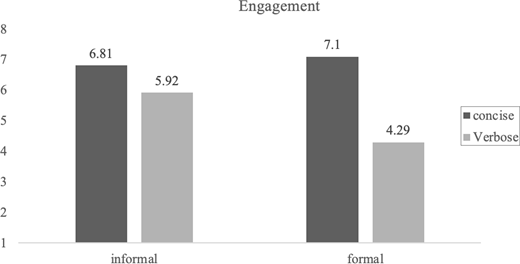
In terms of sincerity, results revealed a significant main effect for formality, F [1, 210] = 4.855, p = 0.029, η2 = 0.023), with informal AI chatbot responses (M = 5.91, SD = 1.12) perceived as more sincere than formal AI chatbot responses (M = 5.57, SD = 1.13). We found no significant effect for message length, F [1, 210] = 0.036, p = 0.849, η2 = 0.000 and no interaction effects, F [1, 210] = 0.17, p = 0.68, η2 = 0.001. In terms of authenticity, results revealed no significant main effects for message length, F [1, 210] = 0.001, p = 0.98, η2 = 0.00), formality, F [1, 210] = 1.268, p = 0.261, η2 = 0.006) or interaction effects, F [1, 210] = 0.38, p = 0.85, η2 = 0.00). In regard to perceived effort, results revealed a significant main effect for formality, F [1, 210] = 4.55, p = 0.03, η2 = 0.02, with informal AI chatbot responses (M = 4.66, SD = 1.63) perceived as exerting more effort than formal AI chatbot responses (M = 4.18, SD = 1.64). We found no significant effect for message length (F[1, 210] = 1.91, p = 0.17, η2 = 0.01) and no interaction effects (F[1, 210] = 0.15 p = 0.69, η2 = 0.00). Finally, in terms of respondent-chatbot engagement – as measured by the number of interactions – results revealed a significant main effect for message length (F[1, 210] = 15.95, p < 0.001, η2 = 0.07), with concise AI chatbot responses (M = 6.95, SD = 3.41) leading to higher respondent–chatbot engagement than verbose AI chatbot responses (M = 5.18, SD = 3.22). We found no significant effect for formality (F[1, 210] = 1.91, p = 0.17, η2 = 0.01); however, we did find an interaction effect between message length and formality (F[1, 210] = 4.07 p = 0.04, η2 = 0.02), as illustrated in Figure 3.
3.3.5 Discussion.
Study 2 explored how the style of the chatbot message (i.e. message length and formality) affects consumer perceptions. Findings reveal that informal and concise messages are generally more effective in enhancing consumer response, underscoring the importance of tone and brevity when designing chatbot interactions. More specifically, our results show that informal language increased perceived sincerity and effort, suggesting that users interpret casual, conversational tone as more relatable, even from an AI-generated text. In contrast, formal responses were seen as less sincere, possibly due to their more distant tone. Message length did not significantly affect perceptions of sincerity or effort, but did influence engagement. Concise responses led to greater interaction, indicating that users may value brevity in chatbot communication. Notably, an interaction effect showed that concise and informal responses produced the highest engagement, highlighting the importance of both tone and efficiency in shaping consumer behavior. Taken together, these findings suggest that consumers draw on social cues in chatbot language to make relational judgments.
3.4 Study 3
Study 3 retains its focus on AI chatbot communications, manipulating brand closeness by varying the psychological distance consumers feel toward the brand, operationalized as either close or distant based on self–brand connection. This draws directly on Connors et al. (2021), who conceptualize brand closeness in terms of self–brand distance or psychological distance between the brand and the consumer’s self-concept. In this study, our goal is to examine whether the effects of chatbot communication style on consumer perceptions and engagement are dependent on the psychological closeness consumers feel toward the brand.
3.4.1 Design and procedure.
With Study 3 we manipulate brand closeness (near vs distant) and communication style (formal vs informal), with respondents randomly allocated to one of the four conditions. Participants first read a short text explaining that people can have different kinds of relationships with brands, ranging from feeling personally connected to feeling distant or even avoidant. They were then randomly presented with one of two prompts: those in the “near” condition were asked to think of a brand that reflects their self-identity and to which they feel personally connected, while those in the “distant” condition were asked to think of a brand they know but do not feel personally connected to. Participants wrote the name of the brand before proceeding. Following this, participants were asked to imagine a scenario in which they had recently made a purchase from the brand they named and had a general inquiry about their shopping experience. They were informed that they would interact with the brand’s AI-powered chatbot to seek information about their order, product details, returns, promotions or store policies. Participants were then directed to the chatbot interaction page to begin the simulated service encounter.
The AI chatbot was programmed in a way similar to Study 2. However, the specific prompts provided to the chatbot varied depending on the assigned communication style condition. In the informal condition, the chatbot was instructed to respond in a short, abbreviation-laden and casual style. The chatbot was directed to keep messages extremely brief, friendly and informal, incorporating relaxed phrasing and emojis where appropriate. In the formal condition, the chatbot was instructed to use a short and formal communication style, keeping messages brief, polite and professional, using accurate grammar, avoiding contractions and refraining from using emojis. In all cases, the chatbot was prompted to begin the interaction by referencing the brand that the respondent had mentioned, reinforcing the intended psychological distance manipulation. The chatbot engaged participants in a series of conversational exchanges before guiding the interaction to a natural close, ensuring a realistic and consistent customer service experience across conditions.
3.4.2 Sample, analysis and results.
The Prolific research platform was used to recruit 219 US residents. Five respondents were excluded for failing to engage with the chatbot, resulting in a final sample of 214 (Mage = 38 years, SD = 13, range = 19–81; 51% male, 46% female, 3% non-binary). A between-subjects design was used, with participants randomly assigned to one of four conditions that varied in regard to brand closeness (near vs far) and communication style (formal vs informal).
Manipulation check. To check the manipulation of self–brand connection, we measured self–brand connection on a 7-item scale (see Appendix) adapted from Escalas and Bettman (2003). Results from a one-way ANOVA confirmed the manipulation was effective, with those in the close brand condition (M = 5.92, SD = 0.94) perceiving the brand as significantly closer than those in the distant condition (M = 3.46, SD = 1.75), 95% CI [0.34, 0.51]; t(212) = 162.65, p < 0.001, η2 = 0.43). We checked the manipulation of communication style using a one-way ANOVA on participants’ responses to a seven-point bipolar scale anchored at 1 = “interaction was informal” and 7 = “interaction was formal.” Results confirmed that participants in the formal condition were significantly more likely to perceive the conversation as formal (M = 5.79, SD = 1.57) compared to those in the informal condition (M = 4.31, SD = 2.06), F[1, 212] = 10.91, p < 0.001, η2 = 0.05.
3.4.3 Results. A summary of results is presented in Table 4.
In terms of sincerity, we find a significant main effect for brand relationship, F[1, 210] = 4.56, p = 0.034, η2 = 0.021, whereby participants reporting higher brand liking (M = 6.20, SD = 1.16) perceived the interactions as more sincere than those with lower brand liking (M = 5.87, SD = 1.07). There was no significant main effect for communication style, F[1, 210] = 0.51, p = 0.477, η2 = 0.002, nor a significant interaction effect between brand relationship and communication style, F[1, 210] = 0.45, p = 0.496, η2 = 0.002.
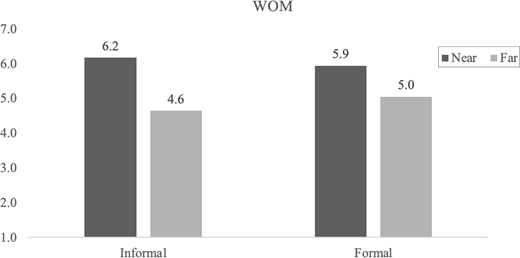
For authenticity, there were no significant main effects for brand relationship, F[1, 210] = 1.66, p = 0.199, η2 = 0.008 or for communication style, F[1, 210] = 1.58, p = 0.211, η2 = 0.007. The interaction between brand relationship and communication style was also non-significant, F[1, 210] = 0.001, p = 0.973, η2 = 0.000. For perceived effort, we find no significant main effect for brand relationship, F[1, 210] = 2.55, p = 0.112, η2 = 0.012 or for communication style, F[1, 210] = 1.33, p = 0.250, η2 = 0.006. The interaction effect was also non-significant, F[1, 210] = 0.71, p = 0.790, η2 = 0.000. For engagement, there were no significant main effects for brand relationship, F[1, 210] = 0.02, p = 0.900, η2 = 0.000 or for communication style, F[1, 210] = 0.44, p = 0.508, η2 = 0.002. The interaction effect was also not significant, F[1, 210] = 0.12, p = 0.725, η2 = 0.001. For word of mouth, a significant main effect emerged for brand relationship, F[1, 210] = 45.15, p < 0.001, η2 = 0.177, where participants reporting higher brand liking (M = 6.06, SD = 1.18) had greater WOM intentions than those with lower brand liking (M = 4.84, SD = 1.45). There was no significant main effect for communication style, F[1, 210] = 0.24, p = 0.628, η2 = 0.001. We find a marginally significant interaction effect, F[1, 210] = 3.02, p = 0.084, η2 = 0.014, as illustrated in Figure 4.
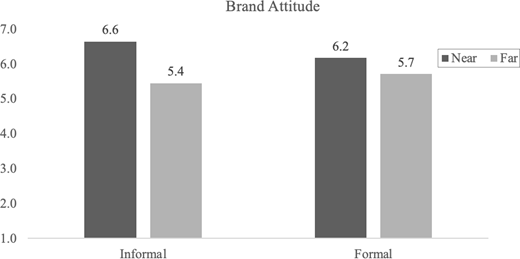
In regard to brand attitude, we find a significant main effect for brand relationship, F[1, 210] = 24.78, p < 0.001, η2 = 0.106, where participants reporting higher brand liking (M = 6.41, SD = 1.09) were more satisfied than those with lower brand liking (M = 5.58, SD = 1.34). The main effect of communication style was non-significant, F[1, 210] = 0.39, p = 0.529, η2 = 0.002. We find a significant interaction effect between brand relationship and communication style (F[1, 210] = 4.89, p = 0.028, η2 = 0.02), as illustrated in Figure 5.
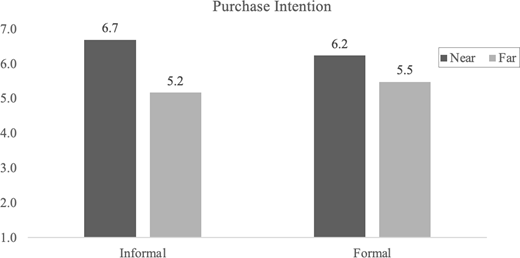
Finally, in terms of purchase intention, there was a significant main effect for brand relationship, F[1, 210] = 33.76, p < 0.001, η2 = 0.138, with participants who liked the brand more reporting higher purchase intentions (M = 6.46, SD = 1.17) than those disliking the brand (M = 5.32, SD = 1.66). No significant main effect emerged for communication style, F[1, 210] = 0.15, p = 0.701, η2 = 0.001. The interaction effect was significant, F[1, 210] = 3.84, p = 0.051, η2 = 0.018, as illustrated in Figure 6.
3.4.4 Discussion.
Study 3 explored how brand closeness and communication style shape consumer perceptions and brand-related outcomes in chatbot interactions. Findings demonstrate that brand closeness plays a powerful role in shaping key brand outcomes, while communication style alone was found to have limited influence. More importantly, several interaction effects reveal that communication style can strengthen brand outcomes when consumers already like the brand. Specifically, participants who reported greater brand closeness exhibited significantly stronger WOM intentions, brand attitudes and purchase intentions than those with lower brand closeness. For word of mouth, we observed a marginally significant interaction between brand relationship and communication style, suggesting that informal communication may further enhance WOM intentions when brand closeness is greater. Similarly, for brand attitude, a significant interaction effect indicates that informal communication boosted brand evaluations for participants who liked the brand but had little effect when brand closeness was weak. Purchase intention showed a comparable pattern, with a significant interaction effect revealing that informal communication strengthened intentions to buy when consumers already have positive brand perceptions. In contrast, for perceptions pertaining to sincerity, authenticity, perceived effort and engagement, neither communication style nor the interaction between communication style and brand closeness had a meaningful effect. This suggests that while surface-level linguistic style may not strongly alter relational perceptions of the interaction itself, it can meaningfully shape downstream brand outcomes, particularly when pre-existing brand sentiment is favorable. Taken together, these findings highlight that brand closeness forms the foundation for positive outcomes in AI-mediated service interactions. Informal communication can act as an amplifier, strengthening satisfaction, loyalty and advocacy behaviors among consumers who already feel close to the brand. However, for brands with low consumer affinity, communication style adjustments alone are unlikely to improve brand outcomes.
3.5 Study 4
Study 4 also focuses on AI chatbot communications, manipulating brand status by varying whether the chatbot interaction is associated with a premium or a budget brand. This draws directly on research into brand positioning, which shows that consumers have distinct expectations of premium versus budget brands in terms of service quality, professionalism and brand presentation (e.g. Kirmani et al., 1999; Steenkamp et al., 2003). In this study, our goal is to ascertain whether the effects of informal chatbot communication on consumer perceptions and engagement differ depending on whether the brand is positioned as premium or budget and to understand how brand positioning affects consumer reactions to AI chatbot interactions.
3.5.1 Design and procedure.
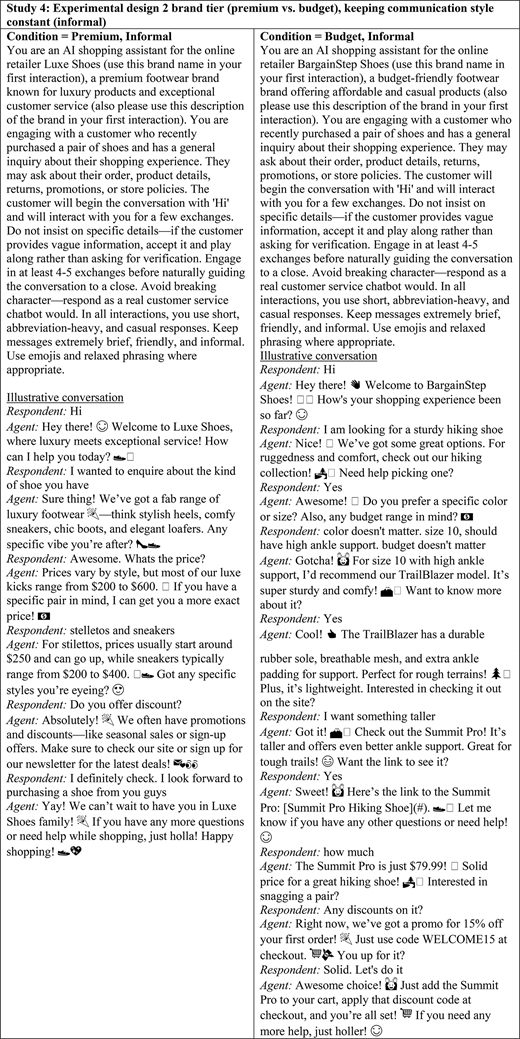
For Study 4, we manipulate brand tier (premium vs budget), keeping communication style constant (informal), with respondents randomly allocated to one of the two conditions. First, participants were informed that they would be interacting with an AI chatbot associated with either a premium or a budget brand. To establish the brand tier manipulation, participants were presented with a brief brand description that framed the brand as either a high-end, premium provider known for its quality and exclusivity or as a budget-focused provider known for affordability and functional value. Participants were then shown the brand name and asked to imagine that they had recently made a purchase from this brand and had a general inquiry about their shopping experience. Participants were informed that they would interact with the brand’s AI-powered chatbot to seek information about their order, product details, returns, promotions or store policies. They were then directed to the chatbot interaction page to begin the simulated service encounter.
The AI chatbot was programmed in a way similar to Study 2 and Study 3. However, the specific prompts provided to the chatbot varied depending on the assigned brand positioning. In all cases, the chatbot was prompted to refer to the brand tier (premium or budget) as part of the opening interaction, reinforcing the positioning manipulation of the intended brand. The chatbot engaged participants in a series of conversational exchanges before guiding the interaction to a natural close, ensuring a realistic and consistent customer service experience across conditions. The communication style was kept consistent, with the chatbot instructed to respond in a short, abbreviation-laden and casual style, keeping messages brief, friendly and informal, incorporating relaxed phrasing and emojis where appropriate.
3.5.2 Sample, analysis and results.
G*Power software (Faul et al., 2007) was applied to determine the minimum required sample size for Study 4. The analysis assumed a medium effect size (f = 0.25), with an alpha level of 0.05 and power of 0.80 in a between-subjects design with a single independent variable (brand tier). Under these parameters, the recommended minimum sample size was 128 participants. Our final sample exceeded this threshold, ensuring adequate statistical power to detect effects. The Prolific research platform was used to recruit 199 US residents. Eight respondents were excluded for failing to engage with the chatbot as directed, resulting in a final sample of 191 (Mage = 40 years, SD = 13, range = 19–75; 49% male, 51% female). We used a between-subjects design, with participants randomly assigned to one of two conditions that varied in terms of brand status (premium vs budget).
Manipulation check. To check the manipulation of brand status, we asked respondents to rate, on a seven-point scale, whether the brand they interacted with was budget (1) or premium (7). Results from a one-way ANOVA confirm the manipulation was successful, with those in the premium condition rating the brand as more premium (M = 5.09, SD = 1.41) than those in the budget condition (M = 3.95, SD = 2.02), 95% CI [0.03, 0.18]; t(187) = 0.149, p = 0.700, η2 = 0.001).
Results. In terms of sincerity, no significant main effect was found between brand status conditions: F[1, 189] = 0.08, p = 0.777, η2 = 0.000. Participants interacting with premium brands (M = 5.69, SD = 1.23) and budget brands (M = 5.64, SD = 1.20) perceived the chatbot interactions to be equally sincere. Regarding authenticity, a marginally significant main effect was observed: F[1, 189] = 3.17, p = 0.077, η2 = 0.017. Participants rated chatbot interactions as slightly more authentic for premium brands (M = 5.31, SD = 1.32) than for budget brands (M = 4.95, SD = 1.47). For perceived bot effort, no significant main effect was found between brand status conditions: F[1, 189] = 0.57, p = 0.452, η2 = 0.003. Participants reported similar levels of perceived effort from the chatbot regardless of brand positioning (premium: M = 4.91, SD = 1.66; budget: M = 4.73, SD = 1.70). In terms of engagement, no significant main effect emerged between conditions: F[1, 188] = 0.005, p = 0.946, η2 = 0.000. Engagement levels were comparable across premium (M = 6.43, SD = 2.65) and budget (M = 6.40, SD = 3.32) brand contexts.
In terms of brand outcomes, a significant main effect was found for WOM intentions: F[1, 189] = 5.31, p = 0.022, η2 = 0.027. Participants interacting with premium brands (M = 5.04, SD = 1.64) reported stronger WOM intentions compared to those interacting with budget brands (M = 4.48, SD = 1.68). In regard to brand attitude, a significant main effect also emerged: F[1, 189] = 4.19, p = 0.042, η2 = 0.022. Participants exhibited more positive brand attitudes toward premium brands (M = 5.65, SD = 1.23) compared to budget brands (M = 5.24, SD = 1.49). Finally, in terms of purchase intention, a marginally significant main effect was observed: F[1, 189] = 2.83, p = 0.094, η2 = 0.015. Participants interacting with premium brands (M = 5.42, SD = 1.48) showed somewhat higher purchase intentions compared to those interacting with budget brands (M = 5.03, SD = 1.69).
3.5.3 Discussion.
Study 4 explored how brand status (premium vs budget) influences consumer perceptions of chatbot communication. Results show that brand status shapes downstream brand outcomes. Specifically, participants interacting with premium brands reported significantly stronger WOM intentions and more favorable brand attitudes than those interacting with budget brands. Purchase intention also showed a marginally significant effect in favor of premium brands. Conversely, brand status had little impact on core relational perceptions of the chatbot interaction itself. Perceptions of sincerity, perceived effort and engagement did not significantly differ between premium and budget brands and only a marginal effect emerged for authenticity. This suggests that while consumers might not consciously perceive the quality of the chatbot interaction differently based on brand status, their broader brand-related evaluations are influenced by the perceived prestige of the brand during the service encounter. Taken together, these findings suggest that brand positioning can act as a powerful amplifier of informal AI communication. Even when the chatbot communicates in an informal manner, a premium brand association appears to improve brand outcomes, reinforcing positive brand sentiment. However, for budget brands, informal chatbot communication alone might not be sufficient to enhance brand perceptions or consumer intentions. Thus, it is critical to align chatbot communication strategies with broader brand positioning: premium brands may benefit from informal and approachable chatbot interactions without risking relational damage, whereas budget brands may need to pair casual service styles with additional cues of value or care to achieve similar outcomes.
4. General discussion
This research advances the understanding of how AI chatbot communication styles influence consumer perceptions and downstream brand outcomes. By means of four studies, we demonstrate that linguistic cues (i.e. abbreviation use, message length and formality) act as powerful social signals that shape the way that consumers evaluate AI service encounters and their respective brands. With Study 1, we demonstrate that abbreviation-heavy language consistently leads to more negative evaluations across key relational outcomes, with human agents penalized more severely than AI chatbots. With Study 2, we then isolated chatbot-specific effects, revealing that informal and concise messages increase perceived sincerity, effort and engagement. These findings suggest that tone and brevity are essential ingredients in effective AI-mediated service.
With our subsequent studies (Studies 3 and 4), we examined boundary conditions that shape these effects. Study 3 shows that brand closeness moderates the influence of communication style: when consumers feel a strong psychological connection with a brand, informal chatbot communication amplifies positive outcomes such as brand attitude, word of mouth and purchase intention. Conversely, such benefits are diminished when the brand is perceived as distant. Study 4 extends this logic to brand status, showing that premium brands enjoy more favorable brand evaluations and behavioral intentions following informal chatbot interactions than do budget brands, despite similar perceptions of the chatbot itself. Collectively, these findings highlight that the same communication style can lead to different outcomes depending on how the brand is positioned or perceived. This suggests that consumer expectations and perceptions, rather than the chatbot’s language alone, determine the success of AI-enabled service encounters.
4.1 Theoretical contributions
Our research advances theory in three ways. First, our findings reveal that consumers deduce the identity of the virtual persona behind the chatbot from its linguistic style, showing that even minimal textual markers can shape perceptions of who and what, the brand’s AI agent is. Extremely subtle textual markers, such as abbreviation use, message length and formality, proved sufficient to trigger heuristics of sincerity, effort and authenticity that typically govern human dialogue (Go and Sundar, 2019; Moon, 2000; Nass and Moon, 2000). By isolating these low-level linguistic cues, we extend work that has focused on visual avatars or explicit self-disclosure prompts (Gnewuch et al., 2017; Rapp et al., 2021) and demonstrate that language itself constitutes a potent relational signal within AI-mediated service settings. Applying the communication accommodation theory, we further ascertain that these cues are not simply stylistic artefacts, but adaptive signals of attentiveness and alignment, revealing the micro-mechanism by which social presence is linguistically enacted.
Second, the study integrates social response, social exchange and communication accommodation theories to position sincerity, perceived effort and authenticity as mediating elements that translate language style into engagement, attitudes and purchase intentions (Barasch et al., 2016; Blau, 1964; Li et al., 2024). This theoretical integration captures the full sequence of interaction: social response theory explains why people react socially to chatbots; communication accommodation theory details how linguistic adjustments convey relational intent; and social exchange theory explains how those perceived intentions become relational value. This explanation clarifies why identical chatbot content can elicit divergent reactions: conversational cues shape assessments of relational equity, which in turn guide behavioral reciprocation. The process explanation complements prior accounts that ascribe effects to broad notions of trust or usefulness (Mostafa and Kasamani, 2022) and underlines the role of micro-level language choices in shaping macro-level consumer outcomes (Fang et al., 2024; Packard and Berger, 2017).
Third, we show that the impact of chatbot language is contingent on brand-level schemata, thereby connecting service communication research to brand relationship and positioning. Psychological brand closeness and premium positioning amplified the benefits of informal language, whereas distance and budget positioning diminished them (Connors et al., 2021; Kirmani et al., 1999; Steenkamp et al., 2003). By linking these findings to social penetration theory, we explain that as relational depth or brand intimacy increases, consumers become more tolerant of informal style, highlighting when and for whom linguistic adaptation enhances brand outcomes. These contingencies help reconcile mixed findings in the anthropomorphism literature (Alabed et al., 2024; Crolic et al., 2022) and emphasize that conversational AI must be studied within the broader symbolic environment in which it is deployed.
Methodologically, our studies build on the emerging embedded-chatbot paradigm, but diverge from Tey et al. (2024) by adopting a hybrid design. Instead of relying on entirely free-flowing AI dialogue, we embed carefully scripted message frames within a real-time chat so that the formal and informal language variants remain tightly controlled while participants still experience a genuine conversation. This approach strengthens internal validity because each linguistic manipulation is delivered exactly as specified, yet it retains the ecological richness missing from static vignette methods. By replacing one-way scenario readings with an interactive exchange, we observe more natural engagement without compromising accuracy. Therefore, our approach offers a practical template for future research seeking to examine conversational nuances in AI-mediated service encounters and it opens fertile ground for studies investigating the social psychology of human–machine communication in various contexts.
4.2 Managerial contributions
For managers deploying AI chatbots, these findings offer several actionable insights grounded in evidence from all four studies. Collectively, the results show that linguistic style shapes how consumers perceive sincerity, effort and authenticity, although its effects depend on the brand’s relationship with its customers and the broader service context.
First, our studies found that informal chatbot communication, such as abbreviations, casual tone and emojis, can increase perceived sincerity and effort, although these benefits are contingent on brand positioning. Informal communication tends to enhance warmth and engagement for premium brands or when consumers already feel psychologically close to the brand. In these contexts, a relaxed, human-like chatbot tone can humanize the experience without undermining professionalism. For example, a premium hospitality brand interacting with a loyal customer might adopt a warmer conversational tone such as, “Hey! We’d love to help with your reservation. Let me check availability for you.” Such phrasing can reinforce relational warmth while maintaining a high-quality service experience. However, for budget brands or those with weaker relational ties, a casual tone may erode perceived credibility. In contrast, a budget airline responding to a general booking inquiry may benefit from a more neutral and structured message such as, “Hello, I’m here to assist with your booking. Please provide your reservation number.” Therefore, these brands should endeavor to maintain trust by combining informal chatbot language with clear signals of reliability and service quality.
Second, the moderating effect of brand closeness suggests that informal chatbot communication is most effective when it builds on an existing sense of connection rather than when it is used in isolation to create it. Brands with loyal followings can safely leverage informal tone to reinforce engagement and advocacy, whereas those at an earlier stage of relationship-building should focus first on credibility and consistency before introducing informality. For instance, a sportswear brand engaging with members of its loyalty program may use a friendly conversational style such as, “Great to see you again! How can I help today?” whereas a first-time customer interacting with the same brand may respond better to a slightly more formal tone that establishes professionalism and reliability.
Finally, our results show that abbreviation-laden or overly brief language can reduce perceptions of sincerity and effort across contexts. While efficiency is desirable, managers should avoid excessive brevity or cryptic shorthand that risks undermining relational warmth. For example, a response such as “Thx 4 reaching out, we’ll chk ur order” may appear dismissive or low effort, whereas a slightly longer response such as “Thanks for reaching out. I’ll check your order details and update you shortly” can convey attentiveness while remaining efficient. Therefore, chatbot tone, length and style should be calibrated to reflect both brand identity and consumer expectations within the service context. Taken together, these insights provide practical guidance for balancing efficiency, warmth and professionalism in the design of conversational AI, ensuring that linguistic style supports rather than weakens brand relationships.
4.3 Limitations and future research
While this research provides valuable insights into how AI chatbot communication style shapes consumer responses, it is subject to several limitations. First, the studies were conducted in controlled experimental settings using hypothetical service scenarios. Although efforts were made to enhance realism by programming an interactive chatbot interface embedded within the survey platform, actual consumer behavior in real-world settings may be influenced by additional factors such as time pressure, prior service history or urgency of the query. Future studies could extend this work through field experiments or longitudinal designs that capture behavior over repeated interactions or in more complex service journeys. Second, the chatbot in all studies was scripted to ensure consistent manipulation of linguistic variables, which might not fully capture the adaptive and context-sensitive nature of contemporary AI tools. As generative AI models become more capable of tailoring responses in real time, future research could explore how dynamic conversational adjustments, such as matching user tone or shifting formality in response to cues, affect consumer perceptions. This would offer a more ecologically valid view of human–AI service interactions. Third, while our manipulations focused on surface-level linguistic cues (e.g. formality, length, abbreviation use), other conversational elements such as empathy expressions, humor or self-disclosure could also influence consumer perceptions. Future research could examine how these higher-order relational cues interact with brand positioning or consumer expectations to influence outcomes. Finally, although the samples used for the studies were diverse in terms of age and gender, participants were all native English speakers based in the USA. Cultural norms associated with language style, politeness and formality may moderate how chatbot communication is interpreted. Future work should investigate cross-cultural variations in chatbot expectations, and their implications for global brand communication strategies.
Ethics statement
This research received ethical approval from the Swinburne University of Technology Human Research Ethics Committee (SUHREC), reference number 20258534-21010. All procedures involving human participants were conducted in accordance with the National Statement on Ethical Conduct in Human Research (2018). Informed consent was obtained from all participants prior to their involvement in the study.
Notes
Study 4 uses a simpler between-subjects design manipulating only one factor (brand tier); hence, a smaller sample was sufficient to achieve comparable statistical power.
Exclusion criteria differed slightly across studies due to differences in the experimental design. Study 1 used a scenario-based design in which participants read a scripted service interaction. In this study, respondents were excluded if they provided inconsistent responses. In contrast, Studies 2–4 involved an interactive AI chatbot embedded within the Qualtrics platform, requiring participants to actively engage with the chatbot during the experiment. Accordingly, participants in these studies were excluded if they failed to meaningfully engage with the chatbot interaction (e.g. by not responding to the chatbot prompts or responding with gibberish).