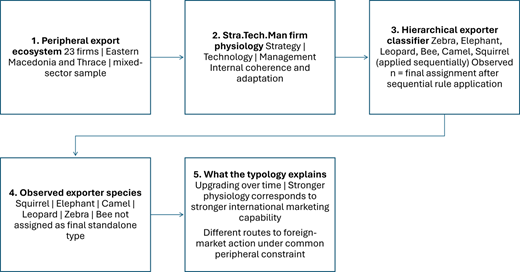
Export and export-marketing research usually differentiate firms by size, sector, export intensity, or performance. We ask whether exporters in a peripheral region also fall into recurrent organizational forms that reflect how strategy, technology, and management (Stra.Tech.Man) are combined inside the firm, and whether that perspective reveals variation a degree-based account leaves obscured.
To examine that possibility, we use a sequential mixed-method design covering 23 firms in Eastern Macedonia and Thrace, a peripheral region on the southeastern edge of the European Union. A hierarchical rule-based classifier anchored in Stra.Tech.Man “physiology” is paired with exploratory reliability checks, paired retrospective change tests, Holm-adjusted correlations, and qualitative coding. Raw rule indicators are distinguished from final primary “species” assignments, and the classifier is interpreted through resource-based, dynamic-capabilities, Uppsala, network, and institutional lenses.
Five final standalone exporter species are assigned in the sample: Squirrel, Elephant, Camel, Leopard, and Zebra. Bee is not assigned as a final standalone type; in the two firms satisfying the raw Bee rule, collaboration appears as a secondary embedded signature. Respondents report present scores that exceed retrospectively reported past scores on the main physiology and marketing composites, and stronger current physiology is associated with stronger international marketing capability.
This evidence should be read as transparent configuration building rather than as a final theory test. The study is exploratory, region-specific, and based on a small non-random sample, key-informant self-assessments, retrospectively reported past ratings, and a rule-based classifier. It identifies analytically transferable classification logic, not population prevalence, causal effects, or evaluated interventions.
Even with these limits, the typology offers a practical diagnostic for managers and policymakers. It suggests species-contingent upgrading priorities while treating these as diagnostic hypotheses rather than tested intervention effects.
Rather than proposing a direct model of export performance, the article shifts attention from customer segmentation to exporter segmentation. It develops a transparent, physiology-based typology of exporter forms, treats international marketing capability as a proximal expression of deeper organizational alignment rather than as a direct performance metric, and shows that similar outward outcomes may rest on different internal forms in peripheral export ecosystems.
1. Introduction
Export marketing capability consists of the routines through which firms read foreign markets, differentiate customers, adapt offerings, and keep commercial activity under control abroad. Product quality matters, but it rarely speaks for itself in export markets. What counts is the firm's capacity to convert market intelligence into segmentation choices, adaptation, and disciplined follow-through, a point well established in the export marketing literature (Cadogan et al., 1999; Day, 1994; Morgan et al., 2012; Vorhies and Morgan, 2005). The harder question is why firms confronting similar foreign-market tasks so often organize those routines in markedly different ways.
The issue becomes sharper in peripheral regions. Firms operating away from dense metropolitan cores often confront longer logistical distances, thinner knowledge and support infrastructures, weaker specialization, and narrower pools of export-oriented expertise. Eastern Macedonia and Thrace illustrates that condition. Prior work depicts it as a lagging and relatively less competitive NUTS 2 region on the southeastern border of Europe, where entrepreneurial development is uneven and firms adapt under structural pressure rather than under conditions of abundance (Boden, 2017; Chatzinikolaou and Vlados, 2023, 2024; Dijkstra et al., 2023). Yet shared constraint does not yield a single export profile. Some firms move cautiously, some codify routines at scale, and a few compete through speed, precision, or legitimacy.
Export research still leans heavily on variables of degree: firms are compared by size, experience, export intensity, or capability (Johanson and Vahlne, 2009; Katsikeas et al., 2000; Morgan et al., 2012; Sousa et al., 2008). Recent work has refined that tradition by linking export outcomes to marketing capabilities, knowledge, domestic market conditions, innovation, and sustainability (Acikdilli et al., 2022; Chang et al., 2024; Forte and Carvalho, 2024; Nave and Ferreira, 2024). The prevailing question nonetheless remains variable-centered. We learn which factors are associated with performance, but much less about whether firms that look similar from the outside are organized differently on the inside. A configurational perspective keeps that issue in view because it asks how capabilities are assembled and deployed inside firms (Fiss, 2007; Freixanet and Federo, 2025; Meyer et al., 1993). Two exporters may post similar market-facing scores and still rest on different internal architectures. A degree-based account flattens that variation. A form-based account keeps it visible.
We develop that argument through Stra.Tech.Man (strategy, technology, management). In the synthesis proposed by Vlados and Chatzinikolaou (2025), the firm is treated as a living adaptive entity whose strategic, technological, and managerial organs evolve together. Their “physiology” argument also makes a stronger claim: firms exposed to similar ecosystem conditions may still diverge because their internal organization differs. The same work introduces the squirrel-elephant-leopard triad and insists that firm nature cannot be read off size alone. Building on that logic, we treat export marketing capability not as an isolated marketing function but as an outward expression of deeper internal organization. The animal labels remain heuristic devices for comparing recurrent exporter forms rather than substitutes for theory.
Against that background, the article asks how exporters in a peripheral regional ecosystem can be segmented into physiology-based “species” and what such segmentation reveals about international marketing capability. We examine final species assignments, retrospectively reported upgrading, physiology–marketing associations, and qualitative evidence on how each species pursues foreign customers.
We therefore position the article as a study of exporter form rather than another search for incremental drivers of export outcomes. It offers a transparent typology that can be inspected case by case and reopens the firm-level organizational question in regional export research. Because the evidence is exploratory and region-specific, the contribution lies in opening a comparative agenda, not in asserting a universal law.
The paper proceeds in a straightforward sequence (Figure 1). Section 2 sets out the theoretical frame. Section 3 positions the study in the recent literature and states the gap more sharply. Section 4 explains the abductive mixed-method design and the hierarchical classifier. Section 5 reports the empirical results. Sections 6 and 7 develop the theoretical, managerial, and policy implications, and Section 8 concludes.
2. Theoretical framework
2.1 Stra.Tech.Man and firm physiology
Stra.Tech.Man conceptualizes the firm as a living adaptive entity in which strategy, technology, and management function less as administrative silos than as interdependent organs. Vlados and Chatzinikolaou (2025) define firm physiology as the internal functioning through which firms adapt, innovate, and evolve, and they present that physiology as a micro-level mechanism that helps explain why ostensibly similar ecosystems produce divergent firm outcomes. Their original schema distinguishes Squirrel, Elephant, and Leopard as stylized forms of “monad-centered,” “massive,” and “flexible” firms. The present study carries that inside-out logic into exporter behavior in a peripheral regional setting, and this shifts export marketing capability from a self-contained departmental competence to a visible expression of internal organization.
2.2 Stra.Tech.Man, resources, and dynamic capabilities
Capability-based theories help specify why this move matters. The resource-based view explains persistent differences through heterogeneous bundles of resources and routines. Recent export research continues to show that market orientation, marketing capabilities, innovation, and cooperation shape exporter outcomes (Acikdilli et al., 2022; Ortigueira-Sánchez et al., 2022). Dynamic-capabilities work pushes further by stressing the need to sense, seize, and reconfigure those resources as foreign markets shift (Dayangan and Aykol, 2024; Mostafiz et al., 2024). Stra.Tech.Man complements that literature by identifying the internal architecture through which such bundles are assembled. Strategy, technology, and management are the organs through which otherwise generic capabilities become operative.
2.3 Internationalization, networks, and institutions under peripheral conditions
Internationalization and ecosystem theories add two further pieces. Uppsala reasoning remains relevant because exporters in peripheral settings often expand under uncertainty, incomplete market knowledge, and limited foreign embeddedness, so outward movement is commonly gradual and learning-driven (Johanson and Vahlne, 2009). Network theory reminds us that firms do not internationalize alone. Foreign customers, distributors, collaborators, and intermediaries can compensate for missing scale or thin local support structures (Dhanaraj and Parkhe, 2006; Ellis, 2011), while recent work shows how network-based internationalization can widen small- and medium-sized enterprise (SME) knowledge base and support expansion abroad (Osarenkhoe and Fjellström, 2024). Institutional theory brings legitimacy back into the picture. For some exporter forms, resilience, certification, sustainability evidence, and trust-building are not peripheral ornaments but constitutive elements of foreign-market behavior (Bıçakcıoğlu-Peynirci and Tanyeri, 2022).
2.4 Exporter species as heuristic organizational forms
Within this integrated perspective, the animal labels are best read as heuristic organizational forms. They are mnemonic devices for recurring configurations through which internal physiology becomes visible in export practice. In the pages that follow, “hunting” refers to the sequence by which firms identify, interpret, attract, and govern foreign demand. Empirically, we capture that sequence through international market sensing, customer understanding and segmentation, marketing-mix adaptation, and commercial control abroad. The typology does not literally biologize the firm. It reorganizes familiar export-marketing constructs around a configurational question: what organizational forms recur when firms pursue foreign customers under common peripheral constraints?
From this perspective, exporters in the same peripheral ecosystem differ not only in strength but also in physiology-based form. Stra.Tech.Man provides the integrating micro-foundation. Resource- and capability-based theories explain why internal bundles and reconfiguration matter. Uppsala and network theory explain movement under uncertainty and relational dependence. Institutional theory clarifies why legitimacy, sustainability evidence, and support conditions shape viable export behavior.
2.5 Linking theory to the classifier
The classifier used in this study extends rather than displaces the Stra.Tech.Man source framework (Table 1). The physiological core remains strategy, technology, management, and their integrated coherence.
Around that core we incorporate exporter-specific selectors: finance, sustainability, collaboration, resilience, and international marketing capability. Finance indicates the capacity to sustain outward activity. Sustainability and certification signal legitimacy in foreign markets. Collaboration captures network embeddedness, while resilience refers to shock absorption and selective adaptation. International marketing capability is the most direct market-facing expression of physiology in foreign-market action. The labels simply name the resulting configurations. Analytically, the point is that exporters can reach foreign markets through different combinations of capability development, niche discipline, network leverage, and post-entry adaptation (Chang et al., 2024; Efrat and Asseraf, 2024; Osarenkhoe and Fjellström, 2024; Yang and Stoian, 2025).
A conceptual tension remains. Stra.Tech.Man does not treat firm size as the essence of physiology, yet the classifier uses employee thresholds for Elephant and below-90 thresholds for Leopard and Camel. We use size here as an observable signal within this dataset, not as the definition of physiology. In other words, Elephant denotes exporters whose foreign-market action in the present sample is organized through scale and coordination. It does not imply that all large firms are elephants in any general Stra.Tech.Man sense.
The rule order prioritizes rare and highly diagnostic signatures before residual adaptive forms. Section 4.3 explains the operational sequence and the distinction between raw rule satisfaction and final hierarchical assignment.
3. Literature review, synthesis, and research gap
3.1 Export performance and export marketing capability
Export performance research provides the first substantive anchor. Classic reviews and model-building studies show that exporter outcomes are shaped by capabilities, strategy implementation, experience, commitment, and environmental conditions (Katsikeas et al., 2000; Morgan et al., 2012; Sousa et al., 2008). More recent work continues that variable-based program by linking exporter outcomes to market orientation, marketing capabilities, innovation, domestic market characteristics, knowledge, cooperation, and sustainability-related strategy (Acikdilli et al., 2022; Aksoy et al., 2024b; Chang et al., 2024; Forte and Carvalho, 2024; Nave and Ferreira, 2024; Ortigueira-Sánchez et al., 2022). Governance has also entered the export-intensity literature, and one recent study shows that the link between board diversity and exporting varies with firm size (Aksoy et al., 2024a). Work on SME internationalization also points to digitalization and innovation capability as internal conditions that support development abroad (EL Abiad et al., 2025). We now know much more about the drivers of export intensity and export performance than we did a decade ago.
The export-marketing capability tradition narrows the focus to the routines through which firms sense foreign markets, understand customer differences, adapt offerings, and keep commercial activity under control abroad (Cadogan et al., 1999; Day, 1994; Morgan et al., 2012; Vorhies and Morgan, 2005). What remains harder to explain is why firms facing similar export tasks organize those routines through different internal logics. Exporters are still often treated as comparable units that vary in strength or outcomes. That leaves room for an account centered on form rather than degree.
3.2 Exporter heterogeneity and configurational reasoning
Another body of work addresses exporter heterogeneity more directly. Configurational research shows that organizational elements acquire meaning in combination rather than in isolation, and that similar outcomes may emerge through more than one internally coherent path (Fiss, 2007; Meyer et al., 1993). A recent configurational study reaches a similar conclusion, showing that internationalization, absorptive capacity, and resource-based factors shape innovation through multiple configurations rather than through one additive formula (Freixanet and Federo, 2025). Ecosystem scholarship presses the same issue from another angle by asking for firmer firm-level theory whenever heterogeneous outcomes are to be explained rather than merely catalogued (Felin and Foss, 2023). In export settings, the implication is straightforward: similar market-facing scores may rest on quite different combinations of coordination, technological absorption, and managerial control.
Even so, exporter heterogeneity only occasionally becomes a transparent typology of exporter forms. Much of the literature acknowledges difference without making it auditable or directly comparable at the firm level. Our question therefore departs from the standard one. We ask not only which capabilities improve export outcomes, but also what recurrent exporter forms become visible when internal physiology and outward capability are read together.
3.3 SME internationalization and networked expansion under constraint
A related stream examines SME internationalization, post-entry development, and networked expansion. Recent studies show that firms do not internationalize through a single sequence. Some scale through focused capability accumulation and niche discipline, some through network leverage, and some through post-entry dynamic-capability development (Efrat and Asseraf, 2024; Osarenkhoe and Fjellström, 2024; Weiss et al., 2022; Yang and Stoian, 2025). A recent large-sample study shows that SMEs internationalizing later often face weaker export performance, although dynamic capabilities and managerial industry experience can soften that disadvantage (Dabić et al., 2025). The literature is valuable because it moves beyond simple export propensity and takes trajectories, learning, and relational embeddedness seriously. Network ties are not uniformly beneficial either. Poor partner choice, overdependence, passive networking, and weak interorganizational communication can hinder internationalization and alliance performance rather than improve it (Franco et al., 2025; Leis and Õim, 2026).
Still, it explains movement more clearly than form. We learn how firms expand, mature, or accelerate abroad, but less about how different exporter logics coexist within the same ecology at the same moment. That is where a physiology-based typology has analytical purchase.
3.4 Peripheral export ecosystems
Regional and peripheral export research provides a fourth point of reference. Recent studies likewise suggest that, in institutionally uneven environments, export intensity and cross-border development rest on the interplay of infrastructure, digitalization, innovation capability, and public-agency arrangements rather than on firm effort alone (Edeh et al., 2025; Sima et al., 2025). Studies of regions and provinces show that place shapes exporting through competitiveness, sectoral opportunity, trade structure, infrastructure, and the availability of knowledge (Ma et al., 2024; Matkovski et al., 2022; Sarihan and Bayir, 2024; Sarihan and Ozdemir, 2025). That literature matters because exporters do not operate on a placeless surface. Regional conditions shape opportunity, constraint, and access to support.
Yet the organizational black box usually stays closed. The unit of analysis is more often the province, cluster, region, sector, or national economy than the internal arrangement of the firm. In Eastern Macedonia and Thrace that omission matters because thin support structures, uneven innovation capacity, and heavy reliance on adaptive routines may make firm-level differences more visible, not less (Chatzinikolaou and Vlados, 2023, 2024).
3.5 Research gap, novelty, and contribution
Read together, the recent literature leaves three connected openings. Export performance and export-marketing research explain which routines, resources, and conditions matter abroad, but they usually treat exporters as generic actors that vary by degree. Configurational and heterogeneity-oriented research accepts causal complexity, yet it only occasionally yields a typology of exporter forms that readers can inspect and audit. Regional export studies show that place matters, although they rarely reach the firm-level mechanisms through which exporters respond to that place.
Our response is to treat exporter heterogeneity as physiology-based form, to read international marketing capability as an outward manifestation of deeper internal organization, and to show how a peripheral setting can make those forms empirically visible. The contribution is therefore not a direct model of export performance. It is a transparent typology that complements performance research by reopening the organizational black box behind similar outward outcomes. Table 2 condenses this positioning across the four literature streams most relevant to the study.
4. Methodology
4.1 Research design and setting
We adopt an abductive sequential mixed-method design. The aim is not to estimate population parameters or fit a universal causal model of exporter outcomes. Our purpose is narrower. We build and interpret an analytically transparent typology from a small but information-rich set of cases. The quantitative stage classifies firms into exporter species, and the qualitative stage then checks and interprets those assignments. That sequence fits the central claim of the article: exporters operating under shared peripheral constraints may differ not only in degree but also in physiology-based form (Creswell and Clark, 2007; Timmermans and Tavory, 2012).
The design is accountable to the claim types it supports. The first claim is descriptive and typological: exporters in this sample can be assigned to recurrent primary forms through explicit rules. The second is comparative and interpretive: those forms differ in their quantitative signatures and qualitative hunting styles. The third is retrospective and descriptive: firms report stronger present than past capabilities. The fourth is associational and theory-building: current physiology and current international marketing capability co-vary in ways consistent with an inside-out interpretation. The fifth is diagnostic: managerial and policy implications are offered as provisional priorities, not as evaluated intervention effects.
Eastern Macedonia and Thrace is an apt empirical setting because prior work repeatedly describes the region as structurally constrained in competitiveness and innovation (Boden, 2017; Chatzinikolaou and Vlados, 2024; Dijkstra et al., 2023). Such a setting generates shared ecological pressure without eliminating firm-level variation. We can therefore observe different organizational responses under broadly common regional conditions.
Data were collected in late 2022 and early 2023 through face-to-face interviews and questionnaire completion with senior executives familiar with the firm's strategy, technology, management, and export behavior. The final analytical file includes 23 exporting firms distributed across sectors and size bands. Nine operate in food and beverage, eight in manufacturing or industrial activities, two in agriculture, one in information and communications technology, and three are unspecified. Four firms are micro, nine small, seven medium, one large, and two unknown. The Supplementary Workbook also contains a continent-count field, but several firms lacked harmonized continent-level export coding. For that reason, export breadth is treated only as background descriptive information in the Supplementary Workbook and does not enter the inferential discussion in the manuscript. The project is exploratory and makes no claim to statistical representativeness. Its value lies in close access to firms in a regional setting where fine-grained exporter evidence remains scarce.
A field-based key-informant design was necessary because many firms in the region do not maintain harmonized archival series on strategy, technology, management, and export marketing. Face-to-face administration also allowed the research team to clarify item meanings, probe concrete examples, and reduce the risk that abstract Stra.Tech.Man questions would be interpreted too loosely across respondents. Subjectivity is not eliminated by that procedure, but comparability within the exploratory design improves.
The data architecture makes managerial interpretations of firm physiology and export-marketing routines visible. It does not directly observe customer behavior, distributor assessments, financial performance outcomes, or shop-floor routines. The key-informant design is therefore appropriate for building a transparent managerial typology, but not for estimating objective export performance or independently validating organizational change. The qualitative fields reduce abstraction by anchoring ratings in concrete examples, while the rule-based classifier converts those accounts into inspectable primary-form assignments.
4.2 Data structure and reproducibility
The manuscript is accompanied by the Supplementary Workbook that serves as an audit trail. It contains the firm-level dataset, classifier logic, species summaries, coded qualitative material, and the full reliability, Wilcoxon, and Spearman outputs. A README explains the role of each sheet and the anonymization procedure, while non-identifying firm codes preserve the links across sheets. For a small-N exploratory study, that degree of transparency matters because readers can inspect how raw fields, thresholds, summary profiles, and reported findings connect.
Present batteries and retrospectively reported past batteries were recorded for strategy (S1–S8), technology (T1–T8), management (M1–M8), Stra.Tech.Man coherence or innovativeness (STM1–STM8), finance (FIN1–FIN8), and marketing (MKT1–MKT8). The marketing block is central to the paper. MKT2, MKT4, MKT6, and MKT8 capture international market sensing, customer understanding and segmentation, marketing-mix adaptation, and commercial control abroad, whereas MKT1, MKT3, MKT5, and MKT7 capture their domestic counterparts. The past-present format is used as a pragmatic indicator of perceived upgrading where comparable archival series are limited; it should not be read as independent longitudinal observation.
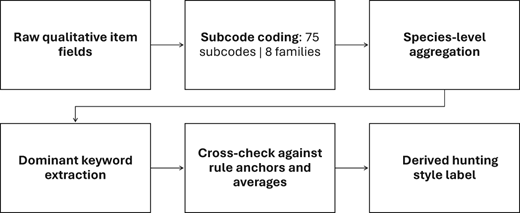
The qualitative layer comprises 75 subcodes grouped into eight broader families: market sensing, segmentation and targeting, marketing mix, commercial control, innovation, collaboration, resilience, and sustainability. The broad families were anchored deductively in the article's export-marketing and Stra.Tech.Man constructs, while the subcodes and dominant keywords capture recurring expressions in the firm-level qualitative fields. An explicit coding dictionary records keyword examples and coding guidance for each subcode. Greek excerpts were retained in the audit workbook, and short English keyword labels were used only as interpretive summaries of recurring coded material. The coded counts were then synthesized into species-level patterns through contextual coding sheets, dominant-keyword summaries, and the hunting-style matrix.
4.3 Rationale for the rule-based classifier
A transparent rule-based classifier is better suited to this study than more heavily parameterized alternatives. With N = 23, latent-class models, factor-analytic classifications, or opaque clustering routines would add instability without comparable interpretive gain. We are not trying to discover hidden classes through a black box. We are operationalizing a theory-led exporter typology in a way that readers can inspect directly. A hierarchical rule system fits that purpose because each species is defined through explicit diagnostic logic (Babyak, 2004; Fabrigar and Wegener, 2012; Kline, 2016; Rudin, 2019).
Methodologically, the classifier preserves the physiological core described by Vlados and Chatzinikolaou (2025) while adding exporter-specific selectors, namely finance, sustainability, collaboration, resilience, and international marketing capability. The ambition is not to replace the source framework. It is to make exporter physiology observable in a small-N, case-based dataset.
The sequence is substantive, not cosmetic. Each firm is checked against Zebra first, then Elephant, Leopard, Bee, Camel, and finally Squirrel as the residual category. Rare and highly diagnostic signatures are assigned first. Zebra captures the distinctive combination of sustainability evidence and financial strength. Elephant captures the scale-led form. Leopard identifies unusually strong technology and international marketing below elephant scale. Bee tests whether external collaboration becomes the dominant organizing logic. Camel captures resilience and financial prudence with more restrained outward exposure. Squirrel absorbs the remaining adaptive cases.
Accordingly, final assigned n refers to the number of firms allocated to a species after the full hierarchy has been applied. It does not refer to the number that might satisfy any single threshold in isolation. Because the classifier is hierarchical, final assignment depends on both threshold satisfaction and rule order. The Supplementary Workbook therefore reports raw rule indicators as well as final species labels. Observed overlaps are reported in the Supplementary Workbook and interpreted in the Results section as secondary traits embedded in dominant primary forms.
4.4 Qualitative integration
Qualitative integration is not an appendage to the classifier. It is part of the typology-building exercise. The qualitative stage checks whether the rule-based assignments are plausible, clarifies how each species approaches foreign customers in practice, and turns numerical signatures into interpretable organizational forms. The hunting-style labels therefore rest on an explicit chain from item-level narrative fields to subcodes, dominant keywords, species-level aggregation, and cross-checks against the quantitative profiles.
The Supplementary Workbook documents that chain. The CodeSubcode_Dictionary records the broad code families, subcodes, Greek keyword examples, and coding guidance; the Contextual_Subcode_Coding sheet links firm-level counts to supporting excerpts; and the Dominant_Keywords_By_Species and Species_Hunting_Styles sheets translate those coded traces into species-level interpretations. The qualitative layer therefore plausibility-checks, contextualizes, and interprets the classifier rather than serving as independent causal validation. Figure 2 summarizes the logic of integration.
4.5 Inferential checks and their role
The inferential analysis is deliberately modest and theory-driven. Cronbach's alpha serves as an exploratory check of internal consistency for the main composites rather than as full psychometric validation (Cronbach, 1951). Wilcoxon signed-rank tests are used for paired present versus retrospectively reported past comparisons because the data are paired, small-N, and effectively ordinal or composite in form (Wilcoxon, 1945). Spearman's rho is used for monotonic associations central to the paper's argument, especially the links between current physiology and current international marketing capability and between reported changes in physiology and reported changes in international marketing capability (Spearman, 1904). Holm correction is applied within the coherent test families reported in the tables and workbook to reduce overinterpretation of isolated significant coefficients (Holm, 1979).
Those tests do not generate the typology, identify causality, or validate the classifier as a universal taxonomy. They help interpret the typology within the sample. The paired results show that firms report improvement from retrospectively described past conditions to the present across the main physiology and marketing composites, while the correlation results show associations consistent with the inside-out proposition that stronger exporter physiology accompanies stronger international marketing capability.
5. Results
5.1 Observed species and sample composition
We begin with the species distribution and the composition of the sample, then turn to reliability and past-present change, then to the theory-driven correlations, and finally to the mixed-method species profiles. Taken together, these results show that common peripheral constraints coexist with patterned exporter heterogeneity.
Five final standalone species are assigned in the sample. Squirrel is the modal form (n = 9), followed by Elephant (n = 6) and Camel (n = 4); Leopard and Zebra each appear twice. Bee is not assigned as a final primary form, although two firms satisfy the raw Bee collaboration rule.
Table 3 reports species counts together with descriptive averages for current international marketing capability. Leopard and Zebra record the highest means, whereas Squirrel and Camel sit lower. Even at this descriptive stage, the sample does not support a single developmental ladder or a simple size-based ranking. Throughout the results, species counts refer to final hierarchical assignments unless otherwise stated. Raw rule indicators are treated as secondary signatures when they are satisfied by firms assigned earlier in the hierarchy.
The sectoral and size distributions reinforce the configurational reading of the typology (Tables 4 and 5). Squirrel is concentrated in smaller firms and food-related activity. Elephant appears mainly as a medium-to-large form. Camel clusters in food and manufacturing. Leopard and Zebra remain rare but distinctive. Tables 3 to 5 also support an equifinality reading of peripheral exporting. Shared regional constraint does not collapse firms into one stereotypical profile. Several routes to foreign-market action remain viable, with different species combining scale, responsiveness, prudence, precision, and legitimacy in different ways.
5.2 Reliability and retrospectively reported upgrading
For exploratory purposes, the reliability results are satisfactory. The management, overall marketing, and international marketing batteries are especially coherent, which gives us some confidence that the composites are stable enough for species-level comparison in a small-N mixed-method design.
Present-scale alpha coefficients (Table 6) range from 0.751 for finance to 0.887 for the full marketing battery. Strategy, technology, management, Stra.Tech.Man coherence, domestic marketing, and international marketing all exceed levels that are adequate for composite-level interpretation in an exploratory study. We do not present these values as full psychometric validation. They are better understood as evidence that the main batteries hang together reasonably well.
The paired Wilcoxon tests in Table 7 indicate broad reported upgrading from retrospectively described past conditions to the present. Present scores exceed past scores for strategy (p = 0.0012), technology (p = 0.0094), management (p = 0.0013), integrated Stra.Tech.Man coherence (p = 0.0017), finance (p = 0.0466), and overall marketing (p = 0.0019), and the Holm-adjusted p-values remain significant in each case. The direction of reported change is uniformly positive. Firms describe themselves as stronger now than before across the core physiological and marketing composites. Species should therefore be read as current dominant forms within an evolving set of firms rather than as fixed essences.
The same retrospective pattern appears in the marketing split. Domestic marketing shows reported improvement from past to present (p = 0.0037), and so does international marketing (p = 0.0051). The four international marketing items all move in a positive direction, with raw p-values between 0.0079 and 0.0129 and Holm-adjusted values of 0.0471 throughout. MKT2 and MKT4 have median differences of zero because many firms were already clustered at relatively high values, but the signed ranks still run strongly in the positive direction. The reported upgrading is not confined to internal organization. It reaches the routines through which firms sense, segment, adapt, and control activity abroad.
5.3 Physiology and international marketing capability
The central quantitative question is whether stronger exporter physiology is associated with stronger international marketing capability. Under the article's inside-out interpretation, the clearest positive associations should link current physiology to current international marketing and, separately, reported changes in physiology to reported changes in international marketing. These tests are correlational checks of theoretical coherence, not causal identification.
That is largely what we find. Current strategy correlates positively with current international marketing capability (rho = 0.642, p = 0.0010), as do current technology (rho = 0.635, p = 0.0011), current management (rho = 0.584, p = 0.0034), and integrated Stra.Tech.Man coherence (rho = 0.594, p = 0.0028). All four survive Holm adjustment (Table 8). For a dataset of this size, these are substantive coefficients. They indicate that stronger foreign-market capability co-occurs with deeper organizational strength rather than with isolated marketing activity. The pattern is consistent with the view that international marketing capability is anchored in strategic, technological, and managerial alignment.
Domestic routines also appear to carry over into international practice. Current domestic marketing capability correlates strongly with current international marketing capability (rho = 0.623, p = 0.0015), and the clearest links appear in sensing (rho = 0.567) and control (rho = 0.587), both of which survive Holm correction. The pattern is consistent with exporters extending and adapting domestic routines rather than creating international routines from scratch. It fits the broader claim that outward market behavior is anchored in pre-existing firm physiology.
The change correlations point in the same direction. The strongest relationship in the matrix links reported change in integrated Stra.Tech.Man coherence to reported change in international marketing capability (rho = 0.705, p = 0.0002, Holm p = 0.0031). Reported change in management also correlates clearly with international marketing change (rho = 0.619, p = 0.0016, Holm p = 0.0229). Export-marketing improvement therefore co-varies with deeper internal strengthening, especially integrated Stra.Tech.Man coherence and management.
The weaker coefficients are instructive as well. Finance is only marginally related to current international marketing capability (rho = 0.419, p = 0.0661). Financial strength alone, then, does not account for the observed variation in foreign-market capability.
Taken together, the correlations support the inside-out interpretation, while remaining associational rather than causal.
5.4 Species profiles and hunting styles
Species profiles come into focus when the rule-based assignments are read alongside the quantitative signatures and coded qualitative material. Each exporter species reflects a distinctive way of sensing markets, adapting the offering, coordinating relationships, and exercising commercial control abroad.
Table 9 synthesizes the rule anchors, quantitative signatures, qualitative patterns, and hunting-style labels for each species. The resulting exporter matrix is compact but differentiated: Squirrel appears as a networked gatherer, Elephant as a systematized campaigner, Leopard as a precision striker, Camel as a resilient selective adapter, and Zebra as a mission-backed trust builder.
The species profiles reveal three contrasts. First, Squirrel and Camel are both smaller-firm forms, but Squirrel is relationally adaptive whereas Camel is resilience-led and upgrading-oriented. Second, Elephant and Leopard both show strong outward capability, but Elephant builds it through scale and coordination whereas Leopard builds it through niche precision. Third, Zebra shows that legitimacy, certification, and sustainability evidence can become commercially constitutive rather than merely symbolic.
No case is ultimately classified as Bee, but Bee is not empirically empty. Two firms satisfy the raw Bee collaboration rule; one is finally assigned as Elephant and the other as Zebra because scale and legitimacy-finance signatures appear earlier in the hierarchy. In this dataset, Bee is best read as a secondary collaboration signature embedded within other species rather than as a standalone exporter form. Across the profiles, five bundles of foreign-market action become visible: relational responsiveness in Squirrel, scale-backed coordination in Elephant, niche precision in Leopard, resilient incremental upgrading in Camel, and legitimacy-backed value delivery in Zebra.
6. Discussion
We now interpret the evidence through capability, internationalization, network, and institutional perspectives and consider what follows for exporter heterogeneity, size, and collaboration.
6.1 From customer segmentation to exporter segmentation
The evidence is consistent with a form-based account. Squirrel, Elephant, Leopard, Camel, and Zebra are not stronger or weaker versions of a single exporter archetype, but distinct configurations of strategy, technology, management, legitimacy, collaboration, resilience, and market-facing routines. Exporter heterogeneity is therefore treated as organizational form, not merely as magnitude. That interpretation extends configurational reasoning into export marketing and answers calls for firmer micro-foundations in ecosystem research (Felin and Foss, 2023; Fiss, 2007; Meyer et al., 1993). The animal labels remain heuristic; Stra.Tech.Man supplies the explanatory core.
6.2 How the findings align with capability and internationalization theory
The evidence is consistent with the paper's inside-out interpretation. The positive associations between strategy, technology, management, integrated Stra.Tech.Man coherence, and international marketing capability suggest that foreign-market routines are anchored in internally organized bundles of resources rather than isolated marketing acts. The retrospectively reported change pattern points in the same direction, especially the link between reported improvement in integrated physiology and reported improvement in international marketing capability. This supports a dynamic-capabilities reading, provided it is treated as theory-building rather than causal proof.
The evidence also resonates with internationalization and network perspectives, though it suggests more than one route through which firms extend outward. The carryover from domestic to international sensing and control fits gradual-learning models in which firms adapt routines developed at home rather than build foreign-market practice from scratch (Johanson and Vahlne, 2009). The qualitative evidence, however, indicates that relational resources are filtered through species-specific organizational logics. Distributors, intermediaries, collaborators, and other ties matter across the sample, but not in the same way or to the same extent (Ellis, 2011; Osarenkhoe and Fjellström, 2024). Zebra brings the institutional dimension into especially sharp relief. In those firms, sustainability evidence, certification, and stakeholder coordination function as commercially relevant sources of legitimacy and market access rather than as symbolic add-ons.
6.3 How the findings extend theory through exporter form
The main theoretical extension lies in the unit of comparison. Recent configurational evidence points in the same direction, showing that internationalization, absorptive capacity, and resource-based factors generate outcomes through multiple non-equivalent combinations rather than one universal route (Freixanet and Federo, 2025). Where much export research explains stronger or weaker outcomes, this study shifts the comparison toward internally coherent exporter forms. They identify distinct ways of assembling foreign-market action. In that sense, the article extends configurational reasoning into export marketing by making exporter form, rather than exporter intensity alone, the object of explanation.
The profiles extend theory by differentiating routes that are often grouped together. Squirrel and Camel separate relational responsiveness from resilient prudence. Elephant and Leopard separate scale-backed systematization from niche precision. Zebra adds a legitimacy-based route in which certification, sustainability evidence, and coordinated value delivery shape market behavior.
The article therefore complements export-performance research rather than displacing it. Here, international marketing capability is treated as a proximal organizational outcome that may support export performance, not as a direct performance measure. The typology opens the black box behind similar outward outcomes by showing that they may rest on different internal physiological configurations.
6.4 How the findings qualify common assumptions about exporting
Several common assumptions are harder to sustain once the evidence is read configurationally. Exporter heterogeneity cannot be reduced to firm size alone. Recent evidence instead suggests that firm size moderates, rather than substitutes for, other organizational effects on export intensity (Aksoy et al., 2024a). Elephant is the scale-led form, but size does not exhaust physiology. Leopard and Zebra show that very strong outward capability can appear below elephant scale, while Camel reminds us that upgrading trajectories matter even when current outward reach remains selective.
Collaboration should not be equated with a collaboration-defined exporter identity. Bee's final non-assignment suggests that collaboration may be absorbed into scale-led coordination or legitimacy-backed value delivery rather than becoming the dominant species-defining logic. Its consolidation as a primary form may require denser intermediaries, stronger interorganizational communication, and more durable public-private coordination.
6.5 Summarized theoretical propositions
Our reading of the evidence yields three provisional propositions. First, exporters in peripheral ecosystems are more usefully compared as physiology-based forms than as points on a single capability continuum. Second, international marketing capability is better understood as a market-facing manifestation of organizational alignment than as an isolated functional resource. Third, collaboration may remain a secondary trait in constrained ecosystems without consolidating into a species-defining primary logic. These propositions align with resource-based, dynamic-capabilities, internationalization, network, and institutional reasoning, while warning against two shortcuts: equating size with exporter type and equating the presence of collaboration with a collaboration-centric exporter form.
Because the design is exploratory, these propositions should be read as theory-building rather than theory-closing. Their value lies in showing how a transparent typology can translate broad theories into exporter forms that are visible, comparable, and open to later testing.
7. Implications
We separate the implications into theoretical, managerial, and policy discussions because the introduced typology has different consequences at each level.
7.1 Theoretical implications
The typology contributes to export-performance research by treating species as pre-performance organizational forms through which market-facing capability is assembled. It also reframes international marketing capability as a market-facing manifestation of Stra.Tech.Man alignment and treats Bee's non-assignment as evidence that collaboration may be present without becoming a primary exporter form.
7.2 Managerial implications
Managerial action begins with diagnosis, not imitation. Each species faces a different upgrading risk: Squirrels risk under-formalization, Elephants risk scale-induced inertia, Leopards risk overextension, Camels risk failing to systematize recent upgrading, and Zebras risk treating legitimacy as symbolic rather than commercial. To make these implications more operational, Table 10 links each species to a general priority and to a concrete evidence-informed action that managers, industry intermediaries, or policymakers can implement.
Practically, managers can use the typology as a staged diagnostic tool. The first step is to identify the firm's dominant species using the transparent rule logic rather than relying on general impressions of export readiness. The second step is to compare the species profile with the firm's weakest international marketing routines. The third step is to select a narrow upgrading intervention that fits the species rather than imitating a generic “best practice” exporter.
For industry leaders, chambers of commerce, export associations, and cluster coordinators, the typology can also support differentiated collective action. Instead of offering the same export seminar or trade-mission package to all firms, support organizations can form species-specific peer groups.
7.3 Policy and societal implications
Policy design should likewise begin from differentiated diagnosis rather than generic exporter support. The common policy task is to reduce the cost of learning, coordination, certification, market intelligence, and collaboration in a peripheral ecosystem. Species-specific support should therefore be combined with shared infrastructure. The implication is that export-support agencies should avoid treating all SMEs as equally constrained or all larger firms as equally prepared. At a broader societal level, this means investing in shared export platforms, cluster intermediaries, cross-firm learning routines, and durable public-private coordination that may allow collaboration-intensive forms to emerge as primary forms rather than remain secondary traits.
7.4 Transferability and limits of inference
The study does not offer statistical generalization. The species counts should not be read as prevalence estimates for Eastern Macedonia and Thrace, Greece, or peripheral regions more broadly. Nor do the paired comparisons establish objective longitudinal change, and the correlations do not identify causal direction. What may transfer is more specific: the rule-based classification logic, the need to separate raw traits from final primary species assignments, and the hypothesis that collaboration-intensive forms may be suppressed in thin peripheral ecosystems. Future studies can test that transferability by applying the same classifier, adjusting thresholds transparently, or comparing final and raw species signatures across regions, sectors, and time.
8. Conclusion
This article contributes to debates on exporter heterogeneity in export-marketing and export-performance research by arguing that exporters in a peripheral region should be compared not only by intensity or performance, but also by organizational form.
Using Stra.Tech.Man as the integrating micro-foundation, the study identifies five final standalone species: Squirrel, Elephant, Camel, Leopard, and Zebra. Bee is not assigned as a final primary form, although two firms satisfy the raw Bee collaboration rule. The evidence also shows broad retrospectively reported upgrading and positive associations between current physiology and current international marketing capability.
Theoretically, the findings align with resource-based and dynamic-capabilities reasoning, distinguish multiple routes of gradual or networked internationalization, and show that legitimacy can be constitutive of export behavior in Zebra-like firms. Practically, the typology offers a diagnostic for differentiated managerial and policy support rather than an evaluated intervention model.
The study remains exploratory and should be read as configuration building rather than as a final theory test. Its transferability lies in the auditable classification logic and the distinction between primary species assignments and embedded secondary traits, not in exact prevalence estimates or thresholds.
Seen from this vantage point, peripheral regions are not only sites of scarcity. They are also settings in which organizational diversity becomes more visible under pressure. Read through a physiology-based lens, foreign-market development looks less like a single ladder and more like an ecology of distinct routes to international action.
The supplementary material for this article can be found online.