This study sought to ascertain the challenges faced and resources derived from using a pop-up business model in the food and beverage industry.
A qualitative approach was utilized, and interviews were conducted with current and past pop-up food and beverage entrepreneurs.
The research found four themes about the challenges of operating pop-ups: restaurant management, entrepreneurial, execution, and physical and mental. This study also identified five themes of resources acquired: cooking knowledge, entrepreneurial experience, brand recognition, restaurant management and operations expertise, and remain/exit awareness.
The research findings provide a framework that can assist current and future restaurant entrepreneurs utilizing the pop-up business model.
This research is one of the first studies to analyze food and beverage pop-up businesses from the entrepreneur’s perspective.
Introduction
Political, economic, social and technological shifts in the restaurant industry have made it difficult for new firms to enter markets. This difficulty is due to the uncertainty of business settings denoted by unpredictable changes in (1) customer demands and preferences, (2) competitive strategies from competing firms and (3) the general business environment (i.e. environmental, regulatory and economic conditions) (Cho, Bonn, & Kang, 2016). Prior research has identified that the food and beverage sector is a risky endeavor, where restaurant profit margins can be as low as 2.2% (Mun & Jang, 2018). Moreover, restaurant failure rates were found to be 15% in the first year, 37.62% after three years, and 53.06% after five years in business (Healy & Mac Con Iomaire, 2019). Furthermore, factors like affiliation, location and restaurant size can impact the success or failure of a restaurant venture (Parsa, Self, Sydnor-Busso, & Yoon, 2011). Given the risky nature of the food and beverage industry, many entrepreneurs have utilized the pop-up business as a vehicle for firm creation. A pop-up food and beverage business is defined as a temporary business that operates within parks, plazas, galleries, event centers, open-air markets and larger restaurants (National Restaurant Association, 2017). Food and beverage pop-ups have experienced an upsurge in recent years. For example, their use has seen a year-over-year increase greater than 100% from May 2022 to April 2024 (Yelp, 2023, 2024). Clearly, food and beverage entrepreneurs see some value in the use of a pop-up as a vehicle to enter the food and beverage industry.
Food and beverage entrepreneurs are not the first to use pop-up businesses in the hospitality industry. Within the hospitality literature, particularly festivals and events, prior research has investigated a similar concept where individuals would set up a temporary business location, including food and beverage offerings, for both commercial events and noncommercial settings (i.e. Duffy & Mair, 2017; Duignan, Everett, Walsh, & Cade, 2018; Justesen, Gyimóthy, & Mikkelsen, 2016). However, while the temporary operations described in the festivals and events literature can be included in the definition of a pop-up food-related business, the current study sought to explore and analyze those individuals who are using pop-ups as a business model to enter the food and beverage industry. For example, some nascent chefs have utilized pop-ups to build their businesses, choosing to forego the traditional timeline that previous restaurateurs have followed (Schindler, 2017). This is an important distinction because it implies that the entrepreneur is using the pop-up business as a model that helps them circumnavigate the long-term financial investment that a permanent business location would require. Thus, it seems that these individuals are using the pop-up business model as a means of entry into the food and beverage industry.
Although an increasing number of food and beverage entrepreneurs are using pop-ups as a business model, there is currently little empirical research that explores this phenomenon, especially from the entrepreneurs’ perspective. For example, most assessments of food and beverage pop-ups: (1) originate from professional trade organizations (National Restaurant Association, 2017; Eventbrite, 2015); (2) are descriptive commentaries (Jones, Comfort, & Hillier, 2017) or calls for further research (DiPietro, 2017); and (3) emphasize one small component, such as legal aspects (Schindler, 2017). Furthermore, the few empirical studies on this topic have not sufficiently addressed the entrepreneur’s perspective on this phenomenon. For instance, Taylor, DiPietro, and So (2018) study focused on pop-ups’ experiential components from a demand perspective. Similarly, Justesen et al. (2016) analyzed the concept of using a pop-up ideology as a mechanism to transform the meal delivery experience in Dutch hospitals. Further, Demetry (2017) conducted an empirical study on food and beverage pop-ups from the entrepreneur’s perspective, but her research focused on how an individual’s use of language drives entrepreneurial beliefs about their business. Therefore, given this gap in the literature in conjunction with the increased use of the pop-up business model, it is imperative to understand the challenges associated with starting and operating a food and beverage pop-up. Also, it is essential to understand which specific resources are gained from operating a food and beverage pop-up. Given these limitations in the literature, this study utilized a qualitative approach to answer the following research questions:
What challenges are associated with opening and operating a pop-up food-related business?
What business resources are acquired by individuals who have experience in operating a pop-up food-related business?
Literature review
Theoretical foundation: creation theory
The theoretical foundation for this study is rooted in entrepreneurship literature’s creation theory. Creation theory suggests that entrepreneurial opportunities are a product of an individual’s unique actions. Although like discovery theory, which posits that discontinuous opportunities exist in the world and are waiting to be discovered (Alvarez & Barney, 2007), creation theory views opportunities as those that are discovered due to an entrepreneur’s unique viewpoint, decision-making process and subjective efforts (Alvarez, Barney, Arikan, & Arikan, 2024). Creation theory serves as a strong foundation for exploring the pop-up restaurant business for several reasons. First, creation theory views entrepreneurial opportunities as those that are subjective in nature, rather than those that sit objectively in the business environment waiting to be discovered. In other words, such entrepreneurial opportunities can only able to be exploited by an individual’s innovative activities and experiments when developing new services, products or business models (Sarasvathy, 2001). As such, many entrepreneurs will engage in a trial-and-error process where they experiment with various schemas until they understand what does and what does not work. This trial-and-error process, or active experimentation, is the foundation that leads to the creation of a new entrepreneurial venture (Alvarez & Barney, 2007; Sarasvathy, 2001).
Second, creation theory views the entrepreneurial process as fundamentally uncertain, where oftentimes the individual is unsure of what the end-goal should or could be. Due to the absence of objectives and predetermined outcomes, the future is not predictable, and entrepreneurs must create their future through their own efforts and adapt as they progress (Baker & Nelson, 2005). As a result, many entrepreneurs pursue the end goal through iterative learning, where they continually receive feedback from the market and make changes as needed. This iterative process is then repeated as many times as needed until the individual understands market demands and turns their idea into a viable business (Alvarez et al., 2024; Sarasvathy, 2001). Third, creation theory is more applicable in unpredictable or continually evolving markets. This is particularly true in markets that have low barriers to entry and are saturated in places. As such, opportunity creation heavily relies on two-way social interactions with various stakeholders, including customers and other collaborators (Alvarez & Barney, 2007). Such interactions can serve as a gateway to new ideas that help entrepreneurs refine their concepts and ideas. Referring back to the iterative nature of creation theory, the process of continually learning from social interactions and tweaking a concept little by little succinctly embodies the business model of the pop-up, which is discussed in more detail in the next sections.
An overview of pop-up businesses
In general, pop-up retail is considered temporary in nature, designed to appear quickly, generate a buzz among consumers, and then disappear quickly (Kim, Fiore, Niehm, & Jeong, 2010). Pop-up retail has roots dating back several centuries and has historical roots across many different cultures (Yu et al., 2018). Historically, pop-ups were centered around periodic markets, where a consistent location would serve as a focal point for traveling merchants to exchange goods and services (Yu et al., 2018). However, pop-ups started to be considered as an alternate strategy for consumer engagement around the turn of the 21st century. The term fashion pop-up is largely attributed to the fashion house, Comme des Garçons, who started to use the strategy in 2004 as a guerrilla marketing technique in various stores around the world (Warnaby & Shi, 2018). By 2010, the use of pop-up retail had exploded among brands, largely since this time coincided with the increased use of the internet, social media and e-commerce platforms, where company giants like Amazon began to rapidly steal market share away from traditional retail operations. Thus, many brands began to use the pop-up business model as a way to create awareness and demand for their products, relying on the temporary status of each respective pop-up to appeal to the “fear-of-missing-out” psyche of consumers (Niehm, Fiore, Jeong, & Kim, 2006). Since this unveiling was temporary and could only be accessed at the pop-up location, consumers were enticed to visit a storefront rather than passively shop via internet platforms.
Fashion houses, on the other hand, used the pop-up model to host events that coincided with product launches, such as fashion shows in major cities As such, these fashion houses’ pop-ups were typically only accessed via invite-only, which is beneficial because it created an “insider-only” only culture that addresses high-end consumers and their need for exclusivity (Klein, Falk, Esch, & Gloukhovtsev, 2016). However, while the fashion and retail industries were some of the early adopters of the pop-up business model, other industries saw the merits of this business strategy and began to utilize it as well. Throughout the 2010s, other brands, such as Warby Parker, used pop-ups to test physical retail before committing to a location (Kinser, 2024). This strategy did not require the retailer to invest in any long-term leases, making it cost-effective as well.
Restaurant industry pop-ups
Restaurant industry pop-ups have increased in popularity in recent years. For example, from May 2022 to April 2023, pop-ups restaurant openings increased by 105% from the previous year (Yelp, 2023). In the following year, that number expanded to a 155% increase from the previous year, despite a slower overall growth rate of 6% for all new restaurants (Yelp, 2024). In the hospitality literature, food and beverage pop-up businesses have mirrored those of pop-up retail in terms of their temporary nature, designed to generate a unique experience for the consumer (Jones et al., 2017; Taylor et al., 2018). This concept has been applied in both non-commercial and commercial settings. For example, Justesen et al. (2016) explored using the pop-up concept in a non-commercial sense by converting existing hospital rooms into sites for pop-ups where patients could become more involved in the meal delivery and meal selection process. While this view of pop-ups leans toward an intrapreneurship process, the introduction of a pop-up within hospital rooms could incorporate a co-creative atmosphere designed to increase guest–host relationships within a hospital setting. Within a commercial lens, Schindler (2017) and Jones et al. (2017) denote that there are two main types of hospitality industry pop-up businesses: underground dining (i.e. supper clubs) and pop-up restaurants, while other scholars have noted that food trucks are also included in this definition (Jones et al., 2017). Accordingly, scholars have stated that the temporary and transient nature of pop-ups is a distinguishing characteristic (Baras, 2015; Jones et al., 2017), with most pop-ups operating for less than a month (Jones et al., 2017). As such, the current study does not include food trucks or ghost kitchens in the definition of a pop-up because food trucks require a different business model than pop-ups. For example, food trucks are often required to have a commissary kitchen that is food inspected, require initial capital outlay for the mobile vehicle, and cannot piggyback off any existing retail location, all of which are vastly different from the core of pop-up restaurants. Similarly, ghost kitchens require capital to acquire the cooking space and lack the intimate nature, exclusivity and temporal nature of pop-ups (Cai, Leung, & Chi, 2022).
Prior researchers have suggested that pop-up restaurants provide budding chefs and restaurateurs the opportunity to practice their craft, research recipes, test service delivery and are appealing because they allow the operator to utilize an underused or neglected kitchen space without the financial burden of a full restaurant build-out (Demetry, 2017; Jones et al., 2017). Pop-up entrepreneurs generate a following through a shortened service week where a limited number of guests are served in an intimate setting (Demetry, 2017), and their marketing strategies are primarily delivered through social media due to its flexible nature, broad reach and reduced costs (Schindler, 2017). Thus, social media platforms, such as Facebook, Twitter and Instagram, will often serve as the “website” for the pop-up. Some pop-ups, such as supper clubs, will announce their dining event hours and location at the last minute, often on the day of the event (Schindler, 2017). Moreover, pop-up food-related businesses have been theorized to incorporate experiential marketing techniques designed to establish a relationship with a select group of clientele (Schindler, 2017). Furthermore, since a pop-up entrepreneur is selling a product or service for money, they are simultaneously earning revenue and building a clientele, which could attract potential investors (Taylor et al., 2018).
Given the aforementioned characteristics, a pop-up, food-related business could potentially reduce the risk, uncertainty and financial requirements of newly created firms. However, despite these assertions, empirical evidence about the challenges faced by food and beverage entrepreneurs who utilize the pop-up business model remains scarce. Also, the literature has not identified the resources gained from using the pop-up business model to enter the food and beverage industry. Therefore, the current study sought to identify and categorize these gaps in the hospitality entrepreneurship literature.
Methodology
Research design
Given the emergent nature of the pop-up food-related business phenomenon and its scarcity in the literature, a qualitative research design was used because it could provide a richer examination of the research questions. Qualitative data serve as a source of specific, well-grounded descriptions of the phenomena in question (Miles, Huberman, & Saldaña, 2020). This method is primarily used when existing theory about a relationship or circumstance either does not exist or is insufficient to cover the research objectives (Creswell, 2014). Thus, while there are studies, theories and frameworks about entrepreneurship, pop-up retail, food-related businesses and food-related business entrepreneurs, there is a lack of theoretical cohesiveness when describing how food and beverage entrepreneurs utilize the pop-up business model. Based on these rationales, a qualitative approach was chosen for this study because its goal was to glean insights from pop-up entrepreneurs to develop new insights and knowledge about the pop-up food-related business.
Study sample and research instrument
This study aimed to understand, from an entrepreneur’s perspective, what are the challenges faced and the resources gained from establishing a pop-up food-related business in the hospitality industry. Data were collected from individuals who (1) currently operate a pop-up, (2) currently operate an established (brick and mortar) food-related business after operating a pop-up, and (3) no longer operate a pop-up or an established food-related business (i.e. dropped out) (Demetry, 2017). Semi-structured face-to-face and telephone interviews were conducted with key participants. Participants were chosen based on a snowballing technique, where each interviewee was asked to recommend other eligible food and beverage entrepreneurs to participate in the study (Creswell, 2014).
Before commencing the interviews, the researchers developed a semi-structured interview protocol with open-ended questions designed to encourage participants to speak openly about their experiences. The first part of the protocol included questions that addressed the background and demographic profile of the participants. Then, participants were asked to describe the challenges incurred when opening and operating a pop-up. Finally, the interviewees were asked to describe the resources acquired from operating a pop-up, food-related business. After each interview, the results were categorized and compared to findings from previous interviews. This process was repeated until data saturation, or when conducting additional interviews did not yield any new insights or new thematic sub-categories within previously established themes, occurred (Charmaz, 2006). In this study, 21 interviews were conducted before data saturation was considered achieved. However, the researcher conducted an additional five interviews to ensure that no new material was derived. As such, the final sample size for this study was 26 interviews.
Qualitative reliability and validity
In qualitative research, the term credibility is used to refer to a study’s rigor concerning internal validity, transferability is used to refer to external validity, and dependability is used to refer to reliability (Anney, 2014; Miles et al., 2020; Morse, 2015). The current study implemented several strategies to ensure credibility, transferability and dependability of the research findings.
To maximize credibility, the current study implemented multiple strategies. First, peer debriefing took place over the course of the data collection process, where the primary data collector periodically presented the findings to a group of academic and restaurant industry experts, each time gaining feedback and guidance about a future course of action. For example, the peer debriefing process validated the researcher’s development of themes and sub-themes derived from the interviewees. This helped to ensure that the themes being developed mirrored the real-life workings of the pop-up business model (Anney, 2014). Furthermore, the peer debriefing process helped the researcher identify the need to revise the sample to include interviewees currently operating a brick-and-mortar location after having previously run a pop-up. By including this group in the sample, a thicker and context-rich description of the challenges faced, and resources gained from operating a pop-up was uncovered. Second, data were obtained from multiple sources and/or multiple methods to find a converging consensus among all (Miles et al., 2020). Due to the variety of backgrounds of the individuals interviewed (i.e. professionally trained vs. not professionally trained) and the current lifecycle of the pop-up (i.e. currently operate a pop-up, evolved to a permanent location, and dropped out), multiple perspectives about the pop-up business were obtained. Finally, the data for this study were collected over an extended period to mitigate the potential influence of short-term fluctuations on participants’ perceptions, which were captured through single interviews (Miles et al., 2020). By conducting interviews across a one-year timeframe, the researcher aimed to reduce variability in the findings attributable to external factors such as economic fluctuations, seasonal changes and evolving consumer preferences (Anney, 2014).
To increase the rigor of transferability, this study utilized a purposive sample during the data collection process. Non-probability purposive sampling gives the researcher better control when seeking potential interviewees because this method specifically seeks new participants and information based on expertise criteria defined by the research objectives (Creswell, 2013). All individuals who were recommended as potential future interviewees were also screened to ensure their expertise in the subject area.
To address dependability, the current study implemented two strategies: code-recode and a variation of inter-coder reliability. Following a coding/recoding scheme, the researcher will code the same data twice – once after the original data collection time and once at least two weeks after the initial coding to verify consistency in observations and definitions of codes and themes (Anney, 2014). In the current study, the researcher first conducted five interviews, coded the data and then stopped collecting data for two weeks. Then, the researcher conducted the coding process again on the same five interviews and verified consistency before continuing with further interviews.
Inter-coder reliability is a technique where qualitative data are evenly distributed and coded among multiple researchers to verify agreement, which strengthens the dependability of the findings (Creswell, 2013). However, this method is unfeasible when one main researcher is meeting with interviewees, establishing rapport and taking field notes (Morse, 2015), as was the case in the current study. In this case, it is recommended that the primary researcher provide the codebook and themes to a colleague or expert to check if the connection between the text, codes and themes makes sense (Anney, 2014; Morse, 2015). Thus, after all interviews were finished, the primary researcher gave the codebook and themes to a colleague with food and beverage expertise, who provided feedback and guidance about the themes and sub-themes of the study. The feedback obtained was used to change themes and sub-themes labels, as well as ensure clarity of the wording in the final manuscript.
Data analysis
After the interviews were accurately transcribed, NVIVO for Mac 2019 was used for the coding process and development of the study’s themes. This study undertook a two-fold strategy suggested by Corbin and Strauss (1990): first using open coding and then axial coding to find patterns among interviewees. During the analysis, this study followed the constant comparative method, a stepwise process where newly acquired data is compared to previous interviewees’ data to uncover similarities and differences (Corbin & Strauss, 1990).
To analyze the data, this study followed the suggestion of Adu (2019). First, the study’s research questions were used as anchor nodes. Then, each anchor node was coded based on the responses of the interviewees. Analysis began with open coding to identify broad properties and to narrow subcategories. During the open-coding process, each interviewee’s statement was analyzed, organized and given a conceptual label. Before moving to the final themes identified in this study, Research Question 1 began with 35 broad labels, and Research Question 2 began with 40 broad labels. After identifying broad categories, related subcategories were then identified and nested within a broader theme (Strauss & Corbin, 1994). The second step in the systematic analysis process is axial coding, where core phenomena were identified (Strauss & Corbin, 1994). From the core phenomena, the researcher took the subcategories and identified which actions comprise the core phenomena’s consequences. Finally, selective coding was conducted. During this stage, the major themes were compiled into a framework that provides a conceptual model for the pop-up food-related business. Table 1 provides a summary of the coding process for Research Question 1, and Table 2 provides a summary of the coding process for Research Question 2.
Results
Demographic information
The current study sought a sample that included a wide variety of backgrounds and expertise. This was done to ensure the challenges faced and resources gained identified were primarily a result of operating a pop-up business, rather than other extraneous factors (e.g. data triangulation). The sample included 14 male interviewees and 12 female interviewees. In terms of ethnicity, 13 interviewees were Caucasian/White, 2 were African American, 10 were Asian/Pacific Islander and 1 was Hispanic/Latino. Of the interviewees, 20 interviewees did not have any formal culinary training, while 6 interviewees earned a culinary school degree or a culinary certificate. Finally, 10 interviewees operated a pop-up as their primary occupation, while the remaining 16 operated their pop-up in addition to their primary occupation. It is important to note that the themes identified in the current study were not materially different among the interviewees’ demographic characteristics (i.e. those with formal culinary training identified the same challenges faced and resources gained as those without formal culinary training). Table 3 illustrates the characteristics of the interviewees.
Pop-up challenges
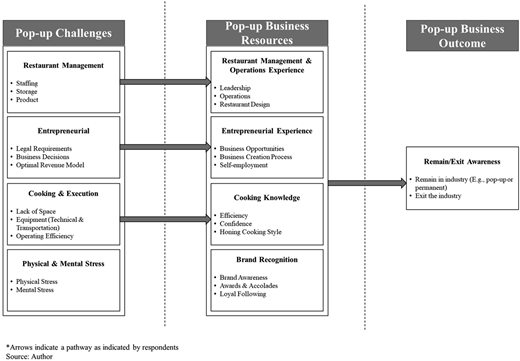
The first research question asked the interviewees to identify the key challenges in starting and operating their pop-up businesses. Four themes emerged: restaurant management challenges, entrepreneurial challenges, cooking and execution challenges, and physical and mental challenges.
Restaurant management challenges
The interviewees identified restaurant management-related challenges when operating their pop-up, and three sub-themes were found: staffing, storage and product. Due to the ad-hoc nature of pop-up events, maintaining a consistent workforce proved difficult. Employee retention was problematic since pop-ups do not offer consistent employment. Additionally, the interviewees struggled with training staff because they lacked managerial expertise. Or, when required to use the host’s (i.e. the landlord of the building used for the pop-up) staff, interviewees noted they could not effectively communicate their vision to the employees, which often resulted in inconsistencies in service and customer experience.” For instance, one interviewee noted:
I actually had to tell the owner of the restaurant that I don’t want [to use] a specific front of the house [employee] because my guests will tell me that their service was not attentive. And it’s my name on the line.
Storage limitations also provided management-related challenges. Given the transient nature of pop-ups, operators frequently had to transport ingredients and equipment to and from different venues. The interviewees noted they were unable to purchase supplies in bulk due to limited storage facilities, increasing costs and inefficiencies. In addition, in the event a pop-up was hosted in a location without a professional kitchen setup, the interviewees had to create makeshift workstations. For instance, the absence of commercial dishwashing facilities meant that dishes often had to be transported home for cleaning, adding to the workload: “…then after the events, we would have to like, you know, do all the dishes back at home.”
Product sourcing was another critical issue. Most interviewees lacked business licenses, restricting their ability to purchase ingredients from food distributors. Instead, they relied on grocery stores, which charged higher prices and often lacked specialty ingredients. This challenge was particularly pronounced among interviewees offering ethnic cuisine, as sourcing authentic ingredients was difficult, sometimes leading to compromises in food quality. As one interviewee noted, “Looking for ingredients is [the] challenge right now. Like, sometimes we would drive to [another state] and then bring back ingredients.”
Entrepreneurial challenges
The second theme for the first research question highlighted entrepreneurial challenges and three sub-themes were identified: legal requirements, business decisions and revenue model. Legal and financial challenges were prevalent among interviewees. The majority of interviewees were first-time business owners and were unfamiliar with tax obligations, leading to difficulties in setting aside sufficient funds for annual payments. Additionally, pop-up operators who sold retail food products faced licensing obstacles, often experiencing long approval processes that delayed their ability to generate revenue: “…we waited for the state for the month of July, for them to schedule the inspection of our kitchen. So, it was just kind of that waiting game, that was the hardest part.”
A lack of experience in making key business decisions was another challenge faced by the interviewees. In particular, the understanding and negotiation of contract terms was challenging because the process was unfamiliar and because various hosts required various terms. For example, some hosts required a flat dollar amount for renting the space, while others required a percentage of total sales. Further, some hosts required their employees to be used for the event, while others would require the interviewees to bring their own cooking equipment. Also, some hosts would promise help in areas such as promoting the event but failed to follow through: “…did a handshake deal where they would help promote us…in the days and weeks leading up to [the event], nobody's responding and nobody's promoting us.” Additionally, the majority of interviewees did not know how to properly price their offerings, relying on instinct and their best guess.
Choosing the appropriate revenue model was another challenge. Revenue model refers to the delivery format of each pop-up event and examples include: a la carte, buffet, supper club or prepaid ticketing. According to the interviewees, proper selection of the revenue model largely revolves around the desire to increase forecast accuracy, thereby minimizing costs and maximizing efficiency via ticket times. One interviewee noted:
The problem with a pop-up that is not in a brick-and-mortar restaurant is that there are no walk-ins. So, if somebody cancels last minute, and they haven’t prepaid, you're screwed, you're done…. our margin of error is if two people don't show up, we breakeven; those two people are pure profit.
Accordingly, the operators experimented with different pricing structures, such as a la carte service, prepaid ticketing and supper clubs. While prepaid ticketing ensured predictable attendance and financial security, it also limited spontaneous customer visits, which could potentially limit revenues. Conversely, a la carte service allowed for greater flexibility and revenue but introduced uncertainty regarding food preparation volumes. As such, interviewees underwent a trial-and-error phase before settling on a revenue model that best suited their business objectives.
Cooking and execution challenges
The third theme identified was cooking and execution challenges during the service delivery of the pop-up. Three sub-themes were identified: lack of space, equipment (technical and transportation) and operating efficiency. Cooking in unfamiliar and often constrained spaces posed significant difficulties. Pop-ups typically operate in makeshift kitchens with limited preparation areas, requiring interviewees to optimize efficiency under less-than-ideal conditions. One interviewee stated, “…I rented out space over there, it was like 200 square feet. Like concrete, original concrete floors, like from the Civil War, like dirt. And no HVAC, no running water.” Additionally, the close proximity of guests to the cooking space meant that operators had to maintain professionalism at all times, carefully managing their demeanor and interactions.
The use of unfamiliar equipment also introduced operational challenges. Since pop-ups often relied on borrowed or rented kitchen spaces, interviewees had to quickly adapt to different stovetops, ovens and cooking appliances. One interviewee described their experience using a host's stove burners, “They're like jet burners. I was like, almost burning some of my food.” In some cases, they worked with non-commercial equipment, which affected food preparation quality and consistency. For example, one interviewee who hosted a pop-up out of their apartment noted,
Trying to cook out of an electric apartment oven. Like, who knows how old it was. And we had to Google how to calibrate the temperature on it to get it 35° higher than it was. [We] had to come up with all these tricks on how to make the pizza properly to [our] standards. This learning curve contributed to execution inefficiencies, especially during the early stages of their pop-up ventures.
Interviewees also struggled with managing ticket times and kitchen workflow. Without a structured kitchen brigade system or a systemized reservation system, they had to develop new strategies to balance efficiency and food quality: “…from 5:15 until 9ish, the wait was up to two hours…it wouldn't slow down.” As a result, the interviewees initially faced difficulties in pacing food orders, leading to bottlenecks during service. However, over time, they learned to stagger production to improve efficiency.
Physical and mental challenges
The transient and labor-intensive nature of pop-up businesses placed a significant mental and physical strain on the interviewees. Every interviewee noted the sheer amount of hard work required to operate the business, such as the constant search for a new venue, the transport of products and equipment, and the need to handle all operational aspects single-handedly. Due to financial constraints, the majority of the interviewees operated without additional full-time staff, further increasing their workload. One interviewee stated, “I made the mistake of letting my opportunity dictate my decisions, instead of setting goals for like, my mental health.”
About half of the interviewees reported they were approaching, or had become, burned out, with some deciding to exit the industry due to the overwhelming stress. The physical toll of long hours, combined with the mental pressure of business uncertainty, led some individuals to reconsider their career trajectory. As one interviewee, who eventually dropped out of the pop-up industry due to physical and mental stress, noted,
I was killing myself… all kinds of physical issues… I was going to a chiropractor…. Because my body started to break. I was in pain, physically and everything.
Additional quotes from the interviewees are provided in Table 4.
Pop-up business resources gained
The second research question asked interviewees to identify which resources were gained from operating a pop-up food-related business. Not surprisingly, several of these resources were acquired when overcoming the previously mentioned challenges. From the interviews, five different themes were identified: cooking knowledge, entrepreneurial experience, brand recognition, restaurant management and operations expertise, and remain/exit awareness.
Cooking knowledge
The first theme in this category refers to the significant improvements in cooking skills gained from operating a pop-up business. Nested within this theme are three sub-themes: efficiency, confidence and honing cooking style. First, the interviewees noted that they improved their speed and consistency when preparing their product offerings. As previously indicated, most interviewees lacked professional experience and struggled to produce food in a timely manner. However, after hosting several pop-up events, they learned how to stagger food orders, which minimized overloading the kitchen and helped improve ticket times. One interviewee who operated a pizza pop-up noted: “I'm getting tickets coming in and I have a pizza coming out every five to seven minutes as opposed to two every 15 to 20 minutes. That was something that was a super hard learning lesson.” The second sub-theme describes how the interviewees improved their confidence in cooking and production capabilities over time. Interviewees stated that they wanted to see if they had the skills to cook food in a professional setting, so they chose the pop-up business model to test their skills in an affordable manner. Thus, these individuals learned how to cook quickly and consistently under pressure, which ultimately increased their cooking confidence, as indicated by one interviewee: “the key was that we learned we could execute [our food] nearly perfect every time.”
The final sub-theme in this category illustrates several reasons why the interviewees were able to hone their cooking style. First, the pop-up model was described as something very conducive to garnering customer feedback. For example, the interviewees used pop-up events to test recipes, gauge customer interest and make any changes, if necessary. This gathering of feedback was vital because it gave them confidence that, should they choose to open a permanent location, they would possess recipes that were already tested and approved by their clientele. Furthermore, over time, this feedback loop with the customers helped the entrepreneur to develop and/or refine their food voice and food style. One interviewee noted, “I noticed that I'm all over the place in my stuff. And I guess maybe I'm just trying to find my voice. And this is an outlet for that.”
Entrepreneurial experience
The second theme showcases areas where the interviewees acquired business-related experience. Three sub-themes were identified: business opportunities, business creation and self-employment. Most interviewees noted that they were able to acquire additional business opportunities from individuals who patronized their pop-ups. For example, one interviewee was approached by a nearby coffee shop and was asked to supply pastries and to-go sandwiches, which provided an additional revenue stream. Another example cited was catering opportunities where a guest would approach the entrepreneur during a pop-up event and ask if they would cater lunch for the guest’s place of business. Other interviewees also stated they were propositioned to cater weddings, anniversaries, birthday parties and corporate events, usually by individuals who attended their pop-ups, as said by one interviewee: “I was selling to ATT, T-Mobile, Verizon, Delta Airlines – to these all these different companies every day of the week.”
The second sub-theme in this category is business creation, which refers to the knowledge, skills and abilities the interviewees gained on how to create a startup. According to the interviewees, operating a pop-up helped them better understand how to go through the legal aspects of creating and operating a business. For example, most interviewees stated that, although not required, they learned it was beneficial to obtain a business license and establish a limited liability company or a general partnership so they could order products at wholesale prices. In addition, each interviewee stated that operating a pop-up made them more business-savvy and cognizant of things like paying taxes throughout the year rather than paying a lump sum during tax season: “Learning how to pay quarterly estimated taxes to ease the brunt of, you know, that first year where you're like, I owe $8,000!”.
Furthermore, the interviewees expressed that they underwent a learning curve when establishing contracts with their hosts because they did not have any experience with contract negotiations, nor were they aware of industry norms, such as reasonable rental rates. However, over time, they were able to accumulate the knowledge and experience to negotiate from a position of strength, which helped to reduce costs. Finally, many interviewees stated that running a pop-up helped them to acquire investments and/or funding for future projects. Specifically, some interviewees noted that some of their regular customers became or wanted to become investors when it came time to open a permanent location. In fact, two of the interviewees were in the process of opening a permanent location, and part of their funding was derived from investors who were repeat customers. In a similar vein, the interviewees noted that running their pop-up showed them that tracking revenues and profit from the onset is the optimal way to establish a business history, which is critical when writing a business plan for acquiring investor capital or a bank loan. Indeed, several pop-up interviewees did not start tracking revenues, expenses and profit until their pop-up was well underway, which they acknowledged as a mistake.
The final sub-theme of this category is titled self-employment, and it addresses how the interviewees felt about becoming their own boss. The interviewees noted that the pop-up business model was a time-saver for their careers in terms of being able to work for themselves. In other words, the hierarchical nature of the food and beverage industry promulgates a typical path where an individual usually works for someone else for a period before acquiring the knowledge and resources to venture out on their own. However, interviewees noted that the pop-up business model was attractive because it meant they could work for themselves earlier in their careers, rather than spend a long time working for and cooking someone else’s food: “...I gotta do a pop-up. Whatever is the fastest way for me to [present] my food to the public.” In addition, most of the interviewees noted they were able to use their pop-up as their full-time place of employment rather than as a side job. Interestingly, six of the interviewees who used their pop-ups as their full-time job indicated that they wished to remain hosting pop-ups as their full-time job, rather than pursuing a permanent location.
Brand recognition
The third theme of this research question highlights how the interviewees gained recognition for their business and their brand. Three sub-themes were identified: brand awareness, awards and accolades, and loyal following. First, brand awareness refers to how interviewees used their pop-ups to generate awareness about their business concept, vision and style. Since opening a permanent restaurant requires significant time and capital resources, restaurateurs will typically move forward with opening a food-related business while they simultaneously initiate their marketing scheme. Thus, the interviewees considered their pop-ups as an optimal solution to this problem since they could operate pop-up events and slowly generate awareness through events and social media without investing significant capital resources. For example, when asked what key resource was gained from operating a pop-up, one interviewee stated, “I feel like there was kind of establishing a name or a reputation of a certain element of business. It was like busting into a restaurant scene, which is really hard to do.”
The second sub-theme is awards and accolades and describes how pop-up interviewees achieved recognition through various media sources. Most notably, five of the interviewees received culinary awards and culinary award nominations from various organizations, including the James Beard Foundation. According to these interviewees, such awards were unexpected, but they boosted the appeal, reach and validity of their business. Similarly, other interviewees received recognition from website publications, magazine articles and even personal appearances on television shows. Regardless of the source of the awards and accolades, all the interviewees noted that these situations significantly increased the demand for future pop-up events. One interviewee stated, “So we didn't expect the [magazine] cover, and it gave us tremendous, tremendous exposure and more restaurants were offering us to have popups at their venue or at their restaurant for free.”
The final sub-theme is loyal following and clientele, and it highlights how interviewees were able to create a loyal following from their pop-ups. For example, the interviewees noted that they were able to develop a relationship with their clientele because the small-scale nature of a pop-up allows the entrepreneur to have face-to-face interactions with customers. Thus, while this was critical for garnering feedback on things like menu items, the interviewees stated that they were able to bring attention to themselves and their vision for the business. This was said to drive loyalty and create a repeat clientele. One interviewee best summarized this knowledge gained when they spoke about opening a permanent restaurant after operating a pop-up.
I think one of the biggest things I learned from, or I benefited from the pop-up was building the customer base… We have a lot of customers already and a lot of regular guests who are really excited for the place to open. So, I think that's probably the most valuable thing I got out of the pop-up, ultimately.
Restaurant management and operations expertise
The fourth theme for the second research question highlights the expertise gained to become better restaurant managers. Three sub-themes were identified: operations, leadership and restaurant design. As previously noted, operating a pop-up business was the first time for most interviewees, and the hiring, maintenance and firing of employees were a learning experience. For those who did have prior management experience, it was often limited to back-of-house issues, so seeking and hiring front-of-house employees was a newly acquired skill. Thus, over time, the interviewees learned skills like how to recognize a good employee, proper employee compensation and the scheduling of all staff. When asked about these skills learned over time, one interviewee stated, “Now, front of the house knows exactly how much they're going to be making, because it is presold and their tip is already guaranteed. So, I now have a system where everybody's happy.”
Second, food costing and menu pricing were other skills gained from operating a pop-up business. Given the fact that the majority of interviewees did not have management responsibilities before operating their pop-ups, the food costs and menu pricing were new challenges for them. Therefore, these individuals had to learn how to search for the best prices and then keep track of how much each ingredient costs. Also, most interviewees did not know how to properly cost a recipe and simply made up a price they thought was correct. They later learned that proper menu costing and pricing were essential to making a profit from their events, as illustrated in the following quote: “We thought that our cost analysis was on point, but then when we started incorporating our packaging into it, we realized we actually were losing money. So…we upped our rates a little bit.”
Finally, the group of interviewees who had either opened a permanent location or were in the process of opening a permanent location noted that they learned some design aspects from the pop-up they could incorporate into their permanent business. For example, some of the interviewees preferred the intimate nature of the pop-up business model, where the event was small enough to where the chefs could directly interact with the guests, so they designed a restaurant that was similar in size and scope. According to these individuals, this was logical because they believed their success was largely due to the relationships that they were able to establish with their clientele. Thus, they wanted to make sure they could maintain these relationships, as well as develop new ones when operating their permanent business. For example, one such interviewee noted, “We will have 30 seats, so…we can have a small staff and still produce high quality food… it's all designed to control the variables that make your life miserable and make service [difficult].”
Remain/exit awareness
The final theme for this research question illustrates the remain/exit awareness learned from operating a pop-up. The data uncovered two sub-themes: remain in the industry and exit the industry. All interviewees noted they felt the pop-up business model was a great teaching tool that showed them their state of readiness for a food and beverage career. For example, about half of the interviewees stated that while they were successful at executing small pop-up events, they were not yet ready to pursue a permanent location. When asked which skills or resources they lacked, they stated they needed to acquire more cooking skills and experience before they would feel comfortable opening a permanent food-related business. As told by one interviewee who decided to stay as a pop-up rather than try to evolve into a permanent location: “Ultimately, I wasn't confident that our concept… would be successful. I needed to fine tune it more.” In fact, one interviewee decided to close their pop-up and move to another country to further their culinary training. On the other hand, a few interviewees had initial aspirations to open a permanent restaurant. However, after operating a pop-up, they changed their mind. Most individuals cited that the high levels of physical and mental stress, as well as the eventual capital resources required, made running a food-related business no longer attractive. Thus, these individuals decided to pivot in their careers and cease the operations of their pop-ups: “So we needed to either expand or contract. We made the decision to contract because it [took] too much time.”
Additional quotes from the interviewees are provided in Table 5.
Conclusions and implications
Conclusions
This research explored the challenges faced and the resources acquired by individuals who have operated a pop-up business in the food and beverage industry. The data has provided several important findings. First, the current study identified four key themes about the types of challenges pop-up interviewees faced: restaurant management, entrepreneurial, cooking/execution, and physical and mental. Based on these themes, it appears that the transient nature of this business model, combined with the unpredictability of day-to-day operations, can cause stress on the entrepreneur. Second, the interviewees were asked to describe what types of resources were acquired from their pop-up, and five themes emerged: cooking knowledge, entrepreneurial experience, brand recognition, restaurant management and operations expertise, and remain/exit awareness. Despite many challenges that pop-up entrepreneurs must overcome, many of them led to the resources gained, which were instrumental in shaping the future of their business. Figure 1 illustrates the pop-up challenges, resources gained and business outcomes identified in the current study.
Theoretical implications
The results from this study have provided meaningful theoretical implications. Previous findings on food and beverage pop-ups and the pop-up business model largely originated from industry-based publications, which, while useful, lack the rigor required for empirical studies. Furthermore, prior empirical studies on pop-ups are primarily viewed through a consumer’s lens (Taylor et al., 2018). In addition, prior research that analyzes the pop-up business model from the entrepreneur’s viewpoint does so from a language and hobby context (Demetry, 2017). As pop-up businesses continue to grow in popularity, it is critical to catalog the core premises of this concept. Therefore, this research contributes to the literature by uncovering the core premises of the challenges faced and resources gained by individuals who have used this business model. This is a major contribution of the study.
In addition, the current study extends the creation theory literature by highlighting how the unique actions of food and beverage entrepreneurs drive the creation process of their food and beverage operation. In answer to calls for a more nuanced and context-specific understanding of venture creation in dynamic industries (Alvarez et al., 2024), like the food and beverage industry, the results illustrate how individuals navigate the nuances of the food and beverage industry and how they optimize constrained resources within a saturated market. As such, the current study builds upon prior research showing how entrepreneurs overcome the challenges and gain key resources when operating within the restaurant industry. Hence, the interviewees’ responses illustrate how their specific actions and reactions shaped their pursuit of business opportunities, rather than simply capitalizing upon an existing opportunity in the marketplace, which is a key tenet of creation theory (Baker & Nelson, 2005).
Furthermore, the findings provided in the current study illustrate unique characteristics of food and beverage pop-ups that are currently absent from the literature. For example, many entrepreneurs interviewed for this study expressed a desire to remain a pop-up business operator indefinitely, given that they could sustain the business. Thus, while some of the interviewees of the current study utilized the pop-up business model as a stepping-stone toward opening a permanent restaurant, other pop-up entrepreneurs planned to remain in the food and beverage industry by only hosting pop-up events. In other words, where prior research on pop-ups noted that pop-ups were considered one-off, individual events (Klein et al., 2016; Niehm et al., 2006), pop-ups in the food and beverage industry resemble something that is designed to reoccur on a temporary and transient basis. However, since these individuals have not invested the capital resources typically required when opening a permanent restaurant, their business is still considered a pop-up.
In addition, the findings contribute to the entrepreneurship literature by identifying how a pop-up can be beneficial to young entrepreneurs. For example, prior research has indicated that acquiring funding sources (Hua & Templeton, 2010) and developing a consistent clientele (Blank & Dorf, 2012) are critical hurdles for nascent businesses. As indicated by the current study, none of the interviewees specified funding as a significant challenge when starting their pop-up. This is attributable to the entrepreneur’s ability to piggyback off their host, which reduces the capital expenditures typically required of new firms. Furthermore, many interviewees noted that their pop-up helped develop a loyal clientele base, and some noted they met future investment partners. This is especially notable since a young pop-up can build a clientele and simultaneously earn revenue, which, combined with low startup costs, can alleviate many burdens associated with starting a new business. Thus, by using the pop-up business model, food and beverage entrepreneurs were able to quickly build a sustainable business without the period of negative growth typically associated with the research and development costs of new firms.
Practical implications
This study also provides practical implications and advice for current and future pop-up business operators. First, this study has identified and mapped the challenges faced and resources gained, both of which can assist future pop-up entrepreneurs when starting their pop-up businesses. Accordingly, the feedback from the interviewees has generated some relevant guidelines that future pop-up food-related entrepreneurs could follow to maximize efficiencies in their businesses. For example, many interviewees noted that an individual should take the time to cost recipes and food offerings. This is particularly important because it will ensure that all menu items are priced accordingly, thus improving the firm’s chances of becoming profitable. Furthermore, proper costing and pricing of menu items are critical for developing business plans and impressing future sources of capital, such as investors or bank loan managers.
Second, many of the interviewees noted that although the pop-up is a temporary business, one should treat it like a permanent restaurant. Specifically, the current study suggests taking the time to hire proper employees who share the ethos of the company. Also, future pop-up entrepreneurs should exhibit best practices when it comes to legal requirements, such as paying taxes quarterly and filing the paperwork and paying the fees to establish a legitimate business. Third, another suggestion from many of the interviewees is that entrepreneurs should make sure to set up their businesses so that they have time to personally interact with the clientele. This includes areas such as the layout of the business, as well as setting aside time to meet face-to-face with customers. As noted in this study. doing this is beneficial in achieving some critical milestones, such as garnering consumer feedback, establishing a loyal following, and perhaps, finding investors for future projects.
Fourth, the interviews from this study suggested that future pop-up entrepreneurs should make sure they reflect on each event and learn from their pop-up operations. For example, it can be beneficial if a pop-up operator can garner feedback on menu items, ask about consumer preferences, and ultimately gauge the level of consumer interest in the business. This information is critical when considering future business projects. Furthermore, a pop-up can assist entrepreneurs who are looking to leverage their pop-up’s success to open a permanent location. Thus, a pop-up can assist with a future restaurant’s site selection, size of the restaurant and kitchen design. By providing these best practices and guidelines, the current study can greatly support future food and beverage entrepreneurs’ aspirations.
Finally, the findings from this study suggest that future restaurateurs, or even current food entrepreneurs, should consider becoming a host for other pop-up operators. Doing so can provide significant benefits to a host. For example, hosting other pop-ups will generate an additional revenue stream for a business owner and could potentially replace a night of service that is otherwise not financially productive (i.e. host pop-ups on a closed day, or substitute a historically slow service period by hosting a pop-up instead). Furthermore, hosting a pop-up could provide the host with an incubator-like opportunity. Specifically, if a host notices that a pop-up entrepreneur is especially talented or is generating a large following, the host could potentially have the first opportunity to invest in any future projects of the successful pop-up company it is hosting.
Limitations and avenues for future research
Although this research provides significant theoretical and empirical implications for the food and beverage industry, there are limitations. First, this study focused on food-related businesses in the hospitality industry. Thus, a business model that first uses a temporary location may not apply to other areas of the hospitality industry, such as hotels, casinos, theme parks and cruise ships. Furthermore, since franchises operate using economies of scale, this research may not apply to franchised operations, which do not have difficulties generating sufficient capital for firm creation. Also, this study was developed using interviews with interviewees located in the Southeastern United States. Thus, the findings may vary in other parts of the country and across the world. Future studies should consider incorporating a qualitative sample that encompasses more geographic regions across the United States and the world. In addition, future studies should seek to specifically focus on uncovering any key differences between those individuals who dropped out, who stayed as a pop-up, and those who evolved into a brick-and-mortar location. Moreover, future studies should seek to parcel out other demographic and background characteristics, such as education and/or tenure in the pop-up space, to glean any differences among interviewees. Finally, future studies should analyze how the lifecycle of a pop-up is similar or different from the lifecycle of other firms. For example, for those firms that evolved from a pop-up to a permanent location, does the pop-up business model have its own life cycle, or is it part of the overall life of the restaurant?