


The aim of this study is to provide a holistic understanding of how financial organisations can develop human-centred design (HCD) capability.
We applied a hybrid research design. We first compiled a snowballing review of the literature to explore the key perspectives on developing HCD capability in organisations. Then, to validate and adapt our findings to the specific characteristics of financial organisations, we applied an expert elicitation process. Twelve expert designers leading HCD practices in the financial sector evaluated and built upon our findings to contribute to 10 managerial propositions aimed at helping financial organisations develop HCD capability.
Our study provides an integrative view of the theoretical base and practical recommendations on how to develop HCD capability in financial organisations. The study suggests formulas for safe HCD experimentation, sustained investment for learning and mechanisms for continuous improvement and evaluation. Furthermore, our research stresses the importance of end-to-end involvement of HCD across the financial service lifecycle. Ultimately, we argue that HCD capability for effective development in financial organisations depends on legitimate leaders equipped with change management skills who can connect HCD to strategic decision-making in finance.
The article proposes a comprehensive and research-backed proposal for developing HCD capability in financial organisations. Its value stems from providing practical guidance, bridging literature theory with real-world application in finance.
1. Introduction
Financial organisations are in the constant pursuit of extending their capabilities to reinforce competitive advantage (Mazzarolo et al., 2021). In this context, managerial attention to human-centredness is emerging as a means for change and differentiation (Magotra et al., 2018). Human-centred design (HCD) as an agile customer-centred approach to innovation endows organisations with the capacity to continually reconfigure innovation competences (Liedtka, 2020). Consequently, financial managers have begun to recognise HCD as a strategic business resource for enhancing customer experience and service quality (Kaartti et al., 2025).
HCD is broadly understood as a creative, evidence-driven approach to problem-solving which places users, customers and other stakeholder experiences at the centre of the design process (Gomide et al., 2024). HCD capability – the collective ability of an organisation to utilise HCD – is increasingly recognised as a marketing-relevant competence because it strengthens customer-centricity (Kindström et al., 2013), improves customer experience (Beckett and Nayak, 2022), enhances trust-building through transparency and usability (Pont and Shaw, 2010) and supports digital engagement (Chaudhuri et al., 2023). Research in bank marketing has long emphasised that customer-centric innovation directly shapes banks' differentiation and marketing performance (e.g. Kabadayi et al., 2019; Chaudhuri et al., 2023). Therefore, developing HCD for understanding customer behaviour in financial services settings is an organisational capability that aligns directly with the recent bank marketing domain, as it provides the mechanisms through which financial organisations translate customer insights into value propositions, digital journeys and relationship-strengthening experiences (Kaartti et al., 2025; Komulainen and Saraniemi, 2019).
The strategic relevance of building HCD capability within financial organisations has become especially clear in recent industry analyses. The Figma (2023b) shows that design teams in finance grew by 35% between 2019 and 2022 and that 50% of global banks now have senior design leadership. Moreover, financial organisations that have invested in HCD report measurable performance improvements: Stash achieved a 20% reduction in product-development time after adopting systematic HCD practices; JPMorgan Chase documented significant fraud reduction and improved portfolio optimisation attributed to AI-enabled and design-supported workflows; and N26 scaled to 8M + users leveraging design-driven consistency and usability (Figma, 2023a). These examples illustrate that HCD capability translates into quantifiable marketing outcomes, including higher digital adoption, reduced friction, faster time-to-market and greater customer trust. There are also concrete cases of financial organisations that have gained recognition for developing HCD capability internally. BBVA Creative was ranked the world's second top in-house design agency (WBDS, 2025), while others (e.g. Emirates NBD, Nordent) have been recognised for best-in-class customer digital journeys (Red Dot, 2025).
Nevertheless, the nascent condition of HCD as an organisational capability leads to managerial unawareness about what aspects are key to developing HCD capability in organisations in general (Kurtmollaiev et al., 2018a, b) and in financial organisations in particular (Iriarte et al., 2017). Recent research in the field reveals solid benefits of HCD practices in the financial sector in implementing customer-centric strategies (Kaartti et al., 2025), developing financial services aligned with customer needs (Komulainen and Saraniemi, 2019) or driving organisational change towards customer-centricity (Iriarte et al., 2017). However, most relevant research in HCD framed in financial organisations focuses on the impact of HCD practices (Kaartti et al., 2025), but very little research has been dedicated to addressing the development of HCD as a capability within a financial organisation.
Financial organisations that develop HCD capability often seek to establish a new dominant logic that supports the entire organisation to embrace today's prevailing business trends in finance, such as digitalisation (Saxena, 2020) and customer centricity (Andaleeb et al., 2016). Despite this increased interest, extant studies in the context of financial organisations have prioritised exploring how designers work and the impact their HCD practices generate (Kaartti et al., 2025) at the expense of understanding how HCD is developed as an organisational capability. We believe that developing HCD capability in financial organisations is, therefore, an undertheorised research topic that requires further exploration. It is important to provide guidance on how financial organisations can develop HCD as an organisational capability that systematically supports improved customer experience and more effective marketing strategies. Thus, the aim of this study is to provide a holistic understanding of how HCD capability can be developed in financial organisations.
In our study, we have used a hybrid research approach. We first explored the key managerial aspects of developing HCD capability through a snowballing review of the literature. Then, to explore and discuss emerging concerns related to the exact characteristics of financial organisations and to propose specific managerial proposals to address them, we conducted an expert elicitation research. Twelve expert designers leading HCD practices in financial organisations evaluated and built upon the themes collected from the literature review. As a result, we propose 10 managerial propositions for the development of HCD capability in financial organisations.
2. Background
2.1 HCD capability development
As mentioned, HCD is a problem-solving approach that relies on participation, creativity, human-centredness, visual thinking and prototyping (Micheli et al., 2018). For this research, under the broad concept of HCD, we embrace its different subdisciplines, including User Experience Design, Service Design, Design Thinking, Strategic Design, Co-Design and Participatory Design. Although there are variances between the different subdisciplines in terms of the applied methods, tools and the expected outputs, scholars agreed that the philosophical ground remains the same (Baker and Moukhliss, 2020). HCD becomes an organisational capability when a firm is able to approach a determined challenge through the enactment of HCD practices using its own or outsourced human resources (Malmberg, 2017). Thus, in respect of the present article, we always refer to HCD capability as the collective ability of an organisation to utilise HCD, under its different subdisciplines, for its development work (Malmberg, 2017).
Recent literature further emphasises that developing HCD capability entails not only introducing new practices, but also reshaping organisational routines, aligning stakeholders and making HCD work visible across units (Björklund et al., 2025). This view reinforces the understanding of HCD capability as a multidimensional organisational accomplishment rather than merely a methodological choice. Therefore, extant literature distinguishes three models to develop HCD capability according to the location of resources: collaborative, hybrid and in-house models (Dunne, 2018). Organisations that opt for the collaborative model seek HCD expertise beyond the boundaries of the organisation, usually engaging designers as external consultants. This is an effective strategy for organisations without mature HCD capabilities to obtain quick outcomes from HCD expertise (Jevnaker and Bruce, 1998). However, outsourced design teams run the risk of working in isolation from the organisation, which can lead to inadequate solutions due to insufficient understanding of the business and market requirements. In addition, the greater the relevance of HCD as a capability for the organisation, the greater the risk the organisation assumes in relying on a core competency to external consultants. As HCD knowledge and practices are located outside the organisational boundaries, internal cultures and structures remain virtually intact, and therefore HCD has limited influence to act as an organisational capability.
Some other organisations establish partnership relations (hybrid models) with specialised design agencies working in-house so that they can devise long-term collaboration strategies (Landoni et al., 2016; Wrigley, 2016; Yu and Sangiorgi, 2018). This shift is closely related to organisations' growing commitment to open innovation models that involve multiple stakeholders (Carroll and Helfert, 2015). However, hybrid models can still create dependency on external design agencies, limiting organisational learning, while data-protection issues complicate collaboration too. Additionally, responsibility for outcomes may become diffuse across partners too, making governance of HCD in the long term, uncertain.
Thus, already a decade ago, Kolko (2015) noted the growing interest in building in-house HCD capability. Developing HCD capability in-house becomes a key asset for sustained competitive edge by enhancing the organisation's capacity to adapt to unceasing market changes (Kaartti et al., 2025). However, developing in-house HCD capability in organisations requires considerable resources and time. An organisation with in-house HCD capability needs to pull down organisational silos and overcome cultural resistances (Vetterli et al., 2016). In addition, in-house HCD processes run the risk of getting tied to routine activities or becoming the responsibility of no one in the organisation but a small team of designers, which restrict the capacity of HCD for driving innovation (Lee, 2020). However, when organisations overcome the barriers for developing HCD capability, a new culture permeates the organisation, enhancing collaboration, human-centricity and innovation. External design sources, on their own, collaborative and hybrid models, may not have the capacity to influence the corporate culture and structures in that measure. Thus, it has started to be a habitual managerial practice to concentrate resources in internal HCD capabilities (Acklin, 2013; Kurtmollaiev et al., 2018a, b). Though the literature already captures many aspects that managers should supervise for developing HCD in their organisations, that knowledge is blurred and scattered in different studies due to the nascent condition of the topic. Developing HCD capability, as a long and complex process of organisational change, needs thoughtful management that can only be achieved through a holistic understanding of its fundamental aspects.
2.2 HCD capability in financial organisations
In spite of the positive impacts of applying HCD practices in financial organisations demonstrated by several authors (e.g. Indriasari et al., 2022; Iriarte et al., 2017; Moeckel, 2020; Kaartti et al., 2025), very little research has been dedicated to investigate how financial organisations can develop HCD capability effectively. This gap persists despite growing evidence that design-driven customer-centricity is becoming a central pillar of financial-services competitiveness (Beckett and Nayak, 2022; Chaudhuri et al., 2023).
Fendt (2024) defends HCD in the field of finance as a novel way to tackle the complexity and uncertainty inherent in the financial sector. However, while Fendt's work introduces a structured Design Thinking methodology adapted for a financial organisation to address behavioural finance anomalies, financial inclusion and market volatility, it does not offer a pathway or a framework to embed the suggested HCD methods and tools in financial organisations longitudinally. Similarly, Indriasari et al. (2022) identify how HCD approaches interact to accelerate product development in digital baking. Again, even their framework can be used by banks to structure banking digital innovation processes, and the study concludes that applying HCD improves product quality, shortens time-to-market and reduces development costs while ensuring customer-centric solutions, it does not offer any guidelines on how to develop and leverage HCD capability to sustain these benefits over time in financial institutions. This limitation is notable given that recent service-marketing literature in finance highlights the need for design-led customer-centred capabilities that extend beyond tools and methods into organisational routines and strategic decision-making (Beckett and Nayak, 2022).
Recently, Kaartti et al. (2025) explore how Service Design methodologies can be applied to enhance customer-centric strategies in financial institutions, highlighting key challenges that financial organisations face when adopting Service Design, including internal resistance, lack of cross-functional collaboration and the complexity of regulatory compliance. Kaartti's et al. (2025) work also provides key activities for applying Service Design principles into financial organisations, and while the above-mentioned barriers and key activities are discussed in depth, the study does not provide detailed strategies for overcoming these barriers and more significantly does not extensively examine how long-term Service Design adoption as an organisational capability could be developed in financial organisations. Finally, Iriarte et al. (2017) suggested university-business partnerships in order to introduce HCD knowledge and practices for enhancing organisational change in financial organisations. However, Iriarte et al. (2017)'s experimentation is still preliminary and very limited in time, and therefore insufficient.
The absence of consolidated knowledge and lack of clear guidelines is particularly problematic because the development of HCD capability often emerges as a complex “meshwork” of organising, aligning and displaying actions within organisations (Björklund et al., 2025; Deserti and Rizzo, 2014), rather than as a linear implementation of tools or processes. Financial organisations, which face specific constraints such as risk regulation, legacy systems and high complexity customer journeys, may therefore require specific recommendations for embedding such “meshworks” into their organisational practices, which may enhance innovation and firm performance (Han and Zhang, 2021). Therefore, this study seeks to integrate existing themes from literature with expert elicitation to guide financial organisations on how to develop HCD capability effectively.
3. Method
3.1 Literature review
We explored prominent themes in the literature related to the topic through a snowballing review process. Snowballing literature reviews are particularly effective when (1) terminology on the topic varies (e.g. Human-Centred Design, User-Centred Design, Design Thinking, Service Design, User Experience Design, Experience Design, Participatory Design, Co-Design): making keyword-based searches less effective and (2) when the research in the topic is scarce – HCD capability development in financial organisations. By following citation trails, researchers can uncover pertinent studies that might otherwise remain hidden (Wohlin, 2014).
3.1.1 Scope of the review
The scope of the review was limited to journal articles that were central to developing HCD capability in organisations. We therefore included both empirical and conceptual articles examining the development of HCD capability from different angles. The articles had to answer positively to the following scoping question: Is the article central to developing HCD capability in organisations? As mentioned, due to the lack of literature in the financial sector, we include all types of organisations in this initial step of our research, and we ensure we discarded articles that were not clearly addressing the development of HCD capability in organisations, such as studies of the application of HCD methods and tools in a specific project.
3.1.2 Literature search flow and execution
We started the snowballing process using a single database, Web of Science. A single database is only required because a snowballing review depends on the referenced papers (Wohlin et al., 2022). All articles had to meet these general requirements: peer-reviewed journal articles in English and dated from 1/1/1990 to 24/1/2024. Peer-reviewed journals ensured validated knowledge (Kerr and Coviello, 2019), while the limit of the publication year was set to reduce the number of unproductive results. It would be unlikely to find any articles on the topic within the scope before the 90s. In addition, we defined a specific range of search terms to narrow the results to the scope of the review. Selected articles had to include at least one term from the first search term group (“human-centred design”) and another term from the second search term group (“capabilit/capacity”) in their title, abstract or keywords. The process we followed for the selection of relevant literature through snowballing review is summarised in Figure 1. The initial search was executed in the abovementioned database already with the definitive search terms on 24/1/2024. Results returned a total of 109 hits.
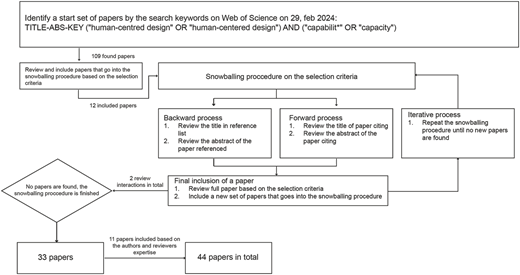
The next step consisted in selecting the articles that met the scope of the review. Two researchers participated in this step independently before cross-checking the decisions to minimise bias in the selection of the articles. The articles had to meet the scope of the review; that is, articles had to be central to developing HCD capability in organisations. The title, abstract and keywords of the articles were revised for this purpose, and 97 articles were discarded resulting in 12 papers.
Then, we revised the full texts of the selected 12 articles, and 9 papers were excluded because of the following criteria: (1) the focus of the article was on the application of HCD practices or (2) the focus of the article was on the effects of HCD practice. At this point, we completed a selection of the literature for the review with three relevant articles within the scope. With the selected three papers, we perform the snowballing procedure (the backward and forward process), in which their references and citing papers were reviewed against the selection criteria to identify new relevant papers. By following this approach, the completeness and replication of the review ensured the sufficient extraction of relevant studies, resulting in 33 included papers through two review iterations in total.
Finally, 11 additional articles were included, eight identified through the researchers' expertise and three added following the reviewers' recommendations. Even though the data of these articles could not fit exactly with the search string, they were inside the scope and were therefore included in the final database of 44 journal articles. The list and data about the selected articles are shown in Supplementary Data – Appendix A.
3.1.3 Data analysis
We analysed the selected literature following Braun and Clarke's (2006) thematic analysis. This approach enabled the systematic identification of patterned insights across the final corpus of 44 journal articles. Firstly, we familiarised ourselves with the full texts and independently generated codes related to any aspects related to HCD capability development in organisations. This produced an initial set of over 203 codes. Next, we iteratively clustered related codes that resulted in 20 preliminary sub-themes. These preliminary sub-themes were reviewed for internal coherence and refined through comparison with the full dataset. Overlapping or weakly supported sub-themes were merged or removed, resulting in eight sub-themes. Finally, the eight sub-themes were elevated into broader four themes that synthesise how prior research conceptualises the development of HCD capability in organisations. Table 1 summarises how the data moved from raw material (44 articles) to the final outputs (4 themes). In addition, Supplementary Data – Appendix A gathers and connects the preliminary 20 sub-themes, the 8 sub-themes and 4 themes.
Summary of the data analysis process applied to the literature review
| Analytical process (Braun and Clarke, 2006) | Description | Output |
|---|---|---|
| Familiarisation with the literature | Full reading of the 44 journal articles | Understanding of the dataset, initial analytic notes |
| Generation of initial codes | Extraction of meaningful segments across all articles | 203 codes |
| Organisation of codes into preliminary sub-themes | Initial grouping of codes based on conceptual similarity | 20 preliminary sub-themes |
| Review of sub-themes | Sub-themes checked for internal coherence and distinctiveness. Weak, overlapping or insufficiently supported sub-themes were refined, merged or removed | 8 sub-themes |
| Definition of themes | Higher-level themes constructed by clustering conceptually related sub-themes. These themes represent the major managerial perspectives emerging from the literature | 4 themes |
3.2 Expert elicitation
We adopted an expert elicitation approach with the aim of connecting our insights from the literature to the specific context of financial organisations. This research approach aligns with Meuser and Nagel (2009) perspective, who emphasise that specific and intricate phenomena can only be understood through the insights of individuals with extensive expertise in that phenomenon. Moreover, the information gathered by expert elicitation is recommended to obtain specific context-rich practical recommendations (Cooke, 1991; Morgan, 2014; Knol et al., 2010).
Expert-based qualitative research is a commonly used methodological approach in the study of organisational capability development, particularly in fields where capabilities are practice-based and embedded in professional expertise. Carlgren et al. (2024) and Rauth et al. (2014) show that expert insights provide access to tacit knowledge and contextual understanding for organisational capability development that cannot be captured through quantitative methods alone. Moreover, this methodological approach is common in bank marketing studies, where researchers regularly rely on in-depth interviews with senior managers and bank specialists to investigate areas such as service quality, customer experience management, and digital transformation in finance. For instance, Ennew and Waite (2013) emphasise the value of managerial expertise when analysing service delivery capabilities in financial organisations. Devlin (1995) employs expert perspectives to understand strategic marketing responses in retail banking, and Foroudi et al. (2017) use in-depth interviews with banking executives to explore capability development related to brand identity and customer experience. This body of work reinforces the suitability of expert elicitation research in examining HCD capability development within financial organisations.
3.2.1 Expert selection
To define expertise, this study follows the guidelines by Gläser and Laudel (2009), which emphasise the importance of selecting experts who possess knowledge that is both highly specialised and practically relevant to the phenomenon under investigation. Gläser and Laudel specify that experts should hold privileged access to information, have accumulated enough experience that enables them to interpret organisational processes and occupy roles that allow them to influence or enact the practices being studied. Therefore, the robustness and credibility of an expert elicitation process does not lie in the number of interviewees as in the rigour of the criteria and procedures used to select the right participants (Gläser and Laudel, 2009).
The selection of participants for the study was subject to the following criteria. Firstly, to ensure substantial and contextually grounded expertise, participants were required to be experienced design professionals with several years of experience in the financial sector (a minimum of five years in the sector), and to be leading HCD practices within their organisations at the time of the interview in financial organisations. Secondly, expert designers working in financial organisations with low HCD maturity levels were excluded to ensure that the organisations represented in the study had sufficiently developed HCD practices to provide meaningful insights. HCD maturity was defined based on data gathered during the interviews and assessed according to the five-level scale proposed by Legarda et al.’s (2021) HCD maturity model: (1) Initial, (2) Repeated, (3) Defined and Expanded, (4) Managed and (5) Optimised. A detailed description of each maturity level is provided in the Interview Script (Supplementary Data – Appendix B). Thirdly, expert designers were selected from financial organisations of different sizes operating globally, regionally in Europe, the USA and LATAM, and nationally (Spain) in order to capture variations in how HCD capability develops across different finance market environments and scales of operation. Altogether, these criteria ensured access to a high level of expertise in developing HCD capability within financial organisations.
3.2.2 Data collection
We compiled a list of 22 expert designers who met our criteria, of whom 16 agreed to participate in the study. Ultimately, 12 were selected for the interviews. Four candidates were excluded either because their financial organisations did not grant authorisation for their participation or because, during the opening questions of the interview, it became evident that they did not meet the inclusion criteria – specifically, they worked in organisations with low HCD maturity or did not occupy HCD leading roles within their organisation. Table 2 characterised each expert designer according to the criteria.
Expert designers profile
| Expert designer no. | Position | Work experience in financial organisations (years) | Organisation size | Operating region | HCD maturity |
|---|---|---|---|---|---|
| 1 | Strategic Design Manager | 7 | Medium | National (Spain) | Repeated |
| 2 | Design Lead | 14 | Large | Global | Repeated |
| 3 | Design Lead and UX Manager | 7 | Large | National (Spain) | Defined and expanded |
| 4 | UX Design Lead | 8 | Large | Global | Managed |
| 5 | UX Design Lead | 13 | Large | Global | Managed |
| 6 | Service Design Manager | 7 | Large | Europe and LATAM | Repeated |
| 7 | UX Manager | 14 | Medium | Europe | Managed |
| 8 | Design Lead | 10 | Large | Global | Managed |
| 9 | Service Design Lead | 9 | Large | USA and LATAM | Managed |
| 10 | UX Lead | 5 | Medium | Europe | Managed |
| 11 | Service Design and Research Manager | 11 | Medium | Europe and USA | Managed |
| 12 | Design Lead | 22 | Medium | National (Spain) | Repeated |
The semi-structured interviews were conducted by two researchers in English and Spanish between April and May 2025, with each session lasting between 45 and 90 min. All interviews were recorded and subsequently transcribed and translated into English when required. A semi-structured interview guide with open-ended questions was used, allowing for a flexible and conversational approach (see the Interview Script in Supplementary Data – Appendix B). Although the interview followed a structured guide, the interviewer adopted a flexible, conversational approach, inviting expert designers to introduce additional themes not initially included in the guide. This method, recommended by Miles et al. (2013), enabled the collection of diverse perspectives from the experts.
The interview began with a brief welcome and an explanation of the study's purpose, followed by an introduction of HCD capability in financial organisations. Questions on participants' professional background, current role within his or her financial organisation and experience with the different HCD subdisciplines were also posed. The expert designers were also invited to assess the maturity of HCD in their financial organisation using Legarda et al.’s (2021) maturity scale.
After the introductory section, the interviewer briefly presented the four themes on HCD capability development identified in the literature review. This overview ensured that all participants shared a baseline understanding of the concepts. For each perspective, the interviewer began by asking expert designers for general reflections on the key managerial perspective to reduce response bias, as recommended by Myers and Newman (2007). Expert designers were then invited to discuss concerns they had observed when developing HCD capability within financial organisations. Expert designers were encouraged to draw on concrete experiences, examples and HCD or organisational practices. After discussing these concerns, the interviewer asked the expert designers to propose recommendations they believed financial organisations should adopt to address them.
3.2.3 Data analysis
Data analysis followed a staged and iterative procedure. We applied the sequential analysis rounds proposed by Guest et al. (2006), analysing interviews in successive batches to track the emergence of new information and assess thematic saturation. This procedure was embedded within Braun and Clarke's (2006) reflexive thematic analysis framework, which was also used for the literature analysis. This combined approach ensured a systematic progression from data familiarisation through coding to sub-themes and theme development and refinement.
The interview data were analysed manually by two researchers. In each analytic round, both researchers first engaged in independent initial coding of the interview transcripts. Following each round, the researchers met to compare, discuss and reconcile their interpretations. Through these meetings, codes were refined, merged, redefined or discarded where necessary, before collaboratively developing and revising emerging sub-themes. This reflexive and iterative process was repeated across all three analytic rounds and continued until no new sub-themes emerged, indicating thematic saturation. Following the refinement of sub-themes, a subsequent interpretive step integrated multiple analytically grounded patterns into higher-level practice-oriented sub-themes, which were subsequently consolidated into themes (managerial propositions) in order to capture broader organisational implications.
In the first analytic round, six interviews (Expert Designers 1–6) were analysed, generating 60 codes derived from key statements provided by the expert designers and resulting in 10 practice-oriented sub-themes. In the second round, four additional interviews (Expert Designers 7–10) were analysed, producing 35 new codes and leading to the identification of five additional practice-oriented sub-themes, thereby expanding the conceptual coverage of the dataset. In the third and final round, the remaining two interviews (Expert Designers 11–12) were analysed, yielding 16 additional codes that reinforced existing practice-oriented sub-themes but did not result in the identification of new ones. This indicated that thematic saturation had been reached, consistent with Guest et al.’s (2006) findings that saturation commonly stabilises within 6–12 interviews. Table 3 summarises the distribution of codes, practice-oriented sub-themes and saturation across the three rounds of analysis. Illustrative quotes supporting the coding process, sub-themes and themes are provided in Appendix C (Supplementary Data). Appendix C also reports the sub-themes identified during the coding process, which capture descriptive, data-grounded patterns prior to their interpretive translation into practice-oriented sub-themes and managerial propositions.
Distribution of codes, practice-oriented sub-themes and saturation
| Coding round | N° of interviews | New codes | Cumulative codes | Practice-oriented sub-themes generated | Saturation notes |
|---|---|---|---|---|---|
| 1 | 6 (Expert Designers 1–6) | 60 | 60 | 10 | Major themes emerge |
| 2 | 4 (Expert Designers 7–10) | 35 | 96 | 5 | Additional variability, remaining conceptual gaps filled |
| 3 | 2 (Expert Designers 11–12) | 16 | 111 | 0 | No new sub-themes, thematic saturation achieved |
| Final output | 12 Expert Designers in total | 111 in total | 111 in total | 15 in total | Consolidation of overlapping sub-themes into 10 themes (managerial propositions) |
Table 4 provides an illustrative example of how interview data were abstracted across successive coding rounds, showing the progression from raw data extracts to codes, sub-themes and the overarching theme for Proposition 1 (“Developing HCD capability requires support systems beyond training initiatives”). The sub-themes presented in Table 4 represent an intermediate analytical step and are intentionally expressed in descriptive terms prior to their integration into higher-level practice-oriented sub-themes.
Illustrative example of the progression from interview quotes to codes, sub-themes and themes
| Coding round | Illustrative raw interview quote (data extract) | Code | Sub-theme | Theme |
|---|---|---|---|---|
| Round 1 (Expert Designers 1–6) | “The teams were doing very good, high-impact work and the changes were noticeable, but without a support structure everything collapsed after a few months. There was no institutional memory.” (Expert Designer 1) | Lack of continuity and follow-up after training | Absence of organisational support structures | Support systems beyond training initiatives |
| “Beyond knowing how to use HCD tools, we have realised that we need spaces in our organisational structure in which to share experiences, reflect on practice and support each other as peers.” (Expert Designer 5) | Need for internal communities and safe spaces | Absence of organisational support structures | ||
| Round 2 (Expert Designers 7–10) | “We carried out intensive HCD courses, but afterwards everything remained the same. The team returned to its previous dynamics. Nothing changed until the role of internal design ambassadors was established in each area and they were given authority and decision-making power.” (Expert Designer 9) | Empowered internal HCD roles | Absence of legitimised HCD roles and responsibilities | |
| “I realised that we needed much more than occasional training workshops […] It is not enough to teach an HCD method or tool; it is necessary to build a community, to create safe spaces within the organisational structure to share experiences, reflect on practice and strengthen the role of those driving change.” (Expert Designer 10) | Formalisation of internal HCD roles | Absence of legitimised HCD roles and responsibilities | ||
| Round 3 (Expert Designers 11–12) | “We started off with support, but when there is no stable budget or follow-up, everything falls apart. We need structures that sustain what has been learnt over time.” (Expert Designer 11) | Lack of continuity and follow-up after training | Absence of organisational support structures |
4. Literature review: developing HCD capability
According to our literature data analysis, eight sub-themes were identified as most significant for the development of HCD capability in the literature: Organisational Condition and Culture, Environmental Drivers, Process, Implications, Barriers and Enablers, Management Tools and Models, Individuals and Training. These eight sub-themes offer an overview of the aspect more mentioned in the analysed papers referred to HCD capability development, but per se they do not offer a comprehensive framework for managerial decision making for developing HCD capability in organisations. Thus, we distributed these sub-themes into four themes for managing the development of HCD capability: Contextual, Longitudinal, Operational and People. While these four themes emerged from our thematic analysis, we will refer to them as “perspectives” throughout the paper to emphasise their interpretive role. This terminology signals that they function not merely as descriptive categories but as conceptual lenses for examining how HCD capability develops within organisations and resonates with Karpen et al.’s (2017) terminology, who highlight the importance of adopting multi-level perspectives to understand how organisational capabilities evolve through interactive practices. Figure 2 outlines the 8 sub-themes identified in the literature and aligns each with the corresponding perspective.
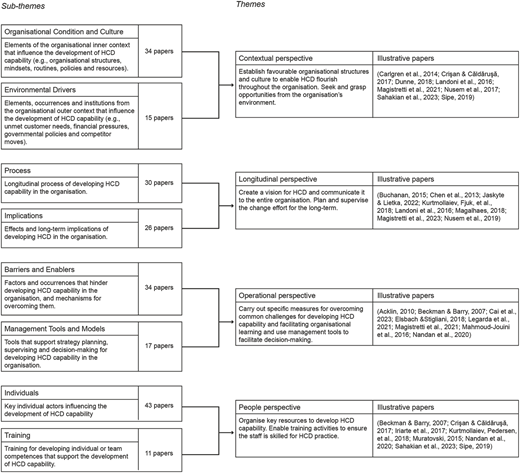
For each sub-theme, Figure 2 also specifies the number of papers discussing it and provides a definition. The associated themes are accompanied by descriptions that clarify their role in supporting the development of HCD capability in organisations. Additionally, illustrative references are provided for each perspective. In the following subsections, we discuss each perspective in detail and explore its presence and relevance across the main themes present in the analysed studies.
4.1 Contextual perspective
One of the most influential themes of developing HCD capability in the literature is the internal and external Context of the firm where the HCD development process occurs. This includes the internal Condition and Culture (34 papers) of the organisation, aiming to develop HCD capability and the external Environmental Drivers (15 papers) that influence the development of HCD capability. These two sub-themes are commonly discussed in the literature, although features related to the internal condition of the organisation are more mentioned (34 papers vs 15 papers).
Condition and Culture is one of the most repeated sub-themes in the literature on developing HCD capability. Common language (Dorst, 2011; Beckman and Barry, 2007), interpersonal relationships (Nusem et al., 2017; Magalhães, 2018), organisation-wide extended assumptions (Buchanan, 2015) and repetitive routines (Carlgren et al., 2016) and values shared among the staff (Sipe, 2020; Junginger, 2015) are the elements that shape an appropriate organisational culture to develop HCD capability. Literature suggested that to develop HCD capability optimally, organisations need to develop a culture which is creative, visual, open to changes, communicative and explorative (Buchanan, 2015; Karpen et al., 2017; Magalhães, 2018; Sipe, 2020). Suggestions on how organisations should organise the right conditions in which HCD capability can flourish throughout the organisation are also common in the literature (Carlgren et al., 2014; Rauth et al., 2014). Organisational structure types may facilitate or hamper the HCD development process (Brinkman et al., 2023). In this sense, many researchers pointed out that organisations should break down organisational silos to form multidisciplinary teams and foster interdepartmental communication and coordination for HCD capability development (Elsbach and Stigliani, 2018; Snyder et al., 2018). Such structural and cultural alignment processes resonate with Björklund et al. (2025), who describe HCD adoption as a “meshwork” of organising, aligning and displaying actions that unfold dynamically across organisational boundaries.
In contrast, external aspects related to Environmental Drivers receive comparatively less attention (15 papers). These drivers include regulatory shifts (Vetterli et al., 2016), market competition (Landoni et al., 2016; Buchanan, 2015) and technological innovation that changes customer expectations (Acklin, 2013; Sahakian and Mahmoud-Jouini, 2023). The literature further points to the influence of emerging partnerships, new collaborative ecosystems and funding mechanisms from public and private sources as pivotal triggers for initiating HCD development (Brinkman et al., 2023; Acklin, 2010; Dunne, 2018). Therefore, literature highlighted that establishing the right conditions for developing HCD capability requires finding and underrating change drivers in the external context of the organisation.
4.2 Longitudinal perspective
Many authors argued that organisations commonly fail to reach the expected HCD development level over time (Magistretti et al., 2023; Jaskyte and Liedtka, 2022). This challenge is often linked to the previous contextual perspective: cultural resistances and the difficulty of integrating HCD practices into established organisational structures (Elsbach and Stigliani, 2018). Literature empathises organisations should dedicate resources to training to acquire HCD knowledge (Acklin, 2010; Wrigley, 2016; Nusem et al., 2017), but they also need to activate mechanisms so that HCD knowledge can be exploited, evaluated and further developed in the long term (Beckman and Barry, 2007; Price et al., 2021). This reflects broader studies that emphasise HCD capability growth as a multi-level, evolving organisational process requiring governance, alignment and continuous refinement (Karpen et al., 2022; Martinkenaite et al., 2017).
Thus, a relevant sub-theme emerging in the literature is the Process for developing HCD capability in organisations (e.g. Elsbach and Stigliani, 2018; Carlgren et al., 2014), which is discussed by 30 papers in total, and the Implications that this developing process has in the organisation in the long term (e.g. Legarda et al., 2021) (mentioned by 26 papers). The articles referring to the Process perspective discuss iterative learning (Beckman and Barry, 2007; Cai et al., 2023), cross-functional collaboration (Mahmoud-Jouini et al., 2016; Chen and Venkatesh, 2013) and leadership commitment to fostering HCD capability over time (Sipe, 2020; Price et al., 2021). Papers discussing the Implications of developing HCD capability focus on the impacts that HCD capability has on the organisation's creativity (Carlgren et al., 2014), human-focused problem-solving (Jaskyte and Liedtka, 2022), product-service performance (Landoni et al., 2016) and competitive differentiation (Magistretti et al., 2023), among other benefits. Authors also mentioned internal long-term effects of HCD on encouraging collaboration across departments (Snyder et al., 2018) and improvement of employee engagement (Brinkman et al., 2023). Additionally, literature empathises that investing in HCD capability can streamline decision-making (Mahmoud-Jouini et al., 2016) and reduce the risk of costly failures in the long term (Acklin, 2013; Sahakian and Mahmoud-Jouini, 2023).
Literature on the Process and Implications might be extensive and rich, but there is a lack of studies that analyse the cost vs the benefits of these processes (Acklin, 2013; Carlgren et al., 2016) critically. Therefore, some authors indicate the necessity of addressing HCD capability development from a longitudinal perspective to establish the right direction and measurement indicators to develop HCD capability. Moreover, the development of HCD capability takes several years and entails several stages until the organisation exploits design proficiently (Brinkman et al., 2023; Kurtmollaiev et al., 2018a, b). Although the literature gathers some longitudinal studies on the development of HCD capability (Price et al., 2021; Beckman and Barry, 2007), there is still little non-contextual knowledge about how HCD capability unfolds within organisations over time.
4.3 Operational perspective
Barriers and Enablers encountered in developing HCD capability have attracted significant academic attention, as highlighted by 34 studies (e.g. Jaskyte and Liedtka, 2022; Nandan et al., 2020). These studies underscore the importance of both systemic and cultural factors (internal and external) in determining the success or failure of HCD capability development within organisations. Cultural resistance to change, lack of executive sponsorship, weak cross-functional collaboration and fragmented understanding of designers' role often emerge as critical barriers (Wrigley et al., 2020; Junginger, 2015; Elsbach and Stigliani, 2018). Such resistance is often exacerbated by entrenched organisational norms and the lack of internal design readiness (Dunne, 2018). Dunne notes that while HCD is often embraced rhetorically, actual implementation is undermined by legacy processes and mindset barriers. In contrast, successful HCD adoption is often enabled by strong leadership engagement (Sipe, 2020; Chen and Venkatesh, 2013), investment in continuous training and reflective practice (Magistretti et al., 2023; Snyder et al., 2018) and the presence of individual leaders who promote integration across departments (Price et al., 2021).
Despite growing interest in HCD integration, the development and application of Management Tools and Models specifically aimed at guiding HCD capability development remain very underrepresented in the literature, appearing in only 17 studies. These tools are focused on translating design ambitions into actionable strategies. Design maturity models, such as those proposed by Legarda et al. (2021) and Micheli et al. (2018), provide scaffolding for assessing the level of HCD integration and prioritising interventions. Storvang et al. (2014) similarly emphasise the importance of capacity frameworks to guide organisations through stages of HCD adoption. In addition, Cai et al. (2023) highlight the importance of timing and context in applying HCD tools, noting that their effectiveness often hinges on synchronisation with broader innovation cycles. Yet scholars such as Micheli et al. (2018) and Sahakian and Mahmoud-Jouini (2023) point out that without appropriate measurement mechanisms, such HCD tools risk being isolated efforts rather than embedded sustainable practices.
4.4 People perspective
Literature indicates that organisations cannot obviate Individuals as fundamental subjects of the development of HCD capability (mentioned by 43 papers). Existing literature highlights the protagonists of designers (Carlgren et al., 2014; Rauth et al., 2014) and less commonly of managers (Kurtmollaiev et al., 2018a, b; Sahakian and Mahmoud-Jouini, 2023) as key stakeholders throughout the process. According to the literature, individual actors serve as key enablers or barriers to the diffusion of HCD practices (Dunne, 2018). This aligns with the notion that individuals bring their own institutional logics and worldviews, which can either support or obstruct innovation adoption (Kurtmollaiev et al., 2018a, b). This perspective reflects findings in capability-development research indicating that through ongoing sensemaking and enactment, individuals play a pivotal role in gradually configuring and strengthening capabilities within organisations (Martinkenaite et al., 2017). In this regard, Nusem et al. (2019) emphasise the importance of moving from individual awareness of HCD principles to their actionable integration in organisational routines, highlighting the need for active engagement strategies.
According to literature, commonly, designers are in charge of leading HCD practices and transferring HCD knowledge and skills to organisation staff through participatory processes and training programs (Elsbach and Stigliani, 2018; Carlgren et al., 2014). But studies indicate that top-management support is also necessary to allocate the resources to enact HCD practices and activate mechanisms to escalate HCD culture throughout the organisation (Sahakian and Mahmoud-Jouini, 2023; Kurtmollaiev et al., 2018a, b; Jaskyte and Liedtka, 2022). However, leadership not only grants access to resources but legitimises design-led change, helping overcome cultural resistance (Buchanan, 2015; Magalhães, 2018). Executives who embody HCD values play a symbolic but very relevant role in shifting organisational norms (Muratovski, 2015).
Finally, very few papers have been oriented towards discussing the role that training has in HCD development (Beckman and Barry, 2007; Kurtmollaiev et al., 2018a, b). Limited research has examined how training programs (11 papers) and professional development efforts can equip individuals and teams with the necessary competencies to drive HCD capability within organisations (Kurtmollaiev et al., 2018a, b). Research shows that structured training significantly increases the ability to apply HCD to complex challenges (Sipe, 2020; Snyder et al., 2018). Some studies explored how organisations receive in-company training, which usually consists of a challenge or project a team needs to resolve using HCD methods with the supervision of an external experienced designer (Brinkman et al., 2023; Kurtmollaiev et al., 2018; Jaskyte and Liedtka, 2022). These hands-on formats are typically more effective in building tacit knowledge and shifting mindsets compared to traditional classroom instruction (Crişan, 2017; Rauth et al., 2014). In particular, design sprints and real-life experimentation help internalise new mental models (Iriarte et al., 2017; Magistretti et al., 2021). Finally, some other researchers discussed how design education should evolve at schools so that design students build competences that cover the gaps emerging today within organisations to manage HCD capability development (Beckman and Barry, 2007; Kurtmollaiev et al., 2018a, b; Magistretti et al., 2023). For example, Wrigley (2016) and Muratovski (2015) argue that future design professionals need not only creative and technical skills but also organisational literacy.
5. Expert elicitation: managerial propositions for developing HCD capability in financial organisations
Based on the insights derived from the expert elicitation analysis, this section suggests 10 managerial propositions that provide a holistic vision to address HCD capability development in financial organisations. The propositions are distributed within the four themes for developing HCD capability gathered from our literature analysis and respond to the main concerns identified by the interviewed expert designers. Figure 3 connects the themes, the concerns raised by the expert designers and the managerial propositions. Illustrative quotes from the expert designers that exemplify the concerns and the managerial propositions can be found in Supplementary Data – Appendix C.
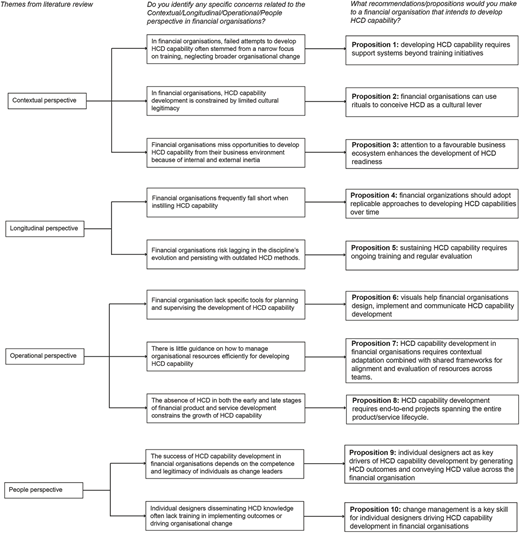
Concerns and managerial propositions for developing HCD capability in financial organisations
Concerns and managerial propositions for developing HCD capability in financial organisations
In the following subsections, we present and discuss one by one the ten managerial propositions for developing HCD capability in financial organisations.
5.1 Contextual perspective
Developing HCD capability requires support systems beyond training initiatives.
According to our interviewed expert designers, organisational scaffolding mechanisms are necessary to ensure that HCD can scale through the organisational hierarchy beyond training. Expert designers observe that regardless of the level of HCD knowledge present in the organisation, HCD realises its full potential in financial organisations only when it permeates strategic decision-making and reaches top management.
Expert designers indicate that organisations in the financial sector may find the greatest challenge for HCD development in the organisational setting itself. Expert designers consistently report that while design teams may achieve high-impact outcomes in pilot projects after HCD training initiatives, these efforts often dissipate once the activity concludes, as there are no institutional mechanisms to sustain the learning over time. They indicated that in the financial sector, the persistence of traditional silos, rigid structures and strictly defined responsibilities, alongside a highly regulated context, initially impedes the cultural and structural changes required to develop HCD capability. Moreover, expert designers noticed that in small financial organisations, the dependency on day-to-day activities discourages investment in HCD capability, which is frequently perceived as too time- and resource-intensive compared to core operations.
Thus, although interviewed experts designers recognise that training in HCD is useful as an initial contact point to familiarise employees with HCD practices, they emphasise that in financial organisations it must be complemented by supporting organisational mechanisms that involve managers. In this sense, expert designers suggest the creation of secure spaces and rituals for HCD experimentation (e.g. workshops, peer-learning forums, cross-departmental communities of practice, reflection retreats, mentoring initiations, formal and informal round tables) between designers and other employees, preferably financial managers, for reflection and support “Beyond knowing how to use HCD tools, we have realised that we need spaces in our organisational structure in which to share experiences, reflect on practice and support each other as peers” (Expert Designer 5).
Financial organisations can use rituals to conceive HCD as a cultural lever.
Expert designers indicate that developing HCD as a capability in financial organisations requires positioning HCD as a cultural lever in the organisation. This requires financial organisations to move beyond HCD methodological adoption. Only then can HCD capabilities be developed and transcend temporary initiatives.
Thus, developing HCD capability in financial organisations requires more than applying HCD practices to improve financial services. Interviewed expert designers warned that treating HCD as a set of tools risks confining it to isolated projects, whereas conceiving it as a cultural lever allows organisations to reconfigure behaviours, structures and strategies around human-centredness. As Expert Designer 4 noted, HCD practices “Collapse against the weight of legacy structures and logics that privilege control over experimentation”. In this setting, HCD initiatives delegated to isolated design units remain peripheral, without influencing broader organisational behaviour. In financial organisations, this shift is particularly significant, as strict regulatory environments and risk-averse cultures often discourage exploratory behaviour.
The interviewed expert designers suggested developing regular rituals (e.g. toolbox talks, informal no-meetings, hack days, monthly town halls, retrospectives demo days) to this aim. These rituals must serve as cultural anchors, reinforcing collaboration and customer focus in day-to-day work, jointly frame problems and generate solutions, institutionalise collective learning and translate lessons into improved HCD practices. Over time, expert designers indicated that these HCD rituals cultivate behaviours of listening, empathy and experimentation, gradually embedding HCD into the organisational culture and signalling that human-centredness is not an isolated initiative but an enduring way of working. Rituals must therefore reward collaboration, creativity and customer-centred outcomes, signalling that HCD is not a peripheral methodology but a cultural asset.
Significantly, the expert designers highlighted that when HCD is legitimised as part of the culture of the financial firm, the impact extends beyond financial service development. As Expert Designer 3 observed, when HCD was embedded, “The most striking thing was seeing how the dynamics between teams changed. They began to share more, make decisions together, and listen to one another. It was not only an improvement in the outcome, it was a transformation in the working culture.” Thus, conceiving HCD as a cultural lever enables financial organisations to foster new forms of collaboration across silos, reduce frictions among departments and reframe decision-making around the customer. Expert Designer 6 also recalled that when HCD was fully integrated, “The first thing that changed was not the product, but the way in which people from different departments relate to one another.”
Attention to a favourable business ecosystem enhances the development of HCD readiness.
Expert designers emphasised that financial organisations ought to actively leverage collaborative networks by positioning themselves within ecosystems that legitimise and foster HCD experimentation. By doing so, financial organisations can significantly increase their readiness to develop HCD as an organisational capability.
The development HCD capability in financial organisations cannot occur in isolation but is strongly shaped by the broader business ecosystem in which they operate. Financial organisations face highly regulated environments. As expert Designer 11 indicated “This sector is hyper-regulated. This has a huge influence on how much you can actually innovate through HCD. Very often, the priority is compliance with regulation and the short term, and design loses its strategic strength.”
Therefore, interviewed expert designers suggest that external interactions beyond finance, if selected properly, may help financial organisations shift their internal mindset, behaviours and ways of working with others, ultimately fostering a HCD culture of experimentation and collaboration (again, secure spaces and rituals). Thus, the interviewees indicate that ecosystem dynamics play a decisive role in building HCD readiness in the financial sector, too. Partnerships with universities, design agencies, start-ups and technology providers were frequently cited by expert designers as critical enablers, providing not only expertise but also legitimacy and external pressure to top management for HCD development: “Breaking out of our bubble was key. We collaborated with a design-oriented tech start-up and that forced us to think differently. We had to change processes, language, and timing. At first it was uncomfortable, but it helped us to rethink how we functioned internally […] The internal culture matters, but without a supportive ecosystem, change is much harder. External alliances and networks give legitimacy and momentum to HCD” (Expert Designer 2).
5.2 Longitudinal perspective
Financial organisations should adopt replicable approaches to developing HCD capabilities over time.
From a process viewpoint, interviewed expert designers depict some common patterns in the development of HCD capability in their organisations. According to the interviewed expert designers, in most initiatives to develop HCD capability, senior designers are hired either as an external advisor (collaborative or hybrid models) or an in-house employee. These designers supervise and train an internal small team in HCD practice through hands-on practice. The team then tries to bring HCD value to the organisation and, frequently, adapts HCD tools to be used in future projects. At that point, the designers and other trained employees disseminate the results of the project to other areas of the organisation; if they are able to generate HCD awareness in other teams, new projects emerge within the organisation, and the HCD function scales up. Moreover, if the management board is convinced of the results, they decide to dedicate resources and generate structures that facilitate HCD practice – e.g. legitimising an in-house design team.
At this point, again, interviewees highlight that the successful integration of HCD requires not only alignment with strategic goals but also the establishment of secure spaces and rituals for experimentation where teams can document, share and adapt HCD practices across projects over time. Expert designers point out that replicability is achieved through autonomous legitimised teams that secure spaces to showcase HCD results and progressively scale: “Each time we repeat the model in another area, we learn more. We don't just copy and paste, but the overall pattern works: small team, autonomy, measurable results, securing a space to share what we have done, and then scaling up” (Expert Designer 6). At this point, expert designers recommend that internal feedback and learning from past HCD projects should be systematically documented and disseminated to avoid repeating mistakes and to build institutional memory on HCD.
Sustaining HCD capability requires ongoing training and regular evaluation.
Expert designers suggest that without periodic renewal, HCD capabilities risk becoming ineffective. Expert designers cautioned that financial organisations are at risk of lagging behind HCD discipline's evolution, especially in regard to Artificial Intelligence and big data in HCD practice, if they do not continuously update their practices. As one expert designer observed, “Many times, people are trained in a specific methodology, such as Design Thinking, and stop there. There is no review of processes, no updating. They keep applying the same approach even though the environment and tools have changed. This weakens HCD and makes the results seem less and less relevant” (Expert Designer 6).
Thus, to prevent such stagnation, financial organisations must establish processes for regular evaluation of HCD practices and ensure sustained investment in training. In addition, expert designers emphasised that rigid, one-size-fits-all frameworks are particularly counterproductive in the financial sector: “There is no single design methodology or tool or method that always fits. I am in favour of having a shared methodology across the company, but it must be flexible and evolve with the discipline” (Expert Designer 3).
This implies that financial organisations should implement feedback loops, systematic evaluations and reflective practices to ensure that HCD remains aligned with both organisational needs and external developments. Periodic training, mentoring with external designers and collaborative exchanges – both within and outside the organisation – help prevent HCD from becoming obsolete and ensure its relevance in a rapidly evolving context.
5.3 Operational perspective
Visuals help financial organisations design, implement and communicate HCD capability development.
Financial organisations need robust tools to measure and communicate whether the development of HCD capability has met the objectives of the organisation. Interviewed expert designers stressed this need, noting that while financial institutions rely heavily on dashboards and Key Performance Indicators (KPIs) in other areas, they often lack clear metrics for evaluating HCD capability, which limits its value significantly. As Expert Designer 5 explained, “We are missing clear indicators. We do things, but we don't know how to measure their impact. There are no dashboards or standardized processes. Sometimes we achieve excellent results, but we can't show them with data. This makes it hard for management to justify why they should continue investing in HCD”. The absence of systematic evaluation makes it difficult to scale good practices, leaving HCD vulnerable to being perceived as “soft” or peripheral to core business outcomes.
Expert designers indicate that when results are translated into data visually, HCD gains greater legitimacy: “It was only when we presented a case with metrics that management began to listen to us. Until then, design seemed like something soft. We showed data on reduced call volumes, improved resolution times, and customer satisfaction. Since then, they have asked us (the design team) to take part in more decisions” (Expert Designer 3). Others highlighted that developing visual dashboards linking design interventions to established financial KPIs significantly increased support: “We started to create visual data dashboards where we linked our design interventions to financial KPIs, and the impact has been very positive” (Expert Designer 9).
Thus, visual tools not only track progress but also provide compelling communication vehicles for engaging decision-makers, reinforcing HCD's value internally. Visual tools become both instruments of measurement and artefacts of persuasion, helping to institutionalise HCD within the financial organisation's financial data-driven logic.
HCD capability development in financial organisations requires contextual adaptation combined with shared frameworks for alignment and evaluation of resources across teams.
HCD capability development in financial organisations requires balancing sensitivity to contextual constraints with the creation of shared frameworks for alignment and evaluation, so that diverse HCD practices reinforce, rather than fragment, the organisation's long-term HCD capability development direction.
Interviewed expert designers consistently emphasised that each financial organisation faces distinct challenges shaped by its size, structure, culture and regulatory environment. They argue that HCD capability-building is contingent upon organisational context and that interventions should be tailored to specific HCD maturity levels and institutional logics of the financial organisation. At the same time, expert designers noted that financial organisations often suffer from fragmented and short-term resource planning for HCD. As one designer remarked, “The resources allocated to HCD are usually very poorly planned. Often there is a budget for a specific project, but not for maintaining or scaling that capability” (Expert Designer 7).
Thus, HCD risks being perceived as a temporary cost rather than a strategic investment if its development is not properly framed in each organisation's momentum. As Expert Designer 6 indicates: “Any mechanism to develop HCD capabilities must be adapted to the specific context of the organisation.”
HCD capability development requires end-to-end projects spanning the entire product/service lifecycle.
Effective HCD capability development requires end-to-end participation of HCD practices across the financial product and service lifecycle. This means involving design teams not only in early research or late-stage visual aesthetics. End-to-end integration strengthens organisational learning through iteration and legitimises HCD as an organisational capability rather than a peripheral function.
One of the main limitations in how financial organisations develop HCD capability lies in the fragmented way HCD practice is often integrated into projects. Interviewed expert designers highlighted that HCD teams are frequently invited only at the beginning – during customer research – or at the very end, when solutions are already defined and design is reduced to a “cosmetic exercise”. As one expert designer observed, “We design customer journeys, we do research, but many times we are removed from the project before implementation. We do not get to see whether what we propose works, nor do we have the chance to iterate. That is frustrating and breaks the learning process” (Expert Designer 8). Others pointed out that this partial involvement severely restricts learning opportunities, “In general, we are called when the project has already been decided. They want us to dress up something that is already closed. So, what strategic capacity can we have if we only decorate what others have defined?” (Expert Designer 2). Such fragmented participation not only undermines the value of HCD as an organisational capability but also prevents organisations from building cumulative capability. “After each project, nobody analysed what had worked or what hadn't. It was closed, the deliverable was presented, and that was it. There was no room to reflect, learn, or improve the approach” (Expert Designer 11).
Conversely, when HCD is embedded end-to-end in new product and service development projects, the impact is markedly different in the financial sector. Expert Designer 6 stressed that projects where HCD accompanied the full lifecycle created much greater organisational learning “We have achieved much greater impact when design accompanies the entire implementation. In a recent project, we were involved from problem detection through to closure. That way, we were able to make corrections along the way and ensure that what we had learnt was not lost and the impact was tremendous”.
5.4 People perspective
Individual designers act as key drivers of HCD capability development by generating HCD outcomes and conveying HCD value across the financial organisation.
Interviewed expert designers highlight that investing in the development of individual leaders – namely design catalysts, design ambassadors, design champions or design change agents (Price et al., 2021) – is essential for developing HCD in financial organisations. These individuals play a pivotal role in generating outcomes, embedding knowledge and building narratives that connect HCD to business value. Yet, expert designers indicate that their impact depends not only on personal competence but also on organisational recognition and authority. When legitimised and strategically positioned by top managers, individual design leaders become the drivers of sustainable HCD capability across financial organisations.
From the perspective of interviewed expert designers, in many cases, HCD capability development initiatives that initially succeeded later collapsed due to the absence of a legitimate individual to champion continuity: “After the first pilot case, where we had good results, but no one took responsibility for maintaining them […] if there is not a person—a name, with prestige and legitimacy inside the organisation—who looks after the process, the urgent will always override design” (Expert Designer 1). Similarly, others warned that without institutionalising leadership, HCD initiatives remain overly dependent on the energy of a few individuals.
According to the expert designers, these individuals typically operate in different intertwined roles. First, they act as creators of HCD outcomes, enacting design practices to demonstrate tangible value for the organisation. By involving employees and managers in hands-on practice, they both deliver results and showcase the relevance of HCD. Secondly, they act as trainers, embedding knowledge within the organisation and enabling teams to carry forward HCD methods independently. Interviewed expert designers stressed that these leaders must have legitimacy and visibility in decision-making spaces: “It is necessary to have someone with a design vision on the committees where the strategic direction of the organisation is decided. Without presence there, design will always remain peripheral” (Expert Designer 1). Thirdly, they are communicators, advocating for HCD and making its business value visible across organisational hierarchies.
Change management is a key skill for individual designers driving HCD capability development in financial organisations.
Building HCD capability in financial organisations requires intentional investment in change management training for design leaders. This includes structured leadership development, peer-learning communities and interdisciplinary collaboration between designers and financial executives (e.g. mentoring programs by senior finance managers). By equipping designers with these competences, financial organisations can transform them into effective catalysts of change who not only introduce HCD practices but also embed them in organisational culture, ensuring long-term impact.
Interviewed expert designers consistently pointed out that designers in financial organisations are increasingly expected to act as change leaders, not just as executors of HCD methods or tools. However, many feel unprepared for this role. As one expert designer reflected, “I was promoted to a leadership role without preparation in change management. Designers know how to facilitate, research, prototype, but we lack training to manage teams, persuade stakeholders, or deal with resistance. At first, this greatly limited the scope I could give to design; when I acquired these competences, everything became much smoother” (Expert Designer 6).
These accounts reveal that, beyond HCD expertise, change management and financial competences for designers are critical for consolidating HCD capability. As mentioned, designers often face resistance, hierarchical decision-making and short-term performance pressures typical of financial organisations. To navigate these contexts, they need skills in persuasion, stakeholder alignment and strategic communication – competences not traditionally included in design education but also financial literacy. The gap between expectations and preparation has structural consequences, according to the interviewees. In financial organisations, when designers lack change management tools and financial literacy, HCD might be overridden by urgent business priorities. By contrast, when designers acquire leadership and change management skills, they can better connect design practices with organisational strategy, frame results in terms of business value and ensure that HCD initiatives scale beyond pilot projects. As Expert Designers 10 and 11 explained, mentoring programmes that pair designers with experienced finance managers helped them become more effective change agents.
6. Discussion
This section discusses our findings in relation to prior research on HCD capability development in financial organisations. It first addresses the organisational and contextual conditions underpinning this capability, then examines its longitudinal evolution, operational enablers and the role of designers as change agents.
6.1 Contextual conditions for HCD capability development in financial organisations
Our study highlights that developing HCD capability in financial organisations depends crucially on organisational support mechanisms that extend beyond training (Proposition 1). This resonates with prior work emphasising that HCD development requires organisational infrastructures that legitimise experimentation and collaborative learning (Björklund et al., 2020; Junginger, 2015). In financial contexts, although training in HCD is useful as an initial contact point to familiarise employees with HCD practices (Micheli et al., 2018), cultural inertia, strong regulatory oversight and siloed structures frequently hinder the translation of HCD from isolated practices into sustained organisational routines. Very similar barriers have been noted in bank marketing literature examining customer-centric transformations in financial services, where organisational culture and cross-functional alignment consistently emerge as constraints (Beckett and Nayak, 2022; Andaleeb et al., 2016).
Thus, our study stresses the need for secure spaces and rituals, structured opportunities for reflection, learning and peer collaboration, to develop HCD within day-to-day work (Proposition 2). This aligns with arguments that HCD practice evolves through repeated social interaction and sensemaking rather than procedural adoption alone (Kolko, 2015; Micheli et al., 2018). Financial organisations, in particular, can benefit from such rituals because they counterbalance the sector's risk-averse logic by creating psychological safety and legitimising exploratory behaviour. Studies on digital banking experience reinforce this need: customer-centric innovation flourishes only when employees internalise human-centredness as an organising principle, not merely as a methodological toolkit (Komulainen and Saraniemi, 2019; Chaudhuri et al., 2023).
To meet this need, financial organisations' readiness for HCD can be shaped by the broader ecosystems in which they are embedded, as external partnerships help challenge entrenched routines and introduce alternative logics and spaces that legitimise experimentation (Proposition 3). Consistent with research showing that HCD capability develops through interorganisational learning and boundary-spanning interactions (e.g. Jevnaker and Bruce, 1998; Dell’Era et al., 2020), our findings indicate that collaborations with universities, design agencies, start-ups and technology providers act as catalysts that accelerate mindset shifts and provide top management with credible signals supporting HCD development.
6.2 Longitudinal view of HCD capability development in financial organisations
Our results emphasise that HCD capability development can unfold in financial organisations through iterative, replicable patterns, understanding HCD capability building as an evolutionary process driven by learning, repetition and adaptation (Kindström et al., 2013; Magistretti et al., 2021) (Proposition 4). We defend that in financial organisations, HCD must begin with small autonomous teams led by experienced designers, whose early demonstrator projects create visible value that gradually attracts managerial attention. This trajectory is consistent with prior findings that HCD capability scales when early low-risk experiments generate convincing evidence for strategic relevance (Rauth et al., 2014; Dunne, 2018). Indeed, some authors such as Kurtmollaiev et al. (2018a, b) and Acklin (2013) have theorised about similar processes of developing HCD capability from the institutional logics and absorptive capacity theories, respectively.
However, the longitudinal development of HCD capability in finance also requires continuous renewal to avoid capability erosion. Static HCD frameworks quickly become obsolete, especially as HCD increasingly intersects with emerging technologies such as AI, advanced analytics and data-driven service innovation. Thus, sustaining HCD capability requires ongoing training and regular evaluation (Proposition 5). This aligns with research showing that HCD capabilities evolve through iterative learning cycles and must adjust to changing organisational and technological conditions (Acklin, 2013; Jaskyte and Liedtka, 2022). It also echoes literature calling for flexible, evolving HCD processes attuned to organisational change (Carlgren et al., 2016) and aligns with bank marketing findings showing that digital transformation pressures demand continuous upskilling in financial services (Saxena, 2020) and redesigning innovation processes to remain customer-centric (Beckett and Nayak, 2022).
6.3 Operational enablers: visuals, context alignment and end-to-end integration
Our study emphasises the importance of visuals (dashboards, metrics and financial data-based journeys and storytelling) to communicate HCD outcomes effectively in financial organisations (Proposition 6). Visual tools, long recognised in HCD practice for their ability to interpret abstract concepts, complex systems and processual sequences (Dell’Era et al., 2020; Micheli et al., 2018; Iriarte et al., 2023), offer a promising avenue for seeking to monitor and communicate HCD development in financial organisations. Beyond new product and service development, such tools have proven effective in facilitating organisational change and making tacit processes visible (Iriarte et al., 2023). Literature partially supports these findings. Visual frameworks have been used to facilitate conversations about organisational purpose, marketing strategies or stakeholder engagement (Kaartti et al., 2025; Kembaren et al., 2014). Structured visualisations such as roadmaps, capability maps or stakeholder ecosystems enable managers to identify gaps in HCD capability and ensure alignment with broader business objectives (Crişan and Căldăruşă, 2017). Thus, visuals not only track progress but also provide compelling communication vehicles for engaging decision-makers and reinforcing HCD's value internally (Nusem et al., 2017). This corroborates work showing that visualisation practices are powerful enablers of HCD legitimacy because they translate intangible value into formats compatible with managerial decision-making (Legarda et al., 2021; Björklund et al., 2025) and aligns with research on customer experience measurement in banking, where visual dashboards improve cross-departmental alignment (Pont and Shaw, 2010).
Furthermore, the results show that HCD capability must balance contextual adaptation with shared frameworks that ensure organisational coherence (Proposition 7). Brinkman et al. (2023) argue that combining context-sensitive adaptation with cross-cutting frameworks can increase the legitimacy of HCD initiatives by ensuring that HCD practices contribute to an overarching organisational vision. Without shared methodologies and resource planning, HCD risks fragmentation, an issue acknowledged in HCD management literature (Micheli et al., 2018; Nusem et al., 2019) and strongly echoed in financial services research, which shows that customer-centric strategies fail when processes and objectives remain siloed (Kaartti et al., 2025; Andaleeb et al., 2016). In this sense, shared frameworks (again, in the form of spaces and rituals) serve as a governance mechanism that aligns HCD efforts towards the development of a cumulative capability. Bailey (2012) argued that managers should balance HCD learning with ongoing project demands, allowing outcomes to fuel organisational engagement and momentum.
End-to-end integration across the product/service lifecycle also emerged as essential (Proposition 8). Partial involvement of designers prevents iterative learning and diminishes HCD contribution. This finding corroborates a substantial body of service design literature (Yu and Sangiorgi, 2018; Iriarte et al., 2023; Kaartti et al., 2025; Kurtmollaiev et al., 2018a, b) and resonates with bank marketing studies emphasising that customer experience innovations require cross-stage integration from insight to implementation (Beckett and Nayak, 2022; Chaudhuri et al., 2023). Thus, for financial organisations, whose service systems are complex and multi-channel, end-to-end HCD participation is crucial to ensure coherence, reduce friction and enable organisational learning cycles. This pattern echoes findings in the literature. Liedtka (2017) also stresses that the full learning benefits of HCD emerge only when it is applied iteratively across the entire lifecycle of new product development.
6.4 Role of designers as catalysts and change agents in financial organisations
Our findings underscore that individuals, particularly design leaders, play a pivotal role in driving HCD capability (Proposition 9). This aligns with research conceptualising designers as boundary spanners, interpreters and catalysts of organisational change (Price et al., 2021; Wrigley, 2016) and with perspectives that highlight the human element of capability development (Björklund et al., 2020; Buchanan, 2015). In financial organisations, where hierarchical decision-making and strong institutional logics often constrain innovation, the presence of legitimised design leaders is especially critical. In this sense, bank marketing literature also highlights the importance of key individuals in customer-centric transformation and digitalisation (Beckett and Nayak, 2022; Kaartti et al., 2025). Our findings extend this insight by showing that designers not only advocate for HCD but enact and model its practices through visible outcomes and storytelling that connects HCD practice to business value in finance.
Crucially, designers require change management skills and financial literacy to be effective in this context (Proposition 10). Literature further emphasises that these individuals require a diverse set of competences (Wrigley, 2016; Sipe, 2020). Brinkman et al. (2023) stress the importance of cross-disciplinary skills that enable leaders to bridge HCD practices with strategic decision-making. Without such competences, even highly committed individuals risk burnout and marginalisation (Ravanello et al., 2017). This is consistent with interviewees' reflections that the absence of strong, legitimised individuals often condemns HCD initiatives to isolation and eventual disappearance. Interviewed expert designers described how the lack of preparation in negotiation, stakeholder alignment and strategic communication limited their capacity to develop HCD capability in financial organisations. Again, this echoes findings that designers increasingly need organisational and management competences to operate as strategic actors (Muratovski, 2015; Deserti and Rizzo, 2014) in finance and aligns with literature showing that HCD often fails not because of methodological weaknesses but due to insufficient organisational skill among leading designers (Elsbach and Stigliani, 2018; Dunne, 2018). Thus, in financial organisations, whose logics prioritise efficiency, risk control and analytical reasoning, designers must be able to articulate HCD results in terms that resonate with senior financial decision-makers.
7. Conclusion
This study provides a holistic understanding of how HCD capability can be developed in financial organisations based on an integrative view of the theoretical base, along with empirical knowledge elicitation. In doing so, it advances an undertheorised topic and paves the way for further research in the field. It contributes to HCD capability research by offering sector-specific evidence from a highly regulated and operationally complex industry, thereby extending prior insights that have largely been developed in other contexts. The study clarifies how HCD capability can be purposefully developed to sustain outcomes related to customer-centric strategies and digital transformation, areas of growing interest in contemporary bank marketing literature.
This article also has notable implications for practice. Our propositions support financial managers in establishing favourable conditions for developing HCD, adopting concrete measures for overcoming challenges throughout the change process, articulating a long-term direction for HCD and organising key resources to build HCD capability. In particular, financial managers can draw on our findings to legitimise HCD internally, allocate resources for sustained capability building and embed HCD practices across the product and service lifecycle. Design leaders working in the finance sector, meanwhile, can use our propositions to guide HCD capability development efforts, communicate HCD's strategic value using data-driven narratives and strengthen their role as change agents who connect HCD practices with broader business objectives in finance. Together, these insights offer actionable guidance for financial organisations seeking to enhance customer experience, accelerate human-centred innovation and remain competitive in digitally mediated service ecosystems.
Despite the valuable insights provided by our study, it is of an exploratory nature, and thus, further research is needed. Firstly, due to the nascent character of the topic, the experiential base of designers currently working to develop HCD capability in financial organisations is still emerging. Although data saturation was achieved in our analysis, expert designers from financial organisations with more mature HCD capabilities may provide additional insights that deepen understanding of the phenomenon. Secondly, our study focused specifically on in-house HCD capability development. As such, we did not examine alternative pathways through which financial organisations may appropriate HCD value, such as hybrid partnership models. Comparative analyses of in-house, collaborative and hybrid HCD capability frameworks, therefore, represent a promising avenue for future inquiry.
Moreover, each of our propositions warrants further empirical investigation to validate and refine them. While we have identified important insights, financial organisations require additional guidance to elaborate effective strategies for developing HCD capability in relation to their specific characteristics, including organisational size, geographic scope and existing HCD maturity. Longitudinal studies could help uncover the micro-processes through which HCD practices diffuse within their particular hierarchical and regulated environments, while quantitative studies could measure the performance outcomes associated with different HCD capability trajectories.
Finally, given the central role of designers as change agents in developing HCD capability, future research should examine how design and finance education might collaborate to equip designers with the skills needed to navigate financial logics, manage organisational change and communicate effectively with bank executives. More specifically, future research should examine pedagogical models, cross-disciplinary training and competency frameworks that equip designers to navigate financial logics and communicate effectively with senior decision-makers in banking organisations.
The authors would like to thank the former students of Modragon Unibertsitatea's Strategic Design MSc program, with special thanks to Sara Gondra for her valuable contribution throughout the expert elicitation research. We also wish to thank the anonymous reviewers and the Editor-in-Chief for offering many valuable suggestions.
The supplementary material for this article can be found online.

