Purpose
This study advocates the importance of taking an evolutionary perspective in the strategic configuration of closed-loop supply chains (CLSC) in the transition to a circular economy. Building on the supply chain management and industrial dynamics research domains, an evolutionary analytical framework was developed and applied in the empirical context of the ongoing industrial transition to e-mobility.
Design/methodology/approach
This study is designed as an in-depth exploratory case study to capture the multi-layer dynamic complexities and their interplay in CSLC development. The empirical investigation was based on two-year interactions between the authors and various departments in a leading European heavy vehicle manufacturer. The proposed evolutionary analytical framework was used for investigating the dynamics of four CLSC configurations through ten possible trajectories.
Findings
The findings demonstrate that the evolution of each CLSC configuration comes with multiple challenges and requirements and point out the necessity for the co-development of technologies, product design and production, and infrastructure through long-term relationships among key supply chain actors. However, this evolutionary journey is associated with multiple dilemmas caused by uncertainties in the market and technology developments. All these factors were properly captured and critically analyzed, along with their interactions, thanks to the constructs included in the proposed evolutionary analytical framework.
Research limitations/implications
The proposed evolutionary framework is applicable for examination of SC transformation in the context of market and technology development, and is particularly relevant for transitioning from linear SC to CLSC. The framework offers a single actor perspective, as it does not directly tackle dynamics and effects of actions taken by SC actors.
Practical implications
The developed framework can support SC managers in identifying, framing, and comparing alternative strategies for CLSC configuration in the transition process.
Originality/value
This study proposes the framework for understanding and guiding the evolutionary process of CLSC development. Its uniqueness lies in the integration of concepts from innovation and evolutionary theories coming from industrial dynamics and SCM literature streams.
1. Introduction
Companies across industries are under constant pressure from society, governments, and markets to transform the dominant linear economic-industrial system. Transitioning to the circular economy (CE) is becoming an indispensable condition for staying in business (Rodysill, 2022; Ripanti and Tjahjono, 2019). At the supply chain level, the CE transition fosters the evolution of linear supply chains into circular, closed-loop supply chains (CLSC) through the integration of recovery processes and reverse logistics. This transformation requires multidimensional effort and consideration of the dynamic interdependence of CLSC processes and actors in the context of a constantly evolving external environment (Amir et al., 2022; Chizaryfard et al., 2021). Studies provide valuable insights about different CLSC elements, such as required resources and capabilities (Ritola et al., 2021; Seles et al., 2022) drivers and barriers (Bressanelli et al., 2019; Roy et al., 2022) of various decisions (Hazen et al., 2020; Nuss et al., 2015) and alternative recovery network models (Chhetri et al., 2022; Reddy et al., 2019). Together these insights characterize CLSC complexity but do not necessarily provide a comprehensive systemic and evolutionary view on how to develop CLSC and how this development could be managed. This limitation represents a grand challenge in making the CE real (De Angelis et al., 2018; Braz and de Mello, 2022). Therefore, Coenen et al. (2018) highlighted the need for a conceptual framework that would guide a continuous process of CLSC evolution.
We aim to address this call and propose an analytical framework that would support an understanding of CLSC development and management of possible evolutionary paths toward the desired CLSC configuration. Given that CLSC literature offers a limited theoretical understanding of the continuity of CLSC development, we decided to transcend disciplinary research boundaries. In particular, we examine two research domains – supply chain management (SCM) and industrial dynamics (ID) – to derive implications for the development of an evolutionary framework. The first research domain was included due to its broader scope in comparison to CLSC. Therefore, it may offer valuable contributions to SC dynamism that are not necessarily related to the closing of material and product loops (e.g. Melnyk et al., 2014; Wieland, 2021). The ID research domain examines the evolutionary processes of industrial transitions and the underlying dynamics of technological change (Carlsson, 1987; Nelson and Winter, 1973). Although ID focuses on industrial systems, we believe it may offer valuable conceptual tools for framing the evolution of SCs under the CE paradigm.
Furthermore, the existing CLSC models and frameworks reported in literature either lack empirical validation or have no reference to real-life applications (MahmoumGonbadi et al., 2021; Zhang et al., 2021). In the present study, we apply the proposed evolutionary framework to examine the development of CLSC for electric vehicle batteries by a heavy vehicle manufacturer. This is a prominent example of the ongoing transition to CE, where on the one hand industry dependence on fossil fuel is at stake, and, on the other hand, the business environment is radically changing. Given the long-term perspective on the growing fleet of e-vehicles (EVs) (BloombergNEF, 2022; IEA, 2022), and thus the increasing demand for high voltage lithium-ion batteries (LIBs or batteries), it is vital to establish a circular model of the LIB SC (Tsiropoulos et al., 2018; Winslow et al., 2018).
Therefore, we strive to answer the following research questions:
What are the relevant factors and their relations that influence evolutionary trajectories of CLSC configurations in the transition towards the CE?
What are the possible evolutionary trajectories of the CLSC of lithium-ion batteries for EVs?
While examination of SCM and ID research domains addresses RQ1 by suggesting the elements and the structure of the framework; the in-depth case study contributes to both RQs: by demonstrating the dynamic interplay of elements of the framework (RQ1) and by providing the example of identification, examination, and comparison of alternative CLSC evolutionary paths (RQ2).
The remainder of the paper is structured as follows. Section 2 presents the overview of how the transition process is viewed at the supply chain level and discusses the challenges of CLSC development from an evolutionary perspective. Section 3 introduced the evolutionary analytical framework. Section 4 describes research methodology. Sections 5 and 6 comprise the results and discussions, respectively. The paper ends with conclusions and prospects for further research.
2. Theoretical background
2.1 The role of evolutionary perspective for CLSC development
CLSC is a system designed “to maximize value creation over the entire life cycle of a product with dynamic recovery of value from different types and volumes of returns over time” (Guide and Van Wassenhove, 2009, p. 10). CLSC development requires transformation of traditional forward supply chain (FSC) to allow the integration of recovery processes and reverse flows that comprise reverse supply chain (RSC).
The structure and organization of CLSC are significantly more complex compared to FSC. CLSC encompasses a wider set of actors (e.g. waste collectors, recyclers) and processes (e.g. remanufacturing, reverse logistics). Many actors play dual roles along the CLSC (e.g. recyclers at RSC act as material suppliers at FSC) (e.g. Stindt et al., 2016), which requires acquisition of new resources and capabilities (e.g. new equipment and technologies, new partnerships across FSC and RSC) (Ritola et al., 2021; Seles et al., 2022). Furthermore, these actors potentially have different strategic priorities and thus they may disagree on the preferred CLSC configuration and its evolution (De Angelis et al., 2018; Guide and Van Wassenhove, 2009).
Coenen et al. (2018) and Braz and de Mello (2022) highlight that CLSC is subject to dynamic complexity, meaning that the evolution of CLSC processes is not linear and necessarily synchronous. Guide et al. (2003) indicated that CLSC processes are tightly interdependent and mutually reinforcing. This suggests that any product or process innovation at one stage of CLSC would require alignment of processes at other CLSC stages, leading to re-evaluation of technical feasibility, economic viability, organizational responsibilities and environmental impact of possible recovery routes, etc. (Hagelüken, 2014; Lapko et al., 2019). If we are to understand CLSC evolution, it is necessary to take into consideration changes happening at each CLSC process/actor and their dynamic interdependence.
Furthermore, Roy et al. (2022) and Bressanelli et al., 2019 identified a wide range of challenges for SC redesign while transitioning to the CE. These challenges cover both external and internal factors and have cross-function and cross-actor nature (Bressanelli et al., 2019; Lapko et al., 2019). Furthermore, considering the constantly changing environment and intrinsic dynamic complexity of CLSC, it is possible to assume challenges would also change during CLSC evolution. Therefore, multidimensional systemic analysis is required (Amir et al., 2022), where dynamic and interdependent challenges are considered and addressed, to support CLSC evolution. So far, this perspective has received little attention in the literature. In particular, Coenen et al. (2018) indicated that there is limited understanding of CLSC evolution under dynamic external factors; thus, leaving industrial actors to make decisions under incomplete information and insufficient knowledge. This is especially problematic for emerging technologies with immature markets, such as electric vehicles and their batteries (Marcos et al., 2021; Rajaeifar et al., 2022).
So far, CLSC design has been predominantly examined through optimization modeling of various tactical and operational decisions (Kazemi et al., 2019; MahmoumGonbadi et al., 2021). Although such models provide valuable insights, they are subject to various limitations, and are frequently constrained by strong assumptions. Thus, they can integrate the complexity and dynamism of the real world only partially. Indeed, studies acknowledge the lack of practical information on the re-design of SC in transition to CE in a real-world context as a significant bottleneck for closing the loops (De Angelis et al., 2018; Braz and de Mello, 2022).
Recent literature calls for more empirical, qualitative, and conceptual/theoretical works that would allow capturing the dynamic complexity of CLSC development (Kazemi et al., 2019; MahmoumGonbadi et al., 2021; Mishra et al., 2023). In particular, Coenen et al. (2018) highlight the need for a conceptual framework that would guide a continuous process of CLSC evolution. This opens the opportunity and value of taking an evolutionary perspective when examining the changes in CLSC processes and their continuous re-alignment within the system and across different time frames.
2.2 The evolutionary perspective in supply chain management
The evolutionary perspective in SCM is an emerging debate arguing that supply chains are not static (Melnyk et al., 2014; Wieland, 2021). In particular, Wieland (2021) defines SC as a socio-ecological system that evolves over time and in space. So far, SC dynamism has been examined through the lens of innovation theory, leading to development of concepts of Supply Chain Innovation and Supply Chain Life Cycle. In the following, we discuss the contributions of these concepts to the better understanding of SC evolution. Then, we highlight how the integration of evolutionary concepts from ID research domain can provide further crucial support.
The research stream of Supply Chain Innovation (SCI) examines the impact of different types of innovations on SC structure, technology, and business processes (e.g. Bello et al., 2004; Arlbjørn and Paulraj, 2013). Following SCI logic, the CE transition would inevitably lead to SC transformation at different levels (products, processes, relations, network structure) to accommodate multiple emerging innovative technologies and processes (Aminoff and Kettunen, 2016; Tebaldi et al., 2018). However, SCI tends to focus on innovation as a trigger of change, leaving behind complexity and dynamism of the innovation diffusion process (steered by market and technology dynamics) and its continuous impact on SC transformation.
Inspired by innovation theory in general, and the product life cycle concept (Foster, 1986; Levitt, 1965) in particular, the concept of Supply Chain Life Cycle was introduced and mainly employed in the context of humanitarian/disaster and transient SCs (e.g. Day et al., 2012; Pettit and Beresford, 2005). Later, MacCarthy et al. (2016) proposed a framework for investigating SC development during the lifecycle stages of emergence, growth, maturity, and decline, considering technology and market dynamics and related SC strategies. However, MacCarthy et al. (2016) did not provide any implications for SC development from one stage to another. For example, it is not clear how SC is expected to transform moving from one stage to another, if there is any interplay between SC strategies (causing synergies or trade-offs), or if earlier SC changes may impose any requirements or restrictions for SC decisions in the future.
Therefore, while SCI and SC life cycle studies suggest the dynamic nature of SC, they provide limited implications for the examination of SC evolution. In particular, the discussion above outlines two critical gaps to be addressed: the continuity of SC development considering dynamic complexity and interdependence of related processes and actors; and the consideration of a changing external environment (through market and technology dynamics) that set enabling or restricting conditions for alternative strategic decisions. We argue that taking an evolutionary perspective is indispensable for addressing these gaps.
ID research domain has evolutionary thinking at its core and a long tradition of investigating industrial changes through conditions and pathways of transition processes (Nelson and Winter, 1973; Windrum and Birchenhall, 1998). ID core concepts comprise path dependency (Arthur, 1989; Stack and Gartland, 2003), lock-in (Liebowitz and Margolis, 1995; Stack and Gartland, 2003), and complementarity (Dahmén, 1989). The main argument in evolutionary theory is that history matters; the early decisions of companies can create inertia and influence their performance over time. This phenomenon is the basis of the concepts of path dependency and lock-in, which explain how companies get restricted by existing technical standards, already built infrastructure, and intra-inter organizational relationships (Garud and Karnoe, 2001; Stack and Gartland, 2003). Path dependency is viewed as an “accumulation of competences and activities to a persistent and stable patent, driven by self-reinforcing processes that, in the absence of external shocks, lead to an irreversible state of inflexibility” (Bergek and Onufrey, 2014, p. 1263). Accordingly, the concept of lock-in is a property or a possible outcome of path dependency.
In the context of SC development, only a few studies reflect on path dependency either by explaining the evolution of SC in a specific sector as an ex-post event (e.g. Wiskerke and Roep, 2007) or by developing scenarios and statistical analyses in forward-looking studies (anticipation) (e.g. Hung and Ryu, 2008). For example, Siltaloppi and Jähi (2021) suggested that the transition to CE of plastics is inhibited by the current lock-in fossil-based production systems and forward supply chains. However, intentional and explicit integration of path dependency and lock-in concepts in the (ex ante) analysis of multiple dimensions of SC evolution is absent.
Furthermore, the evolutionary theory acknowledges the uneven development of industrial transition processes and the way different pieces of the industrial system develop and fit together (Dahmén, 1989). In this regard, the concept of complementarity was introduced (Dahmén, 1989) to reflect the co-evolution and interdependence of different parts of the industrial system. To the best of our knowledge, the concept of complementarities has not been explicitly employed in the SCM research stream. Instead, the literature is rich with frameworks of requirements or enablers and drivers for SC development in general and SC redesign towards the CE in particular (e.g. Roy et al., 2022). Although these concepts capture the relevant forces in a certain context and at a certain time, their interdependence is rarely examined.
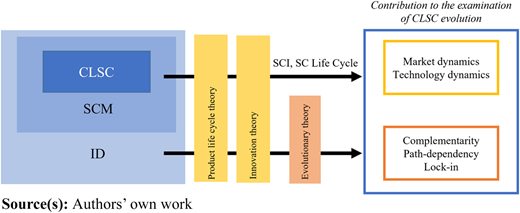
The discussion above highlights the value of both innovation and evolutionary concepts for the examination of continuous CLSC development. While innovation theory highlight that all industrial systems exist under an ongoing transition process triggered by either market or technology changes; the concepts of path dependency, lock-in, and complementarity characterize the evolution process itself. Figure 1 depicts the interconnection of concepts and their contributions to understanding and examination of SC evolution.
3. The evolutionary analytical framework for CLSC development
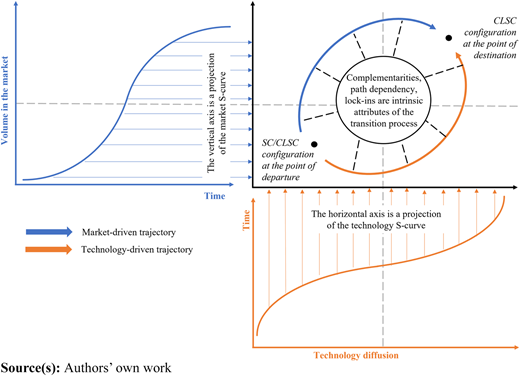
In this section, we propose the evolutionary analytical framework that can assist with identification and comparison of alternative evolution paths for CLSC development. First, building on the innovation theory, we consider the changing external environment through market and technology dynamics represented in lifecycle logic (S-curve) (Foster, 1986; Levitt, 1965). Second, we introduce evolutionary concepts of complementarity, path-dependency and lock-in to examine the impact of market and technology dimensions on SC evolution.
The left side of Figure 2 depicts the market changes conceptualized through both the volume of new products placed in the market and the related volume of returned end-of-life (EOL) products. Given the lifecycle of a new product, an EOL product can be collected after a long time (e.g. it is 8–10 years in the case of LIBs). Therefore, there could be a point somewhere in the middle when the volume of new products placed on the market is high, but the volume of EOL products available for recovery are still low. In the end, the market reaches saturation (a relative plateau on the S-curve) with stable sales volumes of new products and stable return volumes of EOL products. The market S-curve represents these dynamics and projects them on the market dimension axis of the central graph.
The lower part of the graph depicts the changes in technology development. In the beginning, multiple immature technologies (high technology variation) compete in the market; each of them is deployed to a limited extent resulting in low technology diffusion. In the end, technology development reaches maturity with a high diffusion level (dominant technology is present in the market). It is important to note that the framework refers to technologies deployed across FSC and RSC: from new product development and manufacturing to reconditioning operations of EOL products (e.g. remanufacturing and recycling). The framework considers that these technologies do not necessarily develop and diffuse at the same pace. Therefore, there could be points when one type of technology is dominant, and another type is not mature yet (e.g. dominant battery technology and still developing recycling technology). However, it is assumed that, in the end, all essential technologies reach maturity. The technology S-curve represents these dynamics and projects them on the technology dimension axis of the central graph.
These two dimensions create the evolution space, and each point in this space reflects a joint effect of market and technology dynamics that guide the SC evolution from a point of departure to a point of destination. The point of destination represents the desired CLSC configuration. We place it in the upper right area of the space because it frames the most favorable conditions (relevant market stability and technology maturity), which allows the optimization of the desired CLSC set-up. The point of departure characterizes the initial SC state; we place it in the low left area of the space because it frames the situation with the largest uncertainties depending on the interplay of market and technology dynamics. At the same time, the widest set of CLSC configuration options and evolutionary paths are available at this point.
However, two macro trends can be envisioned depending on the prevailing force at the beginning: either the market growth is faster than the technology development or vice versa. The first trend implies the presence of multiple competing technologies with rapidly increasing volumes of new (and EOL) products in the market. The second trend indicates it is possible to witness the emergence of dominant technology while there is still low volume of new (and EOL) products in the market. In turn, these two opposite trends form two alternative trajectories of CLSC evolution, namely: market-driven and technology-driven transitions. Together, the trajectories frame an area of the possible, where the actual CLSC evolution path will lie somewhere in between.
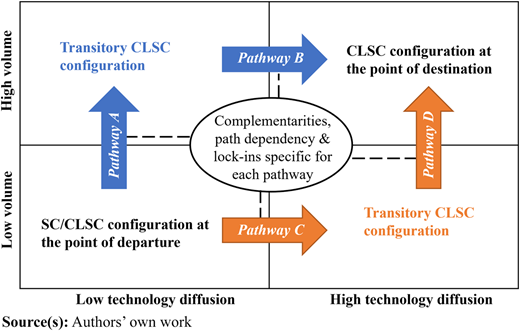
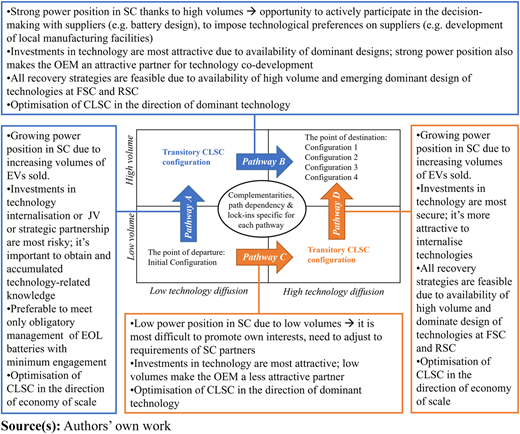
We turn the evolutionary space into the matrix depicted in Figure 3 to facilitate the application of the conceptual framework. While the evolutionary space aims to represent the continuous development of CLSC, the matrix considers a two-step transition process: the first pathway results in a transitory CLSC configuration, and the second pathway leads to the final CLSC configuration. Therefore, each trajectory is composed of two pathways and one transitory CLSC configuration. In particular, the market-driven trajectory is depicted by Pathways A and B and the technology-driven trajectory is represented by Pathways C and D.
While the technology and market dynamics steer the CLSC development (and mark its path on the evolutionary space), we employ the evolutionary concepts of complementarity, path dependency and lock-in to examine the choice of SC strategies and their alignment in adjustment to the changing external environment.
4. Methodology
4.1 Research approach
For answering the research questions, we choose the case study as a research design because of the complexity of CLSC evolution and the need for an in-depth understanding of strategic options and related uncertainties that contribute to SC development in the context of transition to the CE. This approach is argued to be beneficial for examining a multidimensional phenomenon in general (Dyer and Wilkins, 1991; Siggelkow, 2007; Yin, 2003), and for CLSC evolution in particular (Coenen et al., 2018).
We apply the proposed evolutionary framework to examine CLSC of LIBs development from the perspective of a heavy vehicle manufacturer (referred to as an original equipment manufacturer, or OEM, further in the text). This choice is driven by rapidly growing EV fleet (BloombergNEF, 2022; IEA, 2022), constantly evolving battery technology (e.g. Harlow et al., 2019), plethora of uncertainties surrounding technical feasibility, economic viability and environmental impact of LIBs recovery processes (e.g. Bobba et al., 2019). In this context, many industrial actors are trying to (re)define and strengthen their positions in both FSC and RSC of LIBs in order to secure the strategic access to LIBs through CLSC development (e.g. Umicore, 2021; Volvo Car Group, 2021). Therefore, this empirical context offers an opportunity to explore possible evolutionary trajectories of CLSC of LIBs.
The choice of company is motivated by the fact that it has been among the frontier companies in contributing to the development of electrified and autonomous transportation in the electric heavy vehicle manufacturing industry since 2008. The company owns several distinct brands targeting a variety of customers and segments, offering trucks, buses, construction equipment and power solutions for marine and industrial applications with electric drive systems. Its presence in the global market is reflected by its approx. 100,000 employees, production facilities located in 18 countries, 190 markets and worldwide service networks and dealerships. The main mission of the company is accelerating the sustainability transformation towards 100% fossil-free transportation by 2050. Moreover, during the study, the company was in the process of identifying strategic and operational options for developing CLSC for batteries in its entire product portfolio of EVs.
4.2 Data collection
The data collection process was built upon continuous interactions with the company during two years of research. Similar to most qualitative case studies, multiple sources of empirical data were used to reach triangulation (Yin, 2003; Jack and Raturi, 2006). We collected data via various methods, including observations, taking notes, semi-structured interviewing and participating in the company's strategic meetings. Overall, we conducted 30 interviews with managers at the Logistics and Operation Department, Purchasing Department and E-mobility group and three round table meetings with the representative managers of the involved departments. Additionally, we had access to company reports and confidential documents, including 50 pages of company forecasting reports, suppliers' information, logistics network (reported in Table 1).
The semi-structured interview protocol was designed to investigate the development of all CLSC processes as well as their interdependencies. In particular, the following topics were discussed: currently implemented strategies for managing EOL batteries (the point of departure), preferable strategic options per CLSC process and related challenges and requirements considering two horizons (the long-term and the transition period in short/medium term) and different trends of the business environment (market and technology dynamics). These types of information were considered the building blocks for the development of CLSC configurations. We collected data from managers of different units within the company to understand the concerns, interests and priorities of various SC functions. Three round table meetings served to obtain feedback on the initial synthesis of data collected from the interviews and verify correct understanding of the researchers about the OEM's strategic options, challenges and requirements under different time horizons and conditions of the external environment. Furthermore, these strategic meetings were crucial to determining alternative long-term CLSC configurations and discussing the evolutionary paths. Two researchers participated in the interviews and roundtables and took notes. Upon permission, interviews and roundtables were recorded.
4.3 Data analysis
The data analysis followed deductive thematic analysis (Braun and Clarke, 2006; Tate et al., 2010). The developed evolutionary analytical framework helped us to determine the steps and dimensions of the analysis.
First, the notes and recordings of interviews and roundtables were coded manually by two researchers independently and then discussed together. Following the core themes of the interview protocol, the collected data was coded into: (1) the OEM's preferable strategic options; (2) related challenges, and; (3) requirements for CLSC development. These themes were then classified against CLSC processes; two-time horizons (transitional period and long-term); and market (volume)-dependent or technology-dependent (see Table 2 in Findings and Tables A1-A4 in Appendix).
In the second step of the analysis, the initial SC configuration (the point of departure) and four long-term CLSC configurations (the point of destination) were determined. The latter ones were developed based on (1) the identified strategic options, challenges and requirements, (2) the OEM's feedback and preferences for CLSC set-ups and (3) the intention to reflect the gradual increase of CLSC complexity when expanding the involvement of the OEM in CLSC. The CLSC configurations presented in Section 5 are the result of researchers' direct interaction with the managers of the company; they reflect the expectations and preferences of the company's management but not necessarily all the feasible alternatives.
In the third step of the analysis, we examined the evolutionary paths of the long-term CLSC configurations employing the developed analytical framework. Initially, we determined the key characteristics of each pathway considering the changing external environment (market and technology dynamics) and its impact on the OEM's strategic options. Then, we identified transitory CLSC configuration(s) for each trajectory based on the characteristics of the initial pathway (A and C in Figure 3) and by ensuring structural flexibility to achieve the desired long-term CLSC configuration during the final pathway (B and D in Figure 3).
Finally, in the fourth step of the analysis, we identified complementarities, path dependency and lock-ins for each pathway under a specific configuration. The complementarities were identified by examining interdependencies and synergies between the requirements of each CLSC configuration. The propensity for path dependency and lock-ins was examined through the analysis of the possibility for the OEM to shift from transitory configurations to the final configurations, given the constraints imposed by strategic choices in the initial pathways on the strategic choices in the final pathways.
5. Findings
5.1 Heavy vehicle manufacturer embarking on the transition towards CLSC for EV batteries
Following the tradition of the aftermarket business of ICE vehicle components (e.g. remanufacturing of engines), the OEM intends to explore opportunities for the aftermarket business of LIBs, the core EV component. While management of EOL batteries is imposed by legislation (European Commission, 2006), the OEM believes that recovery of the embedded value of EOL batteries is imperative for retaining the competitive advantage in the e-mobility industry.
So far, the OEM does not have any direct and strategic engagement in CLSC of LIBs. At FSC, the OEM purchases complete battery packs from suppliers in Europe, who assemble cells and modules acquired from Asian suppliers. The suppliers own and control key battery technologies (e.g. cell chemistry, battery pack structure, battery health diagnostic) indispensable for performing recovery activities, and are reluctant to share this information. At RSC, the OEM is contractually obliged to return LIBs to battery pack suppliers who organize LIB recycling and ensure compliance with legislative obligations. The suppliers handle the selection and management of recyclers and reverse logistics service providers. Furthermore, the OEM has very limited bargaining power in both FSC and RSC due to low volumes of sold EVs and returned LIBs together with the lack of distinctive know-how on battery technology.
Regardless of these stringent conditions, the OEM aspires to increase its control over the embedded value of returned batteries and integrate remanufacturing, refurbishment and repurposing activities in CLSC. The OEM distinguishes the first two processes in the following way: remanufacturing is the process of replacing all battery modules/cells inside the battery pack with new modules/cells (remanufactured batteries are as good as new ones and include warranty); refurbishment is the process of replacing only a few (two-three) modules that have lower capacity and reusing the rest of components inside a battery pack (refurbished batteries have lower performance compared to new/remanufactured ones). Considering uncertain market and technology dynamics, the OEM has started to evaluate multiple strategic options, along with the associated challenges and requirements, for each CLSC process.
5.2 Strategic positioning along CLSC for EV batteries
The obtained results are organized in three tables that report strategic positioning options for each CLSC process (Table 2), and associated challenges and requirements (Tables A1-A4 in Appendix) considering particularities of transitional and long-term periods. Following the evolutionary framework, the long-term period is characterized by mature markets and the presence of dominant technologies and the transitional period has a multifaceted nature (a combination of different stages of maturity of market and technologies). For simplicity, the tables indicate information considering the earlier stage of the transitional period, when the volume of returned batteries is low and technology diffusion is low.
The strategic options for the transitional period are driven by two principal objectives: first, ensuring the cost-effectiveness of the product recovery system in the context of uncertain market and technology developments, and second, supporting the implementation of long-term options that reflect the OEM's desired level(s) of integration in different CLSC processes. As it is possible to see in Table 2, only a few strategies in the transitional period exclusively target the first objective and are suitable for a limited timeframe. A major part of the strategies in the transitional period aims to address the second objective. This indicates the importance of a planned preparation and stepwise deployment of CLSC processes during the transitional period. Below we provide further details on the OEM's strategic positioning in each CLSC process of these two periods.
Battery purchasing and production – In the long-term, the OEM aspires to operate a local (the EU) battery supply chain to reduce logistics costs and secure accessibility to battery components and materials for recovery processes. This requires the OEM to engage in the establishment of battery production facilities in the EU during the transitional period. While initially, the OEM intends to adapt ICE vehicle architecture to new battery components (to reduce risks related to high uncertainties of market and technology evolution); in the future, the OEM envisions the introduction of a new EV architecture for the entire product portfolio (enabled by standardized battery design). Furthermore, the feasibility (efficiency and effectiveness) of recovery operations is determined by battery design characteristics. This invites the OEM to codevelop batteries with suppliers in the transitional period and, in the long term, to internalize battery pack production and to develop Battery Management System (BMS).
Return of EOL batteries – During the transitional period, the OEM intends to evaluate different contractual agreements with customers and suppliers (return battery contract, service contract and warranty contract) reflecting on battery ownership, modes of battery use and state of returned batteries. In the long term, the OEM aims to improve the competitiveness of the battery aftermarket business by offering leasing schemes and providing a variety of battery replacement options (new, refurbished or remanufactured batteries) aligning battery and EV lifecycles. The availability of a high volume of returned batteries and accumulated knowledge about battery behavior would support the development of cost-effective contractual agreements.
Health diagnostics – In the long-term, the OEM intends to internalize the health diagnostic (HD) process that allows for identifying the appropriate recovery route for returned batteries (recovery option and transportation mode). In the transitional period, the OEM aims to acquire relevant knowledge, skills and equipment. The first step is to train the personnel to conduct the initial visual battery examination and classify them into defective, severely damaged, or suitable for recovery. Meanwhile, the health diagnostics can be performed by either a battery pack supplier (e.g. during the warranty period) or a recycler (upon a contract with a battery supplier), or outsourced to third parties.
Remanufacturing/Refurbishment–The OEM considers these battery life extension processes as the main business areas in e-mobility aftermarket service. Therefore, the OEM intends to internalize them in the long term. This requires acquisition of knowledge, capabilities, technologies and establishment of related infrastructure during the transitional period. Meanwhile, outsourcing of remanufacturing (RM) and refurbishment (RF) to third parties could serve as the main means to learn about them.
Repurposing–During the transitional period, when battery return volumes are low, the OEM intends to develop pilot projects to examine the economic and technical feasibility of this recovery strategy. While exploring repurposing (RP) potential, the OEM also considers the possibility to sell returned batteries (without any intervention) to either recyclers or remanufacturing companies. In the long term, the OEM is interested in internalizing this recovery strategy.
Recycling–In the long-term, the OEM considers multiple ways of engagement in recycling (RC) considering the role of RC in the battery EOL management (dominant or supporting recovery strategy) and ownership of recovered materials (owned by recycler(s) or the OEM). In the transitional period, the OEM targets establishing cost-effective contracts with recyclers. An alternative strategy would be “wait and see” while storing the returned batteries (already adopted by some competitors). This option would allow postponing the development of the recovery network until the volume of EOL batteries becomes sufficiently high for efficient operations.
Reverse logistics–While in the transitional period, the OEM considers (partially) using the existing reverse logistics (RL) channels (established for conventional components) for returned batteries; in the long term, the RL is expected to be significantly expanded to allocate new facilities and geographical markets. Obtaining full control of RL management is crucial for the OEM in the long term. Therefore, the OEM aims to develop the internal management system and foster higher visibility, while transportation and warehousing can be fully outsourced in the transitional period.
While the OEM's engagement varies across different CLSC processes, it is possible to notice that the company ambitiously aims to gain the leading role in CLSC development and obtain control of product and/or material flows. Given the still uncertain technology and market development roadmaps, the OEM considers different engagements in forward and reverse processes. Therefore, it is important to ensure the compatibility of strategic options for developing CLSC configuration (see the right part of Table 2).
5.3 Alternative CLSC configurations for batteries in heavy EVs
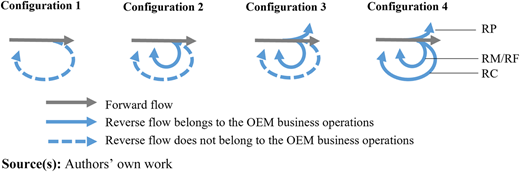
Figure 4 depicts four alternative long-term CLSC configurations that were determined through the analysis of the strategic options, requirements and challenges for each CLSC process (see Table 2 and Tables A1-A4 in Appendix) and the result of round table discussions with the case company.
In Configuration 1 the OEM's long-term strategic interests include obtaining cost-effectiveness of battery production and recovery by fostering standardization of battery technology and battery pack design; adopting a platform architecture approach for EVs; developing local SC; internalizing battery HD; achieving cost-effective RC; and obtaining high quantity and quality of recycled materials. The OEM's engagement in FSC of LIBs is limited to purchasing of complete battery packs from battery suppliers with collaborative development of battery design. In the RSC, RC is the only EOL management strategy aimed to comply with legislative obligations for EOL battery treatment via contractual agreements with battery suppliers (individual EPR schemes). Alternatively, a triangle strategic alliance with battery suppliers and recyclers is also possible. However, in this configuration the OEM does not own recycled materials; it acts as an enabler for closing the loop of battery materials between battery suppliers and recyclers. The RL network is limited to the transportation of returned batteries to recyclers or back to suppliers for warranty issues. The OEM performs EOL battery collection (at dealerships) and HD. The latter helps to increase transparency in battery warranty management and to support RC. Key challenges associated with this configuration are: resistance from suppliers to transfer knowledge and expertise on battery technology (battery structure, performance); uncertainties on the battery technology roadmap; and uncertainty of RC technology development.
In Configuration 2 the OEM's long-term strategic interests include those mentioned in Configuration 1. In addition, enabling the compatibility of battery design with RM/RF operations, minimizing the cost of RC (as it is no longer prioritized as a recovery route) and developing BMS become primary strategic actions as well. The OEM's engagement in FSC repeats Configuration 1 with stronger long-term partnerships with battery pack producers and more active participation in battery design. As for RSC, the OEM performs RM and RF, which become preferential destinations for EOL batteries; only damaged batteries are sent to RC. In comparison to Configuration 1, RL network extends to include transportation of returned batteries to RM/RF facilities and delivery of recovered batteries to dealership points. In Configuration 2, HD becomes crucial for analyzing the remaining value in EOL batteries for life-extending activities. Key challenges associated with Configuration 2 are the resistance from battery pack suppliers to transfer technological and operational knowledge (battery assembling process); uncertain demand for returned battery replacement options (new, remanufactured, or refurbished batteries); uncertainties on the battery technology roadmap; uncertainty about the future price of new batteries and its implications for the economic viability of the recovery options; and higher complexity of RL network due to multiple recovery options.
In Configuration 3 the additional OEM's long-term strategic interests are internalizing the design and production of battery packs (assembling of the service box, battery modules and development of BMS software and hardware) and enabling the compatibility of battery design with the first and the second life applications. In FSC, the OEM purchases battery modules and performs the assembly of battery packs internally. In RSC, the OEM performs RM, RF and RP, while RC remains a recovery route only for damaged batteries. In comparison to Configuration 2, RL network further extends to deliver RP batteries to the market. Key challenges associated with Configuration 3 are similar to those of Configuration 2. In addition, the OEM may face resistance from battery module suppliers regarding internal battery pack assembly.
In Configuration 4 the OEM's long-term strategic interests include those mentioned in Configuration 3, except the role of RC. It is important for the OEM to actively engage in RC process through the establishment of new joint ventures or partnerships with recyclers and battery suppliers to secure ownership of secondary materials and co-develop battery technology and design. Both FSC and RSC structures remain similar to Configuration 3. Key additional challenges associated with Configuration 4 are: loss of critical materials such as cobalt during RC process; need to obtain primary materials in addition to recycled materials; uncertain competitive environment and customer demands.
The following section discusses possible evolutionary trajectories for the development of alternative CLSC configurations departing from the Initial Configuration described in Section 5.1.
6. Discussion
6.1 The evolutionary paths of alternative CLSC configurations
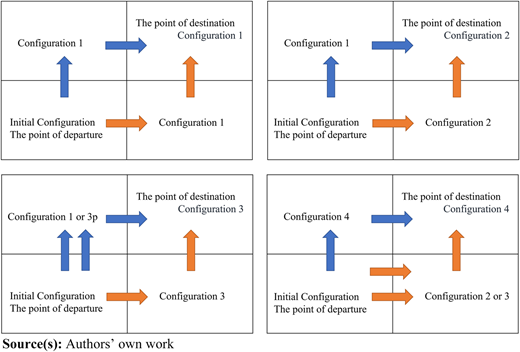
Following the evolutionary matrix (Figure 3) we determined key attributes of four distinct pathways (see Figure 5) and identified transitory CLSC configurations (see Figure 6). Together, they frame CLSC trajectories, as detailed in the following.
Pathway A is driven by an anticipated increase in the volume of EOL batteries with the concurrent presence of several technology variants. In case the OEM targets development of Configuration 1, 2, or 3 in long-term, Pathway A leans towards the Initial Configuration (a simplified version of Configuration 1), which requires limited involvement of the OEM in FSC and RSC. This choice is motivated by the high variety of battery technologies, with an unclear technology roadmap and immature recovery technologies. Under this condition, it is more beneficial for the OEM to postpone its active engagement in recovery activities. Market development during Pathway A allows the OEM to leverage economy of scale to achieve the cost efficiency of RC. Then, Pathway B offers the most beneficial conditions for developing the desired long-term CLSC configuration thanks to high volumes of EOL batteries and a clear(er) battery and recovery technology roadmap. In the pursuit of Configuration 1, the OEM can optimize transitory Configuration 1 in the direction of dominant technologies via better relations or contractual agreements (or alliances) with battery suppliers and recyclers.
Pathway A leads to different transitory configurations under development of Configuration 3 or 4 since they require the establishment of multiple recovery strategies and a higher level of involvement in FSC and RSC. In the pursuit of Configuration 3, availability of increasing volume of returned batteries allows implementation of RP, thus deploying Configuration 3 only partially (transitory Configuration 3p). RP deployment does not require the OEM to change FSC structure and to develop technological and operational compatibility at FSC and RSC while the technology has not yet reached maturity.
Similarly, in the pursuit of Configuration 4, the OEM would benefit from the earliest engagement in the co-development of battery and recovery technologies, thus actively fostering the dominant technologies and acquiring the technological competitive advantage. This means the OEM needs to shift to Configuration 4 as soon as possible leveraging the growing volume in Pathway A, which allows deployment of multiple recovery routs for EOL batteries. Later, during Pathway B, the OEM can optimize the transient CLSC configuration in the direction of dominant technologies. A similar strategy is currently implemented by Tesla and Panasonic (Ludlow et al., 2022) and Volvo and Northvolt (Northvolt, 2022). It is worth noting that this strategy is more difficult since it requires higher investments and integration of battery technology as the core part of the OEM's business.
The choice of transitory configurations is completely different for the lower trajectory (Pathways C and D). Pathway C envisions the emergence of dominant battery and recovery technologies, which fosters the deployment of recovery strategies. Therefore, along this pathway, it is possible to shift from the Initial Configuration to a preferable long-term CLSC configuration even before the increase in volumes of return batteries. The only difference between long-term and transitory configuration is the limited operational capacity of the latter due to still low volume of returned batteries. The conditions of Pathway C provide additional technological implications for the OEM: the emergence of dominant technologies at FSC (e.g. dominant design of the battery pack and BMS) would make it easier for the OEM to engage in the co-development of the battery technologies with suppliers, internalization of battery pack production, and in implementation of RM, RF and RP processes. However, outsourcing recovery processes might be preferable due to low volume of returned batteries and high investments required. Furthermore, low volume of returned batteries enables relative flexibility of the transitory CLSC for modifications driven by technology development in this pathway and by market growth during Pathway D, when the OEM can invest in operational capacity expansion and optimizing the transitory CLSC leveraging the economy of scale.
Pathway C leads to different transitory configurations under the development of Configuration 4 because the small volume of EOL batteries makes it challenging to deploy all four recovery strategies. Thus, the preferable choice could be shifting to transitory Configuration 2 (or 3) first, and developing the other remaining recovery strategies during Pathway D.
Therefore, the proposed evolutionary framework and the simplified matrix foster the analysis of multiple possible realities (alternative long-term CLSC configurations with at least two trajectories to reach each configuration) and capture CLSC evolution at different levels (network structure, relations, capabilities, etc.) through transitory configurations. In particular, we determined ten trajectories with ten transitory CLSC configurations for four alternative long-term configurations of CLSC for LIBs.
So far, the literature has supported decision-makers regarding CLSC development mainly through lists of core decisions/processes and optimization or system dynamic modeling. The former approach indicates CLSC aspects critical for the strategic analysis (e.g. Hazen et al., 2020; Nuss et al., 2015; Amir et al., 2022). Similarly, the developed framework and matrix build on strategic options, requirements and challenges of each CLSC process as elementary data inputs. However, they are considered as constantly evolving interdependent entities and are examined in their dynamic interplay. The proposed framework and matrix foster the shift from the static analysis of different CLSC elements (processes, relations, etc.) to their dynamic analysis. In general, the mathematical modeling approaches documented in the literature share this perspective. However, models tend to address only certain aspects or states of CLSC, such as optimization of specific operational and/tactical decisions (e.g. facility location and capacity optimization) against economic performance (e.g. Chhetri et al., 2022) or examining changes of specific processes over time (e.g. cost of remanufacturing) (e.g. Alamerew and Brissaud, 2020). Therefore, they can accompany the proposed framework and matrix (strategy-setting tools) for in-depth examination of strategic decisions.
6.2 Complementarities, path dependence and lock-ins in CLSC trajectories
After the definition of alternative trajectories of CLSC evolution, the proposed framework suggests examining them through the lens of evolutionary concepts of complementarity, path dependency and lock-in.
Complementarities reflect co-evolutions and dependencies of different parts of CLSC. They refer to interdependencies and synergistic relations between and across CLSC processes that mutually stimulate development of each other. The examination of requirements for CLSC processes and configurations (see Tables A1-A4 in Appendix) allows distinguishing four groups of complementarities. They are as follows: (1) relational dependencies among the OEM and other actors in FSC and RSC; (2) technologies that are essential for the development of battery components and their recovery processes; (3) product development and manufacturing processes; and (4) infrastructure development. Among these four groups, relational complementarities appear to be essential for obtaining the rest. Transferring technological knowledge, co-development of battery design and recovery technologies and development of collaborations are impossible without establishing sound relationships between the OEM and its CLSC partners. This suggests that complementarities across different groups are not independent.
The emergence and nature of these complementarities are different depending on the degree of involvement of the OEM in FSC and RSC in different CLSC configurations, and on the evolution of the business landscape (market and technology trends). Table 3 highlights key complementarities related to each pathway under each specific CLSC configuration. The findings indicate that more complex CLSC configurations require more complementarities within the same group and across all groups. Then, it is notable that the more the OEM aims to engage in RSC, the more involvement in FSC is required. This is evident across all four groups of complementarities. For example, while the OEM's engagement in life-extension recovery strategies in RSC requires gaining the capability to produce battery packs in FSC, the OEM's engagement in recycling in RSC would require internalization of battery cells and module production (in addition to battery pack production).
In the context of evolving external environment, complementarities have different nature for market-driven and technology-driven trajectories. For example, considering relational complementarities, in Pathways A and B the relationships with suppliers serve mostly to reduce technology-related risks through knowledge acquisition. However, the acceleration of battery technology development in the opposite trajectory (Pathways C and D) pushes toward transactional relationships for technology acquisition. Furthermore, the findings suggest that it is more critical to ensure the presence of complementarities for the initial pathways (A and C) because they are subject to a higher level of uncertainty. However, decisions under multiple uncertainties increase the chance of developing complementarities that might create negative inertia in CLSC development.
Indeed, the OEM's strategic decision of pursuing one pathway over the other results in path dependencies and lock-ins that are associated with different technological roadmaps, production processes, infrastructure (e.g. number and size of facilities), as well as intra- and inter-organizational relationships. The sequence of choices along the pathway creates irreversible or costly reversible investments and operations. As presented in Table 3, the nature of path dependencies and lock-ins is influenced by the conditions of each pathway (see Figure 5). For example, in Pathway A, RSC is largely optimized to accommodate increasing volumes of returned batteries for recycling. Therefore, the introduction of other recovery processes and routes at a later stage (Pathway B) under high volumes of batteries is expected to be costly and challenging because of the lock-in the initial network structure. In addition, the postponement of battery recovery (“wait and see” strategy) in Pathway A may lock the OEM in a weaker position in the CLSC compared to technology leaders. Consequently, in Pathway B, the OEM might not be able to acquire technologies due to its dependency on the technology providers (e.g. suppliers), and thus will follow the technological path that other actors will create when the technologies are matured.
It is worth noting that the nature of path dependencies and lock-ins is different for the technology-driven trajectory (Pathway C). In this case, the technology landscape is less uncertain, and it is possible to see which technology is driving the dominant design, but the future demand is unclear. Thus, if the OEM aims for an early optimization of RSC in the direction of dominant technology, it may lead to the lock-in less cost-effective networks. This means that the OEM may choose the right technology but not the best technology provider. Therefore, the long-term agreement with battery suppliers and recovery service providers may lead to lock-in suppliers' abilities to scale up operations. In this situation, the OEM faces the dilemma of whether it is better to shift to another technology provider (battery supplier) or to directly invest in battery production. However, in either option, the OEM might not be able to provide service to customers in the short term due to its inability to scale up sufficiently fast, thus remaining locked in a lower power position in the market.
Overall, by looking at the set of lock-ins across the pathways, it is possible to see the dilemmas of early and late adaptation to technological changes. Since the OEM's involvement and investment in the recovery processes are present in all pathways, these dilemmas are inevitable, and it is important to acknowledge the evolutionary factors that cause them: the uneven change in the rate of technology diffusion and market development, which together lead to the uneven development of complementarities. To conclude, through the proposed evolutionary framework, we demonstrate that regardless of the chosen trajectory, the OEM needs to manage path dependencies and potential lock-ins during the transitional period. Furthermore, the transition to a preferable long-term CLSC configuration may only occur when essential complementarities are in place. Together, these evolutionary concepts allow comparing trajectories in terms of efforts required to develop alternative long-term CLSC configurations.
Compared to the lists of barriers and drivers (e.g. Bressanelli et al., 2019; Roy et al., 2022) resources and capabilities (e.g. Ritola et al., 2021; Seles et al., 2022), challenges and uncertainties (e.g. Marcos et al., 2021; Rajaeifar et al., 2022), that give a rather static overview of the internal and external environments, complementarities and path dependency concepts highlight the dynamic interplay of influencing external forces and SC elements (e.g. processes, resources, relations). The analysis of complementarities, path dependencies and lock-in offers guidance in short-term SC strategic decisions, ensuring their alignment and contribution to the desired long-term CLSC configuration.
7. Conclusion
By taking an evolutionary approach, this paper attempted to frame SC dilemmas associated with the industrial transition to the CE. It constitutes an initial inquiry into the fundamental transitional question of how a company can navigate the expansion of traditional FSC toward CLSC in the context of evolving business environment. We proposed the evolutionary analytical framework that can assist with identification, analysis and comparison of possible evolutionary paths for the transition to the desired long-term CLSC configuration. The novelty of the framework lies in the integration of concepts from innovation and evolutionary theories coming from ID and SCM literature streams.
This approach offers a more comprehensive analysis of the complexity (dynamism and uncertainties) of SC evolution. Furthermore, the proposed framework and matrix provide the strategic and systemic perspective on CLSC development (in alignment with CLSC orientation indicated by Defee et al. (2009)) and stress the continuity of the evolution process. This study answers Coenen et al. (2018)'s call for a conceptual framework for understanding and guiding the evolutionary process of CLSC development.
Through the empirical case, we demonstrate that the proposed framework can help decision makers to navigate through the SC transition process by taking into account interdependencies and synergistic relations between and across SC elements (processes, relationships, resources, etc.) and envision possible negative inertia of strategic choices during the transition process. Furthermore, the framework can assist the policymakers to better understand the impact of governmental interventions (e.g. innovation reinforcing policy, fostering low emission mobility) on the industrial dynamics in the context of transition to the CE.
The limitations of the study refer to the applicability of the developed evolutionary framework and the generalizability of case study results. Considering the composition of the framework, it is applicable for the examination of SC development in the context of market and technology development (emerging technologies, product innovations and volume growth of new and EOL products) and related uncertainties. These conditions are especially relevant for transitioning from traditional linear SC to CLSC. Then, the proposed framework guides the development of SC evolution paths from the perspective of a single actor; and it does not explicitly consider the impact of strategic choices of other industrial actors. As it was demonstrated through the empirical case study, the OEM's strategic options were framed around predictable strategies of other SC actors for different time horizons, and therefore, they are subject to the OEM's understanding of constraints or opportunities imposed by the network. Another type of limitation refers to the results of the conducted case study. Application of the framework in the empirical context provides rich results, however, they are not generalizable to other automotive OEMs or other industries. The case study serves to demonstrate the potential of the framework.
Further research is required to explore applications of the proposed framework from a multi-agent perspective (e.g. application of the framework from a dyad perspective or comparison of framework's applications for different actors in the same SC) and different industrial contexts (with different market and technology dynamics). In addition, future studies can expand the evolutionary framework through other factors that can help characterize SC dynamism.