


Due to its fast growth, cross-border e-commerce (CBEC) is becoming a popular internationalization model, especially in those destination markets with impressive e-commerce development like China. However, CBEC also brings new logistics challenges and uncertainty. This paper aims to understand how companies cope with logistics uncertainty in this field and whether the different types of uncertainty influence the risk management strategies adopted to face them.
A survey targeting online exporters to China and third-party forwarding logistics service providers (3PFLs) is conducted. A structural equation model (SEM) analysis is performed to test the possible relationship between the adopted risk management strategies and the types of uncertainty. The type, industry and size of the company, as well as the distance between the company's home country and China, are used as control variables in the study. Survey results are enriched via interviews with some of the respondents.
The risk management strategies adopted are dependent on the type of logistics uncertainty that the companies face and, to a minor extent, on the industry the company operates in. Conversely, no significant influence is exerted by other types of control factors, i.e. home country, company size or company type.
The paper investigates logistics uncertainty and risk management approaches in the novel context of CBEC. A systematic review of relevant sources of uncertainty is offered to help both scholars and practitioners understand the current complexities of CBEC. From a theoretical perspective, the paper models the investigated concepts in light of the contingency approach. From a practical perspective, results can be of interest since the list of proposed items can support risk identification and evaluation while the interviews with managers can provide insights on risk management practices.
Introduction
Cross-border e-commerce (CBEC) is one of the most rapidly evolving phenomena of the past few years (Cho and Lee, 2017). Today, it represents an important expansion opportunity because it allows companies to sell online abroad with no need of a foreign legal entity (Ballering, 2017; Hsiao et al., 2017; Giuffrida et al., 2017). Several authors in both the academic and managerial environments have declared that CBEC is becoming a necessity for companies to boost international growth (Hsiao et al., 2017; Accenture and AliResearch, 2015; Elia et al., 2019). The importance of this trade mode has become even more evident in light of the coronavirus pandemic, which has accelerated the shift toward online transactions all over the world. Not only large e-commerce players, such as Alibaba, Amazon, JD.com, are investing in CBEC but also traditional retailers, governments or private equity funds are entering this business (Cheng, 2021). However, managing CBEC is not easy, since it entails several barriers, including cultural differences, regulatory matters, compatibility between online payment systems and, most importantly, logistics (Gessner and Snodgrass, 2015; Gomez Herrera et al., 2014).
From a logistics perspective, the pressure on performances in terms, for instance, of fast deliveries, has indeed risen with CBEC development (Halim et al., 2016). However, addressing the needs for efficient deliveries in CBEC is challenging due to undependable and long transit times, complicated and vague return processes or possible bottlenecks at customs (Van Heel et al., 2011; Lun, 2017; Wang et al., 2020). All these challenges produce a high amount of uncertainty, which companies interested in CBEC need to cope with.
One of the main reasons why CBEC logistics is affected by uncertainty is the general lack of global standards and guidelines to manage cross-border transactions and face-related risks. This means that rules, practices and procedures may change from country to country and sometimes even within provinces of the same country, as in the case of China.
In fact, accounting for 40% of the global e-commerce value (Lee, 2017), China has largely encouraged CBEC development through favorable policies. Nonetheless, regulations have undergone frequent modifications and are often subject to controversial interpretations by local authorities, as China is full of unwritten rules and relies on the importance of trust and personal relationships also in business contexts (Huo et al., 2017; Giuffrida et al., 2019).
The World Customs Organization (WCO) has recognized the need for a systematic and harmonized legislation to cope with CBEC logistics vulnerabilities (World Customs Organization, 2018). However, with increasing global trade tensions (such as the ones between the USA and China), a true unified framework is far to be established.
All these elements considered, CBEC appears to be a rapidly evolving phenomenon where different sources could create uncertainty and complexity.
The current literature provides abundant research on e-commerce logistics or global logistics uncertainty, but very few contributions focus on both aspects simultaneously (i.e. on CBEC logistics). Furthermore, the papers actually focused on CBEC logistics, tend to analyze only one or a few risk factors, ignoring the multitude of different sources that can contribute to generate uncertainty (Qi et al., 2020; Shi et al., 2020).
In order to guide managers in better understanding the specific types of challenges characterizing CBEC logistics, this paper aims to explore the different sources of risk in this field and help determine what risk management approaches companies already active in CBEC are using to cope with such uncertainty. More precisely, this study aims at detecting the presence of a relationship between the different types of uncertainty that could be faced in CBEC logistics and the adoption of a specific risk management strategy. This aim is translated in the following research question (RQ):
Do different CBEC logistics uncertainty factors affect the risk management strategy used to face them?
The stated question implies the identification of a specific set of uncertainty sources in CBEC logistics and suitable risk management approaches that need to be correlated to check for the existence of a causal relationship.
In order to address the RQ, we conduct our analysis in China because, as anticipated, this country is the one where CBEC is most developed. The Chinese context is interesting to investigate also because different rules are set up for traditional trade and CBEC and previous studies (Giuffrida et al., 2019) demonstrate that facing the uncertainty of the evolving CBEC logistics scenario is one of the main challenges in China. However, the research on CBEC logistics uncertainty is scarce both in China and elsewhere.
A first examination of the major CBEC logistics challenges in China can be found in Jiao (2015), who provides an overview of CBEC logistics problems, identifying, for instance, tariff issues, complex returns management and high costs. However, his study is mainly descriptive. A second study on the topic is the one presented by Giuffrida et al. (2019), where the authors still suggest future research should investigate CBEC uncertainty. This study goes specifically in this direction.
The remainder of this paper is organized as follows. The next section presents a theoretical overview on CBEC logistics and a systematic review on related uncertainty types and risk management approaches. This section helps develop the conceptual framework of the paper. The third section describes the methodology applied in this study, including research sample, survey measures and interviews. The fourth section presents and discusses the main empirical results. The fifth section elucidates the contributions of the study, whilst the last section concludes.
Literature review and conceptual model
Uncertainty in cross-border e-commerce logistics and related risk management strategies
It is widely acknowledged in both literature and practice that internationalization is a risky business (Pezderka and Sinkovics, 2011; Scott, 2004). Most of the times, this is because companies need to estimate many variables, including market demand, exchange rates, future economic and political conditions of the new market (Atik, 2012). At the same time, information scarcity and high uncertainty make the prediction harder to perform. In current literature, supply chain and logistics risk management are highly debated fields and plenty of contributions exist on the identification of uncertainty factors linked to both national and global supply chains. A nonexhaustive list of contributions includes for instance Sanchez-Rodrigues et al. (2010), Sawhney and Sumukadas (2005), Vilko et al. (2014).
Several authors identify uncertainty in lead times, supplier reliability and long transit times as the biggest criticalities of global supply chains (e.g. Schmidt and Wilhelm, 2000; Speh and Wagenheim, 1978; Manuj and Mentzer, 2008a). Others point at exchange rate fluctuations, demand and market price variability and political instability (e.g. Vidal and Goetschalckx, 2000). Ultimately, most authors agree that global supply chains are complex, constantly evolving and face multiple uncertainties (Manuj and Mentzer, 2008a, 2008b).
These uncertainties are categorized by type and often consider mainly offline transactions.
Pezderka and Sinkovics (2011) are among the first to provide an initial framework to identify CBEC risk factors, although they do not specifically focus on logistics. A literature review on CBEC logistics in China indeed highlights there are many open research areas in this field (Giuffrida et al., 2017). However, CBEC is expected to account for an increasingly larger share of international trade (Wang et al., 2020). As this phenomenon, which is pervasive at multiple levels, takes over traditional internationalization modes, new challenges arise, especially in the logistics domain (Wang, 2017).
By looking at contributions analyzing specific uncertainties related to e-commerce logistics on a national level (i.e. not cross-border), we find that factors like on-time delivery, returns management and customer service accessibility are mentioned (e.g. Ramanathan, 2010; Ramanathan, 2011; Yan and Cao, 2017). If we extend the analysis to a cross-border e-commerce setting, additional complexities need to be considered, such as the need of tracking cross-border deliveries and managing customs clearance.
In response to these requirements, specialized CBEC logistics service providers are becoming particularly popular. These international third-party forwarding logistics service providers (3PFL) typically help companies by acting as intermediaries and collecting orders from different merchants. However, differently from traditional forwarders, CBEC ones need to face a highly unpredictable demand because orders arrive randomly. Efficiently serving each logistics region is therefore extremely complex, as planning, facility location and service capacity allocation problems are significant (Ren et al., 2020).
Given the novelty of the topic at hand, it is therefore useful to perform an organized classification of extant literature. By relying on the retrieved contributions, we conduct a systematic review of logistics uncertainties and find that different types of uncertainty factors may hinder the logistics management of CBEC operations. The systematic review is conducted by considering a set of relevant keywords (i.e. “cross-border” OR “global”, OR “international” AND “e-commerce” OR “online”, AND “logistics” OR “distribution”, or “fulfillment”, AND “risk” OR “uncertainty”). The keywords are inserted in Scopus, Google Scholar and Web of Science to retrieve relevant contributions. The findings from the database search are then enriched via a backward snowballing approach to capture any relevant contributions that may not be indexed in the selected databases (Giuffrida and Mangiaracina, 2020; Wohlin, 2014). We summarize the main outcome of the review on CBEC logistics uncertainty factors in Table 1 below, together with their definitions and some indications about proper risk management mitigation actions suggested by the literature.
Summary of literature findings on types of logistics uncertainty and related risk management approaches
| Type of uncertainty | Definition | Examples of possible negative effects stemming from the uncertainty source | Suggested risk management tools/actions | References |
|---|---|---|---|---|
| Delivery uncertainty | Uncertainty in transportation times and costs and in their control due to long geographical distances, unexpected events, delays, mistakes, tracking problems and lack of integration among different transport systems | High transportation costs, stops or inefficiencies at intermodal hubs, capacity problems | Cooperation with local or international logistics service providers; personal networking and use of tracking technologies | Kawa (2017), Kim et al. (2017), Li et al. (2020), Rahman et al. (2019), Ren et al. (2020) and Wang et al. (2020) |
| Customer service expectation uncertainty | Uncertainty related to the level of service perceived by the final customer, which colud be compromised by poor return management policies, inadequate customer support, lenghty order cycle time and low customization | High returns management costs or times, complaints or negative reviews | Cooperation with local or international logistics service providers; cooperation with e-commerce service providers or CBEC platforms and reengineering of internal processes to improve collaboration between marketing and operations department | Giuffrida et al. (2018), Giuffrida et al. (2019), Qiao et al. (2017), Ying and Dayong (2005), Fang (2017), Qi et al. (2020), Ren et al. (2020) and Wang et al. (2020) |
| Compliance uncertainty | Uncertainty about the compliance to local procedures and standards caused by misalignments, changing tariffs or lack of knowledge about quality requirements or necessary procedures | Incurring fines or restrictions, blocks or delays at customs clearance hubs | Reliance on external experts and legal consultants, hire of in-house compliance team, investment in process automation (e.g. for automated reporting, item classification and rate calculations) | Ballering (2017), Giuffrida et al. (2018), Giuffrida et al. (2019), Jia (2020), Li et al. (2020), Xu (2019) and Zhang et al. (2017) |
| External uncertainty | Uncertainty linked to the external environment, which can hardly be controlled by the company and caused by change in regulations, political or global macroeconomic factors, fraud or counterfeiting | Unfavorable currency exchange rates, restrictive regulations and higher costs | Use of insurance or hedging solutions, investment in cybersecurity measures and cooperation with legal advisors and experts | Giuffrida et al. (2019), Li et al. (2020), Wang et al. (2020), World Customs Organization (2018) and Xu (2019) |
| Inventory management uncertainty | Uncertainty in inventory planning caused by lack of, imprecise or not updated, information about the status of overseas warehouses, fluctuations in warehousing costs and labor costs in foreign markets and variation in the SKUs | High warehousing costs, high inventory management pressure in case SKUs change (e.g. some new are introduced for a test in the new market or others are removed because of negative profit margins) | Coopearation with logistics service providers, use of order management software, increased level of cooperation with procurement, demand management, sales and marketing departments | Gessner and Snodgrass (2015), Giuffrida et al. (2019), Huang et al. (2017), Kawa (2017), Shi et al. (2020), Jia (2020), Ren et al. (2020) and Wang et al. (2020) |
| Product or parcel damage | Uncertainty on the physical status of products, risks of causing damages to the product or altering its quality (e.g. for temperature sensitive goods) before it is delivered to the customer | Increased costs, waste generation, possible negative effects on customer experience or complaints (if the damage is not detected before final delivery) | Invest in monitoring and temperature preservation technology, insurance solutions and incentives for cautions behaviors of logistics operators | Giuffrida et al. (2019), Huang et al. (2017) and World Customs Organization (2018) |
| Demand uncertainty | Uncertainty in demand forecasting and management due to changing consumer preferences across countries or regions, local seasonality effects, uncertain effect of promotional campaigns and lack of historical data | Possible loss of market share and stock outs | Higher integration and cooperation among suppliers, manufacturers, distributors and customer, understand local preferences and demand gaps not served locally through consumer research or A/B testing | Giuffrida et al. (2019), Shi et al. (2020), Qi et al. (2020), Wang and Chen (2019) and Wang et al. (2020) |
Based on the above findings, at least seven different types of uncertainty can characterize CBEC logistics, whose features are described hereafter.
Delivery uncertainty: The delivery of physical goods is recognized as one of the main barriers to the free cross-border flow enabled by e-commerce, due to high costs and long times of shipment. Many factors can cause time and cost uncertainty in the delivery process, including unexpected events, delays, mistakes, tracking problems or lack of integration among different logistics service providers using separate transport systems. All these issues typically bring inefficiency to the company aiming to implement the CBEC initiative (Li et al., 2020; Ren et al., 2020; Wang et al., 2020). According to Kawa (2017), this problem can be reduced by introducing one or more intermediaries that consolidate shipments from multiple retailers and deliver to the clients located in different parts of the world. The consolidator, collecting orders from many vendors, increases its bargaining power with couriers and other logistics companies reaching cooperation conditions that would be hardly accessible to individual sellers. The consolidation model suggests that a cooperative approach might reduce delivery uncertainty. Similarly, Kim et al. (2017) suggest that cross-border e-commerce managers can reduce the timing effect of distance by offering reliable express delivery options to their customers through cooperation with express couriers. With specific reference to the Chinese context, Rahman et al. (2019) state that companies should build guanxi networks with key local partners and stakeholders in order to minimize cost of delivery and stay competitive.
Customer service expectation uncertainty: With the development of CBEC in China, the demand for logistics services and the expectations of high service levels is increasing rapidly (Qiao et al., 2017; Giuffrida et al., 2018). This brings a new type of uncertainty related to the actual expectations that foreign customers have about the service connected with the buying experience (Qi et al., 2020; Wang et al., 2020; Ren et al., 2020). The main problem in this context is that not all customers expect the same type of service. The requirements are higher as the value or the customization needs of the product increase. Therefore, exporting companies are required to provide multiple levels of service of different complexity. In order to provide such a comprehensive system of services, companies must work both internally, developing independent innovation, and externally by enhancing cooperation along the supply chain and integrating resources with their providers (Qiao et al., 2017). Ying and Dayong (2005) provide similar considerations, suggesting that, in an e-commerce environment, logistics service needs can be adequately satisfied thanks to a frequent reengineering of internal logistics processes, but also by developing and improving relationships with logistics service providers. Also the cooperation with e-commerce platforms is key to improve the overall service perceived by customers (Fang, 2017). The risks of disappointing customers can have negative effects, both tangible, e.g. returns management costs, and intangible, e.g. image damage, complaints (Giuffrida et al., 2019).
Compliance uncertainty: One of the most complex issues for companies conducting CBEC initiatives to China is being compliant with regulations (Giuffrida et al., 2018). The challenge is related to the fact that the set-up of a clear CBEC regulation has been discussed for months, but precise rules have not come into force yet or change frequently. Indeed, each CBEC pilot zone typically has specific procedures and protocols that change regionally and are hardly understandable without the help of a local partner (Ballering, 2017; Xu, 2019). In such a context, the risks of incurring in fines, restrictions or delays at customs clearance hubs are particularly high (Giuffrida et al., 2019; Li et al., 2020; Zhang et al., 2017). Therefore, as the uncertainty related to the application and compliance to external rules increases, collaborative practices should be in place. At the same time, stricter internal control on product quality is preferred to reduce the risk of getting fines or shipping products that do not meet the required standards. Also investing in process automation (e.g. for automated reporting, items classification, rate calculations) is typically suggested (Jia, 2020).
External uncertainty: CBEC is also affected by the traditional risks of (global) trade, which are typically not under the control of the company, but dependent on external and often complex dynamics. These risks include exchange rate fluctuations, counterfeit and fraud, regulations change (Giuffrida et al., 2019; World Customs Organization, 2018; Xu, 2019) and can cause an unpredictable increase in costs (Li et al., 2020). These types of risks can rarely be avoided but typically mitigated, respectively, via hedging techniques, investment in cybersecurity measures and cooperation with legal advisors and experts (Wang et al., 2020).
Inventory management uncertainty: With the advent of CBEC, online sellers need to have their products available to sell and deliver to customers quickly. This creates some challenging inventory management-related problems, such as uncertainty in inventory planning due to lack of information about the status of overseas warehouses, or fluctuations in labor and warehousing costs (Huang et al., 2017; Ren et al., 2020; Shi et al., 2020). The complexity increases with the number of channels simultaneously operated by the exporting company (Gessner and Snodgrass, 2015). The high number of small parcels to manage, furthermore, typically increases handling and sorting costs. Also in this case, the literature suggests that an increased level of cooperation with logistics service providers and a consolidation of orders can help reduce the number of sorting and operations and solve the problem of the organization of international logistics (Kawa, 2017; Jia, 2020; Ren et al., 2020; Wang et al., 2020).
Product or parcel damage: Beyond typical inventory planning problems, the e-commerce context brings a higher level of uncertainty also to the physical status of the goods (Giuffrida et al., 2019; Huang et al., 2017). The online context is characterized by many little parcels traveling long distances. This increases their probability of being damaged, with respect to any other type of transaction. Product damages are problematic also because they decrease the customer satisfaction in case the damage occurs in the final last-mile delivery and is seen by the final user. In addition, it leads to higher return rates (World Customs Organization, 2018). While such occurrences can only be avoided via responsible and cautious behaviors by logistics operators, insurance solutions are typically helpful to mitigate the effects of product damage. Also investments in monitoring and temperature preservation technology and data analysis can help prevent damages in case of temperature-sensitive goods (Jia, 2020).
Demand uncertainty: Predicting e-commerce demand is very difficult, especially in a country like China with exponential growth rates in different types of cities. High uncertainty in this case is typically caused by changing consumer preferences across countries or regions, local seasonal effects or unknown effect of new promotional campaigns (Wang and Chen, 2019; Wang et al., 2020). Current literature suggests that generally a better integration among suppliers, manufacturers, distributors and customers is key to reduce demand uncertainty (e.g. Bayraktar et al., 2008). This is also true in the CBEC context. Single companies, even bigger ones, have generally little experience in CBEC to be able to improve their demand management and forecast abilities by working on their own without the support of partners. This is reinforced by the fact that the main gateway to access China is represented by large e-commerce marketplaces (e.g. Tmall or JD), who own precious data regarding consumers online behavior that would be fundamental for sellers to improve their commercial propositions and forecasting abilities.
As shown in Table 1, despite the variety of logistics uncertainty types, sometimes these different factors can interact and lead to a reinforcement of similar negative effects. Examples include stock out and possible loss of market share, which could be caused by both demand and inventory management uncertainty, or complaints, which could be caused, for instance, by both customer service deficiencies and physical product damages.
It is therefore important to identify clear actions for risk reduction and management. The consulted literature sources, as summarized in column four of Table 1, suggest different types of actions for each type of problem. All the mentioned actions, however, seem to resemble the risk management strategy classification framework proposed by Revilla and Saenz (2017), who identify four main supply chain risk management strategies, considering two dimensions and their combinations. The first dimension is the level of internal (i.e. limited to company boundaries) risk management actions implemented. Examples of internal risk management actions include the presence of risk management teams inside the company or the deployment of risk management guidelines and procedures. The second dimension is the level of interorganizational (i.e. involving other actors in the supply chain) risk management actions implemented. Adopting an interorganizational approach means that companies cooperate with suppliers, buyers or 3PFLs to manage their logistics risks more effectively.
By looking at the strategies suggested by authors in CBEC logistics in Table 1, e.g. cooperation with various types of service providers (Kawa, 2017; Qiao et al., 2017; Fang, 2017), building of internal resources or capabilities (Jia, 2020; Giuffrida et al., 2019), increase of collaboration among various departments (Wang and Chen, 2019; Wang et al., 2020), we detect a possible fit with the framework by Revilla and Saenz (2017). The combination of both the internal and the interorganizational dimensions discussed in this framework brings to the definition of four possible strategies, namely
Passive: the company has low levels of both internal and interorganizational risk management practices;
Internal: the company has high level of internal risk management practices and low level of interorganizational ones;
Collaborative: the company has low level of internal and high level of interorganizational risk management practices and
Integral: the company has high levels of both types of risk management practices.
Based on the similarities between the proposed framework by Revilla and Saenz and the findings from our literature review, we assume that the four types of strategies above presented can also adequately depict the type of strategic actions adopted in the CBEC logistics field. We will test the validity of such assumption through an empirical investigation based on a cluster analysis, which is going to be described in the methodology section.
Conceptual model
Summing up our discussion so far, we argue that, since CBEC is a very uncertain phenomenon, the risk management strategies that companies adopt to cope with its challenges depend on a variety of factors. Based on the literature review, we hypothesize that companies could face different types of logistics uncertainty, and this will in turn affect their response in terms of adopted risk management strategy.
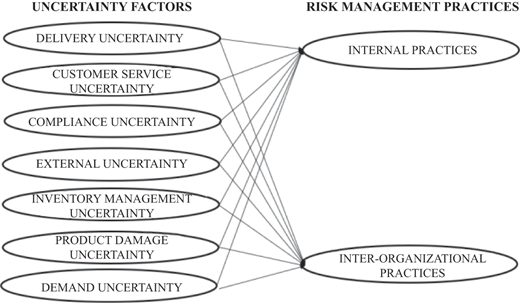
To test this relation is the main novelty of this research. We do so by applying a structural equation model (SEM) where the basic structures are represented by the uncertainty factors and the risk management approaches presented in the previous sections of the literature review. Figure 1 depicts our conceptual model.

Based on our RQ, we are interested in analyzing whether the risk management strategies used in a CBEC context are driven by specific uncertainty factors. As discussed in the literature about the various uncertainty factors, the suggested mitigation actions often vary based on the specific type of uncertainty being faced. Therefore, we propose to test our main hypothesis as follows.
The risk management strategies implemented by companies active in CBEC are associated with the types of identified uncertainty factors.
Methodology
Building the research framework: a contingency approach
The conceptual model proposed in Figure 1 that connects a series of uncertainty factors with a set of risk management approaches draws upon contingency theory, one of the most widespread among the contemporary management theories.
This theory has been applied to many fields, including risk management, operations and supply chain management, logistics and e-commerce (Huang et al., 2010; Ketokivi and Schroeder, 2004; Iyer et al., 2009; Grötsch et al., 2013). In its simplest formulation, contingency theory states that companies achieve the best performances when there is a good fit between their structure and the environmental conditions (Chen et al., 2011).
According to Venkatraman (1989), uncertainty is a key aspect for contingency theory as it influences the strategic responses of companies to mitigate its effect on performances.
In the context of CBEC logistics, the sources of uncertainties are multiple, but they might not be equally perceived or identified by companies due to possible contingency factors, and this can lead to different strategic approaches to uncertainty management.
A growing number of research studies in supply chain management literature use contingency theory to explore various relationships between the environment and company strategies and understand how firms adapt to the context they operate in (Chen et al., 2011). The applications are numerous and encompass several fields. For instance, Lai et al. (2014) adopt a contingency approach to examine the extended producer responsibility practices adopted by export-oriented manufacturers that need to comply with environmental regulatory requirements before their products can enter overseas countries.
More recently, Irfan et al. (2019) focus on the fashion industry and provide evidence of the contingent factors that influence supply chain agility and its impacts on companies' performance. By focusing on the automotive sector, instead, Liao et al. (2011) describe the conditions that determine companies' supply chain adaptations that are needed when they move from a domestic to a global supply chain.
Based on the mentioned studies, we build our conceptual model by incorporating the different types of uncertainty retrieved in the literature and by considering the possible moderation role of control variables that the literature suggests as possibly relevant to our research problem.
We have found that company size is used as a control variable, for instance, in Evangelista et al. (2012), Quintens et al. (2005) and Cagliano et al. (2008). Geographical distances are considered by Evangelista et al. (2012), Thorelli and Glowacka (1995) and Cagliano et al. (2008). Industry membership is analyzed in Kathuria (2000). Furthermore, we have found some authors (e.g. Cho et al., 2008) investigating the effect of the logistics outsourcing level or the collaboration with logistics service providers. Therefore, we select the following four variables as main control variables in the analysis:
industry,
company size,
distance between the home and destination country and
company type (exporter or logistics forwarding service provider).
The RQ is addressed by leveraging on survey data that were specifically collected for this research. The data were used to perform a SEM analysis aiming to test the validity of the model presented in Figure 1 and better conceptualized in Figure 2.
More precisely, the partial least squares approach was adopted using the Smart PLS 3.0 software, which is adequate for exploratory studies. Our approach is exploratory because we only assume the presence of a causal relationship between different types of risks and strategic responses. As part of the SEM protocol, we conducted confirmatory factor analyses (CFAs) on the uncertainty factors and the risk management approaches. Moreover, we performed a cluster analyses to find empirical evidence about the adopted risk management strategies. This step is important so that we can test whether the findings from the literature and, particularly, the framework suggested by Revilla and Saenz (2017) are suitable to depict our area of investigation. Lastly, we conducted interviews with a subset of survey respondents to gather additional insights on CBEC logistics challenges.
In the following paragraphs, more details are offered on the sampling and data collection procedures, the measurement of the variables included in the SEM model, the approach followed to perform the cluster analysis and the execution of interviews.
Sampling and data collection
The data used in this research were collected through an online survey targeted at both foreign companies selling online in China and 3PFLs because companies often do not manage logistics directly, but outsource these processes to service providers. Defining the population for this study was not an easy task. Indeed, no official statistics about companies implementing CBEC to China are available. To identify suitable subjects for our survey, we contacted professionals through LinkedIn, a business-oriented social network available worldwide since 2003, which counted 630 million members in June 2019. Using this platform has provided some advantages, including direct access to the respondent contacts, and possibility to target the most adequate profiles. Over 4000 professionals (1500 companies) were found matching our keywords (“logistics”, “CBEC”, “B2C”, “China”). This number represented our population. According to Forza (2002), at least 179 answers should be collected to detect small association with a significance of 0.05 and a statistical power of 0.6. Therefore, we considered this as the minimum sample size to reach. Out of the population, we contacted and sent the survey, upon acceptance to participate in this research, to 563 companies that represented our theoretical sample. The recipients were selected by stratified random sampling to allow comparisons among subgroups. We received 259 answers (46% response rate).
This sample size is adequate for the purposes of our study. Details about the final sample are presented in Table 2.
Features of the sample
| Item | % | Item | % |
|---|---|---|---|
| Company HQ | Respondents | ||
| Asian country | 32.9 | Exporting company | 59.1 |
| European country | 34.7 | Logistics service provider | 40.9 |
| North American country | 32.4 | Total | 100 |
| Total | 100.0 | ||
| Respondent profile | |||
| Company size | Account director | 20.1 | |
| Small (≤50 employees) | 21.2 | CBEC manager | 17 |
| Medium (50–250 employees) | 26.4 | Director of logistics/SC | 11.6 |
| Big(>250 employees) | 54.8 | Founder/CEO | 11.6 |
| Total | 100.0 | International logistics manager | 19.7 |
| Overseas business manager | 20.1 | ||
| Total | 100 | ||
| Industry | |||
| Apparel and fashion | 14.3 | Furniture | 8.1 |
| Baby care | 12.7 | Health and wellness | 11.5 |
| Consumer electronics | 9.3 | Home design | 10.4 |
| Cosmetics | 9.3 | Luxury goods and jewelry | 9.3 |
| Food and beverage | 15.1 | Total | 100.0 |
The survey was administered online via the tool Opinio. We first prepared a pilot version addressed to ten practitioners and one academic, external to the research group, to test its clarity and validate the used measuress. Following some wording adjustments and the inclusion of two additional uncertain items, related to relabeling mistakes and fines for quality compliance issues, the final version was distributed and stayed online for two months.
Bias prevention and control
A preliminary data analysis was conducted on the submitted answers to prevent nonresponse (Goode and Stevens, 2000; Evangelista et al., 2012) and response biases (Lambert and Harrington, 1990). During data collection, several actions were undertaken to increase the number of respondents and prevent nonresponse bias, including multiple reminders via e-mail, direct contacts by phone, incentives linked to the possibility to access research results. After data collection, a subset of nonrespondents was analyzed. Their characteristics did not significantly differ from the respondent sample. Then, in order to check for response bias, we compared answers submitted at an early stage with later ones, via multivariate t-test, finding no significant differences as well (t-values ranged from 0.25 to 0.71). Moreover, the common latent factor technique was applied to check for the common method bias (Podsakoff et al., 2003). According to this model, we introduced a new factor, i.e. the common latent factor, connected to the manifest variables. This factor should not explain more than 50% of the model variance to exclude the possibility that data are affected by common method bias. In our case, the latent variable indicates an acceptable variance (i.e. below the threshold) equal to 0.239. In addition, we calculated the variance inflation factors (VIFs), which all proved to be between 1.3 and 2.1. Since the VIFs are below 3 (Kock and Lynn, 2012), we can exclude the presence of multicollinearity, which instead arises when data are affected by the common method bias.
SEM and measures definition
By relying on the literature review, a set of measures was identified to define the main variables of our research, i.e. the uncertainties faced by companies, and the risk management strategies. We also include measures for our control variables.
The items used to define the risk factors and the risk management strategies are measured through five-point Likert scales. The control variables are measured as follows.
Company size is expressed by considering the number of employees worldwide: companies with up to 50 employees are small, medium companies have between 50 and 250 employees, while big companies exceed this limit.
Industry refers to the sector the exporting company operates in. In case the respondent is employed at a 3PFL, the industry reflects the one where the majority or the most important of their customers operate. In this study, we limit our scope to the Business to Consumer (B2C) industries that are most sold online in China via CBEC, namely apparel and fashion, baby care, consumer electronics, cosmetics, food and beverage, healthcare, luxury and household items (iResearch, 2016).
The home country is defined as the country where the exporting company or the customer of the 3PL has his/her head quarters (HQs). In this context, we consider three main geographical areas as origins, i.e. North American, European and Asian countries.
Coming to the uncertainty factors, we developed a preliminary list of 19 logistics-related uncertain items, as summarized in Table 3, belonging to the categories presented in the literature review section. Second, we involved some practitioners in the evaluation of the proposed list to identify any missing or redundant elements. Table 4 reports a summary of the profile of the companies who agreed to test and comment the pilot survey. Feedback about the identified uncertainty measures were collected both by sending the survey pilot to a subset of the sample and by interviewing some respondents. After collecting their opinions, two additional items were added to the list, i.e. risk of relabeling mistakes and risk of fines due to quality compliance issues. Therefore, our initial measures for the uncertainty factors consist of 21 items, which companies are asked to rank on a five-point Likert scale. Higher scores imply higher uncertainty of the item. The final set of uncertain factors is obtained by running a CFA on the initial 21 items, as part of the SEM analysis. As for the risk management strategy, the internal and the interorganizational dimensions are measured similarly to Revilla and Saenz (2017). They consider elements such as the presence of a risk manager or team, and the presence of formal risk management plans and guidelines as indicators for internal risk management practices. We do this as well. Coming to the measures for interorganizational practices, however, we identify the level of collaboration with 3PLs, in addition to the level of collaboration with suppliers and buyers considered by Revilla and Saenz (2017). We add this measure because 3PFLs are important players in the fragmented and complex logistics industry in China and companies often refer to them to manage their operations (Cui et al., 2012). Table 5 summarizes all the items and relative measures used to run the tests and verify the hypotheses. For the uncertain factors and the risk management practices the results of the CFA (loadings, AVE, Cronbach alpha, composite reliability) are displayed as well. All the values are satisfactory. Only demand uncertainty shows Cronbach's alpha at a value of 0.65, i.e. lower than the common threshold of 0.7. However, some researchers suggest values greater than 0.6 are acceptable as well (Goforth, 2015). Therefore, we decide to keep all the factors initially included in the model.
Summary of logistics risk items identified in the literature
| Risk item | Description | Reference(s) |
|---|---|---|
| International transport cost | Uncertainty about the quotation of transport cost related to the cross-border shipment of cargoes | Prater et al. (2001) and Pezderka and Sinkovics (2011) |
| International transport tine | Uncertainty about the time needed to accomplish cross-border shipment and related risks of delays | Prater et al. (2001), Ramanathan et al. (2014), Pezderka and Sinkovics (2011) and Durach and Wiengarten (2017) |
| Local (e.g. in China) transport cost | Uncertainty about the quotation of delivery cost to the single customers within the destination country | Prater et al. (2001) and Pezderka and Sinkovics (2011) |
| Local (e.g. in China) transport time | Uncertainty about the time needed to perform local delivery to customers and related risks of delays | Prater et al. (2001), Ramanathan et al. (2014), Pezderka and Sinkovics (2011) and Durach and Wiengarten (2017) |
| Demand level | Risk of poor demand forecast ability and risk of being unable to manage unexpected changes in demand volumes | Sepulveda Rojas and Frein (2008) and Acar et al. (2010) |
| Inventory carrying cost | Uncertainty about the quotation of inventory carrying cost which ultimately depend also on the level of inventory and the value of the product | Acar et al. (2010) |
| Handling time | Uncertainty about the time needed to perform handling activities | Wu (2011) |
| Labor cost | Changes in labor cost which can affect labor intensive processes, e.g. picking | Wu (2011) |
| Return cost | Uncertainty about the cost of managing returns | Jiao (2015) |
| Return time | Uncertainty about the time needed to manage the return process | Jiao (2015) |
| Return rate | Uncertainty about the percentage of products that will be returned by customers | Jiao (2015) |
| Product damage | Risk of product damage due to inadequate care during transport, handling or inventory management activities | Ramanathan et al. (2014) |
| Order cycle time | Uncertainty about the time in between customer order and order delivery | Ramanathan et al. (2014), Durach and Wiengarten (2017) and Acar et al. (2010) |
| Order tracking | Technology breakdowns or errors that might cause problems in order tracking activities | Guo and Zhang (2015) |
| Stock out | Risk of running out of available product inventory | Dadzie and Winston (2007) |
| Customs tariff change | Uncertainty about tariff issues, due to changing or unclear regulations | Sawhnev and Sumukadas (2005), Jiao (2015) |
| Customs clearance delay | Uncertainty about the timeliness of cu stone procedures (e.g. inspections might cause delays) | Sawhnevand Sumukadas (2005), Jiao (2015) |
| Regulations | Any normative regulations in the e-commerce field which could impact the sale of foreign products in an unpredictable way | Jiao (2015) |
| Exchange rates | Uncertainty about the effects of currency (i.e. exchange rate) fluctuations | Gessner and Snodgrass (2015) and Wu (2011) |
Respondents to the pilot survey
| Respondent | Industry | Origin country | Job title |
|---|---|---|---|
| 1 | Baby care | Netherlands | CBEC Manager |
| 2 | Fashion | USA | Founder/CEO |
| 3 | Home design | USA | International Logistics Manager |
| 4 | CBEC logistics (service provider) | Italy | International Logistics Manager |
| 5 | Luxury | Italy | International Logistics Manager |
| 6 | Food and beverage | Korea | Director of Logistics |
| 7 | CBEC logistics (service provider) | Indonesia | Founder/CEO |
| 8 | Cosmetics | Germany | CBEC Manager |
| 9 | Furniture | Canada | CBEC Manager |
| 10 | Baby care | Germany | Director of Logistics |
Measurement items
| Uncertainty factors | Measures | Mean | SD | Loading | CA | CR | AVE |
|---|---|---|---|---|---|---|---|
| Delivery uncertainty | International transport cost | 2.5 | 1.0 | 0.597 | 0.875 | 0.863 | 56.7% |
| International transport time | 2.8 | 1.3 | 0.745 | ||||
| Local (China) transport cost | 2.2 | 1.0 | 0.635 | ||||
| Local (China) transport time | 2.3 | 1.1 | 0.809 | ||||
| Order tracking | 2.2 | 1.2 | 0.811 | ||||
| Customer service uncertainty | Return cost | 2.9 | 1.2 | 0.859 | 0.906 | 0.887 | 67.6% |
| Return time | 3.0 | 1.1 | 0.893 | ||||
| Return rate | 2.7 | 1.2 | 0.859 | ||||
| Order cycle time | 2.6 | 0.8 | 0.566 | ||||
| Compliance uncertainty | Customs tariff change | 2.9 | 1.5 | 0.508 | 0.893 | 0.893 | 68.2% |
| Customs clearance delay | 3.0 | 1.6 | 0.577 | ||||
| Quality control fines | 2.1 | 1.0 | 0.888 | ||||
| Re-labeling mistakes | 1.9 | 1.1 | 0.608 | ||||
| External uncertainty | Regulations | 3.4 | 1.1 | 0.750 | 0.803 | 0.922 | 86.9% |
| Exchange rates | 3.1 | 1.1 | 0.756 | ||||
| Inventory management uncertainty | Inventory carrying cost | 2.4 | 0.9 | 0.693 | 0.817 | 0.982 | 96.9% |
| Handling time | 2.4 | 1.1 | 0.793 | ||||
| Labor cost | 1.9 | 0.9 | 0.650 | ||||
| Product damage uncertainty | Product damage | 2.2 | 1.5 | 0.912 | |||
| Demand uncertainty | Demand level | 2.9 | 1.2 | 0.635 | 0.650 | 0.779 | 54.7% |
| Stock out | 2.2 | 1.1 | 0.860 |
| Risk management practices | Measures | Mean | SD | Loading | CA | CR | AVE |
|---|---|---|---|---|---|---|---|
| Internal Practices | Presence of risk manager/team | 2.8 | 1.3 | 0.889 | 0.898 | 0.894 | 74.5% |
| Presence of risk management guidelines | 3.0 | 1.3 | 0.895 | ||||
| Presence of risk measurement/control tools | 3.1 | 1.3 | 0.806 | ||||
| Interorganizational practices | Collaboration with suppliers | 3.4 | 1.3 | 0.922 | 0.920 | 0.924 | 80.4% |
| Collaboration with buyers | 3.4 | 1.2 | 0.869 | ||||
| Collaboration with 3PFLs | 3.5 | 1.4 | 0.848 |
| Control variables | Measures |
|---|---|
| Size | No. of employees Small = 0–50 Medium = 51–250 Large > 250 |
| Industry | Industry: Apparel baby care, electronics. cosmetics, food, furniture, health, home design and luxury |
| Distance home country –China | Geographical area Asia Pacific = low Europe = medium North America = high |
| Type of company | Type of company: Exporter or 3PFLs |
Note(s): Measurement items (SD = Standard deviation; CA = Cronbach's alpha; CR = Composite reliability; AVE = average variance extracted)
Cluster analysis
Beyond the SEM, a cluster analysis is performed to group companies around the risk management strategies and ensure that the framework suggested by Revilla and Saenz (2017) can actually be suitable to describe the approaches followed by the subjects of this research. In this case, we adopt a two-step clustering method, as common in the extant literature (Cagliano et al., 2008). In the first step, hierarchical clustering with Ward's method is used to identify the number of clusters and the initial cluster centers. The dendrogram confirms that the optimal number of clusters is four. As a second step, k-means clustering is used to assign cases to clusters. As shown in Table 6, respondents can be clustered into the four strategies initially hypothesized.
Interviews
To complement our statistical analysis, additional semi-structured interviews were conducted with some of the survey respondents. As part of the survey protocol, we asked respondents to indicate their interest in providing additional insights via a phone or web call interview. Therefore, we identified 20 different managers, whose company details are reported in Table 7. The whole panel of interviewees is made of seven managers who also participated in the pilot survey (Table 4), while the other 13 participated in the final survey solely.
Interviewees selected among the survey respondents
| Interviewee | Industry | Origin country | Job title |
|---|---|---|---|
| 1 | Baby care | Netherlands | CBEC Manager |
| 2 | Fashion | USA | Founder/CEO |
| 3 | Home design | USA | International Logistics manager |
| 4 | CBEC logistics (service provider) | Italy | International Logistics manager |
| 5 | Luxury | Italy | International Logistics manager |
| 6 | Food and beverages | Korea | Director of Logistics |
| 7 | CBEC logistics (service provider) | Indonesia | Founder/CEO |
| 8 | Luxury | France | Director of Logistics |
| 9 | Health and wellness | USA | CBEC Manager |
| 10 | Consumer electronics | Germany | Director of Logistics |
| 11 | Baby care | Netherlands | CBEC Manager |
| 12 | Luxury | Switzerland | Overseas Business Manager |
| 13 | CBEC logistics (service provider) | USA | International Logistics manager |
| 14 | CBEC logistics (service provider) | Italy | International Logistics manager |
| 15 | Furniture | Italy | Account Director |
| 16 | Cosmetics | Korea | Director of Logistics |
| 17 | CBEC logistics (service provider) | Canada | Founder/CEO |
| 18 | Health and wellness | Korea | CBEC Manager |
| 19 | Fashion | Italy | CBEC Manager |
| 20 | Fashion | France | Overseas Business Manager |
The interviewees were selected among 32 respondents who initially showed availability toward an interview. However, 12 of these were later discarded because it was not possible to establish a direct contact with them. The interviewees are heterogeneous and provide an adequate representation of the diverse companies included in the survey sample. The interviews were conducted in English by the research team. Each interview had an average length of 40 min. The interview protocol consisted of three main parts: general overview about the company CBEC strategy; details about the types of uncertainty faced in logistics and details about the risk management approaches followed for the different types of uncertainty. The interviews were recorded and transformed into notes after execution. The main concepts were summarized and labeled through the use of keywords that would help us connect each interview with the appropriate risk management approach and uncertainty type.
Results and discussion
Relationship between uncertainty factors and risk management strategies
In our RQ, we are interested in testing the hypothesis that the type of uncertainty identified by CBEC exporters to China influences the chosen risk management approach.
In order to verify the existence of a relationship between uncertainty type and adopted risk management strategy, we calculate the path coefficients produced by the SEM analysis with the bootstrap procedure, as required by Smart PLS. By looking at Table 8, we can observe that the use of one of the four risk management strategies is associated to a specific subset of uncertainty types. A negative but significant path (at least at 90% confidence interval) between a given uncertainty type and a risk management practice signal a progressive reduction in the use of that practice as the uncertainty increases. A positive sign means the opposite. By looking at the sign and significance of the interactions, we can determine the association with a specific risk management strategy. We can observe that the integral approach is the most widespread, being adopted for three types of uncertainty, while the passive one is the least adopted. The R-squared value is equal to 0.698 and 0.694 for the internal and interorganizational practices variables, respectively, signaling a good fit for the proposed model.
Path analysis between uncertainties and risk management strategies
| Hypothesized relationship | St. weight* | C.R.* | P-value | Note | Correspondent risk management strategy |
|---|---|---|---|---|---|
| Delivery uncertainty --> Internal practices | −0.249 | −2.175 | 0.044 | Accepted | Collaborative |
| Delivery uncertainty --> Interorganizational practices | 0.243 | 2.218 | 0.047 | Accepted | |
| Customer service uncertainty --> Internal practices | 0.212 | 2.399 | 0.016 | Accepted | Integral |
| Customer service uncertainty --> Interorganizational practices | 0.347 | 3.988 | <0.001 | Accepted | |
| Compliance uncertainty --> Internal practices | −0.225 | −1.742 | 0.084 | Accepted | Collaborative |
| Compliance uncertainty --> Interorganizational practices | 0.259 | 2.537 | 0.011 | Accepted | |
| External uncertainty --> Internal practices | 0.197 | 2.247 | 0.021 | Accepted | Integral |
| External uncertainty --> Interorganizational practices | 0.170 | 2.234 | 0.042 | Accepted | |
| Inventory management uncertainty --> Internal practices | 0.396 | 4.414 | <0.001 | Accepted | Internal |
| Inventory management uncertainty --> Interorganizational practices | −0.231 | −1.840 | 0.076 | Accepted | |
| Product damage --> Internal practices | −0.154 | −1.718 | 0.096 | Accepted | Passive |
| Product damage --> Interorganizational practices | 0.000 | 0.002 | 0.999 | Rejected | |
| Demand uncertainty --> Internal practices | 0.323 | 3.796 | <0.001 | Accepted | Integral |
| Demand uncertainty --> Interorganizational practices | 0.409 | 4.862 | <0.001 | Accepted |
Note(s): *St weight = standardized regression weight; C.R. = Critical ratio (T-statistic)
Relying on the additional interviews and their qualitative insights, we observe that compliance issues are felt as significant uncertainties of CBEC logistics to China by most of foreign companies. This is a reflection of the impact that e-commerce is having on global trade. The large increase of small parcels, with limited data, has posed several challenges not only in terms of lack of standardized procedures between countries but also within different Chinese regions and free-trade zones. This makes it overall difficult to understand how to cope with quality requirements and customs administrations.
Additional considerations can be made regarding why the identified factors are relevant and what is the effect of their uncertainty on the CBEC business in China:
Compliance issues are a source of concern for CBEC sellers because current laws on Chinese CBEC are unclear and flexible. No interpretation is provided and procedures vary according to the local authorities involved. Misunderstandings of local rules and procedures or failure to meet required standards let companies incur in fines. This is also confirmed by the fact that quality compliance issue is a specific uncertainty item that was not considered initially by the authors, while involved practitioners suggested that it was added to the survey tool during the pilot test;
Delivery performance and customer service expectation are mentioned as uncertain factors because Chinese customers are demanding. Interviewed companies state that local consumers are used to fast deliveries, especially when they live in major cities like Shanghai, Guangzhou or Beijing. However, meeting these standards is challenging, especially when the adopted logistics solution is not based on local bonded warehouses. Delays during transport or caused by customs clearance checks might lengthen the turnaround time of several days, with negative effects on the service quality perceived by the customers;
External uncertainties refer to context factors that cannot be controlled by companies, including exchange rates fluctuations and regulation change. Regulations in this case play a major role, due to the fact that a new set of CBEC rules has recently become effective (GB Times, 2019). The effect of a change in the regulation, beyond further compliance burdens, might increase costs for online sellers. The intention of regulators is indeed to reduce the differences existing between CBEC and traditional trade in China;
Demand uncertainty is high in this field, and forecasting activities are complex to perform for many reasons. First, most of the companies have started CBEC business in China recently and cannot rely on historical data to make the predictions; second, e-commerce demand in China tends to increase rapidly. This attracts many players in the field and increases competition. The result is that companies' market shares can be extremely variable and subject to external events like Chinese e-commerce festivals. Third, correctly predicting the demand distribution within China is becoming complex, as e-commerce is spreading also into lower-tier cities.
Regarding the implemented risk management approaches, we observe that
Integral approaches are associated with customer service, demand or external uncertainties. This can be explained by the fact that these types of uncertainties cross over the pure logistics domain and relate to consumer and market knowledge fields, where more transversal competences are needed. Therefore, comprehensive actions (both collaborative and interorganizational) are adopted.
The collaborative approach is used instead for delivery and compliance uncertainty, two domains where most of the interviewees signal a lack of adequate knowledge or skills, which would prevent the effectiveness of internal practices to mitigate the risks.
The internal approach is instead adopted for inventory uncertainty management because inventory management, according to interviewed managers, requires deep knowledge of each company's Stock Keeping Unit (SKU) mix and product features, which is usually found inside the company itself.
The passive approach is then found as a possible response for physical product damage because this is a risk that is generally less felt as critical and no active responses are generally in place neither internally or externally.
Another interesting insight of the research is that the interviewed companies typically mention only a few of the seven retrieved uncertainty types, and tend to consider typically one of the sources as most significant than the others. The selection of a specific strategic response for the uncertainty source also depends on how complex or severe the expected effects of that specific uncertainty are.
Regarding the effectiveness of the mentioned internal and inter-organizational practices, previous studies have found that collaboration along the supply chain helps diminish or better control risks. However, the presence of internal risk management practices can facilitate the establishment of collaborative relations. Therefore, integral strategies provide stronger evidence of being able to reduce risks (Chapman et al., 2002; Kleindorfer and Saad, 2005; Revilla and Saenz, 2017). In the CBEC context, most of the surveyed companies have recently started to operate this business and put risk management practices into place. Since the effectiveness of a strategy can be evaluated over a mid-long timespan, no precise evidence can be collected regarding the actual effect of these strategies on uncertainty reduction or performance enhancement. According to the interviews, most people point out that finding trustworthy local partners is complex. China Post is the main public player in Chinese logistics industry; however, more than 3000 private companies dominate the domestic scenario and can act as local supporters for cross-border operations. The main issue is finding the right partner, able to understand the Chinese market, manage taxation, customs clearance and support future scaling needs, as also pointed out by Giuffrida et al. (2018). Despite these difficulties, integral strategies are the most frequently adopted (45% of the respondents), as Table 6 shows. Given the high uncertainty surrounding the CBEC sector in China, we believe these strategies will gain even more popularity in the future and provide positive effects on uncertainty reduction for companies involved in this business.
The role of control variables
As anticipated in the methodology section, we consider four variables as control variables in our model. In order to do so, we run again the SEM including all the control variables, one by one, as dummy variables. We then measure the new value of the R squared on the dependent variables (i.e. the interorganizational and collaborative practices) and run a test to check whether there is a significant increase in the R squared. By following this process we are able to detect if the control variable has an impact on the relationship between uncertainty factors and risk management strategies. The results are displayed in Table 9 below.
Control variables
| Control variables | Internal practices (T-statistics) | Significance | Interorganizational practices (T-statistics) | Significance |
|---|---|---|---|---|
| Industry: Apparel and fashion | 1.342 | 0.254 | 1.218 | 0.217 |
| Industry: Baby care | 2.361 | 0.018** | 2.476 | 0.011** |
| Industry: Consumer electronics | 0.595 | 0.346 | 0.379 | 0.421 |
| Industry: Cosmetics | 2.396 | 0.016** | 2.259 | 0.020** |
| Industry: Food and beverage | 2.483 | 0.013** | 1.999 | 0.023** |
| Industry: Furniture | 0.995 | 0.312 | 0.479 | 0.497 |
| Industry: Health and wellness | 0.861 | 0.328 | 0.281 | 0.538 |
| Industry: Home design | 0.793 | 0.336 | 0.304 | 0.519 |
| Industry: Luxury goods | 2.250 | 0.021** | 2.384 | 0.012** |
| Company size: Small | 1.467 | 0.142 | 1.371 | 0.174 |
| Company size: Medium | 0.071 | 0.865 | 0.097 | 0.799 |
| Company size: Large | 0.495 | 0.536 | 0.395 | 0.521 |
| Distance: Low | 0.116 | 0.846 | 0.179 | 0.861 |
| Distance: Medium | 0.991 | 0.387 | 1.379 | 0.225 |
| Distance: Large | 1.053 | 0.367 | 1.126 | 0.221 |
| Company type: 3PFLs | 0.695 | 0.339 | 0.064 | 0.921 |
| Company type: Exporter | 1.528 | 0.136 | 1.391 | 0.195 |
Note(s): **significant at 95% CI
By looking at the values in the table, we can derive the following observations: most of the control variables do not have a significant impact on the model. However, some of the control variables representing industry membership do have an impact. More precisely, baby care, cosmetics, food and luxury companies have a positive effect on the adoption of integral strategies.
Regarding the first three industries, this result may be explain by the fact that China has long paid attention to products that are related to baby care, food or cosmetics, due to scandals and problems of low quality that emerged in the past among Chinese sellers. These industries are the most regulated because of safety issues for consumers (Veeck et al., 2010). To this purpose, earlier in 2016, the Chinese government has issued the new tax policy for cross-border e-commerce retail imports and the positive lists, which seem to pose more stringent requirements on the online sale of cosmetics, infant formulas, nutritional products, while the definitions for other categories, such as healthcare products are not clear, thus they will require further specification (Fung Business Intelligence Centre, 2016).
Second, luxury customers are extremely demanding in terms of the overall shopping process, from presale to delivery and postsale services, which imply the companies should keep an open eye on different variables, that go beyond compliance to rules and requirements and refer to service, product availability, quality and logistics performance as well (Liu et al., 2013). Concerns about the risks of buying online are greater for fashion and luxury consumers due to the higher value of the transactions.
The features of these four industries justify therefore the adoption of integral risk management strategies.
The rest of control variables is not significant. This signals that there is no obvious relationship between size and uncertainty, and, in contrast with what may be thought, it is not easier for bigger companies to sell via CBEC than it is for Small and Medium Enterprises (SMEs). Similarly, no impact is exerted by the geographical distance and the type of company. These latter results seem particularly interesting given that many literature contributions often recognize a role to the characteristics of a company in influencing its strategic positioning in complex situations.
For instance, smaller company size, farther distance or less reliance on 3PFLs are generally thought to be more frequently associated with higher level of uncertainty (Gessner and Snodgrass, 2015; Cho and Lee, 2017; Yang and Lirn, 2017), thus leading to the expectations that collaborative or integral risk management approaches would be more likely in place. Based on our study, we find no evidence that such relationships are supported in the CBEC environment.
Implications of the research
Implications for theory
This study provides an extensive investigation of uncertainties in CBEC logistics with specific reference to the Chinese region. The dual position of those who see e-commerce as an enabler or a barrier for the international development of companies is well documented in the literature. Quite interestingly, the same debate is dominating the Chinese CBEC sector. When China started to promote the CBEC sale model in 2013, its approach to this phenomenon was favorable. Indeed, CBEC seemed an “easy” alternative to enter China. However, some recent contributions in the literature and practice (e.g. Jiao, 2015; Giuffrida et al., 2018) suggest that CBEC is not easy. Among others, policy and regulations change fast, local rules differ depending on the chosen pilot zone, building trust is challenging and finding the right logistics partners is complicated.
Due to these and other peculiarities of the Chinese context, we mainly aim to understand how companies cope with the multiple sources of uncertainty in this field.
We model our study, drawing upon the concepts of contingency theory (Woodward, 1965; Lawrence and Lorch, 1967). Based on its principles, we try to understand to what extent different types of uncertainties influence the risk management strategies that companies put into practice. Starting from a literature review, we propose an initial classification consisting of seven main types of uncertainties, in the field of CBEC logistics. Such classification is later tested via CFA. Some of these uncertainty types, e.g. compliance uncertainty and delivery uncertainty, represent the biggest challenges for the majority of companies. Regarding the influence of these uncertainties on the risk management practices, we confirm the presence of a relationship between the two constructs. More specifically, all four types of risk management approaches are used, and this is consistent with the retrieved literature. However, their adoption differs based on the type of uncertainty faced. For instance, companies facing high levels of external, demand or customer service expectations uncertainty tend to opt for an integral risk management strategy, while delivery-oriented companies are more frequently associated with the adoption of a collaborative strategy, characterized by high level of cooperation with logistics partners and low levels of internal risk management practices.
From a theoretical perspective, the fact that this study does not only propose a classification of risk factors but also tries to detect relationships with risk management strategies is an important step forward in the CBEC literature. Indeed, a general approach has been reserved to CBEC so far. A holistic approach considering how the context and multiple sources of environmental uncertainty drive risk management strategies was missing but, in our opinion, highly needed, given the high level of complexity surrounding CBEC operations.
Quite interestingly, we find that the “manifest” control variables (like size, company type and country of origin) do not largely influence uncertainty and the consequent risk management strategy selection. The only exception is industry. We observe that belonging to four industries (food, baby care, luxury and cosmetics) is more highly associated with the adoption of integral risk management strategies probably because these industries are affected by significant burdens, especially in the regulatory area, as also expressed in other literature contributions (Giuffrida et al., 2019). Conversely, company size does not seem to play a big role in this context. The literature has provided different views on this, but the debate is more on the “sign” (positive or negative) of the effect that size produces in online and internationalization contexts, not on the actual existence of this effect. However, in our study, we find that size has no effect on the type of faced uncertainty or the selection of a given risk management strategy. Similarly, there are no evident changes in the results if home country or company type are added as control factors.
Conversely, the “latent” variables who are not directly visible (i.e. the different types and intensity of logistics uncertainty) do have an important impact. The study therefore suggests that these latent uncertain factors play a major role in addressing the risk management strategic approach of the companies. The most important takeaways for academicians deriving from this study are summarized below:
First, a taxonomy of uncertainty types in CBEC logistics is provided in a unique view by systematically revising papers in the literature. Second, a set of risk management actions is proposed and clustered around four main strategies that are aligned with other research in literature, extending their validity and relevance also in this context. Third, the relationship among these two concepts is investigated under the contingency theory approach to find that uncertainty types have relevant explanatory power toward the risk management approaches.
Implications for practice
From a practical viewpoint, the paper presents a handful of insights that can help companies. Our results can be used, for instance, to better understand the challenges of CBEC logistics in China. The risk factors as well as the initial risk items retrieved in literature can be referred to and used as checklists by companies that want to implement risk analysis and management in this field. Also, the inclusion of different types of companies in terms of size, industry and country of origin possibly makes this research more interesting to a wider audience. It must be also noted that CBEC practitioners were involved in many stages of the research, e.g. survey testing, uncertain items verification and comment to results via interviews.
This cooperation ensures that theory is directed to issues that are relevant for business, as suggested by Liu and McKinnon (2019). The most important takeaways for practitioners deriving from this study are summarized below:
First, compliance issues and regulation change are among the biggest complexities for CBEC sellers in China. Interviews to practitioners reinforce the idea that this topic is a concern for players in the sector. Based on this, it is advisable that companies rely on consultants and legal experts to receive assistance before and during their exploration of the CBEC business;
Second, some industries may face more uncertainty than others. Indication of which factors are considered risky for different industries is provided in this paper, so that interested readers can allocate resources toward the understanding of the most critical factors;
Third, integral risk management strategies, which are based on the cooperation with external service providers, are the most frequent in this new business, despite companies recognize the difficulty of finding the right partners. Companies are therefore advised to put effort in this delicate phase and opt for larger providers that are more able to overview the overall process than smaller logistics companies.
Furthermore, by considering the high percentage, that is close to 41%, of companies relying on 3PFLs for the management of their CBEC logistics processes in China (Table 2), this study suggests something important both from a theoretical and practical standpoint: logistics service providers are increasingly becoming strategic to enable the development of CBEC. In order to manage these complex processes, it is necessary to establish strong relationships and ensure trust along the supply chain. This implies 3PFLs are evolving toward a more comprehensive support of the sellers' operations, meaning that their scope of action often moves beyond the dyad. Moreover, traditional logistics service providers are extending their scope of action beyond the logistics field. At the same time, new specialized players are entering the CBEC logistics scenarios. Among these, we observe that CBEC platforms in China, including Tmall, JD.com, Osell or Zongteng, play a major role. As recently acknowledged by Wang et al. (2020), CBEC players are becoming the core and the true integrators of global supply chains by moving from a product to a service dominant logic and offering multiple types of services, e.g. digital payments, logistics, financing, customs and legal consultancy.
Conclusions and future research
Although this study provides theoretical insights and empirical evidence on CBEC logistics, the work can be improved and extended in several ways. Starting from the findings summarized in the previous sections, we note that CBEC logistics uncertainty is a relevant topic that future researchers should try to develop more. This consideration also finds support in a recent work demonstrating the existence of additional uncertainty-related costs in CBEC logistics (Giuffrida et al., 2019). Moreover, this research signals overall weak impact of control variables and no clear evidence yet about the effectiveness or risk management actions. Therefore, some recommendations can follow:
On the one side, additional theoretical approaches, different from contingency theory, can be considered in the future to verify whether combining multiple perspectives can provide further insights on a promising yet complex phenomenon.
On the other side, the connections between different uncertainty types and the adoption of a specific strategic direction may evolve over time. The sample analyzed in this study signals that companies are currently focused on a small set of uncertainty types and use a specific approach to face their perceived uncertainty. However, since different uncertainties drive the adoption of a given risk management approach, some complexities and alternative evolutionary patterns may arise in the future. As companies progress in their CBEC experience, they could need to cope with a larger set of uncertainties. Based on our findings, facing more types of uncertainty would require a diversification of the risk management approaches. However, our sample did not have evidence of companies facing multiple sources of high uncertainty simultaneously. Consequently, it could also happen that as the variety and intensity of uncertainty increases, a convergence toward a unified risk management approach will become prevalent. This is an open question that future research could try to address.
Based on these considerations, additional development paths are suggested as follows:
Monitoring the phenomenon over time and trying to build a longitudinal survey to assess the evolution pattern of both uncertain factors and risk management strategies;
Trying to detect more in detail the working mechanisms of the risk mitigation strategies in the CBEC context focusing on a more in-depth process analysis perspective and
Replicating a similar experiment to other important e-commerce markets, beyond China, such as the USA, Germany or United Kingdom.
The Authors would like to thank the attendants at the CSCMP European Seminar 2020 for their precious feedback on an earlier version of the paper.

