This paper aims to develop a relational and silence-based framework to explain the interconnected phenomena of quiet quitting and quiet firing, positioning them as reciprocal outcomes of unspoken dissatisfaction in contemporary employment relationships.
Adopting a conceptual and integrative approach, the paper synthesizes research from work and organizational psychology, organizational behavior and human resource management, drawing on theories of employee silence, psychological contract, effort-reward imbalance, equity and work engagement.
Quiet quitting and quiet firing are theorized as two sides of the same relational breakdown, quiet quitting reflecting employees’ defensive withdrawal of discretionary effort, quiet firing reflecting managerial or organizational withdrawal of communication, support and responsibility. These dynamics mutually reinforce one another through silence and avoidance, generating prolonged disengagement and inefficiency.
The framework highlights the importance of transparent communication, psychologically safe climates and equitable human resources systems in preventing silent disengagement. Managers require relational and communicative competencies to address dissatisfaction explicitly rather than indirectly.
To the best of the authors’ knowledge, this paper is among the first to theorize quiet quitting and quiet firing jointly within a unified relational-silence framework, extending employee silence theory by incorporating organizational silence enacted through managerial disengagement.
Introduction
This article examines the two harmful phenomena of quiet quitting and quiet firing as manifestations of communication failure within employment relationships. On the one hand, quiet quitting reflects employees’ disengagement from their work and from the organization to which they belong. On the other hand, quiet firing represents the organization’s disengagement from its employees, particularly in terms of communication, support, training and professional development. In both cases, disengagement, as the action or process of withdrawing from involvement in activities, situations or people, is accompanied by an unwillingness or fear on either side to openly communicate concerns and invest in the employment relationship (Atiq et al., 2025; Atiku et al., 2025).
Such mutual disinvestment is detrimental because employees and organizations continue to coexist and interact despite the implicit desire of one party, or both, to terminate the relationship. This dynamic is closely related to the concept of turnover intention, commonly defined as the extent to which employees plan to leave their positions or the organization contemplates removing them from their roles (Jha, 2009).
The development and quality of employment relationships depend on a constellation of individual, relational and contextual variables. Personality traits (Robins et al., 2000), professional roles and expectations (Champion, 2012) and organizational environments (Collins et al., 2019) interact dynamically to shape how relationships between employees and organizations evolve. Depending on this interaction, work relationships may be experienced as supportive, neutral or detrimental, producing varying degrees of satisfaction, engagement or withdrawal (Sartori et al., 2023a, 2023b).
When dissatisfaction emerges, employees and organizations may respond either through voice or silence (Van Dyne et al., 2003). While voice implies open communication and explicit negotiation of expectations, silence involves the suppression of concerns, emotions or intentions that could otherwise recalibrate the relationship (Morrison, 2014). Silence is often adopted because it is perceived as safer than confrontation; however, it frequently generates relational distance and erodes trust over time (Morrison and Milliken, 2000).
A useful relational metaphor is that of a couple whose members progressively disengage without addressing underlying tensions. In one scenario, a partner remains in the relationship for pragmatic reasons while becoming emotionally distant; in another, a partner wishes to end the relationship but avoids taking responsibility, instead behaving in ways that induce the other to leave. When transposed to the employment context, these dynamics closely resemble the phenomena of quiet quitting and quiet firing (Atiq et al., 2025; Atiku et al., 2025).
Quiet quitting refers to employees remaining formally employed while withdrawing cognitive, emotional and behavioral investment (Atiq et al., 2025). Quiet firing, by contrast, refers to organizations or managers indirectly encouraging employees to resign by deteriorating their work conditions rather than explicitly terminating them (Atiku et al., 2025). Both phenomena allow employment relationships to persist despite latent dissatisfaction and an unspoken desire for separation, producing prolonged inefficiency and psychological strain.
This article examines and theorizes quiet quitting and quiet firing as relational outcomes of communicative avoidance. Each of these two concepts is examined first by defining their characteristics and distinguishing them from other related concepts, and then by looking at their implications at the individual, relational and organizational levels. By integrating perspectives from work and organizational psychology (WOP), organizational behavior (OB) and human resource management (HRM), the article highlights shared roots of quiet quitting and quiet firing, reciprocal dynamics and implications for theory and practice.
Quiet quitting
Quiet quitting denotes a pattern of work disengagement in which employees deliberately restrict their contribution to the fulfillment of formal contractual obligations without formally resigning from their positions (Pevec, 2023). Unlike overt withdrawal behaviors such as absenteeism or turnover, quiet quitting represents a subtler form of disengagement whereby employees remain physically present while substantially reducing their psychological and emotional investment in work (Purnomo et al., 2025). Employees who quietly quit establish rigid boundaries around their roles, refrain from discretionary or extra-role behaviors and disengage from broader organizational goals, thereby redefining the employment relationship on strictly transactional terms (Kanwal et al., 2025).
Since the concept of quiet quitting may overlap with other well-known concepts in WOP/OB, such as reduced organizational citizenship behavior (Bolino et al., 2024), work withdrawal (Zhou et al., 2025) and coping-based effort reduction (Daniels et al., 2013), it is necessary, before continuing with our discussion, to distinguish the specific phenomenon of quiet quitting from the three mentioned above (Permana et al., 2024).
Reduced organizational citizenship behavior refers to a decrease in the discretionary, extra-mile actions that employees perform that are not part of their formal job description but contribute to the effective functioning of the organization. It is a behavioral description: someone stops going “above and beyond” (helping coworkers, volunteering, extra-role effort), while quiet quitting is a broader mindset or stance, a conscious decision to limit work strictly to formal job requirements, often tied to work-life balance or disengagement narratives.
Work withdrawal refers to a set of behaviors that employees use to avoid their work tasks or minimize the time they spend at their actual workstation while remaining employed. It refers to avoiding work itself (lateness, absenteeism, presenteeism, mentally checking out), while quiet quitting is about meeting expectations, but not exceeding them.
Coping-based effort reduction is a psychological strategy where an individual intentionally lowers their level of effort or engagement in a task to manage stress, protect self-esteem, or prevent burnout. Quiet quitting may look similar behaviorally, but it is often framed as a principled or values-driven decision, not just a stress reaction.
In practice, quiet quitting is best understood as a deliberate, self-aware choice to meet only formal job requirements while setting boundaries around extra effort, often tied to personal values or work-life balance. What distinguishes it from the others is that it is intentional and within-role, unlike reduced organizational citizenship behavior (just behavior), work withdrawal (doing less than required), or coping-based effort reduction (a reactive response to stress).
Table 1 distinguishes the four concepts based on three criteria: primary driver, “what is being cut?”, visibility, making evident the distinctions among them.
The term quiet quitting gained widespread prominence in 2022 through social media discourse, particularly among younger workers who articulated experiences of burnout, perceived exploitation and deteriorating work–life boundaries (Gün et al., 2025). Its rapid diffusion coincided with the post-pandemic reassessment of work arrangements and expectations, a period characterized by intensified job demands, resource constraints and heightened awareness of inequities in organizational practices (Sartori et al., 2023b). Rather than reflecting a proactive pursuit of balance, quiet quitting appears more frequently rooted in accumulated strain and frustration arising from unmet expectations and prolonged exposure to adverse working conditions (Prentice et al., 2025). In this sense, the phenomenon seems to reflect an adaptive recalibration of effort rather than a rejection of work itself (Margaretha and Panggabean, 2025), a sort of job crafting defined as an individually driven work design process which refers to self-initiated strategies to change the characteristics of one’s job to better align the job with personal needs and goals (Wrzesniewski and Dutton, 2001; Tims et al., 2012). Indeed, individuals engage in job crafting to experience greater meaning at work, a positive work identity and better work-related well-being (Hornung et al., 2010).
Consistent with this interpretation, empirical studies link quiet quitting to a range of negative organizational antecedents, including perceived organizational injustice (Almarzoqee et al., 2025), psychological contract breaches and unmet expectations (Atiq et al., 2025), abusive or unsupportive supervision (Bhawna et al., 2025) and a lack of recognition and meaningfulness at work (Corbin and Flenady, 2024). These findings suggest that quiet quitting is embedded in relational and contextual dynamics shaped by managerial practices and HR systems, aligning with the emphasis on the role of organizational environments in shaping employee attitudes and behaviors (Moisoglou et al., 2025).
Perceived organizational injustice refers to employees’ subjective evaluation of the fairness of the treatment they receive from their organization. A psychological contract breach occurs when employees perceive that their organization has failed to fulfill one or more obligations or promises. Unlike a formal, written employment contract that covers salary and hours, a psychological contract consists of the unwritten, subjective expectations between employees and employers. In WOP, unmet expectations occur when there is a significant gap between individuals’ anticipated reality (what they thought would happen) and the actual outcome. Abusive supervision refers to a persistent pattern of non-physical, hostile behaviors displayed by a supervisor toward their subordinates. Unsupportive supervision refers to a style of management where a leader fails to provide the necessary emotional, instrumental, or informational resources for their subordinates to succeed or maintain their well-being. Unlike abusive supervision, which is characterized by active hostility (like yelling or belittling), unsupportive supervision is often defined by omission or neglect. It is the absence of positive leadership behaviors rather than the presence of overtly aggressive ones. All these factors can easily lead to workplace distress and consequently prompt defensive behaviors, such as quiet quitting.
Indeed, from a psychosocial perspective, quiet quitting can be conceptualized as a defensive self-regulatory response to chronic occupational stress (Dilekçi et al., 2025). Faced with sustained demands and insufficient resources, employees seek to conserve depleted personal resources by reducing effort, engaging in minimal compliance and psychologically distancing themselves from work demands (Sartori et al., 2025). Such behaviors serve as coping strategies aimed at preventing further resource loss and protecting individual well-being (Costantini and Sartori, 2018).
This view aligns closely with Siegrist’s (2017) Effort–Reward Imbalance model, which posits that persistent discrepancies between invested effort and received rewards generate stress and adverse outcomes. Reducing effort may therefore represent an attempt to restore perceived reciprocity. Similarly, Adams’ (1963) Equity Theory suggests that employees respond to perceived unfairness by adjusting their inputs when outcomes are judged as inequitable. Quiet quitting can thus be interpreted as a behavioral mechanism of equity restoration rather than passive indifference (Corbin and Flenady, 2024).
Conversely, when employees experience fairness, recognition and meaningful work, they are more likely to display work engagement characterized by vigor, dedication and discretionary effort (Costantini et al., 2017, 2019; Costantini and Sartori, 2018; Tomietto et al., 2019; Demerouti et al., 2021; Tommasi et al., 2023). Engagement may therefore be viewed as the functional opposite of quiet quitting, a notion supported by recent evidence identifying low work engagement as a primary antecedent of quiet quitting behaviors (Sitorus and Rachmawati, 2024; Kim and Sohn, 2024). Emerging longitudinal research further suggests that quiet quitting represents a patterned and enduring withdrawal of extra-role behavior, akin to work-to-rule practices, rather than a transient motivational fluctuation (Rodwell, 2024).
Quiet firing
While quiet quitting has a deep research thread relating to commitment (engagement) and motivation (satisfaction), quiet firing is a comparatively underexplored yet increasingly recognized phenomenon in contemporary organizations. It refers to a set of managerial or organizational practices through which employees are indirectly encouraged to exit the organization without being formally dismissed (Atiku et al., 2025; Anand et al., 2025). Rather than relying on explicit termination procedures or transparent performance management, organizations progressively render employees’ roles less viable or less meaningful, thereby shifting the burden of exit onto the individual. This form of withdrawal by management allows organizations to avoid the legal, reputational and relational costs associated with formal dismissal while still achieving workforce reduction or reallocation.
Practices associated with quiet firing typically unfold gradually and are often characterized by ambiguity. These may include exclusion from meetings and decision-making processes, systematic withdrawal of responsibilities, denial of training and development opportunities, reduced access to feedback and managerial support, the imposition of unrealistic or poorly specified performance expectations and forms of social or professional isolation (Sartori and Ceschi, 2013). While any single practice may appear benign or situational when considered in isolation, their cumulative and sustained enactment is frequently experienced by employees as marginalization, devaluation and loss of status within the organization. This gradual erosion of role clarity and support differentiates quiet firing from overt disciplinary action but makes it close to mobbing or workplace harassment, which explains its psychological impact (Moayed et al., 2006).
Conceptually, quiet firing overlaps with several established constructs in WOP/OB and HRM research, including managerial neglect (Einarsen et al., 2007), ostracism (Sharma and Dhar, 2024), avoidant leadership (Garzón-Lasso et al., 2024), passive-aggressive supervision (Mitchell and Ambrose, 2007) and constructive discharge (Morrison and Milliken, 2000; Katırcıoğlu, 2024).
Managerial neglect is a passive form of destructive leadership characterized by a supervisor’s failure to fulfill their basic responsibilities toward their subordinates and the organization. While it is primarily passive omission (failing to support, communicate or guide), quiet firing is directional: the pattern of behavior serves the purpose (implicit or explicit) of pushing the employee out.
Ostracism is the act of being excluded, ignored, or shunned by an individual or a group in a social or organizational context. It is about social exclusion (being ignored, left out interpersonally), while quiet firing is broader and more structural, involving work-related conditions (e.g. stalled development, lack of feedback, poor assignments).
Avoidant leadership is a passive management style characterized by a supervisor’s intentional or habitual withdrawal from their responsibilities, decision-making tasks and interpersonal interactions with subordinates. It is a stable leadership style (leaders generally avoid decision-making, feedback, responsibility), while quiet firing is targeted toward specific employees.
Passive-aggressive supervision is a dysfunctional leadership style characterized by an indirect expression of hostility, resentment, or resistance. Rather than addressing issues openly, the supervisor uses covert behaviors, such as sarcasm, withholding information or “the silent treatment”, to undermine or frustrate subordinates while maintaining a veneer of professional politeness. Passive-aggressive supervision involves indirect hostility, while quiet firing is defined less by tone and more by cumulative outcomes.
Constructive discharge (also known as constructive dismissal) occurs when an employer creates working conditions so intolerable that a reasonable person would feel forced to resign. Constructive discharge is a legal concept where conditions become so intolerable that resignation is treated as a firing. Quiet firing may lead to that point but does not have to meet that threshold.
While all these terms describe a breakdown in the manager–employee relationship, quiet firing is a strategic, albeit cowardly, use of work conditions to push someone toward the exit. It is the “employer version” of quiet quitting. Quiet firing is best understood as a targeted, patterned set of managerial behaviors that subtly push a specific employee toward exit without formal termination. What distinguishes it from related constructs is that it is directional and outcome-oriented, not merely passive (neglect), social (ostracism), stylistic (avoidant leadership), expressive (passive-aggression) or severe enough to meet legal thresholds (constructive discharge).
Table 2 distinguishes the six concepts based on three criteria: goal, mechanism, “is it a plan?”, making evident the similarities and the distinctions among them.
At its core, quiet firing often reflects managerial avoidance of direct conflict, limited leadership capability in addressing performance issues, or uncertainty regarding fair and lawful termination processes. From an HRM perspective, it may also signal deficiencies in performance management systems, weak supervisory accountability or misalignment between formal HR policies and enacted managerial practices.
The psychological consequences of quiet firing for targeted employees are substantial (Li et al., 2021). Prolonged exposure to ambiguity, exclusion and lack of feedback undermines fundamental psychological needs for competence, belonging and professional identity. Over time, this may lead to heightened stress, anxiety, emotional exhaustion and reduced self-efficacy. Importantly, dissatisfaction resulting from quiet firing does not necessarily translate into actual turnover, as turnover intention and turnover behavior are distinct constructs influenced by many variables, such as external labor market conditions, employability perceptions and personal constraints (Sartori et al., 2023a). As a result, employees may remain in roles characterized by disengagement, presenteeism (being present at work in a low-productive way) or declining performance, thereby prolonging negative outcomes for both parties.
At the organizational level, quiet firing can be interpreted as a symptom of broader communication and governance failures. The absence of transparent performance management processes and psychologically safe climates leaves employees to infer meaning from managerial silence, often interpreting it as punishment or rejection. Moreover, observing colleagues being quietly marginalized or pushed out can erode trust, perceived fairness and morale across teams, extending disengagement beyond those directly affected. In this sense, quiet firing not only harms individual well-being but also undermines collective engagement and the credibility of HRM systems, making it a critical yet underexamined issue for organizations seeking sustainable people management practices.
The relational dynamics between quiet quitting and quiet firing
Silence-based relational framework
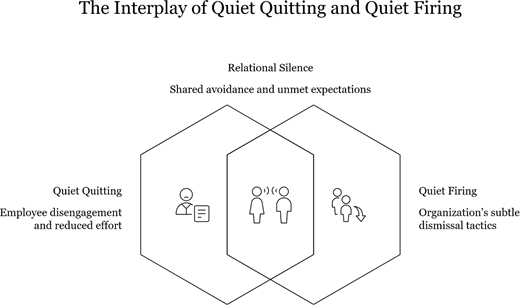
Quiet quitting and quiet firing are conceptualized as interdependent and relational processes sustained by patterns of shared communicative avoidance and unmet expectations within employment relationships (Oquendo et al., 2025).
Drawing on employee and organizational silence theory (Kim and Wang, 2024; Morrison and Milliken, 2000; Morrison, 2014), silence is conceptualized here not merely as the absence of voice, but as a shared and strategic coping mechanism adopted by both employees and organizations to manage dissatisfaction while minimizing perceived interpersonal, legal or reputational risks (Figure 1). From this perspective, silence becomes a socially constructed response to strained employment relationships rather than an individual failure to speak up (Katırcıoğlu, 2024).
To make these relationships more explicit, the present framework advances the following theoretical propositions (Table 3):
Quiet quitting and quiet firing emerge as mutually reinforcing relational dynamics sustained by reciprocal patterns of communicative avoidance between employees and organizations.
Organizational and employee silence function as strategic coping mechanisms aimed at reducing conflict exposure, preserving relational stability and minimizing reputational or legal risks.
The persistence of silence within strained employment relationships contributes to the normalization and institutionalization of disengagement behaviors over time.
At the employee level, quiet quitting represents a form of self-protective silence in which individuals withdraw discretionary effort, emotional investment and extra-role behaviors rather than voicing concerns or exiting the organization (Afi, 2025). Employees may perceive voice as ineffective or risky, particularly in contexts characterized by low psychological safety, prior experiences of ignored feedback, or power asymmetries. Psychological safety is the shared belief among organization members that they can take interpersonal risks without fearing negative consequences for their reputation, status or career. When it is lacking or in short supply, people feel it is better not to put themselves forward and therefore tend to remain silent rather than voice their thoughts, feelings and ideas. As a result, reducing effort and narrowing role boundaries becomes a means of expressing dissatisfaction while avoiding potential retaliation or conflict. This form of silence is therefore behavioral rather than verbal, manifesting through disengagement rather than explicit complaint.
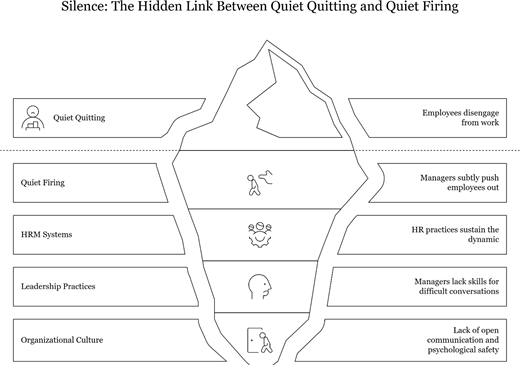
At the organizational and managerial level, quiet firing reflects an institutionalized form of silence in which leaders avoid direct, difficult conversations about performance, expectations or fit. Instead of engaging in transparent performance management, developmental feedback or formal termination processes, managers withdraw feedback, opportunities and relational investment. Such practices may stem from discomfort with conflict, limited managerial capability, or concerns about legal exposure and reputational damage. In HRM terms, quiet firing signals a decoupling between formal HR policies and enacted managerial practices, whereby avoidance substitutes for accountability (Figure 2).
These two processes are mutually reinforcing and evolve through reciprocal interpretation. Employees’ reduced engagement and visible withdrawal may be interpreted by managers as underperformance or lack of motivation, thereby legitimizing further managerial neglect or exclusion. Conversely, experiences of ambiguity, neglect and diminished support reinforce employees’ perceptions that voice is futile, intensifying defensive disengagement. Over time, this interactional dynamic normalizes low expectations on both sides, erodes relational trust and stabilizes dysfunctional employment relationships characterized by minimal compliance and mutual withdrawal.
The framework proposed here positions silence as the central mechanism linking quiet quitting and quiet firing, transforming them from isolated behaviors into interconnected relational dynamics embedded within HR systems, leadership practices and organizational culture.
To clarify these relational mechanisms, the framework advances the following additional propositions:
Employees’ visible disengagement is likely to be interpreted by managers as reduced motivation or underperformance, thereby reinforcing managerial distancing and exclusionary practices.
Perceived organizational neglect and ambiguity strengthen employees’ beliefs that voice is ineffective or risky, increasing defensive withdrawal and disengagement behaviors.
Reciprocal patterns of silence and withdrawal progressively normalize low relational expectations, weaken trust and stabilize dysfunctional employment relationships over time.
Organizational silence operates as the central relational mechanism connecting quiet quitting and quiet firing within broader HR practices, leadership behaviors and organizational culture.
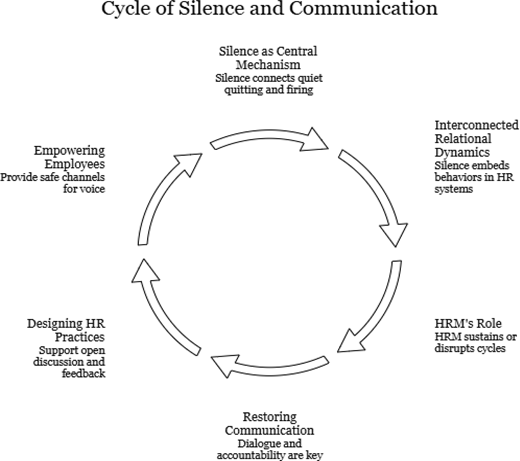
This framing highlights the critical role of HRM in either sustaining or disrupting these cycles. Breaking the quiet quitting-quiet firing dynamic requires the restoration of communication, reciprocity and psychological safety through explicit dialogue and shared accountability. Organizations must design and enact HR practices that support open discussion of expectations, performance and dissatisfaction, while providing managers with the skills and support necessary for constructive feedback and difficult conversations. Simultaneously, employees must be offered credible and protected channels for voice, ensuring that speaking is perceived as safe and consequential rather than risky or futile (Figure 3).
Theoretical contributions
This article advances scientific literature in several important ways.
First, it offers a conceptual integration of quiet quitting and quiet firing within a single relational and silence-based framework, responding directly to recent calls for more relationally grounded explanations of disengagement and withdrawal phenomena in contemporary organizations. Whereas prior studies have predominantly examined quiet quitting as an individual-level coping response, attitudinal outcome, or generational phenomenon, this article situates it within the broader dyadic employment relationship. By doing so, it highlights how patterns of disengagement are co-produced through ongoing interactions between employees and organizational actors, rather than emerging solely from individual dispositions or isolated job characteristics.
Second, the article contributes by theoretically anchoring quiet quitting and quiet firing in well-established WOP/OB and HRM theories, including effort-reward imbalance (Siegrist, 2017), equity theory (Adams, 1963), psychological contract theory (Rousseau, 1995) and employee silence theory (Morrison and Milliken, 2000; Morrison, 2014). Through this integration, the paper demonstrates that quiet quitting and quiet firing are not ephemeral or purely media-driven trends, but contemporary manifestations of enduring dynamics related to perceived unfairness, unmet expectations and breakdowns in reciprocal exchange relationships. The contribution therefore lies less in introducing novel terminology and more in reframing these labels as diagnostic indicators of relational strain and governance failures within employment relationships. This reframing aligns with the emphasis on theory development that deepens understanding of HRM processes rather than merely cataloging emerging phenomena.
Third, the paper extends the employee silence literature by broadening the conceptualization of silence beyond employee voice withholding to include organizational and managerial forms of communicative withdrawal. Specifically, quiet firing is theorized as a form of top-down silence in which managers and organizations systematically withhold feedback, guidance, developmental opportunities and relational investment. Although silence research has traditionally focused on bottom-up processes, this perspective highlights how managerial avoidance and organizational inaction can actively contribute to disengagement, injustice perceptions and deteriorating well-being. By foregrounding quiet firing as a meaningful but under-theorized HRM practice, the article opens new avenues for examining how silence operates across hierarchical levels and how formal HR systems may inadvertently enable such dynamics.
Finally, by positioning silence as a central relational mechanism linking quiet quitting and quiet firing, the article offers a unifying framework that bridges micro-level experiences of disengagement with meso-level HR practices and leadership behaviors. This multilevel perspective has important implications for both theory and practice, suggesting that interventions aimed at reducing disengagement must address not only individual motivation but also communicative norms, managerial accountability and the enactment of HR policies. In doing so, the article contributes to the ongoing agenda of advancing theoretically robust and practically relevant insights into the management of people at work.
Practical implications for human resource management
From an HRM perspective, quiet quitting and quiet firing underscore the strategic importance of communication, fairness and relational competence in sustaining employee engagement and healthy employment relationships. These phenomena highlight how disengagement often emerges not from a lack of formal HR policies but from gaps between policy intent and day-to-day enactment. HR systems should therefore prioritize transparent and consistently applied performance management processes that clarify expectations, provide ongoing developmental feedback and offer employees a credible sense of procedural and distributive justice. In doing so, organizations can reduce effort-reward imbalances and perceptions of inequity that frequently precede both quiet quitting and quiet firing.
Performance management systems play a particularly critical role in disrupting silence-based dynamics. When feedback is infrequent, ambiguous, or avoided altogether, employees are left to infer meaning from managerial inaction, often interpreting silence as disapproval or disregard. Regular, meaningful and two-way feedback processes can mitigate these interpretations by making performance standards explicit and by providing opportunities for early course correction. Similarly, equitable reward and recognition structures signal organizational reciprocity, reinforcing the link between effort, contribution and outcomes and thereby reducing the perceived need for defensive disengagement.
Leadership development represents a second key lever for HRM intervention. The findings of this analysis suggest that quiet firing often reflects deficits in relational and communicative competence rather than deliberate intent to harm. Leadership development initiatives should therefore emphasize relational skills, including the delivery of constructive feedback, conflict management, emotion regulation and the capacity to address underperformance explicitly yet respectfully. Avoidance-based strategies such as quiet firing may reduce short-term managerial discomfort, but they generate substantial long-term costs in the form of disengagement, reputational damage, diminished trust in leadership and weakened perceptions of organizational justice. Equipping managers to engage in difficult conversations is thus not only a developmental concern but a strategic HRM priority.
At the organizational level, fostering sustained work engagement requires investment in meaningful job design, recognition practices and employee participation in decision-making processes. These practices enhance employees’ sense of autonomy, competence and relatedness, thereby counteracting the conditions under which silence and withdrawal become adaptive responses. Tools such as engagement surveys, pulse checks and climate assessments can serve as early warning systems for emerging disengagement, provided they are accompanied by visible managerial follow-through. Without tangible action, such mechanisms risk reinforcing cynicism and further entrenching silence.
This analysis underscores that silence should not be interpreted merely as the absence of voice, but as a strategic relational signal embedded in organizational contexts. Addressing silent disengagement requires HRM approaches that legitimize open dialogue, normalize difficult conversations and position communication as a core organizational capability. By doing so, organizations can move beyond reactive interventions and toward more sustainable models of performance and employee well-being grounded in reciprocity, transparency and trust.
Limitations and directions for future research
As a conceptual paper, this study does not empirically test the proposed relational framework. Future research should examine the reciprocal dynamics between quiet quitting and quiet firing using longitudinal, multi-source and diary-based designs to capture how silence-based disengagement unfolds over time.
Further research is needed to operationalize quiet firing as a distinct construct and to differentiate it empirically from related phenomena such as abusive supervision, laissez-faire leadership and organizational neglect. Developing validated measurement instruments would substantially advance empirical inquiry.
In addition, considering the argument that escalation of silence is imminent, more short-term measures should be researched. Quiet quitting and quiet firing have behavioral markers as noted in the literature reviewed. These behaviors can be measured and compared to organizational actions (support removal) and compared, strengthening the premise that there is a reciprocal connection between the two. In addition, future research should include well studied factors such as age discrimination as a modifying factor.
Cross-cultural studies represent another promising avenue, as cultural norms regarding hierarchy, voice and employment security may shape how silence-based disengagement is enacted and interpreted. Intervention studies evaluating HR practices and leadership behaviors that successfully interrupt cycles of silent disengagement would offer valuable guidance for both scholars and practitioners.
Beyond cultural variations, future research should adopt a cross-sectoral perspective. The prevalence and impact of quiet quitting and quiet firing may differ between the public sector, where job security is often higher, but bureaucracy may foster silence, and the private sector, where competitive pressures might accelerate quiet firing as a strategic tool for workforce reduction. Investigating these phenomena across sectors like healthcare, education and tech will clarify how industry-specific governance and HR systems enable or disrupt cycles of silent disengagement.
Conclusion
This article examined quiet quitting and quiet firing as interconnected manifestations of disengagement within employment relationships, arguing that both are rooted in communicative avoidance. By conceptualizing these phenomena as reciprocal and silence-based processes, the paper moves beyond individual or managerial explanations and highlights their co-constructed, relational nature.
The main contribution lies in the development of a unified framework that integrates quiet quitting and quiet firing within employee silence theory and broader HRM and WOP/OB perspectives. This approach reframes these trends as indicators of deeper relational and systemic dysfunctions rather than isolated behaviors.
Overall, the analysis underscores the critical role of communication, psychological safety and consistent HR practices in preventing cycles of mutual withdrawal. Addressing silent disengagement requires restoring dialogue and reciprocity within employment relationships, thereby supporting more sustainable engagement and organizational effectiveness.