The purpose of this paper is to explore how leadership practices impact the implementation of trust-based management and how trust-based management relates to organizational outcomes in trust reforms in public sector organizations.
The paper uses partial least squares path modeling (PLS-PM) to analyze aggregated, survey data from 1,006 respondents in 2021 and 801 respondents in 2024 pooled to 52 organizational units in a Norwegian city that implemented a trust reform in 2017.
Integrated transformational and transactional leadership in 2021 was positively and significantly related to trust-based management measured two years later, and trust-based management was positively and significantly related to organizational unit performance and organizational citizenship behavior, and negatively and significantly related to intention to leave.
The paper is based on data from one, big organization in a high-trust society. Further research is needed to explore the applicability of the finding across different organizational and institutional contexts.
This paper provides empirical-based knowledge about how organizations and managers can utilize integrated leadership in implementing more trust-based management to improve organizational outcomes.
Increased knowledge about factors that impact the implementation of trust-based management with positive organizational outcomes is important for many organizations and societies that are designing public sector reforms or facing distrust within as well as across organizations.
Prior research has studied how trust, translation and information flows impact trust-based management and how trust-based management impacts innovation. This paper complements prior research with an original analysis of how integrated leadership impacts trust-based management and organizational outcomes.
Introduction
This paper explores the impact of integrated leadership on trust-based management and its outcomes in public sector organizations, and especially in local governments. Trust-based management consists of empowerment, providing relevant feedback on results, and participation in decision-making processes, especially for the employees (Nyhan, 2000).
This paper conceptualizes trust-based management not as new nor necessarily superior concept, but as an element in trust reforms and planned organizational changes to strengthen trust between managers and employees, reduce administrative burden (“red tape”), mend perceived dysfunctional management systems and improve collaboration in public sector (Bentzen and Bringselius, 2023; Siverbo et al., 2024) as well as in private sector organizations (Six and Sorge, 2008). Such challenges are common in many – and maybe especially in big and complex – organizations after several decades of reforms and organizational changes.
It is often assumed that trust reforms will increase trust between managers and employees (vertical trust), and hence improve organizational outcomes such as performance and commitment (Bentzen, 2023; Funck, 2025; Hasche et al., 2021; Torfing and Bentzen, 2020). Many reforms, however, disappoint (Aberbach and Christensen, 2014). Moreover, many organizational changes fail (Kotter, 1995). It is commonly stated that as much as 70% of planned organizational changes fail, but the evidence for this claim is disputed (Hughes, 2011). Some research find, nevertheless, that change management matters and that leadership, and possibly transformational leadership, may be especially important in change management in public sector organizations (van der Voet, 2016).
Trust-based management has been expected to be closely related to transformational leadership and less related to transactional leadership (Torfing and Bentzen, 2020), two leadership styles that have been especially popular in the leadership literature and research over the latest 5 decades (Bass, 1999; Burns, 1978). Policy makers, nevertheless, seldom design reforms exclusively based on one management model addressing only one problem. Similarly, practitioners seldom utilize only one leadership style adapted for one situation only. Policy makers, therefore, commonly blend ideas and solutions from different management models, and practitioners commonly blend different leadership styles, to make management and leadership practices robust to handle different problems in different situations. Effective leadership may, therefore, integrate many styles (Yukl, 2012).
There seems to be increasing recognition of integrated leadership (e.g. Anderson and Sun, 2017; Fernandez et al., 2010; Orazi et al., 2013). So far, however, there are to the best of our knowledge no studies on how leadership practices impact the implementation of trust-based management and ultimately organizational outcomes. Prior research on trust-based management in Scandinavia has largely been confined to translations of trust reforms in public sector organizations (Bentzen, 2019a; Bentzen and Bringselius, 2023), case studies of organizational implementation of trust-based management (Bentzen, 2019b, 2023; Eide et al., 2022; Elmersjö and Sundin, 2021; Ernst, n.d.; Vallentin and Thygesen, 2017), survey-based studies of diffusion of trust-based management in public sector organizations (Siverbo et al., 2024), as well as studies of impacts of information flows on trust-based management (Norkin et al., 2025; Øygarden et al., 2023) and impacts of trust-based management on management control (Funck, 2025) and innovation (Svare et al., 2023). This paper complements the prior research with an original analysis of how leadership practices impact trust-based management and organizational outcomes. This paper is, therefore, an overdue response to Nyhan’s (2000) early call for more research on leadership and trust-based management. The research question is, subsequently: how do leadership practices impact trust-based management and organizational outcomes in public sector organizations?
This paper analyzes aggregated survey data from 1,006 respondents in 2021 and 801 respondents in 2024 pooled in 52 organizational units in a Norwegian city that implemented a trust reform in 2017 (Eide et al., 2022). The data are analyzed with partial least squares path modeling, PLS-PM (Henseler, 2021). The results show that integrated leadership is positively related to trust-based management, and trust-based management is positively related to organizational unit performance and organizational citizenship behavior, and negatively related to turnover intention, as expected. This paper contributes to public leadership and management reform theory by providing evidence on the importance of integrated leadership in implementing trust-based management in public sector organizations (Bentzen, 2019a, b; Ernst, n.d.; Vallentin and Thygesen, 2017) as well as to increased knowledge on leadership and change management in trust reforms in the Scandinavian countries (Bentzen and Bringselius, 2023; Siverbo et al., 2024).
The remainder of the paper is structured as follows. The second section reviews literature and develops working hypotheses. The third section presents contextual background information on trust reforms and trust-based management. The fourth section documents the research design and data. The fifth section presents the results. The sixth section discusses the results. The final section concludes and suggests further research.
Literature review and hypotheses
Trust reforms and trust-based management
Trust in organizations and societies has received much attention since the 1990s (Bouckaert, 2012; Fukuyama, 2015; Guinot and Chiva, 2019; Kramer and Tyler, 1996; Podsakoff et al., 1990; Rousseau et al., 1998). Nyhan, in probably one of the earliest systematic studies of trust-based management in public sector organizations, found that trust-building between managers and workers was positively related to productivity and commitment in an American municipality (Nyhan, 2000). The basic mechanisms identified were that participation in decision-making, information on results from and to employees, and empowerment of the employees, were positively related to trust as well as to productivity and commitment, largely corresponding to earlier management models such as management by objectives and self-control (Drucker, 1954).
Trust reforms are designed to handle de-bureaucratization, decentralization and collaboration, and to enhance trust, effectiveness, innovation and legitimacy (Bentzen and Bringselius, 2023; Siverbo et al., 2024; Vallentin and Thygesen, 2017). Trust has been much studied in relation to trust-based management in trust reforms (Bentzen, 2019b; Hasche et al., 2021). This paper, therefore, focuses on the role of leadership and trust-based management.
Leadership and trust-based management
Leadership (and management) concerns results, followers, changes, systems and values, within as well as across organizations, and basically revolves around the three elements of effectively providing quality results, facilitating organizational members’ cohesion and personal development, while aligning the organization to its environment and making necessary changes (Drucker, 1954; Van Wart, 2003, 2013).
Public leadership is important for many functions and many levels in societies. Hartley defined public leadership as “mobilising individuals, organisations and networks to formulate and/or enact purposes, values and actions which aim or claim to create valued outcomes for the public sphere” (Hartley, 2018, p. 203). Leadership in public sector organizations may be more constrained than leadership in privately owned organizations (Hansen and Villadsen, 2010; Jacobsen, 2024; Rainey and Bozeman, 2000). Still, public leaders – just as other leaders – have a plethora of leadership theories and styles to choose from, for example, authoritarian, distributed and empowering leadership (Anderson and Sun, 2017; Mutonyi et al., 2020), to name just a few. Transformational and transactional leadership may, however, be especially relevant for public leadership (Burns, 1978).
Transformational leadership has been in vogue for a long time (Bass, 1999), but the originator of the theory on transformational leadership underscored that leadership in practice had to be based on transactional leadership, providing immediate output and rewards for stakeholders, as well as transformational leadership encouraging followers to pursue even higher aims and changes (Burns, 1978). This fundamental insight seems to be rediscovered in newer research that pinpoint that, first, transactional leadership may be most important for short-term performance while transformational leadership may be most important for long-term performance (Bass et al., 2003); second, transformational leadership is positively related to many outcome variables (Bao et al., 2025); and, third, it is difficult, however, to empirically isolate distinct leadership styles in leadership practice (Anderson and Sun, 2017; Eva et al., 2025).
A recent meta-analytic review of the public administration leadership literature found that leadership seems to be working for enhancing positive outcomes but works less well in preventing negative outcomes. Even more important, it does not seem to matter much what kind of leadership style leaders practice as long as leaders do lead (Backhaus and Vogel, 2022). In practice, many leadership styles do not differ much from transformational leadership. Eva et al. stated that “(t)he 12 most popular leadership measures considered in our investigation share significant variance and retain very little unique specificity” (Eva et al., 2025, p. 3105). The analysis in this paper, therefore, does not study the impact of one or several distinct leadership styles individually or individual leaders’ behavior. Instead, we hypothesize that an active and systematic leadership practice in organizational units, using combinations of leadership styles, has a positive impact on the implementation of trust-based management.
Organizational units with much integrated leadership have much trust-based management.
Organizational performance
Organizational performance is not only multidimensional but also subjective (Andersen et al., 2016; Boyne, 2003). Performance may have intermediate results as services that can be assessed as conforming to standards (high quality), being productive (economizing) and achieving goals (creating value). To be effective in the long run, the organization also need to innovate existing or new services. These criteria can, however, be assessed differently by different stakeholders such as politicians, managers, professionals and users. We hypothesize that organizational units with much trust-based management will have high organizational unit performance, as assessed by different stakeholders.
Organizational units with much trust-based management have high organizational unit performance.
Organizational commitment
If trust-based management is perceived as working well and impacts outcomes positively, then it is likely that managers and employees will have high institutional trust and be committed to the organization, for example, have much organizational citizenship behavior and little intention to leave the organization (de Geus et al., 2020; Härenstam et al., 2024). Hypotheses 3 and 4 concern the relationship between trust-based management and intention to leave and to organizational citizenship behavior, respectively.
Organizational units with much trust-based management have little intention to leave among their members.
Organizational units with much trust-based management have much organizational citizenship behavior among their members.
Context: trust reforms in Scandinavia
Understanding the context for public sector leadership is important (Vogel and Masal, 2015). Albeit trust-based management was identified and found to work well in a public sector organization in the USA (Nyhan, 2000), it did not seem to take hold there but later – and probably unconnected – became common in many public sector organizations in Scandinavia. The Scandinavian countries are unitary states, have big public sectors and are high-trust societies (Bjørnskov, 2007; Holmberg and Rothstein, 2017). The Scandinavian countries have been active public management reformers (Greve et al., 2020), and their societies and public sectors are generally regarded as well-functioning regarding effectiveness, equality and innovation (Fukuyama, 2015).
To stay effective, equal and innovative after much reform activity for several decades, many public sector organizations in the Scandinavian countries have, during the latest decade, implemented trust reforms (Bentzen and Bringselius, 2023; Siverbo et al., 2024). The core element in these reforms is implementing trust-based management. Changing organizational practices so that employees accept more trust and responsibility is, however, challenging (Bentzen, 2019b; Ernst, n.d.).
There are no systematic studies of the diffusion of trust reforms and implementation of trust-based management across central and local government, but there is a systematic study of the implementation of trust-based management in municipalities. Siverbo et al. (2024) conducted a survey to all the municipal chief administrative officers in the three Scandinavian countries in 2021, with a response rate of 63% in Denmark, 49% in Norway and 52% in Sweden. They concluded that “the concept of TBM has diffused widely in Scandinavia and that a clear majority of the municipalities have worked with the concept for some time” (Siverbo et al., 2024, p. 9). Common purposes for implementing trust-based management were increasing employees’ work autonomy and motivation and reducing overly extensive formal organizational control. They also reported that, in general, the respondents did not report many implementation challenges. The biggest challenges were maintaining momentum “when other issues called for attention”, “remaining faithful to the idea of trust when things go wrong and politicians wanted to handle the situation with regulations” and “the concept of trust itself, what it is and how it should be operationalized, especially in Sweden and Norway” (Siverbo et al., 2024, p. 11).
Leadership clarifies vision and directs change, prioritizes and sets objectives, manages performance and maintains community and commitment. Leadership may, therefore, be especially important in trust reforms for implementing trust-based management, which is the research problem for this paper.
Methods and data
Population and sample
The theoretical population for this analysis is local government organizations. The City of Oslo was selected as a representative case for the analysis. This organization is big and complex, has municipal as well as county tasks and has implemented a trust reform for several years. The trust reform in the City of Oslo was formally decided by the City council in 2017 after having been piloted in four home care districts since 2015 (Eide et al., 2022). The implementation has been going on from 2017 to 2023, which this paper studies. Analyses show that the perceptions of changes in the reform from 2017 to 2020 were modest, but there were more perceived changes from 2021 to 2023.
The City of Oslo had ca. 720,000 inhabitants in 2024, and its 15 districts are each in comparison as big as some of the largest municipalities in Norway. We selected 30 primary and 8 secondary schools from ca. 180 schools, stratified by size and geographical location, and the home care services in 14 of the 15 districts, totaling 52 units in the City of Oslo, as our sample. The 52 units vary in size from small schools to large districts. The selected services have employees with many professional backgrounds. The selected units and services, therefore, represent variation in tasks and professions typical of many public sector organizations. Most importantly, because the City of Oslo has experience from piloting trust-based management since 2015, and full-scale implementation since 2017, the City of Oslo is suitable for providing data on implementation and outcomes of trust-based management, which takes several years to materialize.
Data collection and data aggregation
Data were collected from all managers and employees in two rounds in the selected 52 units. The first survey took place in Spring 2021, resulting in 1,006 responses and a response rate of 17.2%. The second, follow-up survey took place in late Autumn 2023/Winter 2024, resulting in 801 responses and a response rate of 11.6%.
Participation in the surveys were voluntary. The response rate was lower in the second survey than in the first, which raises a potential issue of representativeness and non-response bias. Official administrative data showed that in 2019, the total workforce in the city had 51,000 organizational members of which 69% were women, 51% were of less than 40 years of age, 40% were employed in the educational sector, and 33% were employed in the districts. Analysis of individual demographic traits across the two surveys showed that 15 and 18% had top managerial positions, 65 and 68% of the respondents had been affiliated in their current jobs for 4 years or more, 63 and 66% of the respondents were 40 years or more, and 71 and 70% were women, in the 2021 and 2023 surveys, respectively. The samples, representing ca. 73% of the total workforce, therefore, are representative regarding gender, but have a higher share of older and possibly more experienced respondents than the total workforce.
To test for additional response bias, we included questions probing positive and negative attitudes toward trust-based management. Trust and trust reforms are hard to conceptualize, but trust and trust reforms have positive connotations for many. Unsurprisingly, of the respondents who were knowledgeable about the trust reform, most were positive. 70% in 2021 and 79% in 2024 scored 6 or 7 on the Likert scale on “I am positive towards the idea of trust-based management”, but the data also include respondents with negative attitudes. 18% in 2021 and in 2024 scored 6 or 7 on a seven-point Likert scale on “Trust-based management is mostly just talk”. Therefore, the data represent variation in attitudes and valid experiences for this exploration.
The responses were given under a clause of anonymity. Therefore, we could not pool individual data over time. We instead aggregated the individual data for each of the 52 units and pooled the aggregated unit data from the two surveys for the final analysis.
Measurement
Integrated leadership (IL) was measured with four items from validated scales for transformational and transactional leadership (Jensen et al., 2019). Transformational leadership was measured by asking about the extent the leaders strive to get the employees to work together towards the organization’s vision and seek to make employees accept common goals for the organization. Transactional leadership was measured by asking about the extent leaders give individual employees positive feedback when they perform well, and reward the employees’ performance when they live up to requirements.
Trust-based management (TBM) was measured with three items tapping its three central elements of participation in decision making, feedback information on results (goal clarity), and empowerment (work autonomy) (Nyhan, 2000). The items were measured by replicating validated survey questions (Dallner et al., 2000).
Organizational unit performance (OUP) was measured as an index with sum scores of three items consisting of the respondents’ perceptions of their unit’s number of innovations adopted, goal achievement and effectiveness. The items were taken from a seven-item scale to measure organizational unit performance (Van de Ven and Ferry, 1980; Verbeeten and Speklé, 2015).
Intention to leave (turnover intention, TI) was measured by three items from a five-item scale (Kuvaas, 2006), for example, how probably the organizational member would look for a new job in the next year.
Organizational citizenship behavior (OCB) was measured by three items from a seven-item scale, specifically: defending the municipality or unit when it was criticized, feeling pride if allowed to represent the organization externally, and expressing loyalty to the municipality or unit (Lee and Allen, 2002).
All the survey items were measured on a seven-point Likert scale (1 = Completely disagree/not at all, to 7 = Fully agree/to a large extent).
Integrated leadership was measured with data from the 2021 survey. Trust-based management and the three outcome variables (OUP, TI, OCB) were measured with data from the 2023 survey. Note that managers and employees can assess leadership behavior differently (Jacobsen and Andersen, 2015). Our data had 15% managers in the 2021 survey and 18% managers in the 2024 survey. Consequently, the employees’ perceptions dominate the measurement of leadership practices and trust-based management, as well as the outcome variables in this analysis.
Table 1 documents all the survey questions used to measure the variables.
Two additional variables, one for unit size measured as man-years in 2021, and a dummy variable for sector (schools = 0, home care = 1), were used as exogenous, contextual variables.
Validity, reliability and common method bias
To enhance construct validity and reliability, all variables were measured replicating validated research instruments and measuring the constructs as latent variables or composite constructs with at least three indicators each. There are different views on the practical impact of common method bias (CMB) in empirical research (Fuller et al., 2016; Jakobsen and Jensen, 2015). To reduce common method bias, we followed recommended good practices in designing the surveys, including pilot-testing the survey, using validated scales, reversing some scales and granting anonymous responses (George and Pandey, 2017; Podsakoff et al., 2012). Albeit not conclusive, Harman’s one-factor test with the 16 items showed that the first factor explained 41% of the variance, which is below the common threshold of 50%, indicating little likelihood for common method bias. Most importantly, to secure internal validity, the items for the exogenous variables were taken from a survey conducted in 2021, two years before the items for the dependent variables were measured in the second survey in 2023.
While the data are pooled aggregated individual data to unit scores and not pooled individual manager–employee dyadic relationship scores over time, internal validity may, on the one hand, be lower than using pooled individual manager–employee dyadic relationships data over time. On the other hand, external validity may be high because the data represents typical work relations in complex public sector organizations and units, where employees and managers must relate to several management levels and partly some rotation of managers and employees both during the day and over time. Therefore, measuring mean perceived unit practices and outcomes over time may be a valid representation of management and leadership in practice in such contexts.
Results
The number of useable cases for the analysis is given by the number of organizational units, for which the individual data have been aggregated. 52 is a small number of cases for multivariate analysis of complex models and, therefore, PLS-PM instead of covariance-based structural equation modelling (CB-SEM) was chosen. PLS-PM needs smaller samples sizes to produce stable estimates than CB-SEM because PLS-PM uses regression to estimate portions of the model iteratively, while CB-SEM (usually) uses maximum likelihood estimation based on the whole model (Willaby et al., 2015). The analysis was performed with ADANCO 2.4.1 (Henseler, 2017). The ensuing results follow guidelines for best practice reporting of PLS-PM (Benitez et al., 2020).
Table 2 reports the results of the measurement models. All latent variables were measured with consistent parameter estimates (Mode A consistent). Organizational unit performance was measured as a sum of scores emergent variable. All indicator weights and loadings were significant (p < 0.01). The indicator loadings for the latent variables were above 0.707 and therefore had good reliability, except for two loadings, which were 0.69 and 0.65. All five latent variables had Alpha scores ranging from 0.79 to 0.94, and average variance extracted (AVE) scores ranged from 0.55 to 0.87, indicating high composite and convergent reliability. The largest heterotrait-monotrait (HTMT) score was 0.59 between trust-based-management and organizational citizenship behavior, below the common threshold of 0.85, indicating good discriminant validity. The variables are therefore suitable for further analysis.
Table 3 reports the construct correlations.
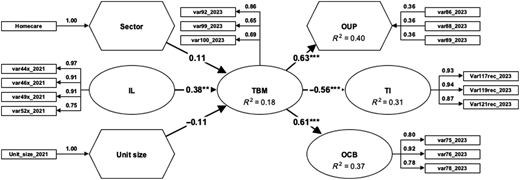
Table 4 reports the results of the structural model, and Figure 1 shows the path model with the main results. Sector, integrated leadership and unit size are the exogenous variables, and trust-based management, organizational unit performance, turnover intention and organizational citizenship behavior are dependent variables.
The global fit for the structural model is acceptable for exploratory analysis. The Standardized Root Mean Squared Residuals (SRMR) score of 0.10 was above the common threshold of 0.08 but below 0.12 and below its 95-percentile confidence interval (HI95) of 0.14. The measurement models’ fit was acceptable, with a coefficient of determination ranging from R2 = 0.18 to R2 = 0.40 (adjusted R2 = 0.13–0.39).
All the hypothesized relationships were significant and in the expected directions. Integrated leadership in 2021 was positively related to trust-based management in 2023 (beta = 0.38, p < 0.01), supporting hypothesis 1. Trust-based management was positively and significantly related to organizational unit performance (beta = 0.63, p < 0.001), supporting hypothesis 2. Trust-based management was also significantly and negatively related to turnover intention (beta = −0.56, p < 0.001) and significantly and positively related to organizational citizenship behavior (beta = 0.61, p < 0.001), supporting hypotheses 3 and 4. Moreover, the hypothesized relationships had from medium to strong Cohen’s effect sizes ranging from 0.16 to 0.67. Note, however, that the dependent variables were correlational data and the effect values for hypotheses 2, 3 and 4 can therefore not be taken as evidence for causal relationships.
The model also included two exogenous variables for sector and unit size. Home care had a small positive but not significant relationship to trust-based management (beta = 0.11, p = 0.50). The relationship between unit size and trust-based management was also small and not significant (beta = −0.11, p = 0.51).
Robustness checks were conducted with several models. A model where integrated leadership was split into two variables for transformational and transactional leadership styles showed that both were positively but not significantly related to trust-based management (transformational leadership: beta = 0.19, p = 0.55; transactional leadership: beta = 0.20, p = 0.52).
Discussion
Prior research shows that transformational and transactional relationship are highly related, and that there is a need to consider integrated leadership (Anderson and Sun, 2017; Bass et al., 2003; Eva et al., 2025; Fernandez et al., 2010; Orazi et al., 2013). This analysis supports this view. Transformational and transactional leadership did not individually impact trust-based management significantly, but integrated leadership combining transformational and transactional relationships had a significant and positive relationship to trust-based management. An important takeaway point from this analysis is therefore that even though many relate trust-based management predominantly to transformational leadership, integrated leadership is more important for implementing trust-based management than transformational leadership only, in addition to high vertical and institutional trust (Bentzen, 2019b) and suitable translation (Bentzen, 2019a).
This exploration started as a study of the relative impact of leadership styles with a presumption that transformational leadership was most important for trust-based management. The analysis soon encountered the problem of high collinearity and relatively low discriminant validity between the two leadership styles. These issues may partly be explained by the fact that negative sanctions, and pecuniary incentives, are not used (much) in local government, at least not judged by the Norwegian survey data in this paper. Maybe the research and development of the common scales for leadership styles have been much influenced by the often relatively individualistic cultures in Anglo-American contexts and by organizations using more negative sanctions, which much of the public leadership theory stems from (Vogel and Masal, 2015).
To make a reliable variable for integrated leadership in the Norwegian local government organization in this analysis, only items tapping leadership behavior for non-pecuniary and positive rewards loaded significantly. There may be many explanations for this. First, the scales for transformational and transactional leadership that were used in this paper were based on research to develop valid scales to measure transformational and transactional leadership in private and public sector organizations, using data from Danish leadership programs (Jensen et al., 2019). There is extensive research on transformational and transactional leadership using scales to measure such leadership styles. Participants in Danish leadership programs or management education or labor relations in most of the countries that have been the settings for the prior scale developments, could still be unrepresentative for public sector organizations in general or Norway in particular. Second, another interesting explanation is that leadership practices that are conducive for trust-based management need to emphasize precisely the positive and non-pecuniary elements of transactional leadership, together with core elements in transformational leadership, to be congruent with an often professional and committed workforce with members who often have long-term public-sector organization occupations, high commitment and little intention to leave. This type of leadership may fit public sector organizations well (Bao et al., 2025). Third, gender bias may provide yet an explanation. Women seem to practice, and maybe appreciate, transformational leadership more than men (Bass, 1999). Our sample, and many public services, have more women than men in the workforce. Hence, practicing much transformational leadership, but combined with the non-pecuniary and positive feedback elements in transactional leadership, may be a good fit in many public sector organizations and especially for trust-based management.
Moreover, there may have been a bias in the conceptualization of management and leadership based on (unnecessary) assumptions of selfish individual motives (Donaldson, 2002), maybe influenced by “economic imperialism” in the 1970s and 1980s (Lazear, 2000), and that human work behavior to realize results has to be motivated by pecuniary punishments and rewards. The core of transactional leadership is, however, not about selfishness or sanctions but delivering results (Burns, 1978) for creating public value (Moore, 1995). Transformational leadership is needed – in addition to transactional leadership – to give overall meaning and vision as well as leading change. In many public sector organizations, where many managers and ordinary employees are professionals and know relatively much compared to formal leaders how to deliver results, transformational leadership may therefore be most important. Leadership in practice, nevertheless, combines elements of the two (or other) leadership styles in what we may term integrated leadership.
There are now proposed several measures for integrated public leadership styles, both based on several underlying dimensions of composite (21-item) or simplified (11-item) scales of normative purposes (Fernandez et al., 2010; Tummers and Knies, 2016; Vogel et al., 2020). This paper has not used these measures. Instead, this paper has utilized common, validated scales for transformational and transactional leadership (Jensen et al., 2019) and combined these two styles into a measure for integrated leadership. This was done for two reasons. First, using these validated scales provides data which are comparable to much previous research. Second, the two leadership styles encompass the three main purposes of leadership, which are providing results, clarifying meaning and directing change and ensuring cohesion and community. Interestingly, such a conception of leadership in management practice was elaborated on already in the 1950s with MBO and self-control (Drucker, 1954), which basically is the core of (integrated) leadership: setting objectives (vision and change), ensure cohesion and community (participation, which also should utilize and develop competence) and user-orientation and focus on results (creating public value/provide results).
Leadership in practice often pragmatically and context-specific blends different leadership styles. There has, since at least the 1990s, been a growing awareness of the importance of integrating (transactional and transformational) leadership styles (Bass, 1999). “Newer” trends in the management and leadership literature seem to recapture this notion by focusing on integrated leadership instead of individual leadership styles (Anderson and Sun, 2017; Backhaus and Vogel, 2022; Fernandez et al., 2010; Orazi et al., 2013). This seems to lead us full circle back to the classics of leadership (Drucker, 1954; Burns, 1978) where the divide between management and leadership and between different leadership styles, or theory X and theory Y, etc. (McGregor, 1960), is most of academic interest because leaders in practice combine management and leadership and integrate different leadership styles (Yukl and Lepsinger, 2005).
Implementing trust-based management is challenging and may not always succeed, as evidenced by case studies in Denmark and Sweden (Ernst, n.d.; Funck, 2025). Therefore, if trust-based management has positive impacts on organizational outcomes, but implementation is difficult, then more knowledge of factors that impact the implementation of trust-based management is important for theory and practice. The results reported above, and other research (Mutonyi et al., 2020), indicate that integrated leadership and leadership emphasizing non-pecuniary and positive rewards, is important for implementing trust-based management and gaining positive organizational outcomes, at least in complex public sector organizations.
The literature indicates that the Scandinavian countries (Bjørnskov, 2007; Holmberg and Rothstein, 2017) and many of the public sector organizations that have implemented trust-based management have had high trust also before the trust reforms or predominantly have been big organizations (Bentzen, 2019b; Eide et al., 2022; Øygarden et al., 2023; Siverbo et al., 2024). Big organizations may have many layers and much competence, which is conducive for using decentralization and empowerment, which are major elements in trust-based management. Simultaneously, big organizations may also have many professional managers and employees and big management support capacity, which is also conducive for change management and leadership support to implement trust-based management. Maybe trust-based management is especially appropriate in big organizations with their many organizational levels and units, which are common in the public sector.
Conclusions
The main finding from this analysis is that leadership integrating transformational and transactional leadership is positively and significantly related trust-based management and trust-based management is positively and significantly related to perceived organizational unit performance and organizational citizen behavior, and negatively and significantly related to intention to leave. Current leadership theory indicates that it does not matter which leadership styles are practiced, if the practices are balanced and systematic. This analysis supports this assertion. Balanced and systematic leadership, for example, integrating transformational and transactional leadership, is, therefore, important for implementing (more) trust-based management and for organizational outcomes, at least in big, complex public sector organizations in high-trust societies.
This analysis has important implications for theory and practice about how organizations and managers can utilize integrated leadership in implementing more trust-based management to improve organizational outcomes. Earlier research has shown that high vertical and institutional trust is important for organizational members to accept more trust (and responsibility) in trust reforms. The opportunity of high trust and the motive for reform are evidently beneficial for implementing trust-based management, but integrated leadership is also important. Maybe integrated leadership is sufficient for implementing trust-based management in other contexts than in the high-trust Scandinavian countries and trust reforms as well. This is an interesting question for future research.
This paper has some limitations. The analysis is based on subjective survey data from one big organization and from a high-trust society only. Moreover, the dependent variables were measured with correlational data from the same survey.
Leadership theory has a plethora of styles and management models, but there is still a need for more knowledge about how organizations and managers integrate leadership styles and how these practices impact organizational outcomes. Further research is needed to explore the applicability of integrated leadership for trust-based management across different organizational and institutional contexts, such as the private and public sectors, small and big organizations, local and central government organizations and organizations in low- and high-trust societies.
This analysis contributes to increased knowledge about factors that impact the implementation of trust-based management. This knowledge is especially important for leadership practice because trust in and between organizations seems to be challenged in many societies, leadership may be perceived and work differently between individuals and across organizations, many reforms disappoint and many planned organizational changes are costly and fail. If more trust-based management has positive organizational outcomes even in organizations and societies with high trust in the first place, then trust-based management may have big and maybe even bigger potential impacts for many other organizations – in the public as well as in the private sector – and in many other societies, especially in these turbulent times.
Ethical approval
This is to confirm that the research study titled “Improving trust-based management in Nordic urban governance and management education” has adhered to all applicable ethical standards and guidelines throughout the research process. This research was approved by Sikt – Norwegian Agency for Shared Services in Education and Research (reference No. 942365), on 2020.08.28, and it was conducted following the ethical guidelines set forth by the national ethical guidelines.
Informed consent
Prior to commencing data collection, the participants were provided with detailed information about the study’s procedures and fully informed about the purpose of the research and the study’s aims, their rights as respondents (including the right to refuse participation or withdraw from the study at any time), and the measures taken to ensure their confidentiality and anonymity.
This paper is part of the “Improving trust-based management in Nordic urban governance and management education” project, financed by the Norwegian Research Council (302053). The author wishes to express his gratitude to his colleagues in the research project for their collaboration in the design of the survey and data collection, to the participating master students, the City of Oslo and the respondents for the participation in the project. I also acknowledge comments when the paper was presented for the International Research Society for Public Management (IRSPM) annual conference 7–9.4.2025, Bologna, Italy. Finally, the constructive comments from the Editor Tim Mau, and two anonymous reviewers are acknowledged.