
Skip to article sections
Purpose

This study reviews and problematizes the literature on the competencies enabling smart working in public administrations, by integrating change management and dynamic capabilities as complementary theoretical lenses.

Design/methodology/approach

A systematic review of 52 peer-reviewed studies was conducted. Papers were retrieved from Scopus and complemented through backward and forward citation searching. All contributions were coded into a 2 × 3 analytical matrix that intersects the two levels of change management (individual and organizational) with the three dimensions of dynamic capabilities (sensing, seizing, reconfiguring/transforming). A subsequent problematizing review was then developed to interrogate assumptions, conceptual boundaries, and contextual blind spots in the reviewed research.

Findings

The literature shows a marked organizational bias (63 out of 97 coded occurrences), while individual transforming remains underrepresented. The problematizing analysis highlights some interrelated theoretical openings based on: (1) heterogeneous definitions of both “competence” and “smart working”; (2) non-linear and always positive links between individual skills and organizational outcomes; (3) limited attention to external contingencies that shape the adoption of smart working in the public sector.

Originality/value

By combining systematic mapping with a problematizing lens and by operationalizing the integration of change management and dynamic capabilities through a six-cell matrix, the study provides a structured yet critical roadmap for future research. For practice, it suggests that technological investments must be coupled with interventions on autonomy, digital resilience, results-oriented culture, and adaptive leadership, tailored to the institutional specificities of each public administration.

Public administrations (PAs) are undergoing continuous transformations in their structures, processes, and functions, driven by social, economic, political, and technological dynamics (OECD, 2020; Kuipers et al., 2014; Gil-Garcia et al., 2018; Halachmi and Greiling, 2013). Despite sustained reform efforts aimed at improving service quality and fostering innovation-oriented cultures, PAs continue to face a structural tension between ensuring continuity and accessibility for citizens and adapting to evolving challenges (Wynen et al., 2014; Kotter, 1996; Kuipers et al., 2014). Addressing this tension requires sustained competence development (particularly in digital, analytical, problem-solving, and adaptive skills) as well as clearer managerial visibility over upskilling pathways that can also support employee retention (Seri and Zanfei, 2013; Maciejewski, 2017; David et al., 2024). Prior research has therefore emphasized communication and digital skills in digital workplaces and the capacity to adapt to change, linking competence development to performance, public-service quality, and more effective government-citizen interactions in the context of digitalization (Meske and Junglas, 2021; Linna et al., 2010).

The COVID-19 pandemic accelerated these dynamics, pushing PAs into large-scale remote working and bringing smart working (SW) to the forefront (Galanti et al., 2021; Ceci et al., 2025). The literature employs multiple labels to describe ICT-enabled work outside conventional workplaces. In this paper, “smart working” is used as an umbrella term encompassing remote working, telework, and working from home, while acknowledging that PA implementations vary in autonomy, digital enablement, and results orientation. Conceptually, SW extends beyond the mere relocation of work and refers to an organizational design combining digital enablement with temporal and spatial flexibility and, in its mature form, greater autonomy, objective-based coordination, and results-oriented accountability (Di Mascio et al., 2021; Palumbo et al., 2023). In practice, however, many PA implementations remain closer to conventional remote working, which helps explain the persistent terminological plurality in the literature.

Analytically, SW is relevant because it shifted from a marginal practice to a core mechanism for service continuity, while simultaneously exposing weaknesses in infrastructure, digital readiness, and procedural clarity and demonstrating potential as a sustainable organizational model (Felstead and Henseke, 2017; McPhail et al., 2024; Ansell et al., 2021; OECD, 2020). Pandemic-driven experimentation enabled process rethinking, skill revaluation, and organizational innovation, and post-pandemic debates increasingly focus on how to institutionalize SW within hybrid work arrangements (Mergel et al., 2019; Fischer et al., 2023; Chan et al., 2023; Kane et al., 2021). As flexibility has become indispensable—alongside digital competence, collaborative attitudes, and innovation-oriented mindsets—sustaining change is often framed as contingent on strengthening competencies at both individual and organizational levels, highlighting the need for integrative analytical frameworks (Lægreid and Wise, 2015; Fernandez and Rainey, 2017).

To address this need, this paper combines change management and dynamic capabilities as complementary lenses. Change management emphasizes the challenges of leading and institutionalizing transformation in the face of bureaucratic inertia and cultural resistance, while dynamic capabilities focus on how organizations sense opportunities, seize them, and reconfigure resources under conditions of turbulence (Kotter, 1996; Amjad and Rehman, 2018; Teece, 2007). Applied to PAs, these perspectives help explain how competencies can support the consolidation of SW beyond emergency adaptation. However, SW research in PAs rarely integrates these lenses explicitly, often treating competencies either as individual skill sets or as organizational enablers, without theorizing how micro-level competence development relates to organizational reconfiguration across phases of change (Mergel et al., 2019; Galanti et al., 2021). Although recent reviews have advanced understanding of SW in the public sector (Palumbo et al., 2024), the literature remains fragmented with respect to identifying which competencies enable SW and how they connect individual adaptation with organizational transformation. To address this gap, the paper adopts a problematizing literature review structured around a six-cell analytical matrix that intersects two levels of change management (individual and organizational) with three dimensions of dynamic capabilities (sensing, seizing, and reconfiguring/transforming). Therefore, the paper is structured as follows: Section 2 presents the theoretical framework, situating change management and dynamic capabilities within the context of SW in PAs; Section 3 outlines the methodology and matrix design; Section 4 discusses findings from the literature review, mapping contributions within the matrix; Section 5 problematizes the literature reviewed; Section 6 concludes with theoretical and practical implications, highlighting directions for future research.

Practitioners often underestimate how deeply digital technologies can reshape PAs, treating digitalization as a straightforward shift from analog to online services (Newman, 2017). In practice, digital government transformation is an ongoing, organization-wide strategy that repeatedly modifies services, procedures, and routines in response to external demands and stakeholders’ adoption of technology (Mergel et al., 2019). Framed this way, the managerial challenge is not “implementing IT”, but sustaining alignment across people, processes, policies, and leadership while preserving public value and legitimacy. From a managerial perspective, this is a change-management problem under distinctive constraints: public organizations must adapt while remaining accountable, rule-bound, and citizen-facing (By and Macleod, 2009). Digital Era Governance further clarifies why: it is not technology per se that transforms public organizations, but how organizations use technology to reconfigure work practices, culture, and expectations about government services (Dunleavy et al., 2006). Consistent with this view, digital transformation in the public sector requires organizational redesign rather than treating IT as a peripheral tool (Mergel et al., 2019).

Within these trajectories, PAs have expanded SW, which implies revisiting work design and the competencies needed to operate effectively outside traditional settings. Virtual work increases the relevance of technology-mediated communication (Varty et al., 2017) and places new demands on managerial coordination and supervision at a distance (Charlier et al., 2016). Accordingly, continued competence development supports performance when employees and managers must navigate complex situations (Seri and Zanfei, 2013; Maciejewski, 2017).

Because digital government implies continuous adaptation rather than one-off projects, change is often better conceptualized as emergent and discontinuous than as a sequence of planned interventions (Weick and Quinn, 1999; By, 2005). This distinction matters for SW in PAs, where individual adoption and organizational redesign frequently progress at different speeds. At the individual level, change management concerns how employees interpret change and (re)develop skills, attitudes, and motivation to adopt new routines (George and Jones, 2001). At the organizational level, it concerns building the conditions for sustained implementation (structures, coordination mechanisms, and culture) often captured through collective readiness (Weiner, 2009). Empirical work also shows that individual readiness is shaped by organizational signals such as perceived support and trust during restructuring, underscoring the cross-level nature of change processes (Gigliotti et al., 2019).

Evidence on SW mechanisms also needs to be read through a pre-/post-Covid lens. Pre-Covid research emphasized pathways such as autonomy and work–family dynamics and showed that outcomes depend heavily on how SW is defined and implemented (Gajendran and Harrison, 2007; Allen et al., 2015). During and after Covid-19, public-sector SW governance highlighted additional challenges for sustaining change and “reading” the environment, including shifts in leadership roles and resilience demands (Di Mascio et al., 2021; Kähkönen, 2023). These dynamics help to explain why tensions and leadership challenges can intensify when innovation collides with established models and expectations (Schwarzmüller et al., 2018).

Dynamic capabilities strengthen this account by explaining how organizations sustain strategic adaptation over time. In PAs, they are especially relevant because they “help organizations change their resource configurations” in response to environmental change (Klievink and Janssen, 2009). More generally, dynamic capabilities are commonly articulated as sensing opportunities and threats, seizing them through organizational adjustment, and transforming and restructuring resources to institutionalize change (Teece et al., 1997; Teece, 2007, 2018; Warner and Wäger, 2019). Post-Covid public-sector experiences make clear that sensing and transformation are not automatic: remote and hybrid governance can strain leadership attention, coordination capacity, and the ability to sustain new routines over time (Di Mascio et al., 2021; Kähkönen, 2023). Seizing also depends on leadership commitment and the willingness to sustain procedures and risk-taking beyond the initial adoption moment (Teece, 2014), while transforming can be costly and risky even when it is necessary to align assets and practices (Teece, 2007; Karimi and Walter, 2015). In this view, individual competencies can be treated as micro foundations that enable organizations to build and deploy capabilities rather than as “skills” that automatically scale up (Winter, 2003; Helfat and Peteraf, 2015).

Conceptually, change management and dynamic capabilities are distinct but complementary perspectives that intersect around organizational renewal. Change management explains how change is interpreted, enabled, and absorbed across individuals and organizations (George and Jones, 2001; Weiner, 2009), whereas dynamic capabilities explain how organizations identify, mobilize, and reconfigure resources to sustain adaptation over time (Teece et al., 1997; Teece, 2007, 2018). Their intersection is most visible in transformation processes, where behavioral and cultural shifts must co-evolve with sensing, seizing, and transforming if SW is to become durable rather than temporary (Warner and Wäger, 2019). This complementarity underpins the six-cell analytical matrix used in the methodology, combining the two change-management levels (individual and organizational) with the three dynamic-capability dimensions (sensing, seizing, transforming) (Teece, 2007; George and Jones, 2001).

Nevertheless, definitions of competencies and of smart/remote working remain heterogeneous, and trajectories from individual skills to organizational outcomes are often non-linear and discontinuous, particularly under the institutional and leadership pressures accentuated during and after Covid-19 (Weick and Quinn, 1999; By, 2005; Di Mascio et al., 2021; Kähkönen, 2023; Schwarzmüller et al., 2018). These issues are examined in depth in Section 5.2, where the framework is critically assessed.

This study adopts a two-stage review design combining (1) a systematic review to identify and map the literature on competencies for SW in PAs and (2) a problematizing review to interrogate assumptions, conceptual boundaries, and contextual blind spots emerging from the mapped literature. The intersection of systematic mapping and problematization improves transparency and replicability while enabling a more analytically robust synthesis. The full selection and analytical procedures are reported in Appendix A.

The systematic review was conducted in Scopus to ensure broad coverage and replicable screening based on consistent bibliographic metadata (Tranfield et al., 2003; Okoli, 2015; Page et al., 2021; Singh et al., 2021). Given the heterogeneous use of the word “smart working,” the search combined common labels (smart working, remote work, agile work, telework/work-from-home), while public-sector relevance was ensured through inclusion/exclusion screening rather than reliance on a single keyword (Snyder, 2019). The Scopus query (reported in Appendix A) combined competence-related terms with remote-working terms and excluded technical/engineering contributions through subject-area restrictions. Following methodological guidance that supports context-sensitive evidence synthesis and the inclusion of non-journal outlets when appropriate (Tranfield et al., 2003; Snyder, 2019; Okoli, 2015; Adams et al., 2017), we included Scopus-indexed journal articles, conference proceedings, books, and book chapters, provided full texts were accessible and addressed competencies in SW within public-sector settings.

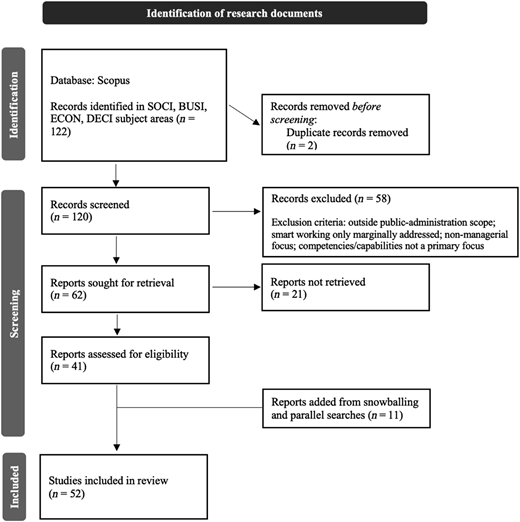
The search yielded 122 records. Screening was conducted in two steps (titles/abstracts, then full texts) using predefined inclusion and exclusion criteria (reported in Appendix A). After screening, 41 documents were retained for full-text review, and 21 additional items were excluded because full texts were not accessible despite retrieval attempts (Page et al., 2021). Snowballing (backward and forward citation searching) following Wohlin et al. (2022) identified 11 further studies, resulting in a final dataset of 52 documents (Figure 1).

For the analysis, we first extracted how each study conceptualized and operationalized “competence” in SW, creating an audit trail to enable systematic comparison across heterogeneous designs (Petticrew and Roberts, 2006; Okoli, 2015). We then mapped each paper to the Dynamic Capabilities/Change Management matrix (Table 1), classifying evidence by level of analysis (individual vs organizational) and dominant capability/change dimension (sensing, seizing, transforming), yielding a six-cell structure (Table 1).

The coding process combined descriptive within-paper coding and deductive classification into matrix cells, allowing multi-cell assignment where studies linked individual and organizational mechanisms or different dimensions. To reduce subjectivity and improve reproducibility, coding rules were specified ex ante, piloted, and refined through discussion of ambiguous cases (MacQueen et al., 1998; Stoll et al., 2019), and the assignment followed a structured four-step procedure adapted from systematic review best practices (Khan et al., 2003; Petticrew and Roberts, 2006) (see Appendix A). The resulting attention map highlights both concentrations (e.g. digital adoption and short-term organizational responses) and gaps (e.g. long-term cultural transformation and multi-level competence integration).

The second phase applied a problematizing review approach (Alvesson and Sandberg, 2011), which is particularly suitable in PA literature, where models are often transferred from private-sector management without sufficient adaptation to public-sector institutional conditions (Schädeli and Ritz, 2024). Each theme followed a recurring structure (dominant view, shared assumptions, problematization, theoretical opening, and a future-oriented prospective question) applied across four lines (Section 5). We use the label Prospective Questions (PQs), rather than conventional research questions, to clarify that these questions do not guide the review ex ante; instead, they emerge from the problematizing analysis to provoke further reflection and open new avenues for theory building and empirical inquiry.

Table 2 presents the matrix in which all the analyzed papers were positioned according to the dimensions they address, as well as the frequency of each dimension across the full set of studies, just to provide a quantitative overview of the papers relevant to each dimension. The dataset includes 52 contributions coded into the six matrix cells, allowing multi-cell assignment when a study addressed more than one level or dimension; accordingly, the 97 coded occurrences reported in Table 2 represent the distribution of topics and emphases across the reviewed literature rather than primary empirical observations. Values are reported as absolute counts and percentages: occurrences are shown as x/97 (share of the 97 coded occurrences), while documents are shown as x/52 (share of the 52 reviewed papers). For the complete list of contributions selected and analyzed, showing the dimensions covered by each one, see Appendix B. A summarized narrative of the review follows, highlighting the main contributions necessary for a comprehensive understanding of the results.

The results of the systematic review, quantitatively summarized in the matrix in Table 2, show that organizational-level dimensions outnumber individual-level dimensions in frequency. Overall, organizational dimensions prevail (63 occurrences), indicating that the literature mainly focuses on how organizations perceive signals of change, seize opportunities, and restructure processes and culture. Individual dimensions appear less frequently, with individual transforming emerging as the least covered area, suggesting that despite acknowledging the relevance of individual behaviors and competencies, the literature privileges collective and systemic dynamics over long-term shifts in professional identity, routines, and meaning at the individual level.

Across the reviewed studies such as Gnecco et al. (2024) and Chow et al. (2022) highlight how the individual sensing dimension emerges when employees recognize new skill requirements or shifts in work patterns. The sudden reliance on SW during the COVID-19 pandemic, for instance, brought relational gaps into sharper focus, underscoring the need for enhanced sensitivity to social and soft skills (Gnecco et al., 2024). Similarly, studies of teleworking health professionals show how monitoring one’s psychological state and navigating technological challenges enabled individuals to detect early signs of well-being or stress (Chow et al., 2022). This capacity to identify both positive and negative effects of remote work in advance constitutes a crucial first step toward effective adaptation to external change and internal organizational dynamics.

Research including Jones et al. (2022) and Chow et al. (2022) highlights how once employees have identified critical issues and opportunities, the capacity to implement new strategies and personal solutions (individual seizing) becomes essential. For example, public employees can exploit digital technologies to overcome geographical barriers and expand citizen participation, thereby demonstrating how individuals may leverage online tools to optimize their work (Jones et al., 2022). Likewise, once employees recognized the potential of working from home, they developed the ability to value uninterrupted concentration time and manage workloads more flexibly, taking autonomous decisions about priorities (Chow et al., 2022).

The literature, including Heiden et al. (2021), Palumbo (2020), and Fischer et al. (2023), demonstrates how over time, the combination of perception and individual action can foster a deeper transformation of professional identity, corresponding to the individual transforming dimension. A survey of telecommuting academics illustrates how the sustained adoption of telework reshaped daily routines and reconfigured perspectives on work–life balance, with some outcomes being negative (Heiden et al., 2021; Palumbo, 2020). In this respect, the concept of digital resilience becomes central. Intensive use of collaborative technologies, when supported by adequate resources, enables employees not only to continuously update their skills but also to recalibrate stress-management strategies (Fischer et al., 2023).

At the organizational level, studies such as Hill et al. (2020) demonstrate how public institutions can, through environmental scanning, anticipate challenges and opportunities, thereby preparing employees for the demands of SW (organizational sensing). Existing research, exemplified by Fischer et al. (2023), shows how such anticipatory capacity forms the basis for targeted policies and long-term strategic choices, which in turn enable organizations to seize opportunities (organizational seizing). For instance, during crises, PAs can leverage existing digital infrastructures to rapidly reconfigure processes and tools in support of work from home (Fischer et al., 2023). As evidenced in studies such as Monroe and Haug, 2022, more broadly, investment in technology and continuous professional development is essential not only for consolidating the benefits of telework but also for sustaining the mission of public service, maintaining productivity, and ensuring organizational cohesion (Monroe and Haug, 2022).

Studies such as Van Wart et al. (2019) demonstrate how the most extensive and profound transition, however, lies in organizational transforming, which entails genuine structural and cultural restructuring. Research on e-leadership indicates that managing virtual teams requires new managerial skills, such as the strategic deployment of digital platforms and the ability to cultivate trust and belonging in virtual settings (Van Wart et al., 2019). Moreover, research highlights how the institutionalization of teleworking procedures within PAs can also reshape relational dynamics, necessitating a rethinking of fundamental principles of hierarchical control and cooperation (Mele et al., 2021). Such changes mark the onset of long-term organizational transformation, in which roles, procedures, and cultural norms are renegotiated in light of the possibilities afforded by digital agility.

Building on the six-cell matrix emerging from the systematic review, this section advances a problematizing analysis that interrogates the assumptions through which the field has defined SW and the competencies that allegedly enable it. Following the logic of problematization (Alvesson and Sandberg, 2011), we do not treat inconsistencies as mere gaps to be filled; rather, we use them to surface shared premises that have constrained what researchers have been able to ask and observe. Each subsection therefore moves from what the literature predominantly claims, to what it tacitly assumes, to why those assumptions can be limiting for managerial understanding and for cumulative theory building, and finally to an opening that motivates a prospective question.

5.1.1 Dominant view

Across the reviewed studies, “competence” is used to denote markedly different objects. Some contributions adopt a technical interpretation (e.g. mastery of digital platforms), whereas others foreground managerial, relational, or distributed leadership capabilities (Fischer et al., 2023; Van Wart et al., 2019). In turn, the individual sensing dimension is often anchored in broad notions of “awareness” or “readiness” for change, with limited specification of how these are enacted in daily work (Bartunek and Woodman, 2015).

5.1.2 Shared assumption

Much of the literature implicitly treats competencies as stable attributes that individuals possess and can “transfer” upward, assuming that, once developed, they naturally translate into organizational benefits. This premise often underplays the mediating role of practices, routines, and social coordination through which individual knowledge becomes organizationally consequential (Brown and Duguid, 2001).

5.1.3 Problematization

From a managerial standpoint, the definitional looseness is not a semantic detail: it makes competence frameworks difficult to design, compare, and evaluate. When “competence” alternates between an individual attribute (e.g. digital literacy), a relational capability (e.g. coordination), and an organizational property (e.g. infrastructure-enabled performance), it becomes unclear what should be trained, what should be redesigned, and what should be governed. The result is a conceptual slippage that also distorts the sensing construct: “awareness” is treated as an internal disposition, even though it plausibly depends on organizational conditions such as hierarchical rigidity, incentives, and the availability of interpretive spaces where weak signals can be discussed and legitimized (Bartunek and Woodman, 2015).

5.1.4 Theoretical opening

A more cumulative research program would treat “competence” as a multilevel construct whose meaning changes across levels (individual vs. organizational) and across dimensions of change (sensing, seizing, transforming), rather than as a single interchangeable label. Doing so would also make room for examining how competencies become effective only when coupled with enabling practices (e.g. coordination routines, feedback loops, and accountability arrangements) that allow individual abilities to be mobilized in context (Brown and Duguid, 2001).

PQ1.

How do alternative conceptualizations of “competence” reallocate explanatory weight across levels and dimensions of SW change, and with what implications for the design and evaluation of competence frameworks in PAs?

5.2.1 Dominant view

The field frequently uses multiple terms (e.g. “telework”, “telecommuting,” “remote work” “agile work”, “work from home”) as if they were analytically equivalent (Golden and Eddleston, 2020; Haddon and Brynin, 2005; Illegems and Verbeke, 2004; Lautsch et al., 2009; Nunes, 2005; Whittle and Mueller, 2009). Even when definitions vary, many accounts converge on two recurring features: work conducted outside physical spaces and enabled by technology (Ferrara et al., 2022). Empirical studies often examine consequences at either the individual level (e.g. well-being, work-life boundary management) or the organizational level (e.g. policy and structural adjustments), but less often articulate the cross-level dynamics that connect the two (Chow et al., 2022; Contreras et al., 2020).

5.2.2 Shared assumption

A tacit premise is that SW is a stable phenomenon that can be meaningfully captured through generic spatial and technological criteria, regardless of whether it emerged as a planned organizational design or as an emergency response. This assumption becomes especially problematic after the pandemic shock, when SW frequently occurred under exceptional constraints.

5.2.3 Problematization

Covid and post-Covid scholarship suggests that the pandemic did not simply scale up “conventional telework” but produced a qualitatively distinct configuration that should be analytically separated from established telework arrangements (Boulet and Parent-Lamarche, 2022; Todisco et al., 2023). Multiple studies caution that observed outcomes reflect the interaction between SW and pandemic interventions (Mele et al., 2023), including safety perceptions shaped by lockdown conditions and broader containment policies (Cellini et al., 2021; Monsey et al., 2023). At the same time, post-outbreak research documents adverse experiences such as reduced sociability, fatigue, alienation, and intensified dependent-care stress (Doberstein and Charbonneau, 2022). Yet evidence also indicates that telework is unlikely to disappear once institutionalized: surveys and interviews show strong employee preferences to maintain it, with implications for retention and employment decisions (Chow et al., 2022). At a macro level, telework has been framed as a resilience mechanism in some developed countries, further complicating reversibility (Rivera-Macias and Casselden, 2024).

For management research, the central limitation is that definitional ambiguity now conflates (1) emergency remote work under crisis constraints; (2) telework as a formal arrangement; and (3) SW (or agile work) as an organizational redesign toward autonomy, objectives-based coordination, and accountability. When these are collapsed, competence claims become difficult to interpret: competencies that “worked” during crisis conditions may not be the same as those needed for durable hybrid governance, and organizational outcomes observed in the pandemic period may reflect exceptional socio-institutional conditions rather than the inherent properties of SW.

5.2.4 Theoretical opening

A stronger definitional approach would treat SW as a family of arrangements whose meaning depends on design intent (emergency continuity vs. organizational redesign), degree of autonomy, results orientation, and institutional embedding, and would test whether competence requirements differ across these configurations. This shift would also enable cross-level theorizing that connects individual experiences (e.g. strain, boundary work) to organizational redesign choices (e.g. performance management, coordination mechanisms).

PQ2.

How do competencies and outcomes differ across emergency remote work, conventional telework, and strategically designed SW in PAs, and which definitional dimensions best predict cross-level effects over time?

5.3.1 Dominant view

The matrix distinguishes individual-level and organizational-level change, but a notable portion of the literature treats their relationship as linear: if individuals acquire relevant competencies (individual seizing), organizational performance and change will follow (organizational seizing) (Kuipers et al., 2014). Similarly, the transforming dimension is often invoked as a necessary step to embed SW, yet the linkage between individual transforming (e.g. new habits and professional identity) and organizational transforming (e.g. redesigned control systems, workflows, and routines) remains underspecified.

5.3.2 Shared assumption

A widespread premise is that competencies “scale” from individuals to organizations with limited friction, and that technology-enabled work arrangements naturally produce deeper organizational transformation.

5.3.3 Problematization

Organizational change research suggests that scaling is rarely automatic: it typically requires negotiation, conflict mediation, and the adaptation of rules and routines to reconcile competing logics and constraints. In PAs, these frictions can be amplified by formal accountability requirements and entrenched hierarchies. Moreover, critical contributions warn against technological and transformational optimism: digitalization does not necessarily generate profound structural change (Pollitt, 2015) nor enhanced organizational meaningfulness for employees (Palumbo et al., 2023). Consistent with research on incremental and continuous change, transformation often unfolds unevenly, through setbacks, reversions, and hybrid solutions that depart from initial designs (Tsoukas and Chia, 2002). Yet the reviewed studies rarely provide medium-to long-term empirical evidence, limiting what can be claimed about sustainability and institutionalization.

From a managerial perspective, the practical risk is to overinvest in training individual competencies while underinvesting in the organizational mechanisms required to convert those competencies into durable redesign (e.g. coordination infrastructures, performance routines, and decision-right clarity). Without longitudinal evidence, the field also risks overstating “transformation” when organizations may have implemented primarily technical adjustments rather than cultural and structural reconfiguration.

5.3.4 Theoretical opening

Future research can treat transforming as a multilevel process in which individual identity work and organizational redesign co-evolve, potentially decoupling or reinforcing each other over time. Longitudinal designs and process methods would allow scholars to observe whether early competence gains stabilize into routines or dissipate as organizations revert to prior control logics.

PQ3.

Through which mechanisms do individual-level competence changes translate into (or fail to translate into) organizational transforming in PAs, and how do these mechanisms vary across phases of SW implementation over time?

5.4.1 Dominant view

Many studies treat the COVID-19 pandemic as the primary driver of rapid SW adoption, emphasizing urgency and adaptation (Chow et al., 2022; Gnecco et al., 2024). However, the literature less often theorizes how institutional and cultural contexts condition adoption trajectories, despite acknowledging that public sector environments are shaped by regulation, bureaucratic constraints, and territorial specificities (Kellogg, 2009).

5.4.2 Shared assumption

A recurring premise is that crisis naturally yields digitalization and SW, and that internal adaptation can be understood primarily as a managerial or technological response rather than as a politically and institutionally mediated process.

5.4.3 Problematization

This assumption can flatten crucial variance: in public sector settings, adoption and institutionalization are frequently shaped by resistance, bargaining, and political dynamics that influence what counts as legitimate change and who bears its costs (Jaros, 2010). Moreover, the link between SW and service quality is often asserted rather than examined. While efficiency gains are sometimes mentioned, fewer studies connect SW arrangements to citizen satisfaction, equity of access, or broader service effectiveness, outcomes that are central to public value. Managerially, this creates a blind spot: organizations may optimize internal flexibility metrics while undermeasuring consequences for service delivery, accountability exposure, and stakeholder trust (Halachmi and Greiling, 2013).

5.4.4 Theoretical opening

A more context-sensitive agenda would model external shocks as triggers whose organizational effects depend on institutional constraints (e.g. civil service rules), political dynamics, and administrative culture. It would also bring citizen-facing outcomes into the analysis, treating service quality not as a peripheral consequence but as a core criterion for evaluating SW configurations.

PQ4.

How do institutional constraints, political dynamics, and organizational cultures moderate the relationship between external shocks (e.g. pandemics) and the institutionalization of SW in PAs, and what are the measurable downstream effects on service quality and citizen outcomes?

Taken together, the four problematization areas highlight recurring conceptual ambiguities, methodological limitations, and contextual blind spots in the literature on competencies for SW in PAs. While the systematic review maps contributions across levels and dynamic-capability dimensions, the problematizing analysis shows how definitional vagueness, linear scaling assumptions, and limited institutional contextualization can produce overly optimistic accounts of transformation.

Managerially, the synthesis suggests that SW cannot be reduced to technology deployment or isolated training initiatives. From a change management perspective, competence building requires aligned incentives, legitimacy, and negotiated adjustments of routines across roles and hierarchical layers (Kotter, 1996). From a dynamic capabilities perspective, competencies can be interpreted as micro foundations that support sensing, seizing, and transforming (Teece, 2007). More specifically, four implications follow.

First, SW policies should be defined against explicit performance and service-quality objectives, rather than broad flexibility narratives. In public-sector settings, flexibility is not an end in itself. Managers need to clarify what SW is expected to improve, whether in terms of continuity of service, responsiveness, employee retention, productivity, or citizen-facing outcomes. This is especially important because the literature often conflates emergency remote work with more strategic forms of SW, making it difficult to assess what kind of organizational arrangement is actually being implemented and against which criteria it should be evaluated. Explicit objectives also reduce ambiguity for employees and middle managers, who otherwise face unclear expectations regarding priorities, accountability, and acceptable performance under hybrid arrangements.

Second, investments should extend beyond technical skills to include managerial and relational competencies. The review suggests that digital literacy alone is insufficient to sustain SW over time. Public managers also need competencies related to trust building, remote coordination, results-oriented supervision, conflict mediation, and communication across dispersed teams. Likewise, employees require not only the ability to use digital tools, but also autonomy, boundary-management capabilities, and collaborative skills that support continuity of work in less supervised settings. Without this broader competence portfolio, technological investments risk remaining underutilized or generating uneven outcomes across units and roles.

Third, managers should anticipate resistance, ambiguity, and role conflict by clarifying responsibilities and decision rights, particularly at middle-management level. One of the recurring blind spots in the literature is the assumption that individual competence development will automatically scale into organizational transformation. In practice, SW often redistributes discretion, changes supervisory routines, and destabilizes established expectations about control and coordination. Middle managers are especially exposed to these tensions because they are required to translate strategic intent into operational routines while maintaining accountability. For this reason, implementation efforts should specify who decides what, how performance is monitored, how exceptions are handled, and how coordination is maintained across on-site and remote staff.

Fourth, SW implementation should be tailored to institutional constraints and administrative cultures rather than transferred through one-size-fits-all models. Public administrations differ in regulatory exposure, service mandates, territorial conditions, and citizen-facing obligations. As a result, competence requirements and viable forms of SW are likely to vary significantly across organizations and functions. A context-sensitive approach is therefore essential: arrangements suitable for back-office administrative units may be inappropriate for services requiring intensive coordination, direct user interaction, or strict procedural compliance. Tailoring SW to institutional specificities also helps avoid the common managerial error of importing private-sector templates without sufficient adaptation to public-sector accountability and legitimacy requirements.

This study systematically reviewed and problematized research on the competencies enabling SW in PAs through a six-cell framework intersecting levels of change (individual and organizational) with dynamic capability dimensions (sensing, seizing, transforming). The systematic review offered a transparent map of how the field distributes attention across levels and dimensions of change, while the problematizing review (Alvesson and Sandberg, 2011) surfaced the assumptions that have constrained cumulative theorizing and managerial usefulness.

The study advances the literature in three interrelated ways. First, it contributes a multilevel, process-oriented framing that helps adjudicate fragmentation. Prior work has often mapped topics or cataloged skills, but the present framework makes explicit that competence claims are meaningful only when anchored to where (individual vs. organizational) and when (sensing vs. seizing vs. transforming) change is occurring. This reframing is conceptually original because it treats competencies not as decontextualized lists but as mechanisms whose relevance depends on change phase and level. Second, the study identifies a definitional fault line that is more consequential after COVID-19 than earlier reviews could fully capture: much of the field continues to conflate emergency remote work, conventional telework, and strategically designed SW. By integrating post-Covid evidence on distinct constraints and outcomes (e.g. crisis conditions, safety perceptions, alienation, dependent-care stress, and retention preferences), the review shows why competence prescriptions derived from the pandemic period should not be generalized without attention to design intent and institutionalization trajectories (Boulet and Parent-Lamarche, 2022; Doberstein and Charbonneau, 2022; Mele et al., 2023). Third, the problematizing analysis challenges a linear scaling narrative that underlies many competence arguments. The prevailing view that individual upskilling naturally translates into organizational transformation is theoretically thin for PAs, where outcomes are mediated by negotiation, routines, and accountability constraints (Tsoukas and Chia, 2002; Pollitt, 2015). By foregrounding these mediating processes, the study offers a more realistic foundation for explaining why SW transformations often produce hybrid outcomes and why transforming may remain partial or reversible.

Conceptually, the review implies that future theorizing should specify (1) the definition of competence being used, (2) the SW configuration under investigation, and (3) the cross-level mechanisms through which competencies are enacted, stabilized, or neutralized. Treating competencies as micro foundations is promising, but only if research explicitly models the organizational practices and governance arrangements that mobilize individual abilities into collective outcomes. Practically, the findings suggest that public managers and HR functions should avoid “skills-first” approaches that assume training is sufficient. Effective SW governance requires an integrated package: clear definitional and policy communication; results-oriented performance routines compatible with public accountability; managerial and relational competencies that sustain coordination and trust in hybrid working arrangements; and explicit support for middle managers who translate strategic intent into daily work. In addition, SW policies should articulate citizen-facing objectives and metrics, not only internal flexibility or efficiency, to ensure that SW strengthens (rather than inadvertently weakens) service quality and public value.

This review is constrained by the scope of published sources and by the uneven temporal horizon of the field, which still contains many studies focused on immediate pandemic responses. The matrix also necessarily simplifies complex interactions between levels and phases of change. These limits, however, indicate concrete research priorities: broaden evidence bases (including carefully triangulated practitioner sources where appropriate), conduct comparative studies across institutional contexts, and adopt longitudinal designs capable of observing institutionalization, drift, and reversal.

Most importantly, the PQs articulated at the end of each problematizing subsection provide an actionable agenda. Collectively, they call for theory-building and empirical testing that (1) links SW to performance and service-quality outcomes, (2) distinguishes SW configurations and the managerial/relational competencies they require, and (3) explains how roles, accountability, and implementation must be adapted to resistance and public-sector constraints. Advancing these directions would support more cumulative knowledge and offer more usable guidance to PAs that are now governing SW as an enduring element of organizational strategy rather than as a temporary crisis response.

More broadly, the study frames smart working in public administrations as an issue that lies at the intersection of public policy, governance, and administration, rather than as a purely technical matter. The review suggests that the viability of smart working depends on how managerial choices are embedded within administrative routines, accountability arrangements, and institutionally specific constraints. Seen in this way, the paper helps clarify some of the conditions under which public sector entities can develop greater robustness and resilience when responding to disruption, while maintaining service continuity and public value.

We acknowledge financial support under the National Recovery and Resilience Plan (NRRP), Mission 4, Component 2, Investment 1.1, Call for tender no. 104 published on 02.02.2022 by the Italian Ministry of University and Research (MUR), funded by the European Union - NextGenerationEU - Project Title SWING - CUP B53D23009790006 - Grant Assignment Decree No. 967 adopted on 30.06.2023 by the Italian Ministry of University and Research (MUR).

The supplementary material for this article can be found online.
Adams
,
R.J.
,
Smart
,
P.
and
Huff
,
A.S.
(
2017
), “
Shades of grey: guidelines for working with the grey literature in systematic reviews for management and organizational studies
”,
International Journal of Management Reviews
, Vol. 
19
No. 
4
, pp. 
432
-
454
, doi: .
Allen
,
T.D.
,
Golden
,
T.D.
and
Shockley
,
K.M.
(
2015
), “
How effective is telecommuting? Assessing the status of our scientific findings
”,
Psychological Science in the Public Interest
, Vol. 
16
No. 
2
, pp. 
40
-
68
, doi: .
Alvesson
,
M.
and
Sandberg
,
J.
(
2011
), “
Generating research questions through problematization
”,
Academy of Management Review
, Vol. 
36
No. 
2
, pp. 
247
-
271
, doi: .
Amjad
,
A.
and
Rehman
,
M.
(
2018
), “
Resistance to change in public organization: reasons and how to overcome it
”,
European Journal of Business Science and Technology
, Vol. 
4
No. 
1
, pp. 
56
-
68
, doi: .
Ansell
,
C.
,
Sørensen
,
E.
and
Torfing
,
J.
(
2021
), “
The COVID-19 pandemic as a game changer for public administration and leadership? The need for robust governance responses to turbulent problems
”,
Public Management Review
, Vol. 
23
No. 
7
, pp. 
949
-
960
, doi: .
Bartunek
,
J.M.
and
Woodman
,
R.W.
(
2015
), “
Beyond Lewin: toward a temporal approximation of organization development and change
”,
Annual Review of Organizational Psychology and Organizational Behavior
, Vol. 
2
No. 
1
, pp. 
157
-
182
, doi: .
Boulet
,
M.
and
Parent-Lamarche
,
A.
(
2022
), “
Paradoxical effects of teleworking on workers’ well-being in the COVID-19 context: a comparison between different public administrations and the private sector
”,
Public Personnel Management
, Vol. 
51
No. 
4
, pp. 
430
-
457
, doi: .
Brown
,
J.S.
and
Duguid
,
P.
(
2001
), “
Knowledge and organization: a social-practice perspective
”,
Organization Science
, Vol. 
12
No. 
2
, pp. 
198
-
213
, doi: .
By
,
R.T.
(
2005
), “
Organisational change management: a critical review
”,
Journal of Change Management
, Vol. 
5
No. 
4
, pp. 
369
-
380
, doi: .
By
,
R.T.
and
Macleod
,
C.
(
2009
),
Managing Organizational Change in Public Services: International Issues, Challenges and Cases
,
Routledge
,
London
, doi: .
Ceci
,
G.
,
Costa
,
V.
and
Iannotta
,
M.
(
2025
), “
Resistance to change: implementing smart working in Italian public administrations
”,
International Public Management Review
, Vol. 
25
No. 
1
, pp. 
30
-
54
,
available at:
 https://ipmr.net/index.php/ipmr/article/view/486
Cellini
,
M.
,
Pisacane
,
L.
,
Crescimbene
,
M.
and
Di Felice
,
F.
(
2021
), “
Exploring employee perceptions towards smart working during the COVID-19 pandemic: a comparative analysis of two Italian public research organizations
”,
Public Organization Review
, Vol. 
21
No. 
4
, pp. 
815
-
833
, doi: .
Chan
,
X.W.
,
Shang
,
S.
,
Brough
,
P.
,
Wilkinson
,
A.
and
Lu
,
C.
(
2023
), “
Work, life and COVID ‐19: a rapid review and practical recommendations for the post‐pandemic workplace
”,
Asia Pacific Journal of Human Resources
, Vol. 
61
No. 
2
, pp. 
257
-
276
, doi: .
Charlier
,
S.D.
,
Stewart
,
G.L.
,
Greco
,
L.M.
and
Reeves
,
C.J.
(
2016
), “
Emergent leadership in virtual teams: a multilevel investigation of individual communication and team dispersion antecedents
”,
The Leadership Quarterly
, Vol. 
27
No. 
5
, pp. 
745
-
764
, doi: .
Chow
,
J.S.F.
,
Palamidas
,
D.
,
Marshall
,
S.
,
Loomes
,
W.
,
Snook
,
S.
and
Leon
,
R.
(
2022
), “
Teleworking from home experiences during the COVID-19 pandemic among public health workers (TelEx COVID-19 study)
”,
BMC Public Health
, Vol. 
22
No. 
1
, p.
674
, doi: .
Contreras
,
F.
,
Baykal
,
E.
and
Abid
,
G.
(
2020
), “
E-leadership and teleworking in times of COVID-19 and beyond: what we know and where do we go
”,
Frontiers in Psychology
, Vol. 
11
, 590271, doi: .
David
,
S.
,
Zinica
,
D.
,
Bărbuță-Mişu
,
N.
,
Savga
,
L.
and
Virlanuta
,
F.-O.
(
2024
), “
Public administration managers’ and employees’ perceptions of adaptability to change under ‘the future of work’ paradigm: a qualitative study
”,
Technological Forecasting and Social Change
, Vol. 
199
, 123088, doi: .
Di Mascio
,
F.
,
Angeletti
,
S.
and
Natalini
,
A.
(
2021
), “
Smart working within Italian central government during the COVID-19 pandemic
”,
Rivista Italiana di Politiche Pubbliche
, Vol. 
1
, pp. 
95
-
125
.
Doberstein
,
C.
and
Charbonneau
,
É.
(
2022
), “
Alienation in pandemic-induced telework in the public sector
”,
Public Personnel Management
, Vol. 
51
No. 
4
, pp. 
491
-
515
, doi: .
Dunleavy
,
P.
,
Margetts
,
H.
,
Bastow
,
S.
and
Tinkler
,
J.
(
2006
), “
New public management is dead—long live digital-era governance
”,
Journal of Public Administration Research and Theory
, Vol. 
16
No. 
3
, pp. 
467
-
494
, doi: .
Felstead
,
A.
and
Henseke
,
G.
(
2017
), “
Assessing the growth of remote working and its consequences for effort, well‐being and work‐life balance
”,
New Technology, Work and Employment
, Vol. 
32
No. 
3
, pp. 
195
-
212
, doi: .
Fernandez
,
S.
and
Rainey
,
H.G.
(
2017
), “Managing successful organizational change in the public sector*”, in
Durant
,
R.F.
and
Durant
,
J.R.S.
(Eds),
Debating Public Administration
, (1st ed.) ,
Routledge
,
New York
, pp. 
7
-
26
, doi: .
Ferrara
,
B.
,
Pansini
,
M.
,
De Vincenzi
,
C.
,
Buonomo
,
I.
and
Benevene
,
P.
(
2022
), “
Investigating the role of remote working on employees’ performance and well-being: an evidence-based systematic review
”,
International Journal of Environmental Research and Public Health
, Vol. 
19
No. 
19
, 12373, doi: .
Fischer
,
C.
,
Siegel
,
J.
,
Proeller
,
I.
and
Drathschmidt
,
N.
(
2023
), “
Resilience through digitalisation: how individual and organisational resources affect public employees working from home during the COVID-19 pandemic
”,
Public Management Review
, Vol. 
25
No. 
4
, pp. 
808
-
835
, doi: .
Gajendran
,
R.S.
and
Harrison
,
D.A.
(
2007
), “
The good, the bad, and the unknown about telecommuting: meta-analysis of psychological mediators and individual consequences
”,
Journal of Applied Psychology
, Vol. 
92
No. 
6
, pp. 
1524
-
1541
, doi: .
Galanti
,
T.
,
Guidetti
,
G.
,
Mazzei
,
E.
,
Zappalà
,
S.
and
Toscano
,
F.
(
2021
), “
Work from home during the COVID-19 outbreak: the impact on employees’ remote work productivity, engagement, and stress
”,
Journal of Occupational and Environmental Medicine
, Vol. 
63
No. 
7
, pp. 
e426
-
e432
, doi: .
George
,
J.M.
and
Jones
,
G.R.
(
2001
), “
Towards a process model of individual change in organizations
”,
Human Relations
, Vol. 
54
No. 
4
, pp. 
419
-
444
, doi: .
Gigliotti
,
R.
,
Vardaman
,
J.
,
Marshall
,
D.R.
and
Gonzalez
,
K.
(
2019
), “
The role of perceived organizational support in individual change readiness
”,
Journal of Change Management
, Vol. 
19
No. 
2
, pp. 
86
-
100
, doi: .
Gil-Garcia
,
J.R.
,
Dawes
,
S.S.
and
Pardo
,
T.A.
(
2018
), “
Digital government and public management research: finding the crossroads
”,
Public Management Review
, Vol. 
20
No. 
5
, pp. 
633
-
646
, doi: .
Gnecco
,
G.
,
Landi
,
S.
and
Riccaboni
,
M.
(
2024
), “
The emergence of social soft skill needs in the post COVID-19 era
”,
Quality and Quantity
, Vol. 
58
No. 
1
, pp. 
647
-
680
, doi: .
Golden
,
T.D.
and
Eddleston
,
K.A.
(
2020
), “
Is there a price telecommuters pay? Examining the relationship between telecommuting and objective career success
”,
Journal of Vocational Behavior
, Vol. 
116
, 103348, doi: .
Haddon
,
L.
and
Brynin
,
M.
(
2005
), “
The character of telework and the characteristics of teleworkers
”,
New Technology, Work and Employment
, Vol. 
20
No. 
1
, pp. 
34
-
46
, doi: .
Halachmi
,
A.
and
Greiling
,
D.
(
2013
), “
Transparency, E-government, and accountability: some issues and considerations
”,
Public Performance and Management Review
, Vol. 
36
No. 
4
, pp. 
572
-
584
, doi: .
Heiden
,
M.
,
Widar
,
L.
,
Wiitavaara
,
B.
and
Boman
,
E.
(
2021
), “
Telework in academia: associations with health and well-being among staff
”,
Higher Education
, Vol. 
81
No. 
4
, pp. 
707
-
722
, doi: .
Helfat
,
C.E.
and
Peteraf
,
M.A.
(
2015
), “
Managerial cognitive capabilities and the microfoundations of dynamic capabilities
”,
Strategic Management Journal
, Vol. 
36
No. 
6
, pp. 
831
-
850
, doi: .
Hill
,
P.
,
Ali
,
A.
,
Narine
,
L.
,
Spielmaker
,
D.
and
Schmutz
,
A.
(
2020
), “
Evaluating Utah’s rural online initiative: empowering rural communities through remote work
”,
Journal of Extension
, Vol. 
58
No. 
5
, doi: .
Illegems
,
V.
and
Verbeke
,
A.
(
2004
), “
Telework: what does it mean for management?
”,
Long Range Planning
, Vol. 
37
No. 
4
, pp. 
319
-
334
, doi: .
Jaros
,
S.
(
2010
), “
Commitment to organizational change: a critical review
”,
Journal of Change Management
, Vol. 
10
No. 
1
, pp. 
79
-
108
, doi: .
Jones
,
E.
,
Frith
,
L.
,
Gabbay
,
M.
,
Tahir
,
N.
,
Hossain
,
M.
,
Goodall
,
M.
,
Bristow
,
K.
and
Hassan
,
S.
(
2022
), “
Remote working in public involvement: findings from a mixed methods study
”,
Research Involvement and Engagement
, Vol. 
8
No. 
1
, p.
58
, doi: .
Kähkönen
,
T.
(
2023
), “
Remote work during the COVID-19 pandemic: identification of working life impacts, employees’ data protection abilities and trust outcomes
”,
Journal of Organizational Change Management
, Vol. 
36
No. 
3
, pp. 
472
-
492
, doi: .
Kane
,
G.C.
,
Nanda
,
R.
,
Phillips
,
A.
and
Copulsky
,
J.
(
2021
), “
Redesigning the post-pandemic workplace
”,
MIT Sloan Management Review
, Vol. 
62
No. 
3
, pp. 
12
-
14
.
Karimi
,
J.
and
Walter
,
Z.
(
2015
), “
The role of dynamic capabilities in responding to digital disruption: a factor-based study of the newspaper industry
”,
Journal of Management Information Systems
, Vol. 
32
No. 
1
, pp. 
39
-
81
, doi: .
Kellogg
,
K.C.
(
2009
), “
Operating room: relational spaces and microinstitutional change in surgery
”,
American Journal of Sociology
, Vol. 
115
No. 
3
, pp. 
657
-
711
, doi: .
Khan
,
K.S.
,
Kunz
,
R.
,
Kleijnen
,
J.
and
Antes
,
G.
(
2003
), “
Five steps to conducting a systematic review
”,
Journal of the Royal Society of Medicine
, Vol. 
96
No. 
3
, pp. 
118
-
121
, doi: .
Klievink
,
B.
and
Janssen
,
M.
(
2009
), “
Realizing joined-up government: dynamic capabilities and stage models for transformation
”,
Government Information Quarterly
, Vol. 
26
No. 
2
, pp. 
275
-
284
, doi: .
Kotter
,
J.P.
(
1996
),
Leading Change
,
Harvard Business School Press
,
Boston, MA
.
Kuipers
,
B.S.
,
Higgs
,
M.
,
Kickert
,
W.
,
Tummers
,
L.
,
Grandia
,
J.
and
Van Der Voet
,
J.
(
2014
), “
The management of change in public organizations: a literature review
”,
Public Administration
, Vol. 
92
No. 
1
, pp. 
1
-
20
, doi: .
Kump
,
B.
,
Engelmann
,
A.
,
Kessler
,
A.
and
Schweiger
,
C.
(
2019
), “
Toward a dynamic capabilities scale: measuring organizational sensing, seizing, and transforming capacities
”,
Industrial and Corporate Change
, Vol. 
28
No. 
5
, pp.
1149
-
1172
, doi: .
Lægreid
,
P.
and
Wise
,
L.R.
(
2015
), “Transitions in civil service systems: robustness and flexibility in human resource management”, in
Van Der Meer
,
F.M.
,
Raadschelders
,
J.C.N.
and
Toonen
,
T.A.J.
(Eds),
Comparative Civil Service Systems in the 21st Century
,
Palgrave Macmillan UK
,
London
, pp. 
203
-
222
, doi: .
Lautsch
,
B.A.
,
Kossek
,
E.E.
and
Eaton
,
S.C.
(
2009
), “
Supervisory approaches and paradoxes in managing telecommuting implementation
”,
Human Relations
, Vol. 
62
No. 
6
, pp. 
795
-
827
, doi: .
Linna
,
P.
,
Pekkola
,
S.
,
Ukko
,
J.
and
Melkas
,
H.
(
2010
), “
Defining and measuring productivity in the public sector: managerial perceptions
”,
International Journal of Public Sector Management
, Vol. 
23
No. 
3
, pp. 
300
-
320
, doi: .
Maciejewski
,
M.
(
2017
), “
To do more, better, faster and more cheaply: using big data in public administration
”,
International Review of Administrative Sciences
, Vol. 
83
No. 
1_suppl
, pp. 
120
-
135
, doi: .
MacQueen
,
K.M.
,
McLellan
,
E.
,
Kay
,
K.
and
Milstein
,
B.
(
1998
), “
Codebook development for team-based qualitative analysis
”,
Field Methods
, Vol. 
10
No. 
2
, pp. 
31
-
36
, doi: .
McPhail
,
R.
,
Chan
,
X.W.C.
,
May
,
R.
and
Wilkinson
,
A.
(
2024
), “
Post-COVID remote working and its impact on people, productivity, and the planet: an exploratory scoping review
”,
International Journal of Human Resource Management
, Vol. 
35
No. 
1
, pp. 
154
-
182
, doi: .
Mele
,
V.
,
Bellé
,
N.
and
Cucciniello
,
M.
(
2021
), “
Thanks, but No thanks: preferences towards teleworking colleagues in public organizations
”,
Journal of Public Administration Research and Theory
, Vol. 
31
No. 
4
, pp. 
790
-
805
, doi: .
Mele
,
V.
,
Belardinelli
,
P.
and
Bellé
,
N.
(
2023
), “
Telework in public organizations: a systematic review and research agenda
”,
Public Administration Review
, Vol. 
83
No. 
6
, pp. 
1649
-
1666
, doi: .
Mergel
,
I.
,
Edelmann
,
N.
and
Haug
,
N.
(
2019
), “
Defining digital transformation: results from expert interviews
”,
Government Information Quarterly
, Vol. 
36
No. 
4
, 101385, doi: .
Meske
,
C.
and
Junglas
,
I.
(
2021
), “
Investigating the elicitation of employees’ support towards digital transformation: the role of leadership and motivation
”,
Behaviour and Information Technology
, Vol. 
40
No. 
11
, pp. 
1120
-
1136
, doi: .
Monroe
,
R.W.
and
Haug
,
J.C.
(
2022
), “
Assessment of telework in a federal agency at the operational phase
”,
Public Organization Review
, Vol. 
22
No. 
3
, pp. 
725
-
742
, doi: .
Monsey
,
L.M.
,
Beckman
,
K.D.
and
Baker
,
B.A.
(
2023
), “
How does gender and work location impact perceived worker stress during COVID-19? Findings from King County, WA
”,
Journal of Workplace Behavioral Health
, Vol. 
38
No. 
1
, pp. 
75
-
101
, doi: .
Neves
,
P.
(
2009
), “
Readiness for change: contributions for employee’s level of individual change and turnover intentions
”,
Journal of Change Management
, Vol. 
9
No. 
2
, pp. 
215
-
231
, doi: .
Newman
,
D.
(
2017
), “
Innovation vs. transformation: the difference in a digital world
”,
Forbes
,
available at:
 https://www.forbes.com/sites/danielnewman/2017/02/16/innovation-vs-transformation-the-difference-in-a-digital-world/
Nunes
,
F.
(
2005
), “
Most relevant enablers and constraints influencing the spread of telework in Portugal
”,
New Technology, Work and Employment
, Vol. 
20
No. 
2
, pp. 
133
-
149
, doi: .
OECD
(
2020
), “
The OECD digital government policy framework: six dimensions of a digital government
”,
OECD Public Governance Policy Papers No. 02
, Vol. 
2
, doi: .
Okoli
,
C.
(
2015
), “
A guide to conducting a standalone systematic literature review
”,
Communications of the Association for Information Systems
, Vol. 
37
, 43, doi: .
Page
,
M.J.
,
McKenzie
,
J.E.
,
Bossuyt
,
P.M.
,
Boutron
,
I.
,
Hoffmann
,
T.C.
,
Mulrow
,
C.D.
,
Shamseer
,
L.
,
Tetzlaff
,
J.M.
,
Akl
,
E.A.
,
Brennan
,
S.E.
,
Chou
,
R.
,
Glanville
,
J.
,
Grimshaw
,
J.M.
,
Hróbjartsson
,
A.
,
Lalu
,
M.M.
,
Li
,
T.
,
Loder
,
E.W.
,
Mayo-Wilson
,
E.
,
McDonald
,
S.
,
McGuinness
,
L.A.
,
Stewart
,
L.A.
,
Thomas
,
J.
,
Tricco
,
A.C.
,
Welch
,
V.A.
,
Whiting
,
P.
and
Moher
,
D.
(
2021
), “
The PRISMA 2020 statement: an updated guideline for reporting systematic reviews
”,
BMJ
, Vol. 
372
No. 
71
, doi: .
Palumbo
,
R.
(
2020
), “
Let me go to the office! An investigation into the side effects of working from home on work-life balance
”,
International Journal of Public Sector Management
, Vol. 
33
Nos
6/7
, pp. 
771
-
790
, doi: .
Palumbo
,
R.
,
Flamini
,
G.
,
Gnan
,
L.
and
Pellegrini
,
M.M.
(
2023
), “
Looking for meanings at work: unraveling the implications of smart working on organizational meaningfulness
”,
International Journal of Organizational Analysis
, Vol. 
31
No. 
3
, pp. 
624
-
645
, doi: .
Palumbo
,
R.
,
Fakhar Manesh
,
M.
and
Petrolo
,
D.
(
2024
), “
What makes work smart in the public sector? Insights from a bibliometric analysis and interpretive literature review
”,
Public Management Review
, Vol. 
26
No. 
6
, pp. 
1449
-
1474
, doi: .
Petticrew
,
M.
and
Roberts
,
H.
(
2006
),
Systematic Reviews in the Social Sciences: A Practical Guide
, (1st ed.) ,
Blackwell Publishing
,
Oxford
, doi: .
Pollitt
,
C.
(
2015
), “
Towards a new world: some inconvenient truths for Anglosphere public administration: the IIAS Braibant Lecture 2014
”,
International Review of Administrative Sciences
, Vol. 
81
No. 
1
, pp. 
3
-
17
, doi: .
Rivera-Macias
,
B.
and
Casselden
,
B.
(
2024
), “
Researching Finnish library responses to Covid-19 digital literacy challenges through the employment of reflective practice
”,
Journal of Librarianship and Information Science
, Vol. 
56
No. 
1
, pp. 
98
-
119
, doi: .
Schädeli
,
D.
and
Ritz
,
A.
(
2024
), “
Managing paradoxes in the public sector: a systematic and problematizing review of macro-level concepts
”,
International Journal of Public Sector Management
, Vol. 
37
No. 
6
, pp. 
789
-
804
, doi: .
Schwarzmüller
,
T.
,
Brosi
,
P.
,
Duman
,
D.
and
Welpe
,
I.M.
(
2018
), “
How does the digital transformation affect organizations? Key themes of change in work design and leadership
”,
Management Revu
, Vol. 
29
No. 
2
, pp. 
114
-
138
, doi: .
Seri
,
P.
and
Zanfei
,
A.
(
2013
), “
The co-evolution of ICT, skills and organization in public administrations: evidence from new European country-level data
”,
Structural Change and Economic Dynamics
, Vol. 
27
, pp. 
160
-
176
, doi: .
Singh
,
V.K.
,
Singh
,
P.
,
Karmakar
,
M.
,
Leta
,
J.
and
Mayr
,
P.
(
2021
), “
The journal coverage of Web of Science, Scopus and Dimensions: a comparative analysis
”,
Scientometrics
, Vol. 
126
No. 
6
, pp. 
5113
-
5142
, doi: .
Snyder
,
H.
(
2019
), “
Literature review as a research methodology: an overview and guidelines
”,
Journal of Business Research
, Vol. 
104
, pp. 
333
-
339
, doi: .
Stoll
,
C.R.T.
,
Izadi
,
S.
,
Fowler
,
S.
,
Green
,
P.
,
Suls
,
J.
and
Colditz
,
G.A.
(
2019
), “
The value of a second reviewer for study selection in systematic reviews
”,
Research Synthesis Methods
, Vol. 
10
No. 
4
, pp. 
539
-
545
, doi: .
Teece
,
D.J.
(
2007
), “
Explicating dynamic capabilities: the nature and microfoundations of (sustainable) enterprise performance
”,
Strategic Management Journal
, Vol. 
28
No. 
13
, pp. 
1319
-
1350
, doi: .
Teece
,
D.J.
(
2014
), “
The foundations of enterprise performance: dynamic and ordinary capabilities in an (economic) theory of firms
”,
Academy of Management Perspectives
, Vol. 
28
No. 
4
, pp. 
328
-
352
, doi: .
Teece
,
D.J.
(
2018
), “
Dynamic capabilities as (workable) management systems theory
”,
Journal of Management and Organization
, Vol. 
24
No. 
3
, pp. 
359
-
368
, doi: .
Teece
,
D.J.
,
Pisano
,
G.
and
Shuen
,
A.
(
1997
), “
Dynamic capabilities and strategic management
”,
Strategic Management Journal
, Vol. 
18
No. 
7
, pp. 
509
-
533
, doi: .
Todisco
,
L.
,
Tomo
,
A.
,
Canonico
,
P.
and
Mangia
,
G.
(
2023
), “
The bright and dark side of smart working in the public sector: employees’ experiences before and during COVID-19
”,
Management Decision
, Vol. 
61
No. 
13
, pp. 
85
-
102
, doi: .
Tranfield
,
D.
,
Denyer
,
D.
and
Smart
,
P.
(
2003
), “
Towards a methodology for developing evidence-informed management knowledge by means of systematic review
”,
British Journal of Management
, Vol. 
14
No. 
3
, pp. 
207
-
222
, doi: .
Tsoukas
,
H.
and
Chia
,
R.
(
2002
), “
On organizational becoming: rethinking organizational change
”,
Organization Science
, Vol. 
13
No. 
5
, pp. 
567
-
582
, doi: .
Van Wart
,
M.
,
Roman
,
A.
,
Wang
,
X.
and
Liu
,
C.
(
2019
), “
Operationalizing the definition of e-leadership: identifying the elements of e-leadership
”,
International Review of Administrative Sciences
, Vol. 
85
No. 
1
, pp. 
80
-
97
, doi: .
Varty
,
C.T.
,
O’Neill
,
T.A.
and
Hambley
,
L.A.
(
2017
), “Leading anywhere workers: a scientific and practical framework”, in
Blount
,
Y.
and
Gloet
,
M.
(Eds),
Anywhere Working and the New Era of Telecommuting
,
IGI Global
,
Hershey, PA
, pp. 
47
-
88
, doi: .
Warner
,
K.S.R.
and
Wäger
,
M.
(
2019
), “
Building dynamic capabilities for digital transformation: an ongoing process of strategic renewal
”,
Long Range Planning
, Vol. 
52
No. 
3
, pp. 
326
-
349
, doi: .
Weick
,
K.E.
and
Quinn
,
R.E.
(
1999
), “
Organizational change and development
”,
Annual Review of Psychology
, Vol. 
50
No. 
1
, pp. 
361
-
386
, doi: .
Weiner
,
B.J.
(
2009
), “
A theory of organizational readiness for change
”,
Implementation Science
, Vol. 
4
No. 
1
, p.
67
, doi: .
Whittle
,
A.
and
Mueller
,
F.
(
2009
), “
‘I could be dead for two weeks and my boss would never know’: telework and the politics of representation
”,
New Technology, Work and Employment
, Vol. 
24
No. 
2
, pp. 
131
-
143
, doi: .
Winter
,
S.G.
(
2003
), “
Understanding dynamic capabilities
”,
Strategic Management Journal
, Vol. 
24
No. 
10
, pp. 
991
-
995
, doi: .
Wohlin
,
C.
,
Kalinowski
,
M.
,
Romero Felizardo
,
K.
and
Mendes
,
E.
(
2022
), “
Successful combination of database search and snowballing for identification of primary studies in systematic literature studies
”,
Information and Software Technology
, Vol. 
147
, 106908, doi: .
Wynen
,
J.
,
Verhoest
,
K.
,
Ongaro
,
E.
and
Van Thiel
,
S.
and
In Cooperation With The Cobra Netwo
(
2014
), “
Innovation-Oriented Culture in the Public Sector: do managerial autonomy and result control lead to innovation?
”,
Public Management Review
, Vol. 
16
No. 
1
, pp. 
45
-
66
, doi: .
Akram
,
A.
,
Bergquist
,
M.
and
Akesson
,
M.
(
2014
), “
Digital visions vs. Product practices: understanding tensions in incumbent manufacturing firms
”,
2014 47th Hawaii International Conference on System Sciences, presented at the 2014 47th Hawaii International Conference on System Sciences (HICSS)
,
Waikoloa, HI
,
IEEE
, pp. 
4516
-
4525
, doi: .
Alvesson
,
M.
and
Kärreman
,
D.
(
2011
),
Qualitative Research and Theory Development: Mystery as Method
,
SAGE Publications
,
London
, doi: .
Fettig
,
K.
,
Gacic
,
T.
,
Koskal
,
A.
,
Kuhn
,
A.
and
Stuber
,
F.
(
2018
), “
Impact of Industry 4.0 on organizational structures
”,
2018 IEEE International Conference on Engineering, Technology and Innovation (ICE/ITMC), presented at the 2018 IEEE International Conference on Engineering, Technology and Innovation (ICE/ITMC)
,
Stuttgart
,
IEEE
, pp. 
1
-
8
, doi: .
Parida
,
V.
,
Oghazi
,
P.
and
Cedergren
,
S.
(
2016
), “
A study of how ICT capabilities can influence dynamic capabilities
”,
Journal of Enterprise Information Management
, Vol. 
29
No. 
2
, pp. 
179
-
201
, doi: .
Rojon
,
C.
,
Okupe
,
A.
and
McDowall
,
A.
(
2021
), “
Utilization and development of systematic reviews in management research: what do we know and where do we go from here?
”,
International Journal of Management Reviews
, Vol. 
23
No. 
2
, pp. 
191
-
223
, doi: .
Shaughnessy
,
H.
(
2018
), “
Creating digital transformation: strategies and steps
”,
Strategy and Leadership
, Vol. 
46
No. 
2
, pp. 
19
-
25
, doi: .
Trübswetter
,
A.
,
Zettl
,
A.
and
Glende
,
S.
(
2018
), “
User-centred change – shaping corporate transformation with participatory design tools
”,
ISPIM Conference Proceedings, International Society for Professional Innovation Management (ISPIM)
, pp. 
1
-
16
.
Published by Emerald Publishing Limited. This article is published under the Creative Commons Attribution (CC BY 4.0) licence. Anyone may reproduce, distribute, translate and create derivative works of this article (for both commercial and non-commercial purposes), subject to full attribution to the original publication and authors. The full terms of this licence may be seen at Link to the terms of the CC BY 4.0 licence.

Supplementary data

Data & Figures

Figure 1
A flowchart titled “Identification of research documents” mapping record screening from identification to final inclusion .The flowchart progresses vertically through three stages labeled on the left as “Identification” , “Screening” , and “Included”. In the “Identification” stage , a box contains the text “Database: Scopus” and “Records identified in S O C I, B U S I, E C O N, D E C I subject areas (n equals 122)”. A right-pointing arrow leads to a box labeled “Records removed before screening: Duplicate records removed (n equals 2)”. A downward-pointing arrow leads into the “Screening” stage to a box labeled “Records screened (n equals 120)”. A right-pointing arrow leads to a box labeled “Records excluded (n equals 58)” which contains the text “Exclusion criteria: outside public-administration scope; smart working only marginally addressed; non-managerial focus; competencies or capabilities not a primary focus”. Below this , a downward-pointing arrow leads to a box labeled “Reports sought for retrieval (n equals 62)”. A right-pointing arrow from this box leads to “Reports not retrieved (n equals 21)”. Another downward-pointing arrow leads to a box labeled “Reports assessed for eligibility (n equals 41)”. Finally , a downward-pointing arrow leads to the “Included” stage box containing the text “Studies included in review (n equals 52)”. In the below right side the text “Reports added from snowballing and parallel searches (n equals 11)” connects the arrow between the boxes “Reports assessed for eligibility (n equals 41)” and “Studies included in review (n equals 52)”.

The literature selection process. Source: Authors’ own elaboration from Page et al. (2021) 

Figure 1
A flowchart titled “Identification of research documents” mapping record screening from identification to final inclusion .The flowchart progresses vertically through three stages labeled on the left as “Identification” , “Screening” , and “Included”. In the “Identification” stage , a box contains the text “Database: Scopus” and “Records identified in S O C I, B U S I, E C O N, D E C I subject areas (n equals 122)”. A right-pointing arrow leads to a box labeled “Records removed before screening: Duplicate records removed (n equals 2)”. A downward-pointing arrow leads into the “Screening” stage to a box labeled “Records screened (n equals 120)”. A right-pointing arrow leads to a box labeled “Records excluded (n equals 58)” which contains the text “Exclusion criteria: outside public-administration scope; smart working only marginally addressed; non-managerial focus; competencies or capabilities not a primary focus”. Below this , a downward-pointing arrow leads to a box labeled “Reports sought for retrieval (n equals 62)”. A right-pointing arrow from this box leads to “Reports not retrieved (n equals 21)”. Another downward-pointing arrow leads to a box labeled “Reports assessed for eligibility (n equals 41)”. Finally , a downward-pointing arrow leads to the “Included” stage box containing the text “Studies included in review (n equals 52)”. In the below right side the text “Reports added from snowballing and parallel searches (n equals 11)” connects the arrow between the boxes “Reports assessed for eligibility (n equals 41)” and “Studies included in review (n equals 52)”.

The literature selection process. Source: Authors’ own elaboration from Page et al. (2021) 

Close modal
Table 1

Dynamic capabilities/change management matrix for SW in PA

LevelSensingSeizingTransforming
IndividualAbility to perceive opportunities or challenges; analytical skills; active listening; contextual interpretationMobilization of resources and knowledge; adoption of digital tools; time management; problem solvingMindset shifts; autonomy; resilience; distributed leadership; redefinition of professional identity
OrganizationalProcesses of detection and interpretation of opportunities/threats; benchmarking; environmental scanning; data-driven decision-makingOrganizational capabilities for SW implementation; policy design; resource allocation; HR management practicesCultural and structural reconfiguration; new leadership models; flexible, results-oriented organization
Source(s): Authors’ elaboration based on Neves (2009), Kotter (1996), Teece (2007), Kump et al. (2019) 
Table 2

Dynamic capabilities/change management matrix

SensingSeizingTransforming
IndividualOccurrences12/97–12.37%14/97–14.43%8/97–8.25%
Documents12/52–23.07%14/52–26.92%8/52–15.38%
OrganizationalOccurrences20/97–20.62%24/97–24.74%19/97–19.59%
Documents20/52–38.46%24/52–46.15%19/52–36.53%
Source(s): Authors’ own elaboration

Supplements

Supplementary data

References

Adams
,
R.J.
,
Smart
,
P.
and
Huff
,
A.S.
(
2017
), “
Shades of grey: guidelines for working with the grey literature in systematic reviews for management and organizational studies
”,
International Journal of Management Reviews
, Vol. 
19
No. 
4
, pp. 
432
-
454
, doi: .
Allen
,
T.D.
,
Golden
,
T.D.
and
Shockley
,
K.M.
(
2015
), “
How effective is telecommuting? Assessing the status of our scientific findings
”,
Psychological Science in the Public Interest
, Vol. 
16
No. 
2
, pp. 
40
-
68
, doi: .
Alvesson
,
M.
and
Sandberg
,
J.
(
2011
), “
Generating research questions through problematization
”,
Academy of Management Review
, Vol. 
36
No. 
2
, pp. 
247
-
271
, doi: .
Amjad
,
A.
and
Rehman
,
M.
(
2018
), “
Resistance to change in public organization: reasons and how to overcome it
”,
European Journal of Business Science and Technology
, Vol. 
4
No. 
1
, pp. 
56
-
68
, doi: .
Ansell
,
C.
,
Sørensen
,
E.
and
Torfing
,
J.
(
2021
), “
The COVID-19 pandemic as a game changer for public administration and leadership? The need for robust governance responses to turbulent problems
”,
Public Management Review
, Vol. 
23
No. 
7
, pp. 
949
-
960
, doi: .
Bartunek
,
J.M.
and
Woodman
,
R.W.
(
2015
), “
Beyond Lewin: toward a temporal approximation of organization development and change
”,
Annual Review of Organizational Psychology and Organizational Behavior
, Vol. 
2
No. 
1
, pp. 
157
-
182
, doi: .
Boulet
,
M.
and
Parent-Lamarche
,
A.
(
2022
), “
Paradoxical effects of teleworking on workers’ well-being in the COVID-19 context: a comparison between different public administrations and the private sector
”,
Public Personnel Management
, Vol. 
51
No. 
4
, pp. 
430
-
457
, doi: .
Brown
,
J.S.
and
Duguid
,
P.
(
2001
), “
Knowledge and organization: a social-practice perspective
”,
Organization Science
, Vol. 
12
No. 
2
, pp. 
198
-
213
, doi: .
By
,
R.T.
(
2005
), “
Organisational change management: a critical review
”,
Journal of Change Management
, Vol. 
5
No. 
4
, pp. 
369
-
380
, doi: .
By
,
R.T.
and
Macleod
,
C.
(
2009
),
Managing Organizational Change in Public Services: International Issues, Challenges and Cases
,
Routledge
,
London
, doi: .
Ceci
,
G.
,
Costa
,
V.
and
Iannotta
,
M.
(
2025
), “
Resistance to change: implementing smart working in Italian public administrations
”,
International Public Management Review
, Vol. 
25
No. 
1
, pp. 
30
-
54
,
available at:
 https://ipmr.net/index.php/ipmr/article/view/486
Cellini
,
M.
,
Pisacane
,
L.
,
Crescimbene
,
M.
and
Di Felice
,
F.
(
2021
), “
Exploring employee perceptions towards smart working during the COVID-19 pandemic: a comparative analysis of two Italian public research organizations
”,
Public Organization Review
, Vol. 
21
No. 
4
, pp. 
815
-
833
, doi: .
Chan
,
X.W.
,
Shang
,
S.
,
Brough
,
P.
,
Wilkinson
,
A.
and
Lu
,
C.
(
2023
), “
Work, life and COVID ‐19: a rapid review and practical recommendations for the post‐pandemic workplace
”,
Asia Pacific Journal of Human Resources
, Vol. 
61
No. 
2
, pp. 
257
-
276
, doi: .
Charlier
,
S.D.
,
Stewart
,
G.L.
,
Greco
,
L.M.
and
Reeves
,
C.J.
(
2016
), “
Emergent leadership in virtual teams: a multilevel investigation of individual communication and team dispersion antecedents
”,
The Leadership Quarterly
, Vol. 
27
No. 
5
, pp. 
745
-
764
, doi: .
Chow
,
J.S.F.
,
Palamidas
,
D.
,
Marshall
,
S.
,
Loomes
,
W.
,
Snook
,
S.
and
Leon
,
R.
(
2022
), “
Teleworking from home experiences during the COVID-19 pandemic among public health workers (TelEx COVID-19 study)
”,
BMC Public Health
, Vol. 
22
No. 
1
, p.
674
, doi: .
Contreras
,
F.
,
Baykal
,
E.
and
Abid
,
G.
(
2020
), “
E-leadership and teleworking in times of COVID-19 and beyond: what we know and where do we go
”,
Frontiers in Psychology
, Vol. 
11
, 590271, doi: .
David
,
S.
,
Zinica
,
D.
,
Bărbuță-Mişu
,
N.
,
Savga
,
L.
and
Virlanuta
,
F.-O.
(
2024
), “
Public administration managers’ and employees’ perceptions of adaptability to change under ‘the future of work’ paradigm: a qualitative study
”,
Technological Forecasting and Social Change
, Vol. 
199
, 123088, doi: .
Di Mascio
,
F.
,
Angeletti
,
S.
and
Natalini
,
A.
(
2021
), “
Smart working within Italian central government during the COVID-19 pandemic
”,
Rivista Italiana di Politiche Pubbliche
, Vol. 
1
, pp. 
95
-
125
.
Doberstein
,
C.
and
Charbonneau
,
É.
(
2022
), “
Alienation in pandemic-induced telework in the public sector
”,
Public Personnel Management
, Vol. 
51
No. 
4
, pp. 
491
-
515
, doi: .
Dunleavy
,
P.
,
Margetts
,
H.
,
Bastow
,
S.
and
Tinkler
,
J.
(
2006
), “
New public management is dead—long live digital-era governance
”,
Journal of Public Administration Research and Theory
, Vol. 
16
No. 
3
, pp. 
467
-
494
, doi: .
Felstead
,
A.
and
Henseke
,
G.
(
2017
), “
Assessing the growth of remote working and its consequences for effort, well‐being and work‐life balance
”,
New Technology, Work and Employment
, Vol. 
32
No. 
3
, pp. 
195
-
212
, doi: .
Fernandez
,
S.
and
Rainey
,
H.G.
(
2017
), “Managing successful organizational change in the public sector*”, in
Durant
,
R.F.
and
Durant
,
J.R.S.
(Eds),
Debating Public Administration
, (1st ed.) ,
Routledge
,
New York
, pp. 
7
-
26
, doi: .
Ferrara
,
B.
,
Pansini
,
M.
,
De Vincenzi
,
C.
,
Buonomo
,
I.
and
Benevene
,
P.
(
2022
), “
Investigating the role of remote working on employees’ performance and well-being: an evidence-based systematic review
”,
International Journal of Environmental Research and Public Health
, Vol. 
19
No. 
19
, 12373, doi: .
Fischer
,
C.
,
Siegel
,
J.
,
Proeller
,
I.
and
Drathschmidt
,
N.
(
2023
), “
Resilience through digitalisation: how individual and organisational resources affect public employees working from home during the COVID-19 pandemic
”,
Public Management Review
, Vol. 
25
No. 
4
, pp. 
808
-
835
, doi: .
Gajendran
,
R.S.
and
Harrison
,
D.A.
(
2007
), “
The good, the bad, and the unknown about telecommuting: meta-analysis of psychological mediators and individual consequences
”,
Journal of Applied Psychology
, Vol. 
92
No. 
6
, pp. 
1524
-
1541
, doi: .
Galanti
,
T.
,
Guidetti
,
G.
,
Mazzei
,
E.
,
Zappalà
,
S.
and
Toscano
,
F.
(
2021
), “
Work from home during the COVID-19 outbreak: the impact on employees’ remote work productivity, engagement, and stress
”,
Journal of Occupational and Environmental Medicine
, Vol. 
63
No. 
7
, pp. 
e426
-
e432
, doi: .
George
,
J.M.
and
Jones
,
G.R.
(
2001
), “
Towards a process model of individual change in organizations
”,
Human Relations
, Vol. 
54
No. 
4
, pp. 
419
-
444
, doi: .
Gigliotti
,
R.
,
Vardaman
,
J.
,
Marshall
,
D.R.
and
Gonzalez
,
K.
(
2019
), “
The role of perceived organizational support in individual change readiness
”,
Journal of Change Management
, Vol. 
19
No. 
2
, pp. 
86
-
100
, doi: .
Gil-Garcia
,
J.R.
,
Dawes
,
S.S.
and
Pardo
,
T.A.
(
2018
), “
Digital government and public management research: finding the crossroads
”,
Public Management Review
, Vol. 
20
No. 
5
, pp. 
633
-
646
, doi: .
Gnecco
,
G.
,
Landi
,
S.
and
Riccaboni
,
M.
(
2024
), “
The emergence of social soft skill needs in the post COVID-19 era
”,
Quality and Quantity
, Vol. 
58
No. 
1
, pp. 
647
-
680
, doi: .
Golden
,
T.D.
and
Eddleston
,
K.A.
(
2020
), “
Is there a price telecommuters pay? Examining the relationship between telecommuting and objective career success
”,
Journal of Vocational Behavior
, Vol. 
116
, 103348, doi: .
Haddon
,
L.
and
Brynin
,
M.
(
2005
), “
The character of telework and the characteristics of teleworkers
”,
New Technology, Work and Employment
, Vol. 
20
No. 
1
, pp. 
34
-
46
, doi: .
Halachmi
,
A.
and
Greiling
,
D.
(
2013
), “
Transparency, E-government, and accountability: some issues and considerations
”,
Public Performance and Management Review
, Vol. 
36
No. 
4
, pp. 
572
-
584
, doi: .
Heiden
,
M.
,
Widar
,
L.
,
Wiitavaara
,
B.
and
Boman
,
E.
(
2021
), “
Telework in academia: associations with health and well-being among staff
”,
Higher Education
, Vol. 
81
No. 
4
, pp. 
707
-
722
, doi: .
Helfat
,
C.E.
and
Peteraf
,
M.A.
(
2015
), “
Managerial cognitive capabilities and the microfoundations of dynamic capabilities
”,
Strategic Management Journal
, Vol. 
36
No. 
6
, pp. 
831
-
850
, doi: .
Hill
,
P.
,
Ali
,
A.
,
Narine
,
L.
,
Spielmaker
,
D.
and
Schmutz
,
A.
(
2020
), “
Evaluating Utah’s rural online initiative: empowering rural communities through remote work
”,
Journal of Extension
, Vol. 
58
No. 
5
, doi: .
Illegems
,
V.
and
Verbeke
,
A.
(
2004
), “
Telework: what does it mean for management?
”,
Long Range Planning
, Vol. 
37
No. 
4
, pp. 
319
-
334
, doi: .
Jaros
,
S.
(
2010
), “
Commitment to organizational change: a critical review
”,
Journal of Change Management
, Vol. 
10
No. 
1
, pp. 
79
-
108
, doi: .
Jones
,
E.
,
Frith
,
L.
,
Gabbay
,
M.
,
Tahir
,
N.
,
Hossain
,
M.
,
Goodall
,
M.
,
Bristow
,
K.
and
Hassan
,
S.
(
2022
), “
Remote working in public involvement: findings from a mixed methods study
”,
Research Involvement and Engagement
, Vol. 
8
No. 
1
, p.
58
, doi: .
Kähkönen
,
T.
(
2023
), “
Remote work during the COVID-19 pandemic: identification of working life impacts, employees’ data protection abilities and trust outcomes
”,
Journal of Organizational Change Management
, Vol. 
36
No. 
3
, pp. 
472
-
492
, doi: .
Kane
,
G.C.
,
Nanda
,
R.
,
Phillips
,
A.
and
Copulsky
,
J.
(
2021
), “
Redesigning the post-pandemic workplace
”,
MIT Sloan Management Review
, Vol. 
62
No. 
3
, pp. 
12
-
14
.
Karimi
,
J.
and
Walter
,
Z.
(
2015
), “
The role of dynamic capabilities in responding to digital disruption: a factor-based study of the newspaper industry
”,
Journal of Management Information Systems
, Vol. 
32
No. 
1
, pp. 
39
-
81
, doi: .
Kellogg
,
K.C.
(
2009
), “
Operating room: relational spaces and microinstitutional change in surgery
”,
American Journal of Sociology
, Vol. 
115
No. 
3
, pp. 
657
-
711
, doi: .
Khan
,
K.S.
,
Kunz
,
R.
,
Kleijnen
,
J.
and
Antes
,
G.
(
2003
), “
Five steps to conducting a systematic review
”,
Journal of the Royal Society of Medicine
, Vol. 
96
No. 
3
, pp. 
118
-
121
, doi: .
Klievink
,
B.
and
Janssen
,
M.
(
2009
), “
Realizing joined-up government: dynamic capabilities and stage models for transformation
”,
Government Information Quarterly
, Vol. 
26
No. 
2
, pp. 
275
-
284
, doi: .
Kotter
,
J.P.
(
1996
),
Leading Change
,
Harvard Business School Press
,
Boston, MA
.
Kuipers
,
B.S.
,
Higgs
,
M.
,
Kickert
,
W.
,
Tummers
,
L.
,
Grandia
,
J.
and
Van Der Voet
,
J.
(
2014
), “
The management of change in public organizations: a literature review
”,
Public Administration
, Vol. 
92
No. 
1
, pp. 
1
-
20
, doi: .
Kump
,
B.
,
Engelmann
,
A.
,
Kessler
,
A.
and
Schweiger
,
C.
(
2019
), “
Toward a dynamic capabilities scale: measuring organizational sensing, seizing, and transforming capacities
”,
Industrial and Corporate Change
, Vol. 
28
No. 
5
, pp.
1149
-
1172
, doi: .
Lægreid
,
P.
and
Wise
,
L.R.
(
2015
), “Transitions in civil service systems: robustness and flexibility in human resource management”, in
Van Der Meer
,
F.M.
,
Raadschelders
,
J.C.N.
and
Toonen
,
T.A.J.
(Eds),
Comparative Civil Service Systems in the 21st Century
,
Palgrave Macmillan UK
,
London
, pp. 
203
-
222
, doi: .
Lautsch
,
B.A.
,
Kossek
,
E.E.
and
Eaton
,
S.C.
(
2009
), “
Supervisory approaches and paradoxes in managing telecommuting implementation
”,
Human Relations
, Vol. 
62
No. 
6
, pp. 
795
-
827
, doi: .
Linna
,
P.
,
Pekkola
,
S.
,
Ukko
,
J.
and
Melkas
,
H.
(
2010
), “
Defining and measuring productivity in the public sector: managerial perceptions
”,
International Journal of Public Sector Management
, Vol. 
23
No. 
3
, pp. 
300
-
320
, doi: .
Maciejewski
,
M.
(
2017
), “
To do more, better, faster and more cheaply: using big data in public administration
”,
International Review of Administrative Sciences
, Vol. 
83
No. 
1_suppl
, pp. 
120
-
135
, doi: .
MacQueen
,
K.M.
,
McLellan
,
E.
,
Kay
,
K.
and
Milstein
,
B.
(
1998
), “
Codebook development for team-based qualitative analysis
”,
Field Methods
, Vol. 
10
No. 
2
, pp. 
31
-
36
, doi: .
McPhail
,
R.
,
Chan
,
X.W.C.
,
May
,
R.
and
Wilkinson
,
A.
(
2024
), “
Post-COVID remote working and its impact on people, productivity, and the planet: an exploratory scoping review
”,
International Journal of Human Resource Management
, Vol. 
35
No. 
1
, pp. 
154
-
182
, doi: .
Mele
,
V.
,
Bellé
,
N.
and
Cucciniello
,
M.
(
2021
), “
Thanks, but No thanks: preferences towards teleworking colleagues in public organizations
”,
Journal of Public Administration Research and Theory
, Vol. 
31
No. 
4
, pp. 
790
-
805
, doi: .
Mele
,
V.
,
Belardinelli
,
P.
and
Bellé
,
N.
(
2023
), “
Telework in public organizations: a systematic review and research agenda
”,
Public Administration Review
, Vol. 
83
No. 
6
, pp. 
1649
-
1666
, doi: .
Mergel
,
I.
,
Edelmann
,
N.
and
Haug
,
N.
(
2019
), “
Defining digital transformation: results from expert interviews
”,
Government Information Quarterly
, Vol. 
36
No. 
4
, 101385, doi: .
Meske
,
C.
and
Junglas
,
I.
(
2021
), “
Investigating the elicitation of employees’ support towards digital transformation: the role of leadership and motivation
”,
Behaviour and Information Technology
, Vol. 
40
No. 
11
, pp. 
1120
-
1136
, doi: .
Monroe
,
R.W.
and
Haug
,
J.C.
(
2022
), “
Assessment of telework in a federal agency at the operational phase
”,
Public Organization Review
, Vol. 
22
No. 
3
, pp. 
725
-
742
, doi: .
Monsey
,
L.M.
,
Beckman
,
K.D.
and
Baker
,
B.A.
(
2023
), “
How does gender and work location impact perceived worker stress during COVID-19? Findings from King County, WA
”,
Journal of Workplace Behavioral Health
, Vol. 
38
No. 
1
, pp. 
75
-
101
, doi: .
Neves
,
P.
(
2009
), “
Readiness for change: contributions for employee’s level of individual change and turnover intentions
”,
Journal of Change Management
, Vol. 
9
No. 
2
, pp. 
215
-
231
, doi: .
Newman
,
D.
(
2017
), “
Innovation vs. transformation: the difference in a digital world
”,
Forbes
,
available at:
 https://www.forbes.com/sites/danielnewman/2017/02/16/innovation-vs-transformation-the-difference-in-a-digital-world/
Nunes
,
F.
(
2005
), “
Most relevant enablers and constraints influencing the spread of telework in Portugal
”,
New Technology, Work and Employment
, Vol. 
20
No. 
2
, pp. 
133
-
149
, doi: .
OECD
(
2020
), “
The OECD digital government policy framework: six dimensions of a digital government
”,
OECD Public Governance Policy Papers No. 02
, Vol. 
2
, doi: .
Okoli
,
C.
(
2015
), “
A guide to conducting a standalone systematic literature review
”,
Communications of the Association for Information Systems
, Vol. 
37
, 43, doi: .
Page
,
M.J.
,
McKenzie
,
J.E.
,
Bossuyt
,
P.M.
,
Boutron
,
I.
,
Hoffmann
,
T.C.
,
Mulrow
,
C.D.
,
Shamseer
,
L.
,
Tetzlaff
,
J.M.
,
Akl
,
E.A.
,
Brennan
,
S.E.
,
Chou
,
R.
,
Glanville
,
J.
,
Grimshaw
,
J.M.
,
Hróbjartsson
,
A.
,
Lalu
,
M.M.
,
Li
,
T.
,
Loder
,
E.W.
,
Mayo-Wilson
,
E.
,
McDonald
,
S.
,
McGuinness
,
L.A.
,
Stewart
,
L.A.
,
Thomas
,
J.
,
Tricco
,
A.C.
,
Welch
,
V.A.
,
Whiting
,
P.
and
Moher
,
D.
(
2021
), “
The PRISMA 2020 statement: an updated guideline for reporting systematic reviews
”,
BMJ
, Vol. 
372
No. 
71
, doi: .
Palumbo
,
R.
(
2020
), “
Let me go to the office! An investigation into the side effects of working from home on work-life balance
”,
International Journal of Public Sector Management
, Vol. 
33
Nos
6/7
, pp. 
771
-
790
, doi: .
Palumbo
,
R.
,
Flamini
,
G.
,
Gnan
,
L.
and
Pellegrini
,
M.M.
(
2023
), “
Looking for meanings at work: unraveling the implications of smart working on organizational meaningfulness
”,
International Journal of Organizational Analysis
, Vol. 
31
No. 
3
, pp. 
624
-
645
, doi: .
Palumbo
,
R.
,
Fakhar Manesh
,
M.
and
Petrolo
,
D.
(
2024
), “
What makes work smart in the public sector? Insights from a bibliometric analysis and interpretive literature review
”,
Public Management Review
, Vol. 
26
No. 
6
, pp. 
1449
-
1474
, doi: .
Petticrew
,
M.
and
Roberts
,
H.
(
2006
),
Systematic Reviews in the Social Sciences: A Practical Guide
, (1st ed.) ,
Blackwell Publishing
,
Oxford
, doi: .
Pollitt
,
C.
(
2015
), “
Towards a new world: some inconvenient truths for Anglosphere public administration: the IIAS Braibant Lecture 2014
”,
International Review of Administrative Sciences
, Vol. 
81
No. 
1
, pp. 
3
-
17
, doi: .
Rivera-Macias
,
B.
and
Casselden
,
B.
(
2024
), “
Researching Finnish library responses to Covid-19 digital literacy challenges through the employment of reflective practice
”,
Journal of Librarianship and Information Science
, Vol. 
56
No. 
1
, pp. 
98
-
119
, doi: .
Schädeli
,
D.
and
Ritz
,
A.
(
2024
), “
Managing paradoxes in the public sector: a systematic and problematizing review of macro-level concepts
”,
International Journal of Public Sector Management
, Vol. 
37
No. 
6
, pp. 
789
-
804
, doi: .
Schwarzmüller
,
T.
,
Brosi
,
P.
,
Duman
,
D.
and
Welpe
,
I.M.
(
2018
), “
How does the digital transformation affect organizations? Key themes of change in work design and leadership
”,
Management Revu
, Vol. 
29
No. 
2
, pp. 
114
-
138
, doi: .
Seri
,
P.
and
Zanfei
,
A.
(
2013
), “
The co-evolution of ICT, skills and organization in public administrations: evidence from new European country-level data
”,
Structural Change and Economic Dynamics
, Vol. 
27
, pp. 
160
-
176
, doi: .
Singh
,
V.K.
,
Singh
,
P.
,
Karmakar
,
M.
,
Leta
,
J.
and
Mayr
,
P.
(
2021
), “
The journal coverage of Web of Science, Scopus and Dimensions: a comparative analysis
”,
Scientometrics
, Vol. 
126
No. 
6
, pp. 
5113
-
5142
, doi: .
Snyder
,
H.
(
2019
), “
Literature review as a research methodology: an overview and guidelines
”,
Journal of Business Research
, Vol. 
104
, pp. 
333
-
339
, doi: .
Stoll
,
C.R.T.
,
Izadi
,
S.
,
Fowler
,
S.
,
Green
,
P.
,
Suls
,
J.
and
Colditz
,
G.A.
(
2019
), “
The value of a second reviewer for study selection in systematic reviews
”,
Research Synthesis Methods
, Vol. 
10
No. 
4
, pp. 
539
-
545
, doi: .
Teece
,
D.J.
(
2007
), “
Explicating dynamic capabilities: the nature and microfoundations of (sustainable) enterprise performance
”,
Strategic Management Journal
, Vol. 
28
No. 
13
, pp. 
1319
-
1350
, doi: .
Teece
,
D.J.
(
2014
), “
The foundations of enterprise performance: dynamic and ordinary capabilities in an (economic) theory of firms
”,
Academy of Management Perspectives
, Vol. 
28
No. 
4
, pp. 
328
-
352
, doi: .
Teece
,
D.J.
(
2018
), “
Dynamic capabilities as (workable) management systems theory
”,
Journal of Management and Organization
, Vol. 
24
No. 
3
, pp. 
359
-
368
, doi: .
Teece
,
D.J.
,
Pisano
,
G.
and
Shuen
,
A.
(
1997
), “
Dynamic capabilities and strategic management
”,
Strategic Management Journal
, Vol. 
18
No. 
7
, pp. 
509
-
533
, doi: .
Todisco
,
L.
,
Tomo
,
A.
,
Canonico
,
P.
and
Mangia
,
G.
(
2023
), “
The bright and dark side of smart working in the public sector: employees’ experiences before and during COVID-19
”,
Management Decision
, Vol. 
61
No. 
13
, pp. 
85
-
102
, doi: .
Tranfield
,
D.
,
Denyer
,
D.
and
Smart
,
P.
(
2003
), “
Towards a methodology for developing evidence-informed management knowledge by means of systematic review
”,
British Journal of Management
, Vol. 
14
No. 
3
, pp. 
207
-
222
, doi: .
Tsoukas
,
H.
and
Chia
,
R.
(
2002
), “
On organizational becoming: rethinking organizational change
”,
Organization Science
, Vol. 
13
No. 
5
, pp. 
567
-
582
, doi: .
Van Wart
,
M.
,
Roman
,
A.
,
Wang
,
X.
and
Liu
,
C.
(
2019
), “
Operationalizing the definition of e-leadership: identifying the elements of e-leadership
”,
International Review of Administrative Sciences
, Vol. 
85
No. 
1
, pp. 
80
-
97
, doi: .
Varty
,
C.T.
,
O’Neill
,
T.A.
and
Hambley
,
L.A.
(
2017
), “Leading anywhere workers: a scientific and practical framework”, in
Blount
,
Y.
and
Gloet
,
M.
(Eds),
Anywhere Working and the New Era of Telecommuting
,
IGI Global
,
Hershey, PA
, pp. 
47
-
88
, doi: .
Warner
,
K.S.R.
and
Wäger
,
M.
(
2019
), “
Building dynamic capabilities for digital transformation: an ongoing process of strategic renewal
”,
Long Range Planning
, Vol. 
52
No. 
3
, pp. 
326
-
349
, doi: .
Weick
,
K.E.
and
Quinn
,
R.E.
(
1999
), “
Organizational change and development
”,
Annual Review of Psychology
, Vol. 
50
No. 
1
, pp. 
361
-
386
, doi: .
Weiner
,
B.J.
(
2009
), “
A theory of organizational readiness for change
”,
Implementation Science
, Vol. 
4
No. 
1
, p.
67
, doi: .
Whittle
,
A.
and
Mueller
,
F.
(
2009
), “
‘I could be dead for two weeks and my boss would never know’: telework and the politics of representation
”,
New Technology, Work and Employment
, Vol. 
24
No. 
2
, pp. 
131
-
143
, doi: .
Winter
,
S.G.
(
2003
), “
Understanding dynamic capabilities
”,
Strategic Management Journal
, Vol. 
24
No. 
10
, pp. 
991
-
995
, doi: .
Wohlin
,
C.
,
Kalinowski
,
M.
,
Romero Felizardo
,
K.
and
Mendes
,
E.
(
2022
), “
Successful combination of database search and snowballing for identification of primary studies in systematic literature studies
”,
Information and Software Technology
, Vol. 
147
, 106908, doi: .
Wynen
,
J.
,
Verhoest
,
K.
,
Ongaro
,
E.
and
Van Thiel
,
S.
and
In Cooperation With The Cobra Netwo
(
2014
), “
Innovation-Oriented Culture in the Public Sector: do managerial autonomy and result control lead to innovation?
”,
Public Management Review
, Vol. 
16
No. 
1
, pp. 
45
-
66
, doi: .
Akram
,
A.
,
Bergquist
,
M.
and
Akesson
,
M.
(
2014
), “
Digital visions vs. Product practices: understanding tensions in incumbent manufacturing firms
”,
2014 47th Hawaii International Conference on System Sciences, presented at the 2014 47th Hawaii International Conference on System Sciences (HICSS)
,
Waikoloa, HI
,
IEEE
, pp. 
4516
-
4525
, doi: .
Alvesson
,
M.
and
Kärreman
,
D.
(
2011
),
Qualitative Research and Theory Development: Mystery as Method
,
SAGE Publications
,
London
, doi: .
Fettig
,
K.
,
Gacic
,
T.
,
Koskal
,
A.
,
Kuhn
,
A.
and
Stuber
,
F.
(
2018
), “
Impact of Industry 4.0 on organizational structures
”,
2018 IEEE International Conference on Engineering, Technology and Innovation (ICE/ITMC), presented at the 2018 IEEE International Conference on Engineering, Technology and Innovation (ICE/ITMC)
,
Stuttgart
,
IEEE
, pp. 
1
-
8
, doi: .
Parida
,
V.
,
Oghazi
,
P.
and
Cedergren
,
S.
(
2016
), “
A study of how ICT capabilities can influence dynamic capabilities
”,
Journal of Enterprise Information Management
, Vol. 
29
No. 
2
, pp. 
179
-
201
, doi: .
Rojon
,
C.
,
Okupe
,
A.
and
McDowall
,
A.
(
2021
), “
Utilization and development of systematic reviews in management research: what do we know and where do we go from here?
”,
International Journal of Management Reviews
, Vol. 
23
No. 
2
, pp. 
191
-
223
, doi: .
Shaughnessy
,
H.
(
2018
), “
Creating digital transformation: strategies and steps
”,
Strategy and Leadership
, Vol. 
46
No. 
2
, pp. 
19
-
25
, doi: .
Trübswetter
,
A.
,
Zettl
,
A.
and
Glende
,
S.
(
2018
), “
User-centred change – shaping corporate transformation with participatory design tools
”,
ISPIM Conference Proceedings, International Society for Professional Innovation Management (ISPIM)
, pp. 
1
-
16
.

Languages

or Create an Account

Close Modal
Close Modal
