Skip to article sections
Purpose

Public organizations in Vietnam are undergoing unprecedented restructuring. However, research on the outcomes of job insecurity in such contexts remains inconsistent. Grounded in self-determination theory (SDT), this study examines how quantitative and qualitative job insecurity differentially influence engagement in learning activities and unethical pro-organizational behavior. It further investigates these effects through two distinct motivational mechanisms: work self-determined motivation and work non-self-determined motivation.

Design/methodology/approach

A two-wave survey was administered to 267 public officers undergoing organizational restructuring. Structural equation modeling was employed to test the hypothesized direct and mediated relationships.

Findings

While quantitative job insecurity shows no significant effects, qualitative job insecurity is negatively associated with both engagement in learning activities and unethical pro-organizational behavior. However, the mechanisms underlying these effects differ. Specifically, qualitative job insecurity reduces engagement in learning activities through work self-determined motivation, whereas it reduces unethical pro-organizational behavior by lowering work non-self-determined motivation. These findings reveal that different forms of job insecurity have distinct impacts and operate through separate motivational pathways, helping to clarify previously mixed empirical results.

Originality/value

This study is among the first to integrate self-determination theory to explain inconsistencies in prior research on job insecurity. Conducted in Vietnam's unique restructuring context, it provides timely insights for public management and contributes to a more nuanced understanding of job insecurity's behavioral consequences.

Public organizations across the globe are currently undergoing profound structural reforms. Governments in various regions – including the United States of America (Roth, 2025), the United Kingdom (Ministry of Housing and Communities and Local Government, 2025), China (Chen, 2023) and Vietnam (Government News, 2024) – have all implemented varying degrees of public workforce downsizing. These transformations reflect each government's broader vision of creating a more streamlined and efficient administrative apparatus, aiming to simplify local governance structures.

Specifically, in Vietnam, following the issuance of Decree 178/2024/ND-CP in December 2024 (Ministry Of Culture - Sports And Tourism, 2025), the government initiated one of its most extensive administrative reforms in decades, consolidating 63 provinces and cities into 34 first-tier administrative units and abolishing the district level altogether (VnEconomy, 2025). As a result, approximately 20% of public employees – more than 22,300 positions – were laid off (Nguyen, 2025).

Consequently, tens of thousands of public sector workers face escalating career instability. This is conceptualized as job insecurity, “a perceived threat to the continuity and stability of employment as it is currently experienced” (Shoss, 2017). In Vietnam, where public employment has traditionally been an “iron rice bowl” guaranteeing lifelong stability, job insecurity's impacts are particularly profound (Ngo et al., 2025). While most empirical job insecurity's studies focus on the private sector, where economic volatility makes job loss a conventional risk, this study examines Vietnamese public officers during these forced mergers, testing job insecurity theories within an unprecedented context, a workforce that never anticipated downsizing. By investigating how a sudden, systemic shock to a historically secure environment affects employee psychology, this research adds a valuable dimension to the global public administration literature.

While scholars commonly recognize job insecurity as a unique workplace stressor, no consensus has emerged on a single optimal definition. Historically, job insecurity's conceptualization has been divided into unidimensional and multidimensional frameworks (Sverke and Hellgren, 2002). Researchers applying a unidimensional lens conceptualize job insecurity purely as an employee's fear of unemployment (Van Hootegem et al., 2018; Probst et al., 2007; Piccoli and De Witte, 2015). In contrast, multidimensional advocates argue job insecurity extends beyond employment status to the potential loss of critical job attributes, such as salary, location and advancement opportunities (Lee et al., 2018; Shoss, 2017; Hellgren et al., 1999). Aligning with this latter perspective, Hellgren et al. (1999) proposed two components: quantitative job insecurity, the fear of losing employment entirely, and qualitative job insecurity, anxiety over losing valued job characteristics, a perceived deterioration in the overall employment relationship (Shoss, 2017).

The enforcement of Decree 178/2024/ND-CP exposes Vietnamese public officers to unprecedented quantitative and qualitative job insecurity. To facilitate downsizing, the government's five-year transition framework offers financial incentives for early retirement and voluntary resignation (Ministry Of Culture - Sports And Tourism, 2025). Paradoxically, these intended support measures generate quantitative job insecurity by replacing permanent tenure with the threat of unemployment. The policies also exacerbate qualitative job insecurity among those who remain through forced transfers to different departments or localities, resulting in diminished salaries, lost leadership positions, or less favorable locations (Ministry Of Culture - Sports And Tourism, 2025). Ultimately, this transition imposes a severe psychological toll, fostering years of ambiguity, it leaves employees uncertain whether they will eventually be transferred, forced into early retirement or permanently retained.

Although job insecurity is prevalent within organizations, its study has yielded mixed findings (Lee et al., 2018). Particularly, some studies find job insecurity elicits positive behavioral responses, such as job performance (Staufenbiel and König, 2010), productivity (Probst et al., 2007), development activities (Van Hootegem et al., 2018, 2023) and organizational citizenship behavior (Lam et al., 2015). In contrast, other research reports detrimental effects, including reduced job attitudes like job satisfaction and organizational commitment (Hur, 2022), turnover intention (Hillman et al., 2023), UPB (Xu et al., 2022; Wang et al., 2022), lower job and organizational performance (Oliveira et al., 2026) and innovation (Hijal-Moghrabi et al., 2020). These inconsistencies may be attributed to several key gaps in the literature.

First, the observed inconsistencies may stem from how job insecurity has been conceptualized. Despite yielding mixed findings, previous studies have predominantly treated job insecurity as a unidimensional, global construct focused solely on the threat of job loss, often relying on scales by Borg and Elizur (1992), Probst (2003) and De Witte (2000), all of which treat job insecurity as a global construct (Lee et al., 2018). None integrated a multidimensional perspective encompassing both quantitative and qualitative job insecurity. Yet, Greenhalgh and Rosenblatt (1984) argue a unidimensional approach fails to capture the phenomenon's true complexity. Because job insecurity's quantitative and qualitative dimensions represent distinct constructs with unique effects on antecedents and outcomes (Lee et al., 2018), a multidimensional framework is essential for reconciling these inconsistent results.

Second, distinct motivational mechanisms may explain job insecurity's divergent consequences (Long et al., 2022). While job insecurity can induce stress and deviance (De Cuyper et al., 2009; Van den Broeck et al., 2014; Piccoli and De Witte, 2015), it can also stimulate proactive coping to preserve employment (Van Hootegem et al., 2018; Shoss, 2017). Drawing on self-determination theory (SDT; Deci et al., 2017), Long et al. (2022) suggest quantitative job insecurity threatens basic security needs, whereas qualitative job insecurity undermines growth resources. These distinct threats activate either self-determined or non-self-determined motivation, driving different behaviors. Consequently, exploring these integrative motivational pathways is necessary to untangle how different job insecurity types influence employee behavior.

To address these gaps, this study uses a two-wave survey of 267 Vietnamese public officers to examine the job insecurity–employee behaviour relationship. Grounded in SDT (Deci et al., 2017), it focuses on two understudied yet important consequences of job insecurity: learning activities, employees' attempt to advance their knowledge, skill and ability through learning (Bezuijen et al., 2010) and unethical pro-organizational behaviour (UPB), behaviors that benefit the organization but violate ethical standards (Umphress et al., 2010). We theorize that the two forms of job insecurity differentially relate to these behaviors through self-determined and non-self-determined work motivation, respectively.

These behavioral outcomes are highly relevant within Vietnam's current public sector landscape. During the five-year transition, thousands of redundant officers are left in a holding pattern. Consequently, learning activities becomes a primary strategy for civil servants to differentiate themselves, prove their ongoing utility, and secure permanent retention over early retirement (De Cuyper et al., 2022). Conversely, intense pressure to demonstrate loyalty and exceptional performance to new leadership often drives officers toward UPB. This aligns with Vietnam's pervasive “achievement disease”, a culture demanding high performance at any cost (Vo, 2025). The fear of redundancy creates fertile ground for “doing the wrong things for the right reasons” (Wang et al., 2022).

Our study makes several important contributions to the literature. First, it distinguishes between quantitative and qualitative job insecurity and examines their differential effects on two contrasting behavioral outcomes: learning activities and UPB. By responding to Lee et al.’s (2018) call to study different forms of job insecurity separately, this research captures their distinct influences on positive and negative behaviors. Second, grounded in SDT, the study uncovers the motivational mechanisms linking job insecurity to behavioral outcomes, highlighting that different behaviors are driven by different types of motivation.

Finally, beyond its behavioral focus, this study speaks to a central concern of public sector management: how system-wide reforms impact the employees upon whom a government's effectiveness depends. Our findings reveal a hidden vulnerability in this process. Rather than examining the organizational-level impacts of job insecurity, we show that job insecurity suppresses both learning activities and UBP due to a motivational deficit rather than an ethical shift, reducing public values. Consequently, a reform that succeeds on paper with fewer agencies and lower headcounts can still erode public value if it leaves behind a demotivated workforce. In this context, a reduction in unethical behavior signals withdrawal rather than integrity, and the simultaneous drop in learning threatens the exact capabilities the reform aims to strengthen.

In this respect, our contribution is not merely to the job-insecurity literature but to the understanding of how public management reform is experienced, absorbed and behaviorally translated by the public servants who enact it. Because most research on organizational change relies on private-sector assumptions, policymakers risk misinterpreting public-sector reactions, expecting reform to motivate self-improvement and resilience (Van Hootegem et al., 2018) when it actually breeds a quiet disengagement. By centering the employee experience, we provide public managers with a tailored understanding of a critical resilience risk that structural indicators alone cannot detect.

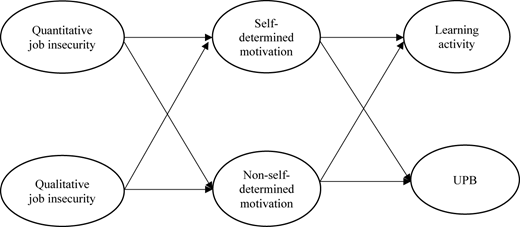
The hypothesized model is presented in Figure 1.

The SDT focuses on the nature and quality of motivation to explain human behavior (Tremblay et al., 2009), distinguishing between autonomous (self-determined) and controlled (non-self-determined) motivation. According to SDT, motivation arises from fulfilling three basic psychological needs – autonomy, competence and relatedness – which are essential for psychological growth and well-being (Deci and Ryan, 2000; Deci et al., 2017). Specifically, self-determined motivation originates from within the individual, as employees engage in their work because they find it inherently interesting or personally meaningful, thereby satisfying their psychological needs. For instance, an employee may choose to develop new skills out of a desire for professional growth.

In contrast, controlled (non-self-determined) motivation stems from external pressures such as rewards, supervision or fear of disapproval (Deci and Ryan, 2000). Here, basic needs are thwarted, and behavior is driven by obligation rather than choice. For example, an employee might learn a skill merely to meet managerial expectations or avoid criticism.

We posit that both dimensions of job insecurity diminish self-determined motivation and non-self-determined motivation. Grounded in SDT, research shows that job insecurity weakens self-determined motivation by frustrating needs for autonomy, relatedness and competence (Vander Elst et al., 2012). Autonomy suffers because job insecurity manifests as an externally imposed gap between expected stability and actual uncertainty (Hartley et al., 1990; Vander Elst et al., 2012), causing a loss of control that undermines agency. Relatedness is frustrated because the fear of loss threatens workgroup continuity (Greenhalgh and Rosenblatt, 1984; Hellgren et al., 1999) and disrupts the social fabric (Vander Elst et al., 2012). Specifically, job insecurity erodes interpersonal trust (DiFonzo and Bordia, 1998), fuels gossip (Bordia et al., 2006) and fosters unhealthy competition (De Cuyper et al., 2009), destroying mutual support. Competence is frustrated because job insecurity's ambiguity (Sverke and Hellgren, 2002) impairs the ability to anticipate demands and plan (Dekker and Schaufeli, 1995) diminishing self-efficacy (Vander Elst et al., 2012).

Job insecurity also undermines non-self-determined motivation, which relies on external contingencies and a reliable effort-reward link (Deci and Ryan, 2000; Gagné and Deci, 2005). By threatening employment and its rewards (Greenhalgh and Rosenblatt, 1984), JI severs this link; viewing outcomes as uncertain and beyond their influence, employees disengage (Vander Elst et al., 2012), reducing non-self-determined motivation.

2.3.1 Self-determined motivation and outcomes

2.3.1.1 Self-determined motivation and learning activities

Bezuijen et al. (2010) defined engagement in learning activities as employees' discretionary involvement in continuous learning aimed at mastering new knowledge, skills and abilities, serving employees' long-term career goals.

Grounded in SDT, Jiang et al. (2022) argue that job uncertainty threatens individuals' growth needs, thereby reducing the self-determined motivation required for learning during ongoing downsizing. This instability triggers a shift from approach-oriented exploration (e.g. learning and exploration to develop competency to survive) to avoidance-oriented risk minimization (Long et al., 2022). Furthermore, while learning activities typically build capability, they inherently carry risks that can paradoxically exacerbate insecurity (Billett, 1995). Employees may fear that participating in training will expose their incompetence or, particularly during restructuring, be viewed as a distraction from core tasks. Consequently, these combined motivational deficits and perceived risks significantly reduce engagement in learning activities.

2.3.1.2 Self-determined motivation and UPB

Employees experiencing job insecurity exhibit lower self-determined motivation, which ultimately decreases UPB. Grounded in SDT, diminished self-determined motivation reflects a suppressed sense of autonomy and personal volition (Deci and Ryan, 2000). This loss of autonomy subsequently reduces employees' self-efficacy and perceived control over their work (Parker, 1998), fostering a fear that deviating from formal rules will result in severe punishment or dismissal (Youli et al., 2014). Because UPB fundamentally involves risky and unethical norm violations, which inherently requires personal volition and a willingness to take risks (Mukherjee and Saritha, 2026; Umphress et al., 2010), this deficit in autonomy and control effectively deters employees from taking the personal risks necessary to engage in such behaviors.

2.4.1 Non-self-determined motivation and learning activities

Employees driven by non-self-determined motivation tend to exhibit less effective study planning, more superficial processing of learning materials and lower levels of concentration and task-focused engagement during learning activities (Vansteenkiste et al., 2010). When employees approach their work out of external pressure or obligation rather than genuine interest, they are more likely to experience stress, reduced focus and diminished enthusiasm for learning. Vansteenkiste et al. (2010) further demonstrated that non-self-determined motivation predicts a range of negative outcomes, including maladaptive coping strategies, test anxiety, surface-level learning and even withdrawal from learning contexts. These patterns have been consistently observed across diverse age groups and cultural settings. Accordingly, non-self-determined motivation is expected to negatively influence employees' engagement in workplace LA.

2.4.2 Non-self-determined motivation and UPB

Experiencing diminished non-self-determined motivation ultimately reduces UPB. In Vietnam's public sector, the “iron rice bowl” tradition of lifetime employment amplifies the psychological impact of JI (Tu et al., 2020). In this context, job loss threatens not just employment, but critical resources like income and social status, and career advancement opportunities (Urbanaviciute et al., 2021). Consequently, when restructuring makes future extrinsic rewards uncertain, employees withdraw from behaviors driven by those incentives, recognizing that the expected instrumental payoff has vanished (Charkhabi, 2019). Furthermore, because public organizations are strictly regulated, employees realize that risky, discretionary actions are unlikely to yield personal benefits during periods of high JI. Consequently, this threat to perceived stability suppresses extrinsically motivated behaviors (Ren et al., 2021), thereby directly reducing employees' engagement in UPB.

Drawing on the preceding arguments, we propose the following hypotheses regarding the mediating roles of self-determined motivation and non-self-determined motivation in the relationships between both dimensions of job insecurity (quantitative and qualitative) and behavioral outcomes.

H1a.

Quantitative job insecurity has a negative indirect effect on employee learning activities via self-determined motivation.

H1b.

Qualitative job insecurity has a negative indirect effect on employee learning activities via self-determined motivation.

H2a.

Quantitative job insecurity has a negative indirect effect on employee learning activities via non-self-determined motivation.

H2b.

Qualitative job insecurity has a negative indirect effect on employee learning activities via non-self-determined motivation.

H3a.

Quantitative job insecurity has a negative indirect effect on employee UPB via self-determined motivation.

H3b.

Qualitative job insecurity has a negative indirect effect on employee UPB via self-determined motivation.

H4a.

Quantitative job insecurity has a negative indirect effect on employee UPB via non-self-determined motivation.

H4b.

Qualitative job insecurity has a negative indirect effect on employee UPB via non-self-determined motivation

We recruited eligible participants working in public sectors and residing in the Vietnam using the online research platform Prolific (Link to the website). Prolific is a commercial crowd-working service explicitly designed for academic research. Prior studies have demonstrated its reliability and suitability for social science experiments and crowdsourcing behavioral research (e.g. Douglas et al., 2023; Palan and Schitter, 2018; Esch et al., 2025). To target the intended population of public officers, a preliminary screening question was used. Only respondents currently employed in Vietnam public organizations were eligible to complete the survey. Each participant received $2 for completing two waves of the survey.

To execute the two-wave research design, we utilized Prolific's screening tools to ensure that participation in the second wave was restricted to those who had completed the preceding rounds. Additionally, participants were required to provide their Prolific IDs at each stage, allowing us to accurately match responses across all two waves.

In the first phase, potential participants received consent statement, screening question, measures of perceived job insecurity and demographic items (age, gender and sector). The second wave, conducted one week later, measured work motivation, UPB and engagement in learning activities. A one-week interval is applied when measuring psychological factors like job insecurity to allow for adequate cognitive and emotional processing. This temporal separation enables researchers to successfully capture lasting psychological impacts rather than immediate, short-term reactions (Griep et al., 2021). This one-week temporal separation was applied in previous studies job insecurity's outcomes, such as (Karatepe et al., 2020; Langerak et al., 2022).

This study targeted 350 respondents, comfortably exceeding established methodological minimums to ensure robust statistical power. Literature widely recommends an absolute threshold of N 200 for structural equation modeling and models with fewer than 40 items (Theodoros, 2018; Singh et al., 2016; Kline, 2023). Furthermore, applying the recommended 5:1 participant-to-variable (N:p) ratio (DeVellis and Thorpe, 2021) to our 34 measured items necessitates a minimum of 170 participants. Consequently, our target sample of 350 safely surpasses both absolute and ratio-based requirements.

After conducting the survey, 282 people completed both waves of the study (response rate = 80.57%). We removed 15 cases due to incomplete responses, duplicate IP addresses or evidently arbitrary or irrelevant answers, yielding a final analytic sample of 267 participants (with 39.3% aged 30–39 and 51.3% male). With respect to sectoral affiliation, 18.4% worked in health care and social assistance, 17.2% in education services, 17.6% in finance and taxation, 10.5% in labor and employment services, 9% in utilities, 8.2% in public administration (core government) and the remaining 19.1% in other public segments.

Job insecurity. We adopted a two-dimensional conceptualization of job insecurity from Hellgren et al. (1999). The scale emphasizes both qualitative (e.g. “My pay development in this organization is promising,” reverse-coded) and quantitative JI (e.g. “I feel uneasy about losing my job in the near future”). Cronbach's alpha for quantitative job insecurity scale was 0.93 and qualitative job insecurity was 0.86.

Work motivation. In the second survey, work motivation was assessed with the 18-item instrument of Tremblay et al. (2009), asking about why they do their job. This scale covers self-determined motivation (e.g. “Because this job is a part of my life”) and non-self-determined motivation (e.g. “For the income it provides me”). Reliability for self-determined motivation was α = 0.92 and non-self-determined motivation was α = 0.84.

Unethical pro-organizational behavior. Participants reported their UPB using the scale from Umphress et al. (2010). An example item is “I would do whatever it takes to help my organization”. The scale demonstrated strong reliability (α = 0.94).

Engagement in learning activities. The eight-item employee engagement in learning activities scale (Bezuijen et al., 2010) was used to measure the extent to which employees engaged in learning activities over the time they felt insecure about their job. An example item is “I continually learn new skills for my job.” The reliability coefficient was α = 0.91.

Control variables. In this study, we controlled for participants' age, gender and sector, as previous research has demonstrated their significant impact on learning activities and UPB (Froehlich et al., 2015; Weerawardena et al., 2006; Dadaboyev et al., 2024).

Prior to hypothesis testing, confirmatory factor analysis was conducted to evaluate the validity and internal consistency reliability of the six-factor measurement model. According to Hair (2019), for a model with a sample size of 250 participants and over 30 observed items, the comparative fit index (CFI) or Tucker–Lewis index (TLI) should be greater than 0.92. Additionally, the root mean square error of approximation (RMSEA) should be lower than 0.08.

Given the modest sample size and the mediation effects in the model, we employed the two-step factor score regression (FSR) approach recommended by Lu et al. (2011). First, we used SPSS Statistics 27 to conduct a factor analysis and calculate factor scores for each latent variable. We computed these estimates using the regression method, which is the conventional choice for continuous data (Thomson, 1934). Second, we applied these factor scores in a linear regression, treating them as direct proxies for the true latent variables. This stepwise technique is advantageous for small samples, as it minimizes the risk of convergence issues and is less vulnerable to model misspecification (Devlieger and Rosseel, 2017).

To evaluate the mediation effects, we assessed the proposed hypotheses using Model 4 of the PROCESS macro. This analysis utilized a bootstrapping procedure with 5,000 resamples to calculate 95% confidence intervals (Hayes, 2017).

Because cross-sectional designs are susceptible to common method bias (CMBs), this study applied several procedural remedies outlined by Podsakoff et al. (2024). Specifically, we ensured participant anonymity, separated predictor and criterion variables using a two-wave survey and randomized questions with reverse coding to prevent response sets.

Despite these precautions, same-source data inherently carries CMB risks. Therefore, we also applied Harman's single-factor test to statistically verify that CMB did not significantly impact the results.

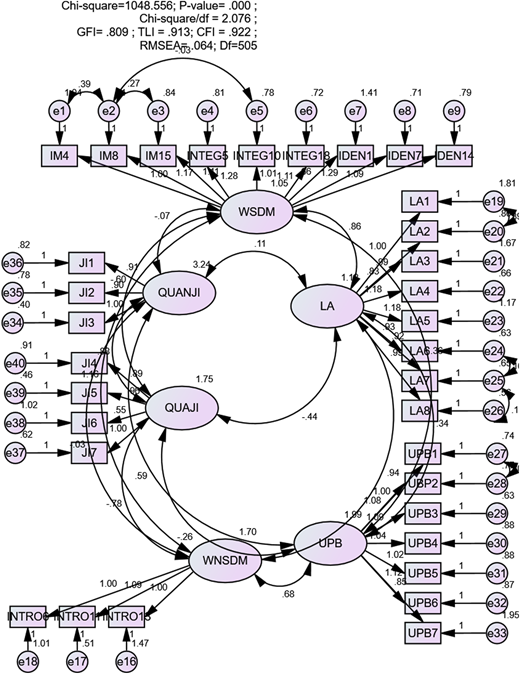
To assess the reliability and validity of the constructs, the measurement model was initially evaluated using confirmatory factor analysis (Anderson and Gerbing, 1988). The findings shown in Table 1. Our measurement model (Model 0) contained six latent factors showed acceptable fit (χ2 (608) = 1048.556, p < 0.001; CFI = 0.922; TLI = 0.913; RMSEA = 0.064) (Hair, 2019).

We assessed the presence of CMB in our model by performing Harman's one-factor test. Of the single-factor model (Model 3), none of the fit criteria were met (χ2 (740) = 5025.821, p < 0.001; CFI = 0.449; TLI = 0.419; RMSEA = 0.148) and the single-factor model showed a worse fit to the data compared to the hypothesized model (see Table 1). Therefore, CMB is not a significant issue in our model.

Table 2 summarizes the validity and reliability results for the first-order constructs. Convergent validity was established, as all average variance extracted (AVE) values exceeded the 0.5 threshold. Construct reliability was also confirmed, with Cronbach's alpha scores ranging from 0.842 (non-self-determined motivation) to 0.940 (UPB), all above the 0.7 minimum. Similarly, composite reliability (CR) values indicated strong internal consistency. To evaluate discriminant validity, the heterotrait-monotrait (HTMT) ratio was applied. All HTMT values remain well below the strict 0.90 threshold. Lastly, all variance inflation factors (VIFs) are less than 5, showing the model is free from multicollinearity. Overall, the measurement model demonstrated robust reliability and validity (Kline, 2023), justifying the subsequent evaluation of the structural model.

4.3.1 The means, standard deviations and correlations of the focal variables are presented in Table 3

Quantitative job insecurity correlated positively with UPB (r = 0.215, p < 0.01). Qualitative job insecurity correlated negatively with self-determined motivation (r = −0.395, p < 0.01), non-self-determined motivation (r = −0.367, p < 0.01), learning activities (r = −0.253, p < 0.01) and UPB (r = −0.132, p < 0.05).

4.3.2 Hypothesis testing

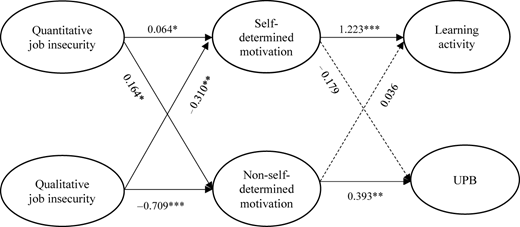
The research result is presented in Table 4. Regarding the pathways predicting learning activities, the indirect effect of quantitative job insecurity through self-determined motivation (Hypothesis 1a) was insignificant and therefore unsupported (Estimate = 0.079, p = 0.051). Conversely, Hypothesis 1b was fully supported, revealing a significant negative indirect effect of qualitative job insecurity on learning activities through self-determined motivation (Estimate = −0.308, p = 0.001). The alternative mediating pathways via non-self-determined motivation to learning activities failed to reach statistical significance for both quantitative job insecurity (Hypothesis 2a: Estimate = 0.006, p = 0.654) and qualitative job insecurity (Hypothesis 2b: Estimate = −0.025, p = 0.649), rendering both hypotheses unsupported.

Turning to the behavioral outcome of UPB, the indirect pathways operating through self-determined motivation were unsupported for both quantitative job insecurity (Hypothesis 3a: Estimate = −0.012, p = 0.637) and qualitative job insecurity (Hypothesis 3b: Estimate = 0.056, p = 0.635). Furthermore, the indirect effect of quantitative job insecurity on UPB through non-self-determined motivation (Hypothesis 4a) was insignificant and thus unsupported (Estimate = 0.065, p = 0.062). However, Hypothesis 4b was fully supported, demonstrating a significant negative indirect effect of qualitative job insecurity on UPB via non-self-determined motivation (Estimate = −0.279, p = 0.014). The results are illustrated in Figure 2.

Table 5 summarizes the results of the hypothesis testing.

Many public organizations are undergoing significant restructuring and reform which often heightens employees' perceptions of job insecurity (Vander Elst et al., 2014). The present study examines how quantitative and qualitative job insecurity influence learning activities and UPB with the mediating effect of self-determined motivation and non-self-determined motivation drawn on self-determined motivation.

While a substantial body of prior research, predominantly situated in Western or private-sector contexts, posits quantitative job insecurity as a primary stressor triggering active behavioral responses (e.g. Sverke and Hellgren, 2002; Shoss, 2017; Van Hootegem et al., 2023), our findings reveal a striking divergence. The non-significant effect of quantitative job insecurity here reflects Vietnam's unique institutional and cultural landscape. Institutionally, the tenure-based public sector minimizes the actual threat of dismissal through long-term contracts. Culturally, entrenched hierarchical norms, high power-distance (Hofstede, 2011) and Confucianism (Kelley, 2006) foster full compliance with organizational decisions: if leadership mandates a layoff, employees passively accept it rather than resisting. Consequently, employees worry less about absolute job loss and more about the degradation of future work condition (e.g. qualitative job insecurity) (De Cuyper et al., 2022). This contextual factor helps explain why quantitative job insecurity exerts a weaker influence than qualitative job insecurity, highlighting the importance of institutional and cultural context in job insecurity research.

Prior research frequently reports inconsistent behavioral outcomes of job insecurity, with some studies suggesting it triggers proactive survival tactics and others finding it causes withdrawal (Van Hootegem et al., 2018, 2023; Xu et al., 2022; Wang et al., 2022). These mixed results often stem from treating motivation as unidimensional. In stark contrast, our findings untangle this theoretical overlap by demonstrating that qualitative job insecurity negatively affects both learning activities and UPB through entirely distinct, dual-motivational pathways. Specifically, learning requires self-determined motivation, where employees perceive goals as meaningful and aligned with personal values (Deci and Ryan, 2000). Yet qualitative job insecurity severely depletes autonomy and competence, weakening self-determined motivation and stifling adaptive behaviors like learning (Long et al., 2022). Simultaneously, it diminishes non-self-determined motivation, curtailing UPB. By isolating these dual pathways, our study diverges from broad motivational models, proving job insecurity's complex effects stem from its distinct impact on autonomous versus controlled motivation.

Our findings carry implications that extend beyond the job insecurity literature to the theory of public sector reform and the behavioral foundations of public management.

First, this study advances the literature by disaggregating job insecurity into its quantitative and qualitative dimensions to assess their distinct effects on learning activities and UPB. By doing so, this study illuminates a micro-level mechanism through which system-wide administrative reform shapes the effectiveness and resilience of public organizations. As such this reframes how the employee experience of public restructuring should be theorized: reforms that aim at productivity and resilience but degrade job quality (through forced transfers, demotion or relocation) still generate profound insecurity, leading to reduced public values. The study also clarifies previous inconsistencies in the literature and calling on future research to model the distinct antecedents and consequences of each dimension of job insecurity.

Second, we clarify the divergent consequences of reform by examining its underlying motivational mechanisms (Long et al., 2022), contributing to the behavioral foundations of public administration. Applying SDT (Deci et al., 2017), we demonstrate that autonomous (self-determined motivation) and controlled (non-self-determined motivation) pathways differentially predict learning attitudes and UPB. Specifically, qualitative job insecurity suppresses learning activities exclusively via self-determined motivation, and UPB exclusively via non-self-determined motivation. For public management theory, this shows that reform may erode the motivational base, both intrinsic and extrinsic, on which a capable, engaged public workforce depends, underscoring the necessity of dual-motivation frameworks for explaining how job insecurity stemmed from restructuring translates into public employee behavior.

Finally, situating the research in Vietnam's reforming public sector challenges the generalizability of models built in Western, private-sector settings. The finding that quantitative job insecurity lacks a significant effect within a tenure-based, high-power-distance context indicates traditional job insecurity models do not seamlessly translate to public administration. Where dismissals are institutionally restricted and hierarchical compliance is expected, the psychological burden of reform shifts from fear of job loss toward degradation of job quality. Institutional and cultural contexts must therefore be treated as central, not peripheral, when theorizing public sector reform.

The findings of this study offer several practical implications for organizations. Accordingly, organizations seeking to sustain employees' learning motivation and ethical behavior must prioritize reducing the level of insecurity employees perceive. This foundational sense of security enables subsequent managerial practices to exert their intended motivational effects.

First, to mitigate qualitative job insecurity, organizations must prioritize clear, consistent communication regarding ongoing changes (Deci et al., 2017; Bezuijen et al., 2010). Transparent communication reduces uncertainty by delineating which job aspects will change and which will remain stable. Practically, leaders should provide timely updates, explain the rationale for restructuring and establish clear timelines. Furthermore, two-way communication (such as regular briefings and anonymous Q&A channels) prevents employees from filling information voids with negative assumptions. This proactive approach is especially critical during gradual transitions, where rumors often outpace official announcements.

Second, organizations can sustain autonomous motivation by providing individualized, development-oriented feedback (Umphress et al., 2010). Rather than relying on generic performance reviews, managers should implement structured approaches like the adaptive feedback framework (AFF) (Maier and Klotz, 2022). The AFF systematically delivers actionable guidance by diagnosing underlying learning needs and integrating informative, tutoring and reflective feedback components. By clarifying effective behaviors and outlining clear pathways for improvement, this structured feedback bolsters employees' psychological need for competence, thereby reinforcing their self-determined motivation.

Despite its contributions, several limitations warrant consideration. First, the survey's cross-sectional nature limits the ability to infer causal relationships among job insecurity, work motivation and behavioral outcomes. Although the two-wave design with a one-week interval helped mitigate immediate response bias and reduce CMB, this temporal separation remains insufficient to establish causal direction. Future research should employ multiwave longitudinal or experience sampling designs to examine within-person motivation dynamics and unethical conduct over time.

Second, omitting organizational tenure and managerial status as controls is a notable limitation, as both likely influence employee coping strategies during job insecurity. Because tenure builds firm-specific human capital (Ng and Feldman, 2010) and managerial roles dictate positional power, individuals across varying levels may utilize distinct behavioral mechanisms when facing job threats (Sverke and Hellgren, 2002). Future research should control for these temporal and hierarchical variables to accurately isolate how job insecurity drives constructive and unethical outcomes.

Third, while the sample size (N = 267) provides adequate statistical power for model testing, it constrains the examination of cross-cultural differences. As Vietnam is characterized by high power distance (Hofstede, 2011) and a socialist-oriented market economy (World Bank, 2025), job insecurity's effects on public officers' behaviors may differ from those among employees in low-power-distance capitalist economies such as the United States. Future research using larger, more diverse samples across countries would enable multigroup structural equation modeling to test the cultural robustness of SDT-based motivational pathways and identify potential boundary conditions.

Finally, the non-significant findings regarding quantitative job insecurity likely reflect unexamined boundary conditions rather than a true lack of effect. Because prior studies show that responses to JI are heavily moderated by individual traits like moral identity (Wang et al., 2022), and contextual factors like perceived fairness and leadership cues (Nguyen et al., 2021; Fehr et al., 2019; Zhang et al., 2018), a single-level analysis may obscure its true impact. Therefore, we strongly encourage future research to adopt a moderated mediation framework to uncover the specific conditions that activate quantitative job insecurity's effect on employee motivation and behavior.

Informed consent was obtained from all individuals who participated in the study. Participation was entirely voluntary, and participants were free to withdraw at any time. All information provided was kept strictly anonymous.

The authors are grateful to the Editor, Prof. Rocco Palumbo, and the three anonymous reviewers for their constructive comments and valuable guidance, which significantly improved the quality of this manuscript.

A structural equation model diagram showing relationships between various latent variables and observed variables.

Anderson
,
J.C.
and
Gerbing
,
D.W.
(
1988
), “
Structural equation modeling in practice: a review and recommended two-step approach
”,
Psychological Bulletin
, Vol. 
103
No. 
3
, pp.
411
-
423
, doi: .
Bezuijen
,
X.M.
,
Van Dam
,
K.
,
Van Den Berg
,
P.T.
and
Thierry
,
H.
(
2010
), “
How leaders stimulate employee learning: a leader–member exchange approach
”,
Journal of Occupational and Organizational Psychology
, Vol. 
83
No. 
3
, pp. 
673
-
693
, doi: .
Billett
,
S.
(
1995
), “
Workplace learning: its potential and limitations
”,
Education + Training
, Vol. 
37
No. 
5
, pp. 
20
-
27
, doi: .
Bordia
,
P.
,
Jones
,
E.
,
Gallois
,
C.
,
Callan
,
V.J.
and
Difonzo
,
N.
(
2006
), “
Management are aliens!:rumors and stress during organizational change
”,
Group and Organization Management
, Vol. 
31
, pp. 
601
-
621
.
Borg
,
I.
and
Elizur
,
D.
(
1992
), “
Job insecurity: correlates, moderators and measurement
”,
International Journal of Manpower
, Vol. 
13
No. 
2
, pp. 
13
-
26
, doi: .
Charkhabi
,
M.
(
2019
), “
Quantitative job insecurity and well-being: testing the mediating role of hindrance and challenge appraisals
”,
Frontiers in Psychology
, Vol. 
9
, p.
2776
, doi: .
Chen
,
L.
(
2023
), “
What is China's new government restructuring plan?
”,
available at:
 Link to the website(
accessed
 2025).
Dadaboyev
,
S.M.U.
,
Paek
,
S.
and
Choi
,
S.
(
2024
), “
Do gender, age and tenure matter when behaving unethically for organizations: meta-analytic review on organizational identity and unethical pro-organizational behavior
”,
Baltic Journal of Management
, Vol. 
19
, pp. 
1
-
18
, doi: .
De Cuyper
,
N.
,
Baillien
,
E.
and
De Witte
,
H.
(
2009
), “
Job insecurity, perceived employability and targets' and perpetrators' experiences of workplace bullying
”,
Work and Stress
, Vol. 
23
No. 
3
, pp. 
206
-
224
, doi: .
De Cuyper
,
N.
,
Smet
,
K.
and
De Witte
,
H.
(
2022
), “
I should learn to feel secure but I don't because I feel insecure: the relationship between qualitative job insecurity and work-related learning in the public sector
”,
Review of Public Personnel Administration
, Vol. 
42
No. 
4
, pp. 
760
-
785
, doi: .
De Witte
,
H.
(
2000
), “
Work ethic and job insecurity: assessment and consequences for well-being
”,
Satisfaction And Performance At Work. From Group To Community
, Vol. 
52
, pp. 
325
-
350
.
Deci
,
E.L.
and
Ryan
,
R.M.
(
2000
), “
The ‘what’ and ‘why’ of goal pursuits: human needs and the self-determination of behavior
”,
Psychological Inquiry
, Vol. 
11
No. 
4
, pp. 
227
-
268
, doi: .
Deci
,
E.L.
,
Olafsen
,
A.H.
and
Ryan
,
R.M.
(
2017
), “
Self-determination theory in work organizations: the state of A science
”,
Annual Review of Organizational Psychology and Organizational Behavior
, Vol. 
4
No. 
1
, pp. 
19
-
43
, doi: .
Dekker
,
S.W.A.
and
Schaufeli
,
W.B.
(
1995
), “
The effects of job insecurity on psychological health and withdrawal: a longitudinal study
”,
Australian Psychologist
, Vol. 
30
No. 
1
, pp. 
57
-
63
, doi: .
Devellis
,
R.F.
and
Thorpe
,
C.T.
(
2021
),
Scale Development: Theory and Applications
,
Sage Publications
.
Devlieger
,
I.
and
Rosseel
,
Y.
(
2017
),
Factor Score Path Analysis: An Alternative for Sem?
,
Hogrefe Publishing
.
Difonzo
,
N.
and
Bordia
,
P.
(
1998
), “
A tale of two corporations: managing uncertainty during organizational change
”,
Human Resource Management
, Vol. 
37
Nos
3-4
, pp. 
295
-
303
, doi: .
Douglas
,
B.D.
,
Ewell
,
P.J.
and
Brauer
,
M.
(
2023
), “
Data quality in online human-subjects research: comparisons between Mturk, Prolific, Cloudresearch, Qualtrics, and sona
”,
PLoS One
, Vol. 
18
No. 
3
, E0279720, doi: .
Esch
,
D.T.
,
Mylonopoulos
,
N.
and
Theoharakis
,
V.
(
2025
), “
Evaluating mobile-based data collection for crowdsourcing behavioral research
”,
Behavior Research Methods
, Vol. 
57
No. 
4
, p.
106
, doi: .
Fehr
,
R.
,
Welsh
,
D.
,
Yam
,
K.C.
,
Baer
,
M.
,
Wei
,
W.
and
Vaulont
,
M.
(
2019
), “
The role of moral decoupling in the causes and consequences of unethical pro-organizational behavior
”,
Organizational Behavior and Human Decision Processes
, Vol. 
153
, pp. 
27
-
40
, doi: .
Froehlich
,
D.E.
,
Beausaert
,
S.A.J.
and
Segers
,
M.S.R.
(
2015
), “
Age, employability and the role of learning activities and their motivational antecedents: a conceptual model
”,
International Journal of Human Resource Management
, Vol. 
26
No. 
16
, pp. 
2087
-
2101
, doi: .
Gagné
,
M.
and
Deci
,
E.L.
(
2005
), “
Self‐determination theory and work motivation
”,
Journal of Organizational Behavior
, Vol. 
26
No. 
4
, pp. 
331
-
362
, doi: .
Government News
(
2024
),
Gov't Releases Plan to Rearrange and Streamline Ministries
,
Vgp – Vietnam Government Portal
,
available at:
 Link to the website (
accessed
 2025).
Greenhalgh
,
L.
and
Rosenblatt
,
Z.
(
1984
), “
Job insecurity: toward conceptual clarity
”,
Academy of Management Review
, Vol. 
9
No. 
3
, pp. 
438
-
448
, doi: .
Griep
,
Y.
,
Vranjes
,
I.
,
Kraak
,
J.M.
,
Dudda
,
L.
and
Li
,
Y.
(
2021
), “
Start small, not random: Why does justifying your time-lag matter?
”,
Spanish Journal of Psychology
, Vol. 
24
, p.
E45
, doi: .
Hair
,
J.F.
(
2019
),
Multivariate Data Analysis
,
Cengage
,
Australia
.
Hartley
,
J.
,
Jacobson
,
D.
,
Klandermans
,
B.
and
Van Vuuren
,
T.
(
1990
),
Job Insecurity: Coping with Jobs at Risk
,
Sage Publications
.
Hayes
,
A.F.
(
2017
),
Introduction to Mediation, Moderation, and Conditional Process Analysis: A Regression-Based Approach
,
Guilford Publications
.
Hellgren
,
J.
,
Sverke
,
M.
and
Isaksson
,
K.
(
1999
), “
A two-dimensional approach to job insecurity: consequences for employee attitudes and well-being
”,
European Journal of Work and Organizational Psychology
, Vol. 
8
No. 
2
, pp. 
179
-
195
, doi: .
Hijal-Moghrabi
,
I.
,
Sabharwal
,
M.
and
Ramanathan
,
K.
(
2020
), “
Innovation in public organizations: Do government reforms matter?
”,
International Journal of Public Sector Management
, Vol. 
33
Nos 
6/7
, pp. 
731
-
749
, doi: .
Hillman
,
W.
,
Salam
,
R.
,
Normawati
,
N.
,
Paramarta
,
V.
and
Sunarsi
,
D.
(
2023
), “
Predicting turnover intention in Indonesian public organisations: investigating the effect of citizen and workplace incivility, and job insecurity
”,
International Journal of Public Sector Management
, Vol. 
36
, pp. 
365
-
381
.
Hofstede
,
G.
(
2011
), “
Dimensionalizing cultures: the hofstede model in context
”,
Online Readings In Psychology And Culture
, Vol. 
2
No. 
1
, p.
8
, doi: .
Hur
,
H.
(
2022
), “
Job security matters: a systematic review and meta-analysis of the relationship between job security and work attitudes
”,
Journal of Management and Organization
, Vol. 
28
No. 
5
, pp. 
925
-
955
, doi: .
Jiang
,
L.
,
Lawrence
,
A.
and
Xu
,
X.
(
2022
), “
Does A stick work? A meta-analytic examination of curvilinear relationships between job insecurity and employee workplace behaviors
”,
Journal of Organizational Behavior
, Vol. 
43
No. 
8
, pp. 
1410
-
1445
, doi: .
Karatepe
,
O.M.
,
Rezapouraghdam
,
H.
and
Hassannia
,
R.
(
2020
), “
Job insecurity, work engagement and their effects on hotel employees' non-green and nonattendance behaviors
”,
International Journal of Hospitality Management
, Vol. 
87
, 102472, doi: .
Kelley
,
L.C.
(
2006
), “
Confucianism in Vietnam: a state of the field essay
”,
Journal of Vietnamese Studies
, Vol. 
1
Nos
1-2
, pp. 
314
-
370
, doi: .
Kline
,
R.B.
(
2023
),
Principles and Practice of Structural Equation Modeling
,
Guilford Publications
.
Lam
,
C.F.
,
Liang
,
J.
,
Ashford
,
S.J.
and
Lee
,
C.
(
2015
), “
Job insecurity and organizational citizenship behavior: exploring curvilinear and moderated relationships
”,
Journal of Applied Psychology
, Vol. 
100
No. 
2
, pp. 
499
-
510
, doi: .
Langerak
,
J.B.
,
Koen
,
J.
and
Van Hooft
,
E.A.J.
(
2022
), “
How to minimize job insecurity: the role of proactive and reactive coping over time
”,
Journal of Vocational Behavior
, Vol. 
136
, 103729, doi: .
Lee
,
C.
,
Huang
,
G.-H.
and
Ashford
,
S.J.
(
2018
), “
Job insecurity and the changing workplace: recent developments and the future trends in job insecurity research
”,
Annual Review of Organizational Psychology and Organizational Behavior
, Vol. 
5
No. 
1
, pp. 
335
-
359
, doi: .
Long
,
L.-R.
,
Tu
,
Y.
,
Wang
,
H.-J.
and
Jiang
,
L.
(
2022
), “
The content of the threat matters: the differential effects of quantitative and qualitative job insecurity on different types of employee motivation
”,
Journal of Business and Psychology
, Vol. 
37
No. 
2
, pp. 
297
-
310
, doi: .
Lu
,
I.R.R.
,
Kwan
,
E.
,
Thomas
,
D.R.
and
Cedzynski
,
M.
(
2011
), “
Two new methods for estimating structural equation models: an illustration and A comparison with two established methods
”,
International Journal of Research in Marketing
, Vol. 
28
No. 
3
, pp. 
258
-
268
, doi: .
Maier
,
U.
and
Klotz
,
C.
(
2022
), “
Personalized feedback in digital learning environments: classification framework and literature review
”,
Computers and Education: Artificial Intelligence
, Vol. 
3
, 100080, doi: .
Ministry Of Culture - Sports And Tourism
(
2025
), “Decree 178/2024/Nd-cp on policies for officials, civil servants, and armed forces personnel when restructuring the apparatus - radio station”, in
Information
,
D.O.G.I.A.F.
(Ed.),
Hanoi, Vietnam: Ministry of Culture - Sports and Tourism
.
Ministry Of Housing and Communities And Local Government
(
2025
), “
Local government reorganisation: policy and programme updates
”,
available at:
 Link to the website (
accessed
 2025).
Mukherjee
,
U.
and
Saritha
,
S.R.
(
2026
), “
Unethical pro-organizational behavior: a systematic literature review and research agenda
”,
International Journal of Ethics and Systems
, Vol. 
42
No. 
2
, pp.
378
-
417
, doi: .
Ng
,
T.W.H.
and
Feldman
,
D.C.
(
2010
), “
Organizational tenure and job performance
”,
Journal of Management
, Vol. 
36
No. 
5
, pp.
1220
-
1250
.
Ngo
,
Q.D.
,
Nguyen
,
Q.H.
and
Vu
,
C.
(
2025
), “
Envisioning future workforce adaptability: a multi‐layered analysis of skills ecosystems in Vietnam's emerging economy
”,
Futures and Foresight Science
, Vol. 
7
No. 
1
, E70000, doi: .
Nguyen
,
T.
(
2025
),
Over 22,000 Government Positions Cut as Vietnam Reforms Public Sector
,
Vietnamnet Global
,
available at:
 Link to the website (
accessed
 2025).
Nguyen
,
C.M.
,
Zhang
,
L.
and
Morand
,
D.
(
2021
), “
Unethical pro-organizational behavior: a moderated mediational model of its transmission from managers to employees
”,
Journal of Leadership and Organizational Studies
, Vol. 
28
No. 
3
, pp. 
379
-
393
, doi: .
Oliveira
,
E.
,
Lam
,
S.Y.
,
Abner
,
G.
,
Lee
,
S.
,
Hur
,
H.
,
Suzuki
,
K.
and
Perry
,
J.L.
(
2026
), “
Does removing job security foster healthy and effective organisations? A systematic review of public and private sector research
”,
Asia Pacific Journal Of Public Administration
, Vol. 
48
No. 
1
, pp. 
21
-
39
, doi: .
Palan
,
S.
and
Schitter
,
C.
(
2018
), “
Prolific.Ac—a subject pool for online experiments
”,
Journal Of Behavioral And Experimental Finance
, Vol. 
17
, pp. 
22
-
27
, doi: .
Parker
,
S.K.
(
1998
), “
Enhancing role breadth self-efficacy: the roles of job enrichment and other organizational interventions
”,
Journal of Applied Psychology
, Vol. 
83
No. 
6
, pp. 
835
-
852
, doi: .
Piccoli
,
B.
and
De Witte
,
H.
(
2015
), “
Job insecurity and emotional exhaustion: testing psychological contract breach versus distributive injustice as indicators of lack of reciprocity
”,
Work and Stress
, Vol. 
29
No. 
3
, pp. 
246
-
263
, doi: .
Podsakoff
,
P.M.
,
Podsakoff
,
N.P.
,
Williams
,
L.J.
,
Huang
,
C.
and
Yang
,
J.
(
2024
), “
Common method bias: It&s bad, it&s complex, it&s widespread, and it&s not easy to fix
”,
Annual Review of Organizational Psychology and Organizational Behavior
, Vol. 
11
, pp. 
17
-
61
.
Probst
,
T.M.
(
2003
), “
Development and validation of the job security index and the job security satisfaction scale: a classical test theory and irt approach
”,
Journal of Occupational and Organizational Psychology
, Vol. 
76
No. 
4
, pp. 
451
-
467
, doi: .
Probst
,
T.M.
,
Stewart
,
S.M.
,
Gruys
,
M.L.
and
Tierney
,
B.W.
(
2007
), “
Productivity, counterproductivity and creativity: the ups and downs of job insecurity
”,
Journal of Occupational and Organizational Psychology
, Vol. 
80
No. 
3
, pp. 
479
-
497
, doi: .
Ren
,
F.
,
Zhang
,
Q.
and
Wei
,
X.
(
2021
), “
Work autonomous and controlled motivation on Chinese employees' work performance and innovative work behaviour: the moderating role of financial stress
”,
Frontiers in Psychology
, Vol. 
12
, 676063, doi: .
Roth
,
A.
(
2025
), “
Us state department announces plan to lay off nearly 15% of its domestic staff
”,
available at:
 Link to the website (
accessed
 2025).
Shoss
,
M.K.
(
2017
), “
Job insecurity: an integrative review and agenda for future research
”,
Journal of Management
, Vol. 
43
No. 
6
, pp. 
1911
-
1939
, doi: .
Singh
,
K.
,
Junnarkar
,
M.
and
Kaur
,
J.
(
2016
), “Measures of positive psychology”, in
Development and Validation
,
Springer
,
Berlin
.
Staufenbiel
,
T.
and
König
,
C.J.
(
2010
), “
A model for the effects of job insecurity on performance, turnover intention, and absenteeism
”,
Journal of Occupational and Organizational Psychology
, Vol. 
83
No. 
1
, pp. 
101
-
117
, doi: .
Sverke
,
M.
and
Hellgren
,
J.
(
2002
), “
The nature of job insecurity: understanding employment uncertainty on the brink of A new millennium
”,
Applied Psychology
, Vol. 
51
No. 
1
, pp. 
23
-
42
, doi: .
Theodoros
,
A.K.
(
2018
), “
Applied psychometrics: sample size and sample power considerations in factor analysis (efa, Cfa) and sem in general
”,
Psychology
, Vol. 
09
, pp. 
2207
-
2230
.
Thomson
,
G.H.
(
1934
), “
The meaning of I in the estimate of G
”,
British Journal of Psychology
, Vol. 
25
No. 
1
, pp. 
92
-
99
, doi: .
Tremblay
,
M.A.
,
Blanchard
,
C.M.
,
Taylor
,
S.
,
Pelletier
,
L.G.
and
Villeneuve
,
M.
(
2009
), “
Work extrinsic and intrinsic motivation scale: its value for organizational psychology research
”,
Canadian Journal Of Behavioural Science/Revue Canadienne Des Sciences Du Comportement
, Vol. 
41
No. 
4
, pp. 
213
-
226
, doi: .
Tu
,
Y.
,
Long
,
L.
,
Wang
,
H.-J.
and
Jiang
,
L.
(
2020
), “
To prevent or to promote: how regulatory focus moderates the differentiated effects of quantitative versus qualitative job insecurity on employee stress and motivation
”,
International Journal of Stress Management
, Vol. 
27
No. 
2
, pp. 
135
-
145
, doi: .
Umphress
,
E.E.
,
Bingham
,
J.B.
and
Mitchell
,
M.S.
(
2010
), “
Unethical behavior in the name of the company: the moderating effect of organizational identification and positive reciprocity beliefs on unethical pro-organizational behavior
”,
Journal of Applied Psychology
, Vol. 
95
No. 
4
, pp. 
769
-
780
, doi: .
Urbanaviciute
,
I.
,
Lazauskaite-Zabielske
,
J.
and
De Witte
,
H.
(
2021
), “
Deconstructing job insecurity: do its qualitative and quantitative dimensions add up?
”,
Occupational Health Science
, Vol. 
5
No. 
3
, pp. 
415
-
435
, doi: .
Van Den Broeck
,
A.
,
Sulea
,
C.
,
Vander Elst
,
T.
,
Fischmann
,
G.
,
Iliescu
,
D.
and
De Witte
,
H.
(
2014
), “
The mediating role of psychological needs in the relation between qualitative job insecurity and counterproductive work behavior
”,
Career Development International
, Vol. 
19
No. 
5
, pp. 
526
-
547
, doi: .
Van Hootegem
,
A.
,
De Witte
,
H.
,
De Cuyper
,
N.
and
Elst
,
T.V.
(
2018
), “
Job insecurity and the willingness to undertake training: the moderating role of perceived employability
”,
Journal of Career Development
, Vol. 
46
No. 
4
, pp. 
395
-
409
, doi: .
Van Hootegem
,
A.
,
Grosemans
,
I.
and
De Witte
,
H.
(
2023
), “
In need of opportunities: a within-person investigation of opposing pathways in the relationship between job insecurity and participation in development activities
”,
Journal of Vocational Behavior
, Vol. 
140
, 103825, doi: .
Vander Elst
,
T.
,
Van Den Broeck
,
A.
,
De Witte
,
H.
and
De Cuyper
,
N.
(
2012
), “
The mediating role of frustration of psychological needs in the relationship between job insecurity and work-related well-being
”,
Work and Stress
, Vol. 
26
No. 
3
, pp. 
252
-
271
, doi: .
Vander Elst
,
T.
,
Richter
,
A.
,
Sverke
,
M.
,
Näswall
,
K.
,
De Cuyper
,
N.
and
De Witte
,
H.
(
2014
), “
Threat of losing valued job features: the role of perceived control in mediating the effect of qualitative job insecurity on job strain and psychological withdrawal
”,
Work and Stress
, Vol. 
28
No. 
2
, pp. 
143
-
164
, doi: .
Vansteenkiste
,
M.
,
Smeets
,
S.
,
Soenens
,
B.
,
Lens
,
W.
,
Matos
,
L.
and
Deci
,
E.L.
(
2010
), “
Autonomous and controlled regulation of performance-approach goals: their relations to perfectionism and educational outcomes
”,
Motivation and Emotion
, Vol. 
34
No. 
4
, pp. 
333
-
353
, doi: .
Vneconomy
(
2025
),
Resolutions and Decisions on Merger of Local Administrative Units Nationwide Announced
,
Vneconomy
,
available at:
 Link to the website
Vo
,
T.T.D.
(
2025
), “
Should performance-oriented organisational culture or learning-oriented organisational model Be encouraged to employees: a context of Vietnam
”,
Human Resource Development International
, pp. 
1
-
11
, doi: .
Wang
,
D.
,
Weng
,
Q.
,
Kiani
,
A.
and
Ali
,
A.
(
2022
), “
Job insecurity and unethical pro-organizational behavior: the joint moderating effects of moral identity and proactive personality
”,
Personality and Individual Differences
, Vol. 
195
, 111685, doi: .
Weerawardena
,
J.
,
O'cass
,
A.
and
Julian
,
C.
(
2006
), “
Does industry matter? Examining the role of industry structure and organizational learning in innovation and brand performance
”,
Journal of Business Research
, Vol. 
59
No. 
1
, pp. 
37
-
45
, doi: .
World Bank
(
2025
), “
Viet Nam overview
”,
available at:
 Link to the website
Xu
,
L.
,
Wen
,
T.
and
Wang
,
J.
(
2022
), “
How does job insecurity cause unethical pro-organizational behavior? The mediating role of impression management motivation and the moderating role of organizational identification
”,
Frontiers in Psychology
, Vol. 
13
, 941650, doi: .
Youli
,
H.
,
Xixi
,
L.
and
Xi
,
W.
(
2014
), “
The effects of transformational leadership on employee's pro-social rule breaking
”,
Canadian Social Science
, Vol. 
10
, p.
128
.
Zhang
,
Y.
,
He
,
B.
and
Sun
,
X.
(
2018
), “
The contagion of unethical pro-organizational behavior: from leaders to followers
”,
Frontiers in Psychology
, Vol. 
9
, p.
1102
, doi: .
Howard
,
J.L.
,
Gagné
,
M.
and
Bureau
,
J.S.
(
2017
), “
Testing A continuum structure of self-determined motivation: a meta-analysis
”,
Psychological Bulletin
, Vol. 
143
No. 
12
, pp. 
1346
-
1377
, doi: .
Huang
,
G.-H.
,
Wellman
,
N.
,
Ashford
,
S.J.
,
Lee
,
C.
and
Wang
,
L.
(
2017
), “
Deviance and exit: the organizational costs of job insecurity and moral disengagement
”,
Journal of Applied Psychology
, Vol. 
102
No. 
1
, pp. 
26
-
42
, doi: .
Jiang
,
L.
and
Probst
,
T.M.
(
2016
), “
A multilevel examination of affective job insecurity climate on safety outcomes
”,
Journal of Occupational Health Psychology
, Vol. 
21
No. 
3
, pp. 
366
-
377
, doi: .
Published by Emerald Publishing Limited. This article is published under the Creative Commons Attribution (CC BY 4.0) licence. Anyone may reproduce, distribute, translate and create derivative works of this article (for both commercial and non-commercial purposes), subject to full attribution to the original publication and authors. The full terms of this licence may be seen at Link to the terms of the CC BY 4.0 licence.

Data & Figures

Figure 1
A diagram representing a hypothesized model of job insecurity and its impact on motivation and learning activity.A diagram of a hypothesized model. The diagram represents the relationships between quantitative job insecurity, qualitative job insecurity, self-determined motivation, non-self-determined motivation, learning activity, and UPB. Quantitative job insecurity and qualitative job insecurity are connected by arrows pointing towards self-determined motivation and non-self-determined motivation. Self-determined motivation has an arrow pointing towards learning activity, while non-self-determined motivation has an arrow pointing towards UPB. Additionally, there is an arrow from learning activity to UPB. The diagram illustrates how different types of job insecurity influence motivation, which in turn affects learning activity and UPB.

Hypothesized model. Source: Author's own created

Figure 1
A diagram representing a hypothesized model of job insecurity and its impact on motivation and learning activity.A diagram of a hypothesized model. The diagram represents the relationships between quantitative job insecurity, qualitative job insecurity, self-determined motivation, non-self-determined motivation, learning activity, and UPB. Quantitative job insecurity and qualitative job insecurity are connected by arrows pointing towards self-determined motivation and non-self-determined motivation. Self-determined motivation has an arrow pointing towards learning activity, while non-self-determined motivation has an arrow pointing towards UPB. Additionally, there is an arrow from learning activity to UPB. The diagram illustrates how different types of job insecurity influence motivation, which in turn affects learning activity and UPB.

Hypothesized model. Source: Author's own created

Close modal
Figure 2
A diagram illustrating the relationships between quantitative job insecurity, qualitative job insecurity, self-determined motivation, non-self-determined motivation, learning activity, and UPB.The diagram presents a model of relationships between various types of job insecurity, motivations, learning activity, and UPB. Quantitative job insecurity positively influences self-determined motivation with a coefficient of 0.064 and non-self-determined motivation with a coefficient of 0.164. Qualitative job insecurity negatively influences self-determined motivation with a coefficient of -0.310 and non-self-determined motivation with a coefficient of -0.709. Self-determined motivation positively influences learning activity with a coefficient of 1.223. Non-self-determined motivation has a negligible effect on learning activity with a coefficient of 0.036 and a positive influence on UPB with a coefficient of 0.393. Learning activity has a negligible effect on UPB with a coefficient of 0.179. The diagram includes annotations indicating the significance levels of the coefficients with asterisks representing p-values less than 0.05, 0.01, and 0.001 respectively.

Research results. Source: Author's own created. Note. ⇢. →. *, **, ***: p-values <0.05, 0.01 and 0.001, respectively

Figure 2
A diagram illustrating the relationships between quantitative job insecurity, qualitative job insecurity, self-determined motivation, non-self-determined motivation, learning activity, and UPB.The diagram presents a model of relationships between various types of job insecurity, motivations, learning activity, and UPB. Quantitative job insecurity positively influences self-determined motivation with a coefficient of 0.064 and non-self-determined motivation with a coefficient of 0.164. Qualitative job insecurity negatively influences self-determined motivation with a coefficient of -0.310 and non-self-determined motivation with a coefficient of -0.709. Self-determined motivation positively influences learning activity with a coefficient of 1.223. Non-self-determined motivation has a negligible effect on learning activity with a coefficient of 0.036 and a positive influence on UPB with a coefficient of 0.393. Learning activity has a negligible effect on UPB with a coefficient of 0.179. The diagram includes annotations indicating the significance levels of the coefficients with asterisks representing p-values less than 0.05, 0.01, and 0.001 respectively.

Research results. Source: Author's own created. Note. ⇢. →. *, **, ***: p-values <0.05, 0.01 and 0.001, respectively

Close modal
Table 1

Confirmatory factor analyses of measurement models

Modelχ2(df)dfχ2/dfCFITLIRMSEA
M0: Hypothesized six-factor model1048.5565052.0760.9220.9130.064
M1: Five-factor model combining self-determined motivation and non-self-determined motivation into one factor2191.6227303.0020.8120.7990.087
M2: Five-factor model combining quantitative job insecurity and qualitative job insecurity into one factor3083.4367304.2240.6980.6770.110
M3: One-factor model5025.8217406.7920.4490.4190.148

Note(s): N = 267. All chi-square values are significant at p < 0.01. The six-factor model is the hypothesized model, with all six measures loading on separate factors. CFI = comparative fit index; TLI = Tucker–Lewis Index; RMSEA = root mean square error of approximation

Source(s): Authors’ own work
Table 2

Constructs validity and reliability

ConstructCronbach's alpha (>0.70)Composite reliability (rho-c) (>0.70)AVE (>0.50)VIF (<5)Heterotrait-monotrait ratio (HTMT) (<0.90)
MediatorsOutcomesQuantitative JIQualitative JIWSDMWNSDMLA
Quantitative JI0.9250.9270.8071.1321.168     
Qualitative JI0.8550.8660.6061.1321.4280.386    
WSDM0.9240.9260.585 3.0010.0610.446   
WNSDM0.8420.7490.569 3.0690.0540.4480.870  
LA0.9090.8770.530  0.1010.2850.7760.665 
UPB0.9400.9450.716  0.2280.1590.2930.4530.274

Note(s): JI = job insecurity; WSDM = work self-determined motivation; WNSDM = work non-self-determined motivation; LA = learning activities; UPB = unethical pro-organizational behavior

Source(s): Authors’ own work
Table 3

Means, standard deviations and correlations among focal variables

VariableMSD123456
1. Quantitative job insecurity4.261.75(0.93)     
2. Qualitative job insecurity3.171.210.344**(0.86)    
3. Self-determined motivation5.041.16−0.031−0.395**(0.92)   
4. Non-self-determined motivation5.151.000.018−0.367**0.781*(0.77)  
5. Learning activities5.131.130.071−0.253**0.718**0.595**(0.90) 
6. UPB2.951.500.215**−0.132*0.258**0.296**0.237**(0.94)

Note(s): N = 267. Cronbach's alphas are presented on the diagonal in parentheses

*p < 0.05

**p < 0.01

Source(s): Authors’ owned work
Table 4

Unstandardized coefficients of path analysis

EffectsEstimatesStandard errorp-valuesNote
Total effects
Quantitative job insecurity → learning activities0.085*0.0270.047 
Quantitative job insecurity → UPB0.053*0.0270.049 
Qualitative job insecurity → learning activities−0.405**0.1190.001 
Qualitative job insecurity → UPB−0.223*0.0860.010 
Direct effects
Quantitative job insecurity → Self-determined motivation0.064*0.0320.043 
Quantitative job insecurity → Non-self-determined motivation0.164*0.0680.015 
Qualitative job insecurity→ Self-determined motivation−0.310**0.0930.001 
Qualitative job insecurity → Non-self-determined motivation−0.709***0.0180.000 
Self-determined motivation → Learning activity1.223***0.2760.000 
Self-determined motivation → UPB−0.1790.2970.547 
Non-self-determined motivation → Learning activity0.0360.0670.591 
Non-self-determined motivation → UPB0.393**0.1230.001 
Indirect effects
Quantitative job insecurity → Self-determined motivation → learning activities (H1a)0.0790.0400.051Unsupported
Qualitative job insecurity → Self-determined motivation → learning activities (H1b)−0.308**0.1120.001Supported
Quantitative job insecurity → Non-self-determined motivation → learning activities (H2a)0.0060.0130.654Unsupported
Qualitative job insecurity → Non-self-determined motivation → learning activities (H2b)−0.0250.0560.649Unsupported
Quantitative job insecurity → Self-determined motivation → UPB (H3a)−0.0120.0240.637Unsupported
Qualitative job insecurity→ Self-determined motivation → UPB (H3b)0.0560.1170.635Unsupported
Quantitative job insecurity → Non-self-determined motivation → UPB (H4a)0.0650.0350.062Unsupported
Qualitative job insecurity → Non-self-determined motivation → UPB (H4b)−0.279**0.1120.014Supported
Control variables
Age → learning activities−0.0430.0400.277 
Age → UPB−0.324**0.0810.000 
Gender → learning activities0.1090.0780.165 
Gender → UPB−0.1800.1530.238 
Sector → learning activities−0.0030.0130.792 
Sector → UPB0.0050.0230.827 

Note(s): *p < 0.05, **p < 0.01. N = 267. Estimates = Unstandardized path coefficients

Source(s): Authors’ own work
Table 5

Summary of research results

HypothesesContentResult
Hypothesis 1aQuantitative job insecurity has a negative indirect effect on employee learning via self-determined work motivationUnsupported
Hypothesis 1bQualitative job insecurity has a negative indirect effect on employee learning via self-determined work motivationSupported
Hypothesis 2aQuantitative job insecurity has a negative indirect effect on employee learning via work non-self-determined motivationUnsupported
Hypothesis 2bQualitative job insecurity has a negative indirect effect on employee learning via work non-self-determined motivationUnsupported
Hypothesis 3aQuantitative job insecurity has a negative indirect effect on employee UPB via self-determined work motivationUnsupported
Hypothesis 3bQualitative job insecurity has a negative indirect effect on employee UPB via self-determined work motivationUnsupported
Hypothesis 4aQuantitative job insecurity has a negative indirect effect on employee UPB via work non-self-determined work motivationUnsupported
Hypothesis 4bQualitative job insecurity has a negative indirect effect on employee UPB via work non-self-determined work motivationSupported
Source(s): Authors’ owned work

Supplements

References

Anderson
,
J.C.
and
Gerbing
,
D.W.
(
1988
), “
Structural equation modeling in practice: a review and recommended two-step approach
”,
Psychological Bulletin
, Vol. 
103
No. 
3
, pp.
411
-
423
, doi: .
Bezuijen
,
X.M.
,
Van Dam
,
K.
,
Van Den Berg
,
P.T.
and
Thierry
,
H.
(
2010
), “
How leaders stimulate employee learning: a leader–member exchange approach
”,
Journal of Occupational and Organizational Psychology
, Vol. 
83
No. 
3
, pp. 
673
-
693
, doi: .
Billett
,
S.
(
1995
), “
Workplace learning: its potential and limitations
”,
Education + Training
, Vol. 
37
No. 
5
, pp. 
20
-
27
, doi: .
Bordia
,
P.
,
Jones
,
E.
,
Gallois
,
C.
,
Callan
,
V.J.
and
Difonzo
,
N.
(
2006
), “
Management are aliens!:rumors and stress during organizational change
”,
Group and Organization Management
, Vol. 
31
, pp. 
601
-
621
.
Borg
,
I.
and
Elizur
,
D.
(
1992
), “
Job insecurity: correlates, moderators and measurement
”,
International Journal of Manpower
, Vol. 
13
No. 
2
, pp. 
13
-
26
, doi: .
Charkhabi
,
M.
(
2019
), “
Quantitative job insecurity and well-being: testing the mediating role of hindrance and challenge appraisals
”,
Frontiers in Psychology
, Vol. 
9
, p.
2776
, doi: .
Chen
,
L.
(
2023
), “
What is China's new government restructuring plan?
”,
available at:
 Link to the website(
accessed
 2025).
Dadaboyev
,
S.M.U.
,
Paek
,
S.
and
Choi
,
S.
(
2024
), “
Do gender, age and tenure matter when behaving unethically for organizations: meta-analytic review on organizational identity and unethical pro-organizational behavior
”,
Baltic Journal of Management
, Vol. 
19
, pp. 
1
-
18
, doi: .
De Cuyper
,
N.
,
Baillien
,
E.
and
De Witte
,
H.
(
2009
), “
Job insecurity, perceived employability and targets' and perpetrators' experiences of workplace bullying
”,
Work and Stress
, Vol. 
23
No. 
3
, pp. 
206
-
224
, doi: .
De Cuyper
,
N.
,
Smet
,
K.
and
De Witte
,
H.
(
2022
), “
I should learn to feel secure but I don't because I feel insecure: the relationship between qualitative job insecurity and work-related learning in the public sector
”,
Review of Public Personnel Administration
, Vol. 
42
No. 
4
, pp. 
760
-
785
, doi: .
De Witte
,
H.
(
2000
), “
Work ethic and job insecurity: assessment and consequences for well-being
”,
Satisfaction And Performance At Work. From Group To Community
, Vol. 
52
, pp. 
325
-
350
.
Deci
,
E.L.
and
Ryan
,
R.M.
(
2000
), “
The ‘what’ and ‘why’ of goal pursuits: human needs and the self-determination of behavior
”,
Psychological Inquiry
, Vol. 
11
No. 
4
, pp. 
227
-
268
, doi: .
Deci
,
E.L.
,
Olafsen
,
A.H.
and
Ryan
,
R.M.
(
2017
), “
Self-determination theory in work organizations: the state of A science
”,
Annual Review of Organizational Psychology and Organizational Behavior
, Vol. 
4
No. 
1
, pp. 
19
-
43
, doi: .
Dekker
,
S.W.A.
and
Schaufeli
,
W.B.
(
1995
), “
The effects of job insecurity on psychological health and withdrawal: a longitudinal study
”,
Australian Psychologist
, Vol. 
30
No. 
1
, pp. 
57
-
63
, doi: .
Devellis
,
R.F.
and
Thorpe
,
C.T.
(
2021
),
Scale Development: Theory and Applications
,
Sage Publications
.
Devlieger
,
I.
and
Rosseel
,
Y.
(
2017
),
Factor Score Path Analysis: An Alternative for Sem?
,
Hogrefe Publishing
.
Difonzo
,
N.
and
Bordia
,
P.
(
1998
), “
A tale of two corporations: managing uncertainty during organizational change
”,
Human Resource Management
, Vol. 
37
Nos
3-4
, pp. 
295
-
303
, doi: .
Douglas
,
B.D.
,
Ewell
,
P.J.
and
Brauer
,
M.
(
2023
), “
Data quality in online human-subjects research: comparisons between Mturk, Prolific, Cloudresearch, Qualtrics, and sona
”,
PLoS One
, Vol. 
18
No. 
3
, E0279720, doi: .
Esch
,
D.T.
,
Mylonopoulos
,
N.
and
Theoharakis
,
V.
(
2025
), “
Evaluating mobile-based data collection for crowdsourcing behavioral research
”,
Behavior Research Methods
, Vol. 
57
No. 
4
, p.
106
, doi: .
Fehr
,
R.
,
Welsh
,
D.
,
Yam
,
K.C.
,
Baer
,
M.
,
Wei
,
W.
and
Vaulont
,
M.
(
2019
), “
The role of moral decoupling in the causes and consequences of unethical pro-organizational behavior
”,
Organizational Behavior and Human Decision Processes
, Vol. 
153
, pp. 
27
-
40
, doi: .
Froehlich
,
D.E.
,
Beausaert
,
S.A.J.
and
Segers
,
M.S.R.
(
2015
), “
Age, employability and the role of learning activities and their motivational antecedents: a conceptual model
”,
International Journal of Human Resource Management
, Vol. 
26
No. 
16
, pp. 
2087
-
2101
, doi: .
Gagné
,
M.
and
Deci
,
E.L.
(
2005
), “
Self‐determination theory and work motivation
”,
Journal of Organizational Behavior
, Vol. 
26
No. 
4
, pp. 
331
-
362
, doi: .
Government News
(
2024
),
Gov't Releases Plan to Rearrange and Streamline Ministries
,
Vgp – Vietnam Government Portal
,
available at:
 Link to the website (
accessed
 2025).
Greenhalgh
,
L.
and
Rosenblatt
,
Z.
(
1984
), “
Job insecurity: toward conceptual clarity
”,
Academy of Management Review
, Vol. 
9
No. 
3
, pp. 
438
-
448
, doi: .
Griep
,
Y.
,
Vranjes
,
I.
,
Kraak
,
J.M.
,
Dudda
,
L.
and
Li
,
Y.
(
2021
), “
Start small, not random: Why does justifying your time-lag matter?
”,
Spanish Journal of Psychology
, Vol. 
24
, p.
E45
, doi: .
Hair
,
J.F.
(
2019
),
Multivariate Data Analysis
,
Cengage
,
Australia
.
Hartley
,
J.
,
Jacobson
,
D.
,
Klandermans
,
B.
and
Van Vuuren
,
T.
(
1990
),
Job Insecurity: Coping with Jobs at Risk
,
Sage Publications
.
Hayes
,
A.F.
(
2017
),
Introduction to Mediation, Moderation, and Conditional Process Analysis: A Regression-Based Approach
,
Guilford Publications
.
Hellgren
,
J.
,
Sverke
,
M.
and
Isaksson
,
K.
(
1999
), “
A two-dimensional approach to job insecurity: consequences for employee attitudes and well-being
”,
European Journal of Work and Organizational Psychology
, Vol. 
8
No. 
2
, pp. 
179
-
195
, doi: .
Hijal-Moghrabi
,
I.
,
Sabharwal
,
M.
and
Ramanathan
,
K.
(
2020
), “
Innovation in public organizations: Do government reforms matter?
”,
International Journal of Public Sector Management
, Vol. 
33
Nos 
6/7
, pp. 
731
-
749
, doi: .
Hillman
,
W.
,
Salam
,
R.
,
Normawati
,
N.
,
Paramarta
,
V.
and
Sunarsi
,
D.
(
2023
), “
Predicting turnover intention in Indonesian public organisations: investigating the effect of citizen and workplace incivility, and job insecurity
”,
International Journal of Public Sector Management
, Vol. 
36
, pp. 
365
-
381
.
Hofstede
,
G.
(
2011
), “
Dimensionalizing cultures: the hofstede model in context
”,
Online Readings In Psychology And Culture
, Vol. 
2
No. 
1
, p.
8
, doi: .
Hur
,
H.
(
2022
), “
Job security matters: a systematic review and meta-analysis of the relationship between job security and work attitudes
”,
Journal of Management and Organization
, Vol. 
28
No. 
5
, pp. 
925
-
955
, doi: .
Jiang
,
L.
,
Lawrence
,
A.
and
Xu
,
X.
(
2022
), “
Does A stick work? A meta-analytic examination of curvilinear relationships between job insecurity and employee workplace behaviors
”,
Journal of Organizational Behavior
, Vol. 
43
No. 
8
, pp. 
1410
-
1445
, doi: .
Karatepe
,
O.M.
,
Rezapouraghdam
,
H.
and
Hassannia
,
R.
(
2020
), “
Job insecurity, work engagement and their effects on hotel employees' non-green and nonattendance behaviors
”,
International Journal of Hospitality Management
, Vol. 
87
, 102472, doi: .
Kelley
,
L.C.
(
2006
), “
Confucianism in Vietnam: a state of the field essay
”,
Journal of Vietnamese Studies
, Vol. 
1
Nos
1-2
, pp. 
314
-
370
, doi: .
Kline
,
R.B.
(
2023
),
Principles and Practice of Structural Equation Modeling
,
Guilford Publications
.
Lam
,
C.F.
,
Liang
,
J.
,
Ashford
,
S.J.
and
Lee
,
C.
(
2015
), “
Job insecurity and organizational citizenship behavior: exploring curvilinear and moderated relationships
”,
Journal of Applied Psychology
, Vol. 
100
No. 
2
, pp. 
499
-
510
, doi: .
Langerak
,
J.B.
,
Koen
,
J.
and
Van Hooft
,
E.A.J.
(
2022
), “
How to minimize job insecurity: the role of proactive and reactive coping over time
”,
Journal of Vocational Behavior
, Vol. 
136
, 103729, doi: .
Lee
,
C.
,
Huang
,
G.-H.
and
Ashford
,
S.J.
(
2018
), “
Job insecurity and the changing workplace: recent developments and the future trends in job insecurity research
”,
Annual Review of Organizational Psychology and Organizational Behavior
, Vol. 
5
No. 
1
, pp. 
335
-
359
, doi: .
Long
,
L.-R.
,
Tu
,
Y.
,
Wang
,
H.-J.
and
Jiang
,
L.
(
2022
), “
The content of the threat matters: the differential effects of quantitative and qualitative job insecurity on different types of employee motivation
”,
Journal of Business and Psychology
, Vol. 
37
No. 
2
, pp. 
297
-
310
, doi: .
Lu
,
I.R.R.
,
Kwan
,
E.
,
Thomas
,
D.R.
and
Cedzynski
,
M.
(
2011
), “
Two new methods for estimating structural equation models: an illustration and A comparison with two established methods
”,
International Journal of Research in Marketing
, Vol. 
28
No. 
3
, pp. 
258
-
268
, doi: .
Maier
,
U.
and
Klotz
,
C.
(
2022
), “
Personalized feedback in digital learning environments: classification framework and literature review
”,
Computers and Education: Artificial Intelligence
, Vol. 
3
, 100080, doi: .
Ministry Of Culture - Sports And Tourism
(
2025
), “Decree 178/2024/Nd-cp on policies for officials, civil servants, and armed forces personnel when restructuring the apparatus - radio station”, in
Information
,
D.O.G.I.A.F.
(Ed.),
Hanoi, Vietnam: Ministry of Culture - Sports and Tourism
.
Ministry Of Housing and Communities And Local Government
(
2025
), “
Local government reorganisation: policy and programme updates
”,
available at:
 Link to the website (
accessed
 2025).
Mukherjee
,
U.
and
Saritha
,
S.R.
(
2026
), “
Unethical pro-organizational behavior: a systematic literature review and research agenda
”,
International Journal of Ethics and Systems
, Vol. 
42
No. 
2
, pp.
378
-
417
, doi: .
Ng
,
T.W.H.
and
Feldman
,
D.C.
(
2010
), “
Organizational tenure and job performance
”,
Journal of Management
, Vol. 
36
No. 
5
, pp.
1220
-
1250
.
Ngo
,
Q.D.
,
Nguyen
,
Q.H.
and
Vu
,
C.
(
2025
), “
Envisioning future workforce adaptability: a multi‐layered analysis of skills ecosystems in Vietnam's emerging economy
”,
Futures and Foresight Science
, Vol. 
7
No. 
1
, E70000, doi: .
Nguyen
,
T.
(
2025
),
Over 22,000 Government Positions Cut as Vietnam Reforms Public Sector
,
Vietnamnet Global
,
available at:
 Link to the website (
accessed
 2025).
Nguyen
,
C.M.
,
Zhang
,
L.
and
Morand
,
D.
(
2021
), “
Unethical pro-organizational behavior: a moderated mediational model of its transmission from managers to employees
”,
Journal of Leadership and Organizational Studies
, Vol. 
28
No. 
3
, pp. 
379
-
393
, doi: .
Oliveira
,
E.
,
Lam
,
S.Y.
,
Abner
,
G.
,
Lee
,
S.
,
Hur
,
H.
,
Suzuki
,
K.
and
Perry
,
J.L.
(
2026
), “
Does removing job security foster healthy and effective organisations? A systematic review of public and private sector research
”,
Asia Pacific Journal Of Public Administration
, Vol. 
48
No. 
1
, pp. 
21
-
39
, doi: .
Palan
,
S.
and
Schitter
,
C.
(
2018
), “
Prolific.Ac—a subject pool for online experiments
”,
Journal Of Behavioral And Experimental Finance
, Vol. 
17
, pp. 
22
-
27
, doi: .
Parker
,
S.K.
(
1998
), “
Enhancing role breadth self-efficacy: the roles of job enrichment and other organizational interventions
”,
Journal of Applied Psychology
, Vol. 
83
No. 
6
, pp. 
835
-
852
, doi: .
Piccoli
,
B.
and
De Witte
,
H.
(
2015
), “
Job insecurity and emotional exhaustion: testing psychological contract breach versus distributive injustice as indicators of lack of reciprocity
”,
Work and Stress
, Vol. 
29
No. 
3
, pp. 
246
-
263
, doi: .
Podsakoff
,
P.M.
,
Podsakoff
,
N.P.
,
Williams
,
L.J.
,
Huang
,
C.
and
Yang
,
J.
(
2024
), “
Common method bias: It&s bad, it&s complex, it&s widespread, and it&s not easy to fix
”,
Annual Review of Organizational Psychology and Organizational Behavior
, Vol. 
11
, pp. 
17
-
61
.
Probst
,
T.M.
(
2003
), “
Development and validation of the job security index and the job security satisfaction scale: a classical test theory and irt approach
”,
Journal of Occupational and Organizational Psychology
, Vol. 
76
No. 
4
, pp. 
451
-
467
, doi: .
Probst
,
T.M.
,
Stewart
,
S.M.
,
Gruys
,
M.L.
and
Tierney
,
B.W.
(
2007
), “
Productivity, counterproductivity and creativity: the ups and downs of job insecurity
”,
Journal of Occupational and Organizational Psychology
, Vol. 
80
No. 
3
, pp. 
479
-
497
, doi: .
Ren
,
F.
,
Zhang
,
Q.
and
Wei
,
X.
(
2021
), “
Work autonomous and controlled motivation on Chinese employees' work performance and innovative work behaviour: the moderating role of financial stress
”,
Frontiers in Psychology
, Vol. 
12
, 676063, doi: .
Roth
,
A.
(
2025
), “
Us state department announces plan to lay off nearly 15% of its domestic staff
”,
available at:
 Link to the website (
accessed
 2025).
Shoss
,
M.K.
(
2017
), “
Job insecurity: an integrative review and agenda for future research
”,
Journal of Management
, Vol. 
43
No. 
6
, pp. 
1911
-
1939
, doi: .
Singh
,
K.
,
Junnarkar
,
M.
and
Kaur
,
J.
(
2016
), “Measures of positive psychology”, in
Development and Validation
,
Springer
,
Berlin
.
Staufenbiel
,
T.
and
König
,
C.J.
(
2010
), “
A model for the effects of job insecurity on performance, turnover intention, and absenteeism
”,
Journal of Occupational and Organizational Psychology
, Vol. 
83
No. 
1
, pp. 
101
-
117
, doi: .
Sverke
,
M.
and
Hellgren
,
J.
(
2002
), “
The nature of job insecurity: understanding employment uncertainty on the brink of A new millennium
”,
Applied Psychology
, Vol. 
51
No. 
1
, pp. 
23
-
42
, doi: .
Theodoros
,
A.K.
(
2018
), “
Applied psychometrics: sample size and sample power considerations in factor analysis (efa, Cfa) and sem in general
”,
Psychology
, Vol. 
09
, pp. 
2207
-
2230
.
Thomson
,
G.H.
(
1934
), “
The meaning of I in the estimate of G
”,
British Journal of Psychology
, Vol. 
25
No. 
1
, pp. 
92
-
99
, doi: .
Tremblay
,
M.A.
,
Blanchard
,
C.M.
,
Taylor
,
S.
,
Pelletier
,
L.G.
and
Villeneuve
,
M.
(
2009
), “
Work extrinsic and intrinsic motivation scale: its value for organizational psychology research
”,
Canadian Journal Of Behavioural Science/Revue Canadienne Des Sciences Du Comportement
, Vol. 
41
No. 
4
, pp. 
213
-
226
, doi: .
Tu
,
Y.
,
Long
,
L.
,
Wang
,
H.-J.
and
Jiang
,
L.
(
2020
), “
To prevent or to promote: how regulatory focus moderates the differentiated effects of quantitative versus qualitative job insecurity on employee stress and motivation
”,
International Journal of Stress Management
, Vol. 
27
No. 
2
, pp. 
135
-
145
, doi: .
Umphress
,
E.E.
,
Bingham
,
J.B.
and
Mitchell
,
M.S.
(
2010
), “
Unethical behavior in the name of the company: the moderating effect of organizational identification and positive reciprocity beliefs on unethical pro-organizational behavior
”,
Journal of Applied Psychology
, Vol. 
95
No. 
4
, pp. 
769
-
780
, doi: .
Urbanaviciute
,
I.
,
Lazauskaite-Zabielske
,
J.
and
De Witte
,
H.
(
2021
), “
Deconstructing job insecurity: do its qualitative and quantitative dimensions add up?
”,
Occupational Health Science
, Vol. 
5
No. 
3
, pp. 
415
-
435
, doi: .
Van Den Broeck
,
A.
,
Sulea
,
C.
,
Vander Elst
,
T.
,
Fischmann
,
G.
,
Iliescu
,
D.
and
De Witte
,
H.
(
2014
), “
The mediating role of psychological needs in the relation between qualitative job insecurity and counterproductive work behavior
”,
Career Development International
, Vol. 
19
No. 
5
, pp. 
526
-
547
, doi: .
Van Hootegem
,
A.
,
De Witte
,
H.
,
De Cuyper
,
N.
and
Elst
,
T.V.
(
2018
), “
Job insecurity and the willingness to undertake training: the moderating role of perceived employability
”,
Journal of Career Development
, Vol. 
46
No. 
4
, pp. 
395
-
409
, doi: .
Van Hootegem
,
A.
,
Grosemans
,
I.
and
De Witte
,
H.
(
2023
), “
In need of opportunities: a within-person investigation of opposing pathways in the relationship between job insecurity and participation in development activities
”,
Journal of Vocational Behavior
, Vol. 
140
, 103825, doi: .
Vander Elst
,
T.
,
Van Den Broeck
,
A.
,
De Witte
,
H.
and
De Cuyper
,
N.
(
2012
), “
The mediating role of frustration of psychological needs in the relationship between job insecurity and work-related well-being
”,
Work and Stress
, Vol. 
26
No. 
3
, pp. 
252
-
271
, doi: .
Vander Elst
,
T.
,
Richter
,
A.
,
Sverke
,
M.
,
Näswall
,
K.
,
De Cuyper
,
N.
and
De Witte
,
H.
(
2014
), “
Threat of losing valued job features: the role of perceived control in mediating the effect of qualitative job insecurity on job strain and psychological withdrawal
”,
Work and Stress
, Vol. 
28
No. 
2
, pp. 
143
-
164
, doi: .
Vansteenkiste
,
M.
,
Smeets
,
S.
,
Soenens
,
B.
,
Lens
,
W.
,
Matos
,
L.
and
Deci
,
E.L.
(
2010
), “
Autonomous and controlled regulation of performance-approach goals: their relations to perfectionism and educational outcomes
”,
Motivation and Emotion
, Vol. 
34
No. 
4
, pp. 
333
-
353
, doi: .
Vneconomy
(
2025
),
Resolutions and Decisions on Merger of Local Administrative Units Nationwide Announced
,
Vneconomy
,
available at:
 Link to the website
Vo
,
T.T.D.
(
2025
), “
Should performance-oriented organisational culture or learning-oriented organisational model Be encouraged to employees: a context of Vietnam
”,
Human Resource Development International
, pp. 
1
-
11
, doi: .
Wang
,
D.
,
Weng
,
Q.
,
Kiani
,
A.
and
Ali
,
A.
(
2022
), “
Job insecurity and unethical pro-organizational behavior: the joint moderating effects of moral identity and proactive personality
”,
Personality and Individual Differences
, Vol. 
195
, 111685, doi: .
Weerawardena
,
J.
,
O'cass
,
A.
and
Julian
,
C.
(
2006
), “
Does industry matter? Examining the role of industry structure and organizational learning in innovation and brand performance
”,
Journal of Business Research
, Vol. 
59
No. 
1
, pp. 
37
-
45
, doi: .
World Bank
(
2025
), “
Viet Nam overview
”,
available at:
 Link to the website
Xu
,
L.
,
Wen
,
T.
and
Wang
,
J.
(
2022
), “
How does job insecurity cause unethical pro-organizational behavior? The mediating role of impression management motivation and the moderating role of organizational identification
”,
Frontiers in Psychology
, Vol. 
13
, 941650, doi: .
Youli
,
H.
,
Xixi
,
L.
and
Xi
,
W.
(
2014
), “
The effects of transformational leadership on employee's pro-social rule breaking
”,
Canadian Social Science
, Vol. 
10
, p.
128
.
Zhang
,
Y.
,
He
,
B.
and
Sun
,
X.
(
2018
), “
The contagion of unethical pro-organizational behavior: from leaders to followers
”,
Frontiers in Psychology
, Vol. 
9
, p.
1102
, doi: .
Howard
,
J.L.
,
Gagné
,
M.
and
Bureau
,
J.S.
(
2017
), “
Testing A continuum structure of self-determined motivation: a meta-analysis
”,
Psychological Bulletin
, Vol. 
143
No. 
12
, pp. 
1346
-
1377
, doi: .
Huang
,
G.-H.
,
Wellman
,
N.
,
Ashford
,
S.J.
,
Lee
,
C.
and
Wang
,
L.
(
2017
), “
Deviance and exit: the organizational costs of job insecurity and moral disengagement
”,
Journal of Applied Psychology
, Vol. 
102
No. 
1
, pp. 
26
-
42
, doi: .
Jiang
,
L.
and
Probst
,
T.M.
(
2016
), “
A multilevel examination of affective job insecurity climate on safety outcomes
”,
Journal of Occupational Health Psychology
, Vol. 
21
No. 
3
, pp. 
366
-
377
, doi: .

Languages

or Create an Account

Close Modal
Close Modal