Quality 5.0 has emerged as a human-centric and sustainability-oriented reorientation of quality management within the broader Industry 5.0 discourse. Defined as a sociotechnical quality paradigm that integrates human well-being, environmental sustainability, organisational resilience and digitally enabled process excellence into a unified value-creation logic, Quality 5.0 remains conceptually underdeveloped and empirically underexplored, particularly in developing-economy contexts. This study aims to explore and operationalise practitioner-perceived Quality 5.0 benefits in South African manufacturing.
An exploratory quantitative research design was adopted. Data was collected from 276 manufacturing professionals using a structured questionnaire informed by Quality 4.0, Industry 5.0, sustainable quality management and service-oriented quality literature. Exploratory factor analysis with Varimax rotation was used to identify underlying benefit dimensions complemented by internal consistency assessment.
The analysis revealed a stable four-factor structure comprising process, people, planet and profit benefit dimensions. The findings indicate that practitioners interpret Quality 5.0 not as a continuation of technology-driven Quality 4.0, but as an integrative and stakeholder-oriented quality paradigm in which digital capabilities are reoriented to support human-centric outcomes, environmental responsibility and long-term organisational resilience.
The study is exploratory in nature and limited by sectoral concentration. The findings should therefore be interpreted as indicative rather than definitive, providing a foundation for further large-scale and cross-contextual validation.
The results offer a diagnostic and sense-making framework for policymakers and industry leaders to identify priority value domains, align technology investments with human and sustainability outcomes and guide context-sensitive Quality 5.0 implementation strategies.
The findings suggest that Quality 5.0 is increasingly perceived as a human-centric approach to quality management in manufacturing. The identification of people- and planet-related benefit dimensions indicates growing awareness of workforce development, human–machine collaboration and environmental responsibility as integral to quality performance. In a developing-economy context such as South Africa, this perception highlights the potential of Quality 5.0 to support improved job quality and more socially responsible manufacturing practices. These implications should be interpreted as indicative, with future research required to empirically assess social and workforce-level outcomes.
This study contributes to the emerging Quality 5.0 literature by offering one of the first empirically informed operationalisations of Quality 5.0 benefits in a developing-country manufacturing context. It provides a structured measurement foundation to support future theory refinement and empirical testing.
1. Introduction
Manufacturing systems worldwide are undergoing a fundamental transformation driven by digitalisation, sustainability imperatives and growing societal expectations regarding human well-being and resilience (Maljugić et al., 2024; Narkhede et al., 2024). While Industry 4.0 prioritised automation, cyber–physical systems and data-driven optimisation, recent discourse has advanced toward Industry 5.0, which explicitly re-centres humans, sustainability and societal value alongside technological advancement. This paradigm shift reflects a growing recognition that technological efficiency alone is insufficient to address contemporary industrial challenges, particularly those related to workforce inclusion, environmental degradation and systemic vulnerability to disruptions (Frick and Grudowski, 2023; Keenavinna and Wickramarachchi, 2024).
Within the quality management domain, this industrial transition has stimulated the emergence of Quality 5.0 as a proposed extension of Quality 4.0 (Maganga and Taifa, 2022, 2023; Mhlongo and Nyembwe, 2023). Quality 4.0 primarily focused on the digital augmentation of quality tools such as real-time analytics, predictive quality and smart monitoring to support Industry 4.0 environments (Adel, 2022; Liu et al., 2024; Narkhede et al., 2024). In contrast, Quality 5.0 is increasingly conceptualised as a broader value-oriented paradigm that integrates digital capability with human-centricity, sustainability and long-term organisational resilience (Bonamigo et al., 2025; Li et al., 2025; Mhlongo and Sukdeo, 2025a; Ozturkcan and Merdin-Uygur, 2026). Despite growing scholarly interest, there remains no clear empirical consensus on what constitutes Quality 5.0, nor agreement on its core benefit dimensions. Existing studies largely conceptualise Quality 5.0 at a high level, with limited empirical validation of its underlying constructs, particularly in manufacturing contexts.
This conceptual ambiguity is further complicated by the lack of clarity regarding the theoretical foundations underpinning Quality 5.0 (Ghobakhloo et al., 2024; Kovari, 2024; Mhlongo and Sukdeo, 2025a). Drawing from the broader Industry 5.0 literature, three theoretical lenses offer relevance. Sociotechnical Systems Theory emphasises the joint optimisation of social and technical subsystems, aligning with Industry 5.0’s emphasis on human–machine collaboration and worker well-being as quality outcomes rather than secondary considerations (Mentzas et al., 2024; Müller and Van Dyk, 2024; Narkhede et al., 2024; Desveaud and Bawack, 2025). The Resource-Based View (RBV) highlights the role of organisational capabilities such as skilled human capital, digital competence and adaptive processes as sources of sustained competitive advantage, positioning Quality 5.0 as a mechanism through which firms translate technological and human resources into superior performance (Lubis, 2022; Keenavinna and Wickramarachchi, 2024; Kovari, 2024). Finally, the Quadruple Bottom Line (QBL) perspective extends traditional performance assessment beyond economic outcomes to include people, planet and societal value, providing a conceptual basis for evaluating quality outcomes in a holistic manner (Mentzas et al., 2024; Müller and Van Dyk, 2024; Narkhede et al., 2024). While these theories are frequently cited in isolation, they have rarely been empirically integrated to operationalise and validate the dimensions of Quality 5.0.
South Africa provides a theoretically informative and practically relevant context in which to examine these issues. As a Global South manufacturing economy, South Africa exhibits a unique combination of advanced industrial sectors alongside persistent structural challenges, including skills inequality, infrastructure instability, socio-economic disparities and sustainability pressures (Ohiomah and Sukdeo, 2022; Mhlongo and Nyembwe, 2024; Müller and Van Dyk, 2024). These conditions make it a valuable stress-test environment for assessing whether the promised benefits of Quality 5.0, particularly human-centric and sustainability-oriented outcomes, can materialise beyond technologically advanced but institutionally stable settings. Studying Quality 5.0 in this context enables the identification of boundary conditions and enhances the robustness of emerging theory by testing it under constrained and complex conditions.
Against this backdrop, this study seeks to identify, categorise and empirically validate the latent benefit dimensions of Quality 5.0 within South African manufacturing organisations. Using a sequential exploratory research design, the study first applies exploratory factor analysis (EFA) to uncover underlying benefit structures and subsequently employs confirmatory factor analysis (CFA) to validate the resulting measurement model. By doing so, the study responds directly to calls for empirically grounded definitions of Quality 5.0 and advances the quality management literature by moving beyond abstract conceptualisation toward validated constructs.
The study makes three key contributions. First, it provides one of the first empirically validated measurement frameworks for Quality 5.0 benefits in manufacturing, addressing a significant gap in the literature. Second, it integrates sociotechnical, resource-based and sustainability-oriented perspectives to offer a theoretically grounded interpretation of Quality 5.0 outcomes. Third, by situating the analysis within a Global South manufacturing context, the study contributes to a more inclusive and context-sensitive understanding of emerging quality paradigms, with implications for both theory and practice.
2. Literature review
2.1 Evolution from Industry 4.0 to Industry 5.0 and implications for quality management
Industry 4.0 marked a fundamental transformation of manufacturing systems through the large-scale integration of advanced digital technologies, including cyber–physical systems, artificial intelligence, big data analytics, the Internet of Things (IoT) and cloud computing (Beltran-Salomon et al., 2025; Bonamigo et al., 2025; Mhlongo and Sukdeo, 2025a). Originally articulated as a strategic initiative to digitalise manufacturing and enable smart factories, Industry 4.0 prioritised automation, real-time data exchange, interconnected systems and autonomous decision-making to enhance efficiency, productivity, flexibility and resource utilisation (Adel, 2022; Mhlongo and Nyembwe, 2023; Ghobakhloo et al., 2024). Within this paradigm, quality management evolved into what is commonly termed Quality 4.0, characterised by data-driven quality assurance, automated inspection, predictive quality tools and digitally enabled process control. Quality 4.0 is therefore widely understood as a technologically enhanced extension of traditional Total Quality Management, reinforcing process excellence through digital capabilities (Liu et al., 2024; Sann, Pimpohnsakun and Booncharoen, 2024; Bonamigo et al., 2025).
Despite these advancements, a growing body of literature has highlighted the limitations of Industry 4.0’s predominantly technology-centric orientation. Critics argue that the paradigm exhibits strong technological determinism, with insufficient consideration of human well-being, social responsibility and environmental sustainability (Frick and Grudowski, 2023; Ghobakhloo et al., 2024; Keenavinna and Wickramarachchi, 2024). In many Industry 4.0 implementations, human roles are largely supervisory, with optimisation logic focused on machines, algorithms and system performance rather than human agency. As a result, productivity gains are often achieved without proportional attention to employee empowerment, ethical considerations, or long-term societal impact.
In response to these limitations, Industry 5.0 has emerged as a complementary and evolutionary paradigm rather than a technological rupture. Introduced prominently through European policy discourse, Industry 5.0 reframes digital transformation by placing human-centricity, sustainability and resilience at the core of industrial value creation. Rather than replacing Industry 4.0 technologies, Industry 5.0 reorients their purpose, positioning technology as an enabler of human–machine collaboration, inclusive innovation and long-term societal well-being (Adel, 2022; Keenavinna and Wickramarachchi, 2024; Kovari, 2024; Mhlongo and Sukdeo, 2025b). This shift expands the goals of industrial systems beyond productivity and efficiency toward balanced economic, social and environmental outcomes.
These paradigmatic differences are reflected across several dimensions. In terms of goal orientation, Industry 4.0 primarily emphasises machine-driven optimisation, reduced human error and scalable mass customisation (Bajic et al., 2023; Frick and Grudowski, 2023; Maljugić et al., 2024). Industry 5.0, by contrast, integrates human intelligence, creativity, ethics and adaptability into production systems, promoting human–robot collaboration, sustainable resource use and organisational resilience. For example, while an Industry 4.0 production line may rely on autonomous robots for assembly and inspection, Industry 5.0 environments employ collaborative robots and extended reality tools that adapt to individual worker skills, ergonomics and safety, thereby enhancing both productivity and work experience.
Similarly, the value creation logic of Industry 4.0 is largely centred on operational efficiency, cost reduction, throughput optimisation and lead-time compression across the value chain. Value is primarily generated through automation and analytics-driven performance improvements in manufacturing and logistics activities. Industry 5.0 extends this logic by incorporating social and environmental dimensions into the definition of value, recognising that resilience, adaptability, employee well-being and sustainability are themselves strategic value drivers (Gamberini and Pluchino, 2024). Under this paradigm, digital technologies are used not only to optimise machines but also to account for worker fatigue, environmental impact, ethical sourcing and lifecycle sustainability, thereby enabling holistic value creation.
At the organisational level, Industry 4.0 is associated with smart factories, interconnected supply chains and machine-centric digital ecosystems, where resilience is achieved mainly through redundancy and automation (Maharaj, 2022; Liu et al., 2024; Mhlongo and Sukdeo, 2025b; Ozturkcan and Merdin-Uygur, 2026). Industry 5.0 advances this model toward adaptive, human-centric and resilient organisational structures. Decision-making becomes more decentralised and context-sensitive, supported by artificial intelligence rather than dominated by it. Organisations are encouraged to embed inclusivity, ethics and socio-technical resilience into their management philosophy, enabling them to better withstand disruptions such as infrastructure instability, pandemics, or geopolitical shocks (Bazel et al., 2024; Rijwani et al., 2024).
From a technology orientation perspective, Industry 4.0 is defined by the convergence of IoT, AI, autonomous robotics, additive manufacturing and digital twins aimed at self-optimising systems. Industry 5.0 builds upon the same technological foundation but repurposes these technologies for human augmentation and sustainability objectives. Digital twins, for instance, evolve from tools that simulate machine performance to systems that also model human factors, ergonomic conditions and environmental impacts, transforming technology from an autonomy enabler into a collaboration facilitator (Leng et al., 2022; Frick and Grudowski, 2023; Keenavinna and Wickramarachchi, 2024).
Within this evolving industrial discourse, Quality 5.0 has been proposed as the quality management counterpart to Industry 5.0. While Quality 4.0 prioritises digitally enabled efficiency, automation and performance optimisation, Quality 5.0 extends the quality management agenda by integrating human-centricity, environmental stewardship and organisational resilience as core quality objectives (Kovari, 2024; Martín-Gómez, Agote-Garrido and Lama-Ruiz, 2024; Müller and Van Dyk, 2024; Sann, Pimpohnsakun and Booncharoen, 2024). Crucially, the distinction between Quality 4.0 and Quality 5.0 does not lie in the adoption of new technologies per se, but in the underlying logic through which quality value is defined, assessed and managed. Quality 5.0 reflects a shift from narrowly defined process excellence toward balanced value creation across economic, social and environmental domains.
Despite increasing conceptual attention, the Quality 5.0 literature remains fragmented and largely normative, with limited empirical clarity regarding how its benefits are perceived, structured, or measured in practice. This gap is particularly pronounced in developing and emerging economies, where socio-economic constraints, skills mismatches and infrastructure limitations shape how quality paradigms are operationalised. Consequently, there is a clear need for empirical studies that systematically identify and validate the benefit dimensions of Quality 5.0, thereby providing a robust foundation for both theory development and practical implementation.
While this evolution clarifies the shift in industrial logic, it remains unclear how these changes translate into a redefinition of quality itself. This necessitates a clearer conceptualisation of Quality 5.0.
2.2 Conceptualising Quality 5.0: beyond Quality 4.0
The emergence of Industry 5.0 reflects a growing recognition that technological advancement alone is insufficient to address the complex sustainability and socio-economic challenges facing modern manufacturing systems. Unlike Industry 4.0, which prioritises automation, digitalisation and efficiency, Industry 5.0 places humans at the centre of production systems while explicitly aligning technological innovation with sustainability, resilience and ethical responsibility (Maharaj, 2022; Liu et al., 2024; Mhlongo and Sukdeo, 2025b; Ozturkcan and Merdin-Uygur, 2026). This paradigm emphasises human–machine collaboration, inclusive value creation and long-term socio-economic and environmental impact.
Within this broader transformation, quality management has undergone a parallel evolution. Quality 4.0 extended traditional quality principles through the integration of digital technologies such as artificial intelligence, big data analytics and cyber–physical systems. Existing studies emphasise automation, analytics and digital integration as primary enablers of quality performance (Malikah and Shin, 2025; Nadeem and Hussain, 2026). While these capabilities have significantly enhanced data-driven decision-making and operational efficiency, they largely retain an operational focus on performance optimisation.
However, emerging evidence suggests that the technology-centric orientation of Quality 4.0 may be insufficient, particularly in developing-economy contexts. Quality 4.0 frameworks often implicitly assume the availability of stable digital infrastructure, advanced skills bases and strong organisational absorptive capacity. In contexts such as South Africa, characterised by infrastructure instability, skills mismatches and socio-economic inequality, these assumptions are frequently violated. As a result, premature or uncontextualised digitalisation may exacerbate workforce displacement concerns, increase resistance to change and divert scarce organisational resources toward underutilised technologies, thereby undermining both quality performance and sustainability outcomes.
Quality 5.0 emerges as a normative and corrective response to these limitations by explicitly repositioning quality management as a human-centric socio-technical system rather than a technology-led optimisation exercise. Rather than extending Quality 4.0 through additional digital sophistication, Quality 5.0 redefines the purpose of technological capabilities by embedding human well-being, environmental sustainability and organisational resilience into the definition of quality itself. This shift is evident in recent service and hospitality research, where advanced technologies are increasingly evaluated based on their impact on employee experience and well-being rather than efficiency alone (Maindola et al., 2026). Similarly, work on service modularity highlights the integration of sustainability and systemic resilience into service design and delivery (Iman, 2024).
From a theoretical perspective, Quality 5.0 represents a transition from technology-centric optimisation to multidimensional value co-creation, where economic, social and environmental outcomes are jointly optimised through sociotechnical systems. This reorientation aligns closely with Sociotechnical Systems Theory, which emphasises the joint optimisation of human and technological subsystems; the RBV, which positions human capital, digital capabilities and organisational learning as strategic quality resources; and the QBL perspective, which highlights the need for balanced value creation across people, planet and profit dimensions.
Importantly, Quality 5.0 is not conceptualised as a linear progression from Quality 4.0, but as a paradigmatic reframing of quality management logic. While Quality 4.0 focuses on improving how quality is achieved through digital technologies, Quality 5.0 redefines what constitutes quality by incorporating human-centricity, sustainability and resilience as core performance outcomes. This distinction implies that factors such as employee empowerment, ethical leadership, socio-economic context awareness and environmental integration are no longer peripheral considerations but central determinants of quality performance. In this study, Quality 5.0 is therefore defined as: “a human-centric, socio-technical quality management paradigm that integrates digital capabilities with human well-being, environmental sustainability and organisational resilience to enable multidimensional value creation.”
The empirically derived dimensions of Process, People, Planet and Profit should thus be interpreted not as the definition of Quality 5.0 itself, but as its observable benefit structure, that is, the ways in which this paradigm manifests in practice. This distinction ensures conceptual clarity by separating the underlying philosophy of Quality 5.0 from its measurable outcomes, thereby addressing concerns regarding overlap with existing frameworks while preserving empirical validity.
Finally, this conceptualisation is particularly relevant in emerging economy contexts, where the success of quality transformation depends less on technological sophistication alone and more on the effective integration of human, organisational and socio-economic factors (Mhlongo and Sukdeo, 2025a). By foregrounding inclusivity, resilience and sustainability, Quality 5.0 provides a more context-sensitive framework capable of guiding quality transformation without reinforcing existing structural inequalities.
The following sections examine how these conceptual distinctions translate into empirically observable Quality 5.0 benefit dimensions.
2.3 Quality 5.0 benefits: current gaps in literature
Existing Quality 5.0 studies commonly identify a broad set of expected benefits, including improved human well-being, enhanced sustainability performance, resilient supply chains and responsible use of advanced technologies (Bajic et al., 2023; Frick and Grudowski, 2023; Maljugić et al., 2024). However, these benefits are often presented as theoretical aspirations rather than empirically grounded constructs. As a result, it remains unclear whether practitioners perceive Quality 5.0 benefits as coherent dimensions or as diffuse outcomes associated with broader sustainability and digital transformation agendas.
Furthermore, the overlap between Quality 4.0 and Quality 5.0 complicates empirical operationalisation. Digital tools such as artificial intelligence, predictive maintenance and real-time quality analytics, which are frequently cited as Quality 5.0 enablers, are well-established elements of Quality 4.0 (Leng et al., 2022; Frick and Grudowski, 2023; Keenavinna and Wickramarachchi, 2024). Without empirical investigation, it is difficult to determine whether these tools are interpreted as part of a new quality paradigm or as a continuation of digitally enabled process excellence.
Several scholars have suggested that Quality 5.0 should be understood through a multiple-bottom-line perspective, integrating economic, social, environmental and organisational dimensions of quality performance (Adel, 2022; Ghobakhloo et al., 2024; Maljugić et al., 2024). While this framing provides conceptual clarity, it has rarely been subjected to empirical testing. Consequently, there is a need for exploratory studies that move beyond prescriptive frameworks and investigate how Quality 5.0 benefits are perceived and structured by practitioners operating in real manufacturing environments.
2.4 Industry 5.0 and Quality 5.0 in emerging economies
For emerging economies, Industry 5.0 and Quality 5.0 present a number of possible advantages: adopting circular design and waste-reducing process controls can lessen local environmental pressures (Gamberini and Pluchino, 2024); targeted investments in cobots and AI for quality can accelerate moves into higher-margin manufacturing (Ghobakhloo et al., 2024); and mass personalization and small-batch niches can help firms escape low-value commodity traps (Fiałkowska-Filipek and Dobrowolska, 2024; Liu et al., 2024; Sann, Pimpohnsakun and Booncharoen, 2024). Examples and theoretical avenues where human-centric automation promotes both quality improvement and skill retention are highlighted in the literature.
However, the literature consistently points to a number of structural barriers that emerging economies must overcome: a lack of advanced digital and human–machine collaboration skills (Keenavinna and Wickramarachchi, 2024; Kovari, 2024; Fazlollahtabar, 2025; Mhlongo and Sukdeo, 2025a); a lack of digital and physical infrastructure (reliable electricity, broadband) (Mhlongo and Nyembwe, 2024); a lack of innovation ecosystems and funding (Maharaj, 2022); and policy gaps pertaining to technology governance and worker protection (Maharaj, 2022; PwC, 2024). Owing to these obstacles, there is a chance that Industry 5.0 will widen the digital divide, favour export industries and big businesses while displacing small and unorganised producers. To align incentives among industry, government and labour, recent studies highlight the importance of coordinated policy (government incentives, training programs and public–private partnerships) (Maganga and Taifa, 2023; Fazlollahtabar, 2025).
Despite the quick conceptual adoption, the discipline lacks lengthy empirical research that chronicles real-world transformations and quantifies benefits not only for process efficiency but overall profits, for people and the earth. As a result, the literature suggests mixed-methods research (action research alongside quantitative impact evaluation) to record distributional effects on employment and working conditions in addition to productivity and quality gains (Bazel et al., 2024; Rijwani et al., 2024).
2.5 Theoretical lenses as sensitising frameworks for Quality 5.0
To support the exploratory operationalisation of Quality 5.0 benefits, this study draws on three complementary theoretical perspectives: Sociotechnical Systems Theory (STS), the RBV and the QBL. Rather than serving as deductive theories that prescribe specific constructs, these perspectives are employed as sensitising frameworks that inform the interpretation and organisation of perceived Quality 5.0 benefits.
2.5.1 Sociotechnical systems theory.
Sociotechnical Systems Theory posits that sustainable organisational performance emerges from the joint optimisation of social and technical subsystems, rather than from technological advancement alone (Desveaud and Bawack, 2025). Within quality management, STS has long emphasised that process effectiveness, product quality and operational reliability depend not only on technical system design but also on human competence, autonomy, motivation and well-being. In the context of Quality 5.0, this perspective becomes increasingly salient as manufacturing systems integrate advanced digital technologies such as artificial intelligence, robotics and cyber–physical systems alongside human judgement and creativity (Leng et al., 2022; Frick and Grudowski, 2023; Desveaud and Bawack, 2025).
By foregrounding human–machine collaboration, STS provides a strong theoretical basis for Quality 5.0’s human-centric orientation. Quality outcomes are thus conceptualised not merely as defect reduction or efficiency gains, but as improvements in workforce empowerment, safety, job satisfaction and knowledge sharing. This theoretical lens explicitly links Quality 5.0 to people-oriented outcomes, supporting the inclusion of employee well-being, skills development and collaborative work design as core quality benefits rather than peripheral social considerations (Keenavinna and Wickramarachchi, 2024; Kovari, 2024).
2.5.2 Resource-based view.
The RBV conceptualises sustained competitive advantage as arising from organisational resources and capabilities that are valuable, rare, inimitable and effectively organised (Lubis, 2022; Husnah et al., 2025). In quality management research, RBV has been widely used to explain how quality-related capabilities such as process maturity, organisational learning and continuous improvement routines translate into superior performance outcomes (Narkhede et al., 2024). Within a Quality 5.0 paradigm, RBV highlights the strategic importance of human capital, digital quality capabilities and adaptive process architectures as critical quality resources.
From this perspective, investments in digital quality tools, predictive analytics, smart maintenance and workforce upskilling are not merely operational enhancements but strategic assets that enable resilient and high-performing manufacturing systems (Keenavinna and Wickramarachchi, 2024; Kovari, 2024; Fazlollahtabar, 2025). RBV therefore provides a clear theoretical rationale for process-related and economic Quality 5.0 benefits, including productivity improvements, cost reductions, operational resilience and long-term profitability. This alignment supports the interpretation of Quality 5.0 as a capability-driven quality paradigm in which organisational learning and process excellence underpin sustainable competitive advantage, particularly in resource-constrained environments such as emerging economies.
2.5.3 Quadruple bottom line.
The QBL extends traditional performance assessment beyond financial outcomes to incorporate social, environmental and organisational value creation. Within the evolving Quality 5.0 discourse, QBL offers a normative and evaluative framework for understanding quality as a multidimensional construct that balances economic performance with human well-being and environmental sustainability. Unlike traditional quality paradigms that primarily emphasise conformance and efficiency, Quality 5.0 reflects a broader conception of value aligned with societal expectations under Industry 5.0 conditions (Mentzas et al., 2024; Narkhede et al., 2024).
In this study, QBL provides the theoretical justification for examining quality benefits across people-, planet-, process- and profit-oriented dimensions. Environmental sustainability outcomes, such as energy efficiency, emissions reduction and circular economy practices are thus interpreted as integral quality benefits rather than external compliance requirements (Gamberini and Pluchino, 2024; Ghobakhloo et al., 2024). Similarly, people-centric and process-related outcomes are viewed as interconnected contributors to long-term economic and societal value. This perspective supports the evolution of quality management from a narrow operational focus toward a holistic value-creation paradigm that aligns organisational performance with sustainability and societal well-being (Kovari, 2024; Mhlongo and Sukdeo, 2025a).
Importantly, these theoretical lenses do not impose a predetermined factor structure on the analysis. Instead, they offer conceptual grounding and interpretive guidance for understanding how Quality 5.0 benefits may empirically cluster in manufacturing contexts where the paradigm is still emerging. Collectively, STS, RBV and QBL provide a robust theoretical foundation that strengthens the conceptual justification for the factor structure identified in this study, while preserving the exploratory integrity of the empirical approach.
2.6 Positioning the study: an exploratory operationalisation of Quality 5.0 benefits
Building on the above literature, this study positions Quality 5.0 as an emerging and context-sensitive quality paradigm whose benefits are not yet empirically stabilised. Rather than testing a fully specified theoretical model, the study adopts an exploratory approach to identify how manufacturing professionals perceive and structure Quality 5.0 benefits in practice.
The South African manufacturing context offers a particularly relevant setting for this investigation. As a developing economy, South Africa faces infrastructural limitations, skills mismatches and socio-economic inequalities that shape quality priorities and constrain technology adoption (Alexander, 2022; Maharaj, 2022; Mhlongo and Sukdeo, 2025a). Consequently, the way Quality 5.0 benefits are perceived may differ from idealised models derived from developed economies.
By empirically exploring benefit dimensions without imposing rigid theoretical assumptions, this study seeks to contribute to the gradual clarification and operationalisation of Quality 5.0. The resulting framework is therefore presented as empirically informed rather than definitively validated, providing a foundation for future confirmatory research and cross-contextual comparison.
2.7 Conceptual starting point: Quality 5.0 as a meta-level quality paradigm
This study intentionally adopts a high-level abstraction by conceptualising Quality 5.0 as a meta-level quality paradigm, rather than commencing from narrowly defined customer needs or firm-specific operational problems. This approach reflects the early developmental trajectory of Quality 4.0, which was first articulated conceptually before being empirically operationalised across digital quality practices. Given the emergent and fragmented nature of Quality 5.0 discourse, a paradigmatic starting point is necessary to establish conceptual coherence before sector-specific application.
From a Sociotechnical Systems Theory (STS) perspective, beginning at an abstract level enables the joint consideration of social and technical subsystems as co-evolving elements of quality performance. In Global South manufacturing contexts, where digital adoption pressures coexist with skills constraints and socio-economic challenges, a purely customer- or efficiency-driven starting point risks privileging technological optimisation at the expense of human well-being and system sustainability. A Quality 5.0 abstraction ensures that human-centricity, collaboration and workforce empowerment are embedded as foundational quality principles rather than treated as secondary outcomes.
From the RBV, Quality 5.0 is conceptualised as a higher-order organisational capability that integrates human capital, digital quality infrastructures and organisational learning. Starting at the paradigmatic level allows quality to be examined not merely as an operational function responding to customer requirements, but as a strategic resource that underpins long-term competitiveness, resilience and innovation, particularly critical in resource-constrained and volatile environments.
The QBL further justifies this abstraction by framing quality value creation as multidimensional, encompassing people, planet, process and profit outcomes. Rather than positioning customer value as a singular or immediate performance metric, the Quality 5.0 paradigm aligns with value-based quality thinking by recognising that customers increasingly evaluate value through reliability, sustainability, ethical production and societal impact. In this sense, customer needs remain implicit but are addressed through systemic quality outcomes that extend beyond short-term efficiency. Collectively, these theoretical lenses justify the use of Quality 5.0 as an abstract organising construct that avoids technological determinism, embeds human and sustainability considerations and provides a coherent foundation for subsequent empirical operationalisation and sector-specific application.
3. Materials and methods
3.1 Research design
Given the emerging and conceptually diffuse nature of Quality 5.0, this study adopted an exploratory quantitative research design aimed at operationalising perceived Quality 5.0 benefits rather than testing a fully established theoretical model. EFA was selected as the primary analytical technique to identify latent benefit dimensions as perceived by manufacturing professionals. This approach is appropriate when constructs are still evolving and empirical clarity is limited (Muzakkir et al., 2022; Ohiomah and Sukdeo, 2022).
To provide additional insight into the internal coherence of the identified factor structure, a confirmatory assessment was subsequently conducted. Consistent with recommendations for early-stage construct development, this confirmatory analysis is interpreted as a supportive internal consistency check rather than as an independent validation of the measurement model.
3.2 Questionnaire development
The questionnaire was developed through a structured review of the Quality 4.0, Industry 5.0, sustainable quality management and quadruple-bottom-line literature. Measurement items were adapted from established Quality 4.0, Industry 4.0/5.0, sustainability and operations management literature to ensure content validity. Given the lack of established measurement scales for Quality 5.0, the instrument was designed to capture perceived benefits rather than objective performance outcomes. Table 1 represents the final list of items that were refined to reflect the Quality 5.0 context and validated through EFA.
An initial pool of 34 items was generated and grouped into four provisional domains reflecting recurring themes in the literature: process excellence, human-centric outcomes, environmental responsibility and economic performance. Items were phrased as benefit-oriented statements (e.g. “enhances…”, “supports…”, “improves…”) and measured using a five-point Likert scale ranging from 1 (strongly disagree) to 5 (strongly agree).
To enhance content validity, the questionnaire was reviewed by a small group of academic peers and industry professionals with experience in quality management and manufacturing systems. Minor wording adjustments were made to improve clarity and contextual relevance before full-scale data collection.
The scale development procedure was further expanded to enhance methodological transparency. Following item generation and refinement, inter-item correlation matrices were examined to assess item redundancy and internal consistency. Inter-item correlations ranged from 0.23 to 0.65. Within-construct correlations were moderate and positive, while cross-construct correlations were lower, indicating satisfactory internal consistency and construct distinctiveness. No correlations exceeded the 0.80 threshold, suggesting absence of item redundancy. The full inter-item correlation matrices are provided as Appendix 1.
3.3 Sampling and data collection
Data were collected from manufacturing professionals working in the South African manufacturing sector. South Africa was selected as the empirical context due to its heterogeneous manufacturing base, characterised by advanced digital adoption in selected sectors alongside persistent socio-economic and infrastructural constraints. This duality provides a robust environment for examining Quality 5.0 benefits beyond idealised technological settings. Moreover, the context allows for the assessment of Quality 5.0 constructs under realistic implementation conditions, thereby strengthening their conceptual robustness.
A non-probabilistic purposive sampling strategy was used to target respondents with relevant experience in quality management, operations, engineering or digital manufacturing initiatives. This approach was considered appropriate given the exploratory nature of the study and the specialised knowledge required to assess Quality 5.0-related benefits.
Participants were contacted through professional networks, industry associations and online platforms commonly used by manufacturing practitioners. Participation was voluntary, and anonymity was assured. A total of 276 valid responses were obtained.
The sample comprised respondents from multiple manufacturing subsectors, including automotive, food processing, metals, chemicals and electronics. While certain sectors were more strongly represented, the sample reflects the practical reality of South Africa’s manufacturing landscape, where adoption of advanced quality and digital practices is uneven across industries.
3.4 Data analysis procedure
3.4.1 Exploratory factor analysis.
EFA was conducted using principal axis factoring with varimax rotation to identify the underlying structure of perceived Quality 5.0 benefits. Varimax rotation was used during the EFA to maximise interpretability and to identify a parsimonious factor structure during the initial scale development phase. At this stage, the objective was to identify distinct benefit dimensions rather than to test theoretically assumed correlations. The interrelationships between factors were subsequently examined during CFA, where correlations among latent constructs were explicitly modelled. The suitability of the data for factor analysis was assessed using the Kaiser–Meyer–Olkin (KMO) measure of sampling adequacy and Bartlett’s test of sphericity. Factor retention was guided by eigenvalues greater than one, scree plot inspection and conceptual interpretability. Items with factor loadings below 0.50 or with significant cross-loadings were removed to improve factor clarity and internal consistency. The resulting factor structure was interpreted in light of the theoretical lenses discussed in the literature review.
While Varimax rotation was initially employed to enhance interpretability through orthogonal factor extraction, the theoretical framing of this study, grounded in Sociotechnical Systems Theory and the QBL perspective, suggests that the underlying constructs may be interrelated. To account for this, an additional robustness check was conducted using Direct Oblimin rotation, which allows for correlated factors. The Oblimin results yielded a factor structure consistent with the Varimax solution, with no substantive cross-loadings or changes in factor composition observed. Factor loadings remained stable and aligned with the original four-factor structure as seen in Appendix 2. These findings confirm the robustness and stability of the extracted dimensions, while also supporting the presence of moderate interrelationships between constructs. Consequently, the Varimax solution was retained for clarity of interpretation, with the Oblimin results providing additional methodological support for construct validity.
3.4.2 Confirmatory assessment.
Following EFA, a CFA was conducted on the same data set to examine the internal consistency and coherence of the identified factor structure. Given that EFA and CFA were performed on the same sample, the CFA results are interpreted cautiously and are not presented as independent validation. Model fit indices are reported to provide transparency regarding the internal structure of the measurement model.
3.5 Reliability and validity considerations
Internal consistency reliability was assessed using Cronbach’s alpha and composite reliability values for each factor. Convergent validity was examined through average variance extracted (AVE), while discriminant validity was assessed by comparing the square root of AVE with inter-construct correlations.
Given the exploratory purpose of the study and the absence of established Quality 5.0 scales, these assessments are used to evaluate the internal robustness of the proposed framework rather than to claim definitive scale validation.
3.6 Ethical considerations
The study adhered to standard ethical research practices. Respondents were informed of the purpose of the study, assured of confidentiality and informed that participation was voluntary. No personally identifiable information was collected, and the data were used solely for academic research purposes.
4. Results
This section is divided into three subsections: the demographics, the EFA and the CFA results.
4.1 Demographic summary
The demographics, as presented in Table 2, reflect the diversity of the participants. For example, they reveal that most respondents (40%) were between the ages of 31 and 40, with a minority (6%) between the ages of 20 and 30. Many of the respondents had between 16 and 20 years of work experience, with only 4% having more than 20 years. The majority of the participants held Postgraduate Degrees, whereas only 20% held a National Diploma and none held only a Matric Certificate.
The majority of the participants (40%) were engineers, with only 4% being technicians. A majority of the respondents (50%) defined their industry as automotive, with the minority (4%) manufacturing electronics. While the sample is not statistically representative of the entire South African manufacturing population, it provides an informed perspective on perceived Quality 5.0 benefits among practitioners engaged with quality and digital transformation initiatives.
4.2 Exploratory factor analysis
4.2.1 Reliability and variance and sampling adequacy.
Prior to conducting EFA, the suitability of the data was assessed. The sampling adequacy was confirmed by the KMO measure of sampling adequacy, which was 0.90, significantly higher than the suggested 0.70 threshold. The correlation matrix was factorable, according to the results of Bartlett’s test of sphericity, which was significant (χ2 = 2,346.51, df = 528, p < 0.001). These results support the application of EFA to explore the latent structure of perceived Quality 5.0 benefits.
Table 3 presents the reliability and variance explained by the study. Cronbach’s α values ranged between 0.88 and 0.93, indicating excellent internal consistency for all four factors. Four factors with eigenvalues greater than 1.0 were identified using principal axis factoring with varimax rotation, which together accounted for 89.3% of the variance.
4.2.2 Factor loadings.
Table 4 presents the rotated loadings for each factor, showing items loading at ≥ 0.70 on their respective constructs. There were no notable cross-loadings, and a clear factor separation was observed. Convergent validity was confirmed by the strong loadings (>0.70) that each item showed on its intended factors.
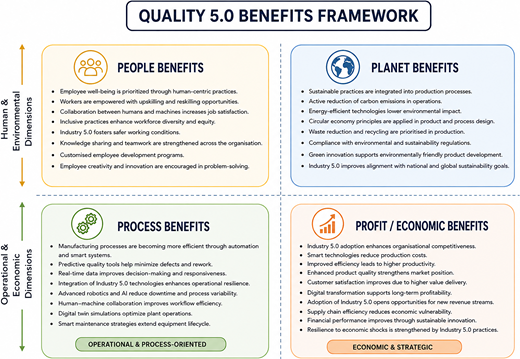
Four principal factors were identified. The first principal factor identified had 8 items, an eigenvalue of 8.72 and explains 27.3% of the variance. This factor was loaded with items such as “potential higher efficiency”, “Digitalization enables predictive quality management and reduced downtime”, “Higher production efficiency”, “Predictive quality tools help minimize defects and rework”, “Real-time data improves decision-making and responsiveness”, “Enhanced operational resilience”, “Reduced downtime and process variability”, “Human–machine collaboration improves workflow efficiency”, “Optimized plant operations” and “extended equipment lifecycle”. In this group, items such as “higher production efficiency” and “Reduced downtime and process variability” were the strongest contributors.
Items such as “enhanced operational resilience”, “improves decision-making and responsiveness”, “reduced downtime and process variability”, “optimize plant operations” all loaded highly with 0.81and 0.80 loadings. This principal factor highlights the impact Industry 5.0 integration will have on the processes and was thus named “Process Benefits”. While technologies such as AI, digital twins and predictive analytics originated in Quality 4.0, their role in Quality 5.0 shifts from efficiency maximisation to enabling human-centric decision-making, sustainability trade-offs and system resilience. The Process benefit acts as a value-creating performance domain that enables results across People, Planet and Profit.
The second principal factor identified had 8 items, an eigenvalue of 7.45 and explains 23.4% of the variance. This factor was loaded with factors such as “Employee well-being is prioritized through human-centric practices”, “Workers are empowered with upskilling and reskilling opportunities”, “Collaboration between humans and machines increases job satisfaction”, “Inclusive practices enhance workforce diversity and equity”, “Industry 5.0 fosters safer working conditions”, “Strengthened knowledge sharing and teamwork across the organizations”, “Customized employee development programs” and “Employee creativity and innovation are encouraged in problem-solving”.
In this factor, the item “Collaboration between humans and machines increases job satisfaction” loaded the highest at 0.81. This factor resonated with the impact of Industry 5.0 on employees and humans and was thus named “People benefits”. This shows the importance of integrating humans back into the process. The third principal factor identified had 8 items, an eigenvalue of 6.39 and explains 20.1% of the variance. This factor was loaded with items such as “Sustainable practices are integrated into production processes”, “Active reduction of carbon emissions in operations”, “Energy-efficient technologies lower environmental impact”, “Circular economy principles are applied in product and process design”, “Waste reduction and recycling are prioritized in production”, “Compliance with environmental and sustainability regulations”, “Green innovation supports environmentally friendly product development” and “Improved alignment with national and global sustainability goals”.
In this factor, the item “Waste reduction and recycling are prioritized in production” loaded the highest with 0.77. This factor presents the impact of Industry 5.0 integration on the environment and planet and was thus named “Planet benefits”. Industry 5.0 further suggests a potential move away from fossil fuels by encouraging the use of bio-based and renewable energy sources in industrial operations to address negative effects due to air pollution, inappropriate waste disposal and excessive use of natural resources and raw materials in Industry 4.0.
The fourth and last principal factor identified had 10 items, an eigenvalue of 5.86 and explains 18.5% of the variance. This factor was loaded with items such as “Industry 5.0 adoption enhances organizational competitiveness”, “Smart technologies reduce production costs”, “Improved efficiency leads to higher productivity”, “Enhanced product quality strengthens market position”, “Customer satisfaction improves due to higher value delivery”, “Digital transformation supports long-term profitability”, “Adoption of Industry 5.0 opens opportunities for new revenue streams”, “Supply chain efficiency reduces economic vulnerability”, “Financial performance improves through sustainable innovation” and “Resilience to economic shocks is strengthened by Industry 5.0 practices”. The item “Digital transformation supports long-term profitability” loaded the highest, with 0.79.
This factor presents the impact of Industry 5.0 integration on the bottom line, profit and was thus named “Profit/Economic benefits”. In the 5th industrial revolution, customers are now attracted to products that are ethically sourced and integrating the circular economy, green technologies and ethical sourcing will ensure customer satisfaction, which will in turn lead to sustainable growth in the organisation. Integrating inclusive practices in the process ensures inclusive economic growth, assuring that everyone benefits from the advent of Quality 5.0 and not just a select few.
The findings of the EFA offer strong empirical evidence of the multifaceted benefits of Quality 5.0 in the South African manufacturing sector. The EFA revealed a significant four-factor structure consisting of profit, process, planet and people, which describe Industry 5.0’s comprehensive value proposition. These therefore present the 4P framework (Process, People, Planet, Profit) as seen in Figure 1, as a suitable model for conceptualising Quality 5.0 benefits in the South African context. The results confirm that beyond efficiency and profitability, Quality 5.0 provides measurable gains in workforce wellbeing and environmental sustainability. This highlights the holistic and balanced value Industry 5.0 offers to countries, more so in developing economies, where both human-centric and sustainability-driven innovations are critical to competitiveness.
4.3 Confirmatory assessment of the factor structure
A CFA was conducted to examine the internal coherence of the four-factor structure identified through EFA. Model fit indices suggested an acceptable fit between the proposed measurement model and the observed data. Given that both EFA and CFA were conducted on the same data set, the CFA results are interpreted as a supportive internal assessment rather than as an independent validation of the measurement model. The confirmatory analysis therefore serves to enhance transparency regarding the internal structure of the proposed framework, rather than to claim definitive empirical confirmation.
4.3.1 Reliability and variance and sampling adequacy.
This study used structural equation modelling (SEM) to perform a CFA to examine the internal coherence of the four–factor measurement model of Quality 5.0 benefits. The model-fit indices for the proposed model are shown in Table 5.
According to the findings, the overall fit indices were within acceptable limits with p > 0.05, CMIN/DF = 1.70, CFI = 0.957, TLI = 0.952, RMSEA = 0.075 and χ2 (df = 734) = 1,248.6. A well-fitting four-factor model is indicated by these values, all of which meet the cut-off criteria recommended in the literature (CFI/TLI ≥ 0.90, RMSEA ≤ 0.08, SRMR ≤ 0.08).
The results of the four-factor confirmatory assessment model, which was developed from the survey of manufacturing experts in South Africa, is shown in Tables 6 and 7. Four correlated latent constructs, namely, Process, People, Planet and Profit, are specified by the model and are each quantified by the corresponding observed benefit items. All items were strong and significant indicators of their intended constructs, as evidenced by the standardised factor loadings that ranged from 0.63 to 0.95 (median = 0.70; p < 0.001).
Table 7 illustrates that the four benefit dimensions are conceptually distinct, though related, indicated by the moderate inter-factor correlations (r = 0.42–0.58), which are significantly below the 0.70 threshold.
Table 8 presents the reliability, convergent and discriminant validity results. Table 8 presents composite reliability (CR), maximum shared variance (MSV) and average variance extracted (AVE) for the four latent constructs are shown in Table 8. According to authors Hair and Alamer (2022) and Byon (2024), AVE is the percentage of variance explained by the observed variables in comparison to the latent construct, whereas composite reliability is a measure of internal consistency based on factor loadings. CR > 0.70 and AVE > 0.50 are the suggested thresholds. Strong reliability was confirmed by the results, which show that all constructs (Process = 0.91; People = 0.89; Planet = 0.88; Profit = 0.93) obtained CR values above 0.90. Convergent validity was also demonstrated by the AVE values (0.55–0.60), which were higher than the 0.50 threshold.
Additionally, the MSV criterion was used to evaluate discriminant validity. The degree to which a latent construct shares variance with other constructs in the model is reflected by MSV. When AVE > MSV, discriminant validity is proven. The constructs were shown to be empirically distinct since the AVE values for each of the four constructs were higher than the corresponding MSV (Process: 0.57 > 0.34; People: 0.60 > 0.36; Planet: 0.55 > 0.32; Profit: 0.58 > 0.38). Convergent and discriminant validity, high reliability and a good model fit all attest to the conceptual soundness and statistical strength of the suggested Quality 5.0 benefits framework.
4.4 Relative salience of Quality 5.0 benefit dimensions
Mean scores across the four dimensions suggest that respondents primarily associate Quality 5.0 with process-related benefits, reflecting the continued importance of digital technologies and data-driven quality practices in manufacturing contexts. People- and planet-related benefits also received positive evaluations, indicating recognition of human-centric and sustainability-oriented outcomes alongside process excellence. Profit-related benefits were perceived as interconnected with the other dimensions rather than as isolated financial outcomes. These findings suggest that, in the South African manufacturing context, Quality 5.0 is perceived as an integrative quality approach in which technological, human, environmental and economic benefits are interrelated.
4.5 Interpretive boundaries of the findings
The results presented in this section reflect perceived benefits of Quality 5.0 as reported by manufacturing professionals, rather than objectively measured organisational outcomes. Consequently, the findings should not be interpreted as evidence of realised performance improvements or causal impacts on social, environmental or economic indicators. Furthermore, the identified factor structure represents an empirically informed representation of Quality 5.0 benefits within the specific sample and context studied. While the structure aligns with theoretical expectations in the literature, its stability and generalisability require further testing using larger and independent samples across different manufacturing contexts.
5. Discussion
This study set out to empirically identify and validate the latent benefit dimensions of Quality 5.0 within the South African manufacturing context. Although the empirical data were collected from South African firms, the resulting Quality 5.0 benefit dimensions align closely with dominant international Industry 5.0 and quality management discourse. This convergence indicates that the extracted factors reflect structural characteristics of Quality 5.0 rather than context-specific artefacts. Importantly, emerging economy settings often surface socio-technical, human and sustainability tensions more explicitly, thereby contributing to theory refinement rather than constraining external validity.
Using a sequential EFA–CFA approach, the findings reveal a robust four-factor structure comprising Process, People, Planet and Profit benefit dimensions. Collectively, these results provide empirical clarity to a concept that has thus far remained largely conceptual, fragmented and normatively discussed in the literature.
5.1 Quality 5.0 as a human-centric sociotechnical paradigm
The emergence of a distinct People benefit dimension provides strong empirical support for the human-centric emphasis articulated in Industry 5.0 discourse. Drawing on Sociotechnical Systems Theory, these findings confirm that quality outcomes in advanced manufacturing environments are co-produced through the interaction of human capabilities and intelligent technologies, rather than being driven solely by automation or digital sophistication.
Items relating to employee well-being, skills development, job satisfaction, inclusivity and collaborative work design loaded strongly and consistently, indicating that respondents perceive human-centric practices as intrinsic quality outcomes rather than peripheral social considerations. This finding extends Quality 4.0 research, which largely prioritised digitalisation and data-driven quality tools, by empirically demonstrating that Quality 5.0 explicitly re-centres human agency within quality management systems.
These results align closely with studies emphasising human–robot collaboration as a cornerstone of Industry 5.0. For instance, Mhlongo and Sukdeo (2025b) identify collaborative robots (cobots) as critical enablers of safe, adaptive and human-centred production environments, while Narkhede et al. (2024) and Rane, Kaya and Rane (2024) show how cobots learn and adapt through continuous interaction with human expertise. Furthermore, the replacement of physically intensive labour with robotics and IoT-enabled systems has been shown to reduce gender-based occupational barriers, enabling more inclusive participation in manufacturing roles (Adel, 2022; Drage and Mackereth, 2022; Ghobakhloo et al., 2024; Mujtaba and Mahapatra, 2024). These findings empirically reinforce the Industry 5.0 proposition that sustainable competitiveness depends on augmenting rather than replacing human contributions through intelligent technologies.
5.2 Process excellence and organisational capability development
The Process benefit dimension emerged as a core component of Quality 5.0, encompassing efficiency, resilience, predictive quality management, smart maintenance and digitally enabled operational control. Interpreted through the RBV, these findings suggest that Quality 5.0 functions as a capability-based quality paradigm, where digital quality infrastructures act as strategic organisational resources.
Unlike traditional quality models centred on standardisation and control, the process benefits identified here reflect adaptive, learning-oriented and resilience-enhancing capabilities. This interpretation is strongly supported by recent Industry 5.0 studies highlighting the role of advanced digital architectures. Mentzas et al. (2024) demonstrate that integrating Industry 5.0 with edge computing reduces latency and system bottlenecks while enabling decentralised, real-time decision-making. Similarly, Bajic et al. (2023) and Bazel et al. (2024) emphasise that real-time data processing through industrial internet of things infrastructures enhances both operational efficiency and system security.
The strong loading of digital twin–related items further corroborates this interpretation. Pant et al. (2025) show that digital twins enable manufacturers to test changes virtually before implementation, reducing downtime, preventing quality failures and supporting predictive quality management. Together, these technologies transform quality management from a reactive control function into a dynamic organisational capability, particularly relevant in volatile and disruption-prone manufacturing environments.
5.3 Environmental sustainability as a core quality outcome
The identification of a coherent Planet benefit dimension highlights the integration of environmental sustainability into the evolving quality management agenda. Respondents strongly associated Quality 5.0 with reduced environmental impact, energy efficiency, circular economy practices and regulatory alignment. These findings lend empirical support to the QBL perspective, which conceptualises quality as a multidimensional value construct extending beyond financial performance.
Rather than treating sustainability as an external compliance requirement, the results indicate that environmental responsibility is increasingly perceived as an inherent quality attribute of manufacturing systems. This aligns with Hickey (2023), who argues that Industry 5.0 organisations must design products and processes with circularity in mind, ensuring recyclability, reuse and repurposing across product lifecycles. The Planet dimension therefore reflects a normative shift in quality management, where environmental stewardship becomes embedded within operational excellence rather than appended as an afterthought.
5.4 Economic value and long-term competitiveness
The Profit dimension confirms that Quality 5.0 delivers tangible economic benefits, including productivity gains, cost reductions, improved competitiveness and enhanced resilience to economic shocks. Interpreted through the RBV lens, these outcomes suggest that investments in Quality 5.0 capabilities contribute to sustained competitive advantage by enhancing organisational agility, innovation potential and adaptive capacity.
Importantly, profit-related benefits did not emerge in isolation but were empirically linked to people-, process- and planet-oriented outcomes. This interdependence reinforces the Industry 5.0 argument that economic performance is achieved through balanced value creation rather than short-term efficiency optimisation. The findings therefore challenge narrow interpretations of quality that prioritise cost and conformance, offering instead a holistic quality paradigm grounded in long-term resilience and sustainable competitiveness.
5.5 Interrelated benefit dimensions and theoretical implications
The moderate inter-factor correlations observed in the CFA indicate that while the four benefit dimensions are conceptually distinct, they are also systematically interconnected. This empirical structure closely mirrors the QBL logic and supports the conceptualisation of Quality 5.0 as an integrative quality management framework. Notably, this factor structure emerged inductively from the data rather than being imposed a priori, strengthening its theoretical and empirical credibility.
By empirically grounding Quality 5.0 in four interrelated benefit dimensions, this study advances quality management theory beyond abstract and normative conceptualisations toward a measurable and actionable framework. In doing so, it extends Quality 4.0 research by explicitly incorporating human-centric and sustainability-driven outcomes, directly responding to calls for a more socially responsible and resilient quality paradigm.
5.6 Contextual insights from the South African manufacturing sector
Although the study is situated within the South African manufacturing context, the findings should not be interpreted as context-bound limitations. Instead, they offer contextually informed insights that enhance theoretical development. South African manufacturers operate under conditions of infrastructure constraints, skills shortages and socio-economic pressures, making them particularly sensitive to the multidimensional value propositions of Quality 5.0.
As such, the South African context serves as a form of boundary condition testing, illustrating how Quality 5.0 benefits become salient under complex socio-technical conditions. Rather than weakening generalisability, this contextualisation strengthens the framework’s relevance for other emerging and resource-constrained economies. Future research may extend this framework across different national and sectoral contexts to further refine its applicability and robustness.
6. Implications
6.1 Theoretical implications
This study contributes to the emerging Quality 5.0 literature by offering an empirically informed operationalisation of perceived Quality 5.0 benefits. Rather than proposing a new grand theory, the findings support a more incremental and disciplined advancement of quality management theory in the context of Industry 5.0.
First, the identification of four interrelated benefit dimensions, namely, process, people, planet and profit, provides empirical grounding for the frequently asserted, but rarely tested, quadruple-bottom-line orientation of Quality 5.0. The results suggest that Quality 5.0 can be understood as a reframing of quality value creation, where digital quality practices are embedded within broader human-centric and sustainability-oriented objectives.
Second, the study clarifies the relationship between Quality 4.0 and Quality 5.0. The findings indicate that Quality 5.0 does not necessarily introduce entirely new technological practices but rather redefines the purpose and evaluative logic of existing digital quality capabilities. This supports the view of Quality 5.0 as a normative and strategic evolution of Quality 4.0, contributing to ongoing debates about paradigm continuity versus disruption in quality management research.
Third, by adopting sociotechnical systems theory, the RBV and the quadruple-bottom-line perspective as sensitising lenses, the study demonstrates how multiple theoretical perspectives can jointly inform the empirical exploration of emerging quality paradigms without imposing rigid deductive structures. This approach may be useful for future research examining other nascent management concepts.
6.2 Managerial and practical implications
For manufacturing managers and quality practitioners, the findings highlight that Quality 5.0 should not be approached as a purely technological initiative. While process-related digital quality tools remain central, their effective deployment is closely linked to human capability development and environmental responsibility.
Managers are encouraged to view Quality 5.0 as an integrative quality strategy, in which investments in advanced quality technologies are accompanied by initiatives aimed at workforce upskilling, employee empowerment and sustainable operational practices. In developing-economy contexts, where resources are constrained, this integrated perspective may help organisations prioritise quality initiatives that deliver both immediate operational benefits and longer-term organisational resilience.
From a policy and institutional perspective, the results suggest that efforts to promote advanced manufacturing and quality transformation should consider human capital development and sustainability alongside technological readiness. However, these implications should be interpreted as practice-oriented insights rather than direct policy prescriptions, given the exploratory nature of the study.
6.3 Practical relevance and use of the Quality 5.0 framework in the South African context
While this study does not propose Quality 5.0 as a direct remedy for structural challenges such as unemployment, infrastructure deficits, or industrial decline, the framework offers important practical value as a diagnostic and sense-making tool for South African manufacturing organisations. Rather than prescribing specific technologies or interventions, the framework enables firms and policymakers to assess where Quality 5.0 value is most likely to emerge across process, people, planet and profit dimensions.
In practice, the framework can be used to identify priority leverage points within organisations, such as skills development gaps, misalignment between automation investments and workforce outcomes, or underexploited sustainability opportunities. For example, firms may observe strong process and profit performance but weaker people or planet outcomes, signalling the need for targeted interventions in training, human–machine collaboration, or environmental practices.
Additionally, the framework supports sector-specific application when combined with contextual analysis. In capital-intensive sectors such as automotive manufacturing, it may guide decisions around digital twins, predictive quality tools and cobot deployment. In mining and resource-based industries, the framework can help balance productivity goals with worker safety, environmental stewardship and community expectations. In agro processing, it may assist in aligning quality improvement initiatives with circular economy principles and inclusive employment strategies.
Importantly, the framework is intended as a precursor to problem-specific and sectoral studies, rather than a standalone solution. When integrated with sectoral diagnostics, policy instruments and skills development initiatives, Quality 5.0 can inform more targeted and context-sensitive industrial strategies. This positioning ensures practical relevance while avoiding over-claiming the transformative capacity of a single quality management framework.
7. Conclusions and recommendations
Quality 5.0 is increasingly positioned as a human-centric and sustainable reframing of quality management that aligns technological advancement with broader stakeholder value creation. However, empirical insights into how its benefits are understood in practice remain limited. Addressing this gap, the present study explored practitioner-perceived Quality 5.0 benefits within the South African manufacturing sector using an exploratory empirical approach.
The findings indicate that Quality 5.0 is perceived as a multidimensional and integrative quality approach encompassing process, people, planet and profit-oriented benefits. This structure suggests that quality value creation under Quality 5.0 extends beyond operational efficiency to include human-centric and environmental considerations, consistent with service-oriented and stakeholder-focused perspectives in quality management.
Rather than offering definitive validation, this study provides an empirically informed foundation for advancing research at the intersection of quality and service sciences. By grounding Quality 5.0 in practitioner perceptions from a developing-economy context, the study contributes to the gradual clarification of Quality 5.0 as an emerging quality paradigm and supports future research examining its implications across manufacturing and service systems.
8. Limitations and future research directions
This study has several limitations that should be acknowledged. First, the sample size, while suitable for EFA, limits the generalisability of the findings and the stability of confirmatory results. Future studies should use larger and independent samples to validate and refine the proposed factor structure.
Second, both EFA and CFA were conducted on the same data set, which may lead to inflated model fit indices. As a result, the confirmatory analysis should be interpreted as an internal consistency assessment rather than as independent validation. Future research should apply the measurement framework to new data sets and alternative contexts.
Third, while this study adopts a cross-sectoral manufacturing perspective to establish a foundational and transferable Quality 5.0 benefit framework, future research would benefit from industry-specific validation and extension. In particular, sector-focused studies could provide deeper insight into how Quality 5.0 benefits manifest under distinct technological, regulatory and labour conditions.
Future studies may empirically test the proposed Quality 5.0 framework within specific manufacturing subsectors to examine sector-specific enablers, barriers and prioritisation of benefit dimensions. For example, automotive manufacturing offers a valuable context for exploring advanced human–robot collaboration, digital twins and sustainability-driven quality practices.
Additionally, hypothesis-driven models may be developed to investigate how contextual factors such as skills availability, supply chain complexity and infrastructure maturity influence Quality 5.0 outcomes across sectors. Comparative studies between Global South and Global North manufacturing contexts are also encouraged to further refine the framework’s applicability and boundary conditions.
Finally, the study relies on self-reported perceptions of benefits rather than objective performance measures. While this approach is appropriate for early-stage construct development, future research should incorporate longitudinal designs, mixed methods and objective indicators to examine how perceived Quality 5.0 benefits translate into realised organisational outcomes.
Funding
This research received no external funding.
Institutional review board statement
The study was conducted in accordance with the Declaration of the University of Johannesburg and approved by the Ethics Committee.
Informed consent statement
Informed consent was obtained from all subjects involved in the study.