The study aims to identify current faculty practices, examine how different levels of higher education (HE) management empower and implement sustainability integration and explore the challenges of integrating sustainability into HE curriculum in emerging countries.
This study sampled Vietnamese universities and international HE institutions (HEIs) operating in Vietnam to represent the emerging context. In-depth interviews were conducted with 19 faculty leaders from 8 universities, with major themes identified through double coding and thematic analysis.
The study identified three major themes of practice by management and faculty to integrate sustainability into the curriculum: structural empowerment, psychological empowerment and practical implementation, and such practices primarily came from the meso and micro levels of management. Prominent challenges for lecturers to strategize and deliver better curricula on sustainability knowledge resulted from the macro-level management, particularly in the lack of supportive frameworks, empowerment and resources.
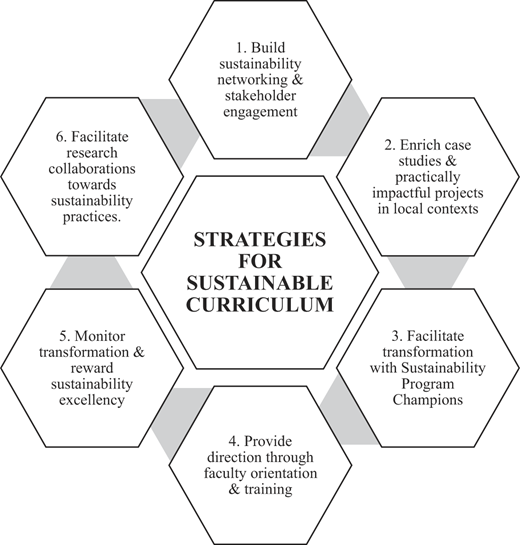
HE management can empower institutions’ sustainability education strategies and practices through building networking and stakeholder engagement, enriching case studies and work-integrated learning projects, facilitating transformation with champions, providing direction through orientation and training, monitoring transformation and rewarding excellence and facilitating research collaborations.
Research on the extent to which HEIs have initiated efforts to incorporate sustainability into their curricula and programs remains limited. Moreover, recent literature on sustainability in HE primarily focuses on practices in developed countries. This study conceptualizes a management framework for HE and identifies key challenges, offering insights grounded in the under-researched context of emerging countries.
1. Introduction
Higher education institutions (HEIs) play a crucial role in advancing sustainable development by integrating sustainability concepts into educational content development and capacity building (Levesque and Wake, 2021). As hubs of knowledge generation and innovation, HEIs are uniquely positioned to lead the shift toward a more sustainable future by equipping students with the knowledge, skills and values needed for sustainability (Adams et al., 2023; Abo-Khalil, 2024). Integrating sustainability into the curriculum not only prepares graduates to become responsible leaders but also enhances the reputation of HEIs by demonstrating their commitment to addressing real-world sustainability challenges (Ahel and Schirmer, 2022). Despite the growing recognition of the importance of sustainability education, existing literature predominantly focuses on developed Western nations. Significant gaps remain in understanding how HEIs in emerging countries incorporate sustainability into their curricula. Successful integration of sustainability requires a thorough understanding of the current practices, barriers and challenges that hinder integration (Holdsworth and Thomas, 2021). Identifying these factors enables the development of targeted strategies to overcome them and facilitate the effective integration of sustainability (Figueiró and Raufflet, 2015).
This study adopts an applied research approach that prioritizes practical insights over theoretical model development. Rather than testing existing theories or conceptual frameworks, the research focuses on empirical documentation and analysis of current practices, challenges and empowerment mechanisms at different levels of HE management, from macro to micro, as they manifest in real educational contexts. This applied focus is particularly relevant as sustainability education in emerging countries often demands context-specific, implementation-driven solutions, where practitioners need concrete insights about what works, what does not and why, rather than abstract theoretical propositions. Accordingly, the research addresses three primary questions:
What are the current practices in integrating sustainability into HE curricula in emerging countries?
How do different levels of HE management in emerging countries empower and implement sustainability integration?
What are the challenges to sustainability integration into HE curricula in emerging countries?
This study contributes to addressing the limitations of Western-centric literature by offering crucial insights into the practices and unique challenges of integrating sustainability into the HE curriculum within an understudied emerging context. Furthermore, the study offers a nuanced understanding of the complex dynamics influencing curriculum transformation across three distinct levels of HE: macro (governance systems, industry landscape), meso (faculties, programs) and micro (individual lecturers). This multi-level perspective reveals critical insights into power dynamics, decision-making processes and implementation gaps that impact sustainability education in emerging countries. Consequently, the study proposes contextually relevant actionable strategies and frameworks for education managers, policymakers and practitioners working to enhance sustainability integration in these resource-constrained environments.
2. Literature review
2.1 Sustainability integration into higher education curriculum practices
The integration of sustainable practices into HE curricula influences student learning by enhancing critical thinking, practical application and global awareness. Problem-based learning linked to Sustainable Development Goals (SDGs) boosted student engagement and comprehension of sustainability, enabling them to address real-world issues effectively (Nguyen et al., 2024). Such practices, observed globally, cultivate competencies like interdisciplinary collaboration and social responsibility, preparing students for complex challenges such as poverty and gender equality (Abo-Khalil, 2024). Moreover, collaborative projects via sustainability networks across multiple countries enrich student experiences through international perspectives (Gamage et al., 2022).
However, most sustainability research in HE reflects practices at HEIs in developed Western countries. In the systematic review by Cheeseman et al. (2019), emerged countries such as Canada, the USA, the UK and Australia accounted for approximately 54% of research in sustainability policies in the HE sector. In contrast, HEIs in emerging countries often lag in integrating sustainability into their current curriculum and student capacity-building (Demaidi and Al-Sahili, 2021). The integration of sustainability into HE curricula should be contextually relevant, reflecting the unique environmental, social and economic challenges faced by the country where HEIs reside. This literature imbalance, reviewed in Table 1, highlights the need for further research in emerging contexts.
2.2 Framework of higher education management for sustainability integration into the curriculum in emerging contexts
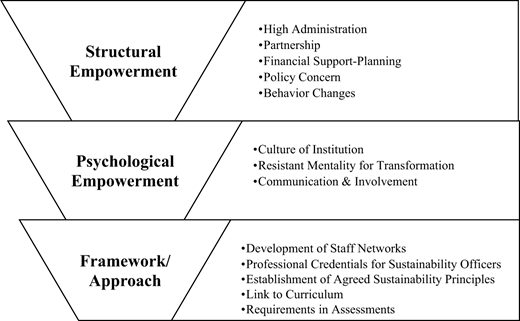
Synthesizing from previous studies by Littledyke et al. (2013), Leal Filho et al. (2020), Bedford (2022) and Gamage et al. (2022), potential factors hindering the effective integration of sustainability into curricula in emerging contexts: structural empowerment, psychological empowerment and practical implementation. Firstly, the concept of structural empowerment plays a fundamental role in the HE systems of emerging countries because of their adherence to strict legal frameworks and regulations (Franco et al., 2018). Littledyke et al. (2013) highlight governance structures and sustainability education within the curriculum as essential pillars for the transformation of HE toward sustainability. Structural empowerment, focusing on leadership and management, encompasses aspects like administrative involvement, partnerships, financial planning, policy considerations and behavioral changes (Leal Filho et al., 2020). Therefore, the role of structural empowerment in sustainability education serves as the foundation for the macro strategic transformation of the curriculum, as it facilitates crucial resources and directional instructions for education managers and practitioners to improve the curriculum with detailed and feasible structures (Holdsworth and Thomas, 2021). This study proposed that empowerment at the macro, structural level by the policy enablers and governance agencies can utilize the established SDGs system to guide curriculum development and further lead to implementation.
Second, psychological empowerment is acknowledged to be a key driving factor for change in curriculum with sustainability (Bedford, 2022; Verhulst and Lambrechts, 2015). Empowerment for academic staff in sustainability education is categorized into levels of latent (a feeling to participate, yet to take action), active (drive and possibility to lead to action) and transformative (promote and lead to action with transformation) (Bedford, 2022). Compared to structural empowerment, psychological empowerment relies more on human factors in management than regulated factors such as the culture of the institution, resistant mentality for transformation, communication and involvement (Verhulst and Lambrechts, 2015). Built upon the triadic reciprocal determinism based on the social cognitive theory (Bandura, 1995), psychological empowerment provided by institutional leaders, managers and senior educators can cause a resonant impact (and the impact can be either supportive or hindering) on the educators’ personal motivation and efficacy to take practical actions toward curriculum development and enhancement with SDG elements.
Third, there are fragmented frameworks/approaches for curriculum reforms on sustainability. Gamage et al. (2022) highlighted six prominent frameworks of implementation in the university sector, including the following:
collaborative paradigm change;
bottom-up, evolving institutional change;
top-down, mandated institutional change;
externally driven initiatives;
isolated initiatives; and
limited institutional change.
In contrast, Leal Filho et al. (2020) consolidated five key frameworks/approaches to sustainability integration in HEIs, such as the development of staff networks, professional credentials for sustainability officers, the establishment of agreed sustainability principles, a link to the curriculum and requirements in assessments.
Drawing on the concepts of structural, psychological and practical empowerment, the framework in Figure 1 serves as a practical tool to examine real-world practices and challenges in integrating sustainability into HEI curricula in emerging contexts. It is not intended as a theoretical model for validation or refinement. From the change management perspective, this framework development serves an applied analytical purpose rather than a theoretical advancement in our study. Change management provides structured frameworks to guide institutions from their current state to a desired future state, focusing on the interplay of process, context and content (Sancak, 2023). Specifically, human factors, particularly employee empowerment and engagement, are central to effective change processes, as highlighted by Verhulst and Lambrechts (2015) in their literature on sustainable development (SD) integration in HEIs. Empowerment, facilitated through professional development initiatives, fosters the adoption of sustainability competencies and enhances stakeholder commitment (Lambrechts et al., 2017). For HEIs pursuing SD integration, empowering employees (administrators, faculty and staff) serves as a key driver of transformative change, positioning them as advocates for sustainability (Akins et al., 2019). Consequently, the role of empowerment as a critical success factor warrants further exploration in the context of organizational change within HEIs. The implementation of SD in curricula emerges as a tangible outcome of these change efforts, supported by tailored implementation models and guidelines that facilitate institution-wide integration of sustainability principles (Verhulst and Lambrechts, 2015).
2.3 Situational context of sustainability integration into higher education curriculum: the case of Vietnam
To examine practices in emerging countries more closely, this study focuses on Vietnam, an emerging Southeast Asian economy and its approach to integrating sustainability into HE. Its active engagement in “the 4.0 industry revolution” (Tri et al., 2021) and rapid changes in socioeconomic conditions create a heightened demand for Vietnamese HE to address complex sustainability challenges, such as climate change, overconsumption and various social problems, through the education of future generations (Nguyen et al., 2024). This represents similar characteristics of most emerging countries with constrained resource availability, but they experienced a substantial increase in expectations for HE to illuminate diverse approaches to sustainability challenges (Tien et al., 2022).
Recent Vietnamese government regulations acknowledge sustainability goals but lack specific directions for sustainability curriculum updates in HEIs. The Education Development Strategy by 2030 outlines national education plans without specifically addressing sustainability, SDGs, or curriculum alignment with sustainable development (Prime Minister, 2017). This aligns with Vietnamese government action plan to equip all learners with knowledge and skills for sustainable development. Accordingly, Ministry of Education and Training (2025) (MOET) has proposed improvements to educational content by incorporating practical elements such as active teaching methods, experiential learning and project-based approaches. It is needed to strengthen the capacity of educational institutions to integrate sustainable development throughout the formal and non-formal education system, together with the increased supply of highly qualified teachers, through international cooperation on teacher training.
However, the implementation largely excluded HE and lacked explicit curriculum design guidelines. MOET’s Decision No. 2257/QD-BGDDT reduced the number of sustainability objectives from four to one, eliminating indicators related to promoting sustainability knowledge and retaining only an indicator for sex education and violence prevention in general education (Ministry of Education and Training, 2019). As a result, sustainability integration into the HE curriculum in Vietnam was inconsistent and caused significant challenges for educators (Tien et al., 2022). Thus, research for insights from Vietnam can offer valuable lessons for HEI managers and policymakers in other emerging countries seeking to develop sustainable education strategies effectively.
3. Methodology
3.1 Research design
Following similar studies (Awuzie and Emuze, 2017; Hernandez-Diaz et al., 2020; Poon, 2017), this study used a qualitative research design, using semi-structured, in-depth interviews with academic lecturers and program managers. This approach was selected to explore HE members’ subjective experiences, perceptions and meaning-making processes, particularly regarding unwritten institutional practices related to the integration of sustainability into context-specific teaching and learning activities (Poon, 2017). In-depth interviews enable access to tacit knowledge that may not be documented in formal policies or observable in day-to-day practice. In addition, sustainability integration often involves navigating complex organizational structures, power dynamics and competing institutional priorities. In-depth interviews can reveal these complex institutional dynamics that might remain obscured through other methods (Cotton et al., 2009).
The interviewees were selected from Vietnamese HEIs ranked among the top 50 in the Vietnam University Ranking (2024). These institutions were chosen for their established reputations and a broad range of education programs. To ensure participants had sufficient knowledge and influence in curriculum design, academic lecturers and program managers with over three years of experience in teaching and curriculum development were selected through purposive sampling. With the approval from the researchers’ university ethics committee, invitations for interviews were sent to 25 potential participants via email published on their respective university websites, resulting in 19 participants from 8 universities agreeing to participate. The number of participants is sufficient to provide a diverse range of views from qualified and relevant stakeholders for curriculum development and teaching, and thus fulfilling the trustworthiness and credibility of qualitative research findings (Guest et al., 2006).
The interview questions ( Appendix) and interview flows were adapted from established studies (Cotton et al., 2009; Poon, 2017), with adjustments to reflect the educational landscape in Vietnam. The questions and flows were further reviewed by some academic scholars and some HEI managers to ensure the relevance to the scope of our study. Participants were first introduced to the research project, which aimed to gather their insights on the university’s efforts and the academic staff’s contributions to sustainability integration. After obtaining explicit consent from the participants in writing, the interviews were conducted to explore participants’ experiences, challenges faced and strategies used to incorporate sustainability knowledge into the curriculum. Interviewees also provided their perspectives on governance and faculty involvement in sustainability curriculum design. The interviews concluded with expressions of gratitude and an opportunity for additional comments.
3.2 Data collection and analysis
All interviews were recorded and transcripts were coded (e.g. P01, P02) to anonymize participants and protect their privacy. Once transcribed, the data were imported into NVivo software for thematic analysis, using double coding to ensure inter-coder reliability. Double coding and thematic analysis were used to extract meaningful patterns and insights from the interview data for a comprehensive understanding of the current state of sustainability integration in Vietnam’s HE sector and the barriers that hinder effective implementation. From the data, our two experienced researchers developed their own preliminary coding framework based on the research questions and initial data review. In the first round, following independent coding, two researchers convened for comparison sessions to evaluate coding alignment. For cases where coding discrepancies emerged, the authors engaged in thorough discussion to reach a consensus. Further, the authors reviewed the literature and discussed some cases with a third researcher to refine code definitions and coding rules. Accordingly, in the second round of independent coding, the inter-coder reliability rate exceeded 0.7, which is considered acceptable based on established literature (Cheung and Tai, 2021). The coded data will be stored securely for five years, after which it will be deleted from the host server.
4. Findings
This section presents the findings of the study, organized according to the research questions: current practices in sustainability integration, the role of different management levels in empowering and implementing sustainability and the challenges faced in integrating sustainability into HE curricula in emerging contexts.
4.1 Current practices to foster sustainability integration into the curriculum (RQ1)
4.1.1 Theme 1: curriculum redesign and refreshment by schools.
The most frequently reported practice among interviewees was the direct adjustment of the curriculum to include sustainability content. These adjustments fell into two categories: curriculum refreshment and curriculum redesign. Refreshments involved minor updates, such as adding sustainability elements into supplementary materials like case studies or examples that align with lecture topics and demonstrate relevant sustainability issues. One language lecturer described their integration strategy:
We deal with a lot of linguistic materials, so we incorporate SDG goals in the materials that we use for developing language proficiency in Japanese and in translating and interpreting materials. We can change the topic by semester, so our focus is more on incorporating materials or sustainability as a material for learning. And then based on that, we work on the topic and develop the competency in the field that we train. (P11, Languages).
Redesigns refer to major changes in a course or program’s structure, such as redesigning assessments or updating course learning outcomes to focus more on sustainability. However, only a few interviewees reported having implemented such major changes:
I introduced the SDGs to the assignment scenario. For the whole semester, they will dig deeper into an SDG. And because our assignments are about something totally different, they’re not about the SDGs, they had to apply it to that topic. So, it means they have to understand sustainability, or you can’t apply it if you don’t really know what it is. (P15, Communication).
4.1.2 Theme 2: orientations and encouragement for sustainability integration.
Interviewees highlighted that discussions within the faculties or departments played a crucial role in enabling sustainability-related curriculum changes. These discussions often involved evaluating suitable updates related to sustainability knowledge or skills.
Interviewees in management roles reported that they not only implemented changes themselves but also encouraged and delegated tasks to their faculty or department members to actively update the curriculum with the latest sustainability issues. Some interviewees also participated in coaching sessions or programs within or across universities on teaching sustainability knowledge and skills to students:
I don’t think of ever being told to use SDGs in my course from our university. The reason I started to do it was that I had a research project about updating the curriculum in local universities and updating the teaching practice, like the way teachers teach. And when I was doing workshops with them, they were always asking me for examples. It’s action research. If I’m asking them to do it, then I need to be doing it too. And so, I did for the first few semesters. I just experimented with putting SDG content in the course to see what would happen and how the students dealt with it. (P15, Communication).
4.1.3 Theme 3: work-integrated collaboration projects and research.
Another approach identified was supporting students in addressing sustainability issues through work-integrated capstone projects with industry partners or nonprofit organizations. This also included facilitating guest lectures, workshops, or seminars delivered by industry and non-governmental organization (NGO) experts on sustainability topics:
In my sustainability tourism class, I had a day devoted to tourism and invited a sustainability consultant. He is a sustainability manager at this company called Asia Trails, and they primarily work with locals, but they also bring a lot of people from India over as well. And when possible, he tries to create what he calls more sustainable engagement when we talk about this in the class. (P14, Communication).
Additionally, some interviewees showcased student projects focused on sustainability as best practices, sharing them with both internal stakeholders, such as other students and faculty, and external stakeholders, including local media.
Alongside industry-based and NGO-based projects, lecturers also said they provided recommendations and supervision for students, as well as other researchers, to address sustainability issues in scientific research projects:
In our business administration faculty, most lecturers focus their research on sustainable development issues. Because I have the freedom to choose topics, currently the proportion of the green consumption and responsible consumption topic is almost 1/3 of the topics of students when working on the thesis. (P01, Marketing).
Table 2 summarizes key practices related to sustainability integration into the curriculum reported by interviewees and reports the frequency of such practices.
4.2 Empowering and implementing sustainability integration by different levels of higher education management (RQ2)
4.2.1 Theme 1: macro-level management.
At the macro level, the influence of psychological empowerment from the industry and social landscape varied. Large-sized industry partners expressed interest in students equipped with sustainability skills and knowledge, viewing them as proactive and responsible future professionals. In contrast, small-scale companies were more concerned with business performance and showed less interest in sustainability. No interviewees reported that industry or social organizations imposed requirements related to sustainability education. They had a greater interest in the direct employability skills of students. Only a few industry partners and NGOs provided partnership opportunities directly related to sustainability topics through student work-integrated projects:
Big businesses care about practical, sustainable values for business’s interests from students. For example, it’s the awareness of saving energy, raw materials, and procedures, which relates to environmental sustainability. They will care about the mindset of students when you organize that work, and how you build the procedure to save the most time, cost, and energy. […] However, small startups are still struggling to survive. There is no room to think about sustainability, and there is no time and energy for sustainable development compliance. Those who follow entrepreneurship trends and loan lots of financial capital have too much pressure on the financial performance, so it’s hard to be sustainable in their business. (P06, Marketing).
Regarding structural empowerment from governance systems, such as MOET, there were no direct policies or formal guidance mandating sustainability integration in curricula. Although there was a general, unofficial encouragement from MOET, it lacked formal enforcement:
Currently, MOET only stipulates what the minimum number of credits is, and then what teaching modules are required in the course. They only give a general framework, not a regulation that you will integrate sustainability and its problems into the development of the program. As far as I know, a new program was developed, and I have read the relevant regulations. However, no requirements about sustainability knowledge were mentioned.” (P02, Business Administration).
At the university level, structural empowerment was similarly limited. Few institutions had formal policies or requirements to integrate sustainability into their curricula, and little support was provided to academic staff for systematic sustainability integration. Even though some universities had encouragement from universities to teach students sustainability knowledge, the universities did not provide any statement regarding their practices:
This will be a challenge because if we are to redo certain things according to a new curriculum, that requires time from each of our lecturers. Because you know, most of the courses are already approved, and if there’s a new course guide, that means we have to redo certain things. It needs workload allocations for lecturers with additional time to do this. (P13, Game Design).
4.2.2 Theme 2: meso-level management.
At the meso level, faculties, schools and departments did not mandate sustainability as a curriculum requirement. Although structural empowerment was not enforced, there was a positive perception of the need for sustainability education, with some faculty members updating their curricula under the encouragement of team leaders:
I was one of the team members when we designed the new courses for our program. We have updated the program from Fashion Merchandise to Enterprise. I designed five new courses, three of which focused on sustainability. I made sure that sustainability components were there, covering all aspects such as people, planet, and profit. I also look mainly to SDG 11, SDG 12, and SDG 14 in my sustainability courses. (P17, Fashion Enterprise).
Courses that naturally aligned with sustainability, such as Architecture or Fashion, often had more systematic approaches to curriculum design based on industry updates. In contrast, academic staff teaching social sciences or art programs were hesitant to integrate sustainability into the curriculum because they did not see an explicit connection to their course syllabus, especially with theory-based or technical courses. For implementation into practical schemes, courses highly relevant to sustainability were integrated into core knowledge by lecturers and assessments with mandatory requirements. Courses with an implicit connection integrated sustainability in case studies, activities and guest sessions. The approach was usually optional for lecturers and students to conduct and participate:
The curriculum was written from the perspective of a design school. How does a student go from having zero design skills to being a competent and confident professional to go into the workforce and get employed? If we just take out everything and make everything sustainability-focused, you’d end up having cohorts of sustainable designers at the end, or specialized in sustainable design, not a general designer. (P08, Design).
4.2.3 Theme 3: micro-level management – individual lecturers.
Individual lecturers did not receive mandatory requirements from upper management to integrate sustainability, resulting in fragmented and individual approaches. But many lecturers and academic managers perceived sustainability education as important for providing students with a stronger performance in the practical context of the corresponding industry and becoming more productive problem-solvers of the SDGs. They are willing to take risks to learn and integrate the sustainability module into their teaching materials:
We had to bear more work to complete the course/module on sustainability with businesses. However, it is not mandatory for teachers to participate. We find it good and see that it will support our teaching courses, so we voluntarily participate. Each teacher also has to pay nearly 300 Canadian dollars in fees to learn and join coaching on their own. Then I can ask the school to sponsor the cost that I have spent. If we take a risk to study and are unable to get the certificate, we have to bear that [own cost]. (P04, Business Administration).
Despite positive attitudes toward integrating sustainability, many lecturers noted a lack of where to start, especially for courses with limited connections to environmental sustainability:
For Design Studies, I have not seen clearly other aspects of social or economic sustainability. Up until this interview, we have not considered sustainability to be that comprehensive, besides addressing environmental benefits. We should have some steps for exploring different pillars to understand a little more. Then we will point out the suitable ones for our courses. (P18, Design).
Table 3 concludes the key findings regarding empowering and implementing sustainability integration by different levels of HE management, taking into consideration the key themes of structural empowerment, psychological empowerment and practical implications.
4.3 Challenges for sustainability integration into the sustainability curriculum (RQ3)
4.3.1 Challenge 1: macro-level challenges for sustainability integration.
At the macro level, challenges stem from the broader industry and social landscape, where awareness and prioritization of sustainability needs vary amongst businesses. Many small and medium enterprises or start-ups prioritize financial performance over corporate responsibility, especially during periods of economic hardship. This focus on profitability often overshadows sustainability considerations:
The ultimate goal of any business, except NGOs, NPOs, or state-owned enterprises, will be profit. When I teach students, especially graduate students, their response will be: ‘I understand what you are saying is reasonable, but now I am weighing between the profitability of the business that I am working for and even the safety of the business that I am working for. Which one do you think I should choose?’ (P07, Human Resources Management).
A significant challenge also arises from the lack of top-down management policies within governance systems, particularly at the MOET level. The absence of formal procedures, benchmarks and systematic action plans for sustainability integration leads to confusion and inconsistency in curriculum transformation efforts among teaching staff:
For universities that belong to the public system under the Ministry of Education and Training, when developing the programs, they will usually follow what is instructed by the Ministry. If you want to integrate those (new) criteria and tell universities to develop/integrate it themselves, it is actually very difficult.” (P05, Economics).
Furthermore, limited human and financial resources pose additional barriers. The lack of official support schemes means that lecturers who wish to integrate sustainability content into their curriculum face multiple layers of review, feedback and justification, making the process time-consuming and resource-intensive.
4.3.2 Challenge 2: meso-level challenges for sustainability integration.
At the meso level, challenges are prevalent within faculties, schools and departments, where there is often no systematic approach to embedding sustainability in curriculum design. Lecturers expressed concerns about the absence of requirements for sustainability as a learning outcome in courses or programs:
I have not integrated sustainability content into the program in a standardized structure. It’s currently only in the form of optional discussion and additional content in approved lectures. I think it will be very necessary if we have standards for the integration of sustainable development, including (becoming) one of the criteria/requirement of learning outcomes of courses. (P01, Marketing).
Sustainability is frequently perceived through a limited lens, often focused more on environmental aspects, leaving economic and social dimensions underrepresented. This is particularly evident in fields such as communication and design, where there is a lack of direct relevance to economic sustainability:
We do touch upon the social pillar of sustainability, and occasionally we discuss the economic pillar too, but for the most part we speak about the environment, and then it’s complemented with the social pillar. We need to consider carefully the fact that, because we are a Communication and Design team, the absence of the economic pillar is inevitable. There is still room to consider how we can adopt that, but keep the relevance to the students’ needs and the course objectives. (P14, Communication).
4.3.3 Challenge 3: micro-level challenges for sustainability integration.
At the micro level, individual lecturers face challenges due to the lack of systematic frameworks that mandate sustainability integration. Without formal obligations, many lecturers do not prioritize sustainability in their teaching, viewing it as beyond their core responsibilities and outside the scope of the current education system’s direction:
The case studies I included (in the course content) in are completely self-arranged. If it needs to be formalized in the course content, we need to get approvals from the principal/program managers. Next, the principal/program managers can allocate the workload for lecturers to integrate these contents to the course. If it is not required, most lecturers don’t automatically do it. (P04, Business Administration).
These individual-level challenges underscore the need for clearer guidance and more structured frameworks to support lecturers in integrating sustainability into their courses, highlighting the importance of both top-down mandates and grassroots enthusiasm for meaningful change.
5. Discussions
This applied research offers practice-based insights that complement, rather than challenge, existing theoretical frameworks in sustainability education. This study’s contribution lies not in theoretical innovation but in empirical examination of how established concepts (empowerment, institutional change, curriculum integration) manifest in the specific context of emerging countries’ HE systems. This study identifies current approaches and practices in HE management regarding the integration of sustainability into the curriculum in Vietnam, representing the broader context of emerging countries. The results address the under-researched gap in the literature on education for sustainable development that has mainly focused on emerged countries, particularly in policy and management (Cheeseman et al., 2019). Consequently, findings from developed contexts are not fully generalizable to emerging ones, where there are significant challenges in structuring and delivering systems that foster sustainability as a key element in the HE curriculum. This study contributes to the specific socio-geographical background of emerging countries, demonstrating how sustainability in education can transform students, institutions and society.
Findings of current practices reveal that SDG integration is inconsistent and individual-driven: some lecturers proactively update curricula, but others do nothing without guidance. Despite structural barriers and limited institutional support, some faculty members demonstrate remarkable adaptive innovation in integrating sustainability content into their curricula redesign and refreshment, mainly through case studies and work-integrated learning assessments. The efforts were encouraged at the school level by program managers and heads of schools who want to make changes and, thus, empower their subordinates to foster sustainable course content and Work-Integrated Learning activities (guest lectures, workshops, seminars, capstone projects) with external stakeholders (businesses, NGOs, media). On the other hand, lecturers are involved in sustainability research projects and gather the knowledge and findings for student learning experiences. Facilitating research collaborations focused on sustainability practices can further embed sustainability into academic transformation. This represents “soft integration” – embedding sustainability content within existing structures rather than fundamentally restructuring educational approaches. Educational content for sustainability issues and developments can be easily added, modified or removed without affecting core curriculum architecture. This often increases student interest and comprehension of abstract sustainability concepts. However, these practices also expose the limitations of ad-hoc, individual-driven approaches in achieving systematic sustainability. Thus, there are differences from the practices of emerging countries where HEIs integrate SDGs systematically – structured industry collaborations, mandatory curriculum updates and staff training to ensure widespread adoption at all levels (Rossoni et al., 2024). Integration spans all disciplines, supported by standardized tools and institutional goals (Bertel et al, 2022). In Vietnam, as an emerging country context, the efforts are sporadic, hindered by resource and policy gaps. The fragmented individual efforts of developing SDGs’ resources and knowledge limit the overall impact of sustainability education on student learning and HEIs’ culture. The individual-driven approaches the authors observed reflect what Wals and Benavot (2017) describe as “islands of innovation” – isolated efforts that, while valuable, lack the systemic support needed for institutional transformation.
There are a few challenges in structural empowerment. In this emerging context, integrating SDGs into university curricula lacks formal support: no clear governance policies (such as the country’s MOET), university mandates, or resource schemes exist, leaving it optional and unstructured. This can be attributed to the lack of clear objectives, indicators and guidance in the policy and the inconsistencies between regulations from the governmental level to the ministry (MOET) level. The issue represents what policy scholars term “aspirational governance” —establishing broad national commitments without sufficient guidance for ministry-level operationalization, such as detailed sector-specific roadmaps, budget allocations and performance indicators. This critical National-to-Ministerial policy translation failure in the emerging context leaves HEIs without the necessary structural foundation for systematic change in sustainability education integration.
In addition, industry collaboration’s interest in sustainable education is limited. The vast majority of local small businesses, which collectively employ the largest share of HEIs’ graduates, remain disconnected from sustainability education initiatives, creating a mismatch between educational content and employment reality. Conversely, emerged countries feature robust frameworks – national policies, accreditation requirements and university strategies mandate SDG inclusion, supported by resource-rich structures for consistent integration across all levels and extensive industry collaborations (Arefin et al., 2021). Without clear mandates, individual HEIs and their faculty members become the default decision-makers for sustainability integration with or without industry collaboration, leading to inconsistent or ad-hoc approaches for SDGs’ coverage across the HE system. Our findings extend Sterling’s (2011) transformative education framework to the specific context of emerging countries, where structural empowerment challenges create additional barriers to the paradigm shift he advocates.
Regarding psychological empowerment, the findings also show positive but unsupported perceptions of sustainability education reflect the cognitive-behavioral dissonance, a state where attitudes and actions are misaligned due to contextual constraints. While interviewees recognize the importance of sustainability education for students and society, vague, informal encouragement from governance and universities fails to translate their intentions into action. They are uncertain about how to effectively integrate sustainability content into their teaching. Hesitancy persists in less relevant disciplines (e.g. arts) because of unclear connections or knowledge-confidence gaps. In emerged countries, psychological empowerment to integrate SDGs is amplified by systemic incentives, institutional priorities. Sustainability is a core value, backed by HEIs’ leadership and faculty across disciplines. Lecturers are motivated and supported to link SDGs to their courses (Levesque and Wake, 2021; Gamage et al., 2022). Conversely, HEIs’ lecturers in emerging countries’ motivation lacks reinforcement. Their positive perceptions often remain unexpressed or underutilized because they lack peer networks and external validation, communities of practice that could sustain and amplify their sustainability interests. This analysis reveals that psychological empowerment requires more than perception and attitude changes. It demands systematic attention to the educational environment and other social factors that either enable or constrain the translation of positive attitudes into effective educational practices/actions.
6. Practical implications
The findings provide some practical implications. First, it is crucial to monitor transformation and reward sustainability excellence among academic staff who excel in integrating sustainability into their HE courses. Recognition of their contributions can involve showcasing their work as best practices, offering rewards and providing more opportunities for sustainability-related projects. Regular assessments, such as mapping curriculum against SDGs, gathering feedback from stakeholders and reflecting on academic practices, can track progress and impact. Moving forward, facilitating transformation with Sustainability Program Champions is another initiative to progress toward a sustainable curriculum. These champions are academic staff with deep knowledge and skills in sustainable education, acting as catalysts for curriculum changes. They can work with various stakeholders to foster curriculum redesign in line with the program strategies and priorities, consulting on syllabi, modules and assignments. Through engagement with industry partners and NGO representatives, champions can help bridge sustainability education with practical experiences, such as work-integrated learning and guest lectures.
Second, building sustainability networking and stakeholder engagement, particularly among those with a vested interest in sustainability, can foster strong collaborations and opportunities to bring sustainability closer to the curriculum and students (Sheth and Parvatiyar, 2020). This not only benefits the academic community but also generates positive impacts on society, local communities and other stakeholders (Sheth and Parvatiyar, 2020). For internal stakeholders (such as course, program and faculty), direct actions toward enhancing and delivering sustainability content, providing expertise and utilizing resources are encouraged. External stakeholders (including industry partners, local communities, educational governance systems and policymakers) can contribute real case studies, collaborate on impactful work-integrated learning projects and showcase the results of best practices, thus further strengthening sustainability education integration. As many NGOs directly address sustainability issues (Abiddin et al., 2022), universities can leverage real-world problems to support students’ problem-based learning.
Third, establishing dedicated research clusters on sustainability and focusing the institution’s strategy on sustainable academic transformation presents a significant opportunity to strengthen the connection between research and teaching activities. Incorporating sustainability research into curriculum design is highly encouraged as a foundational approach to sustainability challenges and developing solutions. This integration allows students to enhance their sustainability knowledge while acquiring relevant methods and skills for innovative ideas. Furthermore, students’ creativity plays a crucial role in exploring new aspects of sustainability research. While research is a critical component of sustainability, it is important that its integration into the curriculum continues to foster and not hinder creativity.
However, the findings reveal notable challenges and barriers faced by academic managers and teaching staff in delivering a comprehensive and effective sustainability integration. Multiple reasons emerged from the qualitative data, including heavy workloads, lack of appropriate knowledge and skills, fragmented approaches and a lack of cohesive and standardized direction from the macro level toward curriculum change. To solve these issues at the micro level, providing direction and knowledge through faculty orientation and training on sustainability for teaching and learning should be made available to all academic staff. A cross-departmental team within universities with formal authority and allocated time can help academic staff drive curriculum transformation, rather than relying on individual faculty goodwill. Furthermore, centralized online platforms could be created that provide templates, case studies, assessment tools and peer networking opportunities specifically designed for emerging market contexts, reducing individual preparation burden. These activities can cover the importance of education for sustainable development, sustainable curricula and the alignment of sustainability with the school, faculty or department strategies. Moreover, including experts in sustainability from various sectors can provide the latest updates and best practices tailored to each program’s sustainability focus. In addition to the provisions of knowledge for sustainable development in university operations, research and practical implications, this study emphasizes the importance of governance and management toward sustainability integration in the curriculum, supporting studies by Wright and Horst (2013). Especially in emerging countries, which heavily rely on formal structures, regulations and orders when approaching institutional changes, the HE system plays a critical role in facilitating or hindering a transformation toward sustainability curricula (Shah Bukhari et al., 2022).
The absence of formal policies and procedures at the macro level significantly impacts fragmented and inconsistent approaches to the integration of sustainability in HE programs. When structural empowerment is lacking, even motivated faculty members cannot implement meaningful changes. Accordingly, instead of general encouragements, HE policymakers should establish comprehensive national curriculum frameworks that provide explicit requirements for sustainability integration into program accreditation standards and quality assurance mechanisms. The national sustainability agenda needs to be systematically translated through regional and institutional levels with consistent messaging, clear expectations and aligned resource provision. Further, they must be matched with HEIs’ capacity development programs, funding mechanisms and technical support systems that enable effective implementation. To measure, benchmarks and indicators for sustainability learning outcomes for HEIs must be incorporated across disciplines. For better linkages to business practices, the framework needs to have a strong connection between the national SDGs and HEIs’ strategies. In this case, the establishment of multi-stakeholder advisory councils of HEIs’ leaders, NGOs, Businesses and HE policy makers’ representatives who can collectively advocate for the integration of policy updates and formally report for sustainability integration progress. This also reduces administrative burdens for sustainability-related curriculum changes.
Another significant challenge is related to limited human and financial resources. HE policymakers at both macro and micro levels should allocate budgets for funding and workload streams for sustainability curriculum development, recognition and reward systems for faculty who excel in sustainability integration, professional development resources specifically targeted at sustainability education and incentives for industry-academic partnerships focused on sustainability. By addressing these governance and policy issues, the HE system in emerging countries can create more conducive environments for sustainability integration, overcoming the structural, resource and coordination challenges and barriers. Figure 2 below synthesizes strategies to integrate sustainability into the HE curriculum for educational policymakers, managers, institutions and educators themselves.
7. Limitations and future research
This study has several limitations. First, the use of convenience sampling restricts the generalizability of the findings. The interviewees were primarily from the social sciences field in Vietnam, and there was a lack of representation from life sciences or natural sciences majors, which could provide a more comprehensive viewpoint. Future research could expand the sample to include perspectives from diverse fields such as technology, environmental sciences and other industries, to compare viewpoints across different teaching fields and contexts. Additionally, this study’s reliance on in-depth interviews within a single emerging country context presents methodological constraints. While Vietnam shares some similarities with other emerging markets, the findings may still reflect country-specific cultural, economic and institutional factors that limit transferability to other contexts. In addition, the absence of methodological triangulation potentially restricts the comprehensive understanding of sustainability integration barriers, as organizational documents and observational data might reveal additional insights not captured through interviews alone. Another limitation is the absence of top management perspectives, such as those from governing bodies like MOET or university heads. As the observations at the macro level were gathered from a bottom-up perspective, they missed out on justifications and insights from top management regarding current practices and approaches. Future research could use mixed qualitative approaches targeting large scales of HE stakeholders at different levels with insights that can enhance the diversity of the findings and, thus, offer broader generalizability and provide statistical insights into the studied phenomenon. Finally, this study’s applied research design, while appropriate for generating practice-based insights, inherently limits its theoretical generalizability. Findings are primarily descriptive and prescriptive rather than explanatory or predictive. Future research could build on these applied insights to develop and test theoretical models of sustainability integration in emerging economy contexts.
8. Conclusion
This study seeks to explore existing faculty practices, the ways in which various levels of HE management promote and apply sustainability integration and the obstacles faced in incorporating sustainability into curricula in emerging nations. This research examined Vietnamese and international HEIs in Vietnam as examples of an emerging context. Through in-depth interviews with 19 faculty leaders from eight universities, major themes were identified using double coding and analysis. The findings underscore that structural and psychological empowerment, alongside practical implementation, are pivotal at the meso and micro levels of management. Faculty leaders are actively engaging in innovative practices, such as embedding sustainability in course design and fostering work-integrated learning, yet they face persistent barriers stemming from macro-level management. The lack of supportive frameworks, inadequate resources and limited empowerment hinder the scalability and impact of these efforts. These challenges highlight the need for systemic change to align HE with the SDGs.
The originality of this research lies in its focus on under-studied emerging contexts, offering a nuanced understanding of how HEIs navigate sustainability integration compared to developed nations. By conceptualizing a HE management framework, this study provides a roadmap for institutions to strengthen their sustainability education strategies. Practical implications include fostering stakeholder engagement, promoting case studies and supporting faculty through training and rewards. These strategies can bridge the gap between policy and practice, ensuring that sustainability knowledge is not only taught but internalized by students. This study’s limitations include the use of convenience sampling and a focus on social sciences faculty in Vietnam, which restricts generalizability and overlooks perspectives from diverse fields such as life or natural sciences, while reliance on interviews within a single country context limits transferability due to cultural and institutional factors. Additionally, the absence of methodological triangulation, top management perspectives and exploration of other actors such as technology or infrastructure, along with the time-bound nature of interviews, constrains a comprehensive understanding of sustainability integration barriers in HE.
Moving forward, HEIs in emerging countries must prioritize macro-level reforms to provide robust support systems, including funding, policy frameworks and research collaborations. By addressing these challenges, institutions can empower faculty as champions of sustainability, fostering transformative education that prepares students to tackle global challenges. This study serves as a call to action for HE management to align resources and vision, ensuring sustainability education drives meaningful change in emerging contexts and beyond.
References
Further reading
Appendix. Interview questionnaire
Interviewee questionnaire
Background information about interviewees
What is your current role and responsibilities?What is your role in curriculum design?
Current approach to sustainability integration into sustainability curriculum
In terms of integrating sustainability content into the curriculum, what are your current personal practices in teaching, designing curriculum and management?Does your school/program/faculty have relevant practices or initiatives to integrate sustainability content into the curriculum?Is there any requirement/policy from the governance system (such as MOET) or from the university management level in integrating sustainability content into the curriculum? If it is required, how do you take corresponding actions to the requirements? If it is not required, what is your approach/your team’s approach to that?From your observation, what are the topics integrated the most into the curriculum: environmental, social or economic? Is there any imbalance in the choices of addressed topics in your curriculum?
Barriers, challenges and impacts
What, if any, difficulties/barriers do you envisage with such integration? Are there aspects of the campus or curriculum that create difficulties in this respect? What are they? Why? How could these barriers be overcome?What are the challenges/obstacles to incorporating sustainability into the curriculum?In your university, do you have a high or low level of autonomy to change the curriculum? If low, is it a challenge for you to integrate sustainability content into the curriculum?