
This paper aims to explore how entrepreneurs use social media (SM) to develop their organisational identity within business networks.
A single embedded case study was used comprising a case firm entrepreneur and eight connected network actors within an artisan food context in Ireland. Data was collected using an in-depth interview complemented with content analysis of networked firms’ Facebook posts (N = 1,652) over a three-year period.
This paper identifies four common network processes through which entrepreneurs can leverage SM to develop their organisational identity within networks. The processes are network relating, collaborating within networks, interacting with trends and connecting with community.
Findings are limited to the Irish artisan food sector and explore identity development through a single SM platform. The applicability and variation of use of the processes across industries would serve to further refine the processes identified.
Practically, the four processes through which identity within a network can be developed using SM can help entrepreneurs to access and position themselves within business networks, gain access to resources and overcome the classic limitations of newness and smallness.
This paper provides a conceptual framework illustrating the processes involved in developing entrepreneurial organisational identity within business networks using SM. This paper adds to a growing literature that places interaction at the heart of identity development and responds to calls to further understanding of the process of identity development for entrepreneurial ventures.
1. Introduction
In recent years, we have witnessed a growth in research examining business relationships and networks in an entrepreneurial context (La Rocca et al., 2019). Digitisation is reshaping marketing (Valos et al., 2014) and interaction processes within B2B networks (Pagani and Pardo, 2017), with social media (SM) emerging as a key theme in entrepreneurial network-based studies (Drummond et al., 2018, 2020). Research suggests that SM can be used as a marketing communications tool (Leek et al., 2019), to facilitate sales processes (Bocconcelli et al., 2017) and to manage business relationships (Cartwright et al., 2021). Viewed in this way, Drummond et al. (2020) define SM marketing capability in an entrepreneurial context as the ability to connect, engage, co-ordinate and collaborate in interaction using SM within a business network context.
Extant literature suggests business relationships and networks are important for entrepreneurial firms to acquire external resources and capabilities (La Rocca et al., 2013; Cenamor et al., 2019) and gain legitimacy in the market (Santos and Mota, 2020). Entrepreneurial firms are born with personal network ties (Jack et al., 2010); however, most are positioned outside of the business networks that enable rapid growth (McGrath and O’Toole, 2018). Characterised by limitations associated with being new and small, entrepreneurial firms lack market reputation and must break into existing networks with established resource flows and activity patterns to develop a position to gain access to further marketplace resources (Håkansson and Waluszewski, 2002; La Rocca et al., 2013). However, connecting and engaging with such networks is a complex process, requiring individual entrepreneurial firms to develop an organisational identity to become a known market player.
Organisational identity in a network context is developed by a company through its connections with other B2B network actors, and its perception by others within the network (Anderson et al., 1994; Öberg et al., 2011). Prior research suggests that entrepreneurs need to be proactive in their organisational identity development to create a strong, successful firm (Abimbola and Vallaster, 2007). However, having an identity in a business network including, for example, distributors, customers, suppliers and competitors, is not inherent for entrepreneurial ventures and needs to be developed. In this paper we respond to recent calls to further understanding of the process through which identity is established for entrepreneurial ventures (Baraldi et al., 2020). More specifically, taking an industrial marketing and purchasing (IMP) group perspective (Håkansson and Snehota, 1989), we explore how SM can be used by entrepreneurial firms to support the development of an organisational identity within a business network.
Due to its low resource commitment and simplicity of use (Siamagka et al., 2015; Drummond et al., 2018), SM is emerging as a key area in entrepreneurial B2B network research. SM can facilitate relationship development (Sigfusson and Chetty, 2013; Quinton and Wilson, 2016), assist the internationalisation process for entrepreneurial ventures (Fraccastoro et al., 2021) and enhance network coordination and collaboration (Drummond et al., 2018). Firms can leverage the data analytics resulting from SM B2B interactions to review impact and improve the efficacy of marketing intelligence (Wang et al., 2021). SM can also be used to co-create value within the network (Drummond et al., 2020; Sundström et al., 2021) and through this process establish its identity among network members. At the same time, identity formation on SM presents firms with challenges and risks as identity development activities are visible to all network members, thereby requiring careful planning and understanding. However, how entrepreneurial firms can develop an identity in a network using SM remains moot in the literature. Additionally, although organisational identity change has been researched extensively, Gioia et al. (2013) note that identity formation has garnered relatively less attention. We aim to fill this gap by answering the following research question:
How do entrepreneurial firms develop an identity within a network using SM in a B2B setting?
Our core contribution rests in the development of a conceptual framework detailing the processes through which entrepreneurial firms create an identity using SM in a B2B setting. This is important as organisational identity can improve the perception of a new ventures’ legitimacy (Parry, 2020) facilitating entry into the business network. We add to growing literature streams which address SM in a B2B context (Bocconcelli et al., 2017; Quinton and Wilson, 2016; Siamagka et al., 2015; Swani et al., 2014), responding to specific calls for additional empirical work in an entrepreneurial context (Sigfusson and Chetty, 2013; Drummond et al., 2018, 2020). The benefits of using SM are clear for the entrepreneurial venture to connect to the network, engage in relationships and share and create resources through co-ordination and collaboration (Drummond et al., 2020). We argue for the potential of developing a strong organisational identity using SM to facilitate the commencement and continuation of these processes. We also contribute to business network research in an entrepreneurial firm context, a rapidly emerging field of research (La Rocca et al., 2013; O’Toole and McGrath, 2018). In practice, understanding how organisational identity can be created using SM holds great significance for the entrepreneurial venture, allowing for a more strategic identity development process to become known, enabling firms to gain a favourable position within a network.
Our paper is structured as follows. Section 2 introduces our core concepts, organisational identity and SM, and detail how they relate to each other. Using an embedded case study design and abductive analysis, we identify four interrelated processes to entrepreneurial organisational identity development and present it in Section 3. In Section 4, we discuss the empirical findings, and in Section 5, we present a conceptual process-based model of organisational identity development within networks using SM. Conclusions and implications are drawn in Section 6, in addition to limitations and suggestions for future research.
2. Literature review
2.1 Organisational identity of B2B firms
The concept of organisational identity originates from a large body of literature centred on corporate branding (Balmer, 2008; Balmer, 2012). More specifically, within an entrepreneurial context, research suggests that the close alignment of brand, organisational identity and reputation translates to consistent and more successful branding efforts leading to enhanced performance (Abimbola and Vallaster, 2007; Abimbola and Kocak, 2007). Taking a branding view (Balmer, 2012), organisational identity is defined as a set of attributes, values, aims and the vision ascribed to an entrepreneurial firm (Abimbola and Vallaster, 2007; Abimbola and Kocak, 2007; Balmer, 1998). The identity development process is predominantly internal with reputation and image being the projection of the identity to external stakeholders (Balmer, 1998, 2008; Schultz and Hatch, 1997). That is, a firm’s identity is initially constructed through the personal attributes, values, aims and vision of its founders and managers (Rode and Vallaster, 2005), which are in turn projected through firm communication and activities (Shi, 2019).
More recently, a considerable volume of research stemming from the IMP school of thought has refined this definition of identity to consider an interactive perspective whereby an organisation’s identity is underpinned by the firm’s relational context and relevant business network connections (Iglesias et al., 2020; Baraldi et al., 2020; Laari-Salmela et al., 2019). In this way, the identity development process is not fully controlled by the firm, nor is it fixed, but rather, it is fluid and in a “constant state of becoming” undergirded by the relationships and networks the business creates with its partners, suppliers, customers and other business actors (Laari-Salmela et al., 2019, p. 203). From an interactive, IMP perspective, the distinction between internal and external processes of identity creation becomes less relevant as business activities transcend organisational borders (von Wallpach et al., 2017). For example, Maon et al. (2021) illustrate the relationship between the role of interactions amongst firms and the role of ethically responsible acts among stakeholders in forming the organisational identity of entrepreneurs and stakeholders in the network. Consideration of identity construction as interactional has resulted in a shift in attention toward a broader perspective to organisational identity which transcends the simplistic view of the construct as merely a set of communicable elements of the marketing mix (Jacobson and Abratt, 2003; Koporcic and Halinen, 2018; Koporcic and Tornroos, 2019).
Taking an interactive perspective is important for entrepreneurial firms, as it links the notion of organisational identities to that of individual identity by elucidating how performativity, impression management and narrative techniques might be enacted during interorganisational dialogues (Törmälä and Gyrd-Jones, 2017; von Wallpach et al., 2017). This view of identity formation aligns with recent trends in the literature, specifically, the introduction of interactive network branding (INB) (Koporcic and Halinen, 2018; Koporcic, 2020), which seeks to bridge the gap between the traditional identity-based literature and the IMP interactive perspective. Focusing on small firms, INB is a process whereby identity is co-created through interaction between multiple business partners used to influence a small firm’s position in the network (Koporcic, 2020). According to this view, identity and reputation unfold and develop over time and cannot exist without each other (Suvatjis and de Chernatony, 2005; Koporcic, 2020).
Research has drawn links between strategising within a network and the identity of a business (Kohtamäki et al., 2016; Laari-Salmela et al., 2019) with identity from an interactive IMP perspective defined as a relational concept (Huemer, 2013; Purchase et al., 2016). In this way, organisational identity is developed and reconfigured by a firm’s network strategies and actions, and altered as the firm initiates new relationships, deepens existing relationships and/or terminates relationships (Anderson et al., 1994; Laari-Salmela et al., 2019). Hence, a firm is identified and recognised in a B2B context through its resources, capabilities, role and position in the network, which in turn determines its attractiveness to potential partners (Baraldi et al., 2020; Gadde et al., 2003). Hence, the line between a firm and its surrounding environment is not static but rather dynamic, as the firm continues to establish new relations and connections with other actors in the network (Anderson et al., 1994). Defining identity through connections has been referred to as the relational self in individual consumer contexts (Kreuzbauer et al., 2014), which also applies in the B2B milieu through the notion of organisational identities in networks (Huemer, 2013). Hence, it is clear that a firm’s identity is socially constructed and co-constituted with other actors in the business network (Iglesias et al., 2020).
Developing an identity is a critical issue for the entrepreneurial venture, as it signals their attractiveness and perceived value within the exchange process (Gadde et al., 2003; Purchase et al., 2016). Network position and identity are inextricably linked (Felzensztein et al., 2009), as connections with other business actors influence the ways in which a company is perceived, both internally and externally (Öberg et al., 2011). Gaining a favourable position in a network for identity development is not a straightforward process for the entrepreneurial venture, as it must be developed through repeated interactive processes (O’Toole and McGrath, 2018). Given their inherent smallness and associated lack of reputation (Santos and Mota, 2020), entrepreneurial firms need to break into established networks of inter-organisational business relationships with pre-existing activity patterns and resource structures (La Rocca et al., 2013; O’Toole and McGrath, 2018) to become a known player in the market. This is essential for identity construction as a network position is only considered to exist “…if perceived and recognised by the parties in the context” (Håkansson and Snehota, 1989, p. 196). Hence, relationships and positions must be developed continually for the firm to acquire an identity in a network (La Rocca and Snehota, 2014). Although it is clear that network-based identity construction is important for entrepreneurial ventures seeking access to external resources and capabilities (Anderson et al., 1994), we have few insights on the process through which identity is acquired and negotiated in an entrepreneurial context (Baraldi et al., 2020) and, more specifically, the role of SM in this process.
2.2 Social media and identity development
SM, defined as “a group of Internet-based applications […] that allow the creation and exchange of User Generated Content” (Kaplan and Haenlein, 2010, p. 61) and the use of the internet to “facilitate conversations” (Lamb, 2015, p. 332) has changed the way firms interact (Drummond et al., 2018). Whilst academic research has largely focussed on the use of SM in business-to-consumer (B2C) contexts (Siamagka et al., 2015), it is increasingly becoming relevant and adopted in a B2B context (Leek et al., 2016; Quinton and Wilson, 2016). As a two-way process, the concept of SM fits comfortably within the IMP perspective given its focus on interaction and aligns with the view of organisational identity formation transcending organisational borders (von Wallpach et al., 2017).
The literature shows that identity development is influenced by the ability of a firm to foster business relationships, access the network and develop a position therein. Research within the B2B SM space suggests the ability of firms to search for new opportunities and identify prospective partners using SM (Niedermeier et al., 2016) and influence B2B buyer behaviour (Diba et al., 2019). SM can enable firms to connect to new businesses, for example customers or distributors, and develop existing business relationships (Schultz et al., 2012; Sigfusson and Chetty, 2013). SM may accelerate the process of relationship formation (Sigfusson and Chetty, 2013), allowing firms to connect on a global scale (Quinton and Wilson, 2016). Additionally, firms’ SM presence and interactions may influence B2B customers’ commitment, intimacy, satisfaction and partner quality perceptions, thereby having the potential to strengthen B2B relationships (Karampela et al., 2020). Hence, SM has been highlighted as central to initiating and developing B2B relationships (Quinton and Wilson, 2016; Swani et al., 2014) and aiding entrepreneurs in managing and growing their relationships and networks (Sigfusson and Chetty, 2013). The idea that SM allows for increased connection is not new (Agnihotri et al., 2016; Kaplan and Haenlein, 2010). SM permits firms to market their business to (Popescul and Georgescu, 2015) which is particularly valuable for small entrepreneurial firms bound by financial, spatial or temporal restrictions (Eltantawy, 2011).
Entrepreneurial firms can further embed and position themselves within a network using SM. Through SM, firms can create and share content (Leek et al., 2016; Sivarajah et al., 2020), to enhance communication with customers and other business actors (Wang et al., 2016) and information exchange (Agnihotri et al., 2016; Itani et al., 2020). SM has developed into a platform for collaboration for small businesses (Wang et al., 2016), particularly given resource constraints of the small firm. SM can enable value co-creation within a network (Drummond et al., 2018; Singaraju et al., 2016), enabling the entrepreneurial firm and its network of partners to co-operate to create new products, new services and, potentially, new networks (Drummond et al., 2018). Although previous research has been conducted which sheds light on firms’ use of SM for brand building activities (Cawsey and Rowley, 2016), we lack understanding of how entrepreneurial firms can use SM to construct identity through interactions within their network.
Given the lack of research on how organisational identity is formed through SM, our study adopts a process research approach to uncovering the steps involved in cultivating an organisational identity using SM. Bizzi and Langley (2012) define process research as incorporating the study of a temporally evolving phenomenon and how this unfolds over time. As identity building activities on SM incorporate multiple activities over prolonged time periods, our study will shed light on this relatively unexplored aspect of SM influence in an entrepreneurial context, adopting a qualitative exploratory approach to understanding how organisational identity can be created using SM for the entrepreneurial firm.
3. Methodology
3.1 Research design
Given the relative newness of B2B SM research (Bocconcelli et al., 2017; Quinton and Wilson, 2016), particularly in an identity development context, a qualitative exploratory approach was adopted to generate new knowledge. For this study, a single, embedded case study method was employed (Drummond et al., 2020). This single case study comprises the main case and eight connected firms within its network. A case study approach is frequently applied in entrepreneurial B2B research (La Rocca et al., 2013; McGrath and O’Toole, 2013) due to its ability to capture real-life instances and events that relate to the organisational phenomena under investigation and create knowledge in under researched areas (Saunders et al., 2016; Beeler et al., 2017). As this paper aims to develop a process framework entrepreneurial firms’ organisational identity formation using SM, it was vital to investigate this underexplored area through in-depth analysis of an entrepreneurial network. This design permits flexibility in the application of a multi-method approach that improves the validity and the reliability of our study as well as the comprehensiveness of its results (Beeler et al., 2017; Drummond et al., 2020).
3.2 Case description
Our case firm operates within the artisan food industry and was established by a single business entrepreneur. To ensure participant anonymity, our case entrepreneur, who offers high-quality ready-to-eat meals, sandwiches and meat products sold for preparation in the home and foodservice, is referred to as “Sam”. Sam is deemed entrepreneurial given that he is risk-taking (McClelland, 1965), innovative, creative and adaptive (Vargas et al., 2018) and constantly seeking opportunities for the future survival and success of his firm (McGrath and O’Toole, 2013). The firm was chosen as craft-based food entrepreneurs operate within complex networks and have grown significantly in number in recent years (Drummond et al., 2018, 2020). Sam’s company relies intensively on its SM presence to promote itself amongst potential business partners, suppliers and customers and to initiate short and long-term collaborations, thereby representing an exemplar case (Eisenhardt, 1989). Convenience and geographic sampling techniques were relevant (Patton, 2002), as the researchers had timely access to the data sources of Sam’s business given its proximity to the researcher’s location. Additionally, previous collaboration with one of the researchers enabled the business entrepreneur to speak more openly about critical information and details that relate to the business’s organisational identity development on SM affording greater information depth and breadth and respondent credibility (Greenleaf et al., 2021).
3.3 Data collection
A multi-method qualitative approach to data collection was used to ensure the robustness of the research (Mik-Meyer, 2020). As entrepreneurial firms’ identity is derived in part from firm’s founders/entrepreneurs (Shi, 2019), an in-depth semi-structured qualitative interview was conducted with Sam (Firm A) to provide insight into the company’s perception of their identity and experience in using SM. The 70-minute interview was conducted virtually, through video-calling, and explored the entrepreneurs’ history, and their relationships with suppliers, distributors, retailer customers and complementary firms. To better understand the firm’s use of SM in identity development, the entrepreneur was questioned on the types of business stakeholders reached through SM, factors considered in choosing stakeholders for future projects and their experience of using SM. The interview yielded valuable insights pertaining to the entrepreneur’s strategic choices in connecting with other actors and supported the researchers in identifying other firms within the network for inclusion in the subsequent SM analysis detailed.
In addition to our interview data, Facebook was selected as the platform for the collection of SM data. Research suggests that Facebook can be used in a B2B context to identify, develop and maintain relationships (Shi, 2019). A total of 667 B2B posts from Firm A were collected and analysed for a three-year period from 2018 to 2021. We focus on identity development in interaction within networks. Hence, the firm’s relational context and relevant business network connections (Iglesias et al., 2020; Baraldi et al., 2020; Laari-Salmela et al., 2019) are important in the process. Subsequently, we analysed the Facebook activity of eight further companies’ who are associated with the case firm to further assist in advancing our understanding of the SM-related identity construction process of the case firm. As illustrated in Table 1, firms were chosen to reflect a range of business relationships with Firm A (business customers, suppliers and complementary firms). Chosen firms had varied levels of SM activity and audience reach (as illustrated through post frequency and page likes, respectively), thereby ensuring a varied sample accounting for more diverse network interactions. Inclusion of Firms B-I yielded a further 985 B2B posts for a three-year period from 2018 to 2021. In analysing the firms’ Facebook posts over a three-year period, we add a temporal dimension to our research, liberating our data from the time constraints associated with interview transcripts or snapshot observations (Algan, 2017) and building on previous entrepreneurial firm identity research through considering SM identity construction activities (Drori et al., 2009). Collection of SM data from the platform was undertaken manually by the researchers
3.4 Data analysis
An abductive reasoning approach to knowledge generation was followed, as we iteratively moved between the collected data and the literature (Saunders et al., 2016; Drummond et al., 2020). The iterative approach towards knowledge generation which abduction affords was particularly relevant given the limited literature in the area and the breadth of data which emerged within the dataset. As such abduction facilitated our objective to develop a conceptual framework of SM-enabled identity construction. Analysing firm interactions provides an understanding of the connections and changes that take place within relationships and networks (Schurr et al., 2008). Therefore, the first stage of data analysis was to reduce the SM data to B2B interactions only, i.e. interactions between the entrepreneurial firms and other network actors. This resulted in 667 interactions from our Case Firm A and 985 further episodes from the eight embedded network members (Firms B-I).
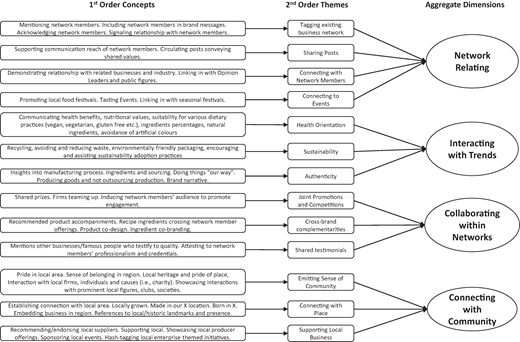
In line with the approach prescribed by Gioia et al. (2013), data was analysed in an iterative basis with the coding framework and subsequent themes being constantly refined through consultation with the underlying data. Using this technique facilitated the development of our conceptual framework building-blocks (i.e. concepts) for organisational identity development using SM. Figure 1 illustrates the analytical process of theme development, supported by underlying evidence. Furthermore, it allowed us to demonstrate the linkages and movement between the 1st-order codes (informants-derived) and the 2nd-order codes (i.e. researchers-derived), ensuring rigour whilst maintaining the creative contribution of qualitative inquiry (Gioia et al., 2013; Grodal et al., 2021). B2B SM interactions were grouped into initial codes, informed in part through terminology employed within the data (Gioia et al., 2013). The initial codes were grouped based on their relatedness to one another, which informed the development of second-order themes. Similar themes were grouped together to develop our conceptual framework. Themes were refined iteratively to ensure the consistency of the data present with the conceptual framework which emerged through the data analysis process. Upon completion of the iterative analytical process, four theoretical categories comprising 13 second-order themes became evident ( Appendix 1). Abiding by the abductive approach of our study, the extant literature was reflected upon throughout the process to help cement the categories upon completion. The analysis process is presented in Appendix 1. Exemplars of associated data are provided in the Appendix 2. To ensure consistency and organisation of the data, QSR NVivo 20 was employed. Computer-aided qualitative data analysis software has been argued to boost transparency and trustworthiness of analysis and allow the researcher more flexibility in moving back and forth between the resultant codes (Kaefer et al., 2015), which corresponds to the abductive reasoning used.
4. Findings
This section is organised around four processes of organisational identity development using SM for entrepreneurial firms:
network relating;
collaborating within networks;
interacting with trends; and
connecting with community.
Table 2 summarises the occurrence of the processes across the case firms and highlights that evidence of the four processes for creating organisational identity on SM was clear across all the case firms. Additionally, our processes were found to overlap, suggesting that these processes of creating identity are neither sequential nor linear but simultaneously occurring whilst producing meaningful outcomes related to organisational identity.
4.1 Network relating
In all instances, our case firms were observed to use SM to connect with established and relevant organisations and institutions that exist within business networks of partners, suppliers and distributors, SM opinion leaders, bloggers/vloggers and event management firms, which we defined here as “Network Relating”. Network relating comprised various activities which served to develop the organisation’s identity through SM. Tagging existing network members was a prevalent means of connection. This involved direct and explicit mentions of the network member in the SM post, e.g. through highlighting a product or an ingredient’s original supplier ( Appendix 2 [A2], 1–5). Tagging was also deployed to convey the ongoing business relationship between the firm and its partners through acknowledging network members or including them in the brand messages (A2, 7). As evidenced within the network activity, this process of identity formation served to bolster facets of the firm’s identity through creating and signalling associations with similarly purposed network members. This can either be explicitly stated or indirectly implied (A2, 6) for instance through announcing: a distributor’s supply chain-related activities (e.g. new store availability); a partners’ new products; product availability; and restocking activities (A2, 8–18).
Secondly, network relating can occur through sharing SM posts of other firms in the network. Sharing SM posts was used to bolster the reach of other businesses to larger audiences or to circulate posts that demonstrate shared values such as locality and healthy and ethical practices: “If you've got a good brand yourself and you’re sharing other people’s content, that enhances the relationship” (Sam’s interview – Firm A). Content shared varied to include healthy recipes incorporating the produce, sustainable or ethical practices of other network firms, distributors’ posts promoting the case firm’s product, advertisements about the firm published by other network members, videos illustrating business-related activities and product descriptions by other network actors (A2, 19–34).
Network relating also occurred through connecting to events and occasions such as tasting events, music and food festivals and seasonal events. Our entrepreneurial case firms connected to these various events on SM by announcing giveaways of event and festival tickets (A2, 43–45, 50). Sharing event-based information was another way of establishing and reinforcing the firm’s identity (A2, 46). Case firms often promoted their presence in the event to attract new visitors, including other businesses and organisations (A2, 47), whereas other SM posts could involve illustrating the firm’s advocacy and interest in the event (A2, 48–49). Further, network relating through events were established via sponsorships, which were amplified through the firms SM channels (A2, 51).
4.2 Collaborating within networks
Our case firms developed their organisational identity using SM through multifaceted collaborations with business partners within the sector. Collaborations require two or more firms to coordinate their promotional efforts to reach and attract new segments of the market, thereby simultaneously providing impetus for network expansion whilst leveraging each firm’s SM audience. These collaborations took the form of joint promotions, offers, competitions, informational content regarding product usage and food complements (including cross-brand complementarities) or testimonials, certifications or awards attained for business performance (e.g. product quality) by firms within the industry.
Joint promotions included explicitly endorsing other firms’ products, advertising B2B and B2C offers in SM posts, thereby indicating an ongoing collaboration between the associated entrepreneurial firms (A2, 81 and 82, 84–86, 90 and 91). Competitions were designed to solicit SM engagement through tagging followers, sharing and liking content, selling tickets and offering giveaways and prizes used to incentivise audience engagement with the firm, whilst collaborating with other network members (A2, 83). Furthermore, the entrepreneurial case firms’ tendency to educate customers about the optimal brand complementarities was clearly mentioned in the interview and noted throughout the connected case firms’ SM content (A2, 90–99): “[…] [should] be eaten with some local cheese, chutney [&] crusty handmade bread […] we want people to use the right products as well and we’re kind of educating people as well in that regard” (Sam’s interview – Firm A). Our case firm’s recommendation of other businesses’ products to consume with their own product provides further evidence of the role of SM in facilitating collaborations taking place behind the visible FB posts.
Equally, sharing testimonials and credentials represented another form of collaboration. Testimonials and credentials were posted as reciprocated positive reviews (A2, 101; 106; 108; 112) and sharing news around awards and certifications received (A2, 100 and 102–105, 107 and 109–111, 113–114). All of these serve to further establish the firm within the network, by affirming the firm’s professionalism and the quality of products and operations through collaborations with industry bodies and independent food monitoring institutions that assess the artisan food sector’s performance.
4.3 Interacting with trends
Much of the case firms’ FB content concentrated on linking to prevalent sectoral trends, for example conveying authenticity, sustainability and health-orientation to further develop organisational identity. Authenticity in this context denotes transparency (across the supply chain), originality and credibility of the firm in manufacturing its artisan food produce. The projection of authenticity was consciously enacted suggesting identity development as a purposive activity: “It’s being always true to ourselves, and be very real about everything we do, a lot of our recipes would be, you know, I suppose are authentic, we need to do this [our] way” (Sam’s interview – Firm A). This was signalled on SM by explicitly stating the ingredients used and manufacturing processes used and emphasising the “real” side of the product and brand (A2, 52, 57–58, 59–60). Authenticity was also expressed by uploading “behind the scenes” multimedia that captured the manufacturing process and product lineage (A2, 53–54, 56). Moreover, authenticity was invoked through brand narratives, depicting the origins and heritage of the firm’s business, illustrating the supplier’s production activities, values and historical context (A2, 54–55, 61). Sam, the entrepreneur of Firm A asserts the importance of SM in enabling the firm to tell its story: “Social media has given us […] an opportunity to tell our story” (Sam’s interview – Firm A).
Secondly, our entrepreneurial case firms ensured their business practices and procedures align to sustainability and prevalent health trends. Instances of interacting with sustainability trends are widely varied in the data but generally include: composting activities, sustainable packaging, recycling, green marketing, supporting sustainability initiatives by other organisations in the area and awards that affirm the firm’s sustainability practices (A2, 62–71). Interacting with health-orientated trends was evident through emphasising the use of natural ingredients, providing vegan and vegetarian products, avoiding artificial colouring, gluten-free and “health benefits” (A2, 72–80) “No artificial colours or flavours are used […] with the main ingredients being family farm fresh milk, from well cared for cows that are free to graze on the lush green Irish pastures” (Firm H).
4.4 Connecting with community
The fourth process of identity development on SM involved connecting with community. This was achieved by connecting to the local area and supporting other local businesses. Our findings suggest that this can be achieved through exhibiting familial heritage and the firm’s connection to the surrounding local area: “[in that video] [I] spoke about [my] family, history, heritage and […] even the […] little things […]that some people may not realize [about our history in business]. So again people [see our posts on SM] are including our family […] [and conclude we’re] very, very family oriented” (Sam’s interview – Firm A).
Our analysis reveals that entrepreneurial firms constructed a sense of community through their SM posts. This is evident by boasting the firms’ connection to the locality and the region, in addition to taking pride in belonging to the surrounding local community. This pride was enacted through highlighting the familial history behind the brand and by explicitly prompting consumers to support other local businesses and firms in the area (A2, 114–117). Connecting with place was also evident through emphasising the importance of using “locally grown products” (Sam) and locally sourced ingredients in the manufacturing process (A2, 118, 120–122, 124–128, 133 and 134). Other SM posts focused on the local area’s uniqueness, excellence and creativity, specifically in the artisan food sector (A2, 122–123 and 129, 132), thereby situating the firm as part of a regional tradition of high-quality food production “[region] has always been a centre of excellence for food and drink, pushing the boundaries of quality and raising standards globally.” (Firm H). Connecting with community is particularly relevant for the case firms in this instance, given the synonymity of the region and its producers with high quality and award-winning food production.
Beyond connecting with the artisan food producer community, emitting a sense of social closeness with locals residing in the city was also noted (A2, 119 and 130–131). The inclination to support local businesses was constantly and consistently adopted for the majority of our case firms. The support manifested in multiple forms, including endorsing local suppliers, showcasing local producer offerings, sponsoring local events, encouraging customers to “buy local” and hash-tagging local enterprise themed initiatives (A2, 135–146).
Similarly, linking to community was performed through interactions with local firms, individuals and charity causes (A2, 157–163), showcasing interactions with prominent local figures, clubs and societies (A2, 147–148), highlighting the local firm’s interaction with customers (A2, 149–153, 156) and indirectly interacting with business customers and distributors through referring to the customer’s response upon purchasing the product or competitions organised for local customers through distributors (A2, 154–155). These SM interactions enhanced the socially oriented endeavour followed by the case firms.
5. Discussion
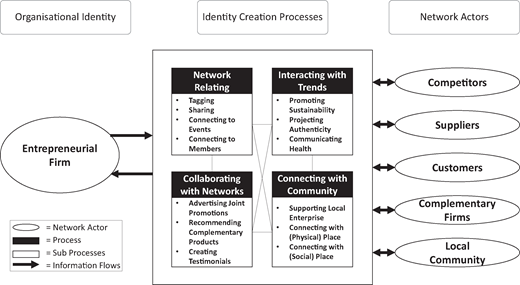
Digitisation is transforming interaction processes and SM is no exception (Georgescu and Popescul, 2015; Drummond et al., 2020). Prior research emphasises the importance of identity development for entrepreneurial firms to access and position themselves within networks (Baraldi et al., 2020; Gadde et al., 2003) with identity defined and developed in interaction with other business actors (Öberg et al., 2011). Our findings complement and add to this literature suggesting that identity can be developed by entrepreneurial firms in interaction using SM through engaging with the four processes to establish and bolster the firm’s identity within the network. Although previous literature highlights that identity development involves predominantly internal processes (Balmer, 1998, 2008; Schultz and Hatch, 1997), our findings suggest that SM-related identity development is heavily underpinned through interaction, thereby adding external dimensions to the process of establishing identity. As illustrated in our conceptual framework presented in Figure 1, the four network related processes of identity development were observed to overlap and influence each other in multiple ways.
Our framework complements extant knowledge that sheds light on entrepreneurial network development processes (Smith and Lohrke, 2008), branding co-creation processes (Iglesias et al., 2020) network capability development processes (McGrath et al., 2019) and entrepreneurial network-based processes using SM (Drummond et al., 2018; Wang et al., 2016). While the complexity of interfirm B2B relational processes means that no two cases are the same, our analysis suggests that the case entrepreneur and embedded network actors exhibit common patterns in developing organisational identity within networks using SM. The patterns and processes infer a dynamic framework of identity development that evolves in interaction and meanings inducement represented by the firms’ values that clearly contributed to the interaction choices and subsequently their identity formation and development.
Network relating as leveraged by our case firm for the purpose of identity development is defined as open and publicly visible initiation of new and further development of existing relationships to become a known player and gain a favourable position in the network based on similar and mutual values adopted by the counterpart firms. Prior literature suggests that SM can be used to connect with new customers (Bocconcelli et al., 2017), facilitate interaction with current customers to inform future innovations (Jussila et al., 2012) and expand the firm’s network context (Drummond et al., 2020). Although the general act of network relating is well established, our findings complement previous studies highlighting how entrepreneurs’, using functions such as tagging on SM, reached out to network members to develop their organisational identity within the network through signalling to wider audiences the alignment of values with other network actors on important issues, such as sustainability and ethical production – a projection of interactivity. As such our data demonstrates how SM can be strategically leveraged to add value to established and ongoing network activities of the firm and lends further evidence to the emerging INB literature (Koporcic and Ivanova-Gongne, 2020).
While extant literature highlights how organisational identity stems from the personal identities of founders (Rode and Vallaster, 2005), our research adds to this by demonstrating how relational values of founders can be enacted and conveyed by the firm using SM to promote and support other network members. This finding supports recent research which questions the relevance of the internal/external dichotomy of organisational identity creation (von Wallpach et al., 2017). However, in addition to relating to value chain members (Agnihotri, 2020; Drummond et al., 2020), the case firm and network actors related to bloggers and SM influencers to develop identity, which are connections more commonly applied in a B2C context (Hudders et al., 2021; Zhou et al., 2021).
In network relating, it was also clear that the case firm and networked actors used SM to share their core attributes and values, central to the identity creation processes (Iglesias et al., 2020). As illustrated in Figure 1, our processes are dynamic and related, and as such by interacting with trends, our case firms were also able to interact with other network members. Sharing of posts on healthy recipes, sustainable packaging, supporting local communities and charitable outreach served to position the firm within the network by conveying firms’ values and demonstrating ethical dimensions of activities undertaken across network firms. This sharing illustrates both how firms perceive themselves, while also influencing how they are perceived. This, in line with previous literature, strengthened their business relationships and social connectedness (Agnihotri, 2020; Wang et al., 2016). The case entrepreneur and embedded actors shared posts illustrating collective values, important for co-creation and trust (Sundström et al., 2021). Prior research suggests network actors may connect to events to enhance resource mobilisation (Drummond et al., 2018, 2020) and as part of an integrated marketing communication (Zahay et al., 2014). Our results underscore previous research, demonstrating the role of events as a network relating act, that contributes to the organisational identity creation of these ventures and can be leveraged through SM to situate the firm within networks and physical places where network activities occur.
Collaborating within networks as part of the identity development process is defined as the means through which entrepreneurs use SM to engage in collaborative activities with network members to become known and gain a favourable position within a network. SM has developed into a platform for collaboration (Jussila et al., 2014) creating opportunities for the development of new ideas and products through interaction processes (Drummond et al., 2022). Our findings support this literature where the entrepreneurs collaborated with other network members through joint promotions, cross-brand complementarities and reciprocal testimonials, as a means of enhancing their identity within the network. In identity development, joint promotions and product pairings enhanced the awareness of the entrepreneurial venture within the network. This complements literature which suggests that offline co-branding can enhance B2B partners’ network position enhancing the recognition and profile of all participating brands (Bengtsson and Servais, 2005). Testimonials and product reviews were also used by entrepreneurs to communicate their firm’s credentials, professionalism, quality and operational effectiveness, thereby adding value to the firm’s offering by providing network-derived social proof (Agnihotri et al., 2016; Andzulis et al., 2013).
Our findings suggest that, when reciprocated between network firms, public reviews by B2B actors can enhance the reputation of the wider network and the firm itself, embedding the shared values and ethos which exist between network firms. In particular, interview data with Firm A supports previous literature highlighting how individual identity and firm entrepreneurs’ values can be enacted during interorganisational dialogues (Törmälä and Gyrd-Jones, 2017), with founder’s beliefs regarding supporting network members translating into firm actions. The projective nature of signalling collaborations across SM leads to further interaction and business partnerships, as firms see the value of engaging in collective activities with similarly purposed firms with shared values. Specifically, the existence of shared firm values such as “supporting local”, allowed individual firms to collaborate in the form of a “shared voice” where shared firm values became explicit across SM marketing content for numerous firms within the network. The leveraging of shared network narratives and values is an important finding in SM identity development, as it allowed case firms to convey their identity to network members, complementing the emerging INB literature (Koporcic and Halinen, 2018; Koporcic, 2020). Finally, developing identity through collaboration enhances the attractiveness of individual firms within the exchange process (Purchase et al., 2016), as firms align their organisational identities to shared values, creating synergies between network actors and an incentive for other network firms to collaborate. While previous literature highlights how organisation identity is developed and reconfigured through relationships (Anderson et al., 1994; Laari-Salmela et al., 2019), firms’ use of SM to openly connect with network firms allowed for the simultaneous development and communication of identity and thereby increasing the efficiency of identity formation.
Interacting with trends is defined as the process by which entrepreneurial firms adapt their SM marketing content to clearly align their brand and identity-related messaging to these trends. SM significantly influences the business environment (Georgescu and Popescul, 2015), and is often where trends are initiated, debated, interpreted by market actors and ultimately grow or dissipate. As noted, the interactional perspective adopted moves organisational identity beyond the communicable elements of the marketing mix (Jacobson and Abratt, 2003; Koporcic and Halinen, 2018; Koporcic and Tornroos, 2019) and as illustrated in Figure 1 aligning with trends was supported through various network interactions. Notably, despite these trends seeming to be highly industry-relevant, interacting with trends in other industries seems characteristic for firms of different sizes. For instance, the tourism industry (Miththapala et al., 2013), technology markets (Vrande et al., 2009) and financial industries (Ko, 2016) are all examples that demonstrate the significance of organisational response to trends. Our findings suggest that the entrepreneurs strategically align to trends not only to promote firm values but to connect to and interact with the environment. The alignment of a brand’s messaging with a societal and/or network trend, helps create a sense of shared meaning and can attract the attention of network members. In recent years, pressure on actors across the value chain to address end-user demands for sustainable and ethical consumption has led to reassessment of firms position within networks, the emergence of novel business models and increased consideration of sustainability positioning in B2B branding (Sebastiani et al., 2013; Vesal et al., 2021). In this study, shared values centred on authenticity, charity, sustainability, healthiness and projecting care towards their surroundings, served to convey and establish the firm’s moral identity through alignment with virtuous network activities. Research suggests that firms can use SM to manage their brand and firm reputation (Andzulis et al., 2013). Although issues of moral identity in B2B context have been explored from a corporate brand perspective (Fan, 2005) and salesforce perspective (Itani and Chaker, 2021), their use as a means to attract the attention of network members for the entrepreneurial case firm was of particular note.
Swani et al. (2014) analysed marketers’ Twitter posts to reveal the use of emotional rather than functional appeals in their brand development with B2B customers. Our study builds on this by demonstrate how these emotional appeals, centred primarily around production values (e.g. authenticity, sustainability and locality) develop and reinforce the entrepreneurial identity development efforts using SM. Though the extant literature states that corporations engage their audience through following common industry-related trends (Wang et al., 2016), the findings broaden the range of trends instantiated by the entrepreneurial firms and assert the trends’ indispensability as a principal mechanism for entrepreneurial identity development.
Connecting with community goes beyond network-related activities to consider the firms embeddedness in the local socio-economic environment. Firms can use SM to leverage their connection with community for identity building purposes through communication their relationship with local businesses and create a sense of place and social closeness. Prior research suggests that SM can facilitate salespeople in creating a collaborative community (Mehmet and Clarke, 2016). In an offline environment, McGrath and O’Toole (2013) highlight that artisan producers develop a sense of community to enhance their reputation as a group and gain access to new positions in the network. Drummond et al. (2018) add to this noting that SM is facilitating a growing supportive community for artisan producers, further enabling collaboration. We build on this literature in highlighting how connecting with community can transcend network activities, establishing the firm and its entrepreneur as part of a region’s heritage, thereby conveying a spatial, social and temporal belonging with the firm’s environment. As trends are driven in part by the communities within which a firm is situated, the process of connecting with community simultaneously supports the process of interacting with trends, thereby further signalling the boundaryless aspect of the identity development processes we uncover in the data. For instance, firms connecting with their community simultaneously align to wider environmental trends regarding authenticity by establishing themselves as local, provincial and relatable to other actors within the network.
As entrepreneurs start out with already established connections with their societies through depending on the founder/owner’s personal relations (Jack et al., 2010), their firms constantly need to maintain, grow and develop these societal connections to stay relevant and familiar to other network members. Our study shows that an entrepreneurial firm’s socially relevant SM content enhances the firm’s ability to expand its network, as other businesses positively perceive the firm as sharing similar values and strategies. Thus, the interactive features of SM provide entrepreneurial firms with the conduits to closely socialise with local communities through crafting posts and content that accentuate pride in belonging to the local and national environment. The necessity of connecting with community as a general means of highlighting the congeniality of the firm through connecting to places and supporting local producers were noted in contextually similar research (i.e. Drummond et al., 2018).
The conceptual framework of entrepreneurial organisational identity development on social media illustrated in Figure 1 demonstrates the interrelatedness of the four processes. Figure 1 helps to showcase the main processes of organisational identity development represented by the primary themes identified in the findings. As opposed to Figure 1 where it aimed to demonstrate the analytical procedure of accurately arriving at these themes, Figure 1 emphasises how these themes (i.e. processes) interrelate and work hand-in-hand to construct organisational identity for entrepreneurial firms. It is clear from our data that although these processes are distinct, they are highly interrelated. Indeed, their interrelatedness reflect in part the multifaceted nature of SM whereby SM activities are often initiated to serve multiple firm objectives simultaneously (Drummond et al., 2022).
Interestingly, a common thread across all four processes was the role of ethics in shaping firms’ interaction and identity development through SM. This was evident both reactively, through responding to trends within the environment and also proactively through the firms’ engagement with community and other network actors. While some instances of ethical practices were explicit, such as engagement in sustainable production processes, others were more oblique and underscore moral inputs in decision-making such as supporting local regions and promoting upcoming firms within the network. This finding complements the work of Maon et al. (2021), which incorporates corporate social responsibility in organisational identity development by illustrating how the case firms’ ethically and strategically select network actors to establish a connection with. It also gives further credence to Freeman’s (2010) work about stakeholder theory that emphasised the inseparable nature of business decisions and the ethical dimension embedded within every strategic network decision to construct a morally oriented organisational identity.
6. Conclusion
In seeking to overcome inherent challenges such as smallness and limited capabilities, entrepreneurs aim to access external resource structures and opportunities by tapping into pre-existing business networks (Håkansson and Waluszewski, 2002; McGrath and O’Toole, 2013). Given the importance of firm identity in accessing networks, there has been calls for research to explore how entrepreneurial identity can be created (Baraldi et al., 2020). Our research aims to address this gap concerning organisational identity development using SM in a B2B entrepreneurial context, given the pervasive nature of digitisation in contemporary interactive marketing (Valos et al., 2014; Pagani and Pardo, 2017).
Theorising from our findings, we present a conceptual framework explaining how entrepreneurial firms can leverage SM to create their identity through the following interrelated network processes:
network relating;
collaborating within networks;
interacting with trends; and
connecting with community.
Incorporating the external dimension of identity (von Wallpach et al., 2017), our findings demonstrate how firms can strategically leverage SM in their interaction with network members to establish their organisational identity. As noted, the four processes are not linear nor sequential, rather they overlap in meaningful ways, thereby reflecting the complex nature of network dynamics. We provide definitions for each process and show how they are situated within the extant literature, ultimately leading to the development of identity for entrepreneurial firms. In doing so, we contribute to recent entrepreneurial-based process literature using SM in a B2B context (Drummond et al., 2022) responding to recent scholarly calls to connect and converge identity related gaps in B2B, entrepreneurship and SM settings (Baraldi et al., 2020; Laari-Salmela et al., 2019; Iglesias et al., 2020). The processes also serve to highlight the important role of ethical and virtuous business practices and approaches embedded and prevalent in the application of these processes. Although the data suggests the presence of moral considerations in firm decisions and interaction, their strategic value is less clear and warrants further investigation.
For practice, identity development is important for entrepreneurial firms signalling legitimacy, recognition and a sense of attractiveness for interfirm interactions and relationships (Baraldi et al., 2020; Purchase et al., 2016). Through network relating, entrepreneurial firms harness the tagging and sharing facilities of SM platforms to initiate and further develop connections with network actors, including value chain members, celebrities and SM influencers. In collaborating within the network, further resources are embedded deepening engagement through joint promotions, shared testimonials and awards, and cross-brand complementarities highlighting the coordinated efforts between networked firms. Furthermore, our findings and analysis suggest a widened scope of network actors that expands to include and reach the local community within which entrepreneurial ventures are situated and establishing their heritage, thereby situating the firm, spatially, socially and temporally within their environment. This is made evident through the interacting with trends and connecting with community processes. In this way, using the four processes can facilitate the identity development process for entrepreneurial firms, which is important to access external resources and opportunities and gain a favourable position within the network.
Despite the use of qualitative research to explore new insights to creating identity by entrepreneurs on SM which was not sufficiently investigated in prior research, the study has some limitations that should be acknowledged. Firstly, our study has solely focused on the agricultural food sector in Ireland. Further research is required in different sectors and regions to establish the wider applicability of the findings presented and to explore any divergences and/or analogies to the conceptual framework proposed in this paper. Future studies could also target different research subjects outside Ireland to verify whether international cultural variances could expand and refine the processes of entrepreneurial SM identity development. Further, given that SM applications are varied in content and purpose (Karampela et al., 2020), future research should explore the impact of using SM platforms other than Facebook to outline the role of virtual environments as units of analysis (Drummond et al., 2020). Finally, given the inherent generalisability limitations associated with qualitative methods, future studies may employ quantitative or mixed methods to further verify our conceptual framework for organisational and entrepreneurial identity construction and development.


 [retail partner location]. Filling the shelves county wide” (Firm A)
 )
)

 ” (Shared by Firm B)
 Kicking off from tomorrow until Sunday, it's a #foodfest not to be missed! We look forward to seeing you all there
  ” (Shared by Firm D)
 Tickets on sale 3:00 p.m. today
  ” (Firm A)
 [Firm D]” (Firm D)
 ” (Firm A)

