This paper aims to identify the paradoxical tensions that manufacturing companies face along their servitization journey at different organizational levels and interfaces between levels.
To achieve this aim, a variable-oriented case study approach has been taken, which considers the stages as impact variables. The single, in-depth, longitudinal case study is about a multi-unit manufacturing company in which a specific business unit developed the servitization strategy. The research adopts the categorization of paradoxes proposed by Smith and Lewis (2011) – learning, belonging, organizing and performing – encompassing both intra- and inter-category tensions.
The comprehensive perspective adopted has allowed us to represent the competing demands faced by firms in advanced services-related innovations. Specific tensions of learning, belonging, organizing, performing or combinations thereof were found at different stages of the servitization journey (exploration, engagement, expansion), and at different levels of analysis, at the focal business unit or at the interfaces between this level and the project team, the corporate level and the ecosystem.
To the best of the authors’ knowledge, this paper is the first attempt to address the issue of paradoxical tensions in servitization with an overarching methodology that considers organizational levels, journey stages and paradoxical tensions simultaneously.
1. Introduction
The traditional servitization narrative contrasts services with products, suggesting manufacturers abandon product orientation in favor of transitioning to service provision. Several contributions have questioned this simplistic juxtaposition, claiming that a more in-depth and critical scrutiny is necessary to fully understand the various interrelated questions pertaining to the transition from traditional manufacturing to modern product-service systems (Kowalkowski et al., 2015). In fact, products – especially complex capital equipment systems – constitute fundamental assets for this transition, as advanced and complex hybrid solutions rely on the interrelation between services and the ability to design and produce industrial products with a highly standardized logic (Ulaga and Reinartz, 2011). This interrelation becomes even more evident in current digitally based servitization processes, or digital servitization, where the use of advanced analytics, customized products and advanced services are interconnected elements (Cenamor et al., 2017; Kohtamäki et al., 2020).
Therefore, there is a need to move from a rhetoric of either-or to a both-and approach since successful manufacturers must simultaneously pursue exploration and exploitation, customization and standardization, effectiveness and efficiency. Manufacturers involved in servitization have to face contradictory logics that endure over time and do not imply simple solutions (Kowalkowski et al., 2015), introducing a persistent paradoxical argument (Kohtamäki et al., 2020).
Paradoxical reasoning has been adopted by management studies to investigate a series of managerial tensions such as exploration vs exploitation, financial goals vs social responsibilities, control vs collaboration within the organization or competition vs collaboration in inter-firm relationships (Schad et al., 2017). The theoretical seminal work for these studies is Smith and Lewis (2011), which proposes four general categories of possible paradoxes in organizations (learning, belonging, organizing and performing), noting that they can occur in isolation or in combination with each other (e.g. learning and belonging). This work also inspired Kohtamäki et al. (2020) to adopt the paradox lens in the study of servitization, which in turn attracted the attention of other servitization scholars.
Studies published in the past three years have demonstrated the effectiveness of using the paradox lens to understand the servitization strategy of manufacturing firms. In particular, some studies (Dmitrijeva et al., 2022; Galvani and Bocconcelli, 2022; Korkeamäki et al., 2022) have shown the need to recognize that a digital servitization strategy is a process that unfolds over time, highlighting different paradoxical tensions at different stages of this journey. Other studies (Eggert et al., 2022; Raja et al., 2022; Sandvik et al., 2021) have emphasized a further need, arising from the different organizational levels at which the paradoxes of servitization can take shape. However, both of these analytical perspectives – that of the temporal stages of servitization strategy and that of the different organizational levels involved – must be adopted when a given paradoxical tension involves only one organizational level (that may not be the one on which a study that has adopted only the temporal perspective focuses on) or appears and is resolved within a given stage (that may be different from the one – generally the engagement stage – on which a study that has adopted only the organizational perspective focuses on). Due to these reasons, we agree with Gölgeci et al. (2022), who point out that it is necessary to analyze the servitization journey by simultaneously adopting the two perspectives that have been found to be separately relevant in studies conducted to date on the paradoxical tensions associated with servitization strategy. Furthermore, the research conducted so far neglects the tensions that can arise in all multi-unit organizations at the interface between the corporate level and the level of the business units (BUs): these tensions are widely discussed in management literature (Menz et al., 2015), but not when they are paradoxical in nature and the focal BU is directly involved in a servitization strategy (Kohtamäki et al., 2020). Finally, only Raja et al. (2022) accepted the Smith and Lewis (2011) suggestion to pay attention to inter-categorical tensions, while the findings of their research (which, moreover, suffers from the two previous gaps) encourage further investigation of this issue.
Our paper aims to address all three of these gaps through a case study of a manufacturing company operating in the packaging industry. The aim is to identify the paradoxical tensions that this company has encountered and faced along its servitization journey at different organizational levels and at the interfaces between levels. The theoretical framework supporting the research is represented by the typology of paradoxes proposed by Smith and Lewis (2011), taking into account not only the four categories but also the inter-categorical tensions.
The remainder of the article is structured as follows: in the next section, we set the theoretical bases for our study, identify the above-mentioned research gaps and present the related research questions; then we illustrate the methodology we followed (Section 3) and show the results of our analysis (Section 4), before discussing them in light of existing studies (Section 5) and highlighting implications for theory and practice (Section 6).
2. Theoretical background
2.1 Digital servitization as an elective context for applying the paradox lens
In the seminal paper that is considered the keystone of the organizational theory of paradoxes, Smith and Lewis (2011) define a paradox as two contradictory but interdependent elements that exist simultaneously and persist over time. The authors identify four general categories of paradoxical tensions inside organizations. The first is defined by the authors as the learning paradox, i.e. the tension between the known and the unknown, past knowledge and future innovation, widely studied by scholars of ambidexterity in the wake of March’s (1991) famous essay on exploration and exploitation in organizational learning. The other three general paradoxes are: belonging or identity paradox, as individuals and teams seek both homogeneity with the rest of the organization and differentiation from it; organizing paradox, which emerges when achieving a desired outcome leads to competing designs and processes within the organization; and performing paradox, stemming from the differing and sometimes conflicting demands, which may come from both internal and external stakeholders. Paradoxes may fall into one or another of these categories, or arise between different categories, such as the conflict between learning and belonging, reflecting “conflicts between the need for change and the desire to retain a developed sense of self and purpose” (Smith and Lewis, 2011, p. 384).
The fact that paradoxical elements exist simultaneously over time presents a fundamental challenge for paradox management. Leaders faced with paradoxical tensions can respond in two different ways: prioritize one element and exclude the other, using an either/or logic; or exploit the interdependence and complementarity among the opposing elements in the paradox, adopting a both/and logic. The latter approach has been chosen and developed over time by the founders of paradox theory (Lewis and Smith, 2022; Smith and Lewis, 2011).
Following the foundational contribution of Smith and Lewis (2011), an increasingly broad scholarly community began to grow around the concepts of organizational paradox theory. The Oxford Handbook of Organizational Paradox, published in 2017, already featured contributions from 66 scholars (Smith et al., 2017). The emergence of this theoretical perspective aligns with the observation that organizations operating in competitive environments are pervaded by tensions and competing demands (Schad et al., 2017). In this regard, manufacturing servitization offers an ideal context for applying the paradox lens. On the one hand, servitization strategies give rise to the so-called service paradox, where “substantial investment in extending the service business leads to increased service offerings and higher costs, but does not generate the expected correspondingly higher returns” (Gebauer et al., 2005, p. 14). Clearly, this represents a typical performing paradox according to Smith and Lewis (2011). On the other hand, the product-service dichotomy is full of tensions both within servitizing firms and in the relationships in their value network (Burton et al., 2016).
The servitization narrative has traditionally contrasted services with products, adopting a simple either/or thinking and suggesting the idea that manufacturers would have to abandon the product-logic to embrace a service logic. By contrast, building on the observation that products and services are interdependent components of manufacturers’ strategies, some scholars have stressed the importance of a more mature both/and approach, challenging the either/or rhetoric (Kohtamäki et al., 2020; Kowalkowski et al., 2015). These authors have therefore brought the product-service dichotomy into the domain of organizational paradox theory (Lewis and Smith, 2022).
In servitization, value is created by customizing advanced services and solutions onto standardized and industrialized installed bases of machines and equipment (Ulaga and Reinartz, 2011). Therefore, for the success of modern manufacturers, both customization of solutions and efficiency in manufacturing must be pursued simultaneously. This introduces a persistent paradoxical argument into the servitization strategies, forcing manufacturers to balance contradictory logics and face enduring challenges that do not have simple solutions. The first to adopt the paradox lens to the study of servitization, recognizing that servitizing organizations need a both/and approach, are Kohtamäki et al. (2020). Through a comparative case study of four companies, the authors identify specific types of paradoxes in servitization and explore different practices that manufacturers apply when dealing with these challenges.
2.2 Paradoxical tensions in digital servitization
As highlighted in the recent literature review by Singh et al. (2024), studies analyzing the paradoxes linked with digital transformation of business began to be published more than ten years ago and have now reached a sizeable volume. Within this vein of research, more recently, specific attention has emerged for the link between digital servitization and paradoxes. Indeed, since the paper of Kohtamäki and colleagues, ten articles have been published, all conducted using qualitative research approaches. The aim of all the papers is to identify specific paradoxical tensions that emerge during the servitization process. Six papers (Chaudhary et al., 2022; Dmitrijeva et al., 2022; Raja et al., 2022; Smania et al., 2024; Stegehuis et al., 2023; Tóth et al., 2022) use the Smith and Lewis’s categorization of paradoxes in some way. Only Raja et al. (2022) use this typology in an inter-categorical rather than intra-categorical way.
Regarding the organizational levels chosen for the identification of tensions, seven studies do not analyze multiple levels while the others develop the analysis at both the intra-organizational and the inter-organizational level. The former level corresponds to the organization as a whole while the inter-organizational level involves customers and possibly other actors in the focal firm’s network (Eggert et al., 2022; Raja et al., 2022). The paper by Sandvik et al. (2021) addresses linkages between levels by admitting that changes in paradoxical tensions at one level can affect tensions on other levels.
Three papers have considered servitization as a journey divided into phases (Dmitrijeva et al., 2022; Galvani and Bocconcelli, 2022; Korkeamäki et al., 2022). The most structured one is proposed by Dmitrijeva et al. (2022) who use the four-stage servitization model of Baines et al. (2020), which includes:
manufacturers’ initial contact with, and study of, servitization;
experimentation and co-development of specific outcome-based services;
increasing the scale of innovation and integration of the product-service offerings; and
optimization and delivery of the servitization portfolio.
The review of studies published to date on paradoxical tensions in digital servitization reveals some gaps.
First, while all the contributions consider either the time dimension or the organizational level dimension, none has used both of them. However, both dimensions are important. On the one hand, servitization strategies are complex processes involving significant changes in terms of both capabilities and service offerings of the firms, as first demonstrated empirically by Martinez et al. (2017) and followed by Baines et al.’s (2020) conceptualization of servitization as a transformative journey. On the other hand, several studies (e.g. Gölgeci et al., 2021; Lenka et al., 2018) have shown that firms’ servitization strategies are influenced in various ways by actors belonging to their ecosystem. As both of these characteristics of servitization strategies must be considered even when they are observed through the paradox lens, the absence of a dual approach in all studies on servitization that have adopted this lens prompted Gölgeci et al. (2022) to suggest adopting both phases and levels as an appropriate methodological choice to advance knowledge on the topic. They propose articulating the temporal dimension into three phases (before, during and after servitization) and indicate three levels of analysis: the intra-organizational level (e.g. individuals, teams), the organizational level (corporate) and the inter-organizational level.
Second, organizational levels are interdependent (Sandvik et al., 2021), meaning that some tensions may arise within each level, while others emerge at the interfaces between levels. However, the reviewed contributions that adopt a multi-level perspective primarily analyze the interface between the entire organization (corporate) and external actors, neglecting potential interfaces within the organization. These internal interfaces could include interactions between the BU involved in the innovation process and the corporate level, or between the project team dedicated to innovation development and the organizational level on which it depends (BU or corporate). The absence of a inter-level approach within the corporate level in all studies on servitization that have adopted the paradox lens is a second literature gap, which is particularly relevant when one considers that multi-unit configuration is widespread not only among large multinationals but also medium-sized companies (Coltorti et al., 2013).
Third, considering the categories of learning, belonging, organizing and performing, tensions “operate between as well as within these categories” (Smith and Lewis, 2011, p. 384). Studies have predominantly focused on intra-category tensions, except for Raja et al. (2022), who solely considered inter-category tensions. However, it is reasonable to assume that both types of paradoxical tensions may emerge in servitization journeys. This suggestion is supported by the findings of Dieste et al. (2022) in the broader context of Industry 4.0. The authors find several inter-category tensions when implementing 4.0 initiatives, the most important of which is the learning-performing one caused by the high investments needed for the learning process (technologies, training, human resources, research).
Based on these gaps, our research aims to identify the paradoxical tensions encountered and faced by manufacturing firms actively involved in digital servitization strategies throughout the servitization journey, considering different organizational levels and the interfaces between them. Specifically, the first research question we have attempted to answer is the following: taking into account the categorization of paradoxes proposed by Smith and Lewis (2011) – learning, belonging, organizing, performing – do these categories all emerge in each phase of the servitization journey and at every organizational level/interface, or do they present a selective configuration in relation to the phases and levels/interfaces? Furthermore, in analyzing the specific characterization of the paradoxical tensions identified, we have sought to understand whether each of them corresponds to a “pure” category (e.g. learning or belonging) or consists of a combination of two categories (e.g. learning and belonging).
3. Methodology
3.1 Research design
In line with similar studies (Dmitrijeva et al., 2022), we adopted a variable-oriented case study approach that considers the stages as impact variables (Miles et al., 2014). Specifically, we aimed to explore how the transitional stages of the servitization journey and the different organizational levels involved impact the emergence, consolidation and modification of paradoxical tensions (Smith and Lewis, 2011).
While previous literature has explicitly utilized processual perspectives to uncover critical challenges in business model transitions and renewals (Khanagha et al., 2014; Paiola et al., 2022; Visnjic et al., 2021) and to investigate the generative forces of paradoxical tensions in servitization (Dmitrijeva et al., 2022; Korkeamäki et al., 2022), to the best of our knowledge, no attempt has been made to combine both perspectives thus far.
Against this background, we determined that an in-depth, process-oriented qualitative case-based research methodology would be suitable for our investigation’s objectives, focusing on understanding “how and why things emerge, develop, grow, or terminate over time” (Langley et al., 2013, p. 1). Literature highlights the appropriateness of case-based research for addressing managerial challenges that necessitates a process-based view (Bluhm et al., 2011), detailed data provision (Yin, 2009), contextualized explanation (Welch et al., 2011) and theory refinement and development (Voss et al., 2002). It is widely adopted in studies focused on paradoxical tensions (Andriopoulos and Gotsi, 2017), particularly in relation to servitization (Dmitrijeva et al., 2022; Galvani and Bocconcelli, 2022; Kohtamäki et al., 2020; Korkeamäki et al., 2022). Specifically, single in-depth and longitudinal approaches are considered appropriate for understanding complex and underinvestigated phenomena such as service-oriented business model transitions (Visnjic et al., 2021) and emerging digitally based servitization (e.g. Tronvoll et al., 2020), although they are comparatively rare in innovation-related research (e.g. Khanagha et al., 2014).
To address the research questions of this study, regarding the specific paradoxical tensions that arise at the different stages of the servitization journey and at the different organizational levels/interfaces involved, we conducted an in-depth case study of an Italian multi-unit industrial firm undergoing a transition towards advanced services. Our investigation focused on a specific medium-sized BU, the Machines Division of a company operating in the packaging industry, which initiated and developed new advanced services. In 2022, the corporate has a total turnover of approximately €400m, and the BU’s contribution to total revenues has grown from €13m to almost €40m (of which 25% is service-related) in the past ten years. They export worldwide, with the domestic market accounting for 30% and North America for 34%.
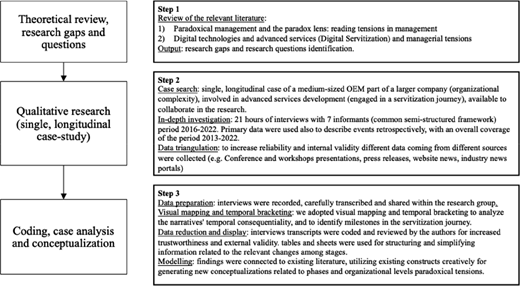
The capital equipment industry is currently undergoing a machine-as-a-service transformation, envisioning an evolution of firms’ offerings toward new and potentially disruptive service-oriented business models (Paiola and Gebauer, 2020; Tronvoll et al., 2020), making it a suitable context for our research. Figure 1 reports the research framework and the analytic process adopted in the study.
3.2 Data collection
Primary and secondary data were collected for the investigation, reinforcing the internal validity and reliability of the empirical evidence (Evers et al., 2017). The main primary data gathering instrument was semi-structured interviews, which were particularly appropriate for obtaining comprehensive and reliable information both in the present and retrospectively (Pettigrew, 1990). In total, we conducted personal interviews with seven managers representing various levels of the organization, including top, middle and line managerial levels. The selection of participants was based on their involvement in the innovation process, their relevance and reliability as informants (Voss et al., 2002): we interviewed all the managers involved in the innovation, that was a project managed by the division with great independence from the corporate. These managers belonged to the BU’s organizational level (general manager, technical director, sales director UE), the project team (BU’s technical director – the team leader, BU’s servitization manager, project manager) and the corporate level (president and CEO, corporate head of communication). We conducted a total of 21 interviews, amounting to more than 20 h and directly covering a span of seven years, from late 2016 to late 2022 (Table 1).
To extend our timespan retrospectively back to 2013 and to enhance the reliability of the data gathered from interviews, we utilized several additional secondary sources (Flick, 2018). These sources included internal documents and archival data such as reports and presentations, speeches at congresses and webinars, public information about the industry or the firm (e.g. press releases, interviews with company members in written or audiovisual formats), information available on the company’s website, industry-specific news portals and other institutional entities such as industry associations and exhibition organizers. Overall, 87 documents totalizing 257 pages together with 23 videos have been scrutinized for data triangulation.
Such detailed and longitudinal research designs are comparatively rare in servitization research and in business innovation-related research at large (Aarikka-Stenroos et al., 2017; Khanagha et al., 2014).
3.3 Data analysis process
Data analysis process followed our research methodology, which combined Baines et al.’s (2020) servitization stage model with Gölgeci et al.’s (2022) organizational levels and Smith and Lewis’s (2011) organizational paradox categories in an integrated research framework. To ensure internal validity, reduce informant bias and improve reliability (Gibbert et al., 2008), we used a rigorous data elaboration method in a multi-step approach similar to Dmitrijeva et al. (2022).
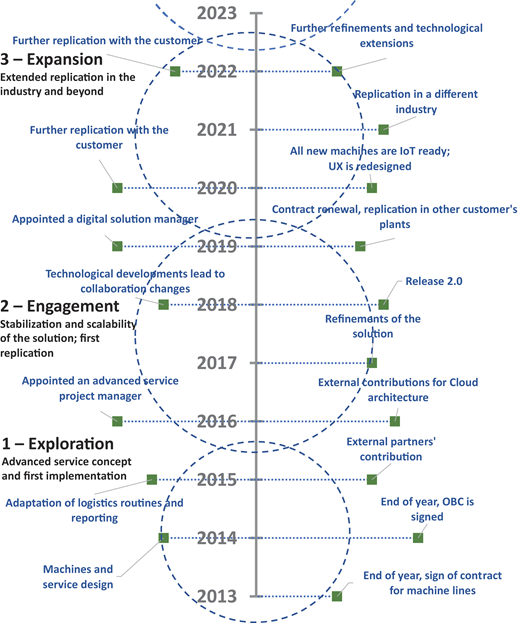
First, we used visual mapping and temporal bracketing strategies (Langley, 1999) to analyze the narratives’ temporal consequentiality. We identified milestones in the innovation process and developed a chronological roadmap of the firm’s servitization journey from its inception. This critical-event timeline is depicted in Figure 1.
Second, we utilized recognized techniques for data reduction and display to structure and simplify the information. The interviews listed in Table 1 were recorded, transcribed and coded adopting established protocols following three steps – namely, open, axial and selective coding (Strauss and Corbin, 1990) – and with the aim of exploring concepts and themes connections as suggested by inductive coding approaches (Gioia et al., 2013).
Considering the significance of data transformation in case study work (Pettigrew, 1990), we identified tensions related to contradictory, interdependent and persistent competing demands. Based on the nature of these demands, we further classified them into codified organizational paradox categories (Smith and Lewis, 2011), namely, learning, belonging, organizing and performing.
Third, we mapped the identified paradoxical tensions onto the chronological roadmap of the servitization journey and the organizational levels involved in the innovation. The predominant tensions were allocated to specific temporal brackets according to Baines et al.’s (2020) four-stage model, based on the firm’s dominant activities and objectives. Additionally, we used organizational levels of analysis as criteria for allocating paradoxical tensions.
3.3.1 Critical events
Figure 2 displays the critical events of our case’s servitization journey. It includes three out of the four stages described by Baines et al. (2020), which aligns with the findings of other scholars and highlights the limited number of manufacturing companies that have reached Stage 4 (Baines et al., 2020; Dmitrijeva et al., 2022).
Stage 1 (exploration) of the servitization journey encompasses the initial exploratory activities in advanced services, starting from the decision to initiate the servitization exploration and ending when the firm’s key stakeholders recognize servitization as a viable opportunity (Baines et al., 2020). In our case, this stage begins in late 2013 when one of the company’s key customers issued a tender to replace some production lines at their main plant, which included a five-year service contract aimed at ensuring the machines’ overall equipment efficiency (OEE). The stage relates to the development of the advanced service concept and the initial implementation of an advanced service capability within the firm. The specific critical events within this transformation stage are detailed in Table 2.
Throughout 2014, the BU put in place the specific designing, constructing and optimizing of the machinery for the advanced service contract, alongside their regular operations. Specific organizational solutions were required for implementing the service contract: along with a dedicated software platform for data management and an in-house control room, an on-site team of ten individuals and an on-site warehouse dedicated to spare parts were established. The experimentation and learning period on the advanced service lasted over a year, eventually reaching the promised outcomes.
Stage 2 (engagement) “captures the manufacturers’ efforts to develop service-based value propositions and evaluate their specific design and delivery implications” (Dmitrijeva et al., 2022, p. 146). This stage begins with the decision to engage in the development of advanced services and continues until the organization fully embraces the potential of servitization (Baines et al., 2020).
In our case, the initial success in meeting the contractual commitments with the key customer reinforces the belief that advanced services are a viable perspective, leading to the recognition of servitization as a sustainable strategy and further investments. Therefore, by the end of 2019, several sequential investments were made to prototype a scalable cloud-based solution, redesign the technological architecture, revise the suppliers portfolio and modify the organizational routines supporting advanced service contracts. The new cloud-based solution (release 2.0) was implemented by the key customer during the contract renewal. It replaced the original solution and was subsequently applied to an additional customer’s plant.
In Stage 3 (expansion) service offerings begin to demonstrate the creation of service value (Dmitrijeva et al., 2022). During this stage, expanding to new customers and industries presents challenges related to adapting service processes and digital applications to a diverse range of functional needs that need to be standardized (Baines et al., 2020). Additionally, pricing and selling activities become specific and challenging.
Efforts for selling the digital solution restart with the recover after the COVID-19 outbreak in 2020, with an IoT platform’s user experience redesigned with new digital partners. First, this leads to signs new contracts for additional key customer’s production lines in Italy. Second, all newly sold machines are now “IoT ready,” and commercial promotions are implemented to encourage new users to explore the platform’s functionality. The number of connected machines steadily grows and customers from various industries show increasing interest. The company secures contracts with several global players, including new customers.
3.3.2 Levels of analysis
Our research considered different organization-related levels of analysis, indicated by the literature as a meaningful criterium for allocating intra- and inter-organizational paradoxical tensions (Gölgeci et al., 2022). Since our case study concerns a multi-unit firm, and the digital servitization strategy involved a specific BU, we first searched and analyzed the paradoxical tensions perceived and faced by relevant actors within this BU. Additionally, we examined all relevant interfaces that the BU has with other intra- and inter-organizational levels, considering three additional levels of analysis as loci where paradoxical tensions can arise and become prominent:
The interface between the BU and the specific project team in charge of developing the service innovation within the BU. This team consists of the team leader (the BU’s technical director), the BU’s servitization manager acting as the functional interface with the customer and the project manager serving as the technical interface with on-site technicians.
The interface between the BU and the corporate level, represented by the president and CEO of the company.
The interface between the BU and the external ecosystem, which serves as the inter-organizational level. In our case, the actors at this level are mainly constituted by key customers and digital technology partners.
4. Findings
4.1 The exploration stage
Stage 1 (exploration) of the servitization journey highlights the paradoxical tensions of exploring advanced services in a product-oriented organization. For the BU, the adoption of an outcome-based contract (OBC) requested by the lead customer presents a strategic opportunity but also an unprecedented risk. The challenge is to learn how to effectively build and manage an OBC, which involves designing ad-hoc solutions for the machines and service architecture, as well as developing new processes, resources and capabilities. This includes establishing on-site operations management teams and dedicated organizational interfaces, all while maintaining a strong connection with the existing BU activities. These dynamics give rise to tensions within the BU itself and with other organizational levels examined in the study (refer to Table 2 for an overall representation).
At the BU level, we observed a fundamental organizing tension regarding the allocation of resources and capabilities for the exploration of advanced services. The conflicting and interdependent factors revolve around integrating advanced services within the product division itself versus creating a separate independent division. In the case study, the chosen coping strategy was to keep the innovation team within the BU. This decision aimed to foster flexibility and empowerment necessary for innovation to flourish while maintaining control over the direction of development and facilitating coordination and collaboration with the existing business. One interviewee notes that:
We have prioritized internal resources over external ones[…] if you don’t have internal people to dedicate to digital servitization, well this could be a serious problem for you (BU General Manager, HD2).
At the interface with the project team in charge of the innovation, conflicts arise between the need for change and learning new things, and the necessity of cultivating and protecting a consolidated identity and mindset (learning::belonging). These conflicts oppose the competing demands of creating new advanced service capabilities and maintaining a satisfactory identification with the BU’s product mindset. In this context, the tensions of learning inherent in the exploration of a completely new dominant logic, the advanced service logic, are paralleled by the new identity that the innovative orientation entails, which the group deeply internalizes during this stage. The team’s identification with the customers’ processes and needs creates distance from the mindset inherent in the rest of the BU, with which the team still interacts daily. As one interviewee notes:
The traditional service structure [within the BU] struggles to understand the logic of the contract, and to learn the logic of the new advanced services and their business models[…] the division’s after-sales maintains its traditional structure and processes, that is founded on selling parts, doing traditional maintenance, selling machine upgrading […] (BU Servitization Manager, SM1).
The BU–corporate interface becomes the theater of an organizing paradoxical tension, characterized by competing designs and processes to achieve a desired outcome, related to the quest for adjusting or innovating internal organizational processes to satisfy the needs of the advanced service contract (e.g. new ways of warehousing and spare parts handling). At this stage, the tension remains latent, given the broad independence that the corporate has granted to the BU to succeed in fulfilling the customer’s requests, allowing the BU to design organizational turnarounds and ad-hoc temporary solutions. In the words of one interviewee:
When it comes to interacting with some corporate offices, like the IT or the purchasing department, and we try to explain our needs in terms of business processes, here we can have some problems[…] we face some rigidities due to the fact that, you know, we are a division of the group and the service culture […] our service orientation, is not evenly distributed in the group (BU General Manager, HD2).
The tension will emerge as salient in the next stage due to the need of stable solutions that regain direction and control.
At the interface with the ecosystem, we finally identified learning::performing tensions between building capabilities for the future and ensuring success in the present, which come into play in the relationship with lead customers and critical digital technology suppliers. These tensions pertain to the competing demands of facing risk and costs of learning and limiting or sharing risks and costs of guaranteed performances. In terms of the relationship with customers, this stage entails a great cognitive investment in building the logic, technology and contractualization of the new advance service. This collaborative nature inherently limits the value extracted from the advanced services in terms of prices and profits related to the actual performances achieved. Regarding digital technology suppliers, their contribution in the learning for the BU influences the reciprocal power, as the contractualized performances are also maintained based on the quality of these external contributions. As referred by one interviewee:
The customer would be supposed to tell you what the value of 1% gain in efficiency for him is […] but he doesn’t tell you that, because he wants to keep that information for himself. That creates tension, discussions and uncertainties for us that we could avoid with a more complete sharing of data from the start (BU Technical Director, TD2).
4.2 The engagement stage
In Stage 2, the company strengthens its commitment to advanced services as a viable business opportunity. This stage encompasses the overall tension related to the interplay between exploring advanced services mechanisms and developing a comprehensive and versatile technological solution capable of streamlining the economics of advanced services and sustaining scalability for the initial replications. Overall, this stage shows a reduction in the intensity and articulation of tensions (see Table 3). Our focal BU continues the work started in Stage 1, particularly focusing on internalizing key resources related to the design and implementation of the digital solution (this point is connected to the BU-ecosystem interface below).
At the BU level, the initial decision to integrate additional capabilities within the BU and specifically within the project team responsible for innovation is reaffirmed in this stage. The primary focus for the BU is to design the organizational processes necessary to streamline advanced services while managing the competing demands of designing service processes for empowerment and flexibility and fostering direction and control for replicability. As one interviewee says:
The fact is that the servitization changes the meaning of service and the way in which you manage customer services […] servitization means selling efficiency and this implies to modify how the division organizes its operations to be able to do it in the most efficient way possible (BU General Manager, HD4).
At the interface with the project team, initial learning tensions related to understanding how to meet the performance guarantees outlined in contracts, which were experienced in Stage 1, gradually fade as a successful cognitive process stabilizes the results and reliability of the envisioned logics and solutions. However, tensions related to belonging persist due to conflicts between the team and the collective identity of the BU. These conflicts arise from the competing demands of upholding the new values associated with advanced services and maintaining the firm’s product mindset, exacerbated by the increasing role of digital technologies as enablers and facilitators of advanced services, which intensify conflicts between the need for change and identity. One interviewee reports that:
The manufacturer culturally is basically somebody that expects an order, prepares a bill of materials, tells the warehouse to prepare the components that have to be assembled, then proceeds with the testing and the delivery, and in the vast majority of cases considers services as a disturbance of this flow (BU Technical Director, TD1).
At the BU–corporate interface, the competing demands of organizing paradoxical tensions, which were latent in Stage 1, become more prominent in Stage 2. These tensions arise from the interface between the BU and the corporate level, particularly in services performed by the corporate as staff functions for the BU, such as common organizational processes and information systems procedures. The new focus on service scalability and replication necessitates specific modifications in these areas, leading to contrasting demands related to maintaining operational efficiency in product business operations and exploring advanced services-oriented processes. As stated by one interviewee:
The corporate IT department did not participate in the upgrading of the digital solution for the contract […] and perhaps it was even for the better[…] the Cloud and the like are not quite their business (BU Servitization Manager, SM1).
At the interface with the ecosystem, the organizing tension related to the redesign of internal processes emerges and affects also the ecosystem actors, especially in the selection of new digital technology suppliers. While the experience gained in the first years allows for a satisfactory adjustment of the risk and reward dynamics underlying the contracts from the customer’s side, the BU realizes that internal competence and capabilities alone are insufficient for fully developing and implementing digital solutions. Additional competences and experiences need to be sourced through external collaborations. These collaborations are scrutinized in light of the new scalability and replication objectives, resulting in the preceding learning::performing tensions dissolving and giving rise to a prominent organizing tension between the competing demands of allocating internal digital capabilities and leveraging external digital capabilities. In the words of one interviewee:
We did some changes as regards technological partners, especially in light of our need of replicating the experience and scaling the solution for new customers and different markets. In the end we partnered with a start-up of young professionals that with a modern approach helped us to build the technological architecture I had in mind. They have good ideas and the competences we need, and they support us very well in what we cannot do by ourselves […] and in all this I am the guy who has the job of integrating all internal and external contributions (BU Servitization Manager, SM1).
4.3 The expansion stage
In Stage 3, servitization becomes a value creation strategy, and the BU faces the overarching challenge of replicating its experience in advanced services. This replication is achieved through the diffusion of its digital solutions, which, in turn, enable the industrialization and expansion of intermediate digitalized services. However, it should be noted that this stage is not yet complete in our case, as is the case in most of the manufacturing companies studied in recent investigations. The competing demands revolve around the need to leverage the knowledge gained in the project for applications in the same and different industries while balancing advanced and intermediate digitalized services. These demands give rise to tensions inherent in market-related challenges, such as selling and pricing (see Table 4).
The paradoxical tensions at play at the BU level are related to the increasing concern about profitability within the BU itself. This raises questions about the sustainability of the costs associated with advanced services customization as a profitable business model, especially when it comes to replicating the experience beyond the lead customer(s). Furthermore, replication attempts involve organizational decisions related to the growing importance of the digital sphere and the need to align the design and implementation of new services with the resources and capabilities required for their commercialization. Thus, performing::organizing paradoxical tensions are connected to the organization of new competences for communicating, selling and pricing the new services. These tensions arise due to the conflict between the demand for a relational approach to value and the prevailing transactional perspective of the extant product business. As one interviewee says:
Roughly counted, over the years we’ve been working on it, we’ve spent [a relevant sum] per year […] so we have a digital solution that has requested [a relevant sum] to develop […] So, in my opinion, it’s necessary to ask ourselves how we can scale it also in different industries and organize a proper sales force for selling it (BU General Manager, HD7).
At the interface with the project team, Stage 3 reintroduces learning and belonging paradoxical tensions that dynamically follow the evolution of the advanced services value proposition and the associated digital resources and capabilities. These tensions sustain the clash between the past and the future in terms of knowledge, mindsets and identity. Conflicts arise between the need for change and the desire to maintain a sense of self and purpose, driven by the focus on replicating knowledge more broadly, beyond the initial lead customer and even beyond the industry itself. This reopens the cognitive exploration of adapting the service concept (at both the advanced and intermediate levels) and the digital solution to diverse usage contexts, while simultaneously needing to balance the contrasting demands of standardization for useful functions. Digital resources and capabilities, such as data analytics, are becoming increasingly relevant, reinforcing the orientation toward the digital servitization of the team (in this stage, the servitization manager is appointed as digital solutions manager). This also contributes to widening the identity-related tension between the team and the rest of the BU, which is still primarily focused on product-oriented technologies and concepts. As one interviewee testifies:
I think that in relation to the needs of advanced services the tension is also within the division, because some people has yet to embrace the servitization logic and when it comes to ask a further change or to raise the bar a little more, they protest saying: “Isn’t it enough? Do they also want our blood?” (BU Servitization Manager, SM5).
At the BU–corporate interface, a latent performing tension emerges between the strategies for ensuring present and future success, which confronts the BU’s innovation perspectives and the corporate strategic objectives, also related to the complementarity within the corporate business portfolio. This tension, while remaining latent at this stage, becomes evident in discussions about expanding complex (and costly) advanced services to connect relevant industry customers to the firm, and the possibility of prioritizing digitally enabled intermediate services with a broader market scope. This perspective has significant effects, particularly on sales force effectiveness and the integration of the BU’s business model within the overarching corporate business model. As one interviewee goes:
My boss [the President] is convinced that we need to work on contracts somehow, saying to the customer: ‘I’ll give you the machine under these conditions, and you commit to buy my packaging material for a certain amount of time’. I am more of the opinion that you must put the customers in a position to realize by themselves that if they use your machine, your packaging material performs better, and in the end, as a matter of fact, their cost per package will be lower (BU General Manager, HD6).
At the BU–ecosystem interface, while previous tensions with technology suppliers have gradually dissolved, Stage 3 introduces a renewed learning::performing paradoxical tension related to the customers. This tension revolves around the ongoing struggle between building capabilities and opportunities for the future while ensuring effectiveness and efficiency in the present. It particularly pertains to the relationship with customers and the objective of replicating the experience in existing and new markets and industries. Key factors include understanding how to adapt and sell the scalable and versatile digital solutions already possessed. Competing demands for digital solutions customization versus standardization for replication are relevant and also involve the balance between advanced services and digitally based intermediate services as a subtle strategic topic. The latter subject has notwithstanding connections also with the approach to technological partners, whose selection and relationships evolves accordingly. As one interviewee says:
When I think that we should scale, and do it with other clients, I also realize that we’re still very committed to growing with that one, because it’s not something you can shut down or stop. It’s not a project you start and then close, it’s a relationship, and so we need at the same time to strengthen this relationship while trying to exploit the experience for further uses (BU Technical Director, TD3).
5. Discussion
Our study has analyzed paradoxical tensions related to servitization from a comprehensive perspective, building on and expanding upon emerging relevant literature. We adopted the paradox lens as codified by Smith and Lewis (2011) examining paradoxes at the intersection of intra- and inter-organizational levels (Gölgeci et al., 2022; Sandvik et al., 2021) and considered the dynamic perspective of servitization staged journey (Dmitrijeva et al., 2022; Galvani and Bocconcelli, 2022; Korkeamäki et al., 2022). Furthermore, we focused on multi-unit firms and took the viewpoint of the BU responsible for developing the innovation.
The adoption of such a comprehensive methodological perspective has allowed us to present a detailed representation of the competing demands faced by firms in advanced services related innovations. As Table 5 shows, all the paradoxical tensions in Smith and Lewis’s (2011) typology appear along the servitization journey but selectively in relation to the stages and organizational levels/interfaces. Moreover, sometimes these tensions correspond to a specific category of the typology (e.g. belonging), while other times they are inter-categorical (e.g. learning and belonging). These results provide comprehensive answers to our research questions, making several contributions to the existing literature.
In terms of the levels of analysis, our work represents one of the first attempts to delve deeper into intra-organizational levels. In servitization literature dealing with paradoxical tensions, when distinguishing between intra- and inter-organizational levels, the former is often associated with the corporate level (Eggert et al., 2022; Galvani and Bocconcelli, 2022; Tóth et al., 2022) or referred to as the “organizational” level (Gölgeci et al., 2022). In some cases, a more detailed view of the intra-organizational level is presented (Raja et al., 2022), which may also include divisions (Sandvik et al., 2021), but the relationships and interfaces with these levels are not explored. By studying the BU level and the interfaces between this level and other relevant levels (team, corporate and inter-organizational), we were able to identify that the prevailing paradoxical tensions vary depending on the level of analysis.
Belonging and learning tensions are predominantly embedded within intra-organizational levels, particularly at the project team level. This level is more exposed to innovation mechanisms and customer interactions compared to other levels, resulting in significant pressure on its organizational identity. The BU and corporate levels are more involved in organizing paradoxes, dealing with decisions related to extending the team’s independence and integrating or differentiating new business logics. This echoes the “autonomy and control paradox” highlighted by Chaudhary et al. (2022), where “autonomy is defined as the experience of freedom by individuals and teams” (p. 327).
As expected, the interface with customers and suppliers is characterized by performing (and learning) paradoxes arising from the coopetition within collaborations (Bengtsson and Raza-Ullah, 2019; Clegg and Cunha, 2019) that may surface as tensions related to information sharing (Eggert et al., 2022; Korkeamäki et al., 2022; Tóth et al., 2022). In our case, these tensions emerge when information asymmetries regarding the exact value of provided productivity performances for the customer lead BU managers to struggle in setting accurate prices.
We found that certain tensions are more pervasive than others. On the one hand, learning tensions are evident at both the intra-organizational interface with teams and the inter-organizational interface with customers and suppliers of digital technologies, indicating their particular relevance in servitization projects. This aligns with prior research that highlights learning as a multilevel construct occurring within both individuals and organizations (Jarzabkowski et al., 2013). On the other hand, organizing tensions predominantly pertain to the BU and permeate its relationship with the corporate level. This reflects the tension between the need for control and the desire to ensure flexibility within the project, which impacts the structuring of processes and procedures.
We also highlight the composite nature of certain tensions, which confirms prior research that has emphasized the “multifoiled” composition of prevalent paradoxical tensions in servitization (Korkeamäki et al., 2022). The pervasive nature of learning paradoxes makes them particularly relevant, even in association with or encompassing other paradoxes (Jarzabkowski et al., 2013, p. 248). Composite paradoxical tensions first emerge at the intra-organizational interface with the team, where learning::belonging tensions characterize the new cognitive activities related to advanced services and the resulting changes in the relationship between the team and the rest of the BU’s identity. Tensions surrounding organizing and performing, observed at the BU and corporate levels (Stage 3), mirror the findings of Dieste et al. (2022), whose work reveals the tension between the need for skilled personnel and the impact of their higher wages on other employees. Learning::performing tensions, on the other hand, are evident at the inter-organizational interface between the BU and the ecosystem. This is due to the critical contributions made by customers and digital technology suppliers to the project, while also making value appropriation more complex for the BU. This point is also connected to the significance of lead customers and digital technology suppliers as triggers and ongoing stimuli for innovation, as well as partners in designing and implementing replicable solutions. This is consistent with the achievements of relevant research streams in innovation management (Greer and Lei, 2012; Mahr et al., 2014) and servitization-related research (Baines and Lightfoot, 2014; Grandinetti et al., 2020).
In relation to the stages of the servitization journey, our work contributes to the existing literature by combining this perspective with the analysis of levels within the organizational paradox lens. The consideration of servitization stages as a relevant variable is rare in extant literature (Dmitrijeva et al., 2022; Galvani and Bocconcelli, 2022; Korkeamäki et al., 2022), and the investigation of inter-categorical paradoxical tensions is hardly ever explored. By contrast, our study demonstrates that both servitization stages and composite tensions are crucial for understanding advanced services innovations. By examining the temporal unfolding of paradoxical tensions, we were able to identify connections among different phases of the servitization process and describe the evolution of these tensions as the project shifts its strategic focus (Baines et al., 2020). Our study shows that tensions can change in nature over time or become variably intertwined, highlighting the predominance of different paradoxes in different phases, with latent and salient tensions alternating in a temporal interplay of interconnected paradoxes (Korkeamäki et al., 2022). Specifically, at the BU–project team interface, the relaxation of cognitive effort in Stage 2 implies the enduring presence of the belonging paradox, which follows the learning and belonging tension of Stage 1 and anticipates its repetition in Stage 3. This marks a transition from the initial exploration of advanced services (Stage 1) to the new cognitive endeavor inherent in the expanded replication of the experience in different markets (Stage 3).
Tensions can also become more pervasive and meaningful or become more intertwined. The former occurs to the organizing tensions at the BU level in early stages: while in Stage 1, organizing tensions are resolved, giving complete autonomy to the team, the balance shifts toward control in Stage 2, with the progressive institutionalization of the advanced service procedures within the BU at large and at the corporate level (see Chaudhary et al., 2022). In Stage 3, the organizing tensions at the BU level incorporate performance-related competing demands that reflects the bottom line’s growing importance in both BU and corporate agendas. Interestingly, this has something to do with the shift at the corporate interface from latent to salient organizational-related tensions in Stages 1 and 2, to the latent performing tensions of Stage 3. Due to the project being quite consolidated and relevant in terms of both specific investments and strategic weight, conflicting perspectives on how to exploit it further may be envisioned in the future.
Focus changes also at the ecosystem interface level: learning::performing tensions in Stage 1 shift to organizing tensions in Stage 2, a stage in which the main focus of the BU is to consider how to properly structure the experience acquired in the project’s early years to be able to replicate it for other customers. Following the development of the relationship with clients in Stage 3, the awakening of the learning::performing tensions in Stage 3 illustrates how the early search for replication resurfaces in different forms later on. This supports previous literature that showed how the balance between customization and complexity is a peculiar trait of provider–customer relationships, posing challenges related to the value and cost of the relationship (Korkeamäki et al., 2022).
6. Conclusions
This study makes several contributions from a theoretical standpoint. First, the empirical evidence suggests that utilizing the organizational dimension of paradoxical tension both at intra-organizational and inter-organizational levels allows to better understanding the paradoxical tensions that arise in multi-unit firms and to identify specifically relevant paradoxical tensions. Our study is the first to do so within the servitization stream of research and among the first within organizational paradoxes research. In particular, the intra-organizational levels involving sub-units or specific innovation groups within the firm have received little attention thus far, despite their relevance in the paradox-based theory (Clegg and Cunha, 2019). Moreover, we contribute to the paradoxical approach on the inter-organizational level, highlighting how the customer interface can be a source of significant managerial paradoxes in innovation processes. This “vertical” perspective extends the “horizontal” nature of coopetition that the paradox-related literature has evidenced in relation to the ecosystem level (Bengtsson and Raza-Ullah, 2019; Clegg and Cunha, 2019).
Second, the study confirms the importance of contextualizing paradoxical tensions along the different stages of the transformative process that underlies innovation. However, only a few studies have considered servitization stages as a relevant variable (Dmitrijeva et al., 2022; Galvani and Bocconcelli, 2022; Korkeamäki et al., 2022). Particularly, servitization is a complex phenomenon with an intricate process, and this study has described the connections, continuities and discontinuities of the evolutionary stages, highlighting the latent and salient characteristics of paradoxical tensions. Our evidence underscores the significant role of learning paradoxical tensions in the early and final stages of the servitization journey, while in the engagement stage, tensions in the organizing category take on a greater prominence.
Third, the methodological choice to also look for inter-categorical tensions in analyzing the case enabled us to shed light on a type of paradox that is particularly relevant for understanding the conflicting demands inherent at both intra-organizational and inter-organizational levels in multi-unit firms. Although inter-categorical tensions are included in the organizational paradox theory (Smith and Lewis, 2011), empirical studies have neglected them (Lewis and Smith, 2022). Our research found 12 paradoxical tensions, five of which were inter-categorical, highlighting the importance of the latter in servitization strategies and the opportunity to look for them in other contexts as well. In particular, it should be noted that the learning paradox never appears independently – unlike the other three – but always in combination with belonging or performing: it is therefore not the opposition between the known and the unknown that creates paradoxical tensions, but rather the opposition between the need to address the latter in its various dimensions and the concern that the established grounds for the firm’s competitive advantage may be eroded.
It is important to highlight that the presence and relevance of inter-categorical paradoxes emerged, thanks to the dual organizational-temporal approach adopted as the domain of our research. On the one hand, four out of five tensions of this type develop in the interfaces that the BU responsible for innovation manages internally with the project team or externally with ecosystem actors. On the other hand, all the inter-categorical tensions found take shape in the initial or final phase of the servitization journey. In other words, if the analysis had been limited to the central phase of innovation development (Table 5), which is generally the only one considered in studies that do not take into account the temporal dimension, we would not have found any inter-categorical tension. Therefore, if the presence of these tensions is considered by organizational paradox theory but remained unobserved, this is not only because they have not received specific attention, but also and above all because – to intercept inter-categorical tensions – researchers need to adopt a sufficiently broad scope to include the organizational and temporal dimensions of paradoxes.
A further important implication of adopting a broad scope in the study of paradoxes concerns the strategic role played in our case not by a member of the top management team but by a middle manager (the BU’s general manager). Middle managers and their strategic role is a topic that has fueled a long tradition of studies, starting with the seminal contribution by Floyd and Wooldridge (1992), who highlighted how middle managers can be involved in the formulation of strategy itself, interacting with upper-level managers and promoting changes in the BU for which they are responsible to make it more adaptable to the implementation of strategy. Recently, Tarakci et al. (2023) pointed out that the dynamic and turbulent environments in which firms are operating may require an enhancement of the strategic role of middle managers compared to what Floyd and Wooldridge observed in the early 1990s, greater autonomy in performing this role and also greater complexity to deal with. This is exactly what our research has highlighted, building a bridge that still needs to be explored between the literature on organizational paradoxes and the one that has dealt with the nexus between strategy and middle management. Our middle manager had to perform a complex relational work to advance the servitization strategy by managing the paradoxical tensions that gradually (temporal dimension) arose in the interfaces with the corporate level, external actors and the project team (organizational dimension).
In terms of managerial implications, our research framework draws the attention of managers at different levels (line, middle and top management) to the diverse challenges involved in developing advanced services within complex multi-unit organizations. Our results emphasize that in these projects, managers must address specific challenges with distinct time horizons, organizational loci and focal points, necessitating coherent delegation processes between managerial levels. Furthermore, the presence of salient and latent tensions urges managers to refine their paradoxical management skills to understand and effectively manage the timing of competing demands in advanced servitization projects. In particular, if (digital servitization) strategy develops at the middle (Floyd and Wooldridge, 2000), as in our case, the middle manager involved encounters and must address all the paradoxical tensions that emerge during the servitization journey. Taking the standpoint of the strategy-building middle managers, they can become “heroes” in their strategic adventure or be downgraded to “villains” – to use the evocative terms in the title of the contribution by Tarakci and colleagues.
The study does have several limitations that reduce its replicability and call for further investigation. First, the critical role of the lead customer in triggering and supporting project evolution, which explains much of the learning::performing tensions we observed at the ecosystem interface, may not be a common condition in all advanced services innovation projects. Second, the adoption of the BU perspective overlooks a significant portion of the project’s complexity, particularly at the team, corporate and ecosystem levels, which deserve additional research.
Finally, our study did not delve into coping practices for addressing paradoxical tensions, which are nevertheless of fundamental importance. In fact, since these tensions arise from contradictory and interdependent elements that exist simultaneously and persist over time (Smith and Lewis, 2011), “companies must therefore cope with them,” as Kohtamäki et al. (2020) highlight in their seminal contribution in this field. Coping practices did, however, emerge in our research, for example with reference to instances and mechanisms of information sharing and shared understanding, themselves deemed relevant by Kohtamäki et al. (2020). Finally, the results we obtained by adopting an extended approach to the study of servitization paradoxes suggest that further investigation should be dedicated to coping practices as a relevant topic in the management of paradoxical tensions.
This paper was inspired by a seminar on the power of paradoxes in management by Wendy Smith hosted by our department in Padua in 2021. The idea of the paper was then developed in a presentation held at the Paradox Research, Education and Practice (PREP) Conference in 2023. Author thank their session’s speakers and in particular Marin Jovanovic for the precious comments to our work and Stephanie Schrage for the suggestions on how to apply the paradox lens to management. Author also thank the three anonymous reviewers for their constructive and insightful comments during the revisions of the paper.
Erratum: It has come to the attention of the publisher that the article, Paiola M. and Grandinetti R. (2026), “Paradoxical tensions in digital servitization strategies: a processual and multi-level analysis”, Journal of Business & Industrial Marketing, Vol. 41 No. 13, pp. 149-165. Link to Paradoxical tensions in digital servitization strategies: a processual and multi-level analysisLink to the cited article, contained a typographical error in the article title.
This has now been amended from “CE:MCParadoxical tensions in digital servitization strategies: a processual and multi-level analysis” to “Paradoxical tensions in digital servitization strategies: a processual and multi-level analysis”.
This error was introduced during the article publication process, for which the publisher apologises.
Funding
This research did not receive any specific grant from funding agencies in the public, commercial or not-for-profit sectors.