The study aims to investigate third actor’s roles in buyer–seller relationship initiation (BSRI) process in turbulent business networks, emphasising how they might have evolved from those already identified in stable business networks.
A qualitative case study of a small Italian winery was deemed useful to provide a novel perspective on the phenomenon of interest. Buyers, sellers and third actors were involved in the data collection. Data were analysed abductively, presenting vignettes of the BSRI processes developed by the small winery with the support of a third actor in turbulent business networks.
The study’s contributions highlight new macro and micro-roles performed by third actors in supporting the sudden initiation of new business relationships in turbulent business networks, emphasising the increasing relevance of social mechanisms in initiating new business relationships in such conditions.
This study offers a novel empirical perspective on third actors’ roles during BSRI in a turbulent business network. It unveils new macro- and micro-roles supporting the sudden initiation of new business relationships.
1. Introduction
Buyer–seller relationship initiation (BSRI) has been recognised as a crucial process for firms’ survival and growth, often considered the prelude to a long-term business relationship (Dwyer et al., 1987; Edvardsson et al., 2008; La Rocca et al., 2013). According to the industrial–network approach of the Industrial Marketing and Purchasing Group (IMP Group) (Håkansson and Snehota, 1995), BSRI has been conceptualised as a multi-linear, blurred, recursive and overlapping sequence of stages/states/phases that lead unknown potential business counterparts to begin a new business relationship (Aaboen and Aarikka-Stenroos, 2017; Perna et al., 2015; Wadell and Bengston, 2024). The BSRI process is influenced by various triggers and inhibitors that can foster or hinder the process (Edvardsson et al., 2008; Mandják et al., 2015). Among the triggers, firms either accept or seek support from third actors (Hassel, 2024). Third actors are individuals or organisations external to the buyer–seller dyad that support the BSRI process by performing distinct roles towards the buyer and seller. Therefore, third actors have been identified as “initiator contributors” of the BSRI process (Aarikka-Stenroos and Halinen, 2007; Aarikka-Stenroos et al., 2018; Fraboni et al., 2024).
However, these roles have been identified during the BSRI process in stable business networks, leaving a paucity of research on the roles third actors might assume in the BSRI process in turbulent business networks, and on how these roles might evolve compared to those already observed in stable business conditions. The rationale for this research gap is linked to two main contemporary issues. Firstly, turbulence in business networks is increasingly becoming the “new normal”, influencing how BSRI unfold and potentially the roles performed by third actors in this process (cf. Draghi, 2024a, 2024b). Secondly, given the actors’ perceptions that arise related to the turbulent business networks’ features, firms face uncertainty and vulnerability challenges that call to urgently seek new business partners and other actors willing to support them in beginning new business relationships to mitigate relational risks and bolster their resilience (Bondeli and Havenvid, 2022; Zafari et al., 2020, 2023). Therefore, the relevance of third actors in the BSRI process becomes even more accentuated in turbulent business networks (Zafari et al., 2020). While third actors’ assurance as trust proxies in BSRI within turbulent business networks has already been addressed (Zafari et al., 2020, 2023), into what and how their roles evolve in supporting BSRI in turbulent business networks still remains overlooked (Wadell and Bengston, 2024; Zafari et al., 2023). The study aims to explore this issue by addressing the following research question:
“What roles do third actors assume, and how do these roles evolve in buyer–seller relationship initiation within turbulent business networks?”
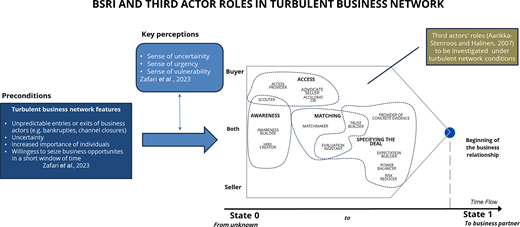
To answer this question, the study draws on a longitudinal qualitative case study of a small Italian winery (Yin, 2018). Data are presented through seven vignettes (Reay et al., 2019) that reconstruct the interactions among the seller (the small winery), its buyers, and third actors that have led to the emergence of new business relationships under turbulent business network conditions. The data collection method was designed to highlight the interplay among seller, buyer and third actor under turbulent business network conditions (Halinen and Törnroos, 2005). Guided by the study’s analytical framework (Figure 1), data were abductively analysed (Dubois and Gadde, 2002; Thompson, 2022).
The study contributes to the IMP Group’s body of literature on BSRI by elucidating the evolving roles of third actors within turbulent business networks. It unveils the novel macro- and micro-roles of third actors that enable firms to initiate business relationships suddenly, thereby broadening the IMP’s perspective on the subject beyond stable business networks. Finally, the study offers new insights into the observed overlap between social and business networks, suggesting that the social mechanisms in actors’ bonds may serve as functional substitutes or complements to formal BSRI mechanisms under turbulent business network conditions.
The remaining manuscript is structured as follows: Section 2 outlines the literature background of the study; Section 3 presents the methodology used; Section 4 presents the findings; Section 5 discusses the findings of the study; Section 6 provides the theoretical and managerial implications of the study; and finally, Section 7 concludes the paper.
2. Literature background
2.1 Developing the buyer–seller relationship initiation process in stable business networks: a focus on third actors
According to the industrial–network approach, a business relationship is defined as a “mutually oriented interaction between two reciprocally committed parties” (Håkansson and Snehota, 1995, p. 25). The BSRI, the initiation of buyer–seller relationship, entails a phase involving unknown potential buyers and sellers that co-exist in space and time (Mandják et al., 2015) and ideally ends with the establishment of the initial business agreement between the involved parties (Edvardsson et al., 2008) or with an assignment that has the potential to lead to a business relationship (Aaboen and Aarikka-Stenroos, 2017). Thus, BSRI represents the prelude to a longer-term business relationship characterised by the progressive development of resource interdependencies and mutual adaptation (Dwyer et al., 1987; Wadell and Bengtson, 2024).
The BSRI process usually gradually unfolds in stable business network conditions (Håkansson and Snehota, 1995). Initially, the buyer and seller seek feasible partners with whom to establish a new business relationship; hence, they exploit their reputation and past performance to perform positioning and posturing activities to attract a potential counterpart (Dwyer et al., 1987; Wilson, 1995). Once mutual recognition between the buyer and seller occurs, they engage in small interactions to develop reciprocal knowledge (Edvardsson et al., 2008; Mandják et al., 2015). While these interactions unfold, a bonding process occurs at the individual level, influencing the development of mutual trust at the individual and organisational levels (Mandják et al., 2015; Valtakoski, 2015). Through interactions, the buyer and seller assess each other, compare their performance with available alternatives within the network and evaluate the potential benefits of forming a business relationship (Dwyer et al., 1987; Wilson, 1995). If the assessment is positive, buyer and seller define mutual goals and duties for their future business relationship (Aarikka-Stenroos et al., 2018).
In this phase, the emerging business relationship is quite fragile due to limited commitment, underdeveloped mutual trust and lack of structural bonds, factors that may prevent the actors involved from withdrawing (Dwyer et al., 1987; Wilson, 1995). As a result, the BSRI is not linear. It can start, stop and pause at any time. Indicating that a challenge is to allow the process to flow seamlessly (Edvardsson et al., 2008).
Previous research on the BSRI has focused on the role of intervening forces that influence its development. These intervening forces have been identified as triggers, converters and inhibitors (Aarikka-Stenroos et al., 2018; Edvardsson et al., 2008; Mandják et al., 2015). Inhibitors, defined as forces that hinder the BSRI process, encompass elements such as perceived distance, the inertia of previous bonds and relationships, perceived risks associated with the counterpart, difficulties in assessing business cooperation outcomes and the image or reputational perceptions of the parties involved (Edvardsson et al., 2008; Hassel, 2024). Triggers and converters are forces that push the BSRI process. Triggers and converters include elements such as personal reputation, prior relationships, referrals, word-of-mouth, network position, attractiveness, goodwill, visibility, time, trust (both cognitive and affective) and the attractiveness of the offering (Aarikka-Stenroos et al., 2018; Edvardsson et al., 2008; Mandják et al., 2015). Triggers and inhibitors can be observed at both the individual and organisational levels (Mandják et al., 2015).
Among the forces influencing the BSRI process, particular importance is attributed to third actors, which can either trigger or inhibit the process (Aarikka-Stenroos and Halinen, 2007; Salmi and Halinen, 2024). Third actors have been defined as “initiator contributors”, an overarching term referring to various entities – contact contributors, artefact contributors and ritual contributors – that contribute to relationship initiation (Aarikka-Stenroos et al., 2018). Third actors are organisations or individuals with prior experience in relating to one or both parties of the emerging dyadic relationship (Aarikka-Stenroos and Halinen, 2007). Their credibility stems from their external position in the dyad; indeed, their involvement in the emerging business relationship generally does not include any monetary reward (Aarikka-Stenroos and Halinen, 2007; Fraboni et al., 2024).
Third actors play a crucial role in creating business opportunities and reducing the challenges of BSRI, acting as guarantors, promoters and mediators (Aarikka-Stenroos et al., 2018; Hassel, 2024; Aarikka-Stenroos and Halinen, 2007; Fraboni et al., 2024). They facilitate the exchange of information, build trust and mitigate risks (Aarikka-Stenroos and Halinen, 2007), playing several roles in supporting the BSRI process. A comprehensive overview of these roles is provided in Table 1.
2.2 Developing buyer–seller relationship initiation in turbulent business networks: third actors and an analytical framework
In recent years, various disruptions – including pandemics, technological breakthroughs and socio-political instability (Zafari et al., 2020, 2023) – have created new conditions of turbulence within business networks. These networks are characterised by radical changes and less tight structures than stable ones (Salmi, 2000). In this context, buyers and sellers are challenged to continuously detect weak signals of change and respond effectively to avoid potential crisis situations and seize latent opportunities (Zafari et al., 2020). This process involves monitoring existing relationships, which may eventually weaken or dissolve, while simultaneously fostering the rapid establishment of new ones (Wadell and Bengtson, 2024). Consequently, the turbulence of the business network influences how firms nurture and establish new business relationships (see Table 2).
In this regard, Zafari et al. (2023) identified five key perceptions arising within turbulent business networks that affect business actors’ sensemaking and how they develop new business relationships. These perceptions are as follows:
the uncertainty of both buyers and sellers regarding future owners of necessary resources;
The sense of urgency that compels them to swiftly capitalise on business opportunities before an unpredictable disruptive event occurs;
The increased sense of vulnerability perceived by both actors, which leads them to enhance information exchange to address emerging threats;
The need to empower individuals to adapt quickly to sudden changes; and
Finally, a growing recognition of the importance of a firm’s ethical behaviour as an indicator of future reliability.
The heightened perception of uncertainty, the imperative to take immediate action and an increased awareness of vulnerability have compelled firms to develop a BSRI process characterised by rapid development, high levels of commitment and interactions since early stages and swift trust founded on the counterpart’s ethical behaviours, reputation and assurance from third actors (Zafari et al., 2020, 2023). As a result, firms establish fragile new business relationships with almost unknown business actors to seize opportunities and mitigate potential risks that may arise.
The picture that emerges suggests the relevance of third actors in supporting BSRI in turbulent business networks. Their assurance regarding the buyer’s or seller’s reliability serves as a trust proxy upon which an initial, swift trust is established between the counterparts (Zafari et al., 2020). Furthermore, in turbulent business networks, individuals, including third actors, are entrusted with greater capacity for action to seize opportunities and mitigate risks. Not surprisingly, in turbulent business networks, firms tend to initiate new business relationships with counterparts where an individual is recognised as capable of expediting and facilitating the BSRI process (Zafari et al., 2023). In addition, the increased overlap between the firm’s business and social networks observed in turbulent networks (Mattsson and Salmi, 2013; Salmi and Halinen, 2024) encourages the emergence of third actors from the broader societal context in which the firm operates, which become an active source of support for firms during challenging periods (Bondeli and Havenvid, 2022; Pedersen et al., 2020). When crises originate from the external (e.g. COVID-19 pandemic), individuals are keener to engage in prosocial behaviours towards affected businesses, driven by a desire to help preserve firms perceived as socially valuable for the local business context (Cortez and Johnston, 2020; Majid et al., 2021). In such contexts, individuals develop situational empathy towards businesses that embody community values and foster a shared sense of social cohesion (Klimecki et al., 2016). These prosocial behaviours, grounded in altruism and mechanisms such as reciprocity and self-interest, are pivotal in supporting firms during uncertain times (Majid et al., 2021).
To abductively explore what roles third actors assume in supporting the BSRI in turbulent business networks and how these roles might evolve compared to those already identified in stable business networks, the study develops a consistent analytical framework (see Figure 1). The framework conceptualises the BSRI phase as the period through which buyer and seller pass “from unknown” (State 0 – they do not know each other) “to partners” (State 1 – they initiate a business relationship) (Wadell and Bengtson, 2024). The framework incorporates the third actor’s roles in supporting the BSRI process already identified in stable business networks (Aarikka-Stenroos and Halinen, 2007; Aarikka-Stenroos et al., 2018; Edvardsson et al., 2008; Fraboni et al., 2024; Valtakoski, 2015). The framework highlights the turbulent business network features and key perceptions as new conditions influencing the BSRI and the role performed by third actors.
3. Methodology
3.1 Qualitative methodology
In this study, a qualitative methodology is adopted as well-suited for the in-depth exploration of new phenomena and identifying causal relationships that are difficult to capture through quantitative approaches (Yin, 2018). In this study, a longitudinal case study methodology was used (Dyer and Wilkins, 1991; Stake, 1995; Yin, 2018) to examine phenomena within their real-world contexts, a practice that is particularly beneficial when the boundaries between the phenomenon and its context are blurred, and researchers have limited or no control over the research subject (Dyer and Wilkins, 1991; Yin, 2018). Furthermore, case studies are particularly effective in examining business-to-business (B2B) relationship dynamics (Halinen and Törnroos, 2005).
3.2 Case selection criteria
To investigate the research question, this study identifies a case study of an small and medium enterprises (SME) that cultivates new business relationships within a turbulent business network through the engagement of third actors. The focus on SMEs is justified by the fact that SMEs often rely on third parties, even in stable business networks, to address the challenges of developing new business relationships – a need that is accentuated in turbulent business networks, where such challenges become increasingly complex, and turbulence threatens their survival (Hassel, 2024; Zafari et al., 2020, 2023). Furthermore, SMEs are often under-represented in B2B studies; therefore, capturing their perspectives can provide valuable insights for theoretical discussions and advance existing theories.
The case was selected within the context of the Italian wine industry, which has experienced significant turbulence since the COVID-19 pandemic (Curtis and Slocum, 2022; Eisenhardt and Graebner, 2007; Temperini et al., 2022). It began with the three national lockdown periods implemented by the Italian government to mitigate the impact of the outbreak, which led to the abrupt closure of Ho.Re.Ca. (hotel, restaurant and catering) channels and restrictions on social gatherings, causing a sharp decline in wine sales.
This turbulent context has impacted the business network, leading to the entry and exit of various actors and the concurrent introduction of structural changes, such as digitalisation. As of today, the wine business network remains unstable due to geopolitical instability (e.g. the Russia–Ukraine conflict; USA tariffs), resulting in rising energy costs in Italy and a notable increase in inflation, thereby increasing the expenses for raw materials, transportation and financial lending. In addition to the direct consequences of these disruptive events, the business network has developed a heightened sense of vulnerability, leading to a desire to capitalise on opportunities before further disruptions emerge. These characteristics have created a sense of urgency among the business actors in the network, thereby significantly shaping their managerial interpretations and actions. Therefore, the context of the Italian wine industry has been deemed helpful in investigating the phenomenon of interest.
In the context of Italian wine, the case has been selected from the Marche region, where the wine industry is well developed, characterised by more than 11,000 enterprises (primarily SMEs) and almost 18,000 hectares of vineyards, of which 20 protected designations of origin and 1 protected geographical indication are certified. In accordance with the national scenario, the Marche wine context has also experienced significant disruptions, culminating in the bankruptcy of its largest winery (Corriere Adriatico, 2024).
The small winery Alpha, located within the Marche region, has been selected through theoretical sampling for its significant revelatory potential (Eisenhardt and Graebner, 2007). Alpha, a small winery producing 80,000 bottles of wine per year, has been considered a valuable case to study for four significant reasons. (1) Alpha does not rely on commercial agents to sell its products; it focuses exclusively on its direct efforts. (2) Alpha is a small winery with human and financial constraints, which, as acknowledged in the literature, necessitates business relationships to grow and survive in increasingly competitive and turbulent markets (Temperini et al., 2022). (3) In response to the decline in sales resulting from COVID-19 and the subsequent disruptions, Alpha proactively shifted its focus towards cultivating informal relationships and business/social contacts to identify and capitalise on new opportunities. This change in approach provides fertile ground for observing the circumstances under which third actors engage in the BSRI process within turbulent business networks, and the roles they play in supporting it. (4) Alpha has participated in previous studies, providing benefits such as previous links established with the small winery and the excellent relationship with Alpha’s informants, enabling the collection of deep, valuable evidence (Yin, 2018). Additional criteria for case selection included geographical proximity and friendly relations with key informants in the case, which helped the research team verify data accuracy in real time (Yin, 2018).
3.3 Data collection
Primary data were collected through seventeen semi-structured interviews (Brinkmann and Kvale, 2018) with key informants relevant to the aim of the study, including Alpha owners, third actors and buyers whose valuable insights have often been overlooked in the existing literature on the subject (Fraboni et al., 2024; see Table 3). Since 2021, the research team has conducted periodic interviews with Alpha to gather information about episodes of interaction with third actors that have led to the establishment of new business relationships under turbulent business network conditions (Aarikka-Stenroos and Halinen, 2007). The study focused only on successful BSRI episodes to empirically observe the roles performed by third actors during BSRI. Over time, Alpha’s CEO has shared seven different episodes in this regard in which third actors played a crucial role in supporting the development of new business relationships. The research team interviewed, when available, the buyers and the third actors mentioned in the episodes to gain additional insights and reconstruct their perspectives by following a processual approach. The research questions focused on gathering information about the interactions between the actors involved in each episode; such episodes had brought Alpha and each buyer from unknowns (State 0) to business partners (State 1).
Additional primary data were collected through direct observations, audio recordings and open interviews during two meetings of the entrepreneur’s association (hereafter Omega) in which Alpha was involved. Primary data were collected through six site visits to Alpha’s cellar, during which the research team engaged in informal discussions with Alpha’s staff members and clients, resulting in the compilation of several field notes.
Secondary data were collected from industry reports, local newspapers and Alpha and its buyers’ websites and social media platforms to enrich data collection, obtain contextual insights, mitigate collection bias and facilitate data triangulation (for further details, see Table 3; Patton, 2014). Theoretical saturation was achieved when, according to the ongoing data analysis process, the newly collected evidence converged with the same findings (Yin, 2018). Finally, a draft of the study was presented to and discussed with Alpha’s CEO during the final interview to corroborate the findings and obtain additional confirmatory evidence.
3.4 Data analysis
A vignette for each of the seven successful BSRI episodes presented by Alpha’s CEO has been developed, using primary data collected from interviews and field notes (Bondeli and Havenvid, 2022). Each vignette presents a detailed narrative of real-life interactions that prompted Alpha and the buyers to initiate a new business relationship, with a third actor supporting them (Supplementary material, Table), allowing the study to empirically observe changes in third actors’ roles under turbulent business network conditions (La Rocca et al., 2017). In alignment with the analytical framework, the vignettes utilised a temporal bracket (from State 0 to State 1) and a visual mapping strategy to elucidate the BSRI process (Langley, 1999; Miles et al., 2018). This approach was consistent with previous research that recognises narratives and visual mapping strategies as essential tools for understanding relational processes and dynamics (Bondeli and Havenvid, 2022; Miles et al., 2018.
Vignettes are presented using a narrative-based approach; however, moving beyond conventional templates (Pratt et al., 2022), they unfold in accordance with the analytical framework (see Figure 1) and are consolidated into a single table (see Supplementary material, Table). This format enhances readers’ understanding, increases the flexibility of these analytical and communicational tools, enriches the description and facilitates interpretation (Cloutier and Ravasi, 2021; Reay et al., 2019). Each vignette provides a comprehensive description of the BSRI dynamics and business network turbulence, also through key quotes (raw data) (Reay et al., 2019). In this way, the study addresses recent claims for qualitative researchers to “show” rather than “tell” data to readers (Pratt et al., 2022) and, finally, favours a cross-comparison of the vignettes. The analysis was performed at the firm level; however, many of the firms involved in the study were SMEs operated by a single individual.
The data pertaining to each vignette were analysed according to abductive thematic analysis, the iterative and recursive data analysis process that conducts parallel and equal engagement with empirical data and extant theoretical understanding to generate evolving explanations (Dubois and Gadde, 2002; Thompson, 2022). The primary codes were initially derived from the theory related to the role of the third actors identified stable business networks, thus leveraging the analytical framework outlined in Figure 1 (Aarikka-Stenroos and Halinen, 2007; Aarikka-Stenroos et al., 2018; Fraboni et al., 2024). Subsequent analysis of the data revealed additional codes that did not align with the roles previously identified by the extant literature. These codes were used to describe new or distinct roles in relation to those previously examined within the study’s analytical framework. The analysis produced several emerging codes, referred to as “micro-roles”, from which four distinct aggregated categories were identified. These categories illustrated the role of third actors in supporting the BSRI within a turbulent business network, denoted as “macro-roles” (Section 5.1, see Table 4). During data analysis, additional codes emerged referring to concepts such as altruism, prosocial behaviours, social community and resilience, providing further material for theoretical and managerial implications (Section 5.2). The relationship between the emerging themes and the entire data set was guided, but not determined by existing theoretical knowledge (Thompson, 2022).
4. Findings: Alpha case background
Alpha was founded in 1959. The founder initially sold wine in bulk, produced in a small facility near his residence. Today, the small winery is managed by the third generation of the family, employs seven staff members – including three family members – cultivates 25 hectares of land, produces 2,000 hectolitres and nearly 80,000 bottles of wine each year, thus generating an annual turnover of approximately 1m Euros. Deeply rooted in the local community, the family is known as the “Pepper Man” family, pointing to an ancestor who sold pepper in the region in the 19th century. Alpha consistently participates in the town’s fairs and hosts an annual October dinner to showcase its latest wine offerings.
Alpha has predominantly engaged with business-to-business buyers, particularly within the Ho.Re.Ca. sector. Over time, Alpha has established direct consumer sales through the wine shop at its production facility. Thus far, Alpha has not pursued partnerships with large retailers, as owners perceive their purchasing practices as overly aggressive and constraining for their dimensions:
In the large retailers, you are only a number, and you must have large volumes. To do it at the prices they want, you must penalise the quality of your products, and we are not willing to do that. –Brother of the CEO of Alpha, co-owner
Until 2018, Alpha employed sales agents to develop new business relationships within the Ho.Re.Ca. sector. However, due to negative experiences with these agents, the small winery ultimately decided to discontinue resorting to them:
Surely, we were unlucky in our choices, but given our past experiences, we decided to do without these professional figures. –CEO of Alpha
Thus, Alpha decided to establish new business relationships directly with Ho.Re.Ca. actors, leveraging its marketing and communication initiatives. Prior to the COVID-19 pandemic, Alpha typically established new business relationships by cold-calling potential buyers and visiting their shops directly to offer them a taste of its wine by leaving its samples. Before the COVID-19 outbreak, Alpha had never had a problem selling wine.
The multiple lockdowns implemented in Italy between 2020 and 2022 had a significant impact on SMEs: in the wine sector, the closure of Ho.Re.Ca. establishments and strict limitations on social gatherings led to a substantial decline in wine sales. The pandemic crisis has resulted in a long-lasting negative impact on the economy, which persists to this day. Subsequent geopolitical instability exacerbated the business landscape, leading to rising inflation, supply chain disruptions and widespread uncertainty. The persistent turbulence in the environment hindered the stabilisation of the business network after the COVID-19 outbreak, resulting in unpredictability and a heightened sense of vulnerability for business actors:
The current market is very turbulent; today, it is more about survival than doing business […] –CEO of Restaurant Delta
During the COVID-19 emergency, Alpha experienced a significant decline in sales as numerous Ho.Re.Ca. partners were forced to close during lockdowns, while others closed permanently due to the challenging business context. Consequently, Alpha recognised that its survival was at risk, as a significant component of its revenue had abruptly diminished. At that point, Alpha recognised the necessity of cultivating new business relationships in response to abrupt channel closures and buyer bankruptcies, a sentiment that remains acknowledged by Alpha’s CEO, in light of the ongoing turbulence within the business network:
Today’s business environment is very difficult; many companies have closed[…] to stay in the market, you must always have exit routes ready, for example, restaurants with which you have maintained and developed contacts that are potentially willing to develop a new business relationship with you soon. By doing so, you can cope with the sudden closures of even historic partners. –CEO of Alpha
Since the reopening after the first lockdown, Alpha recognised a significant shift in the BSRI process, acknowledging that buyers were placing increased importance on human interactions to reach the first business agreement:
After COVID-19, I felt people were keen to talk; they needed to relate. Compared to before the advent of COVID-19, I feel that nowadays, to close a business deal, I have to get to human interaction with the other party as soon as possible. When the customer knows you in person, it is easier to start a business relationship because he gets an idea of you and what the future business relationship could be like. –CEO of Alpha
Over time, Alpha noticed that, with the support of third actors, it was able to engage with potential buyers personally and efficiently and/or cultivate new business relationships swiftly. Therefore, Alpha began to rely more on its social and business contacts to mitigate the unpredictability of the turbulent business network:
The more you have relationships with third parties, the more you can compensate for sudden closures, because they favour direct contact with the other party quickly. –CEO of Alpha
[…] common acquaintances allow you to skip the classic steps of requesting information and gradually contacting the other party, allowing you to get straight to the meeting in person and often to the beginning of the business relationship. –CEO of Alpha
Since the conclusion of the initial lockdown in 2020, Alpha has significantly intensified its efforts to cultivate numerous relationships with social and business contacts, recognising their importance in facilitating and securing new business opportunities. Supplementary material Table demonstrates that Alpha’s approach has emerged as the preferred and most effective approach for the small winery to cultivate new business relationships.
5. Analysis and discussion of the findings
This section is divided into three subsections in which the findings are analysed and discussed. The first subsection examines the evolving roles of third actors in BSRI within turbulent business networks. The second subsection discusses the sudden onset of business relationships involving third actors. Finally, the third subsection explores additional aspects emerging from the data in relation to the roles of third actors in BSRI in turbulent business networks.
5.1 New and changing roles of the third actor in turbulent business networks buyer–seller relationship initiation
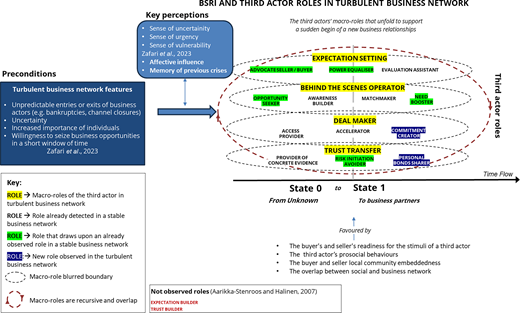
The results indicate that the turbulence within the business network creates unique conditions (Wadell and Bengtson, 2024; Zafari et al., 2023), leading to the evolution of the roles played by third actors in BSRI (Table 4). Shifting from a stage-based perspective to the sudden nature of the BSRI under turbulent business conditions, this study identifies four macro-roles that emerge from the extant key processes of the BSRI framework (Figure 1), within which third actors perform the roles described by Aarikka-Stenroos and Halinen (2007). These four macro-roles are conceptualised to reflect a higher level of abstraction relative to the third-actor roles conceptualisation proposed by Aarikka-Stenroos and Halinen (2007). Accordingly, these roles enacted by third actors in the original framework are hereafter referred to as micro-roles.
5.1.1 The role of the behind-the-scenes operator
In supporting the BSRI process within a turbulent business network, third actors can operate “behind the scenes”, as the activities of many third actors often remain largely unknown to the buyers and sellers, who recognise their efforts only when they begin the business relationship. Third actors quickly create the initial conditions for the emergence of the business relationship, often without questioning buyers and sellers, and without making them aware of their efforts and choices (Vignettes 2, 5, 6 and 7). In doing so, the third actors assume the “behind-the-scenes operator role” that encompasses the development of four distinct yet interconnected micro-roles: opportunity seeker, need booster, awareness builder and matchmaker. The latter two micro-roles have already been identified within a stable business network (Aarikka-Stenroos and Halinen, 2007; Aarikka-Stenroos et al., 2018). In the capacity of an awareness builder, a third actor facilitates mutual awareness among the counterparts (Vignettes 1 and 7). Simultaneously, through their role as matchmakers, third actors evaluate the compatibility among potential business counterparts to foster their collaboration (Vignettes 3 and 7). The additional two micro-roles, opportunity seeker and need booster, are informed by the previously identified scouter and need creator micro-roles within a stable business network (Aarikka-Stenroos and Halinen, 2007; Aarikka-Stenroos et al., 2018). In a turbulent business network, a third actor is unable to fulfil a “scouter” micro-role due to the lack of time to identify potential partners, necessitating a focus on seizing immediate opportunities. Consequently, a third actor transitions from scouting to actively seeking opportunities that exist within the business network at a specific point in time (Vignettes 3 and 7). Likewise, instead of establishing a new need for the buyer and seller within a turbulent business network, a third actor reinforces the existing perception of the necessity to develop multiple business relationships to mitigate the unpredictability of the business context (Vignettes 2 and 5). In doing so, a third actor effectively establishes the conditions necessary to fulfil this need.
5.1.2 The role of expectation setting
Business network turbulence has a severe impact on the managerial actions of buyers and sellers in the BSRI process (Zafari et al., 2020). In this context, the third actor assists both parties in assessing the future of the emerging business relationship, acting as a proxy to establish mutual expectations. Thus, the third actor performs the “expectation-setting role” that encompasses the concurrent development of the evaluation assistant, power equaliser and advocate seller/buyer micro-roles. The latter two draw upon the advocate seller and power balancer roles previously identified within a stable business network (Aarikka-Stenroos and Halinen, 2007; Aarikka-Stenroos et al., 2018; Fraboni et al., 2024). In turbulent business networks, third actors actively advocate for the seller and the buyer, as both actors are vulnerable and have an urge to develop business relationships to mitigate sudden threats, such as supply chain disruptions or channel closures (Vignettes 1–3 and 5–7). Regarding the role of the power balancer (Fraboni et al., 2024) within a turbulent business network, the third actor does not participate in the bargaining process to establish equitable conditions for the emerging business relationship, as the business actors lack the time to do so. Therefore, the third actor assumes the role of guarantor, ensuring that both actors will set fair conditions because of the established trusting relationship they have with the third actor (Vignettes 2, 3 and 7).
Finally, the evaluation assistant micro-role remains consistent with observations in stable business networks (Aarikka-Stenroos and Halinen, 2007), where the third actor helps parties evaluate the opportunity to enter a business relationship in advance, suggesting potential future outcomes (Vignettes 3 and 5–7).
5.1.3 The role of trust transfer
Turbulent business networks lack the time to build trust gradually, as is typically observed in stable business networks (Valtakoski, 2015). Consequently, buyers and sellers are forced to rely on trust proxies to initiate business relationships within a limited timeframe (Zafari et al., 2020). The assurance provided by the third actor serves as one of the trust proxies utilised by the actors (Zafari et al., 2023). In this context, the third actor does not perform a trust-building role, as typically observed in a stable business network (Aarikka-Stenroos and Halinen, 2007; Aarikka-Stenroos et al., 2018); instead, it fulfils a trust-transfer role. The trust that an actor within the emerging dyad has in the third actor is conveyed by the latter to the recommended business counterpart. To perform this macro-role, the third actors synergistically unfold the micro-roles of provider of concrete evidence, risk initiation avoider and personal bonds sharer. The first micro-role has been observed within a stable business network (Aarikka-Stenroos and Halinen, 2007): the insights of a third actor regarding a potential business counterpart are communicated to the other counterpart, providing evidence on the future relationship outcomes (Vignettes 3, 5, 6 and 7). The micro-role of the risk initiation avoider builds upon the previously identified risk-reducer role (Aarikka-Stenroos and Halinen, 2007). In turbulent business networks, in continuity with the provider of concrete evidence micro-role, the third actor continues to share risk-reducing information; however, it cannot ensure the long-term success of the emerging business relationship or effectively mitigate relational risks, as turbulence affects the actor’s behaviour in unpredictable ways. Therefore, as demonstrated in the vignettes, the third actor significantly mitigates the risks associated with not establishing the business relationship (Vignettes 1–7). This is particularly important, as the misallocation of financial and temporal resources can have severe consequences during turbulent times. Finally, the “personal bonds sharer” represents a newly identified micro-role that addresses the initiatives of a third actor in establishing and communicating its personal connections with business counterparts to facilitate the trust-transfer process (Vignettes 2 and 7).
5.1.4 The role of the deal-maker
As demonstrated in the vignettes, third actors enable business actors to bypass the conventional phases of information search activities and interactions (Aarikka-Stenroos et al., 2018; Dwyer et al., 1987; Edvardsson et al., 2008), thereby creating conditions that facilitate the sudden initiation of business relationships. In doing so, the third actor performs the macro-role of a deal maker that entails concurrent development of the commitment creator, accelerator and access provider micro-roles. The latter two have previously been described and observed in a stable business network (Aarikka-Stenroos and Halinen, 2007; Aarikka-Stenroos et al., 2018). A third actor plays a crucial role in fostering the swift development of business relationships by providing direct and reciprocal access (e.g. phone contact, in-person meetings) for both parties involved in the emerging dyad (access provider micro-role, Vignettes 2–7). In addition, this actor is responsible for expediting and completing the BSRI process (accelerator micro-role, Vignettes 1–7). The commitment creator micro-role is a new role that explains how the involvement of a third actor in the BSRI process inspires business parties to reciprocate with commitment, motivated by the social bonds they share with the third actor and their desire to honour the third actor’s contributions during such turbulent times (Vignettes 2, 4 and 7). This mutual commitment favours faster initiation of the business relationship.
5.2 The sudden beginning of the buyer–seller relationship through third actors
Each vignette highlights how buyers and sellers are confronted with disruptions due to unforeseen events that require rapid responses to mitigate emerging threats, such as supply chain interruptions or potential revenue losses. In this context, their readiness to act – operationalised as the prompt initiation of new buyer–seller relationships – becomes a critical enabling condition for seizing emergent business opportunities.
This readiness is particularly evident in interactions involving third actors, as firms display a marked willingness to respond swiftly to their solicitations. With the facilitative support of these third actors, buyer–seller relationships tend to emerge abruptly, frequently in the absence of prior direct interaction. Indeed, in the several episodes observed, the initial phone call or meeting has been the first substantive contact between the parties, at which point the business relationship was effectively established or formalised (e.g. Vignettes 1, 3–7).
5.3 Further discussion of the roles of third actors
The vignettes illustrate that the third actors involved in the initiation of the BSRI are either affiliated with the buyer’s side and/or with the seller’s side. These third actors include friends, relatives, acquaintances or business associates with whom one of the actors in the emerging dyad has previously established relationships. Consequently, the vignettes indicate a convergence between the business and social networks (Mattsson and Salmi, 2013; Salmi and Halinen, 2024), particularly emphasised by the predominance of individual actors in the management of the SMEs featured in the vignettes.
As illustrated in the vignettes, the third actors support the buyer and the seller without any monetary reward. The social mechanisms within the relationships among actors influence third actors to engage in prosocial behaviours driven by genuine altruism, with no self-interest (Vignettes 1, 4 and 7), with the ultimate goal of assisting business actors with whom they have developed social bonds or strong ties. Alternatively, third actors may engage in prosocial behaviours to pursue their own self-interests that may not necessarily involve monetary gains, potentially with the expectation of future reciprocity. For example, in Vignette 3, the PhD student might have acted with the intention of gaining recognition from her superiors. Similarly, in Vignette 6, the distributor may have helped restaurant Gamma to consolidate their ongoing business relationship after making the restaurant aware that he had left the wine-on-tap business.
However, a critical point in relying on third parties to initiate business relationships is that they are difficult to manage, as they are not under contract (Fraboni et al., 2024). Upon reviewing the vignettes, it becomes clear that there is no guarantee that third actors will perform supporting roles at the beginning of the business relationship. For example, in Vignette 2, the third actor not only introduces Alpha to the wine bar, but also ensures that their first meeting takes place in his presence. In this vignette, there are several occasions when the third actor could have changed his mind and stopped supporting the initiation of the business relationship. Specifically, he could have chosen not to introduce Alpha since he had not been asked to do so, or he could have decided not to make an effort to facilitate the initial meeting, even making himself available to supervise the meeting. The same applies to the other vignettes: the prosocial behaviours of third parties (altruistic or otherwise) are neither regulated nor planned, and their occurrence is uncertain.
The key factor in each vignette for building new business relationships is the ability of business actors to respond effectively to the influence of third actors. Their responsiveness to the solicitations of third actors enables them to exploit the prosocial behaviours of third actors that favour the initiation of a business relationship at the exact moment in which they arise, which is crucial since there are no guarantees that these behaviours will be replicated in the future. However, despite their inherent challenges, the findings underscore the crucial role of the third actor in helping the small winery navigate the business network turbulence, allowing it to remain resilient.
6. Theoretical and managerial implications
6.1 Theoretical implications for third actors’ literature
The theoretical implications of the study regarding third actors as initiator contributors of BSRI in turbulent business networks are summarised in Figure 2 and Table 5. The study pinpoints that the business network turbulence generates unique conditions (pre-conditions, Figure 2) that fundamentally alter the roles played by third actors in supporting the BSRI process (Wadell and Bengston, 2024; Zafari et al., 2023). Therefore, the study presents new implications for managing relationships in turbulent business networks (Aarikka-Stenroos and Halinen, 2007; Aarikka-Stenroos et al., 2018).
More in depth, the study emphasises that the so-called key perceptions of the actors (both buyers and sellers) experienced in turbulent business networks play a significant role in shaping the evolving roles of third actors. The sudden changes that occur in a turbulent business network evoke a sense of urgency, uncertainty and vulnerability in both buyers and sellers (Zafari et al., 2023). These perceptions also elicit affective and cognitive responses among business actors, which manifest in their readiness to act swiftly, driven by a perceived scarcity of time and a fear of missing opportunities (Zafari et al., 2023). In this context, where buyers and sellers experienced heightened alertness, also informed by a memory of prior instability events, third actors emerged as essential facilitators for the initiation of business relationships, performing peculiar roles compared to those previously observed in stable business networks (Aarikka-Stenroos and Halinen, 2007). The study identifies four interrelated and simultaneous macro-roles: trust transfer, deal-maker, expectation setting and behind-the-scenes operator. Each macro-role encompasses the nuanced and overlapped development of distinct micro-roles (see Figure 2 and Table 5).
Macro-roles represent a categorisation of the micro-roles played by third actors in BSRI under turbulent business network conditions. According to this level of abstraction, the roles of third actors are designated as micro-roles to distinguish them from the identified macro-roles. Relating these micro-roles to macro-roles allows for a comprehensive understanding of the evolution of third actors’ roles within BSRI in turbulent business networks (Zafari et al., 2023). However, both micro- and macro-roles are theoretical abstractions that allow us to frame the third actors’ roles, since these roles unfold without distinction in the real world.
The study suggests the emergence of new micro-roles, the evolving nature of others and the persistence of others with their original significance but adapted to the turbulent conditions of the business network (Table 5). In addition, some roles proposed by Aarikka-Stenroos and Halinen (2007) were not observed, as illustrated in Figure 2 (see Keys). The study, therefore, challenges the existing conceptualisation of third-actor roles in BSRI, suggesting how the business network turbulence calls for role transformation, expansion and intensification, repositioning the third actor as a proactive figure capable of shaping BSRI dynamics through a range of context-specific roles (Aarikka-Stenroos and Halinen, 2007; Aarikka-Stenroos et al., 2018).
Moreover, the study unveils that, in a turbulent business network, the involvement of third actors prompts buyers and sellers to initiate business relationships suddenly (Figure 2). Indeed, with the supportive engagement of a third actor, the initial and prompt interaction between buyer and seller can mark the beginning of the business relationship. The study, therefore, pinpoints the sudden nature of the BSRI as the result of the simultaneous and overlapping development of the identified third actors’ micro-roles. The study also recognises that the sudden initiation of the business relationship is facilitated by the readiness of both parties to respond to third actors stimuli. Hence, the study enhances the existing literature on the role of third actors in BSRI by suggesting that these actors facilitate the sudden establishment of new business relationships within turbulent business networks (Aarikka-Stenroos et al., 2018; Wadell and Bengtson, 2024; Zafari et al., 2023).
The study further indicates that third actors emerge from business actors’ social networks, demonstrating a willingness to engage in prosocial behaviours to support firms in their operations, especially during turbulent times. Thus, the results suggest that the sudden initiation of business relationships within a turbulent business network is supported by firms’ local embeddedness, which fosters a positive convergence between social and business networks and the emergence of third actors and their prosocial behaviours (Majid et al., 2021; Mattsson and Salmi, 2013).
With reference to the aforementioned point, the study suggests that third actors engage in prosocial behaviours to support the BSRI process driven by either pure altruism or self-interest (Majid et al., 2021). In the context of altruism, they are motivated by situational empathy and/or affective relationships with the firm or the owners. Meanwhile, there are other cases in which the third actors’ support emerges from pure self-interest, even though they are not seeking an immediate reward. Therefore, third actors engage in “actions” without any formal contract or monetary reward – an aspect that emphasises the limited manageability of the third actors involved in the BSRI, undermining the replicability of their behaviour and their continuous support to the firm in turbulent times (Bondeli and Havenvid, 2022).
In conclusion, the study suggests that in a turbulent business network, the social mechanisms in actors’ bonds (Majid et al., 2021; Mattsson and Salmi, 2013; Salmi and Halinen, 2024) may serve as functional substitutes or complements to formal business BSRI mechanisms, thereby enabling a “sudden” BSRI.
6.2 Practical implications
This study elucidates the evolution of third-actor roles in BSRI within a turbulent business network. The study emphasises how challenging it becomes to engage individuals who are not motivated by monetary rewards during a crisis. Third actors engage in and operate solely for non-economic purposes, with the firms’ embeddedness in social and business networks playing a critical role in their emergence and impact. Therefore, the study emphasises that managers should take care of their social embeddedness, particularly in relation to their interactions with small and local communities. Managers’ expectations about third actors’ roles should be considered; in particular, these actors represent an evolutionary perspective on word-of-mouth mechanisms. Their significance increases during times of crisis, and they can directly facilitate the initiation of business deals. Hence, the study recommends that firms remain vigilant to potential opportunities brought by third actors and be prepared to respond promptly to capitalise on these prospects. Therefore, managers and entrepreneurs are urged to enhance their firms’ capacity to respond to opportunities presented by third actors, who, during turbulent times, act proactively to the firm’s benefit (or self-interest).
However, all that glitters is not gold; the engagement of third actors has several drawbacks and dark sides. Firstly, by relying on third actors, the firm risks introducing an element of unpredictability. As demonstrated, third actors are difficult to manage, increasing the number of variables that firms cannot control. Secondly, third actors can be a double-edged sword, as they promote prosocial behaviours to support the local business community while not necessarily being directly engaged with any specific firm. Hence, managers should evaluate the available approaches to initiating a BRSI, recognising third actors as an effective option, though not the only one. Thirdly, a firm is required to assume the risk of placing trust in external entities by establishing a business relationship with a relatively unfamiliar counterpart. In fact, even if the counterpart-the buyer or the seller – recognises a common goal in the short-term development of the business, driven by the prevailing crisis and network turbulence, there remains a risk that, in the long run, one counterpart may prove to be unsuitable. Finally, the study emphasises the significance of third actors in enhancing the resilience of firms, especially SMEs, within a turbulent business network.
7. Conclusion
By examining the case of a small winery and presenting vignettes of how it established new business relationships in turbulent networks, which unfold from the outbreak of COVID-19 to the present, the study offers a novel and deeper understanding of how third actors support firms in initiating business relationships within turbulent business networks. By considering the dyadic perspective and the relationship between the dyad and the third actors, this study offers a new and unique perspective on the role of third actors as initiator contributors to BSRI in turbulent business networks.
By answering the research question:
“What roles do third actors assume, and how do these roles evolve in buyer–seller relationship initiation within turbulent business networks?”
The study provides a threefold contribution to the IMP body of literature on BSRI.
Firstly, the study unveils 4 macro-roles and 13 related micro-roles performed by third actors during BSRI within turbulent business networks that enable firms to initiate new business relationships suddenly (Aarikka-Stenroos et al., 2018; Zafari et al., 2023). Of these 13 micro-roles, 2 are found new, 5 have evolved from their original concept, while the others maintain their original significance, but are adapted to the turbulent conditions of the business network. Both new and modified micro-roles emerge due to the business network’s turbulent conditions and related perceptions. The study, therefore, contributes to the existing conceptualisation of third-actor roles in BSRI, repositioning the third actor as a proactive figure capable of shaping BSRI dynamics through a range of context-specific roles (Aarikka-Stenroos and Halinen, 2007; Aarikka-Stenroos et al., 2018).
Secondly, the study emphasises the sudden nature of the BSRI process when third actors are involved in the BSRI developed under turbulent business network conditions. Previous literature recognised how turbulent business network conditions accelerate the BSRI process (Zafari et al., 2020, 2023; Wadell and Bengtson, 2024). The present study suggests that, in turbulent conditions, the third actors’ roles increasingly accelerate BSRI to the point that it becomes sudden. This is also facilitated by the readiness of the business actors to respond to third actors stimuli. Thirdly, the study provides valuable insights into the observed overlap between social and business networks, suggesting that the social mechanisms in actors’ bonds may serve as functional substitutes or complements to formal BSRI mechanisms in turbulent business networks (Mattsson and Salmi, 2013; Salmi and Halinen, 2024). In doing so, the study emphasises third actors’ prosocial behaviours (driven by altruism or self-interest) developed to support firms during turbulent times. The study, therefore, highlights a link between firms’ embeddedness in the local-social and business networks and the emergence of third actors eager to support buyers and sellers in the BSRI process (Klimecki et al., 2016; Majid et al., 2021).
Overall, the study highlights the importance of social ties as anchors to navigate turbulent times, the relevance of social mechanisms in supporting business relationship dynamics and the role of third actors as a resilience mechanism for firms, especially SMEs, within turbulent business networks (Bondeli and Havenvid, 2022; Pedersen et al., 2020).
7.1 Limitations and further studies
The study is not exempt from limitations. Although qualitative studies are increasingly used to provide insights into interactive empirical processes, the generalisability of the findings described in the manuscript is limited by the specific context and scope. Firstly, the study does not consider the influence of product adaptation, adoption and potential investment problems that may arise between the parties when the business relationship between them suddenly begins (Wadell and Bengtson, 2024). Secondly, the case develops new relationships within a local environment in which the actors are part of the same business context. Thirdly, the case presents only successful BSRI in which the role of the third actor is crucial. Fourthly, the SME setting, which is recognised as heterogeneous and multifaceted, calls for further studies to thoroughly address the role of third actors under turbulent business network conditions.
This study also provides indications for further studies to develop and contribute to the literature on BSRI and the role of third actors. Firstly, it underscores the need for more empirical evidence from other cases, gathered in different contexts and involving firms of different sizes, to compare the results of this study. Secondly, further studies should be focused on how the product type influences the BSRI dynamics and the role of third actors. Thirdly, additional studies can provide empirical evidence regarding the role of third actors in an international business setting, providing analogies and differences with the present study. Fourthly, further studies may investigate the roles of third actors emerging through online channels and social selling activities, given the digital era. Fifthly, new studies can focus on the resource side of the third actor’s role in BSRI within turbulent business networks. Sixthly, additional studies may analyse unsuccessful BSRI in which third actors are engaged to observe a different perspective of the same phenomenon. Finally, further studies can investigate the role of prosocial behaviour, personal liking, cognitive dissonance and altruism in the engagement of third actors, especially in the engagement of non-business subjects as third actors.
References
Supplementary material
The supplementary material for this article can be found online.