Skip to article sections
Purpose

This article presents an in-depth philosophical investigation into the foundational tensions and conceptual uncertainties within information literacy (IL) research.

Design/methodology/approach

This study adopts an aporetic approach—one that highlights the productive role of (seemingly) unresolved contradictions in philosophical inquiry–to explore how persistent puzzles can serve as catalysts for conceptual, theoretical and philosophical renewal in the field. It draws on a comprehensive critical literature review involving over 600 publications, gathered via database searching and snowball sampling.

Findings

The study maps a constellation of six aporias: (1) truth, (2) knowledge and data, (3) information behavior, (4) genericism versus contextuality, (5) ideology and political economy and (6) illiteracy. These aporias are further synthesized into two overarching dilemmas–philosophical/conceptual and social/practical–which reveal enduring fault lines across IL research.

Originality/value

This research offers a comprehensive mapping of conceptual and philosophical aporias in IL. By foregrounding these tensions, it calls for sustained theoretical engagement and interdisciplinary dialog, both of which are essential to advancing IL scholarship.

Information literacy (IL) has advanced considerably over the past few decades across academic, library and educational sectors, yielding numerous theoretical frameworks, pedagogical strategies and real-world applications. Yet. despite these achievements, core tensions persist, calling into question key assumptions and the overall direction of IL research and practice.

Researchers have highlighted several problem areas whose neglect could ultimately undermine IL's viability and thwart its goals: (1) arbitrary, imprecise, or competing definitions despite an implicit consensus (e.g. Bawden, 2001; Todd, 2017; Sample, 2020); (2) under-theorization and a persistent theory-practice gap (e.g. Budd and Lloyd, 2014; Schachter, 2019; Hicks et al., 2024a); (3) uncertain boundaries vis-à-vis neighboring literacies (e.g. Koltay, 2011; Schneider, 2013; Wuyckens et al., 2022); and (4) IL's dual role in reproducing and contesting existing social structures (e.g. Whitworth, 2014; Tewell, 2018). The absence of sustained dialog within the field appears to prolong these challenges.

Accordingly, a more comprehensive analysis of IL's enduring tensions is warranted. Shifting the focus from incremental “problem-solving” toward “problem-posing” (Freire, 1970; Biesta et al., 2019) and a “reality check” (Seamans, 2012) can uncover less obvious but still crucial challenges.

There exist prior works which have identified several conundrums of IL (e.g. Todd, 2000; Pawley, 2003; Kerr, 2010; Haider and Sundin, 2022; Hicks et al., 2024b) (Table 1). However, these studies examine selective bodies of literature or illustrative cases; consequently, comprehensive accounts of how IL research is actually conducted across the field and syntheses grounded in such accounts remain limited. Moreover, existing reviews have tended to devote comparatively less attention to in-depth analysis of how such conundrums are interrelated in terms of metatheoretical foundations–including ontological, epistemological and axiological commitments–underpinning IL research and practice. Addressing this gap, this study conducts a more comprehensive critical review, adopting an aporetic lens–foregrounding paradoxes and unresolved contradictions–to re-examine the central assumptions of IL and contribute to charting new directions for research and practice.

The remainder of the article is organized as follows: Section 2 explains aporia and the aporetic method, Section 3 details data collection for the critical review, Section 4 presents the six aporias identified, Section 5 discusses the implications of such aporias and the conclusion sketches future agendas.

An aporia–often translated as “puzzlement rooted in conflicts of reasons”–refers to both a mental state of perplexity and what generates such a state, i.e. a collection of propositions that are individually plausible but collectively inconsistent or contradictory. In ancient Greek philosophy, aporia was a central tool of inquiry (Rescher, 1987; Karamanolis and Politis, 2018b). The aporia-based method (i.e. “aporetic method”), which utilizes aporetic reasoning, leads to an impasse characterized by puzzlement and uncertainty about “how to proceed” or “what to say” (Palmer, 2018). While the formal structure of the aporia-questions is “Is A the case or is B the case?”, not every question form automatically constitutes an aporia. An aporia necessitates a (seemingly) insurmountable problem (Buddensiek, 2018, pp. 142–143).

There is no single, standardized consensus regarding methods for identifying aporia; indeed, one advantage of an aporetic approach is that it allows and accommodates a variety of ways of being aporetically disposed in response to different questions (Karamanolis and Politis, 2018b, p. 2). The following are commonly presented as conditions that can generate aporia (Rescher, 2009, p. 8; Karamanolis and Politis, 2018a):

  • Conflicts within or across accepted philosophical principles, doctrines and belief systems;

  • Conflicts between stated views and unstated assumptions;

  • Compresent opposites belonging to objects in a certain domain;

  • Equally good reasons for believing both a certain claim and its negation;

  • Conflicts between suppositions in hypothetical or counterfactual reasoning and thought experiments and putative facts or data;

  • Conflicting theoretical deliberations regarding empirical facts; and

  • Contradictory findings or information in empirical inquiry

It is worth noting that not all kinds of questions, queries, inquiries, or procedural remarks can be treated as aporias. Competing or contrary conclusions derived from seemingly persuasive arguments—namely, those that bear the character of a kind of dialectical problem–provide the boundaries for the concept of aporia (Rapp, 2018). In this regard, the term aporia denotes more than the mere state of a paralyzing impasse. It implies that aporetic thinking can explore the conditions of future possibilities to rethink fundamental concepts (Balibar, 2004; Gündoğdu, 2012). An aporia compels us to confront and grapple with it, thereby discovering “a revolutionary theoretical question, posed in the very terms of its denial or in the impossibility of its solution” (Balibar et al., 1995, p. 159). In this way, aporia serves as a necessary philosophical tool for accessing reality, for elucidating the intricate relationship between principles and the phenomena that depend on them and for clarifying their explanatory power, implications and limits (Buddensiek, 2018). The pursuit of euporia–progress through the resolution of aporia—via awareness and discussion of aporia can therefore constitute a means of approaching a more valid understanding, attaining new knowledge, grasping principles, pursuing truth and establishing and developing science (Politis, 2003, pp. 147–149; Boulter, 2013, p. 60; Buddensiek, 2018, p. 137; Nylund, 2024).

In sum, adopting an aporetic lens foregrounds the persistent ambiguities and challenges in the IL field, treating these tensions as productive rather than defects to be quickly mended (Pawley, 2003, p. 448; Haider and Sundin, 2022). On this basis, aporetic analysis maps and clarifies the similarities, differences and relationships among diverse descriptions, positions, frameworks, perspectives, operationalizations, approaches and schools of thought (Todd, 2000, p. 32; Code, 2010; Boulter, 2013, pp. 63–65). It invites scholars and practitioners to reconceptualize IL more rigorously and, in doing so, opens pathways for innovative research and practice.

In line with the goal of this study–to identify aporias of IL–the researcher undertook a critical review of the IL literature. Because of the breadth and diversity of the IL field, any attempt to choose relevant literature is necessarily subject to researcher bias and limitations. To mitigate such risks while capturing the varied perspectives across the field, this paper employs several strategies to gather the relevant literature for the research purpose.

A critical review–or a critical literature review–seeks to examine extant research on a broad topic in order to uncover weaknesses, contradictions, controversies or inconsistencies. Its primary function is to offer a clear understanding of the current body of knowledge in the field and the central questions under investigation, thereby allowing scholars to identify knowledge gaps more confidently (Carnwell and Daly, 2001). The strength of this approach lies in its capacity to highlight problematic areas, inconsistencies, or instances in which existing insights are unreliable (Paré et al., 2015, p. 189). In this way, critical reviews can be an asset to other researchers by directing attention to potential areas for further investigation. In essence, critical reviews concentrate on several key areas: conceptualization, theorization, philosophical underpinnings, challenges, critique and prospects (Carnwell and Daly, 2001; Grant and Booth, 2009; Paré et al., 2015; Wright and Michailova, 2023). Building on this general account, the present study uses the critical review in an additional sense: as a means of identifying aporias.

Critical reviews can employ multiple strategies and methods–including content analysis, meta-ethnography, or critical interpretive synthesis–contingent on the authors' epistemological position (Paré et al., 2015). Given the purpose of the study, the author mainly adopts content and thematic analysis.

3.2.1 Search process

To obtain a sufficiently representative body of literature, this study implemented a two-step search process. The first step involves deciding on search keywords that serve as indicators for the six scopes of the critical review: conceptualization, theorization, philosophical underpinnings, challenges, critique and prospects. A total of 95 search keywords were identified through a pilot survey and by consulting English-language thesauri [1]. These keywords are, however, not exhaustive; consequently, the initial survey could overlook some potentially relevant publications.

To retrieve the initial corpus of literature, these search keywords were combined with (“information literac*” OR “information literate*”) and queried in three major databases–Scopus, Web of Science Core Collection and Library Science Database (ProQuest) [2]–to retrieve matching literature (see Table 2). The search field was limited to title, abstract and author keywords. Only English-language literature was included. Regarding document types, this study included diverse types–journal articles, conference proceedings, dissertations and monographs–in order to capture as wide a range of perspectives as possible. To determine the relevance of each publication, abstracts and introductions (and, where necessary, the main text) were examined. It is worth noting that an article could be related to different scopes or keywords simultaneously. In such cases, the article was assigned to the category deemed most relevant, but was also evaluated in relation to all applicable scopes.

The second step utilizes a snowball sampling (“snowballing”) technique to identify additional relevant literature based on the texts collected during the first step when searches are hindered by scope, database selection, query formulation, or nonstandard terminology (Wohlin, 2014). While both backward snowballing (reference lists) and forward snowballing (citing works) can be used to expand the corpus, this study primarily adopts backward snowballing because the search covers recent publications upto August 2024. Although snowballing is typically repeated to saturation, this study limited the procedure to a single cycle due to time and resource constraints.

Publications added through snowballing fell into four categories: (a) cases in which two or more chapters from the same monograph had already been captured in the first step, (b) literature that constitutes the original formulation or early development of a key concept, approach, or theory, (c) works repeatedly cited across multiple texts retrieved in the first step and (d) studies that merited further examination because they addressed aporias identified during analysis [3].

3.2.2 Relevance check

As this study was conducted by a single researcher, inter-rater reliability and similar checks were not feasible, which may affect the reliability. In interpretive research, however, imposing rigid coding schemes, multiple coders and interrater reliability would render the data superficial, miss the variation in data and the produce trivial results (Morse, 2022). To mitigate bias, this study implemented a dual-phase relevance assessment: an initial screen of titles and abstracts, followed by full-text examination when necessary.

To ensure a focused analysis of IL concepts, theories and philosophical perspectives, specific inclusion and exclusion criteria were applied (see Table 3). Studies not centered on IL–whether they addressed only other literacies (e.g. media literacy) or they limited their scope to purely technological or resource-based challenges–were excluded. In essence, the review included conceptual, theoretical and philosophical discussions of IL, as well as relevant educational or learning theories that deepened IL principles. However, purely practical models, curricula, or instructional approaches were excluded. Where appropriate, foundational sources cited in review articles were also independently examined when they offered substantive conceptual and theoretical insights [4].

3.2.3 Analytic procedure

The analysis of the literature proceeded across several steps. First, to manage the volume of included publications and to assess the analytic validity of the approach, a pilot study was conducted in September 2024 with a subset of the selected literature (n = 102). This pilot reading generated an initial list of candidate aporias (Choi, 2024). Second, building on the pilot results, the full corpus was analyzed. Key propositions and claims were extracted and coded in a spreadsheet, enabling a systematic assessment of recurrent tensions and contradictions across the corpus. Third, these identified candidates were refined through an abstraction process that moved from study-specific wording to more general formulations while retaining the original inferential structure that generated the aporias. Fourth, when additional candidates emerged during coding, the corpus was re-examined iteratively to test whether they constituted aporias. Finally, a set of aporias was selected in light of they (1) recurred across the corpus rather than appearing as isolated disagreements, (2) were central to the conceptualization and/or theorization of IL and (3) reached analytic saturation through iterative re-examination, such that additional readings did not yield qualitatively new aporia structures but instead mapped onto the existing set through refinement.

Although this study makes a meaningful contribution by identifying aporias in IL, it inevitably faces several constraints. First, the vastness of IL scholarship exceeds the feasible scope of a single study. Despite multi-database searches, varied keywords and snowballing, some pertinent works–especially non-English or non-indexed sources–may have been overlooked. Second, the deliberate focus on conceptual, theoretical and philosophical aspects led to the necessary situation of practice-oriented topics–notably, the “theory-practice gap” aporia—outside the present scope. Finally, because identifying “aporias” is interpretive, researchers may hold differing views on what constitutes a paradox. Thus, the aporias presented here are neither definitive nor exhaustive, but rather intended to spur ongoing debate.

These constraints do not diminish the study's value. Instead, they point toward potential avenues for future work: integrate practice-oriented literature, employ multi-coder designs and expand to multi-lingual and cross-cultural corpora.

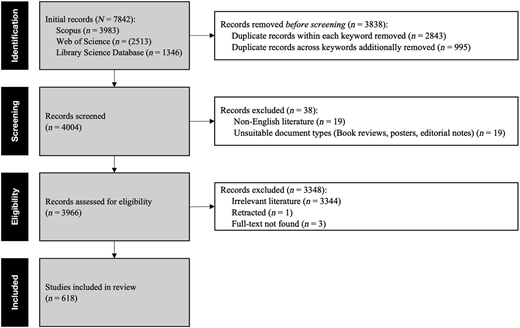
Figure 1 provides the literature search and selection process. Initially, 7,842 records were retrieved from three databases: Scopus (3,983), Web of Science (2,513) and the Library Science Database (1,346). After removing 3,838 duplicates, 4,004 unique records remained. Screening excluded 38 non-English items, book reviews, or editorials, leaving 3,966 full-text articles for further consideration. Of these, 3,348 were excluded (3,344 irrelevant, one retracted and three without full-text access), yielding 618 articles for inclusion [5, 6].

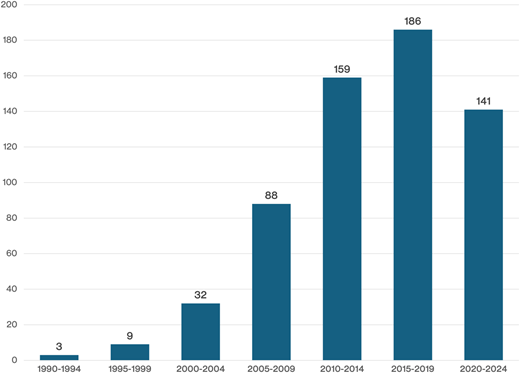
Figure 2 illustrates the 618 included publications in five-year intervals from 1990 to 2024. Output is sparse in 1990–1994, rises substantially from the mid-2000s, peaks in 2015–2019 and remains high in 2020–2024 (ongoing at the time of writing).

Table 4 summarizes the selected publications by their primary subject or field in which IL is commonly examined. Given that many publications span multiple settings or speak across domains, each source was assigned to the subject/field that most closely aligned with its central focus and/or stated context. “Higher education and academic libraries” account for the largest share (n = 193, 31.2%). Another substantial proportion of publications were “cross-setting or did not specify” (n = 162, 26.2%), consistent with the conceptual and theoretical orientation of the present review. Beyond these two dominant categories, the remaining publications are more evenly distributed across everyday life, community and culture (n = 65, 10.5%); K–12 (n = 46, 7.4%); education (general) (n = 43, 7.0%); workplace and organizational settings (n = 43, 7.0%); domain-specific applications (n = 35, 5.7%) and libraries (public/general), archives and museums (n = 31, 5.0%).

Through a comprehensive critical literature review involving results gathered via database searching and snowball sampling, the study maps a constellation of six aporias: truth, knowledge and data, information behavior, genericism versus contextuality, ideology and political economy and illiteracy.

A prominent theme in IL research is the role of IL in responding to the increasingly troublesome issues of mis/disinformation [7]. Several works included in the review engage with post-truth, fake news, infodemic and information disorders, often linking them to technological change and individuals' often uncritical acceptance of information such as heuristic cues over verification (e.g. Frau-Meigs, 2019). Younger users in particular, who typically consume most information through social media, appear to be more susceptible to mis/disinformation. Several authors consequently call for re-centering veracity in IL–conformity to truth and facts–amid contemporary post-truth phenomena and rising political extremism (e.g. Janssen et al., 2017).

4.1.1 Competing views on the relationship between IL and truth

The question of whether IL is directly related to truth elicits contrasting views in the literature. One perspective maintains that IL is fundamentally about adopting a “critical approach” to information, regardless of its factual accuracy. From this standpoint, concepts such as information, reality, truth and facts are context-dependent and never entirely neutral or objective. On this view, IL should foster critical awareness, showing that all information can harbor bias or ambiguity (Detmering, 2010).

A contrasting strand contends that IL cannot function without valuing truth. Even the adept use of ALA information evaluation guidelines or verification tools can amplify falsehoods if users privilege belief-congruent messages that lack a truth-oriented attitude (Borges, 2023). Haider and Sundin (2022, pp. 115–116) add that far-right groups deploy “critical-information” tactics once associated with social-justice aims, showing how technically “information-literate” actors can exploit online platforms to circulate conspiracy theories and extremism. Haider and Sundin thus argue for the need to foreground truth and knowledge in IL (2022, pp. 115–116).

These tensions fuel critiques that major IL frameworks underaddress mis/disinformation (e.g. Faix and Fyn, 2020). The ACRL frame “Authority is Constructed and Contextual,” for instance, is said to fit post-truth reality poorly (e.g. Baer, 2018). Hannah (2023) contends that the epistemological assumptions embedded in major IL frameworks limit engagement with conspiracy theories. QAnon's practices can mirror ACRL frames, indicating that IL education cannot sidestep questions about the truth of information.

4.1.2 Information concepts in IL: truth vs. informativeness

To claim “information literacy,” one must first grapple with the question “what is information?”. In the literature, a salient aporia emerges between “truth” and “informativeness” conceptions of information. Many theoretical accounts adopt expansive, context-driven notions–information as anything experienced as “informative”–often blurring boundaries with data, document, content, media, knowledge, interpretation, or opinion (e.g. Bruce, 1997; Mackey and Jacobson, 2011; Limberg et al., 2012). By contrast, recent IL frameworks tend to treat information as (true) propositional content, reflecting “post-truth” concerns (e.g. Information Literacy Group, 2018; Grizzle et al., 2021).

This alleged aporia is related to the ontological status of information, considering it as objective (external) content, the recipient's subjective (internal) interpretation, or both (see Budd, 2011; Mingers and Standing, 2018; McKinney and Yoos, 2019). Subjective perspectives view information as contingent upon the receiver's interpretation of the message (e.g. “reduction in uncertainty” or “change in cognitive structure”). This suggests that a message conveys no information if its content is already known or not understood by the recipient. Conversely, objective perspectives stress the capacity of information to inform an agent independently of their reception, preserving the distinction between “true” and “false” information. This view warns that subjectivism collapses independent informational content into mere interpretation. Moreover, excessive relativism risks eroding the authority of established scientific information and evidence-based research (e.g. climate change) by reducing it to just another “perspective” (Haider and Sundin, 2019, p. 101).

Certain IL models have been proposed to bridge the subjective and objective dimensions of information. Building on Lupton's (2008) threefold schema–external (objective), internal (subjective) and transformative information—Fázik and Steinerová (2021) conceptualize IL as the competence to verify the truthfulness of information through a critical and dialectical process. According to them, knowledge of the truth serves as a bridge between subjective information and objective information.

The relationship among information, data and knowledge remains aporetic across information science, epitomized by debates surrounding the Data-Information-Knowledge-Wisdom (DIKW) hierarchy (see Frické, 2019). Within IL, this tension is more pronounced because IL is often assumed to intertwine with data use and knowledge acquisition.

4.2.1 IL as knowing versus knowledge for IL

The literature review reveals a tension between IL as a way of “knowing” and “knowledge” itself (see Kerr, 2010; Todd, 2010). Much IL scholarship assumes that changes in learning styles–less knowledge instruction and more information resources–are required in the new information or digital age (e.g. American Library Association, 1989). Hence, IL has often been framed as “the ability to learn” or “learning to learn,” positioning it as a pathway toward knowing, knowledge building and knowledge creation by engaging with information in critical ways (e.g. Shanbhag, 2006). This understanding of IL is typically underpinned by constructivist learning theories, which posit that knowledge is not simply “found” or “transferred”, but rather actively “made” or “constructed” by learners (e.g. Kuhlthau, 2004). Extending this view, Martzoukou and Sayyad Abdi (2017, p. 659) suggest IL as a mindset of continual learning–transferable heuristics that link prior knowledge with lived experience to navigate unfamiliar information.

On the other hand, several studies demonstrate the significant influence of existing (disciplinary) knowledge in learning and IL success. Even when students possess proficiency in IL, they tend to struggle to synthesize their findings due to limited background knowledge (e.g. Rosenblatt, 2010). This suggests that students need to enhance fundamental competencies, such as domain-specific knowledge, cognitive maturity, knowledge transfer and critical thinking, before being introduced to IL and research. Some argue that IL instruction should diagnose and scaffold students' initial knowledge bases–sometimes they may lack necessary prior knowledge–and progressively enhance their understanding (e.g. Aglen, 2016). Todd (2010, p. 147) stresses that disciplinary knowledge–including its creation, validation and structure–must inform IL lest library-centric models clash with disciplinary-specific epistemologies.

Furthermore, beyond individual constructivism, social epistemologies highlight how social, economic, and cultural forces shape knowledge production, distribution and utilization within communities (see Budd, 2004; Fuller, 2017). Yet, the literature demonstrates that scrutinizing and integrating other social epistemologies remain limited.

4.2.2 Gap between novice and expert learners

Another frequently discussed issue in the literature relates to knowledge gaps between novices and experts in different disciplines. Novice learners often struggle to grasp the underlying intentions or epistemic basis of reference materials or databases, whereas expert practitioners possess tacit disciplinary knowledge guiding their choice of information resources. This gap highlights why IL instruction must address disciplinary conventions, research methods and epistemological assumptions (Green, 2010). Unlike students, faculty possess a deeper, more nuanced understanding of the research process, discourse and relevant information within their disciplines (Miller, 2018).

Steinerová (2014) finds that “information horizons” evolve from novice to expert knowledge, influenced by research experience and learning context. Expert searchers with substantive background knowledge on a given topic draw upon tacit knowledge to select search tools, construct searches and evaluate results, thereby experiencing less information-related anxiety. Novice learners, in contrast, lack the required schemas, thus increasing their cognitive load and inhibiting knowledge transfer (e.g. Swanson, 2006, p. 100). Identifying tacit disciplinary practices and assumptions can also help novices not merely adopt disciplinary norms uncritically but eventually critique them, preventing the reinforcement of exclusionary or oppressive assumptions (Miller, 2018).

4.2.3 The conflation of data, information and knowledge

Many influential IL frameworks (e.g. Eisenberg and Berkowitz, 1990; Bruce, 1997; Mackey and Jacobson, 2014) align with the premise of the DIKW model, i.e. a progression from data to information to knowledge to wisdom.

However, conflating data, information, knowledge and wisdom breeds conceptual confusion. Distinguishing information from knowledge has been a central concern in information science (e.g. Farradane, 1980). Marcum (2002, pp. 8–10) criticizes the indiscriminate use of the term “information,” which obscures the fact that information does not automatically become knowledge. Indeed, an overload of information can impede knowledge development. Floridi (2012, p. 432) also argues that individual pieces of semantic information–defined as data that are well-formed, meaningful and true–are not sufficient for an “upgrade” to knowledge. Because information lacks the structural relations necessary to account for one another, it can become knowledge only when positioned within an adequate justificatory account. In turn, existing knowledge conditions “the amount and nature of information” available (Mingers and Standing, 2018, p. 93).

Conflation of data and information also warrants scrutiny. Mutch (1997), for example, notes that information is often regarded as a subset of data, but the process by which data becomes information remains poorly defined. Without confronting meaning and knowledge, he argues, personal information management becomes reduced to mere filing and organizing–important but insufficient activities for understanding how information is created. As Mutch emphasizes, additional data simply leads to overload and paralysis when users are not equipped to address questions of meaning (p. 378).

4.3.1 Relationship between IL and information behavior

IL is widely regarded as closely related to information (seeking) behavior (IB), though the two domains seldom communicate (e.g. Kuhlthau, 2008; Hepworth et al., 2014). As Limberg and Sundin (2006) observe, “information seeking and IL are two sides of the same coin.” They argue that IB can offer IL theoretical grounding, while IL provides IB with an institutional context in which the objectives for information-seeking practices are formed.

The literature nevertheless disagrees on the IL-IB relationship (see Table 5). One position treats IL as “desired,” “optimal,” or “idealized” IB, as opposed to its non-optimal behaviors and practices (e.g. Shenton and Hay-Gibson, 2011).

A second viewpoint posits that IL and IB overlap but remain distinct, as seen in the literature on assessing how IL acquisition influences one's IB (e.g. Atman Uslu and Yildiz Durak, 2022) and in arguments for “IL as a Discipline” with its own ontology and epistemology (see Maybee et al., 2023).

A third strand casts IL as broader than IB, treating information seeking as a core component of a larger constellation of IL skills and abilities (e.g. Bauer, 2018). In particular, phenomenographic studies consider IL to be broader than IB because the former includes cognitive, emotional, social, educational and ethical dimensions of interaction with information (e.g. Bruce, 1997).

A final strand does not clearly distinguish between IB and IL, linking IB “theories/models” directly to IL “practice” (e.g. Limberg and Sundin, 2006), implying IL as an “applied” branch of IB.

4.3.2 IL and intentionality: information practice and heuristics

IL scholarship has traditionally foregrounded intentional, purposeful, or active IB, beginning with an explicit information need or search process. These models privilege systematic evaluation, seldom acknowledging information encountering, opportunistic discovery and heuristic cues (see Erdelez and Makri, 2020). In contrast, IB research has long recognized unintentional, accidental, or passive exposure to information and even deliberate avoidance/ignoring (Given et al., 2023). For instance, Savolainen's (1995) concept of “everyday life information seeking (ELIS)” highlights everyday, casual orientations.

In the surveyed literature, several studies incorporate these perspectives. For example, Lugović (2014) frames individuals as “living repositories” whose memories, aspirations and socio-cognitive abilities continually shape encounters of information beyond formal “search.” Furthermore, researchers increasingly frame IL as an information practice–what is socially and culturally shaped, often habitual actions of identifying, seeking, encountering, using and sharing information. Lloyd (2012), in particular, elaborates on IL as a socially enacted practice–an outcome of co-location and co-participation in information-rich environments–extending earlier works on IL as knowing an information landscape and as sociocultural practice.

However, this approach faces two critiques in turn. First, reliance on habitual, fluent, or heuristic approaches—such as reputation, endorsement, consistency, expectancy violation and persuasive intent–risks superficial evaluation of information (Metzger et al., 2010). Heuristics suited to ignoring low-quality content may not aid in seeking high-value information (Kozyreva et al., 2023) and online consistency heuristics can intensify echo-chamber effects (Haider and Sundin, 2022). Second, practice theory has been criticized in the social sciences for underplaying reflexivity and agency by prioritizing routinized, context-bound activity and sidelining critical awareness and intervention (Porpora, 2015, pp. 149–158). If IL is to serve social change rather than mere habituation, practice-based models need to weave reflexive checkpoints into everyday routines.

In sum, IL scholarship faces two intertwined aporias of intentionality: the tension between goal-driven, intentional search and the pervasive incidental information encounters and the challenge of balancing habituated information practices with reflexive scrutiny.

Recent literature on IL identifies context as one of the field's most frequently discussed themes. Yet across numerous conceptual frameworks and models, there appears to be little agreement on how contextual dimensions should be defined or related to one another. This lack of consensus signals both the diversity of IL phenomena and potential conceptual drift.

4.4.1 IL as generic competencies versus context-specific practice

The literature reveals two diverging perspectives concerning the contextuality of IL. One perspective treats IL as a generic set of competencies, neutral and transferable across different domains and contexts. The other advocates for context-specific or situated practice and experiences, wherein IL must be adapted to sociocultural, disciplinary and local circumstances (Lupton, 2008) [8].

Critics of “simplified checklist” models argue that such models view IL as “a free-floating skill” that can be learned and applied in any context, detached from environmental factors (Haider and Sundin, 2019, 2022). By contrast, approaches influenced by New Literacy Studies and ELIS construct a more nuanced depiction of multiple literacies, emphasizing the importance of particular and local situations and practices, such as workplaces and communities (e.g. Lloyd and Talja, 2010). Similarly, Tuominen et al. (2005) articulate IL as a sociotechnical practice, maintaining that technology is never neutral and that information and actions must be interpreted in relation to their communities of practice.

However, whether IL education should focus exclusively on context-dependent approaches remains contested. Some educational theories, particularly social epistemologies, hold that core disciplinary knowledge is context-independent and thus distinct from everyday, context-bound experience. This suggests that certain IL competencies–e.g. basic Boolean search operations, information-behavior patterns, or workings of social-media recommendation algorithms—can plausibly be taught as transferable, generic skills. Conversely, domain-specific tasks (e.g. systematic reviews in medicine) demand specialized background knowledge. Evidence for the efficacy of contextualized teaching is mixed. For example, reviews in physics and mathematics show that realistic scenarios can boost motivation but also distract learners or hinder transfer when contexts become overly emotional or complex. They also note difficulties in transferring context-bound insights to new domains when instruction is tied to a single situational frame (Taasoobshirazi and Carr, 2008).

It is worth noting that what is “generic” need not be reduced to generic skills or competencies. Sundin (2020, pp. 376–378) distinguishes “learning for use”–operating ICTs functionally–from “learning for critical use”–understanding the socio-technical and structural properties embedded in those same infrastructures (i.e. affordances, economic logics, political consequences). Enacting IL therefore requires skills, abilities and forms of knowledge that reach beyond any single practice or community. Indeed, learning within a tight community of practice can deepen a lack of awareness as to the infrastructure on which that community depends. Hence, Critical IL (CIL) must analyze information infrastructures as simultaneously contextual and structural, cultivating a general awareness that transcends local practice.

In sum, the field confronts a persistent aporia: IL must be sufficiently general to expose hidden infrastructures and power logics and to cultivate context-independent skills and knowledge, yet sufficiently situated to remain meaningful within local practices. Critiques of genericism often target only technical skills, leaving the two other transferable pillars–knowledge and dispositions–under-examined. When learning is confined to the immediate tasks and routines of a single context, it limits access to wider knowledge systems, theoretical bodies and alternative ways of thinking. Such a narrow focus also constrains the formation of information-literate identities and values that transcend any one locale.

4.4.2 Different understandings of context

All human phenomena and actions arise within complex contexts that span personal, interpersonal, institutional, structural and cultural dimensions–and IL is no exception. However, scholars still disagree about how much IL must be situated, despite growing critiques of the concept of IL as a set of generic skills transferable to all information-seeking contexts (e.g. Addison and Meyers, 2013).

In the reviewed literature, the context of IL appears in at least two distinct senses (see Table 6). First, much IL scholarship treats context primarily as a sociocultural matrix of “individuals” that ranges from micro (individual) to macro (institutional, societal) levels. For example, Lloyd (2012, p. 777) argues that IL as a socially enacted performance arises from “the social, material, economic, and historical conditions that shape a site's texture,” together with the community of co-participating actors in that site. Institutional IL frameworks acknowledge that IL may vary significantly across diverse contexts across everyday life, citizenship, education, workplace and health domains (e.g. Information Literacy Group, 2018). Steinerová (2014, p. 72) echoes this stance, urging that IL be woven into an “information culture” involving information practices, with contextual elements ranging from personal and educational to organizational and social settings.

On the other hand, a smaller body of work foregrounds the context of the information itself. For instance, Gross and Latham (2017) propose a peritextual literacy framework, arguing that an understanding of how textual elements–such as metadata and paratexts–mediate and shape content is integral to evaluating and comprehending media outputs, thus linking it closely to IL. Similarly, Forster's nonlinear IB model distinguishes intrinsic (internal) from extrinsic (external) context, demonstrating how multiple factors intertwine in real-world information activities (see Foster and Urquhart, 2012).

In the literature, the term “context” is invoked so widely–and in often abstract or inconsistent ways–that its theoretical value risks being blurred. Overusing context may dilute the word to the point where it refers to almost anything, while focusing too narrowly on certain types of context ignores the multilayered, multifaceted nature of real-world settings. Haider and Sundin (2022, p. 60) caution that if literacies become so entwined in local practices that they “dissolve” into them, the concept risks losing analytical power.

Social phenomena–including individual thoughts and behaviors–are influenced by systems of meaning, ideologies and power relations. IL scholarship has examined the interplay among ideology, political economy and discourse surrounding IL-related concepts, issues, problems, solutions and values (see Sample, 2020; Haider and Sundin, 2022). Šobota (2024, p. 40) frames this as IL's “teleological essence”: “What is IL for and who is it for?”.

The literature reveals competing goals and the ideological logics in IL: citizenship, social engagement and human rights; problem-solving; informed decision-making; lifelong learning; academic excellence; reflective understanding and knowledge construction; and critical consciousness about information systems and academic systems. Such varied perspectives lead to aporias about IL's ends.

4.5.1 IL for social reproduction versus social transformation

Arguably, IL has plural and even somewhat conflicting genealogies (see Pinto et al., 2010; Whitworth, 2014, pp. 27–45). In early formulations, IL was introduced as a form of competence for organizational problem-solving and workforce productivity, envisioned as a driver of sustained economic growth (Zurkowski, 1974; Burchinal, 1976; MacMullin and Taylor, 1984).

In contrast, other scholars framed IL as citizenship and democracy, countering the “pollution of information” formulated by institutionalized public media (Hamelink, 1976; Owens, 1976). International institutions and several IL scholars similarly position IL as a human right indispensable to empowerment, well-being, civic participation and international development (e.g. International Federation of Library Associations and Institutions, 2005; Hepworth and Walton, 2013). Such a political and critical view contests Zurkowski's optimistic prospects for the information environment under economic and political liberalism (Whitworth, 2014, p. 33).

CIL extends this critique by interrogating the ideological and political-economic character of both the information environment and IL itself (see Downey, 2016; Tewell, 2025). As Tewell (2015, p. 25) notes, CIL urges students to engage with–and act upon–the power structures underpinning information production and dissemination.

These strands expose an enduring tension between IL's emancipatory ideals and its instrumental deployment. Can IL simultaneously cultivate the critical consciousness needed to transform unjust systems while simultaneously training individuals to succeed within those same systems? Or does the pursuit of instrumental outcomes inevitably dilute IL's transformative promise?

4.5.2 IL for information society and information age

Another recurrent rationale in the literature was the assertion of “information society” or “information age” as the inevitable global environment, which justifies the need for IL skills and competencies for productivity and competitiveness (e.g. Kuhlthau, 1987; United Nations Educational Scientific and Cultural Organization, 2003). These narratives invoke rapid information growth, overload and mis/disinformation as typical challenges, attributed to technical and social changes (e.g. American Library Association, 1989; Grizzle et al., 2013). IL discourse often frames the knowledge economy as a “struggle for survival of the fittest,” where only those with sufficient technical-intellectual capacities consume information effectively (Tuominen et al., 2005, pp. 333–334).

Critical scholarship, however, cautions that invocations of an “information society/age” are often abstract and ahistorical. Webster (2014) argues that proclaiming a new “information era” can normalize existing arrangements by encouraging acquiescence to present conditions (p. 347). He proposes reversing the usual question––“What is the information revolution doing to us?”–to “What are we doing to information?”, thereby foregrounding how global capitalism drives demand for ICTs, corporate planning, political influence and marketing (p. 351). Webster further underscores the centrality of “theoretical knowledge”–abstract, generalizable and codified knowledge–in contemporary society and distinguishes it both from ICTs and tradable information (p. 34; p. 355).

The information-society narrative tends to position IL as a universal remedy while obscuring underlying power relations. The central aporia remains: Is IL merely a survival toolkit within an inexorable digital economy, or can it also equip citizens to interrogate–and transform–the very structures that proclaim the “information age” inevitable? Clarifying this tension is indispensable for any robust theory of IL in contemporary society.

The concept of “literacy”–the ability to read and write–inevitably implies its own opposite: illiteracy. Thus, any discussion or teaching of information “literacy” presupposes that individuals may “be” or “become”–to varying degrees and in multiple ways–either information literate or illiterate. In other words, IL research and practice posit the (non-)existence of IL both as practices people enact and as outcomes they achieve. However, the literature reveals substantial variation among researchers regarding how illiteracy is defined, measured and problematized.

4.6.1 Critique of deficit narratives versus acknowledging lack of IL

IL scholarship is fundamentally associated with “absence” or “lack”–whether a lack of access to technologies, a lack of skills, or a lack of epistemic authority. Critical perspectives warn, however, that such frames can reproduce simplistic or deterministic “deficit narratives”. Deficit perspectives often surface when librarians or faculty describe learners as “unprepared,” “remedial,” or simply “information illiterate” (e.g. Thornton, 2014). As Budd (2009, p. 55) notes, the notion of IL as a “remedy for a pathology” is pervasive in the field. Shenton (2018) also highlights that IL frameworks tend to assume advanced reading proficiency, prompting educators to see learners as deficient. Drawing on these critiques, strength-based educational approaches attempt to build upon learners' existing knowledge and experiences through constructivist design and adaptable activities (e.g. Pashkova-Balkenhol et al., 2019, p. 105).

Nevertheless, many researchers emphasize that real issues of lack or gaps in IL skills and knowledge do exist. Studies frequently report information skill gaps among undergraduates, leading to constraints on problem solving and innovation (e.g. Godbey, 2013). Research in IB and IL also documents prevalent forms of information anxiety and library anxiety (e.g. Naveed and Anwar, 2019).

In this regard, some argue for recognizing IL as a developmental continuum–i.e. process or spectrum–rather than a dichotomy that labels individuals as “deficient” or “fixed.” As newcomers grow proficient in a field, they enter more deeply into their information worlds and connect with others whose understandings have been concretized through everyday practices and experiences (e.g. Green, 2010). This developmental view is frequently operationalized as discrete “levels” in IL models that articulate staged outcomes and “good practice” (e.g. SCONUL Working Group on Information Literacy, 2011).

Conflicting perspectives on “deficit” or “gap” framings of IL expose an enduring aporia in IL research and practice: On one hand, identifying specific gaps and deficiencies can guide targeted educational interventions and support; on the other, such deficit-oriented perspectives risk pathologizing learners and communities and can reproduce the very exclusions they seek to address.

4.6.2 Structural and ideological forces to illiteracy

To move beyond the aporia between deficit-based and strength-based approaches, it is essential to consider how illiteracy is not merely an individual failing but is shaped and reproduced by wider structural and ideological forces. Discussions of IL routinely intersect with concepts such as information poverty, information inequality and the information/digital divide. Researchers note that these challenges are rooted not just in individual skill levels but also in structural and ideological forces surrounding IL. In the ICT domain, for instance, planned obsolescence in software, services and devices can lead previously information-literate individuals to experience new forms of illiteracy and exacerbate the digital divide and information poverty, particularly for marginalized groups (e.g. Tokić and Tokić, 2015).

Global evidence also shows that legal or formal recognition of information rights, digital access, or IL itself does not guarantee equitable outcomes. Cross-national studies consistently reveal two intertwined gaps: disparities in material access (i.e. infrastructure, connectivity and device ownership) and operational competence (i.e. abilities to search, evaluate and apply information even when access is available) (e.g. Buchanan et al., 2018). These studies commonly conclude that people cultivate IL only when adequate resources, supportive intermediaries and well-designed processes are in place.

In this context, positioning IL as a human right highlights its potential to address information exclusion, information poverty, digital divides and inequality. Acknowledging both technical and information-based deficits–and the necessity of addressing them through systemic as well as individual means–remains crucial for advancing IL theory and practice (see Šobota, 2024).

The findings suggest that IL is sustained as much by constitutive tensions as by consensus. The identified aporias relate to both philosophical-conceptual dilemmas (what counts as information and literacy and where IL's scope begins and ends) and social-practical dilemmas (how IL should be taught, assessed and institutionalized within uneven socio-technical and political-economic conditions). This section briefly discusses the implications of the findings by (1) comparing the identified aporia with those suggested in prior works and (2) proposing potential approaches to addressing these dilemmas.

First, the findings demonstrate that aporias persist across the field (Table 7). While some of these aporias overlap with tensions and contradictions identified in earlier IL scholarship–such as “genericism versus contextuality” and “ideology and political economy”–this review renders the fault lines with greater conceptual nuance through a broader literature base. For example, with respect to the aporia of “genericism vs. contextuality,” the review shows that both orientations entail complex dimensions beyond a simple opposition between contextual practice and general skills.

On the other hand, the review identifies the aporias of “truth,” “knowledge and data,” “information behavior,” and “illiteracy,” which have not been explicitly presented in–or have been treated only briefly by–existing meta-literature. Regarding “knowledge,” much of the surveyed literature adopts an uncritical stance toward the prevalent view that IL is linked to knowledge, and even in critical reviews, it is common not to distinguish information from knowledge as analytic categories. The review further indicates that these blurred boundaries between knowledge and information are closely connected to the aporia of “truth,” which has likewise received limited attention in prior work. The aporia of “information behavior” has also rarely been addressed. Most research does not examine in depth the relationship between information behavior and IL, and this lack of dialog within library and information science appears to constrain the extent to which IL research can fully leverage its potential for development.

What, then, are the implications of these aporias for IL research? As shown in Table 7, the aporias identified in this review share a common feature: they bear on the meta-theoretical dimensions of IL–what IL is (definition), how it exists, is enacted and exerts effects (ontology), how it should be theorized (epistemology), and what it aims at (axiology). For instance, the relationship between the concept of information and “truth” pertains to the ontological and epistemological dimensions of information, while also closely connected to IL's definition (i.e. what it means to be information literate), the epistemic relationship between IL and knowledge/knowing and debates about the aims and values of IL. Similarly, “illiteracy” is an aporia that concerns the ontological question of the absence of IL while also linking to social and ideological value judgments and to educational and policy practice. The aporias of “genericism versus contextuality” and “ideology and political economy,” although most directly associated with conceptual definition and axiology respectively, likewise entail ontological questions about how IL exists and operates at the intersection of individual agency and sociocultural conditions.

From this perspective, the identified aporias are not best understood as difficulties to be addressed in isolation; rather, they call for integrated examination through in-depth, systematic inquiry into the relationships among these meta-theoretical dimensions.

This section synthesizes potential approaches for addressing the aporias identified in this review by summarizing proposals advanced in the surveyed literature. These proposals are not intended as prescriptive recommendations; rather, consistent with the aims of this study, they are offered as part of problem posing and to encourage more sustained and productive discussion within the field.

Truth. The findings show that calls to re-center veracity in the era of post-truth, conspiracy and polarization coexist with traditions that emphasize subjective interpretation and the contextuality of information. Rather than a choice between “truth” and “informativeness,” a productive framing may connect them in IL. Pedagogically, IL can be framed as cultivating both truth-tracking and sense-making without sliding into naïve relativism. For example, distinguishing judgments about content credibility from judgments based on source cues helps specify what is being evaluated. Introducing elementary positions on truth (e.g. correspondence, coherence, pragmatist, pluralist) helps explain why “critical evaluation” requires both justified distrust and justified trust (see Mingers and Standing, 2020; Glanzberg, 2023).

Knowledge and data. The findings caution against a naïve DIKW ladder in which data simply becomes information and then knowledge. Knowledge is not a larger heap of information but a system requiring justificatory structures that often differ across disciplines. From a social epistemological standpoint, IL therefore need not be conflated with “learning” or “knowledge acquisition”. Designing IL curricula informed by social epistemology is expected to make disciplinary warrants explicit and foster deeper comprehension, critical judgment and intellectual autonomy (see McPhail et al., 2024). Clarifying IL's boundaries relative to adjacent literacies (e.g. digital, media, data) is likewise central to theoretical coherence, not merely taxonomic housekeeping. Cross-pollination is most productive when IL foregrounds how people understand and mobilize information, rather than stretching to cover every desirable educational outcome.

Information behavior. The findings array four positions on the IL-IB relationship (see Table 3). Kuhlthau's (2008, p. 72) integrative call for “an overarching conceptual framework that represents the unified whole” is best answered not by collapsing these domains but by articulating their complementary scopes and specifying when findings from one should constrain claims in the other. The literature also supports widening IL's lens to the broader ecology of information contact–intentional seeking, incidental encounter and avoidance–and conceiving IL as a social practice emerging from reflective and dialectic interactions between structure and agency (e.g. Mutch, 2008).

Genericism versus contextuality. This aporia is related to the philosophical debates over the universal and the particular, abstraction and concreteness. If IL is entirely particularized to local practices, the concept risks losing generality; if cast as purely generic, it becomes placeless and analytically thin. Some IL competences plausibly travel across contexts (e.g. claim-evidence mapping, basic verification strategies), while others are discipline-specific (e.g. evidentiary canons in medicine or history). Infrastructural literacies often cut across domains (e.g. how platforms monetize attention and structure visibility). A defensible stance can be a stratified framework that preserves transferability while acknowledging contextuality (see Farrell, 2013; Kuglitsch, 2015). Developing it into a robust theory, however, will require firmer grounding in the philosophy of social science.

Ideology and political economy. Any account of “good” information use presupposes value systems and power. Ideology and political economy are thus internal to IL, not external add-ons. The literature shows IL's dual telos–serving both reproduction and transformation of existing social structures. Therefore, the aim of IL education should extend beyond skill acquisition to equipping learners with knowledge of information environments and power relations and with capacities to transform them.

Illiteracy. This aporia raises ontological and epistemological questions about deficiency. “Illiteracy” can describe ability shortfalls yet also pathologize individuals or communities. Binary labels (information literate/illiterate) misrepresent IL as a static essence rather than a developmental gradient of repertoires, dispositions and justificatory knowledge. Conversely, reducing illiteracy to social labeling ignores the realities of information poverty, digital divides and mis/disinformation. A more adequate theorization can be pursued by linking individual repertoires and structural barriers, avoiding a simple deficit perspective. Educationally, aligning these planes clarifies how macro-level inequities seep into classroom practices.

Using an aporetic, problem-posing lens, this review has surfaced constitutive tensions in IL and has sketched implications for research, education and policy. The identified aporias can operate as boundary conditions that delineate IL's conceptual space, including clarifying when truth-oriented evaluation should be foregrounded and when sense-making takes precedence, when heuristics are appropriate and when they mislead and when general competencies suffice versus when disciplinary knowledge and critical inquiry must lead. Making these boundaries explicit curbs conceptual drift while preserving flexibility.

Furthermore, the aporias imply that ecological and hierarchical approaches to theorizing IL warrant systematic scrutiny. Future studies could theorize IL through analyzing structure–agency relations across information and social environments beyond reducing it to surface functions or purely local practices. In line with this, IL curricula could integrate epistemic grounds–justification, coherence and understanding–rather than checklist compliance, with novice–expert progressions made explicit for assessment and expectation-setting. Such an effort would benefit from the insights drawn from IB studies, which help learners develop metacognition about their IL practices.

Finally, the review reinforces the importance of aligning IL pedagogy with governance, which forms the information environment. Given that post-truth harms, information overload and algorithmic bias are structurally amplified, institutions invest in trustworthy intermediaries–i.e. libraries, community organizations, schools–and adopt procurement and platform policies that ensure access to quality sources and vendor transparency. Taken together, these directions treat aporias not as defects to be eliminated but as diagnostic tools that keep IL inquiry responsive and capable of sustained, creative innovation.

1.

The complete list of search keywords is available in Supplementary_material_1.

2.

The Library Science Collection combines the core literature included in the Library and Information Science Abstracts (LISA) index with full text (Retrieved from https://about.proquest.com/en/products-services/libraryscience/)

3.

In the fourth category, both backward and forward snowballing were applied.

4.

Supplementary_material_2 provides keyword-specific criteria.

5.

Due to space constraints, citations in the main text have been substantially trimmed; an expanded bibliography is provided in Supplementary_material_3.

6.

Search results for each keyword are provided in Supplementary_material_4.

7.

Such a tendency is not restricted to IL alone; numerous studies for other literacies–e.g. media literacy, news literacy and digital literacy–and broader frameworks (e.g. “21st-century skills”) have also proliferated since the mid-2010s (see van Laar et al., 2017).

8.

Lupton (2008) also indicates that the “transformative” perspective is another thread in IL education, which goes beyond socio-cultural practices by being concerned with social change and emancipation.

The supplementary material for this article can be found online.
Addison
,
C.
and
Meyers
,
E.
(
2013
), “
Perspectives on information literacy: a framework for conceptual understanding
”,
Information Research: An International Electronic Journal
, Vol. 
18
No. 
3
,
available at:
 https://eric.ed.gov/?id=EJ1044643 (
accessed
 1 August 2025).
Aglen
,
B.
(
2016
), “
Pedagogical strategies to teach bachelor students evidence-based practice: a systematic review
”,
Nurse Education Today
, Vol. 
36
, pp. 
255
-
263
, doi: .
American Library Association
(
1989
), “
Presidential committee on information literacy: final report
”,
available at:
 https://www.ala.org/acrl/publications/whitepapers/presidential (
accessed
 1 August 2025).
Atman Uslu
,
N.
and
Yildiz Durak
,
H.
(
2022
), “
The relationships between university students' information-seeking strategies, social-media specific epistemological beliefs, information literacy, and personality traits
”,
Library and Information Science Research
, Vol. 
44
No. 
2
, pp. 
101
-
155
, doi: .
Baer
,
A.
(
2018
), “
It's all relative? Post-truth rhetoric, relativism, and teaching on ‘authority as constructed and contextual’
”,
College and Research Libraries News
, Vol. 
79
No. 
2
, pp. 
72
-
75
,
97
doi: .
Balibar
,
É.
(
2004
),
We, the People of Europe?: Reflections on Transnational Citizenship
,
translated by J. Swenson, Princeton University Press, Princeton, NJ
.
Balibar
,
É.
,
Poisson
,
J.M.
and
Lezra
,
J.
(
1995
), “
The infinite contradiction
”,
Yale French Studies
, Vol. 
88
, pp. 
142
-
164
, doi: .
Bauer
,
M.
(
2018
), “
Ethnographic study of business students' information-seeking behavior: implications for improved library practices
”,
Journal of Business and Finance Librarianship
, Vol. 
23
No. 
1
, pp. 
1
-
10
, doi: .
Bawden
,
D.
(
2001
), “
Information and digital literacies: a review of concepts
”,
Journal of Documentation
, Vol. 
57
No. 
2
, pp. 
218
-
259
, doi: .
Biesta
,
G.
,
Filippakou
,
O.
,
Wainwright
,
E.
and
Aldridge
,
D.
(
2019
), “
Why educational research should not just solve problems, but should cause them as well
”,
British Educational Research Journal
, Vol. 
45
No. 
1
, pp. 
1
-
4
, doi: .
Borges
,
J.
(
2023
), “
Infocommunicative literacy: conceptual structure and applications
”,
Journal of Librarianship and Information Science
, Vol. 
55
No. 
3
, pp. 
609
-
616
, doi: .
Boulter
,
S.
(
2013
), “The aporetic method and the defence of immodest metaphysics”, in
Metaphysics from a Biological Point of View
, pp. 
43
-
65
,
Palgrave Macmillan UK
,
London
, doi: .
Bruce
,
C.S.
(
1997
),
The Seven Faces of Information Literacy
,
Auslib Press Adelaide, Blackwood
,
SA
.
Buchanan
,
S.
,
Jardine
,
C.
and
Ruthven
,
I.
(
2018
), “Developing information literacy in dependent and disadvantaged circumstances: a transitional approach in the digital health context”, in
Kurbanoğlu
,
S.
,
Boustany
,
J.
,
Špiranec
,
S.
,
Grassian
,
E.
,
Mizrachi
,
D.
and
Roy
,
L.
(Eds),
Information Literacy in the Workplace. ECIL 2017., Saint Malo, France, 18-21 September 2017
,
Springer
,
Cham
, pp. 
409
-
418
, doi: .
Budd
,
J.M.
(
2004
), “
Academic libraries and knowledge: a social epistemology framework
”,
The Journal of Academic Librarianship
, Vol. 
30
No. 
5
, pp. 
361
-
367
, doi: .
Budd
,
J.M.
(
2009
),
Framing Library Instruction
,
Association of College and Research Libraries
,
Chicago, IL
.
Budd
,
J.M.
(
2011
), “
Meaning, truth, and information: prolegomena to a theory
”,
Journal of Documentation
, Vol. 
67
No. 
1
, pp. 
56
-
74
, doi: .
Budd
,
J.M.
and
Lloyd
,
A.
(
2014
), “
Theoretical foundations for information literacy: a plan for action
”,
Proceedings of the American Society for Information Science and Technology
, Vol. 
51
No. 
1
, pp. 
1
-
5
, doi: .
Buddensiek
,
F.
(
2018
), “Aporia in Aristotle's metaphysics beta”,
Karamanolis
,
G.
and
Politis
,
V.
(Eds),
The Aporetic Tradition in Ancient Philosophy
.
Cambridge University Press
,
Cambridge
, pp. 
137
-
154
, doi: .
Burchinal
,
L.G.
(
1976
), “
The communications revolution: America's third century challenge
”,
The Future of Organizing Knowledge: Papers presented at the Texas A&M University Library's Centennial Academic Assembly. Texas A&M University Library, College Station, TX, available at:
 https://personalpages.manchester.ac.uk/staff/drew.whitworth/burchinal.html (
accessed
 1 August 2025).
Carnwell
,
R.
and
Daly
,
W.
(
2001
), “
Strategies for the construction of a critical review of the literature
”,
Nurse Education in Practice
, Vol. 
1
No. 
2
, pp. 
57
-
63
, doi: .
Choi
,
J.
(
2024
), “Truth, knowledge, and information literacy: an aporetic approach”, in
Kammer
,
J.
and
Park
,
M.S.
(Eds),
Proceedings of the ALISE Annual Conference
,
Portland, OR, October 14-17
, doi: .
Code
,
A.
(
2010
), “Aristotle and the history of skepticism”,
Nightingale
,
A.
and
Sedley
,
D.
(Eds),
Ancient Models of Mind: Studies in Human and Divine Rationality
.
Cambridge University Press
,
Cambridge
, pp. 
97
-
109
, doi: .
Detmering
,
R.
(
2010
), “
Exploring the political dimensions of information literacy through popular film
”,
Portal: Libraries and the Academy
, Vol. 
10
No. 
3
, pp. 
265
-
282
, doi: .
Downey
,
A.
(
2016
),
Critical Information Literacy: Foundations, Inspiration, and Ideas
,
Library Juice Press
,
Sacramento, CA
.
Eisenberg
,
M.B.
and
Berkowitz
,
R.E.
(
1990
),
Information Problem Solving: The Big Six Skills Approach to Library and Information Skills Instruction
,
Ablex Publishing Corporation
,
Norwood, NJ
.
Erdelez
,
S.
and
Makri
,
S.
(
2020
), “
Information encountering re-encountered
”,
Journal of Documentation
, Vol. 
76
No. 
3
, pp. 
731
-
751
, doi: .
Faix
,
A.
and
Fyn
,
A.
(
2020
), “
Framing fake news: misinformation and the ACRL framework
”,
Portal
, Vol. 
20
No. 
3
, pp. 
495
-
508
,
Libraries and the Academy
doi: .
Farradane
,
J.
(
1980
), “
Knowledge, information, and information science
”,
Journal of Information Science
, Vol. 
2
No. 
2
, pp. 
75
-
80
, doi: .
Farrell
,
R.
(
2013
), “
Reconsidering the relationship between generic and situated IL approaches: the Dreyfus model of skill acquisition in formal information literacy learning environments, part II
”,
Library Philosophy and Practice, available at:
 https://digitalcommons.unl.edu/libphilprac/1049 (
accessed
 1 August 2025).
Fázik
,
J.
and
Steinerová
,
J.
(
2021
), “
Technologies, knowledge and truth: the three dimensions of information literacy of university students in Slovakia
”,
Journal of Documentation
, Vol. 
77
No. 
1
, pp. 
285
-
303
, doi: .
Floridi
,
L.
(
2012
), “
Semantic information and the network theory of account
”,
Synthese
, Vol. 
184
No. 
3
, pp. 
431
-
454
, doi: .
Foster
,
A.
and
Urquhart
,
C.
(
2012
), “
Modelling nonlinear information behaviour: transferability and progression
”,
Journal of Documentation
, Vol. 
68
No. 
6
, pp. 
784
-
805
, doi: .
Frau-Meigs
,
D.
(
2019
), “
Information disorders: risks and opportunities for digital media and information literacy?
”,
Medijske studije
, Vol. 
10
No. 
19
, pp. 
10
-
28
, doi: .
Freire
,
P.
(
1970
),
Pedagogy of the Oppressed
, translated by
M.B.
 
Ramos
,
Herder and Herder
,
New York, NY
.
Frické
,
M.
(
2019
), “
The knowledge pyramid: the DIKW hierarchy
”,
Knowledge Organization
, Vol. 
46
No. 
1
, pp. 
33
-
46
, doi: .
Fuller
,
S.
(
2017
), “Social epistemology”,
McDonald
,
J.D.
and
Levine-Clark
,
M.
(Eds),
Encyclopedia of Library and Information Science
. (4th ed.) ,
CRC Press
,
Boca Raton, FL
, pp. 
4197
-
4203
.
Given
,
L.M.
,
Case
,
D.O.
and
Willson
,
R.
(
2023
),
Looking for Information: Examining Research on How People Engage with Information
, (5th ed.) ,
Emerald Publishing
,
Bingley
.
Glanzberg
,
M.
(
2023
),
Truth
,
Metaphysics Research Lab, Stanford University
,
available at:
 https://plato.stanford.edu/archives/fall2023/entries/truth/ (
accessed
 1 August 2025).
Godbey
,
S.
(
2013
), “
Collaboration as an essential tool in information literacy education 9-16: context, qualities and implications
”,
School of Information Student Research Journal
, Vol. 
2
No. 
2
, doi: .
Grant
,
M.J.
and
Booth
,
A.
(
2009
), “
A typology of reviews: an analysis of 14 review types and associated methodologies
”,
Health Information and Libraries Journal
, Vol. 
26
No. 
2
, pp. 
91
-
108
, doi: .
Green
,
R.
(
2010
), “
Information illiteracy: examining our assumptions
”,
The Journal of Academic Librarianship
, Vol. 
36
No. 
4
, pp. 
313
-
319
, doi: .
Grizzle
,
A.
,
Moore
,
P.
,
Dezuanni
,
M.
,
Asthana
,
S.
,
Wilson
,
C.
,
Banda
,
F.
and
Onumah
,
C.
(
2013
),
Media and Information Literacy: Policy and Strategy Guidelines
,
UNESCO
,
available at:
 https://unesdoc.unesco.org/notice?id=p::usmarcdef_0000225606 (
accessed
 1 August 2025).
Grizzle
,
A.
,
Wilson
,
C.
and
Gordon
,
D.
 
(Eds)
(
2021
),
Media and Information Literate Citizens: Think Critically, Click Wisely!
,
UNESCO
,
available at:
 https://unesdoc.unesco.org/notice?id=p::usmarcdef_0000377068 (
accessed
 1 August 2025).
Gross
,
M.
and
Latham
,
D.
(
2017
), “
The peritextual literacy framework: using the functions of peritext to support critical thinking
”,
Library and Information Science Research
, Vol. 
39
No. 
2
, pp. 
116
-
123
, doi: .
Gündoğdu
,
A.
(
2012
), “
Perplexities of the rights of man’: Arendt on the aporias of human rights
”,
European Journal of Political Theory
, Vol. 
11
No. 
1
, pp. 
4
-
24
, doi: .
Haider
,
J.
and
Sundin
,
O.
(
2019
),
Invisible Search and Online Search Engines: The Ubiquity of Search in Everyday Life
,
Routledge
,
New York, NY
, doi: .
Haider
,
J.
and
Sundin
,
O.
(
2022
),
Paradoxes of Media and Information Literacy: The Crisis of Information
,
Routledge
,
Abingdon
.
Hamelink
,
C.
(
1976
), “
An alternative to news
”,
Journal of Communication
, Vol. 
26
No. 
4
, pp. 
120
-
123
, doi: .
Hannah
,
M.
(
2023
), “
Information literacy in the age of internet conspiracism
”,
Journal of Information Literacy
, Vol. 
17
No. 
1
, pp. 
204
-
220
, doi: .
Hepworth
,
M.
and
Walton
,
G.
(
2013
), “Introduction—information literacy and information behaviour, complementary approaches for building capability”,
Hepworth
,
M.
and
Walton
,
G.
(Eds),
Developing People's Information Capabilities: Fostering Information Literacy in Educational, Workplace and Community Contexts
.
Emerald Group Publishing
,
Bingley
, pp. 
1
-
11
.
Hepworth
,
M.
,
Almehmadi
,
F.
and
Maynard
,
S.
(
2014
), “A reflection on the relationship between the study of people's information behaviour and information literacy: changes in epistemology and focus”,
Bruce
,
C.
,
Davis
,
K.
,
Hughes
,
H.
,
Partridge
,
H.
and
Stoodley
,
I.
(Eds),
Information Experience: Approaches to Theory and Practice
.
Emerald Group Publishing
, pp. 
51
-
65
, doi: .
Hicks
,
A.
,
Lloyd
,
A.
and
Pilerot
,
O.
 
(Eds)
(
2024a
),
Information Literacy through Theory
,
Facet Publishing
,
London
.
Hicks
,
A.
,
Lloyd
,
A.
and
Pilerot
,
O.
(
2024b
), “Introduction: themes, patterns and connections”,
Hicks
,
A.
,
Lloyd
,
A.
and
Pilerot
,
O.
(Eds),
Information Literacy through Theory
.
Facet Publishing
,
London
, pp. 
xiii
-
xxv
.
Information Literacy Group
(
2018
), “
CILIP definition of information literacy 2018
”,
available at:
 https://cdn.ymaws.com/www.cilip.org.uk/resource/resmgr/cilip/information_professional_and_news/press_releases/2018_03_information_lit_definition/cilip_definition_doc_final_f.pdf (
accessed
 1 August 2025).
International Federation of Library Associations and Institutions
(
2005
), “
Beacons of the information society: the Alexandria proclamation on information literacy and lifelong learning
”,
available at:
 https://repository.ifla.org/handle/20.500.14598/3147 (
accessed
 1 August 2025).
Janssen
,
M.
,
Van Der Voort
,
H.
and
Wahyudi
,
A.
(
2017
), “
Factors influencing big data decision-making quality
”,
Journal of Business Research
, Vol. 
70
, pp. 
338
-
345
, doi: .
Karamanolis
,
G.
and
Politis
,
V.
 
(Eds)
(
2018a
),
The Aporetic Tradition in Ancient Philosophy
,
Cambridge University Press
,
Cambridge
, doi: .
Karamanolis
,
G.
and
Politis
,
V.
(
2018b
), “Introduction”, in
Karamanolis
,
G.
and
Politis
,
V.
(Eds),
The Aporetic Tradition in Ancient Philosophy
.
Cambridge University Press
,
Cambridge
, pp. 
1
-
8
 
available at:
 https://www.cambridge.org/core/product/2EC5617D7B9EE4CD7081C8CD90179ED5 (
accessed
 1 August 2025).
Kerr
,
P.A.
(
2010
), “
Conceptions and practice of information literacy in academic libraries
”,
Doctoral dissertation, Rutgers, The State University of New Jersey
, doi: .
Koltay
,
T.
(
2011
), “
The media and the literacies: media literacy, information literacy, digital literacy
”,
Media, Culture and Society
, Vol. 
33
No. 
2
, pp. 
211
-
221
, doi: .
Kozyreva
,
A.
,
Wineburg
,
S.
,
Lewandowsky
,
S.
and
Hertwig
,
R.
(
2023
), “
Critical ignoring as a core competence for digital citizens
”,
Current Directions in Psychological Science
, Vol. 
32
No. 
1
, pp. 
81
-
88
, doi: .
Kuglitsch
,
R.Z.
(
2015
), “
Teaching for transfer: reconciling the framework with disciplinary information literacy
”,
Portal: Libraries and the Academy
, Vol. 
15
No. 
3
, pp. 
457
-
470
, doi: .
Kuhlthau
,
C.C.
(
1987
),
Information Skills for an Information Society: A Review of Research
,
ERIC
,
Syracuse, NY
,
available at:
 https://eric.ed.gov/?id=ED297740 (
accessed
 1 August 2025).
Kuhlthau
,
C.C.
(
2004
),
Seeking Meaning: A Process Approach to Library and Information Services
, (2nd ed.) ,
Libraries Unlimited
,
Westport, CT
.
Kuhlthau
,
C.C.
(
2008
), “
From information to meaning: confronting challenges of the twenty-first century
”,
Libri
, Vol. 
58
No. 
2
, pp. 
66
-
73
, doi: .
Limberg
,
L.
and
Sundin
,
O.
(
2006
), “
Teaching information seeking: relating information literacy education to theories of information behaviour
”,
Information Research
, Vol. 
12
No. 
1
,
available at:
 http://InformationR.net/ir/12-1/paper280.html (
accessed
 1 August 2025).
Limberg
,
L.
,
Sundin
,
O.
and
Talja
,
S.
(
2012
), “
Three theoretical perspectives on information literacy
”,
Human IT: Journal for Information Technology Studies as a Human Science
, Vol. 
11
No. 
2
,
available at:
 https://humanit.hb.se/article/view/69 (
accessed
 1 August 2025).
Lloyd
,
A.
(
2012
), “
Information literacy as a socially enacted practice
”,
Journal of Documentation
, Vol. 
68
No. 
6
, pp. 
772
-
783
, doi: .
Lloyd
,
A.
and
Talja
,
S.
 
(Eds)
(
2010
),
Practising Information Literacy: Bringing Theories of Learning, Practice and Information Literacy Together
,
Centre for Information Studies, Wagga Wagga
,
NSW
.
Lugović
,
S.
(
2014
), “Research dimensions in information seeking of music: a plea for the socio-technical perspective”, in
Kurbanoğlu
,
S.
,
Špiranec
,
S.
,
Grassian
,
E.
,
Mizrachi
,
D.
and
Catts
,
R.
(Eds),
Information Literacy: Lifelong Learning and Digital Citizenship in the 21st Century. ECIL 2014, Dubrovnik, Croatia, 20-23 October 2014
,
Springer Cham
, pp. 
722
-
732
, doi: .
Lupton
,
M.
(
2008
), “
Information literacy and learning
”, 
Doctoral dissertation, Queensland University of Technology
,
available at:
 https://eprints.qut.edu.au/26825/(
accessed
 1 August 2025).
Mackey
,
T.P.
and
Jacobson
,
T.E.
(
2011
), “
Reframing information literacy as a metaliteracy
”,
College and Research Libraries
, Vol. 
72
No. 
1
, pp. 
62
-
78
, doi: ,
available at:
 https://crl.acrl.org/index.php/crl/article/view/16132/17578 (
accessed
 1 August 2025).
Mackey
,
T.P.
and
Jacobson
,
T.E.
(
2014
),
Metaliteracy: Reinventing Information Literacy to Empower Learners
,
Neal-Schuman, an imprint of the American Library Association
,
Chicago, IL
.
MacMullin
,
S.E.
and
Taylor
,
R.S.
(
1984
), “
Problem dimensions and information traits
”,
The Information Society
, Vol. 
3
No. 
1
, pp. 
91
-
111
, doi: .
Marcum
,
J.W.
(
2002
), “
Rethinking information literacy
”,
The Library Quarterly
, Vol. 
72
No. 
1
, pp. 
1
-
26
, doi: .
Martzoukou
,
K.
and
Sayyad Abdi
,
E.
(
2017
), “
Towards an everyday life information literacy mind-set: a review of literature
”,
Journal of Documentation
, Vol. 
73
No. 
4
, pp. 
634
-
665
, doi: .
Maybee
,
C.
,
Kaufmann
,
K.F.
,
Tucker
,
V.M.
and
Budd
,
J.
(
2023
), “
Recognizing information literacy as a discipline: reflections on an ACRL 2023 panel discussion
”, Vol. 
2023
No. 
10
, doi: .
McKinney
,
E.H.
and
Yoos
,
C.J.
(
2019
), “
Information as a difference: toward a subjective theory of information
”,
European Journal of Information Systems
, Vol. 
28
No. 
4
, pp. 
355
-
369
, doi: .
McPhail
,
G.
,
Pountney
,
R.
and
Wheelahan
,
L.
(
2024
), “Introduction: knowledge and the curriculum: new perspectives from social realism”,
Mcphail
,
G.
,
Pountney
,
R.
and
Wheelahan
,
L.
(Eds),
Emerging Perspectives from Social Realism on Knowledge and Education: Curricula, Pedagogy, Identity, and Equity
.
Routledge
,
London
, pp. 
3
-
19
, doi: .
Metzger
,
M.J.
,
Flanagin
,
A.J.
and
Medders
,
R.B.
(
2010
), “
Social and heuristic approaches to credibility evaluation online
”,
Journal of Communication
, Vol. 
60
No. 
3
, pp. 
413
-
439
, doi: .
Miller
,
S.D.
(
2018
), “
Diving deep: reflective questions for identifying tacit disciplinary information literacy knowledge practices, dispositions, and values through the ACRL framework for information literacy
”,
The Journal of Academic Librarianship
, Vol. 
44
No. 
3
, pp. 
412
-
418
, doi: .
Mingers
,
J.
and
Standing
,
C.
(
2018
), “
What is information? Toward a theory of information as objective and veridical
”,
Journal of Information Technology
, Vol. 
33
No. 
2
, pp. 
85
-
104
, doi: .
Mingers
,
J.
and
Standing
,
C.
(
2020
), “
A framework for validating information systems research based on a pluralist account of truth and correctness
”,
Journal of the Association for Information Systems
, Vol. 
21
No. 
1
, pp. 
117
-
151
, doi: .
Morse
,
J.M.
(
2022
), “The fallacy of rigor: examining checklist criteria as an indicator of quality”, in
Flick
,
U.
(Ed.),
The SAGE Handbook of Qualitative Research Design
,
SAGE Publications
,
Thousand Oaks, CA
, pp. 
373
-
395
.
Mutch
,
A.
(
1997
), “
Information literacy: an exploration
”,
International Journal of Information Management
, Vol. 
17
No. 
5
, pp. 
377
-
386
, doi: .
Mutch
,
A.
(
2008
),
Managing Information and Knowledge in Organizations: A Literacy Approach
,
Routledge
,
New York, NY
, doi: .
Naveed
,
M.A.
and
Anwar
,
M.A.
(
2019
), “
Modeling information anxiety
”,
Library Philosophy and Practice
,
available at:
 https://digitalcommons.unl.edu/libphilprac/2758 (
accessed
 1 August 2025).
Nylund
,
J.H.
(
2024
), “The concept of ἀπορία”, in
Resolving Aristotle's Aporia on Time
, pp. 
13
-
21
,
Springer Nature Switzerland
,
Cham
, doi: .
Owens
,
M.R.
(
1976
), “
The state government and libraries
”,
Library Journal
, Vol. 
101
No. 
1
, pp. 
19
-
28
.
Palmer
,
J.
(
2018
), “Contradiction and aporia in early Greek philosophy”, in
Karamanolis
,
G.
and
Politis
,
V.
(Eds),
The Aporetic Tradition in Ancient Philosophy
.
Cambridge University Press
,
Cambridge
, pp. 
9
-
29
.
Paré
,
G.
,
Trudel
,
M.C.
,
Jaana
,
M.
and
Kitsiou
,
S.
(
2015
), “
Synthesizing information systems knowledge: a typology of literature reviews
”,
Information and Management
, Vol. 
52
No. 
2
, pp. 
183
-
199
, doi: .
Pashkova-Balkenhol
,
T.
,
Lenker
,
M.
,
Cox
,
E.
and
Kocevar-Weidinger
,
E.
(
2019
), “
Should we flip the script?: a literature review of deficit-based perspectives on first-year undergraduate students' information literacy
”,
Journal of Information Literacy
, Vol. 
13
No. 
2
, pp. 
92
-
111
, doi: .
Pawley
,
C.
(
2003
), “
Information literacy: a contradictory coupling
”,
The Library Quarterly
, Vol. 
73
No. 
4
, pp. 
422
-
452
, doi: .
Pinto
,
M.
,
Cordón
,
J.A.
and
Gómez Díaz
,
R.
(
2010
), “
Thirty years of information literacy (1977—2007)
”,
Journal of Librarianship and Information Science
, Vol. 
42
No. 
1
, pp. 
3
-
19
, doi: .
Politis
,
V.
(
2003
), “
Colloquium 5: aristotle on aporia and searching in metaphysics
”,
Proceedings of the Boston Area Colloquium in Ancient Philosophy
, Vol. 
18
No. 
1
, pp. 
145
-
182
, doi: .
Porpora
,
D.V.
(
2015
),
Reconstructing Sociology: The Critical Realist Approach
,
Cambridge University Press
,
Cambridge
, doi: .
Rapp
,
C.
(
2018
), “Aporia and dialectical method in Aristotle”,
Karamanolis
,
G.
and
Politis
,
V.
(Eds),
The Aporetic Tradition in Ancient Philosophy
.
Cambridge University Press
, pp. 
112
-
136
.
Rescher
,
N.
(
1987
), “
Aporetic method in philosophy
”,
The Review of Metaphysics
, Vol. 
41
No. 
2
, pp. 
283
-
297
,
available at:
 http://www.jstor.org/stable/20128593 (
accessed
 1 August 2025).
Rescher
,
N.
(
2009
),
Aporetics: Rational Deliberation in the Face of Inconsistency
,
University of Pittsburgh Press
,
Pittsburgh, PA
.
Rosenblatt
,
S.
(
2010
), “
They can find it, but they don't know what to do with it: describing the use of scholarly literature by undergraduate students
”,
Journal of Information Literacy
, Vol. 
4
No. 
2
, pp. 
50
-
61
, doi: .
Sample
,
A.
(
2020
), “
Historical development of definitions of information literacy: a literature review of selected resources
”,
The Journal of Academic Librarianship
, Vol. 
46
No. 
2
, 102116, doi: .
Savolainen
,
R.
(
1995
), “
Everyday life information seeking: approaching information seeking in the context of “way of life
”,
Library and Information Science Research
, Vol. 
17
No. 
3
, pp. 
259
-
294
, doi: .
Schachter
,
D.
(
2019
), “
Bridging the gap between theory and practice: critical information literacy teaching in Canadian higher education
”, 
Doctoral dissertation, The University of Edinburgh, 1 August 2025)
.
Schneider
,
R.
(
2013
), “Research data literacy”, in
Kurbanoğlu
,
S.
,
Grassian
,
E.
,
Mizrachi
,
D.
,
Catts
,
R.
and
Špiranec
,
S.
(Eds),
Worldwide Commonalities and Challenges in Information Literacy Research and Practice. ECIL 2013, Istanbul, Turkey, 22-25 October 2013
,
Springer
 
Cham
, pp. 
134
-
140
, doi: .
SCONUL Working Group on Information Literacy
(
2011
), “
The SCONUL seven pillars of information literacy: core model
”,
available at:
 https://www.sconul.ac.uk/SCONULDownloadController/Download?iType=1&iID=1737&cGUID=32310a52-b3d3-4689-bdec-cadf5192494f&cTempLocation= (
accessed
 1 August 2025).
Seamans
,
N.H.
(
2012
), “Information literacy reality check”,
Wilkinson
,
C.W.
and
Bruch
,
C.
(Eds),
Transforming Information Literacy Programs: Intersecting Frontiers of Self, Library Culture, and Campus Community
.
Association of College and Research Libraries
,
Chicago, IL
, pp. 
221
-
244
.
Shanbhag
,
S.
(
2006
), “
Alternative models of knowledge production: a step forward in information literacy as a liberal art
”,
Library Philosophy and Practice
, Vol. 
8
No. 
2
,
available at:
 https://go.gale.com/ps/i.do?id=GALE%7CA145390277&sid=googleScholar&v=2.1&it=r&linkaccess=fulltext&issn=15220222&p=AONE&sw=w&casa_token=OIbuNrS6odgAAAAA:P79uFg2ubyMcrZAmmwJChF1pRKlw87XoAyIgahoXy_nmHas59ZM9Ku6ewVP-QtcarqJ_XgCJl9AXXlVvU6TD (
accessed
 1 August 2025).
Shenton
,
A.K.
(
2018
), “
Reading in information behaviour and information literacy frameworks
”,
Collection and Curation
, Vol. 
37
No. 
2
, pp. 
60
-
64
, doi: .
Shenton
,
A.K.
and
Hay-Gibson
,
N.V.
(
2011
), “
Information behaviour and information literacy: the ultimate in transdisciplinary phenomena?
”,
Journal of Librarianship and Information Science
, Vol. 
43
No. 
3
, pp. 
166
-
175
, doi: .
Šobota
,
D.
(
2024
), “
Rethinking the teleological essence of information literacy
”,
Journal of Information Literacy
, Vol. 
18
No. 
1
, pp. 
38
-
46
, doi: .
Steinerová
,
J.
(
2014
), “Information horizons mapping for information literacy development”, in
Kurbanoğlu
,
S.
,
Špiranec
,
S.
,
Grassian
,
E.
,
Mizrachi
,
D.
and
Catts
,
R.
(Eds),
Information Literacy: Lifelong Learning and Digital Citizenship in the 21st Century. ECIL 2014, Dubrovnik, Croatia, 20-23 October 2014
,
Springer Cham
, pp. 
70
-
80
, doi: .
Sundin
,
O.
(
2020
), “
Where is search in information literacy? A theoretical note on infrastructure and community of practice
”,
Sundqvist, A., Berget, G., Nolin, J. and Skjerdingstad, K.I. (Eds)
,
Sustainable Digital Communities. iConference 2020
,
Boras
,
20-23 March
,
Springer Cham
, pp. 
373
-
379
, doi: .
Swanson
,
T.
(
2006
), “
Information literacy, personal epistemology, and knowledge construction
”,
College and Undergraduate Libraries
, Vol. 
13
No. 
3
, pp. 
93
-
112
, doi: .
Taasoobshirazi
,
G.
and
Carr
,
M.
(
2008
), “
A review and critique of context-based physics instruction and assessment
”,
Educational Research Review
, Vol. 
3
No. 
2
, pp. 
155
-
167
, doi: .
Tewell
,
E.
(
2015
), “
A decade of critical information literacy: a review of the literature
”,
Communications in Information Literacy
, Vol. 
9
No. 
1
, pp. 
24
-
43
, doi: .
Tewell
,
E.
(
2018
), “
The practice and promise of critical information literacy: academic librarians' involvement in critical library instruction
”,
College and Research Libraries
, Vol. 
79
No. 
1
, doi: .
Tewell
,
E.
(
2025
), “
Two decades of critical information literacy: a review of the literature
”, in
Mueller
,
D.M.
(Ed.),
Democratizing Knowledge +Access +Opportunities: The Proceedings of the ACRL 2025 Conference
,
Minneapolis, MN
,
April 2-5
, pp. 
483
-
497
,
available at:
 https://www.ala.org/sites/default/files/2025-03/TwoDecadesofCriticalInformationLiteracy.pdf (
accessed
 1 August 2025).
Thornton
,
J.
(
2014
), “
We will fix the deficit”: deficit theories in the literature of educational technology adoption
”,
Hegarty, B., McDonald, J. and Loke, S.-K. (Eds), Rhetoric and Reality: Critical perspectives on educational technology
.
ASCILITE 2014 Conference, Dunedin, New Zealand, 23-26 November
,
Australasian Society for Computers in Learning in Tertiary Education
, pp. 
320
-
334
, doi: .
Todd
,
R.J.
(
2000
), “
Information literacy: concept, conundrum and challenge
”, in
Booker
,
D.
(Ed.),
Concept, Challenge, Conundrum: From Library Skills to Information Literacy: Proceedings of the Fourth National Information Literacy Conference
,
Adelaide, Australia
,
3-5 December 1999
, pp. 
25
-
34
,
available at:
 https://files.eric.ed.gov/fulltext/ED443439.pdf (
accessed
 1 August 2025)
Todd
,
R.J.
(
2010
), “
From information to knowledge: the information literacy conundrum
”,
Journal of the Korean Society for Library and Information Science
, Vol. 
44
No. 
4
, pp. 
131
-
153
, doi: .
Todd
,
R.J.
(
2017
), “
Information literacy: agendas for a sustainable future
”,
Journal of Information Literacy
, Vol. 
11
No. 
1
, p.
120
, doi: .
Tokić
,
K.
and
Tokić
,
I.
(
2015
), “From information literacy toward information illiteracy”, in
Kurbanoglu
,
S.
,
Boustany
,
J.
,
Špiranec
,
S.
,
Grassian
,
E.
,
Mizrachi
,
D.
and
Roy
,
L.
(Eds),
Information Literacy: Moving toward Sustainability. ECIL 2015, Tallinn, Estonia, 19-22 October 2015
,
Springer
 
Cham
, pp. 
179
-
188
, doi: .
Tuominen
,
K.
,
Savolainen
,
R.
and
Talja
,
S.
(
2005
), “
Information literacy as a sociotechnical practice
”,
The Library Quarterly
, Vol. 
75
No. 
3
, pp. 
329
-
345
, doi: .
United Nations Educational Scientific and Cultural Organization
(
2003
), “
The Prague declaration: towards an information literate society
”,
available at:
 https://classic.austlii.edu.au/au/journals/inCiteALIA/2004/16.html (
accessed
 1 August 2025).
van Laar
,
E.
,
van Deursen
,
A.J.A.M.
,
van Dijk
,
J.A.G.M.
and
de Haan
,
J.
(
2017
), “
The relation between 21st-century skills and digital skills: a systematic literature review
”,
Computers in Human Behavior
, Vol. 
72
, pp.
577
-
588
, doi: .
Webster
,
F.
(
2014
),
Theories of the Information Society
, (4th ed.) ,
Routledge
,
Abingdon
.
Whitworth
,
A.
(
2014
),
Radical Information Literacy: Reclaiming the Political Heart of the IL Movement
,
Chandos Publishing
,
Kidlington
.
Wohlin
,
C.
(
2014
), “
Guidelines for snowballing in systematic literature studies and a replication in software engineering
”,
Proceedings of the 18th international conference on evaluation and assessment in software engineering
, pp. 
1
-
10
.
Wright
,
A.
and
Michailova
,
S.
(
2023
), “
Critical literature reviews: a critique and actionable advice
”,
Management Learning
, Vol. 
54
No. 
2
, pp. 
177
-
197
, doi: .
Wuyckens
,
G.
,
Landry
,
N.
and
Fastrez
,
P.
(
2022
), “
Untangling media literacy, information literacy, and digital literacy: a systematic meta-review of core concepts in media education
”,
Journal of Media Literacy Education
, Vol. 
14
No. 
1
, pp. 
168
-
182
, doi: .
Zurkowski
,
P.G.
(
1974
), “
The information service environment relationships and priorities
”,
National Commission on Libraries and Information Science
,
available at:
 http://files.eric.ed.gov/fulltext/ED100391.pdf (
accessed
 1 August 2025).
Published by Emerald Publishing Limited. This article is published under the Creative Commons Attribution (CC BY 4.0) licence. Anyone may reproduce, distribute, translate and create derivative works of this article (for both commercial and non-commercial purposes), subject to full attribution to the original publication and authors. The full terms of this licence may be seen at Link to the terms of the CC BY 4.0 licence

Supplementary data

Data & Figures

Figure 1
A flowchart traces records from initial identification through screening and eligibility to final inclusion.The flowchart shows four vertical text boxes representing four stages, arranged in a vertical series on the left. From top to bottom, these are labeled “Identification”, “Screening”, “Eligibility”, and “Included”. In the “Identification” stage, a text box reads “Initial records (N equals 7842): Scopus (n equals 3983), Web of Science (n equals 2513), and Library Science Database (n equals 1346)”. A right-pointing arrow from this box leads to another box labeled “Records removed before screening (n equals 3838): Duplicate records within each keyword removed (n equals 2843), and Duplicate records across keywords additionally removed (n equals 995)”. A downward-pointing arrow leads from “Initial records (N equals 7842)” to a text box in the “Screening” stage labeled “Records screened (n equals 4004)”. A right-pointing arrow from this box leads to a text box in the same stage labeled “Records excluded (n equals 38): Non-English literature (n equals 19), and Unsuitable document types (Book reviews, posters, editorial notes) (n equals 19)”. A downward-pointing arrow from “Records screened (n equals 4004)” leads to the “Eligibility” stage, where a text box reads “Records assessed for eligibility (n equals 3966)”. A right-pointing arrow leads from this text box to another text box in the same stage labeled “Records excluded (n equals 3348): Irrelevant literature (n equals 3344), Retracted (n equals 1), and Full-text not found (n equals 3)”. A final downward-pointing arrow leads from “Records assessed for eligibility (n equals 3966)” to the “Included” stage, where a text box reads “Studies included in review (n equals 618)”.

Data collection process. Source: Author’s own work

Figure 1
A flowchart traces records from initial identification through screening and eligibility to final inclusion.The flowchart shows four vertical text boxes representing four stages, arranged in a vertical series on the left. From top to bottom, these are labeled “Identification”, “Screening”, “Eligibility”, and “Included”. In the “Identification” stage, a text box reads “Initial records (N equals 7842): Scopus (n equals 3983), Web of Science (n equals 2513), and Library Science Database (n equals 1346)”. A right-pointing arrow from this box leads to another box labeled “Records removed before screening (n equals 3838): Duplicate records within each keyword removed (n equals 2843), and Duplicate records across keywords additionally removed (n equals 995)”. A downward-pointing arrow leads from “Initial records (N equals 7842)” to a text box in the “Screening” stage labeled “Records screened (n equals 4004)”. A right-pointing arrow from this box leads to a text box in the same stage labeled “Records excluded (n equals 38): Non-English literature (n equals 19), and Unsuitable document types (Book reviews, posters, editorial notes) (n equals 19)”. A downward-pointing arrow from “Records screened (n equals 4004)” leads to the “Eligibility” stage, where a text box reads “Records assessed for eligibility (n equals 3966)”. A right-pointing arrow leads from this text box to another text box in the same stage labeled “Records excluded (n equals 3348): Irrelevant literature (n equals 3344), Retracted (n equals 1), and Full-text not found (n equals 3)”. A final downward-pointing arrow leads from “Records assessed for eligibility (n equals 3966)” to the “Included” stage, where a text box reads “Studies included in review (n equals 618)”.

Data collection process. Source: Author’s own work

Close Figure 1
Figure 2
A vertical bar graph shows publication counts across seven five-year periods from 1990 to 2024.The horizontal axis contains seven categorical markings that read “1990 to 1994”, “1995 to 1999”, “2000 to 2004”, “2005 to 2009”, “2010 to 2014”, “2015 to 2019”, and “2020 to 2024”. The vertical axis ranges from 0 to 200 in increments of 20 units. The graph shows seven vertical bars indicating the number of selected publications corresponding to every five years. The values for the bars are as follows. 1990 to 1994: 3. 1995 to 1999: 9. 2000 to 2004: 32. 2005 to 2009: 88. 2010 to 2014: 159. 2015 to 2019: 186. 2020 to 2024: 141.

Selected publications (Step 1) grouped in 5-year intervals (n = 618). Source: Author's own work

Figure 2
A vertical bar graph shows publication counts across seven five-year periods from 1990 to 2024.The horizontal axis contains seven categorical markings that read “1990 to 1994”, “1995 to 1999”, “2000 to 2004”, “2005 to 2009”, “2010 to 2014”, “2015 to 2019”, and “2020 to 2024”. The vertical axis ranges from 0 to 200 in increments of 20 units. The graph shows seven vertical bars indicating the number of selected publications corresponding to every five years. The values for the bars are as follows. 1990 to 1994: 3. 1995 to 1999: 9. 2000 to 2004: 32. 2005 to 2009: 88. 2010 to 2014: 159. 2015 to 2019: 186. 2020 to 2024: 141.

Selected publications (Step 1) grouped in 5-year intervals (n = 618). Source: Author's own work

Close Figure 2
Table 1

Proposed tensions and contradictions within IL

Author(s)Tensions and contradictions
Todd (2000) 
  • Rhetoric of IL for quality of life and personal empowerment vs. limited systematic validation

  • Seemingly incommensurable definitions of IL (e.g. attributes-centered vs. living-centered conceptions)

  • Educational practices for developing individual competencies vs. IL in everyday life and social environment

Pawley (2003) 
  • IL for empowerment and democracy vs. social control of information

  • Structure vs. agency in information production and recontextualization

  • Naturalizing vs. articulating moral and political ideologies of IL

  • Standardized vs. contextual approach to IL

Kerr (2010) 
  • Competing definitions and theories for IL

  • Incongruence between espoused theories vs. theories-in-use of IL

Haider and Sundin (2022) 
  • Responsibility paradox (information consumer vs. rational citizens)

  • Normativity paradox (contextual plurality of IL vs. democratic participation)

  • Temporal paradox (responding to existing information vs. practices for future information encounters)

  • Trust paradox (necessary mistrust vs. cynical and nihilistic position)

  • Neutrality paradox (use of IL for advancing vs. destabilizing democracy)

Hicks et al. (2024b) 
  • Individual agency vs. sociocultural conditions

  • Different ways of knowing related to IL

  • Moral implications of IL

  • Normative (political and ideological) values conditioning IL

Source(s): Author’s own work
Table 2

Search queries for literature search

DatabaseSearch query
Scopus(TITLE-ABSa-KEYb (“information literac*” OR “information literate*”) AND) AND TITLE (“search keyword”)) AND LANGUAGE (English)
Web of Science((TSc=(“information literac*” OR “information literate”)) AND (TId=(“search keyword”))) AND LAe=(English)
LIS Collection (ProQuest)[STRICT] (title(“information literac*” OR “information literate*”)) OR summaryf(“information literac*” OR “information literate”)) AND title(“search keyword”) AND la.exactd(“English”)

Note(s):

a

Abstract

b

Author keywords

c

Topic (Searches title, abstract, author keywords and Keywords Plus)

d

Title

e

Language

f

All abstract and summary texts

Source(s): Author’s own work
Table 3

General inclusion and exclusion criteria

CriterionIncludedExcluded
Literacy focusWorks dealing specifically with IL as the primary subject
Works on other literacies included if they address both IL and other literacies equally (e.g. media and information literacy)
Works focusing solely on other literacies (e.g. digital literacy alone) without sufficient IL coverage
Conceptual/theoretical scopeConceptual, theoretical, philosophical discussions
Foundational theories (including educational/learning theories) relevant to IL
Technological, practical, policy, infrastructural, or resource-based issues (e.g. challenges or constraints) unlinked to a theoretical or conceptual exploration specific to IL
Models and frameworksConceptual, theoretical, or philosophical IL models
Institutional or national IL frameworks and guidelines
Curriculum, instructional, pedagogical, learning, collaboration, library service, implementation, or measurement models; educational or instructional tools
Educational componentsTheories or philosophical approaches underlying IL instruction (e.g. cognitive psychological models, constructivist learning theories)Curriculum design, instructional frameworks, teaching methods, pedagogical strategies, or purely educational/instructional models (including library-school collaboration)
Review articlesOriginal studies cited within a review are included if they meet IL relevance criteria (These are reviewed during snowballing)Book reviews and meta-reviews themselves
Methodology/PerspectiveResearch methodologies (e.g. grounded theory, phenomenography)
Conceptual, theoretical, or philosophical perspectives
Instructional methods, stakeholder perspectives (e.g. students, teachers) unless accompanied by theoretical analysis
LanguageEnglish-language literatureNon-English literature
Source(s): Author’s own work
Table 4

Primary subjects and fields of the selected publications (N = 618)

Subject/fieldn%
Higher education and academic libraries19331.2
K–12467.4
Education (general)437.0
Libraries (public/general), archives and museums315.0
Everyday life, community and culture6510.5
Workplace and organization437.0
Applied (domain-specific)355.7
Cross-setting or not specified16226.2
Total618100.0

Note(s): “Subject/field” reflects the closest alignment rather than a one-to-one equivalence. Publications that could be assigned to multiple categories were coded to a single category based on their central focus and/or explicitly stated context. “Applied” denotes domain-specific applications of information literacy concepts, frameworks or theories (e.g. health information literacy, digital information literacy and researcher information literacy)

Source(s): Author’s own work
Table 5

Positions on the IL-IB relationship

PositionDescription
IL as “ideal” IBIB describes actual practices (ideal or not), whereas IL prescribes desired ones
IL and IB as overlapping but distinctAcquiring IL may change IB, but each domain keeps its own research agenda
IL as the broader constructIB (especially information search) is a core component of IL
IL as an applied branch of IBIL and IB are interchangeable and there is no need to separate them
Source(s): Author’s own work
Table 6

Major types of contexts of IL

Type/DimensionExample contexts
Sub-personalBiochemical and physiological factors
IndividualSkills and prior knowledge, personality traits, personal goals and needs, affect and motivation
Everyday lifeRoutine information seeking, use, production, privacy, well-being and health management
EducationDisciplinary knowledge, library instruction and lifelong learning
Organization/CommunityWorkplace policies, organizational aims, professional norms and communal information sharing
Cultural/SocietalShared symbols, values and language practices
Political economyEmployability, Information society/age, knowledge economy, neoliberal governance, citizenship and democracy
Physical/TechnologicalMaterial artifacts, infrastructure, devices, platforms, algorithms, spatial location and temporal
InformationalMetadata, paratexts, content and lifecycle of information
Source(s): Author’s own work
Table 7

Comparison of the identified aporias in the review with the proposed tensions and contradictions in IL scholarship

Metatheoretical dimensionsAporias (Author)Todd (2000) Pawley (2003) Kerr (2010) Haider and Sundin (2022) Hicks et al. (2024b) 
Ontology/epistemologyTruth–––Trust paradox (necessary mistrust vs. cynical and nihilistic position)–
Ontology/epistemologyKnowledge and data––––Different ways of knowing related to IL
Ontology/epistemologyInformation behavior–––Temporal paradox (responding to existing information vs. practices for future information encounters)–
DefinitionGenericism versus contextualitySeemingly incommensurable definitions of IL (e.g. attributes-centered vs. living-centered conceptions)Standardized vs. contextual approach to ILCompeting definitions and theories for IL––
Ontology/axiologyIdeology and political economyRhetoric of IL for quality of life and personal empowerment vs. limited systematic validationIL for empowerment and democracy vs. social control of information
Naturalizing vs. articulating moral and political ideologies of IL
Structure vs. agency in information production and recontextualization
–Normativity paradox (contextual plurality of IL vs. democratic participation)
Responsibility paradox (information consumer vs. rational citizens)
Neutrality paradox (use of IL for advancing vs. destabilizing democracy)
Individual agency vs. sociocultural conditions
Moral implications of IL
Normative (political and ideological) values conditioning IL
Ontology/axiologyIlliteracyEducational practices for developing individual competencies vs. IL in everyday life and social environment––––

Note(s): Entries indicate the closest conceptual resonance rather than one-to-one equivalence. “–” indicates no direct correspondence identified in the cited source. One tension in Kerr (2010) concerning “incongruence between espoused theories vs. theories-in-use of IL” is not mapped to the six aporias because it pertains to the theory–practice gap, which is excluded from the scope of this review

Source(s): Author’s own work

Supplements

Supplementary data

References

Addison
,
C.
and
Meyers
,
E.
(
2013
), “
Perspectives on information literacy: a framework for conceptual understanding
”,
Information Research: An International Electronic Journal
, Vol. 
18
No. 
3
,
available at:
 https://eric.ed.gov/?id=EJ1044643 (
accessed
 1 August 2025).
Aglen
,
B.
(
2016
), “
Pedagogical strategies to teach bachelor students evidence-based practice: a systematic review
”,
Nurse Education Today
, Vol. 
36
, pp. 
255
-
263
, doi: .
American Library Association
(
1989
), “
Presidential committee on information literacy: final report
”,
available at:
 https://www.ala.org/acrl/publications/whitepapers/presidential (
accessed
 1 August 2025).
Atman Uslu
,
N.
and
Yildiz Durak
,
H.
(
2022
), “
The relationships between university students' information-seeking strategies, social-media specific epistemological beliefs, information literacy, and personality traits
”,
Library and Information Science Research
, Vol. 
44
No. 
2
, pp. 
101
-
155
, doi: .
Baer
,
A.
(
2018
), “
It's all relative? Post-truth rhetoric, relativism, and teaching on ‘authority as constructed and contextual’
”,
College and Research Libraries News
, Vol. 
79
No. 
2
, pp. 
72
-
75
,
97
doi: .
Balibar
,
É.
(
2004
),
We, the People of Europe?: Reflections on Transnational Citizenship
,
translated by J. Swenson, Princeton University Press, Princeton, NJ
.
Balibar
,
É.
,
Poisson
,
J.M.
and
Lezra
,
J.
(
1995
), “
The infinite contradiction
”,
Yale French Studies
, Vol. 
88
, pp. 
142
-
164
, doi: .
Bauer
,
M.
(
2018
), “
Ethnographic study of business students' information-seeking behavior: implications for improved library practices
”,
Journal of Business and Finance Librarianship
, Vol. 
23
No. 
1
, pp. 
1
-
10
, doi: .
Bawden
,
D.
(
2001
), “
Information and digital literacies: a review of concepts
”,
Journal of Documentation
, Vol. 
57
No. 
2
, pp. 
218
-
259
, doi: .
Biesta
,
G.
,
Filippakou
,
O.
,
Wainwright
,
E.
and
Aldridge
,
D.
(
2019
), “
Why educational research should not just solve problems, but should cause them as well
”,
British Educational Research Journal
, Vol. 
45
No. 
1
, pp. 
1
-
4
, doi: .
Borges
,
J.
(
2023
), “
Infocommunicative literacy: conceptual structure and applications
”,
Journal of Librarianship and Information Science
, Vol. 
55
No. 
3
, pp. 
609
-
616
, doi: .
Boulter
,
S.
(
2013
), “The aporetic method and the defence of immodest metaphysics”, in
Metaphysics from a Biological Point of View
, pp. 
43
-
65
,
Palgrave Macmillan UK
,
London
, doi: .
Bruce
,
C.S.
(
1997
),
The Seven Faces of Information Literacy
,
Auslib Press Adelaide, Blackwood
,
SA
.
Buchanan
,
S.
,
Jardine
,
C.
and
Ruthven
,
I.
(
2018
), “Developing information literacy in dependent and disadvantaged circumstances: a transitional approach in the digital health context”, in
Kurbanoğlu
,
S.
,
Boustany
,
J.
,
Špiranec
,
S.
,
Grassian
,
E.
,
Mizrachi
,
D.
and
Roy
,
L.
(Eds),
Information Literacy in the Workplace. ECIL 2017., Saint Malo, France, 18-21 September 2017
,
Springer
,
Cham
, pp. 
409
-
418
, doi: .
Budd
,
J.M.
(
2004
), “
Academic libraries and knowledge: a social epistemology framework
”,
The Journal of Academic Librarianship
, Vol. 
30
No. 
5
, pp. 
361
-
367
, doi: .
Budd
,
J.M.
(
2009
),
Framing Library Instruction
,
Association of College and Research Libraries
,
Chicago, IL
.
Budd
,
J.M.
(
2011
), “
Meaning, truth, and information: prolegomena to a theory
”,
Journal of Documentation
, Vol. 
67
No. 
1
, pp. 
56
-
74
, doi: .
Budd
,
J.M.
and
Lloyd
,
A.
(
2014
), “
Theoretical foundations for information literacy: a plan for action
”,
Proceedings of the American Society for Information Science and Technology
, Vol. 
51
No. 
1
, pp. 
1
-
5
, doi: .
Buddensiek
,
F.
(
2018
), “Aporia in Aristotle's metaphysics beta”,
Karamanolis
,
G.
and
Politis
,
V.
(Eds),
The Aporetic Tradition in Ancient Philosophy
.
Cambridge University Press
,
Cambridge
, pp. 
137
-
154
, doi: .
Burchinal
,
L.G.
(
1976
), “
The communications revolution: America's third century challenge
”,
The Future of Organizing Knowledge: Papers presented at the Texas A&M University Library's Centennial Academic Assembly. Texas A&M University Library, College Station, TX, available at:
 https://personalpages.manchester.ac.uk/staff/drew.whitworth/burchinal.html (
accessed
 1 August 2025).
Carnwell
,
R.
and
Daly
,
W.
(
2001
), “
Strategies for the construction of a critical review of the literature
”,
Nurse Education in Practice
, Vol. 
1
No. 
2
, pp. 
57
-
63
, doi: .
Choi
,
J.
(
2024
), “Truth, knowledge, and information literacy: an aporetic approach”, in
Kammer
,
J.
and
Park
,
M.S.
(Eds),
Proceedings of the ALISE Annual Conference
,
Portland, OR, October 14-17
, doi: .
Code
,
A.
(
2010
), “Aristotle and the history of skepticism”,
Nightingale
,
A.
and
Sedley
,
D.
(Eds),
Ancient Models of Mind: Studies in Human and Divine Rationality
.
Cambridge University Press
,
Cambridge
, pp. 
97
-
109
, doi: .
Detmering
,
R.
(
2010
), “
Exploring the political dimensions of information literacy through popular film
”,
Portal: Libraries and the Academy
, Vol. 
10
No. 
3
, pp. 
265
-
282
, doi: .
Downey
,
A.
(
2016
),
Critical Information Literacy: Foundations, Inspiration, and Ideas
,
Library Juice Press
,
Sacramento, CA
.
Eisenberg
,
M.B.
and
Berkowitz
,
R.E.
(
1990
),
Information Problem Solving: The Big Six Skills Approach to Library and Information Skills Instruction
,
Ablex Publishing Corporation
,
Norwood, NJ
.
Erdelez
,
S.
and
Makri
,
S.
(
2020
), “
Information encountering re-encountered
”,
Journal of Documentation
, Vol. 
76
No. 
3
, pp. 
731
-
751
, doi: .
Faix
,
A.
and
Fyn
,
A.
(
2020
), “
Framing fake news: misinformation and the ACRL framework
”,
Portal
, Vol. 
20
No. 
3
, pp. 
495
-
508
,
Libraries and the Academy
doi: .
Farradane
,
J.
(
1980
), “
Knowledge, information, and information science
”,
Journal of Information Science
, Vol. 
2
No. 
2
, pp. 
75
-
80
, doi: .
Farrell
,
R.
(
2013
), “
Reconsidering the relationship between generic and situated IL approaches: the Dreyfus model of skill acquisition in formal information literacy learning environments, part II
”,
Library Philosophy and Practice, available at:
 https://digitalcommons.unl.edu/libphilprac/1049 (
accessed
 1 August 2025).
Fázik
,
J.
and
Steinerová
,
J.
(
2021
), “
Technologies, knowledge and truth: the three dimensions of information literacy of university students in Slovakia
”,
Journal of Documentation
, Vol. 
77
No. 
1
, pp. 
285
-
303
, doi: .
Floridi
,
L.
(
2012
), “
Semantic information and the network theory of account
”,
Synthese
, Vol. 
184
No. 
3
, pp. 
431
-
454
, doi: .
Foster
,
A.
and
Urquhart
,
C.
(
2012
), “
Modelling nonlinear information behaviour: transferability and progression
”,
Journal of Documentation
, Vol. 
68
No. 
6
, pp. 
784
-
805
, doi: .
Frau-Meigs
,
D.
(
2019
), “
Information disorders: risks and opportunities for digital media and information literacy?
”,
Medijske studije
, Vol. 
10
No. 
19
, pp. 
10
-
28
, doi: .
Freire
,
P.
(
1970
),
Pedagogy of the Oppressed
, translated by
M.B.
 
Ramos
,
Herder and Herder
,
New York, NY
.
Frické
,
M.
(
2019
), “
The knowledge pyramid: the DIKW hierarchy
”,
Knowledge Organization
, Vol. 
46
No. 
1
, pp. 
33
-
46
, doi: .
Fuller
,
S.
(
2017
), “Social epistemology”,
McDonald
,
J.D.
and
Levine-Clark
,
M.
(Eds),
Encyclopedia of Library and Information Science
. (4th ed.) ,
CRC Press
,
Boca Raton, FL
, pp. 
4197
-
4203
.
Given
,
L.M.
,
Case
,
D.O.
and
Willson
,
R.
(
2023
),
Looking for Information: Examining Research on How People Engage with Information
, (5th ed.) ,
Emerald Publishing
,
Bingley
.
Glanzberg
,
M.
(
2023
),
Truth
,
Metaphysics Research Lab, Stanford University
,
available at:
 https://plato.stanford.edu/archives/fall2023/entries/truth/ (
accessed
 1 August 2025).
Godbey
,
S.
(
2013
), “
Collaboration as an essential tool in information literacy education 9-16: context, qualities and implications
”,
School of Information Student Research Journal
, Vol. 
2
No. 
2
, doi: .
Grant
,
M.J.
and
Booth
,
A.
(
2009
), “
A typology of reviews: an analysis of 14 review types and associated methodologies
”,
Health Information and Libraries Journal
, Vol. 
26
No. 
2
, pp. 
91
-
108
, doi: .
Green
,
R.
(
2010
), “
Information illiteracy: examining our assumptions
”,
The Journal of Academic Librarianship
, Vol. 
36
No. 
4
, pp. 
313
-
319
, doi: .
Grizzle
,
A.
,
Moore
,
P.
,
Dezuanni
,
M.
,
Asthana
,
S.
,
Wilson
,
C.
,
Banda
,
F.
and
Onumah
,
C.
(
2013
),
Media and Information Literacy: Policy and Strategy Guidelines
,
UNESCO
,
available at:
 https://unesdoc.unesco.org/notice?id=p::usmarcdef_0000225606 (
accessed
 1 August 2025).
Grizzle
,
A.
,
Wilson
,
C.
and
Gordon
,
D.
 
(Eds)
(
2021
),
Media and Information Literate Citizens: Think Critically, Click Wisely!
,
UNESCO
,
available at:
 https://unesdoc.unesco.org/notice?id=p::usmarcdef_0000377068 (
accessed
 1 August 2025).
Gross
,
M.
and
Latham
,
D.
(
2017
), “
The peritextual literacy framework: using the functions of peritext to support critical thinking
”,
Library and Information Science Research
, Vol. 
39
No. 
2
, pp. 
116
-
123
, doi: .
Gündoğdu
,
A.
(
2012
), “
Perplexities of the rights of man’: Arendt on the aporias of human rights
”,
European Journal of Political Theory
, Vol. 
11
No. 
1
, pp. 
4
-
24
, doi: .
Haider
,
J.
and
Sundin
,
O.
(
2019
),
Invisible Search and Online Search Engines: The Ubiquity of Search in Everyday Life
,
Routledge
,
New York, NY
, doi: .
Haider
,
J.
and
Sundin
,
O.
(
2022
),
Paradoxes of Media and Information Literacy: The Crisis of Information
,
Routledge
,
Abingdon
.
Hamelink
,
C.
(
1976
), “
An alternative to news
”,
Journal of Communication
, Vol. 
26
No. 
4
, pp. 
120
-
123
, doi: .
Hannah
,
M.
(
2023
), “
Information literacy in the age of internet conspiracism
”,
Journal of Information Literacy
, Vol. 
17
No. 
1
, pp. 
204
-
220
, doi: .
Hepworth
,
M.
and
Walton
,
G.
(
2013
), “Introduction—information literacy and information behaviour, complementary approaches for building capability”,
Hepworth
,
M.
and
Walton
,
G.
(Eds),
Developing People's Information Capabilities: Fostering Information Literacy in Educational, Workplace and Community Contexts
.
Emerald Group Publishing
,
Bingley
, pp. 
1
-
11
.
Hepworth
,
M.
,
Almehmadi
,
F.
and
Maynard
,
S.
(
2014
), “A reflection on the relationship between the study of people's information behaviour and information literacy: changes in epistemology and focus”,
Bruce
,
C.
,
Davis
,
K.
,
Hughes
,
H.
,
Partridge
,
H.
and
Stoodley
,
I.
(Eds),
Information Experience: Approaches to Theory and Practice
.
Emerald Group Publishing
, pp. 
51
-
65
, doi: .
Hicks
,
A.
,
Lloyd
,
A.
and
Pilerot
,
O.
 
(Eds)
(
2024a
),
Information Literacy through Theory
,
Facet Publishing
,
London
.
Hicks
,
A.
,
Lloyd
,
A.
and
Pilerot
,
O.
(
2024b
), “Introduction: themes, patterns and connections”,
Hicks
,
A.
,
Lloyd
,
A.
and
Pilerot
,
O.
(Eds),
Information Literacy through Theory
.
Facet Publishing
,
London
, pp. 
xiii
-
xxv
.
Information Literacy Group
(
2018
), “
CILIP definition of information literacy 2018
”,
available at:
 https://cdn.ymaws.com/www.cilip.org.uk/resource/resmgr/cilip/information_professional_and_news/press_releases/2018_03_information_lit_definition/cilip_definition_doc_final_f.pdf (
accessed
 1 August 2025).
International Federation of Library Associations and Institutions
(
2005
), “
Beacons of the information society: the Alexandria proclamation on information literacy and lifelong learning
”,
available at:
 https://repository.ifla.org/handle/20.500.14598/3147 (
accessed
 1 August 2025).
Janssen
,
M.
,
Van Der Voort
,
H.
and
Wahyudi
,
A.
(
2017
), “
Factors influencing big data decision-making quality
”,
Journal of Business Research
, Vol. 
70
, pp. 
338
-
345
, doi: .
Karamanolis
,
G.
and
Politis
,
V.
 
(Eds)
(
2018a
),
The Aporetic Tradition in Ancient Philosophy
,
Cambridge University Press
,
Cambridge
, doi: .
Karamanolis
,
G.
and
Politis
,
V.
(
2018b
), “Introduction”, in
Karamanolis
,
G.
and
Politis
,
V.
(Eds),
The Aporetic Tradition in Ancient Philosophy
.
Cambridge University Press
,
Cambridge
, pp. 
1
-
8
 
available at:
 https://www.cambridge.org/core/product/2EC5617D7B9EE4CD7081C8CD90179ED5 (
accessed
 1 August 2025).
Kerr
,
P.A.
(
2010
), “
Conceptions and practice of information literacy in academic libraries
”,
Doctoral dissertation, Rutgers, The State University of New Jersey
, doi: .
Koltay
,
T.
(
2011
), “
The media and the literacies: media literacy, information literacy, digital literacy
”,
Media, Culture and Society
, Vol. 
33
No. 
2
, pp. 
211
-
221
, doi: .
Kozyreva
,
A.
,
Wineburg
,
S.
,
Lewandowsky
,
S.
and
Hertwig
,
R.
(
2023
), “
Critical ignoring as a core competence for digital citizens
”,
Current Directions in Psychological Science
, Vol. 
32
No. 
1
, pp. 
81
-
88
, doi: .
Kuglitsch
,
R.Z.
(
2015
), “
Teaching for transfer: reconciling the framework with disciplinary information literacy
”,
Portal: Libraries and the Academy
, Vol. 
15
No. 
3
, pp. 
457
-
470
, doi: .
Kuhlthau
,
C.C.
(
1987
),
Information Skills for an Information Society: A Review of Research
,
ERIC
,
Syracuse, NY
,
available at:
 https://eric.ed.gov/?id=ED297740 (
accessed
 1 August 2025).
Kuhlthau
,
C.C.
(
2004
),
Seeking Meaning: A Process Approach to Library and Information Services
, (2nd ed.) ,
Libraries Unlimited
,
Westport, CT
.
Kuhlthau
,
C.C.
(
2008
), “
From information to meaning: confronting challenges of the twenty-first century
”,
Libri
, Vol. 
58
No. 
2
, pp. 
66
-
73
, doi: .
Limberg
,
L.
and
Sundin
,
O.
(
2006
), “
Teaching information seeking: relating information literacy education to theories of information behaviour
”,
Information Research
, Vol. 
12
No. 
1
,
available at:
 http://InformationR.net/ir/12-1/paper280.html (
accessed
 1 August 2025).
Limberg
,
L.
,
Sundin
,
O.
and
Talja
,
S.
(
2012
), “
Three theoretical perspectives on information literacy
”,
Human IT: Journal for Information Technology Studies as a Human Science
, Vol. 
11
No. 
2
,
available at:
 https://humanit.hb.se/article/view/69 (
accessed
 1 August 2025).
Lloyd
,
A.
(
2012
), “
Information literacy as a socially enacted practice
”,
Journal of Documentation
, Vol. 
68
No. 
6
, pp. 
772
-
783
, doi: .
Lloyd
,
A.
and
Talja
,
S.
 
(Eds)
(
2010
),
Practising Information Literacy: Bringing Theories of Learning, Practice and Information Literacy Together
,
Centre for Information Studies, Wagga Wagga
,
NSW
.
Lugović
,
S.
(
2014
), “Research dimensions in information seeking of music: a plea for the socio-technical perspective”, in
Kurbanoğlu
,
S.
,
Špiranec
,
S.
,
Grassian
,
E.
,
Mizrachi
,
D.
and
Catts
,
R.
(Eds),
Information Literacy: Lifelong Learning and Digital Citizenship in the 21st Century. ECIL 2014, Dubrovnik, Croatia, 20-23 October 2014
,
Springer Cham
, pp. 
722
-
732
, doi: .
Lupton
,
M.
(
2008
), “
Information literacy and learning
”, 
Doctoral dissertation, Queensland University of Technology
,
available at:
 https://eprints.qut.edu.au/26825/(
accessed
 1 August 2025).
Mackey
,
T.P.
and
Jacobson
,
T.E.
(
2011
), “
Reframing information literacy as a metaliteracy
”,
College and Research Libraries
, Vol. 
72
No. 
1
, pp. 
62
-
78
, doi: ,
available at:
 https://crl.acrl.org/index.php/crl/article/view/16132/17578 (
accessed
 1 August 2025).
Mackey
,
T.P.
and
Jacobson
,
T.E.
(
2014
),
Metaliteracy: Reinventing Information Literacy to Empower Learners
,
Neal-Schuman, an imprint of the American Library Association
,
Chicago, IL
.
MacMullin
,
S.E.
and
Taylor
,
R.S.
(
1984
), “
Problem dimensions and information traits
”,
The Information Society
, Vol. 
3
No. 
1
, pp. 
91
-
111
, doi: .
Marcum
,
J.W.
(
2002
), “
Rethinking information literacy
”,
The Library Quarterly
, Vol. 
72
No. 
1
, pp. 
1
-
26
, doi: .
Martzoukou
,
K.
and
Sayyad Abdi
,
E.
(
2017
), “
Towards an everyday life information literacy mind-set: a review of literature
”,
Journal of Documentation
, Vol. 
73
No. 
4
, pp. 
634
-
665
, doi: .
Maybee
,
C.
,
Kaufmann
,
K.F.
,
Tucker
,
V.M.
and
Budd
,
J.
(
2023
), “
Recognizing information literacy as a discipline: reflections on an ACRL 2023 panel discussion
”, Vol. 
2023
No. 
10
, doi: .
McKinney
,
E.H.
and
Yoos
,
C.J.
(
2019
), “
Information as a difference: toward a subjective theory of information
”,
European Journal of Information Systems
, Vol. 
28
No. 
4
, pp. 
355
-
369
, doi: .
McPhail
,
G.
,
Pountney
,
R.
and
Wheelahan
,
L.
(
2024
), “Introduction: knowledge and the curriculum: new perspectives from social realism”,
Mcphail
,
G.
,
Pountney
,
R.
and
Wheelahan
,
L.
(Eds),
Emerging Perspectives from Social Realism on Knowledge and Education: Curricula, Pedagogy, Identity, and Equity
.
Routledge
,
London
, pp. 
3
-
19
, doi: .
Metzger
,
M.J.
,
Flanagin
,
A.J.
and
Medders
,
R.B.
(
2010
), “
Social and heuristic approaches to credibility evaluation online
”,
Journal of Communication
, Vol. 
60
No. 
3
, pp. 
413
-
439
, doi: .
Miller
,
S.D.
(
2018
), “
Diving deep: reflective questions for identifying tacit disciplinary information literacy knowledge practices, dispositions, and values through the ACRL framework for information literacy
”,
The Journal of Academic Librarianship
, Vol. 
44
No. 
3
, pp. 
412
-
418
, doi: .
Mingers
,
J.
and
Standing
,
C.
(
2018
), “
What is information? Toward a theory of information as objective and veridical
”,
Journal of Information Technology
, Vol. 
33
No. 
2
, pp. 
85
-
104
, doi: .
Mingers
,
J.
and
Standing
,
C.
(
2020
), “
A framework for validating information systems research based on a pluralist account of truth and correctness
”,
Journal of the Association for Information Systems
, Vol. 
21
No. 
1
, pp. 
117
-
151
, doi: .
Morse
,
J.M.
(
2022
), “The fallacy of rigor: examining checklist criteria as an indicator of quality”, in
Flick
,
U.
(Ed.),
The SAGE Handbook of Qualitative Research Design
,
SAGE Publications
,
Thousand Oaks, CA
, pp. 
373
-
395
.
Mutch
,
A.
(
1997
), “
Information literacy: an exploration
”,
International Journal of Information Management
, Vol. 
17
No. 
5
, pp. 
377
-
386
, doi: .
Mutch
,
A.
(
2008
),
Managing Information and Knowledge in Organizations: A Literacy Approach
,
Routledge
,
New York, NY
, doi: .
Naveed
,
M.A.
and
Anwar
,
M.A.
(
2019
), “
Modeling information anxiety
”,
Library Philosophy and Practice
,
available at:
 https://digitalcommons.unl.edu/libphilprac/2758 (
accessed
 1 August 2025).
Nylund
,
J.H.
(
2024
), “The concept of ἀπορία”, in
Resolving Aristotle's Aporia on Time
, pp. 
13
-
21
,
Springer Nature Switzerland
,
Cham
, doi: .
Owens
,
M.R.
(
1976
), “
The state government and libraries
”,
Library Journal
, Vol. 
101
No. 
1
, pp. 
19
-
28
.
Palmer
,
J.
(
2018
), “Contradiction and aporia in early Greek philosophy”, in
Karamanolis
,
G.
and
Politis
,
V.
(Eds),
The Aporetic Tradition in Ancient Philosophy
.
Cambridge University Press
,
Cambridge
, pp. 
9
-
29
.
Paré
,
G.
,
Trudel
,
M.C.
,
Jaana
,
M.
and
Kitsiou
,
S.
(
2015
), “
Synthesizing information systems knowledge: a typology of literature reviews
”,
Information and Management
, Vol. 
52
No. 
2
, pp. 
183
-
199
, doi: .
Pashkova-Balkenhol
,
T.
,
Lenker
,
M.
,
Cox
,
E.
and
Kocevar-Weidinger
,
E.
(
2019
), “
Should we flip the script?: a literature review of deficit-based perspectives on first-year undergraduate students' information literacy
”,
Journal of Information Literacy
, Vol. 
13
No. 
2
, pp. 
92
-
111
, doi: .
Pawley
,
C.
(
2003
), “
Information literacy: a contradictory coupling
”,
The Library Quarterly
, Vol. 
73
No. 
4
, pp. 
422
-
452
, doi: .
Pinto
,
M.
,
Cordón
,
J.A.
and
Gómez Díaz
,
R.
(
2010
), “
Thirty years of information literacy (1977—2007)
”,
Journal of Librarianship and Information Science
, Vol. 
42
No. 
1
, pp. 
3
-
19
, doi: .
Politis
,
V.
(
2003
), “
Colloquium 5: aristotle on aporia and searching in metaphysics
”,
Proceedings of the Boston Area Colloquium in Ancient Philosophy
, Vol. 
18
No. 
1
, pp. 
145
-
182
, doi: .
Porpora
,
D.V.
(
2015
),
Reconstructing Sociology: The Critical Realist Approach
,
Cambridge University Press
,
Cambridge
, doi: .
Rapp
,
C.
(
2018
), “Aporia and dialectical method in Aristotle”,
Karamanolis
,
G.
and
Politis
,
V.
(Eds),
The Aporetic Tradition in Ancient Philosophy
.
Cambridge University Press
, pp. 
112
-
136
.
Rescher
,
N.
(
1987
), “
Aporetic method in philosophy
”,
The Review of Metaphysics
, Vol. 
41
No. 
2
, pp. 
283
-
297
,
available at:
 http://www.jstor.org/stable/20128593 (
accessed
 1 August 2025).
Rescher
,
N.
(
2009
),
Aporetics: Rational Deliberation in the Face of Inconsistency
,
University of Pittsburgh Press
,
Pittsburgh, PA
.
Rosenblatt
,
S.
(
2010
), “
They can find it, but they don't know what to do with it: describing the use of scholarly literature by undergraduate students
”,
Journal of Information Literacy
, Vol. 
4
No. 
2
, pp. 
50
-
61
, doi: .
Sample
,
A.
(
2020
), “
Historical development of definitions of information literacy: a literature review of selected resources
”,
The Journal of Academic Librarianship
, Vol. 
46
No. 
2
, 102116, doi: .
Savolainen
,
R.
(
1995
), “
Everyday life information seeking: approaching information seeking in the context of “way of life
”,
Library and Information Science Research
, Vol. 
17
No. 
3
, pp. 
259
-
294
, doi: .
Schachter
,
D.
(
2019
), “
Bridging the gap between theory and practice: critical information literacy teaching in Canadian higher education
”, 
Doctoral dissertation, The University of Edinburgh, 1 August 2025)
.
Schneider
,
R.
(
2013
), “Research data literacy”, in
Kurbanoğlu
,
S.
,
Grassian
,
E.
,
Mizrachi
,
D.
,
Catts
,
R.
and
Špiranec
,
S.
(Eds),
Worldwide Commonalities and Challenges in Information Literacy Research and Practice. ECIL 2013, Istanbul, Turkey, 22-25 October 2013
,
Springer
 
Cham
, pp. 
134
-
140
, doi: .
SCONUL Working Group on Information Literacy
(
2011
), “
The SCONUL seven pillars of information literacy: core model
”,
available at:
 https://www.sconul.ac.uk/SCONULDownloadController/Download?iType=1&iID=1737&cGUID=32310a52-b3d3-4689-bdec-cadf5192494f&cTempLocation= (
accessed
 1 August 2025).
Seamans
,
N.H.
(
2012
), “Information literacy reality check”,
Wilkinson
,
C.W.
and
Bruch
,
C.
(Eds),
Transforming Information Literacy Programs: Intersecting Frontiers of Self, Library Culture, and Campus Community
.
Association of College and Research Libraries
,
Chicago, IL
, pp. 
221
-
244
.
Shanbhag
,
S.
(
2006
), “
Alternative models of knowledge production: a step forward in information literacy as a liberal art
”,
Library Philosophy and Practice
, Vol. 
8
No. 
2
,
available at:
 https://go.gale.com/ps/i.do?id=GALE%7CA145390277&sid=googleScholar&v=2.1&it=r&linkaccess=fulltext&issn=15220222&p=AONE&sw=w&casa_token=OIbuNrS6odgAAAAA:P79uFg2ubyMcrZAmmwJChF1pRKlw87XoAyIgahoXy_nmHas59ZM9Ku6ewVP-QtcarqJ_XgCJl9AXXlVvU6TD (
accessed
 1 August 2025).
Shenton
,
A.K.
(
2018
), “
Reading in information behaviour and information literacy frameworks
”,
Collection and Curation
, Vol. 
37
No. 
2
, pp. 
60
-
64
, doi: .
Shenton
,
A.K.
and
Hay-Gibson
,
N.V.
(
2011
), “
Information behaviour and information literacy: the ultimate in transdisciplinary phenomena?
”,
Journal of Librarianship and Information Science
, Vol. 
43
No. 
3
, pp. 
166
-
175
, doi: .
Šobota
,
D.
(
2024
), “
Rethinking the teleological essence of information literacy
”,
Journal of Information Literacy
, Vol. 
18
No. 
1
, pp. 
38
-
46
, doi: .
Steinerová
,
J.
(
2014
), “Information horizons mapping for information literacy development”, in
Kurbanoğlu
,
S.
,
Špiranec
,
S.
,
Grassian
,
E.
,
Mizrachi
,
D.
and
Catts
,
R.
(Eds),
Information Literacy: Lifelong Learning and Digital Citizenship in the 21st Century. ECIL 2014, Dubrovnik, Croatia, 20-23 October 2014
,
Springer Cham
, pp. 
70
-
80
, doi: .
Sundin
,
O.
(
2020
), “
Where is search in information literacy? A theoretical note on infrastructure and community of practice
”,
Sundqvist, A., Berget, G., Nolin, J. and Skjerdingstad, K.I. (Eds)
,
Sustainable Digital Communities. iConference 2020
,
Boras
,
20-23 March
,
Springer Cham
, pp. 
373
-
379
, doi: .
Swanson
,
T.
(
2006
), “
Information literacy, personal epistemology, and knowledge construction
”,
College and Undergraduate Libraries
, Vol. 
13
No. 
3
, pp. 
93
-
112
, doi: .
Taasoobshirazi
,
G.
and
Carr
,
M.
(
2008
), “
A review and critique of context-based physics instruction and assessment
”,
Educational Research Review
, Vol. 
3
No. 
2
, pp. 
155
-
167
, doi: .
Tewell
,
E.
(
2015
), “
A decade of critical information literacy: a review of the literature
”,
Communications in Information Literacy
, Vol. 
9
No. 
1
, pp. 
24
-
43
, doi: .
Tewell
,
E.
(
2018
), “
The practice and promise of critical information literacy: academic librarians' involvement in critical library instruction
”,
College and Research Libraries
, Vol. 
79
No. 
1
, doi: .
Tewell
,
E.
(
2025
), “
Two decades of critical information literacy: a review of the literature
”, in
Mueller
,
D.M.
(Ed.),
Democratizing Knowledge +Access +Opportunities: The Proceedings of the ACRL 2025 Conference
,
Minneapolis, MN
,
April 2-5
, pp. 
483
-
497
,
available at:
 https://www.ala.org/sites/default/files/2025-03/TwoDecadesofCriticalInformationLiteracy.pdf (
accessed
 1 August 2025).
Thornton
,
J.
(
2014
), “
We will fix the deficit”: deficit theories in the literature of educational technology adoption
”,
Hegarty, B., McDonald, J. and Loke, S.-K. (Eds), Rhetoric and Reality: Critical perspectives on educational technology
.
ASCILITE 2014 Conference, Dunedin, New Zealand, 23-26 November
,
Australasian Society for Computers in Learning in Tertiary Education
, pp. 
320
-
334
, doi: .
Todd
,
R.J.
(
2000
), “
Information literacy: concept, conundrum and challenge
”, in
Booker
,
D.
(Ed.),
Concept, Challenge, Conundrum: From Library Skills to Information Literacy: Proceedings of the Fourth National Information Literacy Conference
,
Adelaide, Australia
,
3-5 December 1999
, pp. 
25
-
34
,
available at:
 https://files.eric.ed.gov/fulltext/ED443439.pdf (
accessed
 1 August 2025)
Todd
,
R.J.
(
2010
), “
From information to knowledge: the information literacy conundrum
”,
Journal of the Korean Society for Library and Information Science
, Vol. 
44
No. 
4
, pp. 
131
-
153
, doi: .
Todd
,
R.J.
(
2017
), “
Information literacy: agendas for a sustainable future
”,
Journal of Information Literacy
, Vol. 
11
No. 
1
, p.
120
, doi: .
Tokić
,
K.
and
Tokić
,
I.
(
2015
), “From information literacy toward information illiteracy”, in
Kurbanoglu
,
S.
,
Boustany
,
J.
,
Špiranec
,
S.
,
Grassian
,
E.
,
Mizrachi
,
D.
and
Roy
,
L.
(Eds),
Information Literacy: Moving toward Sustainability. ECIL 2015, Tallinn, Estonia, 19-22 October 2015
,
Springer
 
Cham
, pp. 
179
-
188
, doi: .
Tuominen
,
K.
,
Savolainen
,
R.
and
Talja
,
S.
(
2005
), “
Information literacy as a sociotechnical practice
”,
The Library Quarterly
, Vol. 
75
No. 
3
, pp. 
329
-
345
, doi: .
United Nations Educational Scientific and Cultural Organization
(
2003
), “
The Prague declaration: towards an information literate society
”,
available at:
 https://classic.austlii.edu.au/au/journals/inCiteALIA/2004/16.html (
accessed
 1 August 2025).
van Laar
,
E.
,
van Deursen
,
A.J.A.M.
,
van Dijk
,
J.A.G.M.
and
de Haan
,
J.
(
2017
), “
The relation between 21st-century skills and digital skills: a systematic literature review
”,
Computers in Human Behavior
, Vol. 
72
, pp.
577
-
588
, doi: .
Webster
,
F.
(
2014
),
Theories of the Information Society
, (4th ed.) ,
Routledge
,
Abingdon
.
Whitworth
,
A.
(
2014
),
Radical Information Literacy: Reclaiming the Political Heart of the IL Movement
,
Chandos Publishing
,
Kidlington
.
Wohlin
,
C.
(
2014
), “
Guidelines for snowballing in systematic literature studies and a replication in software engineering
”,
Proceedings of the 18th international conference on evaluation and assessment in software engineering
, pp. 
1
-
10
.
Wright
,
A.
and
Michailova
,
S.
(
2023
), “
Critical literature reviews: a critique and actionable advice
”,
Management Learning
, Vol. 
54
No. 
2
, pp. 
177
-
197
, doi: .
Wuyckens
,
G.
,
Landry
,
N.
and
Fastrez
,
P.
(
2022
), “
Untangling media literacy, information literacy, and digital literacy: a systematic meta-review of core concepts in media education
”,
Journal of Media Literacy Education
, Vol. 
14
No. 
1
, pp. 
168
-
182
, doi: .
Zurkowski
,
P.G.
(
1974
), “
The information service environment relationships and priorities
”,
National Commission on Libraries and Information Science
,
available at:
 http://files.eric.ed.gov/fulltext/ED100391.pdf (
accessed
 1 August 2025).

Languages

or Create an Account

Close subscription notice
Close access options