In personal advice services (PAS), consumers rely heavily on employee competencies when making purchase decisions. Drawing on job characteristics theory, the role-behavior framework, and affect-as-information theory, this study examines how employees' emotional and professional competencies shape the effectiveness of PAS in fashion retail across offline and online service contexts.
Two qualitative studies explored changes in consumers' fashion shopping behavior and evolving expectations regarding employee competencies in digitally transformed retail environments. Three experimental studies were conducted to test the effects of employee emotional and professional competencies on customer responses across PAS settings.
The findings demonstrate that emotional competence represents a key driver of favorable customer responses in both offline and online service encounters. Moreover, when employee emotional competence is high, the influence of professional competence on customer responses is reduced in online PAS settings.
Whereas previous studies have predominantly investigated emotional and professional competence in isolation and primarily within offline settings, the present research extends prior literature by examining the interplay between these competencies across offline and online PAS. The findings suggest that emotional competence represents a critical capability in digital mediated service interactions, where it can partially compensate for lower professional competence. Further, the results demonstrate that retailers should invest not only in employees' task-related experience, but also in the development of emotional competencies to enhance customer experience across channels.
Introduction
The increasing digitalization of businesses has fundamentally transformed how consumers engage with retailers and how personal advice services (PAS) are delivered across channels. In contemporary fashion retail, consumers may seek shopping advice either in physical stores or through digitally mediated formats, such as live chats or video consultations (Meng et al., 2025; Nobile and Cantoni, 2022). Across both contexts, employees' professional and emotional competencies play a significant role in shaping customers' service experiences, emotional responses, and, ultimately, purchase-related decisions (e.g. Delcourt et al., 2017; Meng et al., 2025).
The growing relevance of PAS in fashion retail has been accelerated by broader developments associated with retail digitalization. Consumers' increasing demand for more convenient shopping has prompted retailers to invest in digital touchpoints and new service formats, such as individualized online consultations, thereby creating new retail business models (Meng et al., 2025; Nobile and Cantoni, 2022; Xie et al., 2025). For example, companies such as Saks Fifth Avenue now offer personalized fashion consultations via digital channels (Saks Fifth Avenue, 2026). Against this background, an important research question emerges: how do employee emotional and professional competencies influence customer responses and consequently service success across offline and online PAS contexts in fashion retail?
Beyond conceptual overviews of employee competencies (see Salman et al., 2020; Nickson et al., 2017 for notable examples), existing research has focused primarily on empirical studies conducted in offline contexts (e.g. Fernandes et al., 2018; Lucia-Palacios et al., 2020; Saleem et al., 2025; Sun et al., 2026; Umar and Saleem, 2022; White, 2005; Wu et al., 2015). Surprisingly, research on these competencies in online contexts as well as direct comparisons between online and offline settings remains limited (not only in fashion but also in other retail and service categories). Among the few, Yao et al. (2025) conceptually acknowledge today's omnichannel retail idea (“online-merge-offline”); however, their empirical study focused exclusively on the offline context, as participants were surveyed about their offline service experience. Yet, for today's fashion retail, online and offline channels have become equally relevant (Guercini et al., 2026).
Simultaneously, new business models, the increasing digitalization in retail and services, the changing ways customers and employees interact (Meng et al., 2025; Nobile and Cantoni, 2022), as well as the need for and relevance of specific employee competencies have also evolved (Fuentes et al., 2017; Röding et al., 2024; Yao et al., 2025). Thus, the first objective of this research is to examine how consumers' shopping behavior and expectations regarding employee competencies have evolved in response to increasing retail digitalization and hybrid service experiences.
The pivotal role of employees in shaping successful service encounters is based on their professional and emotional competencies (Delcourt et al., 2017; Meng et al., 2025; Rao et al., 2024; Röding et al., 2024; Sebald and Jacob, 2018). Professional competence refers to the knowledge and technical expertise (Wu et al., 2015), while emotional competence reflects the ability to perceive, understand, and regulate customers' emotions during the service encounter (Delcourt et al., 2016). In traditional (i.e. offline) retail, emotional competence is known to increase customer satisfaction, trust, word-of-mouth, and repurchase intention (Fernandes et al., 2018; Matute et al., 2018) as well as attachment (Saleem et al., 2025). However, digital contexts with reduced personal interaction have introduced new challenges (Meng et al., 2025; Nobile and Cantoni, 2022), making it harder to read emotional signals (Cartwright and Pappas, 2008) and thus pointing to the relevance of employee professional competence for customer decisions (Röding et al., 2024). Accordingly, research in offline contexts suggests that emotional competence may influence how professional competence is perceived and evaluated (Delcourt et al., 2017). Given that the boundary between traditional and online retail is still blurry (Landmark and Sjøbakk, 2017) and that digital advice settings are becoming more prevalent and increasingly expected to deliver personal, trust-based experiences, the relevance of both competencies may also change. The second objective is thus to investigate the role of employee emotional competence in online PAS in fashion retail, both as an independent driver of customer responses and in interaction with professional competence.
Importantly, emotional competence may not only directly impact service outcomes but also indirectly influence the customer's emotional state. Based on the affect-as-information theory (Forgas, 1995), emotions shape how customers think, feel, and act in service encounters. Research confirms that emotionally competent employees can induce positive emotional states (Fernandes et al., 2018), which then drive satisfaction, advice taking, and loyalty (Hennig-Thurau et al., 2006; Lee et al., 2011). However, online formats offer fewer interpersonal cues, and emotional state regulation becomes more difficult (Bolton et al., 2022; Froehle and Roth, 2004). Investigating how customer emotional state mediates the effect of employee emotional competence, and how this differs between online and offline settings, offers critical insights for service interactions. The third objective is therefore to examine customer emotional state as a mediating mechanism, linking employee emotional competence to customer responses across both offline and online PAS in fashion retail.
Theoretical framework
Understanding how employee competencies shape customer responses and consequently service success in PAS within fashion retail requires a clear conceptual differentiation between the central competency dimensions discussed in the service literature. Existing research primarily differentiates between professional and emotional competence (Delcourt et al., 2017), both of which represent critical resources in service interactions.
Professional competence refers to employees' “required knowledge, technical skills and expertise to handle customer needs” (Wu et al., 2015, p. 225). The literature also discusses this construct under related labels such as expertise (Hofmann et al., 2021), technical competence (Delcourt et al., 2017), cognitive competence (Supramaniam et al., 2024), or simply competence (Sun et al., 2026). Across these conceptualizations, the construct consistently captures employees' task-related abilities and their capacity to provide accurate and reliable service-related information. Emotional competence, by contrast, describes the “employee demonstrated ability to perceive, understand, and regulate customer emotions in a service encounter to create and maintain an appropriate climate for service” (Delcourt et al., 2016, p. 77). It is closely related to emotion management skill (Härtel et al., 2008) and emotional intelligence (Mayer and Salovey, 1997). While emotional competence and emotional intelligence are often used interchangeably, they differ in an important aspect: emotional competence reflects actual, observable behavior enacted during service interactions, whereas emotional intelligence refers to latent individual capabilities. Likewise, related constructs, such as employee empathy (Lajante and Remisch, 2023), employee warmth (Fiske et al., 2007; Luna-Cortés, 2025), or employee emotional labor (e.g. Kim and Lee, 2020, examining fashion store employees) overlap conceptually with emotional competence but remain theoretically distinct. Emotional labor refers to organizational expectations regarding employees' emotional displays (Wong and Law, 2002), which is conceptually different from emotional competence (Table 1, Panel A).
Beyond their conceptual distinction, professional and emotional competence also differ in their functional role within service interactions. Drawing on Katz's (1964) in-role and extra-role behavior framework, professional competence can be understood as an in-role behavior reflecting how well employees fulfill their formal responsibilities (Schepers and Van der Borgh, 2020). In contrast, emotional competence is viewed as extra-role behavior that enables employees to “go above and beyond” by responding more flexibly and sensitively in addressing customer needs (Delcourt et al., 2017). This perspective is further supported by emotion theories, suggesting that emotions shape behavioral responses by cognitively and physiologically activating individuals (Lin et al., 2008; Russell, 2003).
In addition to role-theoretical perspectives, research on job design emphasizes the structural conditions that foster employee performance. Job characteristics theory (JCT; Hackman and Oldham, 1976) proposes that employee motivation and performance are influenced by five core job dimensions, including skill variety, which is directly related to the range of competencies employees possess and can apply. Accordingly, employees who are capable of combining technical expertise with emotional responsiveness may be better positioned to create positive customer experiences and favorable service outcomes.
To contextualize the present research, Table 1 (Panel B) provides an overview of key empirical studies examining employee emotional and/or professional competencies, summarizing their research focus, methodological approaches, and main findings. Existing empirical research has predominantly focused on employee competencies in offline settings across a variety of service categories. Within fashion retail, for example, Lucia-Palacios et al. (2020) demonstrate that task competence strengthens customer satisfaction, while Supramaniam et al. (2024) show that professional competence has a positive effect on customer emotions which subsequently drive customer satisfaction outcomes. More recently, Sun et al. (2026) examined employee motivation to adopt in-store technologies as a driver of professional competence.
Despite the increasing digitalization of retail and the growing relevance of omnichannel service encounters, empirical research (independent of the service category) focusing on the competencies in online settings and/or on the differences between online and offline service encounters remains limited. This omission is particularly noteworthy, given that multichannel or omnichannel strategies nowadays shape contemporary fashion retail experiences (Guercini et al., 2018, 2026). Although Yao et al. (2025; in the restaurant context) conceptually account for omnichannel retail (“online-merge-offline”) when examining different dimensions of service employee competencies, their empirical study focused exclusively on customers' experiences with the perceived competencies in the offline context. For fashion retail, the investigation of employee emotional and professional competencies and their interplay has remained relatively underexplored, particularly across the service online versus offline contexts.
Addressing this gap, the present research examines how employee emotional and professional competencies for PAS in fashion jointly influence the success of offline and online service encounters and thereby strengthen the idea of multichannel or omnichannel strategies in fashion retail. In doing so, the study contributes to a more context-sensitive understanding of employee competencies within increasingly digital and hybrid service environments.
The empirical research
This research comprises five studies examining changes in fashion shopping behavior and the role of employee competencies in the context of PAS in the fashion industry. Studies 1a (18 consumers) and 1b (54 fashion retailers) use qualitative methods to explore the effects of digitalization on shopping habits and expectations regarding employee competencies in both online and offline settings. Studies 2 to 4 employ experimental designs with consumer samples (N = 126, N = 187, and N = 115) to test how employee emotional and professional competence — individually, in combination, and across online versus offline contexts — influence customer responses, including the mediating role of customer emotions. Table 2 provides a concise overview of the conducted studies.
Study 1a
Method
Study 1a involved qualitative semi-structured interviews with consumers, following a case-by-case approach, as individual opinions and beliefs were the primary focus (Mayring, 2014). Five narrative questions on personal expectations and desires regarding offline and online PAS (e.g. “What is particularly important to you regarding the employee providing online shopping advice?”) as well as several follow-up questions (e.g. “How would you describe your relationship with the advisor?”) were formulated. Supportive questions were also used, as they can help to guide the interviewees and motivate them to give more profound answers (Flick, 2022; e.g. “Could you explain this in more detail?”). In addition, interviewees were asked some general questions about their fashion shopping behavior (e.g. “How often do you seek advice in this regard?”).
The sampling process aimed for a representative age distribution, equal gender balance, and participants with an interest in fashion shopping. All studies adhered to ethical research standards. While formal ethical approval was not required, informed consent was obtained prior to participation in the interviews. Participants were informed of their right to withdraw at any time, debriefing was provided, and only anonymous, aggregated data were used. Data were collected until theoretical saturation was achieved (Guest et al., 2006), after which they were transcribed and analyzed. A qualitative content analysis with a deductive approach was undertaken. The systematic rule-based process followed an a priori defined category system (i.e. expectations and desires regarding offline PAS, expectations and desires regarding online PAS, and main differences between the two contexts) according to the interview guideline, and transcripts were divided into units of analysis (Mayring, 2014). The analysis was led by the following quality criteria: procedure documentation, communicative validation, and rule-led approach (Mayring, 2014). The sample consists of 18 recorded interviews with nine female and nine male consumers (Mage = 33.39, SD = 13.40). Five interviewees are from Germany, six from Austria, and seven from South Tyrol. They come from various professions, and some are students.
Results
By paraphrasing relevant sections of the interviews based on the three a priori defined categories and then summarizing the answers of the interviewees, the most frequently used words (“keywords”) in each category were extracted. Quantifiability was enabled by counting the summarized answers or keywords given by the interviewees (Mayring, 2014). Table 3 contains the complete deductive categorization system, including keywords mentioned more than three times and anchor examples (direct quotes) of the interviewees.
Regarding category #1 “expectations and desires regarding offline PAS”, the analysis reveals that all frequently mentioned keywords relate directly to the employee. Importantly, interviewees emphasize not only job-relevant knowledge and professional expertise but also personal and relational characteristics. For example, respondents highlight the importance of employees' ability to empathize and respond sensitively to their individual situations. One interviewee emphasized that the sales assistant “(…) was able to put herself completely in my position and immediately understood what was important after I had just had a baby” (I #3), describing the interaction as “very supportive”. At the same time, professional competence is considered essential as consumers expect advisors to provide accurate and relevant information, such as “that I get the information I expect, that I am presented with the right products and that the salesperson is competent” (I #13). Taken together, these findings suggest that offline PAS is perceived as a combination of professional and emotional competence rather than being driven by either dimension alone.
Category #2 “expectations and desires regarding online PAS” demonstrates that expectations toward the employee remain largely similar despite the change in context. Interviewees continue to stress the relevance of understanding individual needs, emphasizing “that my personal wishes are also addressed” (I #14). Notably, personal contact is still perceived as highly important even in digital settings, as one participant stated: “That the personal contact with the advisor is there. I would say that has always been the most important thing for me” (I #2). In addition to employee-related competencies, respondents also point to service-related aspects such as speed and efficiency, indicating that online advice should be “(…) smooth and uncomplicated (…)” (I #14). Together these quotes illustrate that emotional and professional employee competencies remain central, while being complemented by process-related expectations specific to digital environments.
Category #3 “main differences between the two contexts” highlights distinct advantages associated with offline versus online PAS. Offline advice is perceived as faster and more flexible, allowing immediate reactions to customer feedback, as illustrated by one interviewee: “In the shop, I'm standing in front of the advisor, and he can respond immediately. (…) It's quick and uncomplicated” (I #1). In contrast, online PAS is valued for structural advantages, such as a larger assortment and a calmer environment. As one participant explained, “Online, of course, you simply have a much larger product assortment than in the shop” (I #7), while another appreciated that “(…) online, the focus is then only on one customer” (I #15). These statements indicate that offline and online PAS fulfill complementary roles, with each context offering distinct value propositions to consumers.
In summary, the interviews reveal that advice seeking/giving behaviors have evolved with increasing digitalization; however, the desire for personal contact persists, even in online settings. Participants consistently emphasize the crucial role of the employee in both offline and online fashion contexts. Interviewees express the critical role of employee professional competence, as there is commonly only one chance to meet customers' expectations. Interestingly, the personal connection is also highly valued and for some even the decisive reason for repurchasing behavior. Even though other aspects such as product assortment or process efficiency are relevant, employee competencies clearly emerge as the central focus across both service contexts. Overall, these findings highlight that digitalization does not replace interpersonal service elements but rather reshapes how professional and emotional competencies are expected to be delivered across channels.
Study 1b
Method
To validate the findings gained in Study 1a from a fashion retailer perspective, we conducted an online survey with mostly open-ended questions. As in Study 1a, the survey adhered to established ethical guidelines. The following job positions were eligible to participate in the survey: owner, manager, division or branch manager, or comparable positions. The sample consists of 54 German fashion retailers with 53.20% female and 46.80% male participants with a mean age of 39.26 years (SD = 11.97). In total, the questionnaire consisted of four open questions (e.g. “In your opinion, how has the fashion shopping behavior of consumers generally changed?”), and socio-demographics.
As in Study 1a, the analysis initially followed a deductive evaluation system as the answers were assigned to four a priori formulated categories (i.e. change of customers' fashion shopping behavior, change of customer advice seeking behavior, promising channels for PAS in the future, online alternatives to PAS in physical fashion retail), which are based on conceptual reasoning and the results of Study 1a. This step was followed by a summary content analysis using an inductive approach to provide more details. Sub-categories were formulated by summarizing and structuring data (Mayring, 2014). In the final step, the number of answers per sub-category was calculated and, thereby, quantified. Ambiguous answers were not included.
Results
Regarding category #1 “change of customers' fashion shopping behavior”, almost half of the retailers explicitly mention that their customers shop more online, and some also claim that shopping in brick-and-mortar stores therefore has decreased. Findings related to category #2 “change of customer advice seeking behavior” show that only 25.93% of retailers reported no noticeable changes. The majority (74.07%) observed shifts in customer fashion shopping behavior, with some reporting an increase in online consultations (18.52%) and others noting a decrease in in-store advisory interactions (14.81%). These developments may overlap. Additional changes included greater physical distance in customer interactions (14.81%) and others, such as challenges due to restrictions, more independent customers or a heightened appreciation for personal advice (25.93%). Concerning these changes, two contrasting patterns emerge. The first group believes that customers have become more independent and as such require less advice, for example:
Customers are more self-reliant now (I #36). They enjoy looking around without assistance (I #24).
The second group perceives advice to be valued more, for example:
The appreciation of personal advice is increasing (I #4). Those who seek consultation are thankful that I am still available (I #3).
This divergence suggests that digitalization does not uniformly reduce the demand for advice but instead shows a polarization of customer needs, with some customers becoming more autonomous while others place greater value on personalized support.
Category #3 “promising channels for PAS in the future” demonstrates that the majority of the retailers highly value online consultation channels as future options. The final category “online alternatives to PAS in physical fashion retail” reveals that 68.52% of the retailers already offer their customers some kind of online alternative, such as a classic online shop, telephone or video consultation, or support via chat. This indicates that many retailers are already actively adapting their service offerings to hybrid or digitally supported formats.
In summary, these results underpin those of Study 1a by demonstrating that not only customers but also retailers recognize the need and benefits of PAS in online service encounters. At the same time, the findings highlight that adapting to digital channels requires retailers to respond to increasingly heterogeneous customer expectations. Retailers acknowledge that customers have varying needs, implying that employees must possess not only professional but also emotional competence. These insights extend earlier findings in prior empirical offline research (see Table 1, Panel B) and reveal the need to examine employee professional and emotional competencies in both offline and online service encounters. In particular, the results indicate that the effectiveness of these competencies may depend on the service context (offline versus online) and the evolving expectations of digitally engaged customers. This is important since nowadays fashion is offered and sold via offline and online channels with personal advice by employees.
Hypotheses development
By effectively perceiving, understanding, and regulating customer emotions in offline settings, emotionally competent employees can enhance customer experiences (Fernandes et al., 2018). Accurate identification and regulation of customer emotions have been shown to increase the probability of advice taking in offline settings (Gino and Schweitzer, 2008), improve the level of satisfaction (Fernandes et al., 2018; Saleem et al., 2025; Umar and Saleem, 2022), foster positive word-of-mouth (WOM) communication (Hennig-Thurau et al., 2002) and loyalty (Saleem et al., 2025). Thus, emotional competence enables employees to deliver superior PAS (Delcourt et al., 2013) and can be understood as an extra-role behavior that enhances their ability to meet customer needs more effectively (Schepers and Van der Borgh, 2020). This perspective aligns with emotion theories (Russell, 2003) suggesting that emotions have the power to mentally and physically activate individuals, thereby shaping their responses (Lin et al., 2008). Furthermore, the possession of emotional alongside professional competence enriches skill variety – a key element in JCT known to drive employee motivation and performance – ultimately influencing customer responses and service success (Hackman and Oldham, 1976; Maxham III et al., 2008). Importantly, research indicates that customers also value emotional qualities in online PAS (Bolton et al., 2022), despite the absence of personal face-to-face interactions. Finally, in an era of increasing digitalization, personal relationships appear to hold even greater significance for customers (Bolton et al., 2022; Cartwright and Pappas, 2008). Based on these insights, we hypothesize:
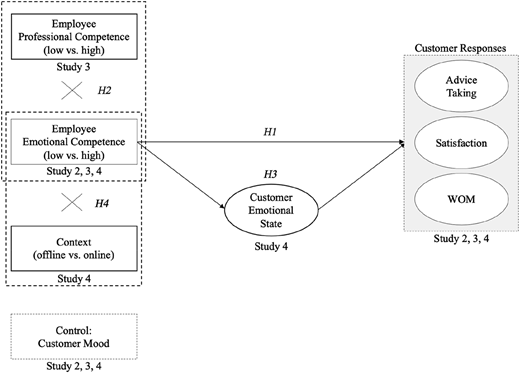
Employee high (vs. low) emotional competence leads to higher (vs. lower) a) advice taking, b) satisfaction, and c) WOM in online PAS.
From the offline world we know that emotional competence in PAS reinforces the impact of professional competence on customer satisfaction (Delcourt et al., 2017; Supramaniam et al., 2024). In addition, employees with higher emotional competence tend to be more successful as they can build a favorable affective atmosphere, which enables seamless interactions with the customer, making a positive influence on customer responses more likely (Delcourt et al., 2013). When assessing service encounters in online PAS, research provides mixed insights. On the one hand, customers rely primarily on professional competence due to the lack of face-to-face interaction (Cartwright and Pappas, 2008). Moreover, customers are often well-informed and possess substantial product knowledge (Klaiber et al., 2015), thereby increasing expectations regarding employees' professional competence. On the other hand, the rising use of the internet and digital services and, with it, the grown use of impersonal settings with perceived distance (Fuentes et al., 2017; Röding et al., 2024), make personal relationships increasingly important for customers (McKinsey and Company, 2025; Sebald and Jacob, 2018; Xie et al., 2025) and consequently service success (Delcourt et al., 2013). Nowadays, employees are expected to permanently interact with customers while competently using modern technologies during the PAS (Röding et al., 2024). However, customers also expect individualized attention in digital service interactions, seeking a personalized, exceptional fashion shopping experience within a trustworthy atmosphere (Ben Saad and Choura, 2023). Following this notion, it can be assumed that the influence of professional competence on customer responses is attenuated when an employee is emotionally competent as service encounters become increasingly impersonal while the desire for personal connection remains (McKinsey and Company, 2025; Xie et al., 2025; see also findings of Study 1a). Therefore, we hypothesize:
An interaction exists between employee emotional and professional competence, such that for high employee emotional competence, the effect of employee professional competence on a) advice taking, b) satisfaction, and c) WOM is weaker compared to low employee emotional competence in online PAS.
Affect-as-information theory indicates that the affective state shapes attitudinal and behavioral responses (Forgas, 1995). Applied to PAS, existing literature shows that employee emotional competence can evoke positive emotions in customers in both offline (Hofmann et al., 2021; Meyer et al., 2017) and online settings (Ruan and Mezei, 2022), thereby fostering favorable customer responses. Thus, emotional competence not only influences customer responses directly but also shapes their emotional state (Lee et al., 2011). Research evidence further shows that emotionally competent employees can actively regulate customer emotions (Delcourt et al., 2016). While customers experience positive emotions, such as pleasantness and happiness when the employee is emotionally competent, negative emotions are experienced with emotionally incompetent employees (Meyer et al., 2017). In addition, customer emotional state cannot solely be viewed as a reaction to employee competencies, but also as a driver of advice taking, satisfaction with the employee, and WOM because customer emotions determine attitudinal and behavioral responses (Lin et al., 2008). Consequently, employee emotional competence is not only important for the success of PAS but also influences customer emotional state which further drives customer responses (Delcourt et al., 2017; Marinova et al., 2018). We hypothesize:
The effect of employee emotional competence on a) advice taking, b) satisfaction, and c) WOM is mediated by customer emotional state.
Digital retail solutions are becoming increasingly important requiring retailers to expand their online sales activities (Klaiber et al., 2015; Landmark and Sjøbakk, 2017). This shift also transforms how customers are addressed and engaged (Fuentes et al., 2017; Röding et al., 2024), and consequently alters the competencies expected of employees (Fuentes et al., 2017; Yao et al., 2025), such as emotional competence. Research indicates that affective information is harder to perceive without face-to-face contact (Cartwright and Pappas, 2008). Technology-mediated communication in online PAS offers a limited degree of customer contact compared to the direct contact in physical stores (Froehle and Roth, 2004) by restricting sensory stimulation (e.g. audition, touch) and human connection between employees and customers (Beltagui et al., 2016). Consequently, the direct impact of employee emotional competence on customer responses may be diminished in the online context. In line with this, literature also shows that customers place less emphasis on emotional qualities in digital settings compared to physical stores (Bolton et al., 2022). Employee emotional competence is based on proximity and is associated with low affective distance (Septianto and Pratiwi, 2016). Online services are more spatially distant than physical stores (Bolton et al., 2022); thus, the effect of employee emotional competence on customer emotional state may be reduced. Based on this reasoning, we propose that employee emotional competence has a weaker effect on customer emotional state in an online compared to an offline context and hypothesize:
The effects hypothesized in H3 are moderated by context, such that the effect of employee emotional competence on customer emotional state is weaker in online (vs. offline) PAS.
Figure 1 summarizes the research model.
Study 2
Method
To test the relationship established in H1, an experimental study using a one-factorial between-subjects design was conducted. Employee professional competence (PC) was kept constant, while employee emotional competence (EC) was manipulated (low vs. high). Participants were given a short scenario asking them to imagine being a customer at a fictional online fashion retailer (DressMe) offering shopping advice and were randomly assigned to one of the two conditions (see Appendix). In the high EC condition, the employee is described as being able to control their emotions, willing to share them with customers, and able to understand customers' feelings. In contrast, these abilities are described as rather poor in the low EC condition (based on Schutte et al., 1998). The subsequent online questionnaire followed common ethical guidelines and measured participants' intention to take advice, satisfaction, WOM, and customer mood. The sample consists of 126 (29.40% male, 70.60% female) participants (Mage = 27.84, SD = 10.26).
Measures
All construct items, derived from the literature, were measured using seven-point Likert scales ranging from “strongly disagree” (1) to “strongly agree” (7). The manipulation of employee emotional competence was tested with five adapted items from Schutte et al. (1998; e.g. “My fashion advisor can tell how I am feeling by listening to the tone of my voice.”). Advice taking was measured with three items from White (2005) and See et al. (2011; e.g. “I will factor in the opinion of the fashion advisor into my decision-making process.”). Satisfaction with the employee was assessed with three items from Hennig-Thurau et al. (2002; e.g. “My choice to use the service of the fashion advisor was a wise one.”) and three items were chosen to measure WOM (Zeithaml et al., 1996; e.g. “I will recommend DressMe to someone who seeks my advice.”). Customer mood (control variable) was measured with one item from Peterson and Sauber (1983; e.g. “Currently I am in a good mood.”).
Results
All constructs show satisfactory reliability and validity. Manipulation checks are successful as the mean value of employee emotional competence was higher in the high condition and lower in the low condition (MEC_low = 2.59; SD = 1.14 vs. MEC_high = 4.81; SD = 0.93; p < 0.01). To test H1, several ANCOVAs with employee emotional competence as independent variable and customer mood as a covariate were run. The findings reveal a significant difference between low and high emotional competence for customer advice taking (F(1, 123) = 20.84, p < 0.01, η2 = 0.15), satisfaction (F(1,123) = 35.35, p < 0.01, η2 = 0.22), and WOM (F(1,123) = 43.32, p < 0.01, η2 = 0.26). Mood did not have a significant influence. Customer advice taking is higher when employee emotional competence is high (MEC_low = 4.50, SD = 1.17 vs. MEC_high = 5.38, SD = 1.00). The same applies to satisfaction (MEC_low = 4.11, SD = 1.27 vs. MEC_high = 5.37, SD = 1.06) and WOM (MEC_low = 3.88, SD = 1.48 vs. MEC_high = 5.41, SD = 1.10). Thus, H1 is confirmed.
Study 3
Method
To test H2, an experimental study using a 2 (employee emotional competence: low vs. high) x 2 (employee professional competence: low vs. high) between-subjects factorial design was conducted. Participants were provided with a scenario and questionnaire similar to Study 2 and were randomly assigned to one of the four conditions. As in Study 2, the employee was first characterized by either low or high emotional competence. In this study, the manipulation of professional competence was added and described as being either low or high. This second dimension refers to the employee's task-related competencies, expertise, and skills (White, 2005). Referring to our scenario, this means that the employee is either highly knowledgeable when it comes to the assortment, sizes, and fashion in general or rather uninformed. The final sample consists of 187 (42.20% female, 57.30% male, 0.50% diverse) participants (Mage = 39.96, SD = 12.38).
Measures
The manipulation of employee emotional competence was adapted and tested with four items. One item was from Schutte et al. (1998) and three items were from Wong and Law (2002; e.g. “The fashion advisor has good understanding of people around him.”). Likewise, four items were used to test the manipulation of employee professional competence; three items were from Germain and Tejeda (2012; e.g. “The fashion advisor shows that he has the education necessary to be an expert in his field.”) and one from Wang et al. (2010). The dependent variables were measured in the same way as in Study 2. For the control variable, a second item was added in Study 3 to enhance measurement reliability.
Results
Construct measures show satisfactory reliability and validity, and manipulation checks are successful. Participants who were assigned to the high emotional competence group (n = 91) rate employee emotional competence as high (MEC_high = 5.92, SD = 1.07), whereas the other group (n = 96) rates emotional competence as low (MEC_low = 2.41, SD = 1.12, t(185) = −21.82, p < 0.001). Further, there is a significant difference between the high (n = 92) and the low (n = 95) professional competence group. Those in the high condition perceive employee professional competence as high (MPC_high = 6.19, SD = 0.74), whereas the other group perceives it as low (MPC_low = 3.17, SD = 1.20, t(185) = −20.61, p < 0.001). To test H2, Process Model 1 (Hayes, 2018; bootstrap = 5,000) was run. The results confirm the hypothesized relationship in H2a and H2b and show that when employee emotional competence is high, the effects of employee professional competence on advice taking (B = −0.77, p < 0.05, CI95[−1.37 …. −0.18], R2 = 0.46) and satisfaction (B = −0.56, p < 0.10, CI95[−1.15 …. 0.03], R2 = 0.58) are weaker compared to when employee emotional competence is low, while no significant effect was found for WOM. Thus, H2 is confirmed for H2a and H2b, but not for H2c.
Study 4
Method
To further expand the research model by comparing the online with the offline context and, finally, to test the relationships proposed in H3 and H4, another experimental study was conducted using a 2 (employee emotional competence: low vs. high) x 2 (context: offline vs. online) between-subjects design. Half of the participants were randomly assigned to the online condition with the fashion retailer “DressMe” and were asked to imagine that their personal advisor is contacting them by video call, while the other half was asked to imagine visiting the physical “DressMe” store and being approached by an advisor. Then, participants were provided with a short dialog between a customer and the employee, including the manipulation of emotional competence, which was either low or high; professional competence was kept constant (high) as in Study 2 (see Appendix). The sample consists of 115 (79.10% female, 20.00% male, 0.90% diverse) participants (Mage = 23.92, SD = 5.01).
Measures
The manipulation of employee emotional competence was tested with four items from Delcourt et al. (2016; e.g. “The fashion advisor was altogether capable of perceiving how I was feeling at the beginning of the conversation.”) and the correct perception of the context was checked with two items (e.g. “I should imagine taking advantage of the following fashion advice: online … offline in a store”). The dependent measures and the assessment of customer mood remained mostly unchanged, except that one additional item was added to the advice taking measure. Customer emotional state was introduced as an additional construct and assessed with three items (Howard and Gengler, 2001; e.g. “After the fashion consultation, I feel happy.”).
Results
The results show satisfactory reliability and validity (Table 4) and the manipulation checks are successful. Means, standard deviations and correlations of all three studies are shown in Table 5.
Participants correctly perceived the context, which was measured on a semantic differential from 1 (=online) to 7 (=offline): Moffline = 5.59, SD = 1.89 vs. Monline = 2.37, SD = 2.15 with t(113) = 8.45, p < 0.001). In addition, the high emotional competence group rates employee emotional competence as high (MEC_high = 5.01, SD = 1.18), whereas the other group rates it as low (MEC_low = 3.44, SD = 1.30, t(113) = −6.80, p < 0.001). To test H3, Process Model 7 (Hayes, 2018; bootstrap = 5,000) was run. In this model, the independent variable was participants' perception of employee emotional competence (low vs. high). The dependent variables were advice taking, satisfaction, and WOM. Customer emotional state served as the mediator, while the context (offline vs. online) functioned as a moderator on the path between emotional competence and customer emotional state. Customer mood was included as a covariate. The results show that employee emotional competence has a positive impact on customer emotional state (B = 0.98, p < 0.05, CI95[0.16 …. 1.80], R2 = 0.10), which further drives customer advice taking (B = 0.63, p < 0.01, CI95[0.49 …. 0.78], R2 = 0.40), satisfaction (B = 0.81, p < 0.01, CI95[0.68 …. 0.94], R2 = 0.59), and WOM (B = 0.78, p < 0.01, CI95[0.64 …. 0.92], R2 = 0.54). Also, a positive effect of mood on customer emotional state (B = 0.29, p < 0.01, CI95[0.09 …. 0.49], R2 = 0.10) can be found. Since there is no significant direct effect of employee emotional competence on the dependent variables (p > 0.10), customer emotional state fully mediates the proposed effects. H3 can be confirmed. H4 posits that the effect hypothesized in H3 is moderated by context, such that the effect of employee emotional competence on customer emotional state is weaker in the online (vs. offline) context. This moderation effect is marginally significant (B = −0.96, p < 0.10, CI95[−2.07 …. 0.16], R2 = 0.10). A conditional effects analysis reveals that the effect of emotional competence on customer emotional state is significant in the offline condition (B = 0.98, p < 0.05, CI95[0.16 …. 1.80], R2 = 0.10), but not in the online condition (B = 0.02, p = n.s., CI95[−0.72 …. 0.77], R2 = 0.10). This pattern provides partial support for H4, indicating that the impact of employee emotional competence is attenuated in online customer interactions.
Discussion
Summary
This research addresses the evolving role of employee competencies in personal advice service (PAS) within increasingly digitalized fashion retail environments. First, it explores how consumers' shopping behavior and expectations regarding employee competencies have shifted with growing digitalization. Findings from Study 1a demonstrate that, despite the expansion of online shopping and digitally mediated service encounters, the value of personal interactions remains high with consumers. Study 1b supports these findings by showing that fashion retailers also acknowledge the importance and growing potential of online advice. At the same time, digitalization appears to alter how these competencies are enacted and evaluated within service encounters. Employees must deliver added value by showcasing exceptional, task-specific expertise to win over customers. At the same time, it is crucial to grasp customers' emotions and respond appropriately. These insights align with research on the importance of employee professional and emotional competence for service encounters (e.g. Delcourt et al., 2017; White, 2005). This result extends existing literature by suggesting that emotional and professional competencies do not merely operate as complementary resources; rather, their relative importance appears to be contingent upon the service context.
Second, the experimental studies reveal that employee emotional competence exerts a substantial influence on central customer responses, including advice taking, satisfaction, and word-of-mouth intentions (WOM). More importantly, the findings demonstrate that emotional competence attenuates the influence of professional competence in online PAS settings. This finding adds a more nuanced perspective to existing literature by suggesting that professional competence remains a central requirement for credible and useful advice (White, 2005), while emotional competence appears to partially compensate for lower professional competence in digital advisory settings. Thus, the relationship between emotional and professional competence is not merely complementary, but context dependent. In online PAS, where personal cues are reduced and service encounters may feel more distant, emotional competence can become a particularly salient resource eliciting favorable customer responses.
Furthermore, the findings identify customer emotional state as an important underlying mechanism explaining how employee emotional competence shapes customer responses. Consistent with affect-as-information theory, which states that customer emotions are an important mechanism through which employee competence affects customer responses, emotionally competent employees elicit more positive customer emotions, which subsequently enhance advice acceptance, satisfaction, and WOM intentions (Forgas, 1995; Lee et al., 2011). However, the mediation effect is stronger in offline settings, suggesting that the emotional transmission and interpretation of affective cues is constrained in online PAS. This indicates an important boundary condition: although emotional competence matters online, its ability to shape customers' emotional state is reduced when interpersonal cues are limited. Taken together, the findings highlight that employee competencies in PAS should be understood as context-sensitive resources whose effectiveness depends on the characteristics of the service environment.
Theoretical contributions
This research offers several theoretical contributions to the literature on service interactions, employee competencies, and digitally mediated retail environments: first, the study contributes to emerging research on the role of retail digitalization for consumer shopping behavior (Guercini et al., 2026) by examining employee competencies across offline and online PAS contexts from both the consumer and retailer perspective.
Second, the findings contribute to existing literature on employee competencies by examining professional and emotional competencies across contexts. In doing so, the study extends research on service interactions and employee competencies (Delcourt et al., 2016; White, 2005) by demonstrating that emotional competence is not only relevant in offline contexts (Delcourt et al., 2013) but also plays a critical role in online PAS. Importantly, the findings go beyond confirming its relevance by showing that emotional competence attenuates the effect of professional competence in online settings, suggesting a substitution-like mechanism. This refines prior assumptions of a purely complementary relationship between both competencies and highlights that their interplay is contingent on the service context. The distinction between professional and emotional competencies is in line with the in-role and extra-role behavior framework (Katz, 1964), where professional competence represents in-role behavior and emotional competence reflects extra-role behavior. The present findings refine this perspective by indicating that the relative importance of these behaviors shifts depending on whether the interaction takes place offline or online. This suggests a context-contingent and partially substitutive relationship between both competencies, thereby challenging assumptions of a uniformly complementary interaction.
Third, this study contributes to the job characteristics theory (JCT; Hackman and Oldham, 1976) by extending the notion of skill variety into digitally mediated service environments. Possessing both professional and emotional competencies reflects a broader repertoire of employee skills, which may enhance motivation, service performance, and ultimately customer evaluations of the service encounter. However, the findings suggest that the effectiveness of this skill variety depends on contextual characteristics of the service environment. In online PAS, where interpersonal cues are limited, emotional competence assumes greater relevance in shaping customer responses. This adds a more context-sensitive perspective to JCT by indicating that the value of specific skill combinations depends on the structural characteristics of the service environment.
Fourth, the study contributes to the advice taking literature (e.g. Gino and Schweitzer, 2008; See et al., 2011) by identifying that emotionally competent employees can increase customers' tendency to take advice. While prior research has primarily focused on informational and expertise-based drivers of advice acceptance, the present findings highlight the importance of emotional and relational factors, particularly in digitally mediated contexts where trust and interpersonal connection may be more difficult to establish.
Fifth, this work contributes to the affect-as-information theory (Forgas, 1995) by empirically demonstrating customer emotional state as a mediating mechanism linking employee emotional competence to customer responses in PAS, which in turn drives positive customer responses such as advice taking, satisfaction, and WOM (Hennig-Thurau et al., 2006; Lee et al., 2011). At the same time, the findings reveal an important boundary condition: the emotional mechanism underlying customer responses is attenuated in online service contexts. This suggests that technology-mediated interactions constrain emotional processing by limiting the availability of interpersonal and affective cues. Consequently, the study advances a more nuanced understanding of emotional mechanisms in contemporary service encounters.
Finally, by linking these theoretical insights to the design of personal advice services, this research contributes to bridging the gap between theory and practice. It highlights how context-dependent competency effects can inform the design and management of PAS in omnichannel retail environments, where both professional expertise and emotional engagement must be strategically aligned with the service context.
Managerial implications
The findings of this research provide several important implications for fashion retailers operating in increasingly digital and omnichannel service environments. Although advice-seeking and advice-giving behaviors have evolved with retail digitalization, customers continue to value interpersonal interaction. Thus, they expect service experiences delivered by professionally and emotionally competent employees across both offline and online channels. Subsequently, fashion retailers operating in omnichannel environments should avoid one-size-fits-all approaches and instead train employees to adapt their competencies to the specific service setting.
The findings indicate that professional competence constitutes a fundamental prerequisite for effective PAS across channels, as customers continue to expect accurate product knowledge and reliable recommendations (Delcourt et al., 2017; Marinova et al., 2018). However, the findings also demonstrate that emotional competence emerges as a critical driver of customer responses, particularly within digitally mediated service encounters. In offline PAS, emotional competence significantly shapes customers' emotional state, which in turn drives important customer responses (Hennig-Thurau et al., 2006; Lin et al., 2008). In online PAS, emotional competence remains highly relevant but operates differently: its indirect effect via customer emotional state is attenuated, while simultaneously reducing the relative importance of professional competence. This suggests that emotional competence can partially compensate for lower professional competence in digital advisory interactions. Managers should therefore treat emotional competence as a strategically relevant capability, particularly in online PAS, where it can buffer against limitations in employees' expertise.
These findings have direct implications for recruitment, employee development, and service training. Beyond task-specific expertise (Delcourt et al., 2017; Marinova et al., 2018), retailers should place greater emphasis on identifying and developing employees' emotional competence (Delcourt et al., 2013, 2017; Wong and Law, 2002). Recruitment processes may benefit from incorporating assessments of emotional skills and responsiveness alongside traditional competency evaluations. Likewise, training programs should include structured interventions such as role plays, coaching, and customer interaction simulations designed to strengthen employees' ability to recognize, interpret, and appropriately respond to customer emotions (Lastner et al., 2024). As customers' emotional state is a key driver of customer responses (Hennig-Thurau et al., 2006; Lin et al., 2008), employees must understand how their interpersonal behavior influences customers' affective reactions and subsequent service evaluations.
The findings additionally highlight the importance of designing digital service environments that support socio-emotional interaction. Since recognizing and conveying emotions is more difficult online, retailers should implement tools that enhance socio-emotional presence without replacing human interaction. For example, video consultations, personalized communication (e.g. addressing customers by name), and advisor-customer matching may help reduce perceived distance and foster relational trust. In addition, digital interfaces such as advisor-linked avatars or personalized video interfaces may strengthen perceived social presence and facilitate emotional communication (Hu et al., 2026). Finally, designing online shopping as a more social experience – through features such as virtual shopping rooms or community-based interactions – may help replicate the relational benefits traditionally associated with offline retail environments and strengthen long-term customer engagement across channels.
Limitations and further research
While the present research advances understanding of employee competencies within offline and online personal advice services (PAS) in fashion retail, several limitations provide opportunities for future research. First, the empirical studies primarily rely on experimental designs and scenario-based evaluations. It would be therefore beneficial to collaborate with fashion retailers to examine employee competencies and collect corresponding customer data within real-world retail environments. Such an approach would strengthen the external validity of the findings and may reveal more complex interaction patterns between emotional and professional competence than can be fully captured in controlled experimental settings. Following this idea, dyadic data sets of advisors and customers could be obtained to observe reciprocal perceptions and interactions more accurately.
Second, additional contextual and individual-level boundary conditions warrant further investigation. The present findings suggest that the effectiveness of employee competencies depends on characteristics of the service environment; however, other relevant moderators remain underexplored. Future research could therefore investigate whether and how factors such as consumer-brand trust, technology affinity of both consumers and employees, and cultural norms moderate the influence of emotional and professional competence in hybrid service settings. In this context, digital competence, defined as the “ability to facilitate online-offline integration” (Yao et al., 2025, p. 3), could be considered alongside emotional and professional competence, particularly in online or hybrid service interactions (Yao et al., 2025; Liu and Liu, 2025; Sun et al., 2026). Incorporating this additional competence may help clarify how frontline employees effectively transfer emotional understanding across channels. Furthermore, insights from technology acceptance research (Shin and Yang, 2025) may help explain how customers evaluate digitally mediated advisory interactions and how technological interfaces shape perceptions of employee competence.
Third, the present research relies on cross-sectional designs. Longitudinal studies could provide additional insights into how perceptions of employee competence and customer responses evolve over time, particularly with repeated interactions or relationship-building efforts in digital contexts. Similarly, the long-term effectiveness of the aforementioned training interventions could be assessed to examine how competence development influences customer outcomes in the long term.6
Authors’ contributions
All authors contributed equally to this manuscript.
We thank Heike Hebborn for her support during the data collection and for her valuable feedback on previous versions of this manuscript.
Appendix
Exemplary dialog: (online context – high emotional competence)
Advisor: Hello, Lea Mueller from DressMe here. I'm calling regarding our consultation appointment to put together your outfits. I would like to go through everything with you again and see if you have any remaining questions.
Customer: Yes, hello. Thank you for your call. Certainly!
Advisor: I have the feeling that you are looking forward to the new experience.
Customer: Yes, traditional online fashion shopping somehow isn't right for me.
Advisor: I completely understand why you don't enjoy traditional online shopping and I know exactly how to get you excited about this new form of consultation.
Customer: I'm curious.
Advisor: Let's get started then. I've gone through your information. You mentioned slim fit jeans. What about the wash first?
Customer: In general, I'm looking for a lighter wash.
Advisor: Okay. I know we offer this model in five different colors. Let me pick something for you.
Customer: Yes, please. Do you think the fit will suit me?
Advisor: I just reviewed your personal details. From experience, I can tell you that the fit of these pants will definitely flatter your figure.
Customer: I just have some concerns because I am very thin at the waist.
Advisor: If the pants really don't fit, we can easily adjust them with two small tucks at the waist.
Customer: Okay, good.
Advisor: Great, I've noted everything. I'll now put together your outfits and send them to you. Any questions from your side?
Customer: I'm excited and have no more questions.
Advisor: You'll only pay for the items you actually want to keep and return the rest. Then I wish you a wonderful day.
Customer: Thank you, I also wish you a good day.