


The cone penetration test (CPT) is widely used to determine the in situ state parameter of soils because it provides continuous data and excellent repeatability at a relatively low cost. Accurate interpretation of the state parameter from CPT is the basis for evaluating the strength of granular soils, including assessing liquefaction susceptibility in important structures such as tailings storage facilities. A few interpretation methods are used in practice. They use two different overburden stress normalisation schemes on tip resistance. These methods vary in how much information they utilise to differentiate among soils. This paper evaluates these methods by applying them to an extensive database of calibration chamber tests. Then, the state parameter interpreted by each method is compared with that determined from laboratory data. The database includes manufactured sands, natural sands, and clean sand tailings. The soils were selected such that both calibration chamber testing and triaxial compression data were available from the literature. This evaluation serves as a minimum requirement for applying these methods in engineering projects, especially those dealing with challenging soils such as fines-rich tailings. This study suggests that methods that account for soil properties and in situ horizontal stresses perform better than those that do not.
Notation
normalised excess pore water pressure
- CPT
cone penetration test
- CPTu
cone penetration test with pore pressure measurement
relative density
void ratio
maximum void ratio
minimum void ratio
normalised friction ratio
sleeve friction
elastic shear modulus
NorSand’s plastic hardening modulus
soil behaviour type
elastic shear rigidity
coefficient of earth pressure at rest
soil-specific constants
soil-specific constants, similar to
soil-specific constants in cavity expansion
friction ratio at the critical state
volumetric coupling coefficient
in situ total mean stress
in situ effective mean stress
normalised tip resistance based on mean total and effective stress
normalised tip resistance in cavity expansion
normalised tip resistance based on and
equivalent clean sand normalised cone tip resistance
normalised tip resistance based on and a stress exponent
tip resistance
corrected tip resistance to compensate for an unequal end-area effect
pore water pressure
in situ pore pressure
shear wave velocity
Poisson’s ratio
the slope of CSL in space
the slope of CSL in space
in situ effective horizontal stress
in situ total vertical stress
in situ effective vertical stress
state parameter
in situ state parameter
state parameter measured in calibration chamber tests
estimated state parameter from interpretation methods
constant volume (critical state) friction angle
- Γ
intercept of CSL in space measured at = 1 kPa
Introduction
Soil liquefaction is a loss of stiffness and shear strength due to the generation of excess pore water pressure caused by monotonic or seismic loading. It is a concern for structures constructed on saturated granular soils (e.g., sand, silt, gravel, and their combinations) and a design problem for large manufactured geotechnical structures such as tailings storage facilities and earth dams. Liquefaction can result in a sudden failure with minimal advanced indicators. The key to assessing liquefaction potential is determining the in situ density (i.e., void ratio, relative density, or the state parameter) explicitly (Been et al., 1986; 1987a) or implicitly (Idriss and Boulanger, 2008).
The relative density has been the de facto density index, but it can be problematic due to practical limitations in determining it in the laboratory (ASTM D4253-16 and ASTM D4254) and its high sensitivity to gradation and variations in the field (Tavenas, 1973). Density alone cannot capture soil response adequately without accounting for confining stress. An alternative index that captures the effects of the density and confining stress is the state parameter proposed by Been and Jefferies (1985). The state parameter is the difference between the void ratio at a given mean effective stress and the critical state void ratio at the same mean effective stress. Soils with the same display similar behaviour and tend to have the same static and cyclic liquefaction potential, among other attributes (Manmatharajan et al., 2023a). The state parameter represents the in situ state of soil: a positive value indicates contractive and strain-softening behaviour in undrained shear, whereas a negative indicates dilative and strain-hardening response. There is a consensus that if the soil is looser than −0.05, then static liquefaction will likely happen under the right loading circumstances (Jefferies and Been, 2015).
Cohesionless soil samples can be easily disturbed during sampling, and obtaining reasonably undisturbed samples is prohibitively expensive. In situ penetration tests have thus become the default approach for characterising cohesionless soils. The cone penetration test with pore pressure measurement (CPTu) is widely used for determining the in situ state parameter and assessing liquefaction potential because it provides continuous data measurement and excellent repeatability at a relatively low cost.
There are several methods of interpreting the state parameter from the CPTu, including those proposed by Fear and Robertson (1995), Konrad (1997), Russell and Khalili (2002), and Shuttle and Jefferies (2016). More commonly used methods are those proposed by Plewes et al. (1992), Shuttle and Jefferies (1998), and its generalised version Ghafghazi and Shuttle (2008). These are progressions of the Been et al. (1986) approach, which accounted for the mechanical properties of soils in determining the state parameter. They all require some accompanying triaxial compression test data, even though they also offer in situ approximations. The cavity expansion methods, Shuttle and Jefferies (1998) and Ghafghazi and Shuttle (2008), require some numerical modelling, while Shuttle and Jefferies (1998) also offered a set of simplified equations to circumvent the modelling. Another popular empirical method proposed by Robertson (2010) is based on the engineering judgement of the author. It does not require any accompanying testing or information as it is entirely based on the CPT’s tip resistance and sleeve friction data. These methods require different levels of information on soil properties, analysis procedures, and theoretical bases. Therefore, unsurprisingly, experience shows that these methods produce different outcomes in practice (Schafer et al., 2019).
This paper evaluates the interpretation of the state parameter from CPT tip resistance through the methods proposed by Been et al. (1986), Plewes et al. (1992), Shuttle and Jefferies (1998), Ghafghazi and Shuttle (2008), and Robertson (2010) by examining them against a database of calibration chamber tests on clean sands. All these methods were developed based entirely or partially on the same database. Therefore, performing well against this database is a minimum requirement for their application in practice. The performance of these methods was evaluated by comparing the estimated from each method with the actual value of measured in calibration chamber tests. Their differences and limitations including how they normalise overburden stress are discussed. The preferred method is identified, and use of some methods is cautioned against, so engineers can avoid extensive errors in determining in situ state parameter and applying it in liquefaction susceptibility.
Background
The most basic CPTu probe provides three channels of data: tip resistance (), sleeve friction (), and pore water pressure (). The pore water pressure is most commonly measured immediately behind the cone in what is referred to as the position. The measured tip resistance () is corrected to to compensate for an unequal end-area effect (ASTM D5778-20).
Overburden correction
In comparing various methods of interpreting the state parameter, the effectiveness of overburden normalisation directly contributes to the quality of the interpretation. Following the ideas of Schmertmann (1976), Wroth (1984) and Houlsby (1988) proposed that the tip resistance can be normalised by total and effective vertical stresses ( and ) using Equation 1
Variations of Equation 1 that include a stress normalisation factor have been proposed by Olsen and Malone (1988), Robertson and Wride (1998), Zhang et al. (2002), Idriss and Boulanger (2004), Moss et al. (2006), Cetin and Isik (2007), Robertson (2009), and Sadrekarimi (2016).
Robertson and Wride (1998) defined by adding a stress exponent in a power function, expressed with Equation 2
where is the atmospheric pressure in the same unit as . The stress normalisation exponent (typically between 0.5 and 1.0) that likely captures the effect of increasing stiffness (among other factors) is a function of soil behaviour type (Been and Jefferies, 1992; Robertson and Wride, 1998) and vertical effective stress , and can be calculated from Equations 3 and 4, according to Robertson (2009).
Houlsby and Hitchman (1988) showed that the effective horizontal stress can normalise tip resistance of a clean sand much better than the vertical stress. does not account for in situ horizontal effective stress or the coefficient of earth pressure at rest . Been et al. (1986) considered the effects of both horizontal and vertical effective stresses on the cone resistance and proposed an improved form of Equation 1 based on mean effective stress with Equation 5.
where is the mean total stress and is the mean effective stress.
Wroth (1984) and Houlsby (1988) also proposed two other dimensionless cone parameters, which were widely adopted by others: the normalised friction ratio and the normalised excess pore pressure , expressed in Equations 6 and 7, respectively:
where is in situ pore pressure. defined by Equation 7 conceptually captures the influence of excess pore water pressure development due to CPT penetration in low permeability soils, which mostly reduces tip resistance. varies from 0 to 1 for fully drained penetration in sands to fully undrained penetration in fines-rich soils. Negative values of may be observed and are often taken as a sign of the dilative behaviour of soil.
State parameter interpretation from CPT
Like the state parameter itself, interpretation of the state parameter has classically been a sand problem, and CPT tip resistance during drained penetration has been one of the most significant input parameters. However, fines (particles smaller than #200 sieve) are common in deposits, and from a practical perspective, liquefaction of fines-rich tailings is a significant area of interest for state parameter interpretation. Hence undrained and partially drained penetration need to be considered in the interpretation process. Consistent with its ‘bare minimum’ evaluation, the rest of this work only considers fully drained penetration ( = 0). This is the only possibility with the existing calibration chamber database, which lacks anything but drained penetration.
Been et al. (1986) and Plewes et al. (1992)
Been et al. (1986) studied the existing calibration chamber database and triaxial test results for fine to medium sands and found the correlation between the stress-normalised CPT tip resistance and state parameter in Equation 8.
where and are soil-specific constants that depend on soil compressibility represented by , the slope of the critical state line in the space. can be determined by conducting triaxial tests on reconstituted soil specimens.
The problem with this approach was that there are significant variations in particle size distribution in the field, which would translate into significant variations in Thus, various gradations of soil make the method difficult to use in practice, given the large number of triaxial tests needed to characterise adequately. Plewes et al. (1992) solved this problem by correlating to the normalised friction ratio through Equation 9
Reid (2015) reviewed this correlation, expanded the database, and demonstrated that it holds valid for many natural soils and tailings, albeit with significant scatter.
Been et al. (1988) noted that the soil-specific constant in Equation 8 is normalised tip resistance at the critical state ( = 0). Therefore, it is reasonable to expect that it would be a function of the friction ratio at the critical state as well, which can be determined from triaxial tests on reconstituted soil specimens. Unlike , is not sensitive to variations of particle size distribution in the field (Manmatharajan et al., 2023b). The relation between and was further improved by incorporating into the interpretation, using Equations 10, 11, and 12
where soil-specific constants and are similar to and in Equation 8. They are functions of the stress ratio at the critical state and the slope of the critical state line . Equations 10 to Equations 12 were initially developed by Been et al. (1988) and improved successively by Plewes et al. (1992) and Been and Jefferies (1992). The abbreviation ‘P’ will be used in the rest of this manuscript for Plewes et al. (1992).
Compared with Equation 8, the addition of the term in Equation 10 accounts for the effect of drainage conditions during cone penetration; thus, Equation 10 can be used for various soils, from sand to silt and even clay. The addition of the ‘+1’ term in Equation 10 was suggested by Houlsby (1988) to avoid a zero normalised tip resistance for fully undrained penetration in clays and is supported by the cavity expansion theory from Shuttle and Cunning (2007).
Cavity expansion (Ghafghazi and Shuttle, 2008; Shuttle and Jefferies, 1998)
Although the methods of Been et al. (1986) and Plewes et al. (1992) are simple, Sladen (1989) found that the Been et al. (1986) method, and by extension, Plewes et al. (1992), has a bias with stress level. Shuttle and Jefferies (1998) used cavity expansion analyses to explore this problem. They found that the bias is caused by missing the elastic shear rigidity () in the interpretation process, where is the elastic shear modulus and is the in situ or consolidation mean effective stress.
Shuttle and Jefferies (1998) used the critical state–based soil constitutive model ‘NorSand’ (Jefferies, 1993) to obtain a normalised tip resistance, which tracks the trend of but is about one order of magnitude smaller than obtained from chamber tests and in situ. Therefore, an empirical scaling function became necessary. The scaling function accounts for the different geometry between cavity expansion and the real CPT, as shown in Equation 13.
Shuttle and Jefferies (1998) found that Equation 8 may be used to recover state parameter in calibration chamber tests on Ticino sand, provided that the parameters and are functions of soil properties represented by calibration parameters of NorSand.
Ghafghazi and Shuttle (2008) applied the spherical cavity expansion of Shuttle and Jefferies (1998) to a database of calibration chamber tests (similar to the one presented later in this paper) using an updated version of NorSand (Ghafghazi, 2011). They proposed an analytical solution for calculating the state parameter from CPT tip resistance using spherical cavity expansion analyses.
Similar to Shuttle and Jefferies (1998), Ghafghazi and Shuttle (2008) require in situ measurement of elastic shear modulus through the shear wave velocity as well as triaxial laboratory testing on reconstituted samples to calibrate NorSand. It also correlates to through a scaling factor, as shown in Equation 14:
The abbreviation ‘CE’ will be used in the rest of this manuscript for cavity expansion solutions (Ghafghazi and Shuttle, 2008; Shuttle and Jefferies, 1998).
Simplified equations of Shuttle and Jefferies (1998)
The method outlined by Shuttle and Jefferies (1998) requires detailed cavity expansion analyses, so they also provided a set of simple equations by adding fitting trendlines through a parametric study on their cavity expansion analyses (Jefferies and Been, 2015). The approximate general equations are in closed form and readily computable.
Equations 15 and 16 capture the effects of soil properties and rigidity on and through the parameters of NorSand:
where fitted equations are simple to use in a spreadsheet, is a volumetric coupling coefficient, is NorSand’s plastic hardening modulus, is the slope of the critical state line in the space, and is Poisson’s ratio.
For each calibration chamber test, having determined from Equation 14, and from Equations 15 and 16, the state parameter can be inferred from Equation 17:
where and are introduced from cavity expansion analysis and equivalent to and in previous equations.
The abbreviation ‘EQ’ will be used in the rest of this manuscript for the simplified equations of Shuttle and Jefferies (1998).
Robertson (2010)
Robertson (2010) extended the chart proposed in Robertson (2009) to suggest a relation between and the equivalent clean sand normalised cone tip resistance , as shown in Equation 18. The correlation is valid in uncemented Holocene age soils and applicable for low-risk projects and initial screening for high-risk projects. Although no data were presented, the method is stated to be based on Jefferies and Been (2006), Shuttle and Cunning (2007), and Wride et al. (2000) from CANLEX site data. These references include calibration chamber data, drained and undrained spherical cavity expansion, and frozen ground sampling. This method relies on the CPT measurements of and , but requires no index or advanced laboratory testing or knowledge of geostatic ratio . The state parameter is obtained from clean sand corrected normalised tip resistance, which is based on the soil behaviour type parameter (Robertson, 2009).
where is equivalent to clean sand normalised cone tip resistance. For the clean sand database used here, is equal to .
Table 1 summarises the stress normalisation factor of each method, soil properties that each method accounts for, and critical inputs for data processing in the interpretation of the state parameter by various methods. The abbreviation ‘R’ will be used in the rest of this manuscript for Robertson (2010).
Summary of soils parameters accounted for and inputs of CPT interpretation
| Methods | Soil properties accounted for | CPT inputs | Independent measurements | Assumed or measured field variables |
|---|---|---|---|---|
| Been et al. (1986) | Triaxial and pressuremeter tests | |||
| Plewes et al. (1992) | Triaxial and pressuremeter tests | |||
| Cavity expansion (Ghafghazi and Shuttle, 2008 ; Shuttle and Jefferies, 1998) | Triaxial, pressuremeter tests and shear wave velocity measurement | |||
| Simplified equations of Shuttle and Jefferies (1998) | Triaxial tests, pressuremeter tests and shear wave velocity measurement | ,,, | ||
| Robertson (2010) | — | N/A | , |
Calibration chamber database
In the past 40 years, calibration chamber tests have played a key role in CPT interpretation, with two alternatives, undisturbed sampling in the field and numerical modelling as an auxiliary role.
Undisturbed sampling is technically tricky and cost-prohibitive, except for a few large projects. Moreover, spatial variability inevitably limits the comparability of CPT-interpreted state parameters to measured values. Numerical modelling has only had partial success due to the difficulties in theoretical and numerical modelling of CPT that are caused by the complexity of soil behaviour and large deformation during cone penetration. Successful numerical models need to be validated against measurements, and to date, this validation has included some forms of empirical ‘scaling’ as described earlier.
Calibration chambers are large circular steel tanks, typically between 0.8 and 1.5 m in diameter and height. Smaller calibration chambers that use miniature cones exist, but these have had limited success due to uncertainties around the influence of cone to particle diameter ratio and difficulties measuring sleeve friction and pore water pressure on miniature cones. Approximately 1.0 to 2.5 tonnes of sand is deposited at a controlled density and consolidated to desired stress levels in a full-size calibration chamber. Then, a CPT is pushed into the sample following similar configurations and settings used in the field. Calibration chamber studies cover a range of densities and confining stress levels. From these tests, it is possible to correlate tip resistance and density represented by void ratio , relative density, or the state parameter. In engineering practice, the in situ state of soil is then obtained by substituting the field CPT measurements at the estimated in situ stress in the correlation determined in the calibration chamber.
Ghafghazi and Shuttle (2008) summarised a database of nine sands for which triaxial compression tests were also available. It includes two natural sands (Da Nang sand and Erksak sand) and five research standard sands (Hokksund sand, Ottawa sand, two variations of Ticino sand, and Toyoura sand) as well as two mine tailings (Syncrude oil tailings and Hilton Mines). Table 2 summarises the index properties of these sands and their critical state parameters. The critical state parameters were obtained from drained or undrained triaxial compression tests on reconstituted samples, with test conditions summarised in Table 3.
Index properties of studied sands and tailings
| Properties | Sand (reference) | ||||||||
|---|---|---|---|---|---|---|---|---|---|
| Da Nang (Hsu, 1999) | Erksak (Been et al., 1987a) | Hilton Mines (Been et al., 1987b) | Hokksund (Been et al., 1987b) | Ottawa (Been et al., 1987b) | Syncrude oil tailings (Golder Associates, 1987a) | Ticino 4 (Been et al., 1987b) | Ticino 9 (Golder Associates, 1987b) | Toyoura 160 (Fioravante et al., 1991) | |
| Mineralogy | Quartz, minor amounts of chert | Quartz, minor amounts of chert | Quartz som feldspar, muscovite, mica, heavy minerals | Feldspar, quartz, some mica | Quartz | Quartz, a small amount of bitumen as discrete gravel-sized lumps | Quartz, a trace of mica | Assumed to be similar to that of Ticino 4 sand | Mainly quartz, 3% chert |
| Grain description | Sub-angular to angular | Sub-rounded | Angular | Sub-angular | Rounded | Angular to sub-angular, mostly cubical | Sub-rounded | Sub-rounded | Sub-angular |
| Percentage (%) passing #200 sieve | 0 | 3.0–6.0 | 2.5 | 0 | 0 | 3.5 | 0 | 0 | 0 |
| 0.073 | 0.044 | 0.170 | 0.054 | 0.028 | 0.065 | 0.056 | 0.05 | 0.044 | |
| Γ | 0.915 | 0.834 | 1.315 | 0.934 | 0.754 | 0.89 | 0.986 | 0.97 | 0.983 |
| 1.25 | 1.25 | 1.4 | 1 | 1.24 | 1.27 | 1.27 | 1.33 | 1.28 | |
| Critical friction angle, | 31.2 | 31.2 | 34.6 | 25.4 | 30.9 | 31.6 | 31.6 | 33.0 | 31.8 |
| Maximum voids ratio, | 0.808 | 0.963 | 1.05 | 0.91 | 0.79 | 0.898 | 0.89 | 0.9 | 0.977 |
| Minimum void ratio, | 0.515 | 0.525 | 0.62 | 0.55 | 0.49 | 0.544 | 0.6 | 0.6 | 0.605 |
Summary of drained triaxial compression tests used in the calibration of NorSand
| Sand | Reference | No. of tests | Sample prep. | Range of void ratio | Range of mean effective stress kPa |
|---|---|---|---|---|---|
| Da Nang | Hsu (1999) | 15 | Moist tamped | 0.56–0.66 | 50–400 |
| Erksak | Been et al. (1987a) | 4 | Moist tamped | 0.54–0.63 | 50–400 |
| Hilton Mines | Golder Associates (1985) | 6 | Moist tamped | 0.71–0.87 | 80–1000 |
| Hokksund | Jefferies and Been (2015) | 15 | unknown | 0.51–0.72 | 34–233 |
| Ottawa | Golder Associates (1985) | 6 | Moist tamped | 0.53–0.74 | 50–220 |
| Syncrude oil tailings | Golder Associates (1987a) | 5 | Moist tamped | 0.53–0.71 | 100–500 |
| Ticino 4 | Golder Associates (1986) | 5 | Moist tamped | 0.65–0.85 | 100–200 |
| Ticino 9 | Golder Associates (1987b) | 5 | Dry pluviated | 0.64–0.81 | 50–300 |
| Toyoura 160 | Golder Associates (1989) | 14 | Moist tamped | 0.61–0.84 | 33–1000 |
Most of these sands are quartz-based materials and have sub-rounded to rounded grain shapes, except for two tailings with heavy metal minerals and the more angular grain shapes. As shown in Figure 1, these are all medium to fine sands with minimal fines passing the #200 sieve. Calibration chamber tests have been conducted in different chambers with different boundary conditions and chamber-to-cone diameter ratios; hence, a correction must be applied to raw results to account for boundary effects. Ghafghazi and Shuttle (2008) used the correction factors recommended by Been et al. (1987b). Table 4 summarises the chambers’ description and test conditions, such as the range of lateral earth pressure ratio , consolidation vertical effective stress, mean effective stress , state parameter , and elastic shear rigidity . Table 5 summarises the calibrated NorSand parameters for the nine sands from Ghafghazi and Shuttle (2008).
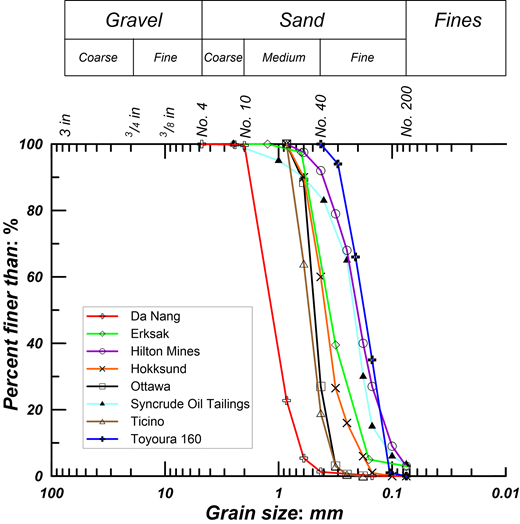
Particle size distribution curves of sands studied in calibration chamber tests
Particle size distribution curves of sands studied in calibration chamber tests
Summary of calibration chamber tests on normally consolidated sands
| Sand | Reference | No. of tests | BCa | Sat. | Chamber ratio, D/d | Sample prep. method | K0 | Vertical effective stress, : kPa | Mean effective stress, kPa | Void ratio, e | State parameter, ψ | Elastic rigidity, b |
|---|---|---|---|---|---|---|---|---|---|---|---|---|
| Da Nang | Hsu (1999) | 38 | BC5 | Dry | 22.1–44.2 | Dry pluv | 0.38–1.77 | 38–160 | 33–152 | 0.56–0.73 | −0.243, −0.022 | 483–832 |
| Erksak | Been et al. (1987a) | 14 | BC4 | Sat. | 38 | Moist tamped | 0.69–1.00 | 30–374 | 25–302 | 0.53–0.66 | −0.229, −0.069 | 373–1196 |
| Hilton Mines | Harman (1976) | 20 | BC1, BC3 | Dry, Sat. | 34.2 | Dry pluv. | 0.37–0.51 | 51–272 | 31–172 | 0.68–0.93 | −0.340, −0.035 | 581–2123 |
| Hokksund | Baldi et al. (1986); Been et al. (1987b), & Parkin et al. (1980) | 51 | BC1, BC3 | Dry | 33.6–48 | Dry pluv. | 0.31–0.51 | 57–402 | 33–252 | 0.55–0.85 | −0.296, 0.045 | 382–2763 |
| Ottawa | Harman (1976) | 30 | BC1,BC2 | Dry, Sat. | 34.2 | Dry pluv | 0.34–0.50 | 51–294 | 29–182 | 0.54–0.73 | −0.171, 0.026 | 667–1252 |
| Syncrude Oil Tailings | Golder Associates (1987a) | 8 | BC4 | Sat, Wet | 38 | Water pluv. & moist tamped | 0.50–0.51 | 50–600 | 33–400 | 0.56–0.70 | −0.227, −0.022 | 274–1204 |
| Ticino 4 | Baldi et al. (1986) | 68 | BC1,BC3 | Dry | 33.6 | Dry pluv. | 0.39–0.64 | 41–515 | 25–367 | 0.59–0.86 | −0.296, −0.001 | 429–2576 |
| Ticino 9 | Golder Associates (1987b) | 9 | BC4 | Dry | 38 | Dry pluv. | 0.50–1.00 | 45–450 | 30–317 | 0.63–0.88 | −0.243, 0.016 | 524–1933 |
| Toyoura 160 | Fioravante et al. (1991) | 41 | BC1, BC2, BC3 | Dry, Sat. | 22.1–120 | Dry pluv. | 0.36–0.49 | 51–295 | 31–177 | 0.64–0.85 | −0.268, −0.041 | 579–1729 |
Boundary conditions (1987 b): BC1, constant stress side-and base restraints; BC2, constant volume side-and base restraints; BC3, constant volume side-restraint and stress base restraint; BC4, constant stress side-restraint and constant volume base restraint; BC5, servo-controlled side-restraint and constant volume base restraint
Elastic shear rigidity
NorSand Parameters for nine calibration chamber sands (modified from Ghafghazi and Shuttle, 2008)
| Sand | CSL | Plasticity | Elasticitya | |||||
|---|---|---|---|---|---|---|---|---|
| Γ | λe | Mtc | N | Η | χtc | Ir | υ | |
| Da Nang | 0.915 | 0.0317 | 1.25 | 0.35 | 4.3 | (From fitting to triaxial data) | 0.2 | |
| Erksak | 0.834 | 0.019 | 1.25 | 0.32 | 3.8 | After Jefferies and Been (2015) = 0.355 is the void ratio at which volumetric compressibility becomes zero | 0.2 | |
| Hilton Mines Tailings | 1.315 | 0.0738 | 1.40 | 0.20 | 50 | 3.5 | Equal to Toyoura 160 | 0.2 |
| Hokksund | 0.934 | 0.0235 | 1.00 | 0.40 | 4.0 | After Lo Presti et al. (1992) | 0.2 | |
| Ottawa | 0.754 | 0.0122 | 1.24 | 0.45 | 4.0 | After Robertson et al. (1995) | 0.2 | |
| Syncrude oil tailings | 0.89 | 0.0283 | 1.27 | 0.28 | 5.8 | After Cunning et al. (1995) | 0.2 | |
| Ticino 4 | 0.986 | 0.0243 | 1.27 | 0.40 | 3.0 | After Shuttle and Jefferies (1998) | 0.2 | |
| Ticino 9 | 0.970 | 0.0217 | 1.33 | 0.40 | 60 | 3.8 | Equal to Ticino 4 | 0.2 |
| Toyoura 160 | 0.983 | 0.019 | 1.28 | 0.41 | 100 | 4.4 | After Chaudhary et al. (2004) | 0.2 |
pref is equal to 100 kPa or equivalent
Results
The calculation of from tip resistance by Been et al. (1986) and Plewes et al. (1992) is similar, except that Plewes et al. (1992) additionally consider the effect of on . Therefore, only the Plewes et al. (1992) results are continually presented in the paper and compared with other methods for simplicity and to avoid redundancy. For Plewes et al. (1992), given that the critical state parameters and for selected sands in the calibration chamber database are available from triaxial tests, the soil-specific constants, and , can be determined from Equations 11 and 12. The studied sands in the database are medium to fine sands, mainly tested dry, and have virtually zero fines contents, resulting in a fully drained penetration with = 0. Therefore, the estimated value of can be calculated from Equation 10.
The calculation of by Shuttle and Jefferies (1998) and Ghafghazi and Shuttle (2008) involves cavity expansion analyses. For the equations provided by Shuttle and Jefferies (1998), the list of soil-specific constants are obtained from substituting the NorSand parameters calibrated from triaxial tests into the approximated fitting equations. Once the are determined, and is calculated from by using the scaling factor as shown in Equation 13, the estimated value of can be calculated from Equation 17. A similar calculation process applies to Ghafghazi and Shuttle (2008), but with the scaling factor between and from Equation 14.
The calculation of by Robertson (2010) is different from the other methods because is only normalised by the vertical effective stress and expressed as , instead of being normalised by the mean effective stress into . Since the sleeve friction data () were not available in the database of the calibration chamber tests, the soil behaviour type parameter had to be assumed before using Equation 18 to estimate . = 1.57 was assumed as a reasonable value for clean sands calculated by assuming = 0.5 at = 100 kPa from Equation 3. Then, the stress exponent and the normalised tip resistance were updated based on Equations 2 and 3 with = 1.57 and . Finally, the estimated value of was calculated from Equation 18.
In comparing various methods of interpreting the state parameter, the effectiveness of overburden stress normalisation directly contributes to the quality of the interpretation. Plewes et al. (1992), Shuttle and Jefferies (1998), and Ghafghazi and Shuttle (2008) all adopt for stress normalisation, while Robertson (2010) uses . Figure 2(a) shows an example of comparing Qtn – ψ and Qp – ψ correlations for Da Nang sand in a semi-logarithmic space. The value of each calibration chamber test is shown near its data point. does a better job of normalising data with less scatter (R2 = 0.91), compared with (R2 = 0.67). An obvious bias in the Qtn – ψ is the influence of , given that does not account for horizontal stresses.
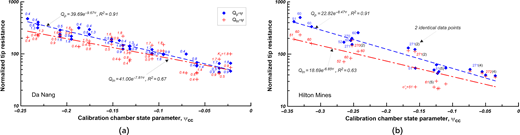
and plotted against for (a) Da Nang sand with k0 values identified; (b) Hilton Mines tailings with vertical effective stresses identified
and plotted against for (a) Da Nang sand with k0 values identified; (b) Hilton Mines tailings with vertical effective stresses identified
Figure 2(a) suggests that values associated with higher values (1.6 to 1.8) are roughly double those associated with lower values (0.4 to 0.5). Figure 2(b) shows another example of Hilton Mines tailings that have been recognised as a compressible material and were tested at a narrower range of values (0.4 to 0.5). In this case, also produces much less scatter (R2 = 0.91) than (R2 = 0.63). In Figure 2(b), the value of each calibration chamber test is shown near its data point, and sometimes one number represents multiple data points (in brackets). The values corresponding to the test at higher value fall higher than those at lower values. For instance, the tests consolidated to ∼270 kPa vertical stress produced values that were roughly double those of tests performed at 50 to 60 kPa.
Table 6 summarises the coefficients of determination (R2) of the semi-logarithmic trendlines for Qtn – ψ and Qp – ψ relations and the range of other soil properties for all studied sands. Clearly, does a better job for stress normalisation than by comparing the R2 values, representing the level of scatter. It appears that performs more poorly for materials that have been tested at a broader range of values, such as Da Nang and Erksak sands, confirming that ignoring horizontal stress’s influence is detrimental to the overburden normalisation. Also, performs poorly in materials with a higher value of (higher compressibility), such as Hilton Mines and Syncrude oil tailings. For the materials tested at a narrow range of values, such as Ottawa and Ticino 9, does a slightly better job for stress normalisation than does, while performs slightly better than for Ticino 4 and Toyoura 160 sands. Hokksund calibration chamber data were collected from different sources and had the greatest scatter in Qtn – ψ and Qp – ψ relations among the database sands.
Comparison of stress normalisation methods
| Sand | R2 | R2 | Range of | Range of state parameter | Vertical effective stress, : kPa | |
|---|---|---|---|---|---|---|
| Da Nang | 0.67 | 0.91 | 0.073 | 0.38–1.77 | −0.243, −0.022 | 38–160 |
| Erksak | 0.53 | 0.92 | 0.044 | 0.69–1.00 | −0.229, −0.069 | 30–374 |
| Hilton Mines Tailings | 0.63 | 0.91 | 0.170 | 0.37–0.51 | −0.340, −0.035 | 51–272 |
| Hokksund | 0.65 | 0.66 | 0.054 | 0.31–0.51 | −0.296, 0.045 | 57–402 |
| Ottawa | 0.86 | 0.95 | 0.028 | 0.34–0.50 | −0.171, 0.026 | 51–294 |
| Syncrude oil tailings | 0.72 | 0.86 | 0.065 | 0.50–0.51 | −0.227, −0.022 | 50–600 |
| Ticino 4 | 0.83 | 0.79 | 0.056 | 0.39–0.64 | −0.296, −0.001 | 41–515 |
| Ticino 9 | 0.80 | 0.88 | 0.05 | 0.50–1.00 | −0.243, 0.016 | 45–450 |
| Toyoura 160 | 0.89 | 0.86 | 0.044 | 0.36–0.49 | −0.268, −0.041 | 51–295 |
| Average | 0.73 | 0.86 |
Ghafghazi and Shuttle (2008) found that the tip resistance measured in two calibration chamber tests can differ by more than a factor of two for the same soil (i.e., Ticino 4), while both were tested at virtually identical conditions in terms of density and stress conditions. They also found that the best prediction accuracy of the state parameter was obtained for those soils with directly estimated from shear wave velocity measurements (i.e., Ottawa, Syncrude oil tailings, and Toyoura 160).
The performance of each method is assessed by comparing its interpreted state parameter with that measured in calibration chamber tests, as shown in Figure 3. The measured state parameter is obtained by subtracting the void ratio of the sample prepared in the calibration chamber at the consolidation stress from the associated critical state void ratio. The one-to-one line of equivalence is plotted, representing a perfect interpretation. Two boundary lines are drawn beside the equivalency line in Figure 3, at ± and ± error margins. There are significant differences in how methods perform in general and on different materials. For example, Robertson (2010) tends to interpret looser than the actual state parameter, while Shuttle and Jefferies (1998) simplified equations tend to interpret a denser than the actual state parameter across the database. Plewes et al. (1992) and the cavity expansion methods (Ghafghazi and Shuttle, 2008,; Shuttle and Jefferies, 1998) tend to perform better and occupy the space near the equivalency line for most materials. The performance of methods among different soils is also different. For example, while all methods performed well on Erksak and Ottawa sands in Figures 3(b) and 3(e), Robertson (2010) completely missed Hilton Mines and Ticino 4 in Figures 3(c) and 3(g), and Shuttle and Jefferies (1998) simplified equations missed Da Nang and Toyoura sands in Figures 3(a) and 3(i), respectively.
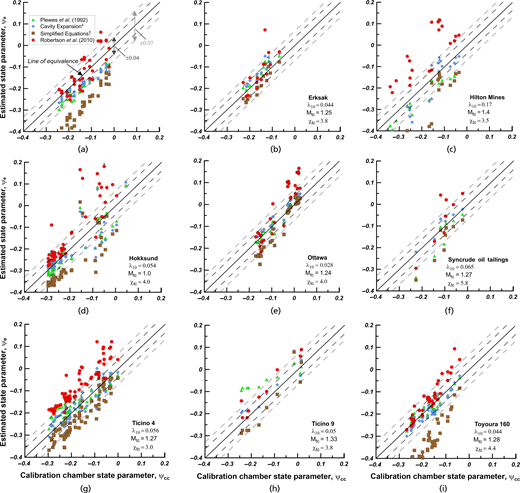
Summary of estimated plotted against measured calibration chamber state parameter for various sands. *Cavity expansion (Shuttle and Jefferies, 1998 and Ghafghazi and Shuttle, 2008). ϮSimplified equations of Shuttle and Jefferies (1998)
Summary of estimated plotted against measured calibration chamber state parameter for various sands. *Cavity expansion (Shuttle and Jefferies, 1998 and Ghafghazi and Shuttle, 2008). ϮSimplified equations of Shuttle and Jefferies (1998)
Table 7 summarises the number of tests with calculated within ± and ± error margins and the confidence level as percentages that various methods can interpret within either error margin. Ghafghazi and Shuttle (2008) identified these two margins as levels at which a significant jump in confidence occurred in the database. From the 279 tests analysed, Plewes et al. (1992) and the cavity expansion methods (Ghafghazi and Shuttle, 2008,; Shuttle and Jefferies, 1998) are the best performers, with 180 (64.5%) and 193 (69.2%) predictions producing errors less than ±0.04 and 238 (85.3%) and 249 (89.2%) predictions producing errors less than ±0.07, respectively. Robertson (2010) produced poor interpretations with only 95 (34.1%) tests within ± error margins and 158 (56.6%) tests within less than ±, respectively. The simplified equations of Shuttle and Jefferies (1998) produced similarly poor interpretations with 68 (24.4%) tests and 113 (40.5%) tests within less than ± and ± error margins, respectively.
Summary of the state parameter interpretation error; from each method
| Number of tests with < 0.04 | Number of tests with < 0.07 | Percentage of tests with < 0.04 | Percentage of tests with < 0.07 | ||||||||||||||
|---|---|---|---|---|---|---|---|---|---|---|---|---|---|---|---|---|---|
| Sand/methods | Total number of tests | Pa | CE | EQ | R | P | CE | EQ | R | P | CE | EQ | R | P | CE | EQ | R |
| Da Nang | 38 | 6 | 13 | 0 | 21 | 32 | 33 | 0 | 30 | 15.8 | 34.2 | 0 | 55.3 | 84.2 | 86.8 | 0 | 78.9 |
| Erksak | 14 | 12 | 10 | 10 | 9 | 14 | 13 | 14 | 12 | 85.7 | 71.4 | 71.4 | 64.3 | 100 | 92.9 | 100 | 85.7 |
| Hilton Mines | 20 | 9 | 8 | 4 | 0 | 13 | 13 | 4 | 3 | 45.0 | 40.0 | 20.0 | 0 | 65.0 | 65.0 | 20.0 | 15.0 |
| Hokksund | 51 | 32 | 36 | 5 | 20 | 41 | 39 | 15 | 37 | 62.7 | 70.6 | 9.8 | 39.2 | 80.4 | 76.5 | 29.4 | 72.5 |
| Ottawa | 30 | 28 | 29 | 17 | 10 | 30 | 30 | 23 | 19 | 93.3 | 96.7 | 56.7 | 33.3 | 100 | 100 | 76.7 | 63.3 |
| Syncrude oil tailings | 8 | 5 | 7 | 2 | 2 | 5 | 8 | 5 | 5 | 62.5 | 87.5 | 25.0 | 25.0 | 62.5 | 100 | 62.5 | 62.5 |
| Ticino 4 | 68 | 47 | 50 | 26 | 5 | 59 | 65 | 43 | 16 | 69.1 | 73.5 | 38.2 | 7.4 | 86.8 | 95.6 | 63.2 | 23.5 |
| Ticino 9 | 9 | 2 | 6 | 4 | 3 | 4 | 8 | 7 | 5 | 22.2 | 66.7 | 44.4 | 33.3 | 44.4 | 88.9 | 77.8 | 55.6 |
| Toyoura 160 | 41 | 39 | 34 | 0 | 25 | 40 | 40 | 2 | 31 | 95.1 | 82.9 | 0 | 61.0 | 97.6 | 97.6 | 4.9 | 75.6 |
| Sum/Average | 279 | 180 | 193 | 68 | 95 | 238 | 249 | 113 | 158 | 64.5 | 69.2 | 24.4 | 34.1 | 85.3 | 89.2 | 40.5 | 56.6 |
P for Plewes et al. (1992), CE for cavity expansion (Shuttle and Jefferies, 1998 and Ghafghazi and Shuttle, 2008), EQ for the simplified equations of Shuttle and Jefferies (1998), and R for Robertson (2010)
The interpretation errors of the four methods plus Been et al. (1986) are presented as a histogram in Figure 4, confirming the earlier observations. Figure 4(a) shows the distribution of the errors by giving equal weight to each of the 279 data points. In contrast, Figure 4(b) removes the bias caused by some materials (e.g., Ticino 4 with 68 tests) having many more tests than others (e.g., Syncrude oil tailings with eight tests). Materials are given equal weight in Figure 4(b) by summarising the percentages of the errors in each material. The differences between Figures 4(a) and 4(b) are inconsequential. In Figure 4, an error () of zero is a perfect interpretation, a positive error interprets a looser state than reality (conservative), and a negative error is unconservative. Been et al. (1986), Plewes et al. (1992), and cavity expansion methods (Ghafghazi and Shuttle, 2008,; Shuttle and Jefferies, 1998) produce the best results. The simplified equations of Shuttle and Jefferies (1998) are grossly unconservative, and Robertson (2010) is grossly conservative.
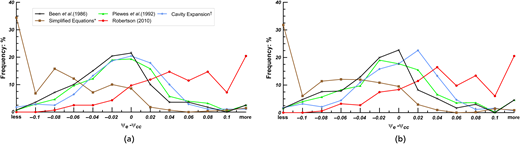
Distribution of error in estimated state parameter, , by method; (a) individual tests weighed equally; (b) materials weighed equally. *Cavity expansion (Shuttle and Jefferies, 1998 and Ghafghazi and Shuttle, 2008). ϮSimplified equations of Shuttle and Jefferies (1998)
Distribution of error in estimated state parameter, , by method; (a) individual tests weighed equally; (b) materials weighed equally. *Cavity expansion (Shuttle and Jefferies, 1998 and Ghafghazi and Shuttle, 2008). ϮSimplified equations of Shuttle and Jefferies (1998)
The performance of these methods on individual materials can be better understood by separating bias from scatter, as illustrated in Figure 5. The scatter is represented by the R2 value of the trendline fitted through the interpretations. The bias is the difference between the state parameter estimated from the trendline and the assumed state parameter. For the scatter, in Figure 5(a), Plewes et al. (1992) and cavity expansion methods (Ghafghazi and Shuttle, 2008,; Shuttle and Jefferies, 1998) produce near-perfect trendlines with a high value of R2 = 0.95 and 0.96, respectively. In Figure 5(b), Plewes et al. (1992) produce the best trendline with R2 = 0.91, followed by cavity expansion methods with R2 = 0.89. Shuttle and Jefferies (1998) simplified equations produce a scatter as low as the last two methods for two sands, but with significant bias. Robertson (2010) produces poor trendlines with the lowest R2 = 0.86 and R2 = 0.63 for two sands and significant bias.
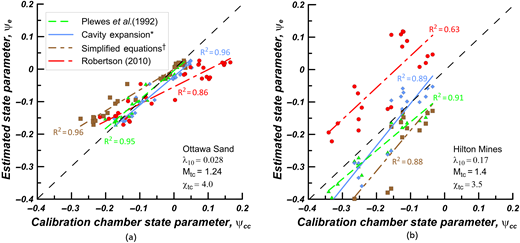
Performance of different state parameter interpretation methods with trendlines shown for (a) Da Nang sand; (b) Hilton Mines tailings. *Cavity expansion (Shuttle and Jefferies, 1998 and Ghafghazi and Shuttle, 2008). ϮSimplified equations of Shuttle and Jefferies (1998)
Performance of different state parameter interpretation methods with trendlines shown for (a) Da Nang sand; (b) Hilton Mines tailings. *Cavity expansion (Shuttle and Jefferies, 1998 and Ghafghazi and Shuttle, 2008). ϮSimplified equations of Shuttle and Jefferies (1998)
The methods using for overburden stress normalisation show similar R2 values, while Robertson (2010) using for overburden stress normalisation shows lower R2 values with higher scatter. The R2 values of the interpretation trend lines produced by each method are summarised in Table 8. Interestingly, the interpretation R2 values for the added trendlines fitted through the predictions produced by Plewes et al. (1992) and Robertson (2010) in Table 8 are almost identical to the R2 values for Qp – ψ and Qtn – ψ relations in Table 6, which implies that the primary source of the difference in scatter in these methods is their stress normalisation approach. In Table 8, the R2 values of the cavity expansion methods (Ghafghazi and Shuttle, 2008,; Shuttle and Jefferies, 1998) and Shuttle and Jefferies (1998) simplified equations are close to that of Plewes et al. (1992), with some differences caused by the influence of other soil properties (NorSand parameters) on the interpretation. As explained earlier, Shuttle and Jefferies (1998) demonstrated that half of the scatter in values come from the influence of overburden on elastic shear rigidity, while the other half is due to the repeatability of calibration chamber tests themselves. As demonstrated earlier, the primary source of higher scatter in , compared with , is due to ignoring the influence of the horizontal stress or on CPT tip resistance. The scatter in state parameter interpretation is not similar across methods or materials. A review of Table 8 highlights Hokksund as a material with poor R2 across all methods. This observation is not surprising given that Hokksund is the second-largest data set in the database (51 tests), but unlike the most extensive set of data (Ticino 4 with 77 tests), its data come from three different references. Human factors and different details of tests may have caused a higher amount of scatter in Hokksund data than in other sands. It is also one of the materials with the elastic modulus assumed instead of measured to the detriment of the cavity expansion-based interpretation process (Ghafghazi and Shuttle, 2008). While the methods using have high R2 values for all other materials (R2 = 0.79 to 0.95), Robertson (2010) produces poor R2 values for Da Nang and Erksak sands as well as Hilton Mines and Syncrude oil tailings (R2 = 0.53 to 0.72). As explained earlier, this high scatter stems from the methods’ stress normalisation approach, as reflected in the near-identical R2 values of the Qtn – ψ correlations and those of the versus in Tables 6 and 8, respectively.
Summary of R2 values of interpretation trend lines of versus from each method
| Sand/methods | Plewes et al. (1992) | Cavity expansion Shuttle and Jefferies (1998) & Ghafghazi and Shuttle (2008) | Simplified equations of Shuttle and Jefferies (1998) | Robertson (2010) |
|---|---|---|---|---|
| Da Nang | 0.94 | 0.94 | 0.94 | 0.70 |
| Erksak | 0.92 | 0.86 | 0.85 | 0.53 |
| Hilton Mines | 0.91 | 0.89 | 0.88 | 0.63 |
| Hokksund | 0.66 | 0.58 | 0.55 | 0.65 |
| Ottawa | 0.95 | 0.96 | 0.96 | 0.86 |
| Syncrude oil tailings | 0.86 | 0.85 | 0.83 | 0.72 |
| Ticino 4 | 0.79 | 0.82 | 0.79 | 0.83 |
| Ticino 9 | 0.88 | 0.87 | 0.89 | 0.80 |
| Toyoura 160 | 0.87 | 0.88 | 0.89 | 0.89 |
| Average | 0.86 | 0.84 | 0.85 | 0.73 |
In addition, it is very informative to understand how the error bias is distributed across different densities to evaluate the scatter error in the interpretation of state parameters in the four methods. As can be seen in Table 9, the error in the state parameter interpretation () is reported at three densities; a dense state ( = −0.3) and a loose state ( = 0.1) as well as the generally accepted threshold for contractive behaviour ( = −0.05). The average error is near zero for all three densities for Plewes et al. (1992) and cavity expansion methods (Ghafghazi and Shuttle, 2008,; Shuttle and Jefferies, 1998). Shuttle and Jefferies (1998) simplified equations have their worst average performance on dense sands ( = −0.13), while Robertson (2010) produces the most significant error for loose sands ( = 0.14). Focusing on the state parameter separating contractive from dilative behaviour, = −0.05, Robertson (2010) would interpret a significantly looser state parameter (Δψ = 0.06 to 0.17) than reality in all sands. The Shuttle and Jefferies (1998) simplified equations would miss the threshold by ( = −0.05 to −0.09) in three of the nine sands. Plewes et al. (1992) would only miss the threshold by ( =−0.06 and −0.07) for the Da Nang and Hilton Mines tailings in the database while performing well for the rest of the sands. The cavity expansion methods (Ghafghazi and Shuttle, 2008 ; Shuttle and Jefferies, 1998) perform well within ± 0.02 for all materials except for Da Nang ( = −0.07) and Erksak sand ( = 0.04).
Summary of bias by each method for selected soils at loose and dense states
| Δ at = −0.3 (dense state) | Δ at = −0.05 (threshold) | Δ at = 0.1 (loose state) | ||||||||||
|---|---|---|---|---|---|---|---|---|---|---|---|---|
| Pa | CE | EQ | R | P | CE | EQ | R | P | CE | EQ | R | |
| Da Nang | −0.04 | 0.00 | −0.19 | −0.01 | −0.06 | −0.07 | −0.13 | 0.02 | −0.08 | −0.11 | −0.09 | 0.04 |
| Erksak | 0.01 | 0.03 | −0.06 | −0.02 | 0.03 | 0.04 | 0.01 | 0.07 | 0.05 | 0.05 | 0.05 | 0.12 |
| Hilton Mines | −0.04 | −0.08 | −0.20 | 0.15 | −0.07 | 0.02 | −0.06 | 0.14 | −0.09 | 0.08 | 0.03 | 0.14 |
| Hokksund | 0.01 | 0.01 | −0.08 | 0.03 | 0.02 | −0.01 | 0.00 | 0.17 | 0.02 | −0.03 | 0.04 | 0.26 |
| Ottawa | −0.02 | 0.00 | −0.15 | −0.10 | 0.00 | 0.02 | −0.03 | 0.06 | 0.01 | 0.03 | 0.05 | 0.15 |
| Syncrude oil tailings | −0.14 | 0.01 | −0.15 | −0.10 | −0.01 | 0.01 | −0.04 | 0.08 | 0.07 | 0.01 | 0.03 | 0.19 |
| Ticino 4 | 0.06 | 0.01 | −0.05 | 0.09 | −0.02 | −0.01 | −0.05 | 0.09 | −0.07 | −0.03 | −0.04 | 0.10 |
| Ticino 9 | 0.18 | 0.04 | −0.08 | 0.02 | 0.03 | 0.02 | −0.01 | 0.10 | −0.06 | 0.02 | 0.03 | 0.14 |
| Toyoura 160 | 0.01 | −0.02 | −0.22 | −0.01 | −0.02 | −0.02 | −0.09 | 0.08 | −0.04 | −0.02 | −0.02 | 0.14 |
| Average | 0.01 | 0.00 | −0.13 | 0.00 | −0.01 | 0.00 | −0.04 | 0.09 | −0.02 | 0.00 | 0.01 | 0.14 |
P for Plewes et al. (1992), CE for cavity expansion (Shuttle and Jefferies, 1998 and Ghafghazi and Shuttle, 2008), EQ for the simplified equations of Shuttle and Jefferies (1998), and R for Robertson (2010)
Discussion
Ultimately, the value of all interpretation methods is interpreting the state parameter in the field well outside of the bounds of the calibration chamber database. Hence, it is crucial to understand which methods perform better on the entire database and which soils cause better or poorer performance for various methods, which would inform the extrapolation beyond the database. The Shuttle and Jefferies (1998) simplified equations perform poorly widely enough not to warrant additional discussion. Robertson (2010) performs similarly poorly but will be further discussed given its fundamental differences and relative popularity in practice.
As demonstrated earlier, Robertson (2010) tends to estimate looser than actual state parameters. It performs poorly for two materials: Hilton Mines Tailings in Figure 3(c) and Hokksund sand in Figure 3(d). Unsurprisingly, these are two materials at the extreme of the two parameters identified by Plewes et al. (1992) to play a pivotal role in interpreting the state parameter: and. Hilton Mines tailings is the most compressible material in the database, with = 0.17, while Hokksund has a very low value of = 1.00, equivalent to a constant volume friction angle of (). Since the method does not account for such differences, it interprets the ‘weakness’ from high compressibility or low friction angle as ‘looseness’. This can be extended to argue that this method can mistake ‘strength’ due to low compressibility, high elastic shear rigidity (such as that arising from age), or high friction angle as ‘denseness’. This can be a dangerous error because essential design considerations such as liquefaction are controlled by density much higher than friction angle, elastic stiffness, or even compressibility. These problems were also identified by Smith (2021).
The cavity expansion methods (Ghafghazi and Shuttle, 2008,; Shuttle and Jefferies, 1998) appear to perform noticeably better than Plewes et al. (1992) in the two tailings (Hilton Mines and Syncrude oil tailings) from the summary of biases presented in Table 7. Plewes et al. (1992) and cavity expansion methods perform equally well across the other sands, and most differences are too small to be further interpreted. However, this raises the question of the value of the extra effort required for cavity expansion analyses. The lesson from the poor performance of the Robertson (2010) method can be employed to address this question. As Ghafghazi and Shuttle (2008) suggested from a review of field data, the more soil properties a method accounts for, the better its interpretation. The cavity expansion analyses not only account for compressibility and friction angle but also account for differences in elastic shear rigidity (, dilatancy (), and even fabric through NorSand’s hardening parameter (). Among these parameters, the elastic shear rigidity has the most considerable influence (Shuttle and Jefferies, 1998) and, fortunately, it can be readily measured in the field through seismic CPT. Thus, while Plewes et al. (1992) can be a convenient and sufficient tool in many cases, in cases where the shear wave velocities may defy typical expectations due to age, cementation, or other properties of a deposit, the additional effort of cavity expansion is well justified. In tailings, it is reasonable to employ Plewes et al. (1992) with a reasonable assumption for for screening and follow-up with cavity expansion analyses as triaxial data become available. If the critical state friction angle of the tailings is not known, a sensitivity analysis between = 1.2 and 1.5 is recommended for the screening level analysis.
The evaluation performed against calibration chamber data here is a valuable way of identifying state parameter interpretation methods that at least work on the database from which they were developed. Nevertheless, it is vital to recognise the differences between how these methods were applied here and how they would be used in the field. Among these differences, the most important is a lack of sleeve friction data in much of the database. This meant that for Robertson (2010), a constant had to be assumed, rather than obtaining from the friction ratio. However, this influence is deemed minor, given that the database comprises only clean sands and recognition of the narrow range of values expected for clean sands in the field. Hilton Mines is likely the material where this effect would be more pronounced, given its higher compressibility. Plewes et al. (1992) also utilised friction ratio in the field to determine values, instead of determining them from triaxial tests. This is a necessity given the spatial variability of particle size distributions in the field and the sensitivity of to that, even in cases where triaxial data may be available. However, site-specific adjustments are recommended in this case. The same approach may be employed by cavity expansion methods (Ghafghazi and Shuttle, 2008 ; Shuttle and Jefferies, 1998) to determine in field applications.
is another parameter that is needed for both Plewes et al. (1992) and cavity expansion methods (Ghafghazi and Shuttle, 2008,; Shuttle and Jefferies, 1998). Fortunately, there is ample evidence that is not significantly affected by changes in particle size distribution within a given geologic unit (Manmatharajan et al., 2023b). Therefore, determining it from laboratory tests on reconstituted samples is necessary for fully utilising the advantages of these methods in differentiating friction from ‘denseness’.
The cavity expansion methods (Ghafghazi and Shuttle, 2008 ; Shuttle and Jefferies, 1998) include other parameters that may be affected by spatial variability to various degrees. As a result, all these methods may lose some of their resolutions in field application compared with calibration chambers due to the assumptions made to determine their input parameters in the field. The solution in these cases is determining the range of error induced by bounding various parameters to reasonable ranges determined from triaxial tests on reconstituted samples.
Similar to Ghafghazi (2011), Monfared and Sadrekarimi (2013), and Schafer et al. (2019), this work focused on drained penetration in clean sand. All the methods reviewed rely on indirect and unvalidated correlations to account for the influence of partially drained and undrained penetration in saturated fine-grained soils. When venturing well outside this database into challenging materials, such as tailings, the potential errors caused by different soil properties must be handled through laboratory testing and computational analyses. The influence of partial drainage must be handled with caution.
Summary and conclusions
A CPT calibration chamber database comprised of nine clean sands, including oil sand and hard rock tailings, was used to assess five popular methods of interpreting the in situ state parameter from the CPT tip resistance. The database was selected such that high-quality triaxial compression tests were available on the same soils on which calibration chamber tests were performed. This database was used to assess the performance of these interpretation methods as a bare minimum test. These methods were entirely or partially created and calibrated against the same database, which means that poor performance against this database should be treated as a red flag for the applicability of these methods outside of the database, especially to highly variable and challenging materials such as tailings.
- ▪
Of these methods, Been et al. (1986), Plewes et al. (1992), Shuttle and Jefferies (1998), and Ghafghazi and Shuttle (2008) are the progressions of one another and increasingly rely on independent measurements of soil properties to isolate the influence of soil density (the state parameter) on the tip resistance from other factors. Their way of normalising overburden stress that accounts for horizontal stresses results in a reasonable amount of scatter. Half of this scatter is known to be a product of the challenges in the repeatability of chamber tests, and the other half is from the influence of elastic shear rigidity, which is accounted for by the cavity expansion methods (Ghafghazi and Shuttle, 2008 ; Shuttle and Jefferies, 1998). These methods performed well across the database.
- ▪
A set of simplified equations built on cavity expansion analyses proposed by Shuttle and Jefferies (1998) appeared to result in dangerously erroneous results and should not be used.
- ▪
The method proposed by Robertson (2010) was shown to perform poorly across the database, with a strong bias for assessing the state parameter to be looser than reality. The method utilises a non-linear overburden correction that does not account for horizontal stresses, and as a result, it produces a significantly higher level of scatter than the other methods. This overestimation should not be mistaken for conservatism, as it can produce unconservative results for certain materials. In addition, good engineering should differentiate between explicit conservatism and potential conservatism buried in error.
- ▪
The Plewes et al. (1992) method is recommended as a quick screening tool, but determining the properties of soils and performing a cavity expansion analysis is necessary when dealing with soils that are noticeably different from those in the database. Other methods must be avoided.
Ghafghazi and Shuttle (2008) demonstrated that methods accounting for differences among soils perform much better than those not. The error significantly increases for materials that deviate from the core of the database (natural clean quartz sands). This fact reminds us that we need the same number of unknowns and equations in all problems, including CPT interpretation. If compressibility, friction angle, drainage conditions, and density can influence tip resistance, correctly interpreting the density will require compressibility, friction angle, and drainage conditions to be independently quantified.
Data availability statement
The datasets analysed during the current study are available from the corresponding author upon reasonable request.
Acknowledgements
The support provided to the research team from the Natural Sciences and Engineering Research Council of Canada (NSERC) (RGPIN-2016-05622 and CRDPJ 537738-18), Klohn Crippen Berger, Kinross Gold, Rocscience, and Vale Brazil is appreciated. The China Scholarship Council (CSC) is acknowledged for funding the PhD studies of the first author.

