Organisations involved in relief delivery tend to have cross-boundary mandates, which cause ambiguity of roles during delivery of relief services to the targeted victims. Having no clear role, specialisation affects service timeliness and increases resource duplication among the relief organisations. The objective of this study is to understand how organisational networks and organisational learning as complex adaptive system metaphors improve both organisational adaptability and role clarity in humanitarian logistics.
Using ordinary partial least squares regression through SmartPLS version 3.3.3, the authors tested the study hypotheses basing on survey data collected from 315 respondents who were selected randomly to complete a self-administered questionnaire from 101 humanitarian organisations. Common method bias (CMB) associated with surveys was minimised by implementing both procedural and post statistics methods.
The results indicate that organisational networks and organisational learning have a significant influence on organisational adaptability and role clarity. The results also show that organisational adaptability partially mediates in the relationship between organisational networks, organisational learning and role clarity.
The major limitation of the study is that the authors have used cross-sectional data to test this research hypotheses. However, this was minimised following Guide and Ketokivi's (2015) recommendation on how to address the limitations of cross-sectional data or the use of longitudinal data that can address CMB and endogeneity problems.
Managers in humanitarian organisations can use the authors’ framework to understand, first, how complex adaptive system competence can be used to create organisational adaptability and, second, how organisational adaptability can help organisational networks and organisational learning in improving role clarity among humanitarian organisations by collaboratively working together.
This research contributes to the existing body of knowledge in humanitarian logistics and supply chain management by empirically testing the anecdotal and conceptual evidence. The findings may be useful to managers who are contemplating the use of organisational networks, organisational learning and organisational adaptability to improve role clarity in disaster relief-related activities.
1. Introduction
The number of organisations involved in relief work in general and humanitarian logistics is large and increasing, creating a new complexity (Jensen and Hertz, 2016). This complexity, which results from a dynamic operational environment, is embedded with multiple responders, which create diverse relationships and role ambiguity among relief responders. The ambiguity of roles among humanitarian organisations (HOs) affects the trust formation required in the temporary organisation (Curnin et al., 2015) and timeliness of services delivered to the victims of a disaster (Jensen and Hertz, 2016). Yet, role clarity among the coordinating partners facilitates task understandability and accomplishment (Curnin et al., 2015). This function in the context of relief delivery is largely overlooked in emergency management, yet it eases the achievement of shared goals among humanitarian organisations (Curnin et al., 2015), facilitates the coordination of operating partners' tasks, promotes open communication among operating partners (Kovács and Falagara Sigala, 2021), reduces competition among relief actors, which helps them in the allocation and sharing of resources (Wankmüller and Reiner, 2020; Jensen and Hertz, 2016; Boin and Bynander, 2015; Balland and Sobhi, 2013), improves learning among the responders (Saavedra and Knox-Clarke, 2015) and boosts timely delivery of relief to the last mile and acquaintance with other organisations' services, contributing to an improved level of predictability of their services (Boin and Bynander, 2015) and organisational commitment (Templer et al., 2020). In response to disaster situations, there is a great proliferation of HOs without a matching set of commonly recognised roles in the relief delivery system (where some have better understanding of their mandate than others) (Jensen and Hertz, 2016), and such a convergence creates more challenges, which may make them fail to perform as expected.
Contextually, despite the undisputed importance of role clarity, during emergency response, most HOs involved in the humanitarian sector do not have a clear role specialisation. Many of Non-Government Organisations (NGOs) take on roles depending on the source of funding or the needs of the community they intend to serve, which makes them carry out many activities related to this community, and sometimes they perform their roles basing on the origin and legal status of the HO. In the response to South Sudan refugees, it was observed that many HOs such as Uganda Red Cross Society (URC), Oxfam International, Real Medicine Foundation, Plan International, Save the Children International and others delivered complementary and different relief services such as food and non-food items, health services, education or child protection. Specifically, Save the Children International was found to be delivering early childhood education in one settlement for South Sudan refugees in West Nile while in another settlement it was providing heath/medical-related services; and yet in a refugee settlement in southwest Uganda, it was providing child protection services. This lack of role specialisation sometimes blurs a HO's role clarity, consequently affecting the fulfilment of its mandate. Additionally, the sector arrangements do not also address the division of labour, but it is seen as akin to sector segments rather than as specific roles in relief delivery chains.
Documented evidence suggests that humanitarian operations are complex and dynamic (Schiffling et al., 2020). Thus, like any other supply network, humanitarian logistics embrace the features of a complex adaptive system (CAS), a system which, over time, emerges coherently through the property of learning and adaptation (Turner et al., 2019). It is the features of a CAS that can either facilitate or restrain its efficacy. For example, organisational networks need to be reactive and proactive, which is embedded in a wider spectrum of relationships that enable them to acquire the resources, information and knowledge needed to perform their task as expected (Thornton et al., 2013). This is important for role clarity, which is reported to be problematic among the HOs (Jensen and Hertz, 2016). Saavedra and Knox-Clarke (2015) argue that successful relief operations require that organisations delivering relief need to have a clear understanding of their roles, responsibility and tasks to be able to meet the disaster victims' needs in a timely manner. This means that they can rapidly respond to short-time changes in demand, and be adaptable, which means that they can adjust to long-term changes by restructuring their systems. The emergency operations in Uganda are a response to spontaneous shocks due to persistent civil wars and conflicts in South Sudan and the Republic of the Congo (DRC) (Stewart et al., 2002). This implies that HOs should be clear about their role as the disasters present complex needs and are inherently random, dynamic and adaptive.
Thus, the fact that HOs lack role specialisation and the sector arrangements do not also address the division of labour, but it is seen as akin to sector segments (Obrecht and Bourne, 2018) rather than specific roles in relief delivery chains, causes role ambiguity (Mutebi et al., 2020b), which limits their task focus during relief delivery (Schiffling et al., 2020; Vega and Roussat, 2015). This may be attributed to organisational learning, organisational networks and organisational adaptability (Dubey et al., 2018). Yet, for an organisation to clearly understand and deliver its role and responsibilities as expected requires that HO be a member of a particular relief network so as to access the resources, knowledge and information necessary for it to learn and understand its role and others' during relief operations. Consequently, according to Altay et al. (2018), organisational learning could lead to HOs facing challenges associated with understanding their roles to have mechanisms that ensure the needed resources are available in a timely manner through developing processes and procedures that streamline action. This can be done without being prescriptive and through empowering those working in the field and locating decision-making close to the point where action is needed (Obrecht and Bourne, 2018).
We also argue that the importance of considering adaptability derives from its function of making HOs rapidly learn new methods to deliver their roles in response to changing circumstances in which HOs become highly reliant on others for information to perform their roles. This makes organisational networks, organisational learning and adaptability important constructs for the HOs to deliver relief (sanitation, water and hygiene, education, protection, medical services, water and food and non-food items) as expected. Previous scholars have used various mechanisms to explain role clarity, such as information transparency (Khan et al., 2019), explicit competences and reflection (Nansubuga and Munene, 2013), boundary spanning (Curnin et al., 2015), organisational competence or resources, professionalism and umbrella body (Jensen and Hertz, 2016). These earlier studies largely ignore the role of organisational learning, organisational networks and organisational adaptability in predicting role clarity and those that tried (such as Jensen and Hertz, 2016) remain disjointed. Additionally, the concept of role clarity has been widely studied in the areas of human resources management (Nansubuga and Munene, 2013; Tang and Chang, 2010), psychology (Kundu et al., 2019; Lynn and Kalay, 2015; Bliese and Castro, 2000; Johnson and Stinson, 1975), sociology (Vungkhanching and Tonsing, 2016; Lyons, 1971a, b) and behavioural science (Karimi et al., 2014; Tarrant and Sabo, 2010). The focus of these studies has been on how to improve employee performance, yet anecdotal evidence indicates that organisations that desire to achieve a common goal, such as the delivery of relief to disaster victims, need to understand their role and responsibilities (role clarity) so as to improve on their service delivery level (Jensen and Hertz, 2016).
The foregoing discourse suggests that role clarity among HOs in Uganda is problematic and that CAS theory (Schiffling et al., 2020; Malina and Holland, 1996) could provide an appropriate theoretical lens through which to understand the problem. The extant survey – based on literature – has revealed a knowledge opportunity in our understanding of role clarity from the CAS perspective. For example, recent studies in HOs using the CAS variable, organisational networks and adaptability have focussed on coordination, rather than role clarity (e.g. Mutebi et al., 2020b). Those that have studied role clarity have not expressly applied CAS theory, yet they acknowledge the complexity and volatility of humanitarian emergencies and corresponding responses (e.g. Cachia and Ramos, 2020; Safarpour et al., 2020; Mutebi et al., 2020a, b; Jabbour et al., 2019; Jensen and Hertz, 2016; Curnin et al., 2015).
In connection with the ongoing conversation on the importance of role clarity, we empirically examine the impact of key theoretical modes of role clarity: organisational learning, organisational networks and organisational adaptability. In this study, we also amplify the mediating role of organisational adaptability in the relationship between organisational learning, organisational networks and role clarity. We investigate the link between these study variables with data from 101 HOs operating in Uganda. The findings from our study shed light on organisational adaptability in horizontal coordination that is similar to that in disaster relief operations, the extent to which organisational adaptability actually impacts role clarity in the involved organisations, and whether a high level of organisational learning and networking with others impact organisations' ability to adapt to the operating environment while delivering relief services to the victims. The results contribute to literature on humanitarian operations and horizontal inter-organisational coordination by highlighting organisational adaptability issues in the temporary and dynamic settings in horizontal disaster relief networks. Section 2 reviews literature on organisational adaptability and the role of organisational learning and networks among HOs in relation to organisational role clarity. Ten hypotheses were derived from the conceptual model guiding this paper. Section 3 describes the statistical methods and methodology employed in the study. Section 4 presents the results; while Section 5 discusses the findings. Section 6 presents the major contribution, and implications of the paper are also highlighted, together with the limitations of the study in connection with recommendations for future research.
2. Theory development and literature review
2.1 Theoretical underpinning
According to Holland (1995), CAS denotes a system that over a period of time develops into a coherent form through its major features of learning adaptation. CAS theory presupposes that all systems undergo sudden, unexpected and disorderly changes in an operating environment. As such, the ability of these organisations to survive in such an environment depends on how well they understand and perform their role and responsibilities to meet the needs of their clients and also where each agent tries to perform its role which, in turn, allows them to obtain an independent relationship with some of the other operating organisations (Stacey, 2007) and that success is measured according to how well they have performed their roles in relation to others. In order to understand and perform their roles and tasks as expected in such a dynamic environment, organisations need to create order among independent agents through interactions that enable them to learn the operating environment based on past experience and the available information, organise them and adapt (Day, 2014). This underlines the role of organisational networks in facilitating organisational learning and adaptability in humanitarian logistics, leading to role clarity.
In a CAS, adaptability implies that the system's agents or elements are responsive, flexible, reactive and proactive in dealing with the inputs of other agents that affect the system (Nilsson, 2003; Tukamuhabwa et al., 2015). Hence, role clarity among HOs responding to the needs of disaster victims can be reflected in the features of a CAS such as adaptability, learning and network connectivity facilitated by the propagation of information, resources and materials (Cachia and Ramos, 2020; Mutebi et al., 2020a; Safarpour et al., 2020; Pathak et al., 2010). Jabbour et al. (2019) and Ramsden (2014) emphasise that when role clarity, learning and adaptability are integrated and coordinated within a humanitarian supply chain, a complex adaptive system forms and transforms the supply chain to meet and satisfy clients' needs. Previous researchers have acknowledged that humanitarian logistics are more complex than commercial logistics (Altay et al., 2018). Role clarity has been viewed as a capability of an organisation that is self-managed and has the competence to network with others (Blomme, 2012), which reflects the properties of learning. Jense and Hertz (2016) suggest that role clarity and learning are two important properties, which may provide a better explanation for disaster response in humanitarian logistics. Thus, the foregoing discourse qualifies the CAS variables as appropriate for explaining role clarity in HOs.
2.2 Organisational networks, organisational adaptability and role clarity
Role clarity is a determinant of organisational performance, improves trust among coordinating organisations and increases the chances for an organisation to commit its resources to what it performs for a longer time. It is defined as the degree to which an organisation has a clear understanding of its tasks, responsibilities and processes during relief operations (Jense and Hertz, 2016). Even though it has usually been used to describe relationships between peers that are socially connected, the meaning of networks has been extended to building successful organisational relationships (Wei-Skillern and Silver, 2013). Gulati et al. (2002) explain that organisational networks are the centrality of an organisation within the overall network, its ties, structural configuration and partners' profiles. Organisational networks induce role clarity among the participating members of a network through the sharing of various kinds of resources (Jabbour et al., 2019; Thornton et al., 2013; Gulati et al., 2002). Saavedra and Knox-Clarke (2015) posit that resources are very crucial in helping relief organisations to understand and perform their roles such as food, medicine, water and shelter delivery in an acceptable manner. For example, networks allow HOs to gain access to grants, donations, transportation, storage capacity and the information necessary to understand and solve operational problems such as late delivery (Ballan and Sobhi, 2013), hence sustaining relief operations (Pazirandeh and Maghsoudi, 2017). Further, Pype et al. (2018) emphasise that regular communication builds mutual respect of each other's knowledge and expertise, which creates a positive working atmosphere and prevents role ambiguity. Role clarity increases organisational visibility to attract resources through networking to meet more needs of the beneficiaries. In this study, we contribute to knowledge by hypothesising that organisational networks significantly relate with role clarity.
Relatedly, studies have shown that clusters of organisations that make decisions jointly and integrate their efforts in the provision of humanitarian relief aid during the complex times of crisis need to exhibit a high level of adaptability (Dubey and Gunasekaran, 2016; Jahre et al., 2009; Obrecht and Bourne, 2018; Seybolt, 2009; Tofighi et al., 2016). According to Seybolt (2009), networks facilitate the adaptation of collaborating partners in a complex operating environment by enabling independent relief actors to access and exchange resources as well as new techniques among that allow them to take advantage of opportunities that come along with the network manner of operations (OCHA, Annual Report, 2013). Additionally, in situations where organisations succeed by jointly working together in the delivery of human relief aid, change occurs faster, trust is boosted, expertise and resources are pooled, learning is fostered, common challenges are jointly addressed, while at the same time the duplication effort is avoided (Humanitarian Exchange Network, 2011). Unlike for dependent networks, interdependent networks produce new systematic behaviours and enhance the functionality of the networks to avoid catastrophic failure (La Rocca et al., 2018). Similarly, Tofighi et al. (2016) argue that networks enable organisations to optimise relief-based design under situation of mixed possibilistic-stochastic uncertainty and support informed decision-making by increasing their resilience during the occurrence of such disasters.
Jahre et al. (2009) emphasise that it is important for organisations to adjust process and infrastructure design and employ their own and others' resources in the permanent network when setting up the temporary network once a crisis occurs. The argument is that since organisations form temporary networks to respond to crises which are unique and full of uncertainties regarding where and when a crisis will recur, what needs will be and what infrastructure will be available, logistics solutions need to be tailored to each occurrence (Oloruntoba and Gray, 2006). Sometimes it is not necessarily true that when an organisation freely joins a relief network, it will benefit from doing so. Competition and opportunistic motives among organisations will hinder some of them from accessing resources and sharing information or even systems that may help them to learn and enhance their capacity to adapt humanitarian responses to the changes in the context of needs and to their evolution (Saavedra and Knox-Clarke, 2015). Notably, CAS theory emphasises that networks and organisational adaptability operate in a dynamic changing environment with non-linear projections to access resources. Hence, we contribute to theory and literature by examining the relationship between networks and organisational adaptability, a relationship that has not been much addressed in previous research. Apart from Jahre et al. (2009), who instituted a discussion on a possible link between organisational network and organisational adaptability within and between temporary solution and permanent networks during crises, prior literature does not sufficiently cover this particular relationship directly. However, there is a stream of research that can only be useful for the purpose of inferring such a relationship. We therefore we contribute to knowledge by hypothesising that organisational networks significantly relate with organisational adaptability.
Subsequently, previous studies show a scanty relationship between organisational adaptability and role clarity. Yet HOs perform such roles and responsibilities such as resources mobilisation and delivery of relief such as medicines, food and shelter on time to people in disaster-affected areas (Baldini et al., 2012) in a highly turbulent environment which requires them to exhibit a certain degree of organisational adaptability. This requires them to come up with new patterns and logistics infrastructure design that enable them to deliver their products/services in a timely manner. In addition, organisational adaptability enables an organisation to align its goals, roles and activities towards saving the lives of the victims (Currion, 2018) and increase the level of flexibility, the speed required to fulfil their role and the responsibilities of delivering medicine, health and food items. Further, Jensen and Hertz (2016) note that some relief organisations are capable of fulfilling certain roles clearly, but their organisational charters may prevent them from doing this formally since doing so would have consequences. This necessitates them to demonstrate the required level of readiness to scan changes in the work environment and to solve difficult problems accurately. It has also been noted that in situations where there is competition for resources, which arise because other, similar organisations try to execute the same roles in the same areas, and possibly also appeal for funding for similar tasks, HOs need to adapt to the environment so that they can remain focussed on the goals of the organisation itself. Jensen and Hertz (2016) further argue that some HOs such as the Red Cross, Oxfam or UN bodies have a clear overall remit but with a much broader scope, which may affect the lack of clarity for their overall remit. Therefore, for them to perform their roles as expected, there is a need for them to own substantial resources and to possess a high degree of organisational adaptability to work both independently or with others. We close the void by insinuating that organisational adaptability and role clarity are significantly related.
However, HOs, whether small or big, so long as they have a remit that is very clear to both them for instance, Médecins Sans Frontières (MSF) and others, which specialise, are likely to be certain about what type of activities they can carry out. Also, in times where an HO is using resources that are very much improvised for a particular intervention, combined with a general willingness to help, for such an organisation to be effective, organisational adaptability is required to achieve any kind of efficiency since such an organisation has inadequate resources to carry out all the tasks needed to alleviate the suffering of the beneficiaries. Jensen and Hertz (2016) indicate that a large number of HOs, whether big or small, lack the required resources to carry out their role and responsibility in the kind of dynamic environment that characterises a disaster situation. Basing on the above, we contribute to literature by showing that HOs can understand as well as perform their roles and responsibilities in an evolving complex operational environment by adjusting their organisational system to fit such situations. Centred to the above, we hypothesise that:
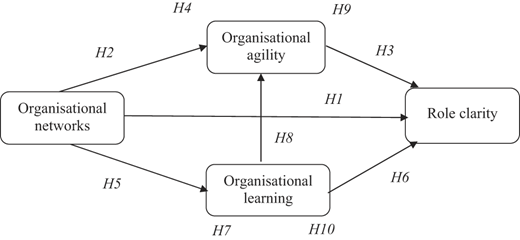
Organisational networks significantly relate with role clarity.
Organisational networks significantly relate with organisational adaptability during relief delivery.
Organisational adaptability and role clarity are significantly related.
Organisational adaptability mediates the relationship between organisational networks and role clarity during relief delivery.
2.3 Organisational networks, organisational learning and role clarity
Scholars such as Jabbour et al. (2019), Srećković (2018), Thornton et al. (2013) and Gulati et al. (2002) indicate a possible relationship between organisational networks and organisational learning. They advance that participating in a network benefits organisations by providing opportunities for sharing various resources. Network scholars such as Gulati et al. (2002) argue that for organisations to access resources such as expertise, supplies, logistics, information and capabilities, they need organisational networks. They posit that such organisational networks create social networks in which most organisations are embedded and that these networks shape the flow of valuable resources and capabilities among operating partners. The resources are crucial in helping organisations acquire the learning capabilities needed to understand and perform their roles in an acceptable manner (Mutebi et al., 2020a). The resources accessed from networks help entities to increase their role clarity regarding meeting the expectations of stakeholders, which enable them to achieve individual and communal goals. For example, networks allow HOs to gain access to the grants, donations, expertise and information necessary to understand and solve operational problems such as late delivery of services (Balland and Sobhi, 2013). This is achieved through regular communication and exchange of both tangible and intangible resources (Pype et al., 2018; Collinson and Elhawary, 2012). In addition, the knowledge and information resources mirror the collective knowledge owned by HOs constituting a particular network; therefore, networks act as conduits through which existing and newly acquired knowledge is disseminated to members. Such diffusion enhances the learning capability of member organisations, which help them to have clarity of their relief delivery roles and responsibilities. Relatedly, networks increase HOs' absorptive capacity, which enables them to perform the relief delivery routines by acquiring, assimilating, transforming and exploiting the knowledge and information acquired from the networks (Liu and Yang, 2019).
According to Curnin et al. (2015) and Webb and Chevreau (2006), organisational learning is necessary for building role clarity during multi-agency coordination in crisis management. In this study, organisational learning is conceptualised as the ability of a HO to devise new beneficial ideas, procedures, processes, services or products for responding to the emerging social needs of disaster victims (Woodman et al., 1993). On the other hand, role clarity is a HO's ability to understand its role and responsibilities to deliver what is expected of during the inter-agency relief operations (Jensen and Hertz, 2016). Woodman et al. (1993) note that creative ideas leading to unique products or services are likely to be generated in a working environment which supports new idea generation and problem-solving. High group cohesions, leadership capabilities and diversity are associated with higher capabilities in an organisation (Gupta and Banerjee, 2016). During emergency situations, a certain level of improvisation and clarity of roles as the situation unfolds is unavoidable, which would be very helpful during the initial stages in particular, but this should not be cast in stone (Jensen and Hertz, 2016). Therefore, organisations are always improvising to meet ever-increasing and varying needs of the disaster victims and are forced to understand and come up with useful new ideas, products or services that meet the needs of the victims, which process enables their understanding of what they are expected to deliver by other stakeholders (Boskoff, 1957). Consequently, it can be seen that organisational learning may facilitate the understanding of an organisation's role and responsibility through information exchange and coordination (Andriopoulos, 2001), which helps entities to deliver the expected relief to victims in time (Bang et al., 2019). Whereas literature portrays a relationship between organisational culture and role clarity, the literature is scanty and mostly available is in the field of human resource, and yet the current study focusses on humanitarian relief delivery. Even those in humanitarian logistics and supply chain, disaster and crisis management who have attempted to explore the concept of role clarity (Curnin et al., 2015; Jensen and Hertz, 2016) have limited themselves to the conceptual and anecdotal levels. This study contributes to theory and humanitarian logistics literature by examining the role of organisational learning in building its clarity of role and responsibilities.
L'Hermitte et al. (2016a, b) advance that due to uncertainties and unpredictable operating conditions, organisations succeed in such operating situations by developing an understanding of what they are supposed to do clearly (role clarity). As such, understanding of roles among entities depends on the resources and capabilities an organisation possesses. These resources include information, skills and funds, while capabilities such as being learning-oriented are essential for organisations to develop and improve understanding of their offerings so that they can swiftly deliver relief. We therefore hypothesise that:
Organisational networks significantly predict organisational learning.
Organisational learning significantly relates with role clarity during relief delivery.
Organisational learning significantly mediates between organisational networks and role clarity during relief delivery.
2.4 Organisational learning, organisational adaptability and role clarity
Prior literature (such as L'Hermitte et al., 2016a, b; James, 2011; Nonaka and von Krogh, 2009; Kreps and Bosworth, 2007; Webb and Chevreau, 2006) shows a possible relationship between organisational learning and organisational adaptability during disaster management. Dubey et al. (2015) and Lee (2004) posit that organisational adaptability is the ability of the organisation to adjust its systems to meet a structural shift in relief operations. Organisational adaptability is operationalised as “the ability of an organisation to monitor the operational environment to come up with new operational guidelines, patterns and logistics infrastructure; evaluate the needs of ultimate beneficiaries, not just immediate beneficiaries; creates flexible process and service designs to adapt to changing conditions; and determines where the organisation's relief stands in terms of technology cycles and relief life cycles” (Jermsittiparsert and Pithuk, 2019). Organisational learning enhances organisational adaptability through the creation of new ideas and knowledge, learning and flexibility thinking (Jabbour et al., 2019; Altay et al., 2018; Obrecht and Bourne, 2018). Jabbour et al. (2019) argue that flexible organisations are able to create flexible teams composed of independent personnel who are likely to explore unstructured or semi-structured challenges with different opinions. Owing to the increasing demand for and urgency of humanitarian relief aid and the dispersed locations in which humanitarian agencies operate, agencies are focussing on new ways of communicating, managing information and mapping (Stoddard et al., 2015). Sense-making is created as the sub-systems in the humanitarian relief aid interact in a constructive way towards achieving a common vision through the process of learning and unlearning (Collinson, 2016). Organisational capabilities promote environmental change, learning and organisational adaptability that create positive change as far as the organisation's products, service outcome and recognition are concerned (Berkhout et al., 2006). Humanitarian agencies continue to explore new measures for boosting humanitarian relief delivery, and these include creative problem-solving at the field level (Obrecht and Warner, 2016) and venturing into new technologies such as the use of drones and 3D printing of a disaster scene (Tatham et al., 2015, 2017). However, resource restrictions can limit the HO's capabilities as it will be occupied with finding resources instead of actually developing new products or services for responding to humanitarian crises (Andriopoulos, 2001). Most of the prior literature focussed on individuals in elaborating the relationship between organisational learning and organisational adaptability.
In addition, Altay et al. (2018), Cao et al. (2015) and Braunscheidel et al. (2010) argue that much of the research on the link between organisational culture and factors related to supply chain performance fails to consider the intermediate processes that affect this relationship. They suggest that researchers should investigate how cultural attributes shape the level of organisational adaptability and how, in turn, that affects performance outcomes. In this study, we focus on how organisational adaptability mediates the relationship between capabilities and role clarity. In previous sections, we have argued that certain cultural values, such as capabilities, lead to different organisational adaptability practices and that different organisational adaptability practices are associated with role clarity outcomes. We posit that a well-established link between capabilities and role clarity is mediated by organisational adaptability. In other words, capabilities influence an organisation to undertake effective actions, when necessary, thus promptly responding to unforeseen events or circumstances and effectively adjusting plans or courses of action, to take changes into account, which, in turn, are partly responsible for their understanding of roles and responsibilities during relief delivery. We suggest that it may be organisational adaptability that accounts for a portion of the relationship between organisational learning and role clarity. This study fills this literature gap by exploring the relationship between organisational learning, organisational adaptability and role clarity at organisational level and also by amplifying the mediating role of organisational adaptability between organisational learning and role clarity, specifically in the humanitarian context. Hence, we deduce that:
Organisational learning and organisational adaptability significantly relate.
Organisational adaptability mediates the relationship between organisational learning and role clarity.
2.5 Organisational networks, organisational learning and organisational adaptability
The relationship between organisational networks and organisational adaptability has already been demonstrated in Sections 2.3 and 2.4 above. In the foregoing, we exemplify the role of organisational learning in linking organisational networks and organisational adaptability. Jense and Hertz (2016) in their study on the coordination roles of relief organisations in humanitarian logistics infer that there is a possibility that organisational learning plays a role in the link between networks and organisational adaptability among relief responders. As argued, network attributes shape the level of organisational learning which, in turn, affects the level of organisational adaptability to the dynamic operating environment in which organisations execute their roles and responsibilities such as the delivery of water, health hygiene and sanitary services, road construction, provision of protection services, among others. In this study, we focus on how organisational learning mediates the relationship between organisational networks and organisational adaptability. We posit that a well-established link between organisational networks and organisational adaptability is mediated by organisational learning. In other words, organisational networks enable members to access the resources, knowledge and information that are crucial in boosting learning, as well as collaborative capabilities necessary in helping network members to understand their mandate and remain action-focussed through absorptive capabilities (L'Hermitte et al., 2016a, b; Curnin et al., 2015). Organisational networks help individuals to adapt to an operating environment that characterises emergency management situations. This is possible when an organisation undertakes effective actions, when necessary, promptly responding to unforeseen events or circumstances and effectively adjusting plans or courses of action to take changes into account which, in turn, are partly responsible for HOs understanding of its roles and responsibilities during relief delivery. We suggest that organisational learning accounts for a portion of the relationship between organisational networks and organisational adaptability. This leads to the following hypothesis:
Organisational learning mediates between organisational networks and role clarity.
From the above review of the empirical works, derived theoretical framework that guided this study is illustrated below:
3. Methods
3.1 Sample
The empirical study was conducted in the Ugandan humanitarian sector. This sector is critical in alleviating the suffering of the people affected by both natural and human-made disasters. This sector combines international and local organisations as well as government departments with the mandate to help those suffering owing to such catastrophes. Such a factor creates the need for these organisations to perform their role or mandate appropriately. Therefore, we consider it as an appropriate sector to analyse the role of organisational learning and networks and acquire the level of organisational adaptability necessary for them to develop the clarity of role/mandates that is helpful during the delivery of relief services or activities. In addition, it is particularly appropriate for our research to analyse such a very important sector. First, role clarity requires a sector with a specific mandate. Second, the dynamic operational environment of this sector allows us to study several activities related to the kind(s) of relief that an organisation is expected to deliver.
To obtain the information required for the development of our research, we collected data from HOs and government departments that were gazetted to deliver relief to recognised settlement areas by the line ministry (Office of the Prime Minister) and those that were also operating partners with the United Nations High Commissioner for Refugees (UNHCR). We put forward an additional requirement, namely the non-inclusion of any organisation with less than two years of relief operations (data was collected between June 2018 and June 2019).
We obtained a total of 150 HOs. Once duplicated cases, errors and organisations whose relief operations had been running for less than two years were eliminated, a total of 136 HOs remained. Before administering the questionnaire, we ensured, to the greatest extent possible, the quality of responses by organising and designing the questionnaire according to Healy et al.'s (2018) recommendation.
The instruments were personally delivered to the heads of programmes and operations, emergency and response managers, programmes managers and supply chain and logistics coordinators of the selected HOs by the researcher in order to ensure that they had the required expertise to answer the questionnaire. Each respondent was given a month to complete the survey, and within the first two weeks we sent a reminder to every respondent who had received the survey instrument using the contact list generated during the distribution period of the questionnaire. The questionnaires that were received but had not been answered by the categories of respondents specified above were eliminated from the sample. In the end, we received a total of 315 valid questionnaires from 101 HOs, which represents 73.26% for a confidence level of 95% and the most unfavourable situation of p = q = 0.5. This sample represented a sampling error of 0.0072%. This can be considered an acceptable response rate in comparison to similar studies using self-administered data collection methods (Krosnick, 1999; Sudman et al., 1996).
Our data represent organisations in relief clusters, the majority of them focussing on development programmes (29.7%), logistics and advocacy (27.7%), professional services (8.9%) and protection (6%). The size of the HOs was equally represented in terms of number of employees, which varied between 1 and over 100. Overall, 27 of the participating HOs were small, with fewer than 50 employees, 42 were medium-sized with between 50 and 100 employees, while 22 had over 100 employees. The age of the organisations varied between 1 and 15 years. In terms of location, 48 were operating in northern Uganda and 43 were operating in the central region of Uganda. The results indicate that these organisations need to communicate with one another for timely relief response. Regarding the respondents, 52.4% were male while 47.6% were female. About 41.6% of the respondents were aged between 34 and 45 and had worked for their organisations for 4–6 years (44.2%). The highest educational qualification among the respondents was a university degree, at 62.9%. Among the sample respondents, 32.7–32.3% were programme and project managers, respectively, which indicated that they were knowledgeable about inter-organisational co-ordination.
In order to check whether the sample was representative of the population under scrutiny, we conducted a non-response bias and common method variance. Non-response bias was evaluated by comparing early respondents and late respondents and by using multivariate Chi-square test along the organisations and respondents' characteristics (i.e. number of employees, years of operation, category of HO, number of years with the organisation, gender, age of respondent and educational background). No significant difference in structural characteristics between early and late respondents for the dependent, independent and intermediate or control variables (Esser and Vliegenthart, 2017) (at 95% confidence level p-value = 0.05) existed between (see Table 1).
A one-way analysis of variance (ANOVA) test on organisational role clarity across the organisational attributes was performed to control for the degree of heterogeneity of the responding organisations. A significance difference was noticed in the operational coverage of the HOs' activities and HO size in terms of number of employees. However, no significant difference was found across the attributes of category of HOs and HOs' years of operations in relief activities and locations of the HOs. Hence, the type of HO and organisational size (number of employees) were controlled for in the partial least square–structural equation model (PLS-SEM) to account for their contribution to the variance accounted for (R2) (see Table 2).
Although according to Ketokivi and Schroeder (2004), common method bias cannot be totally eliminated, especially in cross-sectional data, its impact was controlled through procedural remedies as well as by carrying out statistical remedies as Podsakoff et al. (2003) recommend. The procedural remedies for minimising the influence of common method bias were carefully designed as part of the study procedure and protocol prior to data collection, which included selection of the measurements to avoid ambiguity for the respondents and to ensure content validity. The instrument was in English and was tested with experts in humanitarian logistics who were knowledgeable about the language prior to distribution. Unclear wording was also eliminated from the survey; and all respondents' answers were allowed to be anonymous to assure them that there was no right or wrong answer. Additionally, measures of the independent and dependent variables were obtained from different sources from operations management and humanitarian literature, as Podsakoff et al. (2003) suggest. The following statistical remedies were carried out: Harman's single-factor test was carried out on all variables, by loading them to a principal component factor and using the unrotated solution. The principal component analysis of all the variables used in our model showed nine factors with eigenvalues greater than 1 (67.739%) of the variance in the data. Common method bias does not seem to be a problem. We identified more than one factor, the first accounted for 31.643% of the variance and the unrotated factor structure does not show a general factor (Gruber et al., 2010). Then, we evaluated both the vertical and lateral inner values for the variation inflation factor (VIF) of the relationship in the PLS-SEM, as recommended by Kock and Hadaya (2018). The results in Table 3 show that all the inner VIF values for the vertical and lateral relationship were below the threshold value of 3.3 as Kock (2015) recommends, which indicates common method bias is unlikely to affect our conclusion.
3.2 Instrument development and measurement
Basing on studies of inter-organisational constructs within a network setting, for example, Bernardes et al. (2010), we measured the study constructs based on the perception of the respondents' organisations. The respondents were asked to assess their organisational role clarity compared to other organisations in terms of how they are coordinated within relief operations. The items were measured using a six-point Likert scale, rating from “strongly disagree” to “strongly agree” for organisational learning and networks and from “completely disagree without doubt” to “agree completely without doubt” for the other study construct measurement items.
Organisational learning: We used four (4) lower-order items (LOC) which reflectively measure this construct (L'Hermitte et al., 2016b). In this study, we conceptualise organisational learning according to L'Hermitte et al.'s (2016a) notion, that is, as the willingness of a HO to support innovation that improves the understanding of role and task delivery at the field level, such as routine problem-solving, capturing of experiences, sharing them across operations, evaluating actions on an ongoing basis and engaging in a process of continuous improvement when delivering relief in a complex social system.
Organisational networks: We used six (6) lower-order items (LOC) which reflectively measure organisational networks. In this study, we also conceptualise organisational network according to Gulati et al.'s (2002) notion, that is, as Hos’ centrality within the overall network and its structural configuration of ties and partner profiles that may affect the value it gets from the network.
Organisational adaptability (OA): This was measured with six (6) reflective lower-order items adapted from Lee (2004). These items have been used in refereed empirical research works (Mutebi et al., 2020b; Dubey et al., 2015).
Role clarity: It was conceptualised and defined as the ability of a HO to do what it is expected to perform Macneil (1980). To tap this ability, four (4) reflective measurement items were adapted from Lyon's (1971a, b) to measure role clarity. This measure used requires respondents to assess their organisational ability to understand and completely; (1) deliver relief they are mandated, (2) what activities were necessary to carry out in order to fulfil their role, (3) how the organisational performance was being evaluated and (4) the consequences of not successfully delivering their role responsibilities.
Control variables: We introduced a number of control variables as the studied organisations had significant differences in their role clarity with regard to these variables. Organisation size was measured by the number of employees. The literature shows conflicting results although, generally, larger organisations have the resources needed to perform their role of delivering relief services to the victims (Mutebi et al., 2020a). Moreover, we conceptualised organisation category as referring to the different mandates on the basis of which HOs deliver relief services to the beneficiaries in the various gazetted settlements. Therefore, since the mandate of the HO determines the sector of operation, we adopted the different sectors to represent the organisations' mandates. We expected a negative influence of organisation mandate on role clarity. This is because in a humanitarian setting, HOs are mingled with cross-boundary mandates, which sometimes affects their ability to perform their relief activities successfully. Items that tap each construct with their sources are listed in Table 4.
3.3 Data analysis
We used partial least square structural equation modelling (PLS-SEM) analysis because of the advantages it offers over covariance-based structural equation modelling (CB-SEM) analysis (Hair et al., 2019). This particularly applies to using SmartPLS 3.3.2 version (Ringle et al., 2015) to evaluate our model. The PLS was used for predictive purposes, where theoretical knowledge is underdeveloped. In this case, we do not have a consolidated model and theory to confirm, so PLS is the best alternative (Barclay et al., 1995). In addition, PLS was used to avoid improper solutions and indeterminacy of factors (Fornell and Bookstein, 1982). Also, Hair et al. (2014) recommend the use of PLS when the goal is to predict a key target construct or to identify key “antecedents” constructs; and the research is purely exploratory as is the case with the aim of this research. Further, SEM techniques are recommended for testing the mediation hypotheses. Thus, recent studies have analysed mediating effects with the PLS technique (Dubey et al., 2018).
3.4 Evaluation of the measurement model
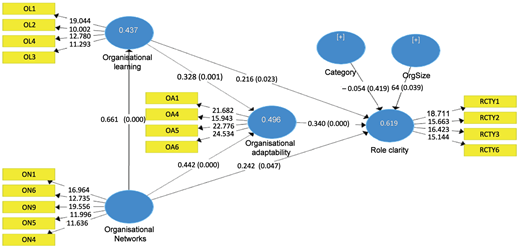
The measurement model is summarised in Figure 1. The reflective measurement model was assessed using SmartPLS 3.3.2 software (Ringle et al., 2015). The PLS variance-based approach was selected as it is robust in convergence at relatively non-normal distributions, and it is also useful for analysing multiple associations when estimating composite factors (Henseler et al., 2014). Additionally, it allows a simultaneous evaluation of both the measurement and structural models, while eliminating concerns about multicollinearity (Henseler et al., 2009a, b). Even when this method has been very highly criticised (Rönkkö and Evermann, 2013), a more elaborate debate about this can be found in McIntosh et al. (2014). It explains the reason why PLS-path modelling is a viable method in studying construct relationships, especially for composite path modelling with a smaller sample size. In relation to our study, as proposed by McIntosh et al. (2014), we took into consideration the different method biases and constraints to ensure valid results, as is evident in the method description provided below. For instance, a variety of bootstrapped-based approaches to building confidence intervals were used to offset the impact of bimodality and discrepancies between analytical and bootstrap sampling distribution (Henseler et al., 2014). Additionally, the sampling requirement of having a representative sample to ensure valid results was adhered to during sampling (Hair et al., 2013). Further, we followed Hair et al.'s (2013) guidelines to report the PLS-SEM result. The skewness and kurtosis values of the items were ranged between −2 and +2, well below the levels suggested for transformation variables, meaning that non-normality of data is not an issue.
Furthermore, to evaluate a reflective measurement model using PLS, we considered individual item reliability, scale reliability, convergent validity and discriminant validity. Individual item reliability is assessed by analysing item loading, where Hair et al. (2020) propose that all item loading should be greater than 0.708. Regarding scale reliability, we analysed both Cronbach's alpha coefficient and composite reliability, which was confirmed with values above 0.7 (Nunnally, 1978). We used average variance extracted (AVE) to evaluate for convergent validity. An AVE with a value of 0.50 or higher is adequate for each construct to explain more than half of its correspondent item (Hair et al., 2017). Hence, as it can be seen in Table 5, all reflective items were accepted in our model. Since all the lower-order constructs had survived with four items, we went ahead to assess whether they were modelled rightly as reflective or otherwise, by use of confirmatory tetrad analysis (CTA-PLS) (Gudergan et al., 2008). To analyse this, we followed Bollen and Ting's (2000) principle of confirmatory approach of testing model-implied vanishing tetrads in the PLS-SEM context.
This analysis follows Bollen and Ting's (2000) principle of confirmatory approach of testing model-implied vanishing tetrads in the PLS-SEM context. For significance testing, we ran the CTA-PLS for a high number of bootstrapping, using 5,000 sub-samples that were created with observations randomly drawn from the original set of data to ensure stability of results and generated the 90% bias-corrected and Bonferroni-adjusted bootstrap confidence interval for each non-redundant tetrad. According to Hair et al. (2019), if the confidence interval of the measurement model's tetrad does not include zero, the reflective measurement model should be rejected and a formative measurement model assumed. The results for the CTA-PLS indicate that all confidence intervals include zero; therefore, the CTA-PLS empirically provides support for reflective measurement model specification.
According to Barclay et al. (1995), the shared variance between a variable and its indicators should be higher than the average variance shared with other variables in the model to establish discriminant validity. We, therefore, used three criteria to evaluate discriminant validity (i.e. loading exceed-loading, Fornell–Larcker criterion and Heterotrait–Monotrait Ratio (HTMT)) for the reflective measurement model (Henseler et al., 2015). First, items should load more strongly on their correspondent constructs than on other constructs (see results in Table 7). Then, the square root of each constructs' AVE should be higher than the level of correlations involving the construct (Fornell and Larcker, 1981). In addition, the HTMT must be significantly smaller than 0.85 (Henseler et al., 2016). The factor loading of the constructs was higher than cross-loadings, indicating that all items measure their corresponding construct (see Table 6). Inter-construct correlations were examined during the measurement model assessment. As shown in Table 7, all constructs have more variance with their item than with items of other constructs. Moreover, all the correlations are below the cut-off value of 0.80 (Hair et al., 2013). Since both cross-loading and Fornell–Larcker criteria have been met, discriminant validity among the construct has been established. Table 8 below illustrates the results obtained from the HTMT test. Based on the results, the inter-construct correlations values are below 0.85. Overall, HTMT is significantly smaller than 0.85, which further suggests that HTMT does not indicate a discriminant validity problem in this study (Henseler et al., 2016).
3.5 Structural model evaluation
Before assessment of the structural model, non-linearity issues to confirm whether a linear relationship exists among the independent and dependent variables and also to confirm collinearity between constructs and the possibilities of endogeneity essentially were examined.
3.6 Quadratic effect analysis (non-linearity)
In order to confirm whether independent and control variables have a linear relationship with the dependent variable, we performed a quadratic effect analysis to establish whether there is a non-linearity effect among the hypothesised relationships (Hair et al., 2018). This was done because a non-linear relationship between two variables has multiple implications for both theory and practices. Hair et al. (2018) specifies that in evaluating the non-linear effect, we consider the significance of the quadratic effect by use of 5,000 samples using the no sign change option at 95% confidence interval, the strength of the non-linear effect by considering the f2 effect size (which assesses the change in R2 value predicted variable when the exogenous quadratic term is omitted from the model). The quadratic effect results in Table 9 reveal that organisational adaptability has a positive and significant quadratic effect on role clarity (β = 0.096, p = 0.020), but with a small effect size value (f2) of 0.044 basing on Gignac and Szodorai (2016) and Cohen's (1988) effect size value (f2) threshold of 0.02, 0.15 and 0.35, while the rest of the independent and control variables have a quadratic effect with role clarity as their β coefficients are non-significant but also with low or no effect size. This means that while the rest of the independent variables have a linear relationship with role clarity, organisational adaptability has a quadratic effect. Therefore, as HOs perform their responsibility of delivering relief to victims, the organisations' level of organisational adaptability matters a lot.
3.7 Collinearity test
In order to assess whether there is collinearity or no collinearity in our structural model, we considered inner VIF values, as well as means and standard deviations of the four constructs and two control variables. All the inner VIF values for all study constructs are below 3.3 (Barroso et al., 2018), which reveals no collinearity, as summarised in Table 10 below. However, as the figures in Table 10 indicate, organisation category and organisational size have a rather low mean, suggesting that HOs often do not perceive themselves as understanding their mandate in relief operations, which affects their role clarity as they are found to be delivering many relief activities. This was the case despite most HOs in our group perceiving their levels of organisational adaptability, capabilities and networks to be quite high (almost a mean of 5 on the six-point scale).
According to Sarstedt et al. (2017), PLS-SEM does not divide the variance into common and unique, but it accounts for the total variance in the observed indicators than explaining the correlations between the indicators. We thus considered all the variances (common, unique and error) that the exogenous variables have in common with the endogenous variables when estimating the relationships between the constructs, since the composite variables are formed from a linear combination of the indicators for each construct (Pazirandeh and Maghsoudi, 2017; Sarstedt et al., 2017). We, therefore, performed a series of ordinary least squares regressions to estimate partial model structures with the intention of minimising the residual variance of the endogenous constructs. The PLS-structural model performed regression by the bootstrapping procedures. After the measurement model, the structural model was assessed in terms of R2 values, which indicates the variability accounted for by the precursor variables in the structural model. Since the R2 and adjusted R2 values consider model complexity and sample size, they are useful in comparing the explanatory power of the different models (Henseler et al., 2014). We, therefore, considered R2 and adjusted R2 in this study to test the direction of causality for the endogenous variables of organisational adaptability and organisational role clarity. In general, the approximate model fit is acceptable as the standardised root mean square residual for the composite model is 0.078, which is below 0.08 (95% bootstrap quantile).
4. Hypothesis testing and results
4.1 Inter-construct correlation
The results in Table 11 indicate that there is a significant positive association between organisational networks, capabilities, organisational adaptability and role clarity. Establishing a significant and positive correlation among the study variables enabled us to proceed to the testing of hypotheses, as is required.
4.2 Direct hypothesis
Using bootstrapping with 10,000 sub-samples with no sign significant option at 95% bias corrected confidence interval, the results reveal that most of the hypothesised relationships are statistically significant (p ≤ 0.05). The results show that organisational networks and role clarity have a positive and significant relationship (β = 0.242, p = 0.044, with lower and upper boundaries of the 95th BCa CI values of 0.014 and 0.458). Organisational networks and organisational adaptability are positively and significantly related (β = 0.442, p = 0.000, with lower and upper boundaries of the 95th BCa CI values of 0.231 and 0.619). Organisational adaptability and role clarity also positively and significantly related (β = 0.340, p = 0.000, with lower and upper boundaries of the 95th BCa CI values of 0.164 and 0.510). Organisational learning and organisational adaptability are also related (β = 0.328, p = 0.001, with lower and upper boundaries of the 95th BCa CI values of 0.126 and 0.520). Organisational learning and role clarity are positively and significantly related (β = 0.216, p = 0.023, with lower and upper boundaries of the 95th BCa CI values of 0.039 and 0.413). Organisational networks and organisational capabilities are also positively and significantly related (β = 0.661, p = 0.000, with lower and upper boundaries of the 95th BCa CI values of 0.490 and 0.772). Organisation size and role clarity are related (β = 0.164, p = 0.040, with lower and upper boundaries of the 95th BCa CI values of 0.016 and 0.328), while organisation category and role clarity have a negative and significant relationship (β = −0.054, p = 0.441, with lower and upper boundaries of the 95th BCa CI values of 0.181 and −0.074), as presented in Table 12.
The R2 values of 0.619 for role clarity, 0.496 for organisational adaptability and 0.431 for organisational learning further support our models in-sample model fit (Sarstedt et al., 2019; Hair et al., 2017), which recommends that any predictive variance between (0 and 1) shows predictive relevance. Finally, we ran a blindfolding procedure with an omission distance of seven to assess the predictive relevance of our model using a cross-validated redundancy values (Q2) index developed by Stone (1974) and Geisser (1975). The literature suggests that a Q2 value above 0 implies that the model has predictive relevance. In our global model, we observe a correct predictive relevance (0.305) for organisational adaptability (0.301) for organisational learning and (0.271) for role clarity, further supporting the model's predictive accuracy.
4.3 Mediation results
We also ran a mediation analysis by following Carrion et al.’s (2017) recommendation, where we introduced organisational adaptability as an intermediate variable between organisational networks and organisational learning at the same time, organisational learning between organisational networks and organisational adaptability and role clarity. The results further show that organisational adaptability has a positive and significant mediating effect on the relationship between organisational networks, capabilities and role clarity (β = 0.151, p = 0.002, with lower and upper boundaries of the 95th BCa CI values of 0.069 and 0.267), (β = 0.112, p = 0.019, with lower and upper boundaries of the 95th BCa CI values of 0.039 and 0.227), confirming our theorised indirect relationship of organisational networks and capabilities with role clarity. This implies that organisational adaptability partially mediates organisational networks, capabilities and role clarity. Further, the mediation results indicate that organisational learning partially mediates the relationship between organisational networks and organisational adaptability and role clarity (β = 0.217, p = 0.005, with lower and upper boundaries of the 95th BCa CI values of 0.079 and 0.380); (β = 0.151, p = 0.002), with lower and upper boundaries of the 95th BCa CI values of 0.039 and 0.227). These results are presented in Table 13 below.
5. Discussion
The results show that organisational networks positively and significantly influence the clarity of organisations' roles. This connotes that the more an organisation builds networks with other members of the relief supply chain through staff interactions, consulting and responding to other relief organisations' requests, the better it understands its roles and responsibilities, which, in the end, helps it to respond with what it is expected to deliver. Furthermore, the relationship implies that an organisation which is good at exchanging information and receiving feedback from other organisations is likely to carry out relief activities within its capacity. This is because through such exchanges, participating organisations usually gain access to sets of relevant information, such as lists of victims' needs, locations and capacity gaps. They are also able to understand the processes and procedures, which they easily domesticate without necessarily re-inventing the wheel. In the context of this study, the project managers of HOs revealed how they were able to purchase and promptly deliver the quantities of relief needed by simply interacting with sister organisations without them stocking what would not be needed. This finding supports Jabbour et al.'s (2019) and Thornton et al.'s (2013) findings that organisational networks induce role clarity among participating members of a network through sharing various resources such as knowledge and information that are crucial in fostering the understanding of roles and responsibilities when delivering food and non-food items.
Organisational networks positively and significantly influence an organisation's level of adaptability. This means that the connections between similar and sister organisations could be tapped into in case of any emergency and that establishing new contacts is likely to help the related organisations appreciate their operational environments better. In turn, this helps to develop appropriate structures, patterns and logistics infrastructure that suit the contexts of implementing their relief activities. This happens because ties and interaction quality are responsible for the transmission of the information necessary for one to appreciate the prevailing circumstances within their operational environments. Consequently, HOs are better informed about how best to organise themselves in the delivery of relief services to meet the expectations of the beneficiaries. This finding is in line with those of Dubey and Gunasekaran (2016) and Obrecht and Bourne (2018), who have shown that clusters of organisations that make decisions jointly and integrate their efforts in the provision of humanitarian relief aid during the complex times of crisis need to exhibit a high level of adaptability.
Further, the study found a positive and significant relationship between organisational adaptability and role clarity. This means that an organisation that can readily scan changes in the environment is likely to solve difficult problems accurately and systematically. They elicit meaning to understand their role and responsibilities in a changing environment, which enables them to respond with the appropriate relief. From this finding, it can be noted that a HO that monitors its operational environment is likely to come up with new operational guidelines, patterns and a logistics infrastructure for delivering relief efficiently. HOs do not only evaluate immediate needs but create flexible processes and service designs to adapt to changing conditions so as to deliver relief to the last-mile beneficiaries. Organisational adaptability determines where the organisation's relief stands in terms of technology and relief life cycles. This enables an organisation to deliver the expected relief basing on its mandate and capacity during relief operations to save disaster victims. This finding is in line with that of Balland and Sobhi (2013), who established that as an organisation seeks clarity of understanding the disaster needs, it should adjust to the demands of the operating situation. A similar argument is shared by Nurmala et al. (2017), who state that successful disaster relief operations require both a high degree of organisational adaptability to local conditions and sufficient experience of the role to be performed by its skilled staff. Furthermore, our results resonate well with those of Dubey et al. (2015), who earlier emphasised the relationship between organisational adaptability and HOs' understanding of their roles. This increases their humanitarian supply chain performance such as selection of the mode of transportation for timely relief delivery to victims.
The results also indicate that organisational adaptability plays a partial mediating role between organisational networks and role clarity among HOs. This means that networks have a direct effect on role clarity as well as an indirect effect through organisational adaptability. This implies that an organisation that creates and maintain networks with other organisations in terms of connections between similar and sister organisations, and also establishes new contacts in case of any emergency, is likely to monitor and evaluate the operational environment against its operational guidelines, patterns and logistics infrastructure. This helps HOs to create flexible process and service designs to adapt to changing conditions. In addition, HOs are likely to determine where their relief stands in terms of technology and relief life cycles. Relatedly, this aids relief delivery basing on mandates and capacity when working with other relief partners (Balland and Sobhi, 2013; Collinson and Elhawary, 2012; Jense and Hertz, 2016; Khan et al., 2019).
Our results similarly suggest that organisational networks increase organisational learning. This finding shows that connections that exist internally and externally with similar and sister organisations are likely to increase their learning capabilities. This is established through improved sharing of past relief experience and operational procedures based on best practices. HOs that jointly evaluate their performance of roles and tasks are likely to improve their collaboration. Contextually, it was established that the forging of strong ties between HOs shaped the flow of valuable information about their role during relief operations. This facilitated their learning to create more reliable ties and opportunities. This finding is supported by that of Gulati et al. (2002), who argue that the informational advantages of organisations from such social networks can enable an organisation to create new collaboration capabilities by means of access, timing and referrals. In addition, the results are consistent with those of the study by Mutebi et al. (2020a), who also argue that organisational learning being action-focussed and the creation of collaborative ties are affected by HOs' centrality to the overall relief network. This is so because HOs acquire the learning capabilities needed to understand and perform their roles in an acceptable manner to meet the expectations of stakeholders.
The results show a positive and significant direct link between organisational learning and role clarity among HOs. Our results imply that HOs' capabilities, such as being learning-oriented while coordinating relief efforts, may help them carry out relief activities in the way they are expected to deliver within its mandate and capacity. This is because learning increases the organisational commitment to search for new and unique ways of responding to problems. It also increases the organisation's ability to create, use and recombine new and existing knowledge in relief responses. In the context of developing countries, this finding demonstrates that an HO where members are committed to active learning will generate new insights and share information with other organisations about their task roles. This helps them to continuously learn from other relief organisations and improve on their performance. In addition, the results attest that an HO that uses past relief experiences can generate its own procedures and mechanisms to jointly evaluate its roles and the tasks it is expected to deliver based on best practices. This finding resonates with the works of Jensen and Hertz (2016) and L'Hermitte et al. (2016a, b), who argue that learning capabilities invoke organisational coordination ability with other organisations. This helps them to undertake effective relief actions that are necessary for responding promptly to unforeseen events by adjusting plans and courses of action.
Further results show that there is a partial mediating effect of organisational learning in the relationship between organisational networks and role clarity. This supports the notion that the strategic importance of organisational networks enables organisations to fulfil their roles and responsibilities when influenced by their learning capability. This implies that when organisational implementers access and use resources such as knowledge and information from the networks, they are likely to generate new insights and share information with other organisations. This helps HOs to develop a clear understanding of the roles and responsibilities of the members within their relief network. This finding also demonstrates that organisational networks present an opportunity for an organisation to continuously learn through the constant interaction and sharing of past relief experiences. This helps HOs to develop procedures and mechanisms for identifying lessons from past operational successes and failures which are necessary for performing their tasks as expected. The statistical results reveal that organisational learning explains 59% of the relationship between organisational networks and role clarity. It should be highlighted that the support afforded by organisational learning mediates the relationship between organisational network and role clarity. This strengthens the classical and more complex adaptive nature of role clarity during relief delivery (Lizier and Reich, 2020; Jordan et al., 2009). From this perspective, relief actors that are conditioned to establish network ties with sister organisations are likely to learn and develop procedures and mechanisms that make HOs develop a clear understanding so as to deliver their roles and responsibilities effectively (Balland and Sobhi, 2013).
Subsequently, there is a positive and significant relationship between organisational learning and organisational adaptability. This finding implies that whenever there is a better organisational level of capabilities, such as structures, this is likely to encourage employees to think and come up with novelty products and services. The HOs that adjust their operational guidelines, patterns and logistics infrastructure to deliver relief evaluate the needs of ultimate beneficiaries and sometimes create adaptive process and service designs. Organisational learning determines where the organisation's relief stands in terms of technology and relief life cycles during operations. In the context of this study, HOs that are creative and innovative through administrative structures are likely to encourage novelty thinking based on the past experiences and best practices. Relatedly, organisations that develop adaptive SOPs, patterns and logistics infrastructure are likely to support appropriate relief activity implementation. Our findings support those of earlier studies (Mutebi et al., 2020b), which established that organisations that continuously adapt to the dynamic operating environment through learning and sharing experiences of past relief activities are likely to work together.
The study also found that organisational adaptability plays a partial mediating role between organisational learning and role clarity. This suggests that organisational learning capability influences organisational adaptability and role clarity. The more HOs continuously learn from one another, the more they become adaptive. This contributes to their understanding of the roles and responsibilities that they perform. Further, the results infer that those organisations that learn from past relief experiences develop mechanisms and procedures which help them adapt to a disaster operating environment. They are also able to come up with patterns and logistics infrastructure that enhance task performance. Additionally, organisational adaptability helps HOs to evaluate and understand the needs of beneficiaries to create flexible processes to meet such needs. The results support CAS theory (Malina and Holland, 1996), which posits that organisations need to have a clear understanding of what they perform in an environment characterised by ambiguity and uncertainty. This accords them the ability to develop a coherent form of learning and adaptation.
Finally, we note that organisational learning partially mediates the relationship between organisational networks and adaptability. This partial mediation accounts for 49% variation. This means that organisational networks can impact adaptability directly (51%) and indirectly through organisational learning. This means that in a dynamic environment, it is important for organisations to adjust process and infrastructure designs by employing their own and other partners' resources in a network. When HOs set up a temporary network during a crisis, it is possible to adjust through organisational learning. Contextually, it was established that HOs use resources such as knowledge and information obtained from their networks to monitor the environment. HOs are able to do this through active learning and self-development among organisational members, generating new insights and acquiring information for continuous learning. This finding resonates with that of Jense and Hertz (2016), who propose that organisational learning links with organisation networks and organisational adaptability among relief responders. In their study of the coordination roles of HOs during the post-election Kenyan crisis in 2007, they found that network attributes shape the level of organisational learning. Whenever organisations learn, it affects their level of organisational adaptability to fit in a dynamic environment in which they execute their roles and responsibilities in delivering relief such as food and non-food items.
6. Conclusion
Drawing on a CAS theory, organisational networks, learning and adaptability may be used by organisations to increase their level of role clarity during situations of emergency relief delivery. We developed a model that attempts to explain how organisational networks, learning and adaptability explain role clarity and the mediating role of organisational adaptability between organisational networks, learning and role clarity among relief organisation during disaster operations. Our theoretical model reconciles the independent contributions of two well-established streams in the literature: studies that explain the use of organisational networks and learning to increase organisations' level of organisational adaptability and those that focus on role clarity in operations management. We tested our ten research hypotheses based on 101 HOs operating in Uganda. Our findings support our hypotheses. The study concludes that organisational adaptability plays a partial mediating between organisational networks and role clarity among HOs. Further, there is a partial mediating effect of organisational learning in the relationship between organisational networks and role clarity. In addition, organisational adaptability plays a partial mediating role between organisational learning and role clarity. Consequently, organisational learning partially mediates the relationship between organisational networks and adaptability. Therefore, this study contributes to the role clarity literature from a CAS theory view.
6.1 Implications: theoretical, practical and managerial
Theoretically, this study explains role clarity among HOs during relief delivery from a CAS perspective. In so doing, it appreciates the complexity of humanitarian logistics management and subsequent emergency response (Cozzolino, 2012) and Carmichael and Hadžikadić (2019) emphasises that, like any other CAS phenomena, role clarity among HOs has an inherent property of adaptability due to the uncertain, unpredictable and emergency nature of the humanitarian response needed. Against this backdrop, we broaden the utility of the CAS theory by showing how understanding and invoking the CAS components is crucial in building role clarity among HOs through clarifying the relationship between organisational networks, learning and adaptability.
Practically, our results suggest that HOs should utilise organisational learning, networks and organisational adaptability as instruments of fostering role clarity. Although we could not prove causality, earlier studies show a relationship between organisational learning components like purposeful by developing a clear vision, action-focussed, collaborative and learning-oriented and role clarity in relief operations (Jensen and Hertz, 2016; L'Hermitte, 2016). HOs should allow learning to happen by collaborating with other HOs to gain the resources they need in order to understand and deliver relief efficiently as expected (Saavedra and Knox-Clarke, 2015). In addition, HOs should be action-oriented as a means to have a clear understanding of their roles and responsibilities to deliver relief such as food and non-food items that meet the ever-changing needs of the victims.
Relatedly, for HOs to have a clear understanding of their roles necessitates that they network with other HOs. This is possible in situations where there are quality interactions among network members such as sister HOs and sectoral members. They can increase their visibility by continuously exchanging information about the relief operational requirements. In principle, it is possible to network, and there are enough examples where this has happened (e.g. between Oxfam, UNICEF, Save the Children International and World Vision in the provision of child protection services). Most practitioners know that networking is certainly not easy in the context of relief operations (Saavedra and Knox-Clarke, 2015). Organisations that engage in the same relief activities are likely to fear being outshone and to lose visibility in the crowd. This fear should be overcome by encouraging HOs to adapt networking conditions where they develop adaptive standard operating procedures (SOPs), so that members can establish contact and interact with other organisations in a manner that allows them to remain focussed on the achievement of shared goals.
Role clarity in relief operations requires an organisation to be able to adjust as the operational environment is uncertain and complex. This requires HOs to adjust their range of operations to increase their possibility of learning for timely relief delivery in an ever-changing environment. Relief actors should demonstrate adaptable behaviour to succeed in a complex environment by learning, unlearning and relearning to understand complex problems. Therefore, relief delivery SOPs should have an adaptive approach (Harwood and Porter, 2020). HOs can integrate organisational adaptability into relief delivery SOPs. This can be done, first, by incorporating adaptive prompts into pre-existing relief delivery SOPs. Prompts are instructional steps that help emergency responders identify and understand unanticipated behaviour during complex events and adjust their relief delivery response plans accordingly.
For managers of HOs to understand their role better during relief operations, they should network and be adaptive. Managers should communicate a clear purpose and align goals and objectives, processes and procedures set up to achieve the overall purpose. This will enable the relief implementers to have a clear understanding of what they are supposed to do when delivering relief. In addition, managers need to be action-focussed, confident and to possess the necessary skills, such as those connected to coordination to handle relief tasks, and also provide implementers with the necessary resources such as the logistics information needed to perform relief activities. Further, managers need to create and promote a learning-oriented environment by having mechanisms in place for identifying lessons from past operational successes and failures. This encourages implementers to reflect on those past operational experiences and generate their own procedures based on best practices.
Managers also need to network to improve on their role clarity through the formation of operating structures such as consortiums and through signing agreements, conducting multilateral joint need assessments and formulating mutual accountability frameworks that allow the exchange information.
Lastly, managers of HOs should encourage organisational adaptability to increase role clarity. This can be made possible by having adaptive SOPs in place which allow relief operation implementers to reflect, learn and make the adjustments needed to handle emergencies. This can be achieved by having a clear understanding of what is needed by victims in specific contexts, which requires the localisation of logistics activity preparedness to meet the changing needs of the beneficiaries. Therefore, HO managers should design operational work plans and attendant procedures that can accommodate emerging patterns during relief delivery.
6.2 Limitations and future research
Although our study offers useful contributions to research, we note the limitations of the study. We suggest that researchers and practitioners should evaluate our study results and contribution in the light of its limitations. (1) We have grounded our theoretical model in CAS theory. Hence, our research hypotheses are based on our constructs in the theoretical model in Figure 2. Like any theory-driven research, our theoretical issues are compounded by measures that do not truly capture organisational learning and role clarity. Hence, to address some of these limitations of the theory-driven research, the use of multiple methods may provide a better understanding of complex phenomena in the humanitarian logistics and supply chain. (2) We have used cross-sectional survey data. However, future studies may adopt longitudinal data and experimental design to further our current understanding of how organisational learning networks and organisational adaptability improve role clarity. (3) The respondents gave their perceptions of their organisations' understandability of their role and responsibilities during relief operations, which might have caused sources desirability which poses a potential bias. Therefore, in future, based on Guide and Ketokivi's (2015) suggestions, the respondents should be encouraged to give their responses based on their organisational records of the operations concluded so that they can present a true picture of whether they are able to perform their duties of delivering relief based on the expectations of other stakeholders.
The authors are grateful to the Almighty God.
Funding: The authors declared that no fund was requested nor received for this paper. The authors took care of all expenses.