


The purpose of this study is to understand how humanitarian service triad members contribute to value co-creation, and how they assess the continuity of services in humanitarian supply chains (HSCs) to ensure support for beneficiaries.
The study applied a qualitative methodology through a single case study of a humanitarian service triad composed of non-governmental organisations (NGOs), service providers and beneficiaries. Empirical data were collected through semi-structured interviews and observations.
The findings confirm that the humanitarian service triad perspective in HSCs allows better understanding of humanitarian assistance. The findings indicate six components grouped into a humanitarian service triad framework, namely: service design, service reachability, training serviceability, collaboration, synergy, ethical considerations and after-service care.
This research contributes to understanding of humanitarian services provision by studying service triads in humanitarian settings. It also confirms the need for cooperation between practitioners in services provision. The findings are limited to the context of refugees in Turkey, specifically humanitarian service triad located in Izmir area.
The Humanitarian Service Triad Framework for Service Provision proposed in this paper can be used as a tool for policy makers and practitioners involved in service design in HSC contexts, stressing the need for including all the framework components in practice.
This study is one of the first to focus on a humanitarian service triad, which includes beneficiaries as triad members in long-term humanitarian service provision.
1. Introduction
Humanitarian supply chains (HSCs) are designed to deliver aid, goods and services, to beneficiaries. Aid is needed at all stages of the disaster cycle, from the immediate response to recovery. The refugee crisis that followed the conflict in Syria poses great challenges, creating a need for new solutions to accommodate the needs of beneficiaries. Such challenges are related to the complexity of the conflict, which involved different state and non-state actors, and its international dimension. It also resulted in internal (Internally Displaced People – IDPs) and cross-border movement (refugees in the region and neighbouring countries).
Turkey, which borders with Syria, has hosted the highest number of refugees: 3.6 million (UNHCR, 2018). In the first stage of the crisis, during and after the intensification of the fighting, humanitarian assistance aimed at fulfilling basic human needs (security, food, shelter, WASH). However, as the conflict developed, assistance evolved into longer-term service provision. This included longer-term accommodation, services such as education, including language and job training with aim to integrate refugees into host communities. The shift from short- to long-term services provision requires a change from focus on immediate needs to a longer-term vision. The service design should also include beneficiaries as co-creators of the service, in line with Grönroos (2011), who defines customers as co-creators of service value alongside companies. That is, the concept of co-creation can also be applied in humanitarian settings, with the customer replaced by the beneficiary as the end user of the service at the same time as the value co-creator.
HSCs consist of multiple members: donors, aid agencies, non-governmental organisations (NGOs), governments, the military, logistics service providers and suppliers (Kovács and Spens, 2008). The beneficiary needs, especially in the early response phase, are frequently unknown to the humanitarian organisations, nevertheless they must be accommodated (Altay and Green, 2006; Kovács and Spens, 2007; Oloruntoba and Gray, 2009).
Recent research has focused on the ways of how to enable many actors to trust each other and work together to meet the needs of beneficiaries (Dubey et al., 2021). In some cases, the co-creation of humanitarian aid involves service triads rather than dyads (Li and Choi, 2009). In practice various approaches of humanitarian supply chain management (HSCM) to co-creation are possible, including information alignment and collaboration for supply chain agility (Dubey et al., 2020a), big data use to create swift trust and coordination (Dubey et al., 2018) and collaboration between civil and military organisations (Dubey et al., 2019a). Other studies have investigated the role of blockchain technology to increase collaboration and resilience (Dubey et al., 2020b). Finally, Dwivedi et al. (2018) analysed how the negative attitudes that employees develop when working in humanitarian contexts can harm collaboration between organisations.
The service triads include various actors providing a humanitarian response (Heaslip and Kovács, 2018). Research focused on triads extends beyond dyadic relationships and cover analysis of multiple service providers. However, research on service triads in humanitarian settings is limited, especially regarding value co-creation in service triads (Heaslip and Kovács, 2018; Heaslip et al., 2018; Vega and Roussat, 2019). In response to such shortcomings, the present study addresses the following research question:
How is value co-created in humanitarian service triads?
This study elaborates theory by taking a case study approach (Eisenhardt, 1989; Yin, 2009; Ketokivi and Choi, 2014) to understand the dynamics of value co-creation in service triads in humanitarian settings. Like Heaslip and Kovács (2018), the study focuses on a service triad, but it investigates the beneficiaries instead of the donors as triad members. It examines long-term service provision for Syrian refugees in Izmir, Turkey, specifically for capacity building and integration with local communities through language and job training. By exploring the underpinnings of service provision, the research contributes to a better understanding of long-term service provision and value co-creation in humanitarian service triads.
The paper is structured as follows. The next section reviews the literature, focusing on service triads. The third section presents the methodology. The fourth section discusses the findings, while the final section offers some conclusions for theory and practice.
2. Literature review
The service triad concept concerns the business relationships between supply chain members (Choi and Wu, 2009). The basic triad includes supplier, buyer and customer (Wynstra et al., 2015), though other combinations are possible, such as a manufacturer and two suppliers (Peinkofer et al., 2019). Triads go beyond dyadic relationships and cover a wider section of the supply chain. This in turn allows a better understanding of the relationships between members.
Research on service triads emerged in the late 2000s, as result of the growing interest in supply chain and operations management (Wynstra et al., 2015). Triads have been studied in commercial supply chains including transport service sector (Andersson et al., 2019), drop shipping fulfilment (Peinkofer et al., 2019), container ports (Russel et al., 2020), third party service providers (Li and Choi, 2009), purchasing (Broekhuis and Scholten, 2018), retail performance (Chuang et al., 2016) and socially responsible operations (Jung et al., 2015).
Within the framework of service-dominant (S-D) logic (Vargo and Lusch, 2004), supply chain actors work together to co-produce service offerings, exchange service offerings and co-create value (Lusch, 2011). In supply chain management, the concept of service-dominant logic, based on value co-creation (VCC) (Vargo and Lusch, 2004; Vargo et al., 2008), provides the basis for performance analysis and on-shelf availability (Ehrenthal et al., 2014; Tuan, 2017), customer loyalty and contribution to the overall process (Thiruvattal, 2017). VCC is “joint activities by parties involved in direct interactions, aiming at contributing to the value that emerges for one or both parties” (Grönroos, 2012, p. 1520). According to Grönroos (2012), customers must communicate with other triad members to co-create value. In addition, it is necessary to consider how each member contributes to the service triad and improve collaboration within the triad (Bagdonienė and Gegužytė, 2018). In short, collaborating and interacting with other members in a supply chain or service triad are essential for creating value (Pinho et al., 2014).
The application of S-D logic and VCC to service management has gone through several stages. The earliest efforts focused on integrating internal and external factors (Maglio and Spohrer, 2008). Later, a move away from good-dominant logic provided new insights from various perspectives regarding the complexity of the process (Saarijärvi et al., 2013; Achrol and Kotler, 2014). More specifically, it provided a paradigmatic perspective (Vargo and Lusch, 2004, 2014; Ng et al., 2012; Mele et al., 2014). Theoretical statements regarding the VCC and service management can be figured out need of seeking alternative ways to demonstrate S-D logic (Galvagno and Dalli, 2014; Barile and Polese, 2009).
To improve knowledge in humanitarian settings, HSCM borrows concepts and theories from other fields and disciplines (Tabaklar et al., 2015). Heaslip and Kovács (2018) identified service triads among the implementing partners, donors, humanitarian organisations (HO) (e.g. UN agencies) and logistics service providers (LSPs). HOs offer services to other HOs (Heaslip, 2013), which demonstrates the transition towards a service-dominant logic. HSCs also focus on goods and services for refugees. Scholten et al. (2018) highlight three service provision processes: (1) acute services, including basic service provision as in immediate response; (2) short-term services, including medium-term service provision, such as asylum processes; and (3) long-term services, including programs such as education. This study focuses on a service triad involving beneficiaries who participate in value creation for long-term humanitarian service provision.
2.1 VCC in humanitarian settings
NGOs have evolved into supply chain partners and an accepted component of supply chain (Hyatt et al., 2016; Peng et al., 2021). In humanitarian operations, the quality of interaction primarily depends on how the service is designed and how beneficiaries participate as the HSC's end users. VCC can be rapidly increased if situations are handled effectively based on efficient implementation of emergency response procedures (Whybark, 2015). Pillitteri et al. (2021) argue that VCC is determined by four factors: beneficiary features (trust, cultural motivation); environment features (such as local context); service design (e.g. stakeholder role); and humanitarian staff involvement. Through such an analysis, the ways that the triad members providing humanitarian services interact during VCC is exposed. The present study analyses communication between HSC triad members in depth to reveal from the members' various perspectives (service effectiveness, local integration, etc.) while providing humanitarian aid.
In any organisational environment providing public services, the actors develop different co-creation dynamics. This in turn determines the business processes (Best et al., 2018; Fawcett et al., 2021). More specifically, while engaging in socially responsible interactions through partnerships for development, non-profits and businesses often agree to improve qualifications (Austin and Seitanidi, 2012). Outcomes are likely to be better in humanitarian operations if the actors collaborate with each other (Bealt et al., 2016; Nurmala et al., 2017), for example by integrating knowledge and finding synergies within the community (Wetter-Edman et al., 2014; Greenhalgh et al., 2016; Taghizadeh et al., 2018; Baccaranni et al., 2019).
Pillitteri et al. (2021) argue that up-to-date research has not addressed the provision of services in humanitarian settings. They therefore used a dyadic perspective (professional service providers and beneficiaries) to investigate VCC, as first researchers to apply VCC theory to humanitarian contexts. They concluded that the outcomes of long-term integration programs depend on involving the beneficiaries. The study investigated what motivates humanitarian triad members, how they interact, collaborate, and communicate, as well as evaluated how their strategic decisions influences supply of their services. Furthermore, while creating a service framework for community-based service environments, relationship management and the transformation of services are crucial factors (Sabri et al., 2019; Obaze, 2019). Finally, supply chain actors can only use resources available and make plans that match their capacity once the basic elements and requirements have been defined (Fernando and Chukai, 2018).
More research is needed to determine the role of VCC in providing humanitarian services (Daugherty, 2011; Galvagno and Dalli, 2014; Heaslip, 2015). There has been little investigation of how multiple humanitarian actors collaborate, despite recent humanitarian-focused studies of VCC. To cover this gap in the knowledge, the present study investigates the role of VCC during operations that involve essential HSC partners: NGOs, governmental institutions, donors and beneficiaries. This provides a wider perspective of those involved. Finally, this study highlights how VCC within humanitarian service triads depends on how the partners are engaged in the process.
3. Research methodology
Researchers use case study methodology if they wish to test a theory's relevance to a particular phenomenon and context. Case studies enable researchers to explore variables in depth through rich data. The methodology is frequently used to explore real-life phenomena (Yin, 2009), which increasingly includes HSCs.
Case study designs can be categorised as four types based on two dimensions: single case vs multiple case and holistic vs embedded (Yin, 2009). Depending on the units or subunits to be analysed, the design is holistic or embedded. Embedded designs focus on a subunit or subunits while holistic designs focus globally on an entire case, such as a program or organisation, when a case lacks logical subunits. An embedded design is best for a case with different subunits. This then enables further extensive research (Yin, 2009).
This qualitative study is applied an embedded single case design to an HSC case comprising a humanitarian triad of NGOs, service providers and beneficiaries, acting as subunits within a VCC environment.
3.1 Case sampling, context description and data collection
Data were collected from semi-structured interviews, which allowed the participants flexibility and freedom to discuss their experiences and provide insights into their own contribution to VCC (Eisenhardt and Graebner, 2007). Interviews are preferred in qualitative case studies because, as guided conversations, they provide rich evidence regarding behaviours or other human-related events (Yin, 2009). A study that relies on interviews mainly explores the participants' subjective perspectives, ideas, feelings and views (Marshall and Rossman, 1995).
We have followed Strauss and Corbin (1990)'s approach as it allowed elaborating theory in relation to the particular phenomenon. With this approach, data regarding the experiences of participants are combined under the leading patterns, which enable us to develop the conceptual framework and propositions.
Semi-structured interviews are non-standardised interviews. This allows the respondent to discuss the research topic freely while the researcher can ask questions or introduce new topics in response to the interview process itself, although each interview is guided by a predefined topic or question list. Semi-structured interviews are particularly appropriate if the researcher is interested in the respondents' behaviours, experiences, perceptions and beliefs. The researcher is therefore interested in both the content and the manner of expression (Matthews and Ross, 2010). Consequently, respondents should have more experience and opinions to enable in-depth exploration of the research topics (Matthews and Ross, 2010).
Sampling is a critical factor in qualitative research (Coyne, 1997). For this study, respondents were selected from each triad member (NGOs, service providers and beneficiaries) located in İzmir, Turkey, through purposive (Palys, 2008) then snowball sampling (Patton, 2002) until data saturation was reached (Eisenhardt, 1989). İzmir is both a destination for refugees from Syria, and a gateway to the Balkan migration route. The Balkan Corridor leads through Greece to Central and Northern European Union countries (Abikova and Piotrowicz, 2021). With over 4 million inhabitants, Izmir is Turkey's third largest city. It hosts increasing numbers of Syrians under temporary protection, rising from 109,926 in 2017 (IGO, 2019) to 149,400 in 2021 (IDGMM, 2021).
The interviewees were selected from the triad members representing each actor in the service triad: six beneficiaries (B), ten NGO representatives and seven service provider representatives (SP) (Table 1). In total, 23 interviews were conducted, lasting between 35 and 90 min (average length 70 min; total length over 26.5 h). The interviews were recorded and transcribed before analysis. Field notes were also taken during the interviews. All interviews were conducted in Turkish before translation into English during transcription, translations were reviewed and confirmed by other Turkish-speaking researchers.
List of respondents (F-Female, M-Male, SP-Service Provider, B-Beneficiary, NGO -Non-Government Organisation)
| Code | Gender | Position | Humanitarian experience/years | Duration/mins |
|---|---|---|---|---|
| NGO-1 | F | Project Manager | 2–5 | 90 |
| NGO-2 | F | Protection Program Officer | 2–5 | 65 |
| NGO-3 | M | Logistics Officer | 2–5 | 90 |
| NGO-4 | F | Communications Officer | 0–1 | 90 |
| NGO-5 | F | Interpreter | 2–5 | 80 |
| NGO-6 | M | Protection Program Officer | 2–5 | 75 |
| NGO-7 | F | Livelihood Program Officer | 0–1 | 75 |
| NGO-8 | F | Social Coherence Program Officer | 0–1 | 90 |
| NGO-9 | F | Social Worker | 2–5 | 75 |
| NGO-10 | M | Logistics Officer | 2–5 | 90 |
| SP-1 | F | Local Institution | 10–15 | 90 |
| SP-2 | M | Head of Trade Association | 15–20 | 90 |
| SP-3 | F | Psychologist | 2–5 | 75 |
| SP-4 | F | Psychologist | 2–5 | 75 |
| SP-5 | F | Turkish Language Trainer | 5–10 | 60 |
| SP-6 | F | Turkish Language Trainer | 0–2 | 50 |
| SP-7 | F | Turkish Language Trainer | 0–2 | 60 |
| Code | Gender | Employment status | Years in Turkey | Duration/mins |
|---|---|---|---|---|
| B-1 | F | Employed | 8 | 60 |
| B-2 | M | Employed | 4 | 60 |
| B-3 | M | Unemployed | 3 | 40 |
| B-4 | F | Seasonal Worker | 8 | 45 |
| B-5 | M | Unemployed | 8 | 40 |
| B-6 | F | Unemployed | 5 | 35 |
The study was conducted in line with institutional ethical guidelines, with special attention to this issue in interviews with beneficiaries. Prior to the interviews, each interviewee was promised anonymity and their permission for recording was sought. Depending on employment status, interviews with beneficiaries were conducted either at a workplace or in a neutral place, such as a restaurant. At first, most of the beneficiaries (B) were reluctant to reveal sensitive autobiographical information. Therefore, opinion leaders were selected among beneficiaries to maximise access to information about a group of the population, as in Moldovan et al. (2017).
The interviews with NGOs representatives were carried out with their humanitarian aid employees. These NGOs are funded from various sources, such as governmental, institutional or private donors. Finally, interviews were conducted with service providers (SP), who act as intermediaries between NGOs and the beneficiaries (end users). SPs provide job-related, language and psychological support to the beneficiaries.
After recording each session, the audio files were transcribed to enable clear and systematic data analysis (Bernard and Ryan, 2010). A discovery-oriented approach (Yin, 2009) was applied to reveal detailed information and ensure that the professionals applied their knowledge and experience to the issue being discussed. We listened to each interview recording carefully to understand context and nuance.
3.2 Data analysis and quality of research
Through generating cumulative coding cycles, we first did open coding to create first-order concepts and then, went on with axial and selective coding. With this approach, we analysed interview transcripts to identify data patterns. Semi-structured interviews produce unstructured data since each respondent expresses themselves differently while giving varied answers based on their own words or actions. Data analysis is also complex and challenging because of the large amount of material. Therefore, the data should be divided into manageable groups. During the interpretation phase, the researcher should translate the respondent's data into meaningful information by inductively generating specific categories, themes and patterns (Marshall and Rossman, 1995).
Analysis has several steps. First, the categories, themes or sub-themes should be identified and described in terms of their essential elements. Second, the researcher should develop a hierarchical coding to attach to the original transcript so that the elements can be linked into a theoretical framework (Bernard and Ryan, 2010).
In this study, qualitative content analysis (Graneheim et al., 2017) was used to identify themes and patterns. Content analysis explores qualitative data to reveal core consistencies and meanings that form a pattern or theme (Patton, 2002). The present study adopted an iterative process whereby the categories were built, tested and revised by continually comparing the emerging categories with new data (Eisenhardt, 1989).
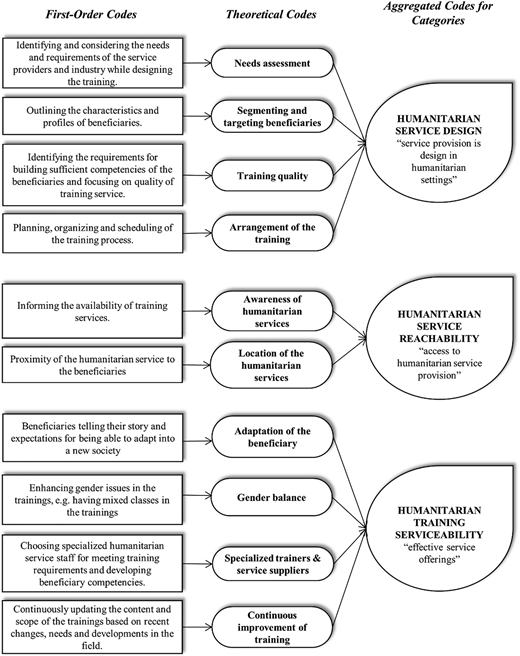
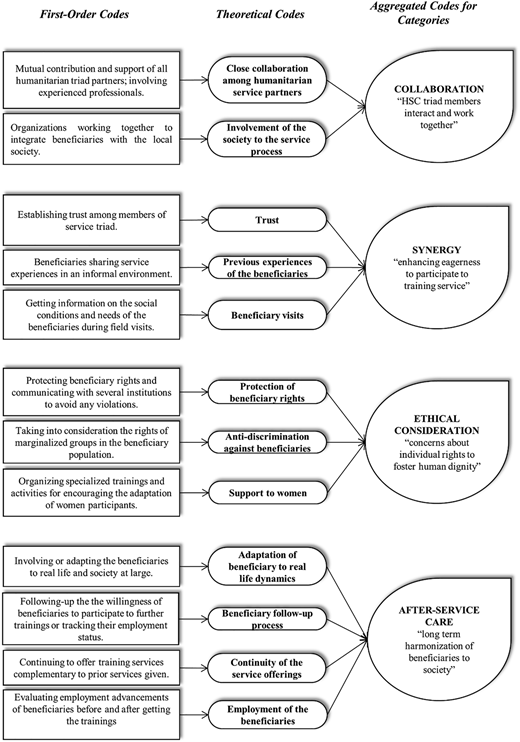
Accordingly, the data were first coded inductively (Eisenhardt, 1989) as open codes to develop first-order codes (see Figure 1 for the dyadic contribution of triad members and Figure 2 for the joint contribution triad members for the coding scheme). The unit of analysis of induction were practices amongst triad members. After this process, selective coding and axial coding (Strauss and Corbin, 1990) were applied to construct theoretical codes and aggregated codes respectively. Consequently, the framework and propositions for the humanitarian service triad were developed (Eisenhardt, 1989).
Interview protocol was prepared and interview data were collected by two researchers. During the interviews one researcher asked the interview questions while the other observed participants' attitudes. The researchers reduced bias by avoiding terms indicating any terms of discrimination, traumatic experiences or other sensitive issues in planning the interview protocol and data collection process. The questions were formulated in the neutral way, without suggesting the answer to interviewees. Interviews with all members of the triad allowed to capture their views from different angles, reducing the bias.
The data were coded by at least two researchers, with disagreements solved through “discursive alignment of interpretations” (Seuring and Gold, 2012). The open coding was done independently by two researchers, then theoretical and aggregated codes were done by two additional researchers. The differences and similarities between coding were reviewed and discussed till common agreement on final set of codes was reached. The data were then triangulated (Denzin, 2017). Field notes, publicly available reports by national, international and humanitarian organisations, as well as internal documents such as training content and statistical data collected by organisations were analysed. All other data sources were compared against interview data, looking for similarities and differences. Case studies must also be evaluated for their methodological rigor (Gibbert et al., 2008). To establish the trustworthiness of the study, the framework suggested by Halldórsson and Aastrup (2003) and Shenton (2004) was used (Table 2).
Trustworthiness of the study
| Dimensions of trustworthiness | Methods of addressing |
|---|---|
| Credibility |
|
| Transferability |
|
| Dependability |
|
| Confirmability |
|
4. Findings
The coding process revealed seven main components of VCC in the humanitarian service triad, whether through the triadic or dyadic contributions of the triad members: (1) humanitarian service design, (2) humanitarian service reachability (access to service), (3) humanitarian training serviceability, (4) collaboration, (5) synergy, (6) ethical considerations and (7) after-service care. Humanitarian service design, humanitarian reachability and humanitarian training serviceability are co-created through the mutual contributions of two triad members, whereas the others are co-created by all members.
After-care in humanitarian services is a generic component that influences all other components and enhances VCC across the triad for the continuous improvement of service delivery. Humanitarian service design, conducted by the NGO and the service provider, coordinates humanitarian services and identifies gaps in the process. Access to humanitarian service, conducted by the NGO and the beneficiaries, concerns gathering information regarding the process. Humanitarian training serviceability includes VCC by the service provider and the beneficiaries while the service is being provided. Two of three triad members are involved in all these co-creation activities.
The key attribute of the humanitarian service process is collaboration between all triad members and the wider society. It includes synergy elements and ethical considerations. After-service care, the final component of the humanitarian service process is an ultimate goal. It provides a long-term perspective and initiates further participation in job training. Each of the seven components is discussed in the following sections.
4.1 Dyadic relationships in humanitarian service triads
Based on the fieldwork, we identified three relationships that involved only two service partners: humanitarian service design (co-created by NGO and SP), humanitarian service reachability (NGO and beneficiary) and humanitarian training serviceability (SP and beneficiary). Each involves different pairings of triad members, as discussed below.
4.1.1 Humanitarian service design
Humanitarian service design (HSD) is a core value co-created by the NGO and service provider. Co-creators design the service provision in the humanitarian setting based on the following steps: assessing the needs of beneficiaries and employers, segmenting and targeting beneficiaries, enhancing training quality and arranging the training (see Table 3 for sub-components of HSD).
Humanitarian service design
| Humanitarian service design | Illustrative quotations from the interviews |
|---|---|
| Assessing the needs of beneficiaries and employers | “The most important thing is identifying the employment requirements. We aim to take into consideration the skills demanded by employers while considering the beneficiary profiles” (NGO-1) |
| “We have analysed the textile sector employment requirements and found that there is a need in certain areas, such as machine operating. In that regard, we've planned to conduct a training course” (SP-2) | |
| “At the beginning of the refugee crisis, we conducted visits to the areas where refugee population is high, and asked them to fill needs analysis forms to understand their needs, including employment, education etc.” (SP-3) | |
| Segmenting and targeting beneficiaries | “We begin to analyse the sensitive issues at the very beginning e.g. ‘When did the beneficiary arrive in this country? What is his origin? What is his education level? From which border did he enter to the country? Why did he choose migration?’” (NGO-2) |
| “We get information regarding beneficiaries' characteristics through pre-interviews or by distributing forms. We adapt the content of the trainings based on the profiles of beneficiaries” (SP-4) | |
| Enhancing training quality | “We try to offer suitable trainings to improve beneficiaries' skills (NGO-6) |
| “Our close connection with NGOs allows us to pre-determine the criterion for service quality and meet relevant requirements. We combine our knowledge and expertise with that of NGOs” (SP-2) | |
| “We arrange class size for more effective training. When the classes were up to 50 people, two beneficiaries were using the same machine, and others had to wait, often spending time on their mobile phones. Therefore, we limited the classes to 30 people” (SP-1) | |
| Arranging the training | “If we offer language trainings, we must consider the schedule of beneficiaries who are employed, e.g. offer evening or afternoon classes. Or, if there is high demand for a training, we ask service providers to run session in the morning and afternoon” (NGO-2) |
| “In the textile sector, the demand for labour tends to increase in the summer-time. So, we consider our participants' availability due to seasonality in the sector” (SP-2) |
A fundamental step in training design is identifying and considering the needs of both beneficiaries and employers. Since NGOs and service providers co-create value through needs assessment, it is important that they review historical data and conduct field visits to identify these needs. Needs are determined based on employers' long-term requirements and embrace service variety in line with the expectations of the future employment sector and skills needed.
It is also important to consider the needs of beneficiaries as these are key inputs to the design process. The beneficiaries' perspective provides a complementary input that supports the development of particular skills provisions needed for future employment.
Based on the information collected, beneficiaries should be segmented to ensure that the training targets appropriate groups. NGOs and service providers assess the beneficiaries' characteristics and segment them based on predetermined criteria. For this, both NGOs and SPs mainly base the beneficiary profiles on their origin, background and level of education.
By building a balance among different profiles, segmentation also helps to achieve social cohesion and overcome prejudice in humanitarian training. Furthermore, NGOs and service providers co-create value through providing training quality, building skills and improving beneficiaries' particular competences.
The aim is to design high-quality training, for example, to ensure an appropriate number of beneficiaries per class.
After determining needs, segmenting beneficiaries and providing training quality, attention is paid to the arrangement of training, including planning, organising and scheduling. This involves the identification of appropriate timings (e.g. based on beneficiaries' working schedules and taking account of irregular work shifts), specifying the duration of each training program, determining the length of training periods based on seasonality, length of working day, availability of beneficiaries.
4.1.2 Humanitarian service reachability
Humanitarian service reachability (HSR) relates to its locational and informational accessibility. This value is co-created across the triad by the NGO and beneficiaries to facilitate access by creating awareness and identifying suitable locations (see Table 4 for sub-components of HSR).
Humanitarian service reachability
| Humanitarian service reachability | Illustrative quotations from the interviews |
|---|---|
| Awareness of humanitarian services | “We are well-known among beneficiaries. We accept many applications. In addition, our organization has a website and various social media accounts. We publicize the activities and trainings via these channels. One more important point: our staff regularly contact beneficiaries by phone” (NGO-1) |
| “When I first arrived this country, I was able to understand Turkish, but I can't speak fluently. I followed social media accounts, and this allowed me to access information and knowledge about training” (B-1) | |
| “There are quite strong networks among beneficiaries. Even if the beneficiaries do not have any direct information regarding our organization or services, they can get information from their neighbours” (NGO-4) | |
| “I was working in a factory, but I was not able to understand the local language. Then I heard about the training opportunities from my neighbour” (B-5) | |
| “If we need to publicize important information, we get in touch with the opinion leader of a neighbourhood. Normally, he/she can reach almost everyone in their district. Also, the information is considered more trustworthy if it comes from the opinion leader” (NGO-1) | |
| “My cousin was attending a Turkish language course and he advised me to join that course, too. His experience encouraged me to take that language training” (B-2) | |
| “We stay in contact with several organizations in the field. For example, if we want to publicize some training, we put our brochures in the police stations or schools” (NGO-9) | |
| “I accompany my child to and from school. While waiting for him, I often see some information on the school's announcement boards. Sometimes, my child brings home some brochures that were distributed in the classroom” (B-6) | |
| “They have strong internal communication through WhatsApp groups. When there is a new training session scheduled, the information is quickly shared” (NGO-2) | |
| “I subscribe to Facebook groups that give news of training sessions. If I face communication difficulties due to the language barrier, I use the simultaneous translation feature of Facebook or Instagram” (B-2) | |
| Location of the humanitarian services | “We (NGOs and SPs) are located in or near the beneficiaries' neighbourhood” (NGO-1) |
| “I can participate in training close to where I live” (B-6) | |
| “We conduct a field analysis before deciding on the location of the training. We chose the place for our training based on the beneficiary population. This allows them to come on foot with no transportation costs and return home safely in the evening” (NGO-7) | |
| “I attend training if I do not have to pay for transportation” (B-5) | |
| “In the families, since most male beneficiaries are working, women beneficiaries take care of their children. We are trying to organize training in their child's school or close to them to increase women's participation” (NGO-2) | |
| “In general, training sessions are conducted in Public Education Centers or schools. I can participate in these kinds of trainings while my children are at the school” (B-6) |
Awareness of the humanitarian service is generated through various communication channels, including opinion leaders, social media, phone calls, field visits and online communication. Publicity is also produced by trainers and local organisations. NGOs established a link between service provider and beneficiary, raising awareness of the service through various communication channels.
This information is further disseminated among beneficiaries by methods like word-of-mouth (WoM). Such communication was highlighted as one of the most effective channels to raise awareness on humanitarian services since beneficiaries often live in the same street, neighbourhood or district.
Information related to the humanitarian service can also be spread by awareness-raising among beneficiaries by opinion leaders. Opinion leaders are beneficiaries who are well-known, trusted and experienced in their neighbourhoods, such as relatives, experienced friends or members of female networks.
In addition, institutions like police stations, repatriation centres, social solidarity networks and schools help increase awareness by sharing information by various means including distributing brochures and posters.
Field visits, regular meetings and phone calls to beneficiaries are particularly emphasised as having a strong effect on generating awareness because information is disseminated intensively through such means. Online communication channels also improve awareness and access to services.
Another important aspect of humanitarian access to service relates to the proximity of the service, so an appropriate location is critical for sustaining participation.
A service that is close by removes barriers to participation due to time and travel costs. In addition, women find it hard to participate because of childcare responsibilities. Therefore, locating the humanitarian service close to their home or their child's school increases their opportunity to participate.
4.1.3 Humanitarian training serviceability
Humanitarian training serviceability (HTS) is a value co-created by service provider and beneficiary during service provision itself. The service provider contributes to the effectiveness of the training process, enhanced by the expertise and experience of the trainer while the beneficiary contributes by engaging and developing their skills (see Table 5 for sub-components of HTS).
Humanitarian training serviceability
| Humanitarian training serviceability | Illustrative quotations from the interviews |
|---|---|
| Enhancing the beneficiary's adaptation | “I can see the change in the beneficiaries during the training process. They seem happier if they can manage their daily routines by themselves; even going to a market alone can be a success story for them” (SP-7) |
| “I learned Turkish through listening, and I developed it with further Turkish courses. Once I could speak Turkish better, I felt more comfortable living here” (B-1) | |
| Providing gender balance during training | “We were not sure about mixed gender groups for training. Therefore, after field visits, and one-to-one interviews, we organized the classes according to gender and we were able to avoid any kind of issue” (SP-6) “I took some training in mixed classes, but I prefer to participate in training where there are only women participants” (B-6) |
| Employing specialised humanitarian training staff | “In the service process, we get internal training, called trainers' training. In addition, our specialization is taken into consideration during the selection stage. Thus, beneficiaries are able to get maximum benefit from our experience and knowledge” (SP-3) |
| “In the training sessions, I understand because the trainers are always able to answer my questions” (B-1) | |
| “The training not only helped me to find a source of income but also enabled me to start a career that will increase my living standards in the long term” (B-4) | |
| Continuously improving the training | “We need to update the content regularly to match recent changes in the area. Conducting field visits help us to improve the content of training” (SP-4) “I have lived in this country for years, and we change, and our needs also change. The content of the training sessions is revised based on these changes; therefore, I am able to stay up to date, and this allows me to make progress towards my goals” (B-1) |
HTS is achieved by enhancing the beneficiary's adaptation, providing gender balance during training, employing specialised humanitarian training staff and continuously improving the training.
The beneficiaries may feel like outsiders because their daily routines are often different from those of locals. Therefore, the primary role of a humanitarian service is to help the beneficiary adapt to the local environment. Beneficiaries are empowered by their adaptation to their social and working environment through their learning in the training sessions, and the removal of local routine barriers like language.
Depending on factors like cultural background, gender balance in the training groups might need particular attention to enhance the effectiveness of the training provision. Training may be better suited to single or mixed-gender groups depending on the topic or the beneficiaries' personal preferences.
Delivery of a humanitarian training service requires different expertise from regular training, particularly a professional approach to sensitive issues. Therefore, its effectiveness strongly depends on the specialisation and expertise of the service provider and training staff to meet outcome requirements and develop sufficient competencies.
This expertise helps beneficiaries develop skills, which helps them to build a more stable and settled life.
Serviceability of humanitarian training is provided by continuous improvement efforts related to the training process. To identify areas for improvement, continuous evaluation of the process and environment is necessary. To satisfy both employers and beneficiaries, the content and scope of training must be continuously and critically updated based on recent changes, and needs and developments in the field.
4.2 Triadic relationships in humanitarian service triads
The following part considers the relationships identified between all three members: SPs, NGOs and beneficiaries.
4.2.1 Collaboration
Collaboration is a key value co-created by all triad members, relying on the interaction and communication among the HSC partners (see Table 6 for sub-components of collaboration).
Collaboration
| Collaboration | Illustrative quotations from the interviews |
|---|---|
| Interaction and communication among the humanitarian supply chain partners | “All NGOs contact each other if there is any event that needs co-ordination” (NGO-1) |
| “When we plan to organize a training session, we need to get in touch with several organizations. Through collaboration and communication with partners, we overcome problems” (SP-2) | |
| “At times when I feel totally desperate, I apply to different organizations. They inform me about the alternative service offered by other NGOs and service providers” (B-1) | |
| “We ask other partners or other NGOs in the field for help when we lack resources” (SP-9) | |
| “When our training projects do not cover the related issue, we know that other organizations in the area will help us to find a solution” (NGO-2) | |
| Involving society in the training service delivery process | “Locals also need to take some responsibilities, as well as beneficiaries. They need to be aware of what is going on around them. We are trying to organize various events that integrate beneficiaries with the entire population” (NGO-2) |
| “When the local people train in the same place as the beneficiaries, integration improves. Both groups participate in social activities together” (SP-2) | |
| “I spend most of my time working or participating in training. During this time, I find a chance to connect with local people. This helps me develop my language skills and also my self-confidence” (B-3) |
NGOs are becoming increasingly specialised in their expertise in line with their growing experience in humanitarian service delivery. As a result, close collaboration among humanitarian service partners is increasing, and organisations are cooperating more closely, sharing resources and jointly solving problems.
This finding highlights the importance of involving society in the training service delivery process through information sharing and collaboration. This contributes to breaking down invisible barriers and prejudices against beneficiaries, enhancing social cohesion and facilitating the integration of the beneficiary with the local community.
4.2.2 Synergy
Synergy is found to be a critical motivation to sustain beneficiaries' participation in various activities conducted as part of humanitarian service provision. Synergy is achieved by increasing beneficiaries' trust in humanitarian service, creating positive prior experience and conducting visits to their social area (see Table 7 for sub-components of synergy).
Synergy
| Synergy | Illustrative quotations from the interviews |
|---|---|
| Increasing beneficiaries' trust in humanitarian service | “Attendance at our training may not be sustained. To overcome this, we try to interact more with beneficiaries to improve our relationships and understand them” (NGO-6) |
| “We are closely following the beneficiaries' level of motivation and satisfaction throughout the training. If we recognize that the content of the training does not match their skills or expectations, we make changes in their work or training to motivate them to participate” (SP-2) | |
| “After attending language courses, I improved my communication skills. This motivated me to attend other courses focusing on alternative career trainings, with the aim of setting up my own business in the future” (B-4) | |
| “The beneficiaries are aware that they can discuss their problems with the NGOs and find a solution” (NGO-4) | |
| “If I cannot attend the training sessions due to some problems, the humanitarian service staff contact me by phone or have home visits to find the problem. This makes me feel that they care about me” (B-4) | |
| “Our main aim is not merely providing the training; instead, most beneficiaries use training to socialize, which builds communication based on trust” (NGO-1) | |
| “During training sessions, beneficiaries request social activities with local people. We try to organize picnics to increase their motivation and adaptation” (SP-1) | |
| “I am trying to participate in events (e.g. breakfast activities) organized by SPs or NGOs as much as I can. We dance and have meals with local people. At those kind of events, I also get a chance to learn their traditions” (B-1) | |
| Creating positive prior experience | “I learned the local language very well through training. I would like to learn another language because I was so satisfied with the previous training experience” (B-2) |
| “Beneficiaries always return to us because they are satisfied with the previous services” (SP-4) | |
| “It is quite hard to convince women or teenagers to attend training sessions. To overcome this, with the help of SPs, we arrange small discussion groups where beneficiaries can talk about their problems in a supportive environment” (NGO-6) | |
| “Activities with a small number of people involved make it easier for me to share my problems” (B-6) | |
| Conducting visits to their social area | “Through the consultancy services, we can reveal the hidden problems of beneficiaries. If I think there is an issue that needs specific help, I can offer a range of options” (SP-3) |
| “When I applied for help regarding some personal issues, humanitarian staff directed me to a specific workshop or seminar that would help me to overcome the problem” (B-3) |
Establishing trust along humanitarian triad during the training process fosters long-term relationships between beneficiaries and organisations.
Although the training process provides an opportunity for beneficiaries, by going further and providing social activities that empower and motivate beneficiaries, NGOs and SPs help them feel recognised and gain their trust.
Synergy in the triad is also fostered by the beneficiaries' previous experiences of humanitarian services.
Value is co-created by all members. NGOs and service providers work together to create a high-quality training service experience for beneficiaries while beneficiaries share their personal stories in an informal environment.
Building close relationships with beneficiaries and allowing them to tell their stories creates a synergistic environment across the triad. Humanitarian service staff conduct field visits to beneficiaries' social environment and listen to beneficiaries' stories to understand their living conditions, personal issues and problems. Thus, beneficiaries can be directed to programs for specialist help, such as a psycho-social support program.
4.2.3 Ethical considerations
Ethical considerations is another principle co-created by the triad members regarding the rights of the individual, which aims to foster human dignity. It is based on considering and protecting their rights, preventing discrimination and supporting women particularly (see Table 8 for sub-components of ethical considerations).
Ethical considerations
| Ethical considerations | Illustrative quotations from the interviews |
|---|---|
| Considering and protecting beneficiary rights | “Our primary aim is to create a safe, supportive space for the beneficiary. Several seminars are organized to increase awareness about beneficiaries' rights in the host country” (NGO-1) |
| “I am trying to attend the seminars given by community centres near my neighbourhood. In these seminars, they generally inform us about what to do in difficult social situations or explain my legal rights in this country” (B-1) | |
| Preventing discrimination | “We support the beneficiaries' awareness of their legal rights in the host country. Sometimes, vulnerable groups need extra support. During these time periods, we organize focus group interviews to find out their needs” (NGO-2) |
| “We are trying to respect and support each group with regard to sensitive issues through our services. For example, when they apply to our centers concerning particular issues, we give them specific information and offer them some alternative activities” (SP-4) | |
| Supporting women | “We are adding extra modules to our training programs for women participants that will support child-care education” (SP-1) |
| “I used to have some doubts about participating the training because I have to take care of my children, but the female language interpreters informed me that some activities will be specifically for developing children's cognitive skills” (B-6) | |
| “In the centers, there are child-friendly areas where well-trained staff look after beneficiaries' children while the women beneficiaries can learn about opportunities and attend the training sessions” (NGO-8) |
Beneficiaries become aware of their legal rights in the host country through the support provided by NGOs and SPs. This enables the protection of beneficiary rights in case of abuse, such as child labour or harassment. Because beneficiaries may not fully understand their legal rights, NGOs and service providers can act as support centres to teach them about their legal rights and assert these when needed.
Some marginalised groups among beneficiaries require extra social support, including dealing with discrimination during the service process.
Triad members also co-create value through organising specialised training sessions and activities to encourage women participants. Support to woman beneficiaries is thus another critical component of ethical considerations. For example, NGOs and the service providers create child-friendly areas to support training attendance or visits. This enables women beneficiaries to participate in training while knowing that their children can play safely in these dedicated areas.
4.2.4 After-service care
After-service care (ASC) is co-created by following up on beneficiaries after providing humanitarian services. This contributes to their long-term social integration. The success and continuity of service training critically depends on measuring the beneficiaries' adaptation to real-life dynamics, following up on their situation, continuing to offer complementary or alternative training, and tracking their employment status. In particular, their employment status is evaluated before and after training to measure any improvement. ASC is provided to make the entire process sustainable (see Table 9 for sub-components of ASC).
After service care
| After service care | Illustrative quotations from the interviews |
|---|---|
| Adaptation to real life dynamics | “In one-to-one interviews and trainings, we try to explain the dynamics of real life. We try to do our best to ensure the adaptation of the beneficiary into a new society” (NGO-7) |
| “We offer the participants various services, not only vocational training, but also legal information to ease their adaptation to a new society” (SP-2) “I used to have a question in my mind while participating the training sessions. Will this information be useful in my life in a new country? Sometimes, I shared my concerns with the trainers, after finishing the training, I understand that this information made me more self-confident” (B-2) | |
| Following up the beneficiary's status | “The beneficiaries' feedback on our services is important for further evaluation” (NGO-7) |
| “We make regular phone calls before and after the training as a part of our work routine to understand their needs and expectations for the upcoming training” (NGO-5) | |
| “Outcomes from an ongoing training program can become data for further planning. We pay close attention to the feedback. The employment status of the beneficiaries is important for us, so we keep in touch with them” (SP-2) | |
| “After completing the first stage of language training, the SPs got in touch with me to inform me about the following stage of the training. This encouraged me to attend the course to further improve my language skills” (B-1) | |
| Continuity of service offerings | “Throughout the training, we listened to the participants, understood their needs, and used these as the basis for future services” (NGO-8) |
| “We try to provide alternative training services to continuously enhance the beneficiary's performance, especially when an applicant lacks the skills for the job assigned” (SP-1) | |
| “I describe the issues that I experience during the training. If these problems are fixed, I consider participating in future training sessions” (B-2) | |
| Continuity of service offering | “We evaluate beneficiary performance and suggest alternative training options to further improve their qualifications” (NGO-1) |
| “The participants stay connected to us via social media tools or WhatsApp groups even after completing the training. Occasionally, they return to us to seek employment opportunities. After the training periods, we stay in touch to offer them further training” (SP-2) | |
| “The NGOs or SPs get in touch with me after a training or seminar to give information on future events” (B-5) | |
| Employment of beneficiaries | “We assess industrial needs to outline the necessary skills of beneficiaries before conducting employment-guaranteed training. After the training, we get in touch with the SPs to check whether the beneficiary is employed” (NGO-1) |
| “I was able to find employment after getting vocational training and local language training. The SPs helped me to find this employment opportunity” (B-1) | |
| Strong communication channels and close relationships among members after the training service enables the triad to meet the expectations of all humanitarian service partners | |
| “Our responsibilities do not end after giving training support. The important point here is providing the beneficiary a chance to support themselves in an unfamiliar environment” (NGO-4) | |
| “When the beneficiaries complete the training, they still stay in touch with us by visiting our centre or through social media channels; we follow them after the training” (SP-2) | |
| “After completing the training, I continue communicating with the trainers, SPs, and NGOs. They show an interest in how my life is developing” (B-3) |
After receiving training, beneficiaries face the challenge of applying their newly-acquired knowledge and skills under real-life conditions. At this point, members of the triad closely track their orientation to support their adaptation to real-life dynamics.
Maintaining communication with beneficiaries can be a challenge after the service process ends. Yet humanitarian assistance becomes more important after the beneficiary enters society and has to find a job or deal with adaptation difficulties unassisted. Therefore, following up the beneficiary's status by creating an atmosphere of trust helps in reaching beneficiaries, tracking their employment status and understand their further training needs.
While training programs can provide short-term solutions for key beneficiary issues, continuity of service offerings is an important component of ASC to implement long-term solutions.
Beneficiaries are eager to participate in further training, especially if they cannot find employment after the first training because they lack a particular skill. Therefore, continuity of service offering and continuity of information sharing with the beneficiaries are crucial aspects of ASC.
One of the most important indicators of the effectiveness of the training program is employment of the beneficiaries after training. Prior to offering training, service providers announce employment-guaranteed training based on market needs identified in cooperation with local employers. NGOs and service providers then cooperate to match the trained beneficiaries with available job opportunities.
5. Discussion
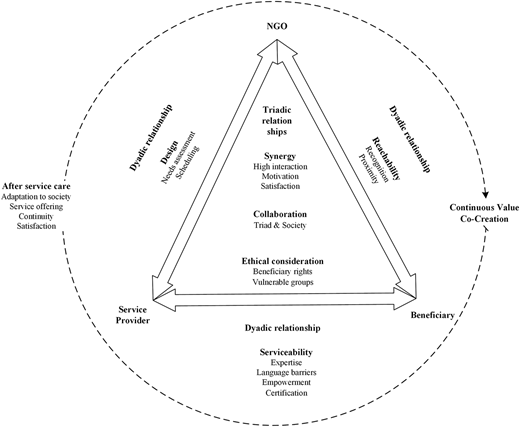
This section discusses and synthesises the findings by comparing them against the literature. This study analysed the long-term establishment of humanitarian service processes, and reviewed the HSC literature in terms of seven VCC components in a humanitarian service triad: HSD, humanitarian reachability, humanitarian training serviceability, collaboration, synergy, ethical consideration and ASC. These components interact to shape VCC mechanisms in the humanitarian service triad framework (Figure 3). HSD, HSR, humanitarian training serviceability and ASC interact sequentially to create a feedback loop that generates VCC in HSCs. Collaboration, synergy and ethical considerations are overarching components in the interaction feedback loop. By visualising VCC, this framework reveals theoretical implications concerning the triad members involved in the HSC, as discussed in the following section.
5.1 Implications for theory
First, this study draws attention to the importance of HSD to increase the long-term effects of quality improvement in humanitarian settings (Chu et al., 2010; Modgil et al., 2020). Determination of the humanitarian aid community's long-term requirements can suggest planning improvements. Likewise, identifying basic requirements and characteristics of field allows settling proper fundamental service structure (Damoah, 2021). Interaction among HSC actors allows better design of humanitarian services (Quarshie and Leuschnerg, 2020; Chen et al., 2020). Delivering required services parallel to the basic preferences of target population allows allocating the related service through an efficient network (Garry et al., 2020; Sirbiladze et al., 2021). Utilising cost and time effective services enhances beneficiary willingness for further participation. Although the services literature has long focused on access to services (Kowalkowski et al., 2017), it has not been sufficiently explored within HSC context (Heaslip et al., 2018). Therefore, we propose;
Interaction of service provider and NGO to improve the service design has a higher long-term quality improvement in HSC triads.
The easier the accessibility to humanitarian services, the better involvement of beneficiaries into humanitarian VCC process.
Moreover, this study contributes to research by identifying which components most critically improve humanitarian aid provision, such as aligning the language, transferring expertise or making the service practical. Bilateral sharing of cumulative knowledge and experiences allows HSC members improve their capabilities accordingly (Bollettino, 2008; Vaillancourt, 2016; Paciarotti et al., 2021; Tabaklar et al., 2021). Besides, improving service effectiveness increases overall performance (Panayides, 2007; Yuan et al., 2018). Therefore, we propose:
Knowledge transfer within HSC by the involvement of SP and B improves to training serviceability in HSC triads.
The higher the training serviceability, the higher the overall performance in HSC service triads.
Furthermore, the findings confirm that one essential value component is collaboration (Moshtari, 2016; Prasanna and Haavisto, 2018; Dubey et al., 2018, 2019a, 2021; Dwivedi et al., 2018). This is co-created through the mutual contribution of all triad members (Finne and Holström, 2013). Our findings reveal how collaboration is reinforced by developing trust, information sharing and mutual respect (Prasanna and Haavisto, 2018) between both triad members and within the wider society. This, in turn, confirms that community education plays a crucial role within the refugee community in constructing strategies for service implementation (Asgary and Price, 2018). Moreover, integration of components throughout local society strengthens the connection and communication among members of HSC (Majka and Longozel, 2017; Makepeace et al., 2017) Thus, following propositions offered:
The higher the involvement of society to service delivery process enhances the integration of beneficiaries to the local community.
The higher the collaboration among the triad members and the society, the better the service VCC process in HSC triads.
Although previous studies have considered the beneficiaries' motivation from various perspectives (Sok et al., 2016), this is not sufficiently addressed as a key component for reinforcing the value co-created throughout the humanitarian service process. Our findings suggest that synergy is a key value co-created by the contribution of all triad members. This increases the beneficiaries' motivation to participate, and thereby deliver an effective long-term service. In short, beneficiaries are becoming an active component in VCC, not merely recipients of the service (Haavisto and Goentzel, 2015; Cardoso et al., 2021; Pillitteri et al., 2021). In the light of this information, following proposition is offered:
The higher the motivation of beneficiaries, the better the outcome of service provided by the HSC triad.
On the other hand, gender-based issues are commonly observed in humanitarian contexts (Dolan, 2016; Wells, 2017; Glass et al., 2018). Our study addressed this in terms of co-creating the ethical consideration value component. This is necessary for preventing violence, mitigating the traumatic effects of discrimination and raising awareness about the importance of protecting basic human rights, particularly for female and minority populations (Oloruntoba and Banomyong, 2018; Babatunde et al., 2020). To elaborate cultural differences, Humanitarian Organisations and SPs would better organise the content of the services offered by taking consideration of individual vulnerable attitudes. Therefore, we propose:
The higher the prioritisation of ethical issues into humanitarian service process, the better the service VCC process in HSC triads
Finally, ASC is an integral aspect of service provision (Sahay et al., 2006; Giannakis, 2011). The success of the training particularly depends on the degree to which the learning is used and integrated into daily life. This is also important for consistently monitoring and continuously improving the service process (Garcia-Torres et al., 2019). Our findings indicated that humanitarian services should be pursued after the process is finished and extended to support the social integration of the beneficiaries. Humanitarian Organisations and SPs ensure intense follow-up processes in order to enhance continuity of the services and contribution by triad members for the following periods (Baba et al., 2015; Woldt et al., 2019). Thus, we propose:
Providing after service care enhances long-term integration of beneficiaries into society.
Delivering after service care contributes to the continuity of humanitarian service VCC process.
The higher the contribution by triad members, the better the continuous VCC in HSC triads.
5.2 Implications for practice
The Humanitarian Service Triad Framework for Service Provision (Figure 3) is also relevant for practitioners. In order to generate a seamless service provision, organisations should assure that all elements of the framework are covered. If necessary, they should provide the missing parts or strengthen the weaker links within the triad. Using this framework, this study also contributes to theory by addressing fundamental aspects of humanitarian aid VCC through creating awareness, building communication links and making informed spatial decisions.
The study identified ASC as a key component of VCC. Therefore, humanitarian organisation managers should take a longer-term perspective in designing their services by monitoring service recipients and their achievements following provision. This requires a shift away from short-term action without follow up towards a focus on longer-term relationships with beneficiaries. Other important design factors are motivation of beneficiaries, ethical consideration and collaboration, as already emphasised in the HSC literature (Moshtari, 2016).
6. Conclusions
This study shed light on the understanding of services provided to HSC beneficiaries. It advances knowledge regarding this concept for the sustainability of the humanitarian aid process and suggests useful information for humanitarian practitioners.
Collaboration has been researched within HSCM (Dubey et al., 2019b). In particular, big data analytics (Dubey et al., 2018, 2019a) and blockchain technology (Dubey et al., 2020b) have studied for their effects on creating trust, visibility, collaborative performance and supply chain agility. Within supply chain collaboration, information sharing is an essential enabler for organisations working together (Cao and Zhang, 2011). This means that managers should create an environment that allows information sharing beyond a dyadic relationship. Engagement of the local population (Sheppard et al., 2013) should also be considered as an extension to the humanitarian service triad.
6.1 Limitations and suggestions for future research
The present study has several limitations. Specifically, our findings relate to one specific context, time and location. Therefore, future studies should test the framework in other contexts through multiple case studies. Future studies should look at different service provision triads in different locations and contexts (e.g. Syrian refugees in different locations), or triads responding to other conflicts or natural disasters. Future research might also include triads focused on other services or a combination of goods and service delivery, such as different sectors (based on a cluster approach). Another option is to investigate triads operating across different stages of the disaster response cycle, especially the preparedness and immediate response phases.
The authors would like to thank all the participants in this study. The authors would also like to thank the anonymous reviewers for all the comments on the previous versions of the manuscript.

