


The purpose of this paper is to present a literature review and conceptual consideration of servitization in humanitarian logistics (HL) and provide a research agenda for HL scholars and insight for practitioners and by doing so will fill a gap in existing research and practice.
The paper uses a literature-based approach that extends concepts usually applied in a commercial context to the area of HL.
The paper initiates a discourse on the importance of taking into account servitization in developing and managing effective emergency relief chains. This paper argues that a broader servitization paradigm needs to be integrated for international humanitarian organisations (IHOs) to maintain a competitive advantage.
The authors investigate servitization as a management innovation in IHOs and plot a research agenda for scholars.
1. Introduction
In a continuous search for new ways of creating and enhancing value many organisations are looking for diversification opportunities in service markets related to their products (Abidi et al., 2015; Visnjic Kastalli and Van Looy, 2013). Although companies offer services to the market, the last few decades have seen the integration of products and services as a possibility for growth and competitiveness (Charles and Lauras, 2011; Jacob and Ulaga, 2008). The provision of services has now turned into a conscious and explicit strategy with services becoming a main competitive differentiating factor in a totally integrated products and service offering (Prockl et al., 2012; Baines et al., 2009).
This phenomenon, known as servitization, involves firms developing the capabilities they need to provide services and solutions that supplement their traditional product offerings (Vandermerwe and Rada, 1988), with the result that boundaries between products and services have become blurred as manufacturers have moved into providing added value services to their product offerings (Grönroos, 2011). Gummesson (1995) notes that all types of resources providing value for customers as services are used by them; not only service activities but also goods as distribution mechanisms for services (Dufour et al., 2018; Vega and Roussat, 2015; Vargo and Lusch, 2004). Thus, servitization is the innovation of a firm’s capabilities and processes to shift from selling products to providing value-added services (Nätti et al., 2014; Baines et al., 2009). By adding services to core products, firms differentiate their offering from competitors, increasing customer dependency and establishing barriers to competition (Cozzolino et al., 2017; Barnett et al., 2013).
Earlier studies of servitization focussed on large manufacturing firms but increasingly interest is directed at organisations involved in delivering humanitarian aid (Bealt et al., 2016; Vega and Roussat, 2015; Kovács, 2014; Heaslip, 2013). Recent research involving aid organisations has directed much interest to humanitarian logistics (HL) due to 80 per cent of humanitarian aid costs tied to logistical activities (Jahre et al., 2015; Van Wassenhove, 2006). HL is commonly defined as “the process of planning, implementing and controlling the efficient, cost-effective flow and storage of goods and materials, as well as related information, from point of origin to point of consumption for the purpose of meeting the end beneficiary’s requirements” (Thomas and Mizushima, 2005, p. 60). An interesting trend in this context is that international humanitarian organisations (IHOs) have started to develop services that they offer to each other (Heaslip, 2013; Kovács and Spens, 2011), yet research on this topic is virtually non-existent (Vega and Roussat, 2015; Heaslip, 2013).
Further, most of the services IHOs offer to each other fall under the realm of logistics. For example, the World Food Programme (WFP) offers customs clearance, transportation and warehousing services through the Logistics Cluster to other organisations (WFP, 2013; Jensen, 2012). They currently run the “common humanitarian transport” of Syria, and use over 4,600 trucks to deliver emergency food distribution to 900 distribution points. Working with over 50 local and international partners, WFP distributes food to between 4 and 5m people every month in Syria (WFP, 2018). All these services are becoming rather standardised, with service request forms having been developed for each ongoing operation.
Also outside of the humanitarian context, Bask et al. (2010) and Saglietto (2013) demonstrate the many good reasons to focus on research regarding logistics services. First, the outsourcing of logistics services is expected to increase; second, the logistics service industry is an emerging industry which promises a positive future and new roles in supply chains and value networks for the logistics industry. Third, value-added logistics services seem to be the fastest growing part of the transport industry. Moreover, as highlighted by Skjoett-Larsen et al. (2007), e-commerce has created major changes in the structures and processes of distribution. To summarise, logistics service providers are likely to continue to strengthen their value creation in supply chain networks both at global and local levels. At the same time, recent literature reviews in operations and supply chain management analysing contemporary themes, trends and potential future directions identify the continuing growth in service operations management and servitization as a potentially ripe area for further research (Chiappetta Jabbour et al., 2017; Heaslip, 2015; Vega and Roussat, 2015; Leiras et al., 2014; Sheppard et al., 2013; Natarajarathinam et al., 2009; Taylor and Taylor, 2009; Craighead et al., 2007; Machuca et al., 2007; Altay and Green, 2006; Gupta et al., 2006).
Research focussing on services and the processes of service provision in the context of HL is limited (Vega and Roussat, 2015; Heaslip, 2015). Much of the research in HL takes a narrow view focussing on goods, product, freight or distribution (Pedraza Martinez and Van Wassenhove, 2011; Pedraza Martinez et al., 2011). Recently, a different perspective has been advanced, broadening the “narrow view” and emphasising the “service view” within HL (Bealt et al., 2016; Abidi et al., 2015; Heaslip, 2015; Vega and Roussat, 2015).
The perspective of HL as a service is growing within management studies (Dufour et al., 2018; Heaslip et al., 2018; Baharmand et al., 2017). It has been highlighted that humanitarian products are actually “goods” which can only be valued while being consumed (Oloruntoba and Gray, 2009; Van Wassenhove, 2006). Even though humanitarian products have both immaterial and material components, their central characteristic are the ability to satisfy specific donor/beneficiary needs (Heaslip, 2013). Those involved in the distribution and receipt of humanitarian aid do not experience “aid” as isolated, but interpret their value as tightly linked to their unique life situations. Thus, we can conclude that the service orientation is inherent in HL in terms of its interest in the use context and in customer collaboration. We have two goals in this conceptual paper:
the first is to fill the gap in extant research, and explore servitization in HL; and
the second goal is to investigate servitization as a management innovation in IHOs and plot a research agenda for HL scholars.
The paper is structured as follows. In the next section, we start by reviewing the extant literature on servitization as a management innovation. The next section provides a description of the systematic review protocols used in examining the literature followed by discussions of findings from the literature across the themes investigated. We then synthesise how servitization can be applied to HL, present an example of cash transfer payments, and provide an agenda of fresh research opportunities integrating servitization and HK before concluding the paper.
2. Mapping theoretical perspectives of servitization in HL research
Systematic reviews differ from traditional narrative reviews by adopting a replicable, scientific and transparent process, in other words a detailed technology, that aims to minimise bias through exhaustive literature searches of published and unpublished studies and by providing an audit trail of the reviewers decisions, procedures and conclusions (Durach et al., 2017; Briner et al., 2009; Rousseau, 2006; Tranfield et al., 2003). Systematic reviews expose studies to rigorous methodological scrutiny. Within the SCM and logistics field it may be possible to conduct a quality assessment of the research articles by evaluating the fit between research methodology and research questions. However, SCM and logistics researchers usually rely on the implicit quality rating of a particular journal (McKinnon, 2013; Menachof et al., 2009), rather than formally applying any quality assessment criteria to the articles they include in their reviews (i.e. refereed journals are “better” than practitioner journals). The difficulty in specifying and conducting quality assessments of studies is a major challenge in developing a systematic review methodology for management research (Denyer and Tranfield, 2009; Rousseasu et al., 2008).
The main goal of a systematic literature review is to make sense of a mass of often contradictory evidence in order to help both academics and practitioners to improve their decision making and practice, narrowing the knowing-doing gap that exists between research and practice. A systematic review (Durach et al., 2017; Tranfield et al., 2003) involves the following stages:
planning the review and identifying its purpose;
defining inclusion/exclusion criteria, identifying and evaluating studies;
extracting potentially relevant literature for a baseline sample;
reducing the data to a synthesis sample in line with inclusion/exclusion criteria; and
reporting findings; and using these to inform research and practice
In the planning review stage a review panel of three academics was formed. The aim was to “identify a need for the review, prepare a proposal and develop a review protocol” (Tranfield et al., 2003, p. 214). The second stage was to conduct the review. A mapping of the field of investigation was conducted to fully define the scope of the study, the data to be collected and the data collection process.
Our choice to review servitization in HL literature entailed one selection decision for establishing the baseline sample. We limited the review to double-blind reviewed journal articles published in this field’s top-tier journals. We focussing on academic contributions that are considered established knowledge (Vega and Roussat, 2015) which are likely to make a significant impact on the field (Heaslip, 2013). Established influential journals tend to shape the theoretical and empirical work in a field by setting new horizons for inquiry within their frame of reference (Furrer et al., 2008).
A three-stage selection process to identify relevant articles from these journals was formulated. First, a search of all issues of these journals from 2013 to the latest issue of January 2018 that was available on-line on 10 January 2018, using various electronic databases (Business Source Premier, JSTOR, Emerald Insight and Science Direct). 2013 was chosen as the cut-off point, because the seminal article calling for an examination of services within HL, “Services operations management and humanitarian logistics” by Heaslip (2013) was published at this time.
Consistent with prior approaches to identifying relevant articles, such as: Lagorio et al., (2016), Tranfield et al. (2003) and Rousseau et al. (2008), we performed keyword searches and retained those articles that contained the word “Humanitarian” and/or any of the phrases “Disaster”, “Emergency Management”, “Crisis Management”, “Services Management”, “Services”, “Servitization”, “Logistics Service Provider”, “3PL”, “4PL” “LSP”, “third party”, fourth party”, “Humanitarian Aid”, “HL”, “Humanitarian Operations” or “Humanitarian Supply Chains”, in either their titles, abstracts or full texts. In total, 31 articles were identified at this stage.
To classify which of these 31 articles focussed on servitization in HL, one of the authors coded and analysed the extent to which (if any) the article focussed on servitization in HL by rating each article’s title and abstract on separate four-point scales anchored at “not at all” and “clearly”. In total, 20 articles satisfied this requirement, and these were forwarded to the synthesis sample. Next, we looked at the number of citations each individual article received in order to maximise the relevance of the set of articles. Rather than using an arbitrary cut-off point of how many citations an article had to receive (which would place newer articles at a disadvantage), we compared the number of citations each article received with the average number of citations received by articles appearing in the respective year in the respective journal. Thus, 17 articles remained for analysis and Table I provides an overview of the articles included in the review. The following sections present the results of such analysis.
Articles included in the review
| Year | Author | Journal title | Article title |
|---|---|---|---|
| 2018 | Dufour et al. | Omega | Logistics service network design for humanitarian response in East Africa |
| 2018 | Heaslip et al. | Journal of Humanitarian Logistics and Supply Chain Management | Cash-based response in relief: the impact for humanitarian logistics |
| 2017 | Baharmand et al. | International Journal of Disaster Risk Reduction | Managing in-country transportation risks in humanitarian supply chains by logistics service providers: Insights from the 2015 Nepal earthquake |
| 2017 | Chiappetta Jabbour et al. | Annals of Operations Research | An analysis of the literature on humanitarian logistics and supply chain management: paving the way for future studies |
| 2017 | Cozzolino et al. | International Journal of Quality and Service Sciences | Logistics service provider’s engagement in disaster relief initiatives: an exploratory analysis |
| 2017 | Nurmala et al. | Supply Chain Management: An International Journal | Humanitarian–business partnerships in managing humanitarian logistics |
| 2016 | Bealt et al. | Journal of Humanitarian Logistics and Supply Chain Management | Collaborative relationships between logistics service providers and humanitarian organisations during disaster relief operations |
| 2016 | Bag | AIMS International Journal of Management | Humanitarian supply chain management: a bibliometric analysis of the literature |
| 2015 | Abidi et al. | Journal of Humanitarian Logistics and Supply Chain Management | The value of fourth-party logistics services in the humanitarian supply chain |
| 2015 | Heaslip | Journal of Humanitarian Logistics and Supply Chain Management | Humanitarian logistics – an opportunity for service research |
| 2015 | Jahre et al. | Procedia Engineering | One size fits all? Using standard global tools in humanitarian logistics |
| 2015 | Vega and Roussat | International Journal of Physical Distribution and Logistics Management | Humanitarian logistics: the role of logistics service providers |
| 2014 | Nätti et al. | Journal of Business and Industrial Marketing | Absorptive capacity and network orchestration in innovation communities – promoting service innovation |
| 2014 | Leiras et al. | Journal of Humanitarian Logistics and Supply Chain Management | Literature review of humanitarian logistics research: trends and challenges |
| 2013 | Holguín-Veras et al. | Journal of Operations Management | On the appropriate objective function for post-disaster humanitarian logistics models |
| 2013 | Saglietto | Universal Journal of Industrial and Business Management | Towards a classification of fourth party logistics (4PL) |
| 2013 | Sheppard et al. | Journal of Humanitarian Logistics and Supply Chain Management | Humanitarian logistics: enhancing the engagement of local populations |
3. Servitization as a management innovation
Vandermerwe and Rada (1988) introduced servitization as a “value-added activity”, where services are added to supplement a product already supplied. Spring and Araujo (2013) and Oliva and Kallenberg (2003) proposed a structured progressive step-by-step approach to servitization, with the provider taking the initiative. Their research makes a clear distinction between products and services and assumes that firms can create value and then deliver it to customers. Martinez et al. (2010) expanded this concept demonstrating that increasing levels of service and interaction with the customer be taken where the customer and supplier move towards servitization together.
Utilising the concepts introduced by service-dominant logic, Ng et al. (2012) focussed on service rather than product and services, describing it as a dynamic activity where value emerges as a result of co-creation between customer, provider and suppliers. Dachs et al. (2012) found a U-shaped relationship between firm size and success of servitization, which indicates that organisations have advantages in servitization. The advantages for small companies are based on their flexibility and effective internal communication, which enable flexible reactions to new market opportunities.
Previous research has recognised that some firms face significant challenges during servitization (Martinez et al., 2010; Brax, 2005) and may fail in their efforts (Neely, 2008; Gebauer et al., 2005). Neely (2008) found that servitised firms tend to declare bankruptcy more often and generate lower net profits as a percentage of revenues than pure manufacturing firms. Gebauer et al. (2005) observed that substantial investments in extending service business do not lead to the expected higher returns in all manufacturing firms. These results indicate that servitization may not be an efficient management innovation in all cases.
Baines et al. (2017) note that 22 articles were published on servitization between 1991 and 2000 but increased fivefold to 101 between 2001 and 2010. These articles came from the services marketing, service management, operations management, product-service systems (PSS) and service sciences domain and helped establish the servitization field. Regarding undeveloped streams of servitization research, Baines et al. (2017) consider there is a need for research on the impact of disruptive innovations and the dynamics of technology shifts, combined with broader environmental and social aspects of servitization in an external context. Internally, we need research on legal and financial frameworks that support advanced services, the roles and advantages of active manufacturing technology innovation regarding supporting services, and the social and collective dynamics of business leaders who influence the propensity to servitize. As regards process and content, research should focus on factors influencing the successful adoption of services, new business models and paths to service business unit development. Finally, there is a need for research to investigate contextual conditions for servitization from a prescriptive orientation.
Further, the servitization literature has identified three general motives behind servitization: economic/financial, strategic/competitive advantage and marketing/user needs. The economic/financial motives described in the literature include the pursuit of higher profit margins and stability of income (Gebauer and Friedli, 2005; Wise and Baumgartner, 1999) due to the resilience of services to economic cycles (Gebauer and Fleisch, 2007; Oliva and Kallenberg, 2003). Strategic motives are largely concerned with gaining competitive advantage. One of the main arguments is that services are difficult to imitate due to their invisible and labour dependent nature (Gebauer and Friedli, 2005; Oliva and Kallenberg, 2003). This means that services reduce the need to compete on the basis of cost (Neely, 2008). Frambach et al. (1997) argue that the value-add of services can enhance the customer value where identical physical products are perceived as customised, which leads to an increase in the barriers to competitors (Baines et al., 2009). Services also create customer loyalty (Correa et al., 2007; Vandermerwe and Rada, 1988) while Baines et al. (2009) note “the customer can become dependent on the supplier” (p. 558). Customers increasingly demand a variety of services (Vandermerwe and Rada, 1988), for example, in the B-2-B context, focussing on core competencies is an additional reason for the need for external services (Oliva and Kallenberg, 2003).
Various researchers have discussed the transition from products to service solutions (see Spring and Araujo, 2013; Paiola et al., 2013; Kowalkowski et al., 2011; Matthyssens and Vandenbempt, 2008). This research points to the requirement for companies to develop capabilities in order to design, sell and deliver services (service capabilities) and to integrate these services into customer-specific solutions (integration capabilities). Continuing the move from products to service solutions further departs from extending services in the customer activities (Paiola et al., 2013) and moves forward to taking over full responsibility for a customer’s process (Kowalkowski et al., 2011) through outsourcing services (Oliva and Kallenberg, 2003), i.e. business process integration services (Matthyssens and Vandenbempt, 2008). Table II highlights the service and integration capabilities discussed in the literature.
Service capabilities and integration capabilities
| Capabilities | Authors |
|---|---|
| Service capabilities | |
| Service culture | Bowen et al. (1989) |
| Service orientation | Homburg et al. (2003) |
| Technical expertise | Matthyssens and Vandenbempt (2008), Allmendiger and Lombreglia (2005) |
| Pricing mechanism | Kindström and Kowalkowski (2014), Oliva and Kallenberg (2003) |
| Organisational structure | Rapaccini et al. (2013), Gebauer et al. (2005) |
| Distribution channels | Kowalkowski et al. (2011), Malleret (2006) |
| Integration capabilities | |
| Understanding customer needs | Paiola et al. (2013), Davies et al. (2006, 2007) |
| Identifying and using external resources from a network | Spring and Araujo (2013) |
| Multi-skilled and cross functional competencies | Windahl and Lakemond (2006, 2010), Neu and Brown (2005) |
Source: Adapted and extended from Paiola et al. (2013)
Service capabilities include establishing a service culture (Bowen et al., 1989) which, in turn, lays the foundation for increasing the degree of service orientation (Homburg et al., 2003). Technical expertise is required as an integral part of remote services, which collect data on the status, diagnostics and usage of the capital goods in question (Allmendiger and Lombreglia, 2005). Oliva and Kallenberg (2003) argue that adequate pricing mechanisms rely on the ability of gathering information and monitoring the usage of the product. Pricing needs not only an estimation of the cost of delivering the service (Malleret, 2006) but also capabilities to assume the operating risk of the capital goods (Kindström and Kowalkowski, 2014). Introducing new services requires capabilities that allow an in-depth understanding of the customers operational and business needs, so that the specific service component to be developed can be identified (Gebauer et al., 2005), the integration of external resources from a network (Spring and Araujo, 2013) and to develop new services systematically by means of a structured model (Rapaccini et al., 2013). Kowalkowski et al. (2011) highlight distribution channels as being essential when transitioning from products to service solutions.
When integrating services into customer-specific solutions, companies need to develop capabilities for understanding customer needs from a comprehensive perspective (Davies et al., 2006, 2007). Integrating a diverse set of product and service components requires multi-skilled and cross-functional competencies (Windahl and Lakemond, 2006, 2010), which include key account management, financial expertise, technical design expertise, communication expertise and project management (Neu and Brown, 2005).
In today’s business, the focus is increasingly on value, especially the role of customers (Viljakainen and Toivonen, 2014; Bezerra Barquet et al., 2013). The service-dominant logic (S-DL) (Vargo and Lusch, 2004, 2008) highlights the value-creating nature of consumption. S-DL points out that customers evaluate the value of goods and services not one by one, but holistically based on the combination of commodities: one commodity purchased from one provider is meaningful only when it is linked to other commodities (Viljakainen and Toivonen, 2014). By offering clients new value that goes beyond the conventional context organisations can increase their competitive advantage and profitable growth (Viljakainen and Toivonen, 2014; Grönroos, 2011; Kowalkowski et al., 2011). The value offerings arise from redefining clients’ problems and discovering hidden demand (Matthyssens and Vandenbempt, 2008; Kim and Mauborgne, 1999). Supplementing own resources with resources from partner networks across industries is at the core of creating new customer-centric solutions (Spring and Araujo, 2013; Bezerra Barquet et al., 2013; Baines et al., 2009; Gebauer and Fleisch, 2007; Normann and Ramirez, 1993).
Servitization is often presented as a strategic choice among larger companies delivering capital equipment and related services (Baines et al., 2009). Business in general has been developed around the dominant logic of tangible goods (Barnett et al., 2013). Firms believe that increasing services will deliver higher margins (Gebauer et al., 2005) and that offering services as well as products increases the level of differentiation (Vandermerwe and Rada, 1988). Similarly, Heaslip (2013) introduced service business development as a strategic choice for IHOs. A discussion about servitization in an HL context is provided next.
4. Servitization in HL
In logistics and operations literature, the perspective that is often taken is simply that of freight/cargo movement which Lusch and Vargo (2014, p. 2) refer to as transport of “the things and stuff that need to be transported, stored, and handled”. Perspectives on and studies of the recipients of emergency and disaster relief and the beneficiaries of disaster management activities in the logistics literature are relatively few (see e.g., Baharmand et al., 2017; Overstreet et al., 2011; Altay and Green, 2006). This is explained in part by the distinction between beneficiaries (end customers) and paying customers, as beneficiaries in the humanitarian context lack purchasing power and is rarely involved in purchasing decisions. Likewise, studies using a service lens focussing on services and the processes of service provision and management in the context of HL for emergency and disaster response are limited (Heaslip, 2013, 2015; Kovács and Spens, 2011).
Like Baines et al. (2017), Kunz et al. note the research in HL suffers from a lack of contextualisation as humanitarian organisations are very specific and differ substantially from that in which commercial companies operate. Due to the unpredictable nature of disasters, logisticians in a humanitarian setting cannot rely on well-defined plans. One of their ten suggestions or “rules” for HL research is “knowing the specificities of the humanitarian context” which they consider “key to avoid selecting a non-relevant problem or making wrong assumptions” (p. 1592).
However, there is a need for IHOs to differentiate themselves, just as commercial companies do (Nurmala et al., 2017; Nätti et al., 2014; Oloruntoba and Gray, 2009). For example, many humanitarian organisations do exactly the same things (provide food, water, sanitation, shelter, health care, education) they seek funding and resources from the same donors (governments, institutional and private), they use the same mass media to raise awareness and funds; their marketing strategies are very similar; and they use the same transport carriers and logistics service providers (Cozzolino et al., 2017; Vega and Roussat, 2015; Heaslip, 2013) – if not acting as fourth party logistics service providers themselves. Consequently, whatever marketing strategies they employ are quickly copied by other IHOs, who in essence, are in competition (Nurmala et al., 2017; Oloruntoba and Gray, 2009; Shaw and Goda, 2004). Organisations trying to create or maintain differentiation in the humanitarian sector, often find that whatever changes they make are greeted by counter moves from competing relief organisations (Nurmala et al., 2017; Oloruntoba and Gray, 2009). For many IHOs the way to sustainable competitive advantage may not lie in changes in the product, promotion or pricing strategies of the organisation, but rather in improving customer service within HL, ancillary services, such as logistics and distribution (Nätti et al., 2014; Saglietto, 2013; Oloruntoba and Gray, 2009) and servitization (Heaslip, 2013).
A traditional concept of customer is the party that pays for goods or services, and is thus involved in a commercial transaction. Just as various segments of the target markets differ in customer requirements, customers in the humanitarian relief context have differing and varying requirements. However, an understanding of the complexity of the customer profile of IHOs could be a key towards understanding the servitization offering. Table III provides an overview of IHOs’ customers.
IHOs customers
| Actor | Function | Commercial transaction | Authors |
|---|---|---|---|
| Beneficiaries | The end-user of the product or service whose needs or requirements must be accommodated | None | Oloruntoba and Gray (2009), Kovács and Spens (2007), Altay and Green (2006) |
| Implementing partner (IP) | These are specific organisations, with specific functions (such as water, shelter, etc.) operating between the international humanitarian organisations (IHOs) and the aid beneficiaries/end-users of the relief effort | Yes between IP and IHO | Matopoulos et al. (2014), Kovács and Spens (2011), Thomas and Mizushima (2005) |
| Donor (governmental, institutional, private) | Provides funding for IHOs to procure staff, relief goods, and transport them to disaster sites for relief distribution. The donor not only provides funding but may also provide supplies such as clothing, food or cooking oil, here the donor acts like a supplier, except that the donor does not get paid | Yes between donor and IHO. None when donor acts as a supplier (in-kind donations) | Heaslip (2013), Holguín-Veras et al. (2013), Oloruntoba and Gray (2009), Van Wassenhove (2006), Kovács and Spens (2009), Van Wassenhove (2006) |
| IHO | Can act as donor, implementing partner, or delivery partner in particular programmes or through clusters | Yes between IHOs | Kovács (2014), Jahre and Jensen (2010) |
| UN Agency | Specific organisation, with specific functions (such as water, shelter, etc.) Can act as delivery partners in particular programmes or through clusters | Yes between donor, IHO and IP | Heaslip (2013), Kovács and Spens (2011), Jahre and Jensen (2010) |
| Logistics service provider | Specific organisation, with specific logistics capabilities (such as distribution, cold chain, warehousing, etc.). Can act as delivery partners in particular programmes | Yes between donor, IHO, UN Agency and IP | Abidi et al. (2015), Bealt et al. (2016), Heaslip (2013), Vega and Roussat (2015) |
4.1 Waves of servitization in HL
Initially IHOs were defined around the products they delivered, the traditional view, such as WFP – food; International Federation of Red Cross and Red Crescent Societies (IFRC) – shelter and Medicines Sans Frontiers (MSF) – health. The Asian tsunami in December of 2004 and the response to the Darfur crisis in 2004/2005 demonstrated problems providing sufficient coverage in large relief operations (Jahre et al., 2015; Jahre and Jensen, 2010). A cluster approach was proposed as a way of addressing gaps and strengthening the effectiveness of humanitarian response. Product foci were used as the basis for structuring humanitarian response through the clusters (Abidi et al., 2015; Kovács and Spens, 2007). Originally there were nine clusters: water, sanitation and hygiene (WASH), protection, nutrition, education, early recovery, emergency shelter, camp management, health, food security and emergency telecommunications. To ensure the delivery of “goods’ for the clusters” “common services” such as logistics were incorporated into the cluster system. The Logistics Cluster is responsible for coordination, information management, and, where necessary, logistics service provision to ensure an effective and efficient logistics response takes place in each and every operation (Holguín-Veras et al., 2013). To achieve this goal, the Logistics Cluster fills gaps in logistics capacity, meets the need for logistics coordination services, and where necessary acts as “provider of last resort”. The introduction of the Logistics Cluster leads to the first wave of servitization in the humanitarian environment; WFP, for example, moved from a focus of delivering food to delivering services (Bealt et al., 2016; Heaslip, 2013; Jensen, 2012), see Table IV for an overview of UNWFPs service offering.
UNWFP move from product to service
| Organisation | Type of relief involvement | UNWFP “Goods” | UNWFP “Services” | UNWFP customers | Expenditure US$ |
|---|---|---|---|---|---|
| United Nations World Food Programme (UNWFP) | Over 75 countries, emergencies, livelihoods, food, education | Food | Information consultancy; Procurement; Customs clearance; Warehousing; Distribution; Inventory Management; Fleet service; Postponement; Training | Governments Donors IHOs UN Agencies NGOs Implementing partners Beneficiaries | 2.97bn |
With this first wave of servitization, it is as if the goods an IHO provides had become a “qualifier”, whereas the service offered has become the “order winner”. The focus has shifted from core products towards the services because offering a mixture of goods and services allows the IHO to differentiate and create a more satisfied and loyal customer – though with a focus on donors as customers, not beneficiaries. Table V shows the different types of IHOs and the move to more service offerings. The traditional view of an IHO is in providing tangible relief (such as water, food and shelter). Examples of traditional IHOs include Oxfam and World Vision. Post the 2004 Asian tsunami, the asset-based IHO developed, leading to asset-based service extensions. This was primarily from the diversification of some traditional IHOs into more complex offerings. Several of the world’s leading IHOs moved in this direction (e.g. United Nations Humanitarian Response Deport (UNHRD)).
Types of international humanitarian organisation
| Asset based – service extension | Service revolution | |
|---|---|---|
↑ Physical service | Warehousing | Information consultancy |
Inventory management | 4PL | |
Postponement | Training | |
Transportation | Cash | |
Distribution | ||
Traditional: thematic focus | Network based – networked service | |
Food | Track and trace | |
Water | Procurement | |
Sanitation | Custom clearance | |
Shelter | Service standardisation | |
Health care | Consolidation | |
Education | ||
Management services → | ||
In the early 2000s a number of network-based IHOs appeared, most notably United Nations Children’s Fund (UNICEF) and WFP. This move by IHOs to offering value-added services includes procurement services being offered by agencies such as the United Nations Children’s Fund (UNICEF), the UNHRD network and the United Nations Office for Project Services to other UN agencies as well as to governments (Baharmand et al., 2017; Kovács, 2014). Procurement works like a pivot in the internal supply chain process turning around requests into actual products/commodities or services to fulfil the needs. Beyond the United Nations (UN) family, the IFRC have developed a procurement centre and procurement portal that has been accredited by the European Commission’s Humanitarian Aid and Civil Protection agency (ECHO), and through which third parties outside Red Cross/Red Crescent national chapters can ask for their services. Other value-added services are also available, for example, the IFRC is offering its services in areas such as “procurement and transportation”, “warehousing and handling”, “contingency stock”, “fleet service” and “insurance” (Kovács, 2014; IFRC, 2012). In addition to these, Heaslip (2013) has demonstrated the existence of further applications of service operations in humanitarian supply chains, for example, the WFP acting as a consignee in major disasters and consolidating transportation, as well as service standardisation. The nature of these networked services necessitates creating geographically extensive and tightly integrated networks of operations, some of which might operate horizontally as Toyasaki et al. (2017) report as regards UNHRD. The development of “common services” has even become one of four key points on the agenda of the Global Logistics Cluster meeting in Copenhagen in November 2014. The global strategy of the Logistics Cluster for 2013–2015 (GLC, 2013) includes the point of developing a “service catalogue” that would be available for addressing and filling gaps in logistics services in risk areas but also to build national preparedness – albeit it remains disputed which role the cluster should play in the latter.
The fourth type of IHO – the service revolution – has been a recent phenomenon. These are IHOs that provide a range of primarily information-based services. These encompass consultancy services (including supply chain configuration) and training. Examples of this type of IHO include UNWFP, which has developed the Logistics Response Team Training that it has offered to other organisations in the Logistics Cluster since 2007. Interestingly, an integral part of this is a “service mindset training” for logisticians. Similarly, UNICEF offers warehouse and inventory management training to other organisations including ministries of health worldwide.
Service development has become the norm in HL (Cozzolino et al., 2017; Vega and Roussat, 2015; Heaslip, 2015). Incredibly many organisations can be included in just one delivery through service tiering; especially when it comes to cross-border operations in conflicts. Figure 1 depicts the various logistics service providers and co-operation or implementing partners in a cross-border delivery to a conflict zone where even vehicles need to be switched – and reloaded – at borders. This is a simple diagram for deliveries in the last mile, which can be much more complex if considering transportation consolidation, and the involvement of fourth party logistics providers, who are seen as providing solutions for various HL issues (Abidi et al., 2015), to freight forwarders in various steps in the material flow.
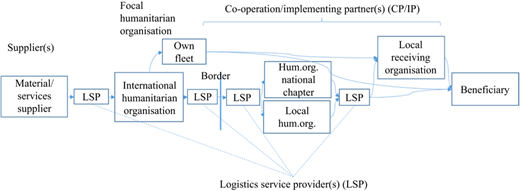
Service tiering of a cross-border delivery
Service tiering of a cross-border delivery
Table VI applies Viljakainen and Toivonen’s (2014) trend analysis to demonstrate how new trends impact on the increasing service orientation within HL and to the humanitarian setting. We now turn to discuss one trend, cash-based assistance (also called cash transfer payments or CTPs), as an example to illustrate how servitization would impact this trend through research and practice.
Humanitarian logistics: new trends and their impacts on an increasing service orientation
| Trend | Impact of trend | Service impact on IHOs | Service opportunities |
|---|---|---|---|
| Cash for transfer | Beneficiaries now have purchasing power Increasing array of financial platforms | New market with stronger value proposition Technological development provides new consumer segment | Platforms needed to be developed Growth opportunities Changing needs of donors |
| Funding | Pooled funding – centralise emergency response fund (CERF) | New service offering enabled by partnering to co-produce value | Social media Crowdfunding |
| Cluster | Improved coordination Information sharing Involvement of local community | Introduction of service dominant offering Building and maintaining communities as platforms for engagement and co-development Deeper understanding of the user experience | New service offerings enabled by partnering to co-produce value Building (strategic) alliances with “competitors” to develop business opportunities Building dynamic capabilities by integrating and reconfiguring resources |
| Mobile technologies | Tracking in needs assessment and capability-vulnerability assessments | Move towards CTPs Supply chain visibility Infrastructure assessment and mapping en route Deeper understanding of beneficiary needs | Mobile banking Tracking and tracing |
| Emergency staff surge capacity | Flexibility of HL Integrated IHO-supplier teams Extended understanding of HL outside of the sector High job rotation and staff fluctuation | Training non-IHO staff on HL activities | HL training required for surge staff Databases/rosters of qualified personnel Volunteer management |
| Stockpiling of goods in strategic locations | Higher level of preparedness Speed of response Standardisation of items | Inventory pre-positioning Warehousing services Packing, and kitting in warehouses Development of inter-agency kits | Warehousing services Packing, labelling, kitting services Postponement strategies Development of enterprise resource planning (ERP) systems for HL |
4.2 Cash-based assistance as an example of service revolution
Until now, the role of beneficiaries as customers in humanitarian operations has been disputed (Bealt et al., 2016; Holguín-Veras et al., 2013; Kovács and Spens, 2007; Van Wassenhove, 2006), not the least because of their lack of purchasing power. The traditional form of humanitarian relief has been to provide the people in need with goods. Beneficiaries in this model do not have voice in the type of goods procured or distributed to them (Matopoulos et al., 2014). However, humanitarian aid is shifting towards providing cash-based assistance instead of goods (Heaslip et al., 2018; Kovács, 2014), thus providing beneficiaries with purchasing power. This move from a product delivery to a cash delivery is the second wave of servitization.
Whilst the Global Logistics Cluster does not yet mention cash-based assistance as part of its current strategy, the cluster lead has started to shift towards their implementation. The WFP’s shift from food aid to food assistance in 2008 is evidence of the changing humanitarian landscape. WFP adopted a cost conscious approach to the global economic downturn that considers: value; accountability; alternative funding models (cash); justification of spending; capacity building; innovation and performance measurement tools (Heaslip et al., 2018).
The use of cash-based assistance is on the rise, for example, between 2009 and 2014, the use of cash by the WFP increased from US$10m (less than 1 per cent of total aid) to US$3bn (IRIN, 2014) and by the start of 2016 it was estimated that cash-based programming accounted for more than 25 per cent of WFPs total spend on assistance (WFP, 2017). Similarly, in 2000, UNHCR implemented 15 programmes that relied on cash and cash-alternatives; by 2015 that number had increased to 60 programmes, with a budget of approximately US$465m (UNHCR, 2015).
Cash-based assistance shorten the supply chain, simplify procurement and remove the need for many HL activities such as transport and warehousing considerations which ultimately may shrink the humanitarian sector considerably (WFP, 2018). In short, a shift from material to financial flows diminishes the total cost of aid whilst simultaneously empowering beneficiaries (Heaslip et al., 2018; Kovács, 2014). Beneficiaries receive the full measure of the intended relief aid through cash transfers as opposed to selling in-kind aid which is sold at much less than the associated logistical costs in order to meet other needs (Bailey et al., 2008). Cash transfers fundamentally alter the balance of power between the donor and the beneficiary as it increases the freedom of beneficiaries to decide how to use the cash (Aker, 2013). This has meant that beneficiaries have changed from being passive beneficiaries to becoming active members of the humanitarian supply chain (Matopoulos et al., 2014). Cash transfers adhere to the oft cited principles of empowerment, dignity and choice for the beneficiaries (Bailey et al., 2008). The beneficiaries need to be consulted and given a participatory role in cash-based assistance programmes (Bailey et al., 2008), similar to the role of customers in a commercial supply chain.
Perhaps the most intriguing change is the impact on financial vs material flows in the humanitarian supply chain. In the traditional model, financial flows originated from donors to IHOs, which used these finances to pay for material supplies that they delivered to beneficiaries (Heaslip et al., 2015). In cash programmes, financial flows from donors still come to IHOs, which then assess the possibility for distributing cash directly to beneficiaries. If this is possible – given that there are items available on a market, for instance – the financial flows go directly to beneficiaries, who pay themselves for the products and services they need. The importance of the market cannot be understated; in fact, the humanitarian sector even sees cash-based assistance as adhering to a market-based logic, and talk about market assessments, and even “market chains” when implementing these types of programmes. For humanitarian organisations, this means becoming the brokers of these flows, and the distributors of cash, but not the providers of materials. Their role in delivering materials diminishes to the materials that are not available on the local market.
In the humanitarian contexts, cash-based assistance speeds up the delivery of aid, reduce the need for inventories and transportation capacity, and even allow beneficiaries to make their own choices rather than humanitarian organisations making these for them (Heaslip et al., 2015). For example, Ugandan mobile network operators MTN and Airtel are partnering with nongovernmental organisations (NGOs) including Danish Church Aid, Mercy Corps and the International Rescue Committee to deliver digital cash to refugees. After the 2004 Indian Ocean tsunami the Sri Lankan Government made people open bank accounts to facilitate a CTP as did the Iranian government after the Bam earthquake in 2003 (Doocy et al., 2006).
There are a range of mechanisms used to deliver cash-based responses to recipients, however, cash transfer programmes utilising mobile money can take one of three forms, fund transfer directly into the beneficiary’s mobile account, fund transfer via a mobile voucher for the beneficiary to redeem (or cash-out) and fund transfer from a pre-determined purpose, such as buying food. All of these options significantly change the actors that are involved in the humanitarian supply chain, including banks, mobile network operators and locally available suppliers and retailers.
This also implies a significant change in supply chain strategy. The traditional humanitarian supply chain pushes items first and gradually moves towards a pull strategy once more information becomes available. Cash transfer programmes enable a pull strategy to be implemented from the beginning. Through this, arguably, they can meet the actual needs of beneficiaries quicker and more accurately.
Generally speaking, cash-based assistance implies a reconfiguration of the humanitarian supply chain with consequential important contributions to the reinstatement of the local economy. In humanitarian supply chains where the main activity is providing physical goods, the actors conducting the activity of distribution are commonly a local implementing partner such as the local authorities or local NGO. Indeed, it is typically not IHOs but their local implementing partners that conduct the last mile distribution of aid in the field. In cash distribution, there is a shift for the role towards an actor that can better handle the financial flow. A pre-condition is still that there are functioning markets on location and that the beneficiary has access to that market. DG ECHO (2013), a major donor for IHOs, suggested a decision tree to support IHOs in their shaping of CTPs, outlining pre-conditions and even checklists for the move from providing items to starting to provide vouchers, to cash for work solutions, to, ultimately, unconditional cash transfers.
This form of humanitarian assistance has since become more popular and new telecommunication solutions for cash transfers such as “mobile money” launched by organisations such as Safaricom have enabled their use in various African countries (Kovács, 2014).
5. Summary of research agenda
Overall, the first and second wave of servitization leaves a number of questions open for further research. First, CTPs require that:
the goods needed by beneficiaries are available on the local market;
a (mobile) banking system exists, and have prevailed in the aftermaths of a disaster; and
beneficiaries have access to markets and can be reached through the banking system.
Second, as regards IHOs, the impact is not a straightforward one. IHOs will need to continue carrying out needs assessments, and capability-vulnerability assessments of beneficiaries as before. In other words, they need to establish who needs what in the aftermaths of a disaster. But now more than before, IHOs also need to be able to assess the capabilities of the local and regional markets. Disasters typically disrupt markets and destabilise infrastructure – from transport to energy to communications infrastructure. In combination, the question is not only one of the availability of items on the local market but also the upkeep of supplies in the longer run. Hence, a first question is which goods would still need to be delivered by IHOs, whereas which others could be replaced with a financial flow and CTPs.
Third, at the same time stable electricity supplies are a typical requirement for both mobile communications and banking. The absence of electricity often shuts banks down in the aftermaths of a disaster, which is why humanitarian logisticians typically carry cash for paying suppliers, logistics service providers and staff. This does not necessarily render CTPs impossible but require alternative solutions such as voucher systems. IHOs will though need to be able to make the assessment whether any banking system exists and is reliable, whether it reaches beneficiaries, or whether there is a need for alternative systems. This alters the requirements on the IHO’s capabilities, and also, the requirements on its implementing partners.
Fourth, cash-based assistance perceives cash as a commodity, and the way it is delivered as specific transfer modalities. However, international banking systems have for good reasons established cash transfer limits to avoid large international transactions for money laundering; and large cash transfers may be quarantined the same way as goods, leading to cash-based programming at times not necessarily being a quicker option than a traditional delivery. More research would be needed to understand the legal and financial implications of delivering cash as a commodity across international borders.
Fifth, even items the IHO needs to deliver in the immediate aftermath of a disaster could reach markets through different channels once the infrastructure has been stabilised. In this case, the question is for how long IHO support is needed in the form of goods, and at which point it can be turned to cash instead and vice versa. Market-based and cash-based assistance can thus truly be seen as a service revolution in the humanitarian sector. That said, its applicability is delimited by the market itself; and all decision trees suggest that there should be the possibility to switch back to humanitarian organisations delivering also goods in case market conditions change or markets fail. The challenge here is to determine such changes in market conditions in time to allow for switching back, considering order and delivery lead times in the traditional humanitarian supply chain. Further research is needed on all of these points.
In summary, as noted in several studies (Tan et al., 2009; Olivia and Kallenberg, 2003) moving from pure product to more service-oriented offerings, similar to the shift explored in PSS, covers several linear steps (Smith et al., 2012; Johnstone et al., 2009; Vargo and Lusch, 2004). Oliva and Kallenberg (2003) suggested the “gradual transformation process” to service provision, defining the start point with sole product offerings gradually expanded to pure service solutions and a combination of product-service value propositions in the middle of the transition. This area of product-service mix has rarely been examined in the context of humanitarian operations and may provide scholars with opportunities to revise the product-service model.
6. Conclusion
This paper is conceptual – its purpose is to provide a research agenda for HL scholars. It thus initiates a discourse on the importance of taking into account servitization in developing and managing effective emergency relief chains. We argue that a broader servitization paradigm needs integration with HL for IHOs to maintain a competitive advantage. This is due to the current manufacturing-based paradigm focussing almost exclusively on tangible relief products and associated “freight” transport and storage when in fact, the practice of HL for disaster response and management has shifted in the direction of providing services, and as of late, cash or vouchers (Kovács, 2014; Heaslip, 2013; IFRC, 2012). Now, the execution of activities, such as deliveries, repair and maintenance, customer training, problem recovery, invoicing, can be incorporated into the service process (Grönroos, 2011).
This study has contributed to the servitization literature by increasing the understanding of how servitization is adopted by IHOs in HL and identifying outstanding issues for further research. The paper also presents a research agenda for HL scholars. By examining the humanitarian environment scholars may be able to develop new servitization offerings and find an effective way of “adding value” to humanitarian and commercial organisations.
This paper highlights a business shift towards a new more customer oriented value proposition to satisfy the changing requirements within the humanitarian sector. Services provision plays a crucial role for new product introduction such as CTPs providing a new product creation. Recently, HL is providing greater attention to customer needs and deeper analysis of customer operations.

