This study aims to examines how customers’ perceptions of restaurant innovativeness influence the perceived value of gastronomic experiences and the overall evaluation of Haute Cuisine restaurants. It addresses a key gap in hospitality research by integrating demand-side perceptions into the understanding of innovation effects.
A quantitative, descriptive–explanatory design was employed. Data were collected through a structured online survey of customers who had recently visited Michelin-listed restaurants in São Paulo (n = 168). After validating the constructs through confirmatory factor analysis, structural equation modeling was applied using the diagonally weighted least squares estimator to test the relationships among innovativeness, perceived value and restaurant evaluation.
Results show that perceived innovativeness exerts a strong and significant effect on perceived value and directly influences restaurant evaluation. Perceived value also significantly affects evaluation, confirming its partial mediating role. Menu and brand innovativeness were the most influential dimensions on perceived innovativeness, while emotional and epistemic value were the strongest components of perceived value.
Non-probabilistic sampling and a single-destination context limit generalization; future studies should expand to additional gastronomic formats and cultural contexts.
Findings highlight the need for managers to approach innovation holistically – aligning menu creativity, sensory experience design, storytelling and brand strategies to enhance emotional and cognitive value perceptions.
This study advances the literature by empirically integrating innovativeness and multidimensional perceived value from a consumer-centric perspective. It provides a validated hierarchical measurement model for Haute Cuisine and offers evidence that innovation operates as both a functional and symbolic driver of experiential value.
1. Introduction
Gastronomic tourism has emerged over recent decades as one of the most dynamic and strategic segments for promoting and strengthening the competitiveness of tourist destinations. By integrating cultural, social, and sensory dimensions, it goes beyond mere food consumption and becomes a way of experiencing local identity and culture (Gómez-Rico et al., 2022). In addition to enriching the visitor experience, gastronomic tourism contributes significantly to local economies by stimulating businesses and reinforcing the image and positioning of destinations in the global tourism market (Basle, 2023).
According to the World Tourism Organization (World Tourism Organization, 2012), gastronomy has become a strategic pillar of destination competitiveness, strongly influencing travel decisions and tourist expenditure worldwide. Recent industry reports also indicate sustained growth in experiential dining and fine-dining segments across major metropolitan destinations, highlighting the economic relevance of innovation in the restaurant sector (World Travel & Tourism Council, 2024). At the same time, advances in digital technologies and the growing influence of social media have transformed the behavior of gastronomic tourists by increasing the visibility of innovative restaurants and immersive experiences that combine cultural authenticity with culinary creativity (Vo-Thanh et al., 2024; Wu et al., 2025). This context reinforces the central role of innovation and sensory engagement in shaping contemporary gastronomic experiences.
Within this scenario, restaurants have become important tourist attractions, particularly Haute Cuisine establishments and venues recognized by international guides such as the Michelin Guide. Beyond satisfying nutritional needs, these restaurants provide unique and memorable experiences that may directly influence destination choice (Madeira et al., 2022; Meneguel et al., 2019). To remain competitive and meet the expectations of increasingly demanding consumers, continuous innovation in menu design, ambiance, and service delivery has become essential (Rahman et al., 2021). Recent studies further suggest that customer perceived innovativeness plays a decisive role in value creation and restaurant differentiation, as it reflects consumers’ ability to recognize originality, authenticity, and the uniqueness of gastronomic experiences (Amer, 2025; Hussain et al., 2025).
The pursuit of novelty, a defining characteristic of gastronomic tourists, moderates the relationship between innovation and experience by directly influencing satisfaction and perceived value (Tsaur et al., 2024). This behavior aligns with the principles of creative tourism, which emphasize interactive and co-created experiences that actively involve visitors in both the production and consumption of tourism offerings (Gómez-Rico et al., 2022). From this perspective, gastronomy can be understood as a subcategory of creative tourism capable of promoting regional economic development and strengthening destination positioning through innovation and creativity (Basle, 2023). This interpretation is also consistent with the Service-Dominant Logic, which recognizes consumers as co-creators of value who actively shape gastronomic experiences through symbolic, emotional, and aesthetic interactions with restaurants (Lutfi and Nupus, 2023; Munawar et al., 2023).
Despite these conceptual advances, important gaps remain in the hospitality innovation literature. Most studies adopt a managerial perspective focused on the supply side, examining innovation capacity through internal resources, organizational processes, and strategic practices, while paying limited attention to how innovation is perceived by customers (Wiastuti and Rashid, 2024). Consequently, empirical studies grounded in the demand perspective remain scarce and represent only a small portion of publications in the field (Vo-Thanh et al., 2024; Wiastuti and Rashid, 2024). This limitation becomes even more significant in the *Haute Cuisine* segment, where perceptions of exclusivity, originality, and authenticity are fundamental to experiential value creation (Gómez-Rico et al., 2022).
In addition, few studies simultaneously examine innovativeness and perceived value, restricting a broader understanding of how customers translate a restaurant’s innovative capacity into emotional, cognitive, and symbolic value (Amer, 2025; Tsaur et al., 2024). Existing research also tends to assess innovation in a fragmented way, focusing on isolated products or services rather than considering the customer journey as an integrated experience shaped by multiple touchpoints (Vo-Thanh et al., 2024). As a result, limited evidence is available regarding how perceptions of innovation influence outcomes such as satisfaction, loyalty, revisit intention, and recommendation (Teng and Chen, 2023).
Recent studies by Wu et al. (2025) and Patwary et al. (2025) suggest that experiential innovation and cultural creativity play a decisive role in the construction of perceived value. Their findings indicate that the integration of technology, authenticity, and emotional engagement constitutes a central foundation of memorable gastronomic experiences. Collectively, these gaps highlight the need for more integrative theoretical models that conceptualize gastronomic experiences as relational and dynamic processes in which innovation is continuously perceived, interpreted, and re-signified by consumers throughout the customer journey.
Based on this context, the present study addresses this gap by examining the influence of restaurant innovativeness on the perceived value of gastronomic experiences from the customer’s perspective in the city of São Paulo. São Paulo represents the largest gastronomic hub in Latin America, concentrating the highest number of Michelin-listed restaurants in Brazil and positioning itself as a major center of fine-dining innovation within emerging markets. Urban gastronomic clusters characterized by international recognition and high culinary density often function as spaces of experiential innovation, where creativity, symbolic differentiation, and competitive positioning are intensified (Hjalager, 2010; Stierand and Lynch, 2008). In addition, upscale restaurants have increasingly been recognized as important drivers of destination attractiveness and gastronomic tourism development (Meneguel et al., 2019; Basle, 2023). Due to its economic relevance, cultural diversity, and international visibility, São Paulo provides an appropriate setting for investigating how perceived innovativeness is transformed into multidimensional experiential value within a highly dynamic and competitive environment.
By integrating the concepts of innovativeness and perceived value, this study seeks to advance theoretical discussions on service innovation while also contributing to managerial strategies aimed at strengthening the competitiveness and attractiveness of restaurants and gastronomic destinations. More specifically, the findings are expected to help managers and researchers better understand the mechanisms through which perceived innovativeness shapes experiential value and influences restaurant evaluation. In doing so, the study offers practical insights for the development of experiences that are more closely aligned with the expectations of contemporary consumers.
The remainder of this paper is organized as follows. First, the theoretical foundations of innovativeness and perceived value in the restaurant context are presented. Next, the research hypotheses and methodological procedures are described. The subsequent section reports and discusses the confirmatory and structural analysis results. Finally, the paper concludes with the study’s theoretical and managerial implications, limitations, and recommendations for future research.
2. Theoretical foundations
In the Brazilian context, tourism policies have increasingly incorporated gastronomy as a strategic element for destination development and differentiation (Brasil. Ministério do Turismo, 2022). Food-related experiences are now recognized as important drivers of urban tourism competitiveness, particularly in large metropolitan areas. Recent studies suggest that gastronomic tourism in Brazil has expanded beyond traditional culinary heritage by incorporating contemporary fine-dining models and experiential consumption patterns (Meneguel et al., 2019; Gândara et al., 2020). This transformation further highlights the importance of investigating innovativeness within upscale restaurant environments.
2.1 Innovativeness in restaurants
The hospitality and tourism literature has consistently recognized innovation as a central element of competitive differentiation, although the distinction between innovation and innovativeness is not always clearly defined (Wiastuti and Rashid, 2024). Innovation generally refers to the implementation of new products, services, processes, or novel combinations of existing elements (Ngo and O'Cass, 2009; Wang and Ahmed, 2007). In contrast, innovativeness relates to an organization’s ongoing ability to identify, develop, and apply original ideas while remaining open to change and adaptation (Hussain et al., 2025).
In the restaurant sector, this distinction becomes strategically important because sustainable competitive advantage depends not only on isolated innovations but also on the continuous capacity to innovate through the alignment of resources, competencies, and organizational practices (Harrington, 2004; Rotundo, 2020). Innovativeness may therefore be understood from two complementary perspectives. The managerial, or supply-side, perspective emphasizes internal resources, organizational capabilities, and decision-making processes. The customer, or demand-side, perspective focuses on perceptions and experiences derived from consumption (Amer, 2025). Although the managerial perspective remains predominant in the literature, the customer perspective is particularly relevant in gastronomic tourism contexts, where destination attractiveness may be closely associated with the perception that restaurants provide unique and genuinely innovative experiences (Gómez-Rico et al., 2022).
Recent studies have identified four major dimensions of innovation in restaurant settings. The first is menu innovation, which involves the introduction of new dishes or the creative reinterpretation of recipes. The second is technology-based service innovation, including interactive websites, online reservation systems, and integration with delivery platforms. The third dimension is experiential innovation, characterized by the creation of environments and interactions that strengthen customer engagement with service staff. Finally, promotional innovation encompasses loyalty programs and differentiated marketing initiatives (Kunz et al., 2011; Teng and Chen, 2023). These dimensions are consistent with the perspective proposed by Kim et al. (2018), who argue that innovation perceived by customers stimulates co-creation behaviors and contributes to stronger perceptions of quality and loyalty.
The adoption and evaluation of innovations are also shaped by individual motivational factors, including functional, hedonic, cognitive, and social motivations, which together form the concept of consumer-motivated innovation. This perspective reinforces the idea that perceptions of innovativeness may vary substantially among stakeholders. While managers tend to emphasize technical and operational aspects, customers are more likely to interpret innovation according to its ability to generate memorable and meaningful experiences (Hussain et al., 2025).
2.2 Perceived value in gastronomic experiences
Perceived value is widely recognized as a multidimensional construct encompassing functional, emotional, social, epistemic, and conditional dimensions (Sheth et al., 1991; Tsai and Wang, 2017). In the gastronomic context, perceived value emerges through a subjective evaluation process that involves both tangible attributes, such as dish quality, service efficiency, and presentation, and intangible aspects, including atmosphere, authenticity, and interactions with staff (Kim et al., 2019). Previous studies suggest that innovations perceived by customers—particularly menu-related and experiential innovations—act as extrinsic cues that contribute to the development of memorable brand experiences (Teng and Chen, 2023). These experiences, in turn, mediate the relationship between innovation and brand attachment, indicating that innovation generates not only functional benefits but also stronger emotional connections with the brand.
Within the Haute Cuisine segment, frameworks such as the Restaurant Innovation Measurement Framework (RIMF) have been proposed to evaluate innovation perception throughout the customer journey, considering both online and offline touchpoints. Evidence derived from analyses of TripAdvisor reviews demonstrates that menu quality, personalized service, and direct interaction with chefs are among the main determinants of satisfaction and perceived value (Vo-Thanh et al., 2024). These findings reinforce the understanding that perceived value results from the combination of multiple interactions and experiences rather than solely from the consumption of the main dish.
More recently, sustainable practices and green innovations have also gained relevance in discussions of perceived value. Initiatives such as efficient resource management, the use of organic ingredients, and environmental certifications have been associated with higher perceived value due to their contribution to social and environmental responsibility, as well as to perceptions of authenticity. When these practices are recognized and legitimized by both customers and employees, they tend to strengthen engagement and reinforce the restaurant’s positive image.
2.3 Relationship between innovativeness and perceived value
Empirical evidence indicates that perceived innovativeness directly influences subjective performance indicators such as loyalty, brand evaluation, and recommendation intention (Teng and Chen, 2023). Customers who perceive restaurants as innovative tend to develop stronger bonds with the brand, increasing their propensity to revisit and recommend the establishment (Kim et al., 2021). This relationship is reinforced by value co-creation, understood as the collaborative interaction between companies and customers to generate mutual benefits. In hospitality contexts, co-creation occurs when customers actively participate in shaping the experience through feedback, service customization, or engagement in gastronomic activities (Lutfi and Nupus, 2023). Consequently, innovative environments enhance perceived value by encouraging meaningful interactions between providers and customers.
In this sense, innovativeness, when recognized and valued by customers, acts as a catalyst for perceived value by strengthening the relationship between innovation perception, satisfaction, loyalty, and organizational performance. In the Haute Cuisine segment, where differentiation is essential, understanding and managing this relationship becomes particularly important for competitive positioning and for reinforcing the attractiveness of gastronomic destinations.
2.4 Research hypothesis and framework
The theoretical review demonstrates that innovativeness has become a strategic factor in restaurant performance by connecting culinary creativity, managerial practices, and the generation of experiential value. Recent studies emphasize that innovation perceived by customers goes beyond technological and operational aspects, becoming a source of symbolic and sensory differentiation (Amer, 2025; Kim et al., 2021). In this context, customer perceived innovativeness reflects consumers’ ability to recognize and value originality, authenticity, and uniqueness in gastronomic products, services, and experiences. Consequently, perceived innovativeness strengthens restaurant competitiveness by translating innovative capacity into customer value.
Recent literature also highlights the role of value co-creation and entrepreneurial orientation in strengthening this process through more participatory interactions and personalized experiences (Lutfi and Nupus, 2023; Munawar et al., 2023). From the perspective of Service-Dominant Logic, consumers are not passive recipients but active participants in value creation, contributing to the construction of gastronomic experiences through their interactions with restaurants (Amer, 2025). This dynamic reinforces the importance of understanding how perceived innovativeness manifests across different dimensions, including menu creativity, service technologies, promotional strategies, and sensory atmospheres that enhance emotional and symbolic engagement (Patwary et al., 2025; Wu et al., 2025).
Despite these advances, the literature still lacks integrative approaches that simultaneously examine perceived innovativeness and experiential value from the consumer’s perspective. Existing studies predominantly emphasize managerial and market-oriented viewpoints, paying less attention to how customers transform perceptions of innovation into emotional, epistemic, and hedonic value during gastronomic experiences (Tsaur et al., 2024). As a result, limited understanding exists regarding the mechanisms through which restaurants’ innovative capacity is recognized and converted into subjective value, ultimately influencing customer evaluation and perceived performance.
To address this gap, the present study proposes a theoretical model that integrates perceived innovativeness, perceived value, and restaurant evaluation. The model assumes that perceived innovativeness acts as a central antecedent of experiential value, influencing both customers’ value perceptions and their overall restaurant evaluation. In addition, perceived value is expected to play a mediating role by translating manifestations of innovation into affective and cognitive evaluations of the gastronomic experience. Based on this framework, the following research hypotheses were formulated:
Innovativeness exerts a positive and significant influence on perceived value.
Innovativeness exerts a positive and significant influence on restaurant evaluation.
Perceived Value exerts a positive and significant influence on restaurant evaluation.
3. Method
3.1 Sample and data collection
This study adopts a quantitative descriptive–explanatory approach to examine the influence of restaurants’ perceived innovativeness on the perceived value of gastronomic experiences. Data collection was conducted in São Paulo between November 2024 and January 2025. São Paulo is internationally recognized as one of the world’s leading gastronomic destinations and concentrates the highest number of Michelin Guide restaurants in Brazil.
The target population consisted of tourists and customers who had gastronomic experiences in São Paulo during the two years preceding data collection. Due to the absence of a comprehensive sampling frame, a non-probabilistic purposive sampling strategy was adopted based on predefined selection criteria (Cooper and Schindler, 2016; Hair et al., 2009). More specifically, the sampling method was non-probabilistic by judgment, selecting participants who met the criterion of having recent experience in restaurants located in the investigated destination. Participants were recruited through targeted dissemination of the questionnaire on gastronomy-related social media and professional networks, focusing on users who followed or interacted with the restaurants investigated in this study. In addition, respondents shared the survey within networks of individuals with similar gastronomic experience profiles.
Considering the unknown population size, an initial target of 400 respondents was established based on general survey planning guidelines (Barbetta, 2002). The final sample was composed of 168 valid observations after data screening and validation procedures. Although smaller than the initial target, sample adequacy was evaluated according to effect size considerations rather than fixed sample-size rules (Westland, 2010).
Consistent with recommendations in the SEM literature, sample adequacy depends on factors such as relationship magnitude, model complexity, and estimation method rather than absolute numerical thresholds (Wolf et al., 2013). Given the ordinal nature of the indicators and the use of the DWLS estimator, model adequacy was assessed through measurement quality, global fit indices, and explained variance. In addition, Cohen’s f2 effect size was incorporated into the results and discussion sections to support the substantive relevance and detectability of the structural relationships examined in this study (Cohen, 1988).
3.2 Measures
The data collection instrument consisted of a structured questionnaire divided into three sections: (1) sociodemographic and respondent profile information; (2) items measuring perceived innovativeness, adapted from validated scales developed by Kim et al. (2018, 2021) and Wiastuti and Rashid (2024), and (3) items related to perceived value, including functional, emotional, social, and epistemic dimensions, based on Choe and Kim (2018, 2019) and Tsai and Wang (2017).
All measurement items were adopted from previously validated scales widely used in studies on restaurants and gastronomic experiences. The items were translated literally into Portuguese, as the constructs and wording were already compatible with the restaurant context and did not require cultural or contextual adaptation. Responses were measured using a 7-point Likert scale ranging from “strongly disagree” to “strongly agree”. This scale was selected to improve response sensitivity and measurement reliability when assessing perceptual constructs (Hair et al., 2009; Preston and Colman, 2000).
Data were collected through an online questionnaire distributed via social media, thematic groups, and dissemination channels related to gastronomy and tourism. To ensure data quality, control questions were included to identify inconsistent responses and verify respondent attention. No items were excluded prior to data collection.
3.3 Data analysis
Item refinement was conducted during the measurement validation stage. Based on the Confirmatory Factor Analysis (CFA) results, a limited number of items were removed due to insufficient factor loadings or inadequate contribution to overall model fit, following established psychometric criteria (Brown, 2015; Hair et al., 2009). A formal pilot study was not conducted because the constructs and scales had already been extensively validated in previous studies within similar restaurant-related contexts. In addition, the CFA results provided empirical evidence supporting construct plausibility, reliability, and validity in the context of restaurants in São Paulo.
The data preparation stage included consistency inspection, treatment of missing values, normality assessment, and descriptive statistical analyses (Field, 2009). Subsequently, CFA was performed to test the factorial structure of the constructs and evaluate convergent validity, discriminant validity, and composite reliability (Brown, 2015; Hair et al., 2009).
After validating the measurement model, Structural Equation Modeling (SEM) was conducted to examine the relationship between perceived innovativeness and perceived value. SEM was selected because it enables the simultaneous assessment of relationships between latent constructs and their observable indicators while also allowing the evaluation of overall model fit. The fit indices considered included the Comparative Fit Index (CFI), Tucker–Lewis Index (TLI), Root Mean Square Error of Approximation (RMSEA), and Standardized Root Mean Square Residual (SRMR), following the recommendations of Hair et al. (2009) and Brown (2015). All analyses were performed using the JASP software.
3.4Ethical approval
Before completing the questionnaire, participants were presented with an online informed consent form explaining the study’s purpose, researcher identity, and ethical safeguards. Participants were informed that the survey was fully anonymous, that no personal or institutional data would be collected, and that participation was voluntary, allowing withdrawal at any time without consequences.
According to the ethical guidelines of the university where the study was conducted, research in the applied social sciences using fully anonymous online questionnaires does not require formal Ethics Committee approval. Nevertheless, the study followed international ethical standards for research involving human participants. In addition, participation posed no foreseeable risk, as the questionnaire focused exclusively on perceptions and opinions related to travel and gastronomic experiences.
4. Results
A total of 168 valid responses were obtained, corresponding to a response rate of 57.14%. All respondents reported having gastronomic experiences in Michelin Guide restaurants located in São Paulo. The sample was predominantly female (66.07%) and mainly composed of Generation Y participants (49.40%). Respondents also presented a relatively high educational level, with most holding either a high school diploma (43.45%) or a master’s degree (24.40%). In terms of household income, 60.70% reported monthly earnings above R$5,648.00, indicating a consumer profile with substantial purchasing power and characteristics consistent with the Haute Cuisine segment (Table 1).
Regarding destination image, leisure was the attribute most strongly associated with the city (55.36%), followed by gastronomy, culture, and business (48.81% each). These results reinforce the image of São Paulo as a multifaceted destination capable of attracting diverse consumer segments while strengthening its competitive positioning.
4.1 Measurement model
The validity of the Innovativeness and Perceived Value constructs was assessed through Confirmatory Factor Analysis (CFA) using the robust Diagonally Weighted Least Squares (DWLS) estimator, which is appropriate for ordinal and non-normal data (DiStefano and Morgan, 2014). The initial model presented fit indices slightly below the recommended thresholds (CFI = 0.945; TLI = 0.940), requiring model respecification based on modification indices.
During this process, items with cross-loadings or low performance were removed, specifically Tech_03 (cutting-edge service offering) and Quality_01 (variety of ingredients). These adjustments progressively improved model fit, resulting in a final solution with satisfactory indices: χ2/df = 1.40, CFI = 0.959, TLI = 0.955, and RMSEA = 0.049 (90% CI: 0.043–0.055), consistent with the recommendations of Hair et al. (2009) and Brown (2015). The final model retained 45 items, all presenting standardized factor loadings above 0.500, ranging from 0.584 to 0.975. In addition, all constructs achieved Average Variance Extracted (AVE) values above 0.500 and Composite Reliability (CR) values above 0.700 (Table 2), supporting convergent validity and internal consistency (Raykov, 1997; Valentini and Damásio, 2016).
Discriminant validity was assessed using the Fornell and Larcker (1981) criterion by comparing AVE values with squared correlations among constructs. The results supported discriminant validity for all dimensions, with the exception of a partial overlap between Technological Innovativeness and Promotional Innovativeness. However, this overlap was considered theoretically justifiable and did not compromise the overall integrity of the model (see Supplementary Material A for the Discriminant Validity Matrix).
In the subsequent stage, a second-order model was specified by grouping the dimensions of Innovativeness and Perceived Value into hierarchical constructs. The initial model presented fit indices below the recommended thresholds (CFI = 0.929; TLI = 0.925), requiring respecification based on modification indices and discriminant validity issues.
The Technological Innovativeness dimension was removed due to strong residual covariance with the Promotional Innovativeness dimension and cross-loadings associated with the item Tech_04 (“innovative ordering procedure”). In addition, items presenting Heywood cases—Prom_01 and Health_01—were excluded, as well as Epistemic_01 (“seeking more information about the food”) because of redundancy with another indicator.
After these adjustments, the model achieved satisfactory fit indices (χ2/df = 1.50; CFI = 0.953; TLI = 0.951; RMSEA = 0.054). The final structure retained 39 items distributed across nine dimensions. Standardized loadings of the first-order dimensions on the higher-order constructs ranged from 0.535 to 0.916, while all constructs presented AVE values above 0.500 and Composite Reliability (CR) values above 0.700, supporting convergent validity and reliability (Table 3) (see Supplementary Material B for more details on the Second-Order Measurement Model).
Discriminant validity was also confirmed (Choe and Kim, 2018, 2019; Rousta and Jamshidi, 2020). Overall, the results indicate that the measurement scales are robust for assessing perceived innovativeness and perceived value within the Haute Cuisine context, providing a consistent basis for the subsequent structural modeling stage examining the causal relationships among the constructs.
4.2 Test of research hypotheses
The final stage of the analysis employed Structural Equation Modeling (SEM) using the DWLS estimator to evaluate the proposed relationships among Innovativeness, Perceived Value, and Restaurant Evaluation. The global fit indices indicated satisfactory model fit according to the thresholds recommended in the literature (Hair et al., 2009). The model achieved CFI = 0.958 and TLI = 0.955, both exceeding the 0.95 criterion, while RMSEA was 0.056 (90% CI [0.049, 0.063], p-close = 0.064), remaining below the maximum acceptable threshold of 0.08. The SRMR value was 0.091, slightly above the recommended cutoff (<0.08), but still considered acceptable given the overall robustness of the model.
The standardized factor loadings of the observed variables on their respective constructs were all statistically significant (p < 0.001) and presented high magnitudes, ranging from 0.70 to 0.94, supporting convergent validity and internal consistency (Fornell and Larcker, 1981). AVE values ranged from 0.633 (Epistemic) to 0.824 (Emotional), all above the recommended threshold of 0.50, while composite reliability values exceeded 0.80 for all constructs, indicating satisfactory reliability (Hair et al., 2009).
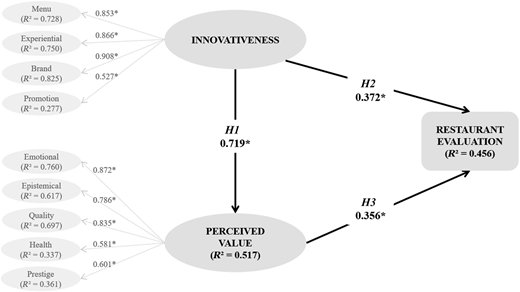
Regarding the structural relationships, Innovativeness exerted a positive and statistically significant effect on Perceived Value (β = 0.719, p < 0.001), reinforcing evidence that innovative restaurant attributes contribute to customers’ valuation of gastronomic experiences (Lee and Park, 2023; Peters and Kallmuenzer, 2018). In addition, both Innovativeness (β = 0.372, p = 0.001) and Perceived Value (β = 0.356, p = 0.002) positively influenced Restaurant Evaluation. These findings confirm the partial mediating role of Perceived Value in the relationship between Innovativeness and Restaurant Evaluation (indirect effect = 0.256, p = 0.003). The total effect of Innovativeness on Restaurant Evaluation was substantial (β = 0.628, p < 0.001), highlighting its strategic relevance for competitiveness and customer satisfaction in the gastronomic sector (Table 4).
Overall, the findings are consistent with previous studies suggesting that restaurants’ innovative capacity not only enhances perceived value directly but also creates favorable conditions for customer loyalty and positive word-of-mouth as downstream outcomes of value creation (Ottenbacher and Harrington, 2007). Therefore, the proposed model provides robust empirical evidence that innovation, when positively perceived by customers, strengthens overall experience evaluation and should be prioritized as a central component of restaurant management and positioning strategies.
5. Discussion and conclusions
The confirmatory and structural modeling results demonstrate the robustness and validity of the evaluated constructs, with satisfactory fit indices and high standardized coefficients across most indicators. These findings support the theoretical plausibility of the proposed relationships and confirm the internal consistency of the measurement model (Brown, 2015; Hair et al., 2009). In the restaurant context, validating the latent structure is particularly important because it enables the examination of complex relationships among constructs such as Innovativeness, Perceived Value, and Restaurant Evaluation with greater statistical rigor.
As presented in Figure 1, the structural model explains a substantial proportion of variance in the endogenous constructs. Innovativeness explains 51.7% of the variance in Perceived Value (R2 = 0.517), corresponding to a very large effect size (Cohen’s f2 ≈ 1.07). Likewise, the combined effects of Innovativeness and Perceived Value explain 45.6% of the variance in Restaurant Evaluation (R2 = 0.456), also indicating a very large global effect size (Cohen’s f2 ≈ 0.84) (Cohen, 1988).
The magnitude of these effect sizes provides additional empirical support for the adequacy of the final sample size, as large effects tend to increase statistical sensitivity and the stability of parameter estimates. Therefore, despite the final sample being smaller than the initial target, the strength of the observed relationships suggests that the main structural effects were estimated with sufficient robustness for the objectives of this study (Westland, 2010; Wolf et al., 2013).
The strongest structural relationship identified in the model was between Innovativeness and Perceived Value (β = 0.719, p < 0.001), indicating that innovative restaurant practices substantially enhance customers’ perceptions of value within gastronomic experiences. This finding is consistent with previous studies suggesting that innovation increases customer appeal by promoting sensory diversity, service originality, and competitive differentiation (Ottenbacher and Harrington, 2009; Stierand and Lynch, 2008). In this sense, innovation in menus, branding, and customer experience should not be interpreted merely as an operational attribute, but rather as a strategic mechanism capable of generating both symbolic and functional value (Hjalager, 2010).
Recent studies further indicate that customer perceived innovativeness functions as a signal of originality, creativity, and authenticity, stimulating emotional and cognitive responses that strengthen experiential value (Amer, 2025; Kim et al., 2021). These findings reinforce the importance of analyzing innovation from the demand perspective, recognizing that perceptions of novelty and uniqueness in gastronomic environments can be translated into symbolic satisfaction and feelings of exclusivity (Wu et al., 2025). From a managerial perspective, this evidence suggests that restaurants seeking to strengthen perceived value should invest in innovations that combine aesthetic creativity, cultural storytelling, and technologies capable of enhancing customers’ sensory and emotional engagement. Such practices may also contribute to strengthening the attractiveness of gastronomic destinations.
The analysis also revealed a significant effect of Perceived Value on Restaurant Evaluation (β = 0.356, p = 0.002), corroborating studies that associate perceptions of superior benefits with higher satisfaction and revisit intention (Ryu et al., 2012; Sweeney and Soutar, 2001). This finding supports the idea that perceived value plays a mediating role between innovative attributes and overall customer evaluation, as previously discussed by Zeithaml (1988).
Recent literature suggests that experiential value encompasses cognitive, affective, and symbolic dimensions formed through the interaction between innovative stimuli and perceptions of authenticity (Patwary et al., 2025; Tsaur et al., 2024). Therefore, perceived value extends beyond functional benefits by incorporating hedonic and epistemic dimensions such as curiosity, learning, and aesthetic pleasure. From a managerial standpoint, these results indicate that perceived value should be understood as a dynamic and relational construct, requiring restaurants to develop experiences capable of generating meaning, engagement, and emotion. In tourism destinations, this orientation may also strengthen destination image and foster stronger affective connections between visitors and place.
Complementarily, Innovativeness also exerted a significant direct effect on Restaurant Evaluation (β = 0.372, p = 0.001), indicating that perceptions of creativity, differentiation, and modernity positively influence customers’ overall judgments, even beyond the mediating role of perceived value. This finding is consistent with the perspective of Bessant and Tidd (2015), who argue that service innovation contributes directly to brand attractiveness and reputation by generating unique and memorable experiences.
The results also reinforce the idea that perceived innovativeness is an important predictor of overall evaluation because it reflects a restaurant’s ability to sustain a renewed and emotionally engaging value proposition (Amer, 2025; Vo-Thanh et al., 2024). In highly competitive environments, innovative restaurants tend to be associated with prestige, reliability, and exclusivity, strengthening reputation and encouraging positive word-of-mouth. From a managerial perspective, maintaining this innovative image requires continuous investment in menu renewal, ambiance design, and digital communication strategies capable of transforming culinary creativity into symbolic value and reinforcing the destination’s positioning within avant-garde gastronomy.
A more detailed interpretation of the latent dimensions further supports these findings. The Emotional dimension presented high explained variance (R2 = 0.760; AVE = 0.824), highlighting the central role of affective bonds in gastronomic experiences. This result aligns with previous studies demonstrating that hospitality, aesthetics, and atmosphere stimulate emotional responses associated with customer loyalty and positive experiential evaluations (Ryu et al., 2012; Torres et al., 2014). The Epistemic Value dimension also showed substantial relevance (R2 = 0.617), suggesting that curiosity and the search for culinary novelty are strongly associated with innovative gastronomic proposals (Quadri-Felitti and Fiore, 2013).
These findings are consistent with Tsaur et al. (2024) and Amer (2025), who emphasize that emotional value reflects the restaurant’s ability to evoke pleasure, inspiration, and a sense of belonging, whereas epistemic value is related to discovery and learning derived from creative culinary practices. Together, these dimensions reinforce the role of perceived innovation as a catalyst for transformative gastronomic experiences capable of strengthening both affective and cognitive customer engagement.
From the supply-side perspective, the Menu (R2 = 0.728) and Brand (R2 = 0.825) dimensions emerged as the strongest components of perceived innovativeness, highlighting the importance of product design and visual identity for competitive differentiation (Harrington, 2004; Stierand et al., 2014). In contrast, the Promotion dimension presented lower explained variance (R2 = 0.277), suggesting that promotional strategies, although relevant, are perceived as less impactful than the structural and experiential elements of the gastronomic offering. This result indicates that communication strategies should reinforce and amplify perceptions of innovation already embedded in the physical and symbolic dimensions of the experience.
These findings are consistent with Wu et al. (2025), who observed that consumers tend to associate innovation more strongly with visual, narrative, and symbolic stimuli integrated into the consumption experience than with isolated promotional actions. Consequently, storytelling strategies, thematic ambiance, and sensory design appear to be more effective mechanisms for communicating innovative positioning in restaurants.
From a broader perspective, the findings support Hjalager’s (2010) argument that gastronomic innovation should be understood as a multidimensional construct involving product, process, marketing, and organizational dimensions. The present study empirically reinforces this perspective by demonstrating that innovativeness extends beyond menu modifications and includes the creation of narratives and experiences capable of communicating uniqueness and value. Similarly, Patwary et al. (2025) argue that the integration of innovation and creative sustainability strengthens perceived value and contributes to long-term competitive advantage. In this sense, the combination of aesthetic innovation, environmental responsibility, and cultural authenticity emerges as a promising strategy for reinforcing perceived value and strengthening the identity of gastronomic destinations.
Finally, the significant relationships identified among Innovativeness, Perceived Value, and Restaurant Evaluation reinforce the idea that innovation should be managed as a strategic asset within the restaurant sector. As proposed by Sundbo and Toivonen (2011), the continuous ability to innovate in ways aligned with consumers’ emotional and cognitive expectations not only sustains competitiveness but also promotes long-term value creation through both tangible and intangible returns. From a managerial perspective, the results suggest that restaurant and destination managers should adopt a systemic view of innovation, in which all dimensions—from menu development to brand identity—contribute to the construction of integrated perceptions of value. Investments in experiences that combine local authenticity with sensory creativity may therefore strengthen the positioning of gastronomic destinations as ecosystems of innovation and culture.
5.1 Conclusions
This study examined the influence of perceived innovativeness on perceived value in Haute Cuisine gastronomic experiences within the context of São Paulo. Using Structural Equation Modeling (SEM) applied to data collected from customers of Michelin Guide restaurants, the study produced robust empirical evidence demonstrating that innovativeness exerts a positive and significant effect on perceived value, which subsequently influences overall restaurant evaluation. In addition, innovativeness also showed a direct effect on restaurant evaluation, indicating that innovative elements, when recognized by customers, can independently enhance both the gastronomic experience and perceptions of quality.
These findings reinforce the importance of understanding innovation from the demand-side perspective, in line with recent studies that conceptualize customer perceived innovativeness as a symbolic and experiential process capable of strengthening consumers’ emotional and cognitive engagement (Amer, 2025; Tsaur et al., 2024).
5.2 Theoretical implications
The findings contribute to advancing the academic debate on innovation in the hospitality sector by confirming that innovativeness is a multidimensional construct encompassing menu, experience, brand, and promotional dimensions (Hjalager, 2010; Stierand and Lynch, 2008). The study also expands the understanding of how these dimensions interact with different forms of perceived value, including emotional, epistemic, quality, health, and prestige value, supporting perspectives that advocate a holistic approach to value creation in the gastronomic sector (Quadri-Felitti and Fiore, 2013; Sweeney and Soutar, 2001). In addition, the results strengthen the theoretical integration between perceived innovativeness and experiential value by demonstrating that innovation perception directly influences consumers’ symbolic and sensory evaluations of gastronomic experiences.
By employing validated scales and a rigorous confirmatory approach, the study reinforces the methodological basis for future investigations focused on innovation perception from the consumer perspective. This empirical contribution supports the consolidation of an emerging research field centered on experiential innovation in hospitality, particularly studies examining value co-creation and new consumption dynamics in creative and digital environments (Wu et al., 2025).
Beyond the immediate findings, the validated hierarchical structure of Innovativeness and Perceived Value offers a replicable analytical framework for future studies. These constructs may function as diagnostic tools for assessing innovation effectiveness across different restaurant typologies and cultural contexts, as well as for examining moderating and mediating mechanisms related to loyalty, destination image, and behavioral intentions. Future research may also adapt these constructs to emerging contexts such as digitalized dining experiences and sustainable gastronomy models.
5.3 Practical implications
From a managerial perspective, the findings suggest that Haute Cuisine restaurant managers should approach innovation as a central strategic element that extends beyond isolated menu changes to include experience design and brand strengthening. Investments in ambiance, gastronomic storytelling, and differentiated services appear particularly important for generating emotional and epistemic value, thereby encouraging customer satisfaction, loyalty, and positive recommendation behaviors. Although promotional strategies showed comparatively lower impact, they remain relevant as mechanisms for communicating and reinforcing implemented innovations. In addition, sustainable practices and green innovations may strengthen symbolic and reputational value by aligning restaurants with growing consumer demands for socio-environmental responsibility.
These managerial implications also extend to gastronomic tourism destinations, which may benefit from fostering innovation ecosystems that integrate chefs, local producers, and territorial promotion strategies. Such integration may contribute to strengthening a creative and sustainable destination image. Furthermore, considering the demographic profile identified in this study, managers operating in similar metropolitan Haute Cuisine environments should develop innovation strategies targeted at consumers who value experiential differentiation, symbolic status, and cultural enrichment. In comparable markets, emphasizing epistemic stimulation, aesthetic refinement, and socially shareable experiences may enhance perceived value more effectively. Conversely, destinations characterized by different socio-demographic profiles may require adapted innovation strategies aligned with distinct cultural and motivational expectations.
5.4 Limitations and future research
Some limitations of this study should be acknowledged. First, the sample was restricted to customers of Michelin Guide restaurants located in São Paulo, limiting the generalizability of the findings to other geographical contexts and gastronomic segments. In addition, the demographic composition of the sample—predominantly female, highly educated, and concentrated in higher income groups—may reflect a specific consumption profile that influences perceptions of innovativeness and experiential value. The use of a non-probabilistic sampling strategy and the final sample size also require caution when interpreting the broader applicability of the results.
Second, the cross-sectional design limits the establishment of definitive causal relationships, restricting the interpretation of findings to statistical associations. Moreover, all variables were based on self-reported perceptions, which may be influenced by cognitive and memory biases.
Future research could expand the geographic scope of analysis and include different restaurant typologies, ranging from casual dining establishments to restaurants located in emerging tourism destinations, to verify the consistency of the observed relationships across distinct contexts. Longitudinal studies may also contribute to understanding how perceptions of innovativeness and value evolve over time, particularly in response to seasonal innovations or strategic changes in restaurant management.
In addition, future investigations should explore the moderating effects of variables such as gastronomic involvement, tourist motivation, and cultural characteristics. Further studies may also deepen the analysis of the relationship between innovation and sustainable practices in shaping perceived value. Finally, the integration of qualitative approaches and customer-generated digital content analyses could provide a more comprehensive understanding of the mechanisms underlying the relationship between innovativeness and perceived value, contributing to the development of more applied and integrative theories within the hospitality sector.
The supplementary material for this article can be found online.