This research aims to investigate when and how restaurants can cross the innovation chasm in adopting service robots in both front-of-house and back-of-house operations. Specifically, it explores customer responses to varying levels of robot deployment, ranging from fully human-operated to fully automated services, across different restaurant types based on cuisine and thematic elements.
It employs two experiments to evaluate customer perceptions of authenticity, quality, fit and patronage intention under different service configurations. These configurations are examined within the context of local cuisine restaurants, fast-food establishments and futuristic-themed dining settings. The research sample consists of adults from the United States, ranging in age from 18 to 83. Multivariate analysis of variance (MANOVA) was conducted to analyze the data.
The results reveal that local cuisine restaurants receive higher ratings in authenticity, quality, fit and patronage intention with fully human-operated services. In contrast, fast-food and futuristic-themed restaurants achieve comparable fit evaluations across human-operated, robot-involved and fully automated service configurations. Within futuristic-themed contexts, human-operated and robot-involved services receive comparable ratings for authenticity and patronage intention. However, when robots are responsible for cooking or when service is fully automated, human-operated services are perceived as higher in quality, with some advantage also observed in authenticity and patronage intention.
The findings guide restaurant operators in optimizing service robot integration strategies to align with customer expectations across diverse dining contexts.
The research sheds light on the evolving interplay between technology and human interaction in dining, contributing to broader discussions on automation’s societal impact.
This research addresses the gap in understanding when and how to deploy service robots to facilitate customer adoption. It provides insights into optimal deployment levels to bridge the ‘innovation chasm’ in service robot adoption across different restaurant contexts.
1. Introduction
The service realm has witnessed significant growth and integration of technology innovations globally. Service robots, often equipped with artificial intelligence (AI), are among the innovative technologies increasingly employed across hospitality and tourism settings, notably in hotels and restaurants (Chuah and Soeiro, 2025; Moriuchi and Murdy, 2024). Robots are now providing services to customers in restaurants, acting as servers and even chefs on a global scale (Ewing-Chow, 2024). Food plays a vital role in the tourism and hospitality industry, and the implementation of service robots at restaurants is going to bring profound challenges to customers’ tourism and gastronomic experiences (Qian and Wan, 2024). The implementation of service robots and their acceptance by customers have received increasing attention due to their innovative nature and potential impact. However, with a few recent exceptions (e.g. Chuah and Soeiro, 2025; Song et al., 2022, 2025), relatively limited research has examined diverse service robot deployment configurations in restaurants, such as varying combinations of human and robot roles in front- and back-of-house operations, particularly in relation to the diversity of restaurant types. This reveals a gap in the service innovation literature in hospitality and tourism, where contextual deployment strategies remain underexplored.
While service robots are generally regarded as positive innovations, it is important to recognize, based on the diffusion of innovation theory (Rogers et al., 2014), that not all innovations are perceived favorably by mainstream customers and successfully adopted. An adoption chasm exists between early adopters and the early majority (Moore, 2006). The chasm can be crossed only when an innovation gains acceptance from a sufficiently large portion of the market (Moore, 2006; Rogers et al., 2014). Restaurants considering service robots should be mindful of the “adoption chasm” and carefully assess their suitability. Those that have already implemented robots should develop proactive strategies to overcome this challenge. A key issue is maintaining customer engagement once the novelty wears off. Specifically, how can these restaurants drive long-term customer adoption and appeal to the mainstream market? Although this process is both theoretically significant and practically essential, it remains underexplored in hospitality and tourism literature.
Based on the diffusion of innovation theory, as innovations move from the early market to the mainstream, business strategies should shift from emphasizing novelty to demonstrating practical benefits that align with customer needs and preferences (Huang et al., 2021; Moore, 2006). This process requires an optimal allocation of resources and a clear understanding of customers’ perceptions. Robotization enables restaurants to offer various deployment combinations of human employees and service robots. Service robots can either replace certain human roles, such as servers and cooks, or assist employees with specific tasks (Ewing-Chow, 2024; Song et al., 2025). When restaurant businesses integrate service robots, they must strategically identify tasks suitable for robots and develop effective strategies to integrate human employees with robots, optimizing service provision (Song et al., 2025). Understanding customer perceptions and intentions regarding different methods of service robot deployment is crucial for offering strategies to facilitate customer adoption.
Moreover, for an innovation to be perceived favorably by customers, it must be central to the business (Keiningham et al., 2019) and align with its core offerings. In restaurant settings, authenticity and quality are recognized as key components of customer needs (Chuah and Soeiro, 2025; Song et al., 2025), and the perceived fit of innovation plays a critical role in customer acceptance (Keiningham et al., 2019). This research, therefore, examines how the deployment of service robots influences customers’ perceptions of authenticity, quality and fit, and their subsequent intention to patronize restaurants when they travel. Additionally, it examines whether these effects differ between different categories of restaurants based on food offerings (local cuisine restaurant vs fast food restaurant) and themes (local cuisine restaurant vs futuristic theme restaurant), as customer expectations may vary across these establishments. The findings from this research, based on two empirical studies conducted with consumer samples from the USA, offer timely and representative insights into broader global trends in tourism and hospitality. They deepen our understanding of service deployment dynamics involving human and robotic resources across diverse restaurant settings. Additionally, the studies provide practical implications for industry practitioners by offering guidance on facilitating service robot adoption and bridging the innovation chasm in hospitality establishments.
2. Literature review and hypothesis development
2.1 Diffusion of innovation theory and crossing the chasm framework
The diffusion of innovation theory (Rogers et al., 2014) explains how new ideas, technologies, and innovations spread through populations over time. It categorizes adopters into five groups based on their attitudes and willingness to embrace innovation: innovators, early adopters, early majority, late majority and laggards. Typically, the adoption process progresses from innovators to laggards (Rogers et al., 2014). Building on this theory, the “crossing the chasm” framework highlights a critical gap, or chasm, between early adopters and the mainstream market. Innovations only achieve widespread success when they manage to cross this chasm (Moore, 2006). To do so, businesses must adapt their marketing strategies and refine their products or services to appeal to a broader customer base, moving beyond the niche market of early adopters. This involves not only proving the value and benefits of the innovation but also ensuring that it integrates smoothly into existing systems and aligns with the business’s core offerings (Moore, 2006; Rogers et al., 2014). In the context of technological innovation within the tourism and hospitality industry, the adoption of service robots follows the diffusion of innovation theory (Binesh et al., 2024). It may soon encounter or could already be facing the adoption chasm. Therefore, it is crucial to develop strategies for successfully integrating this innovation by aligning it with consumer perceptions and expectations to facilitate adoption in the mainstream market.
2.2 Robot deployment methods and customer intention
The rise of service robots in the hospitality and tourism industry reflects a significant trend toward automation and technological advancement (Huang et al., 2024; Kim and Cha, 2024; Lu et al., 2024; Ma et al., 2022). Robotization allows restaurants to implement different combinations of human staff and service robots in their operations. Many restaurant businesses are integrating service robots for tasks such as food preparation and serving. These robots can either support human employees in completing specific tasks or completely replace certain human roles (Tuomi et al., 2021). As a result, a restaurant can adopt one of three service production and delivery approaches: fully operated by human employees, human employees assisted by service robots, or certain roles entirely replaced by robots, each representing a different type of service deployment method.
While service robots may offer potential cost-saving and sanitation benefits, customers may express concerns about the service experiences provided by robots. As the level of robotization increases, especially when robots take on more core customer-facing roles, customers may become more resistant to these services (Chan and Tung, 2019; Wang et al., 2023). According to the diffusion of innovation theory, such resistance may stem from customers perceiving low capabilities between robot services and their expectations of personalized, human-centered hospitality. Specifically, in the restaurant context, researchers have suggested that customers generally do not find robots suitable for tasks such as cooking (Xiao and Zhao, 2022), and they are less likely to patronize a restaurant where robots are responsible for core services such as food preparation compared to those prepared by human employees (Song et al., 2022). Moreover, because service robots are relatively unfamiliar to the general public, people may be less willing to try them, which slows their broader adoption. When given a choice, customers would prefer to be served by human staff rather than robots, particularly in experiences where cultural or personal interaction is expected (Moriuchi and Murdy, 2024). Therefore, this study proposes that:
The service deployment methods in restaurants affect customers’ patronage intention.
2.3 Customer perceived authenticity, quality and fit
Drawing on the diffusion of innovation theory, for customers to perceive an innovation positively, it must be central to the business and aligned with customers’ expectations (Keiningham et al., 2019). When dining at restaurants, authenticity and quality are the key performance expectations customers seek (Latiff et al., 2020; Song et al., 2022; Wang and Mattila, 2015; Zhu and Chang, 2020), and these factors significantly influence customers’ attitudes and behaviors toward adopting new technologies (Song et al., 2025). Furthermore, the perceived fit or congruence between the innovation and the overall service context is crucial in shaping technology acceptance (Choi et al., 2022; Hoang and Tran, 2022). Therefore, this research examines how customers respond differently to various service deployment methods based on their perceptions of authenticity, quality and fit.
Authenticity embodies characteristics of genuineness, reliability, trustworthiness and originality (Canavan and McCamley, 2021). In the tourism and hospitality industry, authenticity stands as a sought-after attribute by customers (Seyitoğlu, 2021). Previous studies have identified authenticity as an important factor to consider when deploying service robots in restaurants (Song et al., 2022, 2025). While these studies lay the foundation for understanding the role of authenticity in restaurants adopting service robots, they primarily focused on service authenticity (e.g. Song et al., 2022, 2025) and customer existential authenticity (Song et al., 2025). In the restaurant context, authenticity encompasses dimensions such as food authenticity (Li and Su, 2022), service authenticity (Latiff et al., 2020; Song et al., 2022) and cultural authenticity (Kim and Baker, 2017; Wang and Mattila, 2015). Building on these previous studies, this research enriches the measurement of perceived authenticity and explores how it varies across different service deployment methods, offering a more comprehensive understanding of authenticity in human-robot interactions within restaurants.
Extant research suggests that services delivered through technological innovations often fall short of customers’ authenticity expectations, as automation and authenticity are intuitively perceived as conflicting by customers (Hu et al., 2021; Seyitoğlu, 2021). This is particularly true for core tasks, such as cooking and sincere communication and display of emotions, where customers expect a more hands-on, traditional, or interpersonal approach (Fuste-Forne, 2021; Hu et al., 2021; Seyitoğlu, 2021; Song et al., 2022). It is reasonable to suggest that customers may perceive authenticity differently depending on the service deployment methods used in restaurants (i.e. fully human-operated, human-robot collaboration, or fully automated). Thus, the following hypothesis is proposed:
The service deployment methods in restaurants affect customers’ perceived authenticity.
Quality is crucial in the services industry and plays a significant role in the successful adoption of technological innovations (Song et al., 2025). In restaurants, quality encompasses both food quality (Zhu, 2022) and service quality (Ha and Jang, 2010; Song et al., 2025; Zhu and Chang, 2020). Service quality refers to customers’ perceptions and evaluations of the overall service experience (Ha and Jang, 2010), while food quality pertains to customers’ assessments of food attributes (Zhu, 2022). Both service quality and food quality have been identified as key factors influencing customers’ psychological and behavioral responses in restaurant settings, whether in traditional human-provided or robot-provided services (Ha and Jang, 2010; Song et al., 2025; Zhu, 2022; Zhu and Chang, 2020).
Research in human-robot interaction indicates that, even when the service provided is identical, customers often perceive robot-provided services as lower in quality compared to those delivered by humans (Castelo et al., 2023; Chan and Tung, 2019). This perception is often attributed to the belief that service automation is motivated by the firm’s desire for cost reduction, which may come at the expense of customer benefits (Castelo et al., 2023). Additionally, studies have found that customers perceive dishes prepared by robots as having lower food quality than those cooked by human chefs (Xiao and Zhao, 2022). This evidence indicates that customers’ perceptions of quality may vary based on the service deployment method employed in restaurants (i.e. fully human-operated, human-robot collaboration or fully automated). Therefore, the following hypothesis is proposed:
The service deployment methods in restaurants affect customers’ perceived quality.
Originating from the organizational behavior literature, perceived fit is initially defined as the compatibility between an individual and organizational attributes (van Vianen, 2018). Given that service robots can be regarded as social presences and entities in service settings (Hu et al., 2021), researchers have extended the person-environment fit concept to human-robot interaction contexts (Hoang and Tran, 2022; Yang et al., 2024). Thus, perceived fit can be defined as the extent to which the service provider, whether human or robot, is compatible with the service environment during encounters. When customers perceive a higher level of fit or congruence between the service provider and the service context, they are more likely to develop positive attitudes and behavioral responses toward the service provider (Choi et al., 2022; Hoang and Tran, 2022; Yang et al., 2024).
In the context of service innovations, researchers suggest that customer perceptions of service automation and technology fit depend on specific tasks (Huang and Rust, 2021; Santiago et al., 2024). Certain service tasks are viewed by customers as more suitable for automation, while others are not (Huang and Rust, 2021; Seyitoğlu, 2021; Yang et al., 2024). For instance, current AI services are considered a better fit for mechanical and certain analytical tasks, but not for intuitive and empathetic ones (Huang and Rust, 2021). Moreover, empirical evidence indicates that customers perceive service employees as a better fit than service robots for providing hedonic services (Yang et al., 2024). Given that different methods of resource deployment are suitable for various service settings (Santiago et al., 2024; Seyitoğlu, 2021), it is reasonable to propose that customers may have differing perceptions regarding the fit of service deployment methods in restaurants.
The service deployment methods in restaurants affect customers’ perceived fit.
2.4 Two perspectives of restaurant type – food offerings and themes
The effects of robotization on customers’ perceptions may vary depending on the situation and the type of service organization (Chuah and Soeiro, 2025; Pitardi et al., 2024; Qian and Wan, 2024). The hospitality and tourism industry features a wide variety of restaurant types (Hanks et al., 2017; Hlee et al., 2019). Restaurants can be categorized in different ways, such as by scale (Chuah and Soeiro, 2025; Hlee et al., 2019; Qian and Wan, 2024; Song et al., 2022), food offerings (Xiao and Zhao, 2022) or theme (Yang et al., 2024). For example, based on food offerings, restaurants can be classified as fast-food establishments that typically serve hamburgers and fries or as venues offering local or ethnic cuisine (Ha and Jang, 2010). Furthermore, restaurants can be segmented by theme or branding concept, including celebrity restaurants, sports restaurants, local cuisine restaurants and others (Hanks et al., 2017; Yang et al., 2024). Building on this body of research, the present study examines the effects of restaurant type, considering both food offerings (fast food vs local cuisine) and themes (local cuisine vs futuristic theme).
Robots are increasingly being used in restaurants for tasks such as meal preparation, order taking and food delivery, particularly in fast-food establishments, where efficiency and consistency are crucial (Jain et al., 2023; Tuomi et al., 2021; Latiff et al., 2020). Currently, fast-food restaurants, with their standardized food preparation and serving processes, are generally perceived by customers as having lower expectations for authenticity and quality. Furthermore, as more fast-food establishments deploy service robots, which are frequently highlighted in the news (e.g. Ewing-Chow, 2024), customers may perceive a strong fit for using robots in such environments and become more likely to patronize these establishments when robots are in use. As the diffusion of innovation theory suggests, innovations are more readily adopted in settings where they complement existing practices and meet the perceived needs of customers.
In contrast, innovations like service robots may face resistance in local or ethnic restaurants, where customers value authenticity and personal interaction over efficiency (Antón et al., 2019). Local cuisine often involves meticulous preparation and reflects a deep connection to local food culture and knowledge. As a result, customers tend to have higher expectations for authenticity and quality at these destination restaurants (Antón et al., 2019), making robot deployment perceived as incompatible. The personal touches associated with traditional cooking methods further enhance customers’ emotional ties to these dining experiences, a sentiment that robots cannot replicate. Additionally, the belief that automation could diminish the uniqueness of local dishes may also negatively impact their perceptions of robot-assisted or fully automated services. This may lead to customer reluctance to dine at such restaurants, perceiving them as less authentic, lower in quality and a poorer fit compared to being served by human staff. Therefore, as local cuisine restaurants adopt more robotic resources, customers may be less inclined to visit, especially in settings where human interaction is seen as integral to the dining experience. Based on the above discussion, the following hypothesis is proposed:
Restaurant type based on food offerings moderates the effect of the service deployment method on customers’ patronage intentions (H5a), perceived authenticity (H5b), perceived quality (H5c) and perceived fit (H5d).Specifically, robot deployment will be rated more favorably in fast-food restaurants than in local cuisine restaurants.
Moreover, restaurants can differentiate themselves through branding themes. For instance, local cuisine can also serve as a restaurant theme, emphasizing traditional authenticity (Huete-Alcocer and Hernandez-Rojas, 2022), while futuristic-themed establishments highlight novelty and innovation. These thematic cues set expectations for the service experience and influence customer perceptions. As discussed earlier, in local cuisine settings, deploying service robots might be counterproductive. Conversely, futuristic-themed establishments could use robotic services as a core part of their market positioning, intentionally creating a high-tech, novel and entertainment-rich environment (Hu, 2021). For example, robots serve as both staff and entertainment in robot cafés and restaurants in Japan, as well as RoboChef in Dubai, known for its robotic chef who prepares gourmet dishes, and Bots and Pots in Croatia, where customers enjoy a novelty dining experience alongside robotic servers (Ewing-Chow, 2024). In these contexts, the presence of service robots is a defining characteristic of these futuristic concepts, which makes them a natural fit with the atmosphere and aligns with consumer expectations, reinforcing thematic coherence and potentially enhancing customer experience.
In addition, customers may form new types of authenticity and quality expectations for technology-involved services that differ from traditional services (Song et al., 2025; Zhu and Chang, 2020). For instance, technological services such as virtual reality can be perceived as authentic because they are seen as genuine and unique in their own way (Kim et al., 2020). Similarly, customers may hold a different set of quality expectations when evaluating robot-provided services in a novelty-driven setting, compared to traditional settings (Chuah and Soeiro, 2025; Song et al., 2025), as robots are perceived as capable of delivering high-quality service and food that aligns with the technological dining environment (Zhu and Chang, 2020). Grounded in the diffusion of innovation theory, the likelihood of adopting innovations increases when they align with consumers’ beliefs and preferences (Rogers et al., 2014). In these cases, the integration of service robots is thus likely to be perceived as more authentic, being novel, unique and genuine in a futuristic atmosphere, and higher in quality, congruent with the service environment, and compatible with the branding concept. This facilitates the acceptance of robotic services as a natural extension of the dining experience. Based on this discussion, the following hypothesis is proposed:
Restaurant type based on themes moderates the effect of the service deployment method on customers’ patronage intentions (H6a), perceived authenticity (H6b), perceived quality (H6c) and perceived fit (H6d).Specifically, robot deployment will be rated more favorably in futuristic theme restaurants than in local cuisine restaurants.
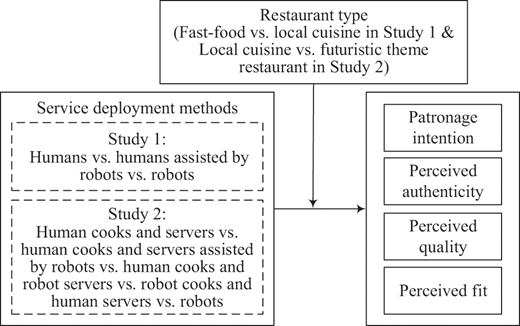
The conceptual model of this research is shown in Figure 1.
3. Study 1
3.1 Methods
3.1.1 Study design and procedures.
Data were collected using Qualtrics through an online survey employing a scenario-based experimental design with a 3 (service deployment method: humans, humans assisted by robots, or robots) × 2 (restaurant type based on food offerings: fast food or local cuisine) structure. The participants, adults from the USA, were randomly assigned to the conditions, offering a contextually rich perspective grounded in a market known for its diverse restaurant formats and active integration of service technologies. The ethics approval number is IRB-23-254. They were presented with a scenario involving imagining traveling and coming across a brochure for a restaurant near their hotel. The service provider and restaurant type were manipulated by varying the descriptions in the scenarios. All scenarios are provided in the Appendix.
Following the scenarios, participants responded to questions related to the study’s main constructs, comprehension checks, a realism check and basic demographics. After data collection, a multivariate analysis of variance (MANOVA) was conducted to analyze the data. This method is commonly used to assess the impact of one or more categorical independent variables on multiple continuous dependent variables. It was particularly appropriate for this research, which involved conceptually related dependent variables measured across different experimental conditions. MANOVA also allows for the evaluation of both main and interaction effects of service deployment method and restaurant type, while controlling for potential Type I error inflation (Field, 2024).
3.1.2 Measures.
Measurement items for this study were from previous literature and modified to fit this study’s context. Perceived authenticity was measured using seven items, consisting of food authenticity (Li and Su, 2022), service authenticity (Latiff et al., 2020; Song et al., 2022) and culture authenticity (Kim and Baker, 2017; Wang and Mattila, 2015). Perceived quality was assessed using ten items, consisting of food quality (Zhu, 2022) and service quality (Zhu and Chang, 2020). Perceived fit was measured by three items adapted from Choi et al. (2022) and Cha et al. (2016). These constructs were measured on a 5-point Likert-type scale (1 = strongly disagree, 5 = strongly agree). Patronage intention was measured with three items (Li and Su, 2022; Wang and Mattila, 2015). Detailed measurement items can be found in the Appendix.
3.1.3 Sample characteristics.
Two attention-check questions were included in the survey. Only surveys that passed these checks were retained for analysis. Two comprehension checks were included, prompting participants to identify the service provider and the restaurant type. Surveys that did not provide answers corresponding to the assigned scenarios in these comprehension checks were discarded. An a priori power analysis was conducted to estimate the minimum sample size required for a MANOVA with a 3 × 2 between-subjects design and four dependent variables. Assuming a small effect size, α = 0.05, and power = 0.85, the analysis indicated a minimum sample size of approximately 363 participants. A total of 410 valid surveys were used for analysis (nfast food = 195, nlocal cuisine = 215; nhumans = 149, nhumans assisted by robots = 127, nrobots = 134). Among all participants, 50.70% were female. Participants’ mean age was 45.16 years (SD = 16.25), ranging from 18 to 83. The detailed demographic information is shown in Table 1. The scenarios’ realism was verified based on the average of two items (1 = strongly disagree, 5 = strongly agree). Participants perceived the scenarios as realistic [M = 3.74, SD = 1.09, t(409) = 13.70, p < 0.01].
3.2 Results
3.2.1 Testing the assumptions.
A MANOVA was conducted using the Statistical software SPSS 29. The assumptions of MANOVA were checked before proceeding with the analysis. First, because the surveys were collected online with randomization, the independence of observations assumption was met. Second, the reliability of the continuous dependent variables was satisfactory, with values exceeding 0.70 (see details in Table 2). The validity of dependent variables was also checked. The Average Variance Extracted (AVE) values were above 0.50 (see Appendix). The heterotrait-monotrait (HTMT) ratio of correlations for all constructs was within acceptable limits. Third, the variables were normally distributed, with acceptable skewness and kurtosis values within the range from −1.50 to 1.50. Fourth, the dependent variables were significantly correlated at an acceptable level (less than 0.85), meeting the assumptions of linearity among dependent variables and the absence of multicollinearity. Fifth, the equality of the variance-covariance matrices was tested using Box’s M test. Although the results were significant (Box’s M = 228.66, p < 0.05), indicating inequality of the variance-covariance matrices, it is known that Box’s M test is particularly sensitive to large sample sizes (Field, 2024). Therefore, it is recommended to proceed with the analysis and interpret the robust statistics, such as Roy’s largest root test statistic, especially when sample sizes are balanced across groups (Ateş et al., 2019). The assumptions of MANOVA were met.
3.2.2 Results of the MANOVA model.
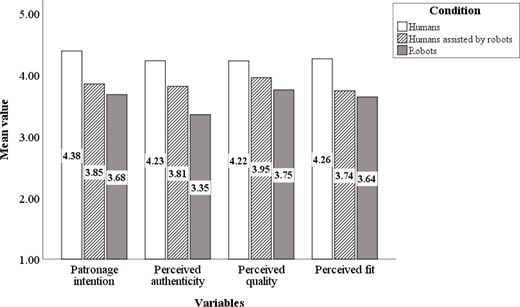
The study applied a MANOVA to examine the main effects of service deployment method and restaurant type on the following dependent variables: patronage intention, perceived authenticity, perceived quality and perceived fit. The analysis also tested for interaction effects between the independent variables. The analysis revealed a significant main effect of the service deployment method on the set of dependent variables (Roy’s largest root = 0.15, F = 14.81, p < 0.01). Specifically, the service deployment method had significant effects on patronage intention [1] [F(2, 409) = 15.31, p < 0.01], perceived authenticity [F(2, 409) = 27.54, p < 0.01], perceived quality [F(2, 409) = 11.65, p < 0.01] and perceived fit [F(2, 409) = 14.69, p < 0.01].
Post hoc tests using the Bonferroni method further revealed that human-provided services were rated higher for patronage intention, perceived authenticity, quality and fit compared to services provided by humans assisted by robots and robots alone. However, when comparing services provided by humans assisted by robots with robots alone, a significant difference was found only in perceived authenticity, with no significant differences in patronage intention, perceived quality, or perceived fit. H1 to H4 are partially supported. Detailed results are shown in Table 3 and Figure 2.
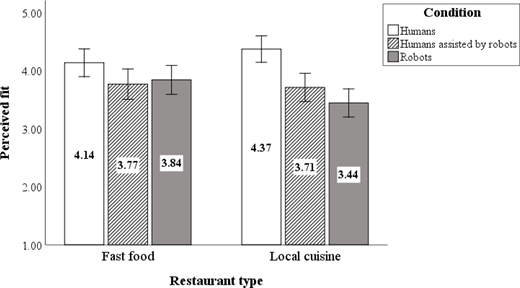
Restaurant type based on food offerings did not have a significant main effect (Roy’s largest root = 0.02, F = 1.77, p > 0.05) but had a significant interaction effect on the set of dependent variables (Roy’s largest root = 0.05, F = 2.38, p = 0.05). The tests of between-subjects effects further revealed that the interaction effect of restaurant type was only significant on perceived fit [F(2, 409) = 3.37, p < 0.05] but not on patronage intention [F(2, 409) = 1.67, p > 0.05], perceived authenticity [F(2, 409) = 1.62, p > 0.05] and perceived quality [F(2, 409) = 1.04, p > 0.05]. Post hoc tests using the Bonferroni method showed that in fast food restaurants, customers’ perceived fit of three service deployment methods was not statistically significantly different (pHumans vs humans assisted by robots = 0.12, pHumans vs robots = 0.27, and pHumans assisted by robots vs robots = 1.00). However, in local cuisine restaurants, human-provided services were rated higher in perceived fit than services provided by humans assisted by robots and by robots alone; the services provided by humans assisted by robots and provided by robots alone were not statistically significantly different in perceived fit (pHumans vs humans assisted by robots < 0.01, pHumans vs robots < 0.01, and pHumans assisted by robots vs robots = 0.40). H5d was supported, but not H5a to H5c. Thus, H5 is partially supported. The results are shown in Figure 3.
4. Study 2
Study 2 expands on Study 1 in two ways. First, it further refines specific human-robot collaboration configurations by differentiating roles in front-of-house and back-of-house operations (e.g. human cooks and robot servers vs robot cooks and human servers), providing a deeper understanding of various collaboration models. Second, Study 2 examines the influence of restaurant type from a branding perspective, contrasting local cuisine restaurants with futuristic-themed establishments. This comparison provides a broader understanding of how the deployment of robots is perceived within different restaurant themes.
4.1 Methods
4.1.1 Study design and procedures.
Data were collected using Prolific through an online survey employing a scenario-based experimental design with a 5 (service deployment method: human cooks and servers, human cooks and servers assisted by robots, human cooks and robot servers, robot cooks and human servers and robot cooks and servers) × 2 (restaurant type based on themes: local cuisine or futuristic theme) structure. The ethics approval number is 103875. The participants, adults from the USA, were randomly assigned to one of the experimental conditions. The scenarios remained similar to those in Study 1, with adjustments made to the wording to reflect differences in restaurant themes and service deployment methods. Following the scenarios, participants responded to questions related to the study’s main constructs, comprehension checks, a realism check and basic demographics.
4.1.2 Measures and sample characteristics.
The main constructs were measured using the same items as in Study 1. Similar attention-check questions and comprehension checks were used as in Study 1. An a priori power analysis was conducted to estimate the minimum sample size required for a MANOVA with a 5 × 2 between-subjects design and four dependent variables. Assuming a small effect size, α = 0.05, and power = 0.85, the analysis indicated a minimum sample size of approximately 921 participants. A total of 948 valid surveys were used for analysis. Among all participants, 50.10% were female and 64.2% were Caucasian. Participants’ mean age was 38.56 years (SD = 13.42), ranging from 18 to 82. The scenarios’ realism was tested with the same items as in Study 1. Participants perceived the scenarios as realistic [M = 3.54, SD = 0.96, t(947) = 17.35, p < 0.01].
4.2 Results
4.2.1 Testing the assumptions and results of the MANOVA model.
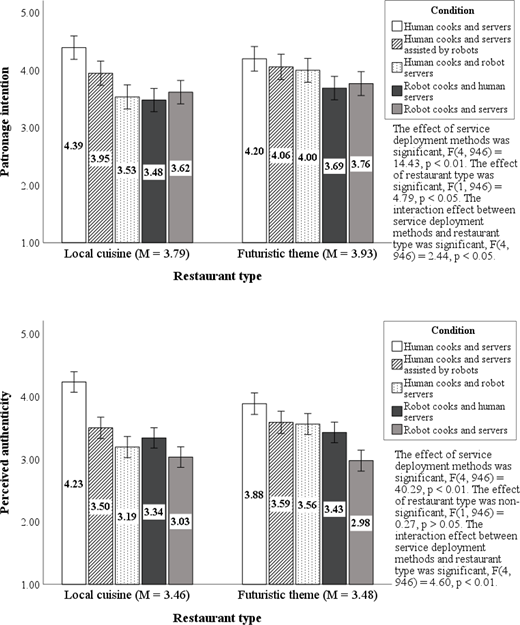
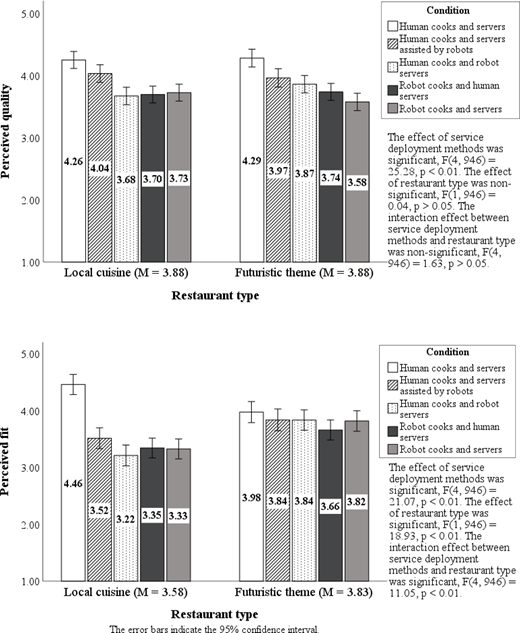
The assumptions of MANOVA were checked and met. The reliability values and correlations among variables are shown in Table 2. The validity of the dependent variables was assessed. The AVE values exceeded 0.50, and the HTMT correlation ratios were within acceptable thresholds. The MANOVA revealed a significant main effect of the service deployment method (Roy’s largest root = 0.18, F = 42.54, p < 0.01), a significant main effect of restaurant type (local cuisine vs futuristic theme) (Roy’s largest root = 0.03, F = 7.41, p < 0.01) and a significant interaction effect of service deployment method and restaurant type (Roy’s largest root = 0.08, F = 18.62, p < 0.01) on the set of dependent variables. The effects of service deployment methods and restaurant type on each dependent variable were examined, with detailed results shown in Figure 4. There was a consistently significant main effect of the service deployment method on all four dependent variables. Participants reported higher patronage intention and perceived fit in futuristic-themed restaurants compared to local cuisine-themed restaurants, while perceived authenticity and quality remained statistically similar between the two restaurant types.
Post hoc tests using the Bonferroni method (also reflected in the 95% confidence interval error bars in Figure 4) revealed that in local cuisine restaurants, the humans alone condition resulted in significantly higher patronage intention than other conditions. Additionally, the condition with human cooks and servers assisted by robots had significantly higher patronage intention than the condition with robot cooks and human servers. No significant differences were found between the other conditions. In futuristic-themed restaurants, the humans alone condition showed a significant difference compared to both the robot cooks and human servers condition and the robot cooks and servers condition. No other conditions showed significant differences in this restaurant type. A similar pattern was observed for perceived authenticity.
Regarding perceived quality, in local cuisine restaurants, the all-human condition and the humans-assisted-by-robots condition were statistically the same, with both being rated significantly higher than the other conditions. In futuristic-themed restaurants, the all-human condition was rated significantly higher than the other conditions, while the humans-assisted-by-robots condition was rated higher than the all-robots condition, but not the other human-robot collaboration conditions. The findings also reveal notable differences in the effects of service deployment methods on perceived fit between local cuisine and futuristic-themed restaurants. In local cuisine restaurants, the highest perceived fit was observed when both cooks and servers were humans. However, as automation increased, perceived fit declined significantly, with the lowest rating occurring when human cooks worked alongside robot servers. In contrast, futuristic-themed restaurants exhibited a more stable pattern in perceived fit across different service deployment methods. The ratings ranged from 3.66 to 3.98, showing less variation compared to local cuisine restaurants. Unlike the local cuisine setting, the introduction of robots in futuristic-themed restaurants did not result in a significant decline in perceived fit. In addition, customers reported a higher perceived fit of automated services in futuristic-themed restaurants than in local cuisine restaurants. Thus, H6a, H6b and H6d are supported while H6c is not.
5. Discussion and conclusions
5.1 Conclusions
This research advances our understanding of service robot adoption by identifying context-dependent thresholds for successful implementation in the restaurant industry. The findings underscore that customer perceptions of automation vary significantly by restaurant type and the specific configuration of robot deployment. Rather than treating automation as a dichotomy between human and robotic service, this research demonstrates that service robotics can take multiple deployment forms, including human cooks and servers assisted by robots, human cooks with robot servers, robot cooks with human servers and fully robotic operations, each eliciting different customer responses. While human-operated services remain critical for maintaining patronage intention and perceptions of authenticity, quality, and fit in local cuisine establishments, fast-food and futuristic-themed restaurants exhibit greater flexibility, with certain robotic configurations performing comparably to human service without detriment to customer evaluations. These insights offer actionable guidance for restaurant operators seeking to cross the innovation chasm, highlighting the importance of aligning technological integration with customer expectations and contextual fit. By elucidating when and how different forms of service robot deployment are most effectively implemented, this research contributes to the broader discourse on technology adoption in service environments.
5.2 Theoretical implications
This research makes several significant theoretical contributions to the service innovation and human-robot interaction literature within the hospitality and tourism context. First, it enriches the understanding of consumer perceptions and acceptance of service technology innovations through the theoretical lens of the diffusion of innovation theory and the cross-the-chasm framework (Moore, 2006; Rogers et al., 2014). Unlike prior research that primarily examined general attitudes toward service robots (e.g. Castelo et al., 2023; Chan and Tung, 2019; Huang et al., 2024; Moriuchi and Murdy, 2024; Tuomi et al., 2021) or focused on one or two specific aspects of customer perception (e.g. Chuah and Soeiro, 2025; Hoang and Tran, 2022; Song et al., 2022; Yang et al., 2024), this research offers a more comprehensive and multidimensional perspective by simultaneously assessing perceived authenticity, quality, fit and patronage intention. These dimensions are identified as core attributes influencing consumer responses to technological innovation in the restaurant context. Additionally, this research deepens the understanding of perceived authenticity and quality within restaurant contexts, expanding their conceptualization and measurement to include dimensions of food authenticity (Li and Su, 2022), service authenticity (Latiff et al., 2020) and cultural authenticity (Kim and Baker, 2017), as well as food quality (Zhu, 2022) and service quality (Zhu and Chang, 2020).
Second, this research adopts a comparative approach that incorporates multiple robot deployment methods and human-robot collaboration configurations. While previous studies on restaurant robot adoption have provided informative evidence by focusing either on front-of-house operations (e.g. Qian and Wan, 2024) or back-of-house operations (e.g. Zhu, 2022; Zhu and Chang, 2020), and by examining single service configurations such as robot-only service (e.g. Song et al., 2025) or basic comparisons between human and robot providers, the current study extends this work by offering a more comprehensive examination of deployment strategies. This design enables a more in-depth understanding of how different configurations influence customer responses under controlled experimental conditions.
Third, this study is among the first to empirically examine the moderating role of restaurant type by differentiating the effects of robot deployment configurations based on both cuisine-based and theme-based classifications. This extends beyond scale-based categorizations examined in previous studies (e.g. Chuah and Soeiro, 2025; Chan and Tung, 2019; Song et al., 2022) and contributes new insights from a marketing and positioning perspective. By identifying specific contextual conditions under which robotic deployment enhances or diminishes the customer experience, this research clarifies when (i.e. in which restaurant types) and how (i.e. through which deployment configurations) the innovation chasm can be effectively addressed to support mainstream market acceptance in different restaurant settings. This, in turn, also enriches the diffusion of innovation theory and the cross-the-chasm framework by identifying restaurant types as boundary conditions that determine consumers’ perceptions of technological innovations in hospitality contexts.
5.3 Practical implications
This research offers practical insights for restaurant practitioners and technology providers in the global tourism and hospitality industry. It highlights the importance of aligning service robot deployment strategies with both the characteristics of the restaurant and customer expectations. First, there are various deployment configurations for adopting service robots at restaurants, and robots can be implemented to assist human employees or to replace specific human roles (Tuomi et al., 2021). An essential factor in ensuring the successful adoption of this innovation and achieving mainstream market acceptance is selecting a service deployment configuration that aligns with customer expectations. This research’s findings indicate that customer perceptions of authenticity, quality, and fit play pivotal roles, and these perceptions differ depending on how the service is delivered.
Importantly, restaurant type should guide robot deployment strategies; this is particularly relevant in markets that are characterized by high restaurant diversity. According to this research, fast-food and futuristic-themed restaurants are well-positioned to benefit from robot involvement. In fast-food settings, robot-assisted and fully automated services are perceived as similarly fitting when compared to fully human-operated services, suggesting alignment with customer expectations. In futuristic-themed restaurants, robots are perceived as well-integrated into the dining experience, aligning with thematic expectations and contributing to a distinctive and innovative brand image. While human-operated and robot-assisted services receive comparable ratings for authenticity and patronage intention, human-operated services are rated more favorably than when robots are responsible for cooking tasks. Managers in these contexts can strategically deploy service robots to reinforce their brand’s innovative identity, without compromising key elements of customer experience. Technology providers and robot developers could also focus on fast-food and futuristic-themed restaurants, tailoring their solutions to meet customer expectations and provide context-appropriate service robots.
However, robots are not the optimal solution for all restaurant types, at least given current technological capabilities and levels of consumer acceptance. In local cuisine restaurants, human-operated services generally receive higher ratings for authenticity, perceived quality, fit, and patronage intention compared to robot-involved or fully automated services. For managers of such establishments, maintaining primarily human-operated service may be essential to preserving authenticity and quality. In these cases, the deployment of robots could negatively impact customer perceptions of the restaurant’s image, potentially reducing patronage.
5.4 Limitations and future research
This research has several limitations and offers recommendations for future studies. First, this research focused on two types of restaurants categorized by food offerings and themes. While these categories are representative, they are not exhaustive. Future research could examine additional types of restaurants, such as ethnic restaurants (Wang and Mattila, 2015). Moreover, other restaurant characteristics, such as food safety measures (Hu et al., 2024), location and dining times, may influence customers’ perceptions and behavior. Future research is encouraged to explore the effects of these factors on service technology deployment. Second, although this research did not aim to examine the impact of customer characteristics on service robot perceptions and intentions to patronize a restaurant, these characteristics could play an important role in shaping customer perceptions and behaviors. For instance, in cultures where interacting with service robots is habitual and technology is deeply integrated into everyday life, customers’ perceptions and behaviors toward new technologies may differ from those in cultures less accustomed to them (Bröhl et al., 2019). On an individual level, customers who possess the necessary knowledge and skills to use innovative technology, demonstrating technological literacy or readiness, may exhibit a higher intention to adopt these technologies (Baltaci et al., 2024; Zheng et al., 2023). Future research could further explore these factors to develop a more comprehensive understanding of customer acceptance of service robots. Third, this research excluded responses that failed attention and comprehension checks to ensure data quality. However, this exclusion may introduce potential bias by underrepresenting individuals with lower engagement or different cognitive styles.
Note
Additional analysis: A mediation analysis was conducted to further validate the selection of variables. The analysis revealed that perceived authenticity, quality, and fit collectively mediated the effect of service deployment method on patronage intention.
References
Appendix
Experiment scenarios
Study 1: A 3 (service deployment method: humans, humans assisted by robots or robots) × 2 (restaurant type based on food offerings: fast food or local cuisine) design
While traveling at a tourist destination, you come across a brochure for a local cuisine restaurant (a fast food restaurant) conveniently located near your hotel. The brochure highlights the restaurant’s focus on serving local cuisine (fast food) prepared by [skilled cooks and served by attentive staff (humans condition); skilled cooks and served by attentive staff; both are assisted by cutting-edge robots (humans assisted by robots condition); or cutting-edge robot cooks and served by attentive robot servers (robots condition)]. The prices listed on the brochure appear reasonable, and the food showcased in the brochure looks good. The brochure also features appealing images of the restaurant, portraying a nice ambiance.
Study 2: A 5 (service deployment method: human cooks and servers, human cooks and servers assisted by robots, human cooks and robot servers, robot cooks and human servers, and robot cooks and servers) × 2 (restaurant type based on themes: local cuisine or futuristic theme) design
While traveling at a tourist destination, you come across a brochure for a local cuisine restaurant (a futuristic-themed restaurant) conveniently located near your hotel. The brochure highlights the restaurant’s focus on serving food prepared by [skilled cooks and served by attentive staff (humans condition); skilled cooks and served by attentive staff; both are assisted by cutting-edge robots (humans assisted by robots condition); cutting-edge robot cooks and served by attentive human servers (robot cooks and human servers condition); skilled human cooks and served by cutting-edge robot servers (robot cooks and human servers condition); or cutting-edge robot cooks and served by attentive robot servers (robots condition)]. The prices listed on the brochure appear reasonable, and the food showcased in the brochure looks good. The brochure also features appealing images of the restaurant, portraying a nice ambiance.
Note(s): Descriptions in italics vary across experimental conditions.