

This paper aims to provide a comprehensive understanding of Vietnamese consumers’ perceived value and to explore the relationships between its constructs, satisfaction and (e)word-of-mouth (WOM) intentions towards Airbnb. Moreover, the relationship between traditional WOM and electronic WOM (eWOM) was also investigated.
An electronic survey was applied to collect data on a sample of Vietnamese Airbnb guests. A total of 352 questionnaires were collected, from which 163 eligible Airbnb users remained for data analysis. The partial least square approach to structural equation modelling was used to analyse the data.
The findings suggested that monetary, functional and hedonic benefits significantly impact Vietnamese customer satisfaction (CS) with Airbnb accommodation, which, in turn, acts as a direct effect and mediator in encouraging customers’ (e)WOM-giving intentions. Moreover, traditional WOM intention positively influences eWOM giving intention.
This study provides a better comprehension of customers’ perceived value that influences CS and their (e)WOM intentions towards Airbnb. Secondly, it extends the literature on WOM intentions from the message communicator’s perspective by confirming the positive association between traditional and eWOM-giving intentions. Finally, this paper reveals insights into the sharing accommodation in a fast-growing market in South East Asia (Vietnam), which supports sharing accommodation platforms and service providers to develop appropriate marketing strategies.
本文旨在全面了解越南消费者的感知价值, 并探讨其结构、满意度和 (e) 对 Airbnb 的口碑意图之间的关系。此外, 还研究了传统口碑(WOM)和电子口碑(eWOM)之间的关系。
应用电子调查收集越南 Airbnb 客人样本的数据。共收集问卷 352 份, 剩余 163 名符合条件的 Airbnb 用户进行数据分析。 SEM 的偏最小二乘法用于分析数据。
调查结果表明, 货币、功能和享乐方面的好处显着影响越南客户对 Airbnb 住宿的满意度, 这反过来又在鼓励客户的 (e)WOM 给予意图方面起到直接作用和中介作用。此外, 传统口碑意向对网络口碑给予意向有正向影响。
本研究提供了对影响客户满意度的客户感知价值及其对 Airbnb 的 (e)WOM 意图的更好理解。其次, 它通过确认传统和 eWOM 给予意图之间的正相关关系, 从信息传播者的角度扩展了关于 WOM 意图的文献。最后, 本文揭示了东南亚(越南)快速增长市场中共享住宿的见解, 从而为共享住宿平台和服务提供商制定适当的营销策略提供支持。
Introduction
Sharing economy is a collective denomination for a business model where transaction activities occur on online platforms. These platforms facilitate an unrestricted market for the temporary use of goods or services often offered by private individuals. Airbnb is a prominent example of the sharing economy that connects hosts and travellers for accommodation rentals (Guttentag et al., 2018). The rapid development of Airbnb has led to an emerging body of literature investigating the factors that motivate or constrain consumers from using Airbnb (Guttentag, 2015; Guttentag et al., 2018; Tussyadiah, 2015; So et al., 2018; Lalicic and Weismayer, 2018). Monetary value, home benefits, sustainability, authenticity, emotion, novelty, social interaction and functional benefits are the main motivational factors that influence customers’ decision to adopt Airbnb. In contrast, distrust, unfamiliarity, insecurity and perceived risks are the major constraints that appeared frequently in the extant literature. Generally speaking, prior studies have mainly focused on investigating the relationships between motivation and perceived security with attitude and loyalty towards Airbnb. In respect to research about customer loyalty, the vast majority of research studied Airbnb consumers’ repurchase intentions (Liang et al., 2018; Möhlmann, 2015; Wang and Jeong, 2018).
Regarding the intangible characteristic of service, to reduce the uncertainty and complexity in making a purchase decision, customers look for additional information (Litvin et al., 2008). Prior scholars confirmed that consumers are influenced by recommendations and online reviews when they are planning a trip or booking a hotel or a restaurant (Kwok and Yu, 2013). As a platform facilitating transactions between strangers, Airbnb exploits online reviews/ratings to capture guests’ stay experiences (Guttentag, 2015). Online reviews will further impact potential users’ booking decisions (Liang et al., 2018). Thus, it is crucial to understand the determinants that encourage Airbnb guests appraising their whole stay experience through spreading positive word-of-mouth (WOM) online and/or directly to their acquaintances. The existing literature review concentrated mostly on the impact of electronic WOM (eWOM); hence, King et al. (2014) suggested further studies to “uncover various antecedents of review-writing behavior”. Yen and Tang (2019) approached this concern with research about the effects of hotel attribute performance on eWOM behaviour. Nonetheless, Guttentag et al. (2018) confirmed that Airbnb and conventional hotels are not identical, as they offer different scales and types of services to customers’ distinct expectations and needs.
Finally, there is limited research investigating Airbnb users in Vietnam. Exceptionally, Nguyen (2020) studied the factors influencing Airbnb booking intentions among Vietnamese millennial travellers. Tran and Filimonau (2020) explored the (de)motivation factors in choosing Airbnb through a comparison of the existing and potential Vietnamese Airbnb users’ perceptions. Based on the above discussion, this study covers the existing research gaps by examining the driven factors of another customer loyalty’s perspective: traditional and eWOM-giving intentions through the application of the cognitive appraisal-emotional response-coping behaviour framework. This theory reveals the determinants of customer emotions in consumption situations and their roles in customer behaviours (Bagozzi, 1992; Lages, 2012). The contribution of this study is threefold. Firstly, this paper contributes to a better comprehension of customers’ perceived value that influences customer satisfaction (CS) and their (e)WOM intentions towards Airbnb. Secondly, it extends the literature on WOM intentions from the message communicator’s perspective by confirming the positive association between traditional and eWOM-giving intentions. Finally, it provides insights into the sharing accommodation in a fast-growing market in South East Asia (Vietnam), which was listed as Airbnb’s top growing destination, with approximately 40,000 listings made available on Airbnb (VNexpress, 2019). This, in turn, will support sharing accommodation platforms and service providers in developing appropriate marketing strategies.
Literature and hypotheses development
The cognitive appraisal–emotional response–coping behaviour framework
The appraisal–emotional responses–coping behaviour framework is defined as a mediation model to investigate the relationship between an individual’s emotions and response behaviour (Lages, 2012). This appraisal process starts with an initial cognitive appraisal of an experience and then progresses through emotional assessments, which subsequently result in an individual’s behavioural intentions (Bagozzi, 1992). Researchers have commonly applied this framework to study the impact of customer cognitive appraisal (e.g. value perception) on customer coping behaviour (e.g. loyalty, behavioural intentions) through the mediating effects of customer emotional responses (e.g. satisfaction, trust or memorability) in various tourism and hospitality contexts (Taylor et al., 2018; Li et al., 2021). Thus, grounded on this well-known framework, the following section investigates the conceptual linkages between constructs underlying the mechanism through which customers’ perceived value contributes to (e)WOM-giving intentions towards Airbnb.
Customers’ perceived value, satisfaction and word-of-mouth intentions
Customers’ perceived value.
Customers’ perceived value refers to their overall appraisal of the product or service’s utility according to their perception of cost-benefit trade-offs in the transaction (Zeithaml, 1988). In the accommodation-sharing platform, a perceived value model was tested with the results that explore the distinctive value aspects of guests’ perception towards this platform, which comprises of functional value (So et al., 2018; Guttentag et al., 2018), value for money (So et al., 2018), novelty value (Williams and Soutar, 2009), emotional and social value (Sweeney and Soutar, 2001) and green value (Jiang and Kim, 2015). However, prior research ended up somewhat with inconsistent conclusions of customers’ perceived value, which can be explained by the application of different approaches and motivational constructs in the distinct population. Therefore, an investigation with a comprehensive combination of the confirmed motives is essential to understand Airbnb users’ perceptions in a specific geographical context.
Customer satisfaction.
CS is conceptualized as an attitude that results from a mental comparison of service and quality that a customer expects to receive from a transaction after purchase (Kim, 2012). Satisfied customers are more likely to say positive things about the organization, will do more business, repurchase and recommend the experience to others (Rather and Sharma, 2017). Existing studies in hospitality management identified perceived value as a key driver of CS (Yang and Mattila, 2016). Additionally, CS was found to play a mediating role in the relationship between customers’ perceived value and loyalty (Williams and Soutar, 2009; El-Adly and Eid, 2016), which can be assumed as a determinant of (e)WOM giving intentions.
Traditional and electronic word-of-mouth.
WOM is defined as the communication between consumers about a product/service or provider without commercial influence (Litvin et al., 2008). WOM is considered as one of the most influential factors affecting consumer behaviour in the hospitality and tourism industry (Daugherty and Hoffman, 2014). In the era of the digital revolution, eWOM communication, which refers to any positive or negative testimony made by potential or existing customers about a product or its provider, is made available to a large number of individuals and institutions via the internet (Hennig-Thurau et al., 2004). There are some unique characteristics that distinguish eWOM from traditional peer review, including greater scalability, speed of diffusion, persistency, accessibility, measurability and quantifiability (Cheung and Thadani, 2012; Hung and Li, 2007).
Table 1 summarizes and compares the contributions of a set of authors in what concerns relationships between customers’ perceived value, satisfaction and loyalty or WOM intention.
Summary of literature review in what concerns the relationships among customers’ perceived value, satisfaction and loyalty
| Authors | Main results |
|---|---|
| Nguyen et al. (2018) | Confirmed positive relationships between monetary benefit, eWOM and CS |
| Tussyadiah (2016) | Confirmed the influences of economic benefit, enjoyment and home amenities in Airbnb CS |
| Li et al. (2021) | Found the significant associations between perceived hedonic, utilitarian value and CS |
| Tussyadiah and Zach (2017) | Social interaction between guests and host highly connect with guests’ satisfaction and positive WOM |
| Jiang et al. (2019) | Found the impact of Airbnb customers’ perceived functional attributes, economic, emotional, social, ethical values on their satisfaction through value co-creation process |
| Melissa and Zahra (2015) | Confirmed a satisfactory experience leads to generate positive eWOM |
| Williams and Soutar (2009), El-Adly and Eid (2016) | Confirmed the mediating role of CS in the relationship between customer perceived value and loyalty |
Customers’ perceived value and satisfaction
Regarding the relationships between customers’ perceived value and satisfaction, Li et al. (2021) found a significant influence of hedonic and utilitarian value on CS towards Airbnb. Customers perceive the utilitarian value of Airbnb accommodation based on monetary benefits, convenience and home attributes (Lee and Kim, 2018). Similarly, Nguyen et al. (2018) previously confirmed a positive relationship between monetary benefit and CS in Airbnb, or functional benefit was found as the key determinant of CS and the possibility of selecting a sharing option again (Möhlmann, 2015). Tussyadiah (2016) found the novelty factor which attracts travellers using sharing accommodation is the isolating location from popular tourist areas. Furthermore, the social interactions with Airbnb hosts, which enhance guest’s self-concept (Lee and Kim, 2018), highly connect with guest satisfaction (Tussyadiah and Zach, 2017). Another common motive that encourages customers participating in the sharing economy is sustainability (Tussyadiah, 2015). Moreover, according to the appraisal – emotional responses – behaviour framework, it is reasonable to argue that customers will be satisfied with Airbnb accommodations if they strongly perceive the aforementioned value during their stay experience. Thus, the following hypotheses are proposed:
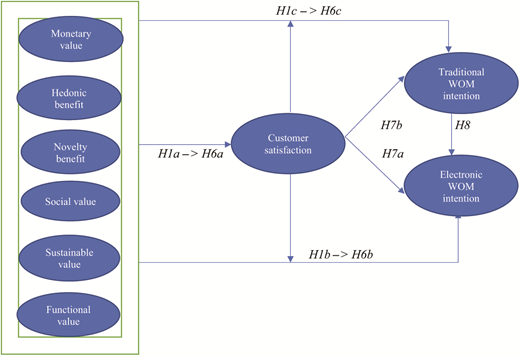
Perceived monetary benefit positively influences CS.
Perceived hedonic benefit positively influences CS.
Perceived novelty benefit positively influences CS.
Perceived social benefit positively affects CS.
Perceived sustainable value positively impacts CS.
Perceived functional value positively influences CS.
Customers’ perceived value and (e)word-of-mouth intention
As discussed previously, CS was found to have a mediating role in the relationship between customer-perceived value and loyalty. Specifically, El-Adly (2019) argued that CS fully mediates the relationship between hedonic value and customer loyalty. Pura (2005) documented that monetary value is one of the key determinants that impact loyalty, including WOM-generating intentions and purchase intentions. Tussyadiah and Zach (2017) confirmed that direct guest-host relations, which relate to the social appeal of accommodation-sharing platforms, consistently link to Airbnb guests’ higher rating scores, increase their satisfaction, and encourage them to leave a positive comments. In the context of green hotels, Wang and Jeong (2018) investigated whether the green image of hotels is positively related to consumers’ green trust and satisfaction, which consequently leads to their favourable WOM intentions. Wang et al. (2004) confirmed a significant influence of functional value on brand loyalty through CS, or tourist satisfaction was found as a mediator between novelty seeking and destination loyalty (Albaity and Melhem, 2017). Furthermore, based on the appraisal process, it is possible to hypothesize that Airbnb customers evaluate their stay experience (perceived value) and progress through further emotional responses (their satisfaction) to finally determine behavioural intentions (WOM intentions), as the below hypotheses:
Perceived monetary benefit influences customer (e)WOM intentions through the mediating role of CS.
Perceived hedonic benefit impacts customer (e)WOM intentions through the mediating role of CS.
Perceived novelty benefit impacts customer (e)WOM intentions through the mediating role of CS.
Perceived social benefit has an indirect impact on customer (e)WOM intentions via CS.
Perceived sustainable value has an indirect impact on customer (e)WOM intentions via CS.
Perceived functional value influences customer (e)WOM intentions through the mediating role of CS.
Customer satisfaction and (e)word-of-mouth behavioural intentions
In the hotel industry, a satisfactory experience in the attributes of service availability and surrounding conditions can lead customers to generate positive eWOM (Melissa and Zahra, 2015). Accommodation providers who identify their customers’ experiences would be able to enhance these moments, and customers are finally more likely to share their experiences to others (Cetin and Dincer, 2013). Jeong and Jang (2011) also affirmed the relationship between CS and willingness to provide positive eWOM on forums or travel review websites. Based on the literature review, the following hypotheses are proposed:
Overall, CS positively impacts customer (e)WOM intentions.
Traditional and electronic word-of-mouth intentions
Nguyen et al. (2019) investigated the impact of traditional and eWOM on travel intentions. Their findings confirmed the influence of traditional WOM in eWOM from the perspective of message receivers, as the source of traditional WOM is usually from customers’ internal networks, and thus, is considered more trustworthy and reliable. Does this association also hold true from the communicators’ perspective? This study shed light on this question by assuming that customers’ traditional WOM-giving intention also positively impacts their willingness to share experiences on online social networks, as customers are more likely to recommend high-quality products and services to friends or relatives. Thus, the hypothesis is defined as follows:
Traditional WOM intention is positively related to eWOM intention.
Guided by the appraisal–emotional–behavioural framework, this study evaluates the conceptual linkages illustrated in Figure 1.
Methodology
Questionnaire
The questionnaire started with an eligibility question to identify the right participants who had the experience of using Airbnb since 2019 and to collect information regarding this most recent stay. The following questions aimed to investigate Vietnamese consumers’ perceived value, satisfaction and (e)WOM intentions towards the Airbnb experience. The last part of the questionnaire included socio-demographic questions. The chosen constructs have been well investigated in the extant literature, which ensures the initial validity and reliability of the measurements, so only minor changes were required to better fit the context of this study. There were 26 items adapted from Tussyadiah (2015), Guttentag et al. (2018), Choe and Kim (2018), Lee and Kim (2018) and Wang and Jeong (2018) to measure the six dimensions of perceived value. CS was measured by four items adapted from Jiang et al. (2019). WOM and eWOM intentions were measured using six items from Walker (2001), Maxham and Netemeyer (2002) and Lee et al. (2010). The source of measurement items is summarized in Table 2. All items were evaluated on a five-point Likert-type scale (1 = strongly disagree to 5 = strongly agree). The questionnaire was interpreted from English to Vietnamese, and another expert supported translating it back to English.
Source of measurement items
| Measurement items | Sources |
|---|---|
| Monetary value | Tussyadiah (2015) Guttentag et al. (2018) Choe and Kim (2018) Lee and Kim (2018) Wang and Jeong (2018) |
| Good value for money | |
| Found good deals in Airbnb | |
| An economical alternatives to hotel | |
| Hedonic benefits | |
| An entertaining accommodation experience | |
| Made me feel happy | |
| Made me elated | |
| Social values | |
| Opportunities to interact more with others guests | |
| Good social opportunities with the host | |
| Feel accepted by others | |
| Leave a good impression on other people | |
| Improve the way I am perceived by others | |
| Novelty benefits | |
| Airbnb accommodation satisfied my curiosity | |
| Opportunities to learn about people, culture | |
| Less standardized accommodation environments | |
| Unique experiences | |
| Functional attributes | |
| Suitable for travel needs | |
| Meet my location needs | |
| Provide up-to-date facilities | |
| Homely feel | |
| Sustainable values | |
| An environmentally friendly accommodation | |
| More efficient resource use | |
| A sustainable way of lodging | |
| Promoting local culture | |
| Satisfactions | Jiang et al. (2019) |
| Satisfied with Airbnb stay | |
| Believe I did the right thing | |
| The value of Airbnb is high | |
| Overall, Airbnb met my expectation | |
| Traditional WOM intention | Walker (2001) Maxham and Netemeyer (2002) Lee et al. (2010) |
| Encourage my friends and relatives to choose Airbnb | |
| Say positive things about Airbnb | |
| Recommend others using Airbnb | |
| Electronic WOM intention | |
| Mention Airbnb to others through social networks | |
| Say positive online | |
| Provide more positive online information about Airbnb in effective way |
Sample and data collection
An online survey was applied to the target population of Vietnamese consumers who have stayed at Airbnb properties since 2019. To verify the clarity and the logical flow of the questionnaire, a pilot test was conducted with five participants. Based on the results of the pilot test, the questionnaire was better clarified and reduced the ambiguity of wording. The final questionnaire was administered on an online survey platform – Google doc – and later distributed to prospective participants using the convenience sampling method. The context of this study is to investigate the (e)WOM intentions of Vietnamese Airbnb guests who must be familiar with using a desktop computer, smartphone or other electronic device, so online data collection is considered as an appropriate option (Birinci et al., 2018). To effectively approach the target respondents, the questionnaire was posted on Facebook-based travel communities in Vietnam, such as Vietnamese backpackers, travelling to Europe and Airbnb hosts community, among others. Moreover, to approach more potential participants, the snowball sampling method was also exploited by which respondents supported to share the questionnaire link with other Vietnamese Airbnb users who met the criteria of this research. After two months of data collection (March–April), the questionnaire was accessed by 352 respondents. Airbnb non-users were asked with only one further question about their reasons for not using this platform.
Data analysis
Data analysis started with a data screening to check for respondents who met the research criteria. Descriptive statistics and the partial least squares structural equation modelling (PLS-SEM) approach were used to analyze the data. Descriptive data analysis was conducted with IBM SPSS 26 to profile the sample, which was followed by the use of SmartPLS 3.0 to test the conceptual model. PLS-SEM was chosen over covariance-based structural equation modelling due to its minimal requirements on measurement items, sample size and residual distributions. The model is confirmed free of common method bias, as the result of a full collinearity test revealed that all variance inflation factors with regard to latent factors were below 3.3 (Kock, 2015).
Results
Demographic profile
There were 352 participants, including 187 Airbnb non-users (53.1%) and 165 users (46.9%), taking part in the survey. The final subsample has 163 respondents after excluding two unusable questionnaires because the experience happened in 2018. In respect with the perceived constraints of using Airbnb amongst non-users, the vast majority of respondents are unfamiliar with the platform (63.1%) or with other unclarified reasons (31.1%), whereas only less than 10% of them stated that Airbnb is either lack of value or has lack of safety. This finding is supported by the Tussyadiah and Pesonen (2018) study, which identified consumers’ unfamiliarity with Airbnb as one of the major demotivation of purchase intentions.
The sample profile of Airbnb users is presented in Table 3. Results show that 63.8% of the sample was female, and 71.2% was single. The mean age of participants was approximately 30. More specifically, the largest percentage of respondents was aged 25–29 (33.1%), followed by the age range of 35–39 and 30–34. The majority of respondents had a bachelor’s degree or postgraduate (93.3%) and earned a monthly income which is above the national average (72.4%). Regarding the type of accommodation, 49.7% of the respondents rented an entire apartment, and 44.8% chose a private room.
The sample profile of Airbnb users
| Variable | Categories | % |
|---|---|---|
| Gender | Male | 36.2 |
| Female | 63.8 | |
| Age group (mean = 30.3) | ≤24 | 18.4 |
| 25–29 | 33.1 | |
| 30–34 | 20.2 | |
| 35–39 | 20.9 | |
| ≥40 | 7.4 | |
| Marital status | Single | 71.2 |
| Married | 24.5 | |
| Others | 4.3 | |
| Education | Highschool | 1.2 |
| College | 4.9 | |
| Bachelor | 63.2 | |
| Post graduated | 30.1 | |
| Others | 0.6 | |
| Income | Below the national average income | 16.6 |
| At national average income | 11.0 | |
| Above the national average income | 72.4 | |
| Type of room | Shared room with others | 3.1 |
| Private room | 44.8 | |
| Entire house | 49.7 | |
| Others | 2.4 |
Assessment of measurement model
The analysis started with the measurement model assessment to check the validity and reliability of the nine reflective constructs in the framework (Figure 1). Two items in “social benefit” (7, 13) and one item in “novelty benefit” (14) were removed because their factor loading was below the threshold value of 0.707 (Hair et al., 2019). The loading of all the retained items on its assigned construct were higher than 0.707. Moreover, the composite reliability were from 0.837 to 0.943 (exceed 0.7), and all rho_A values also exceeded the 0.70 threshold (as shown in Table 4), which confirms the adequacy of construct reliability (Hair et al., 2019).
Measurement model assessment
| Dimensions and items | Loading | CR | AVE | Mean|SD | t | p-value |
|---|---|---|---|---|---|---|
| Monetary value (ρA: 0.835) | 0.900 | 0.750 | ||||
| Good value for money | 0.880 | 3.681|0.757 | 43.421 | 0.000 | ||
| Found good deals in Airbnb | 0.869 | 3.865|0.803 | 38.929 | 0.000 | ||
| An economical alternative to hotels | 0.849 | 3.804|0.958 | 29.932 | 0.000 | ||
| Hedonic benefits (ρA: 0.818) | 0.885 | 0.720 | ||||
| An entertaining accommodation experience | 0.788 | 3.454|0.777 | 14.664 | 0.000 | ||
| Made me feel happy | 0.881 | 3.650|0.696 | 36.008 | 0.000 | ||
| Made me elated | 0.873 | 3.497|0.713 | 34.980 | 0.000 | ||
| Social values (ρA: 0.828) | 0.867 | 0.567 | ||||
| Opportunities to interact more with others guests | 0.702 | 3.049|0.932 | 12.268 | 0.000 | ||
| Good social opportunities with the host | 0.708 | 3.528|0.846 | 12.140 | 0.000 | ||
| Feel accepted by others | 0.842 | 3.423|0.813 | 25.240 | 0.000 | ||
| Leave a good impression on other people | 0.760 | 3.276|0.816 | 10.512 | 0.000 | ||
| Improve the way I am perceived by others | 0.745 | 2.957|0.922 | 12.181 | 0.000 | ||
| Novelty benefits (ρA: 0.773) | 0.837 | 0.562 | ||||
| Airbnb accommodation satisfied my curiosity | 0.705 | 3.528|0.809 | 12.768 | 0.000 | ||
| Opportunities to learn about people, culture | 0.714 | 3.718|0.825 | 11.090 | 0.000 | ||
| Less standardized accommodation environments | 0.759 | 3.804|0.805 | 15.129 | 0.000 | ||
| Unique experiences | 0.816 | 3.865|0.747 | 23.942 | 0.000 | ||
| Functional attributes (ρA: 0.810) | 0.872 | 0.630 | ||||
| Suitable for travel needs | 0.810 | 3.951|0.716 | 27.195 | 0.000 | ||
| Meet my location needs | 0.812 | 3.859|0.725 | 21.239 | 0.000 | ||
| Provide up-to-date facilities | 0.796 | 3.644|0.804 | 24.235 | 0.000 | ||
| Homely feel | 0.756 | 3.883|0.802 | 15.077 | 0.000 | ||
| Sustainable values (ρA: 0.834) | 0.884 | 0.656 | ||||
| An environmentally friendly accommodation | 0.834 | 3.417|0.813 | 27.248 | 0.000 | ||
| More efficient resource use | 0.795 | 3.748|0.778 | 22.334 | 0.000 | ||
| A sustainable way of lodging | 0.850 | 3.601|0.869 | 31.602 | 0.000 | ||
| Promoting local culture | 0.758 | 3.736|0.857 | 17.535 | 0.000 | ||
| Satisfactions (ρA: 0.908) | 0.935 | 0.783 | ||||
| Satisfied with Airbnb stay | 0.905 | 3.865|0.687 | 53.251 | 0.000 | ||
| Believe I did the right thing | 0.891 | 3.785|0.716 | 49.964 | 0.000 | ||
| The value of Airbnb is high | 0.853 | 3.601|0.714 | 33.794 | 0.000 | ||
| Overall, Airbnb met my expectation | 0.890 | 3.840|0.691 | 39.416 | 0.000 | ||
| Traditional WOM intention (ρA: 0.907) | 0.941 | 0.841 | ||||
| Encourage my friends and relatives to choose Airbnb | 0.900 | 3.779|0.814 | 45.880 | 0.000 | ||
| Say positive things about Airbnb | 0.912 | 3.791|0.722 | 38.746 | 0.000 | ||
| Recommend others using Airbnb | 0.939 | 3.810|0.723 | 84.826 | 0.000 | ||
| Electronic WOM intention (ρA: 0.911) | 0.943 | 0.847 | ||||
| Mention Airbnb to others through social networks | 0.909 | 3.356|0.834 | 52.342 | 0.000 | ||
| Say positive online | 0.918 | 3.393|0.854 | 46.989 | 0.000 | ||
| Provide more positive online information about Airbnb in effective way | 0.937 | 3.399|0.855 | 78.947 | 0.000 |
Table 4 also presents the average variance extracted (AVE) of each construct ranging from 0.562 to 0.847 (above 0.5). Moreover, factor loadings showed the significance of all indicators (p-values < 0.001), which provides stronger evidence for convergent validity. Discriminant validity was assessed through a comparison of the square root of each AVE and inter-construct correlation coefficients. The square root of AVE for each factor was higher than the correlations between each construct and other latent variables (Table 5). Additionally, the Heterotrait–Monotrait ratios (HTMT) for all constructs were lower than 0.85, which together confirm discriminant validity.
Correlations among latent variables
| Constructs | Customer satisfaction | Functional value | Hedonic benefit | Monetary benefit | Novelty benefit | Social benefit | Sustainable value | Traditional WOM | eWOM |
|---|---|---|---|---|---|---|---|---|---|
| Customer satisfaction | 0.885* | ||||||||
| Functional value | 0.667*|0.776** | 0.794* | |||||||
| Hedonic benefit | 0.434*|0.503** | 0.378*|0.469** | 0.848* | ||||||
| Monetary benefit | 0.587*|0.674** | 0.520*|0.629** | 0.250*|0.304** | 0.866* | |||||
| Novelty benefit | 0.512*|0.606** | 0.498*|0.607** | 0.395*|0.500** | 0.361*|0.442** | 0.750* | ||||
| Social benefit | 0.326*|0.368** | 0.337*|0.416** | 0.390*|0.468** | 0.275*|0.327** | 0.420*|0.551** | 0.753* | |||
| Sustainable value | 0.558*|0.637** | 0.615*|0.759** | 0.386*|0.480** | 0.479*|0.580** | 0.528*|0.668** | 0.411*|0.481** | 0.810* | ||
| Traditional WOM | 0.742*|0.818** | 0.603*|0.699** | 0.321*|0.374** | 0.558*|0.642** | 0.445*|0.525** | 0.276*|0.310** | 0.509*|0.582** | 0.917* | |
| eWOM | 0.591*|0.650** | 0.412*|0.479** | 0.347*|0.405** | 0.368*|0.420** | 0.424*|0.495** | 0.395*|0.446** | 0.464*|0.534** | 0.645*|0.709** | 0.920* |
Notes:
Diagonal values correspond to the squared root value of AVE for each latent variable to assess the Fornell–Larcker’s criterion.
HTMT values
Structural model assessment
The coefficients of determination (R2), effect size (f2) and predictive power (Q2) for the endogenous variables were evaluated to check the predictive power of the structural model. The coefficients of determination (R2) for endogenous constructs including eWOM, traditional WOM and CS were 0.504, 0.590 and 0.577, respectively, which indicate a large proportion of variance explained by its predictors. The f2 values of “functional value”, “monetary benefit” and “hedonic benefit” on CS were 0.148, 0.129 and 0.041, respectively. Additionally, Stone-Geisser’s Q2 value was computerized by running the blindfolding procedure with an omission distance D = 7 to evaluate the predictive relevance of the model. All the values from this test exceed zero (CS = 0.431, traditional WOM = 0.476, eWOM = 0.405), which confirms sufficient predictive power.
The path coefficients in the structural model are presented in Table 6. The bootstrapping procedure with 5,000 sub-samples was used to check the significance of the paths. Regarding the direct effects between perceived value, CS and (e)WOM intentions, the path from monetary, hedonic and functional attributes to satisfaction were significant. Moreover, customers who are satisfied with their experience at Airbnb accommodations will be more likely to engage in (e)WOM activities. Finally, traditional WOM intentions show a positive impact on Airbnb users’ eWOM-giving willingness. Therefore, hypotheses H1a, H2a, H6a, H7a, H7b and H8 were supported. In contrast, hypotheses H3a, H4a and H5a were not supported (p-value > 0.05), which can be further explained that novelty, sustainable value and social interaction were not significantly influencing CS.
Results of structural model relationships
| Total effect | Path coefficients | Indirect effects | ||||
|---|---|---|---|---|---|---|
| β | Bootstrap-t | β | Bootstrap-t | β | Bootstrap-t | |
| H1a: Monetary benefit → CS | 0.283 | 4.543*** | 0.283 | 4.543*** | ||
| H1b: Monetary benefit → eWOM | 0.123 | 1.513 | –0.080 | 1.064 | 0.203 | 3.615*** |
| H1c: Monetary benefit → Traditional WOM | 0.296 | 4.288*** | 0.146 | 2.188* | 0.151 | 3.933*** |
| H2a: Hedonic benefit → CS | 0.153 | 2.300* | 0.153 | 2.300* | ||
| H2b: Hedonic benefit → eWOM | 0.099 | 1.147 | 0.041 | 0.589 | 0.058 | 1.319 |
| H2c: Hedonic benefit → Traditional WOM | 0.051 | 0.732 | –0.030 | 0.469 | 0.081 | 2.208* |
| H3a: Novelty benefit → CS | 0.141 | 1.760 | 0.141 | 1.760 | ||
| H3b: Novelty benefit → eWOM | 0.139 | 1.329 | 0.052 | 0.729 | 0.087 | 1.449 |
| H3c: Novelty benefit → Traditional WOM | 0.117 | 1.249 | 0.042 | 0.581 | 0.075 | 1.744 |
| H4a: Social benefit → CS | −0.022 | 0.352 | −0.022 | 0.352 | ||
| H4b: Social benefit → eWOM | 0.165 | 1.961* | 0.180 | 2.509* | –0.015 | 0.363 |
| H4c: Social benefit → Traditional WOM | –0.022 | 0.293 | −0.010 | 0.142 | –0.012 | 0.352 |
| H5a: Sustainable value → CS | 0.084 | 1.106 | 0.084 | 1.106 | ||
| H5b: Sustainable value → eWOM | 0.179 | 1.546 | 0.113 | 1.079 | 0.066 | 1.087 |
| H5c: Sustainable value → Traditional WOM | 0.100 | 0.966 | 0.055 | 0.581 | 0.045 | 1.070 |
| H6a: Functional value → CS | 0.348 | 4.951*** | 0.348 | 4.951*** | ||
| H6b: Functional value → eWOM | 0.075 | 0.728 | –0.152 | 1.560 | 0.227 | 3.916*** |
| H6c: Functional value → Traditional WOM | 0.317 | 3.401*** | 0.131 | 1.410 | 0.186 | 3.521*** |
| H7a: CS → eWOM | 0.475 | 5.080*** | 0.223 | 2.406* | 0.251 | 3.093** |
| H7b: CS → Traditional WOM | 0.533 | 6.276*** | 0.533 | 6.276*** | ||
| H8: Traditional WOM → eWOM | 0.471 | 3.945*** | 0.471 | 3.945*** | ||
Notes:
p-value < 0.001;
p-value < 0.01;
p-value < 0.05
According to Carrión et al. (2017), a significant indirect effect is the only prerequisite to establish a mediation effect. As we can see in Table 6, regarding the hypothesized indirect effects in this study, monetary benefit and functional attributes show their significant influences on both traditional and eWOM intentions through the intervening role of CS (p-value < 0.05). While CS partially mediates the relationship between customers’ perceived monetary value and their traditional WOM, it fully mediates the effect of functional attributes on Airbnb consumers’ behavioural intentions. Additionally, perceived hedonic benefit also shows its indirect impact on traditional WOM intention through CS (p-value < 0.05). Thus, H1b, H1c, H2c, H6b and H6c were supported. Nevertheless, CS does not interfere with the associations among hedonic benefit and eWOM or the relationships between novelty, social, sustainable value and customer behaviours, which reject H2b, H3b, H3c, H4b, H4c, H5b and H5c. Interestingly, though testing the mediating role of traditional WOM in the relationship between CS and eWOM is not in this research scope, the findings reveal that traditional WOM exerts a significant mediation effect in this association.
Discussion
Conclusion
Adopting the framework of cognitive appraisal–emotional response–coping behaviour theory, this study developed the hypothesized model to examine the relationships between six dimensions of customers’ perceived value, satisfaction and their willingness to traditional and eWOM activity in the context of Vietnamese Airbnb users. More specifically, this paper aims to identify the mediating role of CS in Airbnb’s perceived value – (e)WOM intentions relationship. Additionally, this study offers the first attempt in investigating the significant impact of traditional WOM intention on eWOM intention from the perspective of a message communicator. Regarding the existing sharing economy-related studies, there exist contrasting findings about customers’ motives in using Airbnb and how these motives impact their satisfaction and behavioural intentions. Hence, this study adds value to the extant literature by revealing a reasonable explanation of these contradictory findings and provides an empirically comprehensive understanding of Airbnb users in a fast-growing market in South East Asia (Vietnam).
Theoretical contributions
The first insights reveal the adverse findings regarding the relationship between Airbnb customers’ perceived value and satisfaction. The results of this study suggest that monetary value and functional attributes serve as the antecedents of Vietnamese customers’ satisfaction with Airbnb, in which functional value is the most important determinant. Moreover, Vietnamese customers also show their satisfaction when they perceive their stay at Airbnb positively in terms of enjoyment. The results are totally in line with findings from recent research, which showed that hedonic value and utilitarian value significantly influence CS (Li et al., 2021) or customers’ participation intention in sharing economy-based accommodation (Guo et al., 2020). Thus, this study once again confirms the significant importance of economic gains, functional attributes and enjoyment of Airbnb accommodation to customer experience.
The path coefficient between sustainability and satisfaction is not significant, which means the perceived value of a sustainable stay at Airbnb has no effect on increasing CS. This finding is consistent with prior research, which noticed the concern with sustainable tourism does not significantly impact tourist’s responsible behaviour (Zgolli and Zmed, 2018). Surprisingly, social benefits and novelty are not pronounced in gaining Vietnamese Airbnb customer’s satisfaction. These findings contradict extant studies which commonly confirmed the role of social interaction and novelty on guest satisfaction towards Airbnb (Tussyadiah and Zach, 2017; Tussyadhiad, 2016). However, the insignificant relationship between social interaction and CS is supported by findings from the most recent studies, which found that social value does not have an affect on Airbnb consumers’ satisfaction (Sthapit et al., 2020; Bin Mahdi and Alhammah, 2021). The absence of this effect can be further justified in two following arguments relating to the specific context of the present study. Firstly, the data was collected during the lockdown in Vietnam, and the government was imposing aggressive social distancing measures, which might impact customer’s perception and expectation towards social interaction. Secondly, according to the room type, almost half of respondents rented entire apartments; thus, they mainly communicate or interact with Airbnb hosts online. These online interactions might not be considered close and strong enough to satisfy guests’ needs in interacting or building mutual relationships with hosts. With respect to the insignificant relationship between novelty and CS, the recent study from Sthapit et al. (2021) also unveiled that perceived authenticity does not always lead to Airbnb customers’ perception of enjoyment. This finding provides support for the dissimilar impact of novelty-seeking motivation on Airbnb customers’ emotions and behavioural intentions. Therefore, the role of social interaction or novelty values in inducing CS should be simultaneously taken into consideration of cultural differences or variations across types of accommodation in future studies (Ruan, 2020).
Secondly, regarding previous research about customer loyalty, the majority of articles studied Airbnb customer’s repurchase intentions (Liang et al., 2018; Möhlmann, 2015; Wang and Jeong, 2018). This study, however, examines the determinants of another loyalty’s perspective: traditional and eWOM giving intentions, which extends the understanding of the link between consumers’ perception of Airbnb value, satisfaction, and willingness in spreading (e)WOM. To encourage customers sharing about Airbnb with their acquaintances or leaving a comment on a social platform, CS plays an important role with a significant direct effect on (e)WOM intentions. This coincides with findings from prior research, which found an association between satisfaction and positive (e)WOM intentions (Maxham and Netemeyer, 2002; Jeong and Jang, 2011; Melissa and Zahra, 2015). Additionally, CS also plays an intervening role between the monetary value, functional attributes and (e)WOM intentions or the influence of hedonic benefit on traditional WOM. The findings show that Vietnamese Airbnb users are more willing to recommend the platform services to their friends and family or leave positive feedback online when they perceive the functional attributes, financial benefit or enjoyment of Airbnb accommodation, with their satisfaction as a mediator.
Thirdly, a distinction is made between traditional WOM and eWOM intentions. Interestingly, the current study showed that Vietnamese customers who share their Airbnb experience with acquaintances are more likely to recommend the platform to others, either directly online or through social network outlets. This finding has not been discussed up to date, and thus, contributes to the existing literature by acknowledging the significant direct and mediating effect of traditional WOM on eWOM intention. Sharing the consumption experience electronically usually requires more effort and time from customers, especially those who do not frequently engage in technology or social media platforms. Thus, Vietnamese Airbnb customers are only willing to leave feedback online when they are extremely satisfied with their stay at Airbnb accommodations and eager to recommend the platform to their close networks.
Practical implications
Understanding relationships between Vietnamese customer’s perception of Airbnb benefits, satisfaction and WOM intentions infers significant implications for Airbnb platforms and service providers. Vietnamese customers appreciate the monetary, functional and emotional values of Airbnb accommodations, which, in turn, act as the antecedents of their satisfaction and loyalty. Hence, promotions or price discounts should be applied to attract consumers who are described as price-sensitive consumers. In terms of hedonic benefits, providing an enjoyable stay with a themed or nicely decorated accommodation is necessary to achieve CS. Airbnb hosts can also go the extra-mile service to surprise guests with welcome letters, snacks or complimentary drinks.
Functional value plays the most important role in satisfying Vietnamese Airbnb customers and indirectly influences customers’ (e)WOM intentions. Providing clean accommodation with well-equipped facilities in an accessible location should be the utmost priority for Airbnb hosts who are targeting the domestic market. These functional attributes should be highlighted and conveyed effectively in the advertising strategies and Airbnb listing information. The insignificant impact of social interaction on Vietnamese Airbnb customers’ satisfaction or their subsequent behavioural intentions provokes a need for Airbnb hosts to have more pleasing interactive communications with guests, even though they book an entire apartment. Prompt and supportive responses to Airbnb guests’ requests before their stay, physically greeting guests during the check-in/check-out and follow-up conversations after their stay, will definitely enhance CS by increasing the perception of social interaction. Regarding the practical implications for Airbnb management, the platform should also modify the appropriate standards to reward outstanding hosts according to customers’ perceived value in a specific destination. The updated standards can serve as guidelines to encourage Airbnb hosts offering the expected benefits to target customers. Finally, Vietnamese customers who share their Airbnb experience with acquaintances are also more likely to recommend the platform to others electronically. Thus, Airbnb platforms or Airbnb hosts can also motivate existing customers sharing their whole stay experience with their family and friends with monetary or non-monetary incentives.
Limitations and future research recommendation
Despite the theoretical and managerial contribution, this paper is not free of limitations. Firstly, the present study focused on Vietnamese Airbnb users observed through a non-probabilistic sample with a small size, which might impact the generalization of the findings. Secondly, though the majority of respondent’s Airbnb experiences precisely happened before the pandemic, the primary data were collected during the COVID-19 outbreak, which might affect their reflected perception and satisfaction. Thus, a study with Vietnamese Airbnb consumers’ experience, which happened during the crisis, should be replicated to compare if there is any peculiarity related to this global pandemic and Vietnamese Airbnb consumers’ perceptions and behavioural intentions. Thirdly, self-directed or social benefits are also major determinants that drive customers to (e)WOM giving intentions. Finally, the tripographics or types of accommodation can also moderate the strength of the relationships between customers’ perceived value and its outcomes; hence, an investigation into the moderating role of these factors is required to extend the findings of this study. These limitations leave a paucity for future research, which aims to expand more factors and diverse sample groups to include consumers from different countries, and test different influential factors in customers’ (e)WOM intentions.
Luis N. Pereira acknowledges financial support from the Research Centre for Tourism, Sustainability and Well-being (CinTurs) [FCT Grant Number UIDP/SOC/04020/2020].

